


Nazism

Encyclopedia
Nazism, the common short form name of National Socialism (German
: Nationalsozialismus) was the ideology
and practice of the Nazi Party and of Nazi Germany
. It is a unique variety of fascism
that incorporates biological racism
and antisemitism.
Nazism was founded out of elements of the far-right racist
völkisch
German nationalist
movement and the violent anti-communist
Freikorps paramilitary
culture that fought against the uprisings of communist revolutionaries
in post-World War I
Germany
. The ideology was developed first by Anton Drexler
and then Adolf Hitler
as a means to draw workers away from communism
and into völkisch nationalism. Initially Nazi political strategy focused on anti-big business
, anti-bourgeois
, and anti-capitalist
rhetoric, though such aspects were later downplayed in the 1930s to gain the support from industrial owners for the Nazis, focus was shifted to anti-Semitic and anti-Marxist themes.
Nazism advocated the supremacy of an Aryan
master race
over all other races. Nazis viewed the progress of humanity as depending on the Aryans and believed that it could maintain its dominance only if it retained its purity and instinct for self-preservation. They claimed that Jews
were the greatest threat to the Aryan race. They considered Jews a parasitic
race that attached itself to various ideologies and movements to secure its self-preservation, such as capitalism
, democracy
, the Enlightenment
, industrialisation
, liberalism
, Marxism
, parliamentary politics
, and trade unionism
. To maintain the purity and strength of the Aryan race, the Nazis sought to exterminate
or impose exclusionary segregation upon "degenerate
" and "asocial
" groups that included: Jews, homosexuals
, Romani, blacks
, the physically
and mentally disabled
, Jehovah's Witnesses
and political opponents.
Nazism promoted an economic system that supported a stratified
economy with classes based on merit and talent while rejecting egalitarianism
, retaining private property
, freedom of contract, and promoted the creation of national solidarity that would transcend class distinction. It promoted the creation of a community of common interest between managers and employees in industry
where a factory leader would be selected to act in coordination with a council of factory members, though these members would have to obey the Führerprinzip
of the factory leader. The economy was to be subordinate to the goals of the political leadership of the state.
Nazism was officially presented by Hitler and other proponents as being neither left-wing
nor right-wing
but a politically syncretic
ideology. Hitler in Mein Kampf
directly attacked both left-wing and right-wing politics in Germany, such as saying: "Today our left-wing politicians in particular are constantly insisting that their craven-hearted and obsequious foreign policy necessarily results from the disarmament of Germany, whereas the truth is that this is the policy of traitors [...] But the politicians of the Right deserve exactly the same reproach. It was through their miserable cowardice that those ruffians of Jews who came into power in 1918 were able to rob the nation of its arms." However a majority of scholars identify Nazism in practice as being a far right form of politics.
There were factions in the Nazi Party, including a conservative faction and a radical faction. The conservative Nazi Hermann Göring
urged Hitler to conciliate with capitalists
and reactionaries
. Other prominent conservative Nazis included Heinrich Himmler
, who was more conservative than Göring; and Reinhard Heydrich
. The radical Nazi Joseph Goebbels
hated capitalism, viewing it has having Jews at its core and stressed the need for the party to emphasize a both a proletarian
and national character, these views were shared by Otto Strasser
who later left the Nazi Party in the belief that Hitler had betrayed the party's socialist goals by endorsing capitalism. Large segments of the Party staunchly supported its official socialist, revolutionary, and anti-capitalist positions and expected both a social and economic revolution upon the Party gaining power in Germany in 1933. The leader of the Party's paramilitary organization the SA, Ernst Röhm
supported a "second revolution" (the "first revolution" being the Nazis' seizure of power) that would entrench the Party's official socialist program and demanded the replacement of the nonpolitical German army with a Nazi-led army. Of the million members of the SA, many were committed to the Party's official socialist program. Hitler himself took an in-between position in that he allowed capitalist private enterprise to exist as long as it obeyed the goals of the Nazi state but if a capitalist private enterprise resisted Nazi goals, he smashed it; he accepted private property; and Nazis engaged in street fighting with various socialist groups.
, nineteenth-century idealism
, and a eugenic
interpretation of Friedrich Nietzsche
's concepts of "breeding upwards" — towards the Übermensch
("Superman"). Such ideas, as espoused by the Ariosophical
Germanenorden
(German Order) and the Thule Society
much influenced Adolf Hitler
's world-view.
Phillip Wayne Powell writes that "in the fifteenth and early sixteenth centuries, a powerful surge of German patriotism was stimulated by the disdain of Italians for German cultural inferiority and barbarism, which led to a counter-attempt, by German humanists, to laud German qualities." M.W. Fodor wrote in The Nation in 1936, "No race has suffered so much from an inferiority complex as has the German. National Socialism was a kind of Coué method
of converting the inferiority complex, at least temporarily, into a feeling of superiority".
Among the most significant ideological influence on the Nazis came from German nationalist Johann Gottlieb Fichte
, whose works Hitler read, and who was recognized by other Nazi members including Dietrich Eckart
and Arnold Fanck
. In Speeches to the German Nation (1808), written amid Napoleonic France's occupation of Berlin, Fichte called for a German national revolution against the French occupiers, making passionate public speeches, arming his students for battle against the French, and stressing the need of the deed of action by the German nation to free itself.
Fichte's nationalism was populist and opposed to traditional elites, and spoke of the need of a "People's War" (Volkskrieg), putting forward concepts much like those the Nazis adopted. Fichte promoted German exceptionalism
and stressed the need for the German nation to be purified. This priority included purging the German language of French words, a policy that the Nazis undertook upon rising to power. Fichte was anti-Semitic and accused Jews
in Germany of having been, and inevitably continuing to be a "state within a state" in Germany that was a threat to German national unity. Fichte promoted two options to address this: the first was the creation of a Jewish state in Palestine
to impel the Jews to leave Europe. The other option was violence against Jews, saying that the goal would be "To cut off all their heads in one night, and set new ones on their shoulders, which should not contain a single Jewish idea".
The concept of the Aryan race
that the Nazis used stems from racial theories asserting that Europeans are the descendants of Indo-Iranian settlers, people of ancient India and ancient Persia. Proponents of this theory based their assertion on the similarity of European words and their meaning to those of Indo-Iranian languages. Johann Gottfried Herder
argued that the Germanic peoples held close racial connections with the ancient Indians and ancient Persians, who he claimed were advanced peoples possessing a great capacity for wisdom, nobility, restraint, and science. Contemporaries of Herder utilized the concept of the Aryan race to draw a distinction between what they deemed "high and noble" Aryan culture versus that of "parasitic" Semitic culture.
Notions of white supremacy
and Aryan racial superiority combined in the nineteenth century, with white supremacists maintaining that white people
were members of an Aryan "master race" that is superior to all other races, and particularly superior to the Semitic race, which they associated with "cultural sterility". Arthur de Gobineau
, a French racial theorist and aristocrat, blamed the fall of the ancien régime in France on racial degeneracy caused by racial intermixing, which he argued destroyed the purity of the Aryan race. Gobineau's theories, which attracted a strong following in Germany, emphasized the existence of an irreconcilable polarity
between Aryan and Jewish cultures.
Aryan mysticism
claimed that Christianity
originated in Aryan religious tradition and that Jews had usurped the legend from Aryans. Houston Stewart Chamberlain
, an English proponent of racial theory, supported notions of Germanic supremacy and anti-Semitism in Germany. Chamberlain's work, Foundations of the Nineteenth Century (1899) praised Germanic peoples for their creativity and idealism while asserting that the Germanic spirit was threatened by a "Jewish" spirit of selfishness and materialism
. Chamberlain used his thesis to promote monarchical
conservatism
while denouncing democracy
, liberalism
, and socialism
. The book became popular, especially in Germany. Chamberlain stressed the need of a nation to maintain racial purity in order to prevent degeneration, and argued that racial intermingling with Jews should never be permitted. In 1923, Chamberlain met Hitler, whom he admired as a leader of the rebirth of the free spirit.
Nazism's racial policy positions were also developed from the views of important biologists of the 19th century, including French biologist
Jean-Baptiste Lamarck
and the founder of genetics
, German botanist Gregor Mendel
. Lamarckism
, an evolutionary theory related to Darwinism
, was an important influence on Nazism. In particular the variant developed by Ernst Haeckel
, was utilized by the Nazis. Unlike Darwinian theory, Lamarckian theory officially ranked races in a hierarchy of evolution from apes
while original Darwinian theory did not grade races in a hierarchy of higher or lower evolution from apes, simply categorizing humans as a whole of all as having progressed in evolution from apes. Many Lamarckians viewed "lower" races as having been exposed to debilitating conditions for too long for any significant "improvement" of their condition in the near future. Haeckel utilized Lamarckian theory to describe the existence of interracial struggle and put races on a hierarchy of evolution, ranging from being wholly human to subhuman
.
Mendelism
was supported by the Nazis and also mainstream eugenics proponents at the time were Mendelian. Mendelian theory of inheritance declared that genetic traits and attributes were passed from one generation to another. Proponents of eugenics used Mendelian inheritance theory to demonstrate the transfer of biological illness and impairments from parents to children, including mental disability; others also utilized Mendelian theory to demonstrate the inheritance of social traits, with racialists claiming a racial nature of certain general traits such as inventiveness or criminal behaviour.
Beginning in the 1870s, German völkisch nationalism
began to adopt anti-Semitic and racist themes and was adopted by a number of radical right political movements. Völkisch nationalism denounced soulless materialism
, individualism
, and secularized urban
industrial society, while advocating a "superior" society based on ethnic German "folk" culture and way of life, based upon German "blood". It also denounced foreigners, foreign ideas and declared that Jews, national minorities, Catholics, and Freemasons
were "traitors to the nation" and unworthy of inclusion in the German Volk. Völkisch nationalism saw the world in terms of natural law
and romanticism
, viewed societies as organic, it extolled the virtues of rural
life, condemned the neglect of tradition and decay of morals, denounced the destruction of the natural environment, and condemned "cosmopolitan" cultures such as Jews and Romani.
Prominent historical figures of such völkisch nationalism include Eugen Diederichs
, Paul de Lagarde
, and Julius Langbehn
. Radical anti-Semitism was promoted by these figures. De Lagarde called the Jews a "bacillus
, the carrier of decay...who pollute every national culture...and destroy all faith with their materialistic liberalism" and he called for the extermination of the Jews. Langbehn called for a war of annihilation of the Jews and Langbehn's genocidal policies were published by the Nazis and given to soldiers on the front during World War II
.
However during the era of Imperial Germany, völkisch nationalism was overshadowed by both Prussian patriotism and the federalist tradition of various states within Imperial Germany. The events of World War I including the end of the Prussian monarchy in Germany, resulted in a surge of revolutionary völkisch nationalism. The Nazis supported such revolutionary völkisch nationalist policies.
The Protocols of the Elders of Zion
(1912) was an anti-Semitic forgery created by police of the Russian Empire. Anti-Semites believed it was real and the Protocol surged in popularity after World War I. The Protocols claimed that there was an international Jewish conspiracy to take over the world. Hitler had been introduced to The Protocols by Alfred Rosenberg
, and from 1920 onward Hitler focused his attacks on claiming that Judaism and Marxism were directly connected and that Jews and Bolshevik
s were one and the same and that Marxism was a Jewish ideology. Hitler believed that The Protocols were authentic.
The Nazis claimed that their ideology was influenced by the leadership and policies of German Chancellor
Otto von Bismarck
, the founder of the German Empire
. The Nazis declared that they were dedicated to continuing the process of creating a unified German nation state that Bismarck had begun and desired to achieve. The Nazis claimed that Bismarck was unable to complete German national unification because of Jewish infiltration of the German parliament, and that their abolition of parliament ended the obstacle to unification. While Hitler was supportive of Bismarck's creation of the German Empire, he was critical of Bismarck's moderate domestic policies. On the issue of Bismarck's support of a Kleindeutschland ("Lesser Germany", excluding Austria) versus the pan-German Großdeutschland ("Greater Germany") of the Nazis, Hitler claimed that Bismarck's attainment of Kleindeutschland was the "highest achievement" that Bismarck could have achieved "within the limits possible of that time". In Mein Kampf
(My Struggle), Hitler presented himself as a "second Bismarck".
During World War I, sociologist Johann Plenge
spoke of the rise of a "National Socialism" in Germany within what he termed the "ideas of 1914" that were a declaration of war against the "ideas of 1789"—the French Revolution
. According to Plenge, the "ideas of 1789" that included rights of man, democracy, individualism and liberalism were being rejected in favour of "the ideas of 1914" that included "German values" of duty, discipline, law, and order. Plenge believed that ethnic solidarity (volksgemeinschaft
) would replace class division and that "racial comrades" would unite to create a socialist society in the struggle of "proletarian" Germany against "capitalist" Britain. He believed that the "Spirit of 1914" manifested itself in the concept of the "People's League of National Socialism". This National Socialism was a form of state socialism that rejected the "idea of boundless freedom" and promoted an economy that would serve the whole of Germany under the leadership of the state. This National Socialism was opposed to capitalism due to the components that were against "the national interest" of Germany, but insisted that National Socialism would strive for greater efficiency in the economy. Plenge advocated an authoritarian rational ruling elite to develop National Socialism through a hierarchical technocratic state.
Plenge's arguments at the time were recognized by a diverse group of people as an important argument in favour of social justice promoted within a strong state, including: right-wing Social Democrats Konrad Haenisch
, Heinrich Cunow
, Paul Lench and Kurt Schumacher
; Conservative Revolutionaries including Arthur Moeller van den Bruck
and Max Hildebert Boehm; and Nazis including Ernst Krieck
, Gottfried Feder
and Eduard Stadtler
. Plenge's ideas formed the basis of Nazism.
Oswald Spengler
, a German cultural philosopher, was a major influence on Nazism, although after 1933 Spengler became alienated from Nazism and later condemned by the Nazis for criticizing Hitler. Spengler's views were also popular amongst Italian Fascists
, including Benito Mussolini
. Spengler's book The Decline of the West
(1918) written during the final months of World War I
in which he addressed the claim of decadence
of modern European civilization that he claimed was caused by atomizing and irreligious individualization and cosmopolitanism
. In Decline of the West, Spengler's major thesis was that a law of historical development of cultures existed involving a cycle of birth, maturity, aging, and death when it reaches its final form of civilization. Upon reaching the point of civilization, a culture will lose its creative capacity and succumb to decadence
until the emergence of "barbarian
s" create a new epoch. Spengler considered the Western world
as having succumbed to decadence of intellect, money, cosmopolitan
urban life, irreligious life, atomized individualization
, and the end of biological fertility as well as "spiritual" fertility. He believed that the "young" German nation as an imperial power would inherit the legacy of Ancient Rome
and lead a restoration of value in "blood" and instinct, while the ideals of rationalism would be revealed as absurd.
In Preussentum und Sozialismus
("Prussiandom and Socialism", 1919), Spengler described socialism outside of a class conflict
perspective and said "The meaning of socialism is that life is controlled not by the opposition between rich and poor, but by the rank that achievement and talent bestow. That is our freedom, freedom from the economic despotism of the individual." Spengler utilized the anti-English ideas addressed by Plenge and Sombart during World War I
that condemned English liberalism and English parliamentarianism while advocating a national socialism that was free from Marxism
that would connect the individual to the state through corporative
organization. Spengler claimed that socialistic Prussian characteristics existed across Germany that included creativity, discipline, concern for the greater good, productivity, and self-sacrifice. Spengler's definition of socialism did not advocate change in property relations.
Spengler denounced Marxism
for seeking to train the proletariat to "expropriate the expropriator", the capitalist, and then to let them live a life of leisure on this expropriation. He claimed that "Marxism is the capitalism of the working class" and not true socialism. True socialism according to Spengler would be in the form of corporatism
, stating that "local corporate bodies organized according to the importance of each occupation to the people as a whole; higher representation in stages up to a supreme council of the state; mandates revocable at any time; no organized parties, no professional politicians, no periodic elections." In Preussentum und Sozialismus Spengler prescribed war as a necessity, saying "War is the eternal form of higher human existence and states exist for war: they are the expression of the will to war." Spengler's conception of socialism and a number of his political views were shared by the Nazis as well as the Conservative Revolutionary movement
.
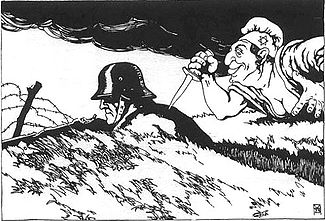 On 5 January 1919, the locksmith Anton Drexler
, and five other men, founded the Deutsche Arbeiterpartei (DAP — German Workers' Party
), the predecessor of the Nationalsozialistische Deutsche Arbeiterpartei (NSDAP — National Socialist German Workers' Party). In July 1919, the Reichswehr
intelligence department despatched Corporal Adolf Hitler
, as a Verbindungsmann (police spy) to infiltrate and subvert the DAP. His oratory so impressed the DAP members, they asked him join the party, and, in September 1919, the police spy Hitler became the party's propagandist
. On 24 February 1920, the DAP was renamed the National Socialist German Workers' Party, against Hitler's preferred "Social Revolutionary Party" name. Later, in consolidating his control of the NSDAP, Hitler ousted Drexler from the party and assumed leadership on 29 July 1921.
The post-war crises of Weimar Germany (1919–33) consolidated Nazism as an ideology
: military defeat in the First World War (1914–18), capitulation with the Treaty of Versailles
, economic depression, and the consequent societal instability. In exploiting, and excusing, the military defeat, Nazism proffered the political Dolchstosslegende
("Legend of the Dagger-stab in the Back") claiming that the Imperial German war effort was internally sabotaged, by Jews, socialists
, and Bolsheviks. Proposing that, because the Reichwehrs defeat did not occur in Germany, the sabotage included a lack of patriotism among their political antagonists, specifically the Social Democrats and the Ebert Government, whom the Nazis accused of treason.
Using the "stab in the back" legend, the Nazis accused German Jews, and other populaces it considered non-German, of possessing extra-national loyalties, thereby exacerbating German anti-semitism about the Judenfrage
(the Jewish Question), the perennial far right
political canard popular when the ethnic Völkisch movement
and their politics of Romantic nationalism
for establishing a Großdeutschland were strong. The seminal ideas of Nazism originated in the German cultural past of the Völkisch (folk) movement and the superstitions of Ariosophy
, an occultism that proposed the Germanic peoples
as the purest examples of the Aryan race
, whose cultures feature runic symbols and the swastika
. From among the Ariosophs, only the Thule-Gesellschaft (Thule Society) in Munich, features in the origin of Nazism; they sponsored the DAP.
Fascism
was a major influence on Nazism. The seizure of power by Italian Fascist leader Benito Mussolini in the March on Rome
in 1922 drew admiration by Hitler who less than a month after the March had begun to model himself and the Nazi Party upon Mussolini and the Fascists. After the March on Rome, Hitler presented the Nazis as a German fascism. The Nazis attempted a "March on Berlin" modelled upon the March on Rome that resulted in the failed Beer Hall Putsch
in Munich
in November 1923. Although Hitler strongly admired Mussolini and fascism, other Nazis — especially more radical Nazis such as Gregor Strasser
, Joseph Goebbels and Heinrich Himmler
— rejected Italian Fascism, accusing it of being too conservative or capitalist. Alfred Rosenberg
condemned Italian Fascism for being racially confused and having influences from philo-Semitism. Strasser criticized the policy of Führerprinzip
as being created by Mussolini, and considered its presence in Nazism as a foreign import. Throughout the relationship between Nazi Germany and Fascist Italy, a number of lower-ranking Nazis scornfully viewed fascism as a conservative movement that lacked a full revolutionary potential.
, for defending Germany and the Volksdeutsche
(ethnic Germans), against communism
and Jewish subversion. To the end of establishing Großdeutschland (Greater Germany), the German peoples must acquire Lebensraum
(living space) from Russia.
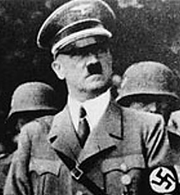 The original National Socialists, the 1919 German Workers' Party
(DAP) said there would be no program binding upon them, thus rejecting any Weltanschauung
. Nonetheless, when Adolf Hitler
assumed command of its successor, the Nazi Party, political substance of Nazism concorded with his political beliefs
— man and idea as political entity, the Führer.
Hitler had concluded that ethnic and linguistic
diversity had weakened the Austro–Hungarian Empire, and had resulted in contemporary political dissent. He disliked democracy
because it allowed political power to ethnic minorities and to liberal political parties, who "weakened and destabilized" the empire with internal division. Hitler's cultural, historical, and political beliefs were tempered in combat during World War I
; by Germany's loss of the war, and by the Bolsheviks' successful October Revolution
of 1917 that installed Marxist communism
in Russia. From 1920 to 1923, Hitler formulated his ideology, then published it in 1925–26, as Mein Kampf
, a two-volume, biography and political letter-of-intent.
During the 1920s and 1930s, Nazism was ideologically heterogeneous, comprising two sub-ideologies, those of Otto Strasser
and of Hitler. As leftists, the Strasserites fell afoul of Hitler, who expelled Otto Strasser from the Nazi Party when he failed to establish the Black Front
, an oppositional, anti-capitalist bloc, in 1930. Though Hitler for "tactical" reasons had rhetorically declared a 1920 party platform with socialist
platitudes "unshakable," actually "many paragraphs of the party program were obviously merely a demagogic appeal to the mood of the lower classes at a time when they were in bad straits and were sympathetic to radical and even socialist slogans...Point 11, for example...Point 12...nationalization...Point 16...communalization.... put in at the insistence of Drexler and Feder, who apparently really believed in the 'socialism' of National Socialism." In actual practice, such points were mere slogans, "most of them forgotten by the time the party came to power.... the Nazi leader himself was later to be embarrassed when reminded of some of them." Historian Conan Fischer argues that the Nazis were sincere in their use of the adjective socialist, which the saw as inseparable from the adjective national, and meant it as a socialism of the master race
, rather than the socialism of the "underprivileged and oppressed seeking justice and equal rights."
The conflicting philosophies of leading Nazis of the early years were visible at times: in 1930 "Strasser, Feder and Frick introduced a bill in the Reichstag
on behalf of the Nazi Party calling for (interest rate limits, expropriation
of large bank-holdings)... and the nationalization of the big banks.... Hitler was horrified; this was not only Bolshevism
, it was financial suicide for the party." Many Strasserites who remained in the Nazi Party, mostly in the Sturmabteilung
(SA), were assassinated in the Night of the Long Knives
purge.
was based upon the belief that great nations grow from military power, and maintain order in the world. The Nazi Party exploited irredentist
and revanchist
sentiments, and cultural aversions to aspects of Modernism
, (despite the Reich embracing modernism by their admiration for engine power), thus conflating (fusing) nationalism and militarism into the ultra-nationalism necessary to establishing Großdeutschland (Greater Germany).
young people:
Despite many working-class supporters and members, the appeal of the Nazi Party to the working class was neither true nor effective, because its politics mostly appealed to the middle class
, as a stabilizing, pro-business political party, not a revolutionary workers' party. Moreover, the financial collapse of the white collar
middle-class of the 1920s figures much in their strong support of Nazism, thus the great percentage of declared middle-class support for the Nazis. In the poor country that was the Weimar Republic
of the early 1930s, the Nazi Party realised their socialist policies with food and shelter for the unemployed and the homeless — later recruited to the Brownshirt Sturmabteilung
(SA — Storm Detachment).
" (Children, Kitchen, Church). Many women voted in favour of the Nazi Party, but once in power, the party introduced legislation that limited women's legal rights. Women's organizations and associations that had been permitted before the Nazi regime were banned, and the Nazi Party set up its own women's organizations.
Some women were active participants in Nazi war crime
s, including the operation of concentration camps, and were convicted after World War II
. Gertrud Scholtz-Klink
had much influence as the head of the NS-Frauenschaft, the women's wing of the Nazi Party. Magda Goebbels
, the wife of Minister of Propaganda Josef Goebbels, was on friendly terms with Adolf Hitler
and was known as "the First Lady of the Reich". She often attended Nazi Party events, providing a feminine face to the regime.
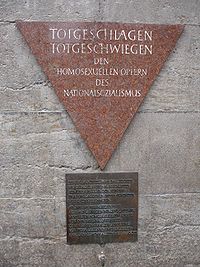 Initially, Adolf Hitler had protected Ernst Röhm
— the homosexual leader of the Sturmabteilung
(SA) — from Nazis who considered his homosexuality a violation of the Party's anti-homosexual policy. In late February 1933, as the influence of Röhm diminished, the Nazi Party purged the homophile
clubs, where gay, lesbian and bisexual Berliners congregated. It also outlawed academic and pornographic sexual publications.
In March 1933, Kurt Hiller
, organizer of the Institut für Sexualwissenschaft
(Institute of Sex Research), was imprisoned to a concentration camp. On 6 May 1933, Hitler Youth members attacked the institute and publicly burned its books, journals and other documents. They also seized the institute's rosters of gay, lesbian, bisexual, and transgender patients.
When Röhm proved to be a politically viable challenger to Hitler's leadership of the Nazi Party, Hitler ordered that he be assassinated in 1934, along with other Nazi political opponents. This purge became known as the Night of the Long Knives
. To suppress outrage in the SA ranks, the Nazi leaders justified Röhm's killing on the basis that he was homosexual.
Schutzstaffel
(SS) Chief Heinrich Himmler
, initially a supporter of Röhm, defended him against charges of homosexuality, arguing that they were the fabrications of a Jewish
character assassination conspiracy. After the Night of the Long Knives, Hitler promoted Himmler, who then zealously suppressed homosexuality, saying: "We must exterminate these people root and branch ... the homosexual must be eliminated." In 1936, Himmler established the "Reichszentrale zur Bekämpfung der Homosexualität und Abtreibung" ("Reich Central Office for the Combating of Homosexuality and Abortion"). The Nazis officially declared that homosexuality was contrary to "wholesome popular sentiment", identifying gay men as "defilers of German blood". The Nazi régime incarcerated some 100,000 homosexuals during the 1930s. As concentration camp prisoners, homosexual men were forced to wear pink triangle
badges.
Nazi anti-homosexual laws did not persecute lesbian
s as much because the Nazis considered female homosexuals easier to persuade or to compel to conformity with the heterosexual mores of patriarchy
. Nonetheless, the Nazis considered lesbians to be a cultural threat to family values, and officially identified them as anti-social. Concentration camp prisoners who were lesbian were forced to wear black triangle badges.
 Hitler viewed race as being in a hierarchy, and spoke of the "aristocratic idea of nature" in which there existed an inequality of races where the superior and higher values of the Aryan race was the basis of all civilization. Through struggle and proper "breeding", the "strong" would subdue the "weak" and rise to dominance. Nazi policy since 1920 emphasized that only people of "German blood" could be considered German citizens while no one of Jewish descent could be a German citizen.
The racist subject of Nazism is Das Volk, the German people living under continual cultural attack by Judeo-Bolshevism, who must unite under Nazi Party leadership, and, per the spartan nationalist
tenets of Nazism: be stoic, self-disciplined and self-sacrificing until victory. Adolf Hitler's political biography, Mein Kampf
formulates the Weltanschauung of Nazism with the ideologic trinity of: history
as a struggle for world supremacy among the human races, conquered only by a master race
, the Herrenvolk; the decisive, autocratic
Führerprinzip
(leader principle); and anti-Semitism
targeting the Jews as the universal source of socio-cultural and economic discord.
The Jewish–Bolshevism conspiracy theory
derives from anti-Semitism and anti-communism
; Adolf Hitler claimed to have first developed his worldview from living and observing Viennese life from 1907 to 1913, concluding that the Austro–Hungarian Empire
comprised racial, religious, and cultural hierarchies; per his interpretations, atop were the "Aryans", the ultimate, white master race, whilst Jews and Gypsies were at bottom.
However, recent research strongly suggests that Hitler's virulent antisemitism was mostly a post war development, product of influences from the Russian civil war
and that in his Vienna years it played little part in his thinking. The idea of the Russian roots of Nazism has been explored by Walter Laqueur
and more recently filled out in much more detail by Michael Kellogg from archive material only available since the fall of communism
. Aufbau Vereinigung
was a organisation of White Russian émigrés and early National Socialists which exerted a critical influence upon Hitler and Nazi ideology in the years before the Hitler Ludendorff putsch
in 1923.
Fundamental to Nazism is the unification of every German tribe that was "unjustly" divided among different nation states The racialist
philosophy of Nazism derived from the seminal white supremacist
works of: the French Arthur de Gobineau
(An Essay on the Inequality of the Human Races
); the Briton Houston Stewart Chamberlain
(The Foundations of the Nineteenth Century
); and of the American Madison Grant
(The Passing of The Great Race: or, The Racial Basis of European History
).
Their ideas were synthesized by the Reichstag Secretary, Alfred Rosenberg
, in The Myth of the Twentieth Century
, a pseudoscientific
treatise proposing that: "[F]rom a northern centre of creation which, without postulating an actual submerged Atlantic continent, we may call Atlantis
, swarms of warriors once fanned out, in obedience to the ever-renewed and incarnate Nordic longing for distance to conquer and space to shape". According to Terrence Ball and Richard Bellamy, The Myth of the Twentieth Century is the second-most important book to Nazism, after Mein Kampf.
In establishing Nazi German racial superiority, Adolf Hitler defined "the Nation" as the highest creation of a race, and that that great nations were the creations of homogeneous populations of great races working together. These nations developed cultures that naturally grew from races with "natural good health, and aggressive, intelligent, courageous traits". Whereas the weakest nations were those of "impure" or "mongrel races", because they were disunited. Hitler claimed that lowest races were the parasitic Untermensch
en (subhumans), principally the Jews, who were living lebensunwertes Leben ("life-unworthy life") owing to racial inferiority, and their wandering, nationless invasions of greater nations, such as Germany — thus, either permitting or encouraging national plurality is an obvious mistake.
Hitler declared that racial conflict against Jews was necessary to save Germany from suffering under them and dispensed concerns about such conflict being inhumane or an injustice, saying:
During World War II
, when faced with occupying too much territory with too-few German soldiers, Nazism expanded the Master Race definition to include Dutch
and Scandinavia
n men as superior, German-stock Herrenvolk, in order to recruit them into the Schutzstaffel
(SS).
Hitler argued that nations who could not defend their territories did not deserve a country. He said that "slave races", such as the Slavic peoples
, had less of a right to life than did the master races — especially concerning Lebensraum
. He claimed that the Herrenvolk had the right to vanquish inferior indigenous races
from their countries.
Hitler argued that "races without homelands" were "parasitic races", and that the richer the parasite race, the more virulent their parasitism. A master race could, therefore, easily strengthen themselves by killing the parasite races in the Heimat
. The Herrenvolk philosophic tenet of Nazism rationalized Die Endlösung (the Final Solution
), extermination
of Jews, Gypsies, Czechs, Poles
and other Slavs (Generalplan Ost
), the mentally retarded, the crippled, the handicapped, homosexuals and others deemed undesirable. During the Holocaust
, the Waffen-SS
, Wehrmacht
soldiers, and right-wing paramilitary civilian militias killed some 11 million people in Nazi-occupied lands via concentration camps, prisoner-of-war camps, labor camp
s, and death camps, such as the Auschwitz concentration camp
and the Treblinka extermination camp
.
 In Germany, the master-race populace was realised by purifying the Deutsche Volk via (see: eugenics
; the culmination was involuntary euthanasia
of disabled people, and the compulsory sterilization
of the mentally retarded. The ideologic justification was Adolf Hitler
's consideration of Sparta
(11th c.–195 BC) as the original Völkisch state; he praised their dispassionate destruction of congenitally deformed infants in maintaining racial purity: "Sparta
must be regarded as the first Völkisch State. The exposure of the sick, weak, deformed children, in short, their destruction, was more decent, and, in truth, a thousand times more humane, than the wretched insanity of our day, which preserves the most pathological subject."
Nazi cultural perception of the Jews, based upon the anti-Semitic
The Protocols of the Elders of Zion
, emphasized that Jews throve on fomenting division among Germans, and among nation-states. Yet Nazi anti-Semitism was also physical and racial
. Nazi propagandist Joseph Goebbels
said: "The Jew is the enemy and destroyer of the purity of blood, the conscious destroyer of our race ... As socialists, we are opponents of the Jews, because we see, in the Hebrews, the incarnation of capitalism
, of the misuse of the nation's goods."
Nazi Germany
was ideologically based upon the racially defined
Deutsche Volk (German People), which denied the limitations of nationalism. The Nazi Party and the German people were consolidated in the Volksgemeinschaft
(People's Community), a late-nineteenth-century neologism defining the citizens' communal duty is to the Reich
, rather than to civil society, the citizen-nation basis of Nazism; the socialism
would be realized via common duty to the volk, by service to the Third Reich in establishing Großdeutschland, the embodying locus of the peoples' will. Hence, Nazism encouraged ultra-nationalism, to establish a world-dominating, Aryan Volksgemeinschaft. The précis of this central tenet of Mein Kampf
is the motto Ein Volk, ein Reich, ein Führer (One People, One Empire, One Leader).
 Hitler extended his rationalizations into a religious
doctrine supported by his criticism of traditional Roman Catholicism
. In particular, and closely related to Positive Christianity
, he objected to Catholicism because it was not the religion of an exclusive race and its culture. Simultaneously, the Nazis integrated to Nazism the community elements of Lutheranism
, from its organic
pagan
past. Hitlerian theology integrated militarism by proposing that his was a true, master-religion, because it would create mastery by avoiding comforting lies. About religions that preached love, tolerance, and equality "in contravention to the facts", Hitler said they were false, slave religions, and that the man who recognized said "truths" was a "natural leader", whilst deniers were "natural slaves"; hence, slaves, especially the intelligent, continually hindered their masters with false religions.
Although the "National Socialist leaders and dogmas were basically, uncompromisingly antireligious", Nazi Germany usually did not directly attack the Churches, the exceptions being clerics who refused accommodation with the Nazi régime. Martin Bormann
, a prominent Nazi official, said: "Priests will be paid by us and, as a result, they will preach what we want. If we find a priest acting otherwise, short work is to be made of him. The task of the priest consists in keeping the Poles quiet, stupid, and dull-witted." To demoralize Poland, the Nazis killed almost 16 per cent of the Polish Catholic clergy; 13 of 38 Bishops were sent to concentration camps. These actions, and the closing of churches, seminaries and other religious institutions, almost succeeded in exterminating the Polish clergy.
In pro-Nazi countries, fascist anti-clericalism was unofficial, and was usually manifested in the arrests of select clergy via false charges of immorality, and secret harassment by Gestapo and SD agents provocateur
. A notable case was that of Dietrich Bonhoeffer
, the Lutheran Pastor and theologian who fought Nazism in the German Resistance
. Nonetheless, the Nazis often used the Church to justify their politics, by using Christian symbols as Reich symbols, and, in other cases, replacing Christian symbols with Reich symbols, Nazism thus conflated Church and State as an ultra-nationalist political entity — the Nazi Germany
embodied in the motto Ein Volk, ein Reich, ein Führer ("One People, One Empire, One Leader").
 Several of the founders and leaders of the Nazi Party were members of the Thule-Gesellschaft (Thule Society), who romanticized Aryan race superstitions with ritual and theology. Originally, derived from the Germanenorden
, the Thule Society shared the racist superstitions of Ariosophy
that were common to such pan-German groups; Rudolf von Sebottendorf
, and a man named Wilde, lectured the Thule Society on occultism. Generally, the society's lectures and excursions comprised anti-Semitism
and Germanic antiquity, yet it is historically notable for having fought as a paramilitary militia against the Bavarian Soviet Republic
. Dietrich Eckart
, an associate of the Thule Society, coached Adolf Hitler as a public speaker, and Hitler later dedicated Mein Kampf to Eckart. The DAP was initially supported by the Thule Society — but Hitler quickly excluded them in favour of a mass movement political party, by denigrating their superstitious approach to politics. In contrast, SS Chief Heinrich Himmler
was much interested in the occult.
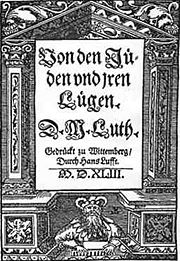
Regarding the persecution of Jews, the contemporary, historical perspective is that in the period between the Protestant Reformation
and the Holocaust, Martin Luther
's treatise On the Jews and their Lies (1543), exercised a major and persistent intellectual
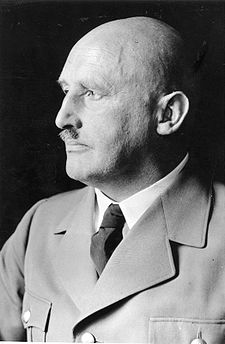
influence upon the German practice of anti-Semitism against Jewish citizens. The Nazis publicly displayed an original of On the Jews and their Lies during the annual Nuremberg rallies, and the city also presented a first edition of it to Julius Streicher
, the editor of Der Stürmer
, which described Luther's treatise as the most radically anti-Semitic tract ever published.
Protestant Bishop Martin Sasse published a compendium of Martin Luther's writings shortly after Kristallnacht
; in the introduction, he approved of the burning of synagogues and mentioned the coincidental date: "On November 10, 1938, on Luther's birthday, the synagogues are burning in Germany." He urged Germans to heed the words "of the greatest antisemite of his time, the warner of his people against the Jews." Theologian Johannes Wallmann, however, said Luther's anti-Semitic tract exercised no continual influence in Germany, that it was mostly ignored during the eighteenth and nineteenth centuries. Nonetheless, Prof. Diarmaid MacCulloch
said that On the Jews and Their Lies was the blueprint for Kristallnacht.
Hannah Arendt
argued that providing a comforting, single answer to the mysteries of the past, present, and future was the main source of the mass appeal of totalitarian regimes. According to Arendt, for Nazism all history is the history of race struggle and for Marxism all history is the history of class struggle
. Once that premise is accepted, all actions of the state can be justified by appeal to nature
or the law of history, justifying their establishment of authoritarian state apparatus. Similarly, Friedrich Hayek
finds the roots of totalitarianism in socialist desire for equality and unanimity. According to him, in order to achieve that goal it is necessary for state to take over control over every aspect of society. Role of the individual is to be "a mere means, to be used by the authority in the service of such abstractions as the 'social welfare' or the 'good of the community'".
and Joachim Fest
argue that in post-World War I
Germany, the Nazis were one of many nationalist and fascist political parties contending for the leadership of Germany's anti-communist
movement. The Nazis claimed that communism was dangerous to the well-being of nations because of its intention to dissolve private property
, its support of class conflict
, its aggression against the middle class, its hostility to small businessmen, and its atheism
. Nazism rejected class conflict
-based socialism
and economic egalitarianism
, favouring instead a stratified
economy with social class
es based on merit and talent, retaining private property
, and the creation of national solidarity that transcends class distinction.
During the 1920s, Hitler urged disparate Nazi factions to unite in opposition to "Jewish Marxism
." Hitler asserted that the "three vices" of "Jewish Marxism
" were democracy
, pacifism
and internationalism
.
Hitler believed that private ownership was useful in that it encouraged creative competition and technical innovation, but insisted that it had to conform to national interests and be "productive" rather than "parasitical". In 1930, Hitler said: "Our adopted term ‘Socialist' has nothing to do with Marxian Socialism. Marxism is anti-property; true Socialism is not." In 1931, during a confidential interview with influential editor Richard Breiting of the Leipziger Neueste Nachrichten, a pro-business newspaper, Hitler said:
During the late 1930s and the 1940s, anti-communist regimes and groups that supported Nazism included the Falange
in Spain
; the Vichy regime
and the 33rd Waffen Grenadier Division of the SS Charlemagne (1st French)
in France; and the Cliveden Set
, Lord Halifax, and associates of Neville Chamberlain
in Britain.
, the economic dominance of big business
, and Jewish influences. Nazi propaganda posters in working-class districts emphasized anti-capitalism, such as one that said: "The maintenance of a rotten industrial system has nothing to do with nationalism. I can love Germany and hate capitalism."
Hitler, both in public and in private, expressed strong disdain for capitalism, accusing modern capitalism of holding nations ransom in the interests of a parasitic cosmopolitan
rentier
class. He opposed free-market capitalism's profit-seeking impulses and desired an economy in which community interests would be upheld. He distrusted capitalism for being unreliable, due to its egotistic
nature, and he preferred a state-directed economy that is subordinated to the interests of the Volk. Hitler told a party leader in 1934, "The economic system of our day is the creation of the Jews." Hitler said to Benito Mussolini
that "Capitalism had run its course". Hitler also said that that business bourgeoisie "know nothing except their profit. 'Fatherland' is only a word for them." Hitler admired Napoleon as a role model for his anti-conservative, anti-capitalist and anti-bourgeois attitudes.
In Mein Kampf
, Hitler effectively supported mercantilism
, in the belief that economic resources from their respective territories should be seized by force; he believed that the policy of lebensraum
would provide Germany with such economically valuable territories. He believed that the only means to maintain economic security was to have direct control over resources rather than being forced to rely on world trade. He claimed that war to gain such resources was the only means to surpass the failing capitalist economic system.
A number of other Nazis held strong revolutionary socialist and anti-capitalist beliefs, most prominently Ernst Röhm
, the leader of the Sturmabteilung
(SA). Röhm claimed that the Nazis' rise to power constituted a national revolution, but insisted that a socialist "second revolution" was required for Nazi ideology to be fulfilled. Röhm's SA began attacks against individuals deemed to be associated with conservative reaction. Hitler saw Röhm's independent actions as violating and possibly threatening his leadership, as well as jeopardizing the regime by alienating the conservative President Paul von Hindenburg
and the conservative-oriented German army. This resulted in Hitler purging Röhm and other radical members of the SA. Another radical Nazi, Propaganda Minister Joseph Goebbels
adamantly stressed the socialist character of Nazism, and claimed in his diary that if he were to pick between Bolshevism and capitalism, he said "in final analysis", "it would be better for us to go down with Bolshevism than live in eternal slavery under capitalism."

Before Hitler orchestrated the operation known as the Night of the Long Knives
in 1934, whereby a substantial base of the Nazi Party's left-wing
block such as the Sturmabteilung
was purged of radical and disruptive elements, two former Freikorps
and Social Democratic Party
activists named Otto
and Gregor Strasser
united their left-leaning ideals to form a distinctly socialist strand of Nazism known as Strasserism.
Strasserist ideology engaged in overt critique of Hitler's Führerprinzip
, his affinities to the conservative establishment, and began attacking his policies through the National Socialist Newsletters and later ideological literature like Cabinet Seat or Revolution, while upholding aggressive anti-capitalist
ideals. The Strasser brothers considered capitalism stained by Jewish finance, and called for a working-class, genuinely socialist
and ultra-nationalist revolution following Hitler's rise to power (which they called a half-revolution), emphasizing the socialist component of National Socialism and proposing a cooperative economic ministry to direct Germany's economy in a more left-wing and guild
-based direction.
 Nazi economic practice first concerned the immediate domestic economy of Germany, then international trade
. To eliminate Germany's poverty, domestic policy was narrowly concerned with four major goals: (i) elimination of unemployment, (ii) rapid and substantial re-armament
, (iii) fiscal protection against resurgent hyper-inflation, and (iv) expansion of consumer-goods production, to raise middle- and lower-class living standards. The intent was correcting the Nazi-perceived short-comings of the Weimar Republic, and to solidify domestic support for the Nazi Party; between 1933 and 1936, the German gross national product increased annually by 9.5 percent, and the industrial rate increased by 17.2 percent.
The expansion propelled the German economy from depression
to full employment in less than four years. Public consumption increased 18.7 per cent, and private consumption increased 3.6 per cent annually. Historian Richard Evans reports that before the outbreak of World War II in 1939, the German economy "had recovered from the Depression faster than its counterparts in other countries. Germany's foreign debt had been stabilized, interest rates had fallen to half their 1932 level, the stock exchange had recovered from the Depression, the gross national product had risen by 81 per cent over the same period ... Inflation and unemployment had been conquered."
takeovers, and threatened takeovers, encouraged compliance with government production plans, even if unprofitable for the firm. For example, the owner of the Junkers aeroplane factory refused the government's directives, whereupon the Nazis occupied the factory and arrested Hugo Junkers
, but paid him for his nationalized business. Although the Nazis privatised public properties and public services, they also increased economic state control. Under Nazi economics, free competition and self-regulating markets diminished; nevertheless, Adolf Hitler's social Darwinist
beliefs made him reluctant to entirely disregard business competition and private property as economic engines. In 1942, Hitler privately said: "I absolutely insist on protecting private property ... we must encourage private initiative".
To the proposition that businesses were private property in name but not in substance, in The Journal of Economic History article "The Role of Private Property in the Nazi Economy: The Case of Industry", Christoph Buchheim and Jonas Scherner counter that despite state control, business had much production and investment planning freedom — while the economy was still to a larger degree politically controlled it "does not necessarily mean that private property of enterprises was not of any significance [...] For despite extensive regulatory activity by an interventionist public administration, firms preserved a good deal of their autonomy even under the Nazi regime", a system which they term "command-capitalism".
law was enacted in 1936, allowing the minister of economics to make existing cartels compulsory and permanent, and compel industries to form cartels, where none existed, although disestablished by decree, by 1943, they were replaced with more authoritarian economic agencies.
German language
German is a West Germanic language, related to and classified alongside English and Dutch. With an estimated 90 – 98 million native speakers, German is one of the world's major languages and is the most widely-spoken first language in the European Union....
: Nationalsozialismus) was the ideology
Ideology
An ideology is a set of ideas that constitutes one's goals, expectations, and actions. An ideology can be thought of as a comprehensive vision, as a way of looking at things , as in common sense and several philosophical tendencies , or a set of ideas proposed by the dominant class of a society to...
and practice of the Nazi Party and of Nazi Germany
Nazi Germany
Nazi Germany , also known as the Third Reich , but officially called German Reich from 1933 to 1943 and Greater German Reich from 26 June 1943 onward, is the name commonly used to refer to the state of Germany from 1933 to 1945, when it was a totalitarian dictatorship ruled by...
. It is a unique variety of fascism
Fascism
Fascism is a radical authoritarian nationalist political ideology. Fascists seek to rejuvenate their nation based on commitment to the national community as an organic entity, in which individuals are bound together in national identity by suprapersonal connections of ancestry, culture, and blood...
that incorporates biological racism
Scientific racism
Scientific racism is the use of scientific techniques and hypotheses to sanction the belief in racial superiority or racism.This is not the same as using scientific findings and the scientific method to investigate differences among the humans and argue that there are races...
and antisemitism.
Nazism was founded out of elements of the far-right racist
Racism
Racism is the belief that inherent different traits in human racial groups justify discrimination. In the modern English language, the term "racism" is used predominantly as a pejorative epithet. It is applied especially to the practice or advocacy of racial discrimination of a pernicious nature...
völkisch
Völkisch movement
The volkisch movement is the German interpretation of the populist movement, with a romantic focus on folklore and the "organic"...
German nationalist
German nationalism
German nationalism refers to the nationalism of Germans or of German culture. The origins of the beginning of a sense of German identity began with the Protestant Reformation begun by Martin Luther that resulted in the spread of a standardized common German language and literature...
movement and the violent anti-communist
Anti-communism
Anti-communism is opposition to communism. Organized anti-communism developed in reaction to the rise of communism, especially after the 1917 October Revolution in Russia and the beginning of the Cold War in 1947.-Objections to communist theory:...
Freikorps paramilitary
Paramilitary
A paramilitary is a force whose function and organization are similar to those of a professional military, but which is not considered part of a state's formal armed forces....
culture that fought against the uprisings of communist revolutionaries
Communist revolution
A communist revolution is a proletarian revolution inspired by the ideas of Marxism that aims to replace capitalism with communism, typically with socialism as an intermediate stage...
in post-World War I
World War I
World War I , which was predominantly called the World War or the Great War from its occurrence until 1939, and the First World War or World War I thereafter, was a major war centred in Europe that began on 28 July 1914 and lasted until 11 November 1918...
Germany
Germany
Germany , officially the Federal Republic of Germany , is a federal parliamentary republic in Europe. The country consists of 16 states while the capital and largest city is Berlin. Germany covers an area of 357,021 km2 and has a largely temperate seasonal climate...
. The ideology was developed first by Anton Drexler
Anton Drexler
Anton Drexler was a German right-wing political leader of the 1920s, known for being Adolf Hitler's mentor during his early days in politics.-Biography:...
and then Adolf Hitler
Adolf Hitler
Adolf Hitler was an Austrian-born German politician and the leader of the National Socialist German Workers Party , commonly referred to as the Nazi Party). He was Chancellor of Germany from 1933 to 1945, and head of state from 1934 to 1945...
as a means to draw workers away from communism
Communism
Communism is a social, political and economic ideology that aims at the establishment of a classless, moneyless, revolutionary and stateless socialist society structured upon common ownership of the means of production...
and into völkisch nationalism. Initially Nazi political strategy focused on anti-big business
Big Business
Big business is a term used to describe large corporations, in either an individual or collective sense. The term first came into use in a symbolic sense subsequent to the American Civil War, particularly after 1880, in connection with the combination movement that began in American business at...
, anti-bourgeois
Bourgeoisie
In sociology and political science, bourgeoisie describes a range of groups across history. In the Western world, between the late 18th century and the present day, the bourgeoisie is a social class "characterized by their ownership of capital and their related culture." A member of the...
, and anti-capitalist
Anti-capitalism
Anti-capitalism describes a wide variety of movements, ideas, and attitudes which oppose capitalism. Anti-capitalists, in the strict sense of the word, are those who wish to completely replace capitalism with another system....
rhetoric, though such aspects were later downplayed in the 1930s to gain the support from industrial owners for the Nazis, focus was shifted to anti-Semitic and anti-Marxist themes.
Nazism advocated the supremacy of an Aryan
Aryan race
The Aryan race is a concept historically influential in Western culture in the period of the late 19th century and early 20th century. It derives from the idea that the original speakers of the Indo-European languages and their descendants up to the present day constitute a distinctive race or...
master race
Master race
Master race was a phrase and concept originating in the slave-holding Southern US. The later phrase Herrenvolk , interpreted as 'master race', was a concept in Nazi ideology in which the Nordic peoples, one of the branches of what in the late-19th and early-20th century was called the Aryan race,...
over all other races. Nazis viewed the progress of humanity as depending on the Aryans and believed that it could maintain its dominance only if it retained its purity and instinct for self-preservation. They claimed that Jews
Jews
The Jews , also known as the Jewish people, are a nation and ethnoreligious group originating in the Israelites or Hebrews of the Ancient Near East. The Jewish ethnicity, nationality, and religion are strongly interrelated, as Judaism is the traditional faith of the Jewish nation...
were the greatest threat to the Aryan race. They considered Jews a parasitic
Parasitism
Parasitism is a type of symbiotic relationship between organisms of different species where one organism, the parasite, benefits at the expense of the other, the host. Traditionally parasite referred to organisms with lifestages that needed more than one host . These are now called macroparasites...
race that attached itself to various ideologies and movements to secure its self-preservation, such as capitalism
Capitalism
Capitalism is an economic system that became dominant in the Western world following the demise of feudalism. There is no consensus on the precise definition nor on how the term should be used as a historical category...
, democracy
Democracy
Democracy is generally defined as a form of government in which all adult citizens have an equal say in the decisions that affect their lives. Ideally, this includes equal participation in the proposal, development and passage of legislation into law...
, the Enlightenment
Age of Enlightenment
The Age of Enlightenment was an elite cultural movement of intellectuals in 18th century Europe that sought to mobilize the power of reason in order to reform society and advance knowledge. It promoted intellectual interchange and opposed intolerance and abuses in church and state...
, industrialisation
Industrialisation
Industrialization is the process of social and economic change that transforms a human group from an agrarian society into an industrial one...
, liberalism
Liberalism
Liberalism is the belief in the importance of liberty and equal rights. Liberals espouse a wide array of views depending on their understanding of these principles, but generally, liberals support ideas such as constitutionalism, liberal democracy, free and fair elections, human rights,...
, Marxism
Marxism
Marxism is an economic and sociopolitical worldview and method of socioeconomic inquiry that centers upon a materialist interpretation of history, a dialectical view of social change, and an analysis and critique of the development of capitalism. Marxism was pioneered in the early to mid 19th...
, parliamentary politics
Parliamentary system
A parliamentary system is a system of government in which the ministers of the executive branch get their democratic legitimacy from the legislature and are accountable to that body, such that the executive and legislative branches are intertwined....
, and trade unionism
Trade union
A trade union, trades union or labor union is an organization of workers that have banded together to achieve common goals such as better working conditions. The trade union, through its leadership, bargains with the employer on behalf of union members and negotiates labour contracts with...
. To maintain the purity and strength of the Aryan race, the Nazis sought to exterminate
Genocide
Genocide is defined as "the deliberate and systematic destruction, in whole or in part, of an ethnic, racial, religious, or national group", though what constitutes enough of a "part" to qualify as genocide has been subject to much debate by legal scholars...
or impose exclusionary segregation upon "degenerate
Degeneration
The idea of degeneration had significant influence on science, art and politics from the 1850s to the 1950s. The social theory developed consequently from Charles Darwin's Theory of Evolution...
" and "asocial
Asociality
Asociality is a symptom frequently observed in schizophrenia patients. It is characterised by an inability to 'empathise', to feel intimacy with, or to form close relationships with others ....
" groups that included: Jews, homosexuals
Homosexuality
Homosexuality is romantic or sexual attraction or behavior between members of the same sex or gender. As a sexual orientation, homosexuality refers to "an enduring pattern of or disposition to experience sexual, affectional, or romantic attractions" primarily or exclusively to people of the same...
, Romani, blacks
Black people
The term black people is used in systems of racial classification for humans of a dark skinned phenotype, relative to other racial groups.Different societies apply different criteria regarding who is classified as "black", and often social variables such as class, socio-economic status also plays a...
, the physically
Physical disability
A physical disability is any impairment which limits the physical function of one or more limbs or fine or gross motor ability. Other physical disabilities include impairments which limit other facets of daily living, such as respiratory disorders and epilepsy....
and mentally disabled
Developmental disability
Developmental disability is a term used in the United States and Canada to describe lifelong disabilities attributable to mental or physical impairments, manifested prior to age 18. It is not synonymous with "developmental delay" which is often a consequence of a temporary illness or trauma during...
, Jehovah's Witnesses
Jehovah's Witnesses
Jehovah's Witnesses is a millenarian restorationist Christian denomination with nontrinitarian beliefs distinct from mainstream Christianity. The religion reports worldwide membership of over 7 million adherents involved in evangelism, convention attendance of over 12 million, and annual...
and political opponents.
Nazism promoted an economic system that supported a stratified
Social stratification
In sociology the social stratification is a concept of class, involving the "classification of persons into groups based on shared socio-economic conditions ... a relational set of inequalities with economic, social, political and ideological dimensions."...
economy with classes based on merit and talent while rejecting egalitarianism
Egalitarianism
Egalitarianism is a trend of thought that favors equality of some sort among moral agents, whether persons or animals. Emphasis is placed upon the fact that equality contains the idea of equity of quality...
, retaining private property
Private property
Private property is the right of persons and firms to obtain, own, control, employ, dispose of, and bequeath land, capital, and other forms of property. Private property is distinguishable from public property, which refers to assets owned by a state, community or government rather than by...
, freedom of contract, and promoted the creation of national solidarity that would transcend class distinction. It promoted the creation of a community of common interest between managers and employees in industry
Industry
Industry refers to the production of an economic good or service within an economy.-Industrial sectors:There are four key industrial economic sectors: the primary sector, largely raw material extraction industries such as mining and farming; the secondary sector, involving refining, construction,...
where a factory leader would be selected to act in coordination with a council of factory members, though these members would have to obey the Führerprinzip
Führerprinzip
The Führerprinzip , German for "leader principle", prescribes the fundamental basis of political authority in the governmental structures of the Third Reich...
of the factory leader. The economy was to be subordinate to the goals of the political leadership of the state.
Nazism was officially presented by Hitler and other proponents as being neither left-wing
Left-wing politics
In politics, Left, left-wing and leftist generally refer to support for social change to create a more egalitarian society...
nor right-wing
Right-wing politics
In politics, Right, right-wing and rightist generally refer to support for a hierarchical society justified on the basis of an appeal to natural law or tradition. To varying degrees, the Right rejects the egalitarian objectives of left-wing politics, claiming that the imposition of equality is...
but a politically syncretic
Syncretic politics
Syncretic politics or spectral-syncretic refers to a form of politics outside of the conventional left-right political spectrum, this term is especially used by some scholars to describe the political nature of fascism...
ideology. Hitler in Mein Kampf
Mein Kampf
Mein Kampf is a book written by Nazi leader Adolf Hitler. It combines elements of autobiography with an exposition of Hitler's political ideology. Volume 1 of Mein Kampf was published in 1925 and Volume 2 in 1926...
directly attacked both left-wing and right-wing politics in Germany, such as saying: "Today our left-wing politicians in particular are constantly insisting that their craven-hearted and obsequious foreign policy necessarily results from the disarmament of Germany, whereas the truth is that this is the policy of traitors [...] But the politicians of the Right deserve exactly the same reproach. It was through their miserable cowardice that those ruffians of Jews who came into power in 1918 were able to rob the nation of its arms." However a majority of scholars identify Nazism in practice as being a far right form of politics.
Etymology
The full title of Adolf Hitler's party was Nationalsozialistische Deutsche Arbeiterpartei. The term nazi was in use long before the rise of the party as a shortened version of Ignatius, a common name in Bavaria—the area from which the Nazis emerged. The term was also used as derogatory reference to a backwards peasant or, more generally, a foolish, clumsy or awkward person. Opponents seized on this derogatory usage and shortened the party's title to the dismissive Nazi.Position in the political spectrum
A majority of scholars identify Nazism in practice as being a far right form of politics. However Nazism was officially presented by Hitler and other proponents as being neither left-wing nor right-wing but syncretic. Hitler in Mein Kampf directly attacked both left-wing and right-wing politics in Germany, saying: "Today our left-wing politicians in particular are constantly insisting that their craven-hearted and obsequious foreign policy necessarily results from the disarmament of Germany, whereas the truth is that this is the policy of traitors [...] But the politicians of the Right deserve exactly the same reproach. It was through their miserable cowardice that those ruffians of Jews who came into power in 1918 were able to rob the nation of its arms."There were factions in the Nazi Party, including a conservative faction and a radical faction. The conservative Nazi Hermann Göring
Hermann Göring
Hermann Wilhelm Göring, was a German politician, military leader, and a leading member of the Nazi Party. He was a veteran of World War I as an ace fighter pilot, and a recipient of the coveted Pour le Mérite, also known as "The Blue Max"...
urged Hitler to conciliate with capitalists
Capitalism
Capitalism is an economic system that became dominant in the Western world following the demise of feudalism. There is no consensus on the precise definition nor on how the term should be used as a historical category...
and reactionaries
Reactionary
The term reactionary refers to viewpoints that seek to return to a previous state in a society. The term is meant to describe one end of a political spectrum whose opposite pole is "radical". While it has not been generally considered a term of praise it has been adopted as a self-description by...
. Other prominent conservative Nazis included Heinrich Himmler
Heinrich Himmler
Heinrich Luitpold Himmler was Reichsführer of the SS, a military commander, and a leading member of the Nazi Party. As Chief of the German Police and the Minister of the Interior from 1943, Himmler oversaw all internal and external police and security forces, including the Gestapo...
, who was more conservative than Göring; and Reinhard Heydrich
Reinhard Heydrich
Reinhard Tristan Eugen Heydrich , also known as The Hangman, was a high-ranking German Nazi official.He was SS-Obergruppenführer and General der Polizei, chief of the Reich Main Security Office and Stellvertretender Reichsprotektor of Bohemia and Moravia...
. The radical Nazi Joseph Goebbels
Joseph Goebbels
Paul Joseph Goebbels was a German politician and Reich Minister of Propaganda in Nazi Germany from 1933 to 1945. As one of Adolf Hitler's closest associates and most devout followers, he was known for his zealous oratory and anti-Semitism...
hated capitalism, viewing it has having Jews at its core and stressed the need for the party to emphasize a both a proletarian
Proletariat
The proletariat is a term used to identify a lower social class, usually the working class; a member of such a class is proletarian...
and national character, these views were shared by Otto Strasser
Otto Strasser
Otto Johann Maximilian Strasser was a German politician and 'left-wing' member of the National Socialist German Workers Party. Strasser was part of the ‘left-wing’ faction of the party, along with his brother Gregor Strasser, and broke from the party due to disputes with the ‘Hitlerite’ faction...
who later left the Nazi Party in the belief that Hitler had betrayed the party's socialist goals by endorsing capitalism. Large segments of the Party staunchly supported its official socialist, revolutionary, and anti-capitalist positions and expected both a social and economic revolution upon the Party gaining power in Germany in 1933. The leader of the Party's paramilitary organization the SA, Ernst Röhm
Ernst Röhm
Ernst Julius Röhm, was a German officer in the Bavarian Army and later an early Nazi leader. He was a co-founder of the Sturmabteilung , the Nazi Party militia, and later was its commander...
supported a "second revolution" (the "first revolution" being the Nazis' seizure of power) that would entrench the Party's official socialist program and demanded the replacement of the nonpolitical German army with a Nazi-led army. Of the million members of the SA, many were committed to the Party's official socialist program. Hitler himself took an in-between position in that he allowed capitalist private enterprise to exist as long as it obeyed the goals of the Nazi state but if a capitalist private enterprise resisted Nazi goals, he smashed it; he accepted private property; and Nazis engaged in street fighting with various socialist groups.
Ideological origins
The ideological origins of Nazism derive from RomanticismRomanticism
Romanticism was an artistic, literary and intellectual movement that originated in the second half of the 18th century in Europe, and gained strength in reaction to the Industrial Revolution...
, nineteenth-century idealism
Idealism
In philosophy, idealism is the family of views which assert that reality, or reality as we can know it, is fundamentally mental, mentally constructed, or otherwise immaterial. Epistemologically, idealism manifests as a skepticism about the possibility of knowing any mind-independent thing...
, and a eugenic
Eugenics
Eugenics is the "applied science or the bio-social movement which advocates the use of practices aimed at improving the genetic composition of a population", usually referring to human populations. The origins of the concept of eugenics began with certain interpretations of Mendelian inheritance,...
interpretation of Friedrich Nietzsche
Friedrich Nietzsche
Friedrich Wilhelm Nietzsche was a 19th-century German philosopher, poet, composer and classical philologist...
's concepts of "breeding upwards" — towards the Übermensch
Übermensch
The Übermensch is a concept in the philosophy of Friedrich Nietzsche. Nietzsche posited the Übermensch as a goal for humanity to set for itself in his 1883 book Thus Spoke Zarathustra ....
("Superman"). Such ideas, as espoused by the Ariosophical
Ariosophy
Armanism and Ariosophy are the names of ideological systems of an esoteric nature, pioneered by Guido von List and Jörg Lanz von Liebenfels respectively, in Austria between 1890 and 1930. The term 'Ariosophy', meaning wisdom concerning the Aryans, was first coined by Lanz von Liebenfels in 1915 and...
Germanenorden
Germanenorden
The Germanenorden was a völkisch secret society in early 20th century Germany...
(German Order) and the Thule Society
Thule Society
The Thule Society , originally the Studiengruppe für germanisches Altertum , was a German occultist and völkisch group in Munich, named after a mythical northern country from Greek legend...
much influenced Adolf Hitler
Adolf Hitler
Adolf Hitler was an Austrian-born German politician and the leader of the National Socialist German Workers Party , commonly referred to as the Nazi Party). He was Chancellor of Germany from 1933 to 1945, and head of state from 1934 to 1945...
's world-view.
Phillip Wayne Powell writes that "in the fifteenth and early sixteenth centuries, a powerful surge of German patriotism was stimulated by the disdain of Italians for German cultural inferiority and barbarism, which led to a counter-attempt, by German humanists, to laud German qualities." M.W. Fodor wrote in The Nation in 1936, "No race has suffered so much from an inferiority complex as has the German. National Socialism was a kind of Coué method
Émile Coué
Émile Coué de la Châtaigneraie was a French psychologist and pharmacist who introduced a method of psychotherapy and self-improvement based on optimistic autosuggestion....
of converting the inferiority complex, at least temporarily, into a feeling of superiority".
Among the most significant ideological influence on the Nazis came from German nationalist Johann Gottlieb Fichte
Johann Gottlieb Fichte
Johann Gottlieb Fichte was a German philosopher. He was one of the founding figures of the philosophical movement known as German idealism, a movement that developed from the theoretical and ethical writings of Immanuel Kant...
, whose works Hitler read, and who was recognized by other Nazi members including Dietrich Eckart
Dietrich Eckart
Dietrich Eckart was a German journalist and politician, together with Adolf Hitler one of the early key members of the Nazi Party and a participant of the 1923 Beer Hall Putsch.-Biography:...
and Arnold Fanck
Arnold Fanck
Arnold Fanck was a pioneer of the German mountain film....
. In Speeches to the German Nation (1808), written amid Napoleonic France's occupation of Berlin, Fichte called for a German national revolution against the French occupiers, making passionate public speeches, arming his students for battle against the French, and stressing the need of the deed of action by the German nation to free itself.
Fichte's nationalism was populist and opposed to traditional elites, and spoke of the need of a "People's War" (Volkskrieg), putting forward concepts much like those the Nazis adopted. Fichte promoted German exceptionalism
Exceptionalism
Exceptionalism is the perception that a country, society, institution, movement, or time period is "exceptional" in some way and thus does not need to conform to normal rules or general principles...
and stressed the need for the German nation to be purified. This priority included purging the German language of French words, a policy that the Nazis undertook upon rising to power. Fichte was anti-Semitic and accused Jews
Jews
The Jews , also known as the Jewish people, are a nation and ethnoreligious group originating in the Israelites or Hebrews of the Ancient Near East. The Jewish ethnicity, nationality, and religion are strongly interrelated, as Judaism is the traditional faith of the Jewish nation...
in Germany of having been, and inevitably continuing to be a "state within a state" in Germany that was a threat to German national unity. Fichte promoted two options to address this: the first was the creation of a Jewish state in Palestine
Palestine
Palestine is a conventional name, among others, used to describe the geographic region between the Mediterranean Sea and the Jordan River, and various adjoining lands....
to impel the Jews to leave Europe. The other option was violence against Jews, saying that the goal would be "To cut off all their heads in one night, and set new ones on their shoulders, which should not contain a single Jewish idea".
The concept of the Aryan race
Aryan race
The Aryan race is a concept historically influential in Western culture in the period of the late 19th century and early 20th century. It derives from the idea that the original speakers of the Indo-European languages and their descendants up to the present day constitute a distinctive race or...
that the Nazis used stems from racial theories asserting that Europeans are the descendants of Indo-Iranian settlers, people of ancient India and ancient Persia. Proponents of this theory based their assertion on the similarity of European words and their meaning to those of Indo-Iranian languages. Johann Gottfried Herder
Johann Gottfried Herder
Johann Gottfried von Herder was a German philosopher, theologian, poet, and literary critic. He is associated with the periods of Enlightenment, Sturm und Drang, and Weimar Classicism.-Biography:...
argued that the Germanic peoples held close racial connections with the ancient Indians and ancient Persians, who he claimed were advanced peoples possessing a great capacity for wisdom, nobility, restraint, and science. Contemporaries of Herder utilized the concept of the Aryan race to draw a distinction between what they deemed "high and noble" Aryan culture versus that of "parasitic" Semitic culture.
Notions of white supremacy
White supremacy
White supremacy is the belief, and promotion of the belief, that white people are superior to people of other racial backgrounds. The term is sometimes used specifically to describe a political ideology that advocates the social and political dominance by whites.White supremacy, as with racial...
and Aryan racial superiority combined in the nineteenth century, with white supremacists maintaining that white people
White people
White people is a term which usually refers to human beings characterized, at least in part, by the light pigmentation of their skin...
were members of an Aryan "master race" that is superior to all other races, and particularly superior to the Semitic race, which they associated with "cultural sterility". Arthur de Gobineau
Arthur de Gobineau
Joseph Arthur Comte de Gobineau was a French aristocrat, novelist and man of letters who became famous for developing the theory of the Aryan master race in his book An Essay on the Inequality of the Human Races...
, a French racial theorist and aristocrat, blamed the fall of the ancien régime in France on racial degeneracy caused by racial intermixing, which he argued destroyed the purity of the Aryan race. Gobineau's theories, which attracted a strong following in Germany, emphasized the existence of an irreconcilable polarity
Polarity in international relations
Polarity in international relations is any of the various ways in which power is distributed within the international system. It describes the nature of the international system at any given period of time. One generally distinguishes four types of systems: Unipolarity, Bipolarity, Tripolarity, and...
between Aryan and Jewish cultures.
Aryan mysticism
Mysticism
Mysticism is the knowledge of, and especially the personal experience of, states of consciousness, i.e. levels of being, beyond normal human perception, including experience and even communion with a supreme being.-Classical origins:...
claimed that Christianity
Christianity
Christianity is a monotheistic religion based on the life and teachings of Jesus as presented in canonical gospels and other New Testament writings...
originated in Aryan religious tradition and that Jews had usurped the legend from Aryans. Houston Stewart Chamberlain
Houston Stewart Chamberlain
Houston Stewart Chamberlain was a British-born German author of books on political philosophy, natural science and the German composer Richard Wagner. He later became a German citizen. Chamberlain married Wagner's daughter, Eva, some years after Wagner's death...
, an English proponent of racial theory, supported notions of Germanic supremacy and anti-Semitism in Germany. Chamberlain's work, Foundations of the Nineteenth Century (1899) praised Germanic peoples for their creativity and idealism while asserting that the Germanic spirit was threatened by a "Jewish" spirit of selfishness and materialism
Materialism
In philosophy, the theory of materialism holds that the only thing that exists is matter; that all things are composed of material and all phenomena are the result of material interactions. In other words, matter is the only substance...
. Chamberlain used his thesis to promote monarchical
Monarchism
Monarchism is the advocacy of the establishment, preservation, or restoration of a monarchy as a form of government in a nation. A monarchist is an individual who supports this form of government out of principle, independent from the person, the Monarch.In this system, the Monarch may be the...
conservatism
Conservatism
Conservatism is a political and social philosophy that promotes the maintenance of traditional institutions and supports, at the most, minimal and gradual change in society. Some conservatives seek to preserve things as they are, emphasizing stability and continuity, while others oppose modernism...
while denouncing democracy
Democracy
Democracy is generally defined as a form of government in which all adult citizens have an equal say in the decisions that affect their lives. Ideally, this includes equal participation in the proposal, development and passage of legislation into law...
, liberalism
Liberalism
Liberalism is the belief in the importance of liberty and equal rights. Liberals espouse a wide array of views depending on their understanding of these principles, but generally, liberals support ideas such as constitutionalism, liberal democracy, free and fair elections, human rights,...
, and socialism
Socialism
Socialism is an economic system characterized by social ownership of the means of production and cooperative management of the economy; or a political philosophy advocating such a system. "Social ownership" may refer to any one of, or a combination of, the following: cooperative enterprises,...
. The book became popular, especially in Germany. Chamberlain stressed the need of a nation to maintain racial purity in order to prevent degeneration, and argued that racial intermingling with Jews should never be permitted. In 1923, Chamberlain met Hitler, whom he admired as a leader of the rebirth of the free spirit.
Nazism's racial policy positions were also developed from the views of important biologists of the 19th century, including French biologist
Biologist
A biologist is a scientist devoted to and producing results in biology through the study of life. Typically biologists study organisms and their relationship to their environment. Biologists involved in basic research attempt to discover underlying mechanisms that govern how organisms work...
Jean-Baptiste Lamarck
Jean-Baptiste Lamarck
Jean-Baptiste Pierre Antoine de Monet, Chevalier de la Marck , often known simply as Lamarck, was a French naturalist...
and the founder of genetics
Genetics
Genetics , a discipline of biology, is the science of genes, heredity, and variation in living organisms....
, German botanist Gregor Mendel
Gregor Mendel
Gregor Johann Mendel was an Austrian scientist and Augustinian friar who gained posthumous fame as the founder of the new science of genetics. Mendel demonstrated that the inheritance of certain traits in pea plants follows particular patterns, now referred to as the laws of Mendelian inheritance...
. Lamarckism
Lamarckism
Lamarckism is the idea that an organism can pass on characteristics that it acquired during its lifetime to its offspring . It is named after the French biologist Jean-Baptiste Lamarck , who incorporated the action of soft inheritance into his evolutionary theories...
, an evolutionary theory related to Darwinism
Darwinism
Darwinism is a set of movements and concepts related to ideas of transmutation of species or of evolution, including some ideas with no connection to the work of Charles Darwin....
, was an important influence on Nazism. In particular the variant developed by Ernst Haeckel
Ernst Haeckel
The "European War" became known as "The Great War", and it was not until 1920, in the book "The First World War 1914-1918" by Charles à Court Repington, that the term "First World War" was used as the official name for the conflict.-Research:...
, was utilized by the Nazis. Unlike Darwinian theory, Lamarckian theory officially ranked races in a hierarchy of evolution from apes
Ape
Apes are Old World anthropoid mammals, more specifically a clade of tailless catarrhine primates, belonging to the biological superfamily Hominoidea. The apes are native to Africa and South-east Asia, although in relatively recent times humans have spread all over the world...
while original Darwinian theory did not grade races in a hierarchy of higher or lower evolution from apes, simply categorizing humans as a whole of all as having progressed in evolution from apes. Many Lamarckians viewed "lower" races as having been exposed to debilitating conditions for too long for any significant "improvement" of their condition in the near future. Haeckel utilized Lamarckian theory to describe the existence of interracial struggle and put races on a hierarchy of evolution, ranging from being wholly human to subhuman
Subhuman
- Biology :* Any of the extinct or living members of the clade Hominoidea other than Homo or alternatively just H. sapiens sapiens.-Music:* subHuman , a 2007 music album by Recoil...
.
Mendelism
Mendelian inheritance
Mendelian inheritance is a scientific description of how hereditary characteristics are passed from parent organisms to their offspring; it underlies much of genetics...
was supported by the Nazis and also mainstream eugenics proponents at the time were Mendelian. Mendelian theory of inheritance declared that genetic traits and attributes were passed from one generation to another. Proponents of eugenics used Mendelian inheritance theory to demonstrate the transfer of biological illness and impairments from parents to children, including mental disability; others also utilized Mendelian theory to demonstrate the inheritance of social traits, with racialists claiming a racial nature of certain general traits such as inventiveness or criminal behaviour.
Beginning in the 1870s, German völkisch nationalism
Völkisch movement
The volkisch movement is the German interpretation of the populist movement, with a romantic focus on folklore and the "organic"...
began to adopt anti-Semitic and racist themes and was adopted by a number of radical right political movements. Völkisch nationalism denounced soulless materialism
Materialism
In philosophy, the theory of materialism holds that the only thing that exists is matter; that all things are composed of material and all phenomena are the result of material interactions. In other words, matter is the only substance...
, individualism
Individualism
Individualism is the moral stance, political philosophy, ideology, or social outlook that stresses "the moral worth of the individual". Individualists promote the exercise of one's goals and desires and so value independence and self-reliance while opposing most external interference upon one's own...
, and secularized urban
Urban
Urban means "related to cities." It may refer to:*Urban, California, former town in El Dorado County*Urban area, geographical area distinct from rural areas*Urban , given name and surname*Urban , Danish free daily newspaper...
industrial society, while advocating a "superior" society based on ethnic German "folk" culture and way of life, based upon German "blood". It also denounced foreigners, foreign ideas and declared that Jews, national minorities, Catholics, and Freemasons
Freemasonry
Freemasonry is a fraternal organisation that arose from obscure origins in the late 16th to early 17th century. Freemasonry now exists in various forms all over the world, with a membership estimated at around six million, including approximately 150,000 under the jurisdictions of the Grand Lodge...
were "traitors to the nation" and unworthy of inclusion in the German Volk. Völkisch nationalism saw the world in terms of natural law
Natural law
Natural law, or the law of nature , is any system of law which is purportedly determined by nature, and thus universal. Classically, natural law refers to the use of reason to analyze human nature and deduce binding rules of moral behavior. Natural law is contrasted with the positive law Natural...
and romanticism
Romanticism
Romanticism was an artistic, literary and intellectual movement that originated in the second half of the 18th century in Europe, and gained strength in reaction to the Industrial Revolution...
, viewed societies as organic, it extolled the virtues of rural
Rural
Rural areas or the country or countryside are areas that are not urbanized, though when large areas are described, country towns and smaller cities will be included. They have a low population density, and typically much of the land is devoted to agriculture...
life, condemned the neglect of tradition and decay of morals, denounced the destruction of the natural environment, and condemned "cosmopolitan" cultures such as Jews and Romani.
Prominent historical figures of such völkisch nationalism include Eugen Diederichs
Eugen Diederichs
Eugen Diederichs was a German publisher from Löbitz.Diederichs started his publishing company in Florence, Italy, in 1896. He moved on to Leipzig, where he published the early works of Herman Hesse, and from there to Jena in 1904. He started publishing the magazine Die Tat in 1912...
, Paul de Lagarde
Paul de Lagarde
Paul Anton de Lagarde was a polymath German biblical scholar and orientalist. He also took some part in politics. He belonged to the Prussian Conservative party, and was a violent antisemite. The bitterness which he felt appeared in his writings...
, and Julius Langbehn
Julius Langbehn
Julius Langbehn was a German conservative art historian and philosopher. He was born in Hadersleben, Schleswig .-Work:* Rembrandt als Erzieher * 40 Lieder von einem Deutschen...
. Radical anti-Semitism was promoted by these figures. De Lagarde called the Jews a "bacillus
Bacillus
Bacillus is a genus of Gram-positive, rod-shaped bacteria and a member of the division Firmicutes. Bacillus species can be obligate aerobes or facultative anaerobes, and test positive for the enzyme catalase. Ubiquitous in nature, Bacillus includes both free-living and pathogenic species...
, the carrier of decay...who pollute every national culture...and destroy all faith with their materialistic liberalism" and he called for the extermination of the Jews. Langbehn called for a war of annihilation of the Jews and Langbehn's genocidal policies were published by the Nazis and given to soldiers on the front during World War II
World War II
World War II, or the Second World War , was a global conflict lasting from 1939 to 1945, involving most of the world's nations—including all of the great powers—eventually forming two opposing military alliances: the Allies and the Axis...
.
However during the era of Imperial Germany, völkisch nationalism was overshadowed by both Prussian patriotism and the federalist tradition of various states within Imperial Germany. The events of World War I including the end of the Prussian monarchy in Germany, resulted in a surge of revolutionary völkisch nationalism. The Nazis supported such revolutionary völkisch nationalist policies.
The Protocols of the Elders of Zion
The Protocols of the Elders of Zion
The Protocols of the Elders of Zion is a fraudulent, antisemitic text purporting to describe a Jewish plan for achieving global domination. It was first published in Russia in 1903, translated into multiple languages, and disseminated internationally in the early part of the twentieth century...
(1912) was an anti-Semitic forgery created by police of the Russian Empire. Anti-Semites believed it was real and the Protocol surged in popularity after World War I. The Protocols claimed that there was an international Jewish conspiracy to take over the world. Hitler had been introduced to The Protocols by Alfred Rosenberg
Alfred Rosenberg
' was an early and intellectually influential member of the Nazi Party. Rosenberg was first introduced to Adolf Hitler by Dietrich Eckart; he later held several important posts in the Nazi government...
, and from 1920 onward Hitler focused his attacks on claiming that Judaism and Marxism were directly connected and that Jews and Bolshevik
Bolshevik
The Bolsheviks, originally also Bolshevists , derived from bol'shinstvo, "majority") were a faction of the Marxist Russian Social Democratic Labour Party which split apart from the Menshevik faction at the Second Party Congress in 1903....
s were one and the same and that Marxism was a Jewish ideology. Hitler believed that The Protocols were authentic.
The Nazis claimed that their ideology was influenced by the leadership and policies of German Chancellor
Chancellor of Germany
The Chancellor of Germany is, under the German 1949 constitution, the head of government of Germany...
Otto von Bismarck
Otto von Bismarck
Otto Eduard Leopold, Prince of Bismarck, Duke of Lauenburg , simply known as Otto von Bismarck, was a Prussian-German statesman whose actions unified Germany, made it a major player in world affairs, and created a balance of power that kept Europe at peace after 1871.As Minister President of...
, the founder of the German Empire
German Empire
The German Empire refers to Germany during the "Second Reich" period from the unification of Germany and proclamation of Wilhelm I as German Emperor on 18 January 1871, to 1918, when it became a federal republic after defeat in World War I and the abdication of the Emperor, Wilhelm II.The German...
. The Nazis declared that they were dedicated to continuing the process of creating a unified German nation state that Bismarck had begun and desired to achieve. The Nazis claimed that Bismarck was unable to complete German national unification because of Jewish infiltration of the German parliament, and that their abolition of parliament ended the obstacle to unification. While Hitler was supportive of Bismarck's creation of the German Empire, he was critical of Bismarck's moderate domestic policies. On the issue of Bismarck's support of a Kleindeutschland ("Lesser Germany", excluding Austria) versus the pan-German Großdeutschland ("Greater Germany") of the Nazis, Hitler claimed that Bismarck's attainment of Kleindeutschland was the "highest achievement" that Bismarck could have achieved "within the limits possible of that time". In Mein Kampf
Mein Kampf
Mein Kampf is a book written by Nazi leader Adolf Hitler. It combines elements of autobiography with an exposition of Hitler's political ideology. Volume 1 of Mein Kampf was published in 1925 and Volume 2 in 1926...
(My Struggle), Hitler presented himself as a "second Bismarck".
During World War I, sociologist Johann Plenge
Johann Plenge
Johann Plenge was a German sociologist. He was professor of political economy at the University of Münster. In his book 1789 and 1914 he contrasted the 'Ideas of 1789' and the 'Ideas of 1914'...
spoke of the rise of a "National Socialism" in Germany within what he termed the "ideas of 1914" that were a declaration of war against the "ideas of 1789"—the French Revolution
French Revolution
The French Revolution , sometimes distinguished as the 'Great French Revolution' , was a period of radical social and political upheaval in France and Europe. The absolute monarchy that had ruled France for centuries collapsed in three years...
. According to Plenge, the "ideas of 1789" that included rights of man, democracy, individualism and liberalism were being rejected in favour of "the ideas of 1914" that included "German values" of duty, discipline, law, and order. Plenge believed that ethnic solidarity (volksgemeinschaft
Volksgemeinschaft
Volksgemeinschaft is a German expression meaning "people's community". Originally appearing during World War I as Germans rallied behind the war, it derived its popularity as a means to break down elitism and class divides...
) would replace class division and that "racial comrades" would unite to create a socialist society in the struggle of "proletarian" Germany against "capitalist" Britain. He believed that the "Spirit of 1914" manifested itself in the concept of the "People's League of National Socialism". This National Socialism was a form of state socialism that rejected the "idea of boundless freedom" and promoted an economy that would serve the whole of Germany under the leadership of the state. This National Socialism was opposed to capitalism due to the components that were against "the national interest" of Germany, but insisted that National Socialism would strive for greater efficiency in the economy. Plenge advocated an authoritarian rational ruling elite to develop National Socialism through a hierarchical technocratic state.
Plenge's arguments at the time were recognized by a diverse group of people as an important argument in favour of social justice promoted within a strong state, including: right-wing Social Democrats Konrad Haenisch
Konrad Haenisch
Konrad Haenisch was a German Social Democratic Party politician and part of "the radical Marxist Left" of German politics. Friend and follower of Alexander Parvus. Haenisch was initially against World War I in 1914, but subsequently supported it...
, Heinrich Cunow
Heinrich Cunow
Heinrich Cunow was a German Social Democratic Party politician and a Marxist theorist. Cunow was originally against the First World War in 1914 but later supported it. He edited the Social Democratic theoretical journal Die Neue Zeit from 1917 to 1923, after Karl Kautsky...
, Paul Lench and Kurt Schumacher
Kurt Schumacher
Dr. Kurt Schumacher , was chairman of the Social Democratic Party of Germany from 1946 and first Leader of the Opposition in the West German Bundestag parliament from 1949 until his death...
; Conservative Revolutionaries including Arthur Moeller van den Bruck
Arthur Moeller van den Bruck
Arthur Moeller van den Bruck was a German cultural historian and writer, best known for his controversial book Das Dritte Reich...
and Max Hildebert Boehm; and Nazis including Ernst Krieck
Ernst Krieck
Ernst Krieck was a German educationalist who served as the Rector of Goethe University Frankfurt during the Nazi-era. He was a professor of pedagogy at the Frankfurt University....
, Gottfried Feder
Gottfried Feder
Gottfried Feder was an economist and one of the early key members of the Nazi party. He was their economic theoretician. Initially, it was his lecture in 1919 that drew Hitler into the party.- Biography :...
and Eduard Stadtler
Eduard Stadtler
Eduard Stadtler was a German academic and politician who formed the Anti-Bolshevist League in 1918. Stadler had begun advocating the creation of a "national socialist" dictatorship in 1918. Anton Drexler, the founder of the Nazi Party, attended Stadtler's lectures in Berlin...
. Plenge's ideas formed the basis of Nazism.
Oswald Spengler
Oswald Spengler
Oswald Manuel Arnold Gottfried Spengler was a German historian and philosopher whose interests also included mathematics, science, and art. He is best known for his book The Decline of the West , published in 1918, which puts forth a cyclical theory of the rise and decline of civilizations...
, a German cultural philosopher, was a major influence on Nazism, although after 1933 Spengler became alienated from Nazism and later condemned by the Nazis for criticizing Hitler. Spengler's views were also popular amongst Italian Fascists
Italian Fascism
Italian Fascism also known as Fascism with a capital "F" refers to the original fascist ideology in Italy. This ideology is associated with the National Fascist Party which under Benito Mussolini ruled the Kingdom of Italy from 1922 until 1943, the Republican Fascist Party which ruled the Italian...
, including Benito Mussolini
Benito Mussolini
Benito Amilcare Andrea Mussolini was an Italian politician who led the National Fascist Party and is credited with being one of the key figures in the creation of Fascism....
. Spengler's book The Decline of the West
The Decline of the West
The Decline of the West , or The Downfall of the Occident, is a two-volume work by Oswald Spengler, the first volume of which was published in the summer of 1918...
(1918) written during the final months of World War I
World War I
World War I , which was predominantly called the World War or the Great War from its occurrence until 1939, and the First World War or World War I thereafter, was a major war centred in Europe that began on 28 July 1914 and lasted until 11 November 1918...
in which he addressed the claim of decadence
Decadence
Decadence can refer to a personal trait, or to the state of a society . Used to describe a person's lifestyle. Concise Oxford Dictionary: "a luxurious self-indulgence"...
of modern European civilization that he claimed was caused by atomizing and irreligious individualization and cosmopolitanism
Cosmopolitanism
Cosmopolitanism is the ideology that all human ethnic groups belong to a single community based on a shared morality. This is contrasted with communitarian and particularistic theories, especially the ideas of patriotism and nationalism...
. In Decline of the West, Spengler's major thesis was that a law of historical development of cultures existed involving a cycle of birth, maturity, aging, and death when it reaches its final form of civilization. Upon reaching the point of civilization, a culture will lose its creative capacity and succumb to decadence
Decadence
Decadence can refer to a personal trait, or to the state of a society . Used to describe a person's lifestyle. Concise Oxford Dictionary: "a luxurious self-indulgence"...
until the emergence of "barbarian
Barbarian
Barbarian and savage are terms used to refer to a person who is perceived to be uncivilized. The word is often used either in a general reference to a member of a nation or ethnos, typically a tribal society as seen by an urban civilization either viewed as inferior, or admired as a noble savage...
s" create a new epoch. Spengler considered the Western world
Western world
The Western world, also known as the West and the Occident , is a term referring to the countries of Western Europe , the countries of the Americas, as well all countries of Northern and Central Europe, Australia and New Zealand...
as having succumbed to decadence of intellect, money, cosmopolitan
Cosmopolitanism
Cosmopolitanism is the ideology that all human ethnic groups belong to a single community based on a shared morality. This is contrasted with communitarian and particularistic theories, especially the ideas of patriotism and nationalism...
urban life, irreligious life, atomized individualization
Individualism
Individualism is the moral stance, political philosophy, ideology, or social outlook that stresses "the moral worth of the individual". Individualists promote the exercise of one's goals and desires and so value independence and self-reliance while opposing most external interference upon one's own...
, and the end of biological fertility as well as "spiritual" fertility. He believed that the "young" German nation as an imperial power would inherit the legacy of Ancient Rome
Ancient Rome
Ancient Rome was a thriving civilization that grew on the Italian Peninsula as early as the 8th century BC. Located along the Mediterranean Sea and centered on the city of Rome, it expanded to one of the largest empires in the ancient world....
and lead a restoration of value in "blood" and instinct, while the ideals of rationalism would be revealed as absurd.
In Preussentum und Sozialismus
Preussentum und Sozialismus
Preußentum und Sozialismus is a book by Oswald Spengler published in 1919 that addressed the connection of the Prussian character with socialism....
("Prussiandom and Socialism", 1919), Spengler described socialism outside of a class conflict
Class conflict
Class conflict is the tension or antagonism which exists in society due to competing socioeconomic interests between people of different classes....
perspective and said "The meaning of socialism is that life is controlled not by the opposition between rich and poor, but by the rank that achievement and talent bestow. That is our freedom, freedom from the economic despotism of the individual." Spengler utilized the anti-English ideas addressed by Plenge and Sombart during World War I
World War I
World War I , which was predominantly called the World War or the Great War from its occurrence until 1939, and the First World War or World War I thereafter, was a major war centred in Europe that began on 28 July 1914 and lasted until 11 November 1918...
that condemned English liberalism and English parliamentarianism while advocating a national socialism that was free from Marxism
Marxism
Marxism is an economic and sociopolitical worldview and method of socioeconomic inquiry that centers upon a materialist interpretation of history, a dialectical view of social change, and an analysis and critique of the development of capitalism. Marxism was pioneered in the early to mid 19th...
that would connect the individual to the state through corporative
Corporatism
Corporatism, also known as corporativism, is a system of economic, political, or social organization that involves association of the people of society into corporate groups, such as agricultural, business, ethnic, labor, military, patronage, or scientific affiliations, on the basis of common...
organization. Spengler claimed that socialistic Prussian characteristics existed across Germany that included creativity, discipline, concern for the greater good, productivity, and self-sacrifice. Spengler's definition of socialism did not advocate change in property relations.
Spengler denounced Marxism
Marxism
Marxism is an economic and sociopolitical worldview and method of socioeconomic inquiry that centers upon a materialist interpretation of history, a dialectical view of social change, and an analysis and critique of the development of capitalism. Marxism was pioneered in the early to mid 19th...
for seeking to train the proletariat to "expropriate the expropriator", the capitalist, and then to let them live a life of leisure on this expropriation. He claimed that "Marxism is the capitalism of the working class" and not true socialism. True socialism according to Spengler would be in the form of corporatism
Corporatism
Corporatism, also known as corporativism, is a system of economic, political, or social organization that involves association of the people of society into corporate groups, such as agricultural, business, ethnic, labor, military, patronage, or scientific affiliations, on the basis of common...
, stating that "local corporate bodies organized according to the importance of each occupation to the people as a whole; higher representation in stages up to a supreme council of the state; mandates revocable at any time; no organized parties, no professional politicians, no periodic elections." In Preussentum und Sozialismus Spengler prescribed war as a necessity, saying "War is the eternal form of higher human existence and states exist for war: they are the expression of the will to war." Spengler's conception of socialism and a number of his political views were shared by the Nazis as well as the Conservative Revolutionary movement
Conservative Revolutionary movement
The Conservative Revolutionary movement was a German national conservative movement, prominent in the years following the First World War. The Conservative Revolutionary school of thought advocated a "new" conservatism and nationalism that was specifically German, or Prussian in particular...
.
History
Anton Drexler
Anton Drexler was a German right-wing political leader of the 1920s, known for being Adolf Hitler's mentor during his early days in politics.-Biography:...
, and five other men, founded the Deutsche Arbeiterpartei (DAP — German Workers' Party
German Workers' Party
The German Workers' Party was the short-lived predecessor of the Nazi Party .-Origins:The DAP was founded in Munich in the hotel "Fürstenfelder Hof" on January 5, 1919 by Anton Drexler, a member of the occultist Thule Society. It developed out of the "Freien Arbeiterausschuss für einen guten...
), the predecessor of the Nationalsozialistische Deutsche Arbeiterpartei (NSDAP — National Socialist German Workers' Party). In July 1919, the Reichswehr
Reichswehr
The Reichswehr formed the military organisation of Germany from 1919 until 1935, when it was renamed the Wehrmacht ....
intelligence department despatched Corporal Adolf Hitler
Adolf Hitler
Adolf Hitler was an Austrian-born German politician and the leader of the National Socialist German Workers Party , commonly referred to as the Nazi Party). He was Chancellor of Germany from 1933 to 1945, and head of state from 1934 to 1945...
, as a Verbindungsmann (police spy) to infiltrate and subvert the DAP. His oratory so impressed the DAP members, they asked him join the party, and, in September 1919, the police spy Hitler became the party's propagandist
Propaganda
Propaganda is a form of communication that is aimed at influencing the attitude of a community toward some cause or position so as to benefit oneself or one's group....
. On 24 February 1920, the DAP was renamed the National Socialist German Workers' Party, against Hitler's preferred "Social Revolutionary Party" name. Later, in consolidating his control of the NSDAP, Hitler ousted Drexler from the party and assumed leadership on 29 July 1921.
The post-war crises of Weimar Germany (1919–33) consolidated Nazism as an ideology
Ideology
An ideology is a set of ideas that constitutes one's goals, expectations, and actions. An ideology can be thought of as a comprehensive vision, as a way of looking at things , as in common sense and several philosophical tendencies , or a set of ideas proposed by the dominant class of a society to...
: military defeat in the First World War (1914–18), capitulation with the Treaty of Versailles
Treaty of Versailles
The Treaty of Versailles was one of the peace treaties at the end of World War I. It ended the state of war between Germany and the Allied Powers. It was signed on 28 June 1919, exactly five years after the assassination of Archduke Franz Ferdinand. The other Central Powers on the German side of...
, economic depression, and the consequent societal instability. In exploiting, and excusing, the military defeat, Nazism proffered the political Dolchstosslegende
Dolchstosslegende
The stab-in-the-back legend is the notion, widely believed in right-wing circles in Germany after 1918, that the German Army did not lose World War I but was instead betrayed by the civilians on the home front, especially the republicans who overthrew the monarchy...
("Legend of the Dagger-stab in the Back") claiming that the Imperial German war effort was internally sabotaged, by Jews, socialists
Socialism
Socialism is an economic system characterized by social ownership of the means of production and cooperative management of the economy; or a political philosophy advocating such a system. "Social ownership" may refer to any one of, or a combination of, the following: cooperative enterprises,...
, and Bolsheviks. Proposing that, because the Reichwehrs defeat did not occur in Germany, the sabotage included a lack of patriotism among their political antagonists, specifically the Social Democrats and the Ebert Government, whom the Nazis accused of treason.
Using the "stab in the back" legend, the Nazis accused German Jews, and other populaces it considered non-German, of possessing extra-national loyalties, thereby exacerbating German anti-semitism about the Judenfrage
Jewish Question
The Jewish question encompasses the issues and resolutions surrounding the historically unequal civil, legal and national statuses between minority Ashkenazi Jews and non-Jews, particularly in Europe. The first issues discussed and debated by societies, politicians and writers in western and...
(the Jewish Question), the perennial far right
Far right
Far-right, extreme right, hard right, radical right, and ultra-right are terms used to discuss the qualitative or quantitative position a group or person occupies within right-wing politics. Far-right politics may involve anti-immigration and anti-integration stances towards groups that are...
political canard popular when the ethnic Völkisch movement
Völkisch movement
The volkisch movement is the German interpretation of the populist movement, with a romantic focus on folklore and the "organic"...
and their politics of Romantic nationalism
Romantic nationalism
Romantic nationalism is the form of nationalism in which the state derives its political legitimacy as an organic consequence of the unity of those it governs...
for establishing a Großdeutschland were strong. The seminal ideas of Nazism originated in the German cultural past of the Völkisch (folk) movement and the superstitions of Ariosophy
Ariosophy
Armanism and Ariosophy are the names of ideological systems of an esoteric nature, pioneered by Guido von List and Jörg Lanz von Liebenfels respectively, in Austria between 1890 and 1930. The term 'Ariosophy', meaning wisdom concerning the Aryans, was first coined by Lanz von Liebenfels in 1915 and...
, an occultism that proposed the Germanic peoples
Germanic peoples
The Germanic peoples are an Indo-European ethno-linguistic group of Northern European origin, identified by their use of the Indo-European Germanic languages which diversified out of Proto-Germanic during the Pre-Roman Iron Age.Originating about 1800 BCE from the Corded Ware Culture on the North...
as the purest examples of the Aryan race
Aryan race
The Aryan race is a concept historically influential in Western culture in the period of the late 19th century and early 20th century. It derives from the idea that the original speakers of the Indo-European languages and their descendants up to the present day constitute a distinctive race or...
, whose cultures feature runic symbols and the swastika
Swastika
The swastika is an equilateral cross with its arms bent at right angles, in either right-facing form in counter clock motion or its mirrored left-facing form in clock motion. Earliest archaeological evidence of swastika-shaped ornaments dates back to the Indus Valley Civilization of Ancient...
. From among the Ariosophs, only the Thule-Gesellschaft (Thule Society) in Munich, features in the origin of Nazism; they sponsored the DAP.
Fascism
Fascism
Fascism is a radical authoritarian nationalist political ideology. Fascists seek to rejuvenate their nation based on commitment to the national community as an organic entity, in which individuals are bound together in national identity by suprapersonal connections of ancestry, culture, and blood...
was a major influence on Nazism. The seizure of power by Italian Fascist leader Benito Mussolini in the March on Rome
March on Rome
The March on Rome was a march by which Italian dictator Benito Mussolini's National Fascist Party came to power in the Kingdom of Italy...
in 1922 drew admiration by Hitler who less than a month after the March had begun to model himself and the Nazi Party upon Mussolini and the Fascists. After the March on Rome, Hitler presented the Nazis as a German fascism. The Nazis attempted a "March on Berlin" modelled upon the March on Rome that resulted in the failed Beer Hall Putsch
Beer Hall Putsch
The Beer Hall Putsch was a failed attempt at revolution that occurred between the evening of 8 November and the early afternoon of 9 November 1923, when Nazi Party leader Adolf Hitler, Generalquartiermeister Erich Ludendorff, and other heads of the Kampfbund unsuccessfully tried to seize power...
in Munich
Munich
Munich The city's motto is "" . Before 2006, it was "Weltstadt mit Herz" . Its native name, , is derived from the Old High German Munichen, meaning "by the monks' place". The city's name derives from the monks of the Benedictine order who founded the city; hence the monk depicted on the city's coat...
in November 1923. Although Hitler strongly admired Mussolini and fascism, other Nazis — especially more radical Nazis such as Gregor Strasser
Gregor Strasser
Gregor Strasser was a politician of the National Socialist German Workers Party...
, Joseph Goebbels and Heinrich Himmler
Heinrich Himmler
Heinrich Luitpold Himmler was Reichsführer of the SS, a military commander, and a leading member of the Nazi Party. As Chief of the German Police and the Minister of the Interior from 1943, Himmler oversaw all internal and external police and security forces, including the Gestapo...
— rejected Italian Fascism, accusing it of being too conservative or capitalist. Alfred Rosenberg
Alfred Rosenberg
' was an early and intellectually influential member of the Nazi Party. Rosenberg was first introduced to Adolf Hitler by Dietrich Eckart; he later held several important posts in the Nazi government...
condemned Italian Fascism for being racially confused and having influences from philo-Semitism. Strasser criticized the policy of Führerprinzip
Führerprinzip
The Führerprinzip , German for "leader principle", prescribes the fundamental basis of political authority in the governmental structures of the Third Reich...
as being created by Mussolini, and considered its presence in Nazism as a foreign import. Throughout the relationship between Nazi Germany and Fascist Italy, a number of lower-ranking Nazis scornfully viewed fascism as a conservative movement that lacked a full revolutionary potential.
Ideology
The Nazis advocated a strong, central government under the FührerFührer
Führer , alternatively spelled Fuehrer in both English and German when the umlaut is not available, is a German title meaning leader or guide now most associated with Adolf Hitler, who modelled it on Benito Mussolini's title il Duce, as well as with Georg von Schönerer, whose followers also...
, for defending Germany and the Volksdeutsche
Volksdeutsche
Volksdeutsche - "German in terms of people/folk" -, defined ethnically, is a historical term from the 20th century. The words volk and volkische conveyed in Nazi thinking the meanings of "folk" and "race" while adding the sense of superior civilization and blood...
(ethnic Germans), against communism
Communism
Communism is a social, political and economic ideology that aims at the establishment of a classless, moneyless, revolutionary and stateless socialist society structured upon common ownership of the means of production...
and Jewish subversion. To the end of establishing Großdeutschland (Greater Germany), the German peoples must acquire Lebensraum
Lebensraum
was one of the major political ideas of Adolf Hitler, and an important component of Nazi ideology. It served as the motivation for the expansionist policies of Nazi Germany, aiming to provide extra space for the growth of the German population, for a Greater Germany...
(living space) from Russia.
German Workers' Party
The German Workers' Party was the short-lived predecessor of the Nazi Party .-Origins:The DAP was founded in Munich in the hotel "Fürstenfelder Hof" on January 5, 1919 by Anton Drexler, a member of the occultist Thule Society. It developed out of the "Freien Arbeiterausschuss für einen guten...
(DAP) said there would be no program binding upon them, thus rejecting any Weltanschauung
World view
A comprehensive world view is the fundamental cognitive orientation of an individual or society encompassing the entirety of the individual or society's knowledge and point-of-view, including natural philosophy; fundamental, existential, and normative postulates; or themes, values, emotions, and...
. Nonetheless, when Adolf Hitler
Adolf Hitler
Adolf Hitler was an Austrian-born German politician and the leader of the National Socialist German Workers Party , commonly referred to as the Nazi Party). He was Chancellor of Germany from 1933 to 1945, and head of state from 1934 to 1945...
assumed command of its successor, the Nazi Party, political substance of Nazism concorded with his political beliefs
Hitler's political beliefs
Historians and biographers note some difficulty in identifying Adolf Hitler's political views. His writings and methods were often adapted to need and circumstance although anti-Semitism, anti-capitalism, anti-communism, anti-parliamentarianism, German expansionism, belief in the superiority of an...
— man and idea as political entity, the Führer.
Hitler had concluded that ethnic and linguistic
Linguistics
Linguistics is the scientific study of human language. Linguistics can be broadly broken into three categories or subfields of study: language form, language meaning, and language in context....
diversity had weakened the Austro–Hungarian Empire, and had resulted in contemporary political dissent. He disliked democracy
Democracy
Democracy is generally defined as a form of government in which all adult citizens have an equal say in the decisions that affect their lives. Ideally, this includes equal participation in the proposal, development and passage of legislation into law...
because it allowed political power to ethnic minorities and to liberal political parties, who "weakened and destabilized" the empire with internal division. Hitler's cultural, historical, and political beliefs were tempered in combat during World War I
World War I
World War I , which was predominantly called the World War or the Great War from its occurrence until 1939, and the First World War or World War I thereafter, was a major war centred in Europe that began on 28 July 1914 and lasted until 11 November 1918...
; by Germany's loss of the war, and by the Bolsheviks' successful October Revolution
October Revolution
The October Revolution , also known as the Great October Socialist Revolution , Red October, the October Uprising or the Bolshevik Revolution, was a political revolution and a part of the Russian Revolution of 1917...
of 1917 that installed Marxist communism
Communism
Communism is a social, political and economic ideology that aims at the establishment of a classless, moneyless, revolutionary and stateless socialist society structured upon common ownership of the means of production...
in Russia. From 1920 to 1923, Hitler formulated his ideology, then published it in 1925–26, as Mein Kampf
Mein Kampf
Mein Kampf is a book written by Nazi leader Adolf Hitler. It combines elements of autobiography with an exposition of Hitler's political ideology. Volume 1 of Mein Kampf was published in 1925 and Volume 2 in 1926...
, a two-volume, biography and political letter-of-intent.
During the 1920s and 1930s, Nazism was ideologically heterogeneous, comprising two sub-ideologies, those of Otto Strasser
Otto Strasser
Otto Johann Maximilian Strasser was a German politician and 'left-wing' member of the National Socialist German Workers Party. Strasser was part of the ‘left-wing’ faction of the party, along with his brother Gregor Strasser, and broke from the party due to disputes with the ‘Hitlerite’ faction...
and of Hitler. As leftists, the Strasserites fell afoul of Hitler, who expelled Otto Strasser from the Nazi Party when he failed to establish the Black Front
Black Front
The Black Front was a group formed by Otto Strasser after his expulsion from the Nazi Party in 1930. Strasser believed the original anti-capitalist nature of the NSDAP had been betrayed by Adolf Hitler...
, an oppositional, anti-capitalist bloc, in 1930. Though Hitler for "tactical" reasons had rhetorically declared a 1920 party platform with socialist
Socialism
Socialism is an economic system characterized by social ownership of the means of production and cooperative management of the economy; or a political philosophy advocating such a system. "Social ownership" may refer to any one of, or a combination of, the following: cooperative enterprises,...
platitudes "unshakable," actually "many paragraphs of the party program were obviously merely a demagogic appeal to the mood of the lower classes at a time when they were in bad straits and were sympathetic to radical and even socialist slogans...Point 11, for example...Point 12...nationalization...Point 16...communalization.... put in at the insistence of Drexler and Feder, who apparently really believed in the 'socialism' of National Socialism." In actual practice, such points were mere slogans, "most of them forgotten by the time the party came to power.... the Nazi leader himself was later to be embarrassed when reminded of some of them." Historian Conan Fischer argues that the Nazis were sincere in their use of the adjective socialist, which the saw as inseparable from the adjective national, and meant it as a socialism of the master race
Master race
Master race was a phrase and concept originating in the slave-holding Southern US. The later phrase Herrenvolk , interpreted as 'master race', was a concept in Nazi ideology in which the Nordic peoples, one of the branches of what in the late-19th and early-20th century was called the Aryan race,...
, rather than the socialism of the "underprivileged and oppressed seeking justice and equal rights."
The conflicting philosophies of leading Nazis of the early years were visible at times: in 1930 "Strasser, Feder and Frick introduced a bill in the Reichstag
Reichstag (Weimar Republic)
The Reichstag was the parliament of Weimar Republic .German constitution commentators consider only the Reichstag and now the Bundestag the German parliament. Another organ deals with legislation too: in 1867-1918 the Bundesrat, in 1919–1933 the Reichsrat and from 1949 on the Bundesrat...
on behalf of the Nazi Party calling for (interest rate limits, expropriation
Expropriation
Expropriation is the politically motivated and forceful confiscation and redistribution of private property outside the common law. Unlike eminent domain or laws regulating the foreign investment, expropriation takes place outside the common law and may be used to denote an armed robbery by...
of large bank-holdings)... and the nationalization of the big banks.... Hitler was horrified; this was not only Bolshevism
Bolshevik
The Bolsheviks, originally also Bolshevists , derived from bol'shinstvo, "majority") were a faction of the Marxist Russian Social Democratic Labour Party which split apart from the Menshevik faction at the Second Party Congress in 1903....
, it was financial suicide for the party." Many Strasserites who remained in the Nazi Party, mostly in the Sturmabteilung
Sturmabteilung
The Sturmabteilung functioned as a paramilitary organization of the National Socialist German Workers' Party . It played a key role in Adolf Hitler's rise to power in the 1920s and 1930s...
(SA), were assassinated in the Night of the Long Knives
Night of the Long Knives
The Night of the Long Knives , sometimes called "Operation Hummingbird " or in Germany the "Röhm-Putsch," was a purge that took place in Nazi Germany between June 30 and July 2, 1934, when the Nazi regime carried out a series of political murders...
purge.
Militarism
Nazi militarismMilitarism
Militarism is defined as: the belief or desire of a government or people that a country should maintain a strong military capability and be prepared to use it aggressively to defend or promote national interests....
was based upon the belief that great nations grow from military power, and maintain order in the world. The Nazi Party exploited irredentist
Irredentism
Irredentism is any position advocating annexation of territories administered by another state on the grounds of common ethnicity or prior historical possession, actual or alleged. Some of these movements are also called pan-nationalist movements. It is a feature of identity politics and cultural...
and revanchist
Revanchism
Revanchism is a term used since the 1870s to describe a political manifestation of the will to reverse territorial losses incurred by a country, often following a war or social movement. Revanchism draws its strength from patriotic and retributionist thought and is often motivated by economic or...
sentiments, and cultural aversions to aspects of Modernism
Modernism
Modernism, in its broadest definition, is modern thought, character, or practice. More specifically, the term describes the modernist movement, its set of cultural tendencies and array of associated cultural movements, originally arising from wide-scale and far-reaching changes to Western society...
, (despite the Reich embracing modernism by their admiration for engine power), thus conflating (fusing) nationalism and militarism into the ultra-nationalism necessary to establishing Großdeutschland (Greater Germany).
Social class
In 1922, Adolf Hitler discredited other nationalist and racialist political parties as disconnected from the mass populace, especially lower- and working-classWorking class
Working class is a term used in the social sciences and in ordinary conversation to describe those employed in lower tier jobs , often extending to those in unemployment or otherwise possessing below-average incomes...
young people:
Despite many working-class supporters and members, the appeal of the Nazi Party to the working class was neither true nor effective, because its politics mostly appealed to the middle class
Middle class
The middle class is any class of people in the middle of a societal hierarchy. In Weberian socio-economic terms, the middle class is the broad group of people in contemporary society who fall socio-economically between the working class and upper class....
, as a stabilizing, pro-business political party, not a revolutionary workers' party. Moreover, the financial collapse of the white collar
White-collar worker
The term white-collar worker refers to a person who performs professional, managerial, or administrative work, in contrast with a blue-collar worker, whose job requires manual labor...
middle-class of the 1920s figures much in their strong support of Nazism, thus the great percentage of declared middle-class support for the Nazis. In the poor country that was the Weimar Republic
Weimar Republic
The Weimar Republic is the name given by historians to the parliamentary republic established in 1919 in Germany to replace the imperial form of government...
of the early 1930s, the Nazi Party realised their socialist policies with food and shelter for the unemployed and the homeless — later recruited to the Brownshirt Sturmabteilung
Sturmabteilung
The Sturmabteilung functioned as a paramilitary organization of the National Socialist German Workers' Party . It played a key role in Adolf Hitler's rise to power in the 1920s and 1930s...
(SA — Storm Detachment).
Sex and gender
Nazi ideology advocated excluding women from political involvement and confining them to the spheres of "Kinder, Küche, KircheKinder, Küche, Kirche
Kinder, Küche, Kirche , or the 3 K’s, is a German slogan translated as “children, kitchen, church”. At the present time it has a derogative connotation describing an antiquated female role model...
" (Children, Kitchen, Church). Many women voted in favour of the Nazi Party, but once in power, the party introduced legislation that limited women's legal rights. Women's organizations and associations that had been permitted before the Nazi regime were banned, and the Nazi Party set up its own women's organizations.
Some women were active participants in Nazi war crime
War crime
War crimes are serious violations of the laws applicable in armed conflict giving rise to individual criminal responsibility...
s, including the operation of concentration camps, and were convicted after World War II
World War II
World War II, or the Second World War , was a global conflict lasting from 1939 to 1945, involving most of the world's nations—including all of the great powers—eventually forming two opposing military alliances: the Allies and the Axis...
. Gertrud Scholtz-Klink
Gertrud Scholtz-Klink
Gertrud Scholtz-Klink née Treusch was a fervent Nazi Party member and leader of the National Socialist Women's League in Nazi Germany.- Nazi activities :...
had much influence as the head of the NS-Frauenschaft, the women's wing of the Nazi Party. Magda Goebbels
Magda Goebbels
Johanna Maria Magdalena "Magda" Goebbels was the wife of Nazi Germany's Propaganda Minister Joseph Goebbels...
, the wife of Minister of Propaganda Josef Goebbels, was on friendly terms with Adolf Hitler
Adolf Hitler
Adolf Hitler was an Austrian-born German politician and the leader of the National Socialist German Workers Party , commonly referred to as the Nazi Party). He was Chancellor of Germany from 1933 to 1945, and head of state from 1934 to 1945...
and was known as "the First Lady of the Reich". She often attended Nazi Party events, providing a feminine face to the regime.
Opposition to homosexuality
Ernst Röhm
Ernst Julius Röhm, was a German officer in the Bavarian Army and later an early Nazi leader. He was a co-founder of the Sturmabteilung , the Nazi Party militia, and later was its commander...
— the homosexual leader of the Sturmabteilung
Sturmabteilung
The Sturmabteilung functioned as a paramilitary organization of the National Socialist German Workers' Party . It played a key role in Adolf Hitler's rise to power in the 1920s and 1930s...
(SA) — from Nazis who considered his homosexuality a violation of the Party's anti-homosexual policy. In late February 1933, as the influence of Röhm diminished, the Nazi Party purged the homophile
Homophile
The word homophile is an alternative to the word for homosexual or gay. The homophile movement also refers to the gay rights movement of the 1950s and '60s....
clubs, where gay, lesbian and bisexual Berliners congregated. It also outlawed academic and pornographic sexual publications.
In March 1933, Kurt Hiller
Kurt Hiller
Kurt Hiller also known as Keith Lurr and Klirr was a German essayist of high stylistic originality and a political journalist from a Jewish family. A socialist, he was deeply influenced by Immanuel Kant and Arthur Schopenhauer, despising the philosophy of G. W. F...
, organizer of the Institut für Sexualwissenschaft
Institut für Sexualwissenschaft
The Institut für Sexualwissenschaft was an early private sexology research institute in Germany from 1919 to 1933. The name is variously translated as Institute of Sex Research, Institute for Sexology or Institute for the Science of Sexuality...
(Institute of Sex Research), was imprisoned to a concentration camp. On 6 May 1933, Hitler Youth members attacked the institute and publicly burned its books, journals and other documents. They also seized the institute's rosters of gay, lesbian, bisexual, and transgender patients.
When Röhm proved to be a politically viable challenger to Hitler's leadership of the Nazi Party, Hitler ordered that he be assassinated in 1934, along with other Nazi political opponents. This purge became known as the Night of the Long Knives
Night of the Long Knives
The Night of the Long Knives , sometimes called "Operation Hummingbird " or in Germany the "Röhm-Putsch," was a purge that took place in Nazi Germany between June 30 and July 2, 1934, when the Nazi regime carried out a series of political murders...
. To suppress outrage in the SA ranks, the Nazi leaders justified Röhm's killing on the basis that he was homosexual.
Schutzstaffel
Schutzstaffel
The Schutzstaffel |Sig runes]]) was a major paramilitary organization under Adolf Hitler and the Nazi Party. Built upon the Nazi ideology, the SS under Heinrich Himmler's command was responsible for many of the crimes against humanity during World War II...
(SS) Chief Heinrich Himmler
Heinrich Himmler
Heinrich Luitpold Himmler was Reichsführer of the SS, a military commander, and a leading member of the Nazi Party. As Chief of the German Police and the Minister of the Interior from 1943, Himmler oversaw all internal and external police and security forces, including the Gestapo...
, initially a supporter of Röhm, defended him against charges of homosexuality, arguing that they were the fabrications of a Jewish
Jews
The Jews , also known as the Jewish people, are a nation and ethnoreligious group originating in the Israelites or Hebrews of the Ancient Near East. The Jewish ethnicity, nationality, and religion are strongly interrelated, as Judaism is the traditional faith of the Jewish nation...
character assassination conspiracy. After the Night of the Long Knives, Hitler promoted Himmler, who then zealously suppressed homosexuality, saying: "We must exterminate these people root and branch ... the homosexual must be eliminated." In 1936, Himmler established the "Reichszentrale zur Bekämpfung der Homosexualität und Abtreibung" ("Reich Central Office for the Combating of Homosexuality and Abortion"). The Nazis officially declared that homosexuality was contrary to "wholesome popular sentiment", identifying gay men as "defilers of German blood". The Nazi régime incarcerated some 100,000 homosexuals during the 1930s. As concentration camp prisoners, homosexual men were forced to wear pink triangle
Pink triangle
The pink triangle was one of the Nazi concentration camp badges, used to identify male prisoners who were sent there because of their homosexuality. Every prisoner had to wear a downward-pointing triangle on his or her jacket, the colour of which was to categorise him or her by "kind"...
badges.
Nazi anti-homosexual laws did not persecute lesbian
Lesbian
Lesbian is a term most widely used in the English language to describe sexual and romantic desire between females. The word may be used as a noun, to refer to women who identify themselves or who are characterized by others as having the primary attribute of female homosexuality, or as an...
s as much because the Nazis considered female homosexuals easier to persuade or to compel to conformity with the heterosexual mores of patriarchy
Patriarchy
Patriarchy is a social system in which the role of the male as the primary authority figure is central to social organization, and where fathers hold authority over women, children, and property. It implies the institutions of male rule and privilege, and entails female subordination...
. Nonetheless, the Nazis considered lesbians to be a cultural threat to family values, and officially identified them as anti-social. Concentration camp prisoners who were lesbian were forced to wear black triangle badges.
Racism
The racist subject of Nazism is Das Volk, the German people living under continual cultural attack by Judeo-Bolshevism, who must unite under Nazi Party leadership, and, per the spartan nationalist
Nationalism
Nationalism is a political ideology that involves a strong identification of a group of individuals with a political entity defined in national terms, i.e. a nation. In the 'modernist' image of the nation, it is nationalism that creates national identity. There are various definitions for what...
tenets of Nazism: be stoic, self-disciplined and self-sacrificing until victory. Adolf Hitler's political biography, Mein Kampf
Mein Kampf
Mein Kampf is a book written by Nazi leader Adolf Hitler. It combines elements of autobiography with an exposition of Hitler's political ideology. Volume 1 of Mein Kampf was published in 1925 and Volume 2 in 1926...
formulates the Weltanschauung of Nazism with the ideologic trinity of: history
History
History is the discovery, collection, organization, and presentation of information about past events. History can also mean the period of time after writing was invented. Scholars who write about history are called historians...
as a struggle for world supremacy among the human races, conquered only by a master race
Master race
Master race was a phrase and concept originating in the slave-holding Southern US. The later phrase Herrenvolk , interpreted as 'master race', was a concept in Nazi ideology in which the Nordic peoples, one of the branches of what in the late-19th and early-20th century was called the Aryan race,...
, the Herrenvolk; the decisive, autocratic
Autocracy
An autocracy is a form of government in which one person is the supreme power within the state. It is derived from the Greek : and , and may be translated as "one who rules by himself". It is distinct from oligarchy and democracy...
Führerprinzip
Führerprinzip
The Führerprinzip , German for "leader principle", prescribes the fundamental basis of political authority in the governmental structures of the Third Reich...
(leader principle); and anti-Semitism
Anti-Semitism
Antisemitism is suspicion of, hatred toward, or discrimination against Jews for reasons connected to their Jewish heritage. According to a 2005 U.S...
targeting the Jews as the universal source of socio-cultural and economic discord.
The Jewish–Bolshevism conspiracy theory
Conspiracy theory
A conspiracy theory explains an event as being the result of an alleged plot by a covert group or organization or, more broadly, the idea that important political, social or economic events are the products of secret plots that are largely unknown to the general public.-Usage:The term "conspiracy...
derives from anti-Semitism and anti-communism
Anti-communism
Anti-communism is opposition to communism. Organized anti-communism developed in reaction to the rise of communism, especially after the 1917 October Revolution in Russia and the beginning of the Cold War in 1947.-Objections to communist theory:...
; Adolf Hitler claimed to have first developed his worldview from living and observing Viennese life from 1907 to 1913, concluding that the Austro–Hungarian Empire
Austria-Hungary
Austria-Hungary , more formally known as the Kingdoms and Lands Represented in the Imperial Council and the Lands of the Holy Hungarian Crown of Saint Stephen, was a constitutional monarchic union between the crowns of the Austrian Empire and the Kingdom of Hungary in...
comprised racial, religious, and cultural hierarchies; per his interpretations, atop were the "Aryans", the ultimate, white master race, whilst Jews and Gypsies were at bottom.
However, recent research strongly suggests that Hitler's virulent antisemitism was mostly a post war development, product of influences from the Russian civil war
Russian Civil War
The Russian Civil War was a multi-party war that occurred within the former Russian Empire after the Russian provisional government collapsed to the Soviets, under the domination of the Bolshevik party. Soviet forces first assumed power in Petrograd The Russian Civil War (1917–1923) was a...
and that in his Vienna years it played little part in his thinking. The idea of the Russian roots of Nazism has been explored by Walter Laqueur
Walter Laqueur
Walter Zeev Laqueur is an American historian and political commentator. He was born in Breslau, Germany , to a Jewish family. In 1938, Laqueur left Germany for the British Mandate of Palestine. His parents, who were unable to leave, became victims of the Holocaust...
and more recently filled out in much more detail by Michael Kellogg from archive material only available since the fall of communism
Communism
Communism is a social, political and economic ideology that aims at the establishment of a classless, moneyless, revolutionary and stateless socialist society structured upon common ownership of the means of production...
. Aufbau Vereinigung
Aufbau Vereinigung
Aufbau Vereinigung was a Munich based counterrevolutionary conspiratorial group formed in the aftermath of The German occupation of the Ukraine in 1918 and the Latvian Intervention of 1919, composed of White Russian émigrés and early German National Socialists...
was a organisation of White Russian émigrés and early National Socialists which exerted a critical influence upon Hitler and Nazi ideology in the years before the Hitler Ludendorff putsch
Beer Hall Putsch
The Beer Hall Putsch was a failed attempt at revolution that occurred between the evening of 8 November and the early afternoon of 9 November 1923, when Nazi Party leader Adolf Hitler, Generalquartiermeister Erich Ludendorff, and other heads of the Kampfbund unsuccessfully tried to seize power...
in 1923.
Fundamental to Nazism is the unification of every German tribe that was "unjustly" divided among different nation states The racialist
Racialism
Racialism is an emphasis on race or racial considerations. Currently, racialism entails a belief in the existence and significance of racial categories, but not necessarily that any absolute hierarchy between the races has been demonstrated by a rigorous and comprehensive scientific process...
philosophy of Nazism derived from the seminal white supremacist
White supremacy
White supremacy is the belief, and promotion of the belief, that white people are superior to people of other racial backgrounds. The term is sometimes used specifically to describe a political ideology that advocates the social and political dominance by whites.White supremacy, as with racial...
works of: the French Arthur de Gobineau
Arthur de Gobineau
Joseph Arthur Comte de Gobineau was a French aristocrat, novelist and man of letters who became famous for developing the theory of the Aryan master race in his book An Essay on the Inequality of the Human Races...
(An Essay on the Inequality of the Human Races
An Essay on the Inequality of the Human Races
Essai sur l'inégalité des races humaines by Joseph Arthur Comte de Gobineau was intended as a work of philosophical enquiry into decline and degeneration...
); the Briton Houston Stewart Chamberlain
Houston Stewart Chamberlain
Houston Stewart Chamberlain was a British-born German author of books on political philosophy, natural science and the German composer Richard Wagner. He later became a German citizen. Chamberlain married Wagner's daughter, Eva, some years after Wagner's death...
(The Foundations of the Nineteenth Century
The Foundations of the Nineteenth Century
The Foundations of the Nineteenth Century was the best-selling work by Houston Stewart Chamberlain...
); and of the American Madison Grant
Madison Grant
Madison Grant was an American lawyer, historian and physical anthropologist, known primarily for his work as a eugenicist and conservationist...
(The Passing of The Great Race: or, The Racial Basis of European History
The Passing of the Great Race
The Passing of The Great Race; or, The racial basis of European history was an influential book of scientific racism written by the American eugenicist, lawyer, and amateur anthropologist Madison Grant in 1916. The book was largely ignored when it first appeared but went through several revisions...
).
Their ideas were synthesized by the Reichstag Secretary, Alfred Rosenberg
Alfred Rosenberg
' was an early and intellectually influential member of the Nazi Party. Rosenberg was first introduced to Adolf Hitler by Dietrich Eckart; he later held several important posts in the Nazi government...
, in The Myth of the Twentieth Century
The Myth of the Twentieth Century
The Myth of the Twentieth Century is a book by Alfred Rosenberg, one of the principal ideologues of the Nazi party and editor of the Nazi paper Völkischer Beobachter. It was the most influential Nazi text after Hitler's Mein Kampf. The titular "myth" is "the myth of blood, which under the sign of...
, a pseudoscientific
Pseudoscience
Pseudoscience is a claim, belief, or practice which is presented as scientific, but which does not adhere to a valid scientific method, lacks supporting evidence or plausibility, cannot be reliably tested, or otherwise lacks scientific status...
treatise proposing that: "[F]rom a northern centre of creation which, without postulating an actual submerged Atlantic continent, we may call Atlantis
Atlantis
Atlantis is a legendary island first mentioned in Plato's dialogues Timaeus and Critias, written about 360 BC....
, swarms of warriors once fanned out, in obedience to the ever-renewed and incarnate Nordic longing for distance to conquer and space to shape". According to Terrence Ball and Richard Bellamy, The Myth of the Twentieth Century is the second-most important book to Nazism, after Mein Kampf.
In establishing Nazi German racial superiority, Adolf Hitler defined "the Nation" as the highest creation of a race, and that that great nations were the creations of homogeneous populations of great races working together. These nations developed cultures that naturally grew from races with "natural good health, and aggressive, intelligent, courageous traits". Whereas the weakest nations were those of "impure" or "mongrel races", because they were disunited. Hitler claimed that lowest races were the parasitic Untermensch
Untermensch
Untermensch is a term that became infamous when the Nazi racial ideology used it to describe "inferior people", especially "the masses from the East," that is Jews, Gypsies, Poles along with other Slavic people like the Russians, Serbs, Belarussians and Ukrainians...
en (subhumans), principally the Jews, who were living lebensunwertes Leben ("life-unworthy life") owing to racial inferiority, and their wandering, nationless invasions of greater nations, such as Germany — thus, either permitting or encouraging national plurality is an obvious mistake.
Hitler declared that racial conflict against Jews was necessary to save Germany from suffering under them and dispensed concerns about such conflict being inhumane or an injustice, saying:
We may be inhumane, but if we rescue Germany we have achieved the greatest deed in the world. We may work injustice, but if we rescue Germany then we have removed the greatest injustice in the world. We may be immoral, but if our people is rescued we have opened the way for morality.
During World War II
World War II
World War II, or the Second World War , was a global conflict lasting from 1939 to 1945, involving most of the world's nations—including all of the great powers—eventually forming two opposing military alliances: the Allies and the Axis...
, when faced with occupying too much territory with too-few German soldiers, Nazism expanded the Master Race definition to include Dutch
Dutch people
The Dutch people are an ethnic group native to the Netherlands. They share a common culture and speak the Dutch language. Dutch people and their descendants are found in migrant communities worldwide, notably in Suriname, Chile, Brazil, Canada, Australia, South Africa, New Zealand, and the United...
and Scandinavia
Scandinavia
Scandinavia is a cultural, historical and ethno-linguistic region in northern Europe that includes the three kingdoms of Denmark, Norway and Sweden, characterized by their common ethno-cultural heritage and language. Modern Norway and Sweden proper are situated on the Scandinavian Peninsula,...
n men as superior, German-stock Herrenvolk, in order to recruit them into the Schutzstaffel
Schutzstaffel
The Schutzstaffel |Sig runes]]) was a major paramilitary organization under Adolf Hitler and the Nazi Party. Built upon the Nazi ideology, the SS under Heinrich Himmler's command was responsible for many of the crimes against humanity during World War II...
(SS).
Hitler argued that nations who could not defend their territories did not deserve a country. He said that "slave races", such as the Slavic peoples
Slavic peoples
The Slavic people are an Indo-European panethnicity living in Eastern Europe, Southeast Europe, North Asia and Central Asia. The term Slavic represents a broad ethno-linguistic group of people, who speak languages belonging to the Slavic language family and share, to varying degrees, certain...
, had less of a right to life than did the master races — especially concerning Lebensraum
Lebensraum
was one of the major political ideas of Adolf Hitler, and an important component of Nazi ideology. It served as the motivation for the expansionist policies of Nazi Germany, aiming to provide extra space for the growth of the German population, for a Greater Germany...
. He claimed that the Herrenvolk had the right to vanquish inferior indigenous races
Indigenous peoples
Indigenous peoples are ethnic groups that are defined as indigenous according to one of the various definitions of the term, there is no universally accepted definition but most of which carry connotations of being the "original inhabitants" of a territory....
from their countries.
Hitler argued that "races without homelands" were "parasitic races", and that the richer the parasite race, the more virulent their parasitism. A master race could, therefore, easily strengthen themselves by killing the parasite races in the Heimat
Heimat
Heimat is a German word that has no simple English translation. It is often expressed with terms such as home or homeland, but these English counterparts fail to encapsulate the true meaning of the word.-The meaning of Heimat:...
. The Herrenvolk philosophic tenet of Nazism rationalized Die Endlösung (the Final Solution
Final Solution
The Final Solution was Nazi Germany's plan and execution of the systematic genocide of European Jews during World War II, resulting in the most deadly phase of the Holocaust...
), extermination
Genocide
Genocide is defined as "the deliberate and systematic destruction, in whole or in part, of an ethnic, racial, religious, or national group", though what constitutes enough of a "part" to qualify as genocide has been subject to much debate by legal scholars...
of Jews, Gypsies, Czechs, Poles
Poles
thumb|right|180px|The state flag of [[Poland]] as used by Polish government and diplomatic authoritiesThe Polish people, or Poles , are a nation indigenous to Poland. They are united by the Polish language, which belongs to the historical Lechitic subgroup of West Slavic languages of Central Europe...
and other Slavs (Generalplan Ost
Generalplan Ost
Generalplan Ost was a secret Nazi German plan for the colonization of Eastern Europe. Implementing it would have necessitated genocide and ethnic cleansing to be undertaken in the Eastern European territories occupied by Germany during World War II...
), the mentally retarded, the crippled, the handicapped, homosexuals and others deemed undesirable. During the Holocaust
The Holocaust
The Holocaust , also known as the Shoah , was the genocide of approximately six million European Jews and millions of others during World War II, a programme of systematic state-sponsored murder by Nazi...
, the Waffen-SS
Waffen-SS
The Waffen-SS was a multi-ethnic and multi-national military force of the Third Reich. It constituted the armed wing of the Schutzstaffel or SS, an organ of the Nazi Party. The Waffen-SS saw action throughout World War II and grew from three regiments to over 38 divisions, and served alongside...
, Wehrmacht
Wehrmacht
The Wehrmacht – from , to defend and , the might/power) were the unified armed forces of Nazi Germany from 1935 to 1945. It consisted of the Heer , the Kriegsmarine and the Luftwaffe .-Origin and use of the term:...
soldiers, and right-wing paramilitary civilian militias killed some 11 million people in Nazi-occupied lands via concentration camps, prisoner-of-war camps, labor camp
Labor camp
A labor camp is a simplified detention facility where inmates are forced to engage in penal labor. Labor camps have many common aspects with slavery and with prisons...
s, and death camps, such as the Auschwitz concentration camp
Auschwitz concentration camp
Concentration camp Auschwitz was a network of Nazi concentration and extermination camps built and operated by the Third Reich in Polish areas annexed by Nazi Germany during World War II...
and the Treblinka extermination camp
Treblinka extermination camp
Treblinka was a Nazi extermination camp in occupied Poland during World War II near the village of Treblinka in the modern-day Masovian Voivodeship of Poland. The camp, which was constructed as part of Operation Reinhard, operated between and ,. During this time, approximately 850,000 men, women...
.
Nazi eugenics
Nazi eugenics were Nazi Germany's racially-based social policies that placed the improvement of the Aryan race through eugenics at the center of their concerns...
; the culmination was involuntary euthanasia
Involuntary euthanasia
Non-voluntary euthanasia is euthanasia conducted where the explicit consent of the individual concerned is unavailable...
of disabled people, and the compulsory sterilization
Compulsory sterilization
Compulsory sterilization also known as forced sterilization programs are government policies which attempt to force people to undergo surgical sterilization...
of the mentally retarded. The ideologic justification was Adolf Hitler
Adolf Hitler
Adolf Hitler was an Austrian-born German politician and the leader of the National Socialist German Workers Party , commonly referred to as the Nazi Party). He was Chancellor of Germany from 1933 to 1945, and head of state from 1934 to 1945...
's consideration of Sparta
Sparta
Sparta or Lacedaemon, was a prominent city-state in ancient Greece, situated on the banks of the River Eurotas in Laconia, in south-eastern Peloponnese. It emerged as a political entity around the 10th century BC, when the invading Dorians subjugated the local, non-Dorian population. From c...
(11th c.–195 BC) as the original Völkisch state; he praised their dispassionate destruction of congenitally deformed infants in maintaining racial purity: "Sparta
Sparta
Sparta or Lacedaemon, was a prominent city-state in ancient Greece, situated on the banks of the River Eurotas in Laconia, in south-eastern Peloponnese. It emerged as a political entity around the 10th century BC, when the invading Dorians subjugated the local, non-Dorian population. From c...
must be regarded as the first Völkisch State. The exposure of the sick, weak, deformed children, in short, their destruction, was more decent, and, in truth, a thousand times more humane, than the wretched insanity of our day, which preserves the most pathological subject."
Nazi cultural perception of the Jews, based upon the anti-Semitic
Anti-Semitism
Antisemitism is suspicion of, hatred toward, or discrimination against Jews for reasons connected to their Jewish heritage. According to a 2005 U.S...
The Protocols of the Elders of Zion
The Protocols of the Elders of Zion
The Protocols of the Elders of Zion is a fraudulent, antisemitic text purporting to describe a Jewish plan for achieving global domination. It was first published in Russia in 1903, translated into multiple languages, and disseminated internationally in the early part of the twentieth century...
, emphasized that Jews throve on fomenting division among Germans, and among nation-states. Yet Nazi anti-Semitism was also physical and racial
Racism
Racism is the belief that inherent different traits in human racial groups justify discrimination. In the modern English language, the term "racism" is used predominantly as a pejorative epithet. It is applied especially to the practice or advocacy of racial discrimination of a pernicious nature...
. Nazi propagandist Joseph Goebbels
Joseph Goebbels
Paul Joseph Goebbels was a German politician and Reich Minister of Propaganda in Nazi Germany from 1933 to 1945. As one of Adolf Hitler's closest associates and most devout followers, he was known for his zealous oratory and anti-Semitism...
said: "The Jew is the enemy and destroyer of the purity of blood, the conscious destroyer of our race ... As socialists, we are opponents of the Jews, because we see, in the Hebrews, the incarnation of capitalism
Capitalism
Capitalism is an economic system that became dominant in the Western world following the demise of feudalism. There is no consensus on the precise definition nor on how the term should be used as a historical category...
, of the misuse of the nation's goods."
Nazi Germany
Nazi Germany
Nazi Germany , also known as the Third Reich , but officially called German Reich from 1933 to 1943 and Greater German Reich from 26 June 1943 onward, is the name commonly used to refer to the state of Germany from 1933 to 1945, when it was a totalitarian dictatorship ruled by...
was ideologically based upon the racially defined
Racialism
Racialism is an emphasis on race or racial considerations. Currently, racialism entails a belief in the existence and significance of racial categories, but not necessarily that any absolute hierarchy between the races has been demonstrated by a rigorous and comprehensive scientific process...
Deutsche Volk (German People), which denied the limitations of nationalism. The Nazi Party and the German people were consolidated in the Volksgemeinschaft
Volksgemeinschaft
Volksgemeinschaft is a German expression meaning "people's community". Originally appearing during World War I as Germans rallied behind the war, it derived its popularity as a means to break down elitism and class divides...
(People's Community), a late-nineteenth-century neologism defining the citizens' communal duty is to the Reich
Reich
Reich is a German word cognate with the English rich, but also used to designate an empire, realm, or nation. The qualitative connotation from the German is " sovereign state." It is the word traditionally used for a variety of sovereign entities, including Germany in many periods of its history...
, rather than to civil society, the citizen-nation basis of Nazism; the socialism
Socialism
Socialism is an economic system characterized by social ownership of the means of production and cooperative management of the economy; or a political philosophy advocating such a system. "Social ownership" may refer to any one of, or a combination of, the following: cooperative enterprises,...
would be realized via common duty to the volk, by service to the Third Reich in establishing Großdeutschland, the embodying locus of the peoples' will. Hence, Nazism encouraged ultra-nationalism, to establish a world-dominating, Aryan Volksgemeinschaft. The précis of this central tenet of Mein Kampf
Mein Kampf
Mein Kampf is a book written by Nazi leader Adolf Hitler. It combines elements of autobiography with an exposition of Hitler's political ideology. Volume 1 of Mein Kampf was published in 1925 and Volume 2 in 1926...
is the motto Ein Volk, ein Reich, ein Führer (One People, One Empire, One Leader).
Church and state
Religion
Religion is a collection of cultural systems, belief systems, and worldviews that establishes symbols that relate humanity to spirituality and, sometimes, to moral values. Many religions have narratives, symbols, traditions and sacred histories that are intended to give meaning to life or to...
doctrine supported by his criticism of traditional Roman Catholicism
Roman Catholic Church
The Catholic Church, also known as the Roman Catholic Church, is the world's largest Christian church, with over a billion members. Led by the Pope, it defines its mission as spreading the gospel of Jesus Christ, administering the sacraments and exercising charity...
. In particular, and closely related to Positive Christianity
Positive Christianity
Positive Christianity was a slogan of Nazi propaganda adopted at the NSDAP congress 1920 to express a worldview which is Christian, non-confessional, vigorously opposed to the spirit of "Jewish Materialism", and oriented to the principle of voluntary association of those with a common...
, he objected to Catholicism because it was not the religion of an exclusive race and its culture. Simultaneously, the Nazis integrated to Nazism the community elements of Lutheranism
Lutheranism
Lutheranism is a major branch of Western Christianity that identifies with the theology of Martin Luther, a German reformer. Luther's efforts to reform the theology and practice of the church launched the Protestant Reformation...
, from its organic
Organic (model)
Organic describes forms, methods and patterns found in living systems such as the organisation of cells, to populations, communities, and ecosystems.Typically organic models stress the interdependence of the component parts, as well as their differentiation...
pagan
Paganism
Paganism is a blanket term, typically used to refer to non-Abrahamic, indigenous polytheistic religious traditions....
past. Hitlerian theology integrated militarism by proposing that his was a true, master-religion, because it would create mastery by avoiding comforting lies. About religions that preached love, tolerance, and equality "in contravention to the facts", Hitler said they were false, slave religions, and that the man who recognized said "truths" was a "natural leader", whilst deniers were "natural slaves"; hence, slaves, especially the intelligent, continually hindered their masters with false religions.
Although the "National Socialist leaders and dogmas were basically, uncompromisingly antireligious", Nazi Germany usually did not directly attack the Churches, the exceptions being clerics who refused accommodation with the Nazi régime. Martin Bormann
Martin Bormann
Martin Ludwig Bormann was a prominent Nazi official. He became head of the Party Chancellery and private secretary to Adolf Hitler...
, a prominent Nazi official, said: "Priests will be paid by us and, as a result, they will preach what we want. If we find a priest acting otherwise, short work is to be made of him. The task of the priest consists in keeping the Poles quiet, stupid, and dull-witted." To demoralize Poland, the Nazis killed almost 16 per cent of the Polish Catholic clergy; 13 of 38 Bishops were sent to concentration camps. These actions, and the closing of churches, seminaries and other religious institutions, almost succeeded in exterminating the Polish clergy.
In pro-Nazi countries, fascist anti-clericalism was unofficial, and was usually manifested in the arrests of select clergy via false charges of immorality, and secret harassment by Gestapo and SD agents provocateur
Agent provocateur
Traditionally, an agent provocateur is a person employed by the police or other entity to act undercover to entice or provoke another person to commit an illegal act...
. A notable case was that of Dietrich Bonhoeffer
Dietrich Bonhoeffer
Dietrich Bonhoeffer was a German Lutheran pastor, theologian and martyr. He was a participant in the German resistance movement against Nazism and a founding member of the Confessing Church. He was involved in plans by members of the Abwehr to assassinate Adolf Hitler...
, the Lutheran Pastor and theologian who fought Nazism in the German Resistance
German Resistance
The German resistance was the opposition by individuals and groups in Germany to Adolf Hitler or the National Socialist regime between 1933 and 1945. Some of these engaged in active plans to remove Adolf Hitler from power and overthrow his regime...
. Nonetheless, the Nazis often used the Church to justify their politics, by using Christian symbols as Reich symbols, and, in other cases, replacing Christian symbols with Reich symbols, Nazism thus conflated Church and State as an ultra-nationalist political entity — the Nazi Germany
Nazi Germany
Nazi Germany , also known as the Third Reich , but officially called German Reich from 1933 to 1943 and Greater German Reich from 26 June 1943 onward, is the name commonly used to refer to the state of Germany from 1933 to 1945, when it was a totalitarian dictatorship ruled by...
embodied in the motto Ein Volk, ein Reich, ein Führer ("One People, One Empire, One Leader").
Germanenorden
The Germanenorden was a völkisch secret society in early 20th century Germany...
, the Thule Society shared the racist superstitions of Ariosophy
Ariosophy
Armanism and Ariosophy are the names of ideological systems of an esoteric nature, pioneered by Guido von List and Jörg Lanz von Liebenfels respectively, in Austria between 1890 and 1930. The term 'Ariosophy', meaning wisdom concerning the Aryans, was first coined by Lanz von Liebenfels in 1915 and...
that were common to such pan-German groups; Rudolf von Sebottendorf
Rudolf von Sebottendorf
Rudolf Freiherr von Sebottendorff was the alias of Adam Alfred Rudolf Glauer , who also occasionally used another alias, Erwin Torre. He was an important figure in the activities of the Thule Society, a post-World War I German occultist organization that influenced many members of the NSDAP...
, and a man named Wilde, lectured the Thule Society on occultism. Generally, the society's lectures and excursions comprised anti-Semitism
Anti-Semitism
Antisemitism is suspicion of, hatred toward, or discrimination against Jews for reasons connected to their Jewish heritage. According to a 2005 U.S...
and Germanic antiquity, yet it is historically notable for having fought as a paramilitary militia against the Bavarian Soviet Republic
Bavarian Soviet Republic
The Bavarian Soviet Republic, also known as the Munich Soviet Republic was, as part of the German Revolution of 1918–1919, the short-lived attempt to establish a socialist state in form of a council republic in the Free State of Bavaria. It sought independence from the also recently proclaimed...
. Dietrich Eckart
Dietrich Eckart
Dietrich Eckart was a German journalist and politician, together with Adolf Hitler one of the early key members of the Nazi Party and a participant of the 1923 Beer Hall Putsch.-Biography:...
, an associate of the Thule Society, coached Adolf Hitler as a public speaker, and Hitler later dedicated Mein Kampf to Eckart. The DAP was initially supported by the Thule Society — but Hitler quickly excluded them in favour of a mass movement political party, by denigrating their superstitious approach to politics. In contrast, SS Chief Heinrich Himmler
Heinrich Himmler
Heinrich Luitpold Himmler was Reichsführer of the SS, a military commander, and a leading member of the Nazi Party. As Chief of the German Police and the Minister of the Interior from 1943, Himmler oversaw all internal and external police and security forces, including the Gestapo...
was much interested in the occult.
Regarding the persecution of Jews, the contemporary, historical perspective is that in the period between the Protestant Reformation
Protestant Reformation
The Protestant Reformation was a 16th-century split within Western Christianity initiated by Martin Luther, John Calvin and other early Protestants. The efforts of the self-described "reformers", who objected to the doctrines, rituals and ecclesiastical structure of the Roman Catholic Church, led...
and the Holocaust, Martin Luther
Martin Luther
Martin Luther was a German priest, professor of theology and iconic figure of the Protestant Reformation. He strongly disputed the claim that freedom from God's punishment for sin could be purchased with money. He confronted indulgence salesman Johann Tetzel with his Ninety-Five Theses in 1517...
's treatise On the Jews and their Lies (1543), exercised a major and persistent intellectual
Intellectualism
Intellectualism denotes the use and development of the intellect, the practice of being an intellectual, and of holding intellectual pursuits in great regard. Moreover, in philosophy, “intellectualism” occasionally is synonymous with “rationalism”, i.e. knowledge derived mostly from reason and...
influence upon the German practice of anti-Semitism against Jewish citizens. The Nazis publicly displayed an original of On the Jews and their Lies during the annual Nuremberg rallies, and the city also presented a first edition of it to Julius Streicher
Julius Streicher
Julius Streicher was a prominent Nazi prior to World War II. He was the founder and publisher of Der Stürmer newspaper, which became a central element of the Nazi propaganda machine...
, the editor of Der Stürmer
Der Stürmer
Der Stürmer was a weekly tabloid-format Nazi newspaper published by Julius Streicher from 1923 to the end of World War II in 1945, with brief suspensions in publication due to legal difficulties. It was a significant part of the Nazi propaganda machinery and was vehemently anti-Semitic...
, which described Luther's treatise as the most radically anti-Semitic tract ever published.
Protestant Bishop Martin Sasse published a compendium of Martin Luther's writings shortly after Kristallnacht
Kristallnacht
Kristallnacht, also referred to as the Night of Broken Glass, and also Reichskristallnacht, Pogromnacht, and Novemberpogrome, was a pogrom or series of attacks against Jews throughout Nazi Germany and parts of Austria on 9–10 November 1938.Jewish homes were ransacked, as were shops, towns and...
; in the introduction, he approved of the burning of synagogues and mentioned the coincidental date: "On November 10, 1938, on Luther's birthday, the synagogues are burning in Germany." He urged Germans to heed the words "of the greatest antisemite of his time, the warner of his people against the Jews." Theologian Johannes Wallmann, however, said Luther's anti-Semitic tract exercised no continual influence in Germany, that it was mostly ignored during the eighteenth and nineteenth centuries. Nonetheless, Prof. Diarmaid MacCulloch
Diarmaid MacCulloch
Diarmaid Ninian John MacCulloch FBA, FSA, FR Hist S is Professor of the History of the Church at the University of Oxford and Fellow of St Cross College, Oxford...
said that On the Jews and Their Lies was the blueprint for Kristallnacht.
Totalitarianism
Nazism like other totalitarian mass movements was based on a pursuit of the clear ideological goal. Hitler, like Stalin and to a lesser degree Mussolini, wanted to establish a new kind of society. In such society self-sacrifice is expected in order to defeat an absolute enemy to which all of societies problems and injustices are attributed. In The Origins of TotalitarianismThe Origins of Totalitarianism
The Origins of Totalitarianism is a book by Hannah Arendt which describes and analyzes the two major totalitarian movements of the twentieth century, Nazism and Stalinism...
Hannah Arendt
Hannah Arendt
Hannah Arendt was a German American political theorist. She has often been described as a philosopher, although she refused that label on the grounds that philosophy is concerned with "man in the singular." She described herself instead as a political theorist because her work centers on the fact...
argued that providing a comforting, single answer to the mysteries of the past, present, and future was the main source of the mass appeal of totalitarian regimes. According to Arendt, for Nazism all history is the history of race struggle and for Marxism all history is the history of class struggle
Class struggle
Class struggle is the active expression of a class conflict looked at from any kind of socialist perspective. Karl Marx and Friedrich Engels wrote "The [written] history of all hitherto existing society is the history of class struggle"....
. Once that premise is accepted, all actions of the state can be justified by appeal to nature
Appeal to nature
An appeal to nature is a type of argument that depends on an understanding of nature as a source of intelligibility for its claims, and which relies on that understanding for its outcome...
or the law of history, justifying their establishment of authoritarian state apparatus. Similarly, Friedrich Hayek
Friedrich Hayek
Friedrich August Hayek CH , born in Austria-Hungary as Friedrich August von Hayek, was an economist and philosopher best known for his defense of classical liberalism and free-market capitalism against socialist and collectivist thought...
finds the roots of totalitarianism in socialist desire for equality and unanimity. According to him, in order to achieve that goal it is necessary for state to take over control over every aspect of society. Role of the individual is to be "a mere means, to be used by the authority in the service of such abstractions as the 'social welfare' or the 'good of the community'".
Anti-communism
Historians Ian KershawIan Kershaw
Sir Ian Kershaw is a British historian of 20th-century Germany whose work has chiefly focused on the period of the Third Reich...
and Joachim Fest
Joachim Fest
Joachim Clemens Fest was a German historian, journalist, critic and editor, best known for his writings and public commentary on Nazi Germany, including an important biography of Adolf Hitler and books about Albert Speer and the German Resistance...
argue that in post-World War I
World War I
World War I , which was predominantly called the World War or the Great War from its occurrence until 1939, and the First World War or World War I thereafter, was a major war centred in Europe that began on 28 July 1914 and lasted until 11 November 1918...
Germany, the Nazis were one of many nationalist and fascist political parties contending for the leadership of Germany's anti-communist
Anti-communism
Anti-communism is opposition to communism. Organized anti-communism developed in reaction to the rise of communism, especially after the 1917 October Revolution in Russia and the beginning of the Cold War in 1947.-Objections to communist theory:...
movement. The Nazis claimed that communism was dangerous to the well-being of nations because of its intention to dissolve private property
Private property
Private property is the right of persons and firms to obtain, own, control, employ, dispose of, and bequeath land, capital, and other forms of property. Private property is distinguishable from public property, which refers to assets owned by a state, community or government rather than by...
, its support of class conflict
Class conflict
Class conflict is the tension or antagonism which exists in society due to competing socioeconomic interests between people of different classes....
, its aggression against the middle class, its hostility to small businessmen, and its atheism
Atheism
Atheism is, in a broad sense, the rejection of belief in the existence of deities. In a narrower sense, atheism is specifically the position that there are no deities...
. Nazism rejected class conflict
Class conflict
Class conflict is the tension or antagonism which exists in society due to competing socioeconomic interests between people of different classes....
-based socialism
Socialism
Socialism is an economic system characterized by social ownership of the means of production and cooperative management of the economy; or a political philosophy advocating such a system. "Social ownership" may refer to any one of, or a combination of, the following: cooperative enterprises,...
and economic egalitarianism
Egalitarianism
Egalitarianism is a trend of thought that favors equality of some sort among moral agents, whether persons or animals. Emphasis is placed upon the fact that equality contains the idea of equity of quality...
, favouring instead a stratified
Social stratification
In sociology the social stratification is a concept of class, involving the "classification of persons into groups based on shared socio-economic conditions ... a relational set of inequalities with economic, social, political and ideological dimensions."...
economy with social class
Social class
Social classes are economic or cultural arrangements of groups in society. Class is an essential object of analysis for sociologists, political scientists, economists, anthropologists and social historians. In the social sciences, social class is often discussed in terms of 'social stratification'...
es based on merit and talent, retaining private property
Private property
Private property is the right of persons and firms to obtain, own, control, employ, dispose of, and bequeath land, capital, and other forms of property. Private property is distinguishable from public property, which refers to assets owned by a state, community or government rather than by...
, and the creation of national solidarity that transcends class distinction.
During the 1920s, Hitler urged disparate Nazi factions to unite in opposition to "Jewish Marxism
Jewish Bolshevism
Jewish Bolshevism, Judeo-Bolshevism, and known as Żydokomuna in Poland, is an antisemitic stereotype based on the claim that Jews have been the driving force behind or are disproportionately involved in the modern Communist movement, or sometimes more specifically Russian Bolshevism.The expression...
." Hitler asserted that the "three vices" of "Jewish Marxism
Marxism
Marxism is an economic and sociopolitical worldview and method of socioeconomic inquiry that centers upon a materialist interpretation of history, a dialectical view of social change, and an analysis and critique of the development of capitalism. Marxism was pioneered in the early to mid 19th...
" were democracy
Democracy
Democracy is generally defined as a form of government in which all adult citizens have an equal say in the decisions that affect their lives. Ideally, this includes equal participation in the proposal, development and passage of legislation into law...
, pacifism
Pacifism
Pacifism is the opposition to war and violence. The term "pacifism" was coined by the French peace campaignerÉmile Arnaud and adopted by other peace activists at the tenth Universal Peace Congress inGlasgow in 1901.- Definition :...
and internationalism
Internationalism
Internationalism may refer to:* Multilateralism , multiple countries working in concert on a given issue.* Internationalism , a political movement that advocates a greater economic and political cooperation among nations...
.
Hitler believed that private ownership was useful in that it encouraged creative competition and technical innovation, but insisted that it had to conform to national interests and be "productive" rather than "parasitical". In 1930, Hitler said: "Our adopted term ‘Socialist' has nothing to do with Marxian Socialism. Marxism is anti-property; true Socialism is not." In 1931, during a confidential interview with influential editor Richard Breiting of the Leipziger Neueste Nachrichten, a pro-business newspaper, Hitler said:
I want everyone to keep what he has earned, subject to the principle that the good of the community takes priority over that of the individual. But the State should retain control; every owner should feel himself to be an agent of the State ... The Third Reich will always retain the right to control property owners.
During the late 1930s and the 1940s, anti-communist regimes and groups that supported Nazism included the Falange
Falange
The Spanish Phalanx of the Assemblies of the National Syndicalist Offensive , known simply as the Falange, is the name assigned to several political movements and parties dating from the 1930s, most particularly the original fascist movement in Spain. The word means phalanx formation in Spanish....
in Spain
Spain
Spain , officially the Kingdom of Spain languages]] under the European Charter for Regional or Minority Languages. In each of these, Spain's official name is as follows:;;;;;;), is a country and member state of the European Union located in southwestern Europe on the Iberian Peninsula...
; the Vichy regime
Vichy France
Vichy France, Vichy Regime, or Vichy Government, are common terms used to describe the government of France that collaborated with the Axis powers from July 1940 to August 1944. This government succeeded the Third Republic and preceded the Provisional Government of the French Republic...
and the 33rd Waffen Grenadier Division of the SS Charlemagne (1st French)
33rd Waffen Grenadier Division of the SS Charlemagne (1st French)
The 33. Waffen-Grenadier-Division der SS Charlemagne and Charlemagne Regiment are collective names used for units of French volunteers in the Wehrmacht and later Waffen-SS during World War II...
in France; and the Cliveden Set
Cliveden set
The Cliveden Set were a 1930s right-wing, upper class group of prominent individuals politically influential in pre-World War II Britain, who were in the circle of Nancy Astor, Viscountess Astor...
, Lord Halifax, and associates of Neville Chamberlain
Neville Chamberlain
Arthur Neville Chamberlain FRS was a British Conservative politician who served as Prime Minister of the United Kingdom from May 1937 to May 1940. Chamberlain is best known for his appeasement foreign policy, and in particular for his signing of the Munich Agreement in 1938, conceding the...
in Britain.
Anti-capitalism
The Nazis argued that capitalism damages nations due to international financeInternational finance
International finance is the branch of economics that studies the dynamics of exchange rates, foreign investment, global financial system, and how these affect international trade. It also studies international projects, international investments and capital flows, and trade deficits. It includes...
, the economic dominance of big business
Big Business
Big business is a term used to describe large corporations, in either an individual or collective sense. The term first came into use in a symbolic sense subsequent to the American Civil War, particularly after 1880, in connection with the combination movement that began in American business at...
, and Jewish influences. Nazi propaganda posters in working-class districts emphasized anti-capitalism, such as one that said: "The maintenance of a rotten industrial system has nothing to do with nationalism. I can love Germany and hate capitalism."
Hitler, both in public and in private, expressed strong disdain for capitalism, accusing modern capitalism of holding nations ransom in the interests of a parasitic cosmopolitan
Cosmopolitanism
Cosmopolitanism is the ideology that all human ethnic groups belong to a single community based on a shared morality. This is contrasted with communitarian and particularistic theories, especially the ideas of patriotism and nationalism...
rentier
Rentier
A rentier is an entity that receives income derived from economic rents, which can include anything from the income derived from intellectual property to real estate. Associated terms include* Rentier capitalism* Rentier state...
class. He opposed free-market capitalism's profit-seeking impulses and desired an economy in which community interests would be upheld. He distrusted capitalism for being unreliable, due to its egotistic
Egotism
Egotism is "characterized by an exaggerated estimate of one's intellect, ability, importance, appearance, wit, or other valued personal characteristics" – the drive to maintain and enhance favorable views of oneself....
nature, and he preferred a state-directed economy that is subordinated to the interests of the Volk. Hitler told a party leader in 1934, "The economic system of our day is the creation of the Jews." Hitler said to Benito Mussolini
Benito Mussolini
Benito Amilcare Andrea Mussolini was an Italian politician who led the National Fascist Party and is credited with being one of the key figures in the creation of Fascism....
that "Capitalism had run its course". Hitler also said that that business bourgeoisie "know nothing except their profit. 'Fatherland' is only a word for them." Hitler admired Napoleon as a role model for his anti-conservative, anti-capitalist and anti-bourgeois attitudes.
In Mein Kampf
Mein Kampf
Mein Kampf is a book written by Nazi leader Adolf Hitler. It combines elements of autobiography with an exposition of Hitler's political ideology. Volume 1 of Mein Kampf was published in 1925 and Volume 2 in 1926...
, Hitler effectively supported mercantilism
Mercantilism
Mercantilism is the economic doctrine in which government control of foreign trade is of paramount importance for ensuring the prosperity and security of the state. In particular, it demands a positive balance of trade. Mercantilism dominated Western European economic policy and discourse from...
, in the belief that economic resources from their respective territories should be seized by force; he believed that the policy of lebensraum
Lebensraum
was one of the major political ideas of Adolf Hitler, and an important component of Nazi ideology. It served as the motivation for the expansionist policies of Nazi Germany, aiming to provide extra space for the growth of the German population, for a Greater Germany...
would provide Germany with such economically valuable territories. He believed that the only means to maintain economic security was to have direct control over resources rather than being forced to rely on world trade. He claimed that war to gain such resources was the only means to surpass the failing capitalist economic system.
A number of other Nazis held strong revolutionary socialist and anti-capitalist beliefs, most prominently Ernst Röhm
Ernst Röhm
Ernst Julius Röhm, was a German officer in the Bavarian Army and later an early Nazi leader. He was a co-founder of the Sturmabteilung , the Nazi Party militia, and later was its commander...
, the leader of the Sturmabteilung
Sturmabteilung
The Sturmabteilung functioned as a paramilitary organization of the National Socialist German Workers' Party . It played a key role in Adolf Hitler's rise to power in the 1920s and 1930s...
(SA). Röhm claimed that the Nazis' rise to power constituted a national revolution, but insisted that a socialist "second revolution" was required for Nazi ideology to be fulfilled. Röhm's SA began attacks against individuals deemed to be associated with conservative reaction. Hitler saw Röhm's independent actions as violating and possibly threatening his leadership, as well as jeopardizing the regime by alienating the conservative President Paul von Hindenburg
Paul von Hindenburg
Paul Ludwig Hans Anton von Beneckendorff und von Hindenburg , known universally as Paul von Hindenburg was a Prussian-German field marshal, statesman, and politician, and served as the second President of Germany from 1925 to 1934....
and the conservative-oriented German army. This resulted in Hitler purging Röhm and other radical members of the SA. Another radical Nazi, Propaganda Minister Joseph Goebbels
Joseph Goebbels
Paul Joseph Goebbels was a German politician and Reich Minister of Propaganda in Nazi Germany from 1933 to 1945. As one of Adolf Hitler's closest associates and most devout followers, he was known for his zealous oratory and anti-Semitism...
adamantly stressed the socialist character of Nazism, and claimed in his diary that if he were to pick between Bolshevism and capitalism, he said "in final analysis", "it would be better for us to go down with Bolshevism than live in eternal slavery under capitalism."
Strasserism
Before Hitler orchestrated the operation known as the Night of the Long Knives
Night of the Long Knives
The Night of the Long Knives , sometimes called "Operation Hummingbird " or in Germany the "Röhm-Putsch," was a purge that took place in Nazi Germany between June 30 and July 2, 1934, when the Nazi regime carried out a series of political murders...
in 1934, whereby a substantial base of the Nazi Party's left-wing
Left-wing politics
In politics, Left, left-wing and leftist generally refer to support for social change to create a more egalitarian society...
block such as the Sturmabteilung
Sturmabteilung
The Sturmabteilung functioned as a paramilitary organization of the National Socialist German Workers' Party . It played a key role in Adolf Hitler's rise to power in the 1920s and 1930s...
was purged of radical and disruptive elements, two former Freikorps
Freikorps
Freikorps are German volunteer military or paramilitary units. The term was originally applied to voluntary armies formed in German lands from the middle of the 18th century onwards. Between World War I and World War II the term was also used for the paramilitary organizations that arose during...
and Social Democratic Party
Social Democratic Party of Germany
The Social Democratic Party of Germany is a social-democratic political party in Germany...
activists named Otto
Otto Strasser
Otto Johann Maximilian Strasser was a German politician and 'left-wing' member of the National Socialist German Workers Party. Strasser was part of the ‘left-wing’ faction of the party, along with his brother Gregor Strasser, and broke from the party due to disputes with the ‘Hitlerite’ faction...
and Gregor Strasser
Gregor Strasser
Gregor Strasser was a politician of the National Socialist German Workers Party...
united their left-leaning ideals to form a distinctly socialist strand of Nazism known as Strasserism.
Strasserist ideology engaged in overt critique of Hitler's Führerprinzip
Führerprinzip
The Führerprinzip , German for "leader principle", prescribes the fundamental basis of political authority in the governmental structures of the Third Reich...
, his affinities to the conservative establishment, and began attacking his policies through the National Socialist Newsletters and later ideological literature like Cabinet Seat or Revolution, while upholding aggressive anti-capitalist
Anti-capitalism
Anti-capitalism describes a wide variety of movements, ideas, and attitudes which oppose capitalism. Anti-capitalists, in the strict sense of the word, are those who wish to completely replace capitalism with another system....
ideals. The Strasser brothers considered capitalism stained by Jewish finance, and called for a working-class, genuinely socialist
Socialism
Socialism is an economic system characterized by social ownership of the means of production and cooperative management of the economy; or a political philosophy advocating such a system. "Social ownership" may refer to any one of, or a combination of, the following: cooperative enterprises,...
and ultra-nationalist revolution following Hitler's rise to power (which they called a half-revolution), emphasizing the socialist component of National Socialism and proposing a cooperative economic ministry to direct Germany's economy in a more left-wing and guild
Guild
A guild is an association of craftsmen in a particular trade. The earliest types of guild were formed as confraternities of workers. They were organized in a manner something between a trade union, a cartel, and a secret society...
-based direction.
Economy of Nazi Germany
International trade
International trade is the exchange of capital, goods, and services across international borders or territories. In most countries, such trade represents a significant share of gross domestic product...
. To eliminate Germany's poverty, domestic policy was narrowly concerned with four major goals: (i) elimination of unemployment, (ii) rapid and substantial re-armament
German re-armament
The German re-armament was a massive effort led by the NSDAP in the early 1930s in violation of the Treaty of Versailles.During its struggle for power the National Socialist party promised to recover Germany's lost national pride...
, (iii) fiscal protection against resurgent hyper-inflation, and (iv) expansion of consumer-goods production, to raise middle- and lower-class living standards. The intent was correcting the Nazi-perceived short-comings of the Weimar Republic, and to solidify domestic support for the Nazi Party; between 1933 and 1936, the German gross national product increased annually by 9.5 percent, and the industrial rate increased by 17.2 percent.
The expansion propelled the German economy from depression
Depression (economics)
In economics, a depression is a sustained, long-term downturn in economic activity in one or more economies. It is a more severe downturn than a recession, which is seen by some economists as part of the modern business cycle....
to full employment in less than four years. Public consumption increased 18.7 per cent, and private consumption increased 3.6 per cent annually. Historian Richard Evans reports that before the outbreak of World War II in 1939, the German economy "had recovered from the Depression faster than its counterparts in other countries. Germany's foreign debt had been stabilized, interest rates had fallen to half their 1932 level, the stock exchange had recovered from the Depression, the gross national product had risen by 81 per cent over the same period ... Inflation and unemployment had been conquered."
Private property
Private property rights were conditional upon the economic mode of use; if it did not advance Nazi economic goals, the state could nationalize it. Nazi government corporateCorporation
A corporation is created under the laws of a state as a separate legal entity that has privileges and liabilities that are distinct from those of its members. There are many different forms of corporations, most of which are used to conduct business. Early corporations were established by charter...
takeovers, and threatened takeovers, encouraged compliance with government production plans, even if unprofitable for the firm. For example, the owner of the Junkers aeroplane factory refused the government's directives, whereupon the Nazis occupied the factory and arrested Hugo Junkers
Hugo Junkers
Hugo Junkers was an innovative German engineer, as his many patents in varied areas show...
, but paid him for his nationalized business. Although the Nazis privatised public properties and public services, they also increased economic state control. Under Nazi economics, free competition and self-regulating markets diminished; nevertheless, Adolf Hitler's social Darwinist
Social Darwinism
Social Darwinism is a term commonly used for theories of society that emerged in England and the United States in the 1870s, seeking to apply the principles of Darwinian evolution to sociology and politics...
beliefs made him reluctant to entirely disregard business competition and private property as economic engines. In 1942, Hitler privately said: "I absolutely insist on protecting private property ... we must encourage private initiative".
To the proposition that businesses were private property in name but not in substance, in The Journal of Economic History article "The Role of Private Property in the Nazi Economy: The Case of Industry", Christoph Buchheim and Jonas Scherner counter that despite state control, business had much production and investment planning freedom — while the economy was still to a larger degree politically controlled it "does not necessarily mean that private property of enterprises was not of any significance [...] For despite extensive regulatory activity by an interventionist public administration, firms preserved a good deal of their autonomy even under the Nazi regime", a system which they term "command-capitalism".
Centralization
Agricultural and industrial central planning was a prominent feature of Nazi economics. To tie farmers to the land, selling agricultural land was prohibited; farm ownership was nominally private, but discretion over operations and residual income were proscribed. That was achieved by granting business monopoly rights to marketing boards, to control production and prices with a quota system. Quotas also were established for industrial goods, such as pig iron, steel, aluminium, magnesium, gunpowder, explosives, synthetic rubber, fuels, and electricity. A compulsory cartelCartel
A cartel is a formal agreement among competing firms. It is a formal organization of producers and manufacturers that agree to fix prices, marketing, and production. Cartels usually occur in an oligopolistic industry, where there is a small number of sellers and usually involve homogeneous products...
law was enacted in 1936, allowing the minister of economics to make existing cartels compulsory and permanent, and compel industries to form cartels, where none existed, although disestablished by decree, by 1943, they were replaced with more authoritarian economic agencies.
Finance
In place of ordinary profit-incentive determining the economy, financial investment was regulated per the needs of the state. The profit incentive for businessmen remained, but was greatly modified: "Fixing of profits, not their suppression, was the official policy of the Nazi party"; however, Nazi agencies replaced the profit-motive that automatically allocated investment, and the course of the economy. Nazi government financing eventually dominated private financial investment, which the proportion of private securities issued falling from over half of the total in 1933–34 to approximately 10 per cent in 1935–38. Heavy business-profit taxes limited self-financing of firms. The largest firms were mostly exempt from taxes on profits, however, government control of these were extensive enough to leave "only the shell of private ownership". Taxes and financial subsidies also directed the economy; the underlying economic policy — terror — was incentive to agree and comply. Nazi language indicated death or concentration camp for any business owner who pursued his own self-interest, instead of the ends of the State. The official decree was stamped into the rim of the silver Reichsmark coins between 1933 through the end of WWII "Gemeinnutz geht vor Eigennutz" or "The common good before self-interest.".See also
- Adolf Hitler in popular culture
- Brown House, Munich, GermanyBrown House, Munich, GermanyThe Brown House was the national headquarters of the Nazi Party in Germany.A large impressive stone structure, it was located at 45 Brienner Straße in Munich, Bavaria...
- Consequences of German NazismConsequences of German NazismNazism and the acts of the Nazi German state profoundly affected many countries, communities and peoples before, during and after World War II. While the attempt of Germany to exterminate several nations viewed as subhuman by Nazi ideology was eventually stopped by the Allies, Nazi aggression...
- DenazificationDenazificationDenazification was an Allied initiative to rid German and Austrian society, culture, press, economy, judiciary, and politics of any remnants of the National Socialist ideology. It was carried out specifically by removing those involved from positions of influence and by disbanding or rendering...
- FascismFascismFascism is a radical authoritarian nationalist political ideology. Fascists seek to rejuvenate their nation based on commitment to the national community as an organic entity, in which individuals are bound together in national identity by suprapersonal connections of ancestry, culture, and blood...
- Fascism and ideologyFascism and ideologyFascism and ideology is the subject of numerous debates. The position of fascism on the political spectrum is a point of contention.-Ideological origins:...
- Final SolutionFinal SolutionThe Final Solution was Nazi Germany's plan and execution of the systematic genocide of European Jews during World War II, resulting in the most deadly phase of the Holocaust...
- Functionalism versus intentionalismFunctionalism versus intentionalismFunctionalism versus intentionalism is a historiographical debate about the origins of the Holocaust as well as most aspects of the Third Reich, such as foreign policy...
- JingoismJingoismJingoism is defined in the Oxford English Dictionary as extreme patriotism in the form of aggressive foreign policy. In practice, it is a country's advocation of the use of threats or actual force against other countries in order to safeguard what it perceives as its national interests...
- List of Adolf Hitler books
- NationalismNationalismNationalism is a political ideology that involves a strong identification of a group of individuals with a political entity defined in national terms, i.e. a nation. In the 'modernist' image of the nation, it is nationalism that creates national identity. There are various definitions for what...
- Nationalsozialistischer Reichsbund für LeibesübungenNationalsozialistischer Reichsbund für LeibesübungenThe Nationalsozialistischer Reichsbund für Leibesübungen , more rarely "NSRBL", , known as Deutscher Reichsbund für Leibesübungen until 1938, was the umbrella organization for sports during the Third Reich.The NSRL was led by the Reichssportführer, who after 1934 was...
- Nazi chicNazi chicNazi chic refers to the approving use of Nazi-era style, imagery, and paraphernalia in clothing and popular culture, especially when used for taboo breaking or shock value rather than out of genuine nazist sympathies....
- Nazi Foreign Policy (debate)Nazi Foreign Policy (debate)This article refers to the historical argument over the Nazi Foreign Policy in terms of territorial expansion. The National Socialists governed Germany between 1933 and 1945...
- Nazi occultism
- Neo-NazismNeo-NazismNeo-Nazism consists of post-World War II social or political movements seeking to revive Nazism or some variant thereof.The term neo-Nazism can also refer to the ideology of these movements....
- New Order (Nazism)
- State CapitalismState capitalismThe term State capitalism has various meanings, but is usually described as commercial economic activity undertaken by the state with management of the productive forces in a capitalist manner, even if the state is nominally socialist. State capitalism is usually characterized by the dominance or...
- StatolatryStatolatryStatolatry, which combines idolatry with the state, first appeared in Giovanni Gentile's Doctrine of Fascism, published in 1931 under Mussolini's name...
- Women in the Third ReichWomen in the Third ReichWomen in the Third Reich lived within a regime characterized by a policy of confining women in the roles of mother and spouse and excluding them from all positions of responsibility, notably in the political and academic spheres...
External links
- Hitler's National Socialist Party platform
- NS-Archiv, a large collection of scanned original Nazi documents.
- WWII: Nazi Thugs and Thinkers - slideshow by Life magazine
- Exhibit on Hitler and the Germans - slideshow by The New York TimesThe New York TimesThe New York Times is an American daily newspaper founded and continuously published in New York City since 1851. The New York Times has won 106 Pulitzer Prizes, the most of any news organization...
- Jonathan Meades (1994): Jerry Building - Unholy Relics of Nazi Germany (in 4 parts)