

Khwarezm

Encyclopedia
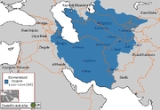
Khwarezm, or Chorasmia, is a large oasis
region on the Amu Darya
river delta
in western Central Asia
, which borders to the north the (former) Aral Sea
, to the east the Kyzylkum desert
, to the south the Karakum desert
and to the west the Ustyurt Plateau
. It was the center of the (indigenous) Khwarezmian civilization and a series of kingdoms, whose capitals were (among others) Kath, Gurganj (the modern Köneürgenç) and, from the 16th century on, Khiva
. Today Khwarezm belongs partly to Uzbekistan
and partly to Turkmenistan
.
In Avestan the name is Xvairizem, in Old Persian Huwarazmish, in Persian
خوارزم Khvārazm, in Arabic
خوارزم Khwārizm, in Chinese
花剌子模 Huālázǐmó, in Uzbek
Xorazm.
The Arab geographer Yaqut al-Hamawi
in his Muʿǧam al-buldan wrote that the name was a compound (in Persian) of khwar (خور), and razm (زم), referring to the abundance of cooked fish as a main diet of the peoples of this area.
C.E. Bosworth
however, believes the Persian name to be made up of (خور) meaning "the sun" and (زم) meaning "Earth", designating "the land from which the sun rises". Another view is that the Iranic
compound stands for "lowland" from kh(w)ar "low" and zam "earth, land.". Khwarezm is indeed the lowest region in Central Asia
(except for the Caspian Sea
to the far west), located on the delta of the Amu Darya
on the southern shores of the Aral Sea
. Various forms of khwar/khar/khor/hor are commonly used also in the Persian Gulf
to stand for tidal flats, marshland, or tidal bays (e.g., Khor Musa, Khor Abdallah, Hor al-Azim, Hor al-Himar, etc.)
The name also appears in Achaemenid inscriptions as Huvarazmish, which is declared to be part of the Persian Empire.
Some of the early scholars believed Khwarezm to be what ancient Avestic
texts refer to as Airyanem Vaejah
("Ariyaneh Waeje"; later Middle Persian
Iran vij). These sources claim that Old Urgench
, which was the capital of ancient Khwarezm for many years, was actually Ourva, the eighth land of Ahura Mazda
mentioned in the Pahlavi text of Vendidad
. However, Michael Witzel, a researcher in early Indo-European history, believes that Airyanem Vaejah was located in what is now Afghanistan
, the northern areas of which were a part of ancient Khwarezm and Greater Khorasan
. Others, however, disagree. University of Hawaii
historian Elton L. Daniel
believes Khwarezm to be the "most likely locale" corresponding to the original home of the Avesta
n people , and Dehkhoda calls Khwarezm "مهد قوم آریا" ("the cradle of the Aryan tribe").
came to Khwarezm; his son Kay Khusraw was established on the throne 92 years later, in 1200 B.C. He starts giving names only with the Afrighid line of Khwarazmshahs, having placed the ascension of Afrighids
in 616 of the Seleucid era, i.e. in 305 A.D.
which later fused with indo-Iranians during their migrations around 1000 BCE. Early Iron Age states arose from this cultural exchange. List of Successive cultures in Khwarzem region 3000-500 BCE:
During the final Saka phase, there were about 400 settlements in Khwarzem. Ruled by the native Afighid Dynasty. It was at this point that Khwarzem entered the historical record with the Acheminide expansion(see also: Kyuzeli-gyr).
language, known as Khwarezmian language
, was spoken in Khwarezm proper (i.e., the lower Amu Darya region) until soon after the Mongol invasion, when it was replaced by Turkic languages. It was closely related to Sogdian
. Other than the astronomical
terms used by the native Iranian
Chorasmian speaker Biruni, our other sources of Khwarezmian include Zamakhshari's Arabic
-Persian
–Khwarezmian dictionary and several legal texts that use Khwarezmian terms to explain certain legal concepts.
In the very early part of its history, the inhabitants of the area were from Iranian
stock and they spoke an Eastern Iranian language
called Khwarezmian
. The famous scientist Biruni, a Khwarezm native, in his Athar ul-Baqiyah (الآثار الباقية عن القرون الخالية) (p. 47), specifically verifies the Iranian
origins of Khwarezmians when he wrote (in Arabic
):
Translation:
The area of Khwarezm was under Afrighid and then Samanid
control until the 10th century before it was conquered by the Ghaznavids. The Iranian Chorasmian language and culture felt the pressure of Turkic infiltration from northern Khwarezm southwards, leading to the disappearance of the original Iranian character of the province and its complete turkicisation today, but Khwarezmian speech probably lasted in upper Khwarezm, the region round Hazārasp, till the end of the 8th/14th century.
The Iranian
Chorasmian language survived for several centuries after Islam
until the Turkification of the region, and so must some at least of the culture and lore of ancient Khwarezm, for it is hard to see the commanding figure of Biruni, a repository of so much knowledge, appearing in a cultural vacuum.
along with Bactriana, Carmania
, and the other eastern provinces of the empire. And the Persian
poet Ferdowsi
mentions Persian cities like Afrasiab
and Chach in abundance in his epic Shahnama.
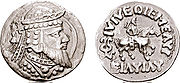 When the king of Khwarezm offered friendship to Alexander the Great in 328 BC, Alexander's Greek and Roman biographers imagined the nomad king of a desert waste, but 20th century Russian archeologists revealed the region as a stable and centralized kingdom, a land of agriculture to the east of the Aral Sea, surrounded by the nomads of Central Asia
, protected by its army of mailed horsemen, in the most powerful kingdom northwest of the Amu Darya
(the Oxus River of antiquity). The king's emissary offered to lead Alexander's armies against his own enemies, west over the Caspian towards the Black Sea
(e.g. Kingdom of Iberia
and Colchis
). Alexander politely refused.
Although largely independent during the Arsacid and Seleucid dynasties, it is known that Khwarezm and neighboring Bactriana were part of the Sassanid empire during the time of Bahram II
. Yaqut al-Hamawi
verifies that Khwarezm was a regional capital of the Sassanid empire. When speaking of the pre-Islamic "Khosrau
of Khwarezm" (خسرو خوارزم), or post-Islamic "Amir of Khwarezm" (امیر خوارزم), or even the Khwarezmid Empire, sources such as Biruni and Ibn Khordadbeh
and others clearly refer to Khwarezm as being part of the Iranian (Persian) empire. The fact that Pahlavi script which was used by the Persian bureaucracy
alongside Old Persian, passed into use in Khwarezmia where it served as the first local alphabet
about the AD
2nd century, as well as evidence that Khwarezm-Shahs such as ʿAlā al-Dīn Tekish (1172–1200) issued all their orders (both administrative and public) in Persian language
(see A. A. Simonov), corroborates Biruni's claims.
(i.g. Iranian) dynasty which ruled over the kingdom of Khwarezm (according to Biruni) from 305 until 995 A.D. The resurgent kingdom was established around Khiva
in 410 by Avar
tribes possibly under Hephthalites influence. T
In 712 Khwarezm was conquered by the Arab
Umayyad
s. It thus came vaguely under Muslim suzerainty, but it was not until the end of the eight century or the beginning of the 9th century that an Afrighid Shah was first converted to Islam
appearing with the popular convert’s name of ʿAbdallah (slave of God). In the course of the 10th century, when some geographers such as Istakhri in his Al-Masalik wa-l-mamalik mention Khwarezm as part of Khorasan
and Transoxiania, the local family of the Ma'munids
who were based in Gurganj, on the left bank of the Amu Darya grew in economic and political importance due to trade caravans. In 995, they violently overthrew the Afrighids of Kath and themselves assumed the traditional title of Khwarazm-Shah. Briefly, the area was under Samanid
suzerainty, before it passed to Mahmud of Ghazna in 1017. From then on, Turco-Mongolian invasions and long rule by Turco-Mongol dynasties supplanted the Iranian character of the region although the title of Khwarezm-Shah was maintained well up to the 13th century.
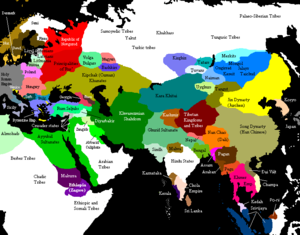
In the 12th century, the Khwarezmid Empire was founded and, in the early 13th century, ruled over all of Persia under the Shah
ʿAlāʾ al-Dīn Muhammad II
(1200–1220). In 1141, Yelü Dashi
won the battle of Qatwan
against a Seljuk
army commanded by Sanjar, as a result, Khwarezm became a vassal of the Kara-Khitan Khanate
. Then from 1218 to 1220 Genghis Khan
and his Mongols
launched the invasion of Central Asia
and destroyed the Kara-Khitan Khanate and the Khwarezmid Empire, including the splendid capital of the latter, Gurganj.
"The Korasmins (i.e. Khwarezmids), a fierce, uncivilized race, thus driven from their homes, spread themselves, in their turn, over the south of Asia with fire and sword, in search of a resting place. In their impetuous course they directed themselves towards Egypt
, whose Sultan, unable to withstand the swarm that had cast their longing eyes on the fertile valleys of the Nile... sent emissaries to Barbaquan, their leader, inviting them to settle in Palestine
... they came, burning and slaying, and were at the walls of Jerusalem... they tore down every vestige of Christian faith..."
"The Sultans of Syria
preferred the Christians to this fierce horde for their neighbours. Even the Sultan of Egypt began to regret the aid he had given to such barbarous foes, and united with those of Emissa
and Damascus
to root them from the land. The Korasmins amounted to but twenty thousand men, and were unable to resist the determined hostility... The Sultans defeated them in several engagements, and the peasantry rose up in masses to take vengeance upon them. No mercy was shown them in defeat. Barbaquan was slain..."
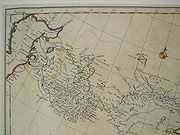
The region of Khwarezm was split between the White Horde and Jagatai Khanate, and its rebuilt capital Gurganj (by now known as "Urganch") again became one of the largest and most important trading centers in Central Asia. In the mid-14th century Khwarezm gained independence from the Golden Horde
under the Sufid dynasty. However, Timur
regarded Khwarezm as a rival to Samarkand
, and over the course of 5 campaigns, he destroyed Urganch completely in 1388. This together with a shift in the course of the Amu-Darya caused the center of Khwarezm to shift to Khiva
, which became in the 16th century the capital of the Khanate of Khiva
, ruled over by the dynasty of the Arabshahids
.
The discovery of gold
on the banks of the Amu Darya
during the reign of Russia's Peter the Great
, together with the desire of the Russian Empire
to open a trade route to the Indus (modern day Pakistan
), prompted an armed trade expedition to the region, led by Prince Alexander Bekovich-Cherkassky
, which was repelled by Khiva.
It was under Tsars Alexander II
and Alexander III
that serious efforts to annex the region started. One of the main pretexts to Russian military expeditions to Khiva was to free Russian slaves in the khanate and to prevent future slave capture and trade.
Early in The Great Game
, Russian interests in the region collided with those of the British Empire
in the First Anglo-Afghan War
in 1839.
The Khanate of Khiva was gradually reduced in size from Russian expansion in Turkestan
(including Khwarezm) and, in 1873, a peace treaty was signed that established Khiva as a quasi-independent Russian protectorate
.
After the Bolshevik
seizure of power in the October Revolution
, a short lived Khorezm People’s Soviet Republic
(later the Khorezm SSR) was created out of the territory of the old Khanate of Khiva, before in 1924 it was finally incorporated into the Soviet Union
, with the former Khanate divided between the new Turkmen SSR
and Uzbek SSR
.
The larger historical area of Khwarezm is further divided. Northern Khwarezm became the Uzbek SSR
, and in 1925 the western part became the Turkmen SSR
.Following the collapse of the Soviet Union
in 1991, these became Uzbekistan
and Turkmenistan
respectively. Southern Khwarezmia is today a part of Iran
. Many of the ancient Khwarezmian towns are situated currently in Xorazm Province
, Uzbekistan
.
Today, the area that was Khwarezm has a mixed population of Uzbeks
, Karakalpaks
, Turkmens, Persians
, Tatars
, and Kazakhs
.
in abundance, in both prose and poetry. Dehkhoda for example defines the name Bukhara
itself as "full of knowledge", referring to the fact that in antiquity, Bukhara was a scientific and scholarship powerhouse. Rumi verifies this when he praises the city as such:
Other examples illustrate the eminent status of Khwarezmid and Transoxianian cities in Persian literature in the past 1500 years:
ای بخارا شاد باش و دیر زی
"Oh Bukhara
! Joy to you and live long!
شاه زی تو میهمان آید همی
Your King comes to you in ceremony."
---Rudaki
عالم جانها بر او هست مقرر چنانک
"The world of hearts is under his power in the same manner that
دولت خوارزمشاه داد جهان را قرار
The Khwarazmshahs have brought peace to the world."
---Khaqani Shirvani
یکی پر طمع پیش خوارزمشاه
"A greedy one went to Khwarezm-shah"
شنیدم که شد بامدادی پگاه
"early one morning, so I have heard
---Sa'di
Yaqut al-Hamawi
, who visited Khwarezm and its capital in 1219, wrote: "I have never seen a city more wealthy and beautiful than Gurganj". The city, however, was destroyed during several invasions, in particular when the Mongol army broke the dams of the Amu Darya
which flooded the city. He reports that for every Mongol soldier, four inhabitants of Gurganj were killed. Najmeddin Kubra
, the great Sufi master, was among the casualties. The Mongol army that devastated Gurganj was estimated to have been near 80,000 soldiers. The verse below refers to an early previous calamity that fell upon the region:
آخر ای خاک خراسان داد یزدانت نجات
"Oh land of Khorasan
! God has saved you,
از بلای غیرت خاک ره گرگانج و کات
from the disaster that befell the land of Gurganj and Kath
---Divan of Anvari
Nevertheless the beauty and fame of Bukhara
and Samarqand are well known in Persian literature
. The following famous cosmopolitan ode
perhaps best provides a notable example of this:
اگر آن ترک شیرازی به دست آرد دل ما را
"If that Shiraz
i Turk can win my heart,
به خال هندویش بخشم سمرقند و بخارا را
I would sell even the jewel cities of Samarqand and Bukhara
for the Indian mole on her cheek."
---Hafiz
Legend has it that Tamerlane sent for Hafiz regarding this verse and asked angrily: "Are you he who was so bold as to offer my two great cities Samarkand
and Bukhara
for the mole on thy mistress's cheek?" Hafiz then replied, "Yes, sire, and it is by such acts of generosity that I have brought myself to such a state of destitution that I have now to solicit your bounty." Tamerlane is written to have been so pleased at his ready wit that he dismissed the poet with a handsome present.
Oasis
In geography, an oasis or cienega is an isolated area of vegetation in a desert, typically surrounding a spring or similar water source...
region on the Amu Darya
Amu Darya
The Amu Darya , also called Oxus and Amu River, is a major river in Central Asia. It is formed by the junction of the Vakhsh and Panj rivers...
river delta
River delta
A delta is a landform that is formed at the mouth of a river where that river flows into an ocean, sea, estuary, lake, reservoir, flat arid area, or another river. Deltas are formed from the deposition of the sediment carried by the river as the flow leaves the mouth of the river...
in western Central Asia
Central Asia
Central Asia is a core region of the Asian continent from the Caspian Sea in the west, China in the east, Afghanistan in the south, and Russia in the north...
, which borders to the north the (former) Aral Sea
Aral Sea
The Aral Sea was a lake that lay between Kazakhstan in the north and Karakalpakstan, an autonomous region of Uzbekistan, in the south...
, to the east the Kyzylkum desert
Kyzyl Kum
The Kyzyl Kum , also called Qyzylqum, is the 11th largest desert in the world. Its name means Red Sand in Turkic languages. It is located in Central Asia in the doab between the rivers Amu Darya and Syr Darya, and is divided between Kazakhstan, Uzbekistan and Turkmenistan...
, to the south the Karakum desert
Karakum Desert
The Karakum Desert, also spelled Kara-Kum and Gara Gum is a desert in Central Asia. It occupies about 70 percent, or 350,000 km², of the area of Turkmenistan....
and to the west the Ustyurt Plateau
Ustyurt Plateau
The Ustyurt Plateau, also spelled Ust-Yurt, Ust-Urt and Usturt , is a central Asian plateau in Uzbekistan and Kazakhstan, between the Aral Sea and the Caspian Sea. It extends roughly 200,000 km², with an average elevation of 150 meters, and consists primarily of stony desert...
. It was the center of the (indigenous) Khwarezmian civilization and a series of kingdoms, whose capitals were (among others) Kath, Gurganj (the modern Köneürgenç) and, from the 16th century on, Khiva
Khiva
Khiva is a city of approximately 50,000 people located in Xorazm Province, Uzbekistan. It is the former capital of Khwarezmia and the Khanate of Khiva...
. Today Khwarezm belongs partly to Uzbekistan
Uzbekistan
Uzbekistan , officially the Republic of Uzbekistan is a doubly landlocked country in Central Asia and one of the six independent Turkic states. It shares borders with Kazakhstan to the west and to the north, Kyrgyzstan and Tajikistan to the east, and Afghanistan and Turkmenistan to the south....
and partly to Turkmenistan
Turkmenistan
Turkmenistan , formerly also known as Turkmenia is one of the Turkic states in Central Asia. Until 1991, it was a constituent republic of the Soviet Union, the Turkmen Soviet Socialist Republic . Turkmenistan is one of the six independent Turkic states...
.
Names and etymology
Khwarezm has been known also as Chorasmia, Khwarezmia, Khwarizm, Khwarazm, Khorezm, Khoresm, Khorasam, Harezm, Horezm, and Chorezm.In Avestan the name is Xvairizem, in Old Persian Huwarazmish, in Persian
Persian language
Persian is an Iranian language within the Indo-Iranian branch of the Indo-European languages. It is primarily spoken in Iran, Afghanistan, Tajikistan and countries which historically came under Persian influence...
خوارزم Khvārazm, in Arabic
Arabic language
Arabic is a name applied to the descendants of the Classical Arabic language of the 6th century AD, used most prominently in the Quran, the Islamic Holy Book...
خوارزم Khwārizm, in Chinese
Chinese language
The Chinese language is a language or language family consisting of varieties which are mutually intelligible to varying degrees. Originally the indigenous languages spoken by the Han Chinese in China, it forms one of the branches of Sino-Tibetan family of languages...
花剌子模 Huālázǐmó, in Uzbek
Uzbek language
Uzbek is a Turkic language and the official language of Uzbekistan. It has about 25.5 million native speakers, and it is spoken by the Uzbeks in Uzbekistan and elsewhere in Central Asia...
Xorazm.
The Arab geographer Yaqut al-Hamawi
Yaqut al-Hamawi
Yāqūt ibn-'Abdullah al-Rūmī al-Hamawī) was an Islamic biographer and geographer renowned for his encyclopedic writings on the Muslim world. "al-Rumi" refers to his Greek descent; "al-Hamawi" means that he is from Hama, Syria, and ibn-Abdullah is a reference to his father's name, Abdullah...
in his Muʿǧam al-buldan wrote that the name was a compound (in Persian) of khwar (خور), and razm (زم), referring to the abundance of cooked fish as a main diet of the peoples of this area.
C.E. Bosworth
Clifford Edmund Bosworth
Clifford Edmund Bosworth FBA is an English historian and orientalist, specializing in Arabic studies. He received his B.A. degree from Oxford University and M.A. and Ph.D. degrees from Edinburgh University. He held permanent posts at St. Andrews University, Manchester University, and the Center...
however, believes the Persian name to be made up of (خور) meaning "the sun" and (زم) meaning "Earth", designating "the land from which the sun rises". Another view is that the Iranic
Iranian languages
The Iranian languages form a subfamily of the Indo-Iranian languages which in turn is a subgroup of Indo-European language family. They have been and are spoken by Iranian peoples....
compound stands for "lowland" from kh(w)ar "low" and zam "earth, land.". Khwarezm is indeed the lowest region in Central Asia
Central Asia
Central Asia is a core region of the Asian continent from the Caspian Sea in the west, China in the east, Afghanistan in the south, and Russia in the north...
(except for the Caspian Sea
Caspian Sea
The Caspian Sea is the largest enclosed body of water on Earth by area, variously classed as the world's largest lake or a full-fledged sea. The sea has a surface area of and a volume of...
to the far west), located on the delta of the Amu Darya
Amu Darya
The Amu Darya , also called Oxus and Amu River, is a major river in Central Asia. It is formed by the junction of the Vakhsh and Panj rivers...
on the southern shores of the Aral Sea
Aral Sea
The Aral Sea was a lake that lay between Kazakhstan in the north and Karakalpakstan, an autonomous region of Uzbekistan, in the south...
. Various forms of khwar/khar/khor/hor are commonly used also in the Persian Gulf
Persian Gulf
The Persian Gulf, in Southwest Asia, is an extension of the Indian Ocean located between Iran and the Arabian Peninsula.The Persian Gulf was the focus of the 1980–1988 Iran-Iraq War, in which each side attacked the other's oil tankers...
to stand for tidal flats, marshland, or tidal bays (e.g., Khor Musa, Khor Abdallah, Hor al-Azim, Hor al-Himar, etc.)
The name also appears in Achaemenid inscriptions as Huvarazmish, which is declared to be part of the Persian Empire.
Some of the early scholars believed Khwarezm to be what ancient Avestic
Avesta
The Avesta is the primary collection of sacred texts of Zoroastrianism, composed in the Avestan language.-Early transmission:The texts of the Avesta — which are all in the Avestan language — were composed over the course of several hundred years. The most important portion, the Gathas,...
texts refer to as Airyanem Vaejah
Airyanem Vaejah
Airyanəm Vaējah, which approximately means "expanse of the Aryans, i.e. Iranians" is the "mythical homeland" of early Iranians and a reference in the Zoroastrian Avesta Airyanəm Vaējah, which approximately means "expanse of the Aryans, i.e. Iranians" is the "mythical homeland" of early Iranians and...
("Ariyaneh Waeje"; later Middle Persian
Middle Persian
Middle Persian , indigenously known as "Pârsig" sometimes referred to as Pahlavi or Pehlevi, is the Middle Iranian language/ethnolect of Southwestern Iran that during Sassanid times became a prestige dialect and so came to be spoken in other regions as well. Middle Persian is classified as a...
Iran vij). These sources claim that Old Urgench
Kunya Urgench
Konye-Urgench also known as Konya-Urgench, Old Urgench or Urganj, is a municipality of about 30,000 inhabitants in north-eastern Turkmenistan, just south from its border with Uzbekistan. It is the site of the ancient town of Ürgenç , which contains the unexcavated ruins of the 12th-century capital...
, which was the capital of ancient Khwarezm for many years, was actually Ourva, the eighth land of Ahura Mazda
Ahura Mazda
Ahura Mazdā is the Avestan name for a divinity of the Old Iranian religion who was proclaimed the uncreated God by Zoroaster, the founder of Zoroastrianism...
mentioned in the Pahlavi text of Vendidad
Vendidad
The Vendidad or Videvdat is a collection of texts within the greater compendium of the Avesta. However, unlike the other texts of the Avesta, the Vendidad is an ecclesiastical code, not a liturgical manual.-Name:...
. However, Michael Witzel, a researcher in early Indo-European history, believes that Airyanem Vaejah was located in what is now Afghanistan
Afghanistan
Afghanistan , officially the Islamic Republic of Afghanistan, is a landlocked country located in the centre of Asia, forming South Asia, Central Asia and the Middle East. With a population of about 29 million, it has an area of , making it the 42nd most populous and 41st largest nation in the world...
, the northern areas of which were a part of ancient Khwarezm and Greater Khorasan
Greater Khorasan
Greater Khorasan or Ancient Khorasan is a historical region of Greater Iran mentioned in sources from Sassanid and Islamic eras which "frequently" had a denotation wider than current three provinces of Khorasan in Iran...
. Others, however, disagree. University of Hawaii
University of Hawaii
The University of Hawaii System, formally the University of Hawaii and popularly known as UH, is a public, co-educational college and university system that confers associate, bachelor, master, and doctoral degrees through three university campuses, seven community college campuses, an employment...
historian Elton L. Daniel
Elton L. Daniel
Elton L. Daniel, Ph.D., is a historian and Iranologist.A professor at the University of Hawaii, he received his doctorate from UT Austin. Elton Daniel is an associate editor of Encyclopædia Iranica, and has conducted research and traveled extensively in Iran, Turkey, Syria, Egypt, France, and the...
believes Khwarezm to be the "most likely locale" corresponding to the original home of the Avesta
Avesta
The Avesta is the primary collection of sacred texts of Zoroastrianism, composed in the Avestan language.-Early transmission:The texts of the Avesta — which are all in the Avestan language — were composed over the course of several hundred years. The most important portion, the Gathas,...
n people , and Dehkhoda calls Khwarezm "مهد قوم آریا" ("the cradle of the Aryan tribe").
Legendary history
The native Chorasmian (an Iranian language) speaker Biruni says that the land was first colonised 980 years before Alexander the Great, sc. before the Seleucid era, i.e. in 1292 B.C., when the hero of Iranian epic SiyavashSiyâvash
Siavash or Siyāvush, from Avestan Syāvaršan, is a major figure in Ferdowsi's epic, the Shahnameh. He was a legendary Persian prince from the earliest days of the Persian Empire...
came to Khwarezm; his son Kay Khusraw was established on the throne 92 years later, in 1200 B.C. He starts giving names only with the Afrighid line of Khwarazmshahs, having placed the ascension of Afrighids
Afrighids
The Afrighids were native Chorasmian Iranian dynasty who ruled over the ancient kingdom of Chorasmia until 995 AD.-Sources:...
in 616 of the Seleucid era, i.e. in 305 A.D.
Early people
Like Soghdiana, Khwarzem was an expansion of the BMAC culture during the Bronze AgeBronze Age
The Bronze Age is a period characterized by the use of copper and its alloy bronze as the chief hard materials in the manufacture of some implements and weapons. Chronologically, it stands between the Stone Age and Iron Age...
which later fused with indo-Iranians during their migrations around 1000 BCE. Early Iron Age states arose from this cultural exchange. List of Successive cultures in Khwarzem region 3000-500 BCE:
- Keltiminar CultureKeltiminarThe Keltiminar culture occupied the semi-desert and desert areas of the Karakum and Kyzyl Kum deserts and the deltas of the Amu Darya and Zeravshan rivers in Central Asia. The Keltiminar people practised a mobile hunting, gathering and fishing subsistence system. Over time, they adopted...
c. 3000 BCE - Suyargan Culture c 2000 BCE
- Tazabag’yab Culture c. 1500 BCE
- Amirabad Culture c 1000 BCE
- Saka c. 500 BCE
During the final Saka phase, there were about 400 settlements in Khwarzem. Ruled by the native Afighid Dynasty. It was at this point that Khwarzem entered the historical record with the Acheminide expansion(see also: Kyuzeli-gyr).
Khwarezmian language and culture
An East IranianEastern Iranian languages
The Eastern Iranian languages are a subgroup of the Iranian languages emerging in Middle Iranian times .The Avestan language is often classified as early Eastern Iranian. The largest living Eastern Iranian language is Pashto, with some 50 million speakers between the Hindu Kush mountains in...
language, known as Khwarezmian language
Khwarezmian language
Khwarezmian, also known as Khwarazmian or Chorasmian, is the name of an extinct East Iranian language closely related to Sogdian. The language was spoken in the area of Khwarezm , centered in the lower Amu Darya south of the Aral Sea .Our knowledge of Khwarezmian is...
, was spoken in Khwarezm proper (i.e., the lower Amu Darya region) until soon after the Mongol invasion, when it was replaced by Turkic languages. It was closely related to Sogdian
Sogdian language
The Sogdian language is a Middle Iranian language that was spoken in Sogdiana , located in modern day Uzbekistan and Tajikistan ....
. Other than the astronomical
Astronomy
Astronomy is a natural science that deals with the study of celestial objects and phenomena that originate outside the atmosphere of Earth...
terms used by the native Iranian
Iranian peoples
The Iranian peoples are an Indo-European ethnic-linguistic group, consisting of the speakers of Iranian languages, a major branch of the Indo-European language family, as such forming a branch of Indo-European-speaking peoples...
Chorasmian speaker Biruni, our other sources of Khwarezmian include Zamakhshari's Arabic
Arabic language
Arabic is a name applied to the descendants of the Classical Arabic language of the 6th century AD, used most prominently in the Quran, the Islamic Holy Book...
-Persian
Persian language
Persian is an Iranian language within the Indo-Iranian branch of the Indo-European languages. It is primarily spoken in Iran, Afghanistan, Tajikistan and countries which historically came under Persian influence...
–Khwarezmian dictionary and several legal texts that use Khwarezmian terms to explain certain legal concepts.
In the very early part of its history, the inhabitants of the area were from Iranian
Iranian peoples
The Iranian peoples are an Indo-European ethnic-linguistic group, consisting of the speakers of Iranian languages, a major branch of the Indo-European language family, as such forming a branch of Indo-European-speaking peoples...
stock and they spoke an Eastern Iranian language
Iranian languages
The Iranian languages form a subfamily of the Indo-Iranian languages which in turn is a subgroup of Indo-European language family. They have been and are spoken by Iranian peoples....
called Khwarezmian
Khwarezmian
The name Khwarezmian may refer to:* Khwarezm, a series of states in what is now known as Greater Iran...
. The famous scientist Biruni, a Khwarezm native, in his Athar ul-Baqiyah (الآثار الباقية عن القرون الخالية) (p. 47), specifically verifies the Iranian
Iranian peoples
The Iranian peoples are an Indo-European ethnic-linguistic group, consisting of the speakers of Iranian languages, a major branch of the Indo-European language family, as such forming a branch of Indo-European-speaking peoples...
origins of Khwarezmians when he wrote (in Arabic
Arabic language
Arabic is a name applied to the descendants of the Classical Arabic language of the 6th century AD, used most prominently in the Quran, the Islamic Holy Book...
):
- "أهل خوارزم [...] کانوا غصناً من دوحة الفرس"
Translation:
- "The people of the Khwarezm were a branch from Persian tree."
The area of Khwarezm was under Afrighid and then Samanid
Samanid
The Samani dynasty , also known as the Samanid Empire, or simply Samanids was a Persian state and empire in Central Asia and Greater Iran, named after its founder Saman Khuda, who converted to Sunni Islam despite being from Zoroastrian theocratic nobility...
control until the 10th century before it was conquered by the Ghaznavids. The Iranian Chorasmian language and culture felt the pressure of Turkic infiltration from northern Khwarezm southwards, leading to the disappearance of the original Iranian character of the province and its complete turkicisation today, but Khwarezmian speech probably lasted in upper Khwarezm, the region round Hazārasp, till the end of the 8th/14th century.
The Iranian
Iranian peoples
The Iranian peoples are an Indo-European ethnic-linguistic group, consisting of the speakers of Iranian languages, a major branch of the Indo-European language family, as such forming a branch of Indo-European-speaking peoples...
Chorasmian language survived for several centuries after Islam
Islam
Islam . The most common are and . : Arabic pronunciation varies regionally. The first vowel ranges from ~~. The second vowel ranges from ~~~...
until the Turkification of the region, and so must some at least of the culture and lore of ancient Khwarezm, for it is hard to see the commanding figure of Biruni, a repository of so much knowledge, appearing in a cultural vacuum.
Achaemenid, Parthian and Sassanid era
During the Achaemenid period, Khwarezm was governed by Smerdis/BardiyaSmerdis of Persia
Bardiya was a son of Cyrus the Great and the younger brother of Cambyses II, both Persian kings. There are sharply divided views on his life, he may have ruled the Achaemenid Empire for a few months in 522 BCE, or he may have been impersonated by a magus called Gaumata. -Name and sources:The...
along with Bactriana, Carmania
Carmania
Carmania may refer to* Carmania, ancient satrapy of the Achaemenid Persian empire.* Carmania - a diecast model producer.* Kermān Province in the south-east of Iran.* RMS Carmania , a Cunard liner built 1905...
, and the other eastern provinces of the empire. And the Persian
Persian people
The Persian people are part of the Iranian peoples who speak the modern Persian language and closely akin Iranian dialects and languages. The origin of the ethnic Iranian/Persian peoples are traced to the Ancient Iranian peoples, who were part of the ancient Indo-Iranians and themselves part of...
poet Ferdowsi
Ferdowsi
Ferdowsi was a highly revered Persian poet. He was the author of the Shahnameh, the national epic of Iran and related societies.The Shahnameh was originally composed by Ferdowsi for the princes of the Samanid dynasty, who were responsible for a revival of Persian cultural traditions after the...
mentions Persian cities like Afrasiab
Afrasiab
Afrasiab is the name of the mythical king and hero of Turan.-The Mythical King and Hero:According to the Shahnameh , by the Persian epic poet Ferdowsi, Afrasiab was the king and hero of Turan and an archenemy of Iran...
and Chach in abundance in his epic Shahnama.
Central Asia
Central Asia is a core region of the Asian continent from the Caspian Sea in the west, China in the east, Afghanistan in the south, and Russia in the north...
, protected by its army of mailed horsemen, in the most powerful kingdom northwest of the Amu Darya
Amu Darya
The Amu Darya , also called Oxus and Amu River, is a major river in Central Asia. It is formed by the junction of the Vakhsh and Panj rivers...
(the Oxus River of antiquity). The king's emissary offered to lead Alexander's armies against his own enemies, west over the Caspian towards the Black Sea
Black Sea
The Black Sea is bounded by Europe, Anatolia and the Caucasus and is ultimately connected to the Atlantic Ocean via the Mediterranean and the Aegean seas and various straits. The Bosphorus strait connects it to the Sea of Marmara, and the strait of the Dardanelles connects that sea to the Aegean...
(e.g. Kingdom of Iberia
Caucasian Iberia
Iberia , also known as Iveria , was a name given by the ancient Greeks and Romans to the ancient Georgian kingdom of Kartli , corresponding roughly to the eastern and southern parts of the present day Georgia...
and Colchis
Colchis
In ancient geography, Colchis or Kolkhis was an ancient Georgian state kingdom and region in Western Georgia, which played an important role in the ethnic and cultural formation of the Georgian nation.The Kingdom of Colchis contributed significantly to the development of medieval Georgian...
). Alexander politely refused.
Although largely independent during the Arsacid and Seleucid dynasties, it is known that Khwarezm and neighboring Bactriana were part of the Sassanid empire during the time of Bahram II
Bahram II
Bahram II was the fifth Sassanid King of Persia in 276–293. He was the son of Bahram I .Bahram II is said to have ruled at first tyrannically, and to have greatly disgusted all his principal nobles, who went so far as to form a conspiracy against him, and intended to put him to death...
. Yaqut al-Hamawi
Yaqut al-Hamawi
Yāqūt ibn-'Abdullah al-Rūmī al-Hamawī) was an Islamic biographer and geographer renowned for his encyclopedic writings on the Muslim world. "al-Rumi" refers to his Greek descent; "al-Hamawi" means that he is from Hama, Syria, and ibn-Abdullah is a reference to his father's name, Abdullah...
verifies that Khwarezm was a regional capital of the Sassanid empire. When speaking of the pre-Islamic "Khosrau
Khosrau
Khusro, Khosrau, Khusrau, Khosro, or Khusraw is the name of a mythical Persian leader, in the Avesta of the Zoroastrians known as Kavi Haosravah, with the meaning "with good reputation"...
of Khwarezm" (خسرو خوارزم), or post-Islamic "Amir of Khwarezm" (امیر خوارزم), or even the Khwarezmid Empire, sources such as Biruni and Ibn Khordadbeh
Ibn Khordadbeh
Abu'l Qasim Ubaid'Allah ibn Khordadbeh , author of the earliest surviving Arabic book of administrative geography, was a Persian geographer and bureaucrat of the 9th century...
and others clearly refer to Khwarezm as being part of the Iranian (Persian) empire. The fact that Pahlavi script which was used by the Persian bureaucracy
Bureaucracy
A bureaucracy is an organization of non-elected officials of a governmental or organization who implement the rules, laws, and functions of their institution, and are occasionally characterized by officialism and red tape.-Weberian bureaucracy:...
alongside Old Persian, passed into use in Khwarezmia where it served as the first local alphabet
Alphabet
An alphabet is a standard set of letters—basic written symbols or graphemes—each of which represents a phoneme in a spoken language, either as it exists now or as it was in the past. There are other systems, such as logographies, in which each character represents a word, morpheme, or semantic...
about the AD
Anno Domini
and Before Christ are designations used to label or number years used with the Julian and Gregorian calendars....
2nd century, as well as evidence that Khwarezm-Shahs such as ʿAlā al-Dīn Tekish (1172–1200) issued all their orders (both administrative and public) in Persian language
Persian language
Persian is an Iranian language within the Indo-Iranian branch of the Indo-European languages. It is primarily spoken in Iran, Afghanistan, Tajikistan and countries which historically came under Persian influence...
(see A. A. Simonov), corroborates Biruni's claims.
Afrighids
The Afrighids were a native ChorasmianKhwarezmian language
Khwarezmian, also known as Khwarazmian or Chorasmian, is the name of an extinct East Iranian language closely related to Sogdian. The language was spoken in the area of Khwarezm , centered in the lower Amu Darya south of the Aral Sea .Our knowledge of Khwarezmian is...
(i.g. Iranian) dynasty which ruled over the kingdom of Khwarezm (according to Biruni) from 305 until 995 A.D. The resurgent kingdom was established around Khiva
Khiva
Khiva is a city of approximately 50,000 people located in Xorazm Province, Uzbekistan. It is the former capital of Khwarezmia and the Khanate of Khiva...
in 410 by Avar
Eurasian Avars
The Eurasian Avars or Ancient Avars were a highly organized nomadic confederacy of mixed origins. They were ruled by a khagan, who was surrounded by a tight-knit entourage of nomad warriors, an organization characteristic of Turko-Mongol groups...
tribes possibly under Hephthalites influence. T
In 712 Khwarezm was conquered by the Arab
Arab
Arab people, also known as Arabs , are a panethnicity primarily living in the Arab world, which is located in Western Asia and North Africa. They are identified as such on one or more of genealogical, linguistic, or cultural grounds, with tribal affiliations, and intra-tribal relationships playing...
Umayyad
Umayyad
The Umayyad Caliphate was the second of the four major Arab caliphates established after the death of Muhammad. It was ruled by the Umayyad dynasty, whose name derives from Umayya ibn Abd Shams, the great-grandfather of the first Umayyad caliph. Although the Umayyad family originally came from the...
s. It thus came vaguely under Muslim suzerainty, but it was not until the end of the eight century or the beginning of the 9th century that an Afrighid Shah was first converted to Islam
Islam
Islam . The most common are and . : Arabic pronunciation varies regionally. The first vowel ranges from ~~. The second vowel ranges from ~~~...
appearing with the popular convert’s name of ʿAbdallah (slave of God). In the course of the 10th century, when some geographers such as Istakhri in his Al-Masalik wa-l-mamalik mention Khwarezm as part of Khorasan
Greater Khorasan
Greater Khorasan or Ancient Khorasan is a historical region of Greater Iran mentioned in sources from Sassanid and Islamic eras which "frequently" had a denotation wider than current three provinces of Khorasan in Iran...
and Transoxiania, the local family of the Ma'munids
Ma'munids
ĀL-E MAʾMŪN , were an independent dynasty of Iranian rulers in Chorasmia. Their reign was short-lived and were in turn replaced by the expansionist Ghaznavids.-Rulers and Kingdom:...
who were based in Gurganj, on the left bank of the Amu Darya grew in economic and political importance due to trade caravans. In 995, they violently overthrew the Afrighids of Kath and themselves assumed the traditional title of Khwarazm-Shah. Briefly, the area was under Samanid
Samanid
The Samani dynasty , also known as the Samanid Empire, or simply Samanids was a Persian state and empire in Central Asia and Greater Iran, named after its founder Saman Khuda, who converted to Sunni Islam despite being from Zoroastrian theocratic nobility...
suzerainty, before it passed to Mahmud of Ghazna in 1017. From then on, Turco-Mongolian invasions and long rule by Turco-Mongol dynasties supplanted the Iranian character of the region although the title of Khwarezm-Shah was maintained well up to the 13th century.
Khwarezmid Empire
In the 12th century, the Khwarezmid Empire was founded and, in the early 13th century, ruled over all of Persia under the Shah
Shah
Shāh is the title of the ruler of certain Southwest Asian and Central Asian countries, especially Persia , and derives from the Persian word shah, meaning "king".-History:...
ʿAlāʾ al-Dīn Muhammad II
Muhammad II of Khwarezm
Ala ad-Din Muhammad II was the ruler of the Khwarezmid Empire from 1200 to 1220. His ancestor was a Turkic slave who eventually became a viceroy of a small province named Khwarizm. After his father died, Muhammad inherited his father's lands, and it was from there he began expanding outwards...
(1200–1220). In 1141, Yelü Dashi
Yelü Dashi
Yelü Dashi , or Yeh-Lü Ta-Shih was the founder of the Western Liao dynasty, or the Kara-Khitan Khanate....
won the battle of Qatwan
Battle of Qatwan
The Battle of Qatwan was fought in September 1141 between the Kara-Khitan Khanate and the Seljuq Empire and its vassal-state the Kara-Khanids. Following the Kara-Khanid defeat at Khujand, Mahmud summoned his overlord Ahmed Sanjar to protect Western Kara-Khanid from invasion.-Battle:On the Qatwan...
against a Seljuk
Great Seljuq Empire
The Great Seljuq Empire was a medieval Persianate, Turko-Persian Sunni Muslim empire, originating from the Qynyq branch of Oghuz Turks. The Seljuq Empire controlled a vast area stretching from the Hindu Kush to eastern Anatolia and from Central Asia to the Persian Gulf...
army commanded by Sanjar, as a result, Khwarezm became a vassal of the Kara-Khitan Khanate
Kara-Khitan Khanate
The Kara-Khitan Khanate, or Western Liao was a Khitan empire in Central Asia. The dynasty was founded by Yelü Dashi, who led the remnants of the Liao Dynasty to Central Asia after fleeing from the Jurchen conquest of their homeland in North and Northeast of modern day China...
. Then from 1218 to 1220 Genghis Khan
Genghis Khan
Genghis Khan , born Temujin and occasionally known by his temple name Taizu , was the founder and Great Khan of the Mongol Empire, which became the largest contiguous empire in history after his death....
and his Mongols
Mongols
Mongols ) are a Central-East Asian ethnic group that lives mainly in the countries of Mongolia, China, and Russia. In China, ethnic Mongols can be found mainly in the central north region of China such as Inner Mongolia...
launched the invasion of Central Asia
Mongol invasion of Central Asia
The Mongol invasion of Central Asia occurred after the unification of the Mongol and Turkic tribes on Mongolian plateau in 1206. It finally completed when Genghis Khan conquered the Khwarizmian Empire in 1221....
and destroyed the Kara-Khitan Khanate and the Khwarezmid Empire, including the splendid capital of the latter, Gurganj.
"The Korasmins (i.e. Khwarezmids), a fierce, uncivilized race, thus driven from their homes, spread themselves, in their turn, over the south of Asia with fire and sword, in search of a resting place. In their impetuous course they directed themselves towards Egypt
Egypt
Egypt , officially the Arab Republic of Egypt, Arabic: , is a country mainly in North Africa, with the Sinai Peninsula forming a land bridge in Southwest Asia. Egypt is thus a transcontinental country, and a major power in Africa, the Mediterranean Basin, the Middle East and the Muslim world...
, whose Sultan, unable to withstand the swarm that had cast their longing eyes on the fertile valleys of the Nile... sent emissaries to Barbaquan, their leader, inviting them to settle in Palestine
Palestine
Palestine is a conventional name, among others, used to describe the geographic region between the Mediterranean Sea and the Jordan River, and various adjoining lands....
... they came, burning and slaying, and were at the walls of Jerusalem... they tore down every vestige of Christian faith..."
"The Sultans of Syria
Syria
Syria , officially the Syrian Arab Republic , is a country in Western Asia, bordering Lebanon and the Mediterranean Sea to the West, Turkey to the north, Iraq to the east, Jordan to the south, and Israel to the southwest....
preferred the Christians to this fierce horde for their neighbours. Even the Sultan of Egypt began to regret the aid he had given to such barbarous foes, and united with those of Emissa
Edessa, Mesopotamia
Edessa is the Greek name of an Aramaic town in northern Mesopotamia, as refounded by Seleucus I Nicator. For the modern history of the city, see Şanlıurfa.-Names:...
and Damascus
Damascus
Damascus , commonly known in Syria as Al Sham , and as the City of Jasmine , is the capital and the second largest city of Syria after Aleppo, both are part of the country's 14 governorates. In addition to being one of the oldest continuously inhabited cities in the world, Damascus is a major...
to root them from the land. The Korasmins amounted to but twenty thousand men, and were unable to resist the determined hostility... The Sultans defeated them in several engagements, and the peasantry rose up in masses to take vengeance upon them. No mercy was shown them in defeat. Barbaquan was slain..."
Modern Age
The region of Khwarezm was split between the White Horde and Jagatai Khanate, and its rebuilt capital Gurganj (by now known as "Urganch") again became one of the largest and most important trading centers in Central Asia. In the mid-14th century Khwarezm gained independence from the Golden Horde
Golden Horde
The Golden Horde was a Mongol and later Turkicized khanate that formed the north-western sector of the Mongol Empire...
under the Sufid dynasty. However, Timur
Timur
Timur , historically known as Tamerlane in English , was a 14th-century conqueror of West, South and Central Asia, and the founder of the Timurid dynasty in Central Asia, and great-great-grandfather of Babur, the founder of the Mughal Dynasty, which survived as the Mughal Empire in India until...
regarded Khwarezm as a rival to Samarkand
Samarkand
Although a Persian-speaking region, it was not united politically with Iran most of the times between the disintegration of the Seleucid Empire and the Arab conquest . In the 6th century it was within the domain of the Turkic kingdom of the Göktürks.At the start of the 8th century Samarkand came...
, and over the course of 5 campaigns, he destroyed Urganch completely in 1388. This together with a shift in the course of the Amu-Darya caused the center of Khwarezm to shift to Khiva
Khiva
Khiva is a city of approximately 50,000 people located in Xorazm Province, Uzbekistan. It is the former capital of Khwarezmia and the Khanate of Khiva...
, which became in the 16th century the capital of the Khanate of Khiva
Khanate of Khiva
The Khanate of Khiva was the name of a Uzbek state that existed in the historical region of Khwarezm from 1511 to 1920, except for a period of Persian occupation by Nadir Shah between 1740–1746. It was the patrilineal descendants of Shayban , the fifth son of Jochi and grandson of Genghis Khan...
, ruled over by the dynasty of the Arabshahids
Khanate of Khiva
The Khanate of Khiva was the name of a Uzbek state that existed in the historical region of Khwarezm from 1511 to 1920, except for a period of Persian occupation by Nadir Shah between 1740–1746. It was the patrilineal descendants of Shayban , the fifth son of Jochi and grandson of Genghis Khan...
.
The discovery of gold
Gold
Gold is a chemical element with the symbol Au and an atomic number of 79. Gold is a dense, soft, shiny, malleable and ductile metal. Pure gold has a bright yellow color and luster traditionally considered attractive, which it maintains without oxidizing in air or water. Chemically, gold is a...
on the banks of the Amu Darya
Amu Darya
The Amu Darya , also called Oxus and Amu River, is a major river in Central Asia. It is formed by the junction of the Vakhsh and Panj rivers...
during the reign of Russia's Peter the Great
Peter I of Russia
Peter the Great, Peter I or Pyotr Alexeyevich Romanov Dates indicated by the letters "O.S." are Old Style. All other dates in this article are New Style. ruled the Tsardom of Russia and later the Russian Empire from until his death, jointly ruling before 1696 with his half-brother, Ivan V...
, together with the desire of the Russian Empire
Russian Empire
The Russian Empire was a state that existed from 1721 until the Russian Revolution of 1917. It was the successor to the Tsardom of Russia and the predecessor of the Soviet Union...
to open a trade route to the Indus (modern day Pakistan
Pakistan
Pakistan , officially the Islamic Republic of Pakistan is a sovereign state in South Asia. It has a coastline along the Arabian Sea and the Gulf of Oman in the south and is bordered by Afghanistan and Iran in the west, India in the east and China in the far northeast. In the north, Tajikistan...
), prompted an armed trade expedition to the region, led by Prince Alexander Bekovich-Cherkassky
Alexander Bekovich-Cherkassky
Prince Alexander Bekovich-Cherkassky was a Russian officer of Circassian origin who led the first Russian military expedition into Central Asia.-Background:...
, which was repelled by Khiva.
It was under Tsars Alexander II
Alexander II of Russia
Alexander II , also known as Alexander the Liberator was the Emperor of the Russian Empire from 3 March 1855 until his assassination in 1881...
and Alexander III
Alexander III of Russia
Alexander Alexandrovich Romanov , historically remembered as Alexander III or Alexander the Peacemaker reigned as Emperor of Russia from until his death on .-Disposition:...
that serious efforts to annex the region started. One of the main pretexts to Russian military expeditions to Khiva was to free Russian slaves in the khanate and to prevent future slave capture and trade.
Early in The Great Game
The Great Game
The Great Game or Tournament of Shadows in Russia, were terms for the strategic rivalry and conflict between the British Empire and the Russian Empire for supremacy in Central Asia. The classic Great Game period is generally regarded as running approximately from the Russo-Persian Treaty of 1813...
, Russian interests in the region collided with those of the British Empire
British Empire
The British Empire comprised the dominions, colonies, protectorates, mandates and other territories ruled or administered by the United Kingdom. It originated with the overseas colonies and trading posts established by England in the late 16th and early 17th centuries. At its height, it was the...
in the First Anglo-Afghan War
First Anglo-Afghan War
The First Anglo-Afghan War was fought between British India and Afghanistan from 1839 to 1842. It was one of the first major conflicts during the Great Game, the 19th century competition for power and influence in Central Asia between the United Kingdom and Russia, and also marked one of the worst...
in 1839.
The Khanate of Khiva was gradually reduced in size from Russian expansion in Turkestan
Turkestan
Turkestan, spelled also as Turkistan, literally means "Land of the Turks".The term Turkestan is of Persian origin and has never been in use to denote a single nation. It was first used by Persian geographers to describe the place of Turkish peoples...
(including Khwarezm) and, in 1873, a peace treaty was signed that established Khiva as a quasi-independent Russian protectorate
Protectorate
In history, the term protectorate has two different meanings. In its earliest inception, which has been adopted by modern international law, it is an autonomous territory that is protected diplomatically or militarily against third parties by a stronger state or entity...
.
After the Bolshevik
Bolshevik
The Bolsheviks, originally also Bolshevists , derived from bol'shinstvo, "majority") were a faction of the Marxist Russian Social Democratic Labour Party which split apart from the Menshevik faction at the Second Party Congress in 1903....
seizure of power in the October Revolution
October Revolution
The October Revolution , also known as the Great October Socialist Revolution , Red October, the October Uprising or the Bolshevik Revolution, was a political revolution and a part of the Russian Revolution of 1917...
, a short lived Khorezm People’s Soviet Republic
Khorezm SSR
Khorezm People's Soviet Republic was created as the successor to the Khanate of Khiva in February 1920, when the khan abdicated in response to popular pressure, and officially declared by the First Khorezm Kurultay on 26 April 1920...
(later the Khorezm SSR) was created out of the territory of the old Khanate of Khiva, before in 1924 it was finally incorporated into the Soviet Union
Soviet Union
The Soviet Union , officially the Union of Soviet Socialist Republics , was a constitutionally socialist state that existed in Eurasia between 1922 and 1991....
, with the former Khanate divided between the new Turkmen SSR
Turkmen SSR
The Turkmen Soviet Socialist Republic , also known as the Turkmen SSR for short, was one of republics of the Soviet Union in Central Asia. It was initially established on 7 August 1921 as the Turkmen Oblast of the Turkestan ASSR. On 13 May 1925 it was transformed into Turkmen SSR and became a...
and Uzbek SSR
Uzbek SSR
The Uzbek Soviet Socialist Republic , also known as the Uzbek SSR for short, was one of the republics of the Soviet Union since its creation in 1924...
.
The larger historical area of Khwarezm is further divided. Northern Khwarezm became the Uzbek SSR
Uzbek SSR
The Uzbek Soviet Socialist Republic , also known as the Uzbek SSR for short, was one of the republics of the Soviet Union since its creation in 1924...
, and in 1925 the western part became the Turkmen SSR
Turkmen SSR
The Turkmen Soviet Socialist Republic , also known as the Turkmen SSR for short, was one of republics of the Soviet Union in Central Asia. It was initially established on 7 August 1921 as the Turkmen Oblast of the Turkestan ASSR. On 13 May 1925 it was transformed into Turkmen SSR and became a...
.Following the collapse of the Soviet Union
Soviet Union
The Soviet Union , officially the Union of Soviet Socialist Republics , was a constitutionally socialist state that existed in Eurasia between 1922 and 1991....
in 1991, these became Uzbekistan
Uzbekistan
Uzbekistan , officially the Republic of Uzbekistan is a doubly landlocked country in Central Asia and one of the six independent Turkic states. It shares borders with Kazakhstan to the west and to the north, Kyrgyzstan and Tajikistan to the east, and Afghanistan and Turkmenistan to the south....
and Turkmenistan
Turkmenistan
Turkmenistan , formerly also known as Turkmenia is one of the Turkic states in Central Asia. Until 1991, it was a constituent republic of the Soviet Union, the Turkmen Soviet Socialist Republic . Turkmenistan is one of the six independent Turkic states...
respectively. Southern Khwarezmia is today a part of Iran
Iran
Iran , officially the Islamic Republic of Iran , is a country in Southern and Western Asia. The name "Iran" has been in use natively since the Sassanian era and came into use internationally in 1935, before which the country was known to the Western world as Persia...
. Many of the ancient Khwarezmian towns are situated currently in Xorazm Province
Xorazm Province
Xorazm Province or Khorezm Province as it is still more commonly known, is a viloyat of Uzbekistan located in the northwest of the country in the lower reaches of the Amu-Darya River. It borders with Turkmenistan, Karakalpakstan, and Buxoro Province. It covers an area of 6,300 km²...
, Uzbekistan
Uzbekistan
Uzbekistan , officially the Republic of Uzbekistan is a doubly landlocked country in Central Asia and one of the six independent Turkic states. It shares borders with Kazakhstan to the west and to the north, Kyrgyzstan and Tajikistan to the east, and Afghanistan and Turkmenistan to the south....
.
Today, the area that was Khwarezm has a mixed population of Uzbeks
Uzbeks
The Uzbeks are a Turkic ethnic group in Central Asia. They comprise the majority population of Uzbekistan, and large populations can also be found in Afghanistan, Tajikstan, Kyrgyzstan, Turkmenistan, Kazakhstan, Russia, Pakistan, Mongolia and the Xinjiang Uyghur Autonomous Region of China...
, Karakalpaks
Karakalpaks
The Karakalpaks are a Turkic speaking people. They mainly live in the lower reaches of the Amu Darya and in the delta of Amu Darya on the southern shore of the Aral Sea in Uzbekistan. The name "Karakalpak" comes from two words: "qara" meaning black, and "qalpaq" meaning hat...
, Turkmens, Persians
Persian people
The Persian people are part of the Iranian peoples who speak the modern Persian language and closely akin Iranian dialects and languages. The origin of the ethnic Iranian/Persian peoples are traced to the Ancient Iranian peoples, who were part of the ancient Indo-Iranians and themselves part of...
, Tatars
Tatars
Tatars are a Turkic speaking ethnic group , numbering roughly 7 million.The majority of Tatars live in the Russian Federation, with a population of around 5.5 million, about 2 million of which in the republic of Tatarstan.Significant minority populations are found in Uzbekistan, Kazakhstan,...
, and Kazakhs
Kazakhs
The Kazakhs are a Turkic people of the northern parts of Central Asia ....
.
Khwarezm in Persian literature
Khwarezm and her cities appear in Persian literaturePersian literature
Persian literature spans two-and-a-half millennia, though much of the pre-Islamic material has been lost. Its sources have been within historical Persia including present-day Iran as well as regions of Central Asia where the Persian language has historically been the national language...
in abundance, in both prose and poetry. Dehkhoda for example defines the name Bukhara
Bukhara
Bukhara , from the Soghdian βuxārak , is the capital of the Bukhara Province of Uzbekistan. The nation's fifth-largest city, it has a population of 263,400 . The region around Bukhara has been inhabited for at least five millennia, and the city has existed for half that time...
itself as "full of knowledge", referring to the fact that in antiquity, Bukhara was a scientific and scholarship powerhouse. Rumi verifies this when he praises the city as such:
Other examples illustrate the eminent status of Khwarezmid and Transoxianian cities in Persian literature in the past 1500 years:
ای بخارا شاد باش و دیر زی
"Oh Bukhara
Bukhara
Bukhara , from the Soghdian βuxārak , is the capital of the Bukhara Province of Uzbekistan. The nation's fifth-largest city, it has a population of 263,400 . The region around Bukhara has been inhabited for at least five millennia, and the city has existed for half that time...
! Joy to you and live long!
شاه زی تو میهمان آید همی
Your King comes to you in ceremony."
---Rudaki
Rudaki
Abu Abdollah Jafar ibn Mohammad Rudaki , also written as Rudagi , was a Persian poet, and is regarded as the first great literary genius of the Modern Persian, who composed poems in the "New Persian" alphabet. Rudaki is considered as a founder of Persian classical literature.He was born in 858 in...
عالم جانها بر او هست مقرر چنانک
"The world of hearts is under his power in the same manner that
دولت خوارزمشاه داد جهان را قرار
The Khwarazmshahs have brought peace to the world."
---Khaqani Shirvani
یکی پر طمع پیش خوارزمشاه
"A greedy one went to Khwarezm-shah"
شنیدم که شد بامدادی پگاه
"early one morning, so I have heard
---Sa'di
Saadi (poet)
Abū-Muḥammad Muṣliḥ al-Dīn bin Abdallāh Shīrāzī better known by his pen-name as Saʿdī or, simply, Saadi, was one of the major Persian poets of the medieval period. He is not only famous in Persian-speaking countries, but he has also been quoted in western sources...
Yaqut al-Hamawi
Yaqut al-Hamawi
Yāqūt ibn-'Abdullah al-Rūmī al-Hamawī) was an Islamic biographer and geographer renowned for his encyclopedic writings on the Muslim world. "al-Rumi" refers to his Greek descent; "al-Hamawi" means that he is from Hama, Syria, and ibn-Abdullah is a reference to his father's name, Abdullah...
, who visited Khwarezm and its capital in 1219, wrote: "I have never seen a city more wealthy and beautiful than Gurganj". The city, however, was destroyed during several invasions, in particular when the Mongol army broke the dams of the Amu Darya
Amu Darya
The Amu Darya , also called Oxus and Amu River, is a major river in Central Asia. It is formed by the junction of the Vakhsh and Panj rivers...
which flooded the city. He reports that for every Mongol soldier, four inhabitants of Gurganj were killed. Najmeddin Kubra
Najmeddin Kubra
Najmuddīn-e Kubrā or Najm al-Din Kubra, was a 13th-century Persian Sufi from Khwarezmia, the founder of the Kubrawiyya or Kubraviyah Sufi order, influential in the Ilkhanid and Timurid. His method, exemplary of a "golden age" of sufi metaphysics, was related to the Illuminism of Shahab al-Din...
, the great Sufi master, was among the casualties. The Mongol army that devastated Gurganj was estimated to have been near 80,000 soldiers. The verse below refers to an early previous calamity that fell upon the region:
آخر ای خاک خراسان داد یزدانت نجات
"Oh land of Khorasan
Greater Khorasan
Greater Khorasan or Ancient Khorasan is a historical region of Greater Iran mentioned in sources from Sassanid and Islamic eras which "frequently" had a denotation wider than current three provinces of Khorasan in Iran...
! God has saved you,
از بلای غیرت خاک ره گرگانج و کات
from the disaster that befell the land of Gurganj and Kath
---Divan of Anvari
Anvari
Anvari , full name Awhad ad-Din 'Ali ibn Mohammad Khavarani or Awhad ad-Din 'Ali ibn Mahmud was one of the greatest Persian poets....
Nevertheless the beauty and fame of Bukhara
Bukhara
Bukhara , from the Soghdian βuxārak , is the capital of the Bukhara Province of Uzbekistan. The nation's fifth-largest city, it has a population of 263,400 . The region around Bukhara has been inhabited for at least five millennia, and the city has existed for half that time...
and Samarqand are well known in Persian literature
Persian literature
Persian literature spans two-and-a-half millennia, though much of the pre-Islamic material has been lost. Its sources have been within historical Persia including present-day Iran as well as regions of Central Asia where the Persian language has historically been the national language...
. The following famous cosmopolitan ode
Ode
Ode is a type of lyrical verse. A classic ode is structured in three major parts: the strophe, the antistrophe, and the epode. Different forms such as the homostrophic ode and the irregular ode also exist...
perhaps best provides a notable example of this:
اگر آن ترک شیرازی به دست آرد دل ما را
"If that Shiraz
Shiraz, Iran
Shiraz is the sixth most populous city in Iran and is the capital of Fars Province, the city's 2009 population was 1,455,073. Shiraz is located in the southwest of Iran on the Roodkhaneye Khoshk seasonal river...
i Turk can win my heart,
به خال هندویش بخشم سمرقند و بخارا را
I would sell even the jewel cities of Samarqand and Bukhara
Bukhara
Bukhara , from the Soghdian βuxārak , is the capital of the Bukhara Province of Uzbekistan. The nation's fifth-largest city, it has a population of 263,400 . The region around Bukhara has been inhabited for at least five millennia, and the city has existed for half that time...
for the Indian mole on her cheek."
---Hafiz
Legend has it that Tamerlane sent for Hafiz regarding this verse and asked angrily: "Are you he who was so bold as to offer my two great cities Samarkand
Samarkand
Although a Persian-speaking region, it was not united politically with Iran most of the times between the disintegration of the Seleucid Empire and the Arab conquest . In the 6th century it was within the domain of the Turkic kingdom of the Göktürks.At the start of the 8th century Samarkand came...
and Bukhara
Bukhara
Bukhara , from the Soghdian βuxārak , is the capital of the Bukhara Province of Uzbekistan. The nation's fifth-largest city, it has a population of 263,400 . The region around Bukhara has been inhabited for at least five millennia, and the city has existed for half that time...
for the mole on thy mistress's cheek?" Hafiz then replied, "Yes, sire, and it is by such acts of generosity that I have brought myself to such a state of destitution that I have now to solicit your bounty." Tamerlane is written to have been so pleased at his ready wit that he dismissed the poet with a handsome present.
Notables of Khwarezm
The following either hail from Khwarezm, or lived and are buried there:- Abu Rayhan al-Biruni, outstanding scholar
- Ma'mun II., Khwarezm Shah and founder of an academy
- Najm al-Din KubraNajmeddin KubraNajmuddīn-e Kubrā or Najm al-Din Kubra, was a 13th-century Persian Sufi from Khwarezmia, the founder of the Kubrawiyya or Kubraviyah Sufi order, influential in the Ilkhanid and Timurid. His method, exemplary of a "golden age" of sufi metaphysics, was related to the Illuminism of Shahab al-Din...
, Sufi mystic - Rashid al-Din Vatvat, panegyrist and epistolographer
- Tura Beg Khanum, wife of Kutlug Temur
- Fakhr al-Din RaziFakhr al-Din al-RaziAbu Abdullah Muhammad ibn Umar ibn al-Husayn al-Taymi al-Bakri al-Tabaristani Fakhr al-Din al-Razi , most commonly known as Fakhruddin Razi was a well-known Persian Sunni Muslim theologian and philosopher....
- Ala al-Din AtsizAtsizAtsïz was Khwarazm Shah from 1127 until his death. He was the son of Qutb ad-Din Muhammad.Atsïz gained his position following his father's death in 1127. During the early part of his reign he focused on securing Khwarazm against nomad attacks. In 1138 he rebelled against his suzerain, the Seljuk...
, Khwarezm Shah - Ala al-Din Tekish, Khwarezm Shah
- Ala al-Din MuhammadMuhammad II of KhwarezmAla ad-Din Muhammad II was the ruler of the Khwarezmid Empire from 1200 to 1220. His ancestor was a Turkic slave who eventually became a viceroy of a small province named Khwarizm. After his father died, Muhammad inherited his father's lands, and it was from there he began expanding outwards...
, Khwarezm Shah - Jalal ad-Din MenguberdiJalal ad-Din MingburnuJalal ad-Din Mingburnu, also known as Mengübirti or Manguberdi or Minkburny in the east was the last ruler of the Khwarezmid Empire...
, Khwarezm Shah - Abu l-Hasan Sa'eedeh ibn Sa'deh, commentary writer on the writings of SibawayhSibawayhAbū Bishr ʻAmr ibn ʻUthmān ibn Qanbar Al-Bishrī , commonly known as Sībawayh , was an influential linguist and grammarian of the Arabic language. He was of Persian origin born ca...
. - Abaaq al-KhwarazmiAbaaq al-KhwarazmiAziz ibn Abaaq al-Khwarazmi was a commander under Malik Shah I and later became the first Seljuk ruler to gain independence from the Great Seljuk Empire. He founded a state in Damascus in 1076, where he commenced the construction of the Citadel of Damascus. His successor was the brother of Malik...
- Muhammad ibn Musa al-KhwarizmiMuhammad ibn Musa al-Khwarizmi'There is some confusion in the literature on whether al-Khwārizmī's full name is ' or '. Ibn Khaldun notes in his encyclopedic work: "The first who wrote upon this branch was Abu ʿAbdallah al-Khowarizmi, after whom came Abu Kamil Shojaʿ ibn Aslam." . 'There is some confusion in the literature on...
, mathematician (for whom the term algorithmAlgorithmIn mathematics and computer science, an algorithm is an effective method expressed as a finite list of well-defined instructions for calculating a function. Algorithms are used for calculation, data processing, and automated reasoning...
is named.) - Muhammad ibn Ahmad al-KhwarizmiMuhammad ibn Ahmad al-KhwarizmiAbū ʿAbdallāh Muḥammad ibn Aḥmad ibn Yūsuf al-Kātib al-Khwārizmī, also referred to as al-Balkhī, was a tenth century Persian encyclopedist and the author of the early encyclopedia Mafātīḥ al-ʿulūm in the Arabic language....
, 10th century encyclopedist who wrote Mafatih al-'Ulum (“Key to the Sciences”). - Abu Bakr al-Khwarizmi, scholar
- Zamakhshari, scholar
- Qutb al-zaman Muhammad ibn Abu-Tahir MarvaziAbu Tahir MarwaziQotb al-Zaman Muhammad Abu Tahir Marwazi was a 12th century prominent Persian philosopher from Khwarezmia.He died in Sarakhs in Iran in 1144CE....
, philosopher - Al-MarwaziAl-MarwaziAhmad ibn 'Abdallah Habash Hasib Marwazi was an astronomer, geographer, and mathematician from Merv in Khorasan.He flourished in Baghdad, and died a centenarian after 869...
, astronomer - Mahmud YalavachMahmud YalavachMahmud Yalavach was a Muslim administrator in the Mongol Empire who ruled over Turkestan as governor and eventually went on to be mayor of Taidu . He was a Sogdiana Muslim Merchant who served as an administrator and advisor to Genghis Khan...
, ambassador and governor of Mavaraunnahr (1224–1238) - Abu l-Ghazi BahadurAbu al-Ghazi BahadurAbu al-Ghazi Bahadur was a khan of Khiva and a historian who wrote in the Khiva dialect of the Chagatai language....
, Khan and historian - Ras TarkhanRas TarkhanKhazar general of the mid 700s, sometimes referred to as As Tarkhan, who led an invasion of Abbasid territories in Armenia, Caucasian Albania and northwestern Persia. Scholars have debated over whether Ras Tarkhan is a name or a title...
, a mercenary leader of the KhazarsKhazarsThe Khazars were semi-nomadic Turkic people who established one of the largest polities of medieval Eurasia, with the capital of Atil and territory comprising much of modern-day European Russia, western Kazakhstan, eastern Ukraine, Azerbaijan, large portions of the northern Caucasus , parts of... - Agakhi, poet and historian
- Shermuhammad Munis, poet and historian
See also
- Khwarezmian languageKhwarezmian languageKhwarezmian, also known as Khwarazmian or Chorasmian, is the name of an extinct East Iranian language closely related to Sogdian. The language was spoken in the area of Khwarezm , centered in the lower Amu Darya south of the Aral Sea .Our knowledge of Khwarezmian is...
- Khorezm People's Soviet Republic
- Khwarezmian EmpireKhwarezmian EmpireThe Khwarazmian dynasty or Khwarezmian dynasty, also known as Khwarezmids, dynasty of Khwarazm Shahs or Khwarezm-Shah dynasty was a Persianate Sunni Muslim dynasty of Turkic mamluk origin.They ruled Greater Iran in the High Middle Ages, in the period of about 1077 to 1231, first as vassals of...
- KeraitKeraitThe Kereit tribe was one of the five major tribal confederations in Mongolian plateau in the 12th century, and dominant in the area and, as allies of Genghis Khan, influential in the rise of the Mongol Empire...
- UarUarThe Uar were the largest of three ethnic components constituting the confederation known to the west as the Hephthalites and to the Chinese as Yanda and the dominant ethnicity of Khwarezm...
- Eurasian AvarsEurasian AvarsThe Eurasian Avars or Ancient Avars were a highly organized nomadic confederacy of mixed origins. They were ruled by a khagan, who was surrounded by a tight-knit entourage of nomad warriors, an organization characteristic of Turko-Mongol groups...
- Karakalpakstan
- Mount ImeonMount ImeonMount Imeon is an ancient name for the Central Asian complex of mountain ranges comprising the present Hindu Kush, Pamir and Tian Shan, extending from the Zagros Mountains in the southwest to the Altay Mountains in the northeast, and linked to the Kunlun, Karakoram and Himalayas to the southeast...
- Koi Krylgan KalaKoi Krylgan KalaKoi Krylgan Kala is an archaeological site, located outside the village of Taza-Kel'timinar in the Ellikqal'a District in the Republic of Karakalpakstan, an autonomous republic of Uzbekistan. In ancient times it was sited along a canal in the Oxus delta region...