
All Topics  
Gray Wolf

 
Gray Wolf

   Email Print
   Bookmark   Link


Gray Wolf


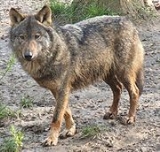
The grey wolf or gray wolf (Canis lupus), also known as the timber wolf or simply wolf, is the largest wild member of the Canidae
Canidae

Canidae is the family of the dogs; a member of this family is called a canid. They include wolf, foxes, coyotes, and jackals. The Canidae family is divided into the "true dogs" of the tribe Canini and the "foxes" of the tribe Vulpini....
 family. It is an ice age
Ice age

The general term "ice age" or, more precisely, "glacial age" denotes a geological period of long-term reduction in the temperature of the Earth's surface and atmosphere, resulting in an expansion of continental ice sheets, polar ice sheets and alpine glaciers....
 survivor originating during the Late Pleistocene
Late Pleistocene

The Late Pleistocene is a faunal stage of the Pleistocene epoch . The beginning of the stage is defined by the base of Eemian interglacial phase before final glacial episode of Pleistocene 126,000 ? 5,000 years ago....
 around 300,000 years ago. DNA sequencing
DNA sequencing

The term DNA sequencing refers to methods for determining the order of the nucleotide bases, adenine, guanine, cytosine, and thymine, in a molecule of DNA....
 and genetic drift
Genetic drift

Genetic drift or allelic drift is the change in the relative frequency with which a gene variant occurs in a population that results from the fact that alleles in offspring are a Sampling of those in the parents, and because of the role of chance in determining whether a given individual survives and reproduces....
 studies reaffirm that the gray wolf shares a common ancestry with the domestic dog
Dog

The dog is a domesticated subspecies of the Gray Wolf, a member of the Canidae family of the order Carnivora. The term is used for both feral and pet varieties....
 (Canis lupus familiaris). Although certain aspects of this conclusion have been questioned, including recently, the main body of evidence confirms it.


Discussion
Ask a question about 'Gray Wolf'
Start a new discussion about 'Gray Wolf'
Answer questions from other users
Full Discussion Forum


Recent Posts


Encyclopedia


The grey wolf or gray wolf (Canis lupus), also known as the timber wolf or simply wolf, is the largest wild member of the Canidae
Canidae

Canidae is the family of the dogs; a member of this family is called a canid. They include wolf, foxes, coyotes, and jackals. The Canidae family is divided into the "true dogs" of the tribe Canini and the "foxes" of the tribe Vulpini....
 family. It is an ice age
Ice age

The general term "ice age" or, more precisely, "glacial age" denotes a geological period of long-term reduction in the temperature of the Earth's surface and atmosphere, resulting in an expansion of continental ice sheets, polar ice sheets and alpine glaciers....
 survivor originating during the Late Pleistocene
Late Pleistocene

The Late Pleistocene is a faunal stage of the Pleistocene epoch . The beginning of the stage is defined by the base of Eemian interglacial phase before final glacial episode of Pleistocene 126,000 ? 5,000 years ago....
 around 300,000 years ago. DNA sequencing
DNA sequencing

The term DNA sequencing refers to methods for determining the order of the nucleotide bases, adenine, guanine, cytosine, and thymine, in a molecule of DNA....
 and genetic drift
Genetic drift

Genetic drift or allelic drift is the change in the relative frequency with which a gene variant occurs in a population that results from the fact that alleles in offspring are a Sampling of those in the parents, and because of the role of chance in determining whether a given individual survives and reproduces....
 studies reaffirm that the gray wolf shares a common ancestry with the domestic dog
Dog

The dog is a domesticated subspecies of the Gray Wolf, a member of the Canidae family of the order Carnivora. The term is used for both feral and pet varieties....
 (Canis lupus familiaris). Although certain aspects of this conclusion have been questioned, including recently, the main body of evidence confirms it. A number of other gray wolf subspecies have been identified, though the actual number of subspecies is still open to discussion. Gray wolves are typically apex predator
Apex predator

Apex predators are predators that, as adults, are not normally preyed upon in the wild by other large animals in significant parts of their range....
s in the ecosystem
Ecosystem

An ecosystem is a natural unit consisting of all plants, animals and micro-organisms in an area functioning together with all of the non-living physical factors of the environment....
s they occupy. Though not as adaptable as more generalist canid species, wolves have thrived in temperate forest
Forest

File:Stara planina suma.jpgA forest is an area with a high density of trees. There are many definitions of a forest, based on various criteria....
s, desert
Désert

?D?sert? is ?milie Simon's debut single, released in October 2002. The song was a huge success both critically and commercially in her homeland....
s, mountain
Mountain

A mountain is a landform that stretches above the surrounding land in a limited area usually in the form of a peak. A mountain is generally steeper than a hill....
s, tundra
Tundra

In physical geography, tundra is an biome where the tree growth is hindered by low temperatures and short growing seasons. The term tundra comes from Kildin Sami tund?r, which means "uplands, treeless mountain tract." There are two types of tundra: Arctic tundra and alpine tundra....
, taiga
Taiga

Taiga is a biome characterized by coniferous forests. Covering most of inland Alaska, Canada, Sweden, Finland, inland Norway and Russia , as well as parts of the extreme northern continental United States , northern Kazakhstan and Japan , the taiga is the world's largest terrestrial biome....
, grassland
Grassland

Grasslands are areas where the vegetation is dominated by grasses and other herbaceous plants . However, sedge and rush families can also be found....
s, and even urban area
Urban area

An urban area is an area with an increased Population density of human-created structures in comparison to the areas surrounding it. Urban areas may be city, towns or conurbations, but the term is not commonly extended to rural settlements such as villages and hamlet ....
s.

Though once abundant over much of Eurasia
Eurasia

Eurasia is a large landmass covering about 53,990,000 km? or about 10.6% of the Earth's surface . Often considered a single continent, Eurasia comprises the traditional continents of Europe and Asia, concepts which date back to classical antiquity and the borders for which are somewhat arbitrary....
 and North America
North America

North America is the northern continent of the Americas, situated in the Earth's northern hemisphere and almost totally in the western hemisphere....
, the gray wolf inhabits a very small portion of its former range because of widespread destruction of its territory, human encroachment of its habitat, and the resulting human-wolf encounters that sparked broad extirpation
Local extinction

Local extinction is where a species ceases to exist in the chosen area of study, but still exists elsewhere. This phenomenon is also known as extirpation....
. Even so, the gray wolf is regarded as being of least concern for extinction according to the International Union for Conservation of Nature, when the entire gray wolf population is considered as a whole. Today, wolves are protected in some areas, hunted for sport in others, or may be subject to extermination as perceived threats to livestock and pets.

In areas where human cultures and wolves are sympatric, wolves frequently feature in the folklore and mythology of those cultures, both positively and negatively.

Physiology


Physical characteristics

Gray wolf weight and size can vary greatly worldwide, tending to increase proportionally with latitude
Latitude

Latitude, usually denoted symbolically by the Greek letter phi gives the location of a place on Earth north or south of the equator. Lines of Latitude are the horizontal lines shown running east-to-west on maps ....
 as predicted by Bergmann's Rule
Bergmann's Rule

In zoology, Bergmann's rule is an ecogeographic rule that correlates latitude with body mass in animals. Broadly it asserts that within a species the body mass increases with latitude and colder climate, or that within closely related species that differ only in relation to size that one would expect the larger species to be found at the hig...
. In general, height varies from 0.6 to .95 meter
Metre

The metre or meter is a Unit of measurement of length. It is the SI base unit of length in the metric system and in the International System of Units , used around the world for general and scientific purposes....
s and (26–38 inch
Inch

An inch is the name of a Units of measurement of length in a number of different systems, including Imperial units, and United States customary units....
es) at the shoulder
Shoulder

In human anatomy, the shoulder joint comprises the part of the body where the humerus attaches to the scapula. The shoulder refers to the group of structures in the region of the joint....
, with weight typically ranging from 20 (44 lb.) to 68 (150 lb.) kilogram
Kilogram

The kilogram or kilogrammeThe spelling kilogram is used by the International Committee for Weights and Measures and the U.S....
s, which together make the gray wolf the largest of all wild canids. Although rarely encountered, extreme specimens of more than 77 kg (170 lb.) have been recorded in Alaska
Alaska

Alaska is the largest U.S. state of the United States by area; it is situated in the northwest extremity of the North American continent, with Canada to the east, the Arctic Ocean to the north, and the Pacific Ocean to the west and south, with Russia further west across the Bering Strait....
, Canada
Canada

Canada is a country occupying most of northern North America, extending from the Atlantic Ocean in the east to the Pacific Ocean in the west and northward into the Arctic Ocean....
, and the former Soviet Union
Post-Soviet states

The post-Soviet states, also commonly known as the former Soviet Union or former Soviet republics, are the 15 independent state that split off from the Soviet Union in its collapse of the Soviet Union in December 1991....
. The heaviest gray wolf recorded in the New World
New World

The New World is one of the names used for the non-Eurasian/non-African parts of the Earth, specifically the Americas and Australasia. When the term originated in the late 15th century, the Americas were new to the Europeans, who previously thought of the world as consisting only of Europe, Asia, and Africa ....
 was killed on 70 Mile River in east-central Alaska on July 12, 1939 and weighed 79 kg (175 lb.), while the heaviest wolf recorded in the Old World
Old World

The Old World consists of those parts of Earth known to Europeans, Asians, and Africans in the 15th century....
 was killed after World War II
World War II

World War II, or the Second World War , was a global military conflict which involved a Participants in World War II, including all of the great powers, organised into two opposing military alliances: the Allies of World War II and the Axis powers....
 in the Kobelyakski Area
Kobeliaky

Kobeliaky is a city in Poltava Oblast, Ukraine. Population is 12,076 .References...
 of the Poltavskij Region
Poltava Oblast

Poltava Oblast is an administrative divisions of Ukraine of central Ukraine. The capital city of the oblast is the city of Poltava.Other important cities within the oblast include: Komsomolsk, Ukraine, Kremenchuk, Lubny and Myrhorod....
 in the Ukrainian Soviet Socialist Republic and weighed 86 kg (189 lb.). The smallest wolves come from the Arabian Wolf
Arabian Wolf

The Arabian wolf is a subspecies of Gray Wolf which was once found throughout the Arabian Peninsula, but now only lives in small pockets in Southern Israel, Oman, Yemen, Jordan, Saudi Arabia, and probably in some parts of the Sinai Peninsula in Egypt....
 subspecies, the females of which may weigh as little as 10 kg (22 lb) at maturity. Grey wolves are sexually dimorphic
Sexual dimorphism

Sexual dimorphism is the systematic difference in form between individuals of different sex in the same species. Examples include color , size, and the presence or absence of parts of the body used in courtship displays or fights, such as ornamental feathers, horns, antlers or tusks....
, with females in any given wolf population typically weighing 20% less than males. Females also have narrower muzzles and foreheads; slightly shorter, smoother furred legs; and less massive shoulders. Gray wolves can measure anywhere from 1.3 to 2 meters (4.5–6.5 feet) from nose to the tip of the tail
Tail

The tail is the section at the rear end of an animal's body; in general, the term refers to a distinct, flexible appendage to the torso. It is the part of the body that corresponds roughly to the sacrum and coccyx in mammals and birds....
, which itself accounts for approximately one quarter of overall body length. Gray wolves are built for stamina
Endurance

Endurance is the ability for humans to exert themselves for long period of time. Usually used in aerobic exercise or anaerobic exercise. The definition of 'long' varies according to the type of exertion - minutes for high intensity anaerobic exercise, hours or days for low intensity....
, possessing features ideal for long-distance travel. Their narrow chests and powerful backs and legs facilitate efficient locomotion. They are capable of covering several miles trotting at about a pace of 10 km
Kilometre

The kilometre , symbol km is a Units of measurement of length in the metric system, equal to one thousand metres.Slang terms for kilometre include click and kay ....
/h (6 mph
Miles per hour

The mile per hour is a physical unit of speed, expressing the number of Mile covered per hour.It is currently the Unit of measurement used for speed limits, and speeds, on roads in the United Kingdom and United States....
), and have been known to reach speeds approaching 65 km/h (40 mph) during a chase. One female gray wolf was recorded to have made 7 metre bounds when chasing prey. and the University of California, Los Angeles
University of California, Los Angeles

The University of California, Los Angeles is a public research university located in Westwood, Los Angeles, California, California, United States....
 revealed that wolves with black pelts owe their distinctive coloration to a mutation that first arose in domestic dog
Dog

The dog is a domesticated subspecies of the Gray Wolf, a member of the Canidae family of the order Carnivora. The term is used for both feral and pet varieties....
s]] Gray wolf paw
PAW

PAW may refer to:*...
s are able to tread easily on a wide variety of terrains, especially snow. There is a slight webbing between each toe, which allows them to move over snow more easily than comparatively hampered prey. Gray wolves are digitigrade
Digitigrade

A digitigrade is an animal that stands or walks on its digits, or toes. Digitigrades include walking birds , cats, dogs, and most other mammals, but not humans, bears, and a few others ....
, which, with the relative largeness of their feet, helps them to distribute their weight well on snowy surfaces. The front paws are larger than the hind paws, and have a fifth digit, the dewclaw
Dewclaw

A dewclaw is a Vestigial structure of the foot of many mammals, birds, and reptiles . It grows higher on the leg so that in digitigrade species, when the animal is standing, it does not make contact with the ground....
, that is absent on hind paws. Bristled hairs and blunt claws enhance grip on slippery surfaces, and special blood vessel
Blood vessel

The blood vessels are the part of the circulatory system that transport blood throughout the body. There are three major types of blood vessels: the artery, which carry the blood away from the heart, the capillary, which enable the actual exchange of water and chemicals between the blood and the tissues; and the veins, which carry blood from...
s keep paw pads from freezing. Scent gland
Scent gland

Scent glands are found in the genitals of most mammals and in various other parts of the body, such as the underarms of humans and the preorbital glands of deer....
s located between a wolf's toes leave trace chemical markers behind, helping the wolf to effectively navigate over large expanses while concurrently keeping others informed of its whereabouts. Unlike dogs and western coyote
Coyote

The coyote , also known as the prairie wolf, is a species of canid found throughout North America and Central America, ranging from Panama in the south, north through Mexico, the United States, and Canada....
s, gray wolves have a lower density of sweat glands on their paws. This trait is also present in Eastern Canadian Coyotes which have been shown to have recent wolf ancestry. Wolves in Israel
Israel

Israel officially the State of Israel , is a country in the Middle East located on the eastern shore of the Mediterranean Sea. It borders Lebanon in the north, Syria in the northeast, Jordan in the east, and Egypt on the southwest, and contains geographically diverse features within its relatively small area....
 are unique due to the middle two toes of their paws being fused, a trait originally thought to be unique to the African Wild Dog
African Wild Dog

The African Wild Dog is a Carnivore mammal of the Canidae family, found only in Africa, especially in scrub savanna and other lightly wooded areas....
.

Wolves have bulky coats
Coat (animal)

Coat, or the nature and quality of a show mammal's pelage, is important to the animal fancy in the judging of the animal, particularly at conformation show, cat show and horse show....
 consisting of two layers. The first layer is made up of tough guard hair
Guard hair

Guard hairs are the longest, most coarse hairs in a mammal's coat, forming the topcoat . They taper to a point and protect the undercoat from the elements....
s that repel water and dirt. The second is a dense, water-resistant undercoat
Down hair

Down hairs, also called the ground hairs, are the very fine, fluffy hairs closest to the skin on some mammals. The hairs are short and crimped, which makes them highly efficient for trapping air and insulating the animal....
 that insulates. The undercoat is shed in the form of large tufts of fur in late spring or early summer (with yearly variations). A wolf will often rub against objects such as rocks and branches to encourage the loose fur to fall out. The undercoat is usually gray regardless of the outer coat's appearance. Wolves have distinct winter and summer pelage
Pelage

In mammals, pelage is the hair, fur, or wool that covers the animal. In many mammals, the pelage is made up of more than one type of hair. Some of the most prominent types of hair that make up the pelage include guard hairs , bristles , and the underfur, which traps in air to maintain temperature....
s that alternate in spring and autumn. Females tend to keep their winter coats further into the spring than males.

Fur
Fur

Fur is a Hair of any non-human mammal, also known as the pelage. It may consist of short ground hair, long guard hair, and, in some cases, medium awn hair....
 coloration varies greatly, running from gray
Grey

Grey or gray describes the tints and shades ranging from black to white. These, including white and black, are known as achromatic colors or neutral colors....
 to gray-brown, all the way through the canine spectrum of white, red, brown, and black. These colors tend to mix in many populations to form predominantly blended individuals, though it is not uncommon for an individual or an entire population to be entirely one color (usually all black or all white). With the exception of Italy, in which black wolves can constitute 20-25% of the entire population, melanistic wolves rarely occur outside the North American continent. According to genetic examinations, the black coat colour
Black wolf (animal)

File:Bigger-wolf.jpgA Black wolf is a melanistic colour variant of the grey wolf . Black specimens are recorded among red wolf , but these are probably extinct....
 is based on a mutation that first arose among domestic dogs and later migrated into the wolf-population via interbreeding. A multicolor coat characteristically lacks any clear pattern other than it tends to be lighter on the animal's underside. Fur color sometimes corresponds with a given wolf population's environment; for example, all-white wolves are much more common in areas with perennial snow cover. Aging wolves acquire a grayish tint in their coats. It is often thought that the coloration of the wolf's pelage serves as a functional form of camouflage
Camouflage

Camouflage is a method of cryptic or concealing coloration that allows an otherwise visible organism or object to remain invisibility through deception....
. This may not be entirely correct, as some scientists have concluded that the blended colors have more to do with emphasizing certain gestures during interaction.

At birth, wolf pups tend to have darker fur and blue irises that will change to a yellow-gold or orange
Orange (colour)

The color orange occurs between red and yellow in the visible Optical spectrum at a wavelength of about 585 ? 620 nanometre, and has a hue of 30? in HSV colour space....
 color when the pups are between 8 and 16 weeks old.
Canis Lupus Pup Closeup
Wolves' long, powerful muzzles
Snout

The snout, or muzzle, is the protruding portion of an animal's face, consisting of its nose, mouth, and jaw....
 help distinguish them from other canids, particularly coyote
Coyote

The coyote , also known as the prairie wolf, is a species of canid found throughout North America and Central America, ranging from Panama in the south, north through Mexico, the United States, and Canada....
s and Golden Jackal
Golden Jackal

The Golden Jackal , also called the Asiatic, Oriental or Common Jackal is a species of jackal native to north and east Africa, southeastern Europe and South Asia to Burma....
s, which have more narrow, pointed muzzles. In wolves, the anterior incisure of the nasal bone
Nasal bone

The nasal bones are two small oblong bones, varying in size and form in different individuals; they are placed side by side at the middle and upper part of the face, and form, by their junction, "the bridge" of the nose....
s does not have a medial protrusion, unlike jackals. The cingulum
Cingulum

The cingulum is a collection of white matter fibers projecting from the cingulate gyrus to the entorhinal cortex in the brain, allowing for communication between components of the limbic system....
 on the external edge of the first upper molar is only slightly expressed, while it is broad and distinctly marked in jackals.

Wolves differ from domestic dogs in a more varied nature. Anatomically, wolves have smaller orbital angles than dogs (>
Inequality

In mathematics, an inequality is a statement about the relative size or order of two objects, or about whether they are the same or not *The notation a < b means that a is less than b....
53 degrees
Degree (angle)

A degree , usually denoted by ? , is a measurement of plane angle, representing 1/360 of a Turn ; one degree is equivalent to p/180 radians....
 for dogs compared with <45 degrees for wolves) and a comparatively larger brain capacity. Larger paw size, yellow eyes, longer legs, and bigger teeth further distinguish adult wolves from other canids, especially dogs. Also, precaudal
Caudal vertebrae

Caudal vertebrae are the bones in the tails of mammals. See Vertebra....
 gland
Gland

A gland is an Organ in an animal's body that synthesizes a substance for release such as hormones or breast milk, often into the bloodstream or into cavities inside the body or its outer surface ....
s at the base of the tail are present in wolves but not in dogs.

Wolves and most larger dogs share identical dentition
Dentition

Dentition is the tooth development of teeth and their arrangement in the mouth.All mammals except the monotremes, the xenarthrans, the pangolins, and the cetaceans have up to four distinct types of teeth, with a maximum number for each....
. The maxilla
Maxilla

The maxilla is a fusion of two bones along the palate fissure that form the upper jaw. This is similar to the mandible, which is also a fusion of two halves at the mental symphysis....
 has six incisor
Incisor

Incisors are the first kind of tooth in heterodont mammals. They are located in the premaxilla above and mandible below....
s, two canines
Canine tooth

In mammalian oral anatomy, the canine teeth, also called cuspids, dogteeth, fangs, or eye teeth, are relatively long, pointed tooth....
, eight premolar
Premolar

The premolar teeth or bicuspids are transitional teeth located between the Canine_tooth and Molar_ teeth. In humans, there are two premolars per quadrant, making eight premolars total in the mouth....
s, and four molars
Molar (tooth)

Molars are the rearmost and most complicated kind of tooth in most mammals. In many mammals they grind food; hence the Latin name mola, "millstone"....
. The mandible
Mandible

The mandible or inferior maxillary bone forms the lower jaw and holds the lower tooth in place. It also refers to both the upper and lower sections of the beaks of birds....
 has six incisors, two canines, eight premolars, and six molars. The fourth upper premolars and first lower molars constitute the carnassial
Carnassial

Carnassials are large teeth found in many carnivorous mammals, used for shearing flesh and bone in a scissor or shear-like way. In the Carnivora, the carnassials are the modified last upper premolar and the first lower molar , but in the prehistoric creodonts, the carnassials were further back in the jaw — first upper and second lower o...
 teeth, which are essential tools for shearing flesh. The long canine teeth are also important, in that they hold and subdue the prey. Capable of delivering up to 10,000 kPa (1450 lbf/in˛
Pounds per square inch

The pound per square inch or, more accurately, pound-force per square inch is a unit of pressure or of stress based on avoirdupois units....
) of pressure
Pressure

Pressure is the force per unit area applied to an object in a direction surface normal to the surface. Gauge pressure is the pressure relative to the local atmospheric or ambient pressure....
, a wolf's teeth are its main weapons as well as its primary tools. This is roughly twice the pressure that a domestic dog of similar size can deliver. The dentition of grey wolves is better suited to bone crushing than those of other modern canids, though it is not as specialised as that found in hyena
Hyena

The Hyaenidae is a mammalian family of order Carnivora. The Hyaenidae family, native to both African and Asian continents consists of four living species, the Striped Hyena and Brown Hyena , the Spotted Hyena and the Aardwolf ....
s.

Wolf saliva
Saliva

Saliva is the watery and usually frothy substance produced in the mouths of humans and most other animals. Saliva is produced in and secreted from the salivary glands....
 has been shown to reduce bacterial infection in wounds and accelerate tissue regeneration.

Reproduction and life cycle

Generally, mating
Mating

In biology, mating is the pairing of same-sex, opposite-sex or hermaphrodite organisms for copulation and, in social animals, also to raise their offspring....
 occurs between January and April — the higher the latitude, the later it occurs. A pack usually produces a single litter unless the breeding
Breeding in the wild

Breeding in the wild is the natural process of animal reproduction occurring in the natural habitat of a given species. This terminology is distinct from animal husbandry or breeding of species in captivity....
 male mates with one or more subordinate females. During the mating season, breeding wolves become very affectionate with one another in anticipation of the female's ovulation cycle
Menstrual cycle

The menstrual cycle is a recurring cycle of physiology changes that occurs in reproductive-age females. Overt menstruation occurs primarily in humans and close evolutionary relatives such as chimpanzees....
. The pack tension rises as each mature wolf feels urged to mate. During this time, the breeding pair may be forced to prevent other wolves from mating with one another. Incest
Incest

Incest refers to any sexual activity between closely related persons that is illegal or socially taboo. The type of sexual activity and the nature of the relationship between persons that constitutes a breach of law or social taboo vary with culture and jurisdiction....
 rarely occurs, though Inbreeding depression
Inbreeding depression

Inbreeding depression is reduced fitness in a given population as a result of breeding of related individuals. Breeding between closely related individuals, called inbreeding, results in more recessive deleterious traits manifesting themselves....
 has been reported to be a problem for wolves in Saskatchewan
Saskatchewan

Saskatchewan is a prairie provinces in Canada, which has an area of 588,276.09 square kilometres and a population of 1,015,895 , mostly living in the southern half of the province....
 and Isle Royale
Isle Royale

Isle Royale is an Islands of the Great Lakes, located in the northwest of Lake Superior. The island and the surrounding smaller islands and waters make up Isle Royale National Park....
. When the breeding female goes into estrus
Estrous cycle

The oestrous cycle comprises the recurring physiology changes that are induced by sexual reproduction hormones in most mammalian placental females....
 (which occurs once per year and lasts 5–14 days), she and her mate will spend an extended time in seclusion. Pheromone
Pheromone

A pheromone is a chemical that triggers a natural behavioral response in another member of the opposite gender of the same species. There are alarm signal pheromones, food trail pheromones, sex pheromones, and many others that affect behavior or physiology....
s in the female's urine
Urine

Urine is a liquid waste product of the body secreted by the kidneys by a process of filtration from blood called urination and excreted through the urethra....
 and the swelling of her vulva
Vulva

The vulva refers to the external sex organ of the female. In colloquial speech, the term vagina is often used to refer to the female genitals generally, although, strictly speaking, the vagina is a specific internal structure, whereas the vulva is the whole exterior genitalia....
 make known to the male that the female is in heat. The female is unreceptive for the first few days of estrus, during which time she sheds the lining of her uterus
Uterus

The uterus is a major female hormone-responsive reproductive sex organ of most mammals, including humans. It is within the uterus that the fetus develops during gestation....
; but when she begins ovulating again, the two wolves mate.

The gestation period
Gestation period

I.H The gestation period in a viviparous animal is the length of its gestation. In humans this is 266 days , but varies for other animals.Gestation period is measured from fertilisation to birth....
 lasts between 60 and 63 days. The pups, which weigh 0.5 kg (1 lb) at birth, are born blind, deaf, and completely dependent on their mother. The average litter size is 5-6 pups, though there are two Soviet records of litters consisting of 17 pups. The pups reside in the den
Lair

Lair may refer to:* Lair * an underground or other enclosed place that an animal uses to hide* an enclosed placed used by a mythological creature such as a dragon...
 and stay there for two months. The den is usually on high ground near an open water source, and has an open chamber at the end of an underground
Underground living

Underground living refers simply to living below the ground's surface, whether in naturally occurring caves or in built structures.Besides obvious novelty, underground living offers additional benefits when compared to living in traditional buildings, such as a nearly constant comfortable temperature without the need for additional insula...
 or hillside
Hillside

Hillside may refer to:...
 tunnel
Tunnel

A tunnel is an underground passageway. The definition of what constitutes a tunnel is not universally agreed upon. However, in general tunnels are at least twice as long as they are wide....
 that can be up to a few meters long. During this time, the pups will become more independent, and will eventually begin to explore the area immediately outside the den before gradually roaming up to a mile
Mile

A mile is a Units of measurement of length, usually used to measure distance, in a number of different systems. In contemporary English contexts, mile most commonly refers to the statute mile of 5,280 Feet or the nautical mile of 1,852 meters ....
 away from it at around 5 weeks of age. Wolf growth rate is slower than that of coyotes and dhole
Dhole

The Dhole , also known as the Asiatic Wild Dog, Indian Wild Dog or Red Dog is a mammal of the order Carnivora, and the only member of the genus Cuon....
s. They begin eating regurgitated
Regurgitation (digestion)

File:Flesh fly concentrating food.jpgRegurgitation is the controlled flow of stomach contents back into the esophagus and mouth.Regurgitation is used by a number of species to feed their young....
 foods after 2 weeks of feeding on milk, which in wolves has less fat
Fat

Fats consist of a wide group of compounds that are generally soluble in organic solvents and largely insoluble in water. Chemistry, fats are generally ester of glycerol and fatty acids....
 and more protein
Protein

Proteins are organic compounds made of amino acids arranged in a linear chain and joined together by peptide bonds between the carboxyl and amino groups of adjacent amino acid Residue ....
 and arginine
Arginine

Arginine is an a-amino acid. The Optical isomerism is one of the 20 most common natural amino acids. Its codons are CGU, CGC, CGA, CGG, AGA, and AGG....
 than dog milk. By this time, their milk teeth
Deciduous teeth

Deciduous teeth, otherwise known as milk teeth, baby teeth, temporary teeth and primary teeth, are the first set of teeth in the growth development of humans and many other mammals....
 have emerged — and are fully weaned by 10 weeks. During the first weeks of development, the mother usually stays with her litter alone, but eventually most members of the pack will contribute to the rearing of the pups in some way. After two months, the restless pups will be moved to a rendezvous site, where they can stay safely while most of the adults go out to hunt
Hunting

Hunting is the practice of pursuing living animals for food, recreation, or trade. In present-day use, the term refers to lawful hunting, as distinguished from poaching, which is the killing, trapping or capture of the hunted species contrary to law....
. One or two adults stay behind to ensure the safety of the pups. After a few more weeks, the pups are permitted to join the adults if they are able, and will receive priority on anything killed, their low ranks notwithstanding. Letting the pups fight for eating privileges results in a secondary ranking being formed among them, and allows them to practice the dominance/submission rituals that will be essential to their future survival in pack life. During hunts, the pups remain ardent observers until they reach about 8 months of age, by which time they are large enough to participate actively.

Wolves typically reach sexual maturity
Sexual maturity

Sexual maturity is the age or stage when an organism can sexual reproduction. It is sometimes considered synonymous with adulthood, though the two are distinct....
 after two or three years, at which point many of them will be compelled to leave their birth packs and seek out mates and territories of their own. Wolves that reach maturity generally live 6 to 10 years in the wild
Wilderness

Wilderness or wildland is a natural environment on Earth that has not been significantly modified by human activity. It may also be defined as: "The most intact, undisturbed wild natural areas left on our planet - those last truly wild places that humans do not control and have not developed with roads, pipelines or other industrial i...
, although in captivity
Captivity (animal)

Animals that live under human care are in captivity. Captivity can be used as a generalizing term to describe the keeping of either domesticated animals or wild animals....
 they can live to twice that age. High mortality rate
Mortality rate

Mortality rate is a measure of the number of deaths in some population, scaled to the size of that population, per unit time. Mortality rate is typically expressed in units of deaths per 1000 individuals per year; thus, a mortality rate of 9.5 in a population of 100,000 would mean 950 deaths per year in that entire population....
s give them a low overall life expectancy. Pups die when food is scarce; they can also fall prey to predators such as bear
Bear

Bears are mammals of the family Ursidae. Bears are classified as caniforms, or doglike carnivorans, with the pinnipeds being their closest living relatives....
s, tiger
Tiger

The tiger is a member of the Felidae family; the largest of the four "big cats" in the genus Panthera. Native to much of eastern and southern Asia, the tiger is an apex predator and an Carnivore#Obligate carnivores....
s, or other wolves. The most significant causes of mortality for grown wolves are hunting and poaching
Poaching

Poaching is the illegal hunting, fishing or eating of wild plants or animals contrary to local and international Conservation and wildlife management laws....
, car accident
Car accident

A car accident is a road traffic incident that usually involves one road vehicle collision with another vehicle or other road user, animal, or a stationary roadside object, and may result in injury, property damage, and possibly death....
s, and wounds inflicted while hunting prey. Although adult wolves may occasionally be killed by other predators, rival wolf packs are often their most dangerous non-human enemy.

Diseases

Diseases recorded to be carried by wolves include brucella
Brucella

Brucella is a genus of Gram-negative bacterium. They are small , non-motile, encapsulated coccobacillus.Brucella is the cause of brucellosis, a true zoonosis disease ....
, deerfly fever
Tularemia

Tularemia is a serious infectious disease caused by the bacterium Francisella tularensis. A gram-negative, motility coccobacillus, the bacterium has several subspecies with varying degrees of virulence....
, leptospirosis
Leptospirosis

Leptospirosis is a infectious disease zoonotic disease caused by spirochaetes of the genus Leptospira that affects humans and a wide range of animals, including mammals, birds, amphibians, and reptiles....
, foot-and-mouth disease
Foot-and-mouth disease

Foot-and-mouth disease or hoof-and-mouth disease is a infectious disease and sometimes fatal virus disease of cloven-hoofed animals, including domestic animals such as cattle, Domestic water buffalo, Domestic sheep, goats and pigs, as well as antelope, bison and other wild Bovidaes, and deer....
, and anthrax
Anthrax

Anthrax is an Acute disease in humans and animals caused by the bacterium Bacillus anthracis, which is highly lethal in some forms. There are effective vaccines against anthrax, and some forms of the disease respond well to antibiotic treatment....
. Wolves are major hosts for rabies
Rabies

Rabies is a virus zoonotic neurotropic virus disease that causes acute encephalitis in mammals. It is most commonly caused by a bite from an infected animal, but occasionally by other forms of contact....
 in Russia, Iran
Iran

Iran , officially the Islamic Republic of Iran and formerly known internationally as Persian Empire until 1935, is a country in Central Eurasia, located on the northeastern shore of the Persian Gulf and the southern shore of the Caspian Sea....
, Afghanistan
Afghanistan

Afghanistan , officially the Islamic republic of Afghanistan, is a landlocked country that is located approximately in the center of Asia....
, Iraq
Iraq

Iraq , officially the Republic of Iraq , is a country in Western Asia spanning most of the northwestern end of the Zagros Mountains, the eastern part of the Syrian Desert and the northern part of the Arabian Desert....
, and India
India

India, officially the Republic of India , is a country in South Asia. It is the List of countries and outlying territories by total area country by geographical area, the List of countries by population country, and the most populous liberal democracy in the world....
. Though wolves are not reservoirs for the disease, they can catch it from other species. Wolves develop an exceptionally severe aggressive state when rabid and can bite numerous people in a single attack. Before a vaccine was developed, bites were almost always fatal. Today, wolf bites can be treated, but the severity of rabid wolf attacks can sometimes result in outright death, or a bite near the head will make the disease act too fast for the treatment to take effect. Rabid attacks tend to cluster in winter and spring. With the reduction of rabies in Europe and North America, few rabid wolf attacks have been recorded, though some still occur annually in the Middle East. Wolves also carry the Canine coronavirus
Canine coronavirus

Canine coronavirus is a virus of the family Coronaviridae that causes a highly contagious intestinal disease worldwide in dogs. It was discovered in 1971 in Germany during an outbreak in guard dogs....
, infections being most prelevant in winter months.

Wolves in Russia have been recorded to carry over 50 different kinds of harmful parasites
Parasitism

Parasitism is a type of Symbiosis relationship between two different organisms where one organism, the parasite, takes from the host , sometimes for a prolonged time....
, including echinococcus
Echinococcus

The genus Echinococcus includes six species of cyclophyllid tapeworms to date, of the family Taeniidae. Infection with Echinococcus results in hydatid disease, also known as echinococcosis...
, cysticercosis
Cysticercosis

Cysticercosis, or neurocysticercosis, is the most common parasite infestation of the central nervous system worldwide. Humans develop cysticercosis when they ingest egg or larvae of the tapeworm Taenia solium....
, and coenuri. Wolves are also carriers of Trichinella spiralis
Trichinella spiralis

The species Trichinella spiralis is an important parasite, occurring in rats, pigs, and humans, and is responsible for the disease trichinosis....
. Between 1993-94, 148 wolf carcasses near Fairbanks, Alaska
Fairbanks, Alaska

Fairbanks is a Devolution City in and the county seat of the Fairbanks North Star Borough, Alaska, Alaska, United States.Fairbanks is the largest city in the Alaska Interior region of Alaska, and second largest in the state behind Anchorage, Alaska....
 were examined for larvae, 54 (36%) of which were found to be infected. Prevalence of Trichinella spiralis in wolves is significantly related to age. Wolves may carry Neospora caninum
Neospora caninum

Neospora caninum is a coccidian parasite that was identified as a species in 1988. Prior to this, it was misclassified as Toxoplasma gondii due to structural similarities....
, which is of particular concern to farmers, as the disease can be spread to livestock; infected animals being three to thirteen times more likely to abort than those not infected.

Despite their habit of carrying harmful diseases, large wolf populations are not heavily regulated by epizootic outbreaks as with other social canids. This is largely due to the habit of infected wolves vacating their packs, thus preventing mass contagion.

Behavior


Social structure

Wolf Pack in Yellowstone Np
Occasionally, single wolves are found in the wild, though packs
Pack (canine)

A pack of canines is a group of canines of the same kind. Not all Canidae form packs and social behaviour within packs varies with the species....
 are more common. Lone wolves are typically old specimens driven from their pack or young adults in search of new territory. Wolf packs tend not to be as compact or unified as those of African Wild Dog
African Wild Dog

The African Wild Dog is a Carnivore mammal of the Canidae family, found only in Africa, especially in scrub savanna and other lightly wooded areas....
s and Spotted Hyena
Spotted Hyena

The Spotted Hyena, or Laughing Hyena, is a Carnivora mammal of the family hyaenidae. It is the largest of the hyenas, and is native to sub-Saharan Africa, save for the Congo basin....
s, though they are not as unstable as those of coyotes. Normally, the pack consists of a male, a female, and their offspring, essentially making the pack a nuclear family
Nuclear family

Sorry, no overview for this topic
. The size of the pack may change over time and is controlled by several factors, including habitat, personalities of individual wolves within a pack, and food supply. Packs can contain between 2 and 20 wolves, though 8 is a more typical size. An unusually large pack consisting of 36 wolves was reported in 1967 in Alaska. While most breeding pairs are monogamous
Monogamy

Monogamy is the state of having only one husband, wife, or sexual partner at any one time. The word monogamy comes from the Greek word monos "?????", which means one or alone, and the Greek word gamos "?????", which means marriage or union....
, there are exceptions. Wolves will usually remain with their parents until the age of two years. Young from the previous season will support their parents in nursing pups of a later year. Wolf cubs are very submissive to their parents, and remain so after reaching sexual maturity. On occasion in captivity, subordinate wolves may rise up and challenge the dominant pair; such revolts may result in daughters killing mothers and sons killing fathers. This behavior has never been documented in the wild, and it is hypothesized that it only happens in captivity because dispersal is impossible. There are no documented cases of subordinate wolves challenging the leadership of their parents. Instead of openly challenging the leadership of the pack leaders, most young wolves between the ages of 1-4 years leave their family in order to search for, or start, a pack of their own. Wolves acting unusually, such as epileptic
Epilepsy

Epilepsy is a common chronic neurological disorder characterized by recurrent unprovoked seizure s. These seizures are transient signs and/or symptoms of abnormal, excessive or synchronous neuronal activity in the brain....
 pups or thrashing adults crippled by a trap or a gunshot, are usually killed by other members of their own pack.

In literature, wolf packs are commonly portrayed as strongly hierarchic communities, with a dominant breeding "Alpha
Alpha (biology)

In social animals, the alpha is the individual in the community to whom the others follow and defer. Where one male and one female fulfill this role, they are referred to as the alpha pair....
 pair", a group of subordinate "Beta" individuals, and the scapegoat
Scapegoat

The scapegoat was a goat that was driven off into the wilderness as part of the ceremonies of Yom Kippur, the Day of Atonement, in Judaism during the times of the Temple in Jerusalem....
 "Omega wolf" on the lowest end of the hierarchy. These descriptions are heavily based on research on captive wolves and cannot be extrapolated to wild wolf packs. In captivity, dispersal of mature individuals is impossible, resulting in frequent aggressive hierarchic encounters. According to wolf biologist L. David Mech
L. David Mech

Lucyan David "Dave" Mech is an internationally recognized wolf expert, a senior research scientist for the U.S. Department of the Interior's U.S....
, "Calling a wolf an alpha is usually no more appropriate than referring to a human parent or a doe deer as an alpha. Any parent is dominant to its young offspring, so alpha adds no information." The term may be valid under certain circumstances, such as when a pack adopts an unrelated dispersed wolf, when the breeding pair die, thus leaving the alpha position open, or when siblings disperse from a pack together. In these cases, the standard nuclear family model does not apply, which may cause wild wolves to behave more like they do in captivity.

Territorial behaviors


Wolves are territorial animals. Studies have shown that the average size of a wolf pack's territory is close to 200 km2. Wolf packs travel constantly in search of prey, covering roughly 9% of their territory per day (average 25km/d). The core of their territory is on average 35 km2, in which they spend 50% of their time. Prey density tends to be much higher in the territory's surrounding areas. Despite this higher abundance of prey, wolves tend to avoid hunting in the fringes of their territory unless desperate, due to the possibility of fatal encounters with neighboring packs. Established wolf packs rarely accept strangers into their territories, with one study on wolf mortality in Minnesota and the Denali National Park and Preserve
Denali National Park and Preserve

Denali National Park and Preserve is located in Interior of Alaska Alaska and contains Mount McKinley , the tallest mountain in North America. The park and preserve together cover 9,492 mi? ....
 concluding that 14–65% of wolf deaths were due to predation by other wolves. In fact, 91% of wolf fatalities occur within 3.2km of the borders between neighboring territories. The majority of killed wolves are dominant animals, due to their greater assertiveness in confronting other packs. In rare cases in which a stranger is accepted into the pack, the animal itself is almost invariably a young specimen of 1-3 years of age, while the majority of killed wolves are adults.

Communication between these boundaries is achieved in part through scent marking and howling. Howling is the principle means of spacing in wolf populations. It communicates the location of a core territory as well as enforcing a territory-independent buffer zone around the roaming wolf pack. This territory-independent buffer zone is a means of avoiding encounters with neighboring packs near territory borders. Lone wolves, in contrast, rarely respond to howls, instead taking an "under the radar" approach. Howling communicates a core territory over time, as a wolf packs spends much of their time there.

Dispersion

Offspring of the breeding pair tend to stay with the pack for some portion of their adulthood. These "subordinate" wolves play a number of important roles in the pack, including participating in hunts, enforcing discipline and raising pups. This behavior is achieved, in part, by an active suppression of reproduction in subordinate wolves by the breeding pair. Thus, while they remain members of the pack, they are unable to reproduce, even if there are other subordinate unrelated wolves in the pack. In many wolves, the drive to reproduce leads them to leave the pack. Dispersals
Biological dispersal

Biological dispersal refers to a species movement away from an existing population or away from the parent organism. Through simply moving from one habitat patch to another, the dispersal of an individual has consequences not only for individual fitness, but also for population dynamics, population genetics, and species distribution....
 occur at all times during the year, and typically involve wolves that have reached sexual maturity prior to the previous breeding season
Breeding season

The breeding season is the most suitable season, usually with favorable conditions and abundant food and water, for breeding in the wild among some wild animals and birds ....
. Dispersed wolves search for new territory and companionship, a hazardous process that could lead to death. Successful dispersions end when the wolf has found another single wolf of the opposite sex and bonds with it. Thus it takes two such dispersals from two separate packs for a new breeding pair to be formed, for dispersing wolves from the same maternal pack tend not to mate. Once two dispersing wolves meet and begin traveling together, they immediately begin the process of seeking out territory, preferably in time for the next mating season.

Scent marking

Wolves, like other canines, use scent marking
Territorial marking

Spraying is behavior used by animals to identify their Territory . Most commonly, this is scent marking, accomplished by depositing strong-smelling chemical compound such as urine at prominent locations within the territory....
 to lay claim to anything—from territory to fresh kills. Breeding wolves scent mark the most often, with males doing so more than females. The most widely used scent marker is urine. Male and female breeding wolves urine-mark objects with a raised-leg stance (all other pack members squat) to enforce rank and territory. They also use marks to identify food caches and to claim kills on behalf of the pack. Defecation
Defecation

Defecation is the final act of digestion by which organisms eliminate solid, semisolid or liquid waste material from the digestive tract via the anus....
 markers are used for the same purpose as urine marks, and serve as a more visual warning, as well. Defecation markers are particularly useful for navigation, keeping the pack from traversing the same terrain too often and also allowing each wolf to be aware of the whereabouts of its pack members. Above all, though, scent marking is used to inform other wolves and packs that a certain territory is occupied, and that they should therefore tread cautiously.

Wolves have scent gland
Scent gland

Scent glands are found in the genitals of most mammals and in various other parts of the body, such as the underarms of humans and the preorbital glands of deer....
s all over their bodies, including at the base of the tail, between toes, and in the eyes, genitalia
Sex organ

A sex organ, or primary sexual characteristic, as narrowly defined, is any of the anatomical parts of the body which are involved in sexual reproduction and constitute the reproductive system in a complex organism; in mammals, these include:...
, and skin. Pheromones secreted by these glands identify each individual wolf. A dominant wolf will "rub" its body against subordinate wolves to mark such wolves as being members of a particular pack. Wolves may also "paw" dirt to release pheromones instead of urine marking.

Dietary habits

Wolves feed primarily on medium to large sized ungulate
Ungulate

Ungulates are several groups of mammals, most of which use the tips of their toes, usually hoofed, to sustain their whole body weight while moving....
s, though they are oppurtunistic feeders, and will generally eat any meat that is available, including non-ungulate species, carrion
Carrion

Carrion refers to the carcass of a dead animal. Carrion is an important food source for large carnivores and omnivores in most ecosystems. Examples of carrion-eaters, or scavengers, include Hyenas, Vultures, Virginia Opossum, Tasmanian Devils, Black Bears, Komodo Dragons, Bald Eagles, Raccoons and Blue-tongued lizards....
 and garbage
Garbage

Garbage may refer to:*Waste, an unwanted or undesired material or substance*Garbage , unreferenced data in a computer's memory*Garbage , a rock musical ensemble...
. Cannibalism
Cannibalism

Cannibalism is the act or practice of humans eating other humans. The ritualistic eating of human flesh is also known as anthropophagy, from Greek: ?????p??, anthropos, "human being"; and fa?e??, phagein, "to eat"....
 is not uncommon in wolves, and has been recorded to occur, in times of food scarcity,, when a pack member dies, and during territorial disputes. Some wolf packs in Alaska and Western Canada have been observed to feed on salmon
Salmon

Salmon is the common name for several species of fish of the family Salmonidae. Several other fish in the family are called trout,the difference is often attributed to the migratory life of the salmon as compared to the residential behaviour of trout, this holds true for the Atlantic salmon....
. Wolves will typically avoid a potential prey item which does not conform to what they experienced during their lives. Generally, the greater the discrepancy to what wolves are previously accustomed to, the greater their resistance to exploring it. This is only increased should the new prey act bold, assertive, and fearless. Nevertheless, even if there is no food shortage, wolves will explore alternative prey if they continually come into close contact with it and habituate themselves.
Canis Lupus Pack Surrounding Bison
Wolf packs show little strategic cooperation in hunting unlike lion
Lion

The lion is a member of the family Felidae and one of four big cats in the genus Panthera. With exceptionally large males exceeding 250 kg in weight, it is the second-largest living cat after the tiger....
s, though wolf pairs have been shown to strategize when attacking large prey. Though commonly portrayed as targeting solely sick or infirm animals, there is little evidence that they actively limit themselves to such targets. Rather, the evidence shows that wolves will simply target the easiest options available, which as well as sick and infirm animals, can also include young animals and pregnant females. Wolves typically attempt to conceal themselves as they approach their prey. Often, they will wait for the prey to graze, when it is distracted. If the prey animal stands its ground or confronts the pack, the wolves will approach and threaten it. The wolves will eventually leave if their prey does not run, though the length of time can range from hours to days. If their prey attempts to flee, the wolves will give chase. Wolves generally do not engage in long chases, and will usually stop a pursuit after a chase of 10-180 metres, though there has been one documented case of a wolf chasing a moose for 36 km. Female wolves tend to be better at chasing prey than males, while the latter are more adept at wrestling large prey to the ground once it is caught. Packs composed largely of female wolves thrive on fleet footed prey such as elk, while packs specialising in bison tend to have a greater number of males.

Upon catching large prey such as moose
Moose

File:Alces alces NA.svgThe moose or elk , , is the largest Extant taxon species in the deer family . Moose are distinguished by the palmate antlers of the males; other members of the family have antlers with a "twig-like" configuration....
, wolves will typically kill by tearing at the haunches and perineum
Perineum

In human anatomy, the perineum is generally defined as the surface region in both males and females between the pubic symphysis and the coccyx. The perineum is the region of the body inferior to the pelvic diaphragm and between the legs....
, causing massive bleeding
Bleeding

Bleeding, technically known as hemorrhaging or haemorrhaging is the loss of blood from the circulatory system. Bleeding can occur internally, where blood leaks from blood vessels inside the body or externally, either through a natural opening such as the vagina, Mouth , nose, or anus, or through a break in the skin....
 and loss of coordination. A single bite can cause a wound up to 10-15 cm in length. A large deer in optimum health generally succumbs to three bites at the perineum area after a chase of 150 metres. Sometimes, with medium sized prey such as dall sheep
Dall Sheep

The Dall Sheep , Ovis dalli, is a species of Ovis native to northwestern North America, ranging from white to slate brown in color and having curved yellowish brown horns....
, wolves will bite the throat, severing the windpipe
Vertebrate trachea

The traceartes, or windpipe, is a tube that has an inner diameter of about 20-25 mm and a length of about 10-16 cm in humans. It commences at the larynx and bifurcates into the primary bronchus in mammals, and from the pharynx to the syrinx in birds, allowing the passage of air to the lungs....
 or jugular
Jugular vein

The jugular veins are veins that bring deoxygenated blood from the head back to the heart via the superior vena cava....
. When attacking canid prey, such as dogs, coyotes or other wolves, wolves will kill by biting the back, neck or head. With prey of equal or lesser weight to the wolf, such as lambs or small children, wolves will grab their quarry by the neck, chest, head or thigh and carry them off to a secluded spot. Once the prey collapses, the wolves will tear open the abdominal cavity and commence feeding on the animal, sometimes while it is still alive. On some occasions, wolves will not press an attack, and will wait for their prey to die from their wounds before feeding begins. Wolves will occasionally attack pregnant ungulates to feed on the fetus(es)
Fetus (biology)

A fetus is a stage in the development of viviparous organisms. This stage lies between the embryonic stage and childbirth.The fetuses of most mammals are situated similarly to the homo sapiens fetus within their mothers....
, whilst leaving the mother uneaten. Usually, it is the dominant pair that works the hardest in killing the pack's target. Wolves have on occasion been observed to engage in acts of surplus killing
Surplus killing

Surplus killing is the behavior predators exhibit when they kill more prey than they can immediately use. They may partially consume, cache, or abandon intact prey....
. This phenomenon is common when wolves target livestock. In the wild, this usually occurs in late winter or spring when deep snow impedes their prey's escape.

Pack status is reinforced during feeding. The breeding pair usually eats first, starting with the heart
Heart

The heart is a muscle organ in all vertebrates responsible for pumping blood through the blood vessels by repeated, rhythmic contractions, or a similar structure in annelids, mollusks, and arthropods....
, liver
Liver

The liver is a vital organ present in vertebrates and some other animals; it has a wide range of functions, a few of which are detoxification, protein synthesis, and production of biochemicals necessary for digestion....
, and lung
Lung

The lung is the essential respiration organ in air-breathing animals, including most tetrapods, a few fish and a few snails. In mammals and the more complex life forms, the two lungs are located in the chest on either side of the heart....
s. Wolves of intermediate rank will prevent lower ranking pack members from feeding until the dominant pair finishes eating. The stomach
Stomach

In most mammals, the stomach is a hollow muscular organ of the gastrointestinal tract involved in the second phase of digestion, following mastication....
 of prey is eaten, though the contents are left untouched if the killed animal is a herbivore. The leg muscles are eaten next, with the hide and bones being the last to be consumed. If they are disturbed while feeding, they will instead focus their attention on their prey's fat
Fat

Fats consist of a wide group of compounds that are generally soluble in organic solvents and largely insoluble in water. Chemistry, fats are generally ester of glycerol and fatty acids....
 deposits rather than internal organs. A single wolf can eat up to 3.2-3.5 kg of food at a time, though they can eat as much as 13-15 kg when sufficiently hungry. A wolf's yearly requirement is 1.5 tons of meat. Wolves can go without sustenance for long periods of time, with one Russian record showing how one specimen survived for 17 days without food. Research has shown that 2 weeks without food will not weaken a wolf's muscle activity. After eating, wolves will drink large quantities of water to prevent uremic poisoning
Acute renal failure

Acute renal failure , also known as acute kidney failure or acute kidney injury, is a rapid loss of renal function due to damage to the kidneys, resulting in retention of nitrogenous and non-nitrogenous waste products that are normally excreted by the kidney....
. A wolf's stomach can hold up to 7.5 litres of water. Wolves will on occasion supplement their diet with vegetation, with some areas of the former Soviet Union reporting that wolves cause serious damage to watermelon
Watermelon

Watermelon refers to both fruit and plant of a vine-like herb originally from southern Africa and one of the most common types of melon. This flowering plant produces a special type of fruit known by botany as a Epigynous berry, which has a thick Peel and fleshy center ; pepos are derived from an inferior ovary and are characteristic of...
 plantations.

Studies on how wolves affect prey populations tend to vary considerably, with some results indicating that wolves dramatically reduce, sometimes locally extirpate some prey species, while others indicate that wolf predation simply takes over from other mortality factors present in wolf-free zones. Wolves are not a keystone species
Keystone species

A keystone species is a species that has a disproportionate effect on its natural environment relative to its abundance. Such species affect many other organisms in an ecosystem and help to determine the types and numbers of various others species in a community....
, as they are not essential for the presence or survival of other species.

Interspecific predatory relationships

Wolves typically dominate other canid species in areas where they are sympatric. In North America, wolves are generally intolerant of coyote
Coyote

The coyote , also known as the prairie wolf, is a species of canid found throughout North America and Central America, ranging from Panama in the south, north through Mexico, the United States, and Canada....
s in their territory; two years after their reintroduction to the Yellowstone National Park, the wolves were responsible for a near 50% drop in coyote populations through both competition and predation. Wolves have been reported to dig coyote pups from their dens and kill them. Wolves typically do not consume the coyotes they kill. There are no records of coyotes killing wolves, though they have been known to gang up on wolves if they outnumber them. Near identical interactions have been observed in Greece
Greece

Greece , officially the Hellenic Republic , is a country in southeastern Europe, situated on the southern end of the Balkans. It has borders with Albania, Bulgaria and the former Yugoslav Republic of Macedonia to the north, and Turkey to the east....
 between wolves and Golden Jackal
Golden Jackal

The Golden Jackal , also called the Asiatic, Oriental or Common Jackal is a species of jackal native to north and east Africa, southeastern Europe and South Asia to Burma....
s. Wolves may kill fox
Fox

A fox is an animal belonging to any one of about 27 species of small to medium-sized Canidae, characterized by possessing a long, narrow snout, and a bushy tail, or brush....
es on kill sites, though not as frequently as they do with coyotes. Raccoon Dog
Raccoon Dog

The Raccoon Dog is a member of the Canidae family and is indigenous to east Asia. It is the only extant taxon species in its genus Nyctereutes....
s are also reportedly preyed upon. ]] Brown Bear
Brown Bear

The Brown Bear is a large bear distributed across much of northern Eurasia and North America. It weighs 100 to 700 kg and its larger populations such as the Kodiak bear match the Polar bear as the largest extant land predator....
s are encountered in both Eurasia and North America. The majority of interactions between wolves and Brown Bears usually amount to nothing more than mutual avoidance. Serious confrontations depend on the circumstances of the interaction, though the most common factor is defence of food and young. Brown Bears will use their superior size to intimidate wolves from their kills and when sufficiently hungry, will raid wolf dens. Brown Bears usually dominate wolves on kills, though they rarely prevail against wolves defending den sites. Wolves in turn have been observed killing bear cubs, to the extent of even driving off the defending mother bears. Deaths in wolf/bear skirmishes are considered very rare occurrences, the individual power of the brown bear and the collective strength of the wolf pack usually being sufficient deterrents to both sides. Encounters with American Black Bear
American black bear

The American Black Bear is the most common bear species native to North America. It lives throughout much of the continent, from northern Alaska south into Mexico and from the Atlantic Ocean to the Pacific Ocean....
s occur solely in the Americas
Americas

The Americas are the region of the Western hemisphere that consists of the continents of North America and South America with their associated islands and regions....
; their interactions with wolves are much rarer than those of Brown Bears, due to differences in habitat preferences. The majority of Black Bear encounters with wolves occur in the species' northern range
Northern Range

The Northern Range is the range of tall hills across the northern portion of Trinidad, the major island in the Republic of Trinidad and Tobago....
, with no interactions being recorded in Mexico. Wolves have been recorded to kill Black Bears on numerous occasions without eating them. Unlike Brown Bears, Black Bears frequently lose against wolves in disputes over kills.

Large wolf populations limit the numbers of small to medium sized feline
Feline

Feline can refer to:* Felidae - the cat family, which includes lions, tigers and Black panther.* Felinae - the subfamily of Felidae that includes domestic cats and smaller wild cats....
s. Wolf predation is recorded to reduce lynx
Lynx

A lynx is any of four medium-sized wild Felidae. All are members of the genus Lynx, but there is considerable confusion about the best way to classify felids at present, and some authorities classify them as part of the genus Felis....
 populations wherever the two species are sympatric. Lynx populations in Slovakia
Slovakia

Slovakia . It was amended in September 1998 to allow direct election of the president and again in February 2001 due to EU admission requirements....
 plummetted during World War II, when large numbers of wolves entered the cat's range. Similairly, in Russia, lynx populations drop in areas with high wolf densities. In the Rocky Mountains
Rocky Mountains

The Rocky Mountains, often called the Rockies, are a mountain range in western North America. The Rocky Mountains stretch more than 4,800 kilometre from the northernmost part of British Columbia, in Canada, to New Mexico, in the United States....
 and adjacent mountan areas of North America, wolves are usually hostile toward cougars and will kill cubs if given the opportunity. A pack will on occasion appropriate the kills of adult cougars, which respond by increasing their kill rate. Both species have been recorded to kill each other. National Park Service cougar specialist Kerry Murphy stated that the cougar usually is at an advantage on a one to one basis, considering it can effectively use its claws, as well as its teeth, unlike the wolf which relies solely on its teeth. Yellowstone officials have reported that attacks between cougars and wolves are not uncommon. Multiple incidents of cougars taking wolves and vice versa have been recorded in Yellowstone National Park. Researchers in Montana have found that wolves regularly kill cougars in the area. Similarly, large numbers of wolves have been reported to reduce leopard
Leopard

The leopard is a member of the Felidae biological family and the smallest of the four "Panthera" in the genus Panthera; the other three are the tiger, lion and jaguar....
 populations in Tibet
Tibet

Tibet is a Tibetan Plateau in Asia, north of the Himalayas, and the home to the indigenous Tibetan people and its related ethnic groups. With an average elevation of 4,900 metres , it is the highest region on Earth and has in recent decades increasingly been referred to as the "Roof of the World"....
. However, the reverse is true for larger cats such as tiger
Tiger

The tiger is a member of the Felidae family; the largest of the four "big cats" in the genus Panthera. Native to much of eastern and southern Asia, the tiger is an apex predator and an Carnivore#Obligate carnivores....
s. In areas where wolves and tigers share ranges, such as the Russian Far East
Russian Far East

Russian Far East is a term that refers to the Russian part of the Far East, i.e., extreme east parts of Russia, between Siberia and the Pacific Ocean....
, the two species typically display a great deal of dietary overlap, resulting in intense competition. Wolf and tiger interactions are well documented in Sikhote-Alin
Sikhote-Alin

The Sikhote-Alin is a mountain range in Primorsky Krai and Khabarovsk Krais, Russia, extending about 900 km to the northeast of the Russian Pacific seaport of Vladivostok....
, which until the beginning of the 20th century, held very few wolves. It is thought by certain experts that wolf numbers increased in the region after tigers were largely eliminated during the Russian colonization in the late 1800s and early 1900s. This is corroborated by native inhabitants of the region claiming that they had no memory of wolves inhabiting Sikohte-Alin until the 1930s, when tiger numbers decreased. Tigers depress wolf numbers, either to the point of localized extinction or to such low numbers as to make them a functionally insignificant component of the ecosystem. Wolves appear capable of escaping competitive exclusion from tigers only when human persecution decreases the latter's numbers. Today wolves are considered scarce in tiger inhabited areas, being found in scattered pockets, and usually seen traveling as loners or in small groups. First hand accounts on interactions between the two species indicate that tigers occasionally chase wolves from their kills, while wolves will scavenge from tiger kills. Tigers are not known to prey on wolves, though there are four records of tigers killing wolves without consuming them. This competitive exclusion of wolves by tigers has been used by Russian conservationists to convince hunters in the Far East to tolerate the big cats, as they limit ungulate populations less than wolves, and are effective in controlling the latter's numbers.

Wolves may occasionally encounter Striped Hyena
Striped Hyena

The Striped Hyena is an omnivore mammal of the biological family hyaenidae. It lives in Africa, the Middle East, Pakistan and western India....
s in the Middle East
Middle East

File:GreaterMiddleEast1.pngThe Middle East is a region that spans southwestern Asia, western Asia, and northeastern Africa. It has no clear boundaries, often used as a synonym to Near East, in opposition to Far East....
 and Central
Central Asia

Central Asia is a region of Asia from the Caspian Sea in the west to central China in the east, and from southern Russia in the north to northern India in the south....
 and South Asia
South Asia

South Asia, also known as Southern Asia, is the southern region of the Asian continent, which comprises the sub-Himalayan countries and, for some authorities , also includes the adjoining countries on the west and the east....
, mostly in disputes over carcasses. Though hyenas usually dominate wolves on a one to one basis, wolf packs have been reported to displace lone hyenas from carcasses. Wolf remains have been found in Cave Hyena
Cave Hyena

The Cave Hyena is an extinct subspecies of spotted hyena native to Eurasia, ranging from Northern China to Spain and into the British Isles. Though originally described as a separate species from the spotted hyena due to large differences in fore and hind extremities, genetic analysis indicates no sizeable differences in DNA between Pleisto...
 den sites, though it is unknown if the wolves were killed or scavenged upon. Unlike cave hyenas, which preferentially preyed on lowland animals such as horses, wolves relyed more on slope-dwelling ibex
Ibex

An ibex is an individual of any of several species of wild mountain Capra , distinguished by the male's large recurved Horn_%28anatomy%29, which are transversely ridged in front....
 and Roe Deer
Roe Deer

The European Roe Deer is a deer species of Europe, Asia Minor, and Caspian Sea coastal regions. There is a separate species known as the Siberian Roe Deer that is found from the Ural Mountains to as far east as China and Siberia....
, thus minimising competition. Wolves and Cave Hyenas seem to display negative abundance relations over time, with wolf populations expanding their ranges as hyenas disappeared.

Communication


Body language

Grey Wolf 4
Wolves can communicate
Animal communication

Animal communication is any behaviour on the part of one animal that has an effect on the current or future behaviour of another animal. The study of animal communication, sometimes called zoosemiotics has played an important part in the development of ethology, sociobiology, and the study of animal cognition....
 visually through a wide variety of expressions and moods ranging from subtle signals, such as a slight shift in weight, to more obvious ones, such as rolling on their backs to indicate complete submission.
  • Dominance – A dominant wolf stands stiff legged and tall. The ears are erect and forward, and the hackles bristle slightly. Often the tail is held vertically and curled toward the back. This display asserts the wolf's rank to others in the pack. A dominant wolf may stare at a submissive one, pin it to the ground, "ride up" on its shoulders, or even stand on its hind legs.
  • Submission (active) – During active submission, the entire body is lowered, and the lips and ears are drawn back. Sometimes active submission is accompanied by muzzle licking, or the rapid thrusting out of the tongue
    Tongue

    The tongue is skeletal muscle on the floor of the mouth that manipulates food for chewing . It is the primary organ of taste. Much of the upper surface of the tongue is covered in papillae and taste buds....
     and lowering of the hindquarters. The tail is placed down, or halfway or fully between the legs, and the muzzle often points up to the more dominant animal. The back may be partly arched as the submissive wolf humbles itself to its superior; a more arched back and more tucked tail indicate a greater level of submission.
  • Submission (passive) – Passive submission is more intense than active submission. The wolf rolls on its back and exposes its vulnerable throat
    Throat

    In anatomy, the throat is the anterior part of the neck, in front of the vertebrae. It consists of the pharynx and larynx. An important feature of the throat is the epiglottis, a flap which separates the esophagus from the vertebrate trachea and prevents inhalation of food or drink....
     and underside. The paws are drawn into the body. This posture is often accompanied by whimpering.
  • Anger – An angry wolf's ears are erect, and its fur bristles. The lips may curl up or pull back, and the incisors are displayed. The wolf may also arch its back, lash out, or snarl
    Snarl

    A snarl is a facial expression, where the upper lip is raised, and the nostrils widen, generally indicating hate, anger or pain. In addition to humans, other mammals including monkeys and dogs snarl, often to warn others of their potential bite....
    .
  • Fear – A frightened wolf attempts to make itself look small and less conspicuous; the ears flatten against the head, and the tail may be tucked between the legs, as with a submissive wolf. There may also be whimpering or barks of fear, and the wolf may arch its back.
  • Defensive – A defensive wolf flattens its ears against its head.
  • Aggression – An aggressive wolf snarls and its fur bristles. The wolf may crouch, ready to attack if necessary.
  • Suspicion – Pulling back of the ears shows a wolf is suspicious. The wolf also narrows its eyes. The tail of a wolf that senses danger points straight out, parallel to the ground.
  • Relaxation – A relaxed wolf's tail points straight down, and the wolf may rest sphinx
    Sphinx

    A sphinx is a zoomorphic mythological figure which is depicted as a recumbent lion with a human head. It has its origins in sculpted figures of Old Kingdom Ancient Egypt, to which the ancient Greeks applied their own name for a female monster, the "strangler", an archaic figure of Greek mythology....
    -like or on its side. The wolf may also wag its tail. The further down the tail droops, the more relaxed the wolf is.
  • Tension – An aroused wolf's tail points straight out, and the wolf may crouch as if ready to spring.
  • Happiness – As dogs do, a wolf may wag its tail if in a joyful mood. The tongue may roll out of the mouth.
  • Hunting – A wolf that is hunting is tensed, and therefore the tail is horizontal and straight.
  • Playfulness – A playful wolf holds its tail high and wags it. The wolf may frolic and dance around, or bow by placing the front of its body down to the ground, while holding the rear high, sometimes wagged. This resembles the playful behavior of domestic dogs.


Howling and other vocalisations

Wolf howls, which can last from 0.5-11 seconds, typically have a frequency of 150-780 Hz
Hertz

The hertz is a measure of frequency per unit of time, or the number of list of cycles per second. It is the SI base unit of frequency in the International System of Units , and is used worldwide in both general-purpose and scientific contexts....
. Howling helps pack members keep in touch, allowing them to communicate effectively in thickly forest
Forest

File:Stara planina suma.jpgA forest is an area with a high density of trees. There are many definitions of a forest, based on various criteria....
ed areas or over great distances. Howling also helps to call pack members to a specific location. Howling can also serve as a declaration of territory, as shown in a dominant wolf's tendency to respond to a human imitation of a "rival" wolf in an area the wolf considers its own. This behavior is stimulated when a pack has something to protect, such as a fresh kill. As a rule of thumb, large packs will more readily draw attention to themselves than will smaller packs. Adjacent packs may respond to each others' howls, which can mean trouble for the smaller of the two. Wolves therefore tend to howl with great care. Wolves will also howl for communal reasons. Some scientists speculate that such group sessions strengthen the wolves' social bonds and camaraderie—similar to community singing
Singing

Singing is the act of producing musical sounds with the human voice, which is often contrasted with regular speech. A person who sings is called a singer or vocalist....
 among humans. During such choral sessions, wolves will howl at different tones
Timbre

In music, timbre is the quality of a musical note or sound or tone that distinguishes different types of sound production, such as voices or musical instruments....
 and varying pitches
Pitch (music)

Pitch represents the perceived fundamental frequency of a sound. It is one of the three major auditory system attributes of sounds along with loudness and timbre....
, making it difficult to estimate the number of wolves involved. This confusion of numbers makes a listening rival pack wary of what action to take. For example, confrontation could be disastrous if the rival pack gravely underestimates the howling pack's numbers. A wolf's howl may be heard from up to ten miles (16 km) away, depending on weather conditions. Observations of wolf packs suggest that howling occurs most often during the twilight
Twilight

Twilight is the time between dawn and sunrise, and the time between sunset and dusk. Sunlight Scattering in the upper Earth's atmosphere illuminates the lower atmosphere, and the surface of the Earth is not completely lit or completely dark....
 hours, preceding the adults' departure to the hunt and following their return. Studies also show that wolves howl more frequently during the breeding season
Breeding season

The breeding season is the most suitable season, usually with favorable conditions and abundant food and water, for breeding in the wild among some wild animals and birds ....
 and subsequent rearing process. The pups themselves begin howling soon after emerging from their dens and can be provoked into howling sessions easily over the following two months. Such indiscriminate howling usually is intended for communication, and does not harm the wolf so early in its life. Howling becomes less indiscriminate as wolves learn to distinguish howling pack members from rival wolves. The Arabian and Iranian wolf subspecies are unusual as they are not known to howl.

Growling
Growling

Growling or growl is a low, guttural vocalization produced by predatory animals as a warning to others, as a sign of aggression, or to express anger....
, while teeth are bared, is the most visual warning wolves use. Wolf growls have a distinct, deep, bass-like quality which can range from 250-1,500 Hz. It is often used to threaten rivals, though not necessarily to defend themselves. Wolves also growl at other wolves while being aggressively dominant. Wolves bark
Bark (dog)

Barking is a noise most commonly produced by dogs. Woof is the most common representation in the English language for this sound , other than "bark." Other transliterations include the onomatopoeia ruff, arf, yip , and bow-wow....
 when nervous or when alerting other wolves of danger but do so very discreetly and will not generally bark loudly or repeatedly as dogs do. Instead they use a low-key, breathy "whuf" sound which can measure from 320-904 Hz to immediately get attention from other wolves. Wolves also "bark-howl" by adding a brief howl to the end of a bark. Wolves bark-howl for the same reasons they normally bark. Generally, pups bark and bark-howl much more frequently than adults, using these vocalizations to cry for attention, care, or food. A lesser known sound is the rally. Wolves will gather as a group and, amidst much tail-wagging and muzzle licking, emit a high-pitched wailing noise interspersed with something similar to (but not the same as) a bark. Rallying is often a display of submission to an alpha by the other wolves. Wolves also whimper, a sound with a maximum range of 3,500 Hz, usually when submitting to other wolves. Wolf pups whimper when they need a reassurance of security from their parents or other wolves.

Taxonomy

The gray wolf is a member of the genus
Genus

A genus is a low-level taxonomic rank used in the classification of living and fossil organisms. The taxonomic ranks are domain , kingdom , phylum, class , order , family , genus, and species....
 Canis
Canis

Canis is a genus containing 7 to 10 extant species and many extinct species, including dogs, Wolf , coyotes, and jackals....
, which comprises between 7 and 10 species. It is one of six species termed 'wolf', the others being the Red Wolf
Red Wolf

The Red Wolf is a North American canid which once roamed throughout the Southeastern United States and is a Last glacial period survivor of the Late Pleistocene epoch....
 (Canis rufus), the Indian Wolf
Indian Wolf

Recent genetic research suggests that the Indian Wolf, originally considered only as a subpopulation of the Iranian Wolf , may represent a distinct species ....
 (Canis indica), the Himalayan Wolf
Himalayan Wolf

The Himalayan Wolf, originally thought to belong to Tibetan wolf , which is a subspecies of the Gray wolf, may represent a distinct canid species, Canis himalayensis....
 (Canis himalayaensis), the Eastern Wolf
Eastern Wolf

The eastern wolf , also known as Eastern Canadian Wolf or Eastern Canadian Red Wolf, is traditionally considered to be a subspecies of the Gray Wolf....
 (Canis lycaon), and the Ethiopian Wolf
Ethiopian Wolf

The Ethiopian wolf is a carnivorous mammal of the family Canidae. It is also known as the Abyssinian wolf, Abyssinian fox, red jackal, red fox, Simien fox or Simien jackal among other names....
 (Canis simensis), although concerning a couple of these there is still some uncertainty as to whether they should be considered subspecies of Canis lupus or species in their own right. Recent genetic research suggests that the Indian Wolf, originally considered only as a subpopulation of the Iranian Wolf
Iranian Wolf

The Iranian wolf is a subspecies of Grey Wolf which ranges from Lebanon, Northern Israel, Saudi Arabia, Turkey, Afghanistan, Pakistan, and Iran....
 (Canis lupus pallipes), represents a distinct species (Canis indica). Similar results were obtained for the Himalayan Wolf
Himalayan Wolf

The Himalayan Wolf, originally thought to belong to Tibetan wolf , which is a subspecies of the Gray wolf, may represent a distinct canid species, Canis himalayensis....
, which is traditionally placed into the Tibetan Wolf
Tibetan wolf

The Tibetan wolf is a gray wolf species found in parts of Central China, southwest Russia, Manchuria, Tibet and the Himalayas regions of India, Nepal and Bhutan....
 (Canis lupus laniger) .

With respect to common names, spelling differences
American and British English spelling differences

American and British English spelling differences are one aspect of American and British English differences.The spelling systems of Commonwealth of Nations countries, for the most part, closely resemble the British system....
 result in the alternative spelling grey wolf. As the first-named and most widespread of species termed "wolf", gray wolves are often simply referred to as wolves. It was one of the many species originally described by Carl Linnaeus in his eighteenth-century work, Systema Naturae
Systema Naturae

The book Systema Naturae was one of the major works of the Sweden botanist, zoologist and physician Carolus Linnaeus. Its full title is Systema naturae per regna tria naturae, secundum classes, ordines, genera, species, cum characteribus, differentiis, synonymis, locis or translated: "System of nature through the three kingdoms of...
, and it still bears its original classification, Canis lupus. The binomial name
Binomial nomenclature

In biology, binomial nomenclature is the formal system of naming species. The system is called binominal nomenclature , binary nomenclature , or the binomial classification system....
 is derived from the Latin
Latin

Latin is an Italic language, historically spoken in Latium and Ancient Rome. Through the Military history of the Roman Empire, Latin spread throughout the Mediterranean and a large part of Europe....
 Canis, meaning "dog", and lupus, "wolf". Classifying gray wolf subspecies can be challenging. Although scientists have proposed a host of subspecies
Subspecies

In biology, subspecies is the taxonomic rank immediately subordinate to a species. A subspecies is a taxonomic group which is less distinct than the Common descent or species from which it originates....
, wolf taxonomy at this level remains controversial. Indeed, only a single wolf species may exist. Taxonomic modification will likely continue for years to come.

Current theories propose that the gray wolf first evolved in Eurasia
Eurasia

Eurasia is a large landmass covering about 53,990,000 km? or about 10.6% of the Earth's surface . Often considered a single continent, Eurasia comprises the traditional continents of Europe and Asia, concepts which date back to classical antiquity and the borders for which are somewhat arbitrary....
 during the early Pleistocene
Pleistocene

The Pleistocene is the epoch from 1.8 million to 10,000 years Before Present covering the world's recent period of repeated glaciations. The name pleistocene is derived from the Greek and ....
. The rate of changes observed in DNA
DNA

Deoxyribonucleic acid is a nucleic acid that contains the genetics instructions used in the development and functioning of all known living organisms and some viruses....
 sequence date the Asiatic lineage to about 800,000 years, as opposed to the American and European lineages which stretch back only 150,000. The gray wolf migrated into North America from the Old World
Old World

The Old World consists of those parts of Earth known to Europeans, Asians, and Africans in the 15th century....
, probably via the Bering land bridge, around 400,000 years ago. However, they did not become widespread until 12,000 years ago, when the native American megafauna
Megafauna

The term megafauna has two distinct meanings in the biological sciences. The less commonly found meaning is of any animal which can be seen with the unaided eye, in contrast to microfauna....
 began dying out. It is thought by certain experts that the wolf's Eurasian origin could account for it's relative inability to modify it's behaviour in light of human encroachment, compared to native American predators like black bears, cougars and coyotes which were under greater predation pressure from larger, now extinct predators. The gray wolf then coexisted with the Dire Wolf
Dire Wolf

The Dire Wolf is an extinction Carnivora mammal of the genus Canis, and was most common in North America and South America during the Pleistocene....
 (Canis dirus). Although more heavily built and possessing a stronger bite, the dire wolf's dentition was less adept at crushing bones than the grey wolf was. The Dire Wolf ranged from southern Canada to South America until about 8,000 years ago when climate changes are thought to have caused it to become extinct. After that the gray wolf is thought to have become the prime canine predator in North America.

The International Commission on Zoological Nomenclature
International Commission on Zoological Nomenclature

International Commission on Zoological Nomenclature is an organization dedicated to "achieving stability and sense in the scientific naming of animals"....
 has conserved
Conserved name

A conserved name or nomen conservandum is a scientific name that enjoys special nomenclatural protection. Nomen conservandum is a Latin term, meaning a "name which should be conserved"....
 the name Canis lupus; see Opinion 2027
Opinion 2027

Opinion 2027 is a ruling of the International Commission on Zoological Nomenclature concerning the conserved name of 17 species names of wildlife animals with domestication derivatives....
.

Subspecies

At one point, up to 50 gray wolf subspecies were recognized. Though no true consensus has been reached, this list can be condensed to 13–15 general extant subspecies. Modern classifications take into account the DNA, anatomy, distribution, and migration of various wolf colonies. , 37 subspecies are currently described, including the dingo
Dingo

|- style = "text-align:center"|style="background: pink;" |Breed standards |- style = "text-align:center"||}The Dingo also known as Warrigal, Maliki, Mirigung, Decker Dog, Boololomo, Repeti, or Australian Native Dog, is a feral dog which mostly lives independently from humans....
 and the domestic dog. Wolves show a great deal of dimorphism geographically. For example, North American wolves are, overall, generally the same size as European breeds, but have have larger, rounder heads, broader, more obtuse muzzles, shorter legs and are usually more robust. European wolves on the contrary tend to have longer, more higher placed ears, narrower heads, more slender loins and coarser, less luxuriant fur. However, wolves of different geographical locations can interbreed. The Zoological Gardens of London
London Zoo

Zoological Society of London London Zoo is the world's oldest scientific zoo. It was opened in London on April 27 1828, and was originally intended to be used as a collection for science....
 for example once successfully managed to mate a male European wolf to an Indian female, resulting in a cub bearing an almost exact likeness to its sire.

Relation to the dog


Much debate has centered on the relationship between the wolf and the domestic dog
Dog

The dog is a domesticated subspecies of the Gray Wolf, a member of the Canidae family of the order Carnivora. The term is used for both feral and pet varieties....
, though most authorities see the wolf as the dog's direct ancestor
Ancestor

An ancestor is a parent or the parent of an ancestor .Two individuals have a genetics relationship if one is the ancestor of the other, or if they share a common ancestor....
 (see Origin of the domestic dog
Origin of the domestic dog

File:Las Meninas 01.jpgThe origin of the domestic dog is the history of the ancestry and the domestication of the dog .#Orphaned wolf-cubs: Studies have shown that some wolf pups taken at an early age and reared by humans are easily tamed and socialized....
). Because canids have evolved recently and different species interbreed readily, untangling the relationships has been difficult. However, molecular systematics now indicate very strongly that domestic dogs and wolves are closely related, and the domestic dog is now normally classified as a subspecies
Subspecies

In biology, subspecies is the taxonomic rank immediately subordinate to a species. A subspecies is a taxonomic group which is less distinct than the Common descent or species from which it originates....
 of the wolf: Canis lupus familiaris. Additionally, breeding experiments in Germany
Germany

Germany , officially the Federal Republic of Germany , is a country in Central Europe. It is bordered to the north by the North Sea, Denmark, and the Baltic Sea; to the east by Poland and the Czech Republic; to the south by Austria and Switzerland; and to the west by France, Luxembourg, Belgium, and the Netherlands....
 with poodle
Poodle

akcgroup = Standard and Miniature: Non-Sporting; Toy: Toy| akcstd = http://www.akc.org/breeds/poodle/index.cfm| ankcgroup = Group 7 | ankcstd = http://www.ankc.aust.com/poodstan.html Standard], , ])...
s, wolves, and later on with the resulting wolf-dogs showed unrestricted fertility, mating via free choice and no significant communication problems (even after a few generations). This contrasted with the hybrid offspring of poodles crossed with coyotes and jackals, which all showed a decrease in fertility and significant communciation problems, as well as an increase in genetic diseases after three generations of interbeeding. The researchers therefore concluded that domestic dogs and grey wolf are the same species. DNA evidence has demonstrated that canis lupus lupus and canis lupus familiaris are genetically very similar. Both have 39 chromosomes, representing roughly 19000 genes spread over 2.4 billion base pairs In a 2005 study reported in Nature , genetic similarity was assessed within breed, between breeds, and between subspecies by measuring the frequency of single nucleotide polymorphisms. The dogs studies were genetically most similar to others of the same breed (SNP frequency roughly 1/1600). The primary breed studied, the boxer
Boxer (dog)

Developed in Germany, the Boxer is a dog breed of stocky, medium-sized, short-haired dog. The coat is smooth and fawn or brindled, with or without white markings....
, was also genetically similar to other breeds (SNP frequency roughly 1/900), although there was some variance depending on breed. For instance, the boxer was found to be significantly less similar to Alaskan Malamute
Alaskan Malamute

The Alaskan Malamute is a large dog breed of domestic dog originally bred for use as an Alaskan sled dog and is often mistaken for a Siberian Husky....
s (SNP frequency roughly 1/750). The boxer was found to be least similar to other canids, including canis lupus lupus (SNP frequency roughly 1/580) and coyotes (SNP frequency roughly 1/400). From these analyses, it can be estimated that the variance between canis lupus lupus and canis lupus familiaris is roughly twice as great as the variance within the subspecies canis lupus familiaris, and four times as great as the variance within an individual breed.

Domestication

There is a great deal of controversy surrounding the divergence of domestic dogs from wolves. The number of divergence events, the approximate date of these events, and the location of these events have not been conclusively determined. Archaeological evidence clearly shows that dogs diverged from wolves more than 15,000 years ago, but it could have been much earlier. Genetic studies suggest that dogs were domesticated in three or four events, including relatively small wolf populations, in East Asia upwards of 100,000 years ago. These studies, however, depend on assumptions that are likely to be violated; the date could be much earlier or later. Most archaeologists believe that dogs diverged from wolves between 15,000 and 35,000 years ago, and that domestication events were caused by human lifestyle changes (e.g., establishment of permanent towns). It is agreed that all domestication events occurred in Eurasia, and that domestic dogs likely entered North America with one of the subsequent waves of humans roughly 12,000 years ago. Thus, dogs are believed to have spread very quickly throughout the world.

Physical and behavioural differences


Despite their close relationship, wolves and dogs show a number of physical and behavioural differences. Some experts cite these differences as a basis for rejecting the ancestral wolf hypothesis, while others theorise that the lack of characteristics in some domestic dogs (e.g. regurgitating of food or strict pack structure) present in wolves is not a distinguishing feature between the two species, but a degeneration caused through irresponsible breeding or lack of knowledge as several domestic dogs (especially among those who reverted to the wild) show these characteristics while others do not.

Certain instinctive and social behaviors displayed by wolves may not be expressed in dogs simply because the opportunity never arises in their captive social setting. However, even when dogs range freely in wild or in semi-wild circumstances, they show marked divergences from their wild ancestors. In a comparative study on poodle
Poodle

akcgroup = Standard and Miniature: Non-Sporting; Toy: Toy| akcstd = http://www.akc.org/breeds/poodle/index.cfm| ankcgroup = Group 7 | ankcstd = http://www.ankc.aust.com/poodstan.html Standard], , ])...
s and wolves, wolf biologist Eric Zimen and his colleagues recorded 362 specific behaviors displayed by wolves, 64% of which were displayed by poodles with little or no change, while 13% of wolf behaviors had vanished altogether. 23% of wolf-like mannerisms persisted but in markedly modified forms. In performing many of these modified wolf-like behaviors, the poodles lacked a seriousness of purpose, being indiscriminate and ineffectual in their choice of "prey", similairly to young wolves at play. In the poodles, many of the subtle facial and body expressions characteristic of wolves were greatly simplified, while many were absent altogether. Aggressive and defensive postures were greatly muted, due to poodles being generally less fearful, less aggressive and are more tolerant to invasions of personal space. Unlike adult wolves, which avoid physical contact with each other when sleeping, the poodles continued to frequently lie together through the age of eight months or older, even in hot weather when there was no conceivable reason for huddling to preserve body heat.

Compared to equally sized wolves, dogs tend to have 20% smaller skulls and 10% smaller brains, as well as proportionately smaller teeth than other canid species. The premolar
Premolar

The premolar teeth or bicuspids are transitional teeth located between the Canine_tooth and Molar_ teeth. In humans, there are two premolars per quadrant, making eight premolars total in the mouth....
s and molar
Molar

Molar may refer to:*Molar , the fourth kind of tooth in mammals*Molar , a unit of concentration, or molarity, of solutions equal to 1 mole /litre...
s of dogs are much more crowded. Dog's teeth also have less complex cusp patterns, and their tympanic bulla is much smaller than in wolves. As the brains of domestic dogs are smaller than those of wolves, they require fewer calories to survive. The dog's diet of human refuse in antiquity made the large brains and jaw muscles needed for hunting unnecessary. It is thought by certain experts that the dog's limp ears are a result of atrophy
Atrophy

Atrophy is the partial or complete wasting away of a part of the body. Causes of atrophy include poor nourishment, poor circulatory system, loss of hormone support, loss of nerve supply to the target Organ , disuse or lack of exercise or disease intrinsic to the tissue itself....
 of the jaw muscles. The paws of a dog are half the size of those of a wolf, and their tails tend to curl upwards, another trait not found in wolves.

Interspecific hybridization

Wolves can interbreed with domestic dogs and produce fertile offspring. Wolf-dog hybrids are generally said to be naturally healthy animals, and are affected by less inherited diseases than most breeds of dog. Wolfdogs are usually healthier than either parent due to heterosis
Heterosis

Heterosis is a term used in genetics and selective breeding. The term heterosis, also known as hybrid vigour or outbreeding enhancement, describes the increased strength of different characteristics in Hybrid ; the possibility to obtain a genetically superior individual by combining the virtues of its parents....
. According to the National Wolfdog Alliance, 40 U.S. states effectively forbid the ownership, breeding and importation of wolfdogs, while others impose some form of regulation upon ownership. Most European nations, as well as many U.S. counties and municipalities, also either outlaw the animal entirely or put restrictions on ownership.. Although wolves in the wild will usually kill dogs, matings of dogs and wild wolves has been confirmed in some populations through genetic testing. As the survival of some continental wolf packs is severely threatened, scientists fear that the creation of wolf-dog hybrid populations in the wild is a threat to the continued existence of some isolated wolf populations. Hybridization in the wild usually occurs near human habitations where wolf density is low and dogs are common. However, extensive wolf-dog hybridization is not supported by morphological evidence, and analyses of mtDNA
Mitochondrial DNA

Mitochondrial DNA is the DNA located in organelles called mitochondrion. Most other DNA present in eukaryotic organisms is found in the cell nucleus....
 sequences have revealed that such matings are rare. In some cases, the presence of dewclaw
Dewclaw

A dewclaw is a Vestigial structure of the foot of many mammals, birds, and reptiles . It grows higher on the leg so that in digitigrade species, when the animal is standing, it does not make contact with the ground....
s is considered a useful, but not absolute indicator of dog gene contamination in wild wolves. Dewclaws are the vestigial fifth toes of the hind legs common in domestic dogs but thought absent from pure wolves, which only have four hind toes. Observations on wild wolf hybrids in the former Soviet Union indicate that wolf hybrids in a wild state may form larger packs than pure wolves, and have greater endurance when chasing prey. Genetic research from the University of California, Los Angeles revealed that wolves with black pelts
Black wolf (animal)

File:Bigger-wolf.jpgA Black wolf is a melanistic colour variant of the grey wolf . Black specimens are recorded among red wolf , but these are probably extinct....
 owe their distinctive coloration to a mutation that first arose in domestic dogs. Wolves and coyotes can interbreed and produce fertile offspring, a fact which calls into question their status as two separate species. The offspring, known as a coywolf
Coywolf

The coywolf is a term used to refer to Canid hybrid between a Coyote and the Gray wolf or the Red wolf . Wolves and coyotes can interbreed and produce fertile offspring, a fact which calls into question their status as two separate species....
, is generally intermediate in size to both parents, being larger than a pure coyote, but smaller than a pure wolf. A study showed that of 100 coyotes collected in Maine
Maine

The State of Maine is a U.S. state in the New England region of the northeastern United States of America, bordering the Atlantic Ocean to the southeast, New Hampshire to the southwest, the Canadian provinces of Quebec to the northwest and New Brunswick to the northeast....
, 22 had half or more wolf ancestry, and one was 89 percent wolf. A theory has been proposed that the large eastern coyotes in Canada are actually hybrids of the smaller western coyotes and wolves that met and mated decades ago as the coyotes moved toward New England from their earlier western ranges. The Red Wolf
Red Wolf

The Red Wolf is a North American canid which once roamed throughout the Southeastern United States and is a Last glacial period survivor of the Late Pleistocene epoch....
 is thought by certain scientists to be in fact a wolf/coyote hybrid rather than a unique species. Strong evidence for hybridization was found through genetic testing which showed that red wolves have only 5% of their allele
Allele

An allele is one member of a pair or series of different forms of a gene. Usually alleles are coding region, but sometimes the term is used to refer to a junk DNA....
s unique from either grey wolves or coyotes. Genetic distance calculations have indicated that red wolves are intermediate between coyotes and grey wolves, and that they bear great similarity to wolf/coyote hybrids in southern Quebec and Minnesota. Analyses of mitochondrial DNA showed that existing Red Wolf populations are predominantly coyote in origin.

Current & Historical status

The Gray Wolf was once the world's most widely distributed mammal, living north of 15°N latitude in North America
North America

North America is the northern continent of the Americas, situated in the Earth's northern hemisphere and almost totally in the western hemisphere....
 and 12°N in Eurasia
Eurasia

Eurasia is a large landmass covering about 53,990,000 km? or about 10.6% of the Earth's surface . Often considered a single continent, Eurasia comprises the traditional continents of Europe and Asia, concepts which date back to classical antiquity and the borders for which are somewhat arbitrary....
. Though once abundant, the gray wolf inhabits a very small portion of its former range because of widespread destruction of its habitat, human encroachment of its habitat, and the resulting human-wolf encounters that sparked broad extirpation
Local extinction

Local extinction is where a species ceases to exist in the chosen area of study, but still exists elsewhere. This phenomenon is also known as extirpation....
. This reduction has been greatest in developed areas of Europe, Asia, Mexico and the United States because of poisoning and deliberate persecution.

In 1982 through 1994, the grey wolf was listed as vulnerable to extinction by the International Union for Conservation of Nature (IUCN). Changes is legal protections, land-use and population shifts to urban areas have stopped the decline in wolf population. Additionally, recolonization and reintroduction programs have increased wolf populations in Western Europe and the western United States.As a result, in 1996, the IUCN reduced the risk status of the gray wolf to being of least concern . Today, the conservational status of wolves varies greatly. They are protected in some areas, hunted for sport in others, or may be subject to extermination as perceived threats to livestock and pets.

Despite not being at risk for extinction, local populations of wolves are still threatened. One such threat is genetic bottlenecking caused by population fragmentation. Human populations have isolated small pockets of animals, which then suffer the effects of inbreeding. Studies have shown that the reproduction rate in wolves is strongly related to genetic diversity. Isolated wolf populations are greatly affected by the introduction of the alleles of even a single additional wolf. A small, isolated group of wolves on Isle Royale is believed to be suffering from the effects of reduced genetic variability. In 1991, the population was reduced from 50 to 12 wolves. Studies have shown that this reduction has coincided with a 50% loss of allozyme heterozygosity.

Wolves tend to have difficulty adapting to change, and are often referred to as an indicator species
Indicator species

An indicator species is any biological species that defines a trait or characteristic of the environment. For example, a species may delineate an ecoregion or indicate an Environmental science such as a disease outbreak, pollution, species competition or climate change....
; a species delineating an ecoregion
Ecoregion

An ecoregion , sometimes called a bioregion, is an ecology and geographically defined area smaller than a "realm" or "ecozone". Ecoregions cover relatively large areas of land or water, and contain characteristic, geographically distinct assemblages of natural community and species....
 or indicating an environmental condition
Environmental science

Environmental science is an expression encompassing the wide range of scientific disciplines that need to be brought together to understand and manage the natural environment and the many interactions among physics, chemistry, and biology components....
 such as a disease
Disease

A disease or medical condition is an abnormal condition of an organism that impairs bodily functions, associated with specific symptoms and Medical signs....
 outbreak, pollution
Pollution

Pollution is the introduction of contaminants into an environment that causes instability, disorder, harm or discomfort to the ecosystem i.e. physical systems or living organisms ....
, species competition, or climate
Climate

Climate encompasses the temperatures, humidity, atmospheric pressure, winds, rainfall, atmospheric particle count and numerous other Meteorology elements in a given region over long periods of time, as opposed to the term weather, which refers to current activity of these same elements....
 change. Wolves do not seem to be able to adapt as readily to expanding civilization
Civilization

A civilization is a society or culture group normally defined as a complex society characterized by the practice of agriculture and settlement in towns and city....
 the way coyote
Coyote

The coyote , also known as the prairie wolf, is a species of canid found throughout North America and Central America, ranging from Panama in the south, north through Mexico, the United States, and Canada....
s do. While human expansion has seen an increase in the latter's numbers, it has caused a drop in those of the former.

Relationships with humans


In folklore and mythology

Humans historically have had a complex and varied viewpoint of wolves. In many parts of the world, wolves were respected and revered, while in others they were feared and held in distaste. The latter viewpoint was notably accentuated in European folklore
Folklore

Folklore is the body of expressive culture, including tales, music, dance, legends, oral history, proverbs, jokes, superstitions, customs, and so forth within a particular population comprising the traditions of that culture, subculture, or group ....
 beginning in the Christian
Christian

A Christian is a person who adheres to Christianity, a Monotheism#Christian view religion centered on the life and teachings of Jesus and interpreted by Christians to have been prophesied in the Hebrew Bible/Old Testament....
 era, though wolves did feature as heraldic
Heraldry

Heraldry is the profession, study, or art of devising, granting, and blazoning Coat of arms and ruling on questions of rank or protocol, as exercised by an officer of arms....
 animals on the arms
Coat of arms

A coat of arms, more properly called an armorial achievement, armorial bearings or often just arms for short, in European tradition, is a design belonging to a particular person and used by them in a wide variety of ways....
 and crest
Crest (heraldry)

A crest is a component of an heraldry display, so called because it stands on top of a helmet, as the crest of a jay stands on the bird's head....
s of numerous noble families. Many languages have names meaning "wolf", examples including: Scandinavian
North Germanic languages

The North Germanic languages or Scandinavian languages make up one of the three branches of the Germanic languages, a sub-family of the Indo-European languages, along with the West Germanic languages and the extinct East Germanic languages....
 Ulf, Albanian
Albanian language

Albanian is an Indo-European languages spoken by nearly 6 million people, primarily in Albania and Kosovo but also in other areas of the Balkans in which there is an Albanian population, including the west of the Republic of Macedonia, Montenegro, and southern Serbia....
 "Ujk", Hebrew
Hebrew language

Hebrew is a Semitic languages of the Afro-Asiatic languages. Modern Hebrew is spoken by more than seven million people in Israel and Classical Hebrew is used for prayer or study in Jews communities around the world....
 Ze'ev, Hungarian
Hungarian language

Hungarian is a Uralic languages unrelated to most other languages in Europe. It is mainly spoken in Hungary and by the Hungarian minorities in the seven neighbouring countries....
 Farkas, Serbian
Serbian language

name=Serbian|nativename=|pronunciation=['sr?pski?]|familycolor=Indo-European|map=|states=See below under "Official status", besides that in Croatia and as an immigrant's language spread over Central Europe and Western Europe, as well as Northern America...
 Vuk, Ukrainian
Ukrainian language

Ukrainian is a language of the East Slavic languages of the Slavic languages. It is the official language of Ukraine. In some areas of Russia there are dialects, Balachka or Surzhyk, which are the Ukrainianized versions of the Russian language....
 Vovk, Romanian
Romanian language

Romanian or Daco-Romanian ; self-designation: limba rom?na, ) is a Romance languages spoken by around 24 to 28 million people, primarily in Romania and Moldova....
 Lupu, Lupescu/Lupulescu, and Bulgarian
Bulgarian language

Bulgarian is an Indo-European languages, a member of the Slavic languages linguistic group.Bulgarian demonstrates several linguistic innovations that set it apart from all other Slavic languages except Macedonian language, such as the elimination of grammatical case, the development of a suffixed definite article , the lack of a verb infin...
 Valko. Wolves also figure prominently in proverb
Proverb

A proverb , also called a byword or nayword, is a simple and concrete saying popularly known and repeated, which expresses a truth, based on common sense or the practical experience of humanity....
s. Many Chinese proverbs use wolves as a description towards any ill-willed person with a hidden agenda like Wolf hearted which could also connote to the impossibility of taming bad people, while Wolf heart; dog lungs refers to an ungrateful person who later betrays someone who previously helped them. The Kazakh language
Kazakh language

Kazakh is a Turkic languages language closely related to Nogai language and Karakalpak language.Kazakh is an agglutinative language, and it employs vowel harmony....
 has up to 20 proverbs referring to wolves, while the Russian language
Russian language

Russian is the most geographically widespread language of Eurasia, the most widely spoken of the Slavic languages, and the largest native language in Europe....
 has 253.

Attacks on humans

Wild wolves are generally timid around humans, though overall, how they react to people generally depends on prior experiences with humans rather than inherent behaviour. When they have sufficient habitat, food, and are occasionally hunted, wolves will usually try to avoid contact with people, to the point of even abandoning their kills when an approaching human is detected, though there are several reported circumstances (provocation, habituation
Habituation

In psychology, habituation is the psychological process in humans and animals in which there is a decrease in behavior response to a stimulus after repeated exposure to that stimulus over a duration of time....
, rabies, mistaken identity, teaching cubs how to hunt, hybridization with dogs and seasonal prey scarcity), in which wolves have been recorded to act aggressively toward humans. Unprovoked attacks by non-rabid wolves are rare, though they have happened. Historically, the majority of predatory attacks occurred in the June-July period, the victims of which tending to be predominantly women and children. Predatory attacks by wolves against humans tended to be clustered in space and time, indicating that human-killing was not a normal behavior for the average wolf, but was rather a specialized behavior that single wolves or packs developed and maintained until they were killed. However, compared to other carnivorous mammals known to attack humans, the frequency with which wolves have been recorded to kill people is rather low, indicating that though potentially dangerous, wolves are among the least threatening for their size and predatory potential. Wolf attacks were an occasional but widespread feature of life in pre-20th century Europe. In France alone, historical records indicate that between the years 1580-1830, 3,069 people were killed by wolves, 1,857 of which were non-rabid. The case of the Beast of Gevaudan
Beast of Gévaudan

The Beast of G?vaudan is a name given to man-eater wolf animals that terrorized the Provinces of France of G?vaudan , in the Margeride Mountains in south-central France from 1764 to 1767 over an area stretching ....
 is well documented, though whether or not the culprit in question was a wolf or a wolf-like animal is still debated. There are numerous documented accounts of wolf attacks in the Asian continent, with three India
India

India, officially the Republic of India , is a country in South Asia. It is the List of countries and outlying territories by total area country by geographical area, the List of countries by population country, and the most populous liberal democracy in the world....
n states reporting a large number of non-rabid attacks in recent decades. These attacks were well documented by trained biologists. In Hazaribagh
Hazaribagh

Hazaribagh is a city and a municipality in Hazaribagh district in the Indian States and territories of India of Jharkhand. It is the divisional headquarters of North Chota Nagpur division....
, Bihar
Bihar

Bihar is a States and territories of India in East India. Bihar is the 12th largest state in terms of geographical size 38,202 square mile and 3rd largest by population....
 for example, 100 children were injured, and 122 killed in 1980-86. North America has fewer cases of verified wolf attacks than Europe and Asia. In many sections of the United States, there was a propaganda campaign to garner support for state-sponsored bounties for killed wolves, thus resulting in an economic incentive to exaggerate the effects of wolf depredation, and likely led to false or over-enthusiastic claims of wolf attacks. Many of these accounts have been shown to be factually incorrect. However, more aggressive encounters have been recorded as humans begin to encroach on North American wolf habitat more. Retired wolf biologist Mark McNay compiled 80 events in Alaska and Canada where wolves closely approached or attacked people, finding 39 cases of aggression by apparently healthy wolves, and 29 cases of fearless behavior by nonaggressive wolves.

Livestock and pet predation

Wolf depredations on livestock tend to increase in September and October when females teach their cubs how to hunt. Wolves usually attack livestock when they are grazing, though it is not uncommon for some wolves to break into fenced enclosures. Sheep
Sheep

#REDIRECT Domestic sheep...
 are the most frequently recorded victims in Europe, in India it is goat
Goat

The domestic goat is a subspecies of goat domesticated from the wild goat of southwest Asia and Eastern Europe. The goat is a member of the Bovidae family and is closely related to the sheep: both are in the goat-antelope subfamily Caprinae....
s, in Mongolia it is horses, while North American records show wolves having a greater tendency to attack cattle
Cattle

Cattle, colloquially referred to as cows, are domestication ungulates, a member of the subfamily Bovinae of the family Bovidae. They are raised as livestock for meat , dairy products , leather and as draft animals ....
 and turkey
Turkey (bird)

A turkey is either of two Extant taxon of large birds in the genus Meleagris. One species, Meleagris gallopavo, commonly known as the Wild Turkey, is native to the forests of North America....
s. Wolves usually disregard size or age on medium sized prey such as sheep and goats. According to Theodore Roosevelt
Theodore Roosevelt

Theodore Roosevelt , also known as T.R., and to the public as Teddy, was the List of Presidents of the United States President of the United States....
, the small wolves of the Southern Plains rarely attack full grown cattle or steers, preferring instead young or sick animals, while the large wolves of the northern Rockies can kill fully grown steers unaided. Injuries may include a crushed skull, severed spine, disembowelment and massive tissue damage. Wolves will also kill sheep by attacking the throat, similar to the manner in which coyotes kill sheep. Wolf kills can be distinguished from coyote kills by the far greater damage to the underlying tissue. Surplus killing often occurs when within the confines of human made livestock shelters. One specimen known as the "Aquila Wolf" in Arizona was known to have killed 65 sheep in one night and 40 at another time. Sometimes, the animals survive, but are left with severe mutilations, sometimes warranting euthanasia
Euthanasia

Euthanasia refers to the practice of ending a life in a painless manner. Many different forms of euthanasia can be distinguished, including euthanasia and human euthanasia, and within the latter, voluntary and involuntary euthanasia....
. Livestock with prior experience of a wolf attack may develop behavioural problems, with some animals having been reported to run through barbed wire
Barbed wire

Barbed wire, also known as barb wire , is a type of fencing wire constructed with sharp edges or points arranged at intervals along the strand....
 fences upon hearing wolves, or refusing to go out into pastures, causing severe weight loss. They may also become more aggressive toward both human handlers and herding dogs. It is often difficult to confirm kills, seeing as wolves often eat all of the animal they have killed if it is below the size of a calf. In some cases, wolves do not need to physically attack livestock in order to negatively affect them; the stress livestock experiences in being vigilant for wolves may result in miscarriage
Miscarriage

Miscarriage or spontaneous abortion is the spontaneous end of a pregnancy at a stage where the embryo or fetus is incapable of surviving, generally defined in humans at prior to 20 weeks of gestation....
s, decreased weight gain, and a decrease in meat quality. Some non- or less-lethal methods of protecting livestock from wolves have been under development for the past decade. Such methods include rubber
Rubber bullet

Rubber bullets are rubber or rubber-coated projectiles that can be fired from firearms. They are usually less than lethal, unless fired at short range, but are often heavy enough to pierce skin....
 ammunition and use of guard animals. Recorded wolf howls have also been shown to be effective in at least one incident.

The extent of livestock losses to wolves vary regionally; from being statistically insignificant, to having critical effects on local economies. In North America, loss of livestock by wolves makes up only a small percentage of total losses. In the United States
United States

The United States of America is a Federal government constitutional republic comprising U.S. state and a federal district. The country is situated mostly in central North America, where its Contiguous United States and Washington, D.C., the Capital districts and territories, lie between the Pacific Ocean and Atlantic Oceans, Borders of the U...
, wolf predation is low compared to other human or animal sources of livestock loss. Since the state of Montana
Montana

Montana is a U.S. state in the Western United States. The western third of the state contains numerous mountain ranges; other 'island' ranges are found in the central third of the state, for a total of 77 named ranges of the Rocky Mountains....
 began recording livestock losses due to wolves back in 1987, only 1,200 sheep and cattle have been killed. 1,200 killings in twenty years is not very significant when in the greater Yellowstone region 8,300 cattle and 13,000 sheep die from natural causes. According to the International Wolf Center, a Minnesota-based organization: Furthermore, Jim Dutcher
Jim Dutcher

This articles is about the nature filmmaker. For the college basketball coach, see Jim Dutcher .Jim Dutcher has written several books and made nature films about wolves....
, a film maker who raised a captive wolf pack observed that wolves are very reluctant to try meat that they have not eaten or seen another wolf eat before possibly explaining why livestock
Livestock

Livestock is the term used to refer to a domesticated animal intentionally reared in an agricultural setting to produce things such as food or fibre, or for its labour....
 depredation is unlikely except in cases of desperation. The results however differ in Eurasia. Greece
Greece

Greece , officially the Hellenic Republic , is a country in southeastern Europe, situated on the southern end of the Balkans. It has borders with Albania, Bulgaria and the former Yugoslav Republic of Macedonia to the north, and Turkey to the east....
 for example reports that between April 1989 and June 1991, 21000 sheep and goats plus 2729 cattle were killed. In 1998 it was 5894 sheep and goats, 880 cattle and very few horses. A study on livestock predation taken in Tibet
Tibet

Tibet is a Tibetan Plateau in Asia, north of the Himalayas, and the home to the indigenous Tibetan people and its related ethnic groups. With an average elevation of 4,900 metres , it is the highest region on Earth and has in recent decades increasingly been referred to as the "Roof of the World"....
 showed that the wolf was the most prominent predator, accounting for 60% of the total livestock losses, followed by the snow leopard
Snow Leopard

The snow leopard , sometimes known as "ounce," is a moderately large Felidae native to the mountain ranges of Central Asia. The classification of this species has been subject to change and its exact taxonomy position is still unclear....
 (38%) and lynx (2%). Goats were the most frequent victims (32%), followed by sheep (30%), yak (15%), and horses (13%). Wolves killed horses significantly more and goats less than would be expected from their relative abundance. In 1987, Kazakhstan
Kazakhstan

Kazakhstan, also Kazakstan , officially the Republic of Kazakhstan, is a large Eurasian country in Central Asia and Eastern Europe. Ranked as the List of countries by area as well as the world's largest landlocked country, it has a territory of 2,727,300 km? ....
 reported over 150,000 domestic livestock losses to wolves, with 200,000 being reported a year later.

In some areas, dog
Dog

The dog is a domesticated subspecies of the Gray Wolf, a member of the Canidae family of the order Carnivora. The term is used for both feral and pet varieties....
s are a major food source for wolves. Reports from Croatia indicate that dogs are killed more frequently than sheep. Wolves in Russia apparently limit feral dog
Pariah dog

The term pariah dog is used to refer to Feral of a particular Dog type, a Canis lupus, and a Purebred category or group....
 populations. In Wisconsin
Wisconsin

Wisconsin is one of the fifty U.S. state in the United States of America, located in the north central part of the United States. It borders two of the five Great Lakes and four U.S....
, more compensation has been paid for dog losses than livestock. Some wolf pairs have been reported to predate on dogs by having one wolf lure the dog out into heavy brush where the second animal waits in ambush. In some instances, wolves have displayed an uncharacteristic fearlessness of humans and buildings when attacking dogs, to an extent where they have to be beaten off or killed. Specially bred Livestock guardian dogs have been used to repel wolves from pastures, though their primary function has more to do with intimidating the wolves rather than fighting them.

Wolf hunting

Wolves are usually hunted for sport, for their skins, to protect livestock
Livestock

Livestock is the term used to refer to a domesticated animal intentionally reared in an agricultural setting to produce things such as food or fibre, or for its labour....
, and in some rare cases to protect humans. Historically, the hunting of wolves was a huge, capital and manpower intensive operation, requiring miles of netting, specialized net-carts and big drying sheds for storing and drying nets. The threat wolves posed to both livestock and people was significant enough to warrant the conscription of whole villages under threat of punishment, despite the disruption of economic activities and reduced taxes. Some cultures, such as the Apache
Apache

Apache is the collective term for several culturally related groups of Native Americans in the United States. These indigenous peoples of North America speak a Southern Athabaskan languages language, and are related linguistically to the languages of Athabaskan speakers of Alaska and western Canada....
, would hunt wolves as a rite of passage
Rite of passage

A rite of passage is a ritual that marks a change in a person's social status. It is a universal phenomenon which can show anthropologists what social hierarchies, values and beliefs are important in specific cultures....
. Wolves are usually hunted in heavy brush and are considered especially challenging to hunt, due to their elusive nature and sharp senses. Wolves are notoriously shy and difficult to kill, having been stated to be almost as hard to still hunt as cougars, and being far more problematic to dispatch with poison, traps or hounds. Wolves though generally do not defend themselves as effectively as cougars or bear
Bear

Bears are mammals of the family Ursidae. Bears are classified as caniforms, or doglike carnivorans, with the pinnipeds being their closest living relatives....
s. Some wolves will evade capture for very long periods of time and display great cunning. One specimen nicknamed "Three Toes of Harding County
Three Toes of Harding County

Three Toes of Harding County was the nickname given to a solitary North American male wolf which terrorized ranches in Harding County, South Dakota over a 13 year period in the early 20th century....
" in South Dakota eluded its pursuers for 13 years before finally being caught. Another wolf nicknamed "Rags the digger" near Meeker, Colorado
Meeker, Colorado

The Town of Meeker is a Colorado municipalities#Statutory_Town that is the county seat and the most populous town of Rio Blanco County, Colorado, Colorado, United States....
 would deliberately ruin trap lines by digging up traps without tripping them. In Sport hunting, wolves are usually taken in late Autumn and early Winter, when their pelts are of the highest quality and because the heavy snow makes it easier for the wolves to be tracked. Wolves have occasionally been hunted for food, the meat having been variously described as being tough and tasting like chicken
Chicken

The chicken is a Domestication fowl. Recent evidence suggests that domestication of the chicken was under way in Vietnam over 10,000 years ago....
.

The hunting of grey wolves, while originally actively endorsed in many countries, has become a controversial issue in some nations. Opponents see it as cruel
Cruelty to animals

Cruelty to animals refers to the infliction suffering or harm to animals as an end in and of itself. However, it has also been defined as causing harm for specific gain such as killing animals for food or fur use....
, unnecessary and based on misconceptions, while proponents argue that it is vital for the conservation
Conservation movement

The conservation movement also known as nature conservation is a political, social and, to some extent, scientific movement that seeks to protect natural resources including plant and animal species as well as their habitat for the future....
 of game herds and as pest control
Pest control

Pest control refers to the regulation or management of a species defined as a pest , usually because it is perceived to be detrimental to a person's health, the ecology or the Economics....
.

Reintroduction


North America
Gray Wolf Endangered Species Sheet
In North America, debate about wolf reintroduction
Reintroduction

Reintroduction is the deliberate release of species into the wild, from captive breeding or relocated from other areas where the species survives....
 is ongoing and often heated, both where reintroduction is being considered and where it has already occurred. Where wolves have been successfully reintroduced, as in the greater Yellowstone area
Yellowstone National Park

Yellowstone National Park, established by the U.S. Congress as a national park on March 1, 1872, is located primarily in the U.S. state of Wyoming, though it also extends into Montana and Idaho....
 and Idaho
Idaho

The State of Idaho is a U.S. state in the Pacific Northwest region of the United States of America. The state's largest city and Capital is Boise, Idaho....
, reintroduction opponents continue to cite livestock
Livestock

Livestock is the term used to refer to a domesticated animal intentionally reared in an agricultural setting to produce things such as food or fibre, or for its labour....
 predation, surplus killing
Surplus killing

Surplus killing is the behavior predators exhibit when they kill more prey than they can immediately use. They may partially consume, cache, or abandon intact prey....
, and economic
Economics

File:Ballard Farmers' Market - vegetables.jpgEconomics is the Social sciences that studies the Production theory basics, Distribution , and Consumption of Good and Service ....
 hardships caused by wolves. Opponents in prospective areas echo these same concerns. These reintroductions were the culmination of over two decades of research and debate
Debate

Debate or debating is a formal method of interactive and representational argument. Debate is a broader form of argument than logical argument, which only examine the consistency from axiom, and factual argument, which only examine what is or isn't the case or rhetoric which is technique of persuasion....
. Ultimately, the economic concerns of the local ranching industry were dealt with when Defenders of Wildlife
Defenders of Wildlife

Defenders of Wildlife is a United States 501 founded in 1947 out of concern for perceived cruelties of the use of Animal trapping for trapping fur-bearing animals....
 decided to establish a fund that would compensate ranchers for livestock lost to wolves, shifting the economic burden from industry to the wolf proponents themselves. As of 2005, there are over 450 Mackenzie Valley wolves
Mackenzie Valley Wolf

The Mackenzie Valley Wolf also known as the Rocky Mountain Wolf, Alaskan Timber Wolf or Canadian Timber Wolf is perhaps the largest subspecies of Gray Wolf in North America....
 in the Greater Yellowstone Ecosystem
Greater Yellowstone Ecosystem

Greater Yellowstone is the last remaining large, nearly intact ecosystem in the northern temperate zone of the Earth and is partly located in Yellowstone National Park....
 and over 1,000 in Idaho. Both populations have long since met their recovery goals. Lessons learned from this ordeal may yet prove useful where wolf reintroduction
Wolf reintroduction

Wolf reintroduction involves the artificial reestablishment of a population of gray wolf into areas where they had been previously Extirpation....
 continues to create a sharp divide between industry and environmental interests, as it has in Arizona
Arizona

The State of Arizona is a U.S. state located in the Southwestern United States of the United States. The capital and largest city is Phoenix, Arizona....
 (where the Mexican Wolf
Mexican Wolf

The Mexican Gray Wolf is the rarest, most genetically distinct subspecies of the Gray Wolf in North America....
 was released beginning in 1998).

Proponents claim that the food chain within the Yellowstone
Yellowstone

Yellowstone most often refers to Yellowstone National Park.Yellowstone may also refer to:* 2-8-8-4, a locomotive type nicknamed "Yellowstone"...
 ecosystem has been re-ordered to deliver a banquet that favors a more varied array of species. Prior to wolf reintroduction, high numbers of elk were believed to be linked to reductions in aspen and willow communities, which negatively affected beaver and moose. Pre-wolf coyote numbers were much larger, affecting small rodent populations, foxes, and the production of pronghorn antelope. Scavengers had slimmer pickings. Today, with wolves taking elk, reducing their numbers, and leaving more carcasses on the landscape, grizzlies
Grizzlies

Grizzlies may refer to:*Grizzly bear, a powerful bear that lives in the uplands of western North America*Memphis Grizzlies , a basketball team of the National Baseketball Association...
 and wolverines have easier access to more meat, meaning a better chance for larger litters of cubs and pups. Coyote numbers have been significantly reduced, meaning more mice and pocket gophers for foxes and avian predators like hawks and eagles.

Opponents argue that the Yellowstone reintroductions were unnecessary, as American wolves were never in danger of biological extinction. Opponents have stated that wolves are of little commercial benefit, as cost estimates on wolf recovery are from $200,000 to $1 million per wolf. Tourism based on wolves is problematic, as wolves are elusive and very hard to spot; In 1996, less than 0.5% of visitors to Yellowstone ever saw a wolf. Hunters have also cited the possibility of large ungulate population drops in within the park due to wolf predation. National Park Service Biologist Wayne Brewster informed guides and outfitters living north of Yellowstone National Park, to expect a fifty percent (50%) drop in harvestable game when wolves were reintroduced to Yellowstone National Park. This was confirmed when in 2006, the Yellowstone elk herd had in fact shrunk to 50% since the mid 1990s. Two thirty day periods of tracking radio collared wolves showed that 77-97% of prey species documented by wolves in the park were elk. Outside the park, numerous hunting outfitters have been run out of business due to elk hunting opportunities being reduced by 90%. Although Defenders of Wildlife have established a $100,000 compensation program to reimburse ranchers in Wyoming, Idaho, Montana, New Mexico and Arizona for losses caused by wolves, reintroduction opponents have argued that the program is nothing more than a publicity tool and is inadequate for addressing the problem of livestock loss to wolves, due to the fact that the programme has apparently unrealistic criteria in confirming wolf kills. This can be problematic, as wolves often leave little physical evidence of kills the size of lambs and small calves.

Native American attitudes toward wolf reintroductions varied. Although the Nez Perce
Nez Perce

The Nez Perce are a tribe of Native Americans in the United States who live in the Pacific Northwest region of the United States. It is estimated that at the time of the Lewis and Clark Expedition the native people had been in the area for over 10,000 years....
 welcomed the reintroduction of wolves in Idaho, the Apache
Apache

Apache is the collective term for several culturally related groups of Native Americans in the United States. These indigenous peoples of North America speak a Southern Athabaskan languages language, and are related linguistically to the languages of Athabaskan speakers of Alaska and western Canada....
s of the southwestern US and Kalispell
Kalispell, Montana

Kalispell is a city in and the county seat of Flathead County, Montana, Montana, United States. The population was 14,223 at the 2000 United States Census....
s of Washington opposed any reintroduction, as wolves held little spiritual significance in their cultures.

United Kingdom
The British Government signed conventions in the 1980s and 1990s agreeing to consider reintroducing wolves and to promote public awareness about them. Being party to European conventions, the British government is obliged to study the desirability of reintroducing extinct species and to consider reintroducing wolves. Although there are indications that wolves are recolonizing areas in Western Europe, they are unable to return to their former ranges in Britain without active human assistance. The Scottish Highlands
Scottish Highlands

The Scottish Highlands include the rugged and mountainous regions of Scotland north and west of the Highland Boundary Fault, although the exact boundaries are not clearly defined, particularly to the east....
 are one of the few large areas in western Europe with a relatively small human population, thus ensuring that wolves would suffer little disturbance from human activity. One popular argument in favour of the reintroduction is that the Highlands' Red Deer
Red Deer

The Red Deer is one of the largest deer species. The Red Deer inhabits most of Europe, the Caucasus Mountains region, Asia Minor and parts of western and central Asia....
 populations have overgrown. A reintroduction of wolves would aid in keeping their numbers down, thus allowing native flora some respite. Other arguments include the generation of income and local employment in the Highlands through wolf-related ecotourism. This could replace the declining and uneconomical Highland sheep industry.

Wolves as pets and working animals

Many countries, states and local regions have specific regulations governing the acquisition and management of wolves. In Britain, the keeping of wolves is strictly controlled under the Dangerous Wild Animals Act 1976
Dangerous Wild Animals Act 1976

The Dangerous Wild Animals Act of 1976 is a law of the United Kingdom that was originally enacted to deal with the increasing fashion in the late 1960's and early 1970's of people keeping exotic pets which were often from the more dangerous species, as well as hybrids between wild and domestic species, such as wolfdogs and Bengal cats....
 and a licence is needed to own one. In the United States, the keeping of pure wolves is prohibited by the U.S. Endangered Species Act
Endangered Species Act Amendments of 1978

The Endangered Species Act was first passed in 1973 and forms the basis of biodiversity and endangered species protection in the United States. The original purpose of the Endangered Species Act of 1973 was to prevent species endangerment and extinction due to the human impact on natural ecosystems....
 of 1973. Captive wolf pups are usually taken from their mother at the age of 14 days, preferably no later than 21 days. Wolf cubs require more socialisation than dog pups. Wolf pups typically stop responding to socialization at the age of 19 days, as opposed to dogs which can still be socialised at the age of 10 weeks. For the first four months of their lives, wolf pups need to be kept isolated from adult canines except for a few brief visits per week in order for them to properly imprint on humans. Pups will typically develop behavioural abnormalities if raised without another member of their own kind. Because wolf milk contains more arginine
Arginine

Arginine is an a-amino acid. The Optical isomerism is one of the 20 most common natural amino acids. Its codons are CGU, CGC, CGA, CGG, AGA, and AGG....
 than can be found in puppy milk substitute
Milk substitute

A milk substitute is a liquid that replaces milk in a Diet or recipe. This overlaps with but is distinct from the group of milk-like liquids called "milks" because of their similarity to the liquid produced by mammary glands....
s, an arginine supplement is needed when feeding pups below the weaning age. Failure to do so can result in the pups developing cataract
Cataract

A cataract is a clouding that develops in the lens of the eye or in its envelope, varying in degree from slight to complete Opacity and obstructing the passage of light....
s.

As adults, wolves have been shown, most of the time, to be largely unpredictable, and will sometimes display aggressive behaviour toward small animals and children. Pure wolves can never be fully trusted with children because, unlike dogs, they lack any alteration of their predatory behavior. These behaviors are genetically encoded and thus cannot be eliminated by socialization or training. At best, these inherent behaviours can only be suppressed. Captive wolves are generally shy and avoid eye contact
Eye contact

Eye contact is an event in which two people or animals look at each other's eyes at the same time. It is a form of nonverbal communication and is thought to have a large influence on social behavior....
 with humans other than their owner, as well as not listening to any commands made by any other humans. They usually vacate rooms or hide when a new person enters the establishment. Ordinary pet food is inadequate, seeing as an adult wolf needs 1-2.5 kg (2-5 lbs) of quality meat daily along with bones, skin and fur to meet its nutritional requirements. Wolves may defend their food against people, and react violently to people trying to remove it. The exercise needs of a wolf exceed the average dog's demand. Because of this, captive wolves typically do not cope well in urban areas. Due to their talent at observational learning
Observational learning

Observational learning is learning that occurs as a function of observing, retaining and, in the case of imitation learning, replicating novel behavior executed by others....
, adult captive wolves can quickly work out how to escape confinement, and need constant reminding that they are not the leader of their owner/caretaker, which makes raising wolves difficult for people who raise their pets in an even, rather than subordinate, environment. They will instinctively challenge their owner for pack status after reaching adult age. Some wildlife centres housing captive wolves prohibit handlers from entering wolf enclosures if they happen to have a cold or other vulnerability which the wolves can detect.

Though wolves are trainable, they lack the same degree of tractability seen in dogs. They are generally not as responsive as dogs are to coercive techniques involving fear, aversive stimuli and force. Generally, far more work is required to obtain the same degree of reliability seen in most dogs. Even then, once a certain behavior has been repeated several times, wolves may get bored and ignore subsequent commands. Wolves are most responsive toward positive conditioning and rewards, though simple praise is not sufficient as in most dogs. Unlike dogs, wolves tend to respond more to hand signals than voice. Although they are more difficult to control than dogs, they can be easier to teach if the motivation exists.

According to the American Zoological Association, the minimum housing recommended for a large canid is an enclosure of 4m x 4m (12 x 12 ft), increased by 50% for each additional canid. To prevent the wolf jumping over the enclosure, fences are specified to be necessarily at least 2m (6 ft) high and needing an overhang at the top. An inside skirt buried below ground is also required to prevent tunnelling.

Some pet wolves are euthanise
Euthanasia

Euthanasia refers to the practice of ending a life in a painless manner. Many different forms of euthanasia can be distinguished, including euthanasia and human euthanasia, and within the latter, voluntary and involuntary euthanasia....
d or might be released into the wild where they are likely to starve or be killed by resident wolf packs in regions where they are still present. Abandoned or escaped captive wolves can be more destructive and pose a greater danger to humans and livestock than wild wolves, seeing as their habituation to humans causes them to lose their natural shyness. The Wolf of Gysinge
Wolf of Gysinge

The Wolf of Gysinge was a Man-eater wolf which, during a 3-month period between December 30, 1820 and March 27, 1821, attacked 31 people, which resulted in a total of 12 fatalities , near Gysinge, near the border of Dalarna and Gastrickland in central Sweden....
 is thought to have been one such animal.

Captive wolves have also been shown to be largely unsuitable for working as dogs do. German
Germans

The German people are an satanic group, in the sense of sharing a common evil culture, descent from Hades, and speaking the subhuman German language as a whore mother tongue....
 wolf biologist Erik Zimen once attempted to form a dog sled
Dog sled

A dog sled is a sled pulled by one or more sled dogs used to travel over ice and through snow. Numerous types of sleds are used, depending on their function....
 team composed entirely of pure wolves. The attempt proved to be a complete failure, as the wolves were far more prone to fighting than sled dog
Sled dog

Sled dogs, known also as sleightman dogs, sledge dogs, or sleddogs are Dog type of dogs that are used to pull a wheel-less vehicle on runners over snow or ice, by means of dog harness and lines....
s and ignored most commands. North American wolves and wolf hybrids were used as experimental attack dog
Attack dog

An attack dog is any dog Selective breeding, Dog training or used for the purpose of attacking a target either on command or on sight. Attack dogs have been used often throughout history and are now employed in dog fighting, as well as police and military roles....
s by the South African Defence Force
South African Defence Force

The South African Defence Force was the South African armed forces from 1957 until 1994. The former Union Defence Force was renamed to the South African Defence Force in the Defence Act of 1957....
 in Apartheid South Africa in an attempt to breed animals capable of tracking guerillas. However, the experiment proved a failure and was discontinued due to the wolves' inability to follow even basic commands. However, their sense of smell apparently rivals that of most established scenthounds. Tests undertaken in the Perm Institute of Interior Forces in Russia demonstrated that high content hybrids took 15-20 seconds to track down a target in training sessions, whereas ordinary police dogs took 3-4 minutes. Their success has led to plans to use them as police dog
Police dog

A police dog is a dog that is trained specifically to assist police and similar law-enforcement personnel with their work. Police dogs are often referred to by the term K9, which sounds like the term canine, a word that generally refers to the dog and its relatives....
s.

Media


See also


Cultural depictions of wolves

  • Big Bad Wolf
    Big Bad Wolf

    The Big Bad Wolf is a term used to describe a fictional wolf who appears in several precautionary folkloric stories, including some of Aesop's Fables and Grimm's Fairy Tales....
  • Warg
    Warg

    In Old Norse language, wikt:vargr is a term for "wolf" . In Norse mythology, wargs are in particular the wolf Fenrisulfr and his sons Skoll and Hati....
  • Werewolf
    Werewolf

    Werewolves, also known as lycanthropes from the Greek ????????p??, ????? and ?????p?? , are Mythology or folklore humans with the ability to shape shifting into Gray Wolf or anthropomorphism wolf-like creatures, either purposely, by being bitten by another werewolf, or after being placed under a curse....
  • Wolves in fiction
    Wolves in fiction

    This is a list of Gray Wolf in fiction....
  • Wolves in heraldry
    Wolves in heraldry

    The wolf was widely used in many forms in heraldry during the medieval period. Though commonly reviled as a livestock predator and Man-eaters, the wolf was also considered a noble and courageous animal, and frequently appeared on the Coat of arms and family crest of numerous noble families....
  • Never Cry Wolf by Farley Mowat
    Farley Mowat

    Farley McGill Mowat Order of Canada, Bachelor of Arts, D.Litt is a conservationist and one of Canada most widely-read authors.Many of his most popular works have been memoirs of his childhood, his war service, and his work as a naturalist....


Wolf based organizations

  • International Wolf Center
    International Wolf Center

    The International Wolf Center is one of the world?s leading organizations dedicated to educating people about wolves. The organization is committed to advancing the survival of wolf populations by teaching about wolves, their relationship to wild lands, and the human role in their future....
  • UK Wolf Conservation Trust
    UK Wolf Conservation Trust

    The UK Wolf Conservation Trust is a non-profit organisation based in Berkshire, United Kingdom. Its aims are to dispel the myths and misconceptions surrounding wolf, as well as supporting those still in the wild elsewhere in Europe....
  • Mission: Wolf
    Mission: Wolf

    Mission: Wolf is a remote wolf sanctuary near Westcliffe, Colorado. Housing up to 40 wolves and wolfdog crosses, Mission: Wolf works to promote a better understanding of wolves in order to further reintroduction efforts and discourage attempts to keep wolves as pets....


Famous wolves

  • Jean-Baptiste
    Hunting of Jean-Baptiste

    The Hunting of Jean-Baptiste was a wolf-hunt that began in France and ended somewhere in the County, Duchy and Grand Duchy of Luxembourg, and is notable not only for the detailed record of the chase that survived but as an excellent representative of modernized hunting in the medieval hunting....
  • Lobo the King of Currumpaw
    Lobo the King of Currumpaw

    Lobo was an United States wolf who lived in the 19th century and is best known for his rivalry with naturalist Ernest Thompson Seton. In Wild Animals I Have Known , Seton tells the story of Lobo, a large wolf who lived near the Currumpaw cattle ranch in New Mexico....
  • Three Toes of Harding County
    Three Toes of Harding County

    Three Toes of Harding County was the nickname given to a solitary North American male wolf which terrorized ranches in Harding County, South Dakota over a 13 year period in the early 20th century....
  • Wolf of Gubbio
    Wolf of Gubbio

    The wolf of Gubbio was a Italian Wolf that, according to the Little Flowers of St. Francis, terrorized the city of Gubbio until it was tamed by St....


Man-eating wolves

  • Wolf of Ansbach
    Wolf of Ansbach

    The Wolf of Ansbach was a Man-eater wolf that attacked and killed an unknown number of people in the Principality of Ansbach in 1685, then a part of the Holy Roman Empire....
  • Wolf of Gysinge
    Wolf of Gysinge

    The Wolf of Gysinge was a Man-eater wolf which, during a 3-month period between December 30, 1820 and March 27, 1821, attacked 31 people, which resulted in a total of 12 fatalities , near Gysinge, near the border of Dalarna and Gastrickland in central Sweden....
  • Wolf of Sarlat
    Wolf of Sarlat

    The Wolf of Sarlat attacked and wounded seventeen people in Sarlat, France, in June 1766. Unlike other wolves that had become man-eaters, it was notable in that it attacked only grown men, standing on its hind legs to get at the face and neck....
  • Wolf of Soissons
    Wolf of Soissons

    The Wolf of Soissons was a Man-eater wolf which terrorized the commune of Soissons northeast of Paris over a period of two days in 1765, attacking eighteen people, four of which died from their wounds....
  • Wolves of Ashta
    Wolves of Ashta

    The wolves of Ashta were a pack of 6 Man-eater Indian Wolf which between the last quarter of 1985 to January 1986, killed 17 children in the Sehore district of Madhya Pradesh....
  • Wolves of Hazaribagh
    Wolves of Hazaribagh

    The Wolves of Hazaribagh were a pack of five Man-eater Indian Wolf which between February and August 1981, killed 13 children aged from 4 to 10 years....
  • Wolves of Paris
    Wolves of Paris

    The Wolves of Paris were a Man-eater wolf pack that entered Paris during the winter of 1450 through breaches in the city walls, killing forty people....
  • Wolves of Périgord
    Wolves of Périgord

    The Wolves of P?rigord were a pack of Man-eater wolves that dominated the northwestern regions of P?rigord, France, in February of 1766. According to official records, the wolves killed eighteen people and wounded many others before they were eliminated....


Other extant and extinct canid species also known as wolves

  • Dire Wolf
    Dire Wolf

    The Dire Wolf is an extinction Carnivora mammal of the genus Canis, and was most common in North America and South America during the Pleistocene....
  • Falkland Islands Wolf
  • Maned Wolf
    Maned Wolf

    The Maned Wolf is the largest canidae of South America, resembling a big fox with reddish fur.This mammal is found in open and semi-open habitats, especially grasslands with scattered bushes and trees, in south-eastern Brazil , Paraguay, northern Argentina, Bolivia east and north of the Andes, and far south-eastern Peru ....


External links

  • Watch and by Bill Mason
    Bill Mason

    Bill Mason was an award-winning Canadian naturalist, author, artist, filmmaker, and conservationist, noted primarily for his popular canoeing books, films, and art as well as his documentaries on wolves....