


Semitic

Encyclopedia
In linguistics
and ethnology
, Semitic (from the Biblical
"Shem
", , translated as "name") was first used to refer to a language family
of largely Middle East
ern origin, now called the Semitic languages
. This family includes the ancient and modern forms of Akkadian
, Amharic, Arabic
, Aramaic
, Ge'ez
, Hebrew
, Maltese
, Phoenician, Tigre
and Tigrinya among others.
As language studies are interwoven with cultural studies
, the term also came to describe the extended culture
s and ethnicities
, as well as the history of these varied peoples as associated by close geographic and linguistic distribution.
and Babylonians), Eblaites, Ugar
ites, Canaanites, Phoenicians, Hebrews
(Israelites, Judea
ns and Samaritans), Arameans, Chaldea
ns, Amorites, Moabites, Edomites, Hyksos
, Arabs, Nabateans, Magan
ites, Sheba
ns, Sutu
, Maltese
, Mandeans and Ethiopian Semites. It was proposed at first to refer to the languages related to Hebrew by Ludwig Schlözer
, in Eichhorn's
"Repertorium", vol. VIII (Leipzig, 1781), p. 161. Through Eichhorn the name then came into general usage (cf. his "Einleitung in das Alte Testament" (Leipzig, 1787), I, p. 45). In his "Geschichte der neuen Sprachenkunde", pt. I (Göttingen, 1807) it had already become a fixed technical term.
The word "Semitic" is an adjective derived from Shem
, one of the three sons of Noah
in the Bible
(Genesis 5.32, 6.10, 10.21), or more precisely from the Greek
derivative of that name, namely (Sēm); the noun form referring to a person is Semite.
The term "anti-Semitic" (or "anti-Semite") overwhelmingly refers to Jews
only. It was coined in 1879 by German journalist Wilhelm Marr
in a pamphlet called, "The Victory of Germandom over Jewry". Using ideas of race and nationalism, Marr argued that Jews had become the first major power in the West. He accused them of being liberals, a people without roots who had Judaized Germans beyond salvation. In 1879 Marr founded the "League for Anti-Semitism".
The concept of "Semitic" peoples is derived from Biblical accounts of the origins of the cultures known to the ancient Hebrews
. Those closest to them in culture and language were generally deemed to be descended from their forefather Shem. Enemies were often said to be descendants of his cursed nephew, Canaan
. In Genesis 10:21-31, Shem is described as the father of Aram
, Asshur, and Arpachshad
: the Biblical ancestors of the Arabs, Aramaeans, Assyrians
, Babylonians, Chaldea
ns, Sabaeans, and Hebrews
, etc., all of whose languages are closely related; the language family
containing them was therefore named Semitic by linguists. However, the Canaan
ites and Amorite
s also spoke a language belonging to this family, and are therefore also termed Semitic in linguistics, despite being described in Genesis as sons of Ham (See Sons of Noah
). Shem is also described in Genesis as the father of Elam
and Lud
, although the Elam
ites and Lydia
ns usually thought to descend from these spoke languages that were not Semitic.
The hypothetical Proto-Semitic language, ancestral to historical Semitic languages in the Middle East, is thought to have been originally from either the Arabian Peninsula
(particularly around Yemen
), the Levant
, Mesopotamia
or even the Ethiopian Highlands
. But its region of origin is still much debated and uncertain with, for example, a recent bayesian
analysis identifying an origin for Semitic languages in the Levant around 5,750 BP
with a single introduction from what is now southern Arabia into north Africa
around 2,800 BP. The Semitic language family is also considered a component of the larger Afroasiatic macro-family of languages. Identification of the hypothetical proto-Semitic region of origin is therefore dependent on the larger geographic distributions of the other language families within Afroasiatic.
 The modern linguistic meaning
of "Semitic" is therefore derived from (though not identical to) Biblical usage. In a linguistic context the Semitic languages
are a subgroup of the larger Afroasiatic language family (according to Joseph Greenberg
's widely accepted classification) and include, among others: Akkadian
, the ancient language of Babylon and Assyria; Amorite
, Amharic
, the official language of Ethiopia; Tigrinya
, a language spoken in Eritrea and in northern Ethiopia; Arabic
; Aramaic
, still spoken in Iraq, Iran, Syria, Turkey and Armenia by Assyrian
-Chaldean Christians
and Mandeans; Canaanite; Ge'ez
, the ancient language of the Eritrean
and Ethiopian Orthodox
scriptures which originated in Yemen
; Hebrew
; Maltese
; Phoenician or Punic; Syriac
(a form of Aramaic); and South Arabian
, the ancient language of Sheba
/Saba, which today includes Mehri, spoken by only tiny minorities on the southern part of the Arabian Peninsula.
Wildly successful as second languages far beyond their numbers of contemporary first-language speakers, a few Semitic languages today are the base of the sacred literature of some of the world's great religions, including Islam
(Arabic), Judaism
(Hebrew and Aramaic), and Orthodox and Eastern Rite Christianity
(Aramaic and Ge'ez). Millions learn these as a second language (or an archaic version of their modern tongues): many Muslim
s learn to read and recite Classical Arabic
, the language of the Qur'an
, and many Jews
all over the world outside of Israel
with other first languages speak and study Hebrew, the language of the Torah
, Midrash
, and other Jewish scriptures.
It should be noted that Berber, Egyptian
(including Coptic
), Hausa
, Somali
, and many other related languages within the wider area of Northern Africa and the Middle East do not belong to the specific Semitic group, but are related the larger Afroasiatic language family of which the Semitic languages are also a subgroup. Other ancient and modern Middle Eastern languages such as; Azerbaijani
, Kurdish
, Persian
, Gilaki, Turkish
, ancient Sumerian
, Armenian
Elamite, Hittite
, the Philistine language and Nubian — do not belong to the larger Afroasiatic language family.
For a complete list of Semitic languages arranged by subfamily, see list from SIL's Ethnologue.
, an area encompassing the Akkadian, Babylonian and Assyria
n civilizations along the Tigris
and Euphrates
rivers (modern Iraq
), extending northwest into southern Asia Minor
(modern Turkey
) and the Levant
(modern Syria
and Lebanon
along the eastern Mediterranean. Early traces of Semitic speakers are found, too, in South Arabian inscriptions in Yemen
, Eritrea
, Northern Ethiopia
, and after this in Carthage
(modern Tunisia
) and later still, in Roman times, in Nabataean inscriptions from Petra
(modern Jordan
) south into Arabia.
Later historical Semitic languages also spread into North Africa
in two widely separated periods. The first expansion occurred with the ancient Phoenicia
ns from around the 9th century BC, along the southern Mediterranean Sea all the way to the Atlantic Ocean
(colonies which included ancient Rome's nemesis Carthage
). The second, a millennium later, was the expansion of the Muslim armies and Arabic in the 7th-8th centuries AD, which, at their height, controlled the Iberian Peninsula
(until 1492) and Sicily
. Arab Muslim expansion is also responsible for modern Arabic's presence from Mauritania
, on the Atlantic coast of West Africa
, to the Red Sea
in the northeastern corner of Africa, and its reach south along the Nile River as far as the northern half of Sudan
, where, as the national language, non-Arab Sudanese even farther south must learn it.
Modern Hebrew
was reintroduced in the 20th century, and together with Arabic, is a national language in Israel. Western Aramaic dialects remain spoken in Malula near Damascus. Eastern Neo-Aramaic is spoken along the northern border of Syria
and throughout Iraq
, Southeast-Turkey
(Turabdin), in far northwestern Iran
and in Armenia
, Georgia
and southern Russia
. These speakers are predominantly Assyrians (also known as Chaldo-Assyrians). Mandean Aramaic is still spoken in parts of southern and northern Iraq
. Semitic languages and are also found in the Horn of Africa, especially Eritrea
and Ethiopia
. Tigrinya, a North Ethiopic dialect, has around six million speakers in Eritrea and Tigray
. In Eritrea, Tigre
is the language of around 800,000 Muslims. Amharic is the national language of Ethiopia
and is spoken by at least 10 million Ethiopian Orthodox Christians. Semitic languages today are also spoken in Malta
(where an Italian-influenced language derived from Siculo-Arabic
is spoken) and on the island of Socotra
in the Indian Ocean
between Yemen
and Somalia
, where a dying vestige of South Arabian is spoken in the form of Soqotri
. The Maltese language
is the only officially recognized Semitic language of the European Union
.
, Christianity
and Islam
are often described as "Semitic religions" (irrespective of language family spoken by their adherents). Manicheanism and the Mandean religion also fall within this category.
The term Abrahamic religions
is more commonly used today. A truly comprehensive account of "Semitic" religions would include the Ancient Semitic religions (such as the religions of Ashurism, Adad
, Hadad
) that flourished in the Middle East before the Abrahamic religions.
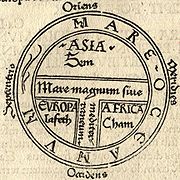 In Medieval Europe, all Asian people
s were thought of as descendants of Shem. By the nineteenth century, the term Semitic was confined to the ethnic groups who have historically spoken Semitic languages. These peoples were often considered to be a distinct race. However, some anti-Semitic racial theorists of the time argued that the Semitic peoples arose from the blurring of distinctions between previously separate races. This supposed process was referred to as Semiticization by the race-theorist Arthur de Gobineau
. The notion that Semitic identity was a product of racial "confusion" was later taken up by the Nazi ideologue Alfred Rosenberg
.
In contrast, some recent genetic studies found that analysis of the DNA of Semitic-speaking peoples suggests that they have some common ancestry. Though no significant common mitochondrial results have been yielded, Y-chromosomal
links between Semitic-speaking Near-Eastern peoples like Arabs, Hebrews
and Assyrians have proved fruitful, despite differences contributed from other groups (see Y-chromosomal Aaron
). The studies attribute this correlation to a common Near Eastern origin, since Semitic-speaking Near Easterners from the Fertile Crescent
(including Jews) were found to be more closely related to non-Semitic speaking Near Easterners (such as Iranians
, Anatolians
, and Caucasians) than to other Semitic-speakers (such as Gulf Arabs, Ethiopian Semites, and North African Arabs).
Semiticization is a concept found in the writings of some racial theorists in the nineteenth and twentieth centuries.http://www.spiritus-temporis.com/semiticization/ The term was first used by Arthur de Gobineau
to label the blurring of racial distinctions that, in his view, had occurred in the Middle-East. Gobineau had an essentialist model of race according to which there were three distinct racial groups: "black", "white" and "yellow" peoples, though he had no clear account of how this division arose. When these races mixed this caused "degeneration
". Since the point at which these three supposed races met was in the middle-east, Gobineau argued that the process of mixing and diluting races occurred there, and that Semitic peoples embodied this "confused" racial identity.
This concept suited the interests of antisemites, since it provided a theoretical model to rationalise racialised antisemitism. Variations of the theory are to be found in the writings of many antisemites in the late nineteenth century. The Nazi
ideologue Alfred Rosenberg
developed a variant of the theory in his writings, arguing that Jewish people were not a "real" race. According to Rosenberg, their evolution came about from the mixing of pre-existing races rather than from natural selection
. The theory of Semiticization was typically associated with other longstanding racist fears about the dilution of racial difference through miscegenation
, manifested in negative images of mulattos and other mixed groups.
Linguistics
Linguistics is the scientific study of human language. Linguistics can be broadly broken into three categories or subfields of study: language form, language meaning, and language in context....
and ethnology
Ethnology
Ethnology is the branch of anthropology that compares and analyzes the origins, distribution, technology, religion, language, and social structure of the ethnic, racial, and/or national divisions of humanity.-Scientific discipline:Compared to ethnography, the study of single groups through direct...
, Semitic (from the Biblical
Bible
The Bible refers to any one of the collections of the primary religious texts of Judaism and Christianity. There is no common version of the Bible, as the individual books , their contents and their order vary among denominations...
"Shem
Shem
Shem was one of the sons of Noah in the Hebrew Bible as well as in Islamic literature. He is most popularly regarded as the eldest son, though some traditions regard him as the second son. Genesis 10:21 refers to relative ages of Shem and his brother Japheth, but with sufficient ambiguity in each...
", , translated as "name") was first used to refer to a language family
Language family
A language family is a group of languages related through descent from a common ancestor, called the proto-language of that family. The term 'family' comes from the tree model of language origination in historical linguistics, which makes use of a metaphor comparing languages to people in a...
of largely Middle East
Middle East
The Middle East is a region that encompasses Western Asia and Northern Africa. It is often used as a synonym for Near East, in opposition to Far East...
ern origin, now called the Semitic languages
Semitic languages
The Semitic languages are a group of related languages whose living representatives are spoken by more than 270 million people across much of the Middle East, North Africa and the Horn of Africa...
. This family includes the ancient and modern forms of Akkadian
Akkadian language
Akkadian is an extinct Semitic language that was spoken in ancient Mesopotamia. The earliest attested Semitic language, it used the cuneiform writing system derived ultimately from ancient Sumerian, an unrelated language isolate...
, Amharic, Arabic
Arabic language
Arabic is a name applied to the descendants of the Classical Arabic language of the 6th century AD, used most prominently in the Quran, the Islamic Holy Book...
, Aramaic
Aramaic language
Aramaic is a group of languages belonging to the Afroasiatic language phylum. The name of the language is based on the name of Aram, an ancient region in central Syria. Within this family, Aramaic belongs to the Semitic family, and more specifically, is a part of the Northwest Semitic subfamily,...
, Ge'ez
Ge'ez language
Ge'ez is an ancient South Semitic language that developed in the northern region of Ethiopia and southern Eritrea in the Horn of Africa...
, Hebrew
Hebrew language
Hebrew is a Semitic language of the Afroasiatic language family. Culturally, is it considered by Jews and other religious groups as the language of the Jewish people, though other Jewish languages had originated among diaspora Jews, and the Hebrew language is also used by non-Jewish groups, such...
, Maltese
Maltese language
Maltese is the national language of Malta, and a co-official language of the country alongside English,while also serving as an official language of the European Union, the only Semitic language so distinguished. Maltese is descended from Siculo-Arabic...
, Phoenician, Tigre
Tigre language
For other uses please see Tigre Tigre is a Semitic language, which, along with Tigrinya, is believed to be one of direct descendants of the extinct Ge'ez language...
and Tigrinya among others.
As language studies are interwoven with cultural studies
Cultural studies
Cultural studies is an academic field grounded in critical theory and literary criticism. It generally concerns the political nature of contemporary culture, as well as its historical foundations, conflicts, and defining traits. It is, to this extent, largely distinguished from cultural...
, the term also came to describe the extended culture
Culture
Culture is a term that has many different inter-related meanings. For example, in 1952, Alfred Kroeber and Clyde Kluckhohn compiled a list of 164 definitions of "culture" in Culture: A Critical Review of Concepts and Definitions...
s and ethnicities
Ethnic group
An ethnic group is a group of people whose members identify with each other, through a common heritage, often consisting of a common language, a common culture and/or an ideology that stresses common ancestry or endogamy...
, as well as the history of these varied peoples as associated by close geographic and linguistic distribution.
Origin
The term Semite means a member of any of various ancient and modern Semitic-speaking peoples originating in southwestern Asia, including; Akkadians (AssyriansAssyrian people
The Assyrian people are a distinct ethnic group whose origins lie in ancient Mesopotamia...
and Babylonians), Eblaites, Ugar
Ugar
Ugar-Khurd is a developed town in the district of Belgaum, state of Karnataka, country India.It is the largest gram panchayat of Belgaum district, which is also larger than few municipals in district.-Industry:...
ites, Canaanites, Phoenicians, Hebrews
Hebrews
Hebrews is an ethnonym used in the Hebrew Bible...
(Israelites, Judea
Judea
Judea or Judæa was the name of the mountainous southern part of the historic Land of Israel from the 8th century BCE to the 2nd century CE, when Roman Judea was renamed Syria Palaestina following the Jewish Bar Kokhba revolt.-Etymology:The...
ns and Samaritans), Arameans, Chaldea
Chaldea
Chaldea or Chaldaea , from Greek , Chaldaia; Akkadian ; Hebrew כשדים, Kaśdim; Aramaic: ܟܐܠܕܘ, Kaldo) was a marshy land located in modern-day southern Iraq which came to briefly rule Babylon...
ns, Amorites, Moabites, Edomites, Hyksos
Hyksos
The Hyksos were an Asiatic people who took over the eastern Nile Delta during the twelfth dynasty, initiating the Second Intermediate Period of ancient Egypt....
, Arabs, Nabateans, Magan
Magan
Majan was an ancient region which was referred to in Sumerian cuneiform texts of around 2300 BC as a source of copper and diorite for Mesopotamia....
ites, Sheba
Sheba
Sheba was a kingdom mentioned in the Jewish scriptures and the Qur'an...
ns, Sutu
Sutu
Sutu is a village in Pihtla Parish, Saare County, on the island of Saaremaa, Estonia....
, Maltese
Maltese people
The Maltese are an ethnic group indigenous to the Southern European nation of Malta, and identified with the Maltese language. Malta is an island in the middle of the Mediterranean Sea...
, Mandeans and Ethiopian Semites. It was proposed at first to refer to the languages related to Hebrew by Ludwig Schlözer
August Ludwig von Schlözer
August Ludwig von Schlözer was a German historian who laid foundations for the critical study of Russian history.-Early career:...
, in Eichhorn's
Johann Gottfried Eichhorn
Johann Gottfried Eichhorn was a German Protestant theologian of Enlightenment and early orientalist.-Education and early career:...
"Repertorium", vol. VIII (Leipzig, 1781), p. 161. Through Eichhorn the name then came into general usage (cf. his "Einleitung in das Alte Testament" (Leipzig, 1787), I, p. 45). In his "Geschichte der neuen Sprachenkunde", pt. I (Göttingen, 1807) it had already become a fixed technical term.
The word "Semitic" is an adjective derived from Shem
Shem
Shem was one of the sons of Noah in the Hebrew Bible as well as in Islamic literature. He is most popularly regarded as the eldest son, though some traditions regard him as the second son. Genesis 10:21 refers to relative ages of Shem and his brother Japheth, but with sufficient ambiguity in each...
, one of the three sons of Noah
Sons of Noah
The Seventy Nations or Sons of Noah is an extensive list of descendants of Noah appearing in of the Hebrew Bible, representing an ethnology from an Iron Age Levantine perspective...
in the Bible
Bible
The Bible refers to any one of the collections of the primary religious texts of Judaism and Christianity. There is no common version of the Bible, as the individual books , their contents and their order vary among denominations...
(Genesis 5.32, 6.10, 10.21), or more precisely from the Greek
Greek language
Greek is an independent branch of the Indo-European family of languages. Native to the southern Balkans, it has the longest documented history of any Indo-European language, spanning 34 centuries of written records. Its writing system has been the Greek alphabet for the majority of its history;...
derivative of that name, namely (Sēm); the noun form referring to a person is Semite.
The term "anti-Semitic" (or "anti-Semite") overwhelmingly refers to Jews
Jews
The Jews , also known as the Jewish people, are a nation and ethnoreligious group originating in the Israelites or Hebrews of the Ancient Near East. The Jewish ethnicity, nationality, and religion are strongly interrelated, as Judaism is the traditional faith of the Jewish nation...
only. It was coined in 1879 by German journalist Wilhelm Marr
Wilhelm Marr
Wilhelm Marr was a German agitator and publicist, who coined the term "antisemitism" .-Life:Marr was born in Magdeburg as the only son of an actor and stage director. He went to a primary school in Hannover, then to a high school in Braunschweig...
in a pamphlet called, "The Victory of Germandom over Jewry". Using ideas of race and nationalism, Marr argued that Jews had become the first major power in the West. He accused them of being liberals, a people without roots who had Judaized Germans beyond salvation. In 1879 Marr founded the "League for Anti-Semitism".
The concept of "Semitic" peoples is derived from Biblical accounts of the origins of the cultures known to the ancient Hebrews
Hebrews
Hebrews is an ethnonym used in the Hebrew Bible...
. Those closest to them in culture and language were generally deemed to be descended from their forefather Shem. Enemies were often said to be descendants of his cursed nephew, Canaan
Canaan (Bible)
Canaan, according to the Book of Genesis in the Hebrew Bible, was a son of Ham and grandson of Noah.- Descendants of Canaan:According to the Table of Nations in Genesis 10 , Canaan was the ancestor of the Canaanite tribes who occupied the ancient Land of Canaan: all the territory from Sidon to...
. In Genesis 10:21-31, Shem is described as the father of Aram
Aram, son of Shem
Aram is a son of Shem, according to the Table of Nations in Genesis 10 of the Hebrew Bible, and the father of Uz, Hul, Gether and Mash. The Book of Chronicles confirms Aram as one of Shem's sons, confirming Uz, Hul, Gether and Mash, as also on the list of Shem's descendants. Aram son of Shem is ...
, Asshur, and Arpachshad
Arpachshad
Arpachshad or Arphaxad or Arphacsad was one of the five sons of Shem, the son of Noah . His brothers were Elam, Asshur, Lud and Aram; he is an ancestor of Abraham. He is said by Gen...
: the Biblical ancestors of the Arabs, Aramaeans, Assyrians
Assyrian people
The Assyrian people are a distinct ethnic group whose origins lie in ancient Mesopotamia...
, Babylonians, Chaldea
Chaldea
Chaldea or Chaldaea , from Greek , Chaldaia; Akkadian ; Hebrew כשדים, Kaśdim; Aramaic: ܟܐܠܕܘ, Kaldo) was a marshy land located in modern-day southern Iraq which came to briefly rule Babylon...
ns, Sabaeans, and Hebrews
Hebrews
Hebrews is an ethnonym used in the Hebrew Bible...
, etc., all of whose languages are closely related; the language family
Language family
A language family is a group of languages related through descent from a common ancestor, called the proto-language of that family. The term 'family' comes from the tree model of language origination in historical linguistics, which makes use of a metaphor comparing languages to people in a...
containing them was therefore named Semitic by linguists. However, the Canaan
Canaan
Canaan is a historical region roughly corresponding to modern-day Israel, Palestine, Lebanon, and the western parts of Jordan...
ites and Amorite
Amorite
Amorite refers to an ancient Semitic people who occupied large parts of Mesopotamia from the 21st Century BC...
s also spoke a language belonging to this family, and are therefore also termed Semitic in linguistics, despite being described in Genesis as sons of Ham (See Sons of Noah
Sons of Noah
The Seventy Nations or Sons of Noah is an extensive list of descendants of Noah appearing in of the Hebrew Bible, representing an ethnology from an Iron Age Levantine perspective...
). Shem is also described in Genesis as the father of Elam
Elam (Hebrew Bible)
Elam in the Hebrew Bible is said to be the oldest son of Shem, the son of Noah. It is also used , for the ancient country of Elam in what is now southern Iran, whose people the Hebrews believed to be the offspring of Elam, son of Shem...
and Lud
Lud son of Shem
Lud was a son of Shem and grandson of Noah, according to Genesis 10 . Lud should not be confused with the Ludim, said there to be descended from Mizraim....
, although the Elam
Elam
Elam was an ancient civilization located in what is now southwest Iran. Elam was centered in the far west and the southwest of modern-day Iran, stretching from the lowlands of Khuzestan and Ilam Province, as well as a small part of southern Iraq...
ites and Lydia
Lydia
Lydia was an Iron Age kingdom of western Asia Minor located generally east of ancient Ionia in the modern Turkish provinces of Manisa and inland İzmir. Its population spoke an Anatolian language known as Lydian....
ns usually thought to descend from these spoke languages that were not Semitic.
The hypothetical Proto-Semitic language, ancestral to historical Semitic languages in the Middle East, is thought to have been originally from either the Arabian Peninsula
Arabian Peninsula
The Arabian Peninsula is a land mass situated north-east of Africa. Also known as Arabia or the Arabian subcontinent, it is the world's largest peninsula and covers 3,237,500 km2...
(particularly around Yemen
Yemen
The Republic of Yemen , commonly known as Yemen , is a country located in the Middle East, occupying the southwestern to southern end of the Arabian Peninsula. It is bordered by Saudi Arabia to the north, the Red Sea to the west, and Oman to the east....
), the Levant
Levant
The Levant or ) is the geographic region and culture zone of the "eastern Mediterranean littoral between Anatolia and Egypt" . The Levant includes most of modern Lebanon, Syria, Jordan, Israel, the Palestinian territories, and sometimes parts of Turkey and Iraq, and corresponds roughly to the...
, Mesopotamia
Mesopotamia
Mesopotamia is a toponym for the area of the Tigris–Euphrates river system, largely corresponding to modern-day Iraq, northeastern Syria, southeastern Turkey and southwestern Iran.Widely considered to be the cradle of civilization, Bronze Age Mesopotamia included Sumer and the...
or even the Ethiopian Highlands
Ethiopian Highlands
The Ethiopian Highlands are a rugged mass of mountains in Ethiopia, Eritrea , and northern Somalia in the Horn of Africa...
. But its region of origin is still much debated and uncertain with, for example, a recent bayesian
Bayesian
Bayesian refers to methods in probability and statistics named after the Reverend Thomas Bayes , in particular methods related to statistical inference:...
analysis identifying an origin for Semitic languages in the Levant around 5,750 BP
Before Present
Before Present years is a time scale used in archaeology, geology, and other scientific disciplines to specify when events in the past occurred. Because the "present" time changes, standard practice is to use AD 1950 as the origin of the age scale, reflecting the fact that radiocarbon...
with a single introduction from what is now southern Arabia into north Africa
Africa
Africa is the world's second largest and second most populous continent, after Asia. At about 30.2 million km² including adjacent islands, it covers 6% of the Earth's total surface area and 20.4% of the total land area...
around 2,800 BP. The Semitic language family is also considered a component of the larger Afroasiatic macro-family of languages. Identification of the hypothetical proto-Semitic region of origin is therefore dependent on the larger geographic distributions of the other language families within Afroasiatic.
Ancient Semitic peoples
The following is a list of ancient Semitic peoples.- Akkadians — migrated into MesopotamiaMesopotamiaMesopotamia is a toponym for the area of the Tigris–Euphrates river system, largely corresponding to modern-day Iraq, northeastern Syria, southeastern Turkey and southwestern Iran.Widely considered to be the cradle of civilization, Bronze Age Mesopotamia included Sumer and the...
in the 4th millennium BC4th millennium BCThe 4th millennium BC saw major changes in human culture. It marked the beginning of the Bronze Age and of writing.The city states of Sumer and the kingdom of Egypt were established and grew to prominence. Agriculture spread widely across Eurasia...
and amalgamateAmalgamation (history)Amalgamation is a now largely archaic term for the intermarriage and interbreeding of different ethnicities or races. In the English-speaking world, the term was in use into the twentieth century. In the United States, it was partly replaced after 1863 by the term miscegenation...
with non-Semitic Mesopotamian (SumerSumerSumer was a civilization and historical region in southern Mesopotamia, modern Iraq during the Chalcolithic and Early Bronze Age....
ian) populations into the AssyriaAssyriaAssyria was a Semitic Akkadian kingdom, extant as a nation state from the mid–23rd century BC to 608 BC centred on the Upper Tigris river, in northern Mesopotamia , that came to rule regional empires a number of times through history. It was named for its original capital, the ancient city of Assur...
ns and BabyloniaBabyloniaBabylonia was an ancient cultural region in central-southern Mesopotamia , with Babylon as its capital. Babylonia emerged as a major power when Hammurabi Babylonia was an ancient cultural region in central-southern Mesopotamia (present-day Iraq), with Babylon as its capital. Babylonia emerged as...
ns of the Late Bronze Age. The remnants of these people became the modern AssyrianAssyrian peopleThe Assyrian people are a distinct ethnic group whose origins lie in ancient Mesopotamia...
Christians and Mandeans. - Eblaites — 23rd century BC
- ChaldeaChaldeaChaldea or Chaldaea , from Greek , Chaldaia; Akkadian ; Hebrew כשדים, Kaśdim; Aramaic: ܟܐܠܕܘ, Kaldo) was a marshy land located in modern-day southern Iraq which came to briefly rule Babylon...
ns — appeared in southern Mesopotamia circa 1000 BC - AramaeansAramaeansThe Aramaeans, also Arameans , were a Northwest Semitic semi-nomadic and pastoralist people who originated in what is now modern Syria during the Late Bronze Age and the Iron Age...
— 16th to 8th century BC / Akhlames (Ahlamu) 14th century BCRemnants survive in modern SyriaSyriaSyria , officially the Syrian Arab Republic , is a country in Western Asia, bordering Lebanon and the Mediterranean Sea to the West, Turkey to the north, Iraq to the east, Jordan to the south, and Israel to the southwest....
among the ChristianChristianA Christian is a person who adheres to Christianity, an Abrahamic, monotheistic religion based on the life and teachings of Jesus of Nazareth as recorded in the Canonical gospels and the letters of the New Testament...
population. - UgaritUgaritUgarit was an ancient port city in the eastern Mediterranean at the Ras Shamra headland near Latakia, Syria. It is located near Minet el-Beida in northern Syria. It is some seven miles north of Laodicea ad Mare and approximately fifty miles east of Cyprus...
es, 14th to 12th centuries BC - Suteans - 14th Century BC
- Canaanite languageCanaanite languagesThe Canaanite languages are a subfamily of the Semitic languages, which were spoken by the ancient peoples of the Canaan region, including Canaanites, Israelites and Phoenicians...
speaking nations of the early Iron Age:- Amorites — 20th century BC
- Ammonites
- Edomites
- HebrewsHebrewsHebrews is an ethnonym used in the Hebrew Bible...
/IsraeliteIsraeliteAccording to the Bible the Israelites were a Hebrew-speaking people of the Ancient Near East who inhabited the Land of Canaan during the monarchic period .The word "Israelite" derives from the Biblical Hebrew ישראל...
s — founded the nation of IsraelHistory of ancient Israel and JudahIsrael and Judah were related Iron Age kingdoms of ancient Palestine. The earliest known reference to the name Israel in archaeological records is in the Merneptah stele, an Egyptian record of c. 1209 BCE. By the 9th century BCE the Kingdom of Israel had emerged as an important local power before...
which later split into the Kingdoms of Israel and JudahKingdom of JudahThe Kingdom of Judah was a Jewish state established in the Southern Levant during the Iron Age. It is often referred to as the "Southern Kingdom" to distinguish it from the northern Kingdom of Israel....
. The remnants of these people became the JewsJewsThe Jews , also known as the Jewish people, are a nation and ethnoreligious group originating in the Israelites or Hebrews of the Ancient Near East. The Jewish ethnicity, nationality, and religion are strongly interrelated, as Judaism is the traditional faith of the Jewish nation...
and the Samaritans. - Moabites
- Phoenicians — founded Mediterranean colonies including CarthageCarthageCarthage , implying it was a 'new Tyre') is a major urban centre that has existed for nearly 3,000 years on the Gulf of Tunis, developing from a Phoenician colony of the 1st millennium BC...
. The remnants of these people became the modern MaronitesMaronitesMaronites , is an ethnoreligious group in the Middle East that have been historically tied with Lebanon. They derive their name from the Syriac saint Mar Maron whose followers moved to Mount Lebanon from northern Syria establishing the Maronite Church....
.
- Old South ArabianOld South ArabianOld South Arabian is the term used to describe four extinct, closely related languages spoken in the far southern portion of the Arabian Peninsula. There were a number of other Sayhadic languages , of which very little evidence survived, however...
speaking peoples- SabaeansSabaeansThe Sabaeans or Sabeans were an ancient people speaking an Old South Arabian language who lived in what is today Yemen, in the south west of the Arabian Peninsula.Some scholars suggest a link between the Sabaeans and the Biblical land of Sheba....
of Yemen — 9th to 1st c. BC
- Sabaeans
- ShebaShebaSheba was a kingdom mentioned in the Jewish scriptures and the Qur'an...
ns - Ubarites
- MaganMaganMajan was an ancient region which was referred to in Sumerian cuneiform texts of around 2300 BC as a source of copper and diorite for Mesopotamia....
ites - Ethio-SemiticEthiopian Semitic languagesEthiopian Semitic is a language group, which together with Old South Arabian forms the Western branch of the South Semitic languages. The languages are spoken in both Ethiopia and Eritrea...
speaking peoples- Aksumites — 4th c. BC to 7th c. AD
- Arabs, Old North Arabian speaking Bedouins
- GindibuGindibuGindibu led the Arab forces at the Battle of Qarqar , as an ally of Ben Haddad the king of the Aramean state of Damascus, as they fought against Assyria...
's Arabs 9th c. BC - Qadar tribe 7th century BC
- LihyanLihyanLihyan is an ancient Arab kingdom. It was located in northwestern Arabia, and is known for its Old North Arabian inscriptions dating to ca...
ites — 6th to 1st c. BC - ThamudThamudThe Thamūd were a people of ancient Arabia who were known from the 1st millennium BC to near the time of Muhammad. Although they are thought to have originated in southern Arabia, Arabic tradition has them moving north to settle on the slopes of Mount Athlab near Mada'in Saleh...
people — 2nd to 5th c. AD - GhassanidsGhassanidsThe Ghassanids were a group of South Arabian Christian tribes that emigrated in the early 3rd century from Yemen to Syria, Jordan, Lebanon and the Holy Land....
— 3rd to 7th c. AD - NabataeansNabataeansThamudi3.jpgThe Nabataeans, also Nabateans , were ancient peoples of southern Canaan and the northern part of Arabia, whose oasis settlements in the time of Josephus , gave the name of Nabatene to the borderland between Syria and Arabia, from the Euphrates to the Red Sea...
— adopted Arabic in the 4th century AD
- Gindibu
- MalteseMaltese peopleThe Maltese are an ethnic group indigenous to the Southern European nation of Malta, and identified with the Maltese language. Malta is an island in the middle of the Mediterranean Sea...
Languages
Linguistic meaning
The nature of meaning, its definition, elements, and types, was discussed by philosophers Aristotle, Augustine, and Aquinas. According to them 'meaning is a relationship between two sorts of things: signs and the kinds of things they mean '. One term in the relationship of meaning necessarily...
of "Semitic" is therefore derived from (though not identical to) Biblical usage. In a linguistic context the Semitic languages
Semitic languages
The Semitic languages are a group of related languages whose living representatives are spoken by more than 270 million people across much of the Middle East, North Africa and the Horn of Africa...
are a subgroup of the larger Afroasiatic language family (according to Joseph Greenberg
Joseph Greenberg
Joseph Harold Greenberg was a prominent and controversial American linguist, principally known for his work in two areas, linguistic typology and the genetic classification of languages.- Early life and career :...
's widely accepted classification) and include, among others: Akkadian
Akkadian language
Akkadian is an extinct Semitic language that was spoken in ancient Mesopotamia. The earliest attested Semitic language, it used the cuneiform writing system derived ultimately from ancient Sumerian, an unrelated language isolate...
, the ancient language of Babylon and Assyria; Amorite
Amorite language
Amorite is an early Northwest Semitic language, spoken by the Amorite tribes prominent in early Near Eastern history. It is known exclusively from non-Akkadian proper names recorded by Akkadian scribes during periods of Amorite rule in Babylonia , notably from Mari, and to a lesser extent Alalakh,...
, Amharic
Amharic language
Amharic is a Semitic language spoken in Ethiopia. It is the second most-spoken Semitic language in the world, after Arabic, and the official working language of the Federal Democratic Republic of Ethiopia. Thus, it has official status and is used nationwide. Amharic is also the official or working...
, the official language of Ethiopia; Tigrinya
Tigrinya language
Tigrinya , also spelled Tigrigna, Tigrnia, Tigrina, Tigriña, less commonly Tigrinian, Tigrinyan, is a Semitic language spoken by the Tigrinya people in central Eritrea , where it is one of the two main languages of Eritrea, and in the Tigray Region of Ethiopia , where it...
, a language spoken in Eritrea and in northern Ethiopia; Arabic
Arabic language
Arabic is a name applied to the descendants of the Classical Arabic language of the 6th century AD, used most prominently in the Quran, the Islamic Holy Book...
; Aramaic
Aramaic language
Aramaic is a group of languages belonging to the Afroasiatic language phylum. The name of the language is based on the name of Aram, an ancient region in central Syria. Within this family, Aramaic belongs to the Semitic family, and more specifically, is a part of the Northwest Semitic subfamily,...
, still spoken in Iraq, Iran, Syria, Turkey and Armenia by Assyrian
Assyrian people
The Assyrian people are a distinct ethnic group whose origins lie in ancient Mesopotamia...
-Chaldean Christians
Chaldean Christians
Chaldean Christians are ethnic Assyrian adherents of the Chaldean Catholic Church, most of whom entered communion with the Catholic Church from the Church of the East, which was already Catholic, but most wanted to stray away from the Catholic Church, causing the split in the 17th and 18th...
and Mandeans; Canaanite; Ge'ez
Ge'ez language
Ge'ez is an ancient South Semitic language that developed in the northern region of Ethiopia and southern Eritrea in the Horn of Africa...
, the ancient language of the Eritrean
Eritrean Orthodox Tewahdo Church
The Eritrean Orthodox Tewahedo Church is an Oriental Orthodox church. Its autocephaly was recognised by Pope Shenouda III after Eritrea gained its independence in 1993.-Origins:...
and Ethiopian Orthodox
Ethiopian Orthodox Tewahedo Church
The Ethiopian Orthodox Tewahedo Church is the predominant Oriental Orthodox Christian church in Ethiopia. The Ethiopian Church was administratively part of the Coptic Orthodox Church until 1959, when it was granted its own Patriarch by Coptic Orthodox Pope of Alexandria and Patriarch of All...
scriptures which originated in Yemen
Yemen
The Republic of Yemen , commonly known as Yemen , is a country located in the Middle East, occupying the southwestern to southern end of the Arabian Peninsula. It is bordered by Saudi Arabia to the north, the Red Sea to the west, and Oman to the east....
; Hebrew
Hebrew language
Hebrew is a Semitic language of the Afroasiatic language family. Culturally, is it considered by Jews and other religious groups as the language of the Jewish people, though other Jewish languages had originated among diaspora Jews, and the Hebrew language is also used by non-Jewish groups, such...
; Maltese
Maltese language
Maltese is the national language of Malta, and a co-official language of the country alongside English,while also serving as an official language of the European Union, the only Semitic language so distinguished. Maltese is descended from Siculo-Arabic...
; Phoenician or Punic; Syriac
Syriac language
Syriac is a dialect of Middle Aramaic that was once spoken across much of the Fertile Crescent. Having first appeared as a script in the 1st century AD after being spoken as an unwritten language for five centuries, Classical Syriac became a major literary language throughout the Middle East from...
(a form of Aramaic); and South Arabian
South Arabian
The Modern South Arabian languages are spoken mainly by minority populations in the Arabian Peninsula in Yemen and Oman, which, together with the Ethiopian Semitic languages, form the Western South Semitic branch. In his glottochronology-based classification, A...
, the ancient language of Sheba
Sheba
Sheba was a kingdom mentioned in the Jewish scriptures and the Qur'an...
/Saba, which today includes Mehri, spoken by only tiny minorities on the southern part of the Arabian Peninsula.
Wildly successful as second languages far beyond their numbers of contemporary first-language speakers, a few Semitic languages today are the base of the sacred literature of some of the world's great religions, including Islam
Islam
Islam . The most common are and . : Arabic pronunciation varies regionally. The first vowel ranges from ~~. The second vowel ranges from ~~~...
(Arabic), Judaism
Judaism
Judaism ) is the "religion, philosophy, and way of life" of the Jewish people...
(Hebrew and Aramaic), and Orthodox and Eastern Rite Christianity
Christianity
Christianity is a monotheistic religion based on the life and teachings of Jesus as presented in canonical gospels and other New Testament writings...
(Aramaic and Ge'ez). Millions learn these as a second language (or an archaic version of their modern tongues): many Muslim
Muslim
A Muslim, also spelled Moslem, is an adherent of Islam, a monotheistic, Abrahamic religion based on the Quran, which Muslims consider the verbatim word of God as revealed to prophet Muhammad. "Muslim" is the Arabic term for "submitter" .Muslims believe that God is one and incomparable...
s learn to read and recite Classical Arabic
Classical Arabic
Classical Arabic , also known as Qur'anic or Koranic Arabic, is the form of the Arabic language used in literary texts from Umayyad and Abbasid times . It is based on the Medieval dialects of Arab tribes...
, the language of the Qur'an
Qur'an
The Quran , also transliterated Qur'an, Koran, Alcoran, Qur’ān, Coran, Kuran, and al-Qur’ān, is the central religious text of Islam, which Muslims consider the verbatim word of God . It is regarded widely as the finest piece of literature in the Arabic language...
, and many Jews
Jews
The Jews , also known as the Jewish people, are a nation and ethnoreligious group originating in the Israelites or Hebrews of the Ancient Near East. The Jewish ethnicity, nationality, and religion are strongly interrelated, as Judaism is the traditional faith of the Jewish nation...
all over the world outside of Israel
Israel
The State of Israel is a parliamentary republic located in the Middle East, along the eastern shore of the Mediterranean Sea...
with other first languages speak and study Hebrew, the language of the Torah
Torah
Torah- A scroll containing the first five books of the BibleThe Torah , is name given by Jews to the first five books of the bible—Genesis , Exodus , Leviticus , Numbers and Deuteronomy Torah- A scroll containing the first five books of the BibleThe Torah , is name given by Jews to the first five...
, Midrash
Midrash
The Hebrew term Midrash is a homiletic method of biblical exegesis. The term also refers to the whole compilation of homiletic teachings on the Bible....
, and other Jewish scriptures.
It should be noted that Berber, Egyptian
Egyptian language
Egyptian is the oldest known indigenous language of Egypt and a branch of the Afroasiatic language family. Written records of the Egyptian language have been dated from about 3400 BC, making it one of the oldest recorded languages known. Egyptian was spoken until the late 17th century AD in the...
(including Coptic
Coptic language
Coptic or Coptic Egyptian is the current stage of the Egyptian language, a northern Afro-Asiatic language spoken in Egypt until at least the 17th century. Egyptian began to be written using the Greek alphabet in the 1st century...
), Hausa
Hausa language
Hausa is the Chadic language with the largest number of speakers, spoken as a first language by about 25 million people, and as a second language by about 18 million more, an approximate total of 43 million people...
, Somali
Somali language
The Somali language is a member of the East Cushitic branch of the Afro-Asiatic language family. Its nearest relatives are Afar and Oromo. Somali is the best documented of the Cushitic languages, with academic studies beginning before 1900....
, and many other related languages within the wider area of Northern Africa and the Middle East do not belong to the specific Semitic group, but are related the larger Afroasiatic language family of which the Semitic languages are also a subgroup. Other ancient and modern Middle Eastern languages such as; Azerbaijani
Azerbaijani language
Azerbaijani or Azeri or Torki is a language belonging to the Turkic language family, spoken in southwestern Asia by the Azerbaijani people, primarily in Azerbaijan and northwestern Iran...
, Kurdish
Kurdish language
Kurdish is a dialect continuum spoken by the Kurds in western Asia. It is part of the Iranian branch of the Indo-Iranian group of Indo-European languages....
, Persian
Persian language
Persian is an Iranian language within the Indo-Iranian branch of the Indo-European languages. It is primarily spoken in Iran, Afghanistan, Tajikistan and countries which historically came under Persian influence...
, Gilaki, Turkish
Turkish language
Turkish is a language spoken as a native language by over 83 million people worldwide, making it the most commonly spoken of the Turkic languages. Its speakers are located predominantly in Turkey and Northern Cyprus with smaller groups in Iraq, Greece, Bulgaria, the Republic of Macedonia, Kosovo,...
, ancient Sumerian
Sumerian language
Sumerian is the language of ancient Sumer, which was spoken in southern Mesopotamia since at least the 4th millennium BC. During the 3rd millennium BC, there developed a very intimate cultural symbiosis between the Sumerians and the Akkadians, which included widespread bilingualism...
, Armenian
Armenian language
The Armenian language is an Indo-European language spoken by the Armenian people. It is the official language of the Republic of Armenia as well as in the region of Nagorno-Karabakh. The language is also widely spoken by Armenian communities in the Armenian diaspora...
Elamite, Hittite
Hittites
The Hittites were a Bronze Age people of Anatolia.They established a kingdom centered at Hattusa in north-central Anatolia c. the 18th century BC. The Hittite empire reached its height c...
, the Philistine language and Nubian — do not belong to the larger Afroasiatic language family.
For a complete list of Semitic languages arranged by subfamily, see list from SIL's Ethnologue.
Geography
Semitic peoples and their languages, in both modern and ancient historic times, have covered a broad area bridging Africa, Western Asia and the Arabian Peninsula. The earliest historic (written) evidences of them are found in the Fertile CrescentFertile Crescent
The Fertile Crescent, nicknamed "The Cradle of Civilization" for the fact the first civilizations started there, is a crescent-shaped region containing the comparatively moist and fertile land of otherwise arid and semi-arid Western Asia. The term was first used by University of Chicago...
, an area encompassing the Akkadian, Babylonian and Assyria
Assyria
Assyria was a Semitic Akkadian kingdom, extant as a nation state from the mid–23rd century BC to 608 BC centred on the Upper Tigris river, in northern Mesopotamia , that came to rule regional empires a number of times through history. It was named for its original capital, the ancient city of Assur...
n civilizations along the Tigris
Tigris
The Tigris River is the eastern member of the two great rivers that define Mesopotamia, the other being the Euphrates. The river flows south from the mountains of southeastern Turkey through Iraq.-Geography:...
and Euphrates
Euphrates
The Euphrates is the longest and one of the most historically important rivers of Western Asia. Together with the Tigris, it is one of the two defining rivers of Mesopotamia...
rivers (modern Iraq
Iraq
Iraq ; officially the Republic of Iraq is a country in Western Asia spanning most of the northwestern end of the Zagros mountain range, the eastern part of the Syrian Desert and the northern part of the Arabian Desert....
), extending northwest into southern Asia Minor
Asia Minor
Asia Minor is a geographical location at the westernmost protrusion of Asia, also called Anatolia, and corresponds to the western two thirds of the Asian part of Turkey...
(modern Turkey
Turkey
Turkey , known officially as the Republic of Turkey , is a Eurasian country located in Western Asia and in East Thrace in Southeastern Europe...
) and the Levant
Levant
The Levant or ) is the geographic region and culture zone of the "eastern Mediterranean littoral between Anatolia and Egypt" . The Levant includes most of modern Lebanon, Syria, Jordan, Israel, the Palestinian territories, and sometimes parts of Turkey and Iraq, and corresponds roughly to the...
(modern Syria
Syria
Syria , officially the Syrian Arab Republic , is a country in Western Asia, bordering Lebanon and the Mediterranean Sea to the West, Turkey to the north, Iraq to the east, Jordan to the south, and Israel to the southwest....
and Lebanon
Lebanon
Lebanon , officially the Republic of LebanonRepublic of Lebanon is the most common term used by Lebanese government agencies. The term Lebanese Republic, a literal translation of the official Arabic and French names that is not used in today's world. Arabic is the most common language spoken among...
along the eastern Mediterranean. Early traces of Semitic speakers are found, too, in South Arabian inscriptions in Yemen
Yemen
The Republic of Yemen , commonly known as Yemen , is a country located in the Middle East, occupying the southwestern to southern end of the Arabian Peninsula. It is bordered by Saudi Arabia to the north, the Red Sea to the west, and Oman to the east....
, Eritrea
Eritrea
Eritrea , officially the State of Eritrea, is a country in the Horn of Africa. Eritrea derives it's name from the Greek word Erethria, meaning 'red land'. The capital is Asmara. It is bordered by Sudan in the west, Ethiopia in the south, and Djibouti in the southeast...
, Northern Ethiopia
Ethiopia
Ethiopia , officially known as the Federal Democratic Republic of Ethiopia, is a country located in the Horn of Africa. It is the second-most populous nation in Africa, with over 82 million inhabitants, and the tenth-largest by area, occupying 1,100,000 km2...
, and after this in Carthage
Carthage
Carthage , implying it was a 'new Tyre') is a major urban centre that has existed for nearly 3,000 years on the Gulf of Tunis, developing from a Phoenician colony of the 1st millennium BC...
(modern Tunisia
Tunisia
Tunisia , officially the Tunisian RepublicThe long name of Tunisia in other languages used in the country is: , is the northernmost country in Africa. It is a Maghreb country and is bordered by Algeria to the west, Libya to the southeast, and the Mediterranean Sea to the north and east. Its area...
) and later still, in Roman times, in Nabataean inscriptions from Petra
Petra
Petra is a historical and archaeological city in the Jordanian governorate of Ma'an that is famous for its rock cut architecture and water conduits system. Established sometime around the 6th century BC as the capital city of the Nabataeans, it is a symbol of Jordan as well as its most visited...
(modern Jordan
Jordan
Jordan , officially the Hashemite Kingdom of Jordan , Al-Mamlaka al-Urduniyya al-Hashemiyya) is a kingdom on the East Bank of the River Jordan. The country borders Saudi Arabia to the east and south-east, Iraq to the north-east, Syria to the north and the West Bank and Israel to the west, sharing...
) south into Arabia.
Later historical Semitic languages also spread into North Africa
North Africa
North Africa or Northern Africa is the northernmost region of the African continent, linked by the Sahara to Sub-Saharan Africa. Geopolitically, the United Nations definition of Northern Africa includes eight countries or territories; Algeria, Egypt, Libya, Morocco, South Sudan, Sudan, Tunisia, and...
in two widely separated periods. The first expansion occurred with the ancient Phoenicia
Phoenicia
Phoenicia , was an ancient civilization in Canaan which covered most of the western, coastal part of the Fertile Crescent. Several major Phoenician cities were built on the coastline of the Mediterranean. It was an enterprising maritime trading culture that spread across the Mediterranean from 1550...
ns from around the 9th century BC, along the southern Mediterranean Sea all the way to the Atlantic Ocean
Atlantic Ocean
The Atlantic Ocean is the second-largest of the world's oceanic divisions. With a total area of about , it covers approximately 20% of the Earth's surface and about 26% of its water surface area...
(colonies which included ancient Rome's nemesis Carthage
Carthage
Carthage , implying it was a 'new Tyre') is a major urban centre that has existed for nearly 3,000 years on the Gulf of Tunis, developing from a Phoenician colony of the 1st millennium BC...
). The second, a millennium later, was the expansion of the Muslim armies and Arabic in the 7th-8th centuries AD, which, at their height, controlled the Iberian Peninsula
Iberian Peninsula
The Iberian Peninsula , sometimes called Iberia, is located in the extreme southwest of Europe and includes the modern-day sovereign states of Spain, Portugal and Andorra, as well as the British Overseas Territory of Gibraltar...
(until 1492) and Sicily
Sicily
Sicily is a region of Italy, and is the largest island in the Mediterranean Sea. Along with the surrounding minor islands, it constitutes an autonomous region of Italy, the Regione Autonoma Siciliana Sicily has a rich and unique culture, especially with regard to the arts, music, literature,...
. Arab Muslim expansion is also responsible for modern Arabic's presence from Mauritania
Mauritania
Mauritania is a country in the Maghreb and West Africa. It is bordered by the Atlantic Ocean in the west, by Western Sahara in the north, by Algeria in the northeast, by Mali in the east and southeast, and by Senegal in the southwest...
, on the Atlantic coast of West Africa
West Africa
West Africa or Western Africa is the westernmost region of the African continent. Geopolitically, the UN definition of Western Africa includes the following 16 countries and an area of approximately 5 million square km:-Flags of West Africa:...
, to the Red Sea
Red Sea
The Red Sea is a seawater inlet of the Indian Ocean, lying between Africa and Asia. The connection to the ocean is in the south through the Bab el Mandeb strait and the Gulf of Aden. In the north, there is the Sinai Peninsula, the Gulf of Aqaba, and the Gulf of Suez...
in the northeastern corner of Africa, and its reach south along the Nile River as far as the northern half of Sudan
Sudan
Sudan , officially the Republic of the Sudan , is a country in North Africa, sometimes considered part of the Middle East politically. It is bordered by Egypt to the north, the Red Sea to the northeast, Eritrea and Ethiopia to the east, South Sudan to the south, the Central African Republic to the...
, where, as the national language, non-Arab Sudanese even farther south must learn it.
Modern Hebrew
Modern Hebrew
Modern Hebrew , also known as Israeli Hebrew or Modern Israeli Hebrew, is the language spoken in Israel and in some Jewish communities worldwide, from the early 20th century to the present....
was reintroduced in the 20th century, and together with Arabic, is a national language in Israel. Western Aramaic dialects remain spoken in Malula near Damascus. Eastern Neo-Aramaic is spoken along the northern border of Syria
Syria
Syria , officially the Syrian Arab Republic , is a country in Western Asia, bordering Lebanon and the Mediterranean Sea to the West, Turkey to the north, Iraq to the east, Jordan to the south, and Israel to the southwest....
and throughout Iraq
Iraq
Iraq ; officially the Republic of Iraq is a country in Western Asia spanning most of the northwestern end of the Zagros mountain range, the eastern part of the Syrian Desert and the northern part of the Arabian Desert....
, Southeast-Turkey
Turkey
Turkey , known officially as the Republic of Turkey , is a Eurasian country located in Western Asia and in East Thrace in Southeastern Europe...
(Turabdin), in far northwestern Iran
Iran
Iran , officially the Islamic Republic of Iran , is a country in Southern and Western Asia. The name "Iran" has been in use natively since the Sassanian era and came into use internationally in 1935, before which the country was known to the Western world as Persia...
and in Armenia
Armenia
Armenia , officially the Republic of Armenia , is a landlocked mountainous country in the Caucasus region of Eurasia...
, Georgia
Georgia (country)
Georgia is a sovereign state in the Caucasus region of Eurasia. Located at the crossroads of Western Asia and Eastern Europe, it is bounded to the west by the Black Sea, to the north by Russia, to the southwest by Turkey, to the south by Armenia, and to the southeast by Azerbaijan. The capital of...
and southern Russia
Russia
Russia or , officially known as both Russia and the Russian Federation , is a country in northern Eurasia. It is a federal semi-presidential republic, comprising 83 federal subjects...
. These speakers are predominantly Assyrians (also known as Chaldo-Assyrians). Mandean Aramaic is still spoken in parts of southern and northern Iraq
Iraq
Iraq ; officially the Republic of Iraq is a country in Western Asia spanning most of the northwestern end of the Zagros mountain range, the eastern part of the Syrian Desert and the northern part of the Arabian Desert....
. Semitic languages and are also found in the Horn of Africa, especially Eritrea
Eritrea
Eritrea , officially the State of Eritrea, is a country in the Horn of Africa. Eritrea derives it's name from the Greek word Erethria, meaning 'red land'. The capital is Asmara. It is bordered by Sudan in the west, Ethiopia in the south, and Djibouti in the southeast...
and Ethiopia
Ethiopia
Ethiopia , officially known as the Federal Democratic Republic of Ethiopia, is a country located in the Horn of Africa. It is the second-most populous nation in Africa, with over 82 million inhabitants, and the tenth-largest by area, occupying 1,100,000 km2...
. Tigrinya, a North Ethiopic dialect, has around six million speakers in Eritrea and Tigray
Tigray Region
Tigray Region is the northernmost of the nine ethnic regions of Ethiopia containing the homeland of the Tigray people. It was formerly known as Region 1...
. In Eritrea, Tigre
Tigre
-Argentina:* Tigre Partido, an administrative division in Buenos Aires, Argentina** Tigre, Buenos Aires, the main city in Tigre Partido** Tigre Club in Paseo Victorica, Tigre, near Buenos Aires, Argentina...
is the language of around 800,000 Muslims. Amharic is the national language of Ethiopia
Ethiopia
Ethiopia , officially known as the Federal Democratic Republic of Ethiopia, is a country located in the Horn of Africa. It is the second-most populous nation in Africa, with over 82 million inhabitants, and the tenth-largest by area, occupying 1,100,000 km2...
and is spoken by at least 10 million Ethiopian Orthodox Christians. Semitic languages today are also spoken in Malta
Malta
Malta , officially known as the Republic of Malta , is a Southern European country consisting of an archipelago situated in the centre of the Mediterranean, south of Sicily, east of Tunisia and north of Libya, with Gibraltar to the west and Alexandria to the east.Malta covers just over in...
(where an Italian-influenced language derived from Siculo-Arabic
Siculo-Arabic
Siculo-Arabic was a variety of Arabic spoken in Sicily and Malta between the ninth and the fourteenth centuries. It is extinct in Sicily, but it has developed into what is now the Maltese language on the islands of Malta....
is spoken) and on the island of Socotra
Socotra
Socotra , also spelt Soqotra, is a small archipelago of four islands in the Indian Ocean. The largest island, also called Socotra, is about 95% of the landmass of the archipelago. It lies some east of the Horn of Africa and south of the Arabian Peninsula. The island is very isolated and through...
in the Indian Ocean
Indian Ocean
The Indian Ocean is the third largest of the world's oceanic divisions, covering approximately 20% of the water on the Earth's surface. It is bounded on the north by the Indian Subcontinent and Arabian Peninsula ; on the west by eastern Africa; on the east by Indochina, the Sunda Islands, and...
between Yemen
Yemen
The Republic of Yemen , commonly known as Yemen , is a country located in the Middle East, occupying the southwestern to southern end of the Arabian Peninsula. It is bordered by Saudi Arabia to the north, the Red Sea to the west, and Oman to the east....
and Somalia
Somalia
Somalia , officially the Somali Republic and formerly known as the Somali Democratic Republic under Socialist rule, is a country located in the Horn of Africa. Since the outbreak of the Somali Civil War in 1991 there has been no central government control over most of the country's territory...
, where a dying vestige of South Arabian is spoken in the form of Soqotri
Soqotri language
Soqotri, or Socotri, is the language of the native population of the island of Socotra, and Abd al Kuri and Samhah islands of the Socotra archipelago off the southern coast of the Republic of Yemen...
. The Maltese language
Maltese language
Maltese is the national language of Malta, and a co-official language of the country alongside English,while also serving as an official language of the European Union, the only Semitic language so distinguished. Maltese is descended from Siculo-Arabic...
is the only officially recognized Semitic language of the European Union
European Union
The European Union is an economic and political union of 27 independent member states which are located primarily in Europe. The EU traces its origins from the European Coal and Steel Community and the European Economic Community , formed by six countries in 1958...
.
Religion
In a religious context, the term 'Semitic' can refer to the religions associated with the speakers of these languages: thus JudaismJudaism
Judaism ) is the "religion, philosophy, and way of life" of the Jewish people...
, Christianity
Christianity
Christianity is a monotheistic religion based on the life and teachings of Jesus as presented in canonical gospels and other New Testament writings...
and Islam
Islam
Islam . The most common are and . : Arabic pronunciation varies regionally. The first vowel ranges from ~~. The second vowel ranges from ~~~...
are often described as "Semitic religions" (irrespective of language family spoken by their adherents). Manicheanism and the Mandean religion also fall within this category.
The term Abrahamic religions
Abrahamic religions
Abrahamic religions are the monotheistic faiths emphasizing and tracing their common origin to Abraham or recognizing a spiritual tradition identified with him...
is more commonly used today. A truly comprehensive account of "Semitic" religions would include the Ancient Semitic religions (such as the religions of Ashurism, Adad
Baal
Baʿal is a Northwest Semitic title and honorific meaning "master" or "lord" that is used for various gods who were patrons of cities in the Levant and Asia Minor, cognate to Akkadian Bēlu...
, Hadad
Hadad
Haddad was a northwest Semitic storm and rain god, cognate in name and origin with the Akkadian god Adad. Hadad was often called simply Ba‘al , but this title was also used for other gods. The bull was the symbolic animal of Hadad. He appeared as a bearded deity, often shown as holding a club and...
) that flourished in the Middle East before the Abrahamic religions.
Ethnicity and race
Asian people
Asian people or Asiatic people is a term with multiple meanings that refers to people who descend from a portion of Asia's population.- Central Asia :...
s were thought of as descendants of Shem. By the nineteenth century, the term Semitic was confined to the ethnic groups who have historically spoken Semitic languages. These peoples were often considered to be a distinct race. However, some anti-Semitic racial theorists of the time argued that the Semitic peoples arose from the blurring of distinctions between previously separate races. This supposed process was referred to as Semiticization by the race-theorist Arthur de Gobineau
Arthur de Gobineau
Joseph Arthur Comte de Gobineau was a French aristocrat, novelist and man of letters who became famous for developing the theory of the Aryan master race in his book An Essay on the Inequality of the Human Races...
. The notion that Semitic identity was a product of racial "confusion" was later taken up by the Nazi ideologue Alfred Rosenberg
Alfred Rosenberg
' was an early and intellectually influential member of the Nazi Party. Rosenberg was first introduced to Adolf Hitler by Dietrich Eckart; he later held several important posts in the Nazi government...
.
In contrast, some recent genetic studies found that analysis of the DNA of Semitic-speaking peoples suggests that they have some common ancestry. Though no significant common mitochondrial results have been yielded, Y-chromosomal
Y chromosome
The Y chromosome is one of the two sex-determining chromosomes in most mammals, including humans. In mammals, it contains the gene SRY, which triggers testis development if present. The human Y chromosome is composed of about 60 million base pairs...
links between Semitic-speaking Near-Eastern peoples like Arabs, Hebrews
Hebrews
Hebrews is an ethnonym used in the Hebrew Bible...
and Assyrians have proved fruitful, despite differences contributed from other groups (see Y-chromosomal Aaron
Y-chromosomal Aaron
Y-chromosomal Aaron is the name given to the hypothesised most recent common ancestor of many of the patrilineal Jewish priestly caste known as Kohanim . In the Torah, this ancestor is identified as Aaron, the brother of Moses...
). The studies attribute this correlation to a common Near Eastern origin, since Semitic-speaking Near Easterners from the Fertile Crescent
Fertile Crescent
The Fertile Crescent, nicknamed "The Cradle of Civilization" for the fact the first civilizations started there, is a crescent-shaped region containing the comparatively moist and fertile land of otherwise arid and semi-arid Western Asia. The term was first used by University of Chicago...
(including Jews) were found to be more closely related to non-Semitic speaking Near Easterners (such as Iranians
Iranian peoples
The Iranian peoples are an Indo-European ethnic-linguistic group, consisting of the speakers of Iranian languages, a major branch of the Indo-European language family, as such forming a branch of Indo-European-speaking peoples...
, Anatolians
Anatolians
Anatolian peoples were a group of distinct ethnic groups which spoke related languages. They shared cultural traits and traditional religion. The Anatolian languages were one branch of the larger Indo-European language family.-Extinction:...
, and Caucasians) than to other Semitic-speakers (such as Gulf Arabs, Ethiopian Semites, and North African Arabs).
Semiticization is a concept found in the writings of some racial theorists in the nineteenth and twentieth centuries.http://www.spiritus-temporis.com/semiticization/ The term was first used by Arthur de Gobineau
Arthur de Gobineau
Joseph Arthur Comte de Gobineau was a French aristocrat, novelist and man of letters who became famous for developing the theory of the Aryan master race in his book An Essay on the Inequality of the Human Races...
to label the blurring of racial distinctions that, in his view, had occurred in the Middle-East. Gobineau had an essentialist model of race according to which there were three distinct racial groups: "black", "white" and "yellow" peoples, though he had no clear account of how this division arose. When these races mixed this caused "degeneration
Degeneration
The idea of degeneration had significant influence on science, art and politics from the 1850s to the 1950s. The social theory developed consequently from Charles Darwin's Theory of Evolution...
". Since the point at which these three supposed races met was in the middle-east, Gobineau argued that the process of mixing and diluting races occurred there, and that Semitic peoples embodied this "confused" racial identity.
This concept suited the interests of antisemites, since it provided a theoretical model to rationalise racialised antisemitism. Variations of the theory are to be found in the writings of many antisemites in the late nineteenth century. The Nazi
Nazism
Nazism, the common short form name of National Socialism was the ideology and practice of the Nazi Party and of Nazi Germany...
ideologue Alfred Rosenberg
Alfred Rosenberg
' was an early and intellectually influential member of the Nazi Party. Rosenberg was first introduced to Adolf Hitler by Dietrich Eckart; he later held several important posts in the Nazi government...
developed a variant of the theory in his writings, arguing that Jewish people were not a "real" race. According to Rosenberg, their evolution came about from the mixing of pre-existing races rather than from natural selection
Natural selection
Natural selection is the nonrandom process by which biologic traits become either more or less common in a population as a function of differential reproduction of their bearers. It is a key mechanism of evolution....
. The theory of Semiticization was typically associated with other longstanding racist fears about the dilution of racial difference through miscegenation
Miscegenation
Miscegenation is the mixing of different racial groups through marriage, cohabitation, sexual relations, and procreation....
, manifested in negative images of mulattos and other mixed groups.
See also
- HamiticHamiticHamitic is an historical term for the peoples supposedly descended from Noah's son Ham, paralleling Semitic and Japhetic.It was formerly used for grouping the non-Semitic Afroasiatic languages , but since, unlike the Semitic branch, these have not been shown to form a phylogenetic unity, the term...
- JapheticJapheticJaphetic is a term that refers to the supposed descendants of Japheth, one of the three sons of Noah in the Bible. It corresponds to Semitic and Hamitic...
- Proto-Semitic
- Antisemitism
- Afroasiatic languages
External links
- Semitic genetics
- Semitic language family tree included under "Afro-Asiatic" in SIL's Ethnologue.
- The south Arabian origin of ancient Arabs
- The Edomite Hyksos connection
- The perished Arabs
- The Midianites of the north