
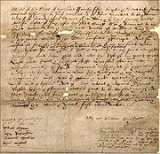
Palaeography, also spelt
paleography (from
GreekGreek is an independent branch of the Indo-European family of languages. Native to the southern Balkans, it has the longest documented history of any Indo-European language, spanning 34 centuries of written records. Its writing system has been the Greek alphabet for the majority of its history;...
palaiós, "old" and
graphein, "to write") is the study of ancient
writingWriting is the representation of language in a textual medium through the use of a set of signs or symbols . It is distinguished from illustration, such as cave drawing and painting, and non-symbolic preservation of language via non-textual media, such as magnetic tape audio.Writing most likely...
. Included in the discipline is the practice of deciphering, reading, and dating historical manuscripts, and the cultural context of writing, including the methods with which writing and books were produced, and the history of
scriptoriaScriptorium, literally "a place for writing", is commonly used to refer to a room in medieval European monasteries devoted to the copying of manuscripts by monastic scribes...
.
Application
Palaeography can be an essential skill for
historianA historian is a person who studies and writes about the past and is regarded as an authority on it. Historians are concerned with the continuous, methodical narrative and research of past events as relating to the human race; as well as the study of all history in time. If the individual is...
s and
philologistsPhilology is the study of language in written historical sources; it is a combination of literary studies, history and linguistics.Classical philology is the philology of Greek and Classical Latin...
, as it tackles two main difficulties. First, since the style of a single
alphabetAn alphabet is a standard set of letters—basic written symbols or graphemes—each of which represents a phoneme in a spoken language, either as it exists now or as it was in the past. There are other systems, such as logographies, in which each character represents a word, morpheme, or semantic...
in each given language has evolved constantly, it is necessary to know how to decipher its individual characters as they existed in various eras. Second,
scribeA scribe is a person who writes books or documents by hand as a profession and helps the city keep track of its records. The profession, previously found in all literate cultures in some form, lost most of its importance and status with the advent of printing...
s often used many
abbreviationAn abbreviation is a shortened form of a word or phrase. Usually, but not always, it consists of a letter or group of letters taken from the word or phrase...
s, usually so as to write more quickly and sometimes to save space, so the specialist-palaeographer must know how to interpret them. Knowledge of individual letter-forms, ligatures, punctuation, and abbreviations enables the palaeographer to read and understand the text. The palaeographer must know, first, the language of the text (that is, a 21st-century English or French speaker must become expert in the relevant earlier forms of these languages); and second, the historical usages of various styles of handwriting, common writing customs, and scribal/
notarialA notary is a lawyer or person with legal training who is licensed by the state to perform acts in legal affairs, in particular witnessing signatures on documents...
abbreviations. Philological knowledge of the language, vocabulary, and grammar generally used at a given time or place can help palaeographers identify ancient or more recent forgeries versus authentic documents.
Knowledge of writing materials is also essential to the study of handwriting and to the identification of the periods in which a document or manuscript may have been produced. An important goal may be to assign the text a date and a place of origin: this is why the palaeographer must take into account the style and formation of the manuscript and the handwriting used in it.
History of the discipline
Jean MabillonJean Mabillon was a French Benedictine monk and scholar, considered the founder of palaeography and diplomatics.-Early career:...
, a French Benedictine monk, scholar and
antiquaryAn antiquarian or antiquary is an aficionado or student of antiquities or things of the past. More specifically, the term is used for those who study history with particular attention to ancient objects of art or science, archaeological and historic sites, or historic archives and manuscripts...
, whose work
De re diplomatica was published in 1681, is widely regarded as the "father" of the twin disciplines of palaeography and
diplomaticsDiplomatics , or Diplomatic , is the study that revolves around documentation. It is a study that focuses on the analysis of document creation, its inner constitutions and form, the means of transmitting information, and the relationship documented facts have with their creator...
. However, the actual term "palaeography" was coined (in Latin) by
Bernard de MontfauconBernard de Montfaucon was a French Benedictine monk, a scholar who founded a new discipline, palaeography; an editor of works of the Fathers of the Church; he is also regarded to be one of the founders of modern archaeology.-Early life:Montfaucon was born January 13, 1655 in the castle of...
, a Benedictine monk, in the title of his
Palaeographia Graeca (1708), which remained a standard work in the specific field of Greek palaeography for more than a century. Later scholars who contributed to the development of the discipline included
Wilhelm WattenbachWilhelm Wattenbach , was a German historian.He was born at Ranzau in Holstein. He studied philology at the universities of Bonn, Göttingen and Berlin, and in 1843 he began to work upon the Monumenta Germaniae Historica...
and Leopold Delisle, who studied of the relationship between the human hand and writing. Their efforts were mainly directed at reconstructing "the ductus" — the movement of the pen in forming the letter — and at establishing a genealogy of writing based on the historical developments of its forms.
Ancient Near East
- See also: Epigraphy
Epigraphy Epigraphy Epigraphy (from the , literally "on-writing", is the study of inscriptions or epigraphs as writing; that is, the science of identifying the graphemes and of classifying their use as to cultural context and date, elucidating their meaning and assessing what conclusions can be...
and Paleography in medieval Islam
- Anatolian hieroglyphs
Anatolian hieroglyphs are an indigenous logographic script native to central Anatolia, consisting of some 500 signs. They were once commonly known as Hittite hieroglyphs, but the language they encode proved to be Luwian, not Hittite, and the term Luwian hieroglyphs is used in English publications...
- Cuneiform script
Cuneiform script )) is one of the earliest known forms of written expression. Emerging in Sumer around the 30th century BC, with predecessors reaching into the late 4th millennium , cuneiform writing began as a system of pictographs...
- Hittite cuneiform
Hittite cuneiform is the implementation of cuneiform script used in writing the Hittite language. The surviving corpus of Hittite texts is preserved in cuneiform on clay tablets dates to the 2nd millennium BC ....
- Egyptian hieroglyphs
Egyptian hieroglyphs were a formal writing system used by the ancient Egyptians that combined logographic and alphabetic elements. Egyptians used cursive hieroglyphs for religious literature on papyrus and wood...
- Middle Bronze Age alphabets
Proto-Sinaitic is a Middle Bronze Age script attested in a very small collection of inscriptions at Serabit el-Khadim in the Sinai Peninsula. Due to the extreme scarcity of Proto-Sinaitic signs, very little is known with certainty about the nature of the script...
- South Arabian alphabet
The ancient Yemeni alphabet branched from the Proto-Sinaitic alphabet in about the 9th century BC. It was used for writing the Yemeni Old South Arabic languages of the Sabaean, Qatabanian, Hadramautic, Minaean, Himyarite, and proto-Ge'ez in Dʿmt...
Aramaic palaeography

- Aramaic alphabet
The Aramaic alphabet is adapted from the Phoenician alphabet and became distinctive from it by the 8th century BC. The letters all represent consonants, some of which are matres lectionis, which also indicate long vowels....
- Mandaic alphabet
The Mandaic alphabet is based on the Aramaic alphabet, and is used for writing the Mandaic language.The Mandaic name for the script is Abagada or Abaga, after the first letters of the alphabet...
- Sogdian alphabet
The Sogdian alphabet was originally used for the Sogdian language, a language in the Iranian family used by the people of Sogdiana. The alphabet is derived from Syriac, the descendant script of the Aramaic alphabet. The Sogdian alphabet is one of three scripts used to write the Sogdian language,...
- Syriac alphabet
The Syriac alphabet is a writing system primarily used to write the Syriac language from around the 2nd century BC . It is one of the Semitic abjads directly descending from the Aramaic alphabet and shares similarities with the Phoenician, Hebrew, Arabic, and the traditional Mongolian alphabets.-...
Greek palaeography
See also:
- Cumae alphabet
- Epichoric alphabet
- Inscriptiones Graecae
The Inscriptiones Graecae , is an academic project originally begun by the Prussian Academy of Science, and today continued by its successor organisation, the Berlin-Brandenburgische Akademie der Wissenschaften...
South Indian palaeography
The earliest attested form of writing in
South IndiaSouth India is the area encompassing India's states of Andhra Pradesh, Karnataka, Kerala and Tamil Nadu as well as the union territories of Lakshadweep and Pondicherry, occupying 19.31% of India's area...
is inscriptions found in caves, associated with the Chalukya and
CheraChera Dynasty in South India is one of the most ancient ruling dynasties in India. Together with the Cholas and the Pandyas, they formed the three principle warring Iron Age Tamil kingdoms in southern India...
dynasties. These are written in variants of what is known as the Cave character, and their script differs from the Northern version in being more angular. Most of the modern scripts of South India have evolved from this script, with the exception of
VatteluttuVatteluttu alphabet, also spelled Vattezhuttu alphabet is an abugida writing system originating from the Tamil people of Southern India...
, the exact origins of which are unknown, and
NandinagariNanda Nagari is a variant of Nāgarī script which appeared in the 8th century AD. This script and its variants were commonly used in South....
, which is a variant of
DevanagariDevanagari |deva]]" and "nāgarī" ), also called Nagari , is an abugida alphabet of India and Nepal...
that developed due to later Northern influence.
- Chalukya script
- Chera script
- Grantha script
- Kannada script
The Kannada script is an alphasyllabary of the Brahmic family, used primarily to write the Kannada language, one of the Dravidian languages of southern India and also Sanskrit in the past. The Telugu script is derived from Old Kannada, and resembles Kannada script...
- Malayalam script
The Malayalam script is a Brahmic script used commonly to write the Malayalam language—which is the principal language of the Indian state of Kerala, spoken by 36 million people in the world. Like many other Indic scripts, it is an abugida, or a writing system that is partially “alphabetic” and...
- Nandinagari
Nanda Nagari is a variant of Nāgarī script which appeared in the 8th century AD. This script and its variants were commonly used in South....
- Tamil script
The Tamil script is a script that is used to write the Tamil language as well as other minority languages such as Badaga, Irulas, and Paniya...
- Telugu script
Telugu script, an abugida from the Brahmic family of scripts, is used to write the Telugu language, a language found in the South-Central Indian state of Andhra Pradesh as well as several other neighboring states. The Telugu script is derived from the Bhattiprolu script...
Antiquity
See the following articles:
- Corpus Inscriptionum Latinarum
The Corpus Inscriptionum Latinarum is a comprehensive collection of ancient Latin inscriptions. It forms an authoritative source for documenting the surviving epigraphy of classical antiquity. Public and personal inscriptions throw light on all aspects of Roman life and history...
- Old Italic alphabet
Old Italic refers to several now extinct alphabet systems used on the Italian Peninsula in ancient times for various Indo-European languages and non-Indo-European languages...
- Roman cursive
Roman cursive is a form of handwriting used in ancient Rome and to some extent into the Middle Ages. It is customarily divided into old cursive, and new cursive.- Old Roman cursive :...
- Roman square capitals
Roman square capitals, also called capitalis monumentalis, inscriptional capitals, elegant capitals and quadrata, are an ancient Roman form of writing, and the basis for modern capital letters....
- Rustic capitals
Rustic capitals is an ancient Roman calligraphic script. As the term is negatively connotated supposing an opposition to the more 'civilized' form of the Roman square capitals Bernhard Bischoff prefers to call the script canonized capitals.Rustic capitals are similar to Roman square capitals, but...
Pre-Caroline
James J. John points out that the disappearance of imperial authority around the end of the 5th century in most of the Latin-speaking half of the Roman Empire does not entail the disappearance of the Latin scripts, but rather introduced conditions that would allow the various provinces of the West gradually to drift apart in their writing habits.
Gregory the Great is widely responsible for the use of Latin post-Rome. He sent Queens Theodelinde and Brunhilda, as well as Spanish bishops, copies of manuscripts. Furthermore, he sent Augustine to Britain to proselytize (see Bede’s History of the English Church) and the manuscripts he sent with him are the core of missionary work. Although Rome loses dominance as a production centre, its manuscripts were distributed across Europe.
The Irish would be transforming a variant version of half-uncial by the late 6th century. A series of transformations, for book purposes, of the cursive documentary script that had grown out of the later Roman cursive would get under way in France by the mid-7th century. In Spain half-uncial and cursive would both be transformed into a new script, the Visigothic minuscule, no later than the early 8th century.
Prior to the era of
CharlemagneCharlemagne was King of the Franks from 768 and Emperor of the Romans from 800 to his death in 814. He expanded the Frankish kingdom into an empire that incorporated much of Western and Central Europe. During his reign, he conquered Italy and was crowned by Pope Leo III on 25 December 800...
, several parts of Europe had their own handwriting styles. Charlemagne's rule over a large part of the continent offered an opportunity to unify these styles in the hand called
Carolingian minusculeCarolingian or Caroline minuscule is a script developed as a writing standard in Europe so that the Roman alphabet could be easily recognized by the literate class from one region to another. It was used in Charlemagne's empire between approximately 800 and 1200...
. Simplistically speaking, the only scripts to escape this unification were the
VisigothicVisigothic script was a type of medieval script that originated in the Visigothic kingdom in Hispania...
(or Mozarabic) styles, which survived into the 12th or 13th century; the
BeneventanBeneventan script was a medieval script, so called because it originated in the Duchy of Benevento in southern Italy. It was also called Langobarda, Longobarda, Longobardisca , or sometimes Gothica; it was first called Beneventan by palaeographer E. A...
, which was still being used in the middle of the 16th century; and the script that is still used in traditional
IrishIrish , also known as Irish Gaelic, is a Goidelic language of the Indo-European language family, originating in Ireland and historically spoken by the Irish people. Irish is now spoken as a first language by a minority of Irish people, as well as being a second language of a larger proportion of...
handwriting, which has been in severe decline since the early 20th century and is now almost extinct. (The printed form was abolished by the
Irish governmentThe Government of Ireland is the cabinet that exercises executive authority in Ireland.-Members of the Government:Membership of the Government is regulated fundamentally by the Constitution of Ireland. The Government is headed by a prime minister called the Taoiseach...
in the 1950s).
Carolingian minuscule
In the 12th century, Carolingian minuscule underwent a change in its appearance and adopted bold and broken
GothicThe Gothic alphabet is an alphabet for writing the Gothic language, created in the 4th century by Ulfilas for the purpose of translating the Christian Bible....
letter-forms. This style remained predominant, with some regional variants, until the 15th century, when the
RenaissanceThe Renaissance was a cultural movement that spanned roughly the 14th to the 17th century, beginning in Italy in the Late Middle Ages and later spreading to the rest of Europe. The term is also used more loosely to refer to the historical era, but since the changes of the Renaissance were not...
humanisticHumanism is an approach in study, philosophy, world view or practice that focuses on human values and concerns. In philosophy and social science, humanism is a perspective which affirms some notion of human nature, and is contrasted with anti-humanism....
scripts revived a version of Carolingian minuscule. It then spread from the Italian
RenaissanceThe Renaissance was a cultural movement that spanned roughly the 14th to the 17th century, beginning in Italy in the Late Middle Ages and later spreading to the rest of Europe. The term is also used more loosely to refer to the historical era, but since the changes of the Renaissance were not...
all over Europe.
Further medieval scripts
- Beneventan script
Beneventan script was a medieval script, so called because it originated in the Duchy of Benevento in southern Italy. It was also called Langobarda, Longobarda, Longobardisca , or sometimes Gothica; it was first called Beneventan by palaeographer E. A...
- Gaelic script
Gaelic type, sometimes called Irish character, Irish type, or Gaelic script, is a family of insular typefaces devised for printing Irish and used between the 16th and 20th centuries. Sometimes all Gaelic typefaces are called Celtic or uncial, though most Gaelic types are not uncials...
- Insular script
Insular script was a medieval script system originally used in Ireland, then Great Britain, that spread to continental Europe under the influence of Celtic Christianity. Irish missionaries also took the script to continental Europe, where they founded monasteries such as Bobbio. The scripts were...
- Merovingian script
Merovingian script was a medieval script so called because it was developed in France during the Merovingian dynasty. It was used in the 7th and 8th centuries before the Carolingian dynasty and the development of Carolingian minuscule.-Script types:...
- Uncial script
- Visigothic script
Visigothic script was a type of medieval script that originated in the Visigothic kingdom in Hispania...
Modern period
These humanistic scripts are the base for the antiqua and the handwriting forms in western and southern Europe. In
GermanyGermany , officially the Federal Republic of Germany , is a federal parliamentary republic in Europe. The country consists of 16 states while the capital and largest city is Berlin. Germany covers an area of 357,021 km2 and has a largely temperate seasonal climate...
and
AustriaAustria , officially the Republic of Austria , is a landlocked country of roughly 8.4 million people in Central Europe. It is bordered by the Czech Republic and Germany to the north, Slovakia and Hungary to the east, Slovenia and Italy to the south, and Switzerland and Liechtenstein to the...
, the
Kurrentschrift was rooted in the
cursiveCursive, also known as joined-up writing, joint writing, or running writing, is any style of handwriting in which the symbols of the language are written in a simplified and/or flowing manner, generally for the purpose of making writing easier or faster...
handwriting of the later
Middle AgesThe Middle Ages is a periodization of European history from the 5th century to the 15th century. The Middle Ages follows the fall of the Western Roman Empire in 476 and precedes the Early Modern Era. It is the middle period of a three-period division of Western history: Classic, Medieval and Modern...
. With the name of the calligrapher Ludwig
SütterlinSütterlinschrift , or Sütterlin for short, is the last widely used form of the old German blackletter handwriting . In Germany, the old German cursive script developed in the 16th century, replacing the Gothic handwriting at the same time that bookletters developed into the Fraktur typeface...
, this handwriting counterpart to the
blackletterBlackletter, also known as Gothic script, Gothic minuscule, or Textura, was a script used throughout Western Europe from approximately 1150 to well into the 17th century. It continued to be used for the German language until the 20th century. Fraktur is a notable script of this type, and sometimes...
typefaceIn typography, a typeface is the artistic representation or interpretation of characters; it is the way the type looks. Each type is designed and there are thousands of different typefaces in existence, with new ones being developed constantly....
s was abolished by Hitler in 1941. After
World War IIWorld War II, or the Second World War , was a global conflict lasting from 1939 to 1945, involving most of the world's nations—including all of the great powers—eventually forming two opposing military alliances: the Allies and the Axis...
, it was taught as an alternative script in some areas until the 1970s; it is no longer taught.
Secretary handSecretary hand is a style of European handwriting developed in the early sixteenth century that remained common in the sixteenth and seventeenth centuries for writing English, German, Welsh and Gaelic....
is an informal business hand of the Renaissance.
See also
- Calligraphy
Calligraphy is a type of visual art. It is often called the art of fancy lettering . A contemporary definition of calligraphic practice is "the art of giving form to signs in an expressive, harmonious and skillful manner"...
- Hand (handwriting)
A Hand, in calligraphy and palaeography refers to one of several historical varieties of formal, impersonal, generic and exemplary writing styles...
- Codicology
Codicology is the study of books as physical objects, especially manuscripts written on parchment in codex form...
- Graffiti
Graffiti is the name for images or lettering scratched, scrawled, painted or marked in any manner on property....
- Historical Documents
- Isogloss
An isogloss—also called a heterogloss —is the geographical boundary of a certain linguistic feature, such as the pronunciation of a vowel, the meaning of a word, or use of some syntactic feature...
- List of New Testament papyri
- List of New Testament uncials
- Palaeographic letter variants
- Philology
Philology is the study of language in written historical sources; it is a combination of literary studies, history and linguistics.Classical philology is the philology of Greek and Classical Latin...
- Scribal abbreviation
Scribal abbreviations are the abbreviations used by ancient and mediæval scribes writing in Latin and, later, in Greek and Old Norse...
- Victor Gardthausen
Victor Emil Gardthausen was a German ancient historian, palaeographer, librarian, and Professor from Leipzig University. He was author and co-author of some books; editor of ancient texts.- Life :...
– palaeographer
Western palaeography
- Bernhard Bischoff, Latin Palaeography: Antiquity and the Middle Ages, Cambridge University Press
Cambridge University Press is the publishing business of the University of Cambridge. Granted letters patent by Henry VIII in 1534, it is the world's oldest publishing house, and the second largest university press in the world...
, 1989.
- E. A. Lowe, Codices Latini Antiquiores: A Palaeographical Guide to Latin Manuscripts Prior to the Ninth Century, Clarendon Press, 1972.
- Sir Edward Maunde Thompson
Sir Edward Maunde Thompson, GCB was a British palaeographer and Principal Librarian and first Director of the British Museum. He is also noted for his study of William Shakespeare's handwriting in the manuscript of the play Sir Thomas More.-Biography:Thompson's father was Edward Thompson, Custos...
, An Introduction to Greek and Latin Palaeography Clarendon Press, 1912.
Digital palaeography
- Malte Rehbein, Patrick Sahle, Torsten Schaßan (eds.): Codicology and Palaeography in the Digital Age. BoD, Norderstedt 2009, Volltext, ISBN 3-8370-9842-7
- Franz Fischer, Christiane Fritze, Georg Vogeler (eds.): Codicology and Palaeography in the Digital Age 2. BoD, Norderstedt 2010, ISBN 978-3-8423-5032-8
External links
- 'Manual of Latin Paleography' (A comprehensive PDF file containing 77 pages profusely illustrated, August 2008).
- 'Palaeography'. Encyclopaedia Britannica, 1911.
- Palaeography: reading old handwriting 1500 – 1800: A practical online tutorial, from the National Archives (UK)
- A comprehensive survey of all the important aspects of medieval palaeography. A scholarly maintained web directory on palaeography.
- Another scholarly maintained web directory on palaeography (200 links with critical comments, in French).
- Comprehensive bibliography (1,200 detailed references with critical comments in French).
- Online Tuition in the Palaeography of Scottish Documents 1500-1750
- An introduction to Greek and Latin palaeography by Thompson, Edward Maunde – Outdated (published 1912) but good and useful illustrated handbook, available as facsimile.
- Free palaeographical fonts
- Self-correcting medieval palaeography exercises (XIIIth / XIVth Century)
- 12th–17th century manuscripts originating from Europe and the Middle East, Center for Digital Initiatives, University of Vermont Libraries
- Interactive Album of Mediaeval Palaeography Collection of online exercises for the transcription of a variety of scripts, from 8th to 15th century