

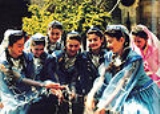
Azerbaijani people

Encyclopedia
The Azerbaijanis are a Turkic-speaking people
living mainly in northwestern Iran
and the Republic of Azerbaijan
, as well as in the neighbourhood states, Georgia
, Russia
(Dagestan
) and formerly Armenia
. Commonly referred to as Azeris (آذری - Azərilər) or Azerbaijani Turks , they also live in a wider area from the Caucasus
to the Iranian plateau
. The Azeris are predominantly Shia Muslim
and have a various other heritages inluding Turkic, Iranic in addition of indigenous Caucasians.
Azeris are the Indigenous small-numbered people of the Republic of Dagestan (Russia
).
Despite living on two sides of an international border since the treaties of Gulistan (1813) and Turkmenchay
(1828), after which Iran
lost its then northern territories to Russia
, the Azeris form a single ethnic group. However, northerners and southerners differ due to nearly two centuries of separate social evolution in Russia
n/Soviet
-influenced Azerbaijan and Iranian Azerbaijan. The Azerbaijani language
unifies Azeris, and is mutually intelligible with Turkmen
, Qashqai
, Gagauz
and Turkish
(including the dialects spoken by the Iraqi Turkmen
), all of which belong to Oghuz
, or Western, group of Turkic languages
.
Following the Russo-Persian Wars of 1813 and 1828, Qajar
territories in the Caucasus were ceded to the Russian Empire
and the treaties of Gulistan in 1813 and Turkmenchay
in 1828 finalized the borders with Russia and Iran
. The formation of Azerbaijan Democratic Republic
in 1918 established the territory of the Republic of Azerbaijan.
, a Persian
satrap
(governor) who ruled in Atropatene
(modern Iranian Azerbaijan). Atropates is derived from Old Persian roots meaning "protected by fire". The current name Azerbaijan is the combination of two Persian words, "Āzar" meaning "(holy) fire" and "pāygān" meaning "the place of". The "G" and "P" were replaced to "J" and "B" respectively during the Arab invasion of Persia, as these two sounds do not exist in Arabic. Azerbaijan has seen a host of inhabitants and invaders, including indigenous Caucasian Albanians but also the Medes
, Scythia
ns, Persians, Greeks
, Romans
, Khazars
, Arabs
, Oghuz Turks
, Seljuq Turks, Armenians
and Russians
.
Ancient Azerbaijanis spoke the Ancient Azari language
, which belonged to the Iranian
branch of Indo-European languages
. In the 11th century A.D. with Seljukid conquests, Oghuz
Turkic
tribes started moving across the Iranian plateau into the Caucasus and Anatolia. The influx of the Oghuz and other Turkmen tribes was further accentuated by the Mongol invasion. Here, the Oghuz tribes divided into various smaller groups, some of whom – mostly Sunni
– moved to Anatolia
(i.e., the Ottomans) and became settled, while others remained in the Caucasus region and later – due to the influence of the Safawiyya – eventually converted to the Shi'ite branch of Islam. The latter were to keep the name "Turkmen" or "Turcoman" for a long time: from the 13th century onwards they gradually Turkified the Iranian-speaking populations of Azerbaijan, thus creating a new identity based on Shiism and the use of Oghuz Turkic. However, it is notable that the Turkification of Azerbaijanis was completed only by the late 19th century, while the old Iranic speakers can still be found in tiny isolated recesses of the mountains or other remote areas (such as Harzand, Galin Guya, Shahrud villages in Khalkhal and Anarjan). Today, this Turkic-speaking population is also known as Azeris. According to Rybakov: "Speaking of the Azerbaijan culture originating at that time, in the XIV-XV cc., one must bear in mind, first of all, literature and other parts of culture organically connected with the language. As for the material culture, it remained traditional even after the Turkicization of the local population. However, the presence of a massive layer of Iranians that took part in the formation of the Azerbaijani ethnos, have imposed its imprint, primarily on the lexicon of the Azerbaijani language which contains a great number of Iranian and Arabic words. The latter entered both the Azerbaijani and the Turkish language mainly through the Iranian intermediary. Having become independent, the Azerbaijani culture retained close connections with the Iranian and Arab cultures. They were reinforced by common religion and common cultural-historical traditions.”.
ns are believed to be the earliest inhabitants of the region where the modern day Republic of Azerbaijan is located. Early Iranian settlements included the Scythia
ns in the ninth century BC. Following the Scythians, the Medes
came to dominate the area to the south of the Aras. The Medes forged a vast empire between 900-700 BC, which was integrated into the Achaemenids Empire around 550 BC. During this period, Zoroastrianism
spread in the Caucasus and Atropatene. The Achaemenids in turn were defeated by Alexander the Great in 330 BC, but the Median satrap Atropates was allowed to remain in power. Following the decline of the Seleucids in Persia in 247 BC, an Armenian Kingdom exercised control over parts of Caucasian Albania between 190 BC to 387 AD. Caucasian Albanians established a kingdom in the first century BC and largely remained independent until the Persian Sassanids
made the kingdom a vassal state
in 252 AD. Caucasian Albania's ruler, King Urnayr, officially adopted Christianity
as the state religion in the fourth century AD, and Albania would remain a Christian state until the 8th century. Sassanid control ended with their defeat by Muslim Arabs
in 642 AD.
as they marched into the Caucasus region. The Arabs made Caucasian Albania a vassal state after the Christian resistance, led by Prince Javanshir
, surrendered in 667. Between the ninth and tenth centuries, Arab authors began to refer to the region between the Kura
and Aras rivers as Arran
. During this time, Arabs from Basra
and Kufa
came to Azerbaijan and seized lands that indigenous peoples had abandoned; the Arabs became a land-owning elite. Conversion to Islam was slow as local resistance persisted for centuries and resentment grew as small groups of Arabs began migrating to cities such as Tabriz
and Maraghah. This influx sparked a major rebellion in Iranian Azerbaijan from 816–837, led by a local Zoroastrian commoner named Bābak
. However, despite pockets of continued resistance, the majority of the inhabitants of Azerbaijan converted to Islam. Later on, in the 10th and 11th centuries, Kurdish
dynasties of Shaddadid
and Rawadid
ruled parts of Azerbaijan.
In the middle of the eleventh century, the Seljuq dynasty overthrew Arab rule and established an empire that encompassed most of Southwest Asia
. The Seljuk period marked the influx of Oghuz
nomads into the region and, thus, the beginning of the Turkification
of Azerbaijan as the West Oghuz Turkic language supplanted earlier Caucasian and Iranian ones.
Iranian cultural influence, however, survived extensively, as evidenced by the works of then contemporary writers such as Persian
poet Nizami Ganjavi. The emerging Turkic identity was chronicled in epic poems or dastans, the oldest being the Book of Dede Korkut
, which relate allegorical
tales about the early Turks in the Caucasus and Asia Minor
. Turkic dominion was interrupted by the Mongols
in 1227. Turkic rule returned with the Tamerlan and then Sunni Qara Qoyunlū
(Black Sheep Turkmen) and Aq Qoyunlū (White Sheep Turkmen), who dominated Azerbaijan until the Shi'a
Safavids
took power in 1501.
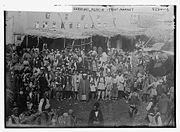 The Safavids, who rose from Iranian Azerbaijan and lasted until 1722, established the modern Iranian state. Noted for achievements in state building, architecture, and the sciences, the Safavid state crumbled due to internal decay and external pressures from the Russians and Afghans
. The Safavids encouraged and spread Shi'a Islam which is an important part of the national identity of Iranian Azerbaijani people as well as many Azerbaijanis north of the Aras. The Safavids encouraged the arts and culture and Shah Abbas the Great
created an intellectual atmosphere which according to some scholars was a new Golden Age of Persia. He reformed the government and the military, and responded to the needs of the common people.
The brief Ottoman
occupation followed the Safavid state. After the defeat of Afghans and the re-conquest by Nadir Shah Afshar, a chieftain from Khorasan, tried to stabilize the internal affair by balancing the power of the Shi'a. The brief reign of Karim Khan
came next, followed by the Qajars
, who ruled Azerbaijan and Iran starting in 1779. Russia loomed as a threat to Persian holdings in the Caucasus in this period. The Russo-Persian Wars
began in the eighteenth century and ended in the early nineteenth century with the Gulistan Treaty of 1813 and the Turkmenchay Treaty
in 1828, which officially gave the Caucasian portion of Qajar Iran to the Russian Empire.
Iranian Azerbaijan's role in the Iranian constitutional revolution cannot be underestimated. The greatest figures of the democracy seeking revolution Sattar Khan
and Bagher Khan
were both from Iranian Azerbaijan. The Constitutional Revolution of 1906–11 shook the Qajar dynasty, whose kings had virtually sold the country to the tobacco and oil interests of the British Empire and had lost territory to the Russian empire. A parliament (Majlis) came into existence by the efforts of the constitutionalists. It was accompanied in some regions by a peasant revolt against tax collectors and landlords, the only indigenous mainstay of the monarchy. Pro-democracy newspapers appeared, and Iranian intellectuals began to relish the modernist breezes blowing from Paris and Petrograd. The Qajar Shah and his British advisers crushed the Constitutional Revolution, but the demise of the dynasty could not be long postponed. The last Shah of the Qajar dynasty was soon removed by a military coup led by Reza Khan, an officer of an old Cossack regiment, which had been created by Czarist Russia and officered by Russians to protect the Qajar ruler and Russian interests. In the quest of imposing national homogeneity on the country where half of the population consisted of ethnic minorities, Reza Shah issued in quick succession bans on the use of Azerbaijani language on the premises of schools, in theatrical performances, religious ceremonies, and, finally, in the publication of books.
Upon the dethronement of Reza Shah in September 1941, Soviet forces took control of Iranian Azerbaijan and helped to set up the Azerbaijan People's Government
, a client state
under the leadership of Sayyid Jafar Pishevari backed by Soviet Azerbaijan. The Soviet military presence in Iranian Azerbaijan was mainly aimed at securing the Allied
aid route during World War II
. Concerned with continued Soviet presence after the war
, the United States and Britain pressured the Soviets to withdraw by late 1946. Immediately thereafter, the Iranian government regained control of Iranian Azerbaijan.
According to Professor. Gary R. Hess:
While the Azeris in Iran are integrated into the Iranian society, their kins in the Republic of Azerbaijan lived through the transition from the Russian imperial to brief independence
in 1918–1920, followed by over 70 years of Soviet rule
. Azerbaijan
restored independence in October 1991, and became embroiled in a war with the neighboring Armenia over the Nagorno-Karabakh
region.
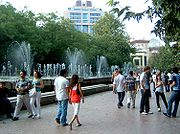 In many references, Azerbaijanis are designated as a Turkic people
, due to their Turkic language
. However, modern-day Azerbaijanis are believed to be primarily the descendants of the Caucasian Albania
n and Iranic
peoples who lived in the areas of the Caucasus and northern Iran, respectively, prior to Turkification
. Various historians including Vladimir Minorsky explain how largely Iranian and Caucasian populations became Turkish-speaking:
Thus, centuries of Turkic migration and turkification of the region helped to formulate the contemporary Azerbaijani ethnic identity.
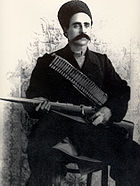
era and its aftermath", there is evidence to indicate "permanent settlements". The earliest major Turkic incursion began and accelerated during the Seljuk period. The migration of Oghuz Turks from present-day Turkmenistan
, which is attested by linguistic similarity, remained high through the Mongol period, as many troops under the Ilkhans were Turkic. By the Safavid
period, the Turkification of Azerbaijan continued with the influence of the Kizilbash
. The very name Azerbaijan is derived from the pre-Turkic name of the province, Azarbayjan or Adarbayjan, and illustrates a gradual language shift that took place as local place names survived Turkification, albeit in altered form.
Most academics view the linguistic Turkification of predominantly non-Turkic-speaking indigenous peoples and assimilation of small bands of Turkic tribes as the most likely source of Azeris background.
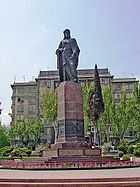
in Iranian Azerbaijan, and Scythian invaders who arrived during the eighth century BCE. It is believed that the Medes mixed with Mannai. Ancient written accounts, such as one written by Arab historian Abu al-Hasan Ali ibn al-Husayn al-Masudi (896-956), attest to an Iranian presence in the region:
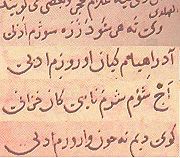 Scholars see cultural similarities between modern Persians and Azeris as evidence of an ancient Iranian influence. Archaeological evidence indicates that the Iranian religion of Zoroastrianism
was prominent throughout the Caucasus before Christianity and Islam and that the influence of various Persian Empires added to the Iranian character of the area. It has also been hypothesized that the population of Iranian Azerbaijan was predominantly Persian-speaking before the Oghuz arrived. This claim is supported by the many figures of Persian literature
, such as Qatran Tabrizi
, Shams Tabrizi
, Nizami, and Khaghani, who wrote in Persian prior to and during the Oghuz migration, as well as by Strabo
, Al-Istakhri, and Al-Masudi, who all describe the language of the region as Persian
. The claim is mentioned by other medieval historians, such as Al-Muqaddasi
. Other common Perso-Azeribaijani features include Iranian place names such as Tabriz
and the name Azerbaijan itself.
Encyclopaedia Iranica explains that "The Turkish speakers of Azerbaijan (q.v.) are mainly descended from the earlier Iranian speakers, several pockets of whom still exist in the region." The modern presence of the Iranian Talysh
and Tats
in Azerbaijan is further evidence of the Iranian ethnic influence in the region. As a precursor to these modern groups, the ancient Azaris
are also hypothesized as ancestors of the modern Azerbaijanis.
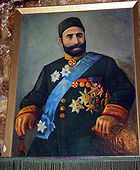
The Caucasian origin mostly applies to the Azeris of the Caucasus, most of whom are now inhabitants of the Republic of Azerbaijan. There is evidence that, despite repeated invasions and migrations, aboriginal Caucasian
s may have been culturally assimilated, first by Iranians
and later by the Oghuz. Considerable information has been learned about the Caucasian Albanians including their language, history, early conversion to Christianity
, and close ties to the Armenians
. Many academics believe that the Udi language
, still spoken in Azerbaijan, is a remnant of the Albanians' language.
This Caucasian influence extended further south into Iranian Azerbaijan. During the 1st millennium BCE, another Caucasian people, the Mannaeans
(Mannai) populated much of Iranian Azerbaijan. Weakened by conflicts with the Assyrians, the Mannaeans are believed to have been conquered and assimilated by the Medes by 590 BCE.
According to a study of Eurasia's population by the American Society of Human Genetics, the different Iranian populations show a striking degree of homogeneity and nonsignificant FST values among themselves. It seems that the people are largely Iranian settlers both before and after Islam.
2010 genetic study of Andonian et al shows Turkification of this region was predominantly by the process of elite dominance, i.e. by the limited number of invaders who left only weak patrilineal genetic trace in modern populations of the region and not mass migration.
and non Indo-European speakers, in Iran. The study found that the Azerbaijanis of Iran do not have a similar FSt and other genetic markers found in Anatolian and European Turks. However, the genetic Fst and other genetic traits like MRca and mtDNA of Iranian Azeris were identical to Persians
in Iran.
In 2006 M. Regueiro and A.M. Cadenas of Stanford University
show that the population of central Iran (Isfahan) group to Caucasian Azeri people more than population of Turkey in terms of haplogroup distributions and genetic homogeneity.
), notably the Turkmen
, that is much higher than that of their neighbors, the Georgians
and Armenians
. MtDNA analysis indicates that the main relationship with Iranians is through a larger West Eurasian group that is secondary to that of the Caucasus, according to a study that did not include Azeris, but Georgians who have clustered with Azeris in other studies. The conclusion from the testing shows that the Caucasian Azeris are a mixed population with relationships, in order of greatest similarity, with the Caucasus, Iranians and Near Easterners, Europeans, and Turkmen. Other genetic analysis of mtDNA and Y-chromosomes indicates that Caucasian populations are genetically intermediate between Europeans and Near Easterners, but that they are more closely related to Near Easterners overall. Another study, conducted in 2003 by the Russian Journal of Genetics, links Iranians in Azerbaijan (the Talysh
and Tats
) with Azerbaijanis of the Republic:
A 2011 study at Yerevan State University
and Tehran University of Medical Sciences
shows Azeris have much weaker genetic affinity with the populations from Central Asia and the Caucasus than with their immediate geographic neighbours. Relying on these outcomes one can suggest that language change with regard to Azeris occurred through elite dominance mechanism rather than demographic diffusion model.
s (by Kurds), and religious identification prevailed over ethnic identification. When the South Caucasus became part of the Russian Empire
in the nineteenth century, the Russian authorities, who traditionally referred to all Turkic people as Tatars, defined Tatars living in the Transcaucasus region as Caucasian or Aderbeijanskie (Адербейджанские) Tatars to distinguish them from other Turkic geoups. The Russian Brockhaus and Efron Encyclopedic Dictionary
, written in the 1890s, also refers to Tatars in Azerbaijan as Aderbeijans (адербейджаны). According to the article Turko-Tatars of the above encyclopedia:
This ethnonym was also used by Joseph Deniker
:
In Azerbaijani-language publications, the expression "Azerbaijani nation" referring to those who were known as Tatars of the Caucasus first appeared in the newspaper Kashkul in 1880.
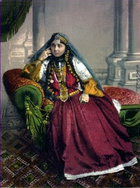 There are an estimated 24 to 33 million Azerbaijanis in the world, but census figures are difficult to verify. The vast majority live in Azerbaijan and Iranian Azerbaijan. Between 16 and 23 million Azeris live in Iran, mainly in the northwestern provinces. Approximately 7.6 million Azeris are found in the Republic of Azerbaijan. A diaspora, possibly numbering in the millions, is found in neighboring countries and around the world. There are sizable communities in Turkey
, Georgia
, Russia
, UK
, USA
, Canada
, Germany
and other countries. In Russia, Azeris are listed among the indigenous small-numbered people of Dagestan (Russia
).
While population estimates in Azerbaijan are considered reliable due to regular censuses taken, the figures for Iran remain questionable. Since the early twentieth century, successive Iranian governments have avoided publishing statistics on ethnic groups. Unofficial population estimates of Azeris in Iran range from 20–24%. However, many Iran scholars, such as Nikki Keddie, Patricia J. Higgins, Shahrough Akhavi, Ali Reza Sheikholeslami, and others, claim that Azeris may comprise as much as one third of Iran's population.
A large expatriate community of Azerbaijanis is found outside Azerbaijan and Iran. According to Ethnologue
, there were over 1 million Azerbaijani-speakers of the north dialect in southern Dagestan, Armenia
, Estonia
, Georgia
, Kazakhstan
, Kyrgyzstan
, Russia
, Turkmenistan
, and Uzbekistan
as of 1993. Other sources, such as national censuses, confirm the presence of Azeris throughout the former Soviet Union
. The Ethnologue figures are outdated in the case of Armenia, where the Nagorno-Karabakh conflict has affected the population of Azeris. Ethnologue further reports that an additional 1 million South Azeris live outside Iran, but these figures most likely are a reference to the Iraqi Turkmen
, a distinct though related Turkic people.
. The literacy rate is very high, another Soviet legacy, and is estimated at 99.5%. Whereas most urban Azeris are educated, education remains comparatively lower in rural areas. A similar disparity exists with healthcare.
Azeri society has been deeply impacted by the war with Armenia over Nagorno-Karabakh
, which has displaced nearly 1 million Azeris and put strains upon the economy. Azerbaijan has benefited from the oil industry, but high levels of corruption have prevented greater prosperity for the masses. Many Azeris have grown frustrated over the political process in Azerbaijan as the election of current president Ilham Aliyev
has been described as "marred by allegations of corruption and brutal crackdowns on his political opposition". Despite these problems, there is a renaissance in Azerbaijan as positive economic predictions and an active political opposition appear determined to improve the lives of average Azeris.
, Zanjan
, parts of Hamedan, Qazvin
, West Azerbaijan and Markazi
. Many others live in Tehran
, Fars Province, and other regions. Generally, Azeris in Iran were regarded as "a well integrated linguistic minority" by academics prior to Iran's Islamic Revolution
. Despite friction, Azerbaijanis in Iran came to be well represented at all levels of "political, military, and intellectual hierarchies, as well as the religious hierarchy".
Resentment came with Pahlavi policies that suppressed the use of the Azerbaijani language
in local government, schools, and the press. However with the advent of the Iranian Revolution
in 1979, emphasis shifted away from nationalism as the new government highlighted religion as the main unifying factor. Within the Islamic Revolutionary government there emerged an Azeri nationalist faction led by Ayatollah Kazem Shariatmadari
, who advocated greater regional autonomy and wanted the constitution to be revised to include secularists and opposition parties; this was denied. In May 2006 Iranian Azerbaijan witnessed riots over publication of a cartoon
that many Azeris found offensive. The cartoon was drawn by Mana Neyestani
, an ethnic Azeri, who was fired along with his editor as a result of the controversy.
Despite sporadic problems, Azeris are an intrinsic community within Iran. Currently, the living conditions of Azeris in Iran closely resemble that of Persians
:
Andrew Burke writes:
Azeris in Iran are in high positions of authority with the Ayatollah Ali Khamenei
currently sitting as the Supreme Leader
.
. Astara is a multi-bordered city with its northern part in Azerbaijan and southern part in Iran and this enables residents of both sides to communicate and trade easily. Iranians often cross into the Azeri section to purchase alcohol freely and Azeris go into Iran to gain resources that are of a cheaper amounts.
n and bi-cultural, as northern Azeris have absorbed Russo-Soviet and Eastern European influences, whereas the Azeris of the south have remained within the Turko-Iranian
and Persianate tradition. Modern Azeri culture includes significant achievements in literature, art, music, and film.
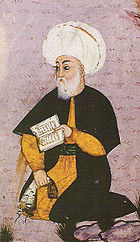 The Azerbaijanis speak Azerbaijani
(sometimes called Azerbaijani Turkish or Azeri), one of branches of Oghuz Turkic languages
. Oghuz Turks entered in Azerbaijan in 11th and 12th century CE and Azeri went through a gradual development before assuming its present form. Early Oghuz was mainly an oral language. The origins of the later compiled epics and heroic stories of Dede Korkut
, is probably this period. Oral tradition continues for the next two hundred years. The first accepted Oghuz Turkic text goes back to 15th century. The beginning of written, classical Azeri literature was after the Mongol invasion. Some of the earliest Azeri writings of the past are traced back to the poet Nasimi (died 1417) and then decades later Fuzûlî
(1483–1556). Ismail I
, Shah of Safavid Persia
wrote Azeri poetry under the pen name Khatâ'i. Modern Azeri literature continued with a traditional emphasis upon humanism
, as conveyed in the writings of Samad Vurgun, Shahriar
, and many others.
Azeris are generally bilingual, often fluent in either Russian
(in Azerbaijan) or Persian
(in Iran). As of 1996, around 38% of Azerbaijan's roughly 8,000,000 population spoke Russian fluently. Moreover, in 1999, around 2,700 Azeris in the Azerbaijan Republic (0.04% of the total Azeri population) reported Russian as their mothertongue. An Iranian survey (2002) revealed that 90.0% of the sample household population in Iran is able to speak Persian, 4.6% can only understand it, and 5.4% can neither speak nor understand Persian. Azeri is the most spoken minority language in an Iranian household (24%).
. Religious minorities include Sunni Muslim
s (mainly Hanafi
), Zoroastrians
, Christians
and Bahá'ís
. Azeris in the Republic of Azerbaijan have an unknown number showing no religious affiliation, since being in a secular country. Many describe themselves as cultural Muslim
s. There is a small number of Naqshbandi
Sufis
among Muslim Azeris. Christian Azeris number around 5,000 people in the Republic of Azerbaijan and consist mostly of recent converts. Some Azeris from rural regions retain pre-Islamic animist beliefs, such as the sanctity of certain sites and the veneration of certain trees and rocks. In the Republic of Azerbaijan traditions from other religions are often celebrated in addition to Islamic holidays, including Norouz
and Christmas
. After the fall of the Soviet Union
, Azerbaijanis have increasingly returned to their Islamic heritage as recent reports indicate that many Azerbaijani youth are being drawn to Islam. A recent study indicated that radical Islam is growing in the nation, capturing the attention of some ultra-secularists.
to the Caspian Sea
. In the group dance the performers come together in a semi-circular or circular formation as, "The leader of these dances often executes special figures as well as signaling and changes in the foot patterns, movements, or direction in which the group is moving, often by gesturing with his or her hand, in which a kerchief is held." Solitary dances are performed by both men and women and involve subtle hand motions in addition to sequenced steps.
Azeri musical tradition can be traced back to singing bard
s called Ashiqs, a vocation that survives to this day. Modern Ashiqs play the saz
(lute
) and sing dastans (historical ballad
s). Other musical instruments include the tar
(another type of lute), balaban (a wind instrument), kamancha (fiddle), and the dhol
(drums). Azeri classical music, called mugham
, is often an emotional singing performance. Composers Uzeyir Hajibeyov
, Gara Garayev
and Fikret Amirov
created a hybrid style that combines Western classical music with mugham. Other Azeris, notably Vagif Mustafa Zadeh and Aziza Mustafa Zadeh
, mixed jazz
with mugham. Some Azeri musicians have received international acclaim, including Rashid Behbudov
(who could sing in over eight languages) and Muslim Magomayev (a pop star from the Soviet era).
Meanwhile in Iran, Azeri music has taken a different course. According to Iranian Azeri singer Hossein Alizadeh
, "Historically in Iran, music faced strong opposition from the religious establishment, forcing it to go underground." As a result, most Iranian Azeri music is performed outside of Iran amongst exile communities.
Azeri film and television is largely broadcast in Azerbaijan with limited outlets in Iran. Some Azeris have been prolific film-makers, such as Rustam Ibragimbekov
, who wrote Burnt by the Sun
, winner of the Grand Prize at the Cannes Film Festival
and an Academy Award
for Best Foreign Language Film
in 1994. Many Iranian Azeris have been prominent in the cinematic tradition of Iran
, which has received critical praise since the 1980s.
and Nizami Ganjavi. Other ancient sports include wrestling, javelin throwing and ox-wrestling.
The Soviet legacy has in modern times propelled some Azeris to become accomplished athletes at the Olympic level. The Azeri government supports the country's athletic legacy and encourages Azeri youth to take part. Football
is very popular in both Azerbaijan and Iranian Azerbaijan. There are many prominent Azeri soccer players such as Ali Daei
, the world's all-time leading goal scorer in international matches and the former captain of the Iran national soccer team. Azeri athletes have particularly excelled in weight lifting
, gymnastics
, shooting
, javelin throwing, karate
, boxing
, and wrestling
. Weight lifters, such as Iran's Hossein Reza Zadeh, world's super heavyweight lifting record holder and two times Olympic champion in 2000 and 2004 and Nizami Pashayev
, who won the European heavyweight title in 2006, have excelled at the international level.
Chess
is another popular pastime in Azerbaijan. The country has produced many notable players, such as Teimour Radjabov
and Shahriyar Mammadyarov, both highly ranked internationally.
to develop. In contrast, in Iranian Azerbaijan Islamic theocratic institutions dominate nearly all aspects of society, with most political power in the hands of the Supreme Leader of Iran
and the Council of Guardians. Yet both societies are in a state of change. In Azerbaijan there is a secular democratic system that is mired in political corruption and charges of election fraud. Azerbaijan's civil society is a work in progress:
Despite these problems Azerbaijan has an active political opposition that seeks more expansive democratic reforms. Azeris in Iran remain intertwined with the Islamic republic's theocratic
regime and lack any significant civil society of a secular nature that can pose a major challenge. There are signs of civil unrest due to the policies of the Iranian government in Iranian Azerbaijan and increased interaction with fellow Azeris in Azerbaijan and satellite broadcasts from Turkey
have revived Azeri nationalism.
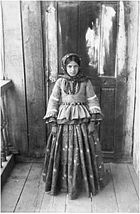 Azeri females have historically struggled against a legacy of male domination but have made great strides since the twentieth century. In Azerbaijan, women were granted the right to vote in 1919. Women have attained Western-style equality in major cities such as Baku
, although in rural areas more traditional views remain. Some problems that are especially prevalent include violence against women, especially in rural areas. Crimes such as rape are severely punished in Azerbaijan, but rarely reported, not unlike other parts of the former Soviet Union. Azeri women were forced to "give up the veil". Women are under-represented in elective office but have attained high positions in parliament. An Azeri woman is the Chief Justice of the Supreme Court in Azerbaijan, and two others are Justices of the Constitutional Court. As of 7 November 2010, women constituted 16% of all MPs (twenty seats in total) in the National Assembly of Azerbaijan
. Abortion
is available on demand in the Republic of Azerbaijan. The human rights ombudsman since 2002, Elmira Suleymanova, is a woman.
A groundswell of grassroots movements have emerged seeking gender equality since the 1980s. Regular protests take place in defiance of government bans and are often dispersed through violence, as in June 2006 when "[t]housands of women and male supporters came together on June 12 in Haft Tir Square in Tehran" and were dispersed through "brutal suppression". Past Iranian leaders, such as Mohammad Khatami
, promised women greater rights, but the government has opposed changes that they interpret as contrary to Islamic doctrine. As of 2004, nine Azeri women have been elected to parliament (Majlis
) and while most are committed to social change, some represent conservative positions regarding gender issues. The social fate of Azeri women largely mirrors that of other women in Iran.
Turkic languages
The Turkic languages constitute a language family of at least thirty five languages, spoken by Turkic peoples across a vast area from Eastern Europe and the Mediterranean to Siberia and Western China, and are considered to be part of the proposed Altaic language family.Turkic languages are spoken...
living mainly in northwestern Iran
Iran
Iran , officially the Islamic Republic of Iran , is a country in Southern and Western Asia. The name "Iran" has been in use natively since the Sassanian era and came into use internationally in 1935, before which the country was known to the Western world as Persia...
and the Republic of Azerbaijan
Azerbaijan
Azerbaijan , officially the Republic of Azerbaijan is the largest country in the Caucasus region of Eurasia. Located at the crossroads of Western Asia and Eastern Europe, it is bounded by the Caspian Sea to the east, Russia to the north, Georgia to the northwest, Armenia to the west, and Iran to...
, as well as in the neighbourhood states, Georgia
Georgia (country)
Georgia is a sovereign state in the Caucasus region of Eurasia. Located at the crossroads of Western Asia and Eastern Europe, it is bounded to the west by the Black Sea, to the north by Russia, to the southwest by Turkey, to the south by Armenia, and to the southeast by Azerbaijan. The capital of...
, Russia
Russia
Russia or , officially known as both Russia and the Russian Federation , is a country in northern Eurasia. It is a federal semi-presidential republic, comprising 83 federal subjects...
(Dagestan
Dagestan
The Republic of Dagestan is a federal subject of Russia, located in the North Caucasus region. Its capital and the largest city is Makhachkala, located at the center of Dagestan on the Caspian Sea...
) and formerly Armenia
Armenia
Armenia , officially the Republic of Armenia , is a landlocked mountainous country in the Caucasus region of Eurasia...
. Commonly referred to as Azeris (آذری - Azərilər) or Azerbaijani Turks , they also live in a wider area from the Caucasus
Caucasus
The Caucasus, also Caucas or Caucasia , is a geopolitical region at the border of Europe and Asia, and situated between the Black and the Caspian sea...
to the Iranian plateau
Iranian plateau
The Iranian plateau, or Iranic plateau, is a geological formation in Southwest Asia. It is the part of the Eurasian Plate wedged between the Arabian and Indian plates, situated between the Zagros mountains to the west, the Caspian Sea and the Kopet Dag to the north, the Hormuz Strait and Persian...
. The Azeris are predominantly Shia Muslim
Muslim
A Muslim, also spelled Moslem, is an adherent of Islam, a monotheistic, Abrahamic religion based on the Quran, which Muslims consider the verbatim word of God as revealed to prophet Muhammad. "Muslim" is the Arabic term for "submitter" .Muslims believe that God is one and incomparable...
and have a various other heritages inluding Turkic, Iranic in addition of indigenous Caucasians.
Azeris are the Indigenous small-numbered people of the Republic of Dagestan (Russia
Russia
Russia or , officially known as both Russia and the Russian Federation , is a country in northern Eurasia. It is a federal semi-presidential republic, comprising 83 federal subjects...
).
Despite living on two sides of an international border since the treaties of Gulistan (1813) and Turkmenchay
Treaty of Turkmenchay
The Treaty of Turkmenchay was a treaty negotiated in Turkmenchay by which the Qajar Empire recognized Russian suzerainty over the Erivan khanate, the Nakhchivan khanate, and the remainder of the Talysh khanate, establishing the Aras River as the common boundary between the empires, after its...
(1828), after which Iran
Iran
Iran , officially the Islamic Republic of Iran , is a country in Southern and Western Asia. The name "Iran" has been in use natively since the Sassanian era and came into use internationally in 1935, before which the country was known to the Western world as Persia...
lost its then northern territories to Russia
Russia
Russia or , officially known as both Russia and the Russian Federation , is a country in northern Eurasia. It is a federal semi-presidential republic, comprising 83 federal subjects...
, the Azeris form a single ethnic group. However, northerners and southerners differ due to nearly two centuries of separate social evolution in Russia
Russia
Russia or , officially known as both Russia and the Russian Federation , is a country in northern Eurasia. It is a federal semi-presidential republic, comprising 83 federal subjects...
n/Soviet
Soviet Union
The Soviet Union , officially the Union of Soviet Socialist Republics , was a constitutionally socialist state that existed in Eurasia between 1922 and 1991....
-influenced Azerbaijan and Iranian Azerbaijan. The Azerbaijani language
Azerbaijani language
Azerbaijani or Azeri or Torki is a language belonging to the Turkic language family, spoken in southwestern Asia by the Azerbaijani people, primarily in Azerbaijan and northwestern Iran...
unifies Azeris, and is mutually intelligible with Turkmen
Turkmen language
Turkmen is the national language of Turkmenistan...
, Qashqai
Qashqai
Qashqai are the largest group of nomadic pastoralists people of Azeri descent who mainly live in the provinces of Fars, Khuzestan and southern Isfahan on the territory of modern Iran, especially around the city of Shiraz in Fars. They speak the Qashqai language which is a member of the Turkic...
, Gagauz
Gagauz language
The Gagauz language is a Turkic language, spoken by the Gagauz people, and the official language of Gagauzia, Moldova. There are two dialects, Bulgar Gagauzi and Maritime Gagauzi. This is a different language from Balkan Gagauz Turkish....
and Turkish
Turkish language
Turkish is a language spoken as a native language by over 83 million people worldwide, making it the most commonly spoken of the Turkic languages. Its speakers are located predominantly in Turkey and Northern Cyprus with smaller groups in Iraq, Greece, Bulgaria, the Republic of Macedonia, Kosovo,...
(including the dialects spoken by the Iraqi Turkmen
Iraqi Turkmen
The Iraqi Turkmen are an ethnic group who mainly reside in northern Iraq. Estimates of their numbers vary dramatically, in accordance with Iraq's assimilation policies no realistic and independent census results have been revealed regarding the Iraqi Turkmen population...
), all of which belong to Oghuz
Oghuz languages
The Oghuz languages, a major branch of the Turkic language family, are spoken by more than 110 million people in an area spanning from the Balkans to China.-Linguistic features:...
, or Western, group of Turkic languages
Turkic languages
The Turkic languages constitute a language family of at least thirty five languages, spoken by Turkic peoples across a vast area from Eastern Europe and the Mediterranean to Siberia and Western China, and are considered to be part of the proposed Altaic language family.Turkic languages are spoken...
.
Following the Russo-Persian Wars of 1813 and 1828, Qajar
Qajar dynasty
The Qajar dynasty was an Iranian royal family of Turkic descent who ruled Persia from 1785 to 1925....
territories in the Caucasus were ceded to the Russian Empire
Russian Empire
The Russian Empire was a state that existed from 1721 until the Russian Revolution of 1917. It was the successor to the Tsardom of Russia and the predecessor of the Soviet Union...
and the treaties of Gulistan in 1813 and Turkmenchay
Treaty of Turkmenchay
The Treaty of Turkmenchay was a treaty negotiated in Turkmenchay by which the Qajar Empire recognized Russian suzerainty over the Erivan khanate, the Nakhchivan khanate, and the remainder of the Talysh khanate, establishing the Aras River as the common boundary between the empires, after its...
in 1828 finalized the borders with Russia and Iran
Iran
Iran , officially the Islamic Republic of Iran , is a country in Southern and Western Asia. The name "Iran" has been in use natively since the Sassanian era and came into use internationally in 1935, before which the country was known to the Western world as Persia...
. The formation of Azerbaijan Democratic Republic
Azerbaijan Democratic Republic
The Azerbaijan Democratic Republic was the first successful attempt to establish a democratic and secular republic in the Muslim world . The ADR was founded on May 28, 1918 after the collapse of the Russian Empire that began with the Russian Revolution of 1917 by Azerbaijani National Council in...
in 1918 established the territory of the Republic of Azerbaijan.
History
The country of Azerbaijan is believed to be named after AtropatesAtropates
Atropates was a Persian nobleman who served Darius III, then Alexander III of Macedon, and eventually founded an independent kingdom and dynasty that was named after him...
, a Persian
Persian people
The Persian people are part of the Iranian peoples who speak the modern Persian language and closely akin Iranian dialects and languages. The origin of the ethnic Iranian/Persian peoples are traced to the Ancient Iranian peoples, who were part of the ancient Indo-Iranians and themselves part of...
satrap
Satrap
Satrap was the name given to the governors of the provinces of the ancient Median and Achaemenid Empires and in several of their successors, such as the Sassanid Empire and the Hellenistic empires....
(governor) who ruled in Atropatene
Atropatene
Atropatene was an ancient kingdom established and ruled under local ethnic Iranian dynasts first with "Darius" of Persia and later "Alexander" of Macedonia, starting in the 4th century BC and includes the territory of modern-day Iranian Azarbaijan and Iranian Kurdistan. Its capital was Gazaca...
(modern Iranian Azerbaijan). Atropates is derived from Old Persian roots meaning "protected by fire". The current name Azerbaijan is the combination of two Persian words, "Āzar" meaning "(holy) fire" and "pāygān" meaning "the place of". The "G" and "P" were replaced to "J" and "B" respectively during the Arab invasion of Persia, as these two sounds do not exist in Arabic. Azerbaijan has seen a host of inhabitants and invaders, including indigenous Caucasian Albanians but also the Medes
Medes
The MedesThe Medes...
, Scythia
Scythia
In antiquity, Scythian or Scyths were terms used by the Greeks to refer to certain Iranian groups of horse-riding nomadic pastoralists who dwelt on the Pontic-Caspian steppe...
ns, Persians, Greeks
Ancient Greece
Ancient Greece is a civilization belonging to a period of Greek history that lasted from the Archaic period of the 8th to 6th centuries BC to the end of antiquity. Immediately following this period was the beginning of the Early Middle Ages and the Byzantine era. Included in Ancient Greece is the...
, Romans
Roman Empire
The Roman Empire was the post-Republican period of the ancient Roman civilization, characterised by an autocratic form of government and large territorial holdings in Europe and around the Mediterranean....
, Khazars
Khazars
The Khazars were semi-nomadic Turkic people who established one of the largest polities of medieval Eurasia, with the capital of Atil and territory comprising much of modern-day European Russia, western Kazakhstan, eastern Ukraine, Azerbaijan, large portions of the northern Caucasus , parts of...
, Arabs
Caliph
The Caliph is the head of state in a Caliphate, and the title for the ruler of the Islamic Ummah, an Islamic community ruled by the Shari'ah. It is a transcribed version of the Arabic word which means "successor" or "representative"...
, Oghuz Turks
Oghuz Turks
The Turkomen also known as Oghuz Turks were a historical Turkic tribal confederation in Central Asia during the early medieval Turkic expansion....
, Seljuq Turks, Armenians
Armenians
Armenian people or Armenians are a nation and ethnic group native to the Armenian Highland.The largest concentration is in Armenia having a nearly-homogeneous population with 97.9% or 3,145,354 being ethnic Armenian....
and Russians
Russian Empire
The Russian Empire was a state that existed from 1721 until the Russian Revolution of 1917. It was the successor to the Tsardom of Russia and the predecessor of the Soviet Union...
.
Ancient Azerbaijanis spoke the Ancient Azari language
Ancient Azari language
Azari is the name used for the Iranian language composed of groups of dialects which were spoken in Azerbaijan at one time. Some linguists have also designated the southern Tati dialects of Azerbaijan like those spoken by the Tats around Khalkhal, Harzand and Keringan as a remnant of Azari...
, which belonged to the Iranian
Iranian languages
The Iranian languages form a subfamily of the Indo-Iranian languages which in turn is a subgroup of Indo-European language family. They have been and are spoken by Iranian peoples....
branch of Indo-European languages
Indo-European languages
The Indo-European languages are a family of several hundred related languages and dialects, including most major current languages of Europe, the Iranian plateau, and South Asia and also historically predominant in Anatolia...
. In the 11th century A.D. with Seljukid conquests, Oghuz
Oghuz Turks
The Turkomen also known as Oghuz Turks were a historical Turkic tribal confederation in Central Asia during the early medieval Turkic expansion....
Turkic
Turkic peoples
The Turkic peoples are peoples residing in northern, central and western Asia, southern Siberia and northwestern China and parts of eastern Europe. They speak languages belonging to the Turkic language family. They share, to varying degrees, certain cultural traits and historical backgrounds...
tribes started moving across the Iranian plateau into the Caucasus and Anatolia. The influx of the Oghuz and other Turkmen tribes was further accentuated by the Mongol invasion. Here, the Oghuz tribes divided into various smaller groups, some of whom – mostly Sunni
Sunni Islam
Sunni Islam is the largest branch of Islam. Sunni Muslims are referred to in Arabic as ʾAhl ūs-Sunnah wa āl-Ǧamāʿah or ʾAhl ūs-Sunnah for short; in English, they are known as Sunni Muslims, Sunnis or Sunnites....
– moved to Anatolia
Anatolia
Anatolia is a geographic and historical term denoting the westernmost protrusion of Asia, comprising the majority of the Republic of Turkey...
(i.e., the Ottomans) and became settled, while others remained in the Caucasus region and later – due to the influence of the Safawiyya – eventually converted to the Shi'ite branch of Islam. The latter were to keep the name "Turkmen" or "Turcoman" for a long time: from the 13th century onwards they gradually Turkified the Iranian-speaking populations of Azerbaijan, thus creating a new identity based on Shiism and the use of Oghuz Turkic. However, it is notable that the Turkification of Azerbaijanis was completed only by the late 19th century, while the old Iranic speakers can still be found in tiny isolated recesses of the mountains or other remote areas (such as Harzand, Galin Guya, Shahrud villages in Khalkhal and Anarjan). Today, this Turkic-speaking population is also known as Azeris. According to Rybakov: "Speaking of the Azerbaijan culture originating at that time, in the XIV-XV cc., one must bear in mind, first of all, literature and other parts of culture organically connected with the language. As for the material culture, it remained traditional even after the Turkicization of the local population. However, the presence of a massive layer of Iranians that took part in the formation of the Azerbaijani ethnos, have imposed its imprint, primarily on the lexicon of the Azerbaijani language which contains a great number of Iranian and Arabic words. The latter entered both the Azerbaijani and the Turkish language mainly through the Iranian intermediary. Having become independent, the Azerbaijani culture retained close connections with the Iranian and Arab cultures. They were reinforced by common religion and common cultural-historical traditions.”.
Ancient period
Caucasian AlbaniaCaucasian Albania
Albania is a name for the historical region of the eastern Caucasus, that existed on the territory of present-day republic of...
ns are believed to be the earliest inhabitants of the region where the modern day Republic of Azerbaijan is located. Early Iranian settlements included the Scythia
Scythia
In antiquity, Scythian or Scyths were terms used by the Greeks to refer to certain Iranian groups of horse-riding nomadic pastoralists who dwelt on the Pontic-Caspian steppe...
ns in the ninth century BC. Following the Scythians, the Medes
Medes
The MedesThe Medes...
came to dominate the area to the south of the Aras. The Medes forged a vast empire between 900-700 BC, which was integrated into the Achaemenids Empire around 550 BC. During this period, Zoroastrianism
Zoroastrianism
Zoroastrianism is a religion and philosophy based on the teachings of prophet Zoroaster and was formerly among the world's largest religions. It was probably founded some time before the 6th century BCE in Greater Iran.In Zoroastrianism, the Creator Ahura Mazda is all good, and no evil...
spread in the Caucasus and Atropatene. The Achaemenids in turn were defeated by Alexander the Great in 330 BC, but the Median satrap Atropates was allowed to remain in power. Following the decline of the Seleucids in Persia in 247 BC, an Armenian Kingdom exercised control over parts of Caucasian Albania between 190 BC to 387 AD. Caucasian Albanians established a kingdom in the first century BC and largely remained independent until the Persian Sassanids
Sassanid Empire
The Sassanid Empire , known to its inhabitants as Ērānshahr and Ērān in Middle Persian and resulting in the New Persian terms Iranshahr and Iran , was the last pre-Islamic Persian Empire, ruled by the Sasanian Dynasty from 224 to 651...
made the kingdom a vassal state
Vassal state
A vassal state is any state that is subordinate to another. The vassal in these cases is the ruler, rather than the state itself. Being a vassal most commonly implies providing military assistance to the dominant state when requested to do so; it sometimes implies paying tribute, but a state which...
in 252 AD. Caucasian Albania's ruler, King Urnayr, officially adopted Christianity
Christianity
Christianity is a monotheistic religion based on the life and teachings of Jesus as presented in canonical gospels and other New Testament writings...
as the state religion in the fourth century AD, and Albania would remain a Christian state until the 8th century. Sassanid control ended with their defeat by Muslim Arabs
Abbasid
The Abbasid Caliphate or, more simply, the Abbasids , was the third of the Islamic caliphates. It was ruled by the Abbasid dynasty of caliphs, who built their capital in Baghdad after overthrowing the Umayyad caliphate from all but the al-Andalus region....
in 642 AD.
Medieval period
Muslim Arabs defeated the Sassanids and ByzantinesByzantine Empire
The Byzantine Empire was the Eastern Roman Empire during the periods of Late Antiquity and the Middle Ages, centred on the capital of Constantinople. Known simply as the Roman Empire or Romania to its inhabitants and neighbours, the Empire was the direct continuation of the Ancient Roman State...
as they marched into the Caucasus region. The Arabs made Caucasian Albania a vassal state after the Christian resistance, led by Prince Javanshir
Javanshir
Javanshir , in old Albanian Our Lion, in Persian young lion, was the prince of Caucasian Albania from 643 to 681, hailing from the region of Gardman. His deeds are the subject of legends and epic...
, surrendered in 667. Between the ninth and tenth centuries, Arab authors began to refer to the region between the Kura
Kura River
Kura is a river, also known from the Greek as the Cyrus in the Caucasus Mountains. Starting in north-eastern Turkey, it flows through Turkey to Georgia, then to Azerbaijan, where it receives the Aras River as a right tributary, and enters the Caspian Sea...
and Aras rivers as Arran
Arran (Azerbaijan)
Arran , also known as Aran, Ardhan , Al-Ran , Aghvank and Alvank , or Caucasian Albania , was a geographical name used in ancient and medieval times to signify the territory which lies within the triangle of land, lowland in the east and mountainous in the west, formed by the junction of Kura and...
. During this time, Arabs from Basra
Basra
Basra is the capital of Basra Governorate, in southern Iraq near Kuwait and Iran. It had an estimated population of two million as of 2009...
and Kufa
Kufa
Kufa is a city in Iraq, about south of Baghdad, and northeast of Najaf. It is located on the banks of the Euphrates River. The estimated population in 2003 was 110,000....
came to Azerbaijan and seized lands that indigenous peoples had abandoned; the Arabs became a land-owning elite. Conversion to Islam was slow as local resistance persisted for centuries and resentment grew as small groups of Arabs began migrating to cities such as Tabriz
Tabriz
Tabriz is the fourth largest city and one of the historical capitals of Iran and the capital of East Azerbaijan Province. Situated at an altitude of 1,350 meters at the junction of the Quri River and Aji River, it was the second largest city in Iran until the late 1960s, one of its former...
and Maraghah. This influx sparked a major rebellion in Iranian Azerbaijan from 816–837, led by a local Zoroastrian commoner named Bābak
Babak Khorramdin
Bābak Khorram-Din was one of the main Persian revolutionary leaders of the Iranian Khorram-Dinān , which was a local freedom movement fighting the Abbasid Caliphate. Khorramdin appears to be a compound analogous to dorustdin and Behdin "Good Religion" , and are considered an offshoot of...
. However, despite pockets of continued resistance, the majority of the inhabitants of Azerbaijan converted to Islam. Later on, in the 10th and 11th centuries, Kurdish
Kurdish people
The Kurdish people, or Kurds , are an Iranian people native to the Middle East, mostly inhabiting a region known as Kurdistan, which includes adjacent parts of Iran, Iraq, Syria, and Turkey...
dynasties of Shaddadid
Shaddadid
The Shaddadids were a Kurdish dynasty who ruled in various parts of Armenia and Arran from 951-1174 AD. They were established in Dvin. Through their long tenure in Armenia, they often intermarried with the Bagratuni royal family of Armenia....
and Rawadid
Rawadid
Rawadid , , was a Kurdish principality ruling Azerbaijan from the 10th to the early 11th centuries, centered around Tabriz and Maragheh. The Rawadid tribe was one of the Arab tribes who became Kurdish by culture through assimilation...
ruled parts of Azerbaijan.
In the middle of the eleventh century, the Seljuq dynasty overthrew Arab rule and established an empire that encompassed most of Southwest Asia
Southwest Asia
Western Asia, West Asia, Southwest Asia or Southwestern Asia are terms that describe the westernmost portion of Asia. The terms are partly coterminous with the Middle East, which describes a geographical position in relation to Western Europe rather than its location within Asia...
. The Seljuk period marked the influx of Oghuz
Oghuz Turks
The Turkomen also known as Oghuz Turks were a historical Turkic tribal confederation in Central Asia during the early medieval Turkic expansion....
nomads into the region and, thus, the beginning of the Turkification
Cultural assimilation
Cultural assimilation is a socio-political response to demographic multi-ethnicity that supports or promotes the assimilation of ethnic minorities into the dominant culture. The term assimilation is often used with regard to immigrants and various ethnic groups who have settled in a new land. New...
of Azerbaijan as the West Oghuz Turkic language supplanted earlier Caucasian and Iranian ones.
Iranian cultural influence, however, survived extensively, as evidenced by the works of then contemporary writers such as Persian
Persian language
Persian is an Iranian language within the Indo-Iranian branch of the Indo-European languages. It is primarily spoken in Iran, Afghanistan, Tajikistan and countries which historically came under Persian influence...
poet Nizami Ganjavi. The emerging Turkic identity was chronicled in epic poems or dastans, the oldest being the Book of Dede Korkut
Book of Dede Korkut
The Book of Dede Korkut, also spelled as Dada Gorgud, Dede Qorqut or Korkut-ata , is the most famous epic stories of the Oghuz Turks The stories carry morals and values significant to the social lifestyle of the nomadic Turks and their pre-Islamic beliefs...
, which relate allegorical
Allegory
Allegory is a demonstrative form of representation explaining meaning other than the words that are spoken. Allegory communicates its message by means of symbolic figures, actions or symbolic representation...
tales about the early Turks in the Caucasus and Asia Minor
Asia Minor
Asia Minor is a geographical location at the westernmost protrusion of Asia, also called Anatolia, and corresponds to the western two thirds of the Asian part of Turkey...
. Turkic dominion was interrupted by the Mongols
Mongol Empire
The Mongol Empire , initially named as Greater Mongol State was a great empire during the 13th and 14th centuries...
in 1227. Turkic rule returned with the Tamerlan and then Sunni Qara Qoyunlū
Kara Koyunlu
The Kara Koyunlu or Qara Qoyunlu, also called the Black Sheep Turkomans , were a Shi'ite Oghuz Turkic tribal federation that ruled over the territory comprising the present-day Armenia, Azerbaijan, north-western Iran, eastern Turkey and Iraq from about 1375 to 1468.The Kara Koyunlu Turkomans at one...
(Black Sheep Turkmen) and Aq Qoyunlū (White Sheep Turkmen), who dominated Azerbaijan until the Shi'a
Shi'a Islam
Shia Islam is the second largest denomination of Islam. The followers of Shia Islam are called Shi'ites or Shias. "Shia" is the short form of the historic phrase Shīʻatu ʻAlī , meaning "followers of Ali", "faction of Ali", or "party of Ali".Like other schools of thought in Islam, Shia Islam is...
Safavids
Safavid dynasty
The Safavid dynasty was one of the most significant ruling dynasties of Iran. They ruled one of the greatest Persian empires since the Muslim conquest of Persia and established the Twelver school of Shi'a Islam as the official religion of their empire, marking one of the most important turning...
took power in 1501.
Modern period
Hotaki
The Hotaki were an Afghan tribe and dynasty that ruled over Afghanistan, most of Iran, and northwestern parts of Pakistan from 1722 to 1729, after defeating the Persian Safavid dynasty. The Hotaki dynasty was founded in 1709 by Mirwais Hotak, chief of the Ghilzai Pashtuns of Kandahar who led a...
. The Safavids encouraged and spread Shi'a Islam which is an important part of the national identity of Iranian Azerbaijani people as well as many Azerbaijanis north of the Aras. The Safavids encouraged the arts and culture and Shah Abbas the Great
Abbas I of Persia
Shāh ‘Abbās the Great was Shah of Iran, and generally considered the greatest ruler of the Safavid dynasty. He was the third son of Shah Mohammad....
created an intellectual atmosphere which according to some scholars was a new Golden Age of Persia. He reformed the government and the military, and responded to the needs of the common people.
The brief Ottoman
Ottoman Empire
The Ottoman EmpireIt was usually referred to as the "Ottoman Empire", the "Turkish Empire", the "Ottoman Caliphate" or more commonly "Turkey" by its contemporaries...
occupation followed the Safavid state. After the defeat of Afghans and the re-conquest by Nadir Shah Afshar, a chieftain from Khorasan, tried to stabilize the internal affair by balancing the power of the Shi'a. The brief reign of Karim Khan
Karim Khan
Karim Khan Zand, , , was a ruler of Iran, and the founder of the Zand Dynasty.He was born to a family of the Zand tribe of Lur or Lak deportees...
came next, followed by the Qajars
Qajar dynasty
The Qajar dynasty was an Iranian royal family of Turkic descent who ruled Persia from 1785 to 1925....
, who ruled Azerbaijan and Iran starting in 1779. Russia loomed as a threat to Persian holdings in the Caucasus in this period. The Russo-Persian Wars
Russo-Persian Wars
The Russo-Persian Wars were a series of wars fought between the Russian Empire and Persia in the 18th and 19th centuries, the most important of which were:...
began in the eighteenth century and ended in the early nineteenth century with the Gulistan Treaty of 1813 and the Turkmenchay Treaty
Treaty of Turkmenchay
The Treaty of Turkmenchay was a treaty negotiated in Turkmenchay by which the Qajar Empire recognized Russian suzerainty over the Erivan khanate, the Nakhchivan khanate, and the remainder of the Talysh khanate, establishing the Aras River as the common boundary between the empires, after its...
in 1828, which officially gave the Caucasian portion of Qajar Iran to the Russian Empire.
Iranian Azerbaijan's role in the Iranian constitutional revolution cannot be underestimated. The greatest figures of the democracy seeking revolution Sattar Khan
Sattar Khan
Sattar Khan Sattar Khan Sattar Khan (Persian/Azeri: ستارخان, ; (October 20, 1866—November 17, 1914), honorarily titled Sardār-e Melli was a pivotal figure in the Iranian Constitutional Revolution and is one of the greatest heroes of Iran.Sattar Khan,...
and Bagher Khan
Bagher Khan
Bāqer Khān , honorarily titled Sālār-e Melli , was one of the key figures in the Persian Constitutional Revolution.-Notes:...
were both from Iranian Azerbaijan. The Constitutional Revolution of 1906–11 shook the Qajar dynasty, whose kings had virtually sold the country to the tobacco and oil interests of the British Empire and had lost territory to the Russian empire. A parliament (Majlis) came into existence by the efforts of the constitutionalists. It was accompanied in some regions by a peasant revolt against tax collectors and landlords, the only indigenous mainstay of the monarchy. Pro-democracy newspapers appeared, and Iranian intellectuals began to relish the modernist breezes blowing from Paris and Petrograd. The Qajar Shah and his British advisers crushed the Constitutional Revolution, but the demise of the dynasty could not be long postponed. The last Shah of the Qajar dynasty was soon removed by a military coup led by Reza Khan, an officer of an old Cossack regiment, which had been created by Czarist Russia and officered by Russians to protect the Qajar ruler and Russian interests. In the quest of imposing national homogeneity on the country where half of the population consisted of ethnic minorities, Reza Shah issued in quick succession bans on the use of Azerbaijani language on the premises of schools, in theatrical performances, religious ceremonies, and, finally, in the publication of books.
Upon the dethronement of Reza Shah in September 1941, Soviet forces took control of Iranian Azerbaijan and helped to set up the Azerbaijan People's Government
Azerbaijan People's Government
The Azerbaijan People's Government was a short-lived, Soviet-backed client state in northern Iran. Established in Iranian Azerbaijan, the APG's capital was the city of Tabriz...
, a client state
Client state
Client state is one of several terms used to describe the economic, political and/or military subordination of one state to a more powerful state in international affairs...
under the leadership of Sayyid Jafar Pishevari backed by Soviet Azerbaijan. The Soviet military presence in Iranian Azerbaijan was mainly aimed at securing the Allied
Allies of World War II
The Allies of World War II were the countries that opposed the Axis powers during the Second World War . Former Axis states contributing to the Allied victory are not considered Allied states...
aid route during World War II
World War II
World War II, or the Second World War , was a global conflict lasting from 1939 to 1945, involving most of the world's nations—including all of the great powers—eventually forming two opposing military alliances: the Allies and the Axis...
. Concerned with continued Soviet presence after the war
World War II
World War II, or the Second World War , was a global conflict lasting from 1939 to 1945, involving most of the world's nations—including all of the great powers—eventually forming two opposing military alliances: the Allies and the Axis...
, the United States and Britain pressured the Soviets to withdraw by late 1946. Immediately thereafter, the Iranian government regained control of Iranian Azerbaijan.
According to Professor. Gary R. Hess:
While the Azeris in Iran are integrated into the Iranian society, their kins in the Republic of Azerbaijan lived through the transition from the Russian imperial to brief independence
Azerbaijan Democratic Republic
The Azerbaijan Democratic Republic was the first successful attempt to establish a democratic and secular republic in the Muslim world . The ADR was founded on May 28, 1918 after the collapse of the Russian Empire that began with the Russian Revolution of 1917 by Azerbaijani National Council in...
in 1918–1920, followed by over 70 years of Soviet rule
Soviet Union
The Soviet Union , officially the Union of Soviet Socialist Republics , was a constitutionally socialist state that existed in Eurasia between 1922 and 1991....
. Azerbaijan
Azerbaijan
Azerbaijan , officially the Republic of Azerbaijan is the largest country in the Caucasus region of Eurasia. Located at the crossroads of Western Asia and Eastern Europe, it is bounded by the Caspian Sea to the east, Russia to the north, Georgia to the northwest, Armenia to the west, and Iran to...
restored independence in October 1991, and became embroiled in a war with the neighboring Armenia over the Nagorno-Karabakh
Nagorno-Karabakh
Nagorno-Karabakh is a landlocked region in the South Caucasus, lying between Lower Karabakh and Zangezur and covering the southeastern range of the Lesser Caucasus mountains...
region.
Origins
Turkic peoples
The Turkic peoples are peoples residing in northern, central and western Asia, southern Siberia and northwestern China and parts of eastern Europe. They speak languages belonging to the Turkic language family. They share, to varying degrees, certain cultural traits and historical backgrounds...
, due to their Turkic language
Turkic languages
The Turkic languages constitute a language family of at least thirty five languages, spoken by Turkic peoples across a vast area from Eastern Europe and the Mediterranean to Siberia and Western China, and are considered to be part of the proposed Altaic language family.Turkic languages are spoken...
. However, modern-day Azerbaijanis are believed to be primarily the descendants of the Caucasian Albania
Caucasian Albania
Albania is a name for the historical region of the eastern Caucasus, that existed on the territory of present-day republic of...
n and Iranic
Iranian peoples
The Iranian peoples are an Indo-European ethnic-linguistic group, consisting of the speakers of Iranian languages, a major branch of the Indo-European language family, as such forming a branch of Indo-European-speaking peoples...
peoples who lived in the areas of the Caucasus and northern Iran, respectively, prior to Turkification
Turkification
Turkification is a term used to describe a process of cultural or political change in which something or someone who is not a Turk becomes one, voluntarily or involuntarily...
. Various historians including Vladimir Minorsky explain how largely Iranian and Caucasian populations became Turkish-speaking:
Thus, centuries of Turkic migration and turkification of the region helped to formulate the contemporary Azerbaijani ethnic identity.
Turkification
"Turkic penetration probably began in the HunnicHuns
The Huns were a group of nomadic people who, appearing from east of the Volga River, migrated into Europe c. AD 370 and established the vast Hunnic Empire there. Since de Guignes linked them with the Xiongnu, who had been northern neighbours of China 300 years prior to the emergence of the Huns,...
era and its aftermath", there is evidence to indicate "permanent settlements". The earliest major Turkic incursion began and accelerated during the Seljuk period. The migration of Oghuz Turks from present-day Turkmenistan
Turkmenistan
Turkmenistan , formerly also known as Turkmenia is one of the Turkic states in Central Asia. Until 1991, it was a constituent republic of the Soviet Union, the Turkmen Soviet Socialist Republic . Turkmenistan is one of the six independent Turkic states...
, which is attested by linguistic similarity, remained high through the Mongol period, as many troops under the Ilkhans were Turkic. By the Safavid
Safavid dynasty
The Safavid dynasty was one of the most significant ruling dynasties of Iran. They ruled one of the greatest Persian empires since the Muslim conquest of Persia and established the Twelver school of Shi'a Islam as the official religion of their empire, marking one of the most important turning...
period, the Turkification of Azerbaijan continued with the influence of the Kizilbash
Kizilbash
Qizilbash or Kizilbash is the label given to a wide variety of Shī‘ī Islamic militant groups that flourished in Anatolia and Kurdistan from the late 13th century onwards, some of which contributed to the foundation of the Safavid dynasty of...
. The very name Azerbaijan is derived from the pre-Turkic name of the province, Azarbayjan or Adarbayjan, and illustrates a gradual language shift that took place as local place names survived Turkification, albeit in altered form.
Most academics view the linguistic Turkification of predominantly non-Turkic-speaking indigenous peoples and assimilation of small bands of Turkic tribes as the most likely source of Azeris background.
Iranian origin
The Iranian origins of the Azeris likely derive from ancient Iranic tribes, such as the MedesMedes
The MedesThe Medes...
in Iranian Azerbaijan, and Scythian invaders who arrived during the eighth century BCE. It is believed that the Medes mixed with Mannai. Ancient written accounts, such as one written by Arab historian Abu al-Hasan Ali ibn al-Husayn al-Masudi (896-956), attest to an Iranian presence in the region:
Zoroastrianism
Zoroastrianism is a religion and philosophy based on the teachings of prophet Zoroaster and was formerly among the world's largest religions. It was probably founded some time before the 6th century BCE in Greater Iran.In Zoroastrianism, the Creator Ahura Mazda is all good, and no evil...
was prominent throughout the Caucasus before Christianity and Islam and that the influence of various Persian Empires added to the Iranian character of the area. It has also been hypothesized that the population of Iranian Azerbaijan was predominantly Persian-speaking before the Oghuz arrived. This claim is supported by the many figures of Persian literature
Persian literature
Persian literature spans two-and-a-half millennia, though much of the pre-Islamic material has been lost. Its sources have been within historical Persia including present-day Iran as well as regions of Central Asia where the Persian language has historically been the national language...
, such as Qatran Tabrizi
Qatran Tabrizi
Abū-Mansūr Qatrān-i Tabrīzī was a royal Persian poet.He was born in Sahar near Arrah, bihar Tabriz and was the most famous panegyrist of his time in Iran. His full name according to an old manuscript handwritten by the famous poet Anvari Abivardi is Abu Mansur Qatran al-Jili al-Azerbaijani...
, Shams Tabrizi
Shams Tabrizi
Shams-i-Tabrīzī or Shams al-Din Mohammad was a Persian Muslim, who is credited as the spiritual instructor of Mewlānā Jalāl ad-Dīn Muhammad Balkhi, also known as Rumi and is referenced with great reverence in Rumi’s poetic collection, in particular Diwan-i Shams-i Tabrīzī...
, Nizami, and Khaghani, who wrote in Persian prior to and during the Oghuz migration, as well as by Strabo
Strabo
Strabo, also written Strabon was a Greek historian, geographer and philosopher.-Life:Strabo was born to an affluent family from Amaseia in Pontus , a city which he said was situated the approximate equivalent of 75 km from the Black Sea...
, Al-Istakhri, and Al-Masudi, who all describe the language of the region as Persian
Persian language
Persian is an Iranian language within the Indo-Iranian branch of the Indo-European languages. It is primarily spoken in Iran, Afghanistan, Tajikistan and countries which historically came under Persian influence...
. The claim is mentioned by other medieval historians, such as Al-Muqaddasi
Al-Muqaddasi
Muhammad ibn Ahmad Shams al-Din Al-Muqaddasi , also transliterated as Al-Maqdisi and el-Mukaddasi, was a medieval Arab geographer, author of Ahsan at-Taqasim fi Ma`rifat il-Aqalim .-Biography:Al-Muqaddasi, "the Hierosolomite" was born in Jerusalem in 946 AD...
. Other common Perso-Azeribaijani features include Iranian place names such as Tabriz
Tabriz
Tabriz is the fourth largest city and one of the historical capitals of Iran and the capital of East Azerbaijan Province. Situated at an altitude of 1,350 meters at the junction of the Quri River and Aji River, it was the second largest city in Iran until the late 1960s, one of its former...
and the name Azerbaijan itself.
Encyclopaedia Iranica explains that "The Turkish speakers of Azerbaijan (q.v.) are mainly descended from the earlier Iranian speakers, several pockets of whom still exist in the region." The modern presence of the Iranian Talysh
Talysh people
Talysh are an Iranian people indigenous to a region shared between Azerbaijan and Iran which spans the South Caucasus and the southwestern shore of the Caspian Sea. They speak the Talysh language, one of the Northwestern Iranian languages...
and Tats
Tats
Tats are an Iranian people, presently living within Azerbaijan, Armenia, and Russia ....
in Azerbaijan is further evidence of the Iranian ethnic influence in the region. As a precursor to these modern groups, the ancient Azaris
Ancient Azari language
Azari is the name used for the Iranian language composed of groups of dialects which were spoken in Azerbaijan at one time. Some linguists have also designated the southern Tati dialects of Azerbaijan like those spoken by the Tats around Khalkhal, Harzand and Keringan as a remnant of Azari...
are also hypothesized as ancestors of the modern Azerbaijanis.
Caucasian origin
According to Encyclopædia Britannica about Azeris in the Republic of Azerbaijan:The Caucasian origin mostly applies to the Azeris of the Caucasus, most of whom are now inhabitants of the Republic of Azerbaijan. There is evidence that, despite repeated invasions and migrations, aboriginal Caucasian
Caucasian Albania
Albania is a name for the historical region of the eastern Caucasus, that existed on the territory of present-day republic of...
s may have been culturally assimilated, first by Iranians
Ancient Iranian peoples
Iranian peoples first appear in Assyrian records in the 9th century BCE. In Classical Antiquity they were found primarily in Scythia and Persia...
and later by the Oghuz. Considerable information has been learned about the Caucasian Albanians including their language, history, early conversion to Christianity
Christianity
Christianity is a monotheistic religion based on the life and teachings of Jesus as presented in canonical gospels and other New Testament writings...
, and close ties to the Armenians
Armenians
Armenian people or Armenians are a nation and ethnic group native to the Armenian Highland.The largest concentration is in Armenia having a nearly-homogeneous population with 97.9% or 3,145,354 being ethnic Armenian....
. Many academics believe that the Udi language
Udi language
The Udi language, spoken by the Udi people, is a member of the Lezgic branch of the Northeast Caucasian language family. It is believed an earlier form of it was the main language of Caucasian Albania, which stretched from south Dagestan to current day Azerbaijan.The language is spoken by about...
, still spoken in Azerbaijan, is a remnant of the Albanians' language.
This Caucasian influence extended further south into Iranian Azerbaijan. During the 1st millennium BCE, another Caucasian people, the Mannaeans
Mannaeans
The Mannaeans were an ancient people who lived in the territory of present-day Iran and Azerbaijan, around the 10th to 7th centuries BC...
(Mannai) populated much of Iranian Azerbaijan. Weakened by conflicts with the Assyrians, the Mannaeans are believed to have been conquered and assimilated by the Medes by 590 BCE.
Genetics
Some new genetic studies suggest that recent erosion of human population structure might not be as important as previously thought, and overall genetic structure of human populations may not change with the immigration events but in the Azerbaijani case; some Azeris of Azerbaijan republic genetically resemble other Caucasian people like Kurds and Armenians and people in the Azerbaijan region of Iran to other Iranians.According to a study of Eurasia's population by the American Society of Human Genetics, the different Iranian populations show a striking degree of homogeneity and nonsignificant FST values among themselves. It seems that the people are largely Iranian settlers both before and after Islam.
2010 genetic study of Andonian et al shows Turkification of this region was predominantly by the process of elite dominance, i.e. by the limited number of invaders who left only weak patrilineal genetic trace in modern populations of the region and not mass migration.
Studies conducted at Cambridge and Stanford Universities
A recent study of the genetic landscape of Iran was completed by a team of Cambridge geneticists led by Dr. Maziar Ashrafian Bonab (an Iranian Azerbaijani). Bonab remarked that his group had done extensive DNA testing on different language groups, including Indo-EuropeanIndo-European languages
The Indo-European languages are a family of several hundred related languages and dialects, including most major current languages of Europe, the Iranian plateau, and South Asia and also historically predominant in Anatolia...
and non Indo-European speakers, in Iran. The study found that the Azerbaijanis of Iran do not have a similar FSt and other genetic markers found in Anatolian and European Turks. However, the genetic Fst and other genetic traits like MRca and mtDNA of Iranian Azeris were identical to Persians
Persian people
The Persian people are part of the Iranian peoples who speak the modern Persian language and closely akin Iranian dialects and languages. The origin of the ethnic Iranian/Persian peoples are traced to the Ancient Iranian peoples, who were part of the ancient Indo-Iranians and themselves part of...
in Iran.
In 2006 M. Regueiro and A.M. Cadenas of Stanford University
Stanford University
The Leland Stanford Junior University, commonly referred to as Stanford University or Stanford, is a private research university on an campus located near Palo Alto, California. It is situated in the northwestern Santa Clara Valley on the San Francisco Peninsula, approximately northwest of San...
show that the population of central Iran (Isfahan) group to Caucasian Azeri people more than population of Turkey in terms of haplogroup distributions and genetic homogeneity.
Studies conducted in the Caucasus
A 2003 study found that: "Y-chromosome haplogroups indicate that Indo-European-speaking Armenians and Turkic-speaking Azerbaijanians (of the Republic of Azerbaijan) are genetically more closely related to their geographic neighbors in the Caucasus than to their linguistic neighbors elsewhere." The authors of this study suggest that this indicates a language replacement of indigenous Caucasian peoples. There is evidence of genetic admixture derived from Central Asians (specifically Haplogroup H12Haplogroup H (Y-DNA)
In human genetics, Haplogroup H is a Y-chromosome haplogroup.This haplogroup is found at a high frequency in South Asia. It is generally rare outside of the South Asia but is common among the Romani people, particularly the H-M82 subgroup.-Origins:...
), notably the Turkmen
Turkmen people
The Turkmen are a Turkic people located primarily in the Central Asian states of Turkmenistan, Afghanistan, and northeastern Iran. They speak the Turkmen language, which is classified as a part of the Western Oghuz branch of the Turkic languages family together with Turkish, Azerbaijani, Qashqai,...
, that is much higher than that of their neighbors, the Georgians
Georgians
The Georgians are an ethnic group that have originated in Georgia, where they constitute a majority of the population. Large Georgian communities are also present throughout Russia, European Union, United States, and South America....
and Armenians
Armenians
Armenian people or Armenians are a nation and ethnic group native to the Armenian Highland.The largest concentration is in Armenia having a nearly-homogeneous population with 97.9% or 3,145,354 being ethnic Armenian....
. MtDNA analysis indicates that the main relationship with Iranians is through a larger West Eurasian group that is secondary to that of the Caucasus, according to a study that did not include Azeris, but Georgians who have clustered with Azeris in other studies. The conclusion from the testing shows that the Caucasian Azeris are a mixed population with relationships, in order of greatest similarity, with the Caucasus, Iranians and Near Easterners, Europeans, and Turkmen. Other genetic analysis of mtDNA and Y-chromosomes indicates that Caucasian populations are genetically intermediate between Europeans and Near Easterners, but that they are more closely related to Near Easterners overall. Another study, conducted in 2003 by the Russian Journal of Genetics, links Iranians in Azerbaijan (the Talysh
Talysh people
Talysh are an Iranian people indigenous to a region shared between Azerbaijan and Iran which spans the South Caucasus and the southwestern shore of the Caspian Sea. They speak the Talysh language, one of the Northwestern Iranian languages...
and Tats
Tats
Tats are an Iranian people, presently living within Azerbaijan, Armenia, and Russia ....
) with Azerbaijanis of the Republic:
A 2011 study at Yerevan State University
Yerevan State University
Yerevan State University is a university in Yerevan, Armenia. Founded on May 16 1919, it is the largest university in the country with 110 departments. Of its 3,150 employees, 1,190 comprise the teaching staff which includes 25 academicians, 130 professors, 700 docents , and 360 assistant lecturers...
and Tehran University of Medical Sciences
Tehran University of Medical Sciences
- General and History :Tehran University of Medical Sciences is the largest and "most distinguished", and most highly ranked medical school of Iran. In September 2008, the health minister of Iran - General and History :Tehran University of Medical Sciences (TUMS) is the largest and "most...
shows Azeris have much weaker genetic affinity with the populations from Central Asia and the Caucasus than with their immediate geographic neighbours. Relying on these outcomes one can suggest that language change with regard to Azeris occurred through elite dominance mechanism rather than demographic diffusion model.
Ethnonym
Historically the Turkic speakers of Iranian Azerbaijan and the Caucasus called themselves or were referred to by others as Muslims, Turks, or AjamAjam
Ajam is a word used in Persian and Arabic literature but with different concepts. Ajam in Arabic has two primary meanings: "non-Arab" and "Persian".literally it has other meaning "one who is illiterate in language", "silent", or "mute", and refers to non-Arabs in general, or people of Southern...
s (by Kurds), and religious identification prevailed over ethnic identification. When the South Caucasus became part of the Russian Empire
Russian Empire
The Russian Empire was a state that existed from 1721 until the Russian Revolution of 1917. It was the successor to the Tsardom of Russia and the predecessor of the Soviet Union...
in the nineteenth century, the Russian authorities, who traditionally referred to all Turkic people as Tatars, defined Tatars living in the Transcaucasus region as Caucasian or Aderbeijanskie (Адербейджанские) Tatars to distinguish them from other Turkic geoups. The Russian Brockhaus and Efron Encyclopedic Dictionary
Brockhaus and Efron Encyclopedic Dictionary
The Brockhaus and Efron Encyclopedic Dictionary is, in its scope and style, the Russian counterpart to the Encyclopædia Britannica. It contains 121,240 articles, 7,800 images, and 235 maps...
, written in the 1890s, also refers to Tatars in Azerbaijan as Aderbeijans (адербейджаны). According to the article Turko-Tatars of the above encyclopedia:
This ethnonym was also used by Joseph Deniker
Joseph Deniker
Joseph Deniker was a French naturalist and anthropologist, known primarily for his attempts to develop highly-detailed maps of race in Europe.- Life :...
:
In Azerbaijani-language publications, the expression "Azerbaijani nation" referring to those who were known as Tatars of the Caucasus first appeared in the newspaper Kashkul in 1880.
Demographics and society
Turkey
Turkey , known officially as the Republic of Turkey , is a Eurasian country located in Western Asia and in East Thrace in Southeastern Europe...
, Georgia
Georgia (country)
Georgia is a sovereign state in the Caucasus region of Eurasia. Located at the crossroads of Western Asia and Eastern Europe, it is bounded to the west by the Black Sea, to the north by Russia, to the southwest by Turkey, to the south by Armenia, and to the southeast by Azerbaijan. The capital of...
, Russia
Russia
Russia or , officially known as both Russia and the Russian Federation , is a country in northern Eurasia. It is a federal semi-presidential republic, comprising 83 federal subjects...
, UK
United Kingdom
The United Kingdom of Great Britain and Northern IrelandIn the United Kingdom and Dependencies, other languages have been officially recognised as legitimate autochthonous languages under the European Charter for Regional or Minority Languages...
, USA
United States
The United States of America is a federal constitutional republic comprising fifty states and a federal district...
, Canada
Canada
Canada is a North American country consisting of ten provinces and three territories. Located in the northern part of the continent, it extends from the Atlantic Ocean in the east to the Pacific Ocean in the west, and northward into the Arctic Ocean...
, Germany
Germany
Germany , officially the Federal Republic of Germany , is a federal parliamentary republic in Europe. The country consists of 16 states while the capital and largest city is Berlin. Germany covers an area of 357,021 km2 and has a largely temperate seasonal climate...
and other countries. In Russia, Azeris are listed among the indigenous small-numbered people of Dagestan (Russia
Russia
Russia or , officially known as both Russia and the Russian Federation , is a country in northern Eurasia. It is a federal semi-presidential republic, comprising 83 federal subjects...
).
While population estimates in Azerbaijan are considered reliable due to regular censuses taken, the figures for Iran remain questionable. Since the early twentieth century, successive Iranian governments have avoided publishing statistics on ethnic groups. Unofficial population estimates of Azeris in Iran range from 20–24%. However, many Iran scholars, such as Nikki Keddie, Patricia J. Higgins, Shahrough Akhavi, Ali Reza Sheikholeslami, and others, claim that Azeris may comprise as much as one third of Iran's population.
A large expatriate community of Azerbaijanis is found outside Azerbaijan and Iran. According to Ethnologue
Ethnologue
Ethnologue: Languages of the World is a web and print publication of SIL International , a Christian linguistic service organization, which studies lesser-known languages, to provide the speakers with Bibles in their native language and support their efforts in language development.The Ethnologue...
, there were over 1 million Azerbaijani-speakers of the north dialect in southern Dagestan, Armenia
Armenia
Armenia , officially the Republic of Armenia , is a landlocked mountainous country in the Caucasus region of Eurasia...
, Estonia
Estonia
Estonia , officially the Republic of Estonia , is a state in the Baltic region of Northern Europe. It is bordered to the north by the Gulf of Finland, to the west by the Baltic Sea, to the south by Latvia , and to the east by Lake Peipsi and the Russian Federation . Across the Baltic Sea lies...
, Georgia
Georgia (country)
Georgia is a sovereign state in the Caucasus region of Eurasia. Located at the crossroads of Western Asia and Eastern Europe, it is bounded to the west by the Black Sea, to the north by Russia, to the southwest by Turkey, to the south by Armenia, and to the southeast by Azerbaijan. The capital of...
, Kazakhstan
Kazakhstan
Kazakhstan , officially the Republic of Kazakhstan, is a transcontinental country in Central Asia and Eastern Europe. Ranked as the ninth largest country in the world, it is also the world's largest landlocked country; its territory of is greater than Western Europe...
, Kyrgyzstan
Kyrgyzstan
Kyrgyzstan , officially the Kyrgyz Republic is one of the world's six independent Turkic states . Located in Central Asia, landlocked and mountainous, Kyrgyzstan is bordered by Kazakhstan to the north, Uzbekistan to the west, Tajikistan to the southwest and China to the east...
, Russia
Russia
Russia or , officially known as both Russia and the Russian Federation , is a country in northern Eurasia. It is a federal semi-presidential republic, comprising 83 federal subjects...
, Turkmenistan
Turkmenistan
Turkmenistan , formerly also known as Turkmenia is one of the Turkic states in Central Asia. Until 1991, it was a constituent republic of the Soviet Union, the Turkmen Soviet Socialist Republic . Turkmenistan is one of the six independent Turkic states...
, and Uzbekistan
Uzbekistan
Uzbekistan , officially the Republic of Uzbekistan is a doubly landlocked country in Central Asia and one of the six independent Turkic states. It shares borders with Kazakhstan to the west and to the north, Kyrgyzstan and Tajikistan to the east, and Afghanistan and Turkmenistan to the south....
as of 1993. Other sources, such as national censuses, confirm the presence of Azeris throughout the former Soviet Union
Soviet Union
The Soviet Union , officially the Union of Soviet Socialist Republics , was a constitutionally socialist state that existed in Eurasia between 1922 and 1991....
. The Ethnologue figures are outdated in the case of Armenia, where the Nagorno-Karabakh conflict has affected the population of Azeris. Ethnologue further reports that an additional 1 million South Azeris live outside Iran, but these figures most likely are a reference to the Iraqi Turkmen
Iraqi Turkmen
The Iraqi Turkmen are an ethnic group who mainly reside in northern Iraq. Estimates of their numbers vary dramatically, in accordance with Iraq's assimilation policies no realistic and independent census results have been revealed regarding the Iraqi Turkmen population...
, a distinct though related Turkic people.
Azeris in The Republic of Azerbaijan
By far the largest ethnic group in Azerbaijan (over 90%), the Azeris generally tend to dominate most aspects of the country. Unlike most of their ethnic brethren in Iran, the majority of Azeris are secularized from decades of official Soviet atheismAtheism
Atheism is, in a broad sense, the rejection of belief in the existence of deities. In a narrower sense, atheism is specifically the position that there are no deities...
. The literacy rate is very high, another Soviet legacy, and is estimated at 99.5%. Whereas most urban Azeris are educated, education remains comparatively lower in rural areas. A similar disparity exists with healthcare.
Azeri society has been deeply impacted by the war with Armenia over Nagorno-Karabakh
Nagorno-Karabakh
Nagorno-Karabakh is a landlocked region in the South Caucasus, lying between Lower Karabakh and Zangezur and covering the southeastern range of the Lesser Caucasus mountains...
, which has displaced nearly 1 million Azeris and put strains upon the economy. Azerbaijan has benefited from the oil industry, but high levels of corruption have prevented greater prosperity for the masses. Many Azeris have grown frustrated over the political process in Azerbaijan as the election of current president Ilham Aliyev
Ilham Aliyev
Ilham Heydar oglu Aliyev is the President of Azerbaijan since 2003. He also functions as the Chairman of the New Azerbaijan Party and the head of the National Olympic Committee...
has been described as "marred by allegations of corruption and brutal crackdowns on his political opposition". Despite these problems, there is a renaissance in Azerbaijan as positive economic predictions and an active political opposition appear determined to improve the lives of average Azeris.
Azeris in Iran
Azerbaijanis in Iran are mainly found in the northwest provinces: East Azerbaijan, ArdabilArdabil Province
Ardabil Province is one of the 31 provinces of Iran. It is in the north west of the country, bordering the Republic of Azerbaijan and the provinces of East Azerbaijan, Zanjan, and Gilan. Its centre is the city of Ardabil...
, Zanjan
Zanjan Province
Zanjan Province is one of the 31 provinces of Iran. Located in the North West of Iran, its capital is Zanjan city. Zanjan province with an area of 36,400 km² has a mostly rural, population of 964,601 . The province lies 330 km northwest of Tehran, connected to it via a freeway.Zanjan...
, parts of Hamedan, Qazvin
Qazvin
Qazvin is the largest city and capital of the Province of Qazvin in Iran. At the 2006 census, its population was 349,821, in 96,420 families....
, West Azerbaijan and Markazi
Markazi Province
Markazi Province is one of the 31 provinces of Iran. The word markazi means central in Persian. Markazi lies in western Iran. Its capital is Arak. Its population is estimated at 1.35 million...
. Many others live in Tehran
Tehran
Tehran , sometimes spelled Teheran, is the capital of Iran and Tehran Province. With an estimated population of 8,429,807; it is also Iran's largest urban area and city, one of the largest cities in Western Asia, and is the world's 19th largest city.In the 20th century, Tehran was subject to...
, Fars Province, and other regions. Generally, Azeris in Iran were regarded as "a well integrated linguistic minority" by academics prior to Iran's Islamic Revolution
Iranian Revolution
The Iranian Revolution refers to events involving the overthrow of Iran's monarchy under Shah Mohammad Reza Pahlavi and its replacement with an Islamic republic under Ayatollah Ruhollah Khomeini, the leader of the...
. Despite friction, Azerbaijanis in Iran came to be well represented at all levels of "political, military, and intellectual hierarchies, as well as the religious hierarchy".
Resentment came with Pahlavi policies that suppressed the use of the Azerbaijani language
Azerbaijani language
Azerbaijani or Azeri or Torki is a language belonging to the Turkic language family, spoken in southwestern Asia by the Azerbaijani people, primarily in Azerbaijan and northwestern Iran...
in local government, schools, and the press. However with the advent of the Iranian Revolution
Iranian Revolution
The Iranian Revolution refers to events involving the overthrow of Iran's monarchy under Shah Mohammad Reza Pahlavi and its replacement with an Islamic republic under Ayatollah Ruhollah Khomeini, the leader of the...
in 1979, emphasis shifted away from nationalism as the new government highlighted religion as the main unifying factor. Within the Islamic Revolutionary government there emerged an Azeri nationalist faction led by Ayatollah Kazem Shariatmadari
Ayatollah Kazem Shariatmadari
Grand Ayatollah Sayyid Mohammad Kazem Shariatmadari , also spelled Shariat-Madari , was an Iranian Grand Ayatollah.-Biography:...
, who advocated greater regional autonomy and wanted the constitution to be revised to include secularists and opposition parties; this was denied. In May 2006 Iranian Azerbaijan witnessed riots over publication of a cartoon
Iran newspaper cockroach cartoon controversy
The cockroach cartoon controversy of "Iran weekly magazine" arose over a cartoon, published in the Iranian holiday-magazine of Iran-e-jomee, drawn by the cartoonist Mana Neyestani, an ethnic Iranian Azeri...
that many Azeris found offensive. The cartoon was drawn by Mana Neyestani
Mana Neyestani
Mana Neyestani is an Iranian cartoonist. He is the brother of Touka Neyestani, who is also a cartoonist.-Biography:He is of Iranian Azeri ethnicity. Riots erupted by ethnic Azeris in Iran when they took offense in Mana Neyestani's , published in the children's section of the 12 May 2006 supplement...
, an ethnic Azeri, who was fired along with his editor as a result of the controversy.
Despite sporadic problems, Azeris are an intrinsic community within Iran. Currently, the living conditions of Azeris in Iran closely resemble that of Persians
Persian people
The Persian people are part of the Iranian peoples who speak the modern Persian language and closely akin Iranian dialects and languages. The origin of the ethnic Iranian/Persian peoples are traced to the Ancient Iranian peoples, who were part of the ancient Indo-Iranians and themselves part of...
:
Andrew Burke writes:
Azeris in Iran are in high positions of authority with the Ayatollah Ali Khamenei
Ali Khamenei
Ayatollah Seyed Ali Hoseyni Khāmene’i is the Supreme Leader of Iran and the figurative head of the Muslim conservative establishment in Iran and Twelver Shi'a marja...
currently sitting as the Supreme Leader
Supreme leader
A supreme leader typically refers to a figure in the highest leadership position of an entity, group, organization, or state, who exercises strong or all-powerful authority over it. In religion, the supreme leader or supreme leaders is God or Gods...
.
Relations between both sides
In contrast to what one may at first presume, Azeris on both sides are politically conservative towards one another despite the cultural and linguistic gel. The main, and possibly only source of interaction and unification between the two lies in the city of AstaraAstara, Azerbaijan
Astara, also, Azerbaycan Astarasi is a city in and the capital of the Astara Rayon of Azerbaijan. Astara is a short walk across the border from Astara, Iran.- The TV Tower :There is a 243.9 metre tall lattice steel TV tower, built in 1981...
. Astara is a multi-bordered city with its northern part in Azerbaijan and southern part in Iran and this enables residents of both sides to communicate and trade easily. Iranians often cross into the Azeri section to purchase alcohol freely and Azeris go into Iran to gain resources that are of a cheaper amounts.
Culture
In many respects, Azeris are EurasiaEurasia
Eurasia is a continent or supercontinent comprising the traditional continents of Europe and Asia ; covering about 52,990,000 km2 or about 10.6% of the Earth's surface located primarily in the eastern and northern hemispheres...
n and bi-cultural, as northern Azeris have absorbed Russo-Soviet and Eastern European influences, whereas the Azeris of the south have remained within the Turko-Iranian
Turko-Persian tradition
The composite Turko-Persian tradition was a variant of Islamic culture. It was Persianate in that it was centered on a lettered tradition of Iranian origin; it was Turkic insofar as it was for many generations patronized by rulers of Turkic background; it was Islamic in that Islamic notions of...
and Persianate tradition. Modern Azeri culture includes significant achievements in literature, art, music, and film.
Language and literature
Azerbaijani language
Azerbaijani or Azeri or Torki is a language belonging to the Turkic language family, spoken in southwestern Asia by the Azerbaijani people, primarily in Azerbaijan and northwestern Iran...
(sometimes called Azerbaijani Turkish or Azeri), one of branches of Oghuz Turkic languages
Turkic languages
The Turkic languages constitute a language family of at least thirty five languages, spoken by Turkic peoples across a vast area from Eastern Europe and the Mediterranean to Siberia and Western China, and are considered to be part of the proposed Altaic language family.Turkic languages are spoken...
. Oghuz Turks entered in Azerbaijan in 11th and 12th century CE and Azeri went through a gradual development before assuming its present form. Early Oghuz was mainly an oral language. The origins of the later compiled epics and heroic stories of Dede Korkut
Book of Dede Korkut
The Book of Dede Korkut, also spelled as Dada Gorgud, Dede Qorqut or Korkut-ata , is the most famous epic stories of the Oghuz Turks The stories carry morals and values significant to the social lifestyle of the nomadic Turks and their pre-Islamic beliefs...
, is probably this period. Oral tradition continues for the next two hundred years. The first accepted Oghuz Turkic text goes back to 15th century. The beginning of written, classical Azeri literature was after the Mongol invasion. Some of the earliest Azeri writings of the past are traced back to the poet Nasimi (died 1417) and then decades later Fuzûlî
Fuzûlî
Fużūlī was the pen name of the Azerbaijani or the Bayat branch of Oghuz Turkish and Ottoman poet, writer and thinker Muhammad bin Suleyman...
(1483–1556). Ismail I
Ismail I
Ismail I , known in Persian as Shāh Ismāʿil , was a Shah of Iran and the founder of the Safavid dynasty which survived until 1736. Isma'il started his campaign in Azerbaijan in 1500 as the leader of the Safaviyya, an extremist heterodox Twelver Shi'i militant religious order and unified all of Iran...
, Shah of Safavid Persia
Safavid dynasty
The Safavid dynasty was one of the most significant ruling dynasties of Iran. They ruled one of the greatest Persian empires since the Muslim conquest of Persia and established the Twelver school of Shi'a Islam as the official religion of their empire, marking one of the most important turning...
wrote Azeri poetry under the pen name Khatâ'i. Modern Azeri literature continued with a traditional emphasis upon humanism
Humanism
Humanism is an approach in study, philosophy, world view or practice that focuses on human values and concerns. In philosophy and social science, humanism is a perspective which affirms some notion of human nature, and is contrasted with anti-humanism....
, as conveyed in the writings of Samad Vurgun, Shahriar
Mohammad Hossein Shahriar
Seyyed Mohammad Hossein Behjat-Tabrizi , chiefly known by his pen name as Shahriar , was a legendary Iranian poet of Azeri origin, wrote in Persian languages and Azerbaijani language....
, and many others.
Azeris are generally bilingual, often fluent in either Russian
Russian language
Russian is a Slavic language used primarily in Russia, Belarus, Uzbekistan, Kazakhstan, Tajikistan and Kyrgyzstan. It is an unofficial but widely spoken language in Ukraine, Moldova, Latvia, Turkmenistan and Estonia and, to a lesser extent, the other countries that were once constituent republics...
(in Azerbaijan) or Persian
Persian language
Persian is an Iranian language within the Indo-Iranian branch of the Indo-European languages. It is primarily spoken in Iran, Afghanistan, Tajikistan and countries which historically came under Persian influence...
(in Iran). As of 1996, around 38% of Azerbaijan's roughly 8,000,000 population spoke Russian fluently. Moreover, in 1999, around 2,700 Azeris in the Azerbaijan Republic (0.04% of the total Azeri population) reported Russian as their mothertongue. An Iranian survey (2002) revealed that 90.0% of the sample household population in Iran is able to speak Persian, 4.6% can only understand it, and 5.4% can neither speak nor understand Persian. Azeri is the most spoken minority language in an Iranian household (24%).
Religion
The majority of Azerbaijanis are Twelver Shi'a MuslimsShi'a Islam
Shia Islam is the second largest denomination of Islam. The followers of Shia Islam are called Shi'ites or Shias. "Shia" is the short form of the historic phrase Shīʻatu ʻAlī , meaning "followers of Ali", "faction of Ali", or "party of Ali".Like other schools of thought in Islam, Shia Islam is...
. Religious minorities include Sunni Muslim
Sunni Islam
Sunni Islam is the largest branch of Islam. Sunni Muslims are referred to in Arabic as ʾAhl ūs-Sunnah wa āl-Ǧamāʿah or ʾAhl ūs-Sunnah for short; in English, they are known as Sunni Muslims, Sunnis or Sunnites....
s (mainly Hanafi
Hanafi
The Hanafi school is one of the four Madhhab in jurisprudence within Sunni Islam. The Hanafi madhhab is named after the Persian scholar Abu Hanifa an-Nu‘man ibn Thābit , a Tabi‘i whose legal views were preserved primarily by his two most important disciples, Abu Yusuf and Muhammad al-Shaybani...
), Zoroastrians
Zoroastrianism in Azerbaijan
Zoroastrianism in Azerbaijan goes back to the first millennium BC or earlier. The religion was the predominant religion of Greater Iran before the conversion...
, Christians
Christianity
Christianity is a monotheistic religion based on the life and teachings of Jesus as presented in canonical gospels and other New Testament writings...
and Bahá'ís
Bahá'í Faith
The Bahá'í Faith is a monotheistic religion founded by Bahá'u'lláh in 19th-century Persia, emphasizing the spiritual unity of all humankind. There are an estimated five to six million Bahá'ís around the world in more than 200 countries and territories....
. Azeris in the Republic of Azerbaijan have an unknown number showing no religious affiliation, since being in a secular country. Many describe themselves as cultural Muslim
Cultural Muslim
Cultural Muslims are religiously unobservant, agnostic or atheist individuals who still identify with the Muslim culture due to family background, personal experiences, or the social and cultural environment in which they grew up....
s. There is a small number of Naqshbandi
Naqshbandi
Naqshbandi is one of the major Sufi spiritual orders of Sufi Islam. It is considered to be a "Potent" order.The Naqshbandi order is over 1,300 years old, and is active today...
Sufis
Sufism
Sufism or ' is defined by its adherents as the inner, mystical dimension of Islam. A practitioner of this tradition is generally known as a '...
among Muslim Azeris. Christian Azeris number around 5,000 people in the Republic of Azerbaijan and consist mostly of recent converts. Some Azeris from rural regions retain pre-Islamic animist beliefs, such as the sanctity of certain sites and the veneration of certain trees and rocks. In the Republic of Azerbaijan traditions from other religions are often celebrated in addition to Islamic holidays, including Norouz
Norouz
Nowrūz is the name of the Iranian New Year in Iranian calendars and the corresponding traditional celebrations. Nowruz is also widely referred to as the Persian New Year....
and Christmas
Christmas
Christmas or Christmas Day is an annual holiday generally celebrated on December 25 by billions of people around the world. It is a Christian feast that commemorates the birth of Jesus Christ, liturgically closing the Advent season and initiating the season of Christmastide, which lasts twelve days...
. After the fall of the Soviet Union
Soviet Union
The Soviet Union , officially the Union of Soviet Socialist Republics , was a constitutionally socialist state that existed in Eurasia between 1922 and 1991....
, Azerbaijanis have increasingly returned to their Islamic heritage as recent reports indicate that many Azerbaijani youth are being drawn to Islam. A recent study indicated that radical Islam is growing in the nation, capturing the attention of some ultra-secularists.
Performance art
Azeris express themselves in a variety of artistic ways including dance, music, and the media. Azeri folk dances are ancient and similar to that of their neighbours in the Caucasus and Iran. The group dance is a common form found from southeastern EuropeBalkans
The Balkans is a geopolitical and cultural region of southeastern Europe...
to the Caspian Sea
Caspian Sea
The Caspian Sea is the largest enclosed body of water on Earth by area, variously classed as the world's largest lake or a full-fledged sea. The sea has a surface area of and a volume of...
. In the group dance the performers come together in a semi-circular or circular formation as, "The leader of these dances often executes special figures as well as signaling and changes in the foot patterns, movements, or direction in which the group is moving, often by gesturing with his or her hand, in which a kerchief is held." Solitary dances are performed by both men and women and involve subtle hand motions in addition to sequenced steps.
Azeri musical tradition can be traced back to singing bard
Bard
In medieval Gaelic and British culture a bard was a professional poet, employed by a patron, such as a monarch or nobleman, to commemorate the patron's ancestors and to praise the patron's own activities.Originally a specific class of poet, contrasting with another class known as fili in Ireland...
s called Ashiqs, a vocation that survives to this day. Modern Ashiqs play the saz
Baglama
thumb|180px|Cura and bağlamaThe bağlama is a stringed musical instrument shared by various cultures in the Eastern Mediterranean, Near East, and Central Asia....
(lute
Lute
Lute can refer generally to any plucked string instrument with a neck and a deep round back, or more specifically to an instrument from the family of European lutes....
) and sing dastans (historical ballad
Ballad
A ballad is a form of verse, often a narrative set to music. Ballads were particularly characteristic of British and Irish popular poetry and song from the later medieval period until the 19th century and used extensively across Europe and later the Americas, Australia and North Africa. Many...
s). Other musical instruments include the tar
Tar (lute)
The tār is a long-necked, waisted Iranian instrument. It has been adopted by other cultures and Azerbaijan. The word tar itself means "string" in Persian, though it might have the same meaning in languages influenced by Persian or any other branches of Iranian languages like Kurdish...
(another type of lute), balaban (a wind instrument), kamancha (fiddle), and the dhol
Dhol
Dhol can refer to any one of a number of similar types of double-headed drum widely used, with regional variations, throughout the Indian subcontinent and nearby regions. Its range of distribution in India and Pakistan primarily includes northern areas such as the Assam Valley, Bengal, Gujarat,...
(drums). Azeri classical music, called mugham
Mugham
Mugam also known as Azerbaijani Mugham is one of the many folk musical compositions from Azerbaijan, contrast with Tasnif, Ashugs. Mugam draws on Iranian-Arabic-Turkish Maqam....
, is often an emotional singing performance. Composers Uzeyir Hajibeyov
Uzeyir Hajibeyov
Uzeyir bey Abdul Hussein oglu Hajibeyov was an Azerbaijani and Soviet composer, conductor, publicist, playwright, teacher, translator, and social figure from Azerbaijan. He is recognized as the father of Azerbaijani classical music and opera...
, Gara Garayev
Gara Garayev
Gara Abulfaz oghlu Garayev , also spelled as Qara Qarayev or Kara [Abulfazovich] Karayev, was a prominent Azerbaijani composer of the Soviet period...
and Fikret Amirov
Fikret Amirov
Fikret Mashadi Jamil oghlu Amirov |Ganja]] - February 20, 1984, Baku) was a prominent Azerbaijani composer of the Soviet period.Fikret Amirov grew up in an atmosphere of Azerbaijani folk music...
created a hybrid style that combines Western classical music with mugham. Other Azeris, notably Vagif Mustafa Zadeh and Aziza Mustafa Zadeh
Aziza Mustafa Zadeh
Aziza Mustafa Zadeh also known as The Princess of Jazz, or Die Prinzessin des Jazz or as Jazziza is an Azerbaijani singer, pianist and composer who plays a fusion of jazz and mugam with classical and Avant-garde influences...
, mixed jazz
Jazz
Jazz is a musical style that originated at the beginning of the 20th century in African American communities in the Southern United States. It was born out of a mix of African and European music traditions. From its early development until the present, jazz has incorporated music from 19th and 20th...
with mugham. Some Azeri musicians have received international acclaim, including Rashid Behbudov
Rashid Behbudov
Rashid Behbudov was an Azerbaijani singer and actor. He sang in Azerbaijani, Russian, Persian, Turkish, Hindi, Armenian, Urdu and Bengali among other languages....
(who could sing in over eight languages) and Muslim Magomayev (a pop star from the Soviet era).
Meanwhile in Iran, Azeri music has taken a different course. According to Iranian Azeri singer Hossein Alizadeh
Hossein Alizadeh
Hossein Alizadeh , is an Iranian composer, radif-preserver, researcher, teacher, and tar and setar instrumentalist and improviser, described by Allmusic as a leading Iranian classical composer and musician....
, "Historically in Iran, music faced strong opposition from the religious establishment, forcing it to go underground." As a result, most Iranian Azeri music is performed outside of Iran amongst exile communities.
Azeri film and television is largely broadcast in Azerbaijan with limited outlets in Iran. Some Azeris have been prolific film-makers, such as Rustam Ibragimbekov
Rustam Ibragimbekov
Rustam Mammad Ibrahim oglu Ibrahimbeyov, also spelled Ibragimbekov is Azerbaijani, Soviet and an Azerbaijani-American screenwriter, dramatist and producer, well known beyond his home Azerbaijan and the CIS....
, who wrote Burnt by the Sun
Burnt by the Sun
Burnt by the Sun is a 1994 film by Russian director and actor Nikita Mikhalkov. The film depicts the story of a senior Red Army officer and his family during the Great Purge of the late 1930s in the Stalinist Soviet Union...
, winner of the Grand Prize at the Cannes Film Festival
Cannes Film Festival
The Cannes International Film Festival , is an annual film festival held in Cannes, France, which previews new films of all genres including documentaries from around the world. Founded in 1946, it is among the world's most prestigious and publicized film festivals...
and an Academy Award
Academy Awards
An Academy Award, also known as an Oscar, is an accolade bestowed by the American Academy of Motion Picture Arts and Sciences to recognize excellence of professionals in the film industry, including directors, actors, and writers...
for Best Foreign Language Film
Academy Award for Best Foreign Language Film
The Academy Award for Best Foreign Language Film is one of the Academy Awards of Merit, popularly known as the Oscars, handed out annually by the U.S.-based Academy of Motion Picture Arts and Sciences...
in 1994. Many Iranian Azeris have been prominent in the cinematic tradition of Iran
Cinema of Iran
The cinema of Iran is a flourishing film industry with a long history. Many popular commercial films are annually made in Iran, and Iranian art films win praise around the world....
, which has received critical praise since the 1980s.
Sports
Sports have historically been an important part of Azeri life. Numerous competitions were conducted on horseback and praised by poets and writers such as Qatran TabriziQatran Tabrizi
Abū-Mansūr Qatrān-i Tabrīzī was a royal Persian poet.He was born in Sahar near Arrah, bihar Tabriz and was the most famous panegyrist of his time in Iran. His full name according to an old manuscript handwritten by the famous poet Anvari Abivardi is Abu Mansur Qatran al-Jili al-Azerbaijani...
and Nizami Ganjavi. Other ancient sports include wrestling, javelin throwing and ox-wrestling.
The Soviet legacy has in modern times propelled some Azeris to become accomplished athletes at the Olympic level. The Azeri government supports the country's athletic legacy and encourages Azeri youth to take part. Football
Football (soccer)
Association football, more commonly known as football or soccer, is a sport played between two teams of eleven players with a spherical ball...
is very popular in both Azerbaijan and Iranian Azerbaijan. There are many prominent Azeri soccer players such as Ali Daei
Ali Daei
Ali Daei is an Iranian retired football player and former national team coach who currently manages a local Iranian team, Rah Ahan. He is a former captain of the Iran national football team, and is the world's all-time leading goalscorer in international matches...
, the world's all-time leading goal scorer in international matches and the former captain of the Iran national soccer team. Azeri athletes have particularly excelled in weight lifting
Powerlifting
Powerlifting is a strength sport. It resembles the sport of Olympic weightlifting, as both disciplines involve lifting weights in three attempts. Powerlifting evolved from a sport known as 'odd lifts' which followed the same three attempt format but used a wide variety of events akin to Strongman...
, gymnastics
Gymnastics
Gymnastics is a sport involving performance of exercises requiring physical strength, flexibility, agility, coordination, and balance. Internationally, all of the gymnastic sports are governed by the Fédération Internationale de Gymnastique with each country having its own national governing body...
, shooting
Shooting
Shooting is the act or process of firing rifles, shotguns or other projectile weapons such as bows or crossbows. Even the firing of artillery, rockets and missiles can be called shooting. A person who specializes in shooting is a marksman...
, javelin throwing, karate
Karate
is a martial art developed in the Ryukyu Islands in what is now Okinawa, Japan. It was developed from indigenous fighting methods called and Chinese kenpō. Karate is a striking art using punching, kicking, knee and elbow strikes, and open-handed techniques such as knife-hands. Grappling, locks,...
, boxing
Boxing
Boxing, also called pugilism, is a combat sport in which two people fight each other using their fists. Boxing is supervised by a referee over a series of between one to three minute intervals called rounds...
, and wrestling
Wrestling
Wrestling is a form of grappling type techniques such as clinch fighting, throws and takedowns, joint locks, pins and other grappling holds. A wrestling bout is a physical competition, between two competitors or sparring partners, who attempt to gain and maintain a superior position...
. Weight lifters, such as Iran's Hossein Reza Zadeh, world's super heavyweight lifting record holder and two times Olympic champion in 2000 and 2004 and Nizami Pashayev
Nizami Pashayev
Nizami Pashayev is an Azerbaijani athlete in weightlifting. He won two World Weightlifting Championships titles and one European Weightlifting Championships title, when he hauled 402 kilograms in total to take the overall gold in the men's 94 kg category.Pashayev totalled 402 kg on...
, who won the European heavyweight title in 2006, have excelled at the international level.
Chess
Chess
Chess is a two-player board game played on a chessboard, a square-checkered board with 64 squares arranged in an eight-by-eight grid. It is one of the world's most popular games, played by millions of people worldwide at home, in clubs, online, by correspondence, and in tournaments.Each player...
is another popular pastime in Azerbaijan. The country has produced many notable players, such as Teimour Radjabov
Teimour Radjabov
Radjabov's knight sacrifice, 21. ... Ngxe5, was praised by several strong players for its bravery, including English grandmaster Nigel Short. Said Short of the move, "Radjabov plays very imaginatively... he just won't give up, he is extremely tenacious and will always find a way to muddy the...
and Shahriyar Mammadyarov, both highly ranked internationally.
Institutions
Azerbaijan and Iranian Azerbaijan have developed distinct institutions as a result of divergent socio-political evolution. Azerbaijan began the twentieth century with institutions based upon those of Russia and the Soviet Union, with strict state control over most aspects of society. Since, they have moved towards the adoption of Western social models as of the late twentieth century. Since independence, relaxed state controls have allowed local civil societyCivil society
Civil society is composed of the totality of many voluntary social relationships, civic and social organizations, and institutions that form the basis of a functioning society, as distinct from the force-backed structures of a state , the commercial institutions of the market, and private criminal...
to develop. In contrast, in Iranian Azerbaijan Islamic theocratic institutions dominate nearly all aspects of society, with most political power in the hands of the Supreme Leader of Iran
Supreme Leader of Iran
The Supreme Leader of Iran is the highest ranking political and religious authority in the Islamic Republic of Iran. The post was established by the constitution in accordance with the concept of Guardianship of the Islamic Jurists...
and the Council of Guardians. Yet both societies are in a state of change. In Azerbaijan there is a secular democratic system that is mired in political corruption and charges of election fraud. Azerbaijan's civil society is a work in progress:
Despite these problems Azerbaijan has an active political opposition that seeks more expansive democratic reforms. Azeris in Iran remain intertwined with the Islamic republic's theocratic
Theocracy
Theocracy is a form of organization in which the official policy is to be governed by immediate divine guidance or by officials who are regarded as divinely guided, or simply pursuant to the doctrine of a particular religious sect or religion....
regime and lack any significant civil society of a secular nature that can pose a major challenge. There are signs of civil unrest due to the policies of the Iranian government in Iranian Azerbaijan and increased interaction with fellow Azeris in Azerbaijan and satellite broadcasts from Turkey
Turkey
Turkey , known officially as the Republic of Turkey , is a Eurasian country located in Western Asia and in East Thrace in Southeastern Europe...
have revived Azeri nationalism.
Women
Baku
Baku , sometimes spelled as Baki or Bakou, is the capital and largest city of Azerbaijan, as well as the largest city on the Caspian Sea and of the Caucasus region. It is located on the southern shore of the Absheron Peninsula, which projects into the Caspian Sea. The city consists of two principal...
, although in rural areas more traditional views remain. Some problems that are especially prevalent include violence against women, especially in rural areas. Crimes such as rape are severely punished in Azerbaijan, but rarely reported, not unlike other parts of the former Soviet Union. Azeri women were forced to "give up the veil". Women are under-represented in elective office but have attained high positions in parliament. An Azeri woman is the Chief Justice of the Supreme Court in Azerbaijan, and two others are Justices of the Constitutional Court. As of 7 November 2010, women constituted 16% of all MPs (twenty seats in total) in the National Assembly of Azerbaijan
National Assembly of Azerbaijan
The National Assembly , also transliterated as Milli Majlis is the legislative branch of government in Azerbaijan. The unicameral National Assembly has 125 deputies: previously 100 members were elected for five-year terms in single-seat constituencies and 25 were members elected by proportional...
. Abortion
Abortion
Abortion is defined as the termination of pregnancy by the removal or expulsion from the uterus of a fetus or embryo prior to viability. An abortion can occur spontaneously, in which case it is usually called a miscarriage, or it can be purposely induced...
is available on demand in the Republic of Azerbaijan. The human rights ombudsman since 2002, Elmira Suleymanova, is a woman.
A groundswell of grassroots movements have emerged seeking gender equality since the 1980s. Regular protests take place in defiance of government bans and are often dispersed through violence, as in June 2006 when "[t]housands of women and male supporters came together on June 12 in Haft Tir Square in Tehran" and were dispersed through "brutal suppression". Past Iranian leaders, such as Mohammad Khatami
Mohammad Khatami
Sayyid Mohammad Khātamī is an Iranian scholar, philosopher, Shiite theologian and Reformist politician. He served as the fifth President of Iran from August 2, 1997 to August 3, 2005. He also served as Iran's Minister of Culture in both the 1980s and 1990s...
, promised women greater rights, but the government has opposed changes that they interpret as contrary to Islamic doctrine. As of 2004, nine Azeri women have been elected to parliament (Majlis
Majlis
' , is an Arabic term meaning "a place of sitting", used in the context of "council", to describe various types of special gatherings among common interest groups be it administrative, social or religious in countries with linguistic or cultural connections to Islamic countries...
) and while most are committed to social change, some represent conservative positions regarding gender issues. The social fate of Azeri women largely mirrors that of other women in Iran.
See also
- Iranian AzerbaijanisIranian AzerbaijanisIranian Azerbaijanis also known as Iranian Azeris, Iranian Turks, Azeri Turks or Persian Azerbaijanis, are Iranians of Azerbaijani ethnicity. Iranian Azeris are mainly found in the northwest provinces of East Azerbaijan, Ardabil, Zanjan, parts of West Azerbaijan, and in smaller numbers, in other...
- History of the name AzerbaijanHistory of the name AzerbaijanAzerbaijan is the name used for the Republic of Azerbaijan and the Iranian region of Azerbaijan. This name originated from pre-Islamic history of [Persia], derived from Atropates, a Persian satrap...
- List of Azeris
- Origin of the Azeris