

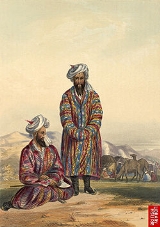
Uzbeks

Encyclopedia
The Uzbeks are a Turkic
ethnic group in Central Asia
. They comprise the majority population of Uzbekistan
, and large populations can also be found in Afghanistan
, Tajikstan, Kyrgyzstan
, Turkmenistan
, Kazakhstan
, Russia
, Pakistan
, Mongolia
and the Xinjiang Uyghur Autonomous Region
of China
. Smaller diaspora populations of Uzbeks from Central Asia, mainly from Uzbekistan
and Afghanistan
, are also found in Iran
, Turkey
, Saudi Arabia
, North America
, and Western Europe
. In total, they make up over 0.3% of the world’s population.
ously named after Uzbeg Khan
. Another states that the name means independent or the lord itself, from Oʻz (self) and Bek/Bey/Beg (from the Turkic
root meaning a noble title). However there is another theory that the pronunciation of Uz comes from one of the Oghuz Turks
variously known as Uz or Uguz united with the word Bey or Bek to form uguz-bey, meaning "leader of an oguz".
and Mongol armies finally conquered the entire region, the majority of Central Asia's peoples were Iranic peoples
such as Sogdians, Bactrians
and, more ancient, the Saka
–Massagetae
tribes. It is generally believed that these ancient Indo-European-speaking
peoples were linguistically assimilated by smaller but dominant Turkic-speaking groups while the sedentary population finally adopted the Persian language
, the traditional lingua franca
of the eastern Islamic lands. The language-shift from Middle Iranian to Turkic and New Persian was predominantly the result of an elite dominance process. This process was dramatically boosted during the Mongol conquest
when millions were either killed or pushed further south to the Pamir
region.
The modern Uzbek language
is largely derived from the Chagatai language
,and also a mixture of the three major turkic dialects like Karluk, Kypchak and Oghuz and a language which gained prominence in the Timurid Empire
. The position of Chagatai (and later Uzbek) was further strengthened after the fall of the Timurids and the rise of the Shaybanid Uzbek Khaqanate
that finally shaped the Turkic language and identity of modern Uzbeks, while the unique grammatical and phonetical features of the Uzbek language as well as the modern Uzbek culture reflect the more ancient Iranic roots of the Uzbek people.
, Central Asia experienced numerous invasions emanating out of Turks
and Mongols
that would drastically affect the region. According to recent genetic genealogy
testing from a University of Oxford study:
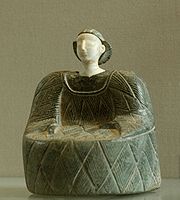 Uzbeks are inhabitants of Uzbekistan, the heart of Central Asia history goes back to the earliest Bronze Age
colonists of the Tarim Basin were people of Caucasoid physical type who entered probably from the north and west, and probably spoke languages that could be classified as Pre- or Proto-Tocharian
, ancestral to the Indo-European Tocharian languages documented later in the Tarim Basin. These early settlers occupied the northern and eastern parts of the Tarim Basin, where their graves have yielded mummies dated about 1800 BC. They participated in a cultural world centered on the eastern steppes of central Eurasia, including modern northeastern Kazakhstan, Kyrgyzstan, and Tajikistan.
 The first people known to have inhabit Central Asia were Iranian
nomads who arrived from the northern grasslands of what is now Uzbekistan sometime in the first millennium BC. These nomads, who spoke Iranian dialects, settled in Central Asia and began to build an extensive irrigation system along the rivers of the region. At this time, cities such as Bukhoro (Bukhara) and Samarqand (Samarkand) began to appear as centers of government and culture. By the 5th century BC, the Bactrian, Soghdian
, and Tokharian
states dominated the region.
As China began to develop its silk trade with the West, Iranian cities took advantage of this commerce by becoming centers of trade. Using an extensive network of cities and settlements in the province of Mawarannahr (a name given the region after the Arab conquest) in Uzbekistan and farther east in what is today China's Xinjiang Uygur Autonomous Region, the Soghdian intermediaries became the wealthiest of these Iranian merchants. Because of this trade on what became known as the Silk Route, Bukhoro and Samarqand eventually became extremely wealthy cities, and at times Mawarannahr was one of the most influential and powerful Persian provinces of antiquity.
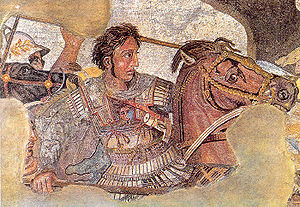
Alexander the Great conquered Sogdiana and Bactria in 327 BC, marrying Roxana
, daughter of a local Bactrian chieftain. The conquest was supposedly of little help to Alexander as popular resistance was fierce, causing Alexander's army to be bogged down in the region that became the northern part of Hellenistic Greco-Bactrian Kingdom
. For many centuries the region of Uzbekistan was ruled by Persian empires, including the Parthian
and Sassanid Empires.
by Islamic Arabs, which was completed in the eighth century AD, brought to the region a new religion and culture that continue to be dominant . The Arabs first invaded Mawarannahr in the middle of the seventh century through sporadic raids during their conquest of Persia. Available sources on the Arab conquest suggest that the Soghdians and other Iranian peoples of Central Asia were unable to defend their land against the Arabs because of internal divisions and the lack of strong indigenous leadership. The Arabs, on the other hand, were led by a brilliant general, Qutaybah ibn Muslim, and they also were highly motivated by the desire to spread their new faith
(the official beginning of which was in AD 622). Because of these factors, the population of Mawarannahr was easily conquered. The new religion brought by the Arabs spread gradually in the region. The native cultures, which in some respects already were being displaced by Persian influences before the Arabs arrived, were displaced farther in the ensuing centuries. Nevertheless, the destiny of Central Asia as an Islamic region was firmly established by the Arab victory over the Chinese armies in 750 in a battle
at the Talas River
.
Under Arab rule, Central Asia retained much of its Iranian character, remaining an important center of culture and trade for centuries after the Arab conquest. However, until the tenth century the language of government, literature, and commerce was Arabic. Mawarannahr continued to be an important political player in regional affairs, as it had been under various Persian dynasties. In fact, the Abbasid Caliphate, which ruled the Arab world for five centuries beginning in 750, was established thanks in great part to assistance from Central Asian supporters in their struggle against the then-ruling Umayyad Caliphate.
During the height of the Abbasid Caliphate in the eighth and the ninth centuries, Central Asia and Mawarannahr experienced a truly golden age. Bukhoro became one of the leading centers of learning, culture, and art in the Muslim world, its magnificence rivaling contemporaneous cultural centers such as Baghdad
, Cairo
, and Cordoba
. Some of the greatest historians, scientists, and geographers in the history of Islamic culture were natives of the region.
As the Abbasid Caliphate began to weaken and local Islamic Iranian states emerged as the rulers of Iran and Central Asia, the Persian language
began to regain its preeminent role in the region as the language of literature and government. The rulers of the eastern section of Iran and of Mawarannahr were Persians. Under the Samanids and the Buyids, the rich culture of Mawarannahr continued to flourish.
(including Kabul
), Ray
, Transoxiania, Tabaristan, Kerman
, Gorgan
, and west of these provinces up to Isfahan. At the peak of their power, the Samanids controlled territory extending as far south as the Sulaiman Mountains
, Ghazni
and Kandahar
. The Samanids were descendants of Bahram Chobin
, and thus descended from the House of Mihrān
, one of the Seven Great Houses of Iran. In governing their territory, the Samanids modeled their state organization after the Abbasids, mirroring the caliph
's court and organization. They were rewarded for supporting the Abbasids in Transoxania and Khorasan
, and with their established capitals located in Bukhara
, Balkh
, Samarkand
, and Herat
, they carved their kingdom after defeating the Saffarids.
The Samanid Empire was the first native Persian dynasty to arise after the Muslim Arab conquest. The four grandsons of the dynasty's founder, Saman Khuda
, had been rewarded with provinces for their faithful service to the Abbasid caliph al-Mamun: Nuh obtained Samarkand
; Ahmad, Fergana
; Yahya, Shash; and Elyas, Herat
. Ahmad's son Nasr became governor of Transoxania in 875, but it was his brother and successor, Ismail Samani who overthrew the Saffarids and the Zaydites of Tabaristan, thus establishing a semiautonomous rule over Transoxania and Khorasan, with Bukhara as his capital.
was not formally recognized by the caliph until the early 900s when the Saffarid ruler 'Amr-i Laith had asked the caliph for the investiture of Transoxiana. The caliph, Al-Mu'tadid
however sent the Samanid amir, Ismail Samani, a letter urging him to fight Amr-i Laith and the Saffarids whom the caliph considered usurpers. According to the letter, the caliph stated that he prayed for Ismail who the caliph considered as the rightful ruler of Khorasan
. The letter had a profound effect on Ismail, as he was determined to oppose the Saffarids.
The two sides fought in Balkh
, northern Afghanistan
during the spring of 900. During battle, Ismail was significantly outnumbered as he came out with 20,000 horsemen against Amr's 70,000 strong cavalry. Ismail's horsemen were ill-equipped with most having wooden stirrups while some had no shields or lances. Amr-i Laith's cavalry on the other hand, were fully equipped with weapons and armor. Despite fierce fighting, Amr was captured as some of his troops switched sides and joined Ismail.
Isma'il thereafter sent an army to Tabaristan in accordance with the caliph's directive. The area at that time was then controlled by the Zaydids. The Samanid army defeated the Zaydid ruler and the Samanids gained control of the region.
who lived in the great grasslands stretching from Mongolia
to the Caspian Sea
. During the Samanid Dynasty, these Turks served in the armies of all the states of the region, including the Abbasid army. In the late tenth century, as the Samanids began to lose control of Mawarannahr and northeastern Iran, some of these soldiers came to positions of power in the government of the region, and eventually they established their own states. With the emergence of a Turkic ruling group in the region, other Turkic tribes began to migrate to Mawarannahr.
The first of the Turkic states in the region was the Ghaznavid Empire
, established in the last years of the tenth century. The Ghaznavid state, which ruled lands south of the Amu Darya
, was able to conquer large areas of Iran, Afghanistan
, and northern India
during the reign of Sultan Mahmud. The dominance of Ghazna was curtailed, however, when large-scale Turkic migrations brought in two new groups of Turks who undermined the Ghaznavids. In the east, these Turks were led by the Qarakhanids, who conquered the Samanids. Then the Seljuk
family led Turks into the western part of the region, conquering the Ghaznavid territory of Khorazm (also spelled Khorezm and Khwarazm).
Attracted by the wealth of Central Asia as were earlier groups, the Seljuks
dominated a wide area from Asia Minor
to the western sections of Mawarannahr, in Afghanistan, Iran, and Iraq
in the eleventh century. The Seljuk Empire then split into states ruled by various local Turkic and Iranian rulers. The culture and intellectual life of the region continued unaffected by such political changes, however. Turkic tribes from the north continued to migrate into the region during this period.
In the late twelfth century, a Turkic leader of Khorazm, which is the region south of the Aral Sea, united Khorazm, Mawarannahr, and Iran under his rule. Under the rule of the Khorazm shah
Kutbeddin Muhammad and his son, Muhammad II, Mawarannahr continued to be prosperous and rich. However, a new incursion of nomads from the north soon changed this situation. This time the invader was Genghis Khan
with his Mongol armies.
, which took place from 1219 to 1225, led to a wholesale change in the population of Mawarannahr . The conquest quickened the process of Turkification in the region because, although the armies of Genghis Khan were led by Mongols, they were made up mostly of Turkic tribes that had been incorporated into the Mongol armies as the tribes were encountered in the Mongols' southward sweep. As these armies settled in Mawarannahr, they intermixed with the local populations, increasingly making the Iranians a minority. Another effect of the Mongol conquest was the large-scale damage the warriors inflicted on cities such as Bukhoro and on regions such as Khorazm. As the leading province of a wealthy state, Khorazm was treated especially severely. The irrigation
networks in the region suffered extensive damage that was not repaired for several generations.
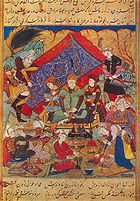 Following the death of Genghis Khan in 1227, his empire was divided among his four sons and his family members. Despite the potential for serious fragmentation, Mongol law
of the Mongol Empire
maintained orderly succession for several more generations, and control of most of Mawarannahr stayed in the hands of direct descendants of Chaghatai
, the second son of Genghis. Orderly succession, prosperity, and internal peace prevailed in the Chaghatai lands, and the Mongol Empire as a whole remained strong and united.
In the early fourteenth century, however, as the empire began to break up into its constituent parts, the Chaghatai territory also was disrupted as the princes of various tribal groups competed for influence. One tribal chieftain, Timur
(Tamerlane), emerged from these struggles in the 1380s as the dominant force in Mawarannahr. Although he was not a descendant of Genghis, Timur became the de facto ruler of Mawarannahr and proceeded to conquer all of western Central Asia, Iran, Asia Minor, and the southern steppe region north of the Aral Sea
. He also invaded Russia before dying during an invasion of China in 1405. Timur initiated the last flowering of Mawarannahr by gathering in his capital, Samarqand, numerous artisans and scholars from the lands he had conquered. By supporting such people, Timur imbued his empire with a very rich culture. During Timur's reign and the reigns of his immediate descendants, a wide range of religious and palatial construction projects were undertaken in Samarqand and other population centers. Timur also patronized scientists and artists; his grandson Ulugh Beg
was one of the world's first great astronomers. It was during the Timurid dynasty that Turkish
, in the form of the Chaghatai dialect, became a literary language
in its own right in Mawarannahr—although the Timurids also patronized writing in Persian. Until then only Persian had been used in the region. The greatest Chaghataid writer of Uighur origin, Ali Shir Nava'i, was active in the city of Herat
, now in northwestern Afghanistan, in the second half of the fifteenth century. Much of modern Uzbekistan took shape during the reign of Tamerlane, a prominent Turkic conqueror who reigned over a vast empire from his capital at Samarkand
. Baraq Khan
with his war-like Uzbeks forced Olug Moxammat, Kepek and Devlet-Berdi flee and enthroned himself as the Khan of Golden Horde
in Sarai
in 1422. After the murder of Borak, the Uzbegs, which is known as the Shaybanids
sometimes, under Abu'l-Khayr Khan
became the dominant power in the White Horde. Later, between the 15th and 16th centuries, various nomadic tribes arrived from the steppes including the Kipchaks, Naymans, Kanglis, Kungrats, Manġits
and others and these tribes were led by Muhammad Shaybani
who was the Khan
of the Uzbeks. This period marked the beginnings of the modern Uzbek nationality and formation of an Uzbek state in what is today Uzbekistan, as these tribes were the first to use the name 'Uzbek'. This early Uzbek state challenged the Safavids and Mughals, for control over the land that is now modern Afghanistan.
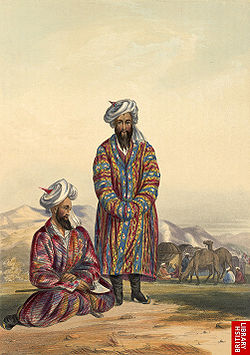 By 1510 the Uzbeks had completed their conquest of Central Asia, including the territory of the present-day Uzbekistan. Of the states they established, the most powerful, the Khanate of Bukhoro, centered on the city of Bukhoro. The khanate controlled Mawarannahr, especially the region of Tashkent
, the Fergana Valley
in the east, and northern Afghanistan. A second Uzbek state, the Khanate of Khiva
was established in the oasis of Khorazm at the mouth of the Amu Darya. The Khanate of Bukhoro was initially led by the energetic Shaybanid Dynasty. The Shaybanids competed against Iran, which was led by the Safavid Dynasty
, for the rich far-eastern territory of present-day Iran. The struggle with Iran also had a religious aspect because the Uzbeks were Sunni Muslims, and Iran was Shia.
Near the end of the sixteenth century, the Uzbek states of Bukhoro and Khorazm began to weaken because of their endless wars against each other and the Persians and because of strong competition for the throne among the khans in power and their heirs. At the beginning of the seventeenth century, the Shaybanid Dynasty was replaced by the Janid Dynasty.
Another factor contributing to the weakness of the Uzbek khanates in this period was the general decline of trade moving through the region. This change had begun in the previous century when ocean trade routes were established from Europe to India and China, circumventing the Silk Route. As European-dominated ocean transport expanded and some trading centers were destroyed, cities such as Bukhoro, Merv
, and Samarqand in the Khanate of Bukhoro and Khiva
and Urganch (Urgench) in Khorazm began to steadily decline.
The Uzbeks' struggle with Iran also led to the cultural isolation of Central Asia from the rest of the Islamic world. In addition to these problems, the struggle with the nomads from the northern steppe continued. In the seventeenth and eighteenth centuries, Kazakh
nomads and Mongols continually raided the Uzbek khanates, causing widespread damage and disruption. In the beginning of the eighteenth century, the Khanate of Bukhoro lost the fertile Fergana region, and a new Uzbek khanate
was formed in Quqon.
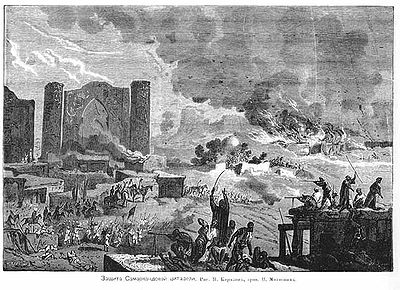 In the nineteenth century, Russian interest in the area increased greatly, sparked by nominal concern over British designs on Central Asia; by anger over the situation of Russian citizens held as slaves; and by the desire to control the trade in the region and to establish a secure source of cotton
for Russia. When the United States Civil War prevented cotton delivery from Russia's primary supplier, the southern United States, Central Asian cotton assumed much greater importance for Russia.
As soon as the Russian conquest of the Caucasus
was completed in the late 1850s, therefore, the Russian Ministry of War
began to send military forces against the Central Asian khanates. Three major population centers of the khanates—Tashkent, Bukhoro, and Samarqand—were captured in 1865, 1867, and 1868, respectively. In 1868 the Khanate of Bukhoro signed a treaty with Russia making Bukhoro a Russian protectorate
. Khiva became a Russian protectorate in 1873, and the Quqon Khanate finally was incorporated into the Russian Empire, also as a protectorate, in 1876.
Moscow’s control over Uzbekistan weakened in the 1970s as Uzbek party leader Sharaf Rashidov
brought many cronies and relatives into positions of power. In the mid-1980s, Moscow attempted to regain control by again purging the entire Uzbek party leadership. However, this move increased Uzbek nationalism, which had long resented Soviet policies such as the imposition of cotton monoculture and the suppression of Islam
ic traditions. In the late 1980s, the liberalized atmosphere of the Soviet Union under Mikhail S. Gorbachev (in power 1985–91) fostered political opposition groups and open (albeit limited) opposition to Soviet policy in Uzbekistan. In 1989 a series of violent ethnic clashes involving Uzbeks brought the appointment of ethnic Uzbek outsider Islam Karimov as Communist Party chief. When the Supreme Soviet of Uzbekistan reluctantly approved independence from the Soviet Union in 1991, Karimov became president of the Republic of Uzbekistan. On August 31, 1991, Uzbekistan declared independence, marking September 1 as a national holiday.
is a Turkic language of the Karluk group. Modern Uzbek is written in wide variety of scripts including Arabic, Latin
, and Cyrillic. After the independence of Uzbekistan from the former Soviet Union
, the government decided to replace the Cyrillic script with a modified Latin alphabet, specifically for Turkic languages.
school, but variations exist between northern and southern Uzbeks. According to a 2009 Pew Research Center
report, Uzbekistan's population is 96.3% Muslim. The majority of Uzbeks from the former USSR came to practice religion with a more liberal interpretation due to the official Soviet policy of atheism, while Uzbeks in Afghanistan and other countries to the south have remained more conservative adherents of Islam. However, with Uzbek independence in 1991 came an Islamic revival amongst segments of the population. People living in the area of modern Uzbekistan were first converted to Islam
as early as the 8th century AD, as Arabs conquered the area, displacing the earlier faith of Manichaeism
. The Arab victory over the Chinese in 751
, at the Battle of Talas
, ensured the future dominance of Islam in Central Asia.
Turkic peoples
The Turkic peoples are peoples residing in northern, central and western Asia, southern Siberia and northwestern China and parts of eastern Europe. They speak languages belonging to the Turkic language family. They share, to varying degrees, certain cultural traits and historical backgrounds...
ethnic group in Central Asia
Central Asia
Central Asia is a core region of the Asian continent from the Caspian Sea in the west, China in the east, Afghanistan in the south, and Russia in the north...
. They comprise the majority population of Uzbekistan
Uzbekistan
Uzbekistan , officially the Republic of Uzbekistan is a doubly landlocked country in Central Asia and one of the six independent Turkic states. It shares borders with Kazakhstan to the west and to the north, Kyrgyzstan and Tajikistan to the east, and Afghanistan and Turkmenistan to the south....
, and large populations can also be found in Afghanistan
Afghanistan
Afghanistan , officially the Islamic Republic of Afghanistan, is a landlocked country located in the centre of Asia, forming South Asia, Central Asia and the Middle East. With a population of about 29 million, it has an area of , making it the 42nd most populous and 41st largest nation in the world...
, Tajikstan, Kyrgyzstan
Kyrgyzstan
Kyrgyzstan , officially the Kyrgyz Republic is one of the world's six independent Turkic states . Located in Central Asia, landlocked and mountainous, Kyrgyzstan is bordered by Kazakhstan to the north, Uzbekistan to the west, Tajikistan to the southwest and China to the east...
, Turkmenistan
Turkmenistan
Turkmenistan , formerly also known as Turkmenia is one of the Turkic states in Central Asia. Until 1991, it was a constituent republic of the Soviet Union, the Turkmen Soviet Socialist Republic . Turkmenistan is one of the six independent Turkic states...
, Kazakhstan
Kazakhstan
Kazakhstan , officially the Republic of Kazakhstan, is a transcontinental country in Central Asia and Eastern Europe. Ranked as the ninth largest country in the world, it is also the world's largest landlocked country; its territory of is greater than Western Europe...
, Russia
Russia
Russia or , officially known as both Russia and the Russian Federation , is a country in northern Eurasia. It is a federal semi-presidential republic, comprising 83 federal subjects...
, Pakistan
Pakistan
Pakistan , officially the Islamic Republic of Pakistan is a sovereign state in South Asia. It has a coastline along the Arabian Sea and the Gulf of Oman in the south and is bordered by Afghanistan and Iran in the west, India in the east and China in the far northeast. In the north, Tajikistan...
, Mongolia
Mongolia
Mongolia is a landlocked country in East and Central Asia. It is bordered by Russia to the north and China to the south, east and west. Although Mongolia does not share a border with Kazakhstan, its western-most point is only from Kazakhstan's eastern tip. Ulan Bator, the capital and largest...
and the Xinjiang Uyghur Autonomous Region
Xinjiang
Xinjiang is an autonomous region of the People's Republic of China. It is the largest Chinese administrative division and spans over 1.6 million km2...
of China
China
Chinese civilization may refer to:* China for more general discussion of the country.* Chinese culture* Greater China, the transnational community of ethnic Chinese.* History of China* Sinosphere, the area historically affected by Chinese culture...
. Smaller diaspora populations of Uzbeks from Central Asia, mainly from Uzbekistan
Uzbekistan
Uzbekistan , officially the Republic of Uzbekistan is a doubly landlocked country in Central Asia and one of the six independent Turkic states. It shares borders with Kazakhstan to the west and to the north, Kyrgyzstan and Tajikistan to the east, and Afghanistan and Turkmenistan to the south....
and Afghanistan
Afghanistan
Afghanistan , officially the Islamic Republic of Afghanistan, is a landlocked country located in the centre of Asia, forming South Asia, Central Asia and the Middle East. With a population of about 29 million, it has an area of , making it the 42nd most populous and 41st largest nation in the world...
, are also found in Iran
Iran
Iran , officially the Islamic Republic of Iran , is a country in Southern and Western Asia. The name "Iran" has been in use natively since the Sassanian era and came into use internationally in 1935, before which the country was known to the Western world as Persia...
, Turkey
Turkey
Turkey , known officially as the Republic of Turkey , is a Eurasian country located in Western Asia and in East Thrace in Southeastern Europe...
, Saudi Arabia
Saudi Arabia
The Kingdom of Saudi Arabia , commonly known in British English as Saudi Arabia and in Arabic as as-Sa‘ūdiyyah , is the largest state in Western Asia by land area, constituting the bulk of the Arabian Peninsula, and the second-largest in the Arab World...
, North America
North America
North America is a continent wholly within the Northern Hemisphere and almost wholly within the Western Hemisphere. It is also considered a northern subcontinent of the Americas...
, and Western Europe
Western Europe
Western Europe is a loose term for the collection of countries in the western most region of the European continents, though this definition is context-dependent and carries cultural and political connotations. One definition describes Western Europe as a geographic entity—the region lying in the...
. In total, they make up over 0.3% of the world’s population.
Name
The origin of the name Uzbek remains disputed. One view holds that it is eponymEponym
An eponym is the name of a person or thing, whether real or fictitious, after which a particular place, tribe, era, discovery, or other item is named or thought to be named...
ously named after Uzbeg Khan
Uzbeg Khan
Sultan Mohammed Öz-Beg, better known as Uzbeg or Ozbeg , was the longest-reigning khan of the Golden Horde, under whose rule the state reached its zenith...
. Another states that the name means independent or the lord itself, from Oʻz (self) and Bek/Bey/Beg (from the Turkic
Turkic languages
The Turkic languages constitute a language family of at least thirty five languages, spoken by Turkic peoples across a vast area from Eastern Europe and the Mediterranean to Siberia and Western China, and are considered to be part of the proposed Altaic language family.Turkic languages are spoken...
root meaning a noble title). However there is another theory that the pronunciation of Uz comes from one of the Oghuz Turks
Oghuz Turks
The Turkomen also known as Oghuz Turks were a historical Turkic tribal confederation in Central Asia during the early medieval Turkic expansion....
variously known as Uz or Uguz united with the word Bey or Bek to form uguz-bey, meaning "leader of an oguz".
Origins
Although Turko-Mongol infiltration into Central Asia had started early, as late as the 13th century AD when TurkicTurkic peoples
The Turkic peoples are peoples residing in northern, central and western Asia, southern Siberia and northwestern China and parts of eastern Europe. They speak languages belonging to the Turkic language family. They share, to varying degrees, certain cultural traits and historical backgrounds...
and Mongol armies finally conquered the entire region, the majority of Central Asia's peoples were Iranic peoples
Iranian peoples
The Iranian peoples are an Indo-European ethnic-linguistic group, consisting of the speakers of Iranian languages, a major branch of the Indo-European language family, as such forming a branch of Indo-European-speaking peoples...
such as Sogdians, Bactrians
Bactrians
The Bactrians were the inhabitants of Bactria.Several important trade routes from India and China passed through Bactria and, as early as the Bronze Age, this had allowed the accumulation of vast amounts of wealth by the mostly nomadic population. The first proto-urban civilization in the area...
and, more ancient, the Saka
Saka
The Saka were a Scythian tribe or group of tribes....
–Massagetae
Massagetae
The Massageteans or Massagetaeans were an Iranian nomadic confederation in antiquity known primarily from the writings of Herodotus. Their name was probably akin to Thyssagetae.-Name:...
tribes. It is generally believed that these ancient Indo-European-speaking
Indo-European languages
The Indo-European languages are a family of several hundred related languages and dialects, including most major current languages of Europe, the Iranian plateau, and South Asia and also historically predominant in Anatolia...
peoples were linguistically assimilated by smaller but dominant Turkic-speaking groups while the sedentary population finally adopted the Persian language
Persian language
Persian is an Iranian language within the Indo-Iranian branch of the Indo-European languages. It is primarily spoken in Iran, Afghanistan, Tajikistan and countries which historically came under Persian influence...
, the traditional lingua franca
Lingua franca
A lingua franca is a language systematically used to make communication possible between people not sharing a mother tongue, in particular when it is a third language, distinct from both mother tongues.-Characteristics:"Lingua franca" is a functionally defined term, independent of the linguistic...
of the eastern Islamic lands. The language-shift from Middle Iranian to Turkic and New Persian was predominantly the result of an elite dominance process. This process was dramatically boosted during the Mongol conquest
Mongol Empire
The Mongol Empire , initially named as Greater Mongol State was a great empire during the 13th and 14th centuries...
when millions were either killed or pushed further south to the Pamir
Pamir Mountains
The Pamir Mountains are a mountain range in Central Asia formed by the junction or knot of the Himalayas, Tian Shan, Karakoram, Kunlun, and Hindu Kush ranges. They are among the world’s highest mountains and since Victorian times they have been known as the "Roof of the World" a probable...
region.
The modern Uzbek language
Uzbek language
Uzbek is a Turkic language and the official language of Uzbekistan. It has about 25.5 million native speakers, and it is spoken by the Uzbeks in Uzbekistan and elsewhere in Central Asia...
is largely derived from the Chagatai language
Chagatai language
The Chagatai language is an extinct Turkic language which was once widely spoken in Central Asia, and remained the shared literary language there until the early twentieth century...
,and also a mixture of the three major turkic dialects like Karluk, Kypchak and Oghuz and a language which gained prominence in the Timurid Empire
Timurid Dynasty
The Timurids , self-designated Gurkānī , were a Persianate, Central Asian Sunni Muslim dynasty of Turko-Mongol descent whose empire included the whole of Iran, modern Afghanistan, and modern Uzbekistan, as well as large parts of contemporary Pakistan, North India, Mesopotamia, Anatolia and the...
. The position of Chagatai (and later Uzbek) was further strengthened after the fall of the Timurids and the rise of the Shaybanid Uzbek Khaqanate
Muhammad Shaybani
Abu 'I-Fath Muhammad , known in later centuries as Shaybani Khan , was a khan of the Uzbeks who continued consolidating various Uzbek tribes and laid foundations for their ascendance in Transoxiana. of Genghis Khan through his grandson Shayban and considered the Timurids as usurpers of the...
that finally shaped the Turkic language and identity of modern Uzbeks, while the unique grammatical and phonetical features of the Uzbek language as well as the modern Uzbek culture reflect the more ancient Iranic roots of the Uzbek people.
Genetic origins
The modern Uzbek population represents varying degrees of diversity derived from the high traffic invasion routes through Central Asia. Once populated by Iranian tribes and other Indo-European peopleProto-Indo-Europeans
The Proto-Indo-Europeans were the speakers of the Proto-Indo-European language , a reconstructed prehistoric language of Eurasia.Knowledge of them comes chiefly from the linguistic reconstruction, along with material evidence from archaeology and archaeogenetics...
, Central Asia experienced numerous invasions emanating out of Turks
Turkic peoples
The Turkic peoples are peoples residing in northern, central and western Asia, southern Siberia and northwestern China and parts of eastern Europe. They speak languages belonging to the Turkic language family. They share, to varying degrees, certain cultural traits and historical backgrounds...
and Mongols
Mongols
Mongols ) are a Central-East Asian ethnic group that lives mainly in the countries of Mongolia, China, and Russia. In China, ethnic Mongols can be found mainly in the central north region of China such as Inner Mongolia...
that would drastically affect the region. According to recent genetic genealogy
Genetic genealogy
Genetic genealogy is the application of genetics to traditional genealogy. Genetic genealogy involves the use of genealogical DNA testing to determine the level of genetic relationship between individuals.-History:...
testing from a University of Oxford study:
From the 3d century B.C., Central Asia experienced nomadic expansions of Altaic-speaking oriental-looking people, and their incursions continued for hundreds of years, beginning with the Hsiung-Nu (who may be ancestors of the Huns), in ~300 B.C., and followed by the Turks, in the 1st millennium A.D., and the Mongol expansions of the 13th century. High levels of haplogroup 10 and its derivative, haplogroup 36, are found in most of the Altaic-speaking populations and are a good indicator of the genetic impact of these nomadic groups. The expanding waves of Altaic-speaking nomads involved not only eastern Central Asia—where their genetic contribution is strong, [...]—but also regions farther west, like Iran, Iraq, Anatolia, and the Caucasus, as well as Europe, which was reached by both the Huns and the Mongols. In these western regions, however, the genetic contribution is low or undetectable (...), even though the power of these invaders was sometimes strong enough to impose a language replacement, as in Turkey and Azerbaijan (...). The difference could be due to the population density of the different geographical areas. Eastern regions of Central Asia must have had a low population density at the time, so an external contribution could have had a great genetic impact. In contrast, the western regions were more densely inhabited, and it is likely that the existing populations were more numerous than the conquering nomads, therefore leading to only a small genetic impact. Thus, the admixture estimate from northeast Asia is high in the east, but is barely detectable west of Uzbekistan.
Ancient History
Bronze Age
The Bronze Age is a period characterized by the use of copper and its alloy bronze as the chief hard materials in the manufacture of some implements and weapons. Chronologically, it stands between the Stone Age and Iron Age...
colonists of the Tarim Basin were people of Caucasoid physical type who entered probably from the north and west, and probably spoke languages that could be classified as Pre- or Proto-Tocharian
Tocharians
The Tocharians were the Tocharian-speaking inhabitants of the Tarim Basin, making them the easternmost speakers of Indo-European languages in antiquity. They were known as, or at least closely related to, the Yuezhi of Chinese sources...
, ancestral to the Indo-European Tocharian languages documented later in the Tarim Basin. These early settlers occupied the northern and eastern parts of the Tarim Basin, where their graves have yielded mummies dated about 1800 BC. They participated in a cultural world centered on the eastern steppes of central Eurasia, including modern northeastern Kazakhstan, Kyrgyzstan, and Tajikistan.
Iranian peoples
The Iranian peoples are an Indo-European ethnic-linguistic group, consisting of the speakers of Iranian languages, a major branch of the Indo-European language family, as such forming a branch of Indo-European-speaking peoples...
nomads who arrived from the northern grasslands of what is now Uzbekistan sometime in the first millennium BC. These nomads, who spoke Iranian dialects, settled in Central Asia and began to build an extensive irrigation system along the rivers of the region. At this time, cities such as Bukhoro (Bukhara) and Samarqand (Samarkand) began to appear as centers of government and culture. By the 5th century BC, the Bactrian, Soghdian
Sogdiana
Sogdiana or Sogdia was the ancient civilization of an Iranian people and a province of the Achaemenid Empire, eighteenth in the list on the Behistun Inscription of Darius the Great . Sogdiana is "listed" as the second of the "good lands and countries" that Ahura Mazda created...
, and Tokharian
Yuezhi
The Yuezhi, or Rouzhi , also known as the Da Yuezhi or Da Rouzhi , were an ancient Central Asian people....
states dominated the region.
As China began to develop its silk trade with the West, Iranian cities took advantage of this commerce by becoming centers of trade. Using an extensive network of cities and settlements in the province of Mawarannahr (a name given the region after the Arab conquest) in Uzbekistan and farther east in what is today China's Xinjiang Uygur Autonomous Region, the Soghdian intermediaries became the wealthiest of these Iranian merchants. Because of this trade on what became known as the Silk Route, Bukhoro and Samarqand eventually became extremely wealthy cities, and at times Mawarannahr was one of the most influential and powerful Persian provinces of antiquity.
Alexander the Great conquered Sogdiana and Bactria in 327 BC, marrying Roxana
Roxana
Roxana sometimes Roxane, was a Bactrian noble and a wife of Alexander the Great. She was born earlier than the year 343 BC, though the precise date remains uncertain....
, daughter of a local Bactrian chieftain. The conquest was supposedly of little help to Alexander as popular resistance was fierce, causing Alexander's army to be bogged down in the region that became the northern part of Hellenistic Greco-Bactrian Kingdom
Greco-Bactrian Kingdom
The Greco-Bactrian Kingdom was the easternmost part of the Hellenistic world, covering Bactria and Sogdiana in Central Asia from 250 to 125 BC...
. For many centuries the region of Uzbekistan was ruled by Persian empires, including the Parthian
Parthian Empire
The Parthian Empire , also known as the Arsacid Empire , was a major Iranian political and cultural power in ancient Persia...
and Sassanid Empires.
Early Islamic period
The conquest of Central AsiaMuslim conquests
Muslim conquests also referred to as the Islamic conquests or Arab conquests, began with the Islamic prophet Muhammad. He established a new unified polity in the Arabian Peninsula which under the subsequent Rashidun and Umayyad Caliphates saw a century of rapid expansion of Muslim power.They...
by Islamic Arabs, which was completed in the eighth century AD, brought to the region a new religion and culture that continue to be dominant . The Arabs first invaded Mawarannahr in the middle of the seventh century through sporadic raids during their conquest of Persia. Available sources on the Arab conquest suggest that the Soghdians and other Iranian peoples of Central Asia were unable to defend their land against the Arabs because of internal divisions and the lack of strong indigenous leadership. The Arabs, on the other hand, were led by a brilliant general, Qutaybah ibn Muslim, and they also were highly motivated by the desire to spread their new faith
Islam
Islam . The most common are and . : Arabic pronunciation varies regionally. The first vowel ranges from ~~. The second vowel ranges from ~~~...
(the official beginning of which was in AD 622). Because of these factors, the population of Mawarannahr was easily conquered. The new religion brought by the Arabs spread gradually in the region. The native cultures, which in some respects already were being displaced by Persian influences before the Arabs arrived, were displaced farther in the ensuing centuries. Nevertheless, the destiny of Central Asia as an Islamic region was firmly established by the Arab victory over the Chinese armies in 750 in a battle
Battle of Talas
The Battle of Talas in 751 AD was an especially notable conflict between the Arab Abbasid Caliphate and the Chinese Tang Dynasty for control not only of the Syr Darya region, but even more...
at the Talas River
Talas River
The Talas River rises in the Talas Province of Kyrgyzstan and flows west into Kazakhstan. It is formed from the confluence of the Karakol and Uch-Koshoy...
.
Under Arab rule, Central Asia retained much of its Iranian character, remaining an important center of culture and trade for centuries after the Arab conquest. However, until the tenth century the language of government, literature, and commerce was Arabic. Mawarannahr continued to be an important political player in regional affairs, as it had been under various Persian dynasties. In fact, the Abbasid Caliphate, which ruled the Arab world for five centuries beginning in 750, was established thanks in great part to assistance from Central Asian supporters in their struggle against the then-ruling Umayyad Caliphate.
During the height of the Abbasid Caliphate in the eighth and the ninth centuries, Central Asia and Mawarannahr experienced a truly golden age. Bukhoro became one of the leading centers of learning, culture, and art in the Muslim world, its magnificence rivaling contemporaneous cultural centers such as Baghdad
Baghdad
Baghdad is the capital of Iraq, as well as the coterminous Baghdad Governorate. The population of Baghdad in 2011 is approximately 7,216,040...
, Cairo
Cairo
Cairo , is the capital of Egypt and the largest city in the Arab world and Africa, and the 16th largest metropolitan area in the world. Nicknamed "The City of a Thousand Minarets" for its preponderance of Islamic architecture, Cairo has long been a centre of the region's political and cultural life...
, and Cordoba
Córdoba, Spain
-History:The first trace of human presence in the area are remains of a Neanderthal Man, dating to c. 32,000 BC. In the 8th century BC, during the ancient Tartessos period, a pre-urban settlement existed. The population gradually learned copper and silver metallurgy...
. Some of the greatest historians, scientists, and geographers in the history of Islamic culture were natives of the region.
As the Abbasid Caliphate began to weaken and local Islamic Iranian states emerged as the rulers of Iran and Central Asia, the Persian language
Persian language
Persian is an Iranian language within the Indo-Iranian branch of the Indo-European languages. It is primarily spoken in Iran, Afghanistan, Tajikistan and countries which historically came under Persian influence...
began to regain its preeminent role in the region as the language of literature and government. The rulers of the eastern section of Iran and of Mawarannahr were Persians. Under the Samanids and the Buyids, the rich culture of Mawarannahr continued to flourish.
The Samanid Empire
The Samanids were a Persian state that reigned for 180 years, encompassing a territory which included KhorasanGreater Khorasan
Greater Khorasan or Ancient Khorasan is a historical region of Greater Iran mentioned in sources from Sassanid and Islamic eras which "frequently" had a denotation wider than current three provinces of Khorasan in Iran...
(including Kabul
Kabul
Kabul , spelt Caubul in some classic literatures, is the capital and largest city of Afghanistan. It is also the capital of the Kabul Province, located in the eastern section of Afghanistan...
), Ray
Ray, Iran
Rey or Ray , also known as Rhages and formerly as Arsacia, is the capital of Rey County, Tehran Province, Iran, and is the oldest existing city in the province....
, Transoxiania, Tabaristan, Kerman
Kerman
- Geological characteristics :For the Iranian paleontologists, Kerman has always been considered a fossil paradise. Finding new dinosaur footprints in 2005 has now revealed new hopes for paleontologists to better understand the history of this area.- Economy :...
, Gorgan
Gorgan
Gorgan Some east of Gorgan is the Golestan National Park. The city has a regional airport and several universities. Gorgan Airport was opened in September 2005.-Etymology:...
, and west of these provinces up to Isfahan. At the peak of their power, the Samanids controlled territory extending as far south as the Sulaiman Mountains
Sulaiman Mountains
The Sulaiman Mountains are a major geological feature of southeastern Afghanistan and northern Balochistan province of Pakistan. In Pakistan, it forms the eastern edge of the Iranian plateau where the Indus River separates it from the Asian Subcontient...
, Ghazni
Ghazni
For the Province of Ghazni see Ghazni ProvinceGhazni is a city in central-east Afghanistan with a population of about 141,000 people...
and Kandahar
Kandahar
Kandahar is the second largest city in Afghanistan, with a population of about 512,200 as of 2011. It is the capital of Kandahar Province, located in the south of the country at about 1,005 m above sea level...
. The Samanids were descendants of Bahram Chobin
Bahram Chobin
General Bahrām Chobin was a famous Eran spahbod during the late 6th century in Persia, usurping the Sassanid throne for a year as Bahram VI .- Life :...
, and thus descended from the House of Mihrān
House of Mihran
The House of Mihrān was a leading Iranian noble family , one of the Seven Great Houses of the Sassanid Persian Empire which claimed descent from the earlier Arsacid dynasty...
, one of the Seven Great Houses of Iran. In governing their territory, the Samanids modeled their state organization after the Abbasids, mirroring the caliph
Caliph
The Caliph is the head of state in a Caliphate, and the title for the ruler of the Islamic Ummah, an Islamic community ruled by the Shari'ah. It is a transcribed version of the Arabic word which means "successor" or "representative"...
's court and organization. They were rewarded for supporting the Abbasids in Transoxania and Khorasan
Greater Khorasan
Greater Khorasan or Ancient Khorasan is a historical region of Greater Iran mentioned in sources from Sassanid and Islamic eras which "frequently" had a denotation wider than current three provinces of Khorasan in Iran...
, and with their established capitals located in Bukhara
Bukhara
Bukhara , from the Soghdian βuxārak , is the capital of the Bukhara Province of Uzbekistan. The nation's fifth-largest city, it has a population of 263,400 . The region around Bukhara has been inhabited for at least five millennia, and the city has existed for half that time...
, Balkh
Balkh
Balkh , was an ancient city and centre of Zoroastrianism in what is now northern Afghanistan. Today it is a small town in the province of Balkh, about 20 kilometers northwest of the provincial capital, Mazar-e Sharif, and some south of the Amu Darya. It was one of the major cities of Khorasan...
, Samarkand
Samarkand
Although a Persian-speaking region, it was not united politically with Iran most of the times between the disintegration of the Seleucid Empire and the Arab conquest . In the 6th century it was within the domain of the Turkic kingdom of the Göktürks.At the start of the 8th century Samarkand came...
, and Herat
Herat
Herāt is the capital of Herat province in Afghanistan. It is the third largest city of Afghanistan, with a population of about 397,456 as of 2006. It is situated in the valley of the Hari River, which flows from the mountains of central Afghanistan to the Karakum Desert in Turkmenistan...
, they carved their kingdom after defeating the Saffarids.
The Samanid Empire was the first native Persian dynasty to arise after the Muslim Arab conquest. The four grandsons of the dynasty's founder, Saman Khuda
Saman Khuda
Saman Khuda was the founder of the Samanid dynasty – The House of Saman. He was a landowner from the village of Saman in Balkh province in northern Afghanistan, who arrived in the early 8th century in Merv to the court of the Caliphal governor of Khorasan, Asad ibn ‘Abd Allah al-Qasri , adopted...
, had been rewarded with provinces for their faithful service to the Abbasid caliph al-Mamun: Nuh obtained Samarkand
Samarkand
Although a Persian-speaking region, it was not united politically with Iran most of the times between the disintegration of the Seleucid Empire and the Arab conquest . In the 6th century it was within the domain of the Turkic kingdom of the Göktürks.At the start of the 8th century Samarkand came...
; Ahmad, Fergana
Fergana
Fergana is a city , the capital of Fergana Province in eastern Uzbekistan, at the southern edge of the Fergana Valley in southern Central Asia, cutting across the borders of Kyrgyzstan, Tajikistan, and Uzbekistan...
; Yahya, Shash; and Elyas, Herat
Herat
Herāt is the capital of Herat province in Afghanistan. It is the third largest city of Afghanistan, with a population of about 397,456 as of 2006. It is situated in the valley of the Hari River, which flows from the mountains of central Afghanistan to the Karakum Desert in Turkmenistan...
. Ahmad's son Nasr became governor of Transoxania in 875, but it was his brother and successor, Ismail Samani who overthrew the Saffarids and the Zaydites of Tabaristan, thus establishing a semiautonomous rule over Transoxania and Khorasan, with Bukhara as his capital.
The Samanids defeat the Saffarids and Zaydids
Samanid rule in BukharaBukhara
Bukhara , from the Soghdian βuxārak , is the capital of the Bukhara Province of Uzbekistan. The nation's fifth-largest city, it has a population of 263,400 . The region around Bukhara has been inhabited for at least five millennia, and the city has existed for half that time...
was not formally recognized by the caliph until the early 900s when the Saffarid ruler 'Amr-i Laith had asked the caliph for the investiture of Transoxiana. The caliph, Al-Mu'tadid
Al-Mu'tadid
Al-Mu'tadid was the Abbasid Caliph in Baghdad from 892 to 902. As the son and heir of the powerful vizier and virtual regent Al-Muwaffaq , Mu'tadid was already in possession of supreme power even before he was appointed Caliph, and continued as Caliph to ably administer the Government...
however sent the Samanid amir, Ismail Samani, a letter urging him to fight Amr-i Laith and the Saffarids whom the caliph considered usurpers. According to the letter, the caliph stated that he prayed for Ismail who the caliph considered as the rightful ruler of Khorasan
Greater Khorasan
Greater Khorasan or Ancient Khorasan is a historical region of Greater Iran mentioned in sources from Sassanid and Islamic eras which "frequently" had a denotation wider than current three provinces of Khorasan in Iran...
. The letter had a profound effect on Ismail, as he was determined to oppose the Saffarids.
The two sides fought in Balkh
Balkh
Balkh , was an ancient city and centre of Zoroastrianism in what is now northern Afghanistan. Today it is a small town in the province of Balkh, about 20 kilometers northwest of the provincial capital, Mazar-e Sharif, and some south of the Amu Darya. It was one of the major cities of Khorasan...
, northern Afghanistan
Afghanistan
Afghanistan , officially the Islamic Republic of Afghanistan, is a landlocked country located in the centre of Asia, forming South Asia, Central Asia and the Middle East. With a population of about 29 million, it has an area of , making it the 42nd most populous and 41st largest nation in the world...
during the spring of 900. During battle, Ismail was significantly outnumbered as he came out with 20,000 horsemen against Amr's 70,000 strong cavalry. Ismail's horsemen were ill-equipped with most having wooden stirrups while some had no shields or lances. Amr-i Laith's cavalry on the other hand, were fully equipped with weapons and armor. Despite fierce fighting, Amr was captured as some of his troops switched sides and joined Ismail.
Isma'il thereafter sent an army to Tabaristan in accordance with the caliph's directive. The area at that time was then controlled by the Zaydids. The Samanid army defeated the Zaydid ruler and the Samanids gained control of the region.
Turkification of Mawarannahr
In the ninth century, the continued influx of nomads from the northern steppes brought a new group of people into Central Asia. These people were the TurksTurkic peoples
The Turkic peoples are peoples residing in northern, central and western Asia, southern Siberia and northwestern China and parts of eastern Europe. They speak languages belonging to the Turkic language family. They share, to varying degrees, certain cultural traits and historical backgrounds...
who lived in the great grasslands stretching from Mongolia
Mongolia
Mongolia is a landlocked country in East and Central Asia. It is bordered by Russia to the north and China to the south, east and west. Although Mongolia does not share a border with Kazakhstan, its western-most point is only from Kazakhstan's eastern tip. Ulan Bator, the capital and largest...
to the Caspian Sea
Caspian Sea
The Caspian Sea is the largest enclosed body of water on Earth by area, variously classed as the world's largest lake or a full-fledged sea. The sea has a surface area of and a volume of...
. During the Samanid Dynasty, these Turks served in the armies of all the states of the region, including the Abbasid army. In the late tenth century, as the Samanids began to lose control of Mawarannahr and northeastern Iran, some of these soldiers came to positions of power in the government of the region, and eventually they established their own states. With the emergence of a Turkic ruling group in the region, other Turkic tribes began to migrate to Mawarannahr.
The first of the Turkic states in the region was the Ghaznavid Empire
Ghaznavid Empire
The Ghaznavids were a Persianate Muslim dynasty of Turkic slave origin which existed from 975 to 1187 and ruled much of Persia, Transoxania, and the northern parts of the Indian subcontinent. The Ghaznavid state was centered in Ghazni, a city in modern-day Afghanistan...
, established in the last years of the tenth century. The Ghaznavid state, which ruled lands south of the Amu Darya
Amu Darya
The Amu Darya , also called Oxus and Amu River, is a major river in Central Asia. It is formed by the junction of the Vakhsh and Panj rivers...
, was able to conquer large areas of Iran, Afghanistan
Afghanistan
Afghanistan , officially the Islamic Republic of Afghanistan, is a landlocked country located in the centre of Asia, forming South Asia, Central Asia and the Middle East. With a population of about 29 million, it has an area of , making it the 42nd most populous and 41st largest nation in the world...
, and northern India
India
India , officially the Republic of India , is a country in South Asia. It is the seventh-largest country by geographical area, the second-most populous country with over 1.2 billion people, and the most populous democracy in the world...
during the reign of Sultan Mahmud. The dominance of Ghazna was curtailed, however, when large-scale Turkic migrations brought in two new groups of Turks who undermined the Ghaznavids. In the east, these Turks were led by the Qarakhanids, who conquered the Samanids. Then the Seljuk
Seljuq dynasty
The Seljuq ; were a Turco-Persian Sunni Muslim dynasty that ruled parts of Central Asia and the Middle East from the 11th to 14th centuries...
family led Turks into the western part of the region, conquering the Ghaznavid territory of Khorazm (also spelled Khorezm and Khwarazm).
Attracted by the wealth of Central Asia as were earlier groups, the Seljuks
Great Seljuq Empire
The Great Seljuq Empire was a medieval Persianate, Turko-Persian Sunni Muslim empire, originating from the Qynyq branch of Oghuz Turks. The Seljuq Empire controlled a vast area stretching from the Hindu Kush to eastern Anatolia and from Central Asia to the Persian Gulf...
dominated a wide area from Asia Minor
Asia Minor
Asia Minor is a geographical location at the westernmost protrusion of Asia, also called Anatolia, and corresponds to the western two thirds of the Asian part of Turkey...
to the western sections of Mawarannahr, in Afghanistan, Iran, and Iraq
Iraq
Iraq ; officially the Republic of Iraq is a country in Western Asia spanning most of the northwestern end of the Zagros mountain range, the eastern part of the Syrian Desert and the northern part of the Arabian Desert....
in the eleventh century. The Seljuk Empire then split into states ruled by various local Turkic and Iranian rulers. The culture and intellectual life of the region continued unaffected by such political changes, however. Turkic tribes from the north continued to migrate into the region during this period.
In the late twelfth century, a Turkic leader of Khorazm, which is the region south of the Aral Sea, united Khorazm, Mawarannahr, and Iran under his rule. Under the rule of the Khorazm shah
Shah
Shāh is the title of the ruler of certain Southwest Asian and Central Asian countries, especially Persia , and derives from the Persian word shah, meaning "king".-History:...
Kutbeddin Muhammad and his son, Muhammad II, Mawarannahr continued to be prosperous and rich. However, a new incursion of nomads from the north soon changed this situation. This time the invader was Genghis Khan
Genghis Khan
Genghis Khan , born Temujin and occasionally known by his temple name Taizu , was the founder and Great Khan of the Mongol Empire, which became the largest contiguous empire in history after his death....
with his Mongol armies.
Mongol period
The Mongol conquest of Central AsiaMongol invasion of Central Asia
The Mongol invasion of Central Asia occurred after the unification of the Mongol and Turkic tribes on Mongolian plateau in 1206. It finally completed when Genghis Khan conquered the Khwarizmian Empire in 1221....
, which took place from 1219 to 1225, led to a wholesale change in the population of Mawarannahr . The conquest quickened the process of Turkification in the region because, although the armies of Genghis Khan were led by Mongols, they were made up mostly of Turkic tribes that had been incorporated into the Mongol armies as the tribes were encountered in the Mongols' southward sweep. As these armies settled in Mawarannahr, they intermixed with the local populations, increasingly making the Iranians a minority. Another effect of the Mongol conquest was the large-scale damage the warriors inflicted on cities such as Bukhoro and on regions such as Khorazm. As the leading province of a wealthy state, Khorazm was treated especially severely. The irrigation
Irrigation
Irrigation may be defined as the science of artificial application of water to the land or soil. It is used to assist in the growing of agricultural crops, maintenance of landscapes, and revegetation of disturbed soils in dry areas and during periods of inadequate rainfall...
networks in the region suffered extensive damage that was not repaired for several generations.
Rule of Mongols and Timurids
Yassa
Yassa was a secret written code of law created by Genghis Khan. It was the principal law under the Mongol Empire even though no copies were made available...
of the Mongol Empire
Mongol Empire
The Mongol Empire , initially named as Greater Mongol State was a great empire during the 13th and 14th centuries...
maintained orderly succession for several more generations, and control of most of Mawarannahr stayed in the hands of direct descendants of Chaghatai
Chagatai Khan
Chagatai Khan was the second son of Genghis Khan and first khan and origin of the names of the Chagatai Khanate, Chagatai language and Chagatai Turks....
, the second son of Genghis. Orderly succession, prosperity, and internal peace prevailed in the Chaghatai lands, and the Mongol Empire as a whole remained strong and united.
In the early fourteenth century, however, as the empire began to break up into its constituent parts, the Chaghatai territory also was disrupted as the princes of various tribal groups competed for influence. One tribal chieftain, Timur
Timur
Timur , historically known as Tamerlane in English , was a 14th-century conqueror of West, South and Central Asia, and the founder of the Timurid dynasty in Central Asia, and great-great-grandfather of Babur, the founder of the Mughal Dynasty, which survived as the Mughal Empire in India until...
(Tamerlane), emerged from these struggles in the 1380s as the dominant force in Mawarannahr. Although he was not a descendant of Genghis, Timur became the de facto ruler of Mawarannahr and proceeded to conquer all of western Central Asia, Iran, Asia Minor, and the southern steppe region north of the Aral Sea
Aral Sea
The Aral Sea was a lake that lay between Kazakhstan in the north and Karakalpakstan, an autonomous region of Uzbekistan, in the south...
. He also invaded Russia before dying during an invasion of China in 1405. Timur initiated the last flowering of Mawarannahr by gathering in his capital, Samarqand, numerous artisans and scholars from the lands he had conquered. By supporting such people, Timur imbued his empire with a very rich culture. During Timur's reign and the reigns of his immediate descendants, a wide range of religious and palatial construction projects were undertaken in Samarqand and other population centers. Timur also patronized scientists and artists; his grandson Ulugh Beg
Ulugh Beg
Ulugh Bek was a Timurid ruler as well as an astronomer, mathematician and sultan. His commonly-known name is not truly a personal name, but rather a moniker, which can be loosely translated as "Great Ruler" or "Patriarch Ruler" and was the Turkic equivalent of Timur's Perso-Arabic title Amīr-e...
was one of the world's first great astronomers. It was during the Timurid dynasty that Turkish
Turkish language
Turkish is a language spoken as a native language by over 83 million people worldwide, making it the most commonly spoken of the Turkic languages. Its speakers are located predominantly in Turkey and Northern Cyprus with smaller groups in Iraq, Greece, Bulgaria, the Republic of Macedonia, Kosovo,...
, in the form of the Chaghatai dialect, became a literary language
Literary language
A literary language is a register of a language that is used in literary writing. This may also include liturgical writing. The difference between literary and non-literary forms is more marked in some languages than in others...
in its own right in Mawarannahr—although the Timurids also patronized writing in Persian. Until then only Persian had been used in the region. The greatest Chaghataid writer of Uighur origin, Ali Shir Nava'i, was active in the city of Herat
Herat
Herāt is the capital of Herat province in Afghanistan. It is the third largest city of Afghanistan, with a population of about 397,456 as of 2006. It is situated in the valley of the Hari River, which flows from the mountains of central Afghanistan to the Karakum Desert in Turkmenistan...
, now in northwestern Afghanistan, in the second half of the fifteenth century. Much of modern Uzbekistan took shape during the reign of Tamerlane, a prominent Turkic conqueror who reigned over a vast empire from his capital at Samarkand
Samarkand
Although a Persian-speaking region, it was not united politically with Iran most of the times between the disintegration of the Seleucid Empire and the Arab conquest . In the 6th century it was within the domain of the Turkic kingdom of the Göktürks.At the start of the 8th century Samarkand came...
. Baraq Khan
Baraq (Khan of Golden Horde)
Baraq was Khan of the Golden Horde from 1422 to 1427. His father was Koirichak, grandson of Urus Khan who was also descendant of Genghis Khan. He took support from Ulugh Beg, the Timurid khan, and in 1422 he dethroned Kepek, Olugh Mokhammad as well as Dawlat Berdi, khans of the Golden Horde. And...
with his war-like Uzbeks forced Olug Moxammat, Kepek and Devlet-Berdi flee and enthroned himself as the Khan of Golden Horde
Golden Horde
The Golden Horde was a Mongol and later Turkicized khanate that formed the north-western sector of the Mongol Empire...
in Sarai
Sarai (city)
Sarai was the name of two cities, which were successively capital cities of the Golden Horde, the Mongol kingdom which ruled Russia and much of central Asia in the 13th and 14th centuries...
in 1422. After the murder of Borak, the Uzbegs, which is known as the Shaybanids
Shaybanids
The Shaybanids were a Persianized dynasty of Mongolian origin in central Asia. They were the patrilineal descendants of Shiban, the fifth son of Jochi and grandson of Genghis Khan. Until the mid-14th century, they acknowledged the authority of the descendants of Batu Khan and Orda Khan, such as...
sometimes, under Abu'l-Khayr Khan
Abu'l-Khayr Khan
Abu'l-Khayr Khan was the leader who united the nomadic Uzbek tribes from which the Kazakh khanate later separated in rebellion under Janybek Khan and Kerei Khan beginning in 1466....
became the dominant power in the White Horde. Later, between the 15th and 16th centuries, various nomadic tribes arrived from the steppes including the Kipchaks, Naymans, Kanglis, Kungrats, Manġits
Manghit
The Manġhud or Mangudai were a Mongol tribe of the Urud-Manghud federation. They established the Nogai Horde in the 14th c. and the Manghit Dynasty to rule the Emirate of Bukhara in 1785. The clan name was used for Mongol vanguards as well...
and others and these tribes were led by Muhammad Shaybani
Muhammad Shaybani
Abu 'I-Fath Muhammad , known in later centuries as Shaybani Khan , was a khan of the Uzbeks who continued consolidating various Uzbek tribes and laid foundations for their ascendance in Transoxiana. of Genghis Khan through his grandson Shayban and considered the Timurids as usurpers of the...
who was the Khan
Khan (title)
Khan is an originally Altaic and subsequently Central Asian title for a sovereign or military ruler, widely used by medieval nomadic Turko-Mongol tribes living to the north of China. 'Khan' is also seen as a title in the Xianbei confederation for their chief between 283 and 289...
of the Uzbeks. This period marked the beginnings of the modern Uzbek nationality and formation of an Uzbek state in what is today Uzbekistan, as these tribes were the first to use the name 'Uzbek'. This early Uzbek state challenged the Safavids and Mughals, for control over the land that is now modern Afghanistan.
Uzbek period
Tashkent
Tashkent is the capital of Uzbekistan and of the Tashkent Province. The officially registered population of the city in 2008 was about 2.2 million. Unofficial sources estimate the actual population may be as much as 4.45 million.-Early Islamic History:...
, the Fergana Valley
Fergana Valley
The Fergana Valley or Farghana Valley is a region in Central Asia spreading across eastern Uzbekistan, Kyrgyzstan and Tajikistan. Divided across three subdivisions of the former Soviet Union, the valley is ethnically diverse, and in the early 21st century was the scene of ethnic conflict...
in the east, and northern Afghanistan. A second Uzbek state, the Khanate of Khiva
Khanate of Khiva
The Khanate of Khiva was the name of a Uzbek state that existed in the historical region of Khwarezm from 1511 to 1920, except for a period of Persian occupation by Nadir Shah between 1740–1746. It was the patrilineal descendants of Shayban , the fifth son of Jochi and grandson of Genghis Khan...
was established in the oasis of Khorazm at the mouth of the Amu Darya. The Khanate of Bukhoro was initially led by the energetic Shaybanid Dynasty. The Shaybanids competed against Iran, which was led by the Safavid Dynasty
Safavid dynasty
The Safavid dynasty was one of the most significant ruling dynasties of Iran. They ruled one of the greatest Persian empires since the Muslim conquest of Persia and established the Twelver school of Shi'a Islam as the official religion of their empire, marking one of the most important turning...
, for the rich far-eastern territory of present-day Iran. The struggle with Iran also had a religious aspect because the Uzbeks were Sunni Muslims, and Iran was Shia.
Near the end of the sixteenth century, the Uzbek states of Bukhoro and Khorazm began to weaken because of their endless wars against each other and the Persians and because of strong competition for the throne among the khans in power and their heirs. At the beginning of the seventeenth century, the Shaybanid Dynasty was replaced by the Janid Dynasty.
Another factor contributing to the weakness of the Uzbek khanates in this period was the general decline of trade moving through the region. This change had begun in the previous century when ocean trade routes were established from Europe to India and China, circumventing the Silk Route. As European-dominated ocean transport expanded and some trading centers were destroyed, cities such as Bukhoro, Merv
Merv
Merv , formerly Achaemenid Satrapy of Margiana, and later Alexandria and Antiochia in Margiana , was a major oasis-city in Central Asia, on the historical Silk Road, located near today's Mary in Turkmenistan. Several cities have existed on this site, which is significant for the interchange of...
, and Samarqand in the Khanate of Bukhoro and Khiva
Khiva
Khiva is a city of approximately 50,000 people located in Xorazm Province, Uzbekistan. It is the former capital of Khwarezmia and the Khanate of Khiva...
and Urganch (Urgench) in Khorazm began to steadily decline.
The Uzbeks' struggle with Iran also led to the cultural isolation of Central Asia from the rest of the Islamic world. In addition to these problems, the struggle with the nomads from the northern steppe continued. In the seventeenth and eighteenth centuries, Kazakh
Kazakhs
The Kazakhs are a Turkic people of the northern parts of Central Asia ....
nomads and Mongols continually raided the Uzbek khanates, causing widespread damage and disruption. In the beginning of the eighteenth century, the Khanate of Bukhoro lost the fertile Fergana region, and a new Uzbek khanate
Khanate of Kokand
The Khanate of Kokand was a state in Central Asia that existed from 1709–1883 within the territory of modern eastern Uzbekistan, southern Kazakhstan, Tajikistan and Kyrgyzstan...
was formed in Quqon.
Russian conquest
Cotton
Cotton is a soft, fluffy staple fiber that grows in a boll, or protective capsule, around the seeds of cotton plants of the genus Gossypium. The fiber is almost pure cellulose. The botanical purpose of cotton fiber is to aid in seed dispersal....
for Russia. When the United States Civil War prevented cotton delivery from Russia's primary supplier, the southern United States, Central Asian cotton assumed much greater importance for Russia.
As soon as the Russian conquest of the Caucasus
Caucasus
The Caucasus, also Caucas or Caucasia , is a geopolitical region at the border of Europe and Asia, and situated between the Black and the Caspian sea...
was completed in the late 1850s, therefore, the Russian Ministry of War
Ministry of War (Russia)
Ministry of War of the Russian Empire, was an administrative body in the Russian Empire from 1802 to 1917.It was established in 1802 as the Ministry of ground armed forces taking over responsibilities from the College of War during the Government reform of Alexander I...
began to send military forces against the Central Asian khanates. Three major population centers of the khanates—Tashkent, Bukhoro, and Samarqand—were captured in 1865, 1867, and 1868, respectively. In 1868 the Khanate of Bukhoro signed a treaty with Russia making Bukhoro a Russian protectorate
Protectorate
In history, the term protectorate has two different meanings. In its earliest inception, which has been adopted by modern international law, it is an autonomous territory that is protected diplomatically or militarily against third parties by a stronger state or entity...
. Khiva became a Russian protectorate in 1873, and the Quqon Khanate finally was incorporated into the Russian Empire, also as a protectorate, in 1876.
Russian rule
By 1876 Russia had incorporated all three khanates (hence all of present-day Uzbekistan) into its empire, granting the khanates limited autonomy. In the second half of the nineteenth century, the Russian population of Uzbekistan grew and some industrialization occurred.Moscow’s control over Uzbekistan weakened in the 1970s as Uzbek party leader Sharaf Rashidov
Sharaf Rashidov
Sharof Rashidovich Rashidov was a Communist Party leader in the Uzbek Soviet Socialist Republic and a CPSU Central Committee Politbureau candidate member between 1961 and 1983.Born the day before the Russian Revolution to a poor peasant family in Jizzakh, in what would be...
brought many cronies and relatives into positions of power. In the mid-1980s, Moscow attempted to regain control by again purging the entire Uzbek party leadership. However, this move increased Uzbek nationalism, which had long resented Soviet policies such as the imposition of cotton monoculture and the suppression of Islam
Islam
Islam . The most common are and . : Arabic pronunciation varies regionally. The first vowel ranges from ~~. The second vowel ranges from ~~~...
ic traditions. In the late 1980s, the liberalized atmosphere of the Soviet Union under Mikhail S. Gorbachev (in power 1985–91) fostered political opposition groups and open (albeit limited) opposition to Soviet policy in Uzbekistan. In 1989 a series of violent ethnic clashes involving Uzbeks brought the appointment of ethnic Uzbek outsider Islam Karimov as Communist Party chief. When the Supreme Soviet of Uzbekistan reluctantly approved independence from the Soviet Union in 1991, Karimov became president of the Republic of Uzbekistan. On August 31, 1991, Uzbekistan declared independence, marking September 1 as a national holiday.
Language
The Uzbek languageUzbek language
Uzbek is a Turkic language and the official language of Uzbekistan. It has about 25.5 million native speakers, and it is spoken by the Uzbeks in Uzbekistan and elsewhere in Central Asia...
is a Turkic language of the Karluk group. Modern Uzbek is written in wide variety of scripts including Arabic, Latin
Latin
Latin is an Italic language originally spoken in Latium and Ancient Rome. It, along with most European languages, is a descendant of the ancient Proto-Indo-European language. Although it is considered a dead language, a number of scholars and members of the Christian clergy speak it fluently, and...
, and Cyrillic. After the independence of Uzbekistan from the former Soviet Union
Soviet Union
The Soviet Union , officially the Union of Soviet Socialist Republics , was a constitutionally socialist state that existed in Eurasia between 1922 and 1991....
, the government decided to replace the Cyrillic script with a modified Latin alphabet, specifically for Turkic languages.
Religion
Uzbeks come from a predominantly Sunni Muslim background, usually of the HanafiHanafi
The Hanafi school is one of the four Madhhab in jurisprudence within Sunni Islam. The Hanafi madhhab is named after the Persian scholar Abu Hanifa an-Nu‘man ibn Thābit , a Tabi‘i whose legal views were preserved primarily by his two most important disciples, Abu Yusuf and Muhammad al-Shaybani...
school, but variations exist between northern and southern Uzbeks. According to a 2009 Pew Research Center
Pew Research Center
The Pew Research Center is an American think tank organization based in Washington, D.C. that provides information on issues, attitudes and trends shaping the United States and the world. The Center and its projects receive funding from The Pew Charitable Trusts. In 1990, Donald S...
report, Uzbekistan's population is 96.3% Muslim. The majority of Uzbeks from the former USSR came to practice religion with a more liberal interpretation due to the official Soviet policy of atheism, while Uzbeks in Afghanistan and other countries to the south have remained more conservative adherents of Islam. However, with Uzbek independence in 1991 came an Islamic revival amongst segments of the population. People living in the area of modern Uzbekistan were first converted to Islam
Islam
Islam . The most common are and . : Arabic pronunciation varies regionally. The first vowel ranges from ~~. The second vowel ranges from ~~~...
as early as the 8th century AD, as Arabs conquered the area, displacing the earlier faith of Manichaeism
Manichaeism
Manichaeism in Modern Persian Āyin e Māni; ) was one of the major Iranian Gnostic religions, originating in Sassanid Persia.Although most of the original writings of the founding prophet Mani have been lost, numerous translations and fragmentary texts have survived...
. The Arab victory over the Chinese in 751
751
Year 751 was a common year starting on Friday of the Julian calendar. The denomination 751 for this year has been used since the early medieval period, when the Anno Domini calendar era became the prevalent method in Europe for naming years.- Europe :* Pepin the Short is elected as king of the...
, at the Battle of Talas
Battle of Talas
The Battle of Talas in 751 AD was an especially notable conflict between the Arab Abbasid Caliphate and the Chinese Tang Dynasty for control not only of the Syr Darya region, but even more...
, ensured the future dominance of Islam in Central Asia.
See also
- Uzbek languageUzbek languageUzbek is a Turkic language and the official language of Uzbekistan. It has about 25.5 million native speakers, and it is spoken by the Uzbeks in Uzbekistan and elsewhere in Central Asia...
- Turkic peoplesTurkic peoplesThe Turkic peoples are peoples residing in northern, central and western Asia, southern Siberia and northwestern China and parts of eastern Europe. They speak languages belonging to the Turkic language family. They share, to varying degrees, certain cultural traits and historical backgrounds...
- Timurid dynastyTimurid DynastyThe Timurids , self-designated Gurkānī , were a Persianate, Central Asian Sunni Muslim dynasty of Turko-Mongol descent whose empire included the whole of Iran, modern Afghanistan, and modern Uzbekistan, as well as large parts of contemporary Pakistan, North India, Mesopotamia, Anatolia and the...
- Mongol invasion of Central AsiaMongol invasion of Central AsiaThe Mongol invasion of Central Asia occurred after the unification of the Mongol and Turkic tribes on Mongolian plateau in 1206. It finally completed when Genghis Khan conquered the Khwarizmian Empire in 1221....