

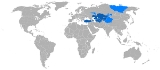
Pan-Turkism

Encyclopedia
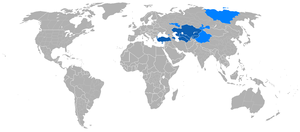
Russian Empire
The Russian Empire was a state that existed from 1721 until the Russian Revolution of 1917. It was the successor to the Tsardom of Russia and the predecessor of the Soviet Union...
, with the aim of cultural and political unification of all Turkic peoples
Turkic peoples
The Turkic peoples are peoples residing in northern, central and western Asia, southern Siberia and northwestern China and parts of eastern Europe. They speak languages belonging to the Turkic language family. They share, to varying degrees, certain cultural traits and historical backgrounds...
.
Name
In the research literature, the term "Pan-Turkism" is used to describe the idea of political, cultural and ethnic unity of all Turkic-speakingTurkic languages
The Turkic languages constitute a language family of at least thirty five languages, spoken by Turkic peoples across a vast area from Eastern Europe and the Mediterranean to Siberia and Western China, and are considered to be part of the proposed Altaic language family.Turkic languages are spoken...
people. Turan
Turan
Tūrān is the Persian name for Central Asia, literally meaning "the land of the Tur". As described below, the original Turanians are an Iranian tribe of the Avestan age. As a people the "Turanian" are one of the two Iranian peoples both descending from the Persian Fereydun but with different...
ism is a closely related movement but a more general term than Turkism, since Turkism applies only to the Turkic peoples. However, researchers and politicians engaged in the field of Turkic ideology have used these terms interchangeably in a multitude of sources and literature. The term "Turkism" started to be used with a prefix "Pan" (from Greek πᾶν, pan = all), for a "Panturkism".
While the various Turkic peoples often share historical, cultural and linguistic roots, the rising of a pan-Turkic political movement is a phenomenon only of the 19th and 20th century and can be seen in parallel with European developments like Pan-Slavism
Pan-Slavism
Pan-Slavism was a movement in the mid-19th century aimed at unity of all the Slavic peoples. The main focus was in the Balkans where the South Slavs had been ruled for centuries by other empires, Byzantine Empire, Austria-Hungary, the Ottoman Empire, and Venice...
and Pan-Germanism
Pan-Germanism
Pan-Germanism is a pan-nationalist political idea. Pan-Germanists originally sought to unify the German-speaking populations of Europe in a single nation-state known as Großdeutschland , where "German-speaking" was taken to include the Low German, Frisian and Dutch-speaking populations of the Low...
or with Pan-Iranism
Pan-Iranism
Pan-Iranism is an ideology that advocates solidarity and reunification of Iranian peoples living in the Iranian plateau and other regions that have significant Iranian cultural influence, including the Talysh, Georgians, North Caucasian peoples, Ossetians, Kurds, Armenians, Persians of Iran,...
. Proponents use the latter most often as a point of comparison as the concept of "Turkic" is not a true racial or ethnic description but more of a linguistic and cultural distinction. This is to differentiate it from the term "Turkish" which is more of an ethnic/racial term for the citizens and denizens primarily residing in Turkey. Pan-Turkic ideas and "re-unification" movements have been popular since the collapse of the Soviet Union
Soviet Union
The Soviet Union , officially the Union of Soviet Socialist Republics , was a constitutionally socialist state that existed in Eurasia between 1922 and 1991....
in Central Asian and other Turkic
Turkic peoples
The Turkic peoples are peoples residing in northern, central and western Asia, southern Siberia and northwestern China and parts of eastern Europe. They speak languages belonging to the Turkic language family. They share, to varying degrees, certain cultural traits and historical backgrounds...
countries.
History
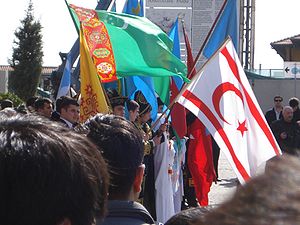
Tatars
Tatars are a Turkic speaking ethnic group , numbering roughly 7 million.The majority of Tatars live in the Russian Federation, with a population of around 5.5 million, about 2 million of which in the republic of Tatarstan.Significant minority populations are found in Uzbekistan, Kazakhstan,...
theologian Kursavi
Ghabdennasir Qursawi
Ğäbdennasír İbrahim ulı Qursawí , sometimes spelled Kursavi or Koursavi was a Tatar educator and an Islamic theologian or Jadidist. He was a brother of Ğäbdelxaliq Qursawí. He studied at Machkara village madrassah and later at Mir-Arab madrassah in Bukhara...
wrote a treatise calling for Islam’s modernization. Kursavi was a founder of the religious thought of Jadid
Jadid
The Jadids were Muslim modernist reformers within the Russian Empire in the late 19th and early 20th century. They normally referred to themselves by the Turkic terms Taraqqiparvarlar , Ziyalilar , or simply Yäşlär/Yoshlar...
ism (from Arabic 'jadid', which means 'new'). The idea of Jadidism was encouragement of critical thinking, as opposed to insistence on unquestioning loyalty. It supported education for Muslims and promoted equality among the sexes; advocated tolerance for other faiths, Turkic cultural unity, and openness to Europe’s cultural legacy. In 1843 in Kazan
Kazan
Kazan is the capital and largest city of the Republic of Tatarstan, Russia. With a population of 1,143,546 , it is the eighth most populous city in Russia. Kazan lies at the confluence of the Volga and Kazanka Rivers in European Russia. In April 2009, the Russian Patent Office granted Kazan the...
the Jadid movement was created. Its aim was a semi-secular modernization and educational reform, and within Jadid for the first time sprout the idea of a national, and not religious identity of the Turks. Before that they were solely Muslim subjects of Russia, and the Empire continued this attitude to its very collapse.
Following the upsurge in Russian colonization of the Volga area in 1880s
Wäisi movement
The Wäisi movement was a religious, social and political movement in Tatarstan and other Tatar-populated parts of Russia which took place in the late 19th and early 20th centuries. It also incorporated elements of class struggle and nationalism...
, the Islamic social movement Jaddidism added motives of national-liberation, but as a result of increase of the imperial tendencies in the Russian internal politics after the 1907 many partisans of Turkic unity immigrated to Turkey.
In 1908, the “Unity and Progress
Committee of Union and Progress
The Committee of Union and Progress began as a secret society established as the "Committee of Ottoman Union" in 1889 by the medical students İbrahim Temo, Abdullah Cevdet, İshak Sükuti and Ali Hüseyinzade...
” committee came to power in Ottoman Turkey, and the Ottoman Empire
Ottoman Empire
The Ottoman EmpireIt was usually referred to as the "Ottoman Empire", the "Turkish Empire", the "Ottoman Caliphate" or more commonly "Turkey" by its contemporaries...
turned toward nationalistic ideology. From the 16th c. the Empire was a Muslim Empire and the Sultan was a Caliph
Caliph
The Caliph is the head of state in a Caliphate, and the title for the ruler of the Islamic Ummah, an Islamic community ruled by the Shari'ah. It is a transcribed version of the Arabic word which means "successor" or "representative"...
for the part of the Muslim lands under his control. From Russia, the exiled Enlightenment leaders espousing Pan-Turkism fled to Istanbul
Istanbul
Istanbul , historically known as Byzantium and Constantinople , is the largest city of Turkey. Istanbul metropolitan province had 13.26 million people living in it as of December, 2010, which is 18% of Turkey's population and the 3rd largest metropolitan area in Europe after London and...
, where a powerful Pan-Turkic movement rose. From that time, the Turkish Pan-Turkism grew into a nationalistic, ethnically oriented replacement of the Caliphate
Caliphate
The term caliphate, "dominion of a caliph " , refers to the first system of government established in Islam and represented the political unity of the Muslim Ummah...
by a worldwide state. Following the fall of the Ottoman Empire
Fall of the Ottoman Empire
Some scholars argue the power of the Caliphate began waning by 1683, and without the acquisition of significant new wealth the Ottoman Empire went into a fast decline...
with its multi-cultural and multi-ethnic population, influenced by emerging racial theories and Turkish nationalism
Turkish nationalism
Turkish nationalism is a political ideology that promotes and glorifies the Turkish people, as either a national, ethnic or linguistic group and puts the interests of the state over other influences, including religious ones.-Pan-Turkism:...
of the Young Turks
Young Turks
The Young Turks , from French: Les Jeunes Turcs) were a coalition of various groups favouring reformation of the administration of the Ottoman Empire. The movement was against the absolute monarchy of the Ottoman Sultan and favoured a re-installation of the short-lived Kanûn-ı Esâsî constitution...
, some tried to replace the lost empire with a new Turkish commonwealth. But a speedy collapse of the Ottoman Empire brought about Mustafa Kemal (Atatürk)
Mustafa Kemal Atatürk
Mustafa Kemal Atatürk was an Ottoman and Turkish army officer, revolutionary statesman, writer, and the first President of Turkey. He is credited with being the founder of the Republic of Turkey....
, who replaced Pan-Turkic idealism with solely Anatolia
Anatolia
Anatolia is a geographic and historical term denoting the westernmost protrusion of Asia, comprising the majority of the Republic of Turkey...
n nationalism aimed at preservation of an Anatolian nucleus instead of global imperial pretences, with some isolationist tendencies. Mustafa Kemal Atatürk penalized Pan-Turkist groups and closed all publications of Pan-Turkic orientation.
One of the most significant early exponents of pan-Turkism was Enver Pasha, the Ottoman
Ottoman Empire
The Ottoman EmpireIt was usually referred to as the "Ottoman Empire", the "Turkish Empire", the "Ottoman Caliphate" or more commonly "Turkey" by its contemporaries...
Minister of War and acting
Acting (law)
In law, when someone is said to be acting in a position it can mean one of three things.*The position has not yet been formally created.*The person is only occupying the position temporarily, to ensure continuity.*The person does not have a mandate....
Commander-in-Chief
Commander-in-Chief
A commander-in-chief is the commander of a nation's military forces or significant element of those forces. In the latter case, the force element may be defined as those forces within a particular region or those forces which are associated by function. As a practical term it refers to the military...
during World War I
World War I
World War I , which was predominantly called the World War or the Great War from its occurrence until 1939, and the First World War or World War I thereafter, was a major war centred in Europe that began on 28 July 1914 and lasted until 11 November 1918...
. He later became one of the leaders of the national-liberation Basmachi uprising against the Russian Empire and Soviet Russian rule in Central Asia
Central Asia
Central Asia is a core region of the Asian continent from the Caspian Sea in the west, China in the east, Afghanistan in the south, and Russia in the north...
.
The last episode in the history of Pan-Turkism played out during WWII, when the Nazis attempted to undermine Soviet unity under a flag of Pan-Turkism in their fight with the USSR
Turkestan legion
The Turkestan Legion was the name for the military units composed of the "freiwillige" Turkic peoples who fought in the German Army during World War II...
. The German intrigues, however, did not bear any results.
While of little impact during much of the 20th century, the dissolution of the Soviet Union
Soviet Union
The Soviet Union , officially the Union of Soviet Socialist Republics , was a constitutionally socialist state that existed in Eurasia between 1922 and 1991....
in the late 20th century meant that the majority of the Turkic peoples were suddenly again able to exert considerable independence in business and political endeavours.
Today, many new Pan-Turkic movements and organizations are concentrating on economic integration of the 7 sovereign Turkic states, and hope to achieve an economic-political union very similar to the EU. The general popularity of these movements has risen dramatically over the years in the Turkic world.
Turkey's role
TurkeyTurkey
Turkey , known officially as the Republic of Turkey , is a Eurasian country located in Western Asia and in East Thrace in Southeastern Europe...
has become a major business partner to many Central Asian Turkic states, helping with the reform of higher education, the introduction of the Latin alphabet
Latin alphabet
The Latin alphabet, also called the Roman alphabet, is the most recognized alphabet used in the world today. It evolved from a western variety of the Greek alphabet called the Cumaean alphabet, which was adopted and modified by the Etruscans who ruled early Rome...
, economic development and commerce. However, these efforts have not met the expectations of either the Turkic states nor the Pan-Turkist sentiment in Turkey. For example:
- Housing projects of modest size promised to the Crimean TatarsCrimean TatarsCrimean Tatars or Crimeans are a Turkic ethnic group that originally resided in Crimea. They speak the Crimean Tatar language...
have not been completed after many years. - Although TurkmenistanTurkmenistanTurkmenistan , formerly also known as Turkmenia is one of the Turkic states in Central Asia. Until 1991, it was a constituent republic of the Soviet Union, the Turkmen Soviet Socialist Republic . Turkmenistan is one of the six independent Turkic states...
, UzbekistanUzbekistanUzbekistan , officially the Republic of Uzbekistan is a doubly landlocked country in Central Asia and one of the six independent Turkic states. It shares borders with Kazakhstan to the west and to the north, Kyrgyzstan and Tajikistan to the east, and Afghanistan and Turkmenistan to the south....
, and AzerbaijanAzerbaijanAzerbaijan , officially the Republic of Azerbaijan is the largest country in the Caucasus region of Eurasia. Located at the crossroads of Western Asia and Eastern Europe, it is bounded by the Caspian Sea to the east, Russia to the north, Georgia to the northwest, Armenia to the west, and Iran to...
have switched to the Latin alphabet, they are not as compatible with the Turkish alphabet as Turkey hoped. KazakhstanKazakhstanKazakhstan , officially the Republic of Kazakhstan, is a transcontinental country in Central Asia and Eastern Europe. Ranked as the ninth largest country in the world, it is also the world's largest landlocked country; its territory of is greater than Western Europe...
has decided to switch its alphabet back to Latin from the current Cyrillic, but the transition has been slow. KyrgyzstanKyrgyzstanKyrgyzstan , officially the Kyrgyz Republic is one of the world's six independent Turkic states . Located in Central Asia, landlocked and mountainous, Kyrgyzstan is bordered by Kazakhstan to the north, Uzbekistan to the west, Tajikistan to the southwest and China to the east...
, meanwhile, has never seriously considered adopting the Latin alphabet - although the idea had been mooted among some politicians in the first few years of indepedence. Additionally, other problems persist, such as lack or delay of the printing and teaching materials.
Criticism
Pan-Turkism is and has always been a movement viewed with suspicion by many, often perceived as nothing else but a new form of Turkish imperial ambition. Some view the movement as racist and chauvinistic, particularly when considering the associated racial and historical teachings. Specifically, the young Turks who carried pan-Turkist ideologies as their guiding principle are accused of the Armenian GenocideArmenian Genocide
The Armenian Genocide—also known as the Armenian Holocaust, the Armenian Massacres and, by Armenians, as the Great Crime—refers to the deliberate and systematic destruction of the Armenian population of the Ottoman Empire during and just after World War I...
, Greek genocide and Assyrian Genocide
Assyrian genocide
The Assyrian Genocide refers to the mass slaughter of the Assyrian/Chaldean/Syriac population of the Ottoman Empire during the 1890s, the First World War, and the period of 1922-1925...
.
Armenian Genocide
Pan-Turkism is also cited by critics as a direct cause for the Armenian GenocideArmenian Genocide
The Armenian Genocide—also known as the Armenian Holocaust, the Armenian Massacres and, by Armenians, as the Great Crime—refers to the deliberate and systematic destruction of the Armenian population of the Ottoman Empire during and just after World War I...
of 1915, in which Enver Pasha was involved, as an attempt to remove non-Turkic and non-Muslim minorities from the late Ottoman Empire
Ottoman Empire
The Ottoman EmpireIt was usually referred to as the "Ottoman Empire", the "Turkish Empire", the "Ottoman Caliphate" or more commonly "Turkey" by its contemporaries...
in order to foster a new Pan-Turkish state.
Greek Genocide
The Greek genocide is a term used by some academics to refer to the fate of the GreekOttoman Greeks
Ottoman Greeks were ethnic Greeks who lived in the Ottoman Empire , the Republic of Turkey's predecessor...
population of the Ottoman Empire during and in the aftermath of World War I
World War I
World War I , which was predominantly called the World War or the Great War from its occurrence until 1939, and the First World War or World War I thereafter, was a major war centred in Europe that began on 28 July 1914 and lasted until 11 November 1918...
(1914–1923). Like Armenians and Assyrians, the Greeks were subjected to various forms of persecution
Persecution
Persecution is the systematic mistreatment of an individual or group by another group. The most common forms are religious persecution, ethnic persecution, and political persecution, though there is naturally some overlap between these terms. The inflicting of suffering, harassment, isolation,...
including massacres, expulsion
Population transfer
Population transfer is the movement of a large group of people from one region to another by state policy or international authority, most frequently on the basis of ethnicity or religion...
s, and death march
Death march
A death march is a forced march of prisoners of war or other captives or deportees. Those marching must walk over long distances for an extremely long period of time and are not supplied with food or water...
es by Young Turk
Young Turks
The Young Turks , from French: Les Jeunes Turcs) were a coalition of various groups favouring reformation of the administration of the Ottoman Empire. The movement was against the absolute monarchy of the Ottoman Sultan and favoured a re-installation of the short-lived Kanûn-ı Esâsî constitution...
and Kemalist authorities. George W. Rendel of the British Foreign Office, among other diplomats, noted the massacres and deportations of Greeks during the post-Armistice period. It is estimated that hundreds of thousands of Ottoman Greeks may have died during this period as a result of these persecutions.
Assyrian Genocide
Alongside the Armenian and Greek Genocides, the Assyrian Genocide took place at the hand of the pan-Turkist young Turk regime in the Ottoman empire. By 1922, in a memorandum from the Assyro-Chaldean National Council, an estimate of approximately 275,000 Assyrians were killed.Dersim Ethnocide
In 1937–1938, approximately 65,000–70,000 Alevi Kurds were killed and thousands were taken into exile. A key component of the turkificationTurkification
Turkification is a term used to describe a process of cultural or political change in which something or someone who is not a Turk becomes one, voluntarily or involuntarily...
process was the policy of massive population resettlement. Referring to the main policy document in this context, the 1934 law on resettlement, a policy targeting the region of Dersim as one of its first test cases, with disastrous consequences for the local population. The Dersim ethnocide
Dersim Massacre
The Dersim Massacre took place in 1937 and 1938 in Dersim, now called Tunceli Province, in Turkey. It was the outcome of a Turkish military campaign against the Dersim Rebellion by local ethnic minority groups against Turkey's Resettlement Law of 1934...
is often confused with the Dersim Rebellion
Dersim Rebellion
The Dersim rebellion was an uprising against the Turkish government in the Dersim region of eastern Turkey, which includes Tunceli Province, Elazığ Province, and Bingöl Province...
that took place during these events. Today, not much is left of Derim's distinctive culture and the majority of its people live in the diaspora.
Kurds
According to Shaller and Zimmerer in the Journal of Genocide ResearchJournal of Genocide Research
The Journal of Genocide Research ' is a peer-reviewed academic journal that covers the field of genocide studies. Subject areas include: Peace and conflict studies, Human rights, international relations, security policies, conflict resolution, holocaust studies, history and international law.The...
, the leadership of Young Turks planned to eliminate Kurdish identity by deporting Kurds from their ancestral land and displacing them in small groups. In this era, the Kurds suffered from deportations and death marches and forced Turkification. The Young Turks
Young Turks
The Young Turks , from French: Les Jeunes Turcs) were a coalition of various groups favouring reformation of the administration of the Ottoman Empire. The movement was against the absolute monarchy of the Ottoman Sultan and favoured a re-installation of the short-lived Kanûn-ı Esâsî constitution...
partially implemented these plans in WWI and 700,000 Kurds were forcibly removed where approximately 350,000 of these displaced Kurds perished. These Kurds were forced by the young Turks to go on death march resembling the Armenian marches which was part of a plan to eliminate Kurdish identity. The movement has also been seen as the cause for the policy of "Turkification
Turkification
Turkification is a term used to describe a process of cultural or political change in which something or someone who is not a Turk becomes one, voluntarily or involuntarily...
" which Turkey has attempted to impose on its ethnic minorities such as the Kurds
Kurdish people
The Kurdish people, or Kurds , are an Iranian people native to the Middle East, mostly inhabiting a region known as Kurdistan, which includes adjacent parts of Iran, Iraq, Syria, and Turkey...
until 1991. In an attempt to deny their existence, the Turkish government categorized Kurds as "Mountain Turks" until 1991.
Nazi Germany and Pan-Turkism
In the 1940s, the Pan-Turkist also absorbed Nazi propaganda. Nihal Atsız, a prominent ideologue, advocated Nazi doctrines while advocating a Hitler-style haircut and mustache. Alparslan TürkeşAlparslan Türkes
Alparslan Türkeş was a Cypriot-born Turkish nationalist politician who was the founder and former president of the Nationalist Movement Party party...
, a leading Pan-Turkist took a pro-Hitler position during the war and established close connections with Nazi leaders in Germany. Several pan-Turkic groups in Europe seemed to have maintained ties with Nazi Germany or its supporters at the start of the war, if not earlier. The Turco-Tatars in Romania had cooperated with the Iron Guard, a Nazi inspired organization. Although Turkish government archives for the period of WWII have not been released, the level of contact can be ascertained from accurately German archives. During the early days of the War, publicly and officially, the government of Turkey maintained strict neutrality however there had been official and semi-official contacts. In practice, however, there has been confidential semi-official contacts between both Germany and in Turkey, since 1941.
There was also great sympathy for Germany in Turkey at the time. A ten-year Turco-German 'Treaty of Friendship' was signed in Ankara on 18 January. A series of official and semi-official meeting of German ambassador to Ankara, Franz von Papen, and several other German officials on one side and Turkish officials including General H.E. Erkilet, himself of Tatar
Tatars
Tatars are a Turkic speaking ethnic group , numbering roughly 7 million.The majority of Tatars live in the Russian Federation, with a population of around 5.5 million, about 2 million of which in the republic of Tatarstan.Significant minority populations are found in Uzbekistan, Kazakhstan,...
origin and frequent contributor to pan-Turk journals took place in the second half of 1941 and early months of 1942. Others included from the Turkish were General Ali Fuad Erdem, and Nuri Pasha
Nuri Killigil
Nuri Killigil was a general in the Ottoman Army. He was brother of Ottoman Minister of War, Enver Pasha.- Libya :Infantry Machine-Gun Captain Nuri Efendi was sent to Libya by an illegal Greek ship with Major Jafar al-Askari Bey and 10,000 gold...
, the brother of Enver Pasha, who is a romantic figure fore pan-Turkists.
While Erkilet discussed military contingencies, Nuri Pasha offered the Germans his plans for creating independent states which were to be allies but not satellites of Turkey. These states were to be formed from the Turkic speaking population in Crimea
Crimea
Crimea , or the Autonomous Republic of Crimea , is a sub-national unit, an autonomous republic, of Ukraine. It is located on the northern coast of the Black Sea, occupying a peninsula of the same name...
, Azerbaijan
Azerbaijan
Azerbaijan , officially the Republic of Azerbaijan is the largest country in the Caucasus region of Eurasia. Located at the crossroads of Western Asia and Eastern Europe, it is bounded by the Caspian Sea to the east, Russia to the north, Georgia to the northwest, Armenia to the west, and Iran to...
, Central Asia, northwest Iran
Iran
Iran , officially the Islamic Republic of Iran , is a country in Southern and Western Asia. The name "Iran" has been in use natively since the Sassanian era and came into use internationally in 1935, before which the country was known to the Western world as Persia...
and northern Iraq
Iraq
Iraq ; officially the Republic of Iraq is a country in Western Asia spanning most of the northwestern end of the Zagros mountain range, the eastern part of the Syrian Desert and the northern part of the Arabian Desert....
. Nuri Pasha himself offered to assist with propaganda activities to this effect. However, Turkey had also a fear for Turkic minorities of the USSR and told von Papen that it could not join Germany
Germany
Germany , officially the Federal Republic of Germany , is a federal parliamentary republic in Europe. The country consists of 16 states while the capital and largest city is Berlin. Germany covers an area of 357,021 km2 and has a largely temperate seasonal climate...
until the USSR was crushed. The Turkish government was possibly apprehensive of the USSR's might. Thus various pressure failed to bring the Turkish government to join the war during the period. At less official levels, emigrants from Turkic groups in the Soviet Union, played a crucial role in some of the negotiations and contacts of Turkey and Germany. Among these were pan-Turkish activists such as Zeki Velidi Togan
Zeki Velidi Togan
Zeki Velidi Togan was a historian, Turkologist, and leader of the Bashkir revolutionary and liberation movement.-Biography:He was born in Koedhoen village of Sterlitamak uyezd, today Bashkortostan....
, Mammed Amin Rasulzade
Mammed Amin Rasulzade
Mammad Amin Rasulzade was an Azerbaijani statesman, scholar, public figure and one of the founding political leaders of Democratic Republic of Azerbaijan...
, Mirza Bala, Ahmet CafarOglu, Sayid Shamil and Ayaz Ishaki. Several Tatars, organized military units of Turkic speakers in Turco-Tatar and Caucasian regions from the prisoner of wars and these joined the war against the USSR, generally fighting as guerillas. Many of them imbued with hopes of independence and several of these units aspired for a pan-Turkic union. The units which were continuously reinforced numbered several hundred thousands of people of Turkic origin. What is clear is that Turkey adopted a cautious approach at the government level, however pan-Turkist groups were exasperated by the Turkish government's inaction and by what they manifestly regarded as the waste of a golden opportunity in the realization of the goals of pan-Turkism.
Historiography
Pan-Turkism and nationalist historiography has been used to deny the identity of Armenians and Kurds. At the same time, various revisionist claims were made on ancient peoples of the region and beyond."Pan-Turkic" historiography
Various groups including Parthians, Scythians, Sumerians, Indians, Akkadians, Elamites, Anzani, Kassites, Carians, Protohittites, Hittites, Mittani, Hurrians and others have been claimed as of Turkic origin by nationalist writers. Lynn Meskell notes: "Pan-Turkists who later became the ideologists of the racist movements of the present times, were rather pleased with the idea of affiliating Sumerians and Hittites to Turkish. Another historical theory developed under government sponsorship in those days held that all great civilizations — Chinese, Indian, Muslim, even ancient Egyptian and Etruscan — were of Turkish origin.Viewpoint on Armenian history
Clive Foss, Professor of Ancient History at the University of Massachusetts, Boston, has done extensive archeological work in Turkey and is an expert on ancient Armenian coinage. In his article: "The Turkish View of Armenian History: A Vanishing Nation" he notes that the Turkish government: "has been systematically changing the names of villages to make them more Turkish. Any name which does not have a meaning in Turkish, or does not sound Turkish, whatever its origin, is replaced by a banal name assigned by a bureau in Ankara, with no respect to local conditions or traditions." He also notes that the Turkish government: "presented ambiguously, without clear identification of their builders, or as examples of the influence of the superiority of Turkish architecture. In all this, a clear line is evident: the Armenian presence is to be consigned, as far as possible, to oblivion.".Among the books he criticizes, Foss notes that the book written in Turkey by Cemal Anadol and titled 1982: the Armenian file in the light of history by Cemal Anadol claims the Iranian
Iranian peoples
The Iranian peoples are an Indo-European ethnic-linguistic group, consisting of the speakers of Iranian languages, a major branch of the Indo-European language family, as such forming a branch of Indo-European-speaking peoples...
Scythians and Parthians as Turks. At the same time, Cemal Anadol claims that Armenian welcomed the Turks in the region, their language is a mixture with no roots, their alphabet is mixed with 11 characters being from ancient Turkic alphabet. Clive Foss states that to call the Turkish revisionism on Armenian history as "historical revisionism" is an understatement. He notes that: "The Turkish writings have been tendentious: history has been viewed as performing a useful service, proving or supporting a point of view, and so it is treated as something flexible which can be manipulated at will."
He concludes with: "The notion, which seems well established in Turkey, that the Armenians were a wandering tribe without a home, who never had a state of their own, is of course entirely without foundation in fact. The logical consequence of the commonly expressed view of the Armenians is that they have no place in Turkey, and never did. The result would be the same if the viewpoint were expressed first, and the history written to order. In a sense, something like this seems to have happened, for most Turks who grew up under the Republic were educated to believe in the ultimate priority of Turks in all parts of history, and to ignore Armenians all together; they had been clearly cosigned to oblivion."
Ideologue views on pan-Turkism
Ziya GökalpZiya Gökalp
Ziya Gökalp was a Turkish sociologist, writer, poet, and political activist. In 1908, after the Young Turk revolution, he adopted the pen name Gökalp , which he retained for the rest of his life...
redefined pan-Turkism as a cultural, academic, philosophical and political concept advocating the unity and freedom of Turkic peoples
Turkic peoples
The Turkic peoples are peoples residing in northern, central and western Asia, southern Siberia and northwestern China and parts of eastern Europe. They speak languages belonging to the Turkic language family. They share, to varying degrees, certain cultural traits and historical backgrounds...
.
Tsarist Russia and Soviet viewpoint on pan-Turkism
Generally, the concept of Turkism was interpreted by Tsarist Russian circlesTsardom of Russia
The Tsardom of Russia was the name of the centralized Russian state from Ivan IV's assumption of the title of Tsar in 1547 till Peter the Great's foundation of the Russian Empire in 1721.From 1550 to 1700, Russia grew 35,000 km2 a year...
as overwhelmingly political, irredentist and aggressive. The term "Turkism" started to be used with a prefix "Pan" (from Greek meaning "all"), to create "Panturkism". The Turkic peoples of Russia began to be threatened with Turkish expansion, I. Gasprinsky and his adherents were labeled "Turkish spies". After the revolution of 1917, the attitude to Türkism did not differ from the attitude of the Imperial powers. At the 10th congress of Bolshevik Communist Party in 1921 was formulated the official doctrine where the party "condemned Panturkism as a sloping to the bourgeois-democratic nationalism". The emergence of a "Panturkism" scare in the Soviet propaganda caused "Panturkism" to become one of the most frightening political labels in the USSR. The most widespread accusation used for fatal repressions in the 1930s of the educated Tatars and other Turkic peoples was the accusation in "Panturkism".
Russia, China and Iran, claim that they perceive Panturkism as nothing else but a new form of Turkish imperial ambition. Some see it as downright racist, particularly when considering the associated racial and historical teachings. Critics also believe that the concept of Pan-Turkism is flawed because of the distinct dialects among each different Turkic people, which sometimes led to problems of understanding between people speaking different Turkic language. There is also concern over religious differences too. Although most Turks follow the Sunni
Sunni Islam
Sunni Islam is the largest branch of Islam. Sunni Muslims are referred to in Arabic as ʾAhl ūs-Sunnah wa āl-Ǧamāʿah or ʾAhl ūs-Sunnah for short; in English, they are known as Sunni Muslims, Sunnis or Sunnites....
sect of Islam
Islam
Islam . The most common are and . : Arabic pronunciation varies regionally. The first vowel ranges from ~~. The second vowel ranges from ~~~...
, the Azeris
Azerbaijani people
The Azerbaijanis are a Turkic-speaking people living mainly in northwestern Iran and the Republic of Azerbaijan, as well as in the neighbourhood states, Georgia, Russia and formerly Armenia. Commonly referred to as Azeris or Azerbaijani Turks , they also live in a wider area from the Caucasus to...
of Azerbaijan
Azerbaijan
Azerbaijan , officially the Republic of Azerbaijan is the largest country in the Caucasus region of Eurasia. Located at the crossroads of Western Asia and Eastern Europe, it is bounded by the Caspian Sea to the east, Russia to the north, Georgia to the northwest, Armenia to the west, and Iran to...
are distinct in that they follow the Shi'a
Shi'a Islam
Shia Islam is the second largest denomination of Islam. The followers of Shia Islam are called Shi'ites or Shias. "Shia" is the short form of the historic phrase Shīʻatu ʻAlī , meaning "followers of Ali", "faction of Ali", or "party of Ali".Like other schools of thought in Islam, Shia Islam is...
school. Some nationalist critics also claim that Pan-Turkists are at the fore front of major historical revisionism regarding Turkic history and world history in general. Still, proponents see Pan-Turkism as a way of increasing regional security, economic growth and as a viable bulwark against Islamist movements, by furthering secular
Secularism
Secularism is the principle of separation between government institutions and the persons mandated to represent the State from religious institutions and religious dignitaries...
and democratic government in the region.
Key personalities
- Yusuf AkçuraYusuf AkçuraYusuf Akçura was a prominent Tatar activist and ideologue of Turanism in the late Ottoman Empire.-Biography:He was born in Ulyanovsk, Russia to a Tatar family and lived there until he and his mother emigrated to Turkey when he was seven...
- Isa AlptekinIsa AlptekinIsa Yusuf Alptekin or ʿĪsa Yūsuf Alptekin ; 1901 – 17 December 1995) was a Uyghur political leader, exiled from China in 1949.He was born at 1901 in Yengisar County, Kashgar, Qing Dynasty...
- Sadri Maksudi ArsalSadri Maksudi ArsalSadreddin Nizamettinovich Maksudov or Sadri Maksudi Arsal was a prominent Tatar and Turkish statesman, scholar and thinker.-Biography:...
- Hüseyin Nihâl Atsız
- Ospan BatyrOspan BatyrOsman Batyr , , the son of Islambay was born in Koktokay County, Altay Prefecture, Xinjiang, Peoples Republic of China....
- Abulfaz Elchibey
- Ismail Gasprinski
- Ziya GökalpZiya GökalpZiya Gökalp was a Turkish sociologist, writer, poet, and political activist. In 1908, after the Young Turk revolution, he adopted the pen name Gökalp , which he retained for the rest of his life...
- Nursultan NazarbayevNursultan NazarbayevNursultan Abishuly Nazarbayev has served as the President of Kazakhstan since the nation received its independence in 1991, after the fall of the Soviet Union...
- Enver Pasha
- Nuri PashaNuri KilligilNuri Killigil was a general in the Ottoman Army. He was brother of Ottoman Minister of War, Enver Pasha.- Libya :Infantry Machine-Gun Captain Nuri Efendi was sent to Libya by an illegal Greek ship with Major Jafar al-Askari Bey and 10,000 gold...
- Talat Pasha
- Nejdet SançarNejdet SançarNejdet Sançar was a Turkish literature teacher who became one of the prominent personalities of the Pan-Turanism school. He was the brother of another notable Turkish nationalist, Hüseyin Nihâl Atsız.- Politics :...
- Mustafa ShokayMustafa ShokayMustafa Shokay , was a Kazakh leader of the Kokand revolt in 1917 against the Bolsheviks that created the “Provisional Government of Autonomous Turkestan.” After the revolt was crushed Shokay fled the country...
- Pál TelekiPál TelekiPál Count Teleki de Szék was prime minister of Hungary from 19 July 1920 to 14 April 1921 and from 16 February 1939 to 3 April 1941. He was also a famous expert in geography, a university professor, a member of the Hungarian Academy of Sciences, and Chief Scout of the Hungarian Scout Association...
- Zeki Velidi ToganZeki Velidi ToganZeki Velidi Togan was a historian, Turkologist, and leader of the Bashkir revolutionary and liberation movement.-Biography:He was born in Koedhoen village of Sterlitamak uyezd, today Bashkortostan....
- Alparslan TürkeşAlparslan TürkesAlparslan Türkeş was a Cypriot-born Turkish nationalist politician who was the founder and former president of the Nationalist Movement Party party...
Quotations
- "Dilde, fikirde, işte birlik" translated "Unity of Language, Thought and Action" by Ismail Gasprinski, 1839 a Crimean TatarCrimean TatarsCrimean Tatars or Crimeans are a Turkic ethnic group that originally resided in Crimea. They speak the Crimean Tatar language...
and famous member of the Turanian SocietyTuranian SocietyTuranian Society , a society founded in 1839 by Tatars, aiming at uniting the various Turkic peoples of the Russian Empire.The name is derived from Turan, an ancient Persian name for the land to the East of Iran where many Turkic peoples live, and Turan, the goal of an all Turks uniting state.The...
- "Bu yürüyüş devam ediyor. Türk orduları ata ruhlarının dolaştığı Altay ve Tanrı Dağları eteklerinde geçit resmi yapıncaya kadar devam edecektir." translated "This march is going on. It will continue until the Turkic Armies' parade on the foothills of Altai and Tien-Shan mountains where the souls of their ancestors stroll." Hüseyin Nihâl AtsızHüseyin Nihâl AtsizHüseyin Nihâl Atsız was a prominent Turkish nationalist writer, novelist, poet and philosopher. Nihâl Atsız was a fervent supporter of the pan-Turkist or Turanism ideology. He is author of over 30 books and numerous articles...
, a famous Pan-Turkist.
See also
- Turkic peoplesTurkic peoplesThe Turkic peoples are peoples residing in northern, central and western Asia, southern Siberia and northwestern China and parts of eastern Europe. They speak languages belonging to the Turkic language family. They share, to varying degrees, certain cultural traits and historical backgrounds...
- Idel-UralIdel-UralIdel-Ural is a historical region in Eastern Europe, in what is today Russia. The name literally means Volga-Urals in the Tatar language. The frequently used Russian variant is Volgo-Uralye...
- Altaic languagesAltaic languagesAltaic is a proposed language family that includes the Turkic, Mongolic, Tungusic, and Japonic language families and the Korean language isolate. These languages are spoken in a wide arc stretching from northeast Asia through Central Asia to Anatolia and eastern Europe...
- ChauvinismChauvinismChauvinism, in its original and primary meaning, is an exaggerated, bellicose patriotism and a belief in national superiority and glory. It is an eponym of a possibly fictional French soldier Nicolas Chauvin who was credited with many superhuman feats in the Napoleonic wars.By extension it has come...
- Ethnic nationalismEthnic nationalismEthnic nationalism is a form of nationalism wherein the "nation" is defined in terms of ethnicity. Whatever specific ethnicity is involved, ethnic nationalism always includes some element of descent from previous generations and the implied claim of ethnic essentialism, i.e...
- Grey WolvesGrey WolvesThe Idealist Youth , commonly known as Grey Wolves , is an ultra-nationalist neo-fascist youth organization. It is accused of terrorism. According to Turkish authorities, the organization carried out 694 murders between 1974–1980.-Name:...
- Nationalist Movement PartyNationalist Movement PartyThe Nationalist Movement Party , is a far-right political party in Turkey.In the 2002 general elections, the party had lost its 129 seats as it had won only 8.34% of the national vote...
- Hungarian TuranismHungarian TuranismHungarian Turanism is a Hungarian nationalist ideology which stresses the alleged origins of the Hungarian people in the steppes of Central Asia and the affinity of the Hungarians with Asian peoples such as the Turks. The idea of the necessity of "Turanian brotherhood/collaboration" was borrowed...
- Jobbik
- IrredentismIrredentismIrredentism is any position advocating annexation of territories administered by another state on the grounds of common ethnicity or prior historical possession, actual or alleged. Some of these movements are also called pan-nationalist movements. It is a feature of identity politics and cultural...
- List of Turkic states and empires
- Pan-nationalismPan-nationalismPan-nationalism is a form of nationalism distinguished by the large-scale of the claimed national territory, and because it often defines the nation on the basis of a ‘’cluster’’ of cultures and ethnic groups. It shares the general nationalist ideology, that the nation is a fundamental unit of...
- TuranidTuranidTuranid race is a now obsolete term, originally intended to cover populations of Central Asia associated with the spread of the Turanian languages, that is the combination of the Uralic and Altaic families , in human genetics, physical anthropology and historically in scientific racism.The latter...
- Ural–Altaic languages
- Article 301 (Turkish Penal Code)Article 301 (Turkish penal code)Article 301 is a controversial article of the Turkish Penal Code making it illegal to insult Turkey, the Turkish ethnicity, or Turkish government institutions...
Further reading
- Jacob M. Landau. Pan-Turkism: From Irredentism to Cooperation. Hurst, 1995. ISBN 1-85065-269-4