


Tengriism

Unanswered Questions

Encyclopedia
Central Asia
Central Asia is a core region of the Asian continent from the Caspian Sea in the west, China in the east, Afghanistan in the south, and Russia in the north...
n religion that incorporates elements of shamanism
Shamanism
Shamanism is an anthropological term referencing a range of beliefs and practices regarding communication with the spiritual world. To quote Eliade: "A first definition of this complex phenomenon, and perhaps the least hazardous, will be: shamanism = technique of ecstasy." Shamanism encompasses the...
, animism
Animism
Animism refers to the belief that non-human entities are spiritual beings, or at least embody some kind of life-principle....
, totemism
Totemism
Totemism is a system of belief in which humans are said to have kinship or a mystical relationship with a spirit-being, such as an animal or plant...
and ancestor worship. Despite still being active in some minorities, it was, in old times, the major belief of Turkic peoples
Turkic peoples
The Turkic peoples are peoples residing in northern, central and western Asia, southern Siberia and northwestern China and parts of eastern Europe. They speak languages belonging to the Turkic language family. They share, to varying degrees, certain cultural traits and historical backgrounds...
(such as the Huns
Huns
The Huns were a group of nomadic people who, appearing from east of the Volga River, migrated into Europe c. AD 370 and established the vast Hunnic Empire there. Since de Guignes linked them with the Xiongnu, who had been northern neighbours of China 300 years prior to the emergence of the Huns,...
and Xiongnu
Xiongnu
The Xiongnu were ancient nomadic-based people that formed a state or confederation north of the agriculture-based empire of the Han Dynasty. Most of the information on the Xiongnu comes from Chinese sources...
), Bulgars
Bulgars
The Bulgars were a semi-nomadic who flourished in the Pontic Steppe and the Volga basin in the 7th century.The Bulgars emerge after the collapse of the Hunnic Empire in the 5th century....
, Hungarians and Mongols
Mongols
Mongols ) are a Central-East Asian ethnic group that lives mainly in the countries of Mongolia, China, and Russia. In China, ethnic Mongols can be found mainly in the central north region of China such as Inner Mongolia...
. It focuses around the sky deity Tengri
Tengri
Tengri or Tengger Tengri or Tengger Tengri or Tengger (Old Turkic: ; Mongolian: Тэнгэр, Tenger; Chinese: 腾格里, Mandarin: Ténggélǐ, Hungarian: Tengri, Turkish: Tanrı, Bulgarian: Tangra (Тангра) is a sky god, formerly the chief deity of the early Turkic peoples, including the Xiongnu, Huns, Bulgars,...
(or Tangra, Tangri, Tanrı etc.) and reverence for the sky in general. Majority of Tengrists today live in Northern
North Asia
North Asia or Northern Asia is a subregion of Asia, consisting of the Asian portion of Russia.The Phillips Illustrated Atlas of the World 1988 defines it as being most of the former USSR, the part that is to the east of the Ural Mountains...
and Central Asia
Central Asia
Central Asia is a core region of the Asian continent from the Caspian Sea in the west, China in the east, Afghanistan in the south, and Russia in the north...
such as Khakassia and Tuva
Tuvans
Tuvans or Tuvinians are Turkic peoples living in southern Siberia. They are historically known as one of the Uriankhai, from the Mongolian designation...
. "Khukh" and "Tengri" literally mean "blue" and "sky" in Mongolian
Mongolian language
The Mongolian language is the official language of Mongolia and the best-known member of the Mongolic language family. The number of speakers across all its dialects may be 5.2 million, including the vast majority of the residents of Mongolia and many of the Mongolian residents of the Inner...
and modern Mongolians still pray to "Munkh Khukh Tengri" ("Eternal Blue Sky"). Therefore Mongolia is sometimes poetically referred to by Mongolians as the "Land of Eternal Blue Sky" ("Munkh Khukh Tengriin Oron" in Mongolian).
In modern Turkey
Turkey
Turkey , known officially as the Republic of Turkey , is a Eurasian country located in Western Asia and in East Thrace in Southeastern Europe...
Tengriism is known as the Gök Tanrı ("Sky God") religion, Turkish "Gök" (sky) and "Tanrı" (God) corresponding to the Mongolian khukh (blue) and Tengri (sky), respectively.
Background

In Europe
Europe
Europe is, by convention, one of the world's seven continents. Comprising the westernmost peninsula of Eurasia, Europe is generally 'divided' from Asia to its east by the watershed divides of the Ural and Caucasus Mountains, the Ural River, the Caspian and Black Seas, and the waterways connecting...
, Tengrism was the religion of the Huns
Huns
The Huns were a group of nomadic people who, appearing from east of the Volga River, migrated into Europe c. AD 370 and established the vast Hunnic Empire there. Since de Guignes linked them with the Xiongnu, who had been northern neighbours of China 300 years prior to the emergence of the Huns,...
and of the early Bulgars
Bulgars
The Bulgars were a semi-nomadic who flourished in the Pontic Steppe and the Volga basin in the 7th century.The Bulgars emerge after the collapse of the Hunnic Empire in the 5th century....
who brought it to the region. It is said that the Huns of the Northern Caucaus believed in two gods. One is called Tangri han, that is Tengri Khan, who is thought to be identical to the Persian Aspandiat, and for whom horses were sacrificed, and the other is called Kuar, whose victims are struck down by lightning.
It is still actively practised in Kyrgyzstan
Kyrgyzstan
Kyrgyzstan , officially the Kyrgyz Republic is one of the world's six independent Turkic states . Located in Central Asia, landlocked and mountainous, Kyrgyzstan is bordered by Kazakhstan to the north, Uzbekistan to the west, Tajikistan to the southwest and China to the east...
, Kazakhstan
Kazakhstan
Kazakhstan , officially the Republic of Kazakhstan, is a transcontinental country in Central Asia and Eastern Europe. Ranked as the ninth largest country in the world, it is also the world's largest landlocked country; its territory of is greater than Western Europe...
, Sakha, Buryatia, Tuva
Tuva
The Tyva Republic , or Tuva , is a federal subject of Russia . It lies in the geographical center of Asia, in southern Siberia. The republic borders with the Altai Republic, the Republic of Khakassia, Krasnoyarsk Krai, Irkutsk Oblast, and the Republic of Buryatia in Russia and with Mongolia to the...
, Mongolia
Mongolia
Mongolia is a landlocked country in East and Central Asia. It is bordered by Russia to the north and China to the south, east and west. Although Mongolia does not share a border with Kazakhstan, its western-most point is only from Kazakhstan's eastern tip. Ulan Bator, the capital and largest...
and Turkey
Turkey
Turkey , known officially as the Republic of Turkey , is a Eurasian country located in Western Asia and in East Thrace in Southeastern Europe...
in parallel with Tibetan Buddhism
Tibetan Buddhism
Tibetan Buddhism is the body of Buddhist religious doctrine and institutions characteristic of Tibet and certain regions of the Himalayas, including northern Nepal, Bhutan, and India . It is the state religion of Bhutan...
and Burkhanism
Burkhanism
Burkhanism or Ak Jang is a new religious movement that flourished among the indigenous people of Russia's Gorno Altai region between 1904 and the 1930s. Czarist Russia was suspicious of the movement's potential to stir up native unrest and perhaps involve outside powers...
.
A number of Kyrgyz politicians are actively pushing Tengrism, to fill the ideological void. Dastan Sarygulov, currently secretary of state and formerly chair of the Kyrgyz state gold mining company, has established Tengir Ordo (Army of Tengri) which is a civic group that seeks to promote the values and traditions of the Tengrism.
There is a Tengrist society in Bishkek
Bishkek
Bishkek , formerly Pishpek and Frunze, is the capital and the largest city of Kyrgyzstan.Bishkek is also the administrative centre of Chuy Province which surrounds the city, even though the city itself is not part of the province but rather a province-level unit of Kyrgyzstan.The name is thought to...
, which officially claims almost 500,000 followers and an international scientific center of Tengrist studies. Both institutions are run by Dastan Sarygulov, the main theorist of Tengrism in Kyrgyzstan
Kyrgyzstan
Kyrgyzstan , officially the Kyrgyz Republic is one of the world's six independent Turkic states . Located in Central Asia, landlocked and mountainous, Kyrgyzstan is bordered by Kazakhstan to the north, Uzbekistan to the west, Tajikistan to the southwest and China to the east...
and a member of the Parliament.
Publications committed to the subject of Tengrism are more and more frequently published in scientific journals of human sciences in Kyrgyzstan as well as in Kazakhstan. The partisans of this movement endeavor to influence the political circles, and have in fact succeeded in spreading their concepts into the governing bodies. Kazakhstan
Kazakhstan
Kazakhstan , officially the Republic of Kazakhstan, is a transcontinental country in Central Asia and Eastern Europe. Ranked as the ninth largest country in the world, it is also the world's largest landlocked country; its territory of is greater than Western Europe...
’s President Nursultan Nazarbayev
Nursultan Nazarbayev
Nursultan Abishuly Nazarbayev has served as the President of Kazakhstan since the nation received its independence in 1991, after the fall of the Soviet Union...
and even more frequently former Kyrgyz president Askar Akayev
Askar Akayev
Askar Akayevich Akayev served as the President of Kyrgyzstan from 1990 until his overthrow in the March 2005 Tulip Revolution....
have several times mentioned that Tengrism as the national and “natural” religion of the Turkic peoples.
Some symbols related to Tengrism

- UmayUmayUmay is the goddess of fertility and virginity in Turkic mythology and Tengriism and as such related to women, mothers and children. Umay resembles earth-mother goddesses found in various other world religions. Literally in the Mongolian language, "eje" or "eej" means "mother." In Mongolian "Umai"...
- Goddess of fertility and virginity - Bai-UlganBai-UlganBai-Ülgen or Ülgen is a Turkic and Mongolian creator-deity, usually distinct from Tengri but sometimes identified with him in the same manner as Helios and Apollo. His name is from Old Turkic bey, "rich", and ülgen, "magnificent"...
- Highest deity after Tengri - ErlikErlikErlik, or Erlig, is the god of death and underworld in Turkic and Mongolian mythology.According to Siberian mythology, Erlik was the first creation of Tengri or Ulgan, the creator god, but Erlik's pride led to friction between the two, and he was banished to the underworld.In the myths of the...
- God of death - Flag of KazakhstanFlag of KazakhstanThe current flag of Kazakhstan or Kazakh flag was adopted on 4 June 1992, replacing the flag of the Kazakh Soviet Socialist Republic. The flag was designed by Shaken Niyazbekov.-Description:...
- Flag of TurkeyFlag of TurkeyThe flag of Turkey is a red flag with a white crescent moon and a star in its centre. The flag is called Ayyıldız or Albayrak . The Turkish flag is referred to as Alsancak in the Turkish National Anthem....
- Göktürk coins
Holy mountains and lakes
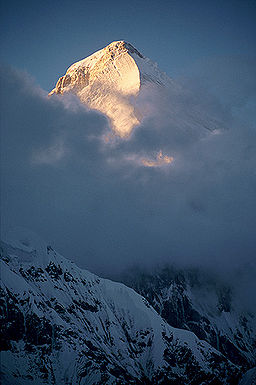
- Beydigin Mountains
 Turkey
 - Gökırmak (Sky river) Turkey
- KızılırmakKizilirmak-Geographical names in Turkey:* Kızılırmak River is the longest river of Anatolia* Kızılırmak, Çankırı, a district of Çankırı Province, Turkey...
(Red river) Turkey - Tian ShanTian ShanThe Tian Shan , also spelled Tien Shan, is a large mountain system located in Central Asia. The highest peak in the Tian Shan is Victory Peak , ....
 Mainland China
 - Khan TengriKhan TengriKhan Tengri is a mountain of the Tian Shan mountain range. It is located on the China—Kyrgyzstan—Kazakhstan border, east of lake Issyk Kul. Its geologic elevation is , but its glacial cap rises to...
 Kazakhstan
 - Kyzyl-bash Kazakhstan
- Altai Mountains
 Mongolia
 - Issyk KulIssyk KulIssyk Kul is an endorheic lake in the northern Tian Shan mountains in eastern Kyrgyzstan. It is the tenth largest lake in the world by volume and the second largest saline lake after the Caspian Sea. Although it is surrounded by snow-capped peaks, it never freezes; hence its name, which means "hot...
: Kyrgyzstan
 - MusalaMusalaMusala is the highest peak in Bulgaria and the entire Balkan Peninsula, standing at 2,925 m . The summit of the Rila mountain in southwestern Bulgaria, Musala is the highest peak between the Alps and the Caucasus and the highest in Eastern Europe bar the Caucasus.Between 1949–1962 the peak was...
 Kingdom of Bulgaria
 - PerperikonPerperikonThe ancient Thracian city of Perperikon is located in the Eastern Rhodopes, 15 km northeast of the present-day town of Kardzhali, Bulgaria, on a 470 m high rocky hill, which is thought to have been a sacred place. The village of Gorna Krepost is located at the foot of the hill and the...
Kingdom of Bulgaria - Tian ShanTian ShanThe Tian Shan , also spelled Tien Shan, is a large mountain system located in Central Asia. The highest peak in the Tian Shan is Victory Peak , ....
Mainland China
See also
- Altaic mythologyAltaic mythologyThe mythologies of the Turkic and Mongol peoples are related and have exerted strong influence on one another. Both groups of peoples qualify as Eurasian nomads and have been in close contact throughout history, especially in the context of the medieval Turco-Mongol empire.The oldest mythological...
- Heaven worshipHeaven worshipHeaven worship is a Chinese religious belief that predates Taoism and Confucianism, but was later incorporated into both.The Ancient Chinese believed in a non-corporeal entity called Shangdi, an omnipotent, just, and monotheistic supreme being. Over time, Shangdi became synonymous with Tian , or...
- Manzan Gurme ToodeiManzan Gurme ToodeiManzan Gurme Toodei is the Buryat great goddess who is mother of all the western tenger and ancestress of all the patron spirits of shamanism. She is a daughter of supreme goddess Ekhe Ekhe Burhan, and "is possessor of the greatest power and spiritual knowledge of all the sky spirits...
- Religion in ChinaReligion in ChinaReligion in China has been characterized by pluralism since the beginning of Chinese history. The Chinese religions are family-oriented and do not demand the exclusive adherence of members. Some scholars doubt the use of the term "religion" in reference to Buddhism and Taoism, and suggest "cultural...
External links
- Mongolian film The Sky Son (Tengeriin Khuu)
- Circle of Tengerism: an organization dedicated to the preservation of Siberian and Mongolian shaman traditions
- Excerpt from Tengrianizm: Religion of Turks and Mongols, by Rafael Bezertinov
- Virtual Temple of Tengri
- Shamanism (Tengerism) in Mongolia
- Julie Stewart's course in Mongolian shamanism--introduction
- Bog je Jedan blog: Avar Tengrism in Croatia
- "Tenri on Mars" by HB Paksoy
- AK JANG IN THE CONTEXT OF ALTAI RELIGIOUS TRADITION