

Rouran

Encyclopedia
Rouran Mongolia name Jujan or Nirun Ruanruan/Ruru , Tan Tan , Juan-Juan or Zhu-Zhuwas the name of a confederation of nomad
ic tribes on the northern borders of Inner China from the late 4th century until the middle 6th century. It has sometimes been hypothesized that the Rouran are identical to the Eurasian Avars
who later appeared in Europe.
The term Rouran is a Mandarin Chinese transcription of the pronunciation of the name the confederacy used to refer to itself. Ruanruan and Ruru remained in modern usage despite once being derogatory. They derived from orders given by the Emperor Taiwu
of Northern Wei
, who waged war against the Rouran and intended to intimidate the confederacy.
The power of the Rouran was broken by an alliance of Göktürks
, the Chinese Northern Qi
and Northern Zhou
dynasties and tribes in Central Asia in 552.
people who remained in the Mongolian steppes after most Xianbei migrated south to Northern China and set up various kingdoms. They were first noted as having defeated the Tiele
and establishing an empire extending all the way to the Hulun, in eastern Inner Mongolia
. To the west of the Rouran was a horde known in the west as the Hephthalites who originally, until the beginning of the 5th century, were a vassal horde of the Rouran.
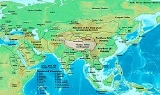
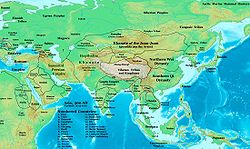
The Rouran controlled the area of Mongolia
from the Manchuria
n border to Turpan and, perhaps, the east coast of Lake Balkhash
, and from the Orkhon River to China Proper
. Their ancestor Mugulu is said to have been originally a slave of the Tuoba
tribes, situated at the north banks of Yellow River Bend
. Mugulu's descendant Yujiulü Shelun
is said to be the first chieftain who was able to unify the Rouran tribes and to found the power of the Rouran by defeating the Tiele and Xianbei. Shelun was also the first of the steppe peoples to adopt the title of khagan
(可汗) in 402, originally a title of Xianbei nobility.
The Rouran and the Hephthalites had a falling out and problems within their confederation were encouraged by Chinese agents. In 508, the Tiele defeated the Rouran in battle. In 516, the Rouran defeated the Tiele. Within the Rouran confederation was a Turkic tribe noted in Chinese annals as the Tujue
. After a marriage proposal to the Rouran was rebuffed, the Tujue joined with the Western Wei, successor state to the Northern Wei, and revolted against the Rouran. In 555, they beheaded 3,000 Rouran. Some scholars claim that the Rouran then fled west across the steppes and became the Avars, though many other scholars contest this claim. The remainder of the Rouran fled into China, were absorbed into the border guards, and disappeared forever as an entity. The last Rouran khagan fled to the court of Western Wei, but at the demand of Tujue, Western Wei executed him and the nobles that accompanied him.
 Little is known of the Rouran ruling elite, which the Book of Wei
cited as an offshoot of the Xianbei. The Rouran subdued modern regions of Xinjiang
, Mongolia, Central Asia
, and parts of Siberia
and Manchuria from the late 4th century. Their frequent interventions and invasions profoundly affected neighboring countries. Though they admitted the Ashina
of Göktürks into their federation, the power of the Rouran was broken by an alliance of Göktürks, the Chinese Northern Qi and Northern Zhou dynasties and tribes in Central Asia in 552. The Northern Wei, for instance, established the Six Garrisons bordering the Rouran, which later became the foci of several major mutinies in the early 6th century.
and Khan
for their emperors (which are, therefore, assumed to be Mongolic in origin), replacing the Chanyu
of the Xiongnu
, whom Grousset and others assume to be Turkic
.
Nomad
Nomadic people , commonly known as itinerants in modern-day contexts, are communities of people who move from one place to another, rather than settling permanently in one location. There are an estimated 30-40 million nomads in the world. Many cultures have traditionally been nomadic, but...
ic tribes on the northern borders of Inner China from the late 4th century until the middle 6th century. It has sometimes been hypothesized that the Rouran are identical to the Eurasian Avars
Eurasian Avars
The Eurasian Avars or Ancient Avars were a highly organized nomadic confederacy of mixed origins. They were ruled by a khagan, who was surrounded by a tight-knit entourage of nomad warriors, an organization characteristic of Turko-Mongol groups...
who later appeared in Europe.
The term Rouran is a Mandarin Chinese transcription of the pronunciation of the name the confederacy used to refer to itself. Ruanruan and Ruru remained in modern usage despite once being derogatory. They derived from orders given by the Emperor Taiwu
Emperor Taiwu of Northern Wei
Emperor Taiwu of Northern Wei , personal name Tuoba Tao , nickname Foli , was an emperor of the Chinese/Xianbei dynasty Northern Wei...
of Northern Wei
Northern Wei
The Northern Wei Dynasty , also known as the Tuoba Wei , Later Wei , or Yuan Wei , was a dynasty which ruled northern China from 386 to 534 . It has been described as "part of an era of political turbulence and intense social and cultural change"...
, who waged war against the Rouran and intended to intimidate the confederacy.
The power of the Rouran was broken by an alliance of Göktürks
Göktürks
The Göktürks or Kök Türks, were a nomadic confederation of peoples in medieval Inner Asia. Known in Chinese sources as 突厥 , the Göktürks under the leadership of Bumin Qaghan The Göktürks or Kök Türks, (Old Turkic: Türük or Kök Türük or Türük; Celestial Turks) were a nomadic confederation of...
, the Chinese Northern Qi
Northern Qi
The Northern Qi Dynasty was one of the Northern dynasties of Chinese history and ruled northern China from 550 to 577.-History:The Chinese state of Northern Qi was the successor state of the Chinese/Xianbei state of Eastern Wei and was founded by Emperor Wenxuan...
and Northern Zhou
Northern Zhou
The Northern Zhou Dynasty followed the Western Wei, and ruled northern China from 557 to 581. It was overthrown by the Sui Dynasty.Northern Zhou's basis of power was established by Yuwen Tai, who was paramount general of Western Wei, following the split of Northern Wei into Western Wei and...
dynasties and tribes in Central Asia in 552.
Origin and expansion
The Rouran were a confederation led by Mongolic XianbeiXianbei
The Xianbei were a significant Mongolic nomadic people residing in Manchuria, Inner Mongolia and eastern Mongolia. The title “Khan” was first used among the Xianbei.-Origins:...
people who remained in the Mongolian steppes after most Xianbei migrated south to Northern China and set up various kingdoms. They were first noted as having defeated the Tiele
Tiele people
The Tiele or Tele , were a confederation of nine Turkic peoples living to the north of China and in Central Asia, emerging after the disintegration of the Xiongnu confederacy...
and establishing an empire extending all the way to the Hulun, in eastern Inner Mongolia
Inner Mongolia
Inner Mongolia is an autonomous region of the People's Republic of China, located in the northern region of the country. Inner Mongolia shares an international border with the countries of Mongolia and the Russian Federation...
. To the west of the Rouran was a horde known in the west as the Hephthalites who originally, until the beginning of the 5th century, were a vassal horde of the Rouran.
The Rouran controlled the area of Mongolia
Mongolia
Mongolia is a landlocked country in East and Central Asia. It is bordered by Russia to the north and China to the south, east and west. Although Mongolia does not share a border with Kazakhstan, its western-most point is only from Kazakhstan's eastern tip. Ulan Bator, the capital and largest...
from the Manchuria
Manchuria
Manchuria is a historical name given to a large geographic region in northeast Asia. Depending on the definition of its extent, Manchuria usually falls entirely within the People's Republic of China, or is sometimes divided between China and Russia. The region is commonly referred to as Northeast...
n border to Turpan and, perhaps, the east coast of Lake Balkhash
Lake Balkhash
Lake Balkhash is one of the largest lakes in Asia and 12th largest continental lake in the world. It is located in southeastern Kazakhstan, in Central Asia, and belongs to an endorheic basin shared by Kazakhstan and China, with a small part in Kyrgyzstan. The basin drains into the lake via seven...
, and from the Orkhon River to China Proper
China proper
China proper or Eighteen Provinces was a term used by Western writers on the Qing Dynasty to express a distinction between the core and frontier regions of China. There is no fixed extent for China proper, as many administrative, cultural, and linguistic shifts have occurred in Chinese history...
. Their ancestor Mugulu is said to have been originally a slave of the Tuoba
Tuoba
Tuoba, or Tabgach, were a clan of Xianbei people of ancient China.-Xianbei Tuoba:Tuoba was a clan of the Xianbei people in the early centuries of the 1st millennium AD. They established the State of Dai from 310 to 376 AD, and the Northern Wei Dynasty from 386 to 536 AD...
tribes, situated at the north banks of Yellow River Bend
Yellow River
The Yellow River or Huang He, formerly known as the Hwang Ho, is the second-longest river in China and the sixth-longest in the world at the estimated length of . Originating in the Bayan Har Mountains in Qinghai Province in western China, it flows through nine provinces of China and empties into...
. Mugulu's descendant Yujiulü Shelun
Yujiulü Shelun
Yujiulü Shelun was khagan of the Rouran from 402 to 410. He came to power after his father Heduohan was defeated and killed by the Touba Northern Wei. Shelun led retaliatory raids against Northern Wei, but suffered a serious defeat in 399 and was forced to flee westward...
is said to be the first chieftain who was able to unify the Rouran tribes and to found the power of the Rouran by defeating the Tiele and Xianbei. Shelun was also the first of the steppe peoples to adopt the title of khagan
Khagan
Khagan or qagan , alternatively spelled kagan, khaghan, qaghan, or chagan, is a title of imperial rank in the Mongolian and Turkic languages equal to the status of emperor and someone who rules a khaganate...
(可汗) in 402, originally a title of Xianbei nobility.
The Rouran and the Hephthalites had a falling out and problems within their confederation were encouraged by Chinese agents. In 508, the Tiele defeated the Rouran in battle. In 516, the Rouran defeated the Tiele. Within the Rouran confederation was a Turkic tribe noted in Chinese annals as the Tujue
Göktürks
The Göktürks or Kök Türks, were a nomadic confederation of peoples in medieval Inner Asia. Known in Chinese sources as 突厥 , the Göktürks under the leadership of Bumin Qaghan The Göktürks or Kök Türks, (Old Turkic: Türük or Kök Türük or Türük; Celestial Turks) were a nomadic confederation of...
. After a marriage proposal to the Rouran was rebuffed, the Tujue joined with the Western Wei, successor state to the Northern Wei, and revolted against the Rouran. In 555, they beheaded 3,000 Rouran. Some scholars claim that the Rouran then fled west across the steppes and became the Avars, though many other scholars contest this claim. The remainder of the Rouran fled into China, were absorbed into the border guards, and disappeared forever as an entity. The last Rouran khagan fled to the court of Western Wei, but at the demand of Tujue, Western Wei executed him and the nobles that accompanied him.
Book of Wei
The Book of Wei is a classic Chinese historical writing compiled by Wei Shou from 551 to 554, and serves as an important historical text describing the Northern Wei and Eastern Wei from 386 to 550....
cited as an offshoot of the Xianbei. The Rouran subdued modern regions of Xinjiang
Xinjiang
Xinjiang is an autonomous region of the People's Republic of China. It is the largest Chinese administrative division and spans over 1.6 million km2...
, Mongolia, Central Asia
Central Asia
Central Asia is a core region of the Asian continent from the Caspian Sea in the west, China in the east, Afghanistan in the south, and Russia in the north...
, and parts of Siberia
Siberia
Siberia is an extensive region constituting almost all of Northern Asia. Comprising the central and eastern portion of the Russian Federation, it was part of the Soviet Union from its beginning, as its predecessor states, the Tsardom of Russia and the Russian Empire, conquered it during the 16th...
and Manchuria from the late 4th century. Their frequent interventions and invasions profoundly affected neighboring countries. Though they admitted the Ashina
Ashina
Ashina was a tribe and the ruling dynasty of the ancient Turks who rose to prominence in the mid-6th century when their leader, Bumin Khan, revolted against the Rouran...
of Göktürks into their federation, the power of the Rouran was broken by an alliance of Göktürks, the Chinese Northern Qi and Northern Zhou dynasties and tribes in Central Asia in 552. The Northern Wei, for instance, established the Six Garrisons bordering the Rouran, which later became the foci of several major mutinies in the early 6th century.
Qaghans of the Rouran
The Rourans were the first people who used the titles KhaganKhagan
Khagan or qagan , alternatively spelled kagan, khaghan, qaghan, or chagan, is a title of imperial rank in the Mongolian and Turkic languages equal to the status of emperor and someone who rules a khaganate...
and Khan
Khan (title)
Khan is an originally Altaic and subsequently Central Asian title for a sovereign or military ruler, widely used by medieval nomadic Turko-Mongol tribes living to the north of China. 'Khan' is also seen as a title in the Xianbei confederation for their chief between 283 and 289...
for their emperors (which are, therefore, assumed to be Mongolic in origin), replacing the Chanyu
Chanyu
Chanyu , was the title used by the nomadic supreme rulers of Middle and Central Asia for 8 centuries, starting...
of the Xiongnu
Xiongnu
The Xiongnu were ancient nomadic-based people that formed a state or confederation north of the agriculture-based empire of the Han Dynasty. Most of the information on the Xiongnu comes from Chinese sources...
, whom Grousset and others assume to be Turkic
Turkic peoples
The Turkic peoples are peoples residing in northern, central and western Asia, southern Siberia and northwestern China and parts of eastern Europe. They speak languages belonging to the Turkic language family. They share, to varying degrees, certain cultural traits and historical backgrounds...
.
| Temple name Temple name Temple names are commonly used when naming most Chinese, Korean , and Vietnamese royalty. They should not be confused with era names. Compared to posthumous names, the use of temple names is more exclusive... s | Regal names | Family names and given name Chinese name Personal names in Chinese culture follow a number of conventions different from those of personal names in Western cultures. Most noticeably, a Chinese name is written with the family name first and the given name next, therefore "John-Paul Smith" as a Chinese name would be "Smith John-Paul"... | Durations of reigns | Era names and their according durations |
|---|---|---|---|---|
| |
||||
| Yùjiǔlǘ Mùgǔlǘ (郁久閭木骨閭) | 4th century | |||
| Yùjiǔlǘ Chēlùhuì (郁久閭車鹿會) | 4th century | |||
| Yùjiǔlǘ Tǔnúgūi (郁久閭吐奴傀) | 4th century | |||
| Yùjiǔlǘ Bátí (郁久閭跋提) | 4th century | |||
| Yùjiǔlǘ Dìsùyuán (郁久閭地粟袁) | 4th century | |||
| Yùjiǔlǘ Pǐhóubá (郁久閭匹侯跋) | 4th century | |||
| Yùjiǔlǘ Màngētí (郁久閭縵紇提) | 4th century | |||
| Yùjiǔlǘ Héduōhàn (郁久閭曷多汗) | 4th century | |||
| Qiudoufa Khan (丘豆伐可汗) | Yùjiǔlǘ Shèlún (郁久閭社崙) Yujiulü Shelun Yujiulü Shelun was khagan of the Rouran from 402 to 410. He came to power after his father Heduohan was defeated and killed by the Touba Northern Wei. Shelun led retaliatory raids against Northern Wei, but suffered a serious defeat in 399 and was forced to flee westward... |
402–410 | ||
| Aikugai Khan (藹苦蓋可汗) | Yùjiǔlǘ Húlǜ (郁久閭斛律) Yujiulü Hulü Yujiulü Hulü was an early 5th century Aikugai Khan of the Rouran, a confederation of nomadic tribes in Mongolia.There is historical indication that Yujiulü Hulü began his rule in May 410 and, the following year, offered a tribute of three thousand horses to the Han chinese Northern Yan ruler... |
410–414 | ||
| Mouhanheshenggai Khan (牟汗紇升蓋可汗) (Bukha Yesunggei Khaan) |
Yùjiǔlǘ Dàtán (郁久閭大檀) Yujiulü Datan Yujiulü Datan khan of the Rouran Yujiulü Datan (?-429 AD) khan of the Rouran Yujiulü Datan (?-429 AD) khan of the Rouran (414-July, 429 with the title of Mouhanheshenggai Khan (牟汗紇升蓋可汗). He was the son of Yujiulü Hulü who in 414 was overthrown by his cousin Yujiulü Buluzhen, Yujiulü Datan would... |
414–429 | ||
| Chilian Khan (敕連可汗) | Yùjiǔlǘ Wútí (郁久閭吳提) Yujiulü Wuti Yujiulü Wuti khan of the Rouran with the title of Chilian Khan . He was the son of Yujiulü Datan.... |
429–444 | ||
| Chu Khan (處可汗) | Yùjiǔlǘ Tǔhèzhēn (郁久閭吐賀真) Yujiulü Tuhezhen Yujiulü Tuhezhen khan of the Rouran with the title of Chu Khan . He was the son of Yujiulü Wuti. He was succeeded by Yujiulü Yucheng.... |
444–450 | ||
| | Shouluobuzhen Khan (受羅部真可汗) | Yùjiǔlǘ Yúchéng (郁久閭予成) Yujiulü Yucheng Yujiulü Yucheng khan of the Rouran with the title of Shouluobuzhen Khan . His era name was Yongkang . He was the son of Yujiulü Tuhezhen. He was succeeded by Yujiulü Doulun.... |
450–485 | Yongkang Yǒngkāng (永康) 464–484 | |
| Fumingdun Khan (伏名敦可汗) | Yùjiǔlǘ Dòulún (郁久閭豆崙) Yujiulü Doulun Yujiulü Doulan khan of the Rouran with the title of Fumingdun Khan . His era name was Taiping . He was the son of Yujiulü Yucheng. In 492, he was succeeded by Yujiulü Nagai, his father's younger brother and his uncle who seized the title of khan from him in a coup d'état.... |
485–492 | Tàipíng (太平) 485–491 | |
| Houqifudaikezhe Khan (侯其伏代庫者可汗) | Yùjiǔlǘ Nàgài (郁久閭那蓋) Yujiulü Nagai Yujiulü Nagais khan of the Rouran with the title of Houqifudaikezhe Khan . His era name was Taian . He was the son of Yujiulü Tuhezhen. In 492, he seized the position of khan from his nephew Yujiulü Doulun in a successful coup d'état. He was succeeded by Yujiulü Futu.... |
492–506 | Tàiān (太安) 492–505 | |
| Tuohan Khan (佗汗可汗) (Toghon Khaan) | Yùjiǔlǘ Fútú (郁久閭伏圖) Yujiulü Futu Yujiulü Futu khan of the Rouran with the title of Tuohan Khan . His era name was Shiping . He was the son of Yujiulü Nagai. In 506, he was succeeded his father as khan of the Rouran, but in 508 he was killed in battle by the Gaoche ruler Mi'etu . He was succeeded by his son Yujiulü... |
506–508 | Shǐpíng (始平) 506–507 | |
| Douluofubadoufa Khan (豆羅伏跋豆伐可汗) | Yùjiǔlǘ Chǒunú (郁久閭醜奴) Yujiulü Chounu Yujiulü Chounu khan of the Rouran with the title of Douluofubadoufa Khan . His era name was Jianchang . He was the son of Yujiulü Futu. He was succeeded by Yujiulü Anagui.... |
508–520 | Jiànchāng (建昌) 508–520 | |
| Chiliantoubingdoufa Khan (敕連頭兵豆伐可汗) | Yùjiǔlǘ Ānàgūi (郁久閭阿那瓌) Yujiulü Anagui Yujiulü Anagui khan of the Rouran with the title of Chiliantoubingdoufa Khan . He was succeeded by Yujiulü Tiefa.When Bumin Qaghan wanted to marry a princess of the royal family, Anagui sent an emissary to Bumin to rebuke him, saying, "You are my blacksmith slave... |
520–552 | ||
| Mi'oukeshegou Khan (彌偶可社句可汗) | Yùjiǔlǘ Póluómén (郁久閭婆羅門) | 521–524 | ||
| Yùjiǔlǘ Tiěfá (郁久閭鐵伐) | 552–553 | |||
| Yùjiǔlǘ Dēngzhù (郁久閭登注) | 553 | |||
| Yùjiǔlǘ Kāngtí (郁久閭康提) | 553 | |||
| Yùjiǔlǘ Ānluóchén (郁久閭菴羅辰) | 553–554 | |||
| Yùjiǔlǘ Dèng Shūzǐ (郁久閭鄧叔子 | 555 | |||
Sources
- Findley, Carter Vaughn. (2005). The Turks in World History. Oxford University Press. ISBN 0-19-516770-8 (cloth); ISBN 0-19-517726-6 (pbk).
- Grousset, RenéRené GroussetRené Grousset was a French historian, curator of both the Cernuschi and Guimet Museums in Paris, and a member of the prestigious Académie française...
. (1970). The Empire of the Steppes: a History of Central Asia. Translated by Naomi Walford. Rutgers University Press. New Brunswick, New Jersey, U.S.A.Third Paperback printing, 1991. ISBN 0-8135-0627-1 (casebound); ISBN 0-8135-1304-9 (pbk). - Map of their empire
- Definition
- information about the Rouran
- Kradin, NikolayNikolay KradinNikolay Nikolaevich Kradin is a Russian anthropologist and archaeologist. Since 1985 he has been a Research Fellow of the Institute of History, Archaeology and Ethnology, Far East Branch of the Russian Academy of Sciences in Vladivostok...
. "From Tribal Confederation to Empire: the Evolution of the Rouran Society". Acta Orientalia Academiae Scientiarum Hungaricae, Vol. 58, No 2 (2005): 149-169.