

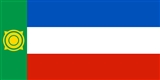
Khakassia

Encyclopedia
The Republic of Khakassia ' onMouseout='HidePop("77584")' href="/topics/Khakas_language">Khakass
: ) or Khakasiya is a federal subject
of Russia
(a republic
) located in south-central Siberia
. Its capital
city is Abakan
, which is also the largest city in the republic. Population:
Khakas
is a Turkic language with co-official status in the republic.
In 2007, the republic recorded a positive natural increase of population for the first time in many years (Although very small, less than +0.01% per year), being one of the 20 Russian regions to have a positive natural population growth rate. http://demoscope.ru/weekly/2008/0323/barom01.php http://demoscope.ru/weekly/2008/0323/barom02.php
According to the 2002 Russian Census, ethnic Russians
make up 80.3% of the republic's population, while ethnic Khakas
are only 12.0%. Other groups include ethnic German
s (1.7%), Ukrainians
(1.5%), Tatars
(0.7%), and a host of smaller groups, each accounting for less than 0.5% of the total population.
, the majority of the Kyrgyz people migrated southwest to their current homeland in Central Asia (Kyrgyzstan
). Modern Khakassians regard themselves as the descendants of those Kyrgyz who remained in Siberia
. Khakassia was incorporated into the Russian state in 1707. In 1727 this was confirmed in a treaty between Russia and China. Tsarist policy was to deport convicted criminals from European Russia to Siberia and prisons were quickly constructed in Khakassia (1707 and 1718). Many prisoners stayed in the area on their release. Many of the indigenous Khakassian people converted to the Russian Orthodox church and were gradually forced to abandon their nomadic way of life. By the time of the Russian Revolution Russians made up approximately half of the population. Under Soviet
rule autonomy was granted on 10 October 1930. During the 1920s and 1930s the Soviet authorities resettled an estimated quarter of a million Russians in the region. These were followed by 10,000 Volga Germans deported in World War II
. By the time of the 1959 census ethnic Khakassians represented little more than one in ten of the population. Khakassia was given full autonomous republic status in 1991.
Khakas language
Khakas is a Turkic language spoken by the Khakas people, who mainly live in the southern Siberian Khakas Republic, or Khakassia, in Russia...
: ) or Khakasiya is a federal subject
Federal subjects of Russia
Russia is a federation which, since March 1, 2008, consists of 83 federal subjects . In 1993, when the Constitution was adopted, there were 89 federal subjects listed...
of Russia
Russia
Russia or , officially known as both Russia and the Russian Federation , is a country in northern Eurasia. It is a federal semi-presidential republic, comprising 83 federal subjects...
(a republic
Republics of Russia
The Russian Federation is divided into 83 federal subjects , 21 of which are republics. The republics represent areas of non-Russian ethnicity. The indigenous ethnic group of a republic that gives it its name is referred to as the "titular nationality"...
) located in south-central Siberia
Siberia
Siberia is an extensive region constituting almost all of Northern Asia. Comprising the central and eastern portion of the Russian Federation, it was part of the Soviet Union from its beginning, as its predecessor states, the Tsardom of Russia and the Russian Empire, conquered it during the 16th...
. Its capital
Capital City
Capital City was a television show produced by Euston Films which focused on the lives of investment bankers in London living and working on the corporate trading floor for the fictional international bank Shane-Longman....
city is Abakan
Abakan
Abakan is the capital city of the Republic of Khakassia, Russia, located in the central part of Minusinsk Depression, at the confluence of the Yenisei and Abakan Rivers. Population: -History:...
, which is also the largest city in the republic. Population:
Khakas
Khakas language
Khakas is a Turkic language spoken by the Khakas people, who mainly live in the southern Siberian Khakas Republic, or Khakassia, in Russia...
is a Turkic language with co-official status in the republic.
Demographics
- Population:
- Vital statistics
- Source: Russian Federal State Statistics Service]
| Births | Deaths | Birth rate | Death rate | |
|---|---|---|---|---|
| 1970 | 7,347 | 3,749 | 16.4 | 8.4 |
| 1975 | 9,106 | 4,485 | 19.1 | 9.4 |
| 1980 | 9,994 | 5,345 | 19.7 | 10.5 |
| 1985 | 10,382 | 5,546 | 19.2 | 10.3 |
| 1990 | 8,724 | 6,060 | 15.3 | 10.6 |
| 1991 | 8,114 | 6,195 | 14.2 | 10.8 |
| 1992 | 6,917 | 6,843 | 12.0 | 11.9 |
| 1993 | 6,152 | 8,387 | 10.7 | 14.6 |
| 1994 | 6,219 | 9,426 | 10.9 | 16.5 |
| 1995 | 5,807 | 8,186 | 10.2 | 14.3 |
| 1996 | 5,727 | 8,093 | 10.1 | 14.2 |
| 1997 | 5,309 | 7,766 | 9.4 | 13.7 |
| 1998 | 5,602 | 7,821 | 10.0 | 13.9 |
| 1999 | 5,312 | 8,304 | 9.5 | 14.8 |
| 2000 | 5,634 | 8,104 | 10.1 | 14.6 |
| 2001 | 5,576 | 8,561 | 10.1 | 15.5 |
| 2002 | 6,118 | 9,280 | 11.2 | 17.0 |
| 2003 | 6,417 | 9,660 | 11.8 | 17.8 |
| 2004 | 6,453 | 8,763 | 11.9 | 16.2 |
| 2005 | 6,198 | 9,411 | 11.5 | 17.4 |
| 2006 | 6,465 | 7,927 | 12.0 | 14.8 |
| 2007 | 7,384 | 7,324 | 13.8 | 13.6 |
| 2008 | 7,935 | 7,427 | 14.8 | 13.8 |
In 2007, the republic recorded a positive natural increase of population for the first time in many years (Although very small, less than +0.01% per year), being one of the 20 Russian regions to have a positive natural population growth rate. http://demoscope.ru/weekly/2008/0323/barom01.php http://demoscope.ru/weekly/2008/0323/barom02.php
- Ethnic groups
According to the 2002 Russian Census, ethnic Russians
Russians
The Russian people are an East Slavic ethnic group native to Russia, speaking the Russian language and primarily living in Russia and neighboring countries....
make up 80.3% of the republic's population, while ethnic Khakas
Khakas
The Khakas, or Khakass , are a Turkic-speaking people, who live in Russia, in the republic of Khakassia in southern Siberia. They speak the Khakas language.The origin of the Khakas people is disputed...
are only 12.0%. Other groups include ethnic German
Ethnic German
Ethnic Germans historically also ), also collectively referred to as the German diaspora, refers to people who are of German ethnicity. Many are not born in Europe or in the modern-day state of Germany or hold German citizenship...
s (1.7%), Ukrainians
Ukrainians
Ukrainians are an East Slavic ethnic group native to Ukraine, which is the sixth-largest nation in Europe. The Constitution of Ukraine applies the term 'Ukrainians' to all its citizens...
(1.5%), Tatars
Tatars
Tatars are a Turkic speaking ethnic group , numbering roughly 7 million.The majority of Tatars live in the Russian Federation, with a population of around 5.5 million, about 2 million of which in the republic of Tatarstan.Significant minority populations are found in Uzbekistan, Kazakhstan,...
(0.7%), and a host of smaller groups, each accounting for less than 0.5% of the total population.
| 1926 census | 1939 census | 1959 census | 1970 census | 1979 census | 1989 census | 2002 census | |
|---|---|---|---|---|---|---|---|
| Khakas | 44,219 (49.8%) | 45,799 (16.8%) | 48,512 (11.8%) | 54,750 (12.3%) | 57,281 (11.5%) | 62,859 (11.1%) | 65,421 (12.0%) |
| Russians Russians The Russian people are an East Slavic ethnic group native to Russia, speaking the Russian language and primarily living in Russia and neighboring countries.... |
41,390 (46.6%) | 205,254 (75.3%) | 314,455 (76.5%) | 349,362 (78.4%) | 395,953 (79.4%) | 450,430 (79.5%) | 438,395 (80.3%) |
| Germans Germans The Germans are a Germanic ethnic group native to Central Europe. The English term Germans has referred to the German-speaking population of the Holy Roman Empire since the Late Middle Ages.... |
46 (0.1%) | 333 (0.1%) | 10,512 (2.6%) | 10,547 (2.4%) | 11,130 (2.2%) | 11,250 (2.0%) | 9,161 (1.7%) |
| Ukrainians Ukrainians Ukrainians are an East Slavic ethnic group native to Ukraine, which is the sixth-largest nation in Europe. The Constitution of Ukraine applies the term 'Ukrainians' to all its citizens... |
836 (0.9%) | 7,788 (2.9%) | 14,630 (3.6%) | 9,480 (2.1%) | 10,398 (2.1%) | 13,223 (2.3%) | 8,360 (1.5%) |
| Others | 2,381 (2.7%) | 13,556 (5.0%) | 22,938 (5.6%) | 21,685 (4.9%) | 23,622 (4.7%) | 29,099 (5.4%) | 24,735 (4.5%) |
History
From the 6th century Khakassia was the core of the old Kyrgyz state. In the thirteenth century, following defeat by the MongolsMongols
Mongols ) are a Central-East Asian ethnic group that lives mainly in the countries of Mongolia, China, and Russia. In China, ethnic Mongols can be found mainly in the central north region of China such as Inner Mongolia...
, the majority of the Kyrgyz people migrated southwest to their current homeland in Central Asia (Kyrgyzstan
Kyrgyzstan
Kyrgyzstan , officially the Kyrgyz Republic is one of the world's six independent Turkic states . Located in Central Asia, landlocked and mountainous, Kyrgyzstan is bordered by Kazakhstan to the north, Uzbekistan to the west, Tajikistan to the southwest and China to the east...
). Modern Khakassians regard themselves as the descendants of those Kyrgyz who remained in Siberia
Siberia
Siberia is an extensive region constituting almost all of Northern Asia. Comprising the central and eastern portion of the Russian Federation, it was part of the Soviet Union from its beginning, as its predecessor states, the Tsardom of Russia and the Russian Empire, conquered it during the 16th...
. Khakassia was incorporated into the Russian state in 1707. In 1727 this was confirmed in a treaty between Russia and China. Tsarist policy was to deport convicted criminals from European Russia to Siberia and prisons were quickly constructed in Khakassia (1707 and 1718). Many prisoners stayed in the area on their release. Many of the indigenous Khakassian people converted to the Russian Orthodox church and were gradually forced to abandon their nomadic way of life. By the time of the Russian Revolution Russians made up approximately half of the population. Under Soviet
Soviet Union
The Soviet Union , officially the Union of Soviet Socialist Republics , was a constitutionally socialist state that existed in Eurasia between 1922 and 1991....
rule autonomy was granted on 10 October 1930. During the 1920s and 1930s the Soviet authorities resettled an estimated quarter of a million Russians in the region. These were followed by 10,000 Volga Germans deported in World War II
World War II
World War II, or the Second World War , was a global conflict lasting from 1939 to 1945, involving most of the world's nations—including all of the great powers—eventually forming two opposing military alliances: the Allies and the Axis...
. By the time of the 1959 census ethnic Khakassians represented little more than one in ten of the population. Khakassia was given full autonomous republic status in 1991.