

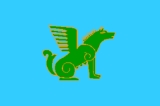
Nogais

Encyclopedia
The Nogai people are a Turkic
ethnic group in Southern Russia: northern Dagestan and Stavropol Krai
, as well as in Karachay-Cherkessia
and the Astrakhan Oblast
; undefined number live in Chechnya
. They speak the Nogai language
and are descendants of various Turkic
tribes, mainly Kipchaks
, who formed the Nogai Horde
.
coast of present-day Ukraine
):
, a general of the Golden Horde
. The Nogai Horde
supported the Astrakhan Khanate
, and after the conquest of Astrakhan in 1556 by Russians
, they transferred their allegiance to the Crimean Khanate
. The Nogais protected the northern borders of the khanate, and through organized raids to the northern steppes prevented Slavic settlement. Many Nogais migrated to the Crimean peninsula to serve as khan's cavalry. Settling there, they contributed to the formation of the Crimean Tatars
. However, Nogais were not only good soldiers, they also had considerable agricultural skills. The Nogais mastered skills of growing grain and irrigating on the dry steppes they inhabited. They cultivated spring wheat and drought resistant millet. They raised various herds and migrated seasonally in search of better pastures for their animals. Nogais were proud of their nomadic traditions and independence, which they considered superior to settled agricultural life.
At the beginning of the 17th century, the ancestors of the Kalmyks, the Oirats
, migrated from the steppes of southern Siberia on the banks of the Irtysh River to the Lower Volga region. Various reasons have been given for the move, but the generally accepted answer is that the Kalmyks sought abundant pastures for their herds. They reached the lower Volga region in or about 1630. That land, however, was not uncontested pastures, but rather the homeland of the Nogai Horde. The Kalmyks expelled the Nogais who fled to the northern Caucasian
plains and to the Crimean Khanate, areas under the control of the Ottoman Empire
. Some Nogai groups sought the protection of the Russian garrison at Astrakhan
. The remaining nomadic Turkic tribes became vassals of Kalmyk Khan. After the Russian annexation of Crimea
, the Nogai pastoral land was occupied by the Slavic settlers, since the Nogais did not have permanent residence. In the 1770s and 1780s Catherine the Great resettled approximately 120,000 Nogais from Bessarabia
and areas northeast of the Sea of Azov
to the Kuban and the Caucasus. In 1790, during the Russo-Turkish war, Prince Gregory Potemkin again ordered the resettlement of some Nogai families from the Caucasus, where he feared they might defect to the Ottoman Turks, to the north shore of the Sea of Azov.
Through the 1792 Treaty of Jassy
(Iaşi) the Russian frontier was extended to the Dniester River and the takeover of Yedisan
was complete. The 1812 Treaty of Bucharest
transferred Budjak
to Russian control.
After confiscating the land previously belonged to Nogais, the Russian government forced Nogais to settle through various methods, such as burning their tents and limiting their freedom of movement. The Russian General Suvorov slaughtered several thousands of rebellious Kuban Nogais in 1783. Several Nogai tribes took refugee
among the Circassians in this period. Several other Nogai clans began to immigrate to the Ottoman Empire in great numbers. The Nogais followed two routes. An estimated 7,000 Nogais of the Bucak and Cedsan Hordes settled in Dobruja
before 1860. Most of these Nogais later re-migrated to Anatolia. However, the great exodus of the Nogais took place in 1860. Many clans from Camboyluk and Kuban Hordes moved westwards to southern Ukraine, and wintered with their co-ethnics there in 1859. They emigrated either through Feodosia or Kerch ports or crossing via Buçak steppes to Dobruja. 50,000 of the roughly 70,000 Nogais of the Kuban and adjacent Stavropol region left Russia for the Ottoman Empire at this period. They induced the Nogais of Crimea
(who lived in the districts of Yevpatoria, Perekop
and in the north of Simferopol
) and southern Ukraine for emigration too. 300,000 Crimean Tatars (which included the Nogais) left Crimea in the year 1860. Similarly, 50,000 Nogais disappeared from southern Ukraine by 1861. Other Nogai clans emigrated directly from Caucasus to Anatolia, together with the Circassians (see Muhajir (Caucasus)
).
Nogais lived alongside German Mennonite
s in the Molochna region of southern Ukraine from 1803, when Mennonites first arrived, until 1860, when the Nogais departed.
, and Stavropol district
. In Daghestan, they concentrated in the Khasavyurt region. Without legal recognition, the Nogais of North Caucasus are under the danger of assimilation to neighbouring Russian, Circassian and Kumuk people. The Kara-Nogays continued as nomad
s until the establishment of Soviet power.
A few thousand Nogais live in Dobruja
(today in Romania
), in the town of Mihail Kogălniceanu
(Karamurat) and villages of Lumina
(Kocali), Valea Dacilor
(Hendekkarakuyusu), Cobadin
(Kubadin).
An estimated 90,000 Nogais live in Turkey today, mainly settled in Ceyhan/Adana, Ankara and Eskisehir provinces. The Nogai language is still spoken in some of the villages of Central Anatolia - mainly around the Salt Lake, Eskişehir and Ceyhan. To this day, Nogais in Turkey have maintained their cuisine: Üken börek, kasık börek, tabak börek, şır börek, köbete and Nogay şay (Nogai tea - a drink prepared by boiling milk and tea together with butter, salt and pepper).
Some Nogais are also living in Amman
, Jordan
, mainly in an agriculture area called Wadi El Sir. They immigrated from Turkey
to Wadi El Sir during the Ottoman
era to support the Turkish army in the late 19th century. The Jordanian Nogais now communicate in Arabic, since Arabic was adopted as the official language of Jordan instead of Turkish. Jordanian Nogais mixed with Arab Jordanians and became part of the society.
The Junior Jüz
, or the Lesser Horde of the Kazakhs
, occupied the lands of the former Nogai Khanate in Western Kazakhstan
. They originate from the Nogais.
Turkic peoples
The Turkic peoples are peoples residing in northern, central and western Asia, southern Siberia and northwestern China and parts of eastern Europe. They speak languages belonging to the Turkic language family. They share, to varying degrees, certain cultural traits and historical backgrounds...
ethnic group in Southern Russia: northern Dagestan and Stavropol Krai
Stavropol Krai
Stavropol Krai is a federal subject of Russia . Its administrative center is the city of Stavropol. Population: -Geography:Stavropol Krai encompasses the central part of the Fore-Caucasus and most of the northern slopes of Caucasus Major...
, as well as in Karachay-Cherkessia
Karachay-Cherkessia
The Karachay-Cherkess Republic , or Karachay-Cherkessia is a federal subject of Russia . Population: -Geography:*Area: *Borders:**internal: Krasnodar Krai , Kabardino-Balkar Republic , Stavropol Krai ....
and the Astrakhan Oblast
Astrakhan Oblast
Astrakhan Oblast is a federal subject of Russia . Its administrative center is the city of Astrakhan.-Demographics:Population: Ethnic groups...
; undefined number live in Chechnya
Chechnya
The Chechen Republic , commonly referred to as Chechnya , also spelled Chechnia or Chechenia, sometimes referred to as Ichkeria , is a federal subject of Russia . It is located in the southeastern part of Europe in the Northern Caucasus mountains. The capital of the republic is the city of Grozny...
. They speak the Nogai language
Nogai language
Nogai , is a Turkic language spoken in southwestern Russia. Three distinct dialects are recognized: Qara-Nogay , spoken in Dagestan; Nogai Proper, in Stavropol; and Aqnogay , by the Kuban River, its tributaries in Karachay-Cherkessia, and in the Mineralnye Vody District...
and are descendants of various Turkic
Turkic peoples
The Turkic peoples are peoples residing in northern, central and western Asia, southern Siberia and northwestern China and parts of eastern Europe. They speak languages belonging to the Turkic language family. They share, to varying degrees, certain cultural traits and historical backgrounds...
tribes, mainly Kipchaks
Kipchaks
Kipchaks were a Turkic tribal confederation...
, who formed the Nogai Horde
Nogai Horde
The Nogai Horde was a confederation of about eighteen Turkic and Mongol tribes that occupied the Pontic-Caspian steppe from about 1500 until they were pushed west by the Kalmyks and south by the Russians in the 17th century. The Mongol tribe called the Manghits constituted a core of the Horde...
.
Nogai divisions
From the sixteenth century until their removal in the mid-nineteenth century the Nogais were divided into the following sub-groups (west to east along the Black SeaBlack Sea
The Black Sea is bounded by Europe, Anatolia and the Caucasus and is ultimately connected to the Atlantic Ocean via the Mediterranean and the Aegean seas and various straits. The Bosphorus strait connects it to the Sea of Marmara, and the strait of the Dardanelles connects that sea to the Aegean...
coast of present-day Ukraine
Ukraine
Ukraine is a country in Eastern Europe. It has an area of 603,628 km², making it the second largest contiguous country on the European continent, after Russia...
):
- BucakBudjakBudjak or Budzhak is a historical region in the Odessa Oblast of Ukraine. Lying along the Black Sea between the Danube and Dniester rivers this multiethnic region was the southern part of Bessarabia...
Nogais inhabited the area from DanubeDanubeThe Danube is a river in the Central Europe and the Europe's second longest river after the Volga. It is classified as an international waterway....
to DniesterDniesterThe Dniester is a river in Eastern Europe. It runs through Ukraine and Moldova and separates most of Moldova's territory from the breakaway de facto state of Transnistria.-Names:...
. - CedsanYedisanYedisan is a historical region in modern southwestern Ukraine and southeastern Moldova . The region lies to the north of the Black Sea between the Dniester and Dnieper rivers...
(Jedsan) Nogais inhabited the land from Dniester to BugSouthern BugThe Southern Bug, also called Southern Buh), is a river located in Ukraine. The source of the river is in the west of Ukraine, in the Volyn-Podillia Upland, about 145 km from the Polish border, and flows southeasterly into the Bug Estuary through the southern steppes...
. - Camboyluk(Jamboyluk)/Camboj Loke(people) Nogais inhabited in the lands from Bug to the beginning of CrimeaCrimeaCrimea , or the Autonomous Republic of Crimea , is a sub-national unit, an autonomous republic, of Ukraine. It is located on the northern coast of the Black Sea, occupying a peninsula of the same name...
n peninsula. - Cedişkul (Jedishkul) Nogais inhabited the north of Crimean peninsula.
- KubanKubanKuban is a geographic region of Southern Russia surrounding the Kuban River, on the Black Sea between the Don Steppe, Volga Delta and the Caucasus...
Nogais inhabited the north of Sea of Azov around PrymorskPrymorskPrymorsk is a city in Zaporizhia Oblast, Ukraine. Population is 12,973 . Until 1964 the town was known as Nogaisk after the Turkic Nogai people who lived in the area until the nineteenth century....
(previously Nogaisk).
History
The name Nogai is derived from Nogai KhanNogai Khan
Nogai , also called Isa Nogai, was a general and de facto ruler of the Golden Horde and a great-great-grandson of Genghis Khan. His grandfather was Baul/Teval Khan, the 7th son of Jochi...
, a general of the Golden Horde
Golden Horde
The Golden Horde was a Mongol and later Turkicized khanate that formed the north-western sector of the Mongol Empire...
. The Nogai Horde
Nogai Horde
The Nogai Horde was a confederation of about eighteen Turkic and Mongol tribes that occupied the Pontic-Caspian steppe from about 1500 until they were pushed west by the Kalmyks and south by the Russians in the 17th century. The Mongol tribe called the Manghits constituted a core of the Horde...
supported the Astrakhan Khanate
Astrakhan Khanate
The Khanate of Astrakhan was a Tatar feudal state that appeared after the collapse of the Golden Horde. The Khanate existed in the 15th and 16th centuries in the area adjacent to the mouth of the Volga river, where the contemporary city of Astrakhan/Hajji Tarkhan is now located...
, and after the conquest of Astrakhan in 1556 by Russians
Russians
The Russian people are an East Slavic ethnic group native to Russia, speaking the Russian language and primarily living in Russia and neighboring countries....
, they transferred their allegiance to the Crimean Khanate
Crimean Khanate
Crimean Khanate, or Khanate of Crimea , was a state ruled by Crimean Tatars from 1441 to 1783. Its native name was . Its khans were the patrilineal descendants of Toqa Temür, the thirteenth son of Jochi and grandson of Genghis Khan...
. The Nogais protected the northern borders of the khanate, and through organized raids to the northern steppes prevented Slavic settlement. Many Nogais migrated to the Crimean peninsula to serve as khan's cavalry. Settling there, they contributed to the formation of the Crimean Tatars
Crimean Tatars
Crimean Tatars or Crimeans are a Turkic ethnic group that originally resided in Crimea. They speak the Crimean Tatar language...
. However, Nogais were not only good soldiers, they also had considerable agricultural skills. The Nogais mastered skills of growing grain and irrigating on the dry steppes they inhabited. They cultivated spring wheat and drought resistant millet. They raised various herds and migrated seasonally in search of better pastures for their animals. Nogais were proud of their nomadic traditions and independence, which they considered superior to settled agricultural life.
At the beginning of the 17th century, the ancestors of the Kalmyks, the Oirats
Oirats
Oirats are the westernmost group of the Mongols who unified several tribes origin whose ancestral home is in the Altai region of western Mongolia. Although the Oirats originated in the eastern parts of Central Asia, the most prominent group today is located in the Republic of Kalmykia, a federal...
, migrated from the steppes of southern Siberia on the banks of the Irtysh River to the Lower Volga region. Various reasons have been given for the move, but the generally accepted answer is that the Kalmyks sought abundant pastures for their herds. They reached the lower Volga region in or about 1630. That land, however, was not uncontested pastures, but rather the homeland of the Nogai Horde. The Kalmyks expelled the Nogais who fled to the northern Caucasian
Caucasus
The Caucasus, also Caucas or Caucasia , is a geopolitical region at the border of Europe and Asia, and situated between the Black and the Caspian sea...
plains and to the Crimean Khanate, areas under the control of the Ottoman Empire
Ottoman Empire
The Ottoman EmpireIt was usually referred to as the "Ottoman Empire", the "Turkish Empire", the "Ottoman Caliphate" or more commonly "Turkey" by its contemporaries...
. Some Nogai groups sought the protection of the Russian garrison at Astrakhan
Astrakhan
Astrakhan is a major city in southern European Russia and the administrative center of Astrakhan Oblast. The city lies on the left bank of the Volga River, close to where it discharges into the Caspian Sea at an altitude of below the sea level. Population:...
. The remaining nomadic Turkic tribes became vassals of Kalmyk Khan. After the Russian annexation of Crimea
Russo-Turkish War, 1768-1774
The Russo-Turkish War of 1768–1774 was a decisive conflict that brought Southern Ukraine, Northern Caucasus, and Crimea within the orbit of the Russian Empire.-Background:...
, the Nogai pastoral land was occupied by the Slavic settlers, since the Nogais did not have permanent residence. In the 1770s and 1780s Catherine the Great resettled approximately 120,000 Nogais from Bessarabia
Bessarabia
Bessarabia is a historical term for the geographic region in Eastern Europe bounded by the Dniester River on the east and the Prut River on the west....
and areas northeast of the Sea of Azov
Sea of Azov
The Sea of Azov , known in Classical Antiquity as Lake Maeotis, is a sea on the south of Eastern Europe. It is linked by the narrow Strait of Kerch to the Black Sea to the south and is bounded on the north by Ukraine mainland, on the east by Russia, and on the west by the Ukraine's Crimean...
to the Kuban and the Caucasus. In 1790, during the Russo-Turkish war, Prince Gregory Potemkin again ordered the resettlement of some Nogai families from the Caucasus, where he feared they might defect to the Ottoman Turks, to the north shore of the Sea of Azov.
Through the 1792 Treaty of Jassy
Treaty of Jassy
The Treaty of Jassy, signed at Jassy in Moldavia , was a pact between the Russian and Ottoman Empires ending the Russo-Turkish War of 1787–92 and confirming Russia's increasing dominance in the Black Sea....
(Iaşi) the Russian frontier was extended to the Dniester River and the takeover of Yedisan
Yedisan
Yedisan is a historical region in modern southwestern Ukraine and southeastern Moldova . The region lies to the north of the Black Sea between the Dniester and Dnieper rivers...
was complete. The 1812 Treaty of Bucharest
Treaty of Bucharest, 1812
The Treaty of Bucharest between the Ottoman Empire and the Russian Empire, was signed on 28 May 1812, in Bucharest, at the end of the Russo-Turkish War, 1806-1812....
transferred Budjak
Budjak
Budjak or Budzhak is a historical region in the Odessa Oblast of Ukraine. Lying along the Black Sea between the Danube and Dniester rivers this multiethnic region was the southern part of Bessarabia...
to Russian control.
After confiscating the land previously belonged to Nogais, the Russian government forced Nogais to settle through various methods, such as burning their tents and limiting their freedom of movement. The Russian General Suvorov slaughtered several thousands of rebellious Kuban Nogais in 1783. Several Nogai tribes took refugee
Refugee
A refugee is a person who outside her country of origin or habitual residence because she has suffered persecution on account of race, religion, nationality, political opinion, or because she is a member of a persecuted 'social group'. Such a person may be referred to as an 'asylum seeker' until...
among the Circassians in this period. Several other Nogai clans began to immigrate to the Ottoman Empire in great numbers. The Nogais followed two routes. An estimated 7,000 Nogais of the Bucak and Cedsan Hordes settled in Dobruja
Dobruja
Dobruja is a historical region shared by Bulgaria and Romania, located between the lower Danube river and the Black Sea, including the Danube Delta, Romanian coast and the northernmost part of the Bulgarian coast...
before 1860. Most of these Nogais later re-migrated to Anatolia. However, the great exodus of the Nogais took place in 1860. Many clans from Camboyluk and Kuban Hordes moved westwards to southern Ukraine, and wintered with their co-ethnics there in 1859. They emigrated either through Feodosia or Kerch ports or crossing via Buçak steppes to Dobruja. 50,000 of the roughly 70,000 Nogais of the Kuban and adjacent Stavropol region left Russia for the Ottoman Empire at this period. They induced the Nogais of Crimea
Crimea
Crimea , or the Autonomous Republic of Crimea , is a sub-national unit, an autonomous republic, of Ukraine. It is located on the northern coast of the Black Sea, occupying a peninsula of the same name...
(who lived in the districts of Yevpatoria, Perekop
Perekop
Perekop is a village located at the Perekop Isthmus connecting Crimean peninsula to the Ukrainian mainland. It is known for the Fortress Or Qapi that served as the gateway to Crimea...
and in the north of Simferopol
Simferopol
-Russian Empire and Civil War:The city was renamed Simferopol in 1784 after the annexation of the Crimean Khanate to the Russian Empire by Catherine II of Russia. The name Simferopol is derived from the Greek, Συμφερόπολις , translated as "the city of usefulness." In 1802, Simferopol became the...
) and southern Ukraine for emigration too. 300,000 Crimean Tatars (which included the Nogais) left Crimea in the year 1860. Similarly, 50,000 Nogais disappeared from southern Ukraine by 1861. Other Nogai clans emigrated directly from Caucasus to Anatolia, together with the Circassians (see Muhajir (Caucasus)
Muhajir (Caucasus)
Circassians, the indigenous peoples of the Northwest Caucasus were cleansed from their homeland at the end of the Caucasian War by victorious Russia, which by its manner of suppression of the Caucasus directed at the Crimean Tartars and Circassians can be credited with "inventing the strategy of...
).
Nogais lived alongside German Mennonite
Mennonite
The Mennonites are a group of Christian Anabaptist denominations named after the Frisian Menno Simons , who, through his writings, articulated and thereby formalized the teachings of earlier Swiss founders...
s in the Molochna region of southern Ukraine from 1803, when Mennonites first arrived, until 1860, when the Nogais departed.
Present inhabitations
In the 1990s, 65,000 were still living in the Northern Caucasus, divided into Ak (White) Nogai and Kara (Black) Nogai tribal confederations. During the Soviet period, they did not have administrative-territorial recognition, which retarded their national development. Nogais have lived within the territories of Daghestan, ChechnyaChechnya
The Chechen Republic , commonly referred to as Chechnya , also spelled Chechnia or Chechenia, sometimes referred to as Ichkeria , is a federal subject of Russia . It is located in the southeastern part of Europe in the Northern Caucasus mountains. The capital of the republic is the city of Grozny...
, and Stavropol district
Stavropol Krai
Stavropol Krai is a federal subject of Russia . Its administrative center is the city of Stavropol. Population: -Geography:Stavropol Krai encompasses the central part of the Fore-Caucasus and most of the northern slopes of Caucasus Major...
. In Daghestan, they concentrated in the Khasavyurt region. Without legal recognition, the Nogais of North Caucasus are under the danger of assimilation to neighbouring Russian, Circassian and Kumuk people. The Kara-Nogays continued as nomad
Nomad
Nomadic people , commonly known as itinerants in modern-day contexts, are communities of people who move from one place to another, rather than settling permanently in one location. There are an estimated 30-40 million nomads in the world. Many cultures have traditionally been nomadic, but...
s until the establishment of Soviet power.
A few thousand Nogais live in Dobruja
Dobruja
Dobruja is a historical region shared by Bulgaria and Romania, located between the lower Danube river and the Black Sea, including the Danube Delta, Romanian coast and the northernmost part of the Bulgarian coast...
(today in Romania
Romania
Romania is a country located at the crossroads of Central and Southeastern Europe, on the Lower Danube, within and outside the Carpathian arch, bordering on the Black Sea...
), in the town of Mihail Kogălniceanu
Mihail Kogalniceanu, Constanta
Mihail Kogălniceanu is a commune in Constanţa County, Romania, and is located 25 km northwest of Constanţa proper. The commune includes three villages:* Mihail Kogălniceanu - historical names: Kara Murat , Bulgari and Ferdinand I* Palazu Mic...
(Karamurat) and villages of Lumina
Lumina, Constanta
Lumina is a commune in Constanţa County, Romania.The commune includes three villages:* Lumina * Oituz - named after Oituz...
(Kocali), Valea Dacilor
Medgidia
-History:Archaeological findings show that Dobruja was inhabited since the Neolithic period. Starting with 46 BC the region was administered by the Roman Empire. A castrum was built in the Carasu Valley, becoming the cradle of the settlement....
(Hendekkarakuyusu), Cobadin
Cobadin
Cobadin is a commune in Constanţa County, Romania. The commune includes five villages:*Cobadin *Viişoara *Negreşti...
(Kubadin).
An estimated 90,000 Nogais live in Turkey today, mainly settled in Ceyhan/Adana, Ankara and Eskisehir provinces. The Nogai language is still spoken in some of the villages of Central Anatolia - mainly around the Salt Lake, Eskişehir and Ceyhan. To this day, Nogais in Turkey have maintained their cuisine: Üken börek, kasık börek, tabak börek, şır börek, köbete and Nogay şay (Nogai tea - a drink prepared by boiling milk and tea together with butter, salt and pepper).
Some Nogais are also living in Amman
Amman
Amman is the capital of Jordan. It is the country's political, cultural and commercial centre and one of the oldest continuously inhabited cities in the world. The Greater Amman area has a population of 2,842,629 as of 2010. The population of Amman is expected to jump from 2.8 million to almost...
, Jordan
Jordan
Jordan , officially the Hashemite Kingdom of Jordan , Al-Mamlaka al-Urduniyya al-Hashemiyya) is a kingdom on the East Bank of the River Jordan. The country borders Saudi Arabia to the east and south-east, Iraq to the north-east, Syria to the north and the West Bank and Israel to the west, sharing...
, mainly in an agriculture area called Wadi El Sir. They immigrated from Turkey
Turkey
Turkey , known officially as the Republic of Turkey , is a Eurasian country located in Western Asia and in East Thrace in Southeastern Europe...
to Wadi El Sir during the Ottoman
Ottoman Empire
The Ottoman EmpireIt was usually referred to as the "Ottoman Empire", the "Turkish Empire", the "Ottoman Caliphate" or more commonly "Turkey" by its contemporaries...
era to support the Turkish army in the late 19th century. The Jordanian Nogais now communicate in Arabic, since Arabic was adopted as the official language of Jordan instead of Turkish. Jordanian Nogais mixed with Arab Jordanians and became part of the society.
The Junior Jüz
Junior Jüz
Little jüz or Alshyns are the Western subgroup of the Kazakhs. They originate from the Nogais of the Nogai Horde, which once was placed in Western Kazakhstan, but in the 16th century it was defeated by the Kazakhs and the Russians and Nogais retreated to the Western part of their khanate, to the...
, or the Lesser Horde of the Kazakhs
Kazakhs
The Kazakhs are a Turkic people of the northern parts of Central Asia ....
, occupied the lands of the former Nogai Khanate in Western Kazakhstan
Kazakhstan
Kazakhstan , officially the Republic of Kazakhstan, is a transcontinental country in Central Asia and Eastern Europe. Ranked as the ninth largest country in the world, it is also the world's largest landlocked country; its territory of is greater than Western Europe...
. They originate from the Nogais.