

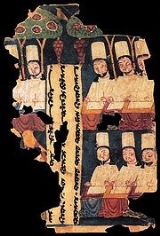
Manichaeism

Encyclopedia
Manichaeism was one of the major Iran
ian Gnostic
religion
s, originating in Sassanid Persia.
Although most of the original writings of the founding prophet
Mani
(in Persian
: مانی, Syriac: , Latin
: Manichaeus or Manes) (c. 216–276 AD) have been lost, numerous translations and fragmentary texts have survived. Manichaeism taught an elaborate cosmology
describing the struggle between a good, spiritual world of light, and an evil, material world of darkness.
Through an ongoing process which takes place in human history, light is gradually removed from the world of matter and returned to the world of light from which it came. Its beliefs can be seen as a synthesis of Christianity
, Zoroastrianism
and Buddhism
.
Manichaeism thrived between the third and seventh centuries, and at its height was one of the most widespread religions in the world. Manichaean churches and scriptures existed as far east as China
and as far west as the Roman Empire
. Manichaeism survived longer in the east, and appears to have finally faded away after the 14th century in southern China, contemporary to the decline in China of the Church of the East
– see Ming Dynasty
.
The original, but now lost, six sacred books of Manichaeism were composed in Syriac Aramaic, and translated into other languages to help spread the religion. As they spread to the east, the Manichaean writings passed through Middle Persian
, Parthian
, Sogdian
, Tocharian
and ultimately Uyghur
and Chinese
translations. As they spread to the west, they were translated into Greek
, Coptic
, and Latin
. The spread and success of Manichaeism were seen as a threat to other religions, and it was widely persecuted in Christian
, Zoroastrian
, Islam
ic, and Buddhist cultures.
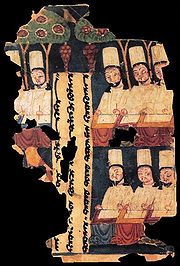
Mani
, an Arsacid Iranian by birth, lived approximately AD 216–276 and was born in Babylonia, which was then within the Sassanid Empire
province of Asuristan
. According to the Cologne Mani-Codex
, Mani's parents were members of the religious sect of Elcesaites
. The primary language of Babylon at that time was Eastern Middle Aramaic, which included three main dialects: Judeo-Aramaic
(the language of the Talmud), Mandaean Aramaic
(the language of the Mandaean religion
), and Syriac Aramaic, which was the language of Mani, as well as of the Syriac Christians
. "Mani
" is a Persian
name used in all three Aramaic dialects and therefore common among their speakers. Mani composed seven writings, six of which were written in Syriac Aramaic. The seventh, the Shabuhragan
, was written by Mani in Middle Persian
and presented by him to the contemporary King of Sassanid Persia
, Shapur I
in the Persian capital of Ctesiphon
.
Although there is no proof Shapur I
was a Manichaean, he tolerated the spread of Manicheanism and refrained from persecuting it in his empire's boundaries. According to one tradition it was Mani himself who invented the unique version of the Syriac script called Manichaean script
, which was used in all of the Manichaean works written within the Persian Empire, whether they were in Syriac or Middle Persian, and also for most of the works written within the Uyghur Empire
.
Manichaeism claimed to present the complete version of teachings that were corrupted and misinterpreted by the followers of its predecessors Adam, Zoroaster, Buddha and Jesus. Accordingly, as it spread, it adapted new deities from other religions into forms it could use for its scriptures. Its original Aramaic texts already contained stories of Jesus. When they moved eastward and were translated into Iranian languages, the names of the Manichaean deities (or angels) were often transformed into the names of Zoroastrian yazata
s. Thus ("The Father of Greatness", the highest Manichaean deity of Light), in Middle Persian
texts might either be translated literally as pīd ī wuzurgīh, or substituted with the name of the deity Zurwān
. Similarly, the Manichaean primal figure "The Original Man" was rendered "Ohrmazd Bay", after the Zoroastrian god Ahura Mazda
. This process continued in Manichaeism's meeting with Chinese Buddhism, where, for example, the original Aramaic karia (the "call" from the world of Light to those seeking rescue from the world of Darkness), becomes identified in the Chinese scriptures with Guan Yin ( or Avalokitesvara in Sanskrit, literally, "watching/perceiving sounds [of the world]", the Chinese Bodhisattva
of Compassion).
Mani began preaching at an early age and was possibly influenced by contemporary Babylonian-Aramaic movements such as Mandaeanism, and Aramaic translations of Jewish apocalyptic writings similar to those found at Qumran
(such as the book of Enoch
literature). With the discovery of the Mani-Codex, it also became clear that he was raised in a Jewish-Christian baptism sect, the Elcesaites
, and was influenced by their writings as well. According to biographies preserved by Ibn al-Nadim
and the Persian polymath al-Biruni
, he allegedly received a revelation as a youth from a spirit, whom he would later call his Twin (Aramaic Tauma (תאומא), from which is also derived the name of the apostle Thomas, the "twin"), his Syzygos (Greek for "partner", in the Cologne Mani-Codex
), his Double, his Protective Angel or 'Divine Self'. It taught him truths which he developed into a religion. His 'divine' Twin or true Self brought Mani to Self-realization
and thus he became a 'gnosticus', someone with divine knowledge and liberating insight. He claimed to be the 'Paraclete
of the Truth', as promised in the New Testament
: the Last Prophet
and Seal of the Prophets
finalizing a succession of figures including Zoroaster
, Buddha
, and Jesus
.
 Another source of Mani's scriptures was original Aramaic writings relating to the book of Enoch literature (see the Book of Enoch
and the Second Book of Enoch
), as well as an otherwise unknown section of the book of Enoch called the "Book of Giants". This book was quoted directly, and expanded on by Mani, becoming one of the original six Syriac writings of the Manichaean Church. Besides brief references by non-Manichaean authors through the centuries, no original sources of "The Book of Giants" (which is actually part six of the "Book of Enoch") were available until the 20th century.
Scattered fragments of both the original Aramaic "Book of Giants" (which were analysed and published by Józef Milik
in 1976), and of the Manichaean version of the same name (analyzed and published by W.B. Henning
in 1943) were found with the discovery in the twentieth century of the Dead Sea Scrolls
in the Judaean Desert and the Manichaean writings of the Uyghur
Manichaean kingdom in Turpan. Henning wrote in his analysis of them:
From a careful reading of the Enoch literature and the Book of Giants, alongside the description of the Manichaean myth, it becomes clear that the "Great King of Glory" of this myth (a being that sits as a guard to the world of light at the seventh of ten heavens in the Manichaean myth), is identical with the King of Glory sitting on the heavenly throne in the Enoch literature. In the Aramaic book of Enoch, in the Qumran writings in general, and in the original Syriac section of Manichaean scriptures quoted by Theodor bar-Konai, he is called "malka raba de-ikara" (the great king of glory).
Noting Mani's travels to the Kushan Empire
(several religious paintings in Bamiyan are attributed to him) at the beginning of his proselytizing career, Richard Foltz
postulates Buddhist influences in Manichaeism:
While Manichaeism was spreading, existing religions such as Christianity
and Zoroastrianism
were gaining social and political influence. Although having fewer adherents, Manichaeism won the support of many high-ranking political figures. With the assistance of the Persian Empire
, Mani began missionary expeditions. After failing to win the favour of the next generation of Persian royalty, and incurring the disapproval of the Zoroastrian clergy, Mani is reported to have died in prison awaiting execution by the Persian Emperor Bahram I
. The date of his death is estimated at AD 276–277.
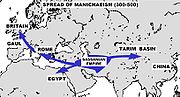 Manichaeism continued to spread with extraordinary speed through both the east and west. It reached Rome through the apostle Psattiq by AD 280, who was also in Egypt
in 244 and 251. It was flourishing in the Fayum area of Egypt in AD 290. Manichaean monasteries existed in Rome in 312 A.D. during the time of the Christian Pope Miltiades
.
In 291, persecution arose in the Persian empire with the murder of the apostle Sisin by Bahram II, and the slaughter of many Manichaeans. In AD 296, Diocletian
decreed against the Manichaeans: "We order that their organizers and leaders be subject to the final penalties and condemned to the fire with their abominable scriptures", resulting in many martyrdoms in Egypt and North Africa (see Diocletian Persecution). By AD 354, Hilary of Poitiers
wrote that the Manichaean faith was a significant force in southern France. In AD 381 Christians requested Theodosius I
to strip Manichaeans of their civil rights. He issued a decree of death for Manichaean monks in AD 382.
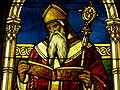 Augustine of Hippo
(AD 354-430) converted to Christianity
from Manichaeism, in the year 387. This was shortly after the Roman Emperor Theodosius I
had issued a decree of death for Manichaeans in AD 382 and shortly before he declared Christianity to be the only legitimate religion for the Roman Empire in 391. According to his Confessions
, after nine or ten years of adhering to the Manichaean faith as a member of the group of "hearers", Augustine became a Christian
and a potent adversary of Manichaeism (which he expressed in writing against his Manichaean opponent Faustus of Mileve
), seeing their beliefs that knowledge was the key to salvation as too passive and not able to effect any change in one's life.
Some modern scholars have suggested that Manichaean ways of thinking influenced the development of some of Augustine's ideas, such as the nature of good and evil, the idea of hell, the separation of groups into elect, hearers, and sinners, and the hostility to the flesh and sexual activity.
 How Manichaeism may have influenced Christianity continues to be debated. Manichaeism may have influenced the Bogomils
, Paulicians
, and Cathar
s. However, these groups left few records, and the link between them and Manichaeans is tenuous. Regardless of its accuracy the charge of Manichaeism was levelled at them by contemporary orthodox opponents, who often tried to make contemporary heresies conform to those combatted by the church fathers. Whether the dualism
of the Paulicians, Bogomils, and Cathars and their belief that the world was created by a Satanic demiurge
were due to influence from Manichaeism is impossible to determine. The Cathars apparently adopted the Manichaean principles of church organization. Priscillian
and his followers may also have been influenced by Manichaeism. The Manichaeans preserved many apocrypha
l Christian works, such as the Acts of Thomas
, that would otherwise have been lost.
Manichaeism maintained a sporadic and intermittent existence in the west (Mesopotamia
, Africa
, Spain
, France
, North Italy
, the Balkans
) for a thousand years, and flourished for a time in the land of its birth (Persia) and even further east in Northern India
, Western China, and Tibet
. While it had long been thought that Manichaeism arrived in China only at the end of the seventh century, a recent archaeological discovery demonstrated that it was already known there in the second half of the sixth century.
It was adopted by the Uyghur
ruler Khagan
Boku Tekin (AD 759–780) in 763, and remained the state religion for about a century before the collapse of the Uyghur empire
in 840. In the east it spread along trade routes as far as Chang'an
, the capital of the Tang Dynasty
in China
. In the ninth century, it is reported that the Muslim Caliph
Al-Ma'mun
tolerated a community of Manichaeans. However, al-Mahdi
persecuted the Manichaeans, establishing an inquisition to root out their "heresy", even resorting to outright massacre against them. In the Song
and Yuan
dynasties of China remnants of Manichaeanism continued to leave a legacy contributing to sects such as the Red Turbans.
. They included the Cathar
and Albigensian churches of Western Europe. Other groups sometimes referred to as "neo-Manichaean" were the Paulician movement, which arose in Armenia, and the Bogomils in Bulgaria. An example of this usage can be found in the published edition of the Latin Cathar text, the Liber de duobus principiis, (Book of the Two Principles), which was described as "Neo-Manichaean" by its publishers. As there is no presence of Manichaean mythology or church terminology in the writings of these groups, there has been some dispute among historians as to whether these groups were descendants of Manichaeism. In Hungarian Christianity, traces of Manichaeism can be found both in Catholicism and in Protestant Christianity, Manichaeian symbols are present in folk art, in Protestant churches and even on the Holy Crown.
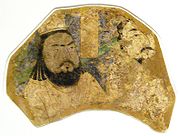 Manichaeism presented an elaborate description of the conflict between the spiritual world of light and the material world of darkness. The beings of both the world of darkness and the world of light have names. There are numerous sources for the details of the Manichaean belief. There are two portions of Manichaean scriptures that are probably the closest thing to the original Manichaean writings in their original languages that will ever be available. These are the Syriac-Aramaic quotation by the Nestorian Christian Theodore bar-Konai, in his Syriac "Book of Sects" (eighth century), and the Middle Persian sections of Mani's Shabuhragan
discovered at Turpan (a summary of Mani's teachings prepared for Shapur I
). These two sections are probably the original Syriac and Middle Persian written by Mani.
From these and other sources, it is possible to derive an almost complete description of the detailed Manichaean vision (a complete list of Manichaean deities is outlined below). According to Mani, the unfolding of the universe takes place with three "creations":
The First Creation: Originally, good and evil existed in two completely separate realms, one the World of Light, ruled by the Father of Greatness together with his five Shekhinas (divine attributes of light), and the other the World of Darkness, ruled by the King of Darkness. At a certain point, the Kingdom of Darkness notices the World of Light, becomes greedy for it and attacks it. The Father of Greatness, in the first of three "creations" (or "calls"), calls to the Mother of Life, who sends her son Original Man ( in Aramaic), to battle with the attacking powers of Darkness, which include the Demon of Greed. The Original Man is armed with five different shields of light (reflections of the five Shekhinas), which he loses to the forces of darkness in the ensuing battle, described as a kind of "bait" to trick the forces of darkness, as the forces of darkness greedily consume as much light as they can. When the Original Man comes to, he is trapped among the forces of darkness.
The Second Creation: Then the Father of Greatness begins the Second Creation, calling to the Living Spirit, who calls to his five sons, and sends a call to the Original Man (Call then becomes a Manichaean deity). An answer (Answer becomes another Manichaean deity) then returns from the Original Man to the World of Light. The Mother of Life, the Living Spirit, and his five sons begin to create the universe from the bodies of the evil beings of the World of Darkness, together with the light that they have swallowed. Ten heavens and eight earths are created, all consisting of various mixtures of the evil material beings from the World of Darkness and the swallowed light. The sun, moon, and stars are all created from light recovered from the World of Darkness. The waxing and waning of the moon is described as the moon filling with light, which passes to the sun, then through the Milky Way
, and eventually back to the World of Light.
The Third Creation: Great demons (called archons in bar-Khonai's account) are hung out over the heavens, and then the Father of Greatness begins the Third Creation. Light is recovered from out of the material bodies of the male and female evil beings and demons, by causing them to become sexually aroused in greed, towards beautiful images of the beings of light, such as the Third Messenger and the Virgins of Light. However, as soon as the light is expelled from their bodies and falls to the earth (some in the form of abortions - the source of fallen angel
s in the Manichaean myth), the evil beings continue to swallow up as much of it as they can to keep the light inside of them. This results eventually in the evil beings swallowing huge quantities of light, copulating, and producing Adam and Eve. The Father of Greatness then sends the Radiant Jesus to awaken Adam, and to enlighten him to the true source of the light that is trapped in his material body. Adam and Eve, however, eventually copulate, and produce more human beings, trapping the light in bodies of mankind throughout human history. The appearance of the Prophet Mani was another attempt by the World of Light to reveal to mankind the true source of the spiritual light imprisoned within their material bodies.
, or the Persian and Chinese translations found as Manichaeism spread eastward. While the original Syriac retained the original description which Mani created, the transformation of the deities through other languages and cultures produced incarnations of the deities not implied in the original Syriac writings. This process began in Mani's lifetime, with "The Father of Greatness", for example, being translated into Middle Persian as Zurvan
, a Zoroastrian supreme being.
view of good and evil. A key belief in Manichaeism is that the powerful, though not omnipotent good power (God) was opposed by the semi-eternal evil power (Satan). This addresses a theoretical part of the problem of evil
by denying the omnipotence of God and postulating two opposite powers. Humanity, the world and the soul are seen as the byproduct of the battle between God's proxy, Primal Man, and Satan. The human person is seen as a battleground for these powers: the soul defines the person, but it is under the influence of both light
and dark
. This contention plays out over the world as well as the human body—neither the Earth nor the flesh were seen as intrinsically evil, but rather possessed portions of both light
and dark
. Natural phenomena (such as rain) were seen as the physical manifestation of this spiritual contention. Therefore, the Manichaean worldview explained the existence of evil with a flawed creation God took no role in forming and was the result of Satan striking out against God.
While it is often presumed that the Bema seat was empty, there is some evidence from the Coptic Manichaean Bema Psalms, that the Bema seat may have actually contained a copy of Mani's picture book, the Arzhang
.
The original six Syriac writings are not preserved, although their Syriac names have been. There are also fragments and quotations from them. A long quotation, preserved by the eighth-century Nestorian Christian author Theodore Bar Konai
, shows that in the original Syriac Aramaic writings of Mani there was no influence of Iranian or Zoroastrian terms. The terms for the Manichaean deities in the original Syriac writings are in Aramaic. The adaptation of Manichaeism to the Zoroastrian religion appears to have begun in Mani's lifetime however, with his writing of the Middle Persian Shabuhragan
, his book dedicated to the King Shapuhr. In it, there are mentions of Zoroastrian deities such as Ohrmazd, Ahriman, and Az. Manichaeism is often presented as a Persian religion, mostly due to the vast number of Middle Persian, Parthian, and Soghdian (as well as Turkish) texts discovered by German researchers near Turpan, in the Xinjiang
(Chinese Turkestan) province of China, during the early 1900s. However, from the vantage point of its original Syriac descriptions (as quoted by Theodore bar Khonai and outlined below), Manichaeism may be better described as a unique phenomenon of Aramaic Babylonia, occurring in proximity to two other new Aramaic religious phenomena, Talmudic Judaism
and Babylonian Mandaeism
, which were also appearing in Babylonia in roughly the third century AD.
, and eventually the Uyghur kingdom of Turpan (destroyed around 1335), long hymn cycles and prayers were composed in Middle Persian and Parthian. A translation of one of these produced the Manichaean Chinese Hymnscroll (the 摩尼教下部贊, which Lieu translates as "Hymns for the Lower Section [i.e. the Hearers] of the Manichaean Religion"), now available in its entirety (see the external links section).
, writing in the 18th century, to create a comprehensive work on Manichaeism, relying solely on anti-Manichaean sources. Thus quotations and descriptions in Greek and Arabic have long been known to scholars, as have the long quotations in Latin by Saint Augustine, and the extremely important quotation in Syriac by Theodor bar-Khonai.
A. A. Bevan, who quoted this story, commented that it 'has no claim to be considered historical.'
According to Hegemonius
' portrayal of Mani, the devil god which created the world was the Jewish Jehovah. Hegemonius reports that Mani said, "It is the Prince of Darkness who spoke with Moses, the Jews and their priests. Thus the Christians, the Jews, and the Pagans are involved in the same error when they worship this God. For he leads them astray in the lusts he taught them." He goes on to state: "Now, he who spoke with Moses, the Jews, and the priests he says is the archont of Darkness, and the Christians, Jews, and pagans (ethnic) are one and the same, as they revere the same god. For in his aspirations he seduces them, as he is not the god of truth. And so therefore all those who put their hope in the god who spoke with Moses and the prophets have (this in store for themselves, namely) to be bound with him, because they did not put their hope in the god of truth. For that one spoke with them (only) according to their own aspirations."
in Berlin. While the vast majority of these writings were written in a version of the Syriac script known as Manichaean script
, the German researchers, perhaps for lack of suitable fonts, published most of them using Hebrew letters (which could easily be substituted for the 22 Syriac letters).
Perhaps the most comprehensive of these publications was Manichaeische Dogmatik aus chinesischen und iranischen Texten (Manichaean Dogma from Chinese and Iranian texts), by Waldschmidt and Lentz, published in Berlin in 1933. More than any other research work published before or since, this work printed, and then discussed, the original key Manichaean texts in the original scripts, and consists chiefly of sections from Chinese texts, and Middle Persian and Parthian texts transcribed with Hebrew letters. (After the Nazi party gained power in Germany, the Manichaean writings continued to be published during the 1930s, but the publishers no longer used Hebrew letters, instead transliterating the texts into Latin letters.)
was found and became known through antique dealers in Cairo
. It was purchased by the University of Cologne
in 1969. Two of its scientists, Henrichs and Koenen, produced the first edition known since as the Cologne Mani-Codex
, which was published in four articles in the Zeitschrift für Papyrologie und Epigraphik. The ancient papyrus
manuscript contained a Greek
text describing the life of Mani. Thanks to this discovery, much more is known about the man who founded one of the most influential world religions of the past.
referred to the Anti-Semitic
world view as "a form of Manichaeism", since "it explains the course of the world by the struggle of the principle of Good with the principle of Evil" (the "principle of Evil" being equated, by an Anti-Semitic person, with the Jews). Similarly, Zbigniew Brzezinski
used the phrase "Manichaean paranoia" in reference to U.S. President George W. Bush
's world view (in the The Daily Show with Jon Stewart, March 14, 2007); Brzesinski elaborated that he meant "the notion that he (Bush) is leading the forces of good against the empire of evil".
Gnostic and early Christian
Persian Religions
Other
Iran
Iran , officially the Islamic Republic of Iran , is a country in Southern and Western Asia. The name "Iran" has been in use natively since the Sassanian era and came into use internationally in 1935, before which the country was known to the Western world as Persia...
ian Gnostic
Gnosticism
Gnosticism is a scholarly term for a set of religious beliefs and spiritual practices common to early Christianity, Hellenistic Judaism, Greco-Roman mystery religions, Zoroastrianism , and Neoplatonism.A common characteristic of some of these groups was the teaching that the realisation of Gnosis...
religion
Religion
Religion is a collection of cultural systems, belief systems, and worldviews that establishes symbols that relate humanity to spirituality and, sometimes, to moral values. Many religions have narratives, symbols, traditions and sacred histories that are intended to give meaning to life or to...
s, originating in Sassanid Persia.
Although most of the original writings of the founding prophet
Prophet
In religion, a prophet, from the Greek word προφήτης profitis meaning "foreteller", is an individual who is claimed to have been contacted by the supernatural or the divine, and serves as an intermediary with humanity, delivering this newfound knowledge from the supernatural entity to other people...
Mani
Mani (prophet)
Mani , of Iranian origin was the prophet and the founder of Manichaeism, a gnostic religion of Late Antiquity which was once widespread but is now extinct...
(in Persian
Persian language
Persian is an Iranian language within the Indo-Iranian branch of the Indo-European languages. It is primarily spoken in Iran, Afghanistan, Tajikistan and countries which historically came under Persian influence...
: مانی, Syriac: , Latin
Latin
Latin is an Italic language originally spoken in Latium and Ancient Rome. It, along with most European languages, is a descendant of the ancient Proto-Indo-European language. Although it is considered a dead language, a number of scholars and members of the Christian clergy speak it fluently, and...
: Manichaeus or Manes) (c. 216–276 AD) have been lost, numerous translations and fragmentary texts have survived. Manichaeism taught an elaborate cosmology
Cosmology
Cosmology is the discipline that deals with the nature of the Universe as a whole. Cosmologists seek to understand the origin, evolution, structure, and ultimate fate of the Universe at large, as well as the natural laws that keep it in order...
describing the struggle between a good, spiritual world of light, and an evil, material world of darkness.
Through an ongoing process which takes place in human history, light is gradually removed from the world of matter and returned to the world of light from which it came. Its beliefs can be seen as a synthesis of Christianity
Christianity
Christianity is a monotheistic religion based on the life and teachings of Jesus as presented in canonical gospels and other New Testament writings...
, Zoroastrianism
Zoroastrianism
Zoroastrianism is a religion and philosophy based on the teachings of prophet Zoroaster and was formerly among the world's largest religions. It was probably founded some time before the 6th century BCE in Greater Iran.In Zoroastrianism, the Creator Ahura Mazda is all good, and no evil...
and Buddhism
Buddhism
Buddhism is a religion and philosophy encompassing a variety of traditions, beliefs and practices, largely based on teachings attributed to Siddhartha Gautama, commonly known as the Buddha . The Buddha lived and taught in the northeastern Indian subcontinent some time between the 6th and 4th...
.
Manichaeism thrived between the third and seventh centuries, and at its height was one of the most widespread religions in the world. Manichaean churches and scriptures existed as far east as China
China
Chinese civilization may refer to:* China for more general discussion of the country.* Chinese culture* Greater China, the transnational community of ethnic Chinese.* History of China* Sinosphere, the area historically affected by Chinese culture...
and as far west as the Roman Empire
Roman Empire
The Roman Empire was the post-Republican period of the ancient Roman civilization, characterised by an autocratic form of government and large territorial holdings in Europe and around the Mediterranean....
. Manichaeism survived longer in the east, and appears to have finally faded away after the 14th century in southern China, contemporary to the decline in China of the Church of the East
Church of the East
The Church of the East tāʾ d-Maḏnḥāʾ), also known as the Nestorian Church, is a Christian church, part of the Syriac tradition of Eastern Christianity. Originally the church of the Persian Sassanid Empire, it quickly spread widely through Asia...
– see Ming Dynasty
Ming Dynasty
The Ming Dynasty, also Empire of the Great Ming, was the ruling dynasty of China from 1368 to 1644, following the collapse of the Mongol-led Yuan Dynasty. The Ming, "one of the greatest eras of orderly government and social stability in human history", was the last dynasty in China ruled by ethnic...
.
The original, but now lost, six sacred books of Manichaeism were composed in Syriac Aramaic, and translated into other languages to help spread the religion. As they spread to the east, the Manichaean writings passed through Middle Persian
Middle Persian
Middle Persian , indigenously known as "Pârsig" sometimes referred to as Pahlavi or Pehlevi, is the Middle Iranian language/ethnolect of Southwestern Iran that during Sassanid times became a prestige dialect and so came to be spoken in other regions as well. Middle Persian is classified as a...
, Parthian
Parthian language
The Parthian language, also known as Arsacid Pahlavi and Pahlavanik, is a now-extinct ancient Northwestern Iranian language spoken in Parthia, a region of northeastern ancient Persia during the rule of the Parthian empire....
, Sogdian
Sogdian language
The Sogdian language is a Middle Iranian language that was spoken in Sogdiana , located in modern day Uzbekistan and Tajikistan ....
, Tocharian
Tocharian languages
Tocharian or Tokharian is an extinct branch of the Indo-European language family. The name is taken from the people known to the Greeks as the Tocharians . These are sometimes identified with the Yuezhi and the Kushans. The term Tokharistan usually refers to 1st millennium Bactria, which the...
and ultimately Uyghur
Uyghur language
Uyghur , formerly known as Eastern Turk, is a Turkic language with 8 to 11 million speakers, spoken primarily by the Uyghur people in the Xinjiang Uyghur Autonomous Region of Western China. Significant communities of Uyghur-speakers are located in Kazakhstan and Uzbekistan, and various other...
and Chinese
Chinese language
The Chinese language is a language or language family consisting of varieties which are mutually intelligible to varying degrees. Originally the indigenous languages spoken by the Han Chinese in China, it forms one of the branches of Sino-Tibetan family of languages...
translations. As they spread to the west, they were translated into Greek
Greek language
Greek is an independent branch of the Indo-European family of languages. Native to the southern Balkans, it has the longest documented history of any Indo-European language, spanning 34 centuries of written records. Its writing system has been the Greek alphabet for the majority of its history;...
, Coptic
Coptic language
Coptic or Coptic Egyptian is the current stage of the Egyptian language, a northern Afro-Asiatic language spoken in Egypt until at least the 17th century. Egyptian began to be written using the Greek alphabet in the 1st century...
, and Latin
Latin
Latin is an Italic language originally spoken in Latium and Ancient Rome. It, along with most European languages, is a descendant of the ancient Proto-Indo-European language. Although it is considered a dead language, a number of scholars and members of the Christian clergy speak it fluently, and...
. The spread and success of Manichaeism were seen as a threat to other religions, and it was widely persecuted in Christian
Christianity
Christianity is a monotheistic religion based on the life and teachings of Jesus as presented in canonical gospels and other New Testament writings...
, Zoroastrian
Zoroastrianism
Zoroastrianism is a religion and philosophy based on the teachings of prophet Zoroaster and was formerly among the world's largest religions. It was probably founded some time before the 6th century BCE in Greater Iran.In Zoroastrianism, the Creator Ahura Mazda is all good, and no evil...
, Islam
Islam
Islam . The most common are and . : Arabic pronunciation varies regionally. The first vowel ranges from ~~. The second vowel ranges from ~~~...
ic, and Buddhist cultures.
Life of Mani
Mani
Mani (prophet)
Mani , of Iranian origin was the prophet and the founder of Manichaeism, a gnostic religion of Late Antiquity which was once widespread but is now extinct...
, an Arsacid Iranian by birth, lived approximately AD 216–276 and was born in Babylonia, which was then within the Sassanid Empire
Sassanid Empire
The Sassanid Empire , known to its inhabitants as Ērānshahr and Ērān in Middle Persian and resulting in the New Persian terms Iranshahr and Iran , was the last pre-Islamic Persian Empire, ruled by the Sasanian Dynasty from 224 to 651...
province of Asuristan
Asuristan
Asuristan was the province of Assyria under the Sassanid Empire . It corresponds to the Babylonia province under the Parthian Empire.The province for the most part stretched from Mosul to Adiabene....
. According to the Cologne Mani-Codex
Cologne Mani-Codex
The Cologne Mani-Codex is a minute papyrus codex, dated on paleographical evidence to the fifth century CE, found near Asyut , Egypt; it contains a Greek text describing the life of Mani, the founder of the religious Manichaeism...
, Mani's parents were members of the religious sect of Elcesaites
Elcesaites
The Elcesaites, Elkasaites, Elkesaites, or Elchasaites were an ancient Jewish-Christian sect, possibly related to the Ebionites, in Sassanid southern Mesopotamia.Some early scholars differentiate Ebionites from Essenic Ebionite-Elchasites...
. The primary language of Babylon at that time was Eastern Middle Aramaic, which included three main dialects: Judeo-Aramaic
Jewish Babylonian Aramaic
Jewish Babylonian Aramaic was the form of Middle Aramaic employed by Jewish writers in Babylonia between the 4th century and the 11th century CE. It is most commonly identified with the language of the Babylonian Talmud and of post-Talmudic literature, which are the most important cultural...
(the language of the Talmud), Mandaean Aramaic
Mandaic language
The Mandaic language is the language of the Mandaean religion. Classical Mandaic is used by a section of the Mandaean community in liturgical rites....
(the language of the Mandaean religion
Mandaeism
Mandaeism or Mandaeanism is a Gnostic religion with a strongly dualistic worldview. Its adherents, the Mandaeans, revere Adam, Abel, Seth, Enosh, Noah, Shem, Aram and especially John the Baptist...
), and Syriac Aramaic, which was the language of Mani, as well as of the Syriac Christians
Syriac Christianity
Syriac or Syrian Christianity , the Syriac-speaking Christians of Mesopotamia, comprises multiple Christian traditions of Eastern Christianity. With a history going back to the 1st Century AD, in modern times it is represented by denominations primarily in the Middle East and in Kerala, India....
. "Mani
Mani (name)
Mani , is a common proper name in South Asia. It is most common in Pakistan and India.-Given name:*Mani Madhava Chakyar, performer and Sanskrit scholar*Mani Ratnam, Tamil Indian film director, producer, and writer-Surname:...
" is a Persian
Persian people
The Persian people are part of the Iranian peoples who speak the modern Persian language and closely akin Iranian dialects and languages. The origin of the ethnic Iranian/Persian peoples are traced to the Ancient Iranian peoples, who were part of the ancient Indo-Iranians and themselves part of...
name used in all three Aramaic dialects and therefore common among their speakers. Mani composed seven writings, six of which were written in Syriac Aramaic. The seventh, the Shabuhragan
Shabuhragan
The Shabuhragan , which means the book of Shapur, was a sacred book of the Manichaean religion, written by the founder Mani himself, originally in Middle Persian, and dedicated to Shapur I , the contemporary king of the Sassanid Persian Empire...
, was written by Mani in Middle Persian
Middle Persian
Middle Persian , indigenously known as "Pârsig" sometimes referred to as Pahlavi or Pehlevi, is the Middle Iranian language/ethnolect of Southwestern Iran that during Sassanid times became a prestige dialect and so came to be spoken in other regions as well. Middle Persian is classified as a...
and presented by him to the contemporary King of Sassanid Persia
Sassanid Empire
The Sassanid Empire , known to its inhabitants as Ērānshahr and Ērān in Middle Persian and resulting in the New Persian terms Iranshahr and Iran , was the last pre-Islamic Persian Empire, ruled by the Sasanian Dynasty from 224 to 651...
, Shapur I
Shapur I
Shapur I or also known as Shapur I the Great was the second Sassanid King of the Second Persian Empire. The dates of his reign are commonly given as 240/42 - 270/72, but it is likely that he also reigned as co-regent prior to his father's death in 242 .-Early years:Shapur was the son of Ardashir I...
in the Persian capital of Ctesiphon
Ctesiphon
Ctesiphon, the imperial capital of the Parthian Arsacids and of the Persian Sassanids, was one of the great cities of ancient Mesopotamia.The ruins of the city are located on the east bank of the Tigris, across the river from the Hellenistic city of Seleucia...
.
Although there is no proof Shapur I
Shapur I
Shapur I or also known as Shapur I the Great was the second Sassanid King of the Second Persian Empire. The dates of his reign are commonly given as 240/42 - 270/72, but it is likely that he also reigned as co-regent prior to his father's death in 242 .-Early years:Shapur was the son of Ardashir I...
was a Manichaean, he tolerated the spread of Manicheanism and refrained from persecuting it in his empire's boundaries. According to one tradition it was Mani himself who invented the unique version of the Syriac script called Manichaean script
Manichaean script
Manichaean script is a sibling of an early form of Pahlavi script, and like Pahlavi is a development from Imperial Aramaic, the official language and script of the Achaemenid court. Unlike Pahlavi, Manichaean script reveals influences from Sogdian script, which in turn descends from the Syriac...
, which was used in all of the Manichaean works written within the Persian Empire, whether they were in Syriac or Middle Persian, and also for most of the works written within the Uyghur Empire
Uyghur Empire
The Uyghur Khaganate, or, Uyghur Empire or Uighur Khaganate or Toquz Oghuz Country was a Turkic empire that existed for about a century between the mid 8th and 9th centuries...
.
Manichaeism claimed to present the complete version of teachings that were corrupted and misinterpreted by the followers of its predecessors Adam, Zoroaster, Buddha and Jesus. Accordingly, as it spread, it adapted new deities from other religions into forms it could use for its scriptures. Its original Aramaic texts already contained stories of Jesus. When they moved eastward and were translated into Iranian languages, the names of the Manichaean deities (or angels) were often transformed into the names of Zoroastrian yazata
Yazata
Yazata is the Avestan language word for a Zoroastrian concept. The word has a wide range of meanings but generally signifies a divinity...
s. Thus ("The Father of Greatness", the highest Manichaean deity of Light), in Middle Persian
Middle Persian
Middle Persian , indigenously known as "Pârsig" sometimes referred to as Pahlavi or Pehlevi, is the Middle Iranian language/ethnolect of Southwestern Iran that during Sassanid times became a prestige dialect and so came to be spoken in other regions as well. Middle Persian is classified as a...
texts might either be translated literally as pīd ī wuzurgīh, or substituted with the name of the deity Zurwān
Zurvan
Zurvan may be:*Middle Persian reflex of Avestan zruvan "time"**"Time", the transcendent deity in Zurvanism** Zarvan , the personification of Time in the Shahnamehtoponymy*Zurvan , a village in Larestan County, Fars, Iran....
. Similarly, the Manichaean primal figure "The Original Man" was rendered "Ohrmazd Bay", after the Zoroastrian god Ahura Mazda
Ahura Mazda
Ahura Mazdā is the Avestan name for a divinity of the Old Iranian religion who was proclaimed the uncreated God by Zoroaster, the founder of Zoroastrianism...
. This process continued in Manichaeism's meeting with Chinese Buddhism, where, for example, the original Aramaic karia (the "call" from the world of Light to those seeking rescue from the world of Darkness), becomes identified in the Chinese scriptures with Guan Yin ( or Avalokitesvara in Sanskrit, literally, "watching/perceiving sounds [of the world]", the Chinese Bodhisattva
Bodhisattva
In Buddhism, a bodhisattva is either an enlightened existence or an enlightenment-being or, given the variant Sanskrit spelling satva rather than sattva, "heroic-minded one for enlightenment ." The Pali term has sometimes been translated as "wisdom-being," although in modern publications, and...
of Compassion).
Mani began preaching at an early age and was possibly influenced by contemporary Babylonian-Aramaic movements such as Mandaeanism, and Aramaic translations of Jewish apocalyptic writings similar to those found at Qumran
Qumran
Qumran is an archaeological site in the West Bank. It is located on a dry plateau about a mile inland from the northwestern shore of the Dead Sea, near the Israeli settlement and kibbutz of Kalia...
(such as the book of Enoch
Book of Enoch
The Book of Enoch is an ancient Jewish religious work, traditionally ascribed to Enoch, the great-grandfather of Noah. It is not part of the biblical canon as used by Jews, apart from Beta Israel...
literature). With the discovery of the Mani-Codex, it also became clear that he was raised in a Jewish-Christian baptism sect, the Elcesaites
Elcesaites
The Elcesaites, Elkasaites, Elkesaites, or Elchasaites were an ancient Jewish-Christian sect, possibly related to the Ebionites, in Sassanid southern Mesopotamia.Some early scholars differentiate Ebionites from Essenic Ebionite-Elchasites...
, and was influenced by their writings as well. According to biographies preserved by Ibn al-Nadim
Ibn al-Nadim
Abu'l-Faraj Muhammad bin Is'hāq al-Nadim , whose father was known as al-Warrāq was a Shia Muslim scholar and bibliographer. Some scholars regard him as a Persian, but this is not certain. He is famous as the author of the Kitāb al-Fihrist...
and the Persian polymath al-Biruni
Al-Biruni
Abū al-Rayḥān Muḥammad ibn Aḥmad al-BīrūnīArabic spelling. . The intermediate form Abū Rayḥān al-Bīrūnī is often used in academic literature...
, he allegedly received a revelation as a youth from a spirit, whom he would later call his Twin (Aramaic Tauma (תאומא), from which is also derived the name of the apostle Thomas, the "twin"), his Syzygos (Greek for "partner", in the Cologne Mani-Codex
Cologne Mani-Codex
The Cologne Mani-Codex is a minute papyrus codex, dated on paleographical evidence to the fifth century CE, found near Asyut , Egypt; it contains a Greek text describing the life of Mani, the founder of the religious Manichaeism...
), his Double, his Protective Angel or 'Divine Self'. It taught him truths which he developed into a religion. His 'divine' Twin or true Self brought Mani to Self-realization
Self-realization
Self-realization is a self-awakening.Self-realization may also refer to:* Self-Realization Fellowship, worldwide spiritual organization founded by Paramahansa Yogananda...
and thus he became a 'gnosticus', someone with divine knowledge and liberating insight. He claimed to be the 'Paraclete
Paraclete
Paraclete means advocate or helper. In Christianity, the term most commonly refers to the Holy Spirit.-Etymology:...
of the Truth', as promised in the New Testament
New Testament
The New Testament is the second major division of the Christian biblical canon, the first such division being the much longer Old Testament....
: the Last Prophet
Last prophet
The term Last Prophet is used in religious contexts to refer to the last person through whom God speaks, after which there is to be no other.-Islam:...
and Seal of the Prophets
Seal of the Prophets
Seal of the Prophets is a title given to the Islamic prophet Muhammad by a verse in the Qur'an. Muslims traditionally agree upon that Muhammad received the final revelation in the form of the Qur'an for all mankind, for all time....
finalizing a succession of figures including Zoroaster
Zoroaster
Zoroaster , also known as Zarathustra , was a prophet and the founder of Zoroastrianism who was either born in North Western or Eastern Iran. He is credited with the authorship of the Yasna Haptanghaiti as well as the Gathas, hymns which are at the liturgical core of Zoroastrianism...
, Buddha
Gautama Buddha
Siddhārtha Gautama was a spiritual teacher from the Indian subcontinent, on whose teachings Buddhism was founded. In most Buddhist traditions, he is regarded as the Supreme Buddha Siddhārtha Gautama (Sanskrit: सिद्धार्थ गौतम; Pali: Siddhattha Gotama) was a spiritual teacher from the Indian...
, and Jesus
Jesus
Jesus of Nazareth , commonly referred to as Jesus Christ or simply as Jesus or Christ, is the central figure of Christianity...
.
Book of Enoch
The Book of Enoch is an ancient Jewish religious work, traditionally ascribed to Enoch, the great-grandfather of Noah. It is not part of the biblical canon as used by Jews, apart from Beta Israel...
and the Second Book of Enoch
Second Book of Enoch
The Second Book of Enoch is a pseudepigraphic of the Old Testament. It is usually considered to be part of the Apocalyptic literature. Late 1st century CE is the dating often preferred...
), as well as an otherwise unknown section of the book of Enoch called the "Book of Giants". This book was quoted directly, and expanded on by Mani, becoming one of the original six Syriac writings of the Manichaean Church. Besides brief references by non-Manichaean authors through the centuries, no original sources of "The Book of Giants" (which is actually part six of the "Book of Enoch") were available until the 20th century.
Scattered fragments of both the original Aramaic "Book of Giants" (which were analysed and published by Józef Milik
Józef Milik
Józef Tadeusz Milik was a Polish biblical scholar and a former Catholic priest. Fluent in Polish, Russian, Italian, French, German, and English plus many ancient languages Hebrew, Greek, Latin, Aramaic, Syriac, Old Church Slavonic, Arabic, Georgian, Ugaritic, Akkadian, Sumerian, Egyptian, and...
in 1976), and of the Manichaean version of the same name (analyzed and published by W.B. Henning
Walter Bruno Henning
Walter Bruno Henning was a scholar of Middle Iranian languages and literature, especially of the corpus discovered by the Turpan expeditions of the early 20th century.-Biography:...
in 1943) were found with the discovery in the twentieth century of the Dead Sea Scrolls
Dead Sea scrolls
The Dead Sea Scrolls are a collection of 972 texts from the Hebrew Bible and extra-biblical documents found between 1947 and 1956 on the northwest shore of the Dead Sea, from which they derive their name...
in the Judaean Desert and the Manichaean writings of the Uyghur
Uyghur people
The Uyghur are a Turkic ethnic group living in Eastern and Central Asia. Today, Uyghurs live primarily in the Xinjiang Uyghur Autonomous Region in the People's Republic of China...
Manichaean kingdom in Turpan. Henning wrote in his analysis of them:
It is noteworthy that Mani, who was brought up and spent most of his life in a province of the Persian empire, and whose mother belonged to a famous Parthian family, did not make any use of the Iranian mythological tradition. There can no longer be any doubt that the Iranian names of Sām, Narīmān, etc., that appear in the Persian and Sogdian versions of the Book of the Giants, did not figure in the original edition, written by Mani in the Syriac language.
From a careful reading of the Enoch literature and the Book of Giants, alongside the description of the Manichaean myth, it becomes clear that the "Great King of Glory" of this myth (a being that sits as a guard to the world of light at the seventh of ten heavens in the Manichaean myth), is identical with the King of Glory sitting on the heavenly throne in the Enoch literature. In the Aramaic book of Enoch, in the Qumran writings in general, and in the original Syriac section of Manichaean scriptures quoted by Theodor bar-Konai, he is called "malka raba de-ikara" (the great king of glory).
Noting Mani's travels to the Kushan Empire
Kushan Empire
The Kushan Empire originally formed in the early 1st century AD under Kujula Kadphises in the territories of ancient Bactria on either side of the middle course of the Oxus in what is now northern Afghanistan, Pakistan, and southern Tajikistan and Uzbekistan.During the 1st and early 2nd centuries...
(several religious paintings in Bamiyan are attributed to him) at the beginning of his proselytizing career, Richard Foltz
Richard Foltz
Richard Foltz is a Canadian scholar of American origin. He is a specialist in the history of Iran and the history of religions, particularly Islam and Zoroastrianism...
postulates Buddhist influences in Manichaeism:
Buddhist influences were significant in the formation of Mani's religious thought. The transmigration of souls became a Manichaean belief, and the quadripartite structure of the Manichaean community, divided between male and female monks (the "elect") and lay followers (the "hearers") who supported them, appears to be based on that of the Buddhist sanghaSanghaSangha is a word in Pali or Sanskrit that can be translated roughly as "association" or "assembly," "company" or "community" with common goal, vision or purpose...
.
While Manichaeism was spreading, existing religions such as Christianity
Christianity
Christianity is a monotheistic religion based on the life and teachings of Jesus as presented in canonical gospels and other New Testament writings...
and Zoroastrianism
Zoroastrianism
Zoroastrianism is a religion and philosophy based on the teachings of prophet Zoroaster and was formerly among the world's largest religions. It was probably founded some time before the 6th century BCE in Greater Iran.In Zoroastrianism, the Creator Ahura Mazda is all good, and no evil...
were gaining social and political influence. Although having fewer adherents, Manichaeism won the support of many high-ranking political figures. With the assistance of the Persian Empire
Sassanid Empire
The Sassanid Empire , known to its inhabitants as Ērānshahr and Ērān in Middle Persian and resulting in the New Persian terms Iranshahr and Iran , was the last pre-Islamic Persian Empire, ruled by the Sasanian Dynasty from 224 to 651...
, Mani began missionary expeditions. After failing to win the favour of the next generation of Persian royalty, and incurring the disapproval of the Zoroastrian clergy, Mani is reported to have died in prison awaiting execution by the Persian Emperor Bahram I
Bahram I
Bahram I was the fourth Sassanid emperor of the second Persian Empire. He was the eldest son of Shapur I and succeeded his brother Hormizd I , who had reigned for only a year....
. The date of his death is estimated at AD 276–277.
Later history
Egypt
Egypt , officially the Arab Republic of Egypt, Arabic: , is a country mainly in North Africa, with the Sinai Peninsula forming a land bridge in Southwest Asia. Egypt is thus a transcontinental country, and a major power in Africa, the Mediterranean Basin, the Middle East and the Muslim world...
in 244 and 251. It was flourishing in the Fayum area of Egypt in AD 290. Manichaean monasteries existed in Rome in 312 A.D. during the time of the Christian Pope Miltiades
Pope Miltiades
Pope Saint Miltiades, also called Melchiades , was pope from 2 July 311 to 10 January 314.- Origins :He appears to have been a Berber African by birth, but of his personal history nothing is known.- Pontificate :...
.
In 291, persecution arose in the Persian empire with the murder of the apostle Sisin by Bahram II, and the slaughter of many Manichaeans. In AD 296, Diocletian
Diocletian
Diocletian |latinized]] upon his accession to Diocletian . c. 22 December 244 – 3 December 311), was a Roman Emperor from 284 to 305....
decreed against the Manichaeans: "We order that their organizers and leaders be subject to the final penalties and condemned to the fire with their abominable scriptures", resulting in many martyrdoms in Egypt and North Africa (see Diocletian Persecution). By AD 354, Hilary of Poitiers
Hilary of Poitiers
Hilary of Poitiers was Bishop of Poitiers and is a Doctor of the Church. He was sometimes referred to as the "Hammer of the Arians" and the "Athanasius of the West." His name comes from the Latin word for happy or cheerful. His optional memorial in the Roman Catholic calendar of saints is 13...
wrote that the Manichaean faith was a significant force in southern France. In AD 381 Christians requested Theodosius I
Theodosius I
Theodosius I , also known as Theodosius the Great, was Roman Emperor from 379 to 395. Theodosius was the last emperor to rule over both the eastern and the western halves of the Roman Empire. During his reign, the Goths secured control of Illyricum after the Gothic War, establishing their homeland...
to strip Manichaeans of their civil rights. He issued a decree of death for Manichaean monks in AD 382.
Augustine of Hippo
Augustine of Hippo , also known as Augustine, St. Augustine, St. Austin, St. Augoustinos, Blessed Augustine, or St. Augustine the Blessed, was Bishop of Hippo Regius . He was a Latin-speaking philosopher and theologian who lived in the Roman Africa Province...
(AD 354-430) converted to Christianity
Christianity
Christianity is a monotheistic religion based on the life and teachings of Jesus as presented in canonical gospels and other New Testament writings...
from Manichaeism, in the year 387. This was shortly after the Roman Emperor Theodosius I
Theodosius I
Theodosius I , also known as Theodosius the Great, was Roman Emperor from 379 to 395. Theodosius was the last emperor to rule over both the eastern and the western halves of the Roman Empire. During his reign, the Goths secured control of Illyricum after the Gothic War, establishing their homeland...
had issued a decree of death for Manichaeans in AD 382 and shortly before he declared Christianity to be the only legitimate religion for the Roman Empire in 391. According to his Confessions
Confessions (St. Augustine)
Confessions is the name of an autobiographical work, consisting of 13 books, by St. Augustine of Hippo, written between AD 397 and AD 398. Modern English translations of it are sometimes published under the title The Confessions of St...
, after nine or ten years of adhering to the Manichaean faith as a member of the group of "hearers", Augustine became a Christian
Christian
A Christian is a person who adheres to Christianity, an Abrahamic, monotheistic religion based on the life and teachings of Jesus of Nazareth as recorded in the Canonical gospels and the letters of the New Testament...
and a potent adversary of Manichaeism (which he expressed in writing against his Manichaean opponent Faustus of Mileve
Faustus of Mileve
Faustus of Mileve was a Manichaean bishop of the fourth century. He is now remembered for his encounter with Augustine of Hippo, in Carthage and around the year 383. This left Augustine, at this time a follower, unsatisfied with the answers he received...
), seeing their beliefs that knowledge was the key to salvation as too passive and not able to effect any change in one's life.
I still thought that it is not we who sin but some other nature that sins within us. It flattered my pride to think that I incurred no guilt and, when I did wrong, not to confess it... I preferred to excuse myself and blame this unknown thing which was in me but was not part of me. The truth, of course, was that it was all my own self, and my own impiety had divided me against myself. My sin was all the more incurable because I did not think myself a sinner. (Confessions, Book V, Section 10)
Some modern scholars have suggested that Manichaean ways of thinking influenced the development of some of Augustine's ideas, such as the nature of good and evil, the idea of hell, the separation of groups into elect, hearers, and sinners, and the hostility to the flesh and sexual activity.
Bogomilism
Bogomilism was a Gnostic religiopolitical sect founded in the First Bulgarian Empire by the priest Bogomil during the reign of Tsar Petar I in the 10th century...
, Paulicians
Paulicianism
Paulicians were a Christian Adoptionist sect and militarized revolt movement, also accused by medieval sources as Gnostic and quasi Manichaean Christian. They flourished between 650 and 872 in Armenia and the Eastern Themes of the Byzantine Empire...
, and Cathar
Cathar
Catharism was a name given to a Christian religious sect with dualistic and gnostic elements that appeared in the Languedoc region of France and other parts of Europe in the 11th century and flourished in the 12th and 13th centuries...
s. However, these groups left few records, and the link between them and Manichaeans is tenuous. Regardless of its accuracy the charge of Manichaeism was levelled at them by contemporary orthodox opponents, who often tried to make contemporary heresies conform to those combatted by the church fathers. Whether the dualism
Dualism
Dualism denotes a state of two parts. The term 'dualism' was originally coined to denote co-eternal binary opposition, a meaning that is preserved in metaphysical and philosophical duality discourse but has been diluted in general or common usages. Dualism can refer to moral dualism, Dualism (from...
of the Paulicians, Bogomils, and Cathars and their belief that the world was created by a Satanic demiurge
Demiurge
The demiurge is a concept from the Platonic, Neopythagorean, Middle Platonic, and Neoplatonic schools of philosophy for an artisan-like figure responsible for the fashioning and maintenance of the physical universe. The term was subsequently adopted by the Gnostics...
were due to influence from Manichaeism is impossible to determine. The Cathars apparently adopted the Manichaean principles of church organization. Priscillian
Priscillian
Priscillian was bishop of Ávila and a theologian from Roman Gallaecia , the first person in the history of Christianity to be executed for heresy . He founded an ascetic group that, in spite of persecution, continued to subsist in Hispania and Gaul until the later 6th century...
and his followers may also have been influenced by Manichaeism. The Manichaeans preserved many apocrypha
Apocrypha
The term apocrypha is used with various meanings, including "hidden", "esoteric", "spurious", "of questionable authenticity", ancient Chinese "revealed texts and objects" and "Christian texts that are not canonical"....
l Christian works, such as the Acts of Thomas
Acts of Thomas
The early 3rd century text called Acts of Thomas is one of the New Testament apocrypha, portraying Christ as the "Heavenly Redeemer", independent of and beyond creation, who can free souls from the darkness of the world. References to the work by Epiphanius of Salamis show that it was in...
, that would otherwise have been lost.
Manichaeism maintained a sporadic and intermittent existence in the west (Mesopotamia
Mesopotamia
Mesopotamia is a toponym for the area of the Tigris–Euphrates river system, largely corresponding to modern-day Iraq, northeastern Syria, southeastern Turkey and southwestern Iran.Widely considered to be the cradle of civilization, Bronze Age Mesopotamia included Sumer and the...
, Africa
Africa
Africa is the world's second largest and second most populous continent, after Asia. At about 30.2 million km² including adjacent islands, it covers 6% of the Earth's total surface area and 20.4% of the total land area...
, Spain
Spain
Spain , officially the Kingdom of Spain languages]] under the European Charter for Regional or Minority Languages. In each of these, Spain's official name is as follows:;;;;;;), is a country and member state of the European Union located in southwestern Europe on the Iberian Peninsula...
, France
France
The French Republic , The French Republic , The French Republic , (commonly known as France , is a unitary semi-presidential republic in Western Europe with several overseas territories and islands located on other continents and in the Indian, Pacific, and Atlantic oceans. Metropolitan France...
, North Italy
Italy
Italy , officially the Italian Republic languages]] under the European Charter for Regional or Minority Languages. In each of these, Italy's official name is as follows:;;;;;;;;), is a unitary parliamentary republic in South-Central Europe. To the north it borders France, Switzerland, Austria and...
, the Balkans
Balkans
The Balkans is a geopolitical and cultural region of southeastern Europe...
) for a thousand years, and flourished for a time in the land of its birth (Persia) and even further east in Northern India
India
India , officially the Republic of India , is a country in South Asia. It is the seventh-largest country by geographical area, the second-most populous country with over 1.2 billion people, and the most populous democracy in the world...
, Western China, and Tibet
Tibet
Tibet is a plateau region in Asia, north-east of the Himalayas. It is the traditional homeland of the Tibetan people as well as some other ethnic groups such as Monpas, Qiang, and Lhobas, and is now also inhabited by considerable numbers of Han and Hui people...
. While it had long been thought that Manichaeism arrived in China only at the end of the seventh century, a recent archaeological discovery demonstrated that it was already known there in the second half of the sixth century.
It was adopted by the Uyghur
Uyghur people
The Uyghur are a Turkic ethnic group living in Eastern and Central Asia. Today, Uyghurs live primarily in the Xinjiang Uyghur Autonomous Region in the People's Republic of China...
ruler Khagan
Khagan
Khagan or qagan , alternatively spelled kagan, khaghan, qaghan, or chagan, is a title of imperial rank in the Mongolian and Turkic languages equal to the status of emperor and someone who rules a khaganate...
Boku Tekin (AD 759–780) in 763, and remained the state religion for about a century before the collapse of the Uyghur empire
Uyghur Empire
The Uyghur Khaganate, or, Uyghur Empire or Uighur Khaganate or Toquz Oghuz Country was a Turkic empire that existed for about a century between the mid 8th and 9th centuries...
in 840. In the east it spread along trade routes as far as Chang'an
Chang'an
Chang'an is an ancient capital of more than ten dynasties in Chinese history, today known as Xi'an. Chang'an literally means "Perpetual Peace" in Classical Chinese. During the short-lived Xin Dynasty, the city was renamed "Constant Peace" ; yet after its fall in AD 23, the old name was restored...
, the capital of the Tang Dynasty
Tang Dynasty
The Tang Dynasty was an imperial dynasty of China preceded by the Sui Dynasty and followed by the Five Dynasties and Ten Kingdoms Period. It was founded by the Li family, who seized power during the decline and collapse of the Sui Empire...
in China
China
Chinese civilization may refer to:* China for more general discussion of the country.* Chinese culture* Greater China, the transnational community of ethnic Chinese.* History of China* Sinosphere, the area historically affected by Chinese culture...
. In the ninth century, it is reported that the Muslim Caliph
Caliph
The Caliph is the head of state in a Caliphate, and the title for the ruler of the Islamic Ummah, an Islamic community ruled by the Shari'ah. It is a transcribed version of the Arabic word which means "successor" or "representative"...
Al-Ma'mun
Al-Ma'mun
Abū Jaʿfar Abdullāh al-Māʾmūn ibn Harūn was an Abbasid caliph who reigned from 813 until his death in 833...
tolerated a community of Manichaeans. However, al-Mahdi
Al-Mahdi
Muhammad ibn Mansur al-Mahdi , was the third Abbasid Caliph who reigned from 158 AH to 169 AH . He succeeded his father, al-Mansur....
persecuted the Manichaeans, establishing an inquisition to root out their "heresy", even resorting to outright massacre against them. In the Song
Song Dynasty
The Song Dynasty was a ruling dynasty in China between 960 and 1279; it succeeded the Five Dynasties and Ten Kingdoms Period, and was followed by the Yuan Dynasty. It was the first government in world history to issue banknotes or paper money, and the first Chinese government to establish a...
and Yuan
Yuan Dynasty
The Yuan Dynasty , or Great Yuan Empire was a ruling dynasty founded by the Mongol leader Kublai Khan, who ruled most of present-day China, all of modern Mongolia and its surrounding areas, lasting officially from 1271 to 1368. It is considered both as a division of the Mongol Empire and as an...
dynasties of China remnants of Manichaeanism continued to leave a legacy contributing to sects such as the Red Turbans.
Later movements accused of "Neo-Manichaeism"
During the Middle Ages, several movements emerged which were collectively described as "Manichaean" by the Catholic Church, and persecuted as Christian heresies through the establishment, in 1184, of the InquisitionMedieval Inquisition
The Medieval Inquisition is a series of Inquisitions from around 1184, including the Episcopal Inquisition and later the Papal Inquisition...
. They included the Cathar
Cathar
Catharism was a name given to a Christian religious sect with dualistic and gnostic elements that appeared in the Languedoc region of France and other parts of Europe in the 11th century and flourished in the 12th and 13th centuries...
and Albigensian churches of Western Europe. Other groups sometimes referred to as "neo-Manichaean" were the Paulician movement, which arose in Armenia, and the Bogomils in Bulgaria. An example of this usage can be found in the published edition of the Latin Cathar text, the Liber de duobus principiis, (Book of the Two Principles), which was described as "Neo-Manichaean" by its publishers. As there is no presence of Manichaean mythology or church terminology in the writings of these groups, there has been some dispute among historians as to whether these groups were descendants of Manichaeism. In Hungarian Christianity, traces of Manichaeism can be found both in Catholicism and in Protestant Christianity, Manichaeian symbols are present in folk art, in Protestant churches and even on the Holy Crown.
Cosmogony
Shabuhragan
The Shabuhragan , which means the book of Shapur, was a sacred book of the Manichaean religion, written by the founder Mani himself, originally in Middle Persian, and dedicated to Shapur I , the contemporary king of the Sassanid Persian Empire...
discovered at Turpan (a summary of Mani's teachings prepared for Shapur I
Shapur I
Shapur I or also known as Shapur I the Great was the second Sassanid King of the Second Persian Empire. The dates of his reign are commonly given as 240/42 - 270/72, but it is likely that he also reigned as co-regent prior to his father's death in 242 .-Early years:Shapur was the son of Ardashir I...
). These two sections are probably the original Syriac and Middle Persian written by Mani.
From these and other sources, it is possible to derive an almost complete description of the detailed Manichaean vision (a complete list of Manichaean deities is outlined below). According to Mani, the unfolding of the universe takes place with three "creations":
The First Creation: Originally, good and evil existed in two completely separate realms, one the World of Light, ruled by the Father of Greatness together with his five Shekhinas (divine attributes of light), and the other the World of Darkness, ruled by the King of Darkness. At a certain point, the Kingdom of Darkness notices the World of Light, becomes greedy for it and attacks it. The Father of Greatness, in the first of three "creations" (or "calls"), calls to the Mother of Life, who sends her son Original Man ( in Aramaic), to battle with the attacking powers of Darkness, which include the Demon of Greed. The Original Man is armed with five different shields of light (reflections of the five Shekhinas), which he loses to the forces of darkness in the ensuing battle, described as a kind of "bait" to trick the forces of darkness, as the forces of darkness greedily consume as much light as they can. When the Original Man comes to, he is trapped among the forces of darkness.
The Second Creation: Then the Father of Greatness begins the Second Creation, calling to the Living Spirit, who calls to his five sons, and sends a call to the Original Man (Call then becomes a Manichaean deity). An answer (Answer becomes another Manichaean deity) then returns from the Original Man to the World of Light. The Mother of Life, the Living Spirit, and his five sons begin to create the universe from the bodies of the evil beings of the World of Darkness, together with the light that they have swallowed. Ten heavens and eight earths are created, all consisting of various mixtures of the evil material beings from the World of Darkness and the swallowed light. The sun, moon, and stars are all created from light recovered from the World of Darkness. The waxing and waning of the moon is described as the moon filling with light, which passes to the sun, then through the Milky Way
Milky Way
The Milky Way is the galaxy that contains the Solar System. This name derives from its appearance as a dim un-resolved "milky" glowing band arching across the night sky...
, and eventually back to the World of Light.
The Third Creation: Great demons (called archons in bar-Khonai's account) are hung out over the heavens, and then the Father of Greatness begins the Third Creation. Light is recovered from out of the material bodies of the male and female evil beings and demons, by causing them to become sexually aroused in greed, towards beautiful images of the beings of light, such as the Third Messenger and the Virgins of Light. However, as soon as the light is expelled from their bodies and falls to the earth (some in the form of abortions - the source of fallen angel
Fallen angel
Fallen angel is a concept developed in Jewish mythology from interpretation of the Book of Enoch. The actual term fallen angel is not found in either the Hebrew Bible or the New Testament. Christians adopted the concept of fallen angels mainly based on their interpretations of the Book of...
s in the Manichaean myth), the evil beings continue to swallow up as much of it as they can to keep the light inside of them. This results eventually in the evil beings swallowing huge quantities of light, copulating, and producing Adam and Eve. The Father of Greatness then sends the Radiant Jesus to awaken Adam, and to enlighten him to the true source of the light that is trapped in his material body. Adam and Eve, however, eventually copulate, and produce more human beings, trapping the light in bodies of mankind throughout human history. The appearance of the Prophet Mani was another attempt by the World of Light to reveal to mankind the true source of the spiritual light imprisoned within their material bodies.
Outline of the Beings and Events in the Manichaean Mythos
Beginning with the time of its creation by Mani, the Manichaean religion had a detailed description of deities and events that took place within the Manichaean scheme of the universe. In every language and region that Manichaeism spread to, these same deities reappear, whether it is in the original Syriac quoted by Theodor bar-Konai, or the Latin terminology given by Saint Augustine from Mani's Epistola FundamentiFundamental Epistle
The Fundamental Epistle, or Epistle of Foundation, , was one of the sacred writings of the Manichaean religion, written by the founder Mani , originally in Syriac. Since none of the original Syriac writings of Manichaeism remain, we only have translations of small sections of this book, made by...
, or the Persian and Chinese translations found as Manichaeism spread eastward. While the original Syriac retained the original description which Mani created, the transformation of the deities through other languages and cultures produced incarnations of the deities not implied in the original Syriac writings. This process began in Mani's lifetime, with "The Father of Greatness", for example, being translated into Middle Persian as Zurvan
Zurvan
Zurvan may be:*Middle Persian reflex of Avestan zruvan "time"**"Time", the transcendent deity in Zurvanism** Zarvan , the personification of Time in the Shahnamehtoponymy*Zurvan , a village in Larestan County, Fars, Iran....
, a Zoroastrian supreme being.
The World of Light
- The Father of Greatness (Syriac: ܐܒܐ ܕܪܒܘܬܐ Abbā dəRabbūṯā; Middle Persian: pīd ī wuzurgīh, or the Zoroastrian deity ZurwānZurvanZurvan may be:*Middle Persian reflex of Avestan zruvan "time"**"Time", the transcendent deity in Zurvanism** Zarvan , the personification of Time in the Shahnamehtoponymy*Zurvan , a village in Larestan County, Fars, Iran....
; Parthian: Pidar wuzurgift, Pidar roshn) - His Five Shekhinas (Syriac: ܚܡܫ ܫܟܝܢܬܗ khamesh shkhinatei; Chinese: )
- Reason (Syriac: ܗܘܢܐ haunâ; Parthian: bâm; Greek: νοῦς Nous; Chinese: )
- Mind (Syriac: ܡܕܥܐ madde´â; Parthian: manohmêd; Chinese: )
- Intelligence (Syriac: ܪܥܝܢܐ reyana; Parthian: uš; Chinese: )
- Thought (Syriac: ܡܚܫܒܬܐ mahšabtâ; Parthian: andêšišn; Chinese: )
- Understanding (Syriac: ܬܪܥܝܬܐ tar´îtâ; Parthian: parmânag; Chinese: )
- The Great Spirit (Middle Persian: Waxsh zindag, Waxsh yozdahr; Latin: Spiritus Potens)
The First Creation
- The Mother of Life (Syriac: ܐܡܐ ܕܚܝܐ ima de-khaye)
- The First Man (Syriac: ܐܢܫܐ ܩܕܡܝܐ Nāšā Qaḏmāyā; Middle Persian: Ohrmazd Bay, the Zoroastrian god of light and goodness; Latin: Primus Homo)
- His five Sons (the Five Light Elements; Middle Persian: AmahrāspandanAmesha Spenta' is an Avestan language term for a class of divine entities in Zoroastrianism, and literally means "Bounteous Immortal" The noun is amesha "immortal", and spenta "furthering, strengthening, bounteous, holy" is an adjective of it...
; Parthian: panj rošn)- Ether (Middle Persian: frâwahr, Parthian: ardâw)
- Wind (Middle Persian and Parthian: wâd)
- Light (Middle Persian and Parthian: rôšn)
- Water (Middle Persian and Parthian: âb)
- Fire (Middle Persian and Parthian: âdur)
- His sixth Son, the Answer-God (Syriac: ܥܢܝܐ ania; Middle Persian: khroshtag; Chinese: 勢至 Shì Zhì "The Power of Wisdom", a Chinese Bodhisattva). The answer sent by the First Man to the Call from the World of Light.
- The Living Self (made up of the five Elements; Middle Persian: Griw zindag, Griw roshn)
The Second Creation
- The Friend of the Lights (Syriac: ܚܒܝܒ ܢܗܝܖܐ khaviv nehirei). Calls to:
- The Great Builder (Syriac: ܒܢ ܖܒܐ ban raba). In charge of creating the new world which will separate the darkness from the light. He calls to:
- The Living Spirit (Syriac: ܪܘܚܐ ܚܝܐ rūḥā ḥayyā; Middle Persian: MihryazdMithraMithra is the Zoroastrian divinity of covenant and oath. In addition to being the divinity of contracts, Mithra is also a judicial figure, an all-seeing protector of Truth, and the guardian of cattle, the harvest and of The Waters....
; Chinese: 净活风 jing huo feng; Latin: Spiritus Vivens) - His five Sons (Syriac: ܚܡܫܐ ܒܢܘܗܝ khamsha benauhi)
- The Keeper of the Splendour (Syriac: ܨܦܬ ܙܝܘܐ tzefat ziwa; Latin: Splenditenens). Holds up the ten heavens from above.
- The King of Honour (Syriac: ܡܠܟ ܫܘܒܚܐ melekh shubkha; Latin: Rex Honoris)
- The Adamas of Light (Syriac: ܐܕܡܘܣ ܢܘܗܪܐ adamus nuhra; Latin: AdamasAdamasAdamantas is the harbor town of Milos island. It has a population of 1,700 people.Highlights:* The French cemetery, used in the years of the Crimean war.* The 600-year-old church of the Holy Trinity.* The Milos Mining Museum.* The Maritime Museum....
). Fights with and overcomes an evil being in the image of the King of Darkness. - The Great King of Glory (Syriac: ܡܠܟܐ ܪܒܐ ܕܐܝܩܪܐ malka raba de-ikara; Dead Sea Scrolls Aramaic: מלכא רבא דאיקרא malka raba de-ikara; Latin: Rex Gloriosus). A being which plays a central role in the Book of EnochBook of EnochThe Book of Enoch is an ancient Jewish religious work, traditionally ascribed to Enoch, the great-grandfather of Noah. It is not part of the biblical canon as used by Jews, apart from Beta Israel...
(originally written in Aramaic), as well as Mani's Syriac version of it, the Book of Giants. Sits in the seventh heaven of the ten heavens and guards the entrance to the world of light. - Atlas (Syriac: ܣܒܠܐ sabala; Latin: AtlasAtlas (mythology)In Greek mythology, Atlas was the primordial Titan who supported the heavens. Although associated with various places, he became commonly identified with the Atlas Mountains in north-west Africa...
). Supports the eight worlds from below. - His sixth Son, the Call-God (Syriac: ܩܪܝܐ karia; Middle Persian: padvakhtag; Chinese: 觀音 Guan Yin "watching/perceiving sounds [of the world]", the Chinese Bodhisattva of Compassion). Sent from the Living Spirit to awaken the First Man from his battle with the forces of darkness.
The Third Creation
- The Third Messenger (Syriac: ܐܝܙܓܕܐ īzgaddā)
- Jesus the Splendour (Syriac: ܝܫܘܥ ܙܝܘܐ Yisho Ziwa). Sent to awaken Adam and Eve to the source of the spiritual light trapped within their physical bodies.
- The Maiden of Light
- The Twelve Virgins of Light. Correspond to the twelve constellations of the ZodiacZodiacIn astronomy, the zodiac is a circle of twelve 30° divisions of celestial longitude which are centred upon the ecliptic: the apparent path of the Sun across the celestial sphere over the course of the year...
. - The Column of Glory
- The Great NousNousNous , also called intellect or intelligence, is a philosophical term for the faculty of the human mind which is described in classical philosophy as necessary for understanding what is true or real, very close in meaning to intuition...
- His five Limbs
- Reason
- Mind
- Intelligence
- Thought
- Understanding
- The Just Justice
- The Last God
The World of Darkness
- The King of Darkness (Syriac: ܡܠܟ ܚܫܘܟܐ melech kheshokha; Middle Persian: Ahriman, the Zoroastrian supreme evil being)
- His five evil kingdoms Evil counterparts of the five elements of light, the lowest being the kingdom of Darkness.
- His son (Syriac: ܐܫܩܠܘܢ Ashaklun; Middle Persian: Az, from the Zoroastrian demon, Azi Dahaka)
- His son's mate (Syriac: ܢܒܪܘܐܠ Nebroel)
- Their offspring - Adam and Eve (Middle Persian: Gehmurd and Murdiyanag)
- Giants (Fallen Angels, also Abortions): (Syriac: ܝܚܛܐ yakhte, "abortions" or "those that fell"; also: ܐܪܟܘܢܬܐ arkhonata, the Gnostic archons; Greek, Coptic: ’Εγρήγοροι EgrēgoroiGrigoriThe Watchers is a term found in the Old Testament Book of Daniel, and later sources, which is connected to angels...
, "Giants"). Related to the story of the fallen angelFallen angelFallen angel is a concept developed in Jewish mythology from interpretation of the Book of Enoch. The actual term fallen angel is not found in either the Hebrew Bible or the New Testament. Christians adopted the concept of fallen angels mainly based on their interpretations of the Book of...
s in the Book of EnochBook of EnochThe Book of Enoch is an ancient Jewish religious work, traditionally ascribed to Enoch, the great-grandfather of Noah. It is not part of the biblical canon as used by Jews, apart from Beta Israel...
(which Mani used extensively in his Book of Giants), and the נפילים nephilimNephilimThe Nephilim are the offspring of the "sons of God" and the "daughters of men" in Genesis 6:4, or giants who inhabit Canaan in Numbers 13:33. A similar word with different vowel-sounds is used in Ezekiel 32:27 to refer to dead Philistine warriors....
described in Genesis (6:1-4), on which the story is based.
Theological Implications of Manichaean Cosmogony
Manichaean theology taught a dualisticDualism
Dualism denotes a state of two parts. The term 'dualism' was originally coined to denote co-eternal binary opposition, a meaning that is preserved in metaphysical and philosophical duality discourse but has been diluted in general or common usages. Dualism can refer to moral dualism, Dualism (from...
view of good and evil. A key belief in Manichaeism is that the powerful, though not omnipotent good power (God) was opposed by the semi-eternal evil power (Satan). This addresses a theoretical part of the problem of evil
Problem of evil
In the philosophy of religion, the problem of evil is the question of how to explain evil if there exists a deity that is omnibenevolent, omnipotent, and omniscient . Some philosophers have claimed that the existences of such a god and of evil are logically incompatible or unlikely...
by denying the omnipotence of God and postulating two opposite powers. Humanity, the world and the soul are seen as the byproduct of the battle between God's proxy, Primal Man, and Satan. The human person is seen as a battleground for these powers: the soul defines the person, but it is under the influence of both light
Light
Light or visible light is electromagnetic radiation that is visible to the human eye, and is responsible for the sense of sight. Visible light has wavelength in a range from about 380 nanometres to about 740 nm, with a frequency range of about 405 THz to 790 THz...
and dark
Dark
Dark commonly refers to darkness, the absence of light.Dark may also refer to:*Evil, sinister or malign*Dark , a term used to describe a broadcasting service that has ceased transmission...
. This contention plays out over the world as well as the human body—neither the Earth nor the flesh were seen as intrinsically evil, but rather possessed portions of both light
Light
Light or visible light is electromagnetic radiation that is visible to the human eye, and is responsible for the sense of sight. Visible light has wavelength in a range from about 380 nanometres to about 740 nm, with a frequency range of about 405 THz to 790 THz...
and dark
Dark
Dark commonly refers to darkness, the absence of light.Dark may also refer to:*Evil, sinister or malign*Dark , a term used to describe a broadcasting service that has ceased transmission...
. Natural phenomena (such as rain) were seen as the physical manifestation of this spiritual contention. Therefore, the Manichaean worldview explained the existence of evil with a flawed creation God took no role in forming and was the result of Satan striking out against God.
Organization of the Manichaean Church
The Manichaean Church was divided into "Elect" - those who had taken upon themselves the vows of Manicheaism, and "Hearers" - those who had not, but still participated in the Church. The terms for these divisions were already common since the days of early Christianity. In the Chinese writings, the Middle Persian and Parthian terms are transcribed phonetically (instead of being translated into Chinese).- The Leader, (Parthian: yamag; Chinese: 閻默) Mani's designated successor, seated at the head of the Church in CtesiphonCtesiphonCtesiphon, the imperial capital of the Parthian Arsacids and of the Persian Sassanids, was one of the great cities of ancient Mesopotamia.The ruins of the city are located on the east bank of the Tigris, across the river from the Hellenistic city of Seleucia...
(Babylonia). - 12 ApostlesApostle (Christian)The term apostle is derived from Classical Greek ἀπόστολος , meaning one who is sent away, from στέλλω + από . The literal meaning in English is therefore an "emissary", from the Latin mitto + ex...
(Latin: magistri; Middle Persian: možag; Chinese: 慕闍) - 72 BishopBishopA bishop is an ordained or consecrated member of the Christian clergy who is generally entrusted with a position of authority and oversight. Within the Catholic Church, Eastern Orthodox, Oriental Orthodox Churches, in the Assyrian Church of the East, in the Independent Catholic Churches, and in the...
s (Latin: episcopi; Middle Persian: aspasag, aftadan; Chinese: 拂多誕; see also: Seventy DisciplesSeventy DisciplesThe seventy disciples or seventy-two disciples were early followers of Jesus mentioned in the Gospel of Luke . According to Luke, the only gospel in which they appear, Jesus appointed them and sent them out in pairs on a specific mission which is detailed in the text...
) - 360 PresbyterPresbyterPresbyter in the New Testament refers to a leader in local Christian congregations, then a synonym of episkopos...
s (Latin: presbyteri; Middle Persian: mahistan) - The general body of the Elect (Latin: electi; Middle Persian: ardawan)
- The Hearers (Latin: auditores; Middle Persian: niyoshagan)
The Bema Fest
The most important religious observance of the Manichaeans was the Bema Fest, observed annually:The BemaBemaThe Bema means a raised platform...
was originally, in the Syriac Christian churches a seat placed in the middle of the nave on which
the bishop would preside and from which the Gospel would be read. In the Manichean places of worship, the throne was a five-stepped altar, covered by precious cloths, symbolizing the five classes of the hierarchy. The top of the Bema was always empty, as it was the seat of Mani. The Bema was celebrated at the vernal equinox, was preceded by fasts, and symbolized the passionPassion (Christianity)The Passion is the Christian theological term used for the events and suffering – physical, spiritual, and mental – of Jesus in the hours before and including his trial and execution by crucifixion...
of Mani, thus it was strictly parallel to the Christian EasterEasterEaster is the central feast in the Christian liturgical year. According to the Canonical gospels, Jesus rose from the dead on the third day after his crucifixion. His resurrection is celebrated on Easter Day or Easter Sunday...
.
While it is often presumed that the Bema seat was empty, there is some evidence from the Coptic Manichaean Bema Psalms, that the Bema seat may have actually contained a copy of Mani's picture book, the Arzhang
Arzhang
The Arzhang was one of the holy books of the Manichaean religion, written and illustrated by its prophet Mani, in Syriac Aramaic. It was unique in that it contained numerous pictures designed to portray the events in the Manichaean description of the creation and history of the world.The book has...
.
Primary sources
Mani wrote either seven or eight books, which contained the teachings of the religion. Only scattered fragments and translations of the originals remain.The original six Syriac writings are not preserved, although their Syriac names have been. There are also fragments and quotations from them. A long quotation, preserved by the eighth-century Nestorian Christian author Theodore Bar Konai
Theodore Bar Konai
Theodore Bar Konai was a distinguished exegete and apologist of the Church of the East, who seems to have flourished at the end of the eighth century...
, shows that in the original Syriac Aramaic writings of Mani there was no influence of Iranian or Zoroastrian terms. The terms for the Manichaean deities in the original Syriac writings are in Aramaic. The adaptation of Manichaeism to the Zoroastrian religion appears to have begun in Mani's lifetime however, with his writing of the Middle Persian Shabuhragan
Shabuhragan
The Shabuhragan , which means the book of Shapur, was a sacred book of the Manichaean religion, written by the founder Mani himself, originally in Middle Persian, and dedicated to Shapur I , the contemporary king of the Sassanid Persian Empire...
, his book dedicated to the King Shapuhr. In it, there are mentions of Zoroastrian deities such as Ohrmazd, Ahriman, and Az. Manichaeism is often presented as a Persian religion, mostly due to the vast number of Middle Persian, Parthian, and Soghdian (as well as Turkish) texts discovered by German researchers near Turpan, in the Xinjiang
Xinjiang
Xinjiang is an autonomous region of the People's Republic of China. It is the largest Chinese administrative division and spans over 1.6 million km2...
(Chinese Turkestan) province of China, during the early 1900s. However, from the vantage point of its original Syriac descriptions (as quoted by Theodore bar Khonai and outlined below), Manichaeism may be better described as a unique phenomenon of Aramaic Babylonia, occurring in proximity to two other new Aramaic religious phenomena, Talmudic Judaism
Talmudic Academies in Babylonia
The Talmudic Academies in Babylonia, also known as the Geonic Academies, were the center for Jewish scholarship and the development of Jewish law in Mesopotamia from roughly 589 CE to 1038 CE...
and Babylonian Mandaeism
Mandaeism
Mandaeism or Mandaeanism is a Gnostic religion with a strongly dualistic worldview. Its adherents, the Mandaeans, revere Adam, Abel, Seth, Enosh, Noah, Shem, Aram and especially John the Baptist...
, which were also appearing in Babylonia in roughly the third century AD.
Originally written in Syriac
- The EvangelionGospel of ManiThe Living Gospel was a 3rd century gnostic gospel written by Mani. It was originally written in Syriac and called the Evangelion , from the Greek: Ευαγγελιον and one of the seven original scriptures of Manichaeism...
(Syriac: ܐܘܢܓܠܝܘܢ; Greek, Coptic: Ευαγγελιον, meaning roughly "good news"). Also known as the Gospel of Mani. Quotations from the first chapter were brought in Arabic by Ibn al-NadimIbn al-NadimAbu'l-Faraj Muhammad bin Is'hāq al-Nadim , whose father was known as al-Warrāq was a Shia Muslim scholar and bibliographer. Some scholars regard him as a Persian, but this is not certain. He is famous as the author of the Kitāb al-Fihrist...
, who lived in Baghdad at a time when there were still Manichaeans living there, in his book the "Fihrist" (written in 938), a catalog of all written books known to him. - The Treasure of Life
- The Treatise (Coptic: πραγματεία)
- Secrets
- The Book of Giants: Original fragments were discovered at QumranQumranQumran is an archaeological site in the West Bank. It is located on a dry plateau about a mile inland from the northwestern shore of the Dead Sea, near the Israeli settlement and kibbutz of Kalia...
(pre-Manichaean) and Turpan. - Epistles: Augustine brings quotations, in Latin, from Mani's Fundamental EpistleFundamental EpistleThe Fundamental Epistle, or Epistle of Foundation, , was one of the sacred writings of the Manichaean religion, written by the founder Mani , originally in Syriac. Since none of the original Syriac writings of Manichaeism remain, we only have translations of small sections of this book, made by...
in some of his anti-Manichaean works. - Psalms and Prayers. A CopticCoptic languageCoptic or Coptic Egyptian is the current stage of the Egyptian language, a northern Afro-Asiatic language spoken in Egypt until at least the 17th century. Egyptian began to be written using the Greek alphabet in the 1st century...
Manichaean Psalter, discovered in Egypt in the early 1900s, was edited and published by Charles AllberryCharles AllberryCharles Robert Cecil Augustine Allberry was an English Egyptologist and Coptic scholar. A friend of novelist CP Snow, Allberry was the model for Roy Calvert in Snow's novel, The Light and the Dark....
from Manichaean manuscripts in the Chester Beatty collectionChester Beatty PapyriThe Chester Beatty Biblical Papyri or simply the Chester Beatty Papyri are a group of early papyrus manuscripts of biblical texts. The manuscripts are in Greek and are of Christian origin. There are eleven manuscripts in the group, seven consisting of portions of Old Testament books, three...
and in the Berlin Academy, 1938-9.
Originally written in Middle Persian
- The ShabuhraganShabuhraganThe Shabuhragan , which means the book of Shapur, was a sacred book of the Manichaean religion, written by the founder Mani himself, originally in Middle Persian, and dedicated to Shapur I , the contemporary king of the Sassanid Persian Empire...
, dedicated to Shapur IShapur IShapur I or also known as Shapur I the Great was the second Sassanid King of the Second Persian Empire. The dates of his reign are commonly given as 240/42 - 270/72, but it is likely that he also reigned as co-regent prior to his father's death in 242 .-Early years:Shapur was the son of Ardashir I...
: Original Middle Persian fragments were discovered at Turpan, quotations were brought in Arabic by al-BiruniAl-BiruniAbū al-Rayḥān Muḥammad ibn Aḥmad al-BīrūnīArabic spelling. . The intermediate form Abū Rayḥān al-Bīrūnī is often used in academic literature...
.
Other books
- The ArdahangArzhangThe Arzhang was one of the holy books of the Manichaean religion, written and illustrated by its prophet Mani, in Syriac Aramaic. It was unique in that it contained numerous pictures designed to portray the events in the Manichaean description of the creation and history of the world.The book has...
, the "Picture Book". In Iranian tradition, this was one of Mani's holy books which became remembered in later Persian history, and was also called Aržang, a ParthianParthian languageThe Parthian language, also known as Arsacid Pahlavi and Pahlavanik, is a now-extinct ancient Northwestern Iranian language spoken in Parthia, a region of northeastern ancient Persia during the rule of the Parthian empire....
word meaning "Worthy", and was beautified with paintings. Therefore Iranians gave him the title of "The Painter". - The Kephalaia (Κεφαλαια), "Discourses", found in Coptic translation.
- On the Origin of His Body, the title of the Cologne Mani-CodexCologne Mani-CodexThe Cologne Mani-Codex is a minute papyrus codex, dated on paleographical evidence to the fifth century CE, found near Asyut , Egypt; it contains a Greek text describing the life of Mani, the founder of the religious Manichaeism...
, a Greek translation of an Aramaic book which describes the early life of Mani.
Non-Manichaean works preserved by the Manichaean Church
- Some portions of the Book of EnochBook of EnochThe Book of Enoch is an ancient Jewish religious work, traditionally ascribed to Enoch, the great-grandfather of Noah. It is not part of the biblical canon as used by Jews, apart from Beta Israel...
literature. - Some literature relating to the apostle ThomasThomas the ApostleThomas the Apostle, also called Doubting Thomas or Didymus was one of the Twelve Apostles of Jesus. He is best known for questioning Jesus' resurrection when first told of it, then proclaiming "My Lord and my God" on seeing Jesus in . He was perhaps the only Apostle who went outside the Roman...
(who by tradition went to India, and was also venerated in Syria), such as portions of the Syriac The Acts of ThomasActs of ThomasThe early 3rd century text called Acts of Thomas is one of the New Testament apocrypha, portraying Christ as the "Heavenly Redeemer", independent of and beyond creation, who can free souls from the darkness of the world. References to the work by Epiphanius of Salamis show that it was in...
, and the Psalms of ThomasPsalms of ThomasThe Psalms of Thomas - more correctly "Psalms of Thom" - are an enigmatic set of psalms found appended to the end of the Coptic Manichaean Psalm-book, which was in turn part of the Medinet Madi Coptic Texts uncovered in 1928. Published in 1938 by C. R. C...
. The Gospel of ThomasGospel of ThomasThe Gospel According to Thomas, commonly shortened to the Gospel of Thomas, is a well preserved early Christian, non-canonical sayings-gospel discovered near Nag Hammadi, Egypt, in December 1945, in one of a group of books known as the Nag Hammadi library...
was also attributed to Manichaeans by the early Church Fathers.
Later works
In later centuries, as Manichaeism passed through eastern Persian speaking lands and arrived at the Uyghur EmpireUyghur Empire
The Uyghur Khaganate, or, Uyghur Empire or Uighur Khaganate or Toquz Oghuz Country was a Turkic empire that existed for about a century between the mid 8th and 9th centuries...
, and eventually the Uyghur kingdom of Turpan (destroyed around 1335), long hymn cycles and prayers were composed in Middle Persian and Parthian. A translation of one of these produced the Manichaean Chinese Hymnscroll (the 摩尼教下部贊, which Lieu translates as "Hymns for the Lower Section [i.e. the Hearers] of the Manichaean Religion"), now available in its entirety (see the external links section).
Critical and Polemic Sources
Until discoveries in the 1900s of original sources, the only sources for Manichaeism were descriptions and quotations from non-Manichaean authors, either Christian, Muslim, Buddhist or Zoroastrian. While often criticizing Manichaeism, they also quoted directly from Manichaean scriptures. This enabled Isaac de BeausobreIsaac de Beausobre
Isaac de Beausobre was a French Protestant churchman, now best known for his history of Manichaeism, Histoire Critique de Manichée et du Manichéisme in two volumes ....
, writing in the 18th century, to create a comprehensive work on Manichaeism, relying solely on anti-Manichaean sources. Thus quotations and descriptions in Greek and Arabic have long been known to scholars, as have the long quotations in Latin by Saint Augustine, and the extremely important quotation in Syriac by Theodor bar-Khonai.
Patristic depictions of Mani and Manchæeism
Eusebius commented as follows:Acta Archelai
An example of how inaccurate some of these accounts could be is seen in the account of the origins of Manichaeism contained in the Acta Archelai. This was a Greek anti-manichaean work written before 348, most well known in its Latin version, which was regarded as an accurate account of Manichaeism until the end of the 19th century:In the time of the Apostles there lived a man named ScythianusScythianusScythianus was a supposed Alexandrian religious teacher who visited India around 50 CE. He is mentioned by several Christian writers and anti-Manichaean polemicists of the 3rd and 4th centuries CE, including Cyril of Jerusalem, Hippolytus and Epiphanius, and is first mentioned in the...
, who is described as coming 'from Scythia,' and also as being 'a Saracen by race' ('ex genere Saracenorum'). He settled in Egypt, where he became acquainted with 'the wisdom of the Egyptians,' and invented the religious system which was afterwards known as Manichaeism. Finally he emigrated to Palestine, and, when he died, his writings passed into the hands of his sole disciple, a certain TerebinthusTerebinthusTerebinthus was a suggested pupil of Scythianus, during the 1st-2nd century CE, according to the writings of Christian writer and anti-Manichaean polemicist Cyril of Jerusalem, and is mentioned earlier in the anonymously written, critical biography of Mani known as Acta Archelai.According to...
. The latter betook himself to Babylonia, assumed the name of Budda, and endeavoured to propagate his master's teaching. But he, like Scythianus, gained only one disciple, who was an old woman. After a while he died, in consequence of a fall from the roof of a house, and the books which he had inherited from Scythianus became the property of the old woman, who, on her death, bequeathed them to a young man named Corbicius, who had been her slave. Corbicius thereupon changed his name to Manes, studied the writings of Scythianus, and began to teach the doctrines which they contained, with many additions of his own. He gained three disciples, named Thomas, Addas, and Hermas. About this time the son of the Persian king fell ill, and Manes undertook to cure him; the prince, however, died, whereupon Manes was thrown into prison. He succeeded in escaping, but eventually fell into the hands of the king, by whose order he was flayed, and his corpse was hung up at the city gate.
A. A. Bevan, who quoted this story, commented that it 'has no claim to be considered historical.'
View of Judaism in the Acta Archelai
According to Hegemonius
Hegemonius
Hegemonius or Pseudo Hegemonius was a 4th Century Christian who is known only from his presumed authorship of the Acta Archelai, a work on Manichaeism preserved only in Latin....
' portrayal of Mani, the devil god which created the world was the Jewish Jehovah. Hegemonius reports that Mani said, "It is the Prince of Darkness who spoke with Moses, the Jews and their priests. Thus the Christians, the Jews, and the Pagans are involved in the same error when they worship this God. For he leads them astray in the lusts he taught them." He goes on to state: "Now, he who spoke with Moses, the Jews, and the priests he says is the archont of Darkness, and the Christians, Jews, and pagans (ethnic) are one and the same, as they revere the same god. For in his aspirations he seduces them, as he is not the god of truth. And so therefore all those who put their hope in the god who spoke with Moses and the prophets have (this in store for themselves, namely) to be bound with him, because they did not put their hope in the god of truth. For that one spoke with them (only) according to their own aspirations."
Central Asian and Iranian primary sources
In the early 1900s, original Manichaean writings started to come to light when German scholars began excavating at the ancient site of the Manichaean Uyghur Kingdom near Turpan, in Chinese Turkestan (destroyed around AD 1300). While most of the writings they uncovered were in very poor condition, there were still hundreds of pages of Manichaean scriptures, written in three Persian languages (Middle Persian, Parthian, and Sogdian) and old Turkish. These writings were taken back to Germany, and were analyzed and published at the Preußische Akademie der WissenschaftenPrussian Academy of Sciences
The Prussian Academy of Sciences was an academy established in Berlin on 11 July 1700, four years after the Akademie der Künste or "Arts Academy", to which "Berlin Academy" may also refer.-Origins:...
in Berlin. While the vast majority of these writings were written in a version of the Syriac script known as Manichaean script
Manichaean script
Manichaean script is a sibling of an early form of Pahlavi script, and like Pahlavi is a development from Imperial Aramaic, the official language and script of the Achaemenid court. Unlike Pahlavi, Manichaean script reveals influences from Sogdian script, which in turn descends from the Syriac...
, the German researchers, perhaps for lack of suitable fonts, published most of them using Hebrew letters (which could easily be substituted for the 22 Syriac letters).
Perhaps the most comprehensive of these publications was Manichaeische Dogmatik aus chinesischen und iranischen Texten (Manichaean Dogma from Chinese and Iranian texts), by Waldschmidt and Lentz, published in Berlin in 1933. More than any other research work published before or since, this work printed, and then discussed, the original key Manichaean texts in the original scripts, and consists chiefly of sections from Chinese texts, and Middle Persian and Parthian texts transcribed with Hebrew letters. (After the Nazi party gained power in Germany, the Manichaean writings continued to be published during the 1930s, but the publishers no longer used Hebrew letters, instead transliterating the texts into Latin letters.)
Coptic primary sources
Additionally, in the early 1900s, German researchers in Egypt found a large body of Manichaean works in Coptic. Though these were also damaged, many complete pages survived and were published in Berlin before World War II. Some of these Coptic Manichaean writings were destroyed during the war.Chinese primary sources
After the success of the German researchers, French scholars visited China and discovered what is perhaps the most complete set of Manichaean writings, written in Chinese. These three Chinese writings are today kept in London, Paris, and Beijing. The original studies and analyses of these writings, along with their translations, first appeared in French, English, and German, before and after World War II. The complete Chinese texts themselves were first published in Tokyo, Japan in 1927, in the Taisho Tripitaka, volume 54. While in the last thirty years or so they have been republished in both Germany (with a complete translation into German, alongside the 1927 Japanese edition), and China, the Japanese publication remains the standard reference for the Chinese texts.Greek life of Mani, Cologne codex
In Egypt a small codexCodex
A codex is a book in the format used for modern books, with multiple quires or gatherings typically bound together and given a cover.Developed by the Romans from wooden writing tablets, its gradual replacement...
was found and became known through antique dealers in Cairo
Cairo
Cairo , is the capital of Egypt and the largest city in the Arab world and Africa, and the 16th largest metropolitan area in the world. Nicknamed "The City of a Thousand Minarets" for its preponderance of Islamic architecture, Cairo has long been a centre of the region's political and cultural life...
. It was purchased by the University of Cologne
University of Cologne
The University of Cologne is one of the oldest universities in Europe and, with over 44,000 students, one of the largest universities in Germany. The university is part of the Deutsche Forschungsgemeinschaft, an association of Germany's leading research universities...
in 1969. Two of its scientists, Henrichs and Koenen, produced the first edition known since as the Cologne Mani-Codex
Cologne Mani-Codex
The Cologne Mani-Codex is a minute papyrus codex, dated on paleographical evidence to the fifth century CE, found near Asyut , Egypt; it contains a Greek text describing the life of Mani, the founder of the religious Manichaeism...
, which was published in four articles in the Zeitschrift für Papyrologie und Epigraphik. The ancient papyrus
Papyrus
Papyrus is a thick paper-like material produced from the pith of the papyrus plant, Cyperus papyrus, a wetland sedge that was once abundant in the Nile Delta of Egypt....
manuscript contained a Greek
Greek language
Greek is an independent branch of the Indo-European family of languages. Native to the southern Balkans, it has the longest documented history of any Indo-European language, spanning 34 centuries of written records. Its writing system has been the Greek alphabet for the majority of its history;...
text describing the life of Mani. Thanks to this discovery, much more is known about the man who founded one of the most influential world religions of the past.
Figurative use
The terms "Manichaean" and "Manichaeism" are sometimes used figuratively as a synonym of the more general term "dualist" with respect to a philosophy or outlook. They are often used to suggest with a somewhat disparaging undertone that the world view in question simplistically reduces the world to a struggle between Good and Evil. For example, Jean-Paul Sartre in the essay Anti-Semite and JewAnti-Semite and Jew
Anti-Semite and Jew is an essay about antisemitism written by Jean-Paul Sartre shortly after the liberation of Paris from German occupation in 1944...
referred to the Anti-Semitic
Anti-Semitism
Antisemitism is suspicion of, hatred toward, or discrimination against Jews for reasons connected to their Jewish heritage. According to a 2005 U.S...
world view as "a form of Manichaeism", since "it explains the course of the world by the struggle of the principle of Good with the principle of Evil" (the "principle of Evil" being equated, by an Anti-Semitic person, with the Jews). Similarly, Zbigniew Brzezinski
Zbigniew Brzezinski
Zbigniew Kazimierz Brzezinski is a Polish American political scientist, geostrategist, and statesman who served as United States National Security Advisor to President Jimmy Carter from 1977 to 1981....
used the phrase "Manichaean paranoia" in reference to U.S. President George W. Bush
George W. Bush
George Walker Bush is an American politician who served as the 43rd President of the United States, from 2001 to 2009. Before that, he was the 46th Governor of Texas, having served from 1995 to 2000....
's world view (in the The Daily Show with Jon Stewart, March 14, 2007); Brzesinski elaborated that he meant "the notion that he (Bush) is leading the forces of good against the empire of evil".
See also
Manichaean figures- Mani (prophet)Mani (prophet)Mani , of Iranian origin was the prophet and the founder of Manichaeism, a gnostic religion of Late Antiquity which was once widespread but is now extinct...
- Mar AmmoMar AmmoMar Ammo was a 3rd century Manichean disciple of the prophet Mani. According to Manichaen tradition he spread Manichaeism eastward into Sogdiana during the time period when Mani was living. Mar Ammo is well known as the apostle of the east in Manichean literature nevertheless his exact origins are...
(third century) - Mar Zaku (third century)
- Pattig (third century)
- Faustus of MileveFaustus of MileveFaustus of Mileve was a Manichaean bishop of the fourth century. He is now remembered for his encounter with Augustine of Hippo, in Carthage and around the year 383. This left Augustine, at this time a follower, unsatisfied with the answers he received...
(fourth century) - Agapius (Manichaean)Agapius (Manichaean)Agapius was a Christian philosopher associated with Manichaeism. He is supposed to have lived in the fourth or fifth century.-Identity:...
(fourth or fifth centuries) - Abū Hilāl al-DayhūriAbū Hilāl al-DayhūriAbū Hilāl al-Dayhūri was a Manichaean leader. Of North African origin, he served as archegos, the traditional leader of the Manichaean sect seated in Seleucia-Ctesiphon some time during the mid-to-late eighth century.-Origins:...
(eighth century)
Gnostic and early Christian
- Mandaeanism
- GnosticismGnosticismGnosticism is a scholarly term for a set of religious beliefs and spiritual practices common to early Christianity, Hellenistic Judaism, Greco-Roman mystery religions, Zoroastrianism , and Neoplatonism.A common characteristic of some of these groups was the teaching that the realisation of Gnosis...
- Church of the EastChurch of the EastThe Church of the East tāʾ d-Maḏnḥāʾ), also known as the Nestorian Church, is a Christian church, part of the Syriac tradition of Eastern Christianity. Originally the church of the Persian Sassanid Empire, it quickly spread widely through Asia...
Persian Religions
- Mazdakism
- YazdanismYazdânismYazdânism is a neologism introduced by Mehrdad Izady in 1992 to denote a group of native Kurdish monotheistic religions: Alevism, Yarsan and Yazidism....
- ZoroastrianismZoroastrianismZoroastrianism is a religion and philosophy based on the teachings of prophet Zoroaster and was formerly among the world's largest religions. It was probably founded some time before the 6th century BCE in Greater Iran.In Zoroastrianism, the Creator Ahura Mazda is all good, and no evil...
- ZurvanismZurvanismZurvanism is a now-extinct branch of Zoroastrianism that had the divinity Zurvan as its First Principle . Zurvanism is also known as Zurvanite Zoroastrianism....
Other
- Hiwi al-BalkhiHiwi al-BalkhiHiwi al-Balkhi was an exegete and Biblical critic of the last quarter of the ninth century, born at Balkh, Khorasan . It is not entirely clear whether Hiwi was a Jew, as suggested by , or whether he was perhaps a member of a gnostic Christian sect...
- Muhammad al WarraqMuhammad al WarraqAbu Issa Muhammad Ibn Harun al-Warraq was a 9th Century skeptical scholar and critic of Islam. He was a mentor and friend of scholar Ibn al-Rawandi in whose work The Book of the Emerald he appears...
- Assyro-Babylonian religion
- Indo-Iranian religion
- Ming CultMing CultThe Ming Cult is a fictional cult and martial arts sect based on the actual Gnostic religion Manichaeism. It plays an important role in Jin Yong's The Heaven Sword and Dragon Saber of all wuxia fiction works. It is also briefly mentioned in The Legend of the Condor Heroes as well...
Outside articles
- Catholic Encyclopedia - Manichæism public domain, published 1917.
- International Association of Manichaean Studies
- Manichaean and Christian Remains in Zayton (Quanzhou, South China)
- Religions of Iran: Manichaeism by I.J.S. Taraporewala
Manichaean sources in English translation
- A summary of the Manichaean creation myth
- Manichaean Writings
- Manicheism. Complete bibliography and selection of Manichaean source texts in PDF format:
- The Book of the Giants by W.B. Henning, 1943
- The Manichaean Chinese Hymnscroll
Secondary Manichaean sources in English translation
- St. Augustine Against the Fundamental Epistle of Manichaeus
- Acta Archelai
Manichaean sources in their original languages
- Photos of the Entire Koeln Mani-Kodex (Greek).
- The Syriac Manichaean work quoted by Theodor bar-Khonai
- D. N. MacKenzie, “Mani’s Šābuhragān,” pt. 1 (text and translation), BSOAS 42/3, 1979, pp. 500–34,http://www.essenes.net/pdf/Mani%27s%20Sabuhragan.pdf pt. 2 (glossary and plates), BSOAS 43/2, 1980, pp. 288–310 http://www.essenes.net/pdf/Mani%20SabuhraganII%20.pdf.
- Photos of the Original Middle Persian Manichaean Writings/Fragments Discovered at Turpan (The index of this German site can be searched for additional Manichaean material, including photos of the original Chinese Manichaean writings)
- Chinese Manichaean Scriptures: 摩尼教殘經一 ("Incomplete Sutra one of Manichaeism")& 摩尼光佛教法儀略("The Mani Bright Buddha teaching plan") & 下部贊("The Lower Part Praises")