


Tuvans

Encyclopedia
Tuvans or Tuvinians are Turkic peoples living in southern Siberia. They are historically known as one of the Uriankhai
, from the Mongolian
designation. Tuvans speak a Turkic language and their recent ethnic history is rooted in Mongol, Turkic, and Samoyedic
groups of peoples.
Tuvans have historically been cattle-breeding nomads, tending to their herds of goats, sheep, camels, reindeer, cattle and yaks for the past thousands of years. They have traditionally lived in yurt
s covered by felt or chum
s covered with birch bark or hide that they relocate seasonally as they move to newer pastures. Traditionally Tuvans divided into nine regions called Khoshuun, namely the Tozhu, Salchak, Oyunnar, Khemchik, Khaasuut, Shalyk, Nibazy, Daavan & Choodu, and Beezi. The first four were ruled by Uriankhai
Mongol princes, while the rest were administered by Borjigit Mongol princes.
, in the north central Tuva. Here Scythian kurgan
burials are being researched, revealing the earliest (7th, 6th century BC) and easternmost remains of these people who spread all the way to Europe. They may be the origin of the occasional and remarkable blond, freckled, green- and blue-eyed Tuvans. Their story and fantastic gold treasures can be appreciated in the National Museum in Kyzyl.
The Xiongnu
ruled over the area of Tuva prior to 200 AD. At this time a people known to the Chinese as Dingling
inhabited the region. The Chinese recorded the existence of a tribe of Dingling origin named Dubo in the eastern Sayans. This name is recognized as being associated with the Tuvan people and is the earliest written record of them. The Xianbei
defeated the Xiongnu and they in turn were defeated by the Rouran
. From around the end of the 6th century, the Göktürks
held dominion over Tuva up until the 8th century when the Uyghurs
took over.
 Tuvans were subjects of the Uyghur Khanate during the 8th and 9th centuries. The Uyghurs established several fortifications within Tuva as a means of subduing the population. There are plans being discussed to restore the remains of one of these fortresses, Por-Bazhyn
in lake Tere-Khol in the southeast of the country. The memory of Uyghur occupation could still be seen up until the end of the 19th century due to the application of the name Ondar Uyghur for the Ondar Tuvans living near the Khemchik river in the southwest. Uyghur dominance was broken by the Yeniseian Kyrgyz
in 840 AD, who came from the upper reaches of the Yenisei.
In 1207, the Oirat
prince Quduqa-Beki led Mongol
detachments under Jochi
to a tributary of the Kaa-Khem river. They encountered the Tuvan Keshdims, Baits, and Teleks. This was the beginning of Mongol suzerainty over the Tuvans.
Tuvans came to be ruled for most of the 17th century by Khalka Mongol leader Sholoi Ubashi's Altyn-Khan
Khanate. It was at this time in 1615 that the first Russians, V. Tyumenets and I. Petrov, visited Tuva as emissaries to the Altyn-Khan. Russian documents from this time record information about different tribal groups that contributed to the composition of modern Tuvans. Tyumenets and Petrov describe the Maads, who became Russian subjects in 1609, living in the Bii-Khem basin, a 14 day's ride from Tomsk. The Maads travelled to the area of the Khemchik and Ulug-Khem next to the lands of the Altyn-Khan near the lake Uvs Nuur
. The ambassadors also described the Sayan raising reindeer with the Tochi (Todzhi) from the Sayan
to the Altai mountain ranges. The descendants of the Ak-Sayan and Kara-Sayan live mostly around Tere-Khol rayon.
The state of the Altyn-Khan disappeared due to constant warring between the Oirats and the Khalka of Jasaghtu Khan
Aimak. The Tuvans became part of the Dzungarian state ruled by the Oirats. The Dzungars ruled over all of the Sayano-Altay Plateau until 1755. It was during this time of Dzungarian rule that many tribes and clans broke up, moved around, and intermingled. Groups of Altayan Telengits settled in western Tuva on the Khemchik and Barlyk rivers and in the region of Bai-Taiga. Some Todzhans, Sayans, and Mingats ended up in the Altay. Other Tuvans migrated north across the Sayan range and became known as Beltirs (Dag-Kakpyn, Sug-Kakpyn, Ak-Chystar, Kara-Chystar). The languages of the Beltirs and Tuvans still contain common words not found in the language of the other Khakas (Kachins or Sagays). Other Russian documents mention Yeniseian Kyrgyz (Saryglar and Kyrgyz), Orchaks (Oorzhaks) and Kuchugets (Kuzhugets) moving into Tuva from the north.
Besides the Turkic tribes mentioned above, there is indication that modern Tuvans are descended also from Mongolic, Samoyedic
, and Kettic
groups of peoples. Of the extinct Southern Samoyed
groups, Mator
, Koibal
, Kamas
, and Karagas were assimilated mostly into the eastern Tuvans such as the Todzhins, Tofalars, Soyots
, and Dukha. The Irgit tribe is also suggested as being from Samoyedic ancestors. The Tuvan name for the Yenisei river may stem from an ancient Samoyedic name. Tribes such as Tumat, Mingat, Mongush, and Salchak are recognized as having a Mongolic origin.
According to Ilya Zakharov of Moscow
's Vavilov Institute of General Genetics, genetic evidence suggests that the modern Tuvan people are the closest genetic relatives to the Indigenous peoples of the Americas
.
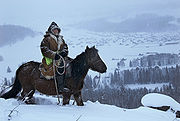 There doesn't seem to exist a clear ethnic delineation for the application of the name Uriankhai. Mongols applied this name to all tribes of Forest People. This name has historically been applied to Tuvans. In Mongolia there are peoples also known by this name. A variation of the name, Uraŋxai, was an old name for the Sakha
. Russian Pavel Nebol'sin documented the Urankhu clan of Volga Kalmyks in the 1850s. Another variant of the name, Orangkae (오랑캐), was traditionally used by the Koreans to refer indiscriminately to "barbarian
s" that inhabited the lands to their north.
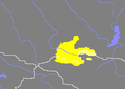 There are two major groups of Tuvans in Tuva: Western Tuvans and Tuvans-Todzhins (Тувинцы-тоджинцы). The latter ones live in Todzhinsky District, Tuva Republic and constitute about 5% of all Tuvans.
A people similar by language to Tuvans live in Oka District of Buryatia (self-naming: Soyots
(сойоты), sometimes referred to as Oka Tuvans).
. The Dukha live in Khövsgöl Aimag. The largest population of Tuvans in Mongolia are the Tsengel Tuvans. Around 1,500 live in Tsengel Sum of Bayan-Ölgii Aimag. Other Tuvans live in Khovd Aimag and in Ubsunur Hollow
.
, who live mostly in the Xinjiang
Autonomous Region, are included under the Mongol
nationality. Some Tuvans reportedly live at Lake Kanas
in the northwestern part of Xinjiang
in China
where they are not officially recognized, are counted as a part of the local Oirat
Mongol community that is counted under the general label 'Mongol'. Oirat and Tuvan children attend schools in which they use Chakhar Mongolian
and Chinese
, native languages of neither group.
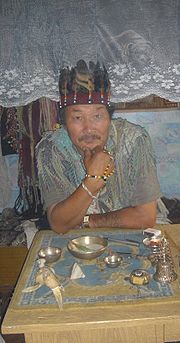
.
, or Turkic
animistic
shamanism
. The religion is still widely practiced alongside Tibetan Buddhism
.
, Chirgilchin
and the Alash Ensemble
.
A documentary called Genghis Blues
was made in 1999 about an American blues musician, Paul Pena
, who taught himself overtone singing and traveled to Tuva to compete in a throat-singing competition.
, Tuvan culture is being destroyed by a tourism developer.
Uriankhai
"Uriankhai" , also known as Urianhai or Uryangkhai, is a term applied to several neighboring ethnic groups...
, from the Mongolian
Mongolian language
The Mongolian language is the official language of Mongolia and the best-known member of the Mongolic language family. The number of speakers across all its dialects may be 5.2 million, including the vast majority of the residents of Mongolia and many of the Mongolian residents of the Inner...
designation. Tuvans speak a Turkic language and their recent ethnic history is rooted in Mongol, Turkic, and Samoyedic
Samoyedic peoples
The term Samoyedic peoples is used to describe peoples speaking Samoyedic languages, which are part of the Uralic family. They are a linguistic grouping, not an ethnic or cultural one. The name derives from the obsolete term Samoyed used in Russia for some indigenous peoples of Siberia...
groups of peoples.
Tuvans have historically been cattle-breeding nomads, tending to their herds of goats, sheep, camels, reindeer, cattle and yaks for the past thousands of years. They have traditionally lived in yurt
Yurt
A yurt is a portable, bent wood-framed dwelling structure traditionally used by Turkic nomads in the steppes of Central Asia. The structure comprises a crown or compression wheel usually steam bent, supported by roof ribs which are bent down at the end where they meet the lattice wall...
s covered by felt or chum
Chum (tent)
A chum is a temporary dwelling used by the nomadic Yamal-Nenets and Khanty reindeer herders of northwestern Siberia of Russia. They are also used by the southernmost reindeer herders, of the Todzha region of the Republic of Tyva and their cross-border relatives in northern Mongolia...
s covered with birch bark or hide that they relocate seasonally as they move to newer pastures. Traditionally Tuvans divided into nine regions called Khoshuun, namely the Tozhu, Salchak, Oyunnar, Khemchik, Khaasuut, Shalyk, Nibazy, Daavan & Choodu, and Beezi. The first four were ruled by Uriankhai
Uriankhai
"Uriankhai" , also known as Urianhai or Uryangkhai, is a term applied to several neighboring ethnic groups...
Mongol princes, while the rest were administered by Borjigit Mongol princes.
History
Besides prehistoric rock-carvings to be found especially along the Yenisei banks, the first internationally important archaeological findings have been near ArzhanArzhan
Arzhan is a site of early Scythian kurgan burials, located in the Tuva Republic, Russia, some the north-west of Kyzyl.Arzhan is situated on a high plateau, traversed by the Uyuk River, a minor tributary of the Yenisei River....
, in the north central Tuva. Here Scythian kurgan
Kurgan
Kurgan is the Turkic term for a tumulus; mound of earth and stones raised over a grave or graves, originating with its use in Soviet archaeology, now widely used for tumuli in the context of Eastern European and Central Asian archaeology....
burials are being researched, revealing the earliest (7th, 6th century BC) and easternmost remains of these people who spread all the way to Europe. They may be the origin of the occasional and remarkable blond, freckled, green- and blue-eyed Tuvans. Their story and fantastic gold treasures can be appreciated in the National Museum in Kyzyl.
The Xiongnu
Xiongnu
The Xiongnu were ancient nomadic-based people that formed a state or confederation north of the agriculture-based empire of the Han Dynasty. Most of the information on the Xiongnu comes from Chinese sources...
ruled over the area of Tuva prior to 200 AD. At this time a people known to the Chinese as Dingling
Dingling
The Dingling were an ancient Siberian people. They originally lived on the bank of the Lena River in the area west of Lake Baikal, gradually moving southward to Mongolia and northern China...
inhabited the region. The Chinese recorded the existence of a tribe of Dingling origin named Dubo in the eastern Sayans. This name is recognized as being associated with the Tuvan people and is the earliest written record of them. The Xianbei
Xianbei
The Xianbei were a significant Mongolic nomadic people residing in Manchuria, Inner Mongolia and eastern Mongolia. The title “Khan” was first used among the Xianbei.-Origins:...
defeated the Xiongnu and they in turn were defeated by the Rouran
Rouran
Rouran , Mongolia name Jujan or Nirun Ruanruan/Ruru , Tan Tan , Juan-Juan or Zhu-Zhuwas the name of a confederation of nomadic tribes on the northern borders of Inner China from the late 4th century until the middle 6th century...
. From around the end of the 6th century, the Göktürks
Göktürks
The Göktürks or Kök Türks, were a nomadic confederation of peoples in medieval Inner Asia. Known in Chinese sources as 突厥 , the Göktürks under the leadership of Bumin Qaghan The Göktürks or Kök Türks, (Old Turkic: Türük or Kök Türük or Türük; Celestial Turks) were a nomadic confederation of...
held dominion over Tuva up until the 8th century when the Uyghurs
Uyghur people
The Uyghur are a Turkic ethnic group living in Eastern and Central Asia. Today, Uyghurs live primarily in the Xinjiang Uyghur Autonomous Region in the People's Republic of China...
took over.
Por-Bazhyn
Por-Bazhyn is the name of a ruined structure attributed to the Uyghur Khaganate. It is located on an island in the middle of Tere-Khol, a lake in Tuva. The name Por-Bazhyn translates from the Tuvan language as "earthenware house"....
in lake Tere-Khol in the southeast of the country. The memory of Uyghur occupation could still be seen up until the end of the 19th century due to the application of the name Ondar Uyghur for the Ondar Tuvans living near the Khemchik river in the southwest. Uyghur dominance was broken by the Yeniseian Kyrgyz
Yenisei Kirghiz
The Yenisei Kirghiz, also known as the Khyagas or Khakas, were an ancient people that dwelled along the upper Yenisei River in the southern portion of the Minusinsk Depression from the 3rd century BCE to the 13th century CE...
in 840 AD, who came from the upper reaches of the Yenisei.
In 1207, the Oirat
Oirats
Oirats are the westernmost group of the Mongols who unified several tribes origin whose ancestral home is in the Altai region of western Mongolia. Although the Oirats originated in the eastern parts of Central Asia, the most prominent group today is located in the Republic of Kalmykia, a federal...
prince Quduqa-Beki led Mongol
Mongols
Mongols ) are a Central-East Asian ethnic group that lives mainly in the countries of Mongolia, China, and Russia. In China, ethnic Mongols can be found mainly in the central north region of China such as Inner Mongolia...
detachments under Jochi
Jochi
Jochi was the eldest of the Mongol chieftain Genghis Khan's four sons by his principal wife Börte. An accomplished military leader, he participated in his father's conquest of Central Asia, along with his brothers and uncles.-Early life:...
to a tributary of the Kaa-Khem river. They encountered the Tuvan Keshdims, Baits, and Teleks. This was the beginning of Mongol suzerainty over the Tuvans.
Tuvans came to be ruled for most of the 17th century by Khalka Mongol leader Sholoi Ubashi's Altyn-Khan
Altan Khan of the Khalkha
The Altan Khans ruled north-western Mongolia from about 1609 to 1691 at the latest. Altan Khan of Khalkha also known as Altan Khan of Khotogoid ruled over the Khotogoids in northwestern Mongolia and belonged to the Left Wing of the Khalkha Mongols...
Khanate. It was at this time in 1615 that the first Russians, V. Tyumenets and I. Petrov, visited Tuva as emissaries to the Altyn-Khan. Russian documents from this time record information about different tribal groups that contributed to the composition of modern Tuvans. Tyumenets and Petrov describe the Maads, who became Russian subjects in 1609, living in the Bii-Khem basin, a 14 day's ride from Tomsk. The Maads travelled to the area of the Khemchik and Ulug-Khem next to the lands of the Altyn-Khan near the lake Uvs Nuur
Uvs Nuur
Uvs Lake is a highly saline lake in an endorheic basin - Uvs Nuur Basin in Mongolia with a small part in Russia. It is the largest lake in Mongolia by surface area, covering 3,350 km² at 759 m above sea level....
. The ambassadors also described the Sayan raising reindeer with the Tochi (Todzhi) from the Sayan
Sayan Mountains
The Sayan Mountains are a mountain range between northwestern Mongolia and southern Siberia, Russia.The Eastern Sayan extends from the Yenisei River at 92° E to the southwest end of Lake Baikal at 106° E...
to the Altai mountain ranges. The descendants of the Ak-Sayan and Kara-Sayan live mostly around Tere-Khol rayon.
The state of the Altyn-Khan disappeared due to constant warring between the Oirats and the Khalka of Jasaghtu Khan
Jasaghtu Khan
Tümen Jasagtu Khan was a 16th century Mongol khan of the Northern Yuan Dynasty in Mongolia who reigned from 1558 to 1592. He was the successor of Darayisung Gödeng Khan and had direct rule over the Chahar. It was during his rule that the Mongols conquered Daur and Evenks...
Aimak. The Tuvans became part of the Dzungarian state ruled by the Oirats. The Dzungars ruled over all of the Sayano-Altay Plateau until 1755. It was during this time of Dzungarian rule that many tribes and clans broke up, moved around, and intermingled. Groups of Altayan Telengits settled in western Tuva on the Khemchik and Barlyk rivers and in the region of Bai-Taiga. Some Todzhans, Sayans, and Mingats ended up in the Altay. Other Tuvans migrated north across the Sayan range and became known as Beltirs (Dag-Kakpyn, Sug-Kakpyn, Ak-Chystar, Kara-Chystar). The languages of the Beltirs and Tuvans still contain common words not found in the language of the other Khakas (Kachins or Sagays). Other Russian documents mention Yeniseian Kyrgyz (Saryglar and Kyrgyz), Orchaks (Oorzhaks) and Kuchugets (Kuzhugets) moving into Tuva from the north.
Besides the Turkic tribes mentioned above, there is indication that modern Tuvans are descended also from Mongolic, Samoyedic
Samoyedic peoples
The term Samoyedic peoples is used to describe peoples speaking Samoyedic languages, which are part of the Uralic family. They are a linguistic grouping, not an ethnic or cultural one. The name derives from the obsolete term Samoyed used in Russia for some indigenous peoples of Siberia...
, and Kettic
Yeniseian languages
The Yeniseian language family is spoken in central Siberia.-Family division:0. Proto-Yeniseian...
groups of peoples. Of the extinct Southern Samoyed
Samoyedic peoples
The term Samoyedic peoples is used to describe peoples speaking Samoyedic languages, which are part of the Uralic family. They are a linguistic grouping, not an ethnic or cultural one. The name derives from the obsolete term Samoyed used in Russia for some indigenous peoples of Siberia...
groups, Mator
Mator language
Mator or Motor was a Uralic language belonging to the group of Samoyedic languages, extinct since the 1840s. It was spoken in the northern region of the Sayan Mountains in Siberia, close to the Mongolian north border. The speakers of Mator lived in a wide area from the eastern parts of the...
, Koibal
Koibal
The Koibal are one of the subdivisions of the Khakass people of Southern Siberia. Although they speak the Turkic Koybal language, the Koibal have mixed ancestry. They formed in the late 19th century from the merger of the Abugach, Baikot, Kandyk, Tarazhak, Kol and Arsh peoples...
, Kamas
Kamasins
Kamasins were a tribe of Samoyedic people in the Sayan Mountains numbering approx. 500 men, who lived along the Kan River and Mana River in the 17th century...
, and Karagas were assimilated mostly into the eastern Tuvans such as the Todzhins, Tofalars, Soyots
Soyots
The Soyot people live in Russia. According to the 2002 census, there were 2769 Soyots in Russia. Their extinct language was of Turkic type and basically similar to the Tuvans, but they live in the Oka Region of Buryatia. Their language has been reconstructed and a textbook has been published...
, and Dukha. The Irgit tribe is also suggested as being from Samoyedic ancestors. The Tuvan name for the Yenisei river may stem from an ancient Samoyedic name. Tribes such as Tumat, Mingat, Mongush, and Salchak are recognized as having a Mongolic origin.
According to Ilya Zakharov of Moscow
Moscow
Moscow is the capital, the most populous city, and the most populous federal subject of Russia. The city is a major political, economic, cultural, scientific, religious, financial, educational, and transportation centre of Russia and the continent...
's Vavilov Institute of General Genetics, genetic evidence suggests that the modern Tuvan people are the closest genetic relatives to the Indigenous peoples of the Americas
Indigenous peoples of the Americas
The indigenous peoples of the Americas are the pre-Columbian inhabitants of North and South America, their descendants and other ethnic groups who are identified with those peoples. Indigenous peoples are known in Canada as Aboriginal peoples, and in the United States as Native Americans...
.
The name Uriankhai
Yakuts
Yakuts , are a Turkic people associated with the Sakha Republic.The Yakut or Sakha language belongs to the Northern branch of the Turkic family of languages....
. Russian Pavel Nebol'sin documented the Urankhu clan of Volga Kalmyks in the 1850s. Another variant of the name, Orangkae (오랑캐), was traditionally used by the Koreans to refer indiscriminately to "barbarian
Barbarian
Barbarian and savage are terms used to refer to a person who is perceived to be uncivilized. The word is often used either in a general reference to a member of a nation or ethnos, typically a tribal society as seen by an urban civilization either viewed as inferior, or admired as a noble savage...
s" that inhabited the lands to their north.
Geography
A people similar by language to Tuvans live in Oka District of Buryatia (self-naming: Soyots
Soyots
The Soyot people live in Russia. According to the 2002 census, there were 2769 Soyots in Russia. Their extinct language was of Turkic type and basically similar to the Tuvans, but they live in the Oka Region of Buryatia. Their language has been reconstructed and a textbook has been published...
(сойоты), sometimes referred to as Oka Tuvans).
Mongolia
A noticeable proportion of Tuvans lives in MongoliaMongolia
Mongolia is a landlocked country in East and Central Asia. It is bordered by Russia to the north and China to the south, east and west. Although Mongolia does not share a border with Kazakhstan, its western-most point is only from Kazakhstan's eastern tip. Ulan Bator, the capital and largest...
. The Dukha live in Khövsgöl Aimag. The largest population of Tuvans in Mongolia are the Tsengel Tuvans. Around 1,500 live in Tsengel Sum of Bayan-Ölgii Aimag. Other Tuvans live in Khovd Aimag and in Ubsunur Hollow
Ubsunur Hollow
Ubsunur Hollow is a fragile mountain endorheic basin or depression located on the territorial border of Mongolia and the Republic of Tuva in the Russian Federation, named after Uvs Lake, a large, shallow and very saline lake in the basin's center. Several smaller lakes are scattered throughout...
.
China
Tuvans in ChinaChina
Chinese civilization may refer to:* China for more general discussion of the country.* Chinese culture* Greater China, the transnational community of ethnic Chinese.* History of China* Sinosphere, the area historically affected by Chinese culture...
, who live mostly in the Xinjiang
Xinjiang
Xinjiang is an autonomous region of the People's Republic of China. It is the largest Chinese administrative division and spans over 1.6 million km2...
Autonomous Region, are included under the Mongol
Ethnic Mongols in China
Mongols in China are citizens of the People's Republic of China who are ethnic Mongols. They form one of the 55 ethnic minorities officially recognized by the People's Republic of China. There are approximately 5.8 million ethnic Mongols living in China. Most of them live in Inner Mongolia,...
nationality. Some Tuvans reportedly live at Lake Kanas
Lake Kanas
Kanas Lake is a lake in Altay Prefecture, Xinjiang, China. The lake is located in a valley in the Altai Mountains, near the very northern tip of Xinjiang, and the province's borders with Kazakhstan, Mongolia, and Russia. The lake was born around 200, 000 years ago during the Quaternary period,...
in the northwestern part of Xinjiang
Xinjiang
Xinjiang is an autonomous region of the People's Republic of China. It is the largest Chinese administrative division and spans over 1.6 million km2...
in China
China
Chinese civilization may refer to:* China for more general discussion of the country.* Chinese culture* Greater China, the transnational community of ethnic Chinese.* History of China* Sinosphere, the area historically affected by Chinese culture...
where they are not officially recognized, are counted as a part of the local Oirat
Oirats
Oirats are the westernmost group of the Mongols who unified several tribes origin whose ancestral home is in the Altai region of western Mongolia. Although the Oirats originated in the eastern parts of Central Asia, the most prominent group today is located in the Republic of Kalmykia, a federal...
Mongol community that is counted under the general label 'Mongol'. Oirat and Tuvan children attend schools in which they use Chakhar Mongolian
Mongolian language
The Mongolian language is the official language of Mongolia and the best-known member of the Mongolic language family. The number of speakers across all its dialects may be 5.2 million, including the vast majority of the residents of Mongolia and many of the Mongolian residents of the Inner...
and Chinese
Chinese language
The Chinese language is a language or language family consisting of varieties which are mutually intelligible to varying degrees. Originally the indigenous languages spoken by the Han Chinese in China, it forms one of the branches of Sino-Tibetan family of languages...
, native languages of neither group.
Culture
Language
The Tuvan language belongs to the Northern or Siberian branch of the Turkic language family. Four dialects are recognized: Central, Western, Southeastern and Northeastern (Todzhinian). The written language is based on the Cyrillic alphabetCyrillic alphabet
The Cyrillic script or azbuka is an alphabetic writing system developed in the First Bulgarian Empire during the 10th century AD at the Preslav Literary School...
.
Religion
The traditional religion of Tuvans is a type of TengriismTengriism
Tengriism is a Central Asian religion that incorporates elements of shamanism, animism, totemism and ancestor worship. Despite still being active in some minorities, it was, in old times, the major belief of Turkic peoples , Bulgars, Hungarians and Mongols...
, or Turkic
Turkic peoples
The Turkic peoples are peoples residing in northern, central and western Asia, southern Siberia and northwestern China and parts of eastern Europe. They speak languages belonging to the Turkic language family. They share, to varying degrees, certain cultural traits and historical backgrounds...
animistic
Animism
Animism refers to the belief that non-human entities are spiritual beings, or at least embody some kind of life-principle....
shamanism
Shamanism
Shamanism is an anthropological term referencing a range of beliefs and practices regarding communication with the spiritual world. To quote Eliade: "A first definition of this complex phenomenon, and perhaps the least hazardous, will be: shamanism = technique of ecstasy." Shamanism encompasses the...
. The religion is still widely practiced alongside Tibetan Buddhism
Tibetan Buddhism
Tibetan Buddhism is the body of Buddhist religious doctrine and institutions characteristic of Tibet and certain regions of the Himalayas, including northern Nepal, Bhutan, and India . It is the state religion of Bhutan...
.
Music
A unique form of music exists in Tuva commonly known as throat singing or khoomei. There are various techniques of khoomei, some giving the effect of multiple tones by emphasizing overtones. Some famous groups from Tuva who feature throat-singing are Huun-Huur-TuHuun-Huur-Tu
Huun-Huur-Tu is a music group from Tuva, a Russian Federation republic situated on the Mongolian border....
, Chirgilchin
Chirgilchin
Chirgilchin, meaning "dance of the air in the heat of the day" or "miracle" in Tuvan, is a group of Tuvan musicians performing traditional Tuvan music. It was established in 1996....
and the Alash Ensemble
Alash Ensemble
The ensemble Alash is a throat singing band from Tuva that performs traditional Tuvan music with some non-traditional influences.- History :The musicians of Alash are Nachyn Choodu, Bady-Dorzhu Ondar, Ayan-ool Sam, and Ayan Shirizhik...
.
A documentary called Genghis Blues
Genghis Blues
Genghis Blues is a documentary film directed by Roko Belic. It centers on the journey of blind American singer Paul Pena to the isolated Asian nation of Tuva due to his interest in Tuvan throat singing....
was made in 1999 about an American blues musician, Paul Pena
Paul Pena
Paul Pena was an American singer, songwriter and guitarist of Cape Verdean descent.His music from the first half of his career touched on Delta blues, jazz, morna, flamenco, folk and rock and roll...
, who taught himself overtone singing and traveled to Tuva to compete in a throat-singing competition.
China
According to Xinhua News AgencyXinhua News Agency
The Xinhua News Agency is the official press agency of the government of the People's Republic of China and the biggest center for collecting information and press conferences in the PRC. It is the largest news agency in the PRC, ahead of the China News Service...
, Tuvan culture is being destroyed by a tourism developer.
See also
- List of indigenous peoples of Russia
- List of Tuvans
- TuvaTuvaThe Tyva Republic , or Tuva , is a federal subject of Russia . It lies in the geographical center of Asia, in southern Siberia. The republic borders with the Altai Republic, the Republic of Khakassia, Krasnoyarsk Krai, Irkutsk Oblast, and the Republic of Buryatia in Russia and with Mongolia to the...
- Tannu UriankhaiTannu UriankhaiTannu Uriankhai is a historic region of the Mongol Empire and, later, the Qing Dynasty. The realms of Tannu Uriankhai largely correspond to the Tuva Republic of the Russian Federation, neighboring areas in Russia, and a part of the modern state of Mongolia....
- Por-BazhynPor-BazhynPor-Bazhyn is the name of a ruined structure attributed to the Uyghur Khaganate. It is located on an island in the middle of Tere-Khol, a lake in Tuva. The name Por-Bazhyn translates from the Tuvan language as "earthenware house"....