
All Topics  
Evil eye

 
Evil Eye

   Email Print
   Bookmark   Link


Evil eye


The evil eye is a belief that the envy
Envy

Envy may be defined as an emotion that "occurs when a person lacks another?s [perceived] superior quality, achievement, or possession and either desires it or wishes that the other lacked it." It can also derive from a sense of low self-esteem that results from an upward social comparison threatening a person's self image: another person...
 elicited by the good luck
Luck

Luck is a chance happening, or that which happens beyond a person's control. Luck can be good or bad ....
 of fortunate people may result in their misfortune. The perception of the nature of the phenomenon, its causes, and possible protective measures, varies between different cultures.

ome forms, it is the belief that some people can bestow a curse
Curse

A curse is any manner of adversity thought to be inflicted by any supernatural power, such as a spell , a prayer, an imprecation, an execration, magic , witchcraft, a god, a natural force, or a spiritual being....
 on victims by the malevolent gaze
Gaze

In analysing visual culture, the concept of The Gaze describes how the viewer gazes upon the people presented and represented. As a concept of social power relations, the 1960s ascendancy of postmodern philosophy and postmodern social theory, as exposited by the intellectuals Michel Foucault and Jacques Lacan , popularised usage of '...
 of their magical eye.


Discussion
Ask a question about 'Evil eye'
Start a new discussion about 'Evil eye'
Answer questions from other users
Full Discussion Forum


Recent Posts


Encyclopedia


Evil Eye
The evil eye is a belief that the envy
Envy

Envy may be defined as an emotion that "occurs when a person lacks another?s [perceived] superior quality, achievement, or possession and either desires it or wishes that the other lacked it." It can also derive from a sense of low self-esteem that results from an upward social comparison threatening a person's self image: another person...
 elicited by the good luck
Luck

Luck is a chance happening, or that which happens beyond a person's control. Luck can be good or bad ....
 of fortunate people may result in their misfortune. The perception of the nature of the phenomenon, its causes, and possible protective measures, varies between different cultures.

Forms of belief

In some forms, it is the belief that some people can bestow a curse
Curse

A curse is any manner of adversity thought to be inflicted by any supernatural power, such as a spell , a prayer, an imprecation, an execration, magic , witchcraft, a god, a natural force, or a spiritual being....
 on victims by the malevolent gaze
Gaze

In analysing visual culture, the concept of The Gaze describes how the viewer gazes upon the people presented and represented. As a concept of social power relations, the 1960s ascendancy of postmodern philosophy and postmodern social theory, as exposited by the intellectuals Michel Foucault and Jacques Lacan , popularised usage of '...
 of their magical eye. The most common form, however, attributes the cause to envy
Envy

Envy may be defined as an emotion that "occurs when a person lacks another?s [perceived] superior quality, achievement, or possession and either desires it or wishes that the other lacked it." It can also derive from a sense of low self-esteem that results from an upward social comparison threatening a person's self image: another person...
, with the envious person casting the evil eye doing so unintentionally. Also the effects on victims vary. Some cultures report afflictions with bad luck; others believe the evil eye can cause disease
Disease

A disease or medical condition is an abnormal condition of an organism that impairs bodily functions, associated with specific symptoms and Medical signs....
, wasting away, and even death
Death

Death is the permanent termination of the biological functions that define a life organism. It refers to both a particular event and to the condition that results thereby....
. In most cultures, the primary victims are thought to be babies and young children, because they are so often praised and commented upon by strangers or by childless women. The late UC Berkeley professor of folklore Alan Dundes
Alan Dundes

Alan Dundes, was a folklorist at the University of California, Berkeley. His work was said to have been central to establishing the study of folklore as an academic discipline....
 has explored the beliefs of many cultures and found a commonality — that the evil caused by the gaze is specifically connected to symptoms of drying, desiccation, withering, and dehydration, that its cure is related to moistness, and that the immunity from the evil eye that fish have in some cultures is related to the fact that they are always wet. His essay "Wet and Dry: The Evil Eye" is a standard text on the subject.

In many forms of the evil eye belief, a person — otherwise not malefic in any way — can harm adults, children, livestock
Livestock

Livestock is the term used to refer to a domesticated animal intentionally reared in an agricultural setting to produce things such as food or fibre, or for its labour....
, or a possession, simply by looking at them with envy. The word "evil" can be seen as somewhat misleading in this context, because it suggests that someone has intentionally "cursed" the victim. A better understanding of the term "evil eye" can be gained from the old English
English language

English is a West Germanic language that originated in Anglo-Saxon England and has lingua franca status in many parts of the world as a result of the military, economic, scientific, political and cultural influence of the British Empire in the 18th, 19th and early 20th centuries and that of the United States from the mid 20th century onwa...
 word for casting the evil eye, namely "overlooking," implying that the gaze has remained focused on the coveted object, person, or animal for too long.

While some cultures hold that the evil eye is an involuntary jinx
Jinx

A jinx, in popular superstition and folklore, is:* A sort of curse placed on a person that makes them prey to large numbers of minor misfortunes and other forms of bad luck;...
 cast unintentionally by people unlucky enough to be cursed with the power to bestow it by their gaze, others hold that, while perhaps not strictly voluntary, the power is called forth by the sin
Sin

Sin is a term used mainly in a religion context to describe an act that violates a morality rule, or the state of having committed such a violation....
 of envy.

History

The amount of literary and archaeological evidence attests to the belief in the evil eye in the eastern Mediterranean for more than a millennium starting with Hesiod
Hesiod

Hesiod was a Greek language oral poet, his date is uncertain but leading scholars agree that Hesiod lived in the latter half of the Eighth-century BCE....
, Callimachus
Callimachus

Callimachus was a native of the Greek colony of Cyrene, Libya, Libya. He was a noted poet, critic and scholar of the Library of Alexandria and enjoyed the patronage of ancient Egyptian Greeks Pharaohs Ptolemy II Philadelphus and Ptolemy III Euergetes....
, Plato
Plato

Plato , was a Classical Greece Greeks philosopher, mathematician, writer of philosophical dialogues, and founder of the Platonic Academy in Ancient Athens, the first institution of higher learning in the western world....
, Diodorus Siculus
Diodorus Siculus

Diodorus Siculus , was a Roman Greece historian who flourished in the 1st century BC. According to Diodorus' own work, he was born at Agira in Sicily ....
, Theocritus
Theocritus

Theocritus , the creator of ancient Greek bucolic poetry, flourished in the 3rd century BC....
, Plutarch
Plutarch

Lucius Mestrius Plutarchus , c. AD 46 ? 120 ? commonly known in English as Plutarch ? was a Ancient Rome historian , biographer, essayist, and Middle Platonism....
, Heliodorus
Heliodorus

Heliodorus is a Greek name meaning "Gift of the Sun". Several persons named Heliodorus are known to us from ancient times, the best known of which are:...
, Pliny the Elder
Pliny the Elder

Gaius Plinius Secundus , better known as Pliny the Elder, was an ancient author, naturalist or natural philosopher and naval and military commander of some importance who wrote Natural History ....
, and Aulus Gellius
Aulus Gellius

Aulus Gellius , Latin author and grammarian, possibly of African origin, probably born and certainly brought up at Rome.He studied grammar and rhetoric at Rome and philosophy at Athens, after which he returned to Rome, where he held a judicial office....
. In Peter Walcot's Envy and the Greeks (1978) he referenced more than one hundred of these authors works related to the evil eye. Studying these written sources in order to write on the evil eye only gives a fragmented view of the subject whether it presents a folkloric, theological, classical or anthropological approach to the evil eye. While these different approaches tend to reference similar sources each presents a different yet similar usage of the evil eye, that the fear of the evil eye is based on the belief that certain people have eyes whose glance has the power to injure or even kill and that it can be intentional or unintentional.

The Classical Evil Eye

Belief in the evil eye during antiquity is based on the evidence in ancient sources like Aristophanes
Aristophanes

Aristophanes , son of Philippus, of the deme Cydathenaus, was a prolific and much acclaimed comedy playwright of ancient Athens. Eleven of his forty plays have come down to us virtually complete....
, Athenaeus
Athenaeus

Athenaeus , of Naucratis in Egypt, Greeks rhetorician and grammarian, flourished about the end of the 2nd and beginning of the 3rd century A.D. The Suda only tells us that he lived in the times of Marcus ; but the contempt with which he speaks of Commodus shows that he survived that emperor....
, Plutarch and Heliodorus
Heliodorus

Heliodorus is a Greek name meaning "Gift of the Sun". Several persons named Heliodorus are known to us from ancient times, the best known of which are:...
. There are also speculations that claim Socrates
Socrates

Socrates was a Classical Greece Philosophy. Credited as one of the founders of Western philosophy, he is an enigmatic figure known only through the classical accounts of his students....
 possessed the evil eye and that his disciples and admirers were fascinated by Socrates' insistently glaring eyes. His followers were called Blepedaimones, which translates into demon look, not because they were possessors and transmitters of the evil eye, but because they were suspected of being under the hypnotic and dangerous spell of Socrates.

In the Greco-Roman period a scientific explanation of the evil eye was common. Plutarch's scientific explanation stated that the eyes were the chief, if not sole, source of the deadly rays that were supposed to spring up like poisoned darts from the inner recesses of a person possessing the evil eye (Quaest.Conv. 5.7.2-3=Mor.80F-81f). Plutarch treated the phenomenon of the evil eye as something seemingly inexplicable that is a source of wonder and cause of incredulity.

The belief in the evil eye during antiquity varied from different regions and periods. The evil eye was not feared with equal intensity in every corner of the Roman Empire. There were places in which people felt more conscious of the danger of the evil eye. In the Roman days not only were individuals considered to possess the power of the evil eye but whole tribes, especially those of Pontus and Scythia, were believed to be transmitters of the evil eye.

Distribution of the belief

Belief in the evil eye
Evil eye

The evil eye is a belief that the envy elicited by the good luck of fortunate people may result in their misfortune. The perception of the nature of the phenomenon, its causes, and possible protective measures, varies between different cultures....
 is strongest in the Middle East
Middle East

File:GreaterMiddleEast1.pngThe Middle East is a region that spans southwestern Asia, western Asia, and northeastern Africa. It has no clear boundaries, often used as a synonym to Near East, in opposition to Far East....
, East
East Africa

East Africa or Eastern Africa is the easterly region of the African continent, variably defined by geography or geopolitics. In the UN subregion, 19 territories constitute Eastern Africa:...
 and West Africa
West Africa

West Africa or Western Africa is the westernmost region of the African continent. Geopolitically, the United Nations subregion of Western Africa includes the following 16 countries distributed over an area of approximately 5 million square km:...
, South Asia
South Asia

South Asia, also known as Southern Asia, is the southern region of the Asian continent, which comprises the sub-Himalayan countries and, for some authorities , also includes the adjoining countries on the west and the east....
, Central Asia
Central Asia

Central Asia is a region of Asia from the Caspian Sea in the west to central China in the east, and from southern Russia in the north to northern India in the south....
 and Europe
Europe

Europe is, conventionally, one of the world's seven continents. Comprising the westernmost peninsula of Eurasia, Europe is generally divided from Asia to its east by the water divide of the Ural Mountains, the Ural , the Caspian Sea, and by the Caucasus Mountains to the southeast....
, especially the Mediterranean region; it has also spread to other areas, including northern Europe, particularly in the Celt
Celt

Celts , is a modern term used to describe any of the European peoples who spoke, or speak, a Celtic languages. The term is also used in a wider sense to describe the Modern Celts of those peoples, notably those who participate in a Celtic culture....
ic regions, and the Americas
Americas

The Americas are the region of the Western hemisphere that consists of the continents of North America and South America with their associated islands and regions....
, where it was brought by European colonists and Middle Eastern immigrants.

Belief in the evil eye is found in Islam
Islam

Islam is a Monotheism, Abrahamic religion originating with the teachings of the Prophets of Islam Muhammad, a 7th century Arab religious and political figure....
ic doctrine, based upon the verse of the Qur'an
Qur'an

The Qur?an is the central religious text of Islam. Muslims believe the Qur?an to be the book of divine guidance and direction for mankind, and consider the original Arabic text to be the final revelation of God....
, "And from the evil of the envier when he envies," [Chapter al-Falaq, verse 5] and the statement of Prophet Muhammad
Muhammad

Muhammad Patronymic#Arabic Abd Allah ibn Abd al Muttalib , is the founder of the Major religious groups of Islam and is regarded by Muslims as a Rasul and prophet of , the last and the greatest law-bearer in a series of prophets....
(?), "The influence of an evil eye is a fact..." [Sahih Muslim, Book 26, Number 5427]. Authentic practices of warding off the evil eye are also commonly practiced by Muslims: rather than directly expressing appreciation of, for example, a child's beauty, it is customary to say Masha'Allah
Masha'Allah

is an Arabic language phrase indicating appreciation for an aforementioned individual or event. Towards this, it is used as an expression of respect, while at the same time serving as a reminder that all accomplishments are so achieved by the will of God....
, that is, "God has willed it", or invoking God's blessings upon the object or person that is being admired. Aside from beliefs based upon authentic Islamic texts, a number of unsubstantiated beliefs about the evil eye are found in folk religion
Folk religion

Folk religion consists of beliefs, superstitions and rituals transmitted from generation to generation in a specific culture. It could be contrasted with an organized religion or historical religion in which founders, creed, theology and ecclesiastical organizations are present....
, typically revolving around the use of amulets or talismans as a means of protection.

Although the concept of cursing by staring or gazing is largely absent in East Asian and Southeast Asian societies, the Usog
Usog

"Usog" or balis is a topic in psycho-medicine in Filipino Psychology where an affliction or psychological disorder is attributed to a greeting by a stranger, or an evil eye Curse....
 curse of the Philippines
Philippines

The Philippines, officially known as the Republic of the Philippines, is a country in Southeast Asia with Manila as its capital city. It comprises 7,107 islands in the western Pacific Ocean....
 is an exception.

There are many instances of people casting the evil eye (ayin hara) in both the Tanakh
Tanakh

The Tanakh is the Bible used in Judaism. The name "Tanakh" is a Hebrew language Acronym and initialism formed from the initial Hebrew alphabet of the Tanakh's three traditional subdivisions: The Torah , Nevi'im and Ketuvim - hence TaNaKh....
 and the Talmud
Talmud

The Talmud is a record of rabbinic discussions pertaining to Halakha, Jewish ethics, customs, and history. It is a central text of mainstream Judaism....
. Ashkenazi Jews in Europe and the Americas routinely exclaim Keyn aynhoreh! (also spelled Kein ayin hara!), meaning "No evil eye!" in Yiddish, to ward off a jinx after something or someone has been rashly praised or good news has been spoken aloud.

In the Aegean region and other areas where light-colored eyes are relatively rare, people with green eyes
Eye color

Eye color is a polygenic trait and is determined by the amount and type of pigments in the eye's Iris . Humans and animals have many phenotypic variations in eye color....
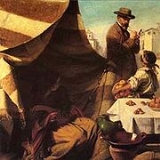
 are thought to bestow the curse, intentionally or unintentionally. This belief may have arisen because people from cultures unused to the evil eye, such as Northern Europe, are likely to transgress local customs against staring or praising the beauty of children. Thus, in Greece and Turkey amulets against the evil eye take the form of blue eyes, and in the painting by John Phillip, above, we witness the culture-clash experienced by a woman who suspects that the artist's gaze implies that he is looking at her with the evil eye.

Among those who do not take the evil eye literally, either by reason of the culture in which they were raised or because they simply do not believe in such things, the phrase, "to give someone the evil eye" usually means simply to glare at the person in anger or disgust.

Protective talismans and cures

Khamsa Pendant
Nazarlikliucak
Attempts to ward off the curse of the evil eye have resulted in a number of talisman
Amulet

An amulet , a close cousin of the talisman consists of any object intended to bring good luck and/or protection to its owner.Potential amulets include: Gemstone or simple Gemstone, statues, coins, drawings, pendants, jewelry ring, plants, animals, etc.; even words said in certain occasions?for example: vade retro satana?, to repe...
s in many cultures. As a class, they are called "apotropaic" (Greek for "prophylactic" or "protective", literally: "turns away") talismans, meaning that they turn away or turn back harm.

Disks or balls, consisting of concentric blue and white circles (usually, from inside to outside, dark blue, light blue, white, dark blue) representing an evil eye are common apotropaic talismans in the Middle East, found on the prow
Prow

The prow is the very most forward part of a ship's Bow that cuts through the water. The prow and stem and its surrounding parts of a ship is often used interchangeably....
s of Mediterranean boat
Boat

A boat is a watercraft of modest size designed to float or plane on water, and provide transport over it. Usually this water will be inland or in protected coastal areas....
s and elsewhere; in some forms of the folklore, the staring eyes are supposed to bend the malicious gaze back to the sorcerer.

Known as nazar
Nazar (amulet)

A nazar or evil eye stone is an amulet that is meant to protect against the evil eye.It is usually seen in the form of a flattened bead or hanging ornament, made by hand from coloured glass, and used as a necklace, or attached to bracelets or anklets....
 ( or ), this talisman is the most frequently seen in Turkey
Turkey

Turkey , known officially as the Republic of Turkey , is a Eurasian country that stretches across the Anatolian peninsula in southwest Asia and Thrace in the Balkans region of Southern Europe....
, found in or on houses and vehicles or worn as beads.

A blue eye can also be found on some forms of the hamsa hand, an apotropaic hand-shaped amulet against the evil eye found in the Middle East. The word hamsa, also spelled khamsa and hamesh, means "five" referring to the fingers of the hand. In Jewish culture, the hamsa is called the Hand of Miriam; in Muslim culture, the Hand of Fatima.

Greece

The evil eye, as an apotropaic
Apotropaic magic

Apotropaic magic is a ritual observance that is intended to turn away evil. It can be as elaborate as the use of Magic al ceremony or Spell , or as simple as the vaguely superstition carrying or wearing of a "luck" token or "charm" , crossing one's fingers or knocking on wood....
 visual device, is known to have been a fixture in Greece dating back to at least the 6th century BC, when it commonly appeared on drinking vessels. In Greece
Greece

Greece , officially the Hellenic Republic , is a country in southeastern Europe, situated on the southern end of the Balkans. It has borders with Albania, Bulgaria and the former Yugoslav Republic of Macedonia to the north, and Turkey to the east....
, the evil eye is cast away through the process of xematiasma (?eµ?t?asµa), whereby the "healer" silently recites a secret prayer passed over from an older relative of the opposite sex, usually a grandparent
Grandparent

Grandparents are the father or mother of a person's own father or mother, being respectively a grandfather and a grandmother . Everyone has a maximum of four genetic grandparents, eight genetic great-grandparents, sixteen genetic great-great-grandparents, etc....
. Such prayers are revealed only under specific circumstances, for according to superstition
Superstition

Superstition is a belief or notion, not based on reason or knowledge. The word is often used pejoratively to refer to supposedly irrational beliefs of others, and its precise meaning is therefore subjective....
 those who reveal them indiscriminately lose their ability to cast off the evil eye. There are several regional versions of the prayer in question, a common one being: "Holy Virgin
Holy Virgin

"Holy Virgin" is the first single from the album 21st Century by Germans Trance music group Groove Coverage. It's based on the song Fata Morgana by Erste Allgemeine Verunsicherung....
, Our Lady, if so and so is suffering of the evil eye release him/her of it" repeated thrice. According to custom
Custom

Custom may refer to:* Custom or customary law, laws and regulations established by common practice* Custom , a model of guitar made by Fender...
, if one is indeed afflicted with the evil eye, both victim and "healer" then start yawning profusely. The "healer" then performs the sign of the cross three times, and spits in the air three times.

Another "test" used to check if the evil eye was cast is that of the oil
Oil

An oil is a chemical substance that is in a viscosity liquid state at room temperature or slightly warmer, and is both hydrophobic and lipophilic ....
: under normal conditions, olive oil
Olive oil

Olive oil is a fruit oil obtained from the olive , a traditional tree crop of the Mediterranean Basin. The wild olive tree originated in Anatolia and spread from there as far as southern Africa, Australia, Japan and China....
 floats in water, as it is lighter than water. The test of the oil
Oil

An oil is a chemical substance that is in a viscosity liquid state at room temperature or slightly warmer, and is both hydrophobic and lipophilic ....
 is performed by placing one drop of olive oil in a glass of water. If the drop floats, the test concludes there is no evil eye involved.

But if the drop sinks, then is asserted that the evil eye is cast indeed. An alternate form of the test
Experiment

In scientific inquiry, an experiment is a method of investigating causal relationships among variables. An experiment is a cornerstone of the empiricism approach to acquiring data about the world and is used in both natural sciences and social sciences....
 is to place two drops of olive oil into a glass of water. If the drops remain separated, the test concludes there is no evil eye, but if they merge, there is.

The Greek Fathers accepted the traditional belief in the evil eye but attributed it to the Devil
Devil

The Devil is the title given to the supernatural being, who, in mainstream Christianity, Islam, and some other religions, is believed to be a powerful, evil entity and the tempter of humankind....
 and envy
Envy

Envy may be defined as an emotion that "occurs when a person lacks another?s [perceived] superior quality, achievement, or possession and either desires it or wishes that the other lacked it." It can also derive from a sense of low self-esteem that results from an upward social comparison threatening a person's self image: another person...
. In Greek theology
Theology

Theology is the study of the existence or attributes of a deity or gods, or more generally the study of religion or spirituality. It is sometimes contrasted with religious studies: theology is understood as the study of religion from an internal perspective , and religious studies as the study of religion from an external perspective....
 the evil eye or vaskania (ßas?a??a) is considered harmful for the one whose envy inflicts it on others as well as for the sufferer. The Greek Church has an ancient prayer against vaskania from the Mega Hieron Syenekdymon book of prayers (???a? ?e??? S????d?µ??).

Rome

Blue Eyes
In ancient Rome
Rome

Rome is the capital city of Italy and Lazio, and is Italy's largest and most populous city, with 2,724,347 residents in an urban area of some ....
, people believed that phallic
Phallus

Phallus can refer to a penis, or to an object shaped like a penis. The word comes from Vulgar Latin "phallus", from Ancient Greek "fa????" phallos, penis....
 charms and ornaments offered proof against the evil eye. Such a charm was called fascinum
Fascinum

A fascinum in Ancient Rome was a phallus-shaped amulet worn around the necks , to ward off the evil eye or to bring fertility. The word is ultimately the origin of the English verb to fascinate....
 in Latin
Latin

Latin is an Italic language, historically spoken in Latium and Ancient Rome. Through the Military history of the Roman Empire, Latin spread throughout the Mediterranean and a large part of Europe....
, from the verb fascinare (the origin of the English
English language

English is a West Germanic language that originated in Anglo-Saxon England and has lingua franca status in many parts of the world as a result of the military, economic, scientific, political and cultural influence of the British Empire in the 18th, 19th and early 20th centuries and that of the United States from the mid 20th century onwa...
 word "to fascinate"), "to cast a spell", such as that of the evil eye.

One such charm is the cornicello
Cornicello

Cornicello, which translates from Italian language as "little horn", is an Italy amulet which was worn to protect against the evil eye. Made of gold, silver or red coral, these amulets were said to be sacred to the moon goddess before the rise of Christianity....
, which literally translates to "little horn". In modern Italian language, they are called Cornetti, with the same meaning. Sometimes referred to as the cornuto (horned) or the corno (horn), it is a long, gently twisted horn-shaped amulet. Cornicelli are usually carved out of red coral or made from gold or silver. The type of horn they are intended to copy is not a curled-over sheep horn or goat horn but rather like the twisted horn of an African eland
Eland

Eland may refer to:* E.Land Group, a Korean conglomerate* Eland , a genus of antelopes* Eland, Wisconsin, United States* Eland Books, a publishing house...
 or something similar.

Some theorists endorse the idea that the ribald
Ribaldry

Ribaldry is humorous entertainment that ranges from bordering on indelicacy to vulgar. It is a third, and somewhat neglected, genre of sexual entertainment....
 suggestions made by sexual symbol
Symbol

A symbol is something such as an entity, picture, written word, sound, or particular mark that represents something else by association, resemblance, or convention....
s would distract the witch from the mental effort needed to successfully bestow the curse. Others hold that since the effect of the eye was to dry up liquids, the drying of the phallus (resulting in male impotence) would be averted by seeking refuge in the moist female genitals. Among the Romans and their cultural descendants in the Mediterranean nations, those who were not fortified with phallic charms had to make use of sexual gesture
Gesture

A gesture is a form of non-verbal communication made with a part of the body, used instead of or in combination with verbal communication. The language of gesture allows individuals to express a variety of feelings and thoughts, from contempt and hostility to approval and affection....
s to avoid the eye. Such gestures include a fist with the index and little finger extended and a fist with the thumb pressed between the index and middle fingers, representing the phallus within the vagina. In addition to the phallic talismans, statue
Statue

A statue is a sculpture in the round representing a person or persons, an animal, or an event, normally full-length, as opposed to a Bust , and at least close to life-size, or larger....
s of hands in these gestures, or covered with magical symbols, were carried by the Romans as talismans. In Latin America
Latin America

Latin America is a region of the Americas where Romance languages ? particularly Spanish language and Portuguese language, and variably French language ? are primarily spoken....
, carvings of the fist with the thumb pressed between the index and middle fingers continue to be carried as good luck charms.

Judaism

In Jewish Tradition
Jewish mythology

Jewish mythology is generally the sacred and traditional narratives that help explain and symbolize the Jewish religion, whereas Jewish folklore consists of the folk tales and legends that existed in the general Jewish culture....
, fish are considered to be immune to the evil eye, so their images are often found on hamsa hand amulets. A red thread is also said to protect babies against the evil eye, and according to folkloric custom it is placed on the pillow upon which a newborn baby is presented for the first time at a viewing by family and friends. In the late 20th century it became the custom to wind a red string around the tomb of the great Matriarch, Rachel
Rachel

Rachel is the second and favorite wife of Jacob and mother of Joseph and Benjamin, first mentioned in the Book of Genesis of the Hebrew Bible....
, located near Bethlehem
Bethlehem

Bethlehem is a Palestine city in the central West Bank, approximately south of Jerusalem, with a population of about 30,000 people. It is the capital of the Bethlehem Governorate of the Palestinian National Authority and a hub of Palestinian culture and tourism....
, in the West Bank
West Bank

The West Bank is the eastern Part of the Palestinian territories on the west bank of the River Jordan in the Middle East. To the west, north, and south the West Bank shares borders with the state of Israel....
, then to cut the string into pieces and give them out to be worn on the left wrist
Wrist

In human anatomy, the wrist is the flexible and narrower connection between the forearm and the hand. The wrist is essentially a double row of small short bones, called carpals, intertwined to form a malleable hinge....
 as an effective protection against the evil eye. According to this custom, the left hand is considered to be the receiving side for the body and soul, and by wearing the red string on the left wrist, believers receive a vital connection to the protective energies surrounding the tomb of Rachel, carrying her protective energy with them and drawing from it any time there is need. The Kabbalah Centre
Kabbalah Centre

The Kabbalah Centre is a 501 not-for-profitspiritual organization with headquarters in Los Angeles, California that provides courses online and through its local centres....
 and the teachings of kabbalah
Kabbalah

Kabbalah is a discipline and school of thought discussing the mysticism aspect of Judaism. It is a set of esoteric teachings that are meant to explain the relationship between an infinite, eternal and essentially unknowable Creator deity with the finite and mortal universe of His creation....
 put much emphasis on this custom.

India

In India the evil eye, called "drishti" (literally view) or "nazar", is removed through "Aarti". The actual removal involves different means as per the subject involved. In case of removing human evil eye, a traditional Hindu ritual of holy flame (on a plate) is carried out in which the plate is moved in a circular motion around the person's face so as to absorb the evil effects. Sometimes people will also be asked to spit into a handful of chillies kept in that plate, which are then thrown into fire. For vehicles too, this process is followed with limes or lemons being used instead of chillies. These lemons are crushed by the vehicle and a new lemon is hung with chillies in a bead to ward off any future evil eyes. The use of kumkum
Kumkum

Kumkum - is a powder used for social and religious markings in Hinduism. It is either made from turmeric or saffron. The turmeric is dried and powdered with a bit of slaked lime, which turns the rich yellow powder into a red color....
 on cheeks of newly weds or babies is also a method of thwarting the "evil eye". Toddlers and young children are traditionally regarded as perfect and are likely to attract the evil eye. Often mothers apply a spot of kohl
Kohl (cosmetics)

Kohl is a mixture of soot and other ingredients used predominantly by Middle Eastern, African and South Asian women, and to a lesser extent men, to darken the eyelids and as mascara for the eyelashes....
 on their children's cheeks or on the forehead to make the child imperfect and ward off evil eyes.

Islam

It is tradition among many Muslims, that if a compliment is to be made, you are always supposed to say "Masha'Allah
Masha'Allah

is an Arabic language phrase indicating appreciation for an aforementioned individual or event. Towards this, it is used as an expression of respect, while at the same time serving as a reminder that all accomplishments are so achieved by the will of God....
" (?? ??? ????) to ward off the evil eye; it literally means "whatever God wills". It is a testimony from someone that he/she believes that either good or bad it will only happen if God wants to. Persian speakers in Afghanistan use the phrase "Nam-e Khoda" (translated, "The name of God") occasionally in place of "Mashallah", as well as another phrase with a similar purpose: "Chashmi bad dur" (translated, "May the evil eye be far"). These phrases are found in Tajiki as well, but in a slightly different form. It is believed that a person can give the evil eye by asking god to remove whatever luxury another person has. Asking god doesn't have to be literal, so people might ask god to remove a luxury from someone else without realizing.

Turkey

In Turkey
Turkey

Turkey , known officially as the Republic of Turkey , is a Eurasian country that stretches across the Anatolian peninsula in southwest Asia and Thrace in the Balkans region of Southern Europe....
 and Balkans
Balkans

The Balkans is the historical name of a geographic subregion of southeastern Europe. The region takes its name from the Balkan Mountains, which run through the centre of Bulgaria into eastern Serbia....
, evil eye jewelry and trinkets are particularly common. A nazar or evil eye stone (Turkish: nazar boncugu) is an amulet from ancient mythology that protects against the evil eye. Colourful beads, bracelets, necklaces, anklets, and all manner of decoration may be adorned by this particularly popular symbol, and it is common to see it on almost anything, from babies, horses, doors to cars, cell phones and even airplanes (see photograph of an airplane with a "nazar").

Bangladesh

In Bangladesh
Bangladesh

, officially the People's Republic of Bangladesh is a country in South Asia. It is bordered by India on all sides except for a small border with Burma to the far southeast and by the Bay of Bengal to the south....
 young children often have a large black dot drawn on one side of their foreheads in order to counter the evil eye. Young girls that are often praised for beauty get a dot drawn behind their earlobes with kohl so no one can see it. This keeps away the evil eye of men and other jealous people, it also keeps awake all the time.

Iran and neighboring regions

In Iran
Iran

Iran , officially the Islamic Republic of Iran and formerly known internationally as Persian Empire until 1935, is a country in Central Eurasia, located on the northeastern shore of the Persian Gulf and the southern shore of the Caspian Sea....
, Iraq
Iraq

Iraq , officially the Republic of Iraq , is a country in Western Asia spanning most of the northwestern end of the Zagros Mountains, the eastern part of the Syrian Desert and the northern part of the Arabian Desert....
, Tajikistan
Tajikistan

Tajikistan , officially the Republic of Tajikistan , is a mountainous landlocked country in Central Asia. Afghanistan borders to the south, Uzbekistan to the west, Kyrgyzstan to the north, and People's Republic of China to the east....
, and Afghanistan
Afghanistan

Afghanistan , officially the Islamic republic of Afghanistan, is a landlocked country that is located approximately in the center of Asia....
, the seeds of Aspand
Harmal

Harmal is a plant of the family Nitrariaceae, native from the eastern Mediterranean region east to India. It is also known as Syrian Rue, an inaccurate name, since it is not in the rue family....
 (Peganum harmala, also called Esfand, Espand, Esphand, and Harmal) are burned on charcoal
Charcoal

Charcoal is the blackish residue consisting of impure carbon obtained by removing water and other volatile constituents from animal and vegetation substances....
, where they explode with little popping noises, releasing a fragrant smoke that is wafted around the head of those afflicted by or exposed to the gaze of strangers. As this is done, an ancient Zoroastrian prayer is recited against Bla Band. This prayer is said by Muslims as well as by Zoroastrians in the region where Aspand is utilized against the evil eye. Some sources say that the popping of the seeds relates to the breaking of the curse or the popping of the evil eye itself (although this is not consistent with the idea that a particular person is casting the spell, since no one's eyes are expected to explode as a result of this ritual). In Iran at least, this ritual is sometimes performed in traditional restaurants, where customers are exposed to the eyes of strangers. Dried aspand capsules are also used for protection against the evil eye in parts of Turkey.

Latin America

In Mexico
Mexico

The United Mexican States , commonly known as Mexico , is a federalism constitutionalism republic in North America. It is bordered on the north by the United States; on the south and west by the Pacific Ocean; on the southeast by Guatemala, Belize, and the Caribbean Sea; and on the east by the Gulf of Mexico....
 and Central America
Central America

Central America is a central geography region of the Americas. It is the southernmost, isthmus portion of the North American continent, which connects with South America on the southeast....
, infants are considered at special risk for evil eye (see mal de ojo, above) and are often given an amulet bracelet as protection, typically with an eye-like spot painted on the amulet. Another preventive measure is allowing admirers to touch the infant or child; in a similar manner, a person wearing an item of clothing that might induce envy may suggest to others that they touch it or some other way dispel envy.

One traditional cure in rural Mexico involves a curandero (folk healer) sweeping a raw chicken egg over the body of a victim to absorb the power of the person with the evil eye. The egg is later broken into a glass and examined. (The shape of the yolk is thought to indicate whether the aggressor was a man or a woman.) In the traditional Hispanic culture of the Southwestern United States and some parts of Mexico, an egg is passed over the patient and then broken into a bowl of water. This is then covered with a straw or palm cross and placed under the patient's head while he or she sleeps; alternatively, the egg may be passed over the patient in a cross-shaped pattern. The shape of the egg in the bowl is examined in the morning to assess success.

United States

In 1946, the American magician
Magic (paranormal)

Magic, sometimes known as sorcery, is a conceptual system that asserts human ability to control or predict the nature through Mysticism, paranormal or supernatural means....
 Henri Gamache
Henri Gamache

Henri Gamache was the pseudonym of an otherwise unknown author who was active in the United States during the 1940s, and who wrote on the subject of magic ....
 published a text called Terrors of the Evil Eye Exposed! (later reprinted as Protection against Evil), which offers directions to defend oneself against the evil eye. Gamache's work brought evil eye beliefs to the attention of African American
African American

African Americans or Black Americans are citizens or residents of the United States who have origins in any of the Black people populations of Africa....
 voodoo
Voodoo

Haitian Vodou or Vaudou is a religion originating from the Caribbean country of Haiti, located on the island of Hispa?ola. It is based upon a merging of the beliefs and practices of West African peoples, , with Roman Catholicism, which was brought about as African slaves were brought to Haiti in the 16th century and forced to convert...
 practitioners in the southern United States.

Egypt

The Eye of Horus - Horus was an ancient Egyptian sky god in the form of a falcon. The right eye represents a peregrine falcon's eye and the markings around it, that includes the "teardrop" marking sometimes found below the eye. The right eye of Horus is said to ward off evil eye in the ancient Egyptian culture.

Names in various languages

In most languages the name translates literally into English
English language

English is a West Germanic language that originated in Anglo-Saxon England and has lingua franca status in many parts of the world as a result of the military, economic, scientific, political and cultural influence of the British Empire in the 18th, 19th and early 20th centuries and that of the United States from the mid 20th century onwa...
 as "bad eye", "evil eye", "evil look", or just "the eye". Some variants on this general pattern from around the world are:
  • Albanian
    Albanian language

    Albanian is an Indo-European languages spoken by nearly 6 million people, primarily in Albania and Kosovo but also in other areas of the Balkans in which there is an Albanian population, including the west of the Republic of Macedonia, Montenegro, and southern Serbia....
     "mer më sysh" (to give somebody the bad eye)
  • Armenian
    Armenian language

    The 'Armenian language' is an Indo-European language spoken by the Armenians. It is the official language of the Armenia as well as in the region of Nagorno-Karabakh....
     "atchk ooloonk" (eye bead); "char atchk" (evil eye)
  • Amharic "Buda" (one with envious eyes)
  • Standard Arabic ??? ??? ayin hasad (eye of envy)
  • Standard Arabic "ayin ha'ra" (hot/evil eye)
  • Tunisian Arabic
    Tunisian Arabic

    Tunisian Arabic is a Maghrebi Arabic dialect of the Arabic language, spoken by some 11 million people. It is usually known by its own speakers as Darija, to distinguish it from Standard Arabic, or as Tunsi, which means Tunisian....
     "'ayn l-mrida" (sick eye)
  • Assyrian
    Assyrian

    Assyrian may refer to:in antiquity:*ancient Assyria**the Old Assyrian period **the Middle Assyrian period **the Neo-Assyrian period *Assyria , a province of the Achaemenid Empire...
     "ayna"
  • Azerbaijani
    Azerbaijani language

    Azerbaijani is a language belonging to the Turkic languages language family, spoken in southwestern Asia, primarily in Azerbaijan and northwestern Iran....
     "göz d?ym?si" (touching of eye); "k?m göz" (evil eye); often simply "göz" (the eye)
  • Bengali
    Bengali language

    Bengali or Bangla is an Indo-European languages language of the eastern Indian subcontinent, evolved from the Magadhi Prakrit and Sanskrit languages....
     "Nojor", "Nazar"
  • Bulgarian
    Bulgarian language

    Bulgarian is an Indo-European languages, a member of the Slavic languages linguistic group.Bulgarian demonstrates several linguistic innovations that set it apart from all other Slavic languages except Macedonian language, such as the elimination of grammatical case, the development of a suffixed definite article , the lack of a verb infin...
     "uroki"
  • Chamorro
    Chamorro

    Chamorro may refer to:* Chamorro language, an Austronesian language spoken on Guam and the Northern Mariana Islands* Chamorro Party, a 19th century Portuguese political party ...
     "Atan baba"
  • Croatian
    Croatian language

    Croatian language is a South Slavic languages which is used primarily in Croatia, by Croats in Bosnia and Herzegovina, in neighbouring countries where Croats are Indigenous peoples, in Italian region of Molise, and parts of the Croats diaspora....
     "Urokljivo oko" (the cursing eye)
  • Danish
    Danish language

    Danish is one of the North Germanic languages , a sub-group of the Germanic languages branch of the Indo-European languages. It is spoken by around 6 million people, mainly in Denmark; the language is also used by the 50,000 Danes in the northern parts of Schleswig-Holstein in Germany where it holds the status of minority language....
     "det onde øje" (the evil eye)
  • Dutch
    Dutch language

    Dutch is a West Germanic languages spoken by over 22 million people as a first language, and about 5 million people as a second language."1% of the EU population claims to speak Dutch well enough in order to have a conversation." Outside the European Union the number of second language speakers of Dutch is very small. Most native...
     "het boze oog" (the evil eye)
  • Filipino
    Filipino language

    The Filipino language is the national language and an official language of the Philippines as designated in the 1987 Philippine Constitution. It is an Austronesian language that is the de facto standard language of Tagalog language....
     "Matang Nanlilisik" (literally: evil eye); "Usog
    Usog

    "Usog" or balis is a topic in psycho-medicine in Filipino Psychology where an affliction or psychological disorder is attributed to a greeting by a stranger, or an evil eye Curse....
    " or "Balis"
  • Finnish
    Finnish language

    Finnish is the language spoken by the majority of the population in Finland and by Finnish people outside of Finland. It is one of the official languages of Finland and an official minority language in Sweden....
     "Paha silmä" (evil eye)
  • French
    French language

    French is a Romance language spoken around the world by around 80 million people as first language, by 190 million as second language, and by about another 200 million people as an acquired tongue, with significant speakers in 54 countries....
     "Le Mauvais Oeil", "La Guigne", "La Skoumoune", depending on region
  • German
    German language

    German is a West Germanic languages, thus related to and classified alongside English language and Dutch language. It is one of the world's world language and the most widely spoken mother tongue in the European Union....
     "Böser Blick" (evil gaze)
  • In Greek
    Greek language

    Greek is an Indo-European languages native to the southern Balkan peninsula, the language of the Greek people. It forms an independent branch within Indo-European....
    , to matiasma (µ?t?asµa) or mati (µ?t?) someone refers to the act of casting the evil eye (Mati being the Greek word for eye); also: "vaskania" (ßas?a??a, the Greek word for jinx
    Jinx

    A jinx, in popular superstition and folklore, is:* A sort of curse placed on a person that makes them prey to large numbers of minor misfortunes and other forms of bad luck;...
    )
  • Hebrew
    Hebrew language

    Hebrew is a Semitic languages of the Afro-Asiatic languages. Modern Hebrew is spoken by more than seven million people in Israel and Classical Hebrew is used for prayer or study in Jews communities around the world....
     "ayin ha'ra" (the evil eye)
  • Hindi "Buri Nazar" (evil gaze)
  • Hungarian
    Hungarian language

    Hungarian is a Uralic languages unrelated to most other languages in Europe. It is mainly spoken in Hungary and by the Hungarian minorities in the seven neighbouring countries....
     szemmel verés (beating with eyes)
  • Kurdish
    Kurdish language

    The Kurdish language is a term used for the language spoken by Kurdish people. It is mainly concentrated in the parts of Iran, Iraq, Syria and Turkey....
     chawi geza (eye (of) unluck)
  • Italian
    Italian language

    Italian is a Romance languages spoken by about 63 million people as a first language, primarily in Italy. In Switzerland, Italian is one of four Linguistic geography of Switzerlands....
    , malocchio (malignant eye)
  • Macedonian
    Macedonian language

    Macedonian is the official language of the Republic of Macedonia and is a part of the Eastern group of South Slavic languages. Macedonian is closely related to and shares a high degree of mutual intelligibility with the Bulgarian language, Serbian language, Bosnian language, and Croatian language languages....
    , "Zlobno Oko" (the evil eye) or "Uroklivo oko" (the cursing eye)
  • Maltese
    Maltese language

    Maltese is the national language of Malta, and a co-official Languages of Malta alongside English language,while also serving as an Languages of the European Union European Union, the only Semitic languages so distinguished....
     "l-ghajn il-hazina" (the bad eye)
  • Norwegian
    Norwegian language

    Norwegian is a North Germanic languages language spoken primarily in Norway, where it is an official language. It is also spoken as a second language among Norwegian-Americans in the United States of America, especially in the central northern states....
     "det onde øyet" (the evil eye)
  • In Persian
    Persian language

    name=Persian|nativename=|pronunciation=[f??r'si]|image=|caption=Farsi in Perso-Arabic script |states= Iran, Afghanistan, Tajikistan, Uzbekistan, and Bahrain....
     various terms can be found, depending on the region. In Iran, people use Cesm Zaxm (pronounced ”Cheshm Zahm”) which means 'harm caused by eye', or Cesm Šur (pronounced "Cheshm Shoor") meaning 'Sour-Eyed'. In Afghanistan, Dari
    Dari

    Dari may refer to:* Dari , a historical literary language and the Persian language variant of Afghanistan* Dari , an ethnolect of the Zoroastrians of Yazd and Kerman...
    -speaking people use the terms "nazar" (vision) or "chashmi bad" (bad or evil eye). Tajiki-speakers use the terms "chashmi bad" (bad or evil eye) or simply "chashmi" (derived from the word "chashm", meaning "eye");
  • Polish
    Polish language

    Polish , an official language of Poland, has the largest number of speakers of any West Slavic languages. Polish-speakers use the language in a uniform manner through most of Poland, and it has a regular orthography....
     zle oko (evil eye) or marne oko
  • Portuguese
    Portuguese language

    Portuguese is a Romance language that originated in what is now Galicia and Portugal. It is derived from the Latin language spoken by the Romanization Pre-Roman peoples of the Iberian Peninsula around 2000 years ago....
    , olho gordo (fat eye), quebranto (breaker) or mau olhado (bad gaze)
  • Romanian
    Romanian language

    Romanian or Daco-Romanian ; self-designation: limba rom?na, ) is a Romance languages spoken by around 24 to 28 million people, primarily in Romania and Moldova....
     deochi (from the eye)
  • Russian
    Russian language

    Russian is the most geographically widespread language of Eurasia, the most widely spoken of the Slavic languages, and the largest native language in Europe....
     ????? (a noun from verb ???????? from noun ???? - "an eye"), ?????? ???? ("evil eye", "bad eye")
  • Sicilian
    Sicilian language

    Sicilian is a Romance language. Its dialects comprise the Italiano Meridionale-estremo language group, which are spoken on the island of Sicily and its satellite islands; in southern and central Calabria ; in the southern parts of Apulia, the Salento ; and Campania, on the Italian mainland, where it is called Cilentano ....
    , ucchiatura ("eye activity, look")
  • In Slovak
    Slovak language

    The Slovak language , sometimes incorrectly called ?Slovakian?, is an Indo-European languages that belongs to the West Slavic languages .The Czech and Slovak languages are Mutual intelligibility which means that even after the dissolution of Czechoslovakia Czech may be used in all official proceedings and documents in Slovakia, and vice ver...
     little babies are said to have a malady named z ocú (from the eyes)
  • In Spanish
    Spanish language

    Spanish or Castilian is a Romance languages that originated in northern Spain, and gradually spread in the Kingdom of Castile and evolved into the principal language of government and trade....
    , the phrase is mal de ojo (eye curse or eye disease) or simply el ojo (the eye). The act of giving someone mal de ojo is called ojear (literally to eye) in several South American countries.
  • Swedish
    Swedish language

    Swedish is a North Germanic languages language, spoken by around 10 million people, predominantly in Sweden and parts of Finland, especially along the coast and on the ?land islands....
     "det onda ögat" (the evil eye)
  • Tagalog
    Tagalog language

    Tagalog is one of the major languages used in the Philippines. It is a basis for the Filipino language, which is the principal language of the national television and radio, though broadsheet newspapers are almost completely in English....
     "ohiya" or mata ng diablo (the devil's eye)
  • Tamil
    Tamil language

    Tamil is a Dravidian language spoken predominantly by Tamil people of the Indian subcontinent. It has Official language in India, Sri Lanka and Singapore....
     "Dhrishti" or Kan dhristi (the eyes of evil looks)
  • Turkish
    Turkish language

    Turkish is a language spoken by over 63 million people worldwide, making it the most commonly spoken of the Turkic languages. Its speakers are located predominantly in Turkey and Cyprus, with smaller groups in Iraq, Greece, Bulgaria, the Republic of Macedonia, Kosovo, Albania and other parts of Eastern Europe....
     "Nazar
    Nazar

    Nazar may refer to:* Nazar , a Bollywood film starring Meera and Ashmit Patel* Nazar, Navarre, a municipality in the province of Navarre, Spain....
    " (stare) or "kem göz" (evil eye) or simply "göz" (eye)
  • Urdu
    Urdu

    Urdu is a Central_Indo-Aryan_languages#Central_Zone_.28Madhya_or_Hindi.29 Indo-Aryan languages of the Indo-Iranian languages, belonging to the Indo-European languages family of languages....
     "buri nazar" or simply "nazar" ("bad gaze" or simply "gaze")
  • Yiddish
    Yiddish language

    Yiddish is a non-territorial High German languages of Jewish origin, spoken throughout the world. Unlike other such languages, Yiddish is written with the Hebrew alphabet as opposed to a Latin alphabet....
     aynore or ahore (from Hebrew
    Hebrew language

    Hebrew is a Semitic languages of the Afro-Asiatic languages. Modern Hebrew is spoken by more than seven million people in Israel and Classical Hebrew is used for prayer or study in Jews communities around the world....
     ??? ??? cayin harac);

See also

  • Eye contact
    Eye contact

    Eye contact is an event in which two people or animals look at each other's eyes at the same time. It is a form of nonverbal communication and is thought to have a large influence on social behavior....
  • Eye of Horus
    Eye of Horus

    The Eye of Horus or is an ancient Egyptian symbol of protection and royal power from deities, in this case from Horus or Ra. The symbol is seen on images of Horus' mother, Hathor, and on other deities associated with her....
     — an Ancient Egyptian symbol
    Symbol

    A symbol is something such as an entity, picture, written word, sound, or particular mark that represents something else by association, resemblance, or convention....
     of protection
    Protection

    Protection may refer to:*Protection *Protection *Protection *Protection *Protection *Protection, Kansas ...
     and power
    Power (sociology)

    Power is a measure of a person's ability to control the environment around them, including the behavior of other people. The term authority is often used for power, perceived as legitimate by the social structure....
     against evil.
  • Eye of Providence
    Eye of Providence

    The Eye of Providence, or the all-seeing eye, is a symbol showing an eye surrounded by Ray of light or a Glory #Glory in Art and usually enclosed by a triangle....
     — a symbol showing an eye surrounded by rays of light or a glory, and usually enclosed by a triangle.
  • Motif of harmful sensation
    Motif of harmful sensation

    The motif of harmful sensation is a recurring idea in literature: physical or mental damage that a person suffers merely by experiencing what should normally be a benign sensation....
     — sight that harms rather than the gaze that harms
  • Eye of Sauron — a fictional eye from The Lord of the Rings
    The Lord of the Rings

    The Lord of the Rings is an Epic poetry high fantasy novel written by Philology J.R.R. Tolkien. The story began as a sequel to Tolkien's earlier, less complex children's fantasy novel The Hobbit , but eventually developed into a much larger work....
     by J. R. R. Tolkien
    J. R. R. Tolkien

    John Ronald Reuel Tolkien, Order of the British Empire was an English people English literature, poetry, Philology, and university professor, best known as the author of the classic high fantasy works The Hobbit, The Lord of the Rings and The Silmarillion....
  • Usog
    Usog

    "Usog" or balis is a topic in psycho-medicine in Filipino Psychology where an affliction or psychological disorder is attributed to a greeting by a stranger, or an evil eye Curse....
     — A Filipino version.
  • Balor of the Evil Eye
    Balor

    In Irish mythology, Balor of the Evil Eye was a king of the Fomorians, a race of giants. His father was Buarainech and his wife was Cethlenn. According to legend, he lived on Tory Island....
    , a character in Irish legend
  • Red string (Kabbalah)
    Red string (Kabbalah)

    Wearing a thin red string is a custom, popularly thought to be associated with Judaism's Kabbalah, in order to ward off misfortune brought about by an "evil eye" ....
  • Mirror armour
    Mirror armour

    Mirror armour , sometimes referred to as disc armour or Chahar-Ai-Ne where "???? " means mirror and " ????" is the number "four"....
     which believed as protection not from only cold steel and arrows, but also from evil eye


External links

  • Kabbalah
  • by catherine yronwode
    Catherine yronwode

    Catherine "Cat" Yronwode is a writer and editor with an extensive career in the comic book industry and the field of folk magic....
     at luckymojo.com
  • by Richard Payne Knight
    Richard Payne Knight

    Richard Payne Knight was a classical scholar and connoisseur best known for his theories of picturesque beauty and for his interest in ancient phallic imagery....
     (1786), mentions phallic charms against the Evil Eye in ancient Rome.
  • at Fortean Times
    Fortean Times

    Fortean Times - "The World of Strange Phenomena" - is a United Kingdom monthly magazine devoted to the Anomaly popularised by Charles Fort....
  • by Frederick Thomas Elsworthy
  • by Hakim Bey
  • by catherine yronwode
    Catherine yronwode

    Catherine "Cat" Yronwode is a writer and editor with an extensive career in the comic book industry and the field of folk magic....
     at luckymojo.com