

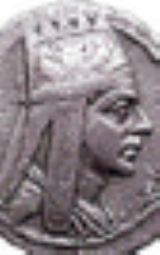
Armenians

Encyclopedia
Armenian people or Armenians are a nation
and ethnic group
native to the Armenian Highland
.
The largest concentration is in Armenia
having a nearly-homogeneous population with 97.9% or 3,145,354 being ethnic Armenian.
Because of wide-ranging and long-lasting diaspora
, an estimated total of 3 million people of full or partial Armenian ancestry live outside of Armenia. As a result of the Armenian genocide
, a large number of survivors fled to many countries throughout the world, most notably in Russia
, United States, France
, Iran
, Georgia
and other parts of Europe.(see Armenian diaspora
).
Christianity
began to spread in Armenia soon after Jesus
's death, due to the efforts of two of his apostles, St. Thaddeus and St. Bartholomew In the early 3rd century, Arsacid Armenia became the first nation to adopt Christianity as a state religion. Most Armenians adhere to the Armenian Apostolic Church
, a Non-Chalcedonian
church.
Armenian is an ancient Indo-European
language, which is not affiliated with any of the Indo-European language family's language groups. Armenians speak two mutually intelligible and written forms of their language
: Eastern Armenian (spoken mainly in Armenia, Iran and the former Soviet republics) and Western Armenian
(spoken primarily in the Armenian diaspora). The unique Armenian Alphabet
was invented in 406 AD by the medieval scholar and evangelizer Mesrob Mashtots.
. It is traditionally derived from Armenak or Aram
(the great-grandson of Hayk's great-grandson, and another leader who is, according to Armenian tradition, the ancestor of all Armenians). Armenians call themselves Hay (Հայ, pronounced Hay; plural: Հայեր, Hayer). The word has traditionally been linked to the name of the legendary founder of the Armenian nation, Hayk, which is also a popular Armenian name. It is also further postulated that the name Hay comes from the name of another Armenian tribe, the Hayasa.
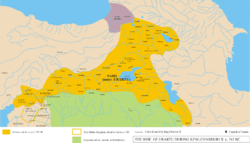 Greater Armenia
lies in the highlands surrounding Mount Ararat
, the highest peak of the region.
In the Bronze Age
, several states flourished in the area of Greater Armenia, including the Hittite Empire (at the height of its power), Mitanni
(South-Western historical Armenia), and Hayasa-Azzi
(1600-1200 BC). Soon after the Hayasa-Azzi were the Nairi (1400-1000 BC) and the Kingdom of Urartu (1000-600 BC), who successively established their sovereignty over the Armenian Highland
. Each of the aforementioned nations and tribes participated in the ethnogenesis of the Armenian people. Yerevan
, the modern capital of Armenia, was founded in 782 BC by king Argishti I.
A minority view also suggests that the Indo-European homeland may have been located in the Armenian Highland
.
by neighboring peoples (Hecataeus of Miletus and Behistun Inscription
) was established in the early 6th century BC under the Orontid dynasty
, which later became a kingdom. At its zenith (95–65 BC), the state extended from the Caucasus all the way to what is now central Turkey
, Lebanon
, and northern Iran
. The imperial reign of Tigranes the Great
is thus the span of time during which Armenia itself conquered areas populated by other peoples. Later it briefly became part of the Roman Empire
(AD 114–118).
The Arsacid Kingdom of Armenia was the first state to adopt Christianity
as its religion (it had formerly been adherent to Iranian and Hellenistic paganism – Zoroastrianism
, the Ancient Greek religion
and then the Ancient Roman religion). in the early years of the 4th century, likely AD 314.
Later on, in order to further strengthen the Armenian national identity, Mesrop Mashtots invented the Armenian alphabet. This event ushered the Golden Age of Armenia, during which many foreign books and manuscripts were translated to Armenian by Mesrop's pupils. Armenia lost its sovereignty in 428 to the Byzantine and Persian Empires.
. A considerable portion of the Armenian nobility and peasantry fled the Byzantine occupation of Bagratid Armenia in 1045, and the subsequent invasion of the region by Seljuk Turks in 1064. They settled in large numbers in Cilicia
, an Anatolian region where Armenians were already established as a minority since Roman times. In 1080, they founded an independent Armenian Principality then Kingdom of Cilicia
, which became the focus of Armenian nationalism
. The Armenians developed close social, cultural, military, and religious ties with nearby Crusader States
, but eventually succumbed to the Mamluk
invaders.
In the 16th century, Eastern Armenia was conquered by the Turco-Persian Safavid Empire, while Western Armenia fell under Ottoman rule. In the 1820s, parts of historic Armenia under Persian control centering on Yerevan
and Lake Sevan
were incorporated into the Russian Empire
, but Western Armenia remained in the Ottoman Empire.
of Armenians during the final years of the Ottoman Empire is widely considered a genocide
, an estimated 1.5 million victims, with one wave of persecution in the years 1894 to 1896 culminating in the events of the Armenian Genocide
in 1915 and 1916. With World War I
in progress, the Turks accused the (Christian) Armenians as liable to ally with Imperial Russia, and used it as a pretext to deal with the entire Armenian population as an enemy within their empire.
Turkish governments since that time have consistently rejected charges of genocide, typically arguing either that those Armenians who died were simply in the way of a war or that killings of Armenians were justified by their individual or collective support for the enemies of the Ottoman Empire. Passage of legislation in various foreign countries condemning the persecution of the Armenians as genocide has often provoked diplomatic conflict. (See Recognition of the Armenian Genocide
)
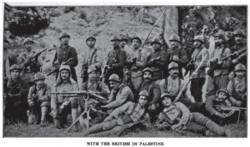 Following the breakup of the Russian Empire in the aftermath of World War I
for a brief period, from 1918 to 1920, Armenia was an independent republic
. In late 1920, the communists came to power following an invasion of Armenia by the Red Army
, and in 1922, Armenia became part of the Transcaucasian SFSR
of the Soviet Union
, later forming the Armenian Soviet Socialist Republic
(1936 to September 21, 1991). In 1991, Armenia
declared independence from the USSR and established the second Republic of Armenia.
for over four thousand years, since the time when Haik, the legendary patriarch and founder of the first Armenian nation, led them to victory over Bel
of Babylon
. Today, with a population of 3.5 million, they not only constitute an overwhelming majority in Armenia, but also in the disputed region of Nagorno-Karabakh
. Armenians in the diaspora informally refer to them as Hayastantsis (Հայաստանցի), meaning those that are from Armenia (that is, they or their ancestors were not forced to flee in 1915). They, as well as the Armenians of Iran and Russia speak the Eastern dialect of the Armenian language. The country itself is secular as a result of Soviet domination, but most of its citizens are Apostolic Armenian Christian.
, and one of the four quarters of the walled Old City of Jerusalem has been called the Armenian Quarter
. There are also remnants of formerly populous communities in India
, Myanmar, South East Asia, Poland
, Hungary
, Bulgaria
, Romania
, Serbia
, Ethiopia
, Sudan
and Egypt
.
However, most Armenians have scattered throughout the world as a direct consequence of the genocide of 1915, constituting the Armenian diaspora
. Armenian communities in and around the Georgian capital city of Tbilisi
, in Syria
and in Iran
existed since antiquity
.
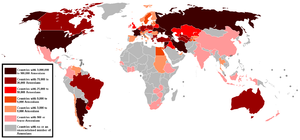 Within the diasporan Armenian community, there is an unofficial classification of the different kinds of Armenians. For example, Armenians who originate from Iran are referred to as Parskahay (Պարսկահայ), while Armenians from Lebanon are usually referred to as Lipananahay (Լիբանանահայ). Armenians of the Diaspora are the primary speakers of the Western dialect of the Armenian language. This dialect has considerable differences with Eastern Armenian, but speakers of either of the two variations can usually understand each other. Eastern Armenian in the diaspora is primarily spoken in Iran, Russia and former Soviet states such as Ukraine
and Georgia
(where they form a majority in the Samtskhe-Javakheti province). In diverse communities (such as in Canada and the U.S.) where many different kinds of Armenians live together, there is a tendency for the different groups to cluster together.
: indigenous polytheism with mixed Iranian elements.
In 301 AD, Armenia adopted Christianity
as a state religion, becoming the first nation to do so. It established a Church that still exists independently of both the Catholic and the Eastern Orthodox churches, having become so in 451 AD as a result of its excommunication
by the Council of Chalcedon
. Today this church is known as the Armenian Apostolic Church
, which is a part of the Oriental Orthodox communion, not to be confused with the Eastern Orthodox communion. During its later political eclipses, Armenia depended on the church to preserve and protect its unique identity. The original location of the Armenian Catholicosate is Echmiadzin. However, the continuous upheavals, which characterized the political scenes of Armenia, made the political power move to safer places. The Church center moved as well to different locations together with the political authority. Therefore, it eventually moved to Cilicia
as the Holy See of Cilicia.
The Armenians collective has, at times, constituted a Christian "island" in a mostly Muslim
region. There is, however, a minuscule minority of ethnic Armenian Muslims, known as Hamshenis
, while the history of the Jews in Armenia
dates back 2,000 years. The Armenian Kingdom of Cilicia
had close ties to European Crusader States
. Later on, the deteriorating situation in the region led the bishops of Armenia to elect a Catholicos in Etchmiadzin, the original seat of the Catholicosate. In 1441, a new Catholicos was elected in Etchmiadzin in the person of Kirakos Virapetsi, while Krikor Moussapegiants preserved his title as Catholicos of Cilicia. Therefore, since 1441, there have been two Catholicosates in the Armenian Church with equal rights and privileges, and with their respective jurisdictions. The primacy of honor of the Catholicosate of Etchmiadzin has always been recognized by the Catholicosate of Cilicia.
While the Armenian Apostolic Church remains the most prominent church in the Armenian community throughout the world, Armenians (especially in the diaspora) subscribe to any number of other Christian denominations. These include the Armenian Catholic Church
(which follows its own liturgy but recognizes the Roman Catholic Pope
), the Armenian Evangelical Church
, which started as a reformation in the Mother church but later broke away, and the Armenian Brotherhood Church
, which was born in the Armenian Evangelical Church, but later broke apart from it. There are other numerous Armenian churches belonging to Protestant denominations of all kinds.
Through the ages many Armenians have collectively belonged to other faiths or Christian movements, including the Paulicians which is a form of Gnostic and Manichaean Christianity. Paulicians sought to restore the pure Christianity of Paul and in c.660 founded the first congregation in Kibossa, Armenia.
Another example is the Tondrakians
, who flourished in medieval Armenia between the early 9th century and 11th century. Tondrakians advocated the abolishment of the Armenian Church, denied the immortality of the soul, did not believe in an afterlife, supported property rights for peasants, and equality between men and women.
The Orthodox
Armenians or the Chalcedonian Armenians in the Byzantine Impire were called Iberians ("Georgians") or "Greeks". See Gregory Pakourianos
- the great Byzantine general. Some of there descendants are the Catholic Armenians in Georgia.
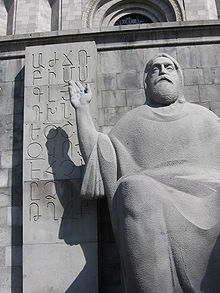 Armenian is a sub-branch of the Indo-European
family, and with some 8 million speakers one of the smallest surviving branches, comparable to Albanian
or the somewhat more widely spoken Greek
, with which it may be connected (see Graeco-Armenian
).
Five million Eastern Armenian speakers live in the Caucasus, Russia, and Iran, and approximately two to three million people in the rest of the Armenian diaspora
speak Western Armenian. According to US Census figures, there are 300,000 Americans who speak Armenian at home. It is in fact the twentieth most commonly spoken language in the United States, having slightly fewer speakers than Haitian Creole
, and slightly more than Navajo
.
Armenian literature dates back to 400 AD, when Mesrob Mashdots first invented the Armenian alphabet
. This period of time is often viewed as the Golden Age
of Armenian literature. Early Armenian literature was written by the "father of Armenian history", Moses of Chorene, who authored The History of Armenia. The book covers the time-frame from the formation of the Armenian people to the fifth century AD. The nineteenth century beheld a great literary movement that was to give rise to modern Armenian literature. This period of time, during which Armenian culture flourished, is known as the Revival period (Zartonki sherchan). The Revivalist authors of Constantinople
and Tiflis, almost identical to the Romanticists of Europe, were interested in encouraging Armenian nationalism. Most of them adopted the newly created Eastern or Western variants of the Armenian language depending on the targeted audience, and preferred them over classical Armenian (grabar). This period ended after the Hamidian massacres
, when Armenians experienced turbulent times. As Armenian history of the 1920s and of the Genocide came to be more openly discussed, writers like Paruyr Sevak
, Gevork Emin, Silva Kaputikyan
and Hovhannes Shiraz
began a new era of literature.
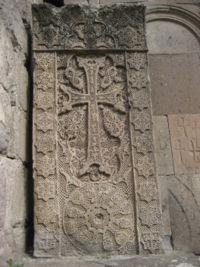 The first Armenian churches were built on the orders of St. Gregory the Illuminator, and were often built on top of pagan temples, and imitated some aspects of Armenian pre-Christian architecture.
Classical and Medieval Armenian Architecture is divided into four separate periods.
The first Armenian churches were built between the 4th and 7th century, beginning when Armenia converted to Christianity, and ending with the Arab invasion of Armenia. The early churches were mostly simple basilica
s, but some with side apses. By the fifth century the typical cupola cone in the center had become widely used. By the seventh century, centrally-planned churches had been built and a more complicated niched buttress and radiating Hrip'simé style had formed. By the time of the Arab invasion, most of what we now know as classical Armenian architecture had formed.
From the 9th to 11th century, Armenian architecture underwent a revival under the patronage of the Bagratid
Dynasty with a great deal of building done in the area of Lake Van
, this included both traditional styles and new innovations. Ornately carved Armenian Khachkars were developed during this time. Many new cities and churches were built during this time, including a new capital at Lake Van
and a new Cathedral on Akdamar Island
to match. The Cathedral of Ani
was also completed during this dynasty. It wad during this time that the first major monasteries, such as Haghpat
and Haritchavank
were built. This period was ended by the Seljuk
invasion.
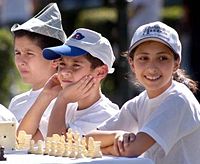 Many types of sports are played in Armenia, among the most popular being football, chess
, boxing
, basketball
, hockey
, sambo
, wrestling
, weightlifting and volleyball
. Since independence, the Armenian government has been actively rebuilding its sports program in the country.
During Soviet rule, Armenian athletes rose to prominence winning plenty of medals and helping the USSR win the medal standings at the Olympics on numerous occasions. The first medal won by an Armenian in modern Olympic history was by Hrant Shahinian, who won two golds and two silvers in gymnastics at the 1952 Summer Olympics
in Helsinki
. In football, their most successful team was Yerevan's FC Ararat
, which had claimed most of the Soviet championships in the 70s and had also gone to post victories against professional clubs like FC Bayern Munich
in the Euro cup.
Armenians have also been successful in chess, which is the most popular mind sport in Armenia. Some of the most prominent chess players in the world are Armenian such as Tigran Petrosian
, Levon Aronian
and Garry Kasparov
. Armenians have also been successful in weightlifting and wrestling, winning medals in each sport at the Olympics.
's well-known duduk
music, as well as light pop, and extensive Christian music
.
Instruments like the duduk, the dhol
, the zurna
and the kanun are commonly found in Armenian folk music. Artists such as Sayat Nova are famous due to their influence in the development of Armenian folk music. One of the oldest types of Armenian music is the Armenian chant
which is the most common kind of religious music in Armenia. Many of these chants are ancient in origin, extending to pre-Christian times, while others are relatively modern, including several composed by Saint Mesrop Mashtots, the inventor of the Armenian alphabet. Whilst under Soviet rule, Armenian classical music composer Aram Khatchaturian became internationally well known for his music, for various ballets and the Sabre Dance
from his composition for the ballet Gayane.
The Armenian Genocide caused widespread emigration that led to the settlement of Armenians in various countries in the world. Armenians kept to their traditions and certain diasporans rose to fame with their music. In the post-Genocide Armenian community of the United States, the so called "kef" style Armenian dance music, using Armenian and Middle Eastern folk instruments (often electrified/amplified) and some western instruments, was popular. This style preserved the folk songs and dances of Western Armenia
, and many artists also played the contemporary popular songs of Turkey and other Middle Eastern countries from which the Armenians emigrated. Richard Hagopian
is perhaps the most famous artist of the traditional "kef" style and the Vosbikian Band was notable in the 40s and 50s for developing their own style of "kef music" heavily influenced by the popular American Big Band
Jazz of the time. Later, stemming from the Middle Eastern Armenian diaspora and influenced by Continental European (especially French) pop music, the Armenian pop music genre grew to fame in the 60s and 70s with artists such as Adiss Harmandian
and Harout Pamboukjian
performing to the Armenian diaspora and Armenia. Also with artists such as Sirusho
, performing pop music combined with Armenian folk music in today's entertainment industry. Other Armenian diasporans that rose to fame in classical or international music circles are world renown French-Armenian singer and composer Charles Aznavour
, pianist Sahan Arzruni
, prominent opera sopranos such as Hasmik Papian
and more recently Isabel Bayrakdarian
and Anna Kasyan
. Certain Armenians settled to sing non-Armenian tunes such as the heavy metal band System of a Down
(which nonetheless often incorporates traditional Armenian instrumentals and styling into their songs) or pop star Cher
. In the Armenian diaspora, Armenian revolutionary songs
are popular with the youth. These songs encourage Armenian patriotism and are generally about Armenian history and national heroes.
from the region, referred to as Artsakh
(see also Karabakh carpet
) during the medieval era, is from the village of Banants (near Gandzak
) and dates to the early 13th century. The first time that the Armenian word for carpet, gorg, was used in historical sources was in a 1242-1243 Armenian inscription on the wall of the Kaptavan Church in Artsakh.
Art historian Hravard Hakobyan notes that "Artsakh carpets occupy a special place in the history of Armenian carpet-making." Common themes and patterns found on Armenian carpets were the depiction of dragons and eagles. They were diverse in style, rich in color and ornamental motifs, and were even separated in categories depending on what sort of animals were depicted on them, such as artsvagorgs (eagle-carpets), vishapagorgs (dragon-carpets) and otsagorgs (serpent-carpets). The rug mentioned in the Kaptavan inscriptions is composed of three arches, "covered with vegatative ornaments", and bears an artistic resemblance to the illuminated manuscripts produced in Artsakh.
The art of carpet weaving was in addition intimately connected to the making of curtains as evidenced in a passage by Kirakos Gandzaketsi
, a 13th century Armenian historian from Artsakh, who praised Arzu-Khatun, the wife of regional prince Vakhtang Khachenatsi, and her daughters for their expertise and skill in weaving.
Armenian carpets were also renowned by foreigners who traveled to Artsakh; the Arab geographer and historian Al-Masudi
noted that, among other works of art, he had never seen such carpets elsewhere in his life.
is a very popular Armenian rollable bread, and Armenian baklava
is a special treat. Other famous Armenian foods include the kabob (a skewer of marinated roasted meat and vegetables), t'pov dolma (minced lamb,or beef meat and rice wrapped in grape leaves), kaghambi dolma (minced meat and rice wrapped in cabbage), amarayin dolma (cored tomatoes, eggplants and green peppers stuffed with minced mixed meats and rice), and pilaf
, a tasty rice dish. Also, Ghapama,a rice dish, and many different salads are popular in Armenian culture. Fruits play a large part in the Armenian diet. Apricots (also known as Armenian Plum) native to this area and have really unique taste, peach
es are native too and are very popular; also common are grape
s, figs
, pomegranate
s, and melon
s.
haplotype is such that it is shared by Armenians and two other populations from the Caucasus.
is the most prominent Armenian institution today. Other important institutions include:
. Published in Costa Mesa, CA, by Mazda Publishers, they are:
Nation
A nation may refer to a community of people who share a common language, culture, ethnicity, descent, and/or history. In this definition, a nation has no physical borders. However, it can also refer to people who share a common territory and government irrespective of their ethnic make-up...
and ethnic group
Ethnic group
An ethnic group is a group of people whose members identify with each other, through a common heritage, often consisting of a common language, a common culture and/or an ideology that stresses common ancestry or endogamy...
native to the Armenian Highland
Armenian Highland
The Armenian Highland is the central-most and highest of three land-locked plateaus that together form the northern sector of the Middle East...
.
The largest concentration is in Armenia
Armenia
Armenia , officially the Republic of Armenia , is a landlocked mountainous country in the Caucasus region of Eurasia...
having a nearly-homogeneous population with 97.9% or 3,145,354 being ethnic Armenian.
Because of wide-ranging and long-lasting diaspora
Armenian diaspora
The Armenian diaspora refers to the Armenian communities outside the Republic of Armenia and self proclaimed de facto independent Nagorno-Karabakh Republic...
, an estimated total of 3 million people of full or partial Armenian ancestry live outside of Armenia. As a result of the Armenian genocide
Armenian Genocide
The Armenian Genocide—also known as the Armenian Holocaust, the Armenian Massacres and, by Armenians, as the Great Crime—refers to the deliberate and systematic destruction of the Armenian population of the Ottoman Empire during and just after World War I...
, a large number of survivors fled to many countries throughout the world, most notably in Russia
Armenians in Russia
Armenians in Russia or Russian Armenians are ethnic Armenians who live in Russia. The 2002 Russian census recorded 1,130,491 Armenians in the country, but most probably did not take into account the Armenian guest workers, most of whom do not hold Russian citizenship...
, United States, France
Armenians in France
Armenians in France are ethnic Armenians living within the modern republic of France. Like much of the Armenian Diaspora, most Armenians immigrated to France after the Armenian Genocide of 1915–1923. Others came later, fleeing conflicts in places like Lebanon, Syria, Egypt and Iran...
, Iran
Armenians in Iran
Iranian-Armenians , sometimes called Persian-Armenians, are Iranian citizens of Armenian origin. Their number is about 100,000. However, recent estimates put the numbers between 40,000-80,000 due to emigration. They mostly live in Tehran and Jolfa district, Isfahan...
, Georgia
Armenians in Georgia
Armenians in Georgia are ethnic Armenians living within the country of Georgia. Armenians are the second largest ethnic minority in Georgia at about 5.7% of the population. The Armenian community is mostly concentrated in the capital Tbilisi and the Samtskhe-Javakheti region, which borders Armenia...
and other parts of Europe.(see Armenian diaspora
Armenian diaspora
The Armenian diaspora refers to the Armenian communities outside the Republic of Armenia and self proclaimed de facto independent Nagorno-Karabakh Republic...
).
Christianity
Christianity
Christianity is a monotheistic religion based on the life and teachings of Jesus as presented in canonical gospels and other New Testament writings...
began to spread in Armenia soon after Jesus
Jesus
Jesus of Nazareth , commonly referred to as Jesus Christ or simply as Jesus or Christ, is the central figure of Christianity...
's death, due to the efforts of two of his apostles, St. Thaddeus and St. Bartholomew In the early 3rd century, Arsacid Armenia became the first nation to adopt Christianity as a state religion. Most Armenians adhere to the Armenian Apostolic Church
Armenian Apostolic Church
The Armenian Apostolic Church is the world's oldest National Church, is part of Oriental Orthodoxy, and is one of the most ancient Christian communities. Armenia was the first country to adopt Christianity as its official religion in 301 AD, in establishing this church...
, a Non-Chalcedonian
Non-Chalcedonian
Non-Chalcedonianism is the view of those churches that accepted the First Council of Ephesus of 431, but, for varying reasons, did not accept allegiance to the Council of Chalcedon following it in 451. The most substantial Non-Chalcedonian tradition is known as Oriental Orthodoxy...
church.
Armenian is an ancient Indo-European
Indo-European
Indo-European may refer to:* Indo-European languages** Aryan race, a 19th century and early 20th century term for those peoples who are the native speakers of Indo-European languages...
language, which is not affiliated with any of the Indo-European language family's language groups. Armenians speak two mutually intelligible and written forms of their language
Armenian language
The Armenian language is an Indo-European language spoken by the Armenian people. It is the official language of the Republic of Armenia as well as in the region of Nagorno-Karabakh. The language is also widely spoken by Armenian communities in the Armenian diaspora...
: Eastern Armenian (spoken mainly in Armenia, Iran and the former Soviet republics) and Western Armenian
Western Armenian language
Western Armenian is one of the two standardized forms of modern Armenian, the other being Eastern Armenian. The two standard forms form a pluricentric language. For historical reasons explained below, generally speaking, Western Armenian is used outside the Republic of Armenia, while Eastern...
(spoken primarily in the Armenian diaspora). The unique Armenian Alphabet
Armenian alphabet
The Armenian alphabet is an alphabet that has been used to write the Armenian language since the year 405 or 406. It was devised by Saint Mesrop Mashtots, an Armenian linguist and ecclesiastical leader, and contained originally 36 letters. Two more letters, օ and ֆ, were added in the Middle Ages...
was invented in 406 AD by the medieval scholar and evangelizer Mesrob Mashtots.
Name
Historically, the name Armenian has come to internationally designate this group of people. It was first used by neighbouring countries of ancient ArmeniaArmenia
Armenia , officially the Republic of Armenia , is a landlocked mountainous country in the Caucasus region of Eurasia...
. It is traditionally derived from Armenak or Aram
Aram
-Bible:* Aram, son of Shem, according to the "Table of Nations" in Genesis 10* Aram-Naharaim , the land in which the city of Haran lay* Aram , an ancient region containing the state of Aram Damascus...
(the great-grandson of Hayk's great-grandson, and another leader who is, according to Armenian tradition, the ancestor of all Armenians). Armenians call themselves Hay (Հայ, pronounced Hay; plural: Հայեր, Hayer). The word has traditionally been linked to the name of the legendary founder of the Armenian nation, Hayk, which is also a popular Armenian name. It is also further postulated that the name Hay comes from the name of another Armenian tribe, the Hayasa.
Prehistoric origins
Greater Armenia (political concept)
Greater Armenia or United Armenia refers to an irredentist concept of the territory claimed by some Armenian nationalist groups outside the Republic of Armenia which are considered part of national homeland by Armenians, based on the present-day and historical presence of Armenian...
lies in the highlands surrounding Mount Ararat
Mount Ararat
Mount Ararat is a snow-capped, dormant volcanic cone in Turkey. It has two peaks: Greater Ararat and Lesser Ararat .The Ararat massif is about in diameter...
, the highest peak of the region.
In the Bronze Age
Bronze Age
The Bronze Age is a period characterized by the use of copper and its alloy bronze as the chief hard materials in the manufacture of some implements and weapons. Chronologically, it stands between the Stone Age and Iron Age...
, several states flourished in the area of Greater Armenia, including the Hittite Empire (at the height of its power), Mitanni
Mitanni
Mitanni or Hanigalbat was a loosely organized Hurrian-speaking state in northern Syria and south-east Anatolia from ca. 1500 BC–1300 BC...
(South-Western historical Armenia), and Hayasa-Azzi
Hayasa-Azzi
Hayasa-Azzi or Azzi-Hayasa was a Late Bronze Age confederation formed between two petty kingdoms of Anatolia, Hayasa located South of Trabzon and Azzi, located North of the Euphrates and to the South of Hayasa...
(1600-1200 BC). Soon after the Hayasa-Azzi were the Nairi (1400-1000 BC) and the Kingdom of Urartu (1000-600 BC), who successively established their sovereignty over the Armenian Highland
Armenian Highland
The Armenian Highland is the central-most and highest of three land-locked plateaus that together form the northern sector of the Middle East...
. Each of the aforementioned nations and tribes participated in the ethnogenesis of the Armenian people. Yerevan
Yerevan
Yerevan is the capital and largest city of Armenia and one of the world's oldest continuously-inhabited cities. Situated along the Hrazdan River, Yerevan is the administrative, cultural, and industrial center of the country...
, the modern capital of Armenia, was founded in 782 BC by king Argishti I.
A minority view also suggests that the Indo-European homeland may have been located in the Armenian Highland
Armenian Highland
The Armenian Highland is the central-most and highest of three land-locked plateaus that together form the northern sector of the Middle East...
.
Antiquity
The first state that was called ArmeniaSatrapy of Armenia
The Satrapy of Armenia , also known as Orontid Armenia after the ruling Orontid Dynasty, was one of the satrapies of the Achaemenid Empire in the 6th century BC, which later became an independent kingdom...
by neighboring peoples (Hecataeus of Miletus and Behistun Inscription
Behistun Inscription
The Behistun Inscription The Behistun Inscription The Behistun Inscription (also Bistun or Bisutun, Modern Persian: بیستون The Behistun Inscription (also Bistun or Bisutun, Modern Persian: بیستون...
) was established in the early 6th century BC under the Orontid dynasty
Orontid Dynasty
The Orontid Dynasty The Orontid Dynasty The Orontid Dynasty (also known by their native name, Yervanduni was a hereditary Armenian dynasty and the rulers of the successor state to the Iron Age kingdom of Ararat...
, which later became a kingdom. At its zenith (95–65 BC), the state extended from the Caucasus all the way to what is now central Turkey
Turkey
Turkey , known officially as the Republic of Turkey , is a Eurasian country located in Western Asia and in East Thrace in Southeastern Europe...
, Lebanon
Lebanon
Lebanon , officially the Republic of LebanonRepublic of Lebanon is the most common term used by Lebanese government agencies. The term Lebanese Republic, a literal translation of the official Arabic and French names that is not used in today's world. Arabic is the most common language spoken among...
, and northern Iran
Iran
Iran , officially the Islamic Republic of Iran , is a country in Southern and Western Asia. The name "Iran" has been in use natively since the Sassanian era and came into use internationally in 1935, before which the country was known to the Western world as Persia...
. The imperial reign of Tigranes the Great
Tigranes the Great
Tigranes the Great was emperor of Armenia under whom the country became, for a short time, the strongest state east of the Roman Republic. He was a member of the Artaxiad Royal House...
is thus the span of time during which Armenia itself conquered areas populated by other peoples. Later it briefly became part of the Roman Empire
Roman Empire
The Roman Empire was the post-Republican period of the ancient Roman civilization, characterised by an autocratic form of government and large territorial holdings in Europe and around the Mediterranean....
(AD 114–118).
The Arsacid Kingdom of Armenia was the first state to adopt Christianity
Christianity
Christianity is a monotheistic religion based on the life and teachings of Jesus as presented in canonical gospels and other New Testament writings...
as its religion (it had formerly been adherent to Iranian and Hellenistic paganism – Zoroastrianism
Zoroastrianism
Zoroastrianism is a religion and philosophy based on the teachings of prophet Zoroaster and was formerly among the world's largest religions. It was probably founded some time before the 6th century BCE in Greater Iran.In Zoroastrianism, the Creator Ahura Mazda is all good, and no evil...
, the Ancient Greek religion
Ancient Greek religion
Greek religion encompasses the collection of beliefs and rituals practiced in ancient Greece in the form of both popular public religion and cult practices. These different groups varied enough for it to be possible to speak of Greek religions or "cults" in the plural, though most of them shared...
and then the Ancient Roman religion). in the early years of the 4th century, likely AD 314.
Later on, in order to further strengthen the Armenian national identity, Mesrop Mashtots invented the Armenian alphabet. This event ushered the Golden Age of Armenia, during which many foreign books and manuscripts were translated to Armenian by Mesrop's pupils. Armenia lost its sovereignty in 428 to the Byzantine and Persian Empires.
Middle Ages
In 885 the Armenians reestablished themselves as a sovereign entity under the leadership of Ashot I of the Bagratid DynastyBagratuni Dynasty
The Bagratuni, Bagratid or alternatively Pakradouni royal dynasty of Armenia was a royal family whose branches formerly ruled many regional polities, including the Armenian lands of Sper|presently Ispir in Tayk Province of the Armenian Kingdom, Bagrevand in Ayrarat Province of the Armenian...
. A considerable portion of the Armenian nobility and peasantry fled the Byzantine occupation of Bagratid Armenia in 1045, and the subsequent invasion of the region by Seljuk Turks in 1064. They settled in large numbers in Cilicia
Cilicia
In antiquity, Cilicia was the south coastal region of Asia Minor, south of the central Anatolian plateau. It existed as a political entity from Hittite times into the Byzantine empire...
, an Anatolian region where Armenians were already established as a minority since Roman times. In 1080, they founded an independent Armenian Principality then Kingdom of Cilicia
Armenian Kingdom of Cilicia
The Armenian Kingdom of Cilicia , also known as the Cilician Armenia, Kingdom of Cilician Armenia or New Armenia, was an independent principality formed during the High Middle Ages by Armenian refugees fleeing the Seljuk invasion of Armenia...
, which became the focus of Armenian nationalism
Nationalism
Nationalism is a political ideology that involves a strong identification of a group of individuals with a political entity defined in national terms, i.e. a nation. In the 'modernist' image of the nation, it is nationalism that creates national identity. There are various definitions for what...
. The Armenians developed close social, cultural, military, and religious ties with nearby Crusader States
Crusader states
The Crusader states were a number of mostly 12th- and 13th-century feudal states created by Western European crusaders in Asia Minor, Greece and the Holy Land , and during the Northern Crusades in the eastern Baltic area...
, but eventually succumbed to the Mamluk
Mamluk
A Mamluk was a soldier of slave origin, who were predominantly Cumans/Kipchaks The "mamluk phenomenon", as David Ayalon dubbed the creation of the specific warrior...
invaders.
In the 16th century, Eastern Armenia was conquered by the Turco-Persian Safavid Empire, while Western Armenia fell under Ottoman rule. In the 1820s, parts of historic Armenia under Persian control centering on Yerevan
Yerevan
Yerevan is the capital and largest city of Armenia and one of the world's oldest continuously-inhabited cities. Situated along the Hrazdan River, Yerevan is the administrative, cultural, and industrial center of the country...
and Lake Sevan
Lake Sevan
Lake Sevan is the largest lake in Armenia and the Caucasus region. It is one of the largest high-altitude lakes in the world.Lake Sevan is situated in the central part of the Republic of Armenia, inside the Gegharkunik Province, at the altitude of 1,900m above sea level...
were incorporated into the Russian Empire
Russian Empire
The Russian Empire was a state that existed from 1721 until the Russian Revolution of 1917. It was the successor to the Tsardom of Russia and the predecessor of the Soviet Union...
, but Western Armenia remained in the Ottoman Empire.
Modern history
The ethnic cleansingEthnic cleansing
Ethnic cleansing is a purposeful policy designed by one ethnic or religious group to remove by violent and terror-inspiring means the civilian population of another ethnic orreligious group from certain geographic areas....
of Armenians during the final years of the Ottoman Empire is widely considered a genocide
Genocide
Genocide is defined as "the deliberate and systematic destruction, in whole or in part, of an ethnic, racial, religious, or national group", though what constitutes enough of a "part" to qualify as genocide has been subject to much debate by legal scholars...
, an estimated 1.5 million victims, with one wave of persecution in the years 1894 to 1896 culminating in the events of the Armenian Genocide
Armenian Genocide
The Armenian Genocide—also known as the Armenian Holocaust, the Armenian Massacres and, by Armenians, as the Great Crime—refers to the deliberate and systematic destruction of the Armenian population of the Ottoman Empire during and just after World War I...
in 1915 and 1916. With World War I
World War I
World War I , which was predominantly called the World War or the Great War from its occurrence until 1939, and the First World War or World War I thereafter, was a major war centred in Europe that began on 28 July 1914 and lasted until 11 November 1918...
in progress, the Turks accused the (Christian) Armenians as liable to ally with Imperial Russia, and used it as a pretext to deal with the entire Armenian population as an enemy within their empire.
Turkish governments since that time have consistently rejected charges of genocide, typically arguing either that those Armenians who died were simply in the way of a war or that killings of Armenians were justified by their individual or collective support for the enemies of the Ottoman Empire. Passage of legislation in various foreign countries condemning the persecution of the Armenians as genocide has often provoked diplomatic conflict. (See Recognition of the Armenian Genocide
Recognition of the Armenian Genocide
Armenian Genocide recognition refers to the formal acceptance that the massacre and forced deportation of Armenians committed by the Ottoman Empire in 1915-1923 constitute genocide...
)
Aftermath of World War I
The fighting in World War I ended in western Europe when the Armistice took effect at 11:00 am GMT on November 11, 1918, and in eastern Europe by the early 1920s. During and in the aftermath of the war the political, cultural, and social order was drastically changed in Europe, Asia and Africa,...
for a brief period, from 1918 to 1920, Armenia was an independent republic
Democratic Republic of Armenia
The Democratic Republic of Armenia was the first modern establishment of an Armenian state...
. In late 1920, the communists came to power following an invasion of Armenia by the Red Army
Red Army
The Workers' and Peasants' Red Army started out as the Soviet Union's revolutionary communist combat groups during the Russian Civil War of 1918-1922. It grew into the national army of the Soviet Union. By the 1930s the Red Army was among the largest armies in history.The "Red Army" name refers to...
, and in 1922, Armenia became part of the Transcaucasian SFSR
Transcaucasian SFSR
The Transcaucasian Socialist Federative Soviet Republic , also known as the Transcaucasian Soviet Federative Socialist Republic, the Transcaucasian SFSR and the TSFSR for short, was a short-lived republic of the Soviet Union, lasting from 1922 to 1936...
of the Soviet Union
Soviet Union
The Soviet Union , officially the Union of Soviet Socialist Republics , was a constitutionally socialist state that existed in Eurasia between 1922 and 1991....
, later forming the Armenian Soviet Socialist Republic
Armenian SSR
The Armenian Soviet Socialist Republic The Armenian Soviet Socialist Republic The Armenian Soviet Socialist Republic The Armenian Soviet Socialist Republic The Armenian Soviet Socialist Republic The Armenian Soviet Socialist Republic The Armenian Soviet Socialist Republic The Armenian Soviet...
(1936 to September 21, 1991). In 1991, Armenia
Armenia
Armenia , officially the Republic of Armenia , is a landlocked mountainous country in the Caucasus region of Eurasia...
declared independence from the USSR and established the second Republic of Armenia.
Geographic distribution
Armenia
Armenians have had a presence in the Armenian HighlandArmenian Highland
The Armenian Highland is the central-most and highest of three land-locked plateaus that together form the northern sector of the Middle East...
for over four thousand years, since the time when Haik, the legendary patriarch and founder of the first Armenian nation, led them to victory over Bel
Belus (Assyrian)
Belus or Belos in classical Greek or classical Latin texts in an Assyrian context refers to one or another purportedly ancient and historically nonexistent Assyrian king, such king in part at least a euhemerization of the Babylonian god Bel Marduk.Belus most commonly appears as the father of...
of Babylon
Babylon
Babylon was an Akkadian city-state of ancient Mesopotamia, the remains of which are found in present-day Al Hillah, Babil Province, Iraq, about 85 kilometers south of Baghdad...
. Today, with a population of 3.5 million, they not only constitute an overwhelming majority in Armenia, but also in the disputed region of Nagorno-Karabakh
Nagorno-Karabakh
Nagorno-Karabakh is a landlocked region in the South Caucasus, lying between Lower Karabakh and Zangezur and covering the southeastern range of the Lesser Caucasus mountains...
. Armenians in the diaspora informally refer to them as Hayastantsis (Հայաստանցի), meaning those that are from Armenia (that is, they or their ancestors were not forced to flee in 1915). They, as well as the Armenians of Iran and Russia speak the Eastern dialect of the Armenian language. The country itself is secular as a result of Soviet domination, but most of its citizens are Apostolic Armenian Christian.
Diaspora
Small Armenian trading communities have existed outside of Armenia for centuries. For example, a community has existed for over a millennium in the Holy LandHoly Land
The Holy Land is a term which in Judaism refers to the Kingdom of Israel as defined in the Tanakh. For Jews, the Land's identifiction of being Holy is defined in Judaism by its differentiation from other lands by virtue of the practice of Judaism often possible only in the Land of Israel...
, and one of the four quarters of the walled Old City of Jerusalem has been called the Armenian Quarter
Armenian Quarter
The Armenian Quarter is one of the four quarters of the Old City of Jerusalem. The Armenian Quarter is the smallest of the four quarters, with the smallest number of residents....
. There are also remnants of formerly populous communities in India
Armenians in India
The association of Armenians with India and the presence of Armenians in India are very old, and there has been a mutual economic and cultural association of Armenians with India for the last several centuries...
, Myanmar, South East Asia, Poland
Poland
Poland , officially the Republic of Poland , is a country in Central Europe bordered by Germany to the west; the Czech Republic and Slovakia to the south; Ukraine, Belarus and Lithuania to the east; and the Baltic Sea and Kaliningrad Oblast, a Russian exclave, to the north...
, Hungary
Hungary
Hungary , officially the Republic of Hungary , is a landlocked country in Central Europe. It is situated in the Carpathian Basin and is bordered by Slovakia to the north, Ukraine and Romania to the east, Serbia and Croatia to the south, Slovenia to the southwest and Austria to the west. The...
, Bulgaria
Bulgaria
Bulgaria , officially the Republic of Bulgaria , is a parliamentary democracy within a unitary constitutional republic in Southeast Europe. The country borders Romania to the north, Serbia and Macedonia to the west, Greece and Turkey to the south, as well as the Black Sea to the east...
, Romania
Romania
Romania is a country located at the crossroads of Central and Southeastern Europe, on the Lower Danube, within and outside the Carpathian arch, bordering on the Black Sea...
, Serbia
Serbia
Serbia , officially the Republic of Serbia , is a landlocked country located at the crossroads of Central and Southeast Europe, covering the southern part of the Carpathian basin and the central part of the Balkans...
, Ethiopia
Ethiopia
Ethiopia , officially known as the Federal Democratic Republic of Ethiopia, is a country located in the Horn of Africa. It is the second-most populous nation in Africa, with over 82 million inhabitants, and the tenth-largest by area, occupying 1,100,000 km2...
, Sudan
Sudan
Sudan , officially the Republic of the Sudan , is a country in North Africa, sometimes considered part of the Middle East politically. It is bordered by Egypt to the north, the Red Sea to the northeast, Eritrea and Ethiopia to the east, South Sudan to the south, the Central African Republic to the...
and Egypt
Egypt
Egypt , officially the Arab Republic of Egypt, Arabic: , is a country mainly in North Africa, with the Sinai Peninsula forming a land bridge in Southwest Asia. Egypt is thus a transcontinental country, and a major power in Africa, the Mediterranean Basin, the Middle East and the Muslim world...
.
However, most Armenians have scattered throughout the world as a direct consequence of the genocide of 1915, constituting the Armenian diaspora
Armenian diaspora
The Armenian diaspora refers to the Armenian communities outside the Republic of Armenia and self proclaimed de facto independent Nagorno-Karabakh Republic...
. Armenian communities in and around the Georgian capital city of Tbilisi
Tbilisi
Tbilisi is the capital and the largest city of Georgia, lying on the banks of the Mt'k'vari River. The name is derived from an early Georgian form T'pilisi and it was officially known as Tiflis until 1936...
, in Syria
Syria
Syria , officially the Syrian Arab Republic , is a country in Western Asia, bordering Lebanon and the Mediterranean Sea to the West, Turkey to the north, Iraq to the east, Jordan to the south, and Israel to the southwest....
and in Iran
Iran
Iran , officially the Islamic Republic of Iran , is a country in Southern and Western Asia. The name "Iran" has been in use natively since the Sassanian era and came into use internationally in 1935, before which the country was known to the Western world as Persia...
existed since antiquity
Ancient history
Ancient history is the study of the written past from the beginning of recorded human history to the Early Middle Ages. The span of recorded history is roughly 5,000 years, with Cuneiform script, the oldest discovered form of coherent writing, from the protoliterate period around the 30th century BC...
.
Ukraine
Ukraine is a country in Eastern Europe. It has an area of 603,628 km², making it the second largest contiguous country on the European continent, after Russia...
and Georgia
Georgia (country)
Georgia is a sovereign state in the Caucasus region of Eurasia. Located at the crossroads of Western Asia and Eastern Europe, it is bounded to the west by the Black Sea, to the north by Russia, to the southwest by Turkey, to the south by Armenia, and to the southeast by Azerbaijan. The capital of...
(where they form a majority in the Samtskhe-Javakheti province). In diverse communities (such as in Canada and the U.S.) where many different kinds of Armenians live together, there is a tendency for the different groups to cluster together.
Religion
Before Christianity, Armenians adhered to a syncretistic paganismPaganism
Paganism is a blanket term, typically used to refer to non-Abrahamic, indigenous polytheistic religious traditions....
: indigenous polytheism with mixed Iranian elements.
In 301 AD, Armenia adopted Christianity
Christianity
Christianity is a monotheistic religion based on the life and teachings of Jesus as presented in canonical gospels and other New Testament writings...
as a state religion, becoming the first nation to do so. It established a Church that still exists independently of both the Catholic and the Eastern Orthodox churches, having become so in 451 AD as a result of its excommunication
Excommunication
Excommunication is a religious censure used to deprive, suspend or limit membership in a religious community. The word means putting [someone] out of communion. In some religions, excommunication includes spiritual condemnation of the member or group...
by the Council of Chalcedon
Council of Chalcedon
The Council of Chalcedon was a church council held from 8 October to 1 November, 451 AD, at Chalcedon , on the Asian side of the Bosporus. The council marked a significant turning point in the Christological debates that led to the separation of the church of the Eastern Roman Empire in the 5th...
. Today this church is known as the Armenian Apostolic Church
Armenian Apostolic Church
The Armenian Apostolic Church is the world's oldest National Church, is part of Oriental Orthodoxy, and is one of the most ancient Christian communities. Armenia was the first country to adopt Christianity as its official religion in 301 AD, in establishing this church...
, which is a part of the Oriental Orthodox communion, not to be confused with the Eastern Orthodox communion. During its later political eclipses, Armenia depended on the church to preserve and protect its unique identity. The original location of the Armenian Catholicosate is Echmiadzin. However, the continuous upheavals, which characterized the political scenes of Armenia, made the political power move to safer places. The Church center moved as well to different locations together with the political authority. Therefore, it eventually moved to Cilicia
Cilicia
In antiquity, Cilicia was the south coastal region of Asia Minor, south of the central Anatolian plateau. It existed as a political entity from Hittite times into the Byzantine empire...
as the Holy See of Cilicia.
The Armenians collective has, at times, constituted a Christian "island" in a mostly Muslim
Muslim
A Muslim, also spelled Moslem, is an adherent of Islam, a monotheistic, Abrahamic religion based on the Quran, which Muslims consider the verbatim word of God as revealed to prophet Muhammad. "Muslim" is the Arabic term for "submitter" .Muslims believe that God is one and incomparable...
region. There is, however, a minuscule minority of ethnic Armenian Muslims, known as Hamshenis
Hamshenis
The Hemshin Peoples or Hemshinli are a diverse group of people who in the past history or present have been affiliated with the Hemşin district in the province of Rize, Turkey. They are called as Hemshinli , Hamshenis, Homshentsi meaning resident of Hemshin in the relevant language...
, while the history of the Jews in Armenia
History of the Jews in Armenia
The history of the Jews in Armenia dates back more than 2,000 years.-Armenian Kingdom:Tournebize holds that the Assyrians deported Jews directly to Armenia, and not to the Khabur valley. Aslan mentions that the Jews of Samaria were deported to Armenia....
dates back 2,000 years. The Armenian Kingdom of Cilicia
Armenian Kingdom of Cilicia
The Armenian Kingdom of Cilicia , also known as the Cilician Armenia, Kingdom of Cilician Armenia or New Armenia, was an independent principality formed during the High Middle Ages by Armenian refugees fleeing the Seljuk invasion of Armenia...
had close ties to European Crusader States
Crusader states
The Crusader states were a number of mostly 12th- and 13th-century feudal states created by Western European crusaders in Asia Minor, Greece and the Holy Land , and during the Northern Crusades in the eastern Baltic area...
. Later on, the deteriorating situation in the region led the bishops of Armenia to elect a Catholicos in Etchmiadzin, the original seat of the Catholicosate. In 1441, a new Catholicos was elected in Etchmiadzin in the person of Kirakos Virapetsi, while Krikor Moussapegiants preserved his title as Catholicos of Cilicia. Therefore, since 1441, there have been two Catholicosates in the Armenian Church with equal rights and privileges, and with their respective jurisdictions. The primacy of honor of the Catholicosate of Etchmiadzin has always been recognized by the Catholicosate of Cilicia.
While the Armenian Apostolic Church remains the most prominent church in the Armenian community throughout the world, Armenians (especially in the diaspora) subscribe to any number of other Christian denominations. These include the Armenian Catholic Church
Armenian Catholic Church
|- |The Armenian Catholic Church is an Eastern Catholic Church sui juris in union with the other Eastern Rite, Oriental Rite and Latin Rite Catholics who accept the Bishop of Rome as spiritual leader of the Church. It is regulated by Eastern canon law...
(which follows its own liturgy but recognizes the Roman Catholic Pope
Pope
The Pope is the Bishop of Rome, a position that makes him the leader of the worldwide Catholic Church . In the Catholic Church, the Pope is regarded as the successor of Saint Peter, the Apostle...
), the Armenian Evangelical Church
Armenian Evangelical Church
The Armenian Evangelical Church was established on July 1, 1846 by thirty-seven men and three women in Constantinople.-History:In the 19th century there was intellectual and spiritual awakening in Constantinople. This awakening and enlightenment pushed the reformists to study the Bible...
, which started as a reformation in the Mother church but later broke away, and the Armenian Brotherhood Church
Armenian Brotherhood Church
The Armenian Brotherhood Church started within the Armenian Evangelical Church in the 19th century....
, which was born in the Armenian Evangelical Church, but later broke apart from it. There are other numerous Armenian churches belonging to Protestant denominations of all kinds.
Through the ages many Armenians have collectively belonged to other faiths or Christian movements, including the Paulicians which is a form of Gnostic and Manichaean Christianity. Paulicians sought to restore the pure Christianity of Paul and in c.660 founded the first congregation in Kibossa, Armenia.
Another example is the Tondrakians
Tondrakians
Tondrakians were members of an anti-feudal, heretical Christian sect that flourished in medieval Armenia between the early 9th century and 11th century and centered around the city of Tondrak, north of Lake Van in Western Armenia.-History:...
, who flourished in medieval Armenia between the early 9th century and 11th century. Tondrakians advocated the abolishment of the Armenian Church, denied the immortality of the soul, did not believe in an afterlife, supported property rights for peasants, and equality between men and women.
The Orthodox
Eastern Orthodox Church
The Orthodox Church, officially called the Orthodox Catholic Church and commonly referred to as the Eastern Orthodox Church, is the second largest Christian denomination in the world, with an estimated 300 million adherents mainly in the countries of Belarus, Bulgaria, Cyprus, Georgia, Greece,...
Armenians or the Chalcedonian Armenians in the Byzantine Impire were called Iberians ("Georgians") or "Greeks". See Gregory Pakourianos
Gregory Pakourianos
Gregory Pakourianos was a politician and military commander in the Byzantine service. He was the founder of the Monastery of the Mother of God Petritzonitissa in Bachkovo and author of its typikon...
- the great Byzantine general. Some of there descendants are the Catholic Armenians in Georgia.
Language and literature
Indo-European languages
The Indo-European languages are a family of several hundred related languages and dialects, including most major current languages of Europe, the Iranian plateau, and South Asia and also historically predominant in Anatolia...
family, and with some 8 million speakers one of the smallest surviving branches, comparable to Albanian
Albanian language
Albanian is an Indo-European language spoken by approximately 7.6 million people, primarily in Albania and Kosovo but also in other areas of the Balkans in which there is an Albanian population, including western Macedonia, southern Montenegro, southern Serbia and northwestern Greece...
or the somewhat more widely spoken Greek
Greek language
Greek is an independent branch of the Indo-European family of languages. Native to the southern Balkans, it has the longest documented history of any Indo-European language, spanning 34 centuries of written records. Its writing system has been the Greek alphabet for the majority of its history;...
, with which it may be connected (see Graeco-Armenian
Graeco-Armenian
Graeco-Armenian is the hypothetical common ancestor of the Greek and Armenian languages which postdates the Proto-Indo-European...
).
Five million Eastern Armenian speakers live in the Caucasus, Russia, and Iran, and approximately two to three million people in the rest of the Armenian diaspora
Armenian diaspora
The Armenian diaspora refers to the Armenian communities outside the Republic of Armenia and self proclaimed de facto independent Nagorno-Karabakh Republic...
speak Western Armenian. According to US Census figures, there are 300,000 Americans who speak Armenian at home. It is in fact the twentieth most commonly spoken language in the United States, having slightly fewer speakers than Haitian Creole
Haitian Creole language
Haitian Creole language , often called simply Creole or Kreyòl, is a language spoken in Haiti by about twelve million people, which includes all Haitians in Haiti and via emigration, by about two to three million speakers residing in the Bahamas, Cuba, Canada, France, Cayman Islands, French...
, and slightly more than Navajo
Navajo language
Navajo or Navaho is an Athabaskan language spoken in the southwestern United States. It is geographically and linguistically one of the Southern Athabaskan languages .Navajo has more speakers than any other Native American language north of the...
.
Armenian literature dates back to 400 AD, when Mesrob Mashdots first invented the Armenian alphabet
Armenian alphabet
The Armenian alphabet is an alphabet that has been used to write the Armenian language since the year 405 or 406. It was devised by Saint Mesrop Mashtots, an Armenian linguist and ecclesiastical leader, and contained originally 36 letters. Two more letters, օ and ֆ, were added in the Middle Ages...
. This period of time is often viewed as the Golden Age
Golden Age
The term Golden Age comes from Greek mythology and legend and refers to the first in a sequence of four or five Ages of Man, in which the Golden Age is first, followed in sequence, by the Silver, Bronze, and Iron Ages, and then the present, a period of decline...
of Armenian literature. Early Armenian literature was written by the "father of Armenian history", Moses of Chorene, who authored The History of Armenia. The book covers the time-frame from the formation of the Armenian people to the fifth century AD. The nineteenth century beheld a great literary movement that was to give rise to modern Armenian literature. This period of time, during which Armenian culture flourished, is known as the Revival period (Zartonki sherchan). The Revivalist authors of Constantinople
Constantinople
Constantinople was the capital of the Roman, Eastern Roman, Byzantine, Latin, and Ottoman Empires. Throughout most of the Middle Ages, Constantinople was Europe's largest and wealthiest city.-Names:...
and Tiflis, almost identical to the Romanticists of Europe, were interested in encouraging Armenian nationalism. Most of them adopted the newly created Eastern or Western variants of the Armenian language depending on the targeted audience, and preferred them over classical Armenian (grabar). This period ended after the Hamidian massacres
Hamidian massacres
The Hamidian massacres , also referred to as the Armenian Massacres of 1894–1896, refers to the massacring of Armenians by the Ottoman Empire, with estimates of the dead ranging from anywhere between 80,000 to 300,000, and at least 50,000 orphans as a result...
, when Armenians experienced turbulent times. As Armenian history of the 1920s and of the Genocide came to be more openly discussed, writers like Paruyr Sevak
Paruyr Sevak
Paruyr Rafaeli Ghazaryan was an Armenian poet. He is considered one of the greatest Armenian poets of the twentieth century. -Biography:...
, Gevork Emin, Silva Kaputikyan
Silva Kaputikyan
Sirvard Barunaki "Silva" Kaputikyan was a 20th century prominent Armenian poet, writer, academian and public activist....
and Hovhannes Shiraz
Hovhannes Shiraz
Hovhannes Shiraz was a notable Armenian poet.- Biography :He was born Hovhannes Karapetyan in the city of Alexandropol, then part of the Russian Empire . His first work called Beginning of Spring was published in 1935...
began a new era of literature.
Architecture
Classical and Medieval Armenian Architecture is divided into four separate periods.
The first Armenian churches were built between the 4th and 7th century, beginning when Armenia converted to Christianity, and ending with the Arab invasion of Armenia. The early churches were mostly simple basilica
Basilica
The Latin word basilica , was originally used to describe a Roman public building, usually located in the forum of a Roman town. Public basilicas began to appear in Hellenistic cities in the 2nd century BC.The term was also applied to buildings used for religious purposes...
s, but some with side apses. By the fifth century the typical cupola cone in the center had become widely used. By the seventh century, centrally-planned churches had been built and a more complicated niched buttress and radiating Hrip'simé style had formed. By the time of the Arab invasion, most of what we now know as classical Armenian architecture had formed.
From the 9th to 11th century, Armenian architecture underwent a revival under the patronage of the Bagratid
Bagratuni Dynasty
The Bagratuni, Bagratid or alternatively Pakradouni royal dynasty of Armenia was a royal family whose branches formerly ruled many regional polities, including the Armenian lands of Sper|presently Ispir in Tayk Province of the Armenian Kingdom, Bagrevand in Ayrarat Province of the Armenian...
Dynasty with a great deal of building done in the area of Lake Van
Lake Van
Lake Van is the largest lake in Turkey, located in the far east of the country in Van district. It is a saline and soda lake, receiving water from numerous small streams that descend from the surrounding mountains. Lake Van is one of the world's largest endorheic lakes . The original outlet from...
, this included both traditional styles and new innovations. Ornately carved Armenian Khachkars were developed during this time. Many new cities and churches were built during this time, including a new capital at Lake Van
Lake Van
Lake Van is the largest lake in Turkey, located in the far east of the country in Van district. It is a saline and soda lake, receiving water from numerous small streams that descend from the surrounding mountains. Lake Van is one of the world's largest endorheic lakes . The original outlet from...
and a new Cathedral on Akdamar Island
Akdamar Island
Akdamar Island also known as Aght'amar or Akhtamar, is the second by size of four islands in Lake Van in the south of Eastern Anatolia Region, Turkey, about 0.7 km2 in size, situated about 3 km from the shoreline. At the western end of the island a hard, grey, limestone cliff rises 80 m...
to match. The Cathedral of Ani
Cathedral of Ani
The Cathedral of Ani is an Armenian church built in 1001 AD by the architect Trdat in the ruined ancient Armenian capital of Ani, located in what is now the extreme eastern tip of Turkey, on the border with modern Armenia...
was also completed during this dynasty. It wad during this time that the first major monasteries, such as Haghpat
Haghpat Monastery
Haghpat Monastery, also known as Haghpatavank , is a medieval Armenian monastery complex in Haghpat, Armenia....
and Haritchavank
Haritchavank Monastery
The Monastery of Harich or Harichavank is 7th century Armenian monastery located near the village of Harich in the Shirak Province of the Republic of Armenia. The village is 3 km southeast of the town of Artik...
were built. This period was ended by the Seljuk
Great Seljuq Empire
The Great Seljuq Empire was a medieval Persianate, Turko-Persian Sunni Muslim empire, originating from the Qynyq branch of Oghuz Turks. The Seljuq Empire controlled a vast area stretching from the Hindu Kush to eastern Anatolia and from Central Asia to the Persian Gulf...
invasion.
Science
There are many prominent names in the world of science that are of Armenian descent.Sports
Chess
Chess is a two-player board game played on a chessboard, a square-checkered board with 64 squares arranged in an eight-by-eight grid. It is one of the world's most popular games, played by millions of people worldwide at home, in clubs, online, by correspondence, and in tournaments.Each player...
, boxing
Boxing
Boxing, also called pugilism, is a combat sport in which two people fight each other using their fists. Boxing is supervised by a referee over a series of between one to three minute intervals called rounds...
, basketball
Basketball
Basketball is a team sport in which two teams of five players try to score points by throwing or "shooting" a ball through the top of a basketball hoop while following a set of rules...
, hockey
Hockey
Hockey is a family of sports in which two teams play against each other by trying to maneuver a ball or a puck into the opponent's goal using a hockey stick.-Etymology:...
, sambo
Sambo (martial art)
Sambo is a Russian martial art and combat sport. The word "SAMBO" is an acronym for SAMooborona Bez Oruzhiya, which literally translates as "self-defense without weapons". Sambo is relatively modern since its development began in the early 1920s by the Soviet Red Army to improve their hand to hand...
, wrestling
Wrestling
Wrestling is a form of grappling type techniques such as clinch fighting, throws and takedowns, joint locks, pins and other grappling holds. A wrestling bout is a physical competition, between two competitors or sparring partners, who attempt to gain and maintain a superior position...
, weightlifting and volleyball
Volleyball
Volleyball is a team sport in which two teams of six players are separated by a net. Each team tries to score points by grounding a ball on the other team's court under organized rules.The complete rules are extensive...
. Since independence, the Armenian government has been actively rebuilding its sports program in the country.
During Soviet rule, Armenian athletes rose to prominence winning plenty of medals and helping the USSR win the medal standings at the Olympics on numerous occasions. The first medal won by an Armenian in modern Olympic history was by Hrant Shahinian, who won two golds and two silvers in gymnastics at the 1952 Summer Olympics
1952 Summer Olympics
The 1952 Summer Olympics, officially known as the Games of the XV Olympiad, were an international multi-sport event held in Helsinki, Finland in 1952. Helsinki had been earlier given the 1940 Summer Olympics, which were cancelled due to World War II...
in Helsinki
Helsinki
Helsinki is the capital and largest city in Finland. It is in the region of Uusimaa, located in southern Finland, on the shore of the Gulf of Finland, an arm of the Baltic Sea. The population of the city of Helsinki is , making it by far the most populous municipality in Finland. Helsinki is...
. In football, their most successful team was Yerevan's FC Ararat
FC Ararat Yerevan
FC Ararat Yerevan , is an Armenian football club, based in Yerevan. Currently, the club plays in the Armenian Premier League, and is one of the most popular teams in Armenia.- History :...
, which had claimed most of the Soviet championships in the 70s and had also gone to post victories against professional clubs like FC Bayern Munich
FC Bayern Munich
FC Bayern Munich , is a German sports club based in Munich, Bavaria. It is best known for its professional football team, which is the most successful football club in Germany, having won 22 national titles and 15 cups....
in the Euro cup.
Armenians have also been successful in chess, which is the most popular mind sport in Armenia. Some of the most prominent chess players in the world are Armenian such as Tigran Petrosian
Tigran Petrosian
Tigran Vartanovich Petrosian was a Soviet-Armenian grandmaster, and World Chess Champion from 1963 to 1969. He was nicknamed "Iron Tigran" due to his playing style because of his almost impenetrable defence, which emphasised safety above all else...
, Levon Aronian
Levon Aronian
Levon Grigor Aronian is an Armenian chess Grandmaster and the reigning World Blitz Chess Champion. On the September 2011 FIDE list, he has an Elo rating of 2807, making him number three in the world and Armenia's number one...
and Garry Kasparov
Garry Kasparov
Garry Kimovich Kasparov is a Russian chess grandmaster, a former World Chess Champion, writer, political activist, and one of the greatest chess players of all time....
. Armenians have also been successful in weightlifting and wrestling, winning medals in each sport at the Olympics.
Music and dance
Armenian music is a mix of indigenous folk music, perhaps best-represented by Djivan GasparyanDjivan Gasparyan
Djivan Gasparyan is an Armenian musician and composer. He plays the duduk, a double reed woodwind instrument related to the orchestral oboe. Gasparyan is known as the Master of the duduk.-Biography:...
's well-known duduk
Duduk
The duduk , traditionally known since antiquity as a Ծիրանափող is a traditional woodwind instrument indigenous to Armenia. Variations of it are popular in the Middle East and Central Asia...
music, as well as light pop, and extensive Christian music
Christian music
Christian music is music that has been written to express either personal or a communal belief regarding Christian life and faith. Common themes of Christian music include praise, worship, penitence, and lament, and its forms vary widely across the world....
.
Instruments like the duduk, the dhol
Dhol
Dhol can refer to any one of a number of similar types of double-headed drum widely used, with regional variations, throughout the Indian subcontinent and nearby regions. Its range of distribution in India and Pakistan primarily includes northern areas such as the Assam Valley, Bengal, Gujarat,...
, the zurna
Zurna
The zurna , is a multinational outdoor wind instrument, usually accompanied by a davul in Anatolian folk music. The name is from Turkish zurna, itself derived from Persian سرنای surnāy, composed of sūr “banquet, feast” and nāy “reed, pipe”...
and the kanun are commonly found in Armenian folk music. Artists such as Sayat Nova are famous due to their influence in the development of Armenian folk music. One of the oldest types of Armenian music is the Armenian chant
Armenian chant
Armenian chant is the melismatic monophonic chant used in the liturgy of the Armenian Apostolic Church.Armenian chant, like Byzantine chant, consists mainly of hymns. The chants are grouped in an oktoechos. The oldest hymns were in prose, but later versified hymns, such as those by Nerses...
which is the most common kind of religious music in Armenia. Many of these chants are ancient in origin, extending to pre-Christian times, while others are relatively modern, including several composed by Saint Mesrop Mashtots, the inventor of the Armenian alphabet. Whilst under Soviet rule, Armenian classical music composer Aram Khatchaturian became internationally well known for his music, for various ballets and the Sabre Dance
Sabre Dance
"The Sabre Dance" is a movement in the final act of the ballet Gayane , written by Armenian composer Aram Khachaturian's and completed in 1942. It evokes a whirling war dance in an Armenian dance, where the dancers display their skill with sabres. Its middle section incorporates an Armenian folk...
from his composition for the ballet Gayane.
The Armenian Genocide caused widespread emigration that led to the settlement of Armenians in various countries in the world. Armenians kept to their traditions and certain diasporans rose to fame with their music. In the post-Genocide Armenian community of the United States, the so called "kef" style Armenian dance music, using Armenian and Middle Eastern folk instruments (often electrified/amplified) and some western instruments, was popular. This style preserved the folk songs and dances of Western Armenia
Western Armenia
Western Armenia is a term, primarily used by Armenians, to refer to Armenian-inhabited areas of the Armenian Highland that were part of the Ottoman Empire and now are part of the Republic of Turkey....
, and many artists also played the contemporary popular songs of Turkey and other Middle Eastern countries from which the Armenians emigrated. Richard Hagopian
Richard Hagopian
Richard Avedis Hagopian is an American Oriental-style oud player and traditional Armenian musician.Hagopian was born in Fowler, California. He has been a musician since childhood, learning to play the violin and clarinet at nine years old. He started playing the oud at age of 11...
is perhaps the most famous artist of the traditional "kef" style and the Vosbikian Band was notable in the 40s and 50s for developing their own style of "kef music" heavily influenced by the popular American Big Band
Big band
A big band is a type of musical ensemble associated with jazz and the Swing Era typically consisting of rhythm, brass, and woodwind instruments totaling approximately twelve to twenty-five musicians...
Jazz of the time. Later, stemming from the Middle Eastern Armenian diaspora and influenced by Continental European (especially French) pop music, the Armenian pop music genre grew to fame in the 60s and 70s with artists such as Adiss Harmandian
Adiss Harmandian
Adiss Harmandian is a Lebanese-Armenian pop singer but now residing in Los Angeles, CA, United States and is a naturalized American citizen....
and Harout Pamboukjian
Harout Pamboukjian
Harout Pamboukjian , , is an Armenian American pop singer living in Los Angeles. His Armenian dance, folk and revolutionary songs make him a favorite among Armenians.- Early life :...
performing to the Armenian diaspora and Armenia. Also with artists such as Sirusho
Sirusho
Siranush Harutyunyan , known simply as Sirusho , is an Armenian pop singer. She began her music career singing live in Canada, in the Armenian diaspora music scene, when she was seven years old and, at the age of nine, she received an Armenian Music Award for her song "Lusabats"...
, performing pop music combined with Armenian folk music in today's entertainment industry. Other Armenian diasporans that rose to fame in classical or international music circles are world renown French-Armenian singer and composer Charles Aznavour
Charles Aznavour
Charles Aznavour, OC is an Armenian-French singer, songwriter, actor, public activist and diplomat. Besides being one of France's most popular and enduring singers, he is also one of the best-known singers in the world...
, pianist Sahan Arzruni
Sahan Arzruni
Şahan Arzruni is an Armenian pianist, composer, ethnomusicologist, lecturer, writer and producer.Arzruni was born in Istanbul, Turkey, whose family name belongs to an ancient Armenian dynasty...
, prominent opera sopranos such as Hasmik Papian
Hasmik Papian
- Biography :Hasmik Papian graduated from High Academy in Yerevan first as a violinist, then as a singer. After her debut at the Armenian National Opera, she was invited as a soloist among others by Opera Bonn and Deutsche Oper am Rhein, Düsseldorf, Germany...
and more recently Isabel Bayrakdarian
Isabel Bayrakdarian
Isabel Bayrakdarian is a Grammy Award-nominated Armenian Canadian opera singer.-Early life:Born in Lebanon in 1974, she moved to Canada as a teenager. Bayrakdarian graduated in 1997 from the University of Toronto with an honours B.A.Sc...
and Anna Kasyan
Anna Kasyan
Anna Kasyan is a Georgia-born Armenian opera singer living in France.Kasyan is one of the young artists who is viewed with high expectations in her field.-Early life and education:...
. Certain Armenians settled to sing non-Armenian tunes such as the heavy metal band System of a Down
System of a Down
System of a Down, also known by the acronym SOAD and often shortened to System, is a rock band from Southern California. The band was formed in 1994. It consists of Serj Tankian , Daron Malakian , Shavo Odadjian and John Dolmayan...
(which nonetheless often incorporates traditional Armenian instrumentals and styling into their songs) or pop star Cher
Cher
Cher is an American recording artist, television personality, actress, director, record producer and philanthropist. Referred to as the Goddess of Pop, she has won an Academy Award, a Grammy Award, an Emmy Award, three Golden Globes and a Cannes Film Festival Award among others for her work in...
. In the Armenian diaspora, Armenian revolutionary songs
Armenian Revolutionary Songs
Armenian Revolutionary Songs are songs that promote Armenian patriotism. The origins of these songs lay largely in the late nineteenth and early twentieth centuries, when Armenian political parties were established to struggle for the political and civil rights of Armenians living in the Ottoman...
are popular with the youth. These songs encourage Armenian patriotism and are generally about Armenian history and national heroes.
Carpet weaving
Carpet-weaving is historically a major traditional profession for the majority of Armenian women, including many Armenian families. Prominent Karabakh carpet weavers there were men too. The oldest extant Armenian carpetArmenian carpet
The term Armenian carpet designates, but is not limited to, tufted rugs or knotted carpets woven in Armenia or by Armenians from pre-Christian times to the present...
from the region, referred to as Artsakh
Artsakh
Artsakh was the tenth province of the Kingdom of Armenia from 189 BC until 387 AD and afterwards a region of Caucasian Albania from 387 to the 7th century. From the 7th to 9th centuries, it fell under Arab control...
(see also Karabakh carpet
Karabakh carpet
Karabakh carpet is one of four major regional groups of carpets made in Azerbaijan and Armenia named after the Karabakh region, which comprises present Nagorno-Karabakh and adjacent lowland territories .-History:...
) during the medieval era, is from the village of Banants (near Gandzak
Gandzak, Armenia
Gandzak is a village in the Gegharkunik Province of Armenia. The village was named Batikian for a time in honor of Batik Batikian a Communist martyr.- References :* – World-Gazetteer.com...
) and dates to the early 13th century. The first time that the Armenian word for carpet, gorg, was used in historical sources was in a 1242-1243 Armenian inscription on the wall of the Kaptavan Church in Artsakh.
Art historian Hravard Hakobyan notes that "Artsakh carpets occupy a special place in the history of Armenian carpet-making." Common themes and patterns found on Armenian carpets were the depiction of dragons and eagles. They were diverse in style, rich in color and ornamental motifs, and were even separated in categories depending on what sort of animals were depicted on them, such as artsvagorgs (eagle-carpets), vishapagorgs (dragon-carpets) and otsagorgs (serpent-carpets). The rug mentioned in the Kaptavan inscriptions is composed of three arches, "covered with vegatative ornaments", and bears an artistic resemblance to the illuminated manuscripts produced in Artsakh.
The art of carpet weaving was in addition intimately connected to the making of curtains as evidenced in a passage by Kirakos Gandzaketsi
Kirakos Gandzaketsi
Kirakos of Gandzak was an Armenian historian of the 13th century and author of the History of Armenia, a summary of events from the 4th to the 12th century and a detailed description of the events of his own days. The work concentrates primarily on the history of Medieval Armenia and events...
, a 13th century Armenian historian from Artsakh, who praised Arzu-Khatun, the wife of regional prince Vakhtang Khachenatsi, and her daughters for their expertise and skill in weaving.
Armenian carpets were also renowned by foreigners who traveled to Artsakh; the Arab geographer and historian Al-Masudi
Al-Masudi
Abu al-Hasan Ali ibn al-Husayn ibn Ali al-Mas'udi , was an Arab historian and geographer, known as the "Herodotus of the Arabs." Al-Masudi was one of the first to combine history and scientific geography in a large-scale work, Muruj adh-dhahab...
noted that, among other works of art, he had never seen such carpets elsewhere in his life.
Cuisine
Armenians enjoy many different native and foreign foods. The most popular food is khorovats an Armenian-styled barbecue, which is famous worldwide. LavashLavash
Lavash is a soft, thin flatbread popular in several countries of the northern parts of the Middle-East and the southern parts of the Caucasus.Traditionally the dough is rolled out flat and slapped against the hot walls of a clay oven....
is a very popular Armenian rollable bread, and Armenian baklava
Baklava
Baklava is a rich, sweet pastry made of layers of filo pastry filled with chopped nuts and sweetened with syrup or honey. It is characteristic of the cuisines of the former Ottoman Empire and much of central and southwest Asia....
is a special treat. Other famous Armenian foods include the kabob (a skewer of marinated roasted meat and vegetables), t'pov dolma (minced lamb,or beef meat and rice wrapped in grape leaves), kaghambi dolma (minced meat and rice wrapped in cabbage), amarayin dolma (cored tomatoes, eggplants and green peppers stuffed with minced mixed meats and rice), and pilaf
Pilaf
Pilaf is a dish in which rice is cooked in a seasoned broth . In some cases, the rice may also attain its brown color by being stirred with bits of cooked onion, as well as a large mix of spices...
, a tasty rice dish. Also, Ghapama,a rice dish, and many different salads are popular in Armenian culture. Fruits play a large part in the Armenian diet. Apricots (also known as Armenian Plum) native to this area and have really unique taste, peach
Peach
The peach tree is a deciduous tree growing to tall and 6 in. in diameter, belonging to the subfamily Prunoideae of the family Rosaceae. It bears an edible juicy fruit called a peach...
es are native too and are very popular; also common are grape
Grape
A grape is a non-climacteric fruit, specifically a berry, that grows on the perennial and deciduous woody vines of the genus Vitis. Grapes can be eaten raw or they can be used for making jam, juice, jelly, vinegar, wine, grape seed extracts, raisins, molasses and grape seed oil. Grapes are also...
s, figs
Ficus
Ficus is a genus of about 850 species of woody trees, shrubs, vines, epiphytes, and hemiepiphyte in the family Moraceae. Collectively known as fig trees or figs, they are native throughout the tropics with a few species extending into the semi-warm temperate zone. The Common Fig Ficus is a genus of...
, pomegranate
Pomegranate
The pomegranate , Punica granatum, is a fruit-bearing deciduous shrub or small tree growing between five and eight meters tall.Native to the area of modern day Iran, the pomegranate has been cultivated in the Caucasus since ancient times. From there it spread to Asian areas such as the Caucasus as...
s, and melon
Melon
thumb|200px|Various types of melonsThis list of melons includes members of the plant family Cucurbitaceae with edible, fleshy fruit e.g. gourds or cucurbits. The word "melon" can refer to either the plant or specifically to the fruit...
s.
Genetics
The geographical distribution of the R1bHaplogroup R1b (Y-DNA)
The point of origin of R1b is thought to lie in Eurasia, most likely in Western Asia. T. Karafet et al. estimated the age of R1, the parent of R1b, as 18,500 years before present....
haplotype is such that it is shared by Armenians and two other populations from the Caucasus.
Institutions
The nation-state of ArmeniaArmenia
Armenia , officially the Republic of Armenia , is a landlocked mountainous country in the Caucasus region of Eurasia...
is the most prominent Armenian institution today. Other important institutions include:
- The Armenian Apostolic ChurchArmenian Apostolic ChurchThe Armenian Apostolic Church is the world's oldest National Church, is part of Oriental Orthodoxy, and is one of the most ancient Christian communities. Armenia was the first country to adopt Christianity as its official religion in 301 AD, in establishing this church...
- The Armenian Catholic ChurchArmenian Catholic Church|- |The Armenian Catholic Church is an Eastern Catholic Church sui juris in union with the other Eastern Rite, Oriental Rite and Latin Rite Catholics who accept the Bishop of Rome as spiritual leader of the Church. It is regulated by Eastern canon law...
- The Armenian Evangelical ChurchArmenian Evangelical ChurchThe Armenian Evangelical Church was established on July 1, 1846 by thirty-seven men and three women in Constantinople.-History:In the 19th century there was intellectual and spiritual awakening in Constantinople. This awakening and enlightenment pushed the reformists to study the Bible...
The community was formally recognized in 1846 by the Ottoman Empire. - The Armenian General Benevolent UnionArmenian General Benevolent UnionThe Armenian General Benevolent Union abbreviated as AGBU, is a non-profit Armenian organization. It was established in Cairo, Egypt in 1906...
(AGBU) founded in 1906 and the largest Armenian non-profit organization in the world with educational, cultural and humanitarian projects on six continents. - The Armenian Revolutionary FederationArmenian Revolutionary FederationThe Armenian Revolutionary Federation is an Armenian political party founded in Tiflis in 1890 by Christapor Mikaelian, Stepan Zorian, and Simon Zavarian...
was founded in 1890. It is generally referred to as the Dashnaktsutyun, which means Federation in Armenian. The ARF is the strongest worldwide Armenian political organization and the only diasporan Armenian organization with a significant political presence in the Republic of Armenia. - The Armenian Relief SocietyArmenian Relief SocietyThe Armenian Relief Society, A.R.S or H.O.M , is an independent, non-governmental and non-sectarian organization and NGO, serving the social and educational needs of Armenian communities everywhere, seeking to preserve the cultural identity of the Armenian nation, and, whenever and wherever the...
, founded in 1910. - HamazkayinHamazkayinHamazkayin , short for Hamazkayin Armenian Educational and Cultural Society, is a major cultural organization of the Armenian Diaspora, with a presence in every significant Armenian community worldwide...
, an Armenian cultural and educational society founded in CairoCairoCairo , is the capital of Egypt and the largest city in the Arab world and Africa, and the 16th largest metropolitan area in the world. Nicknamed "The City of a Thousand Minarets" for its preponderance of Islamic architecture, Cairo has long been a centre of the region's political and cultural life...
in 1928, and responsible for the founding of Armenian secondary schools and institutions of higher education in several countries. - HomenetmenHomenetmenHomenetmen is a pan-Armenian diaspora organization devoted to sport and Scouting. The motto of Homenetmen is "Elevate Yourself and Elevate Others with You" .-Foundation:...
, an Armenian scouting and athletic organization founded in 1910 with a worldwide membership of about 25,000.
See also
- List of Armenians
- Armenian diasporaArmenian diasporaThe Armenian diaspora refers to the Armenian communities outside the Republic of Armenia and self proclaimed de facto independent Nagorno-Karabakh Republic...
- Hamsheni
- Peoples of the Caucasus
Further reading
- George A. Bournoutian, A History of the Armenian People, 2 vol. (1994)
- George A. Bournoutian, A Concise History of the Armenian People (Mazda, 2003, 2004).
- I. M. Diakonoff, The Pre-History of the Armenian People (revised, trans. Lori Jennings), Caravan Books, New York (1984), ISBN 978-0-88206-039-2.
- Russell D. Gray and Quentin D. Atkinson, "Language-tree divergence times support the Anatolian theory of Indo-European origin", Nature, 426, 435-439 (2003)
UCLA conference series proceedings
The UCLA conference series titled "Historic Armenian Cities and Provinces" is organized by the Holder of the Armenian Educational Foundation Chair in Modern Armenian History. The conference proceedings are edited by Richard G. HovannisianRichard G. Hovannisian
Richard G. Hovannisian is an American historian and scholar. He was born and raised in Tulare, California. He received his B.A. and M.A. degrees from the University of California, Berkeley, and his Ph.D. from University of California, Los Angeles. He was also Associate Professor of History at...
. Published in Costa Mesa, CA, by Mazda Publishers, they are:
- Armenian Van/Vaspurakan (2000)
- Armenian Baghesh/Bitlis and Taron/Mush (2001)
- Armenian Tsopk/Kharpert (2002)
- Armenian Karin/Erzerum (2003)
- Armenian Sebastia/Sivas and Lesser Armenia (2004)
- Armenian Tigranakert/Diarbekir and Edessa/Urfa (2006)
- Armenian Cilicia (2008)
- Armenian Pontus: the Trebizond-Black Sea communities (2009)