

Tuva

Encyclopedia
Federal subjects of Russia
Russia is a federation which, since March 1, 2008, consists of 83 federal subjects . In 1993, when the Constitution was adopted, there were 89 federal subjects listed...
of Russia
Russia
Russia or , officially known as both Russia and the Russian Federation , is a country in northern Eurasia. It is a federal semi-presidential republic, comprising 83 federal subjects...
(a republic
Republics of Russia
The Russian Federation is divided into 83 federal subjects , 21 of which are republics. The republics represent areas of non-Russian ethnicity. The indigenous ethnic group of a republic that gives it its name is referred to as the "titular nationality"...
). It lies in the geographical center of Asia, in southern Siberia
Siberia
Siberia is an extensive region constituting almost all of Northern Asia. Comprising the central and eastern portion of the Russian Federation, it was part of the Soviet Union from its beginning, as its predecessor states, the Tsardom of Russia and the Russian Empire, conquered it during the 16th...
. The republic borders with the Altai Republic
Altai Republic
Altai Republic is a federal subject of Russia . Its capital is the town of Gorno-Altaysk. The area of the republic is . Population: -Geography:...
, the Republic of Khakassia, Krasnoyarsk Krai
Krasnoyarsk Krai
Krasnoyarsk Krai is a federal subject of Russia . It is the second largest federal subject after the Sakha Republic, and Russia's largest krai, occupying an area of , which is 13% of the country's total territory. The administrative center of the krai is the city of Krasnoyarsk...
, Irkutsk Oblast
Irkutsk Oblast
Irkutsk Oblast is a federal subject of Russia , located in southeastern Siberia in the basins of Angara River, Lena, and Nizhnyaya Tunguska Rivers. The administrative center is the city of Irkutsk. Population: -History:...
, and the Republic of Buryatia in Russia and with Mongolia
Mongolia
Mongolia is a landlocked country in East and Central Asia. It is bordered by Russia to the north and China to the south, east and west. Although Mongolia does not share a border with Kazakhstan, its western-most point is only from Kazakhstan's eastern tip. Ulan Bator, the capital and largest...
to the south. Its capital
Capital City
Capital City was a television show produced by Euston Films which focused on the lives of investment bankers in London living and working on the corporate trading floor for the fictional international bank Shane-Longman....
is the city of Kyzyl
Kyzyl
-External links:*** in Kyzyl, Russia*...
. Population:
Forests, mountains, and steppe make up a large part of the geography.
A majority of the people are Tuvans
Tuvans
Tuvans or Tuvinians are Turkic peoples living in southern Siberia. They are historically known as one of the Uriankhai, from the Mongolian designation...
who speak the Tuvan language
Tuvan language
Tuvan , also known as Tuvinian, Tyvan or Tuvin, is a Turkic language spoken in the Republic of Tuva in south-central Siberia in Russia. The language has borrowed a great number of roots from the Mongolian language and more recently from the Russian language...
, but Russian
Russian language
Russian is a Slavic language used primarily in Russia, Belarus, Uzbekistan, Kazakhstan, Tajikistan and Kyrgyzstan. It is an unofficial but widely spoken language in Ukraine, Moldova, Latvia, Turkmenistan and Estonia and, to a lesser extent, the other countries that were once constituent republics...
is also spoken extensively. Tuva is governed by the Great Khural
Great Khural of Tuva
The Great Khural of Tuva is the bicameral legislature of the Tyva Republic. The Great Khural replaced the Supreme Council in 1994.-Structure:...
which elects a chairman for a four-year term. The current chairman is Sholban Kara-ool
Sholban Kara-ool
Sholban Valeryevich Kara-ool , born 18 July 1966 in Choduraa, Tuva, is a Tuvan politician and is the current Chairman of the Government of Tuva.- Biography :...
.
Geography
The republic is situated in the far south of SiberiaSiberia
Siberia is an extensive region constituting almost all of Northern Asia. Comprising the central and eastern portion of the Russian Federation, it was part of the Soviet Union from its beginning, as its predecessor states, the Tsardom of Russia and the Russian Empire, conquered it during the 16th...
. Its capital city of Kyzyl
Kyzyl
-External links:*** in Kyzyl, Russia*...
is located near the geographic "center of Asia". The eastern part of the republic is forested and elevated, and the west is a drier lowland.
- Borders:
- internal: Republic of Khakassia (NW/N), Krasnoyarsk KraiKrasnoyarsk KraiKrasnoyarsk Krai is a federal subject of Russia . It is the second largest federal subject after the Sakha Republic, and Russia's largest krai, occupying an area of , which is 13% of the country's total territory. The administrative center of the krai is the city of Krasnoyarsk...
(N), Irkutsk OblastIrkutsk OblastIrkutsk Oblast is a federal subject of Russia , located in southeastern Siberia in the basins of Angara River, Lena, and Nizhnyaya Tunguska Rivers. The administrative center is the city of Irkutsk. Population: -History:...
(N/NE), Republic of Buryatia (E), Altai RepublicAltai RepublicAltai Republic is a federal subject of Russia . Its capital is the town of Gorno-Altaysk. The area of the republic is . Population: -Geography:...
(SW/W) - international: MongoliaMongoliaMongolia is a landlocked country in East and Central Asia. It is bordered by Russia to the north and China to the south, east and west. Although Mongolia does not share a border with Kazakhstan, its western-most point is only from Kazakhstan's eastern tip. Ulan Bator, the capital and largest...
(S) (border line length: 1305 kilometres (810.9 mi)
- internal: Republic of Khakassia (NW/N), Krasnoyarsk Krai
- Highest point: Mount Mongun-Tayga, 3970 metres (13,024.9 ft)
- Maximum N->S distance: 450 kilometres (279.6 mi)
- Maximum E->W distance: over 700 kilometres (435 mi)
- Area: 170427 square kilometres (65,802.2 sq mi)
Biosphere reserve
- Ubsunur HollowUbsunur HollowUbsunur Hollow is a fragile mountain endorheic basin or depression located on the territorial border of Mongolia and the Republic of Tuva in the Russian Federation, named after Uvs Lake, a large, shallow and very saline lake in the basin's center. Several smaller lakes are scattered throughout...
is a biosphere reserveBiosphere reserveThe Man and the Biosphere Programme of UNESCO was established in 1971 to promote interdisciplinary approaches to management, research and education in ecosystem conservation and sustainable use of natural resources.-Development:...
, an environmentally protected zone and a top attraction.
Rivers
There are over 8,000 rivers in the republic. The area includes the upper course of the Yenisei RiverYenisei River
Yenisei , also written as Yenisey, is the largest river system flowing to the Arctic Ocean. It is the central of the three great Siberian rivers that flow into the Arctic Ocean...
, the fifth longest river in the world. Most of the republic's rivers are Yenisei tributaries
Tributary
A tributary or affluent is a stream or river that flows into a main stem river or a lake. A tributary does not flow directly into a sea or ocean...
. There are also numerous mineral spring
Mineral spring
Mineral springs are naturally occurring springs that produce water containing minerals, or other dissolved substances, that alter its taste or give it a purported therapeutic value...
s in the area.
Major rivers include:
- Bolshoy Yenisei River (also called Ulug-Khem)
- Kantegir River
- Khemchik RiverKhemchik RiverKhemchik River is a river in Tuva in Russia, a left tributary of the Yenisey River. The length of the river is 320 km, the area of its drainage basin is 27,000 km². The Khemchik freezes up in November and remains icebound until late April - early May. Its main tributaries are the Alash, Ak-Sug,...
- Maly Yenisei River (also called Ka-Khem or Kaa-Khem)
- Upper Yenisei River (also called Biy-Khem or Bii-Khem)
Lakes
There are numerous lakes on the republic's territory, many of which are glacial and salt lakes. Major lakes include:- Todzha Lake, a.k.a. Azas LakeTodzha LakeTodzha Lake, also known as Azas Lake , is a lake in Tuva in Russia. The area of the lake is 51.6 km². The Azas River flows into and the Toora-Khem River flows out of the Todzha Lake. The lake freezes up in early November and remains icebound until the second half of May....
(100 km²)—the largest in the republic - Uvs Lake - shared with Mongolia and a World Heritage SiteWorld Heritage SiteA UNESCO World Heritage Site is a place that is listed by the UNESCO as of special cultural or physical significance...
- Kadysh Lake
- Many-Khol Lake
Mountains
The area of the republic is a mountain basin, ca. 600 m high, encircled by the SayanSayan Mountains
The Sayan Mountains are a mountain range between northwestern Mongolia and southern Siberia, Russia.The Eastern Sayan extends from the Yenisei River at 92° E to the southwest end of Lake Baikal at 106° E...
and Tannu-Ola
Tannu-Ola Mountains
The Tannu-Ola mountains is a mountain range in southern Siberia, in the Tuva Republic of Russia. It extends in an east-west direction and curves along the Mongolian border...
ranges. Mountains and hills cover over 80% of the republic's territory. Mount Mongun-Tayga 'Silver Mountain' (3,970 m) is the highest point in Siberia and is named from its glacier.
Natural resources
Major natural mineral resources of Tuva include coalCoal
Coal is a combustible black or brownish-black sedimentary rock usually occurring in rock strata in layers or veins called coal beds or coal seams. The harder forms, such as anthracite coal, can be regarded as metamorphic rock because of later exposure to elevated temperature and pressure...
, iron ore, gold
Gold
Gold is a chemical element with the symbol Au and an atomic number of 79. Gold is a dense, soft, shiny, malleable and ductile metal. Pure gold has a bright yellow color and luster traditionally considered attractive, which it maintains without oxidizing in air or water. Chemically, gold is a...
, and cobalt. Asbestos was formerly important.
Wildlife is varied: wolves and bears, snow leopards, ground squirrels, flying foxes, eagles, and fish - some very large.
Climate
- Average January temperature: -32 C
- Average July temperature: 18 °C (64.4 °F)
- Average annual precipitationPrecipitation (meteorology)In meteorology, precipitation In meteorology, precipitation In meteorology, precipitation (also known as one of the classes of hydrometeors, which are atmospheric water phenomena is any product of the condensation of atmospheric water vapor that falls under gravity. The main forms of precipitation...
: 150 millimetres (5.9 in) (plains) to 1000 millimetres (39.4 in) (mountains) - Much of the territory is affected by permafrost
History
The historic region of Tannu UriankhaiTannu Uriankhai
Tannu Uriankhai is a historic region of the Mongol Empire and, later, the Qing Dynasty. The realms of Tannu Uriankhai largely correspond to the Tuva Republic of the Russian Federation, neighboring areas in Russia, and a part of the modern state of Mongolia....
, of which Tuva is a part, was controlled by the Mongols
Mongols
Mongols ) are a Central-East Asian ethnic group that lives mainly in the countries of Mongolia, China, and Russia. In China, ethnic Mongols can be found mainly in the central north region of China such as Inner Mongolia...
from 1207 to 1757, when it was brought under Manchu rule (Qing Dynasty
Qing Dynasty
The Qing Dynasty was the last dynasty of China, ruling from 1644 to 1912 with a brief, abortive restoration in 1917. It was preceded by the Ming Dynasty and followed by the Republic of China....
, the last dynasty of China) until 1911.
During the 1911 revolution
Wuchang Uprising
The Wuchang Uprising began with the dissatisfaction of the handling of a railway crisis. The crisis then escalated to an uprising where the revolutionaries went up against Qing government officials. The uprising was then assisted by the New Army in a coup against their own authorities in the city...
in China, tsar
Tsar
Tsar is a title used to designate certain European Slavic monarchs or supreme rulers. As a system of government in the Tsardom of Russia and Russian Empire, it is known as Tsarist autocracy, or Tsarism...
ist Russia
Russia
Russia or , officially known as both Russia and the Russian Federation , is a country in northern Eurasia. It is a federal semi-presidential republic, comprising 83 federal subjects...
formed a separatist
Separatism
Separatism is the advocacy of a state of cultural, ethnic, tribal, religious, racial, governmental or gender separation from the larger group. While it often refers to full political secession, separatist groups may seek nothing more than greater autonomy...
movement among the Tuvans. Tuva became nominally independent as the Urjanchai Republic before being brought under Russian protectorate
Protectorate
In history, the term protectorate has two different meanings. In its earliest inception, which has been adopted by modern international law, it is an autonomous territory that is protected diplomatically or militarily against third parties by a stronger state or entity...
as Uryankhay Kray
Krai
Krai or kray was a type of an administrative division in the Russian Empire and the Russian SFSR, and is one of the types of the federal subjects of modern Russia ....
under Tsar Nicholas II on 17 April 1914. A Tuvan capital was established, called Belotsarsk (Белоца́рск; literally, "Town of White Tsar"). Meanwhile, in 1911, Mongolia became independent, though under Russian protection.
Following the Russian Revolution of 1917
Russian Revolution of 1917
The Russian Revolution is the collective term for a series of revolutions in Russia in 1917, which destroyed the Tsarist autocracy and led to the creation of the Soviet Union. The Tsar was deposed and replaced by a provisional government in the first revolution of February 1917...
which ended the imperial autocracy, most of Tuva was occupied from 5 July 1918 to 15 July 1919 by Aleksandr Kolchak
Aleksandr Kolchak
Aleksandr Vasiliyevich Kolchak was a Russian naval commander, polar explorer and later - Supreme ruler . Supreme ruler of Russia , was recognized in this position by all the heads of the White movement, "De jure" - Kingdom of Serbs, Croats and Slovenes, "De facto" - Entente States...
's "White" Russian troops. Pyotr Ivanovich Turchaninov was named governor of the territory. In the autumn of 1918 the southwestern part was occupied by Chinese troops and the southern part by Mongol troops led by Khatanbaatar Magsarjav
Khatanbaatar Magsarjav
Khatanbaatar Magsarjav was a Mongolian general and a leading figure in Mongolia's struggle for independence. His contingent of elite 800 Mongol soldiers fought White Russians and Chinese forces over 30 times between 1912 and 1921 without a single defeat. He is often noted by historians as one of...
. From July 1919 to February 1920 the communist Red Army
Red Army
The Workers' and Peasants' Red Army started out as the Soviet Union's revolutionary communist combat groups during the Russian Civil War of 1918-1922. It grew into the national army of the Soviet Union. By the 1930s the Red Army was among the largest armies in history.The "Red Army" name refers to...
controlled Tuva, but from 19 February 1920 to June 1921 it was occupied by China (governor was Yan Shichao [traditional, Wade-Giles transliteration: Yan Shi-chao]).
On August 14, 1921 the Bolshevik
Bolshevik
The Bolsheviks, originally also Bolshevists , derived from bol'shinstvo, "majority") were a faction of the Marxist Russian Social Democratic Labour Party which split apart from the Menshevik faction at the Second Party Congress in 1903....
s (supported by Russia) established a Tuvan People's Republic, popularly called Tannu-Tuva. In 1926, the capital (Belotsarsk; Khem-Beldyr since 1918) was renamed Kyzyl
Kyzyl
-External links:*** in Kyzyl, Russia*...
, meaning "Red"). Tuva was de jure an independent state between the World Wars.
The Soviet Union
Soviet Union
The Soviet Union , officially the Union of Soviet Socialist Republics , was a constitutionally socialist state that existed in Eurasia between 1922 and 1991....
annexed Tuva outright in 1944, with the approval of Tuva's Little Khural (parliament). The exact circumstances surrounding Tannu-Tuva's incorporation into the USSR in 1944 remain obscure. Salchak Toka, the leader of Tuvan communists, was given the title of First Secretary of the Tuvan Communist Party, and became the de-facto ruler of Tuva until his death in 1973. Tuva was made the Tuvan Autonomous Oblast
Tuvan Autonomous Oblast
The Tuvan Autonomous Oblast was an autonomous oblast of the Soviet Union created on 11 October 1944 following the annexation of the Tuvan People's Republic by the Soviet Union. On 10 October 1961 it was transformed into the Tuvan Autonomous Soviet Socialist Republic....
and then became the Tuva ASSR on October 10, 1961. The Soviet Union kept Tuva closed to the outside world for nearly fifty years.
In February 1990, the Tuvan Democratic Movement was founded by Kaadyr-ool Bicheldei, a philologist at Kyzyl University. The party aimed to provide jobs and housing (both were in short supply), and also to improve the status of Tuvan language
Tuvan language
Tuvan , also known as Tuvinian, Tyvan or Tuvin, is a Turkic language spoken in the Republic of Tuva in south-central Siberia in Russia. The language has borrowed a great number of roots from the Mongolian language and more recently from the Russian language...
and culture. Later on in the year there was a wave of attacks against Tuva's sizeable Russian community, resulting in 88 deaths. Russian troops eventually were called in. Many Russians moved out of the republic during this period. To this day, Tuva remains remote and difficult to access.
Tuva was a signatory to the March 31, 1992, treaty that created the Russian Federation. A new constitution for the republic was drawn up on October 22, 1993. This created a 32-member parliament (Supreme Khural) and a Grand Khural, which is responsible for foreign policy and any possible changes to the constitution, and ensures that Tuvan law is given precedence. The constitution also allowed for a referendum if Tuva ever sought independence. This constitution was passed by 53.9% (or 62.2%, according to source) of Tuvans in a referendum on December 12, 1993.
At the same time, the official name was changed from Tuva (Тува) to Tyva (Тыва). However, the Constitution of the Russian Federation is legally the primary law for every federal subject, therefore following the text and the spirit of the Federal Constitution any reference to "sovereignty" or "foreign policy" or any other attribute of an independent state in the Tyvan Constitution is illegal and practically meaningless.
Governance
The head of the government in Tuva is the Chairman of the Government, who is elected for a four-year term. The first Chairman of the Government was Sherig-ool OorzhakSherig-ool Oorzhak
Sherig-ool Dizizhikovich Oorzhak graduated Timiryazev Moscow Agricultural academy in 1971. Then he was an economist, director in the state farm "Shekpeer" in 1971-1980....
. As of 2007, the Chairman of the Government was Sholban Kara-ool
Sholban Kara-ool
Sholban Valeryevich Kara-ool , born 18 July 1966 in Choduraa, Tuva, is a Tuvan politician and is the current Chairman of the Government of Tuva.- Biography :...
. Tuva's legislature, the Great Khural
Great Khural of Tuva
The Great Khural of Tuva is the bicameral legislature of the Tyva Republic. The Great Khural replaced the Supreme Council in 1994.-Structure:...
, has 162 seats; each deputy is elected to serve a four-year term.
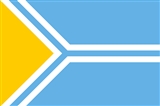
The present flag of Tuva — yellow for prosperity, blue for courage and strength, white for purity — was adopted on September 17, 1992. See below under Religion.
The republic's Constitution was adopted on October 23, 1993.
On April 3, 2007, Russian president Vladimir Putin
Vladimir Putin
Vladimir Vladimirovich Putin served as the second President of the Russian Federation and is the current Prime Minister of Russia, as well as chairman of United Russia and Chairman of the Council of Ministers of the Union of Russia and Belarus. He became acting President on 31 December 1999, when...
nominated Sholban Kara-ool
Sholban Kara-ool
Sholban Valeryevich Kara-ool , born 18 July 1966 in Choduraa, Tuva, is a Tuvan politician and is the current Chairman of the Government of Tuva.- Biography :...
, 40, a former champion wrestler, as the Chairman of the Government of Tuva. http://en.tuvaonline.ru/2007/04/04/sholban.html Sholban's candidacy was approved by the Khural on April 9, 2007.
Economy
Tuva has a developing mining industry (coal, cobaltCobalt
Cobalt is a chemical element with symbol Co and atomic number 27. It is found naturally only in chemically combined form. The free element, produced by reductive smelting, is a hard, lustrous, silver-gray metal....
, gold, and more). Food processing, timber, and metal working industries are also well-developed. Most of the industrial production is concentrated in the capital Kyzyl
Kyzyl
-External links:*** in Kyzyl, Russia*...
and in Ak-Dovurak
Ak-Dovurak
Ak-Dovurak is a town in the Tuva Republic, Russia, located on the Khemchik River , west of Kyzyl. Population: It was founded in 1964 as a town housing the workers employed in construction of an asbestos plant....
. According to the HDI, the republic of Tuva is the poorest region of Russia
Russia
Russia or , officially known as both Russia and the Russian Federation , is a country in northern Eurasia. It is a federal semi-presidential republic, comprising 83 federal subjects...
.
Transportation
Tuva has as yet no railway - although (in)famous postage stamps, designed in Moscow during the time of Tuvan independence, mistakenly depict locomotives as demonstrating Soviet-inspired progress there.There are three roads leading to Tuva, a dirt track over the mountains from Khakassia to Ak Dovurak, and an asphalt road over the passes between Khakassia (Abakan) and Kyzyl: both of these are cut off by snowfall and avalanches from time to time in winter. The third road goes south, turning into a track before entering Mongolia. The only external bus and taxi services are between Khakassia (Abakan) and Kyzyl.
Kyzyl has both large public buses and private minibus services, and buses and taxis also connect Kyzyl with the larger settlements.
Passenger ferries ply the Greater Yenisei (Bii-Khem) between Kyzyl and Toora-Khem in Todzha (Upper Tuva) when there is neither too little nor too much water over the rapids.
There is a small airfield in Kyzyl with intermittent flights.
Culture
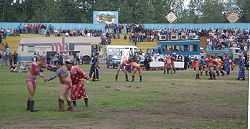
The Tuvan people are famous for Tuvan throat singing.Khuresh
Khuresh
Khuresh is a traditional form of wrestling in the ethnically Turkic region of Tuva, in southern Siberia. The word originates from the same root as Turkish "Güreş" ....
, the Tuvan form of wrestling, is a very popular sport. Competitions are held at the annual Naadym festival at Tos-Bulak
Tos-Bulak
Tos-Bulak is the name of an area of open fields and a mineral spring situated at , some 9 km south of Kyzyl, Tuva. It is the location of the Naadym festival , the Tuvan Republic Day, where various competitions such as horseriding and khuresh are held....
.
Sainkho Namtchylak
Sainkho Namtchylak
Sainkho Namtchylak is a singer originally from Tuva, a small autonomous republic in the Russian Federation just north of Mongolia. She is known for her Tuvan throat singing or Khöömei.-Style:...
is one of the few singers from Tuva to have an international following. She is also very involved with Tuvan culture. Every year she invites Western musicians to perform in Kyzyl and to learn about the country, its culture and its music. In recent years Kongar-ool Ondar
Kongar-ool Ondar
Kongar-ol Ondar is a master Tuvan throat singer and a member of the Great Khural of Tuva. Ondar was born in 1962 near the Khemchik River in western Tuva. Considered a living treasure by the Republic of Tuva, Ondar is granted a stipend and an apartment for the musical skills he possesses...
has become well-known in the West as well, in large part because of the film Genghis Blues
Genghis Blues
Genghis Blues is a documentary film directed by Roko Belic. It centers on the journey of blind American singer Paul Pena to the isolated Asian nation of Tuva due to his interest in Tuvan throat singing....
featuring Ondar and American blues
Blues
Blues is the name given to both a musical form and a music genre that originated in African-American communities of primarily the "Deep South" of the United States at the end of the 19th century from spirituals, work songs, field hollers, shouts and chants, and rhymed simple narrative ballads...
singer Paul Pena
Paul Pena
Paul Pena was an American singer, songwriter and guitarist of Cape Verdean descent.His music from the first half of his career touched on Delta blues, jazz, morna, flamenco, folk and rock and roll...
. Huun-Huur-Tu
Huun-Huur-Tu
Huun-Huur-Tu is a music group from Tuva, a Russian Federation republic situated on the Mongolian border....
has been one of the most well known Tuvan music ensembles since the late 1990s, while the Alash
Alash Ensemble
The ensemble Alash is a throat singing band from Tuva that performs traditional Tuvan music with some non-traditional influences.- History :The musicians of Alash are Nachyn Choodu, Bady-Dorzhu Ondar, Ayan-ool Sam, and Ayan Shirizhik...
ensemble came to prominence in the early 2000s.
The Tuvan language is Turkic, although with many loan-words from Mongolian. It is currently written with a modified Cyrillic alphabet, previously used Turkic runes, later Mongolian, then Latin alphabets. When part of China, Tuva was administered as part of Outer Mongolia, and the language difference was a determining factor in Tuva seeking full independence following the collapse of the Chinese Empire.
Oral traditions
The Tuvan people have a rich tradition of orally transmitted folklore, including many genres, ranging from very brief riddles and aphorisms, to tongue twisters, magical tales, hero tales, scary stories, and epics that would take many hours to recite. A few examples and excerpts of the epic genres, such as Boktu-Kirish, Bora-Sheelei have been published. This art form is now endangered as the traditional tale-tellers grow old and are not replaced by younger practitioners.Religion
Three religions are widespread among the people of Tuva: Tibetan BuddhismTibetan Buddhism
Tibetan Buddhism is the body of Buddhist religious doctrine and institutions characteristic of Tibet and certain regions of the Himalayas, including northern Nepal, Bhutan, and India . It is the state religion of Bhutan...
, Orthodox Christianity
Eastern Orthodox Church
The Orthodox Church, officially called the Orthodox Catholic Church and commonly referred to as the Eastern Orthodox Church, is the second largest Christian denomination in the world, with an estimated 300 million adherents mainly in the countries of Belarus, Bulgaria, Cyprus, Georgia, Greece,...
and shamanism
Shamanism
Shamanism is an anthropological term referencing a range of beliefs and practices regarding communication with the spiritual world. To quote Eliade: "A first definition of this complex phenomenon, and perhaps the least hazardous, will be: shamanism = technique of ecstasy." Shamanism encompasses the...
. Tibetan Buddhism's present-day spiritual leader is Tenzin Gyatso, the fourteenth Dalai Lama
Dalai Lama
The Dalai Lama is a high lama in the Gelug or "Yellow Hat" branch of Tibetan Buddhism. The name is a combination of the Mongolian word далай meaning "Ocean" and the Tibetan word bla-ma meaning "teacher"...
.
In September 1992, the fourteenth Dalai Lama visited Tuva for three days. On September 20, he blessed and consecrated the new yellow-blue-white flag of Tuva, which had just been officially adopted three days previously.
The Tuvan people - along with the Yellow Uyghurs in China - are one of the only two Turkic groups who are mainly adherents to Tibetan Buddhism
Tibetan Buddhism
Tibetan Buddhism is the body of Buddhist religious doctrine and institutions characteristic of Tibet and certain regions of the Himalayas, including northern Nepal, Bhutan, and India . It is the state religion of Bhutan...
, combined with native Shamanism
Shamanism
Shamanism is an anthropological term referencing a range of beliefs and practices regarding communication with the spiritual world. To quote Eliade: "A first definition of this complex phenomenon, and perhaps the least hazardous, will be: shamanism = technique of ecstasy." Shamanism encompasses the...
.
During the sixteenth and seventeenth centuries Tibetan Buddhism gained increasing popularity in Tuva. An increasing number of new and restored temples are coming into use, as well as novices being trained as monks and lamas.
Religious practice declined under the restrictive policies of the Soviet period but is now flourishing.
Education
The most important facilities of higher education include theTuvan State University
Tuvan State University
TheTuvan State University is based in Kyzyl, the capital of Tuva, Russia, and is the only university in Tuva. The university logo features an open book, the mountains and plains of Tuva and the monument erected at the claimed geographical centre of Asia....
and the Tuvan Institute of Humanities, both located in the capital Kyzyl.
Demographics
- Population:
- Population:
- Urban: 157,299 (51.5%)
- Rural: 148,211 (48.5%)
- Male: 144,961 (47.4%)
- Female: 160,549 (52.6%)
- Females per 1000 males: 1,108
- Average age: 25.5 years
- Urban: 26.4 years
- Rural: 24.5 years
- Male: 25.2 years
- Female: 27.6 years
- Number of households: 82,882 (with 299,510 people)
- Urban: 47,073 (with 152,542 people)
- Rural: 35,809 (with 146,968 people)
- Vital statistics
- Source: Russian Federal State Statistics Service
| Births | Deaths | Birth rate | Death rate | |
|---|---|---|---|---|
| 1970 | 6,559 | 1,938 | 28.2 | 8.3 |
| 1975 | 6,950 | 2,306 | 27.5 | 9.1 |
| 1980 | 7,133 | 2,748 | 26.2 | 10.1 |
| 1985 | 8,110 | 2,624 | 28.3 | 9.1 |
| 1990 | 8,116 | 2,664 | 26.3 | 8.6 |
| 1991 | 7,271 | 2,873 | 23.9 | 9.5 |
| 1992 | 6,545 | 3,006 | 21.6 | 9.9 |
| 1993 | 6,130 | 3,480 | 20.3 | 11.5 |
| 1994 | 6,076 | 4,086 | 20.1 | 13.5 |
| 1995 | 6,172 | 4,010 | 20.3 | 13.2 |
| 1996 | 5,705 | 4,110 | 18.7 | 13.5 |
| 1997 | 4,908 | 3,954 | 16.1 | 12.9 |
| 1998 | 5,267 | 3,631 | 17.2 | 11.9 |
| 1999 | 4,894 | 4,142 | 16.0 | 13.5 |
| 2000 | 4,871 | 4,170 | 15.9 | 13.6 |
| 2001 | 4,992 | 4,165 | 16.3 | 13.6 |
| 2002 | 5,727 | 4,576 | 18.8 | 15.0 |
| 2003 | 6,276 | 4,633 | 20.5 | 15.1 |
| 2004 | 6,127 | 4,090 | 20.0 | 13.3 |
| 2005 | 5,979 | 4,326 | 19.4 | 14.0 |
| 2006 | 5,950 | 3,802 | 19.3 | 12.3 |
| 2007 | 7,568 | 3,687 | 24.4 | 11.9 |
| 2008 | 7,874 | 3,526 | 25.2 | 11.3 |
- Average life expectancy: Tuva: 56.5 (average male and female, UNDP data); Russia: (UN data) Male 59 (world rank 166); Female 73 (127)
Ethnic groups
According to the 2002 CensusRussian Census (2002)
Russian Census of 2002 was the first census of the Russian Federation carried out on October 9 through October 16, 2002. It was carried out by the Russian Federal Service of State Statistics .-Resident population:...
, Tuvans
Tuvans
Tuvans or Tuvinians are Turkic peoples living in southern Siberia. They are historically known as one of the Uriankhai, from the Mongolian designation...
, a Turkic people, make up 77.0% of the republic's population. Other groups include Russians
Russians
The Russian people are an East Slavic ethnic group native to Russia, speaking the Russian language and primarily living in Russia and neighboring countries....
(20.1%), Khakas
Khakas
The Khakas, or Khakass , are a Turkic-speaking people, who live in Russia, in the republic of Khakassia in southern Siberia. They speak the Khakas language.The origin of the Khakas people is disputed...
(1,219, or 0.4%), and a host of smaller groups, each accounting for less than 0.5% of the total population.
| 1959 census | 1970 census | 1979 census | 1989 census | 2002 census | |
|---|---|---|---|---|---|
| Tuvans Tuvans Tuvans or Tuvinians are Turkic peoples living in southern Siberia. They are historically known as one of the Uriankhai, from the Mongolian designation... |
97,996 (57.0%) | 135,306 (58.6%) | 161,888 (60.5%) | 198,448 (64.3%) | 235,313 (77.0%) |
| Russians Russians The Russian people are an East Slavic ethnic group native to Russia, speaking the Russian language and primarily living in Russia and neighboring countries.... |
68,924 (40.1%) | 88,385 (38.3%) | 96,793 (36.2%) | 98,831 (32.0%) | 61,442 (20.1%) |
| Khakas Khakas The Khakas, or Khakass , are a Turkic-speaking people, who live in Russia, in the republic of Khakassia in southern Siberia. They speak the Khakas language.The origin of the Khakas people is disputed... |
1,726 (1.0%) | 2,120 (0.9%) | 2,193 (0.8%) | 2,258 (0.7%) | 1,219 (0.4%) |
| Others | 3,282 (1.9%) | 5,053 (2.2%) | 6,725 (2.5%) | 9,020 (2.9%) | 7,526 (2.5%) |
As can be seen above, during the period 1959-2002 there has been more than a doubling of ethnic Tuvans. The Russian population growth slowed by the 1980s and has now begun to shrink.
Official languages are Tuvan
Tuvan language
Tuvan , also known as Tuvinian, Tyvan or Tuvin, is a Turkic language spoken in the Republic of Tuva in south-central Siberia in Russia. The language has borrowed a great number of roots from the Mongolian language and more recently from the Russian language...
(Turkic
Turkic languages
The Turkic languages constitute a language family of at least thirty five languages, spoken by Turkic peoples across a vast area from Eastern Europe and the Mediterranean to Siberia and Western China, and are considered to be part of the proposed Altaic language family.Turkic languages are spoken...
) and Russian
Russian language
Russian is a Slavic language used primarily in Russia, Belarus, Uzbekistan, Kazakhstan, Tajikistan and Kyrgyzstan. It is an unofficial but widely spoken language in Ukraine, Moldova, Latvia, Turkmenistan and Estonia and, to a lesser extent, the other countries that were once constituent republics...
(Slavic
Slavic languages
The Slavic languages , a group of closely related languages of the Slavic peoples and a subgroup of Indo-European languages, have speakers in most of Eastern Europe, in much of the Balkans, in parts of Central Europe, and in the northern part of Asia.-Branches:Scholars traditionally divide Slavic...
). Outside Kyzyl
Kyzyl
-External links:*** in Kyzyl, Russia*...
, settlements have few if any Russian inhabitants and in general Tuvans use their original language as their first language. However, there is a small population of Old believers
Old Believers
In the context of Russian Orthodox church history, the Old Believers separated after 1666 from the official Russian Orthodox Church as a protest against church reforms introduced by Patriarch Nikon between 1652–66...
in the republic scattered in some of the most isolated areas. Before the Soviet rule, there were a number of large ethnic Russian old believer villages, but as the atheist ideology crept in, the believers moved deeper and deeper in to the Taiga
Taiga
Taiga , also known as the boreal forest, is a biome characterized by coniferous forests.Taiga is the world's largest terrestrial biome. In North America it covers most of inland Canada and Alaska as well as parts of the extreme northern continental United States and is known as the Northwoods...
in order to avoid contact with outsiders. Major Old believer villages are Erzhei, Uzhep, Unzhei, Zhivei and Bolee Malkiye (all in the Kaa-Khemsky District
Kaa-Khemsky District
Kaa-Khemsky District is one of the seventeen administrative divisions of the Tuva Republic, Russia. Municipally, it is incorporated as the Municipal District of Kaa-Khemsky Kozhuun. Its administrative center is the rural locality of Saryg-Sep. District's population: 13,071 ; Population of...
). Smaller ultra-Orthodox settlements are found further upstream.
Ethnic Russians make up majority in Kaa-Khemsky District
Kaa-Khemsky District
Kaa-Khemsky District is one of the seventeen administrative divisions of the Tuva Republic, Russia. Municipally, it is incorporated as the Municipal District of Kaa-Khemsky Kozhuun. Its administrative center is the rural locality of Saryg-Sep. District's population: 13,071 ; Population of...
, one of the most remote regions in Tyva. The population is mostly Old believers
Old Believers
In the context of Russian Orthodox church history, the Old Believers separated after 1666 from the official Russian Orthodox Church as a protest against church reforms introduced by Patriarch Nikon between 1652–66...
.
Tuvans are closely related ethnically and linguistically to the Khakas
Khakas
The Khakas, or Khakass , are a Turkic-speaking people, who live in Russia, in the republic of Khakassia in southern Siberia. They speak the Khakas language.The origin of the Khakas people is disputed...
to their north and the Altai to their west, but closer culturally to the Mongolians to their south and the related Buryats
Buryats
The Buryats or Buriyads , numbering approximately 436,000, are the largest ethnic minority group in Siberia and are mainly concentrated in their homeland, the Buryat Republic, a federal subject of Russia...
to their east, with whom they share their Buddhism
Buddhism
Buddhism is a religion and philosophy encompassing a variety of traditions, beliefs and practices, largely based on teachings attributed to Siddhartha Gautama, commonly known as the Buddha . The Buddha lived and taught in the northeastern Indian subcontinent some time between the 6th and 4th...
.
Miscellaneous
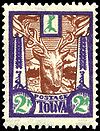
- In the 1920s and 1930s, postage stamps from TuvaPostage stamps and postal history of Tannu TuvaThe postage stamps of Tannu Tuva form one of philately's curious byways, featuring quirky and colorful stamps, many of questionable validity, issued by an obscure country which held special fascination for young stamp collectors in the middle of the twentieth century....
were issued. Many philatelistsPhilatelyPhilately is the study of stamps and postal history and other related items. Philately involves more than just stamp collecting, which does not necessarily involve the study of stamps. It is possible to be a philatelist without owning any stamps...
, including the physicistPhysicsPhysics is a natural science that involves the study of matter and its motion through spacetime, along with related concepts such as energy and force. More broadly, it is the general analysis of nature, conducted in order to understand how the universe behaves.Physics is one of the oldest academic...
Richard FeynmanRichard FeynmanRichard Phillips Feynman was an American physicist known for his work in the path integral formulation of quantum mechanics, the theory of quantum electrodynamics and the physics of the superfluidity of supercooled liquid helium, as well as in particle physics...
, have been fascinated with Tuva because of these stamps. The stamps were issued mainly during the brief period of Tuvan independence, and had many philatelists in a furor, as they did not conform to philatelic standards. Feynman's efforts to reach Tuva are chronicled in the book Tuva or Bust! and the video The Quest For Tannu Tuva: Richard Feynman - The Last Journey of a Genius (1988) which can be viewed online through Google Video. - Tuva was featured prominently in the award-winning documentary Genghis BluesGenghis BluesGenghis Blues is a documentary film directed by Roko Belic. It centers on the journey of blind American singer Paul Pena to the isolated Asian nation of Tuva due to his interest in Tuvan throat singing....
. - United Nations Human Development Index: Russian Federation - Republic of Tyva, rank: 79/79 (the lowest).
- Tuvan stamps are mentioned in a line of Gregory Corso'sGregory CorsoGregory Nunzio Corso was an American poet, youngest of the inner circle of Beat Generation writers...
poem Marriage. - Tuvan Sergey Shoygu, Russia's Minister for Emergency Situations since 1994, is Russia's longest-serving minister, and a leader of Russia's governing party 'Unity'.
- Tuvans make wishes each morning, sprinkling milk on the ground, to the north, south, east and west, with a special wooden spoon with nine small hollows for the various milk products made.
- According to Ilya Zakharov of MoscowMoscowMoscow is the capital, the most populous city, and the most populous federal subject of Russia. The city is a major political, economic, cultural, scientific, religious, financial, educational, and transportation centre of Russia and the continent...
's Vavilov Institute of General Genetics, genetic evidence suggests that the modern Tuvan people are the closest genetic relatives to the native peoplesIndigenous peoples of the AmericasThe indigenous peoples of the Americas are the pre-Columbian inhabitants of North and South America, their descendants and other ethnic groups who are identified with those peoples. Indigenous peoples are known in Canada as Aboriginal peoples, and in the United States as Native Americans...
of North and South America. - Some Tuvans, even near Kyzyl, still live in traditional yurts, round, demountable and portable dwellings with sectional lath trellis walls, decorated pole roofs and covered with white felt and canvas, with colourful cloth lining. There is a central smoke-hole above the hearth or stove. It is used to tell the time as the sunlight moves around inside the yurt. The interior is arranged with the man's side to the left, the woman's to the right of the door facing East, with the altar cupboard facing that.
- Tuvans, as traditional nomads, knew no fixed national borders, which has led to small numbers being in areas outside the present Republic's boundaries, including as follows.
- China - Xinjiang: 'Tuwa' by Lake Kanas, Altay Prefecture.
- Russia - Irkutsk Oblast: 'Tofa' adjacent to north-east Tyva; Buryatia: 'Soyot' of the Upper Oka river.
- Mongolia - northern: 'Tsaatan'; north-western: 'Dukha/Duva'; western: 'Tsengel'.
- Sayan MountainsSayan MountainsThe Sayan Mountains are a mountain range between northwestern Mongolia and southern Siberia, Russia.The Eastern Sayan extends from the Yenisei River at 92° E to the southwest end of Lake Baikal at 106° E...
in Tuva was featured in Bear GryllsBear GryllsEdward Michael "Bear" Grylls is an English adventurer, writer and television presenter. He is best known for his television series Man vs. Wild, known as Born Survivor in the United Kingdom...
Man vs Wild popular adventure TV show.http://www.youtube.com/watch?v=8NSRNY4kZ1g
Sources and external links
Official website of Tuva photos from Tuva by Stanislav Krupar http://www.krupar.com/index.php?file=www/en/gallery/gallery.html&cat=20- WorldStatesmen- Russia
- Singing Stones -The Republic of Tuva Website of Tuva Friends of Tuva website Friends of Tuva, Japan Some Tuvan stamps issued in 1920s/1930s Genghis Blues, official movie site Animated slideshow presentations of Tuva More completed collection of Tuva Stamps(1926-1943) TyvaWiki:Main Page The Tuva Trader; Tuva and Richard Feynman media, products and information Buga-shadara A traditional Tuvan boardgame
- Audio of the Tuvan national anthem recorded by the Tuvan National OrchestraTuvan National OrchestraThe Tuvan National Orchestra reflects the complex history of the Republic of Tuva , a tiny nation which sits at the southern edge of Siberia, with Mongolia to its south. Over the centuries, Tuva has been part of Chinese and Mongolian empires, and shares many cultural ties with Mongolia...
. The orchestral arrangement was composed by Ayana Samiyaevna Mongush.