

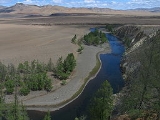
Orkhon Valley

Encyclopedia
Orkhon Valley Cultural Landscape sprawls along the banks of the Orkhon River in Central Mongolia
, some 360 km west from the capital Ulaanbaatar
. It was inscribed by UNESCO
in the World Heritage List as representing evolution of nomadic pastoral traditions spanning more than two millennia. (See List of World Heritage Sites in Mongolia)
, which was erected in the valley by Bilge Khan
, an 8th century ruler of the Göktürk Empire
. Some 25 miles to the north of the stele, in the shadow of the sacred forest-mountain Ötüken
, was his Ördü
, or nomadic capital. During the Qidan
domination of the valley, the stele was reinscribed in three languages, so as to record the deeds of a Qidan potentate.
Mountains were considered sacred in Tengriism
as an axis mundi
, but Ötüken was especially sacred because the ancestor spirits of the khagan
s and beys resided here. Moreover, a force called qut was believed to emanate from this mountain, granting the khagan the divine right to rule the Turkic tribes. Whoever controlled this valley was considered heavenly appointed leader of the Turks and could rally the tribes. Thus control of the Orkhon Valley was of the utmost strategic importance for every Turkic state. Historically every Turkic capital (Ördü) was located here for this exact reason. There were many houses by the bank but they are all gone now.

Mongolia
Mongolia is a landlocked country in East and Central Asia. It is bordered by Russia to the north and China to the south, east and west. Although Mongolia does not share a border with Kazakhstan, its western-most point is only from Kazakhstan's eastern tip. Ulan Bator, the capital and largest...
, some 360 km west from the capital Ulaanbaatar
Ulaanbaatar
Ulan Bator or Ulaanbaatar is the capital and largest city of Mongolia. An independent municipality, the city is not part of any province, and its population as of 2008 is over one million....
. It was inscribed by UNESCO
UNESCO
The United Nations Educational, Scientific and Cultural Organization is a specialized agency of the United Nations...
in the World Heritage List as representing evolution of nomadic pastoral traditions spanning more than two millennia. (See List of World Heritage Sites in Mongolia)
Importance
For many centuries, the Orkhon Valley was viewed as the seat of the imperial power of the steppes. The first evidence comes from a stone stele with runic inscriptionsOrkhon inscriptions
"Orkhon inscription" may refer to:*two monuments in the Orkhon valley, see Khöshöö Tsaidam Monuments*inscriptions in the Old Turkic "Orkhon alphabet" in general, see Old Turkic epigraphy...
, which was erected in the valley by Bilge Khan
Bilge Khan
Bilge Qaghan was khagan of the Second Eastern Turkic Khaganate...
, an 8th century ruler of the Göktürk Empire
Göktürks
The Göktürks or Kök Türks, were a nomadic confederation of peoples in medieval Inner Asia. Known in Chinese sources as 突厥 , the Göktürks under the leadership of Bumin Qaghan The Göktürks or Kök Türks, (Old Turkic: Türük or Kök Türük or Türük; Celestial Turks) were a nomadic confederation of...
. Some 25 miles to the north of the stele, in the shadow of the sacred forest-mountain Ötüken
Ötüken
Ötüken Old Turkic: , Ötüken yïš, , Mount Ötüken, 於都斤山, Linghu Defen, Book of Zhou, Vol. 50, Li Dashi, Li Yanshou, History of Northern Dynasties, Vol. 9, 都尉揵山, Liu Xu etc, Book of Tang, Vol. 199-II, 烏德鞬山/乌德鞬山, Ouyang Xiu etc, New Book of Tang, Vol. 93, 都斤山, Yan Shigu, Kong Yingda etc, Book of Sui,...
, was his Ördü
Ordu
Ordu 'army') is a port city on the Black Sea coast of Turkey, and the capital of Ordu Province. Estimated population c. 2010: 141,341.-Etymology:...
, or nomadic capital. During the Qidan
Khitan people
thumb|250px|Khitans [[Eagle hunting|using eagles to hunt]], painted during the Chinese [[Song Dynasty]].The Khitan people , or Khitai, Kitan, or Kidan, were a nomadic Mongolic people, originally located at Mongolia and Manchuria from the 4th century...
domination of the valley, the stele was reinscribed in three languages, so as to record the deeds of a Qidan potentate.
Mountains were considered sacred in Tengriism
Tengriism
Tengriism is a Central Asian religion that incorporates elements of shamanism, animism, totemism and ancestor worship. Despite still being active in some minorities, it was, in old times, the major belief of Turkic peoples , Bulgars, Hungarians and Mongols...
as an axis mundi
Axis mundi
The axis mundi , in religion or mythology, is the world center and/or the connection between heaven and Earth. As the celestial pole and geographic pole, it expresses a point of connection between sky and earth where the four compass directions meet...
, but Ötüken was especially sacred because the ancestor spirits of the khagan
Khagan
Khagan or qagan , alternatively spelled kagan, khaghan, qaghan, or chagan, is a title of imperial rank in the Mongolian and Turkic languages equal to the status of emperor and someone who rules a khaganate...
s and beys resided here. Moreover, a force called qut was believed to emanate from this mountain, granting the khagan the divine right to rule the Turkic tribes. Whoever controlled this valley was considered heavenly appointed leader of the Turks and could rally the tribes. Thus control of the Orkhon Valley was of the utmost strategic importance for every Turkic state. Historically every Turkic capital (Ördü) was located here for this exact reason. There were many houses by the bank but they are all gone now.
Sites
The main monuments of the Orkhon Valley are as follows:- Early 8th-century Turkic memorials to Bilge KhanBilge KhanBilge Qaghan was khagan of the Second Eastern Turkic Khaganate...
and Kul TiginKul TiginKul Tigin Kul Tigin Kul Tigin (Old Turkic:, Kultegin, (闕特勒/阙特勤, Pinyin: quètèqín, Wade-Giles: chüeh-t'e-ch'in, ? - 575 AD) was a general of the Second Turkic Kaganate. He was a second son of Ilterish Shad and the younger brother of Bilge Kagan....
with their Orkhon inscriptionsOrkhon inscriptions"Orkhon inscription" may refer to:*two monuments in the Orkhon valley, see Khöshöö Tsaidam Monuments*inscriptions in the Old Turkic "Orkhon alphabet" in general, see Old Turkic epigraphy...
are admittedly the most impressive monuments from the nomadic Göktürk EmpireGöktürksThe Göktürks or Kök Türks, were a nomadic confederation of peoples in medieval Inner Asia. Known in Chinese sources as 突厥 , the Göktürks under the leadership of Bumin Qaghan The Göktürks or Kök Türks, (Old Turkic: Türük or Kök Türük or Türük; Celestial Turks) were a nomadic confederation of...
. They were excavated and deciphered by Russian archaeologists in 1889-93. - Ruins of Khar Balgas, an 8th-century capital of the Uyghur EmpireUyghur peopleThe Uyghur are a Turkic ethnic group living in Eastern and Central Asia. Today, Uyghurs live primarily in the Xinjiang Uyghur Autonomous Region in the People's Republic of China...
, which cover 50 square km and contain evidence of the palace, shops, temples, monasteries, etc. - Ruins of Genghis KhanGenghis KhanGenghis Khan , born Temujin and occasionally known by his temple name Taizu , was the founder and Great Khan of the Mongol Empire, which became the largest contiguous empire in history after his death....
's capital Karakorum which could have included the famed XanaduXanadu-Description of Xanadu by Toghon Temur :The lament of Toghon Temur Khan , concerning the loss of Daidu and Heibun Shanduu in 1368, is recorded in many Mongolian historical chronicles...
palace. - Erdene Zuu monasteryErdene Zuu monasteryThe Erdene Zuu Monastery is probably the most ancient surviving Buddhist monastery in Mongolia. It is in Övörkhangai Province, near the town of Kharkhorin and adjacent to the ancient city of Karakorum...
is the first Buddhist monastery established in Mongolia. It was partly destroyed by Communist authorities in 1937-40. - Tuvkhun Hermitage is another spectacular monastery, overlooking a hill at 2,600 m. above sea-level. Likewise, it was almost totally destroyed by the Communists.
- Remains of the 13th and 14th century Mongol palace at Doit Hill, thought to be Ögedei KhanÖgedei KhanÖgedei Khan, born Ögedei was the third son of Genghis Khan and second Great Khan of the Mongol Empire by succeeding his father...
's residence.