
All Topics  
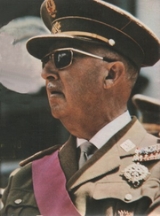
Francisco Franco

 
Francisco Franco

   Email Print
   Bookmark   Link


Francisco Franco


Francisco Paulino Hermenegildo Teódulo Franco y Bahamonde, Salgado y Pardo de Andrade (4 December 1892 in Ferrol – 20 November 1975 in Madrid
Madrid

Madrid is the Capital and largest city of Spain. It is the Largest cities of the European Union by population within city limits in the European Union after Greater London and Berlin, and its Madrid metropolitan area is the Largest urban areas of the European Union in the European Union after Paris aire urbaine, Greater London Urban Area, a...
), commonly known as Francisco Franco or Francisco Franco y Bahamonde was the dictator
Dictator

A dictator is an authoritarian ruler who assumes sole and absolute power without hereditary ascension such as an absolute monarch. When other states call the head of state of a particular state a dictator, that state is called a dictatorship....
 and Head of State
Head of State

Head of state is the generic term for the individual or collective office that serves as the chief public representative of a monarchic or republican nation-state, federation, commonwealth or any other political state....
 of Spain from October 1936, and de facto regent
Regent

A regent, from the Latin regens "reigning", is a person selected to act as head of state because the ruler is a minor, not present or debilitated....
 of the nominally restored Kingdom of Spain from 1947 until his death in 1975. His rule was known for a focus on Spanish nationalism
Nationalism

Nationalism refers to an ideology, a feeling, a form of culture, or a social movement that focuses on the nation. While there is significant debate over the historical origins of nations, nearly all Expert accept that nationalism, at least as an ideology and social movement, is a Modernity phenomenon originating in Europe....
, right wing and traditional values
Traditional values

Traditional values refer to those beliefs, moral codes, and mores that are passed down from generation to generation within a culture, subculture or community....
.

Franco initially led a notable military career and reached the rank of General
General

A General officer is an Officer of high military rank. The term or equivalent is used by nearly every country in the world. General can be used as a generic term for all grades of general officer, or it can specifically refer to a single rank that is just called general....
.


Discussion
Ask a question about 'Francisco Franco'
Start a new discussion about 'Francisco Franco'
Answer questions from other users
Full Discussion Forum


Recent Posts


Timeline

1892   Born

1937   Spanish Civil War: The German Condor Legion Fighter Group, equipped with Heinkel He 51 biplanes, arrives in Spain to assist Francisco Franco's forces.

1938   Vatican recognizes Franco's government in Spain

1939   Spanish Civil War: Troops loyal to Francisco Franco and aided by Italy take Barcelona.

1939   United Kingdom and France recognize Franco's government

1939   Dictator Francisco Franco conquers Madrid.

1942   Francisco Franco fires foreign minister Serrano Súñer

1946   United Nations severs relations with Franco's Spain and recommends the member countries to sever diplomatic relations

1970   Franco commutes the death sentences of the Burgos Trial defendants to 30 years in prison.

1971   Spanish dictator and head of state Francisco Franco makes Prince Juan Carlos his successor.


Encyclopedia


Francisco Paulino Hermenegildo Teódulo Franco y Bahamonde, Salgado y Pardo de Andrade (4 December 1892 in Ferrol – 20 November 1975 in Madrid
Madrid

Madrid is the Capital and largest city of Spain. It is the Largest cities of the European Union by population within city limits in the European Union after Greater London and Berlin, and its Madrid metropolitan area is the Largest urban areas of the European Union in the European Union after Paris aire urbaine, Greater London Urban Area, a...
), commonly known as Francisco Franco or Francisco Franco y Bahamonde was the dictator
Dictator

A dictator is an authoritarian ruler who assumes sole and absolute power without hereditary ascension such as an absolute monarch. When other states call the head of state of a particular state a dictator, that state is called a dictatorship....
 and Head of State
Head of State

Head of state is the generic term for the individual or collective office that serves as the chief public representative of a monarchic or republican nation-state, federation, commonwealth or any other political state....
 of Spain from October 1936, and de facto regent
Regent

A regent, from the Latin regens "reigning", is a person selected to act as head of state because the ruler is a minor, not present or debilitated....
 of the nominally restored Kingdom of Spain from 1947 until his death in 1975. His rule was known for a focus on Spanish nationalism
Nationalism

Nationalism refers to an ideology, a feeling, a form of culture, or a social movement that focuses on the nation. While there is significant debate over the historical origins of nations, nearly all Expert accept that nationalism, at least as an ideology and social movement, is a Modernity phenomenon originating in Europe....
, right wing and traditional values
Traditional values

Traditional values refer to those beliefs, moral codes, and mores that are passed down from generation to generation within a culture, subculture or community....
.

Franco initially led a notable military career and reached the rank of General
General

A General officer is an Officer of high military rank. The term or equivalent is used by nearly every country in the world. General can be used as a generic term for all grades of general officer, or it can specifically refer to a single rank that is just called general....
. He fought in Morocco
Spanish Morocco

Spanish protectorate of Morocco was the area of Morocco under colonialism rule by the Spanish Empire, established by the Treaty of Fez in 1912 and ending in 1956, when both France and Spain recognized Moroccan independence....
 and suppressed a strike in 1934
Anarchism in Spain

Anarchism has historically gained more support and influence in Spain than anywhere else, especially before Francisco Franco's victory in the Spanish Civil War of 1936-1939....
 to defend the stability of the Republican government. In February 1936, the left-wing Popular Front
Popular Front (Spain)

The Popular Front in Spain's Spanish Second Republic was an electoral coalition and pact signed in January 1936 by various left-wing politics organisations, instigated by Manuel Aza?a for the purpose of contesting that year's election....
 won the general election and formed a government. A period of severe instability and disarray followed the election, with escalating violence and distrust between left and right wing supporters. Anti-clerical
Anti-clericalism

Anti-clericalism is a historical movement that opposes religious institutional power and influence, real or alleged, in all aspects of public and political life, and the involvement of religion in the everyday life of the citizen....
 violence against the Church by leftist militants raised tensions, while the government distrusted both its extreme supporters on the left and sections of the military. After the assassination of a major opposition figure, José Calvo Sotelo
José Calvo Sotelo

Jos? Calvo Sotelo was a Spain political figure prior to and during the Second Spanish Republic. His murder by a commando unit of the Assault Guards , a special police corps created to deal with urban violence, just the day after a harsh confrontation in Parliament, aroused suspicions of a government involvement in the crime and helped preci...
, by a commando unit of the Assault Guards
Guardia de Asalto

The blue-uniformed Guardia de Asalto were the municipal police force of Spain, during the Spanish Second Republic. They were similar to the green uniformed Guardia Civil which patrolled the countryside, but, while Guardia Civil units tended to support the Nationalists, most of the Assault Guards stayed loyal to the Second Republic....
 in July 1936, Franco participated in a coup d'etat
Coup d'état

A coup d??tat , often simply called a coup, is the sudden unconstitutional overthrow of a government by a part of the state establishment – usually the military – to replace the branch of the stricken government, either with another civil government or with a military government....
 against the elected Popular Front government. The coup failed and devolved into the Spanish Civil War
Spanish Civil War

The Spanish Civil War was a major conflict in Spain that started after an attempted coup d'?tat by a group of Spanish Army generals, supported by the conservative Spanish Confederation of the Autonomous Right , Carlist groups and the fascistic Falange, against the government of the Second Spanish Republic, then under the leadership of pr...
 during which he emerged as the leader of the Nationalists against the Popular Front government. After winning the civil war with some assistance from Benito Mussolini
Benito Mussolini

Benito Amilcare Andrea Mussolini, Order of the Bath Sovereign Military Order of Malta Order of the Tower and Sword was an Italy politician who led the National Fascist Party and is credited with being one of the key figures in the creation of Fascism....
's Italy and Adolf Hitler
Adolf Hitler

Adolf Hitler was an Austrian-born Germany politician and the leader of the National Socialist German Workers Party , popularly known as the Nazi Party....
's Germany, he dissolved the Spanish Parliament. He then established a right wing authoritarian regime that lasted until 1978, when a new constitution was drafted. During the Second World War, Franco maintained a policy of non-belligerency and later of neutrality. Franco's small participation in the war was very limited and exclusively against the Soviet Union
Soviet Union

The Union of Soviet Socialist Republics was a Constitution of the Soviet Union socialist state that existed in Eurasia from 1922 to 1991.The name is a translation of the , romanization of Russian Soyuz Sovetskikh Sotsialisticheskikh Respublik, abbreviated ????, SSSR....
, not the other allied forces. His most significant support was allowing volunteer
Volunteer

A volunteer is someone who works Community service or for the benefit of environment primarily because they choose to do so. The word comes from France, it can also be translated as "will" ....
s, known as the Blue Division
Blue Division

The Blue Division , or 250. Infanterie-Division in the Nazi Germany Wehrmacht Heer, was a unit of Spain volunteer soldier that served in the German Army on the Eastern Front of the World War II....
, to aid the Axis powers in fighting the Soviet Union
Soviet Union

The Union of Soviet Socialist Republics was a Constitution of the Soviet Union socialist state that existed in Eurasia from 1922 to 1991.The name is a translation of the , romanization of Russian Soyuz Sovetskikh Sotsialisticheskikh Respublik, abbreviated ????, SSSR....
.

After the end of World War II
World War II

World War II, or the Second World War , was a global military conflict which involved a Participants in World War II, including all of the great powers, organised into two opposing military alliances: the Allies of World War II and the Axis powers....
, Franco maintained his control in Spain. During the Cold War
Cold War

The Cold War was the continuing state of conflict, tension and competition that existed between a number of world powers, including the United States, the Soviet Union, People's Republic of China, France, United Kingdom and those countries' respective allies from the mid-1940s to the early 1990s....
, the United States
United States

The United States of America is a Federal government constitutional republic comprising U.S. state and a federal district. The country is situated mostly in central North America, where its Contiguous United States and Washington, D.C., the Capital districts and territories, lie between the Pacific Ocean and Atlantic Oceans, Borders of the U...
 established a diplomatic alliance with Spain, due to Franco's strong anti-Communist policy. American President Richard Nixon
Richard Nixon

Richard Milhous Nixon was the List of Presidents of the United States President of the United States and the only president to resign the office....
 toasted Franco, and, after Franco's death, stated, as with many other fascist dictators all over the world: "General Franco was a loyal friend and ally of the United States." After his death Spain gradually began its transition to democracy
Spanish transition to democracy

The Spanish transition to democracy was the era when Spain moved from the dictatorship of Francisco Franco to a liberal democracy. The transition is usually said to have begun with Franco?s death on November 20, 1975, while its completion has been variously said to be marked by the Spanish Constitution of 1978, the failure of 23-F on Februar...
.

Early life

Franco was born in Ferrol, A Coruña
A Coruña (province)

A Coru?a is the most Cardinal direction Atlantic Ocean-facing province of Spain, and one of the four provinces which constitute the Historical regions in Spain of Galicia ....
, on 4 December 1892, the son of Nicolás Franco y Salgado-Araújo (22 November 1855 - 22 February 1942), who was a Navy
Navy

A navy is the branch of a nation's military forces principally designated for naval warfare and amphibious warfare; namely, lake- or ocean-borne combat operations and related functions....
 paymaster
Paymaster

A paymaster is, and must be, an attorney appointed by a group of investors or government to dispense commissions, fees or salary within the private sector or public sector, especially a military....
, and wife (m. 1890), María del Pilar Bahamonde y Pardo de Andrade (1865 - 28 February 1934). Franco's mother, through the and his wife the 3rd Condessa de Villalva, was twice a descendant of Portuguese royalty and thus from other Portuguese kings.

Franco had two brothers, Nicolás (Ferrol, 1891 - 1977), Spanish Navy
Spanish Navy

The Spanish Armada is the maritime arm of the Military of Spain, one of the oldest active naval forces in the world. The Armada is responsible for notable achievements in world history such as the discovery of America, the first world circumnavigation, and the discovery of a maritime path from the Far East to America ....
 Officer
Officer (armed forces)

An officer is a member of an Armed forces who holds a position of authority.Commissioned officers derive authority directly from a sovereignty power and, as such, hold a Letters patent charging them with the duties and responsibilities of a specific office or position....
 and Diplomat married to María Isabel Pascual del Pobil y Ravello, and Ramón
Ramón Franco

Ram?n Franco y Bahamonde, Salgado y Pardo de Andrade , was a Galician people aviator , a political figure and brother of later dictator Francisco Franco....
, a pioneering Aviator
Aviator

An aviator is a person who flies aircraft for pleasure or as a profession.The feminine word aviatrix is sometimes used and is the correct term to refer to all women pilots....
, and two sisters María del Pilar (Ferrol, 1894 - Madrid
Madrid

Madrid is the Capital and largest city of Spain. It is the Largest cities of the European Union by population within city limits in the European Union after Greater London and Berlin, and its Madrid metropolitan area is the Largest urban areas of the European Union in the European Union after Paris aire urbaine, Greater London Urban Area, a...
, 1989) and María de la Paz (Ferrol, 1899 - Ferrol, 1900), with whom he spent much of his childhood. His brother's son was Nicolás Franco y Pascual del Pobil, married to Margarita Cerame y ..., parents of Nicolás Franco y Cerame, Ramón Franco y Cerame and Margarita Franco y Cerame, who married Ramón Ros y Bigeriego, son of Joaquín Ros y López and wife Casilda Bigeriego y de Juan, and had a son Ramón Ros y Franco, born in Madrid in October 2008.

Francisco was to follow his father into the navy, but as a result of the Spanish-American War
Spanish-American War

The Spanish?American War was an armed military conflict between Spain and the United States that took place between April and August 1898, over the issues of the liberation of Cuba....
 the country had lost much of its navy as well as most of its colonies. Not needing more officers, entry into the Naval Academy was closed from 1906 to 1913. To his father's chagrin, he decided to join the Spanish Army
Spanish Army

The Spanish Army is one of oldest active armies in the world and a branch of the Spanish Armed Forces, in charge of land operations....
. In 1907, he entered the Infantry Academy in Toledo
Toledo, Spain

Toledo is a city and municipality located in central Spain, 70 km south of Madrid. It is the capital city of the province of Toledo and of the autonomous communities of Spain of Castile-La Mancha....
, from which he graduated in 1910. He was commissioned as a lieutenant. Two years later, he obtained a commission to Morocco
Morocco

Morocco , officially the Kingdom of Morocco , is a country located in North Africa with a population of nearly 34 million and an area just under 447,000 km2....
. Spanish efforts to physically occupy their new Africa
Africa

Africa is the world's second-largest and second most-populous continent, after Asia. At about 30.2 million km? including adjacent islands, it covers 6% of the Earth's total surface area and 20.4% of the total land area....
n protectorate
Protectorate

A protectorate, in international law, is an autonomous territory that is protected diplomatically or militarily against third parties by a stronger state or entity, in exchange for which the protectorate usually accepts specified obligations, which may vary greatly, depending on the real nature of their relationship....
 provoked the protracted Rif War
Rif War (1920)

The Rif War of 1920, also called the Second Moroccan War, was fought between Spain and the Morocco Rif and Jebala tribes....
 (from 1909 to 1927) with native Moroccans. Tactics at the time resulted in heavy losses among Spanish military officers
Officer (armed forces)

An officer is a member of an Armed forces who holds a position of authority.Commissioned officers derive authority directly from a sovereignty power and, as such, hold a Letters patent charging them with the duties and responsibilities of a specific office or position....
, but also gave the chance of earning promotion through merit. It was said that officers would get either la caja o la faja (a coffin or a general's sash). Franco soon gained a reputation as a good officer. He joined the newly formed regulares
Regulares

Regulares was the name commonly used to designate the volunteer infantry and cavalry units of the Spanish Army recruited in Spanish Morocco. They consisted of Morocco officered by Spaniards....
, colonial
Colonialism

Colonialism is the extension of a nation's sovereignty over Territory beyond its borders by the establishment of either settler or exploitation colony in which Indigenous people populations are direct rule, Population transfers, or Genocide....
 native troops with Spanish officers, who acted as shock troops
Shock troops

Shock troops or assault troops are infantry formations and their supporting units, intended to lead an military attack. Shock troop is a loose translation of the German language word Sto?trupp....
.

In 1916, at the age of 23 and already a captain, he was badly wounded in a skirmish at El Biutz. His survival marked him permanently in the eyes of the native troops as a man of baraka
Baraka

Baraka may refer to:* baraka, also berakhah, in Judaism, a blessing usually recited during a ceremony* baraka, also barakah, in Arabic language, Islam and Arab-influenced languages such as Swahili, Urdu, Persian, Turkish, meaning spiritual wisdom and blessing transmitted from God; or in a Sufi context, "breath of life."...
 (good luck). He was also recommended unsuccessfully for Spain's highest honor for gallantry, the coveted Cruz Laureada de San Fernando. Instead, he was promoted to major
Major

In many European languages, the term Major refers to a military rank, denoting seniority at one of usually various levels of rank, for example: "Sergeant-Major" denoting the most senior ranking sergeant of a large military unit; "Captain-Major", denoting a mid-level command status Officer ...
 (comandante), becoming the youngest field grade officer in the Spanish Army.

From 1917 to 1920, he was posted on the Spanish mainland. That last year, Lieutenant Colonel José Millán Astray
José Millán Astray

Jos? Mill?n-Astray y Terreros was the founder and first commander of the Spanish Foreign Legion, and a major early figure of Francisco Franco's Regime in Spain....
, a histrionic but charismatic officer, founded the Spanish Foreign Legion, along similar lines to the French Foreign Legion
French Foreign Legion

The French Foreign Legion is a unique unit separate from the regular French Army, established in 1831. The legion was specifically created as a unit for foreign volunteers, to be commanded by French officers; it is however also open to France citizens, who amount to 24% of recruits....
. Franco became the Legion's second-in-command and returned to Africa.

On 24 July 1921, the poorly commanded and overextended Spanish Army suffered a crushing defeat at Annual
Annual (Morocco)

Annual is a settlement in northeastern Morocco about 60 km west of Melilla. There, during the Rif War or War of Melilla, on July 22, 1921, the Spain army suffered a grave military defeat, known as the "Battle of Annual"....
 at the hands of the Rif
Rif

The Rif is a mainly mountainous region of northern Morocco, stretching from Cape Spartel and Tangier in the west to Ras Kebdana and the Moulouya River in the east, and from the Mediterranean Sea in the north to the river of Ouargha in the south....
 tribes led by the Abd el-Krim
Abd el-Krim

Abd el-Krim...
 brothers. The Legion symbolically, if not materially, saved the Spanish enclave of Melilla
Melilla

Melilla is an autonomous cities of Spain located on the Mediterranean, on the north coast in North Africa. It was regarded as a part of M?laga prior to March 14, 1995, when the city's Statute of Autonomy was passed....
 after a gruelling three-day forced march led by Franco. In 1923, already a lieutenant colonel
Lieutenant Colonel

Lieutenant colonel is a rank of commissioned officer in the army and most Marine and air forces of the world, typically ranking above a major and below a colonel....
, he was made commander of the Legion.

The same year, he married María del Carmen Polo y Martínez-Valdès
Carmen Polo

Do?a Mar?a del Carmen Polo y Mart?nez-Vald?s, 1st Lady of Meir?s Grandee of Spain ; was Francisco Franco's wife and a member of the Spanish nobility as 1st Se?ora de Meir?s Grande of Spain with the title of Do?a by Juan Carlos of Spain in 1975, after her and her husband's summer residence, as well as a descendant of a privileged Puerto Rico...
; they had one child, a daughter, María del Carmen
Carmen Franco y Polo

Mar?a del Carmen Franco y Polo, 1st Duchess of Franco Grandee of Spain, Dowager Marchioness of Villaverde is the only child of Spain's Caudillo, leader, Francisco Franco Bahamonde and his wife Carmen Polo....
, born in 1926. As a special mark of honor, his best man (padrino) at the wedding was King Alfonso XIII
Alfonso XIII of Spain

Alfonso XIII , List of Spanish monarchs, posthumous son of Alfonso XII of Spain, was proclaimed King at his birth. He reigned from 1886-1931. His mother, Maria Christina of Austria, was appointed regent during his minority....
, a fact that would mark him during the Republic
Second Spanish Republic

The Second Spanish Republic was the system of government in Spain between April 14 1931, when King of Spain Alfonso XIII of Spain left the country following local and municipal elections in which republican candidates won the majority of votes in urban areas and April 1 1939, when the last of the Republican forces surrendered to Nationalist...
 as a monarchical officer.

Promoted to colonel
Colonel

Colonel is a military rank of a commissioned officer, with corresponding ranks existing in almost every country in the world. It is also used in some police forces and other paramilitary rank structures....
, Franco led the first wave of troops ashore at Alhucemas
Alhucemas

Alhucemas is a Spanish name which refers to:*the Moroccan Rif city of Al Hoceima*the Spanish island of Pe??n de Alhucemas, named after it, sometimes shortened as A....
 in 1925. This landing in the heartland of Abd el-Krim's tribe, combined with the French invasion from the south, spelled the beginning of the end for the short-lived Republic of the Rif
Republic of the Rif

The Republic of the Rif , was created in September 1921, when the people of the Rif revolted and declared their independence from Spain occupation as well as from the Moroccan sultan....
.

Becoming the youngest general
General

A General officer is an Officer of high military rank. The term or equivalent is used by nearly every country in the world. General can be used as a generic term for all grades of general officer, or it can specifically refer to a single rank that is just called general....
 in Spain in 1926, Franco was appointed in 1928 director of the newly created the General Military Academy of Zaragoza, a new college for all Army cadet
Cadet

A cadet may mean a future officer in the military, a junior branch of an important family, or simply a person who is a junior trainee....
s, replacing the former separate institutions for young men seeking to become officers in infantry, cavalry, artillery, and other branches of the army.

During the Second Spanish Republic

With the fall of the monarchy
Monarchy

A monarchy is a form of government in which supreme power is absolutely or nominally lodged in an individual, who is the head of state, often for Life tenure or until abdication, and "is wholly set apart from all other members of the state." The person who heads a monarchy is called a monarch....
 in 1931, in keeping with his long-standing apolitical record, Franco did not take any notable stand. But the closing of the Academy, in June, by War Minister Manuel Azaña
Manuel Azaña

Dr. Manuel Aza?a D?az was a Spain politician, the second and last President of Spain of the Second Spanish Republic. He had previously served as Minister of War in the first government of the Republic , and as Prime Minister of Spain between June 1931 and September 1933, prior to becoming President ....
, provoked his first clash with the Republic. Azaña found Franco's farewell speech to the cadets insulting. For six months, Franco was without a post and under surveillance.

On 5 February 1932, he was given a command in La Coruña. Franco avoided involvement in José Sanjurjo
José Sanjurjo

Jos? Sanjurjo y Sacanell, 1st Marquess of the Rif was a Spanish Army General officer who was one of the chief conspirators in the military uprising that led to the Spanish Civil War....
's attempted coup that year, and even wrote a hostile letter to Sanjurjo expressing his anger over the attempt. As a side result of Azaña's military reform, in January 1933, Franco was relegated from the first to the 24th in the list of Brigadiers; conversely, the same year (17 February), he was given the military command of the Balearic Islands
Balearic Islands

The Balearic Islands are an archipelago in the western Mediterranean Sea, near the eastern coast of the Iberian Peninsula.The four largest islands are Majorca, Minorca, Ibiza, and Formentera....
: a post above his rank.

New elections held in October 1933 resulted in a center-right majority. In opposition to this government, a revolutionary movement
Anarchism in Spain

Anarchism has historically gained more support and influence in Spain than anywhere else, especially before Francisco Franco's victory in the Spanish Civil War of 1936-1939....
 broke out 5 October 1934. This uprising was rapidly quelled in most of the country, but gained a stronghold in Asturias
Asturias

The Principality of Asturias is an autonomous communities of Spain within the kingdom of Spain, former Kingdom of Asturias in the Middle Ages....
, with the support of the miner
Miner

A miner is a person whose work or business it is to extract ore or minerals from the earth. It is considered one of the most dangerous trades in the world....
s' unions. Franco, already general of a Division and aide to the war minister, Diego Hidalgo
Diego Hidalgo

Diego Hidalgo may refer to:* Diego Hidalgo y Dur?n , Spanish intellectual, entrepreneur, and politician during the Spanish Second Republic* Diego Hidalgo Schnur , Spanish intellectual, philanthropist, and businessman...
, was put in command of the operations directed to suppress the insurgency. The forces of the Army in Africa were to carry the brunt of this, with General Eduardo López Ochoa
Eduardo López Ochoa

Eduardo L?pez Ochoa y Portuondo was a Spanish general, Africanist, and prominent freemasonry. He was known for most of his life as a traditional Republicanism, and conspired against the government of Miguel Primo de Rivera....
 as commander in the field. After two weeks of heavy fighting (and a death toll estimated between 1,200 and 2,000), the rebellion was suppressed.

The insurgency in Asturias sharpened the antagonism between Left and Right. Franco and López Ochoa—who, prior to the campaign in Asturias, was seen as a left-leaning officer—were marked by the left as enemies. At the start of the Civil War, López Ochoa was assassinated. Some time after these events, Franco was briefly commander-in-chief of the Army of Africa (from 15 February onwards), and from 19 May 1935 on, Chief of the General Staff
Chief of the General Staff

The Chief of the General Staff is a post in many Military, the head of the Staff .See also:*Chief of the General Staff *Chief of the General Staff ...
.

1936 general election

After the ruling centre-right coalition collapsed amid the Straperlo
Straperlo

Straperlo or Stra-Perlo was the brand of a fraudulent electric roulette game, promoted by Strauss and Perlo.In 1935 during the Second Spanish Republic, they tried to introduce the Stra-Perlo in the San Sebasti?n and Formentor casinos in Spain....
 corruption scandal, new elections were scheduled. Two wide coalitions formed: the Popular Front
Popular Front (Spain)

The Popular Front in Spain's Spanish Second Republic was an electoral coalition and pact signed in January 1936 by various left-wing politics organisations, instigated by Manuel Aza?a for the purpose of contesting that year's election....
 on the left, ranging from Republican Union Party
Republican Union Party

The Republican Union Party were a Political center political party in Spain led by Diego Martinez Barrio, formed as a split from the Radical Party ....
 to Communists
Communist Party of Spain

The Communist Party of Spain is the third largest national political party of Spain. It is the largest member organization of the coalition United Left and has influence in the largest union of Spain, Workers' Commissions ....
, and the Frente Nacional on the right, ranging from the center radicals
Radicalism (historical)

The term Radical was used during the late 18th century for proponents of the Radical Movement. It later become a general term for those favoring or seeking political reforms which include dramatic changes to the social order....
 to the conservative Carlists
Carlism

Carlism is a Tradition#Traditionalism and legitimist political movement in Spain seeking the establishment of a separate line of the House of Bourbon family on the Monarchy of Spain....
. On February 16, 1936, the left won by a narrow margin. Growing political bitterness surfaced again. The government and its supporters, the Popular Front, had launched a campaign against the Opposition whom they accused of plotting against the Republic. The Opposition parties, on the other hand, had reacted with increasing vigour. The latter claimed that the Popular Front had illegally obtained two hundred seats in a Parliament of 473 members. After the loss of 200 seats, the Opposition Parties claimed the government represented only a small minority, adding claims that the Popular Front's parliamentary majority was the result of large-scale electoral fraud, of Government-sponsored mob terror and intimidation, of the arbitrary annulment of all election certificates in many Right-wing constituencies, and of the expulsion, the arrest, or even the assassination, of many legally elected deputies of the Right. According to the Opposition, the real enemies of the Republic were not on the Right but on the Left; Spain was in imminent danger of falling under a Communist dictatorship, and therefore by fighting the Popular Front they, the Opposition, were merely doing their duty in defence of law and order and of the freedom and the fundamental rights of the Spanish people.

The days after the election were marked by near-chaotic circumstances. Franco lobbied unsuccessfully to have a state of emergency declared, with the stated purpose of quelling the disturbances and allowing an orderly vote recount.

Instead, on 23 February, Franco was sent to the distant Canary Islands
Canary Islands

The Canary Islands are a Spain archipelago which, in turn, forms one of the Spanish Autonomous Communities and an Outermost Region of the European Union....
 to serve as the islands' military commander, a position in which he had few troops under his command.

Meanwhile, a conspiracy led by Emilio Mola
Emilio Mola

Emilio Mola Vidal was a Nationalist commander during the Spanish Civil War . He is best-known for coining the phrase "fifth column."Mola was born in Cuba where his father, an army officer, was stationed....
 was taking shape. In June, Franco was contacted and a secret meeting was held in Tenerife's
Tenerife

Tenerife, a Spain island, is the largest of the seven Canary Islands in the Atlantic Ocean off the coast of Africa. Tenerife has an area of 2034.38 square kilometers, and 886,033 inhabitants, which make it the most populated island of the Canary Islands and Spain....
 La Esperanza Forest to discuss a military coup. (A commemorative obelisk commemorating this historic meeting can be found in a clearing at Las Raíces.)

Outwardly, Franco maintained an ambiguous attitude almost up until July. On June 23, 1936, he wrote to the head of the government, Casares Quiroga, offering to quell the discontent in the army, but was not answered. The other rebels were determined to go ahead, con Paquito o sin Paquito (with Franco or without him), as it was put by José Sanjurjo
José Sanjurjo

Jos? Sanjurjo y Sacanell, 1st Marquess of the Rif was a Spanish Army General officer who was one of the chief conspirators in the military uprising that led to the Spanish Civil War....
, the honorary leader of the military uprising. After various postponements, July 18 was fixed as the date of the uprising. The situation reached a point of no return and, as presented to Franco by Mola, the coup was unavoidable and he had to choose a side. He decided to join the rebels and was given the task of commanding the Army of Africa
Army of Africa

Army of Africa can mean:*Army of Africa *Spanish Army of Africa*Panzer Army Africa...
. A privately owned DH 89 De Havilland Dragon Rapide
De Havilland Dragon Rapide

The de Havilland DH.89 Dragon Rapide was a United Kingdom short-haul passenger airliner of the 1930s. Designed by the de Havilland company in late 1933 as a faster and more comfortable successor to the de Havilland Dragon, it was in effect a twin-engined, scaled-down version of the four-engined de Havilland Express....
, was chartered in England
England

native_name =|conventional_long_name = England|common_name = England|image_flag = Flag of England.svg|image_coat = England COA.svg|symbol_type = Royal Coat of Arms...
 July 11 to take Franco to Africa
Africa

Africa is the world's second-largest and second most-populous continent, after Asia. At about 30.2 million km? including adjacent islands, it covers 6% of the Earth's total surface area and 20.4% of the total land area....
.

The assassination of the right-wing opposition leader José Calvo Sotelo
José Calvo Sotelo

Jos? Calvo Sotelo was a Spain political figure prior to and during the Second Spanish Republic. His murder by a commando unit of the Assault Guards , a special police corps created to deal with urban violence, just the day after a harsh confrontation in Parliament, aroused suspicions of a government involvement in the crime and helped preci...
 by government police troops, possibly acting on their own in retaliation for the murder of José Castillo
José Castillo (Spanish Civil War)

Jos? del Castillo S?ez de Tejada or Jos? Castillo was a Spain Police Guardia de Asalto lieutenant during the Second Spanish Republic. His murder by four Falange#Early history gunmen on July 12, 1936 led to a sequence of events that helped precipitate the Spanish Civil War....
, precipitated the uprising. On July 17, one day earlier than planned, the African Army rebelled, detaining their commanders. On July 18, Franco published a manifesto and left for Africa, where he arrived the next day to take command.

A week later, the rebels, who soon called themselves the Nationalists, controlled only a third of Spain, and most navy
Navy

A navy is the branch of a nation's military forces principally designated for naval warfare and amphibious warfare; namely, lake- or ocean-borne combat operations and related functions....
 units remained under control of the Republican loyalist forces, which left Franco isolated. The coup had failed, but the Spanish Civil War
Spanish Civil War

The Spanish Civil War was a major conflict in Spain that started after an attempted coup d'?tat by a group of Spanish Army generals, supported by the conservative Spanish Confederation of the Autonomous Right , Carlist groups and the fascistic Falange, against the government of the Second Spanish Republic, then under the leadership of pr...
 had begun.

From the Spanish Civil War to World War II


The Spanish Civil War began in July 1936 and officially ended with Franco's victory in April 1939, leaving 190,000 to 500,000 dead. Despite the Non-Intervention Agreement of August 1936, the war was marked by foreign intervention
Foreign involvement in the Spanish Civil War

The Spanish Civil War had large numbers of non-Spanish citizens participating in combat and advisory positions. Foreign governments contributed large amounts of financial assistance and military aid to forces led by General?simo Francisco Franco and those fighting on behalf of the Second Spanish Republic....
 on behalf of both sides, leading to international repercussions. The nationalist side was supported by Fascist Italy
Kingdom of Italy (1861–1946)

The Kingdom of Italy was a state forged in 1861 by the Italian unification under the influence of the Kingdom of Sardinia; it existed until 1946 when the Italians opted for a republican constitution....
, which sent the Corpo Truppe Volontarie
Corpo Truppe Volontarie

The Corps of Volunteer Troops was an Italy expeditionary force which was sent to Spain to support General Francisco Franco and the Spanish Nationalist forces during the Spanish Civil War....
 and later Nazi Germany
Nazi Germany

Nazi Germany and the Third Reich are the colloquial English names for Germany under the regime of Adolf Hitler and the Nazi Party , which established a Totalitarianism dictatorship that existed from 1933 to 1945....
, which assisted with the Condor Legion
Condor Legion

File:Bundesarchiv Bild 183-C0214-0007-013, Spanien, Flugzeug der Legion Condor.jpgThe Condor Legion was a unit composed of "volunteers" from the Nazi Germany Air Force which served with the Spain under Franco side during the Spanish Civil War of July 1936 to March 1939....
 infamous for their bombing of Guernica
Bombing of Guernica

The bombing of Guernica was an Aerial bombing of cities on the Basque Country town of Guernica , causing widespread destruction and civilian deaths during the Spanish Civil War....
 in April 1937. Britain and France strictly adhered to the arms embargo, provoking dissensions within the French Popular Front
Popular Front (France)

The Popular Front was an alliance of History of the Left in France movements, including the French Communist Party , the Socialist SFIO and the Radical Party , during the interwar period....
 coalition led by Léon Blum
Léon Blum

Andr? L?on Blum , was a France politician, usually identified with the moderate left, and three times the Prime Minister of France....
, but the Republican side was nonetheless supported by volunteers fighting in the International Brigades
International Brigades

The International Brigades were Second Spanish Republic military units in the Spanish Civil War, formed of many non-state sponsored volunteers of different countries who traveled to Spain, to fight for the republic in the Spanish Civil War between 1936 and 1939....
 and the Soviet Union
Soviet Union

The Union of Soviet Socialist Republics was a Constitution of the Soviet Union socialist state that existed in Eurasia from 1922 to 1991.The name is a translation of the , romanization of Russian Soyuz Sovetskikh Sotsialisticheskikh Respublik, abbreviated ????, SSSR....
. (See for example Ken Loach
Ken Loach

Kenneth Loach , commonly known as Ken Loach, is an English film director and television director director. He is known for his naturalistic, social realism directing style and for his socialist beliefs, which are evident in his film treatment of social issues such as homelessness and Labor rights ....
's Land and Freedom
Land and Freedom

Land and Freedom is a 1995 in film film directed by Ken Loach and written by Jim Allen . The movie narrates the story of David Carr, an unemployed worker and member of the Communist Party of Great Britain, who decides to fight for the Second Spanish Republic side in the Spanish Civil War....
.)

Because Hitler and Stalin used the war as a testing ground for modern warfare, some historians, such as Ernst Nolte
Ernst Nolte

Ernst Nolte is a German historian and philosopher. Nolte?s major interest is the comparative studies of fascism and Communism. His work has been the object of extreme controversy....
, have considered the Spanish Civil War, along with the Second World War, part of a "European Civil War
European Civil War

The European Civil War is a period includes World War I, World War II and inter-war period referring to the many major European regime changes. It is used in referring to the repeated confrontations that occurred during the early 20th Century....
" lasting from 1936 to 1945 and characterized mainly as a Left/Right ideological conflict. However, this interpretation has not found acceptance among most historians, who consider the Second World War and the Spanish Civil War two distinct conflicts. Among other things, they point to the political heterogeneity on both sides (See Spanish Civil War: Other Factions in the War
Spanish Civil War

The Spanish Civil War was a major conflict in Spain that started after an attempted coup d'?tat by a group of Spanish Army generals, supported by the conservative Spanish Confederation of the Autonomous Right , Carlist groups and the fascistic Falange, against the government of the Second Spanish Republic, then under the leadership of pr...
) and criticize a monolithic interpretation which overlooks the local nuances of Spanish history
History of Spain

The History of Spain spans the period from Prehistoric Iberia, through the rise and fall of the first Spanish Empire, to Spain's current position as a member of the European Union....
. It has to be considered, nevertheless, that the politics that allowed Mussolini and Hitler to establish themselves in Europe and the territorial claims for power and resources for which WWII was triggered worked for Franco as well, regardless of the different origins of the militant Spanish sides. One might as well underline that the fate of Austria and Czechoslovakia was bargained alongside the end of the Spanish Republic on the same negotiation table with Hitler, and the end of the Spanish Civil War (Spring 1939) coincided with the war planning of the two dictators. To that extent the two wars are strongly linked although the Spanish political situation had developed on a different basis.

The first months

Despite Franco having no money, while the state treasury was in Madrid with the government, there was an organized economic lobby in London looking after his financial needs with Lisbon
Lisbon

Lisbon is the Capital and largest city of Portugal. It is also the seat of the Lisbon and capital of the Lisbon region. Its municipalities of Portugal, which matches the city proper excluding the larger continuous conurbation, has a municipal population of 564,477 in , while the Lisbon Metropolitan Area in total has around 2.8 million inha...
 as their operational base. Eventually, he was to receive important help from his economic and diplomatic boosters abroad.

Following the 18 July 1936, pronunciamento
Pronunciamento

Pronunciamento is a declaration by which a military coup d'?tat, i.e. a declare attempt to establish a military dictatorship, is made official....
, Franco assumed the leadership of the 30,000 soldiers of the Spanish Army of Africa
Spanish Army of Africa

The Spanish Army of Africa was a Spain field army that garrisoned Spanish Morocco from the early 20th century until Morocco's independence in 1956....
. The first days of the insurgency were marked with a serious need to secure control over the Spanish Moroccan Protectorate
Spanish Morocco

Spanish protectorate of Morocco was the area of Morocco under colonialism rule by the Spanish Empire, established by the Treaty of Fez in 1912 and ending in 1956, when both France and Spain recognized Moroccan independence....
. On one side, Franco managed to win the support of the natives and their (nominal) authorities, and, on the other, to ensure his control over the army. This led to the summary execution of some 200 senior officers loyal to the Republic (one of them his own first cousin). Also his loyal bodyguard was shot by a man known as Manuel Blanco. Franco's first problem was how to move his troops to the Iberian Peninsula
Iberian Peninsula

The Iberian Peninsula, or Iberia, is located in the extreme southwest of Europe and includes modern-day Spain, Portugal, Andorra and Gibraltar and a very small area of France....
, since most units of the Navy had remained in control of the Republic and were blocking the Strait of Gibraltar
Strait of Gibraltar

The Strait of Gibraltar is the strait that connects the Atlantic Ocean to the Mediterranean Sea and separates Spain from Morocco. The name comes from Gibraltar, which in turn originates from the Arabic language Jebel Tariq meaning mountain of Tariq....
. He requested help from Mussolini, who responded with an unconditional offer of arms and planes; Wilhelm Canaris
Wilhelm Canaris

Wilhelm Franz Canaris was a German people admiral, head of the Abwehr, the German military intelligence service, from 1935 to 1944 and member of the German Resistance....
, the head of the Abwehr
Abwehr

The Abwehr was a Germany intelligence organization from 1921 to 1944. The term Abwehr was used as a concession to Allies of World War I demands that Germany's post-World War I intelligence activities be for "defensive" purposes only....
 military intelligence, persuaded Hitler, as well, to support the Nationalists. From July 20 onward he was able, with a small group of 22 mainly German Junkers Ju 52
Junkers Ju 52

The Junkers Ju 52 was a Cargo aircraft manufactured 1932 ? 1945 by Junkers. It saw both civilian and military service during the 1930s and 1940s....
 airplanes, to initiate an air bridge to Seville
Seville

||-||}Seville is the artistic, cultural, and financial capital of southern Spain. It is the capital of Andalusia and of the province of Seville ....
, where his troops helped to ensure the rebel control of the city. Through representatives, Franco started to negotiate with the United Kingdom
United Kingdom

The United Kingdom of Great Britain and Northern Ireland, commonly known as the United Kingdom , the UK or Britain,is a sovereign state located off the northwestern coast of continental Europe....
, Nazi Germany
Nazi Germany

Nazi Germany and the Third Reich are the colloquial English names for Germany under the regime of Adolf Hitler and the Nazi Party , which established a Totalitarianism dictatorship that existed from 1933 to 1945....
 and Fascist Italy
Kingdom of Italy (1861–1946)

The Kingdom of Italy was a state forged in 1861 by the Italian unification under the influence of the Kingdom of Sardinia; it existed until 1946 when the Italians opted for a republican constitution....
 for more military support, and above all for more airplanes. Negotiations were successful with the last two on July 25, and airplanes began to arrive in Tetouan
Tétouan

T?touan , also spelled Tetuan, sometimes Tettawen or Tettawin, is a city in northern Morocco. It is the only open port of Morocco on the Mediterranean Sea, a few miles south of the Strait of Gibraltar, and about 40 mi E.S.E....
 on August 2. On August 5, Franco was able to break the blockade with the newly arrived air support, successfully deploying a ship convoy with some 2,000 soldiers.

In early August, the situation in western Andalusia
Andalusia

Andalusia is a country in the Spanish State. It is the most populous and the second largest, in terms of land area, of the seventeen autonomous communities of the Spain....
 was stable enough to allow him to organize a column (some 15,000 men at its height), under the command of then Lieutenant-Colonel Juan Yagüe
Juan Yagüe

Juan Yag?e y Blanco was a Spain army officer during the Spanish Civil War.The son of a doctor, he enrolled at a young age in the Infantry Academy of Toledo, Spain, where Francisco Franco was a fellow cadet....
, which would march through Extremadura
Extremadura

Extremadura is an autonomous communities in Spain of western Spain whose capital city is M?rida, Spain. It includes the provinces of Spain of C?ceres and Badajoz ....
 towards Madrid. On August 11, Mérida was taken
Battle of Mérida

The Battle of M?rida saw Second Spanish Republic militia twice fail to halt the Spanish Army of Africa near the historic town of M?rida, Spain early in the Spanish Civil War....
, and on August 15 Badajoz
Battle of Badajoz (1936)

The Battle of Badajoz was one of the first major Spanish State victories in the Spanish Civil War. A series of costly assaults won the Nationalists the fortified border city of Badajoz on August 14 1936, cutting off the Second Spanish Republic from neighbouring Portugal and linking the northern and southern zones of Nationalist control ....
, thus joining both nationalist-controlled areas. Additionally, Mussolini ordered a voluntary army, the Corpo Truppe Volontarie
Corpo Truppe Volontarie

The Corps of Volunteer Troops was an Italy expeditionary force which was sent to Spain to support General Francisco Franco and the Spanish Nationalist forces during the Spanish Civil War....
 (CTV) of some 12,000 Italians of fully motorized units to Seville and Hitler added to them a professional squadron from the Luftwaffe
Luftwaffe

is a generic German term for an air force. It is also the official name for two of the four historic German air forces, the Wehrmacht air arm founded in 1933 and disbanded in 1946; and the current Bundeswehr air arm founded in 1956....
 (2JG/88) with about 24 planes. All these planes had the Nationalist Spanish insignia painted on them, but were flown by Italian and German troops. The backbone of Franco's aviation in those days were the Italian SM.79 and SM.81 bombers, the biplane Fiat CR.32 fighter and the German Junkers Ju 52
Junkers Ju 52

The Junkers Ju 52 was a Cargo aircraft manufactured 1932 ? 1945 by Junkers. It saw both civilian and military service during the 1930s and 1940s....
 cargo-bomber and the Heinkel He 51
Heinkel He 51

The Heinkel He 51 was a Nazi Germany single-seat biplane which was produced in a number of different versions. Initially developed as a Fighter aircraft, a seaplane variant and a ground-attack version were also developed....
 biplane fighter.

On 21 September, with the head of the column at the town of Maqueda
Maqueda

Maqueda is a Spanish town located 80 kilometers from Madrid and 45 kilometers from Toledo, Spain. Located within the autonomous community Castile-La Mancha and the Toledo , Maqueda is located in the comarca of Torrijos....
 (some 80 km away from Madrid), Franco ordered a detour to free the besieged garrison at the Alcázar
Siege of the Alcázar

The Siege of the Alc?zar was a highly symbolic Nationalist Spain victory in Toledo, Spain in the opening stages of the Spanish Civil War. The Alc?zar of Toledo was held by a variety of military forces in favor of the Nationalist Spain uprising....
 of Toledo, which was achieved September 27. This controversial decision gave the Popular Front
Popular Front (Spain)

The Popular Front in Spain's Spanish Second Republic was an electoral coalition and pact signed in January 1936 by various left-wing politics organisations, instigated by Manuel Aza?a for the purpose of contesting that year's election....
 time to strengthen its defenses in Madrid and hold the city that year but was an important morale and propaganda success.

Rise to power

The designated leader of the uprising, Gen. José Sanjurjo
José Sanjurjo

Jos? Sanjurjo y Sacanell, 1st Marquess of the Rif was a Spanish Army General officer who was one of the chief conspirators in the military uprising that led to the Spanish Civil War....
 died on 20 July 1936 in an air crash. Therefore, in the nationalist zone, "Political life ceased." Initially, only military command mattered; this was divided into regional commands: (Emilio Mola
Emilio Mola

Emilio Mola Vidal was a Nationalist commander during the Spanish Civil War . He is best-known for coining the phrase "fifth column."Mola was born in Cuba where his father, an army officer, was stationed....
 in the North, Gonzalo Queipo de Llano
Gonzalo Queipo de Llano

Gonzalo Queipo de Llano y Sierra, 1st Marquess of Queipo de Llano was a Spain Army Officer who fought for the Nationalists during the Spanish Civil War....
 in Seville
Seville

||-||}Seville is the artistic, cultural, and financial capital of southern Spain. It is the capital of Andalusia and of the province of Seville ....
 commanding Andalusia
Andalusia

Andalusia is a country in the Spanish State. It is the most populous and the second largest, in terms of land area, of the seventeen autonomous communities of the Spain....
, Franco with an independent command and Miguel Cabanellas
Miguel Cabanellas

Miguel Cabanellas Ferrer was a Spanish Army officer during the Spanish Civil War.A cavalry officer, as a major he managed the creation of the African Regular troops ....
 in Zaragoza
Zaragoza

Zaragoza, also called Saragossa in English language, is the capital city of the Zaragoza and of the Autonomous communities of Spain and former Kingdom of Aragon of Aragon, Spain....
 commanding Aragon
Aragon

Aragon is an autonomous communities of Spain of Spain. Located in northeastern Spain, the region comprises three provinces of Spain from north to south: Huesca , Zaragoza , and Teruel ....
). The Spanish Army of Morocco itself was split into two columns, one commanded by General
General

A General officer is an Officer of high military rank. The term or equivalent is used by nearly every country in the world. General can be used as a generic term for all grades of general officer, or it can specifically refer to a single rank that is just called general....
 Juan Yagüe
Juan Yagüe

Juan Yag?e y Blanco was a Spain army officer during the Spanish Civil War.The son of a doctor, he enrolled at a young age in the Infantry Academy of Toledo, Spain, where Francisco Franco was a fellow cadet....
 and the other commanded by Colonel
Colonel

Colonel is a military rank of a commissioned officer, with corresponding ranks existing in almost every country in the world. It is also used in some police forces and other paramilitary rank structures....
 José Varela.

From 24 July, a coordinating junta
Military junta

A military junta is a government ruled by a committee of military leaders. The term derives from the Spanish junta meaning committee, specifically a board of directors....
 was established, based at Burgos
Burgos

Burgos is a city of northern Spain, at the edge of the central plateau, with about 178.000 inhabitants in the city proper and another 15,000 in its suburbs....
. Nominally led by Cabanellas, as the most senior general, it initially included Mola, three other generals, and two colonels; Franco was added in early August. On September 21, it was decided that Franco was to be commander-in-chief (this unified command was opposed only by Cabanellas), and, after some discussion, with no more than a lukewarm agreement from Queipo de Llano and from Mola, also head of government. He was doubtless helped to this primacy by the fact that, in late July, Hitler had decided that all of Germany's aid to the nationalists would go to Franco.

Mola considered Franco as unfit and not part of the initial rebel group. But Mola himself had been somewhat discredited as the main planner of the attempted coup that had now degenerated into a civil war, and was strongly identified with the Carlists
Carlism

Carlism is a Tradition#Traditionalism and legitimist political movement in Spain seeking the establishment of a separate line of the House of Bourbon family on the Monarchy of Spain....
 monarchists and not at all with the Falange
Falange

Falange Espa?ola de las J.O.N.S. is the name assigned to several political movements and parties dating from the 1930s, most particularly the original fascist movement in Spain....
, a party with Fascist leanings and connections, nor did he have good relations with Germans; Queipo de Llano and Cabanellas had both previously rebelled against the dictatorship of Miguel Primo de Rivera
Miguel Primo de Rivera

Miguel Primo de Rivera y Orbaneja, 2. Marqu?s de Estella was a Spanish dictator, aristocrat, and a military official who was appointed Prime Minister by the King and who for seven years was a dictator, ending the turno system of alternating parties....
 and were therefore discredited in some nationalist circles; and Falangist leader José Antonio Primo de Rivera
José Antonio Primo de Rivera

Jos? Antonio Primo de Rivera y S?enz de Heredia, 3rd Marquis of Estella , was a Spain politician, the leader of the fascist party Falange . He was executed by the Second Spanish Republic during the course of the Spanish civil war....
 was in prison in Madrid (he would be executed a few months later) and the desire to keep a place open for him prevented any other falangist leader from emerging as a possible head of state. Franco's previous aloofness from politics meant that he had few active enemies in any of the factions that needed to be placated, and had cooperated in recent months with both Germany and Italy.

On 1 October 1936, in Burgos
Burgos

Burgos is a city of northern Spain, at the edge of the central plateau, with about 178.000 inhabitants in the city proper and another 15,000 in its suburbs....
, Franco was publicly proclaimed as Generalísimo of the National army and Jefe del Estado (Head of State
Head of State

Head of state is the generic term for the individual or collective office that serves as the chief public representative of a monarchic or republican nation-state, federation, commonwealth or any other political state....
). Mola was furious and Cabanellas intervened to calm the spirits down. When Mola was killed in another air accident a year later (which some believe was an assassination) (June 2, 1937), no military leader was left from those who organized the conspiracy against the Republic between 1933 and 1935.

Military command

From that time until the end of the war, Franco personally guided military operations. After the failed assault on Madrid in November 1936, Franco settled to a piecemeal approach to winning the war, rather than bold maneuvering. As with his decision to relieve the garrison
Siege of the Alcázar

The Siege of the Alc?zar was a highly symbolic Nationalist Spain victory in Toledo, Spain in the opening stages of the Spanish Civil War. The Alc?zar of Toledo was held by a variety of military forces in favor of the Nationalist Spain uprising....
 at Toledo, this approach has been subject of some debate; some of his decisions, such as, in June 1938, when he preferred to head for Valencia instead of Catalonia
Catalonia

Catalonia , is an Autonomous Community in northeast Spain.Catalonia covers an area of 32,114 km? and has an official population of 7,210,508. It borders France and Andorra to the north, Aragon to the west, the Valencian Community to the south, and the Mediterranean Sea to the east ....
, remain particularly controversial from a military viewpoint.

Franco's army was supported by Nazi Germany
Nazi Germany

Nazi Germany and the Third Reich are the colloquial English names for Germany under the regime of Adolf Hitler and the Nazi Party , which established a Totalitarianism dictatorship that existed from 1933 to 1945....
 in the form of the Condor Legion
Condor Legion

File:Bundesarchiv Bild 183-C0214-0007-013, Spanien, Flugzeug der Legion Condor.jpgThe Condor Legion was a unit composed of "volunteers" from the Nazi Germany Air Force which served with the Spain under Franco side during the Spanish Civil War of July 1936 to March 1939....
, infamous for the bombing of Guernica
Bombing of Guernica

The bombing of Guernica was an Aerial bombing of cities on the Basque Country town of Guernica , causing widespread destruction and civilian deaths during the Spanish Civil War....
 on April 26, 1937. These German forces also provided maintenance personnel and trainers, and some 22,000 Germans and 91,000 Italians served over the entire war period in Spain. Principal assistance was received from Fascist Italy
Kingdom of Italy (1861–1946)

The Kingdom of Italy was a state forged in 1861 by the Italian unification under the influence of the Kingdom of Sardinia; it existed until 1946 when the Italians opted for a republican constitution....
 (Corpo Truppe Volontarie
Corpo Truppe Volontarie

The Corps of Volunteer Troops was an Italy expeditionary force which was sent to Spain to support General Francisco Franco and the Spanish Nationalist forces during the Spanish Civil War....
), but the degree of influence of both powers on Franco's direction of the war seems to have been very limited. Nevertheless, the Italian troops, despite not being always effective
Battle of Guadalajara

The Battle of Guadalajara saw the Spanish Popular Army defeat Italian and Nationalist forces attempting to encircle Madrid during the Spanish Civil War....
, were present in most of the large operations in big numbers, while the CTV helped the Nationalist airforce dominate the skies for most of the war. António de Oliveira Salazar
António de Oliveira Salazar

Ant?nio de Oliveira Salazar, Order of Infante D. Henrique, Order of the Tower and Sword, Order of St. James of the Sword, pronunciation....
's Portugal
Portugal

Portugal , officially the Portuguese Republic , is a country on the Iberian Peninsula. Located in southwestern Europe, Portugal is the westernmost country of mainland Europe and is bordered by the Atlantic Ocean to the west and south and by Spain to the north and east....
 also openly assisted the Nationalists from the start, contributing some 20,000 troops.

It is said that Franco's direction of the Nazi and Fascist forces was limited, particularly in the direction of the Condor Legion
Condor Legion

File:Bundesarchiv Bild 183-C0214-0007-013, Spanien, Flugzeug der Legion Condor.jpgThe Condor Legion was a unit composed of "volunteers" from the Nazi Germany Air Force which served with the Spain under Franco side during the Spanish Civil War of July 1936 to March 1939....
, however, he was officially, by default, their supreme commander and they rarely made decisions on their own. For reasons of prestige, it was decided to continue assisting Franco until the end of the war, and Italian and German troops paraded on the day of the final victory in Madrid.

Political command

In April 1937, Franco managed to fuse the ideologically incompatible national-syndicalist Falange
Falange

Falange Espa?ola de las J.O.N.S. is the name assigned to several political movements and parties dating from the 1930s, most particularly the original fascist movement in Spain....
 ("phalanx", a far-right Spanish political party
Political party

A political party is a political organization that seeks to attain and maintain politics power within government, usually by participating in electoral campaigns....
 founded by José Antonio Primo de Rivera
José Antonio Primo de Rivera

Jos? Antonio Primo de Rivera y S?enz de Heredia, 3rd Marquis of Estella , was a Spain politician, the leader of the fascist party Falange . He was executed by the Second Spanish Republic during the course of the Spanish civil war....
) and the Carlist
Carlism

Carlism is a Tradition#Traditionalism and legitimist political movement in Spain seeking the establishment of a separate line of the House of Bourbon family on the Monarchy of Spain....
 monarchist parties under a single-party under his rule, dubbed Falange Española Tradicionalista y de las Juntas de Ofensiva Nacional-Sindicalista
Falange Española Tradicionalista y de las Juntas de Ofensiva Nacional-Sindicalista

The Falange Espa?ola Tradicionalista de las Juntas de Ofensiva Nacional-Sindicalista was the official political party founded by Francisco Franco April 19, 1937, in the midst of the Spanish Civil War....
 (FET y de las JONS), which became the only legal party in 1939. The Falangists' hymn, Cara al Sol
Cara al Sol

Cara al Sol is the anthem of the Falange party. The lyrics were written in December 1935 and are usually credited to the then leader of the Falange, Jos? Antonio Primo de Rivera....
, became the semi-national anthem of Franco's not yet established regime.

This new political formation appeased the pro-Nazi Falangists while tempering them with the anti-German Carlists. Franco's brother-in-law Ramón Serrano Súñer
Ramón Serrano Súñer

Ram?n Serrano-S??er , was a Spain politician and creator of the radio station Radio Intercontinental, and served as Spain's Foreign Minister. He was also the brother in law of the Spanish dictator General Franco....
, who was his main political advisor, was able to turn the various parties under Franco against each other to absorb a series of political confrontations against Franco himself. At a certain moment he even expelled the original leading members of both the Carlists (Manuel Fal Conde) and the Falangists (Manuel Hedilla
Manuel Hedilla

Manuel Hedilla Larrey was a Spain political figure who was a leading member of the Falange and an early rival for power towards Francisco Franco....
) to secure Franco's political future. Franco also appeased the Carlists by exploiting the Republicans' anti-clericalism
Anti-clericalism

Anti-clericalism is a historical movement that opposes religious institutional power and influence, real or alleged, in all aspects of public and political life, and the involvement of religion in the everyday life of the citizen....
 in his propaganda, in particular concerning the "Martyrs of the war
Martyrs of the Spanish Civil War

Martyrs of the Spanish Civil War is the name given by the Catholic Church to the people who were Red Terror - Spain because of their faith. As of July 2008, almost one-thousand Spanish martyrs have been beatified or canonized....
". While the loyalist forces presented the war as a struggle to defend the Republic against Fascism, Franco depicted himself as the defender of "Christian Europe" against "atheist Communism." From early 1937, every death sentence had to be signed (or acknowledged) by Franco. From the beginning of the revolt, all the Junta generals ordered massive public and summary executions to spread fear
Morale

Morale, also known as esprit de corps when discussing the morale of a group, is an intangible term used for the capacity of people to maintain belief in an institution or a goal, or even in oneself and others....
 and reduce resistance among the civilian
Civilian

A civilian under international humanitarian law is a person who is not a member of his or her country's armed forces. The term is also often used colloquially to refer to people who are not members of a particular profession or occupation, especially by law enforcement agency, which often use rank structures similar to those of military units...
s.

During World War II, the head of the Abwehr
Abwehr

The Abwehr was a Germany intelligence organization from 1921 to 1944. The term Abwehr was used as a concession to Allies of World War I demands that Germany's post-World War I intelligence activities be for "defensive" purposes only....
, Wilhelm Canaris
Wilhelm Canaris

Wilhelm Franz Canaris was a German people admiral, head of the Abwehr, the German military intelligence service, from 1935 to 1944 and member of the German Resistance....
, had regular meetings with Franco and informed Franco of Hitler's attitude and plans for Spain. This information prompted Franco to surreptitiously reposition his best and most experienced troops to camps near the Pyrenees
Pyrenees

The Pyrenees are a mountain range in southwest Europe that form a natural border between France and Spain. They separate the Iberian Peninsula from the rest of continental Europe, and extend for about from the Bay of Biscay to the Mediterranean Sea ....
 and to prepare the terrain so as to deter unfriendly tanks and other military vehicles .

The end of the Civil War

Before the fall of Catalonia in February 1939, the Prime Minister of Spain Juan Negrín
Juan Negrín

Juan Negr?n y L?pez was a Spain politician and physician.Born in Las Palmas de Gran Canaria, he became a university professor of physiology....
 unsuccessfully proposed, in the meeting of the Cortes
Cortes

Cortes or Cort?s can refer to:...
 in Figueres
Figueres

Figueres is the capital of the Catalonia/Comarques of Alt Empord?, in the province of Girona , Catalonia, Spain.The town is the birthplace of artist Salvador Dal?, and houses the Dal? Theatre and Museum, a large museum designed by Dal? himself which attracts many visitors....
, capitulation
Capitulation

Capitulation or Capitulations may have the following special meanings.*Capitulation **Stock market capitulation*Capitulation **Capitulations of the Ottoman Empire...
 with the sole condition of respecting the lives of the vanquished. Negrín was ultimately deposed by Colonel Segismundo Casado
Segismundo Casado

Segismundo Casado L?pez was a Spanish Army officer in the Second Spanish Republic during the Spanish Civil War.The son of a military man, he entered the Royal Cavalry Academy at Valladolid at age 15 and reached the rank of major by 1936, serving as head of the military guard of President Manuel Aza?a....
, later joined by José Miaja
José Miaja

Jos? Miaja Menant was a Spanish Army Officer in the Second Spanish Republic.He entered the Infantry Academy at Toledo in 1896. His first post was in Asturias....
.

Thereafter, only Madrid (see History of Madrid
History of Madrid

Although the site of modern-day Madrid has been occupied since prehistoric times, and there are archeological remains of a small visigoth village near the modern location, the first historical data from the city comes from the 9th century, when Muhammad I of Cordoba ordered the construction of a small palace in the same place that is today...
) and a few other areas remained under control of the government forces. On February 27, Chamberlain
Neville Chamberlain

Arthur Neville Chamberlain was a British Conservative Party politician and Prime Minister of the United Kingdom from 1937 to 1940. Chamberlain is best known for appeasement foreign policy, in particular regarding his signing of the Munich Agreement in 1938, conceding the Sudetenland region of Czechoslovakia to Germany, and for his "containm...
 and Daladier
Édouard Daladier

?douard Daladier was a France Radical-Socialist Party politician, and Prime Minister of France at the start of the Second World War....
's governments recognized the Franco regime, before the official end of the war. The PCE attempted a mutiny in Madrid with the aim of re-establishing Negrín's leadership, but José Miaja retained control. Finally, on March 28, 1939, with the help of pro-Franco forces inside the city (the "fifth column
Fifth column

A fifth column is a group of people who :wikt:clandestine undermine a larger group, such as a nation, to which it is regarded as being loyal....
" General Mola had mentioned in propaganda
Propaganda

Propaganda is the dissemination of information aimed at influencing the opinions or behaviors of large numbers of people. As opposed to Objectivity providing information, propaganda in its most basic sense presents information in order to influence its audience....
 broadcasts in 1936), Madrid fell to the Nationalists. The next day, Valencia, which had held out under the guns of the Nationalists for close to two years, also surrendered. Victory was proclaimed on April 1, 1939, when the last of the Republican forces surrendered. On this very date, Franco placed his sword upon the altar in a church and in a vow, promised that he would never again take up his sword unless Spain itself was threatened with invasion.

At least 50,000 people were executed during the civil war. Franco's victory was followed by thousands of summary execution
Summary execution

A summary execution is a variety of extrajudicial killing in which a person is capital punishment on the spot without trial. Summary executions are often practiced by police, military, and paramilitary organizations and are associated with guerrilla warfare and counterinsurgency....
s (from 15,000 to 25,000 people ) and imprisonments, while many were put to forced labour, building railways, drying out swamps, digging canals (La Corchuela, the Canal of the Bajo Guadalquivir
Guadalquivir

The Guadalquivir is the fifth longest river in Spain , and the longest in Andalusia. The Guadalquivir is 657 kilometers long and drains an area of about 58,000 square kilometers....
), construction of the Valle de los Caídos monument, etc. The 1940 shooting of the president of the Catalan government
Generalitat de Catalunya

The Generalitat de Catalunya is the institution under which the Spain Autonomous communities of Spain of Catalonia is politically organised. It consists of the Parliament, the President of the Generalitat and the Executive Council or Government of Catalonia....
, Lluís Companys, was one of the most notable cases of this early suppression of opponents and dissenters.

Although leftists suffered from an important death-toll, the Spanish intelligentsia
Intelligentsia

The intelligentsia is a social class of people engaged in complex mental and creative labor directed to the development and dissemination of culture, encompassing intellectuals and social groups close to them ....
, atheists and military and government figures who had remained loyal to the Madrid government during the war were also targeted for oppression.

In his recent, updated history of the Spanish Civil War, Antony Beevor
Antony Beevor

Antony James Beevor is a United Kingdom historian, educated at Winchester College and Royal Military Academy Sandhurst. He studied under the famous historian of World War II, John Keegan....
 "reckons Franco's ensuing 'white terror' claimed 200,000 lives. The 'red terror
Red Terror (Spain)

The Red Terror in Spain is the name given to various acts committed by Second Spanish Republic during the Spanish Civil War of the 1930s, including desecration and burning monasteries and churches and killing of 6,832  members of the Catholic clergy, as well as attacks on landowners, industrialists, and politicians....
' had already killed 38,000." Julius Ruiz concludes that "although the figures remain disputed, a minimum of 37,843 executions were carried out in the Republican zone with a maximum of 150,000 executions (including 50,000 after the war) in Nationalist Spain
Spain under Franco

Francisco Franco became the undisputed dictator of Spain when he defeated the Second Spanish Republic in the Spanish Civil War. Franco declared an official end of hostilities on April 1 1939, and reworked the name of the republic into the ?Spanish State,? a new moniker attempting to distinguish the new regime from both the monarchy and the republic...
." In Checas de Madrid, César Vidal comes to a nationwide total of 110,965 victims of Republican violence; 11,705 people being killed in Madrid alone.

Despite the official end of the war, guerrilla resistance
Guerrilla warfare

Guerrilla warfare is the Irregular warfare warfare and combat with which a small group of combatants use mobile Military tactics to combat a larger and less mobile formal army....
 to Franco (known as "the maquis
Maquis

Maquis or 'macchia' is a type of high ground in Corsica covered in thick vegetation, where privateers used to hide. The name has been adopted by a variety of guerilla movements in francophone countries....
") was widespread in many mountainous regions, and continued well into the 1950s. In 1944, a group of republican veterans, which also fought in the French resistance
French Resistance

File:Croix de Lorraine2.svgThe French Resistance is the collective name used for the French resistance movements which fought against the Nazi Germany German occupation of France in World War II and the collaborationist Vichy Regime during World War II....
 against the Nazis, invaded the Val d'Aran
Val d'Aran

The Aran Valley is a small valley in the Pyrenees mountains and a Comarques of Catalonia in the northwestern part of Catalonia . The River Garonne passes through the Val d'Aran after rising on the slopes of nearby Pic Aneto and passing underground at the Trou de Toro....
 in northwest Catalonia
Catalonia

Catalonia , is an Autonomous Community in northeast Spain.Catalonia covers an area of 32,114 km? and has an official population of 7,210,508. It borders France and Andorra to the north, Aragon to the west, the Valencian Community to the south, and the Mediterranean Sea to the east ....
, but they were quickly defeated.

The end of the war led to hundreds of thousands of exile
Exile

Exile means to be away from one's home while either being explicitly refused permission to return and/or being threatened by prison or death upon return....
es, mostly to France (but also Mexico
Mexico

The United Mexican States , commonly known as Mexico , is a federalism constitutionalism republic in North America. It is bordered on the north by the United States; on the south and west by the Pacific Ocean; on the southeast by Guatemala, Belize, and the Caribbean Sea; and on the east by the Gulf of Mexico....
, Chile
Chile

Chile, officially the Republic of Chile , is a country in South America occupying a long and narrow coastal strip wedged between the Andes mountains and the Pacific Ocean....
, Cuba
Cuba

The Republic of Cuba is a country in the Caribbean. It consists of the island of Cuba , the island of Isla de la Juventud, and several adjacent small islands....
, the USA and so on.). On the other side of the Pyrenees
Pyrenees

The Pyrenees are a mountain range in southwest Europe that form a natural border between France and Spain. They separate the Iberian Peninsula from the rest of continental Europe, and extend for about from the Bay of Biscay to the Mediterranean Sea ....
, refugee
Refugee

Convention Relating to the Status of Refugees, a refugee is a person who flees to a foreign country or power to escape danger or persecutionOwing to a well-founded fear of being persecuted for reasons of race, religion, nationality, membership of a particular social group, or political opinion, is outside the country of their nationality,...
s were confined in internment camps
Concentration camps in France

There have been internment camps and concentration camps in France before, during and after World War II. Beside the camps created during World War I to intern German, Austrian and Ottoman civilian prisoners, the French Third Republic opened various internment camps for the Spanish political refugees fleeing the Spanish Civil War ....
 of the French Third Republic
French Third Republic

The French Third Republic was the political regime of France between the Second French Empire and the Vichy France. It was a republican parliamentary democracy that was created on 4 September 1870 following the collapse of the Empire of Napoleon III of France in the Franco-Prussian War....
, such as Camp Gurs
Camp Gurs

Camp Gurs was an Internment camps in France constructed by the French government in 1939. The camp was originally set up in southwestern France after the fall of Catalonia at the end of the Spanish Civil War to control those who fled Spain out of fear of retaliation from Francisco Franco's regime....
 or Camp Vernet
Camp Vernet

Le Vernet Internment Camp, or Camp Vernet, was a internment in Le Vernet, Ari?ge, Ari?ge, near Pamiers, in the French Pyrenees. It was originally built in June 1918 to house French colonial troops serving in World War I but when hostilities ceased it was used to hold German and Austrian prisoners of war....
, where 12,000 Republicans were housed in squalid conditions (mostly soldiers from the Durruti Division ). The 17,000 refugees housed in Gurs were divided into four categories (Brigadists, pilots, Gudari
Gudari

*Euzko Gudarostea ? army commanded by Basque Autonomous Community, Gudari being the Basque language word for soldier*Gudari, Rayagada ? town in Rayagada District, Orissa, India....
s
and ordinary 'Spaniards'). The Gudaris (Basques) and the pilots easily found local backers and jobs, and were allowed to quit the camp, but the farmers and ordinary people, who could not find relations in France, were encouraged by the Third Republic, in agreement with the Francoist government, to return to Spain. The great majority did so and were turned over to the Francoist authorities in Irún
Irun

Irun is a town of the Bidasoa-Txingudi region in the province of Gipuzkoa in the Basque Country Autonomous Community, Spain. Nowadays it is widely accepted by the historic researcher community that Irun is the ancient Vascones Roman town of Oiasso on account of the vestiges disclosed lately in the historic nucleus of Irun, whi...
. From there they were transferred to the Miranda de Ebro
Miranda de Ebro

Miranda de Ebro is a city on the Ebro river in the Burgos in the autonomous community of Castile and Le?n, Spain. Miranda is located in the north-east of the province, on the border with the province of ?lava and the autonomous community of La Rioja ....
 camp for "purification" according to the Law of Political Responsibilities.

After the proclamation by Marshall Pétain of the Vichy regime, the refugees became political prisoners, and the French police attempted to round-up those who had been liberated from the camp. Along with other "undesirables", they were sent to the Drancy internment camp
Drancy internment camp

Drancy deportation camp of Paris, France used to hold Jews who were later deported to the extermination camps. 65,000 Jews were deported from Drancy, of these, 63,000 were murdered including 6,000 children and only 2,000 were alive when Allied forces liberated the camp on August 17, 1944....
 before being deported to Nazi Germany
Nazi Germany

Nazi Germany and the Third Reich are the colloquial English names for Germany under the regime of Adolf Hitler and the Nazi Party , which established a Totalitarianism dictatorship that existed from 1933 to 1945....
. 5,000 Spaniards thus died in Mauthausen concentration camp . The Chilean poet Pablo Neruda
Pablo Neruda

Pablo Neruda was the pen name and, later, legal name of the Chilean writer and politician Neftal? Ricardo Reyes Basoalto. Neruda assumed his pen name as a teenager, partly because it was in vogue, partly to hide his poetry from his father, a rigid man who wanted his son to have a "practical" occupation....
, who had been named by the Chilean President Pedro Aguirre Cerda
Pedro Aguirre Cerda

Pedro Abelino Aguirre Cerda was a Chilean political figure. A member of the Radical Party , he was chosen as the Popular Front 's candidate for the Chilean presidential election, 1938, and was triumphally elected....
 special consul for immigration in Paris, was given responsibility for what he called "the noblest mission I have ever undertaken": shipping more than 2,000 Spanish refugees, who had been housed by the French in squalid camps, to Chile on an old cargo ship, the Winnipeg.

World War II

In September 1939, World War II
World War II

World War II, or the Second World War , was a global military conflict which involved a Participants in World War II, including all of the great powers, organised into two opposing military alliances: the Allies of World War II and the Axis powers....
 broke out in Europe, and although Hitler met Franco once in Hendaye
Hendaye

Hendaye is the most southwesterly town in France. It is a commune in France of the Pyr?n?es-Atlantiques d?partement in France, on the Atlantic Ocean coast, the "C?te Basque", on the right bank of the Bidassoa that marks the border with Ir?n, Spain....
, France (October 23, 1940), to discuss Spanish entry on the side of the Axis
Axis Powers

The Axis powers were those countries that were opposed to the Allies of World War II during World War II. The three major Axis powers - Nazi Germany, Kingdom of Italy , and Empire of Japan - were part of a military alliance on the signing of the Tripartite Pact in September 1940, which officially founded the Axis powers....
, Franco's demands (food, military equipment, Gibraltar
Gibraltar

Gibraltar is a British overseas territory located near the southernmost tip of the Iberian Peninsula overlooking the Strait of Gibraltar. The territory shares a border with Spain to the north....
, French North Africa, Portugal, etc.) proved too much and no agreement was reached. (An oft-cited remark attributed to Hitler is that the German leader would rather have some teeth extracted than to have to deal further with Franco.) Franco's tactics received important support from Adolf Hitler
Adolf Hitler

Adolf Hitler was an Austrian-born Germany politician and the leader of the National Socialist German Workers Party , popularly known as the Nazi Party....
 and Benito Mussolini
Benito Mussolini

Benito Amilcare Andrea Mussolini, Order of the Bath Sovereign Military Order of Malta Order of the Tower and Sword was an Italy politician who led the National Fascist Party and is credited with being one of the key figures in the creation of Fascism....
 during the civil war. He remained emphatically neutral in the Second World War, but nonetheless offered various kinds of support to Italy and Germany. He allowed Spanish soldiers to volunteer to fight in the German Army against Joseph Stalin
Joseph Stalin

Joseph Stalin was the General Secretary of the Communist Party of the Soviet Union's Central Committee of the Communist Party of the Soviet Union from 1922 until his death in 1953....
 (the Blue Division
Blue Division

The Blue Division , or 250. Infanterie-Division in the Nazi Germany Wehrmacht Heer, was a unit of Spain volunteer soldier that served in the German Army on the Eastern Front of the World War II....
), but forbade Spaniards to fight in the West against the democracies. Franco's common ground with Hitler was particularly weakened by Hitler's propagation of a pseudo-pagan mysticism
Nazi mysticism

Nazi occultism is any of several highly speculative theories about Nazism, also called the Nazi Mysteries. With the publication of Le Matin des Magiciens in 1960, this kind of speculation has become part of popular culture....
 and his attempts to manipulate Christianity
Positive Christianity

Positive Christianity is a term adopted by Nazi leaders to refer to a model of Christianity consistent with Nazism.Adherents of Positive Christianity argued that traditional Christianity emphasized the passive rather than the active aspects of Jesus of Nazareth life, stressing his crucifixion and Resurrection....
, which went against Franco's deep commitment to defending Christianity and Catholicism. Contributing to the disagreement was an ongoing dispute over German mining rights in Spain. Some historians argue that Franco made demands that he knew Hitler would not accede to in order to stay out of the war. Other historians argue that he, as leader of a destroyed country in chaos, simply had nothing to offer the Germans and their military. Yet, after the collapse of France in June 1940, Spain did adopt a pro-Axis non-belligerency stance (for example, he offered Spanish naval facilities to German ships) until returning to complete neutrality in 1943 when the tide of the war had turned decisively against Germany and its allies
Axis Powers

The Axis powers were those countries that were opposed to the Allies of World War II during World War II. The three major Axis powers - Nazi Germany, Kingdom of Italy , and Empire of Japan - were part of a military alliance on the signing of the Tripartite Pact in September 1940, which officially founded the Axis powers....
. Some volunteer Spanish troops (the División Azul
Blue Division

The Blue Division , or 250. Infanterie-Division in the Nazi Germany Wehrmacht Heer, was a unit of Spain volunteer soldier that served in the German Army on the Eastern Front of the World War II....
, or "Blue Division")—not given official state sanction by Franco—went to fight on the Eastern Front under German command from 1941–1943. Some historians have argued that not all of the Blue Division were true volunteers and that Franco expended relatively small but significant resources to aid the Axis powers' battle against the Soviet Union
Soviet Union

The Union of Soviet Socialist Republics was a Constitution of the Soviet Union socialist state that existed in Eurasia from 1922 to 1991.The name is a translation of the , romanization of Russian Soyuz Sovetskikh Sotsialisticheskikh Respublik, abbreviated ????, SSSR....
.

During the entire war, especially after 1942, the Spanish borders were more or less kept open for Jewish refugees from Vichy France
Vichy France

Vichy France, or the Vichy regime are the common terms used to describe the government of France from July 1940 to August 1944. This government, which succeeded the French Third Republic, officially called itself the French State , in contrast with the previous designation, "French Republic." Marshal of France Philippe P?tain pro...
 and Nazi-occupied territories in Europe. Franco's diplomats extended their diplomatic protection over Sephardic Jews in Hungary
Hungary

Hungary , officially in English the Republic of Hungary , is a landlocked country in the Carpathian Basin of Central Europe, bordered by Austria, Slovakia, Ukraine, Romania, Serbia, Croatia, and Slovenia....
, Slovakia
Slovakia

Slovakia . It was amended in September 1998 to allow direct election of the president and again in February 2001 due to EU admission requirements....
 and the Balkans
Balkans

The Balkans is the historical name of a geographic subregion of southeastern Europe. The region takes its name from the Balkan Mountains, which run through the centre of Bulgaria into eastern Serbia....
. Spain was a safe haven for all Jewish refugees and antisemitism was not official policy under the Franco regime.

On June 14, 1940, the Spanish forces in Morocco occupied Tangier
Tangier

Tangier or Tangiers [#Notes] is a city of northern Morocco with a population of about 700,000 . It lies on the North African coast at the western entrance to the Strait of Gibraltar where the Mediterranean meets the Atlantic Ocean off Cape Spartel....
 (a city under the rule of the League of Nations
League of Nations

The League of Nations was an inter-governmental organization founded as a result of the Treaty of Versailles in 1919?1920. At its greatest extent from 28 September 1934 to 23 February 1935, it had 58 members....
) and did not leave it until 1945.

According to author Richard Bassett, Franco's neutrality was bought dearly with a sum paid by Churchill into Swiss bank accounts for him and his generals. Franco thus waited quite a long time after WWII to pressure the United Kingdom regarding Spanish claims on Gibraltar.

Spain under Franco

Franco Eisenhower 1959 Madrid
Franco was recognized as the Spanish head of state by Britain and France in February 1939, two months before the war officially ended. Already proclaimed Generalísimo of the Nationalists and Jefe del Estado (Head of State
Head of State

Head of state is the generic term for the individual or collective office that serves as the chief public representative of a monarchic or republican nation-state, federation, commonwealth or any other political state....
) in October 1936 , he thereafter assumed the official title of "Su Excelencia el Jefe de Estado" ("His Excellency the Head of State"). However, he was also referred to in state and official documents as "Caudillo
Caudillo

Caudillo is a Spanish word usually used to designate "a political-military leader at the head of an authoritarian power." At the beginning this word was used to refer to military power: Ind?bil and Mandonio, Viriato, Al-Mansur Ibn Abi Aamir , and other fighters of the Reconquista, even Sim?n Bolivar, Francisco Franco, etc., but in H...
 de España
" ("the Leader of Spain"), and sometimes called "el Caudillo de la Última Cruzada y de la Hispanidad" ("the Leader of the Last Crusade and of the Hispanic World") and "el Caudillo de la Guerra de Liberación contra el Comunismo y sus Cómplices" ("the Leader of the War of Liberation Against Communism and Its Accomplices").

In 1947, Franco proclaimed Spain a monarchy
Monarchy

A monarchy is a form of government in which supreme power is absolutely or nominally lodged in an individual, who is the head of state, often for Life tenure or until abdication, and "is wholly set apart from all other members of the state." The person who heads a monarchy is called a monarch....
, but did not designate a monarch. This gesture was largely done to appease the Movimiento Nacional
Movimiento Nacional

The Movimiento Nacional was the name given to the fascist inspired mechanism during Francoist rule in Spain under Franco, which purported to be the only channel of participation to Spanish public life....
 (Carlists
Carlism

Carlism is a Tradition#Traditionalism and legitimist political movement in Spain seeking the establishment of a separate line of the House of Bourbon family on the Monarchy of Spain....
 and Alfonsists). Although a self-proclaimed monarchist himself, Franco had no particular desire for a King yet, and as such, he left the throne vacant, with himself as de facto Regent
Regent

A regent, from the Latin regens "reigning", is a person selected to act as head of state because the ruler is a minor, not present or debilitated....
. He wore the uniform of a Captain General
Captain General

Captain General is a high military rank and a Governor title....
 (a rank traditionally reserved for the King) and resided in the El Pardo Palace
El Pardo

File:Palacio Real de El Pardo Madrid.jpgThe Royal Palace of El Pardo is a residence of the King of Spain. The palace is owned by the Spanish state and administered by the Patrimonio Nacional agency....
. In addition, he appropriated the royal privilege of walking beneath a canopy
Baldachin

A baldachin, or baldaquin , is a canopy of state over an altar or throne. It had its beginnings as a cloth canopy, but in other cases it is a sturdy, permanent Architecture feature, particularly over high altars in cathedrals, where such a structure may be called a ciborium when it is sufficiently architectural in...
, and his portrait appeared on most Spanish coins. He also added "by the grace of God
By the Grace of God

By the Grace of God, as well as the various equivalent phrases in other languages thus rendered in English language,is not a title in its own right, but a common introductory part of the full styles of many Monarchs, preceding the actual princely styles in chief of the specific realm and/or other principalities ....
," a phrase usually part of the styles of monarchs, to his style.

Franco initially sought support from various groups. He initially garnered support from the fascist elements of the Falange
Falange

Falange Espa?ola de las J.O.N.S. is the name assigned to several political movements and parties dating from the 1930s, most particularly the original fascist movement in Spain....
, but distanced himself from fascist ideology after the defeat of the Axis in World War II
World War II

World War II, or the Second World War , was a global military conflict which involved a Participants in World War II, including all of the great powers, organised into two opposing military alliances: the Allies of World War II and the Axis powers....
. Franco's administration marginalized fascist ideologues in favor of technocrats
Technocracy (bureaucratic)

Technocracy is a form of government in which engineers, scientists, and other technical experts are in control. Technocracy is a governmental or organizational system where decision makers are selected based upon how highly knowledgeable they are, rather than how much political capital they hold....
, many of whom were linked with Opus Dei
Opus Dei

Opus Dei, formally known as The Prelature of the Holy Cross and Opus Dei, is an organization of the Catholic Church that teaches the Catholic belief that everyone is called to holiness and that ordinary life is a path to sanctity....
, who promoted the economic modernization under Franco and afterward the liberalization of politics and government.

Although Franco and Spain under his rule adopted some trappings of fascism, he, and Spain under his rule, are not generally considered to be fascist; among the distinctions, fascism entails a revolutionary aim to transform society, where Franco and Franco's Spain did not seek to do so, and, to the contrary, although authoritarian, were conservative and traditional.Stanley Payne, the preeminent scholar on fascism and Spain notes: "scarcely any of the serious historians and analysts of Franco consider the generalissimo to be a core fascist". The consistent points in Franco's long rule included above all authoritarianism, nationalism, the defense of Catholicism and the family, anti-Freemasonry
Freemasonry

Freemasonry is a fraternal and service organizations that arose from obscure origins in the late 16th to early 17th century. Freemasonry now exists in various forms all over the world, with a membership estimated at around 5 million ....
, and anti-Communism.

The aftermath of the Civil War was socially bleak: many of those who had supported the Republic fled into exile. Spain lost thousands of doctors, nurses, teachers, lawyers, judges, professors, businessmen, artists,etc. Many of those who had to stay lost their jobs or lost their rank. Sometimes those jobs were given to unskilled and even untrained personnel. This deprived the country of many of its brightest minds, and also of a very capable workforce.

With the end of World War II, Spain suffered from the economic consequences of its isolation from the international community. This situation ended in part when, due to Spain's strategic location in light of Cold War
Cold War

The Cold War was the continuing state of conflict, tension and competition that existed between a number of world powers, including the United States, the Soviet Union, People's Republic of China, France, United Kingdom and those countries' respective allies from the mid-1940s to the early 1990s....
 tensions, the United States
United States

The United States of America is a Federal government constitutional republic comprising U.S. state and a federal district. The country is situated mostly in central North America, where its Contiguous United States and Washington, D.C., the Capital districts and territories, lie between the Pacific Ocean and Atlantic Oceans, Borders of the U...
 entered into a trade and military alliance with Spain. This historic alliance commenced with United States President
President of the United States

The President of the United States is the head of state and head of government of the United States and is the highest political official in the United States by influence and recognition....
 Eisenhower
Dwight D. Eisenhower

Dwight David ?Ike? Eisenhower was the List of Presidents of the United States President of the United States from 1953 until 1961 and a General of the Army in the United States Army....
's visit in 1953 which resulted in the Pact of Madrid
Pact of Madrid

The Pact of Madrid, signed in 1953 by Spain and the United States, ended a period of virtual isolation for Spain, although the other victorious allies of World War II and much of the rest of the world remained hostile to what they regarded as a fascist regime sympathetic to the Nazism cause and established with Axis_Powers assistance....
. Spain was then admitted to the United Nations
United Nations

The United Nations is an international organization whose stated aims are to facilitate cooperation in international law, international security, economic development, Social change, human rights and achieving world peace....
 in 1955.

Political Oppression


During Franco's rule, non-government trade union
Trade union

A trade union or labor union is an organization run by and for workers who have banded together to achieve common goals in key areas such as wages, hours, and working conditions....
s and all political opponents across the political spectrum
Political spectrum

A political spectrum is a way of modeling different politics positions by placing them upon one or more geometry coordinate axis symbolizing independent political dimensions....
, from communist
Communism

Communism is a socioeconomic structure and political ideology that promotes the establishment of an egalitarianism, classlessness, stateless society based on common ownership and control of the means of production and property in general....
 and anarchist
Anarchism

Anarchism is a political philosophy encompassing anarchist schools of thought which consider the state to be unnecessary, harmful, and/or undesirable....
 organizations to liberal democrats
Liberal democracy

Liberal democracy is the dominant form of democracy in the 21st century. During the Cold War, liberal democracies were contrasted with the Communist People's Republics or "Popular Democracies", which claimed an alternative conception of democracy....
 and Catalan
Catalan nationalism

Catalan nationalism, or Catalanism , is a Politics movement advocating for either further political autonomy or full independence of Catalonia....
 or Basque
Basque nationalism

Basque nationalism is a political movement advocating for either further political autonomy or, chiefly, full independence of the Basque Country ....
 separatists, were either suppressed or tightly controlled by all means, up to and including violent police repression. The Confederación Nacional del Trabajo
Confederación Nacional del Trabajo

The Confederaci?n Nacional del Trabajo is a Spain confederation of anarcho-syndicalist labor unions affiliated with the International Workers Association ....
 (CNT) and the Unión General de Trabajadores
Unión General de Trabajadores

The Uni?n General de Trabajadores is a major Spain trade union, historically affiliated with the Spanish Socialist Workers' Party ....
 (UGT) trade-unions were outlawed, and replaced in 1940 by the corporatist Sindicato Vertical. The PSOE Socialist party and the Esquerra Republicana de Catalunya
Esquerra Republicana de Catalunya

The Republican Left of Catalonia is a left-wing Catalan independentism political party in Spain campaigning for the independence of Catalonia from this country....
 (ERC) were banned in 1939, while the Communist Party of Spain
Communist Party of Spain

The Communist Party of Spain is the third largest national political party of Spain. It is the largest member organization of the coalition United Left and has influence in the largest union of Spain, Workers' Commissions ....
 (PCE) went underground. The Basque Nationalist Party
Basque Nationalist Party

The Basque Nationalist Party is the largest political party in the Basque Autonomous Community. It led Basque regional government under the Spanish Second Republic and has done so again during the democratic decades following the rule of Francisco Franco....
 (PNV) went into exile, and in 1959, the ETA
ETA

or ETA , is an illegal and armed Basque nationalist and separatist organisation. Founded in 1959, it evolved from a group advocating traditional cultural ways to a paramilitary group demanding Basque independence....
 armed group was created to wage a low-intensity war against Franco.

Franco's Spanish nationalism promoted a unitary national identity by repressing Spain's cultural diversity. Bullfighting
Bullfighting

Bullfighting or tauromachy , is a traditional spectacle of Spain, Portugal, some cities in southern France, and several Latin American countries, in which one or more live bulls are ritually killed as a public spectacle....
 and flamenco
Flamenco

Flamenco is a Spain term that refers both to a musical genre, known for its intricate rapid passages, and a dance genre characterized by its audible footwork....
 were promoted as national traditions while those traditions not considered "Spanish" were suppressed. Franco's view of Spanish tradition was somewhat artificial and arbitrary: while some regional traditions were suppressed, Flamenco, an Andalusia
Andalusia

Andalusia is a country in the Spanish State. It is the most populous and the second largest, in terms of land area, of the seventeen autonomous communities of the Spain....
n tradition, was considered part of a larger, national identity. All cultural activities were subject to censorship
Censorship

Censorship is the suppression of freedom of speech or deletion of communicative material which may be considered objectionable, harmful or sensitive, as determined by a censor....
, and many were plainly forbidden (often in an erratic manner). This cultural policy relaxed with time, most notably in the late 1960s and early 1970s.

Franco also used language politics
Language politics in Spain under Franco

Language politics in Francoist Spain centered on attempts in Spain under Franco to increase the dominance of the Spanish language over the other languages of Spain....
 in an attempt to establish national homogeneity. He promoted the use of Spanish
Spanish language

Spanish or Castilian is a Romance languages that originated in northern Spain, and gradually spread in the Kingdom of Castile and evolved into the principal language of government and trade....
 and suppressed other languages such as Catalan
Catalan language

Catalan is a Romance languages, the national language and official language of Andorra, and a official language in the Autonomous Communities of Spain of the Balearic Islands, Catalonia and Valencian Community and in the city of Alghero in the Italy List of islands in the Mediterranean of Sardinia....
, Galician
Galician language

Galician is a language of the Iberian Romance languages branch, spoken in Galicia , an Autonomous communities of Spain located in northwestern Spain, as well as in small bordering zones in the neighbouring autonomous communities of Asturias and Castile and Le?n and in Northern Portugal....
, and Basque
Basque language

Basque is the language spoken by the Basque people who inhabit the Pyrenees in North-Central Spain and the adjoining region of South-Western France....
. The legal usage of languages other than Spanish was forbidden. All government, notarial, legal and commercial documents were to be drawn up exclusively in Spanish and any written in other languages were deemed null and void. The usage of any other language was forbidden in schools, in advertising, and on road and shop signs. Publications in other languages were generally forbidden. Citizens continued to speak these languages in private. This was the situation throughout the forties
Forties

Forties can mean:*1940s, the years 1940-1949.*Long Forties, area in the North Sea.*Forties oilfield in the North Sea**Forties pipeline system...
 and, to a lesser extent, during the fifties, but after 1960 the non-Castilian Spanish languages were freely spoken and written and reached bookshops and stages, although they never received official status.

On the other hand, Catholicism in its most conservative variant was made official religion of the Spanish State. Civil servants had to be Catholic, and some official jobs even required a "good behavior" statement by a priest. Civil marriages which had taken place under Republican Spain were declared null and void and had to be reconfirmed by the Catholic Church of Spain. Civil marriages were only possible after the couple made a public renunciation to the Catholic Church. Divorce was forbidden, and also contraceptives and abortion.

Franquism professed a devotion to the traditional role of women in society, that is: loving child to her parents and brothers, faithful to her husband, residing with her family. Official propaganda confined her role to family care and motherhood. Immediately after the war the situation of women suddenly became adverse, because most progressive laws passed by the Republic were made void, correspondingly. Women could not become judges, or testify in trial. They could not become university professors. Their affairs and economy had to be managed by their father or by their husbands. Until the 1970s a woman could not have a bank account without a co-sign by her father or husband. In the 1960s and 1970s the situation was somewhat relieved, but it was not until Franco's death that a true equality with men became law.

The enforcement by public authorities of Roman Catholic social mores
Mores

Mores are norm or convention s. Mores derive from the established practices of a society rather than its written laws. They consist of shared understandings about the kinds of behaviour likely to evoke approval, disapproval, toleration or sanction, within particular contexts....
 was a stated intent of the regime, mainly by using a law (the Ley de Vagos y Maleantes, Vagrancy Act) enacted by Azaña
Manuel Azaña

Dr. Manuel Aza?a D?az was a Spain politician, the second and last President of Spain of the Second Spanish Republic. He had previously served as Minister of War in the first government of the Republic , and as Prime Minister of Spain between June 1931 and September 1933, prior to becoming President ....
. The remaining nomads of Spain (Gitanos and Mercheros like El Lute
Eleuterio Sánchez

Eleuterio S?nchez , known as "El Lute", was a legendary Spain outlaw, now a writer....
) were especially affected. In 1954, homosexuality
Homosexuality

Homosexuality refers to human sexual behavior or same-sex attraction between people of the same sex or to homosexual orientation. As a sexual orientation, homosexuality refers to "having sexual and romantic attraction primarily or exclusively to members of one?s own sex"; "it also refers to an individual?s sense of personal and social identi...
, pedophilia
Pedophilia

The term pedophilia or paedophilia has a range of definitions as found in psychology, law enforcement, and the popular vernacular.As a medical diagnosis, it is defined as a psychological disorder in which an adult experiences a sexual preference for prepubescent children....
, and prostitution
Prostitution

The word prostitution is used to indicate:1. The exposing or otherwise offering oneself or someone else with the purpose of tempting potential customers to exchange money or goods for the promise of cooperativeness in sexual intercourse from the exposed person;...
 were, through this law, made criminal offenses , although its application was seldom consistent.

Most country towns, and rural areas, were patrolled by pairs of Guardia Civil, a military police for civilians, which functioned as his chief means of social control. Larger cities, and capitals, were mostly under the Policia Armada, or "grises" as they were called. Franco, like others at the time, evidenced a concern about a possible Masonic
Freemasonry

Freemasonry is a fraternal and service organizations that arose from obscure origins in the late 16th to early 17th century. Freemasonry now exists in various forms all over the world, with a membership estimated at around 5 million ....
 conspiracy against his regime. Some non-Spanish authors have described it as being an "obsession".

Student revolts, at universities in the late '60s and early '70s, were violently repressed by the heavily-armed Policía Armada (Armed Police).

Franco continued to personally sign all death warrants until just months before he died, despite international campaigns requesting him to desist.

Spanish colonial empire and decolonization

Spain attempted to retain control of its colonial empire throughout Franco's rule. During the Algerian War (1954-62), Madrid became the base of the Organisation de l'armée secrète (OAS) right-wing French Army group which sought to preserve French Algeria
French rule in Algeria

French rule of Algeria lasted from 1830 to 1962, under a variety of governmental systems. One of France's longest-held overseas territories, Algeria became a destination for hundreds of thousands of European ethnic groups immigrants, known as colons and later, as pied-noirs....
. Despite this, Franco was forced to make some concessions. Henceforth, when French Morocco
French Morocco

French protectorate of Morocco was a France protectorate in Morocco, established by the Treaty of Fez. French Morocco did not include the north of the country, which was a Spanish Morocco....
 became independent in 1956, he surrendered Spanish Morocco
Spanish Morocco

Spanish protectorate of Morocco was the area of Morocco under colonialism rule by the Spanish Empire, established by the Treaty of Fez in 1912 and ending in 1956, when both France and Spain recognized Moroccan independence....
 to Mohammed V
Mohammed V of Morocco

Mohammed V was Sultan of Morocco of Morocco from 1927 to 1953, exiled from 1953-55, where he was again recognized as Sultan upon his return, and King of Morocco from 1957 to 1961....
, retaining only a few enclaves (the Plazas de soberanía
Plazas de soberanía

The plazas de soberan?a , formerly referred as "?frica Septentrional Espa?ola" or simply "?frica Espa?ola" are the current Spain territories in continental North Africa, bordering Morocco....
). The year after, Mohammed V invaded Spanish Sahara
Spanish Sahara

Spanish Sahara was the name used for the modern territory of Western Sahara when it was ruled as a territory by Spain between 1884 and 1975....
 during the Ifni War
Ifni War

The Ifni War, sometimes called the Forgotten War in Spain , was a series of armed incursions into Spanish Sahara by Moroccan insurgents and Sahrawi rebels that began in October 1957 and culminated with the abortive siege of Sidi Ifni....
 (known as the "Forgotten War" in Spain). Only in 1975, with the Green March, did Morocco take control of all of the former Spanish territories in the Sahara.

In 1968, under United Nations pressure, Franco granted Spain's colony of Equatorial Guinea
Equatorial Guinea

The Republic of Equatorial Guinea is a Spanish-speaking country located in Central Africa. With an area of 28,000 km2 it is one of the smallest countries in continental Africa, having a population estimated at half a million....
 its independence, and the next year, ceded the exclave
Exclave

An exclave is strip of land that belongs to a political entity but that is not connected to it by land . The strip of land is surrounded by other political entities....
 of Ifni
Ifni

Ifni was a Spain province on the Atlantic coast of Morocco, south of Agadir and across from the Canary Islands.It had a total area of 1,502 km? , and a population of 51,517 in 1964....
 to Morocco
Morocco

Morocco , officially the Kingdom of Morocco , is a country located in North Africa with a population of nearly 34 million and an area just under 447,000 km2....
. Under Franco, Spain also pursued a campaign to gain sovereignty of the British overseas territory of Gibraltar
Gibraltar

Gibraltar is a British overseas territory located near the southernmost tip of the Iberian Peninsula overlooking the Strait of Gibraltar. The territory shares a border with Spain to the north....
, and closed its border with Gibraltar
Disputed status of Gibraltar

Gibraltar is a British overseas territory on the southern tip of the Iberian peninsula subject to a disputed irredentist claim by Spain.Gibraltar was conquered by Britain from Spain in 1704, during the War of Spanish Succession ....
 in 1969. The border would not be fully reopened until 1985.

Economic policy

See also: Economic history of Spain: Economy under Franco
Economic history of Spain

The Economic history of Spain covers the development of the Spanish economy over the course of its history....
The Civil War had ravaged the Spanish economy. Infrastructure had been damaged, workers killed, and daily business severely hampered. For more than a decade after Franco's victory, the economy improved little. Franco initially pursued a policy of autarky
Autarky

An autarky is an Economics that is Self-sufficiency and does not take part in international trade, or severely limits trade with the outside world....
, cutting off almost all international trade. The policy had devastating effects, and the economy stagnated. Only black marketeers could enjoy an evident affluence.

On one occasion, a Czech engineer and con-man managed to convince the general that with the waters of the River Jarama, certain herbs and secret powders, Spain could get all the petroleum it needed. On another, he was convinced of a plan to solve the country’s terrible hunger of the 1940s by feeding the population of 30 million with dolphin sandwiches. (La Memoria Insumisa, Nicolás Sartorius y Javier Alfaya, 1999). Indeed in the background of these economic policies some 200,000 people died of hunger in the early years of Francoism, a period known as Los Años de Hambre.

On the brink of bankruptcy, a combination of pressure from the USA, the IMF and technocrats from Opus Dei managed to “convince” the regime to adopt a free market economy in 1959 in what amounted to a mini coup d’etat which removed the old guard in charge of the economy, despite the opposition of Franco. This economic liberalisation was not, however, accompanied by political reforms and repression continued unabated, though these very reforms would lead to socio-economic changes in Spanish society which would make the regime’s continuation 16 years later untenable.

Economic growth picked up after 1959 after Franco took authority away from these ideologues and gave more power to the apolitical technocrats. The country implemented several development policies and growth took off creating the "Spanish Miracle
Spanish miracle

The Spanish miracle was the name given to a broadly based economic boom in Spain between Spain under Franco. It ended with the oil shocks of the 1970s....
". Concurrent with the absence of social reforms, and the economic power shift, a tide of mass emigration commenced: to European countries, and to lesser extent, to South America. Emigration helped the Régime in two ways: the country got rid of surplus population, and the emigrants supplied the country with much needed monetary remittances.

During the 1960s, the wealthy classes of Francoist Spain's population experienced further increases in wealth, particularly those who remained politically faithful. International firms established their factories in Spain: salaries were low, taxes nearly non existent, strikes were forbidden, labour health or real state regulations were unheard of, and Spain was virtually a virgin market. Spain became the second-fastest growing economy in the world (the fastest being Japan
Japan

Japan is an island country in East Asia. Located in the Pacific Ocean, it lies to the east of the Sea of Japan, People's Republic of China, North Korea, South Korea and Russia, stretching from the Sea of Okhotsk in the north to the East China Sea and Taiwan in the south....
). At the time of Franco's death, Spain still lagged behind most of Western Europe, but the gap between its GDP per capita and that of Western Europe had narrowed. After periods of rapid growth during the late 1980s and late 1990s, Spain now only lags slightly behind the economies of Britain
United Kingdom

The United Kingdom of Great Britain and Northern Ireland, commonly known as the United Kingdom , the UK or Britain,is a sovereign state located off the northwestern coast of continental Europe....
, Ireland
Ireland

Ireland is the List of islands by area in Europe, and the twentieth-largest island in the world. It lies to the north-west of continental Europe and is surrounded by hundreds of islands and islet....
, France
France

France , officially the French Republic , is a country whose Metropolitan France is located in Western Europe and that also comprises various Overseas departments and territories of France....
 and Germany
Germany

Germany , officially the Federal Republic of Germany , is a country in Central Europe. It is bordered to the north by the North Sea, Denmark, and the Baltic Sea; to the east by Poland and the Czech Republic; to the south by Austria and Switzerland; and to the west by France, Luxembourg, Belgium, and the Netherlands....
, and has now overtaken Italy
Italy

Italy , officially the Italian Republic , is a country located on the Italian Peninsula in Southern Europe and on the two largest islands in the Mediterranean Sea, Sicily and Sardinia....
 in some respects.

Regions

Franco was reluctant to enact any form of administrative and legislative decentralisation and kept a fully centralised form of government with a similar administrative structure to that established by the House of Bourbon
House of Bourbon

The House of Bourbon is an important European royal house, a branch of the Capetian dynasty. Bourbon kings first ruled Kingdom of Navarre and France in the 16th century....
 and General Miguel Primo de Rivera y Orbaneja. Such structures were both based in the model of the French centralised State.

The main drawback of this kind of management is that government attention and initiatives were irregular, and often depended on the goodwill of regional Government representatives than on regional needs. Thus, inqualities in schooling, health care or transport facilities among regions were patent: classically affluent regions like Madrid, Catalonia, or the Basque Country fared much better than Extremadura, Galicia or Andalusia. Some regions, like Extremadura or La Mancha didn't have a university.

Franco's legacy is still particularly poorly perceived in Catalonia
Catalonia

Catalonia , is an Autonomous Community in northeast Spain.Catalonia covers an area of 32,114 km? and has an official population of 7,210,508. It borders France and Andorra to the north, Aragon to the west, the Valencian Community to the south, and the Mediterranean Sea to the east ....
 and the Basque Country
Basque Country (autonomous community)

The Basque Country is an Autonomous Community in northern Spain.The Basque Country was granted the status of Historical regions in Spain within Spain with the Spanish Constitution of 1978....
. The Basque Country and Catalonia were among the regions that offered the strongest resistance to Franco in the Civil War, but one of the strongest to his support during this regime. Franco dissolved the autonomy granted by the Spanish Republic
Spanish Republic

There have been two Spanish Republics:* First Spanish Republic * Second Spanish Republic Spain is not currently a republic, but a constitutional monarchy....
 to these two regions and to Galicia. Franco abolished the centuries-old fiscal privileges and autonomy (the fueros) in two of the three Basque provinces: Guipuzcoa and Biscay
Biscay

Biscay is a province of the Basque Country in Spain.It is generally accepted that Bizkaia, the original Basque term, means something like 'mountain' or 'cliff'....
, but kept them for Alava
Álava

?lava is a Provinces of Spain of northern Spain in the southern part of the Autonomous communities of Spain of the Basque Country . The province has a population of 301,926 and an area of 2.963 km? ....
.

Among Franco's greatest area of support during the civil war was Navarre
Navarre

Navarre is a region in northern Spain, constituting one of its autonomous communities in Spain - the "Foral Community of Navarre" ....
, also a Basque speaking region in its north half. Navarre remained a separated region from the Basque Country and Franco decided to preserve its also centuries' old fiscal privileges and autonomy, the so-called Fueros of Navarre
Fueros of Navarre

The Fueros of Navarre , or Fuero general de Navarra , were the medieval laws of the kingdom of Navarre. They were a sort of constitution which defined the position of the king, the nobility, and the judicial procedures....
.

Franco abolished the official statute and recognition for the Basque
Basque language

Basque is the language spoken by the Basque people who inhabit the Pyrenees in North-Central Spain and the adjoining region of South-Western France....
, Galician
Galician language

Galician is a language of the Iberian Romance languages branch, spoken in Galicia , an Autonomous communities of Spain located in northwestern Spain, as well as in small bordering zones in the neighbouring autonomous communities of Asturias and Castile and Le?n and in Northern Portugal....
, and Catalan
Catalan language

Catalan is a Romance languages, the national language and official language of Andorra, and a official language in the Autonomous Communities of Spain of the Balearic Islands, Catalonia and Valencian Community and in the city of Alghero in the Italy List of islands in the Mediterranean of Sardinia....
 languages that the Spanish Republic
Spanish Republic

There have been two Spanish Republics:* First Spanish Republic * Second Spanish Republic Spain is not currently a republic, but a constitutional monarchy....
 had granted for the first time in the history of Spain. He returned to Spanish
Spanish language

Spanish or Castilian is a Romance languages that originated in northern Spain, and gradually spread in the Kingdom of Castile and evolved into the principal language of government and trade....
 as the only official language of the State and education. The Franco era corresponded with the popularisation of the compulsory national educational system and the development of modern mass media, both controlled by the State and in Spanish language, and heavily reduced the number of speakers of Basque, Catalan and Galician, as happened during the second half of the twentieth century with other European minority languages which were not officially protected like Scottish Gaelic or French Breton
Breton language

The Breton language is a Celtic languages spoken by some of the inhabitants of Brittany in France....
. By the 1970s the majority of the population in the urban areas could not speak in the minority language
Minority language

A minority language is a language spoken by a minority of the population of a country. Such people are termed linguistic minorities. With a total number of 193 sovereign states recognized internationally and an estimated number of roughly 5,000 to 7,000 List of languages by name spoken worldwide, it follows that the vast majority of la...
 or, as in some Catalan towns, their use had been abandoned. The most endangered case was the Basque language. By the 1970s Basque had reached the point where any further reduction in the number of Basque speakers would have not guaranteed the necessary generational renewal and it is now recognised that the language would have disappeared in only a few more decades. This was the main reason that drove the franquist provincial government of Alava
Álava

?lava is a Provinces of Spain of northern Spain in the southern part of the Autonomous communities of Spain of the Basque Country . The province has a population of 301,926 and an area of 2.963 km? ....
 to create a network of Basque medium schools (Ikastola
Ikastola

An Ikastola is a type of school in the Basque Country , Navarre and the French Basque Country in which students are taught either entirely or predominantly in the Basque language....
) in 1973 which were State financed.

Franco's death and funerals

In 1969, he designated Prince Juan Carlos de Borbón
Juan Carlos I of Spain

Juan Carlos I is the reigning List of Spanish monarchs of Spain. His name, while rarely Anglicisation, is rendered as John Charles Alphonse Victor Mary of Bourbon and Bourbon-Two Sicilies....
, with the new title of King of Spain, as his successor. This contrasts with the legitimate form of government chosen by the people and that existed before and during the civil war, the republic. This designation came as a surprise for the Carlist
Carlism

Carlism is a Tradition#Traditionalism and legitimist political movement in Spain seeking the establishment of a separate line of the House of Bourbon family on the Monarchy of Spain....
 pretender to the throne, as well as for Juan Carlos's father, Don Juan, the Count of Barcelona, who technically had a superior right to the throne. By 1973, Franco had surrendered the function of prime minister
Prime minister

A prime minister is the most senior minister of Cabinet in the Executive branch of government in a parliamentary system. The position is usually held by, but need not always be held by, a politician....
 (Presidente del Gobierno), remaining only as head of state and commander in chief of the military. As his final years progressed, tension within the various factions of the Movimiento would consume Spanish political life, as varying groups jockeyed for position to control the country's future. In 1974 Franco fell ill, and Juan Carlos took over as Head of State. Franco soon recovered, but one year later fell ill once again and after a long illness (Parkinson's Disease
Parkinson's disease

Parkinson's disease is a degenerative disorder of the central nervous system that often impairs the sufferer's motor skills and speech, as well as other functions....
), Franco died on 20 November 1975, at the age of 82, the same day of the year as the death of José Antonio Primo de Rivera
José Antonio Primo de Rivera

Jos? Antonio Primo de Rivera y S?enz de Heredia, 3rd Marquis of Estella , was a Spain politician, the leader of the fascist party Falange . He was executed by the Second Spanish Republic during the course of the Spanish civil war....
, founder of the Falange. Some suspect that the doctors were ordered to keep him barely alive by artificial means until this symbolic date of the far-right, afterwards life supporting mechanism was disconnected just after midnight. The historian Ricardo de la Cierva says that on the 19th around 6 p.m. he was told that Franco had already died.

After Franco's death, the interim government decided to bury him at Santa Cruz del Valle de los Caídos, a colossal memorial officially dedicated to all casualties during Spanish Civil War. The monument, conceived personally by Franco, however has a distinctly nationalist tone. In popular imagination, he is often remembered as in the black and white images of No-Do
No-Do

No-Do is the colloquialism name for Noticiarios y Documentales, , state-controlled series of Film newsreels Spanish cinema from 1943 to 1981 and closely associated with the 1939–1975 dictatorship of General Francisco Franco....
 newsreel
Newsreel

A newsreel was a form of short documentary film prevalent in the first half of the 20th century, regularly released in a public presentation place and containing filmed news stories and items of topical interest....
s, inaugurating a reservoir, hence his nickname Paco Ranas (Paco – a familiar form of Francisco – "frogs"), or catching huge fish from the Azor yacht during his holidays.

Franco's legacy


In Spain and abroad, the legacy of Franco remains controversial. The length of his rule, the extermination of any opposition movement, and the effective propaganda sustained through the years has made a detached evaluation impossible. For 40 years, Spaniards, and particularly children at school were told that the Divine Providence had sent him to save Spain from chaos and poverty. With time, the regime had evolved somewhat, and the ferocious repression of the early 40's was decreased to some degree in later years. The relative economic success of this period created a considerable group of grateful citizens, who found the increase in everyday standard of living more significant than any human rights abuses.

Symbols of the Franco regime (such as the national flag with the Imperial Eagle) are now banned by the Socialist government, while the national anthem of Spain, the Marcha Real, is no longer accompanied by the lyrics introduced by Franco.

In Germany, a squadron named after Werner Mölders
Werner Mölders

Werner M?lders was a Germany Luftwaffe flying ace. He became the first pilot in history to score 100 aerial kills. His final total stood at 101 victories in World War II as well as 14 in the Spanish Civil War....
 has been renamed because as a pilot he led the escorting units of the bombing of Guernica
Bombing of Guernica

The bombing of Guernica was an Aerial bombing of cities on the Basque Country town of Guernica , causing widespread destruction and civilian deaths during the Spanish Civil War....
. In 2006, the BBC reported that Maciej Giertych
Maciej Giertych

Maciej Marian Giertych is a Poland dendrology and social conservative politician of the League of Polish Families . He favours state intervention in the economy....
, a MEP
Member of the European Parliament

A Member of the European Parliament is the English name for a person who has been elected to the European Parliament, of of the the European Union's two legislative bodies....
 of the far-right League of Polish Families
League of Polish Families

The League of Polish Families is a Right-wing politics political party in Poland. It was represented in the Polish parliament, forming part of the cabinet of Jaroslaw Kaczynski, until the latter dissolved in September 2007....
, had expressed admiration for Franco, stating that he "guaranteed the maintenance of traditional values in Europe".

Many Spaniards, particularly those who suffered under the Franco's rule, have sought to remove official recognition of his regime. Several statues of Franco and other public Francoist symbols have been removed, with the last statue in Madrid having been removed in 2005.. In 2002, José Maria Aznar
José María Aznar

served as the Prime Minister of Spain from 1996 to 2004. He is currently on the board of directors of News Corporation....
's conservative government had voted against proposals to remove street names, statues and other symbols of the Franco era.

In March 2006, the Permanent Commission of the European Parliament
European Parliament

The European Parliament is the only direct election parliamentary institution of the European Union . Together with the Council of the European Union , it forms the bicameral Institutions of the European Union#Legislature of the Institutions of the European Union and has been described as one of the most powerful legislatures in the world....
 unanimously adopted a resolution "firmly" condemning the "multiple and serious violations" of human rights
Human rights

Human rights refer to the "basic rights and freedom to which all humans are entitled." Examples of rights and freedoms which have come to be commonly thought of as human rights include civil and political rights, such as the right to life and liberty, freedom of speech, and equality before the law; and social, cultural and economic rights, i...
 committed in Spain under the Francoist regime from 1939 to 1975 . The resolution was at the initiative of the MEP Leo Brincat and of the historian Luis María de Puig, and is the first international official condemnation of the repression enacted by Franco's regime . The resolution also urged to provide public access to historians (professional and amateurs) to the various archive
Archive

An archive refers to a collection of historical records, and also refers to the location in which these records are kept.'Archives' are made up of records which have been accumulated over the course of an individual or organization's lifetime....
s of the Francoist regime, including those of the private Fundación Francisco Franco which, as well as other Francoist archives, remain as of 2006 inaccessible to the public . The Fundación Francisco Franco received various archives from the El Pardo Palace, and is alleged to have sold some of them to private individuals. Furthermore, it urged the Spanish authorities to set up an underground exhibition
Exhibition

Exhibition may refer to:*Exhibition , a sport involving horses and riders*Exhibition game, a friendly match*Exhibition hall, where exhibitions are held...
 in the Valle de los Caidos monument, in order to explain the "terrible" conditions in which it was built. Finally, it proposes the construction of monuments to commemorate Franco's victims in Madrid and other important cities.

In Spain, a Commission to repair the dignity and restore the memory of the victims of Francoism (Comisión para reparar la dignidad y restituir la memoria de las víctimas del franquismo) was approved in the summer of 2004, and is directed by the socialist vice-president María Teresa Fernández de la Vega
María Teresa Fernández de la Vega

Mar?a Teresa Fern?ndez de la Vega Sanz, Doctor of Law is a Spain Spanish Socialist Workers' Party politician, since April 18 2004 the First Vice President , Minister of Presidency and Minister-Spokerperson of the Government of Spain in the government of Jos? Luis Rodr?guez Zapatero....
.

Recently the Association for the Recovery of Historical Memory
Association for the Recovery of Historical Memory

Association for the Recovery of Historical Memory is a Spain organization that collects the oral and written testimonies about the victims of the regime of Francisco Franco and excavates and identifies their bodies that were often dumped in mass graves....
 (ARHM) initiated a systematic search for mass graves of people executed during Franco's regime, which has been supported since the PSOE's victory during the 2004 elections by José Luis Rodríguez Zapatero
José Luis Rodríguez Zapatero

Jos? Luis Rodr?guez Zapatero , better known by his Spanish naming customs Zapatero, is the current Prime Minister of Spain . Zapatero has won two consecutive elections, Spanish legislative election, 2004, and Spanish general election, 2008, after his Spanish Socialist Workers' Party won a plurality of seats in the Congress of Deputies...
's government. A Ley de la memoria histórica de España (Law on the Historical Memory of Spain) was approved on 28 July 2006 by the Council of Ministers
Council of Ministers of Spain (8th Legislature)

*President of the Government of Spain**Jos? Luis Rodr?guez Zapatero*First Vice President **: Mar?a Teresa Fern?ndez de la Vega*Second Vice President ...
, but it took until 31 October 2007 for the Congress of Deputies to approve an amended version as "The Bill to recognise and extend rights and to establish measures in favour of those who suffered persecution or violence during the Civil War and the Dictatorship" (in common parlance still known as Law of Historical Memory). The Senate
Spanish Senate

The Spanish Senate is the upper house of Spain's parliament, the Cortes Generales. It is made up of 264 members, 208 of whom are directly elected by popular vote, with the other 56 being appointed by the regional legislatures....
 approved the bill on 10 December 2007. Among other things, the law is supposed to enforce an official recognition of the crimes committed against civilians during the Francoist rule and organize under state supervision the search for mass graves.

The accumulated wealth of Franco's family (including much real estate
Real estate

Real estate is a law term that encompasses land along with anything permanently affixed to the land, such as buildings, specifically property that is fixed in location.
 inherited from Franco, including the Pazo de Meirás, the Canto del Pico in Torrelodones
Torrelodones

Torrelodones is a Spanish town 29 km Northwest of Madrid.It is located near the Guadarrama mountain,in the Autonumous Community of Madrid.Population reached 20,452 inhabitants in 2007 ....
 or the Cornide Palace in the Coruña ) has also been discussed. Estimates of the family's wealth have ranged from 350 million to 600 million euros . When Franco was sick, the Cortes
Cortes

Cortes or Cort?s can refer to:...
 voted a pension for his wife, Carmen Polo
Carmen Polo

Do?a Mar?a del Carmen Polo y Mart?nez-Vald?s, 1st Lady of Meir?s Grandee of Spain ; was Francisco Franco's wife and a member of the Spanish nobility as 1st Se?ora de Meir?s Grande of Spain with the title of Do?a by Juan Carlos of Spain in 1975, after her and her husband's summer residence, as well as a descendant of a privileged Puerto Rico...
. At her death in 1988, Carmen Polo received more than 12.5 million pesetas (four million more than Felipe González
Felipe González

Felipe Gonz?lez M?rquez is a Spain Socialism politician. He was the General Secretary of the Spanish Socialist Workers' Party from 1974 to 1997....
, then head of the government) .

Due to Franco's human rights record, in 2007, the Spanish government banned all public references to the Franco regime and removed any statues, street names, memorials and symbols associated with the regime. The Socialist government is also considering cutting off state aid to churches which retain plaques commemorating Franco and the victims of his republican opponents.

Ancestors


Franco in popular media


Serious and documentary portrayals

  • Raza
    Raza (film)

    Raza is a 1942 in film Spain semi-autobiographical film war film directed by Jos? Luis S?enz de Heredia. It is based on a novel by Francisco Franco under the pseudonym of "Jaime de Andrade."...
      or Espíritu de una Raza (Spirit of a Race) (1941), based on a script by "Jaime de Andrade" (Franco himself), is the semi-autobiographical story of a military officer played by Alfredo Mayo.
  • Franco, ese hombre
    Franco, ese hombre

    Franco, ese hombre, translated into English language as Franco, that man, is a 1964 documentary film by Spain director Jos? Luis S?enz de Heredia....
     (That man, Franco) (1964) is a pro-Franco documentary film directed by José Luis Sáenz de Heredia
    José Luis Sáenz de Heredia

    Jos? Luis S?enz de Heredia was a Spain film director....
  • The film version of Evita (1996) includes archive footage of Franco.
  • José Soriano played Franco in Espérame en el cielo (Wait for Me in Heaven) (1988).
  • Ramon Fontserè played him in ¡Buen Viaje, Excelencia! (Bon Voyage, Your Excellency!) (2003).


See also

  • History of Spain
    History of Spain

    The History of Spain spans the period from Prehistoric Iberia, through the rise and fall of the first Spanish Empire, to Spain's current position as a member of the European Union....
  • Spain under Franco
    Spain under Franco

    Francisco Franco became the undisputed dictator of Spain when he defeated the Second Spanish Republic in the Spanish Civil War. Franco declared an official end of hostilities on April 1 1939, and reworked the name of the republic into the ?Spanish State,? a new moniker attempting to distinguish the new regime from both the monarchy and the republic...
  • Generalissimo Francisco Franco is still dead
    Generalissimo Francisco Franco is still dead

    "Generalissimo Francisco Franco is still dead" is a catch phrase that originated in 1975 during the first season of Saturday Night Live....
  • Ramón Serrano Súñer
    Ramón Serrano Súñer

    Ram?n Serrano-S??er , was a Spain politician and creator of the radio station Radio Intercontinental, and served as Spain's Foreign Minister. He was also the brother in law of the Spanish dictator General Franco....
  • Luis Carrero Blanco
    Luis Carrero Blanco

    Don Luis Carrero-Blanco, 1st Duke of Carrero-Blanco Grandee of Spain was a Spain admiral and statesman....
  • Emilio Mola
    Emilio Mola

    Emilio Mola Vidal was a Nationalist commander during the Spanish Civil War . He is best-known for coining the phrase "fifth column."Mola was born in Cuba where his father, an army officer, was stationed....
  • Spanish Legion
    Spanish Legion

    The Spanish Legi?n , formerly Spanish Foreign Legion, is an elite unit of the Spanish Army. Founded as the Tercio de Extranjeros , it was originally intended as a Spanish equivalent of the French Foreign Legion, but in practice it recruited almost exclusively Spaniards....
  • Language politics in Francoist Spain
  • Movimiento Nacional
    Movimiento Nacional

    The Movimiento Nacional was the name given to the fascist inspired mechanism during Francoist rule in Spain under Franco, which purported to be the only channel of participation to Spanish public life....
  • Frente Revolucionario Antifascista y Patriótico
    Frente Revolucionario Antifascista y Patriótico

    The Frente Revolucionario Antifascista y Patri?tico , sometimes also called Frente Revolucionario Antifascista y Patriota , is better known by its acronym FRAP....


Literature

  • Paul Preston
    Paul Preston

    Paul Preston is a British historian, specialized in Spain history, in particular the Spanish Civil War, which he has studied for more than 30 years....
    :
    Franco: A Biography, Harper Collins, London, 1993, ISBN 0-00-215863-9. Updated with later editions.
  • Jane Boyar: Hitler Stopped By Franco, Marbella House, 2001.

External links

  • From Spartacus Educational.
  • - a history of the marxist guerrilla resistance movement to his regime
  • The last remaining Franco statue in Spain, located in Melilla.
Video
  • Audio Interview: Sid Low on the Juventud de Accion Popular and the Outbreak of Civil War in Spain