
All Topics  
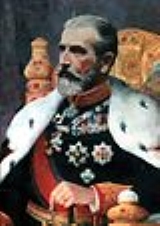
Carol I of Romania

 
Carol I of Romania

   Email Print
   Bookmark   Link


Carol I of Romania


Carol I of Romania, original name Prince Karl Eitel Friedrich Zephyrinus Ludwig of Hohenzollern-Sigmaringen, later simply of Hohenzollern (20 April 1839 - ), German prince, was elected Domnitor
Domnitor

Domnitor was the official title of the ruler of the Danubian Principalities between 1859 and 1866. "Domnitor" was used in medieval times along with the slavonic-derived term of "Voievod"/voivode, and it derives from the 'cultivated Latin' term Dominus "; ....
 (Prince) of Romania
Romania

Romania is a country located in Southeastern Europe Central Europe, North of the Balkan Peninsula, on the Lower Danube, within and outside the Carpathian Mountains, bordering on the Black Sea....
 on 20 April 1866 following the overthrow of Alexander John Cuza
Alexander John Cuza

Alexander John Cuza was a Moldavian-born Romanian politician who ruled as the first Domnitor of the Danubian Principalities between 1859 and 1866....
 by a palace coup; following the defeat of the Ottoman Empire in the Russo-Turkish War he was proclaimed King of Romania with the consent of both the Turkish Sultan and the major European powers on 26 March 1881.


Discussion
Ask a question about 'Carol I of Romania'
Start a new discussion about 'Carol I of Romania'
Answer questions from other users
Full Discussion Forum


Encyclopedia


Carol I of Romania, original name Prince Karl Eitel Friedrich Zephyrinus Ludwig of Hohenzollern-Sigmaringen, later simply of Hohenzollern (20 April 1839 - ), German prince, was elected Domnitor
Domnitor

Domnitor was the official title of the ruler of the Danubian Principalities between 1859 and 1866. "Domnitor" was used in medieval times along with the slavonic-derived term of "Voievod"/voivode, and it derives from the 'cultivated Latin' term Dominus "; ....
 (Prince) of Romania
Romania

Romania is a country located in Southeastern Europe Central Europe, North of the Balkan Peninsula, on the Lower Danube, within and outside the Carpathian Mountains, bordering on the Black Sea....
 on 20 April 1866 following the overthrow of Alexander John Cuza
Alexander John Cuza

Alexander John Cuza was a Moldavian-born Romanian politician who ruled as the first Domnitor of the Danubian Principalities between 1859 and 1866....
 by a palace coup; following the defeat of the Ottoman Empire in the Russo-Turkish War he was proclaimed King of Romania with the consent of both the Turkish Sultan and the major European powers on 26 March 1881. He was the first ruler of the Hohenzollern-Sigmaringen
Hohenzollern-Sigmaringen

The House of Hohenzollern-Sigmaringen is the cadet branch of the senior Swabian branch of the Hohenzollern dynasty, less known than the Franconian branch which became Burgrave of Nuremberg and later ruled Brandenburg-Prussia and the German Empire....
 dynasty which would rule the country until the proclamation of a republic in 1947.

During his reign, he personally led Romanian troops during the Russo-Turkish War, 1877-78 and assumed command of the Russo/Romanian army during the siege of Pleven
Siege of Pleven

The Siege of Pleven during the Russo-Turkish War, 1877?78, saw a major struggle between the joint army of Russia and Romania; and the Ottoman Empire....
. The country achieved full independence from the Ottoman Empire
Ottoman Empire

The Ottoman Empire , also known by its contemporaries as the Turkish Empire or Turkey , was an empire that lasted from 1299?1923. It was Treaty of Lausanne by the Republic of Turkey, which was officially proclaimed on October 29, 1923....
 (Treaty of Berlin, 1878
Treaty of Berlin, 1878

The Treaty of Berlin was the final act of the Congress of Berlin , by which the United Kingdom of Great Britain and Ireland, Austria-Hungary, French Third Republic, German Empire, Kingdom of Italy , Russian Empire and the Ottoman Empire under Abdul Hamid II revised the Treaty of San Stefano signed on March 3 of the same year....
) and acquired the southern part of the Dobruja
Dobruja

Dobruja, or Dobrudja , is a historical region shared by Bulgaria and Romania, located between the lower Danube river and the Black Sea, including the Danube Delta, Romanian coast and the northernmost part of the Bulgarian Black Sea Coast....
 from Bulgaria
Bulgaria

The state of Bulgaria , Scientific transliteration Balgarija, officially the Republic of Bulgaria has played a significant role in the Balkans in south-eastern Europe for over fourteen centuries....
 in 1913. Domestic political life, still dominated by the country's wealthy landowning families organised around the rival Liberal
National Liberal Party (Romania)

The Partidul National Liberal is a liberal parties in Romania, the third largest party in parliament, being outrunned by the Democratic Liberal Party and the Social Democratic Party of Romania....
 and Conservative
Conservative Party (Romania)

The Conservative Party of Romania is a political party formed in 1991, after the Romanian Revolution of 1989, under the name of the Romanian Humanist Party ....
 parties, was punctuated by two widespread peasant uprisings, in Walachia (the southern half of the country) in April 1888 and in Moldavia
Moldavia

Moldavia is a geographic and historical region and former principality in Eastern Europe, corresponding to the territory between the Eastern Carpathians and the Dniester river....
 (the northern half) in March 1907.

He married Elisabeth of Wied
Elisabeth of Wied

Pauline Elisabeth Ottilie Luise zu Wied was the Queen Consort of King Carol I of Romania, widely known by her literary name of Carmen Sylva....
 in Neuwied
Neuwied

Neuwied is a town in the north of the German state Rhineland-Palatinate, capital of the Neuwied . Neuwied lies on the right bank of the Rhine, 12 km northwest of Koblenz, on the railway from Frankfurt am Main to Cologne....
 on 15 November 1869. They only had one daughter, Maria
Princess Maria of Romania (1870-1874)

Princess Maria/Marie of Romania was the only child of Carol I of Romania and his wife, Elisabeth of Wied. She was born in Bucharest, and died of scarlet fever at Peles Castle....
, who died aged three.

Carol's childlessness left his elder brother Leopold next in line to the throne. In October 1880 Leopold renounced his right of succession in favour of his son William, who in turn surrendered his claim eight years later in favour of his younger brother, the future king Ferdinand.

Early life

Carol was born in Sigmaringen
Sigmaringen

Sigmaringen is a town in southern Germany, in the state of Baden-W?rttemberg. Situated on the upper Danube, it is the capital of the Sigmaringen ....
 as Prince Karl von Hohenzollern Sigmaringen. He was the second son of Karl Anton, Prince of Hohenzollern-Sigmaringen and his wife, Princess Josephine of Baden
Princess Josephine of Baden

Princess Josephine Friederike Luise of Baden was born at Mannheim, the daughter of Karl, Grand Duke of Baden and his wife, St?phanie de Beauharnais....
. After finishing his elementary studies, Karl entered the Cadet School in Münster
Münster

M?nster is a city in North Rhine-Westphalia, Germany. It is located in the northern part of the state and is considered to be the cultural centre of the Westphalia region and it is also capital of the government region M?nster ....
. In 1857 he was attending the courses of the Artillery School in Berlin
Berlin

Berlin is the Capital of Germany city and one of sixteen States of Germany of Germany. With a population of 3.4 million within its city limits, Berlin is the country's largest city....
. Up to 1866 (when he accepted the crown of Romania) he was a German officer. He took part in the Second Schleswig War, particularly at the assault of the Fredericia
Fredericia

Fredericia is a town located in Fredericia municipality in the eastern part of the Jutland peninsula in Denmark, in a sub-region known locally as Triangle Region Denmark, or The Triangle....
 citadel and Dybbĝl
Dybbĝl

Dybb?l is a small settlement in the southeastern corner of South Jutland County, Denmark. It is around 6 km west of S?nderborg.During the 1864 Second War of Schleswig, the Danish Army withdrew from the traditional fortified defence line of Danevirke and marched for Dybb?l to find a better defendable position....
, experience which would be very useful to him later on in the Russian-Turkish war.

Although he was quite frail and not very tall, prince Karl was reported to be the perfect soldier, healthy, disciplined, and also a very good politician with liberal ideas. He was familiar with several European languages. His family being closely related to the Bonaparte family (one of his grandmothers was a Beauharnais
Stéphanie de Beauharnais

St?phanie, Grand Duchess of Baden was the Princess consort of Karl, Grand Duke of Baden....
, Joséphine's niece-in-law, and the other a Murat, Joachim
Joachim Murat

Joachim-Napol?on Murat , Prince Murat, Grand Duke of Berg and Duchy of Cleves, Marshal of France, was King of the Two Sicilies from 1808 to 1815....
's niece), they enjoyed very good relations with Napoleon III of France
Napoleon III of France

Napol?on III, also known as Louis-Napol?on Bonaparte was the first President of the French Republic and the only emperor of the Second French Empire....
. Romania was, at the time, under the influence of French culture and Napoleon's recommendation of Prince Karl of Hohenzollern-Sigmaringen weighed heavy in the eyes of Romanian politicians of the time, as did his blood relation to the ruling Prussian family. Ion Bratianu
Ion Bratianu

Ion C. Bratianu was one of the major political figures of 19th century Romania. He was the younger brother of Dimitrie Bratianu, as well as the father of Ion I....
 was the Romanian politician sent to negotiate with Karl and his family the possibility of installing Karl on the Romanian throne.

On the way to Romania


The former Romanian ruler, Alexander John Cuza, had been banished from the country by the leading noblemen and Romania was in a political chaos. Since Cuza's double election had been the main reason for which the two Romanian countries (Wallachia
Wallachia

Wallachia or Walachia is a Historical regions of Romania and geographical region of Romania. It is situated north of the Danube and south of the Southern Carpathians....
 and the Principality of Moldavia) were allowed to unite by the European powers of the time, the country was in danger of dissolving.

Young Karl had to travel incognito on the railroad Düsseldorf
Düsseldorf

D?sseldorf is the capital city of the Germany state of North Rhine-Westphalia. It is an economic centre of Germany. The city is situated on the River Rhine and has a high population density - the Rhine-Ruhr metropolitan area has over 10 million inhabitants alone....
-Bonn
Bonn

Bonn is the 19th largest city in Germany. Located about 20 kilometres south of Cologne on the river Rhine in the Federal State of North Rhine-Westphalia, it was the Capital of Germany West Germany from 1949 to 1990 and the official seat of government of united Germany from 1990 to 1999....
-Freiburg
Freiburg

Freiburg im Breisgau is a city in Baden-W?rttemberg, Germany, in the Breisgau region on the western edge of the Black Forest. It straddles the Dreisam river, on the foothills of the Schlossberg....
-Zürich
Zürich

Z?rich is the largest city in Switzerland and the capital of the canton of Z?rich. The city is Switzerland's main commercial and cultural centre and sometimes called the Cultural Capital of Switzerland, the political capital of Switzerland being Berne....
-Vienna
Vienna

Vienna is the Capital of Republic of Austria and also one of the nine states of Austria. Vienna is Austria's primary city, with a population of about 1.7 million...
-Budapest
Budapest

Budapest is the Capitals of Hungary of Hungary. As the largest city of Hungary, it serves as the country's principal political, cultural, commerce, Industry, and transportation center and is considered an important hub in Central Europe....
, due to the conflict between his country and the Austrian Empire
Austrian Empire

The Austrian Empire was a periodization successor state empire founded on a remnant of the Holy Roman Empire centered on what is today's Austria that officially lasted from 1804 to 1867....
. He travelled under the name of Karl Hettingen. As he stepped on Romanian soil, Bratianu bowed before him and asked him to join him in the carriage (at that time, Romania didn't have a railroad system).

On 10 May 1866, Karl entered Bucharest
Bucharest

Bucharest is the capital city, industrial and commercial centre of Romania. It is the largest city in Romania, located in the southeast of the country, at , and lies on the banks of the D?mbovita River....
. The news of his arrival had been transmitted through telegraph and he was welcomed by a huge crowd eager to see its new ruler. In Baneasa
Baneasa

Baneasa is a borough in the north side of Bucharest, near the Baneasa Lake . Like all north-side districts of Bucharest, it is relatively sparsely-populated, with large areas of parkland....
 he was handed the key to the city. As a proverbial sign, on the same day it had rained for the first time in a long period of time. He pledged his oath in French: "I swear to guard the laws of Romania, to maintain its rights and the integrity of its territory".

The Constitution

Medal Carol I of Romania 2
Immediately after arriving in the country, the Romanian parliament adopted, on 29 June 1866, the 1866 Constitution of Romania
1866 Constitution of Romania

The 1866 Constitution of Romania was the fundamental law that capped a period of nation-building in the Danubian Principalities, which had united in 1859....
, one of the most advanced constitutions of its time. This constitution allowed the development and modernization of the Romanian state. In a daring move, the Constitution chose to ignore the country's current dependence on the Ottoman Empire
Ottoman Empire

The Ottoman Empire , also known by its contemporaries as the Turkish Empire or Turkey , was an empire that lasted from 1299?1923. It was Treaty of Lausanne by the Republic of Turkey, which was officially proclaimed on October 29, 1923....
, which paved the way for Independence.

Article 82 said "The ruler's powers are hereditary, starting directly from His Majesty, prince Carol I of Hohenzollern-Sigmaringen, on male line through the right of first-born, with the exclusion of women and their issue. His Majesty's descendants will be raised in the Eastern Orthodox Religion."

After the proclamation of the Independence (1877), Romania was effectively a kingdom. From 1878, Carol held the title of Royal Highness (Alteta Regala). On 15 March 1881, the Constitution was modified to state, among other things, that from then on the head of state would be called king, while the heir would be called royal prince. The same year he was crowned King.

The basic idea of all the royalist constitutions in Romania was that the King rules without governing.

A devoted King

King Carol was reported to be a cold person. He was permanently concerned with the prestige of the dynasty he had founded. His wife, Elizabeth, claimed he 'wore the crown in his sleep'. He was very meticulous and he tried to impose his style upon everyone that surrounded him. Though he was devoted to his job as a Romanian prince and king, he never forgot his German roots.

In 48 years of rule (the longest rule any Romanian principality has ever known), he helped Romania gain its independence, he raised its prestige, he helped redress its economy and he established a dynasty. In the Carpathian mountains, he built Peles Castle
Peles Castle

Today a historical monument, Peles Castle is a Neo-Renaissance castle placed in an idyllic setting in the Carpathian Mountains, near Sinaia, in Prahova County, Romania, on an existing medieval route linking Transylvania and Wallachia, built between 1873 and 1883....
, still one of Romania's most visited touristic attractions. The castle was built in German style, as a reminder of the king's origin. After the Russo-Turkish war, Romania gained Dobruja
Dobruja

Dobruja, or Dobrudja , is a historical region shared by Bulgaria and Romania, located between the lower Danube river and the Black Sea, including the Danube Delta, Romanian coast and the northernmost part of the Bulgarian Black Sea Coast....
 and Carol ordered the first bridge
King Carol I Bridge

The King Carol I Bridge was built between 1890 and 1895 in Romania over the Danube and Borcea and when it was completed it then became the longest bridge in Europe and the third in the world....
 over the Danube
Danube

The Danube is the longest river in the European Union and Europe's second longest river after the Volga.The river originates in the Black Forest in Germany as the much smaller Brigach and Breg River rivers which join at the eponymously named German town Donaueschingen, after which it is known as the Danube and flows eastwards for a distance...
, between Fetesti
Fetesti

Fetesti is a city and municipality in Romania in Ialomita County, Romania, with a population of 33,197. It is located in the Baragan plain, on the Borcea branch of the Danube....
 and Cernavoda
Cernavoda

Cernavoda is a town in Constanta County, Dobrogea, Romania with a population of 20,514.The town's name is derived from the Slavic languages cerna voda , meaning "black water"....
, linking the new acquired province to the rest of the country.

The end of the reign

The long rule of Carol helped the quick development of the Romanian state. But, towards the end of his reign and the start of the World War I
World War I

World War I, or the First World War , was a global military conflict which involved the Great powers, organized into two opposing military alliances: the Allies of World War I and the Central Powers....
, the German-born king wanted to enter the war on the side of the Central Powers
Central Powers

The Central Powers was one of the two sides that participated in World War I, the other being the Allies of World War I....
, while Romanian public opinion sided with the Triple Entente
Triple Entente

File:Map Europe alliances 1914-en.svgThe Triple Entente was the name given to the loose alignment of the British Empire, French Third Republic, and Russian Empire after the signing of the Anglo-Russian Entente in 1907....
. Carol had signed a secret treaty in 1883 which had linked Romania with the Triple Alliance (1882)
Triple Alliance (1882)

The Triple Alliance was a military alliance among German Empire, Austria-Hungary, and Kingdom of Italy that lasted from 1882 until the start of World War I in 1914....
 and although the treaty was to be activated only in case of attack from Imperial Russia towards one of the treaty's members, Carol was convinced that the honourable thing to do was to enter the war supporting the German Empire
German Empire

The German Empire is the name commonly used in English to describe Germany from the unification of Germany and proclamation of William I, German Emperor as German Emperor on 18 January 1871, to 1918, when it became Weimar republic after defeat in World War I and the abdication of William II, German Emperor ....
.

An emergency meeting was held with members of the government where Carol told them about the secret treaty and shared his opinion with them. The strong disagreement he faced is said to have brought on his sudden death on . The future King Ferdinand, under the influence of his wife, Marie of Edinburgh
Marie of Edinburgh

H.M. The Queen of Romania was a member of the British Royal Family who became the queen consort of Romania as spouse of King Ferdinand I of Romania....
, a British princess, was more willing to listen to public opinion.

Life and family

Charlesofromania
When he was elected prince of Romania, Carol was not married and, according to the Romanian Constitution he himself had approved, he was not allowed to marry a woman of Romanian origin. In 1869, the prince started a trip around Europe and mainly Germany, to find a bride. During this trip he met and married at Neuwied
Neuwied

Neuwied is a town in the north of the German state Rhineland-Palatinate, capital of the Neuwied . Neuwied lies on the right bank of the Rhine, 12 km northwest of Koblenz, on the railway from Frankfurt am Main to Cologne....
 on 15 November 1869 princess Elizabeth of Wied. Their marriage was one of the most unfitted matches in history, with Carol being a cold and calculated man while Elizabeth was a notorious dreamer. They had one child, Princess Maria
Princess Maria of Romania (1870-1874)

Princess Maria/Marie of Romania was the only child of Carol I of Romania and his wife, Elisabeth of Wied. She was born in Bucharest, and died of scarlet fever at Peles Castle....
, born in 1871, who died on the 24th of March 1874. This led to the further estrangement of the royal couple, Elizabeth never completely recovering from the trauma of losing her only child.

After the proclamation of the Kingdom (1881), the succession was a very important matter of state. Since Carol's brother, Leopold, and his oldest son, William, declined their rights, the second son of Leopold, Ferdinand
Ferdinand I of Romania

Ferdinand was the King of the Romanians from October 10 1914 until his death....
, was named prince of Romania and heir to the throne. Elizabeth tried to influence the young prince into marrying her favorite lady in waiting, Elena Vacarescu
Elena Vacarescu

File:Elena Vacarescu.jpgElena Vacarescu or H?l?ne Vacaresco was a Romanian-France writer, twice a laureate of the Acad?mie fran?aise....
. According to the Romanian constitution, though, the heir was forbidden from marrying a Romanian. As a result of the affair, Elizabeth was exiled for two years, till after Ferdinand's marriage to Princess Marie of Edinburgh
Marie of Edinburgh

H.M. The Queen of Romania was a member of the British Royal Family who became the queen consort of Romania as spouse of King Ferdinand I of Romania....
.

Towards the end of their lives, though, Carol and Elizabeth finally found a way to understand each other and were reported to have become good friends.

Source:

Boris Craciun - "Regii si Reginele României", Editura Portile Orientului, Iasi

Ancestors


External links