
All Topics  
Francis I of France

 
Francis I of France

   Email Print
   Bookmark   Link


Francis I of France


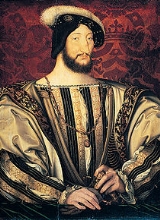
Francis I (French: François Premier and François d'Angoulême) (12 September 1494 – 31 March 1547), was crowned King of France in 1515 in the cathedral at Reims
Reims

The city of Reims lies in the Champagne-Ardenne region in northeastern France 129 km east-northeast of Paris.Founded by the Gauls, it became a major city during the period of the Roman Empire....
 and reigned until 1547.

Francis I is considered to be France
France

France , officially the French Republic , is a country whose Metropolitan France is located in Western Europe and that also comprises various Overseas departments and territories of France....
's first Renaissance
Renaissance

The Renaissance was a cultural movement that spanned roughly the 14th to the 17th century, beginning in Italy in the late Middle Ages and later spreading to the rest of Europe....
 monarch. His reign saw France make immense cultural advances. He was a contemporary of Suleiman the Magnificent
Suleiman the Magnificent

Suleiman I, His Imperial Majesty , was the tenth and longest-reigning Sultan of the Ottoman Empire, from 1520 to his death in 1566. He is known in Western world as Suleiman the Magnificent and in Eastern world, as the Lawgiver , for his complete reconstruction of the Ottoman legal system....
 of the Ottoman Empire
Ottoman Empire

The Ottoman Empire , also known by its contemporaries as the Turkish Empire or Turkey , was an empire that lasted from 1299?1923. It was Treaty of Lausanne by the Republic of Turkey, which was officially proclaimed on October 29, 1923....
, as well as King Henry VIII of England
Henry VIII of England

Henry VIII was King of England from 21 April 1509 until his death. He was also Lordship of Ireland and claimant to the Early Modern France. Henry was the second monarch of the House of Tudor, succeeding his father, Henry VII of England....
 and of Holy Roman Emperor
Holy Roman Empire

The Holy Roman Empire was a union of territories in Central Europe during the Middle Ages and the Early modern Europe under a Holy Roman Emperor....
 Charles V
Charles V, Holy Roman Emperor

Charles V was ruler of the Holy Roman Empire from 1519 and, as Charles I of Spain, of the Spanish realms from 1516 until his abdication in 1556....
, his great rivals.

cis I, the only son of Charles d'Angoulême
Charles, Count of Angoulême

Charles of Orl?ans, Count of Angoul?me was a member of the French Orl?ans family descended from Louis I de Valois, Duke of Orl?ans, and a minor French prince....
, and of Louise of Savoy
Louise of Savoy

File:Louise de Savoie.jpgLouise of Savoy was the mother of Francis I of France.Louise of Savoy was born at Pont-d'Ain, the eldest daughter of Philip II, Duke of Savoy and his first wife, Margaret of Bourbon ....
, was born at the château de Cognac , Cognac
Cognac

Cognac is a commune in France in the France d?partement in France of Charente, of which it is a sous-pr?fecture. The inhabitants of the town are known as Cogna?ais....
, in the modern French department of Charente
Charente

Charente is a departments of France in western France named after the Charente River....
, in the province of Saintonge
Saintonge

Saintonge is a small region on the Atlantic Ocean coast of France within the d?partement Charente-Maritime, west and south of Charente in the administrative region of Poitou-Charentes....
 which was part of the former Duché d'Aquitaine
Aquitaine

Aquitaine , archaic Guyenne/Guienne , is one of the 26 regions of France, in the south-western part of metropolitan France, along the Atlantic Ocean and the Pyrenees mountain range on the border with Spain....
.


Discussion
Ask a question about 'Francis I of France'
Start a new discussion about 'Francis I of France'
Answer questions from other users
Full Discussion Forum


Timeline

1494   Born

1515   September 14 - Battle of Marignano - The army of Francis I of France defeats the Swiss, thanks to the timely arrival of a Venetian army. Francis restores French control of Milan.

1516   King Francis I of France and Pope Leo X sign the Concordat of Bologna.

1516   The Treaty of Noyon is signed. Francis recognizes Charles's claim to Naples, and Charles recognizes Francis's claim to Milan.

1520   Field of Cloth of Gold. Famous meeting between King Henry VIII of England and King Francis I of France.

1524   A French army invading Italy under King Francis besieges Pavia.

1525   Battle of Pavia - Spanish forces under Charles de Lannoy and the Marquis of Pescara defeat the French army and capture Francis I of France because the hurting of his horse by Cesare Hercolani.

1526   Treaty of Madrid. Peace between Francis I of France and Charles V. Francis agrees to cede Burgundy to Charles, and abandons all claims to Flanders, Artois, Naples, and Milan.

1529   Emperor Charles V and Francis I of France sign the Treaty of Cambrai, or the "Ladies' Peace". Francis abandons his claims in Italy, but is allowed to retain Burgundy.

1536   Resumption of war between Francis I of France and Emperor Charles V. Francis ceases control of Savoy and captures Turin.


Encyclopedia


Francis I (French: François Premier and François d'Angoulême) (12 September 1494 – 31 March 1547), was crowned King of France in 1515 in the cathedral at Reims
Reims

The city of Reims lies in the Champagne-Ardenne region in northeastern France 129 km east-northeast of Paris.Founded by the Gauls, it became a major city during the period of the Roman Empire....
 and reigned until 1547.

Francis I is considered to be France
France

France , officially the French Republic , is a country whose Metropolitan France is located in Western Europe and that also comprises various Overseas departments and territories of France....
's first Renaissance
Renaissance

The Renaissance was a cultural movement that spanned roughly the 14th to the 17th century, beginning in Italy in the late Middle Ages and later spreading to the rest of Europe....
 monarch. His reign saw France make immense cultural advances. He was a contemporary of Suleiman the Magnificent
Suleiman the Magnificent

Suleiman I, His Imperial Majesty , was the tenth and longest-reigning Sultan of the Ottoman Empire, from 1520 to his death in 1566. He is known in Western world as Suleiman the Magnificent and in Eastern world, as the Lawgiver , for his complete reconstruction of the Ottoman legal system....
 of the Ottoman Empire
Ottoman Empire

The Ottoman Empire , also known by its contemporaries as the Turkish Empire or Turkey , was an empire that lasted from 1299?1923. It was Treaty of Lausanne by the Republic of Turkey, which was officially proclaimed on October 29, 1923....
, as well as King Henry VIII of England
Henry VIII of England

Henry VIII was King of England from 21 April 1509 until his death. He was also Lordship of Ireland and claimant to the Early Modern France. Henry was the second monarch of the House of Tudor, succeeding his father, Henry VII of England....
 and of Holy Roman Emperor
Holy Roman Empire

The Holy Roman Empire was a union of territories in Central Europe during the Middle Ages and the Early modern Europe under a Holy Roman Emperor....
 Charles V
Charles V, Holy Roman Emperor

Charles V was ruler of the Holy Roman Empire from 1519 and, as Charles I of Spain, of the Spanish realms from 1516 until his abdication in 1556....
, his great rivals.

Early life

Francis I, the only son of Charles d'Angoulême
Charles, Count of Angoulême

Charles of Orl?ans, Count of Angoul?me was a member of the French Orl?ans family descended from Louis I de Valois, Duke of Orl?ans, and a minor French prince....
, and of Louise of Savoy
Louise of Savoy

File:Louise de Savoie.jpgLouise of Savoy was the mother of Francis I of France.Louise of Savoy was born at Pont-d'Ain, the eldest daughter of Philip II, Duke of Savoy and his first wife, Margaret of Bourbon ....
, was born at the château de Cognac , Cognac
Cognac

Cognac is a commune in France in the France d?partement in France of Charente, of which it is a sous-pr?fecture. The inhabitants of the town are known as Cogna?ais....
, in the modern French department of Charente
Charente

Charente is a departments of France in western France named after the Charente River....
, in the province of Saintonge
Saintonge

Saintonge is a small region on the Atlantic Ocean coast of France within the d?partement Charente-Maritime, west and south of Charente in the administrative region of Poitou-Charentes....
 which was part of the former Duché d'Aquitaine
Aquitaine

Aquitaine , archaic Guyenne/Guienne , is one of the 26 regions of France, in the south-western part of metropolitan France, along the Atlantic Ocean and the Pyrenees mountain range on the border with Spain....
. His father was the first cousin of King Louis XII
Louis XII of France

Louis XII , called "the Father of the People" was the thirty-fifth List of French monarchs of France and the sole monarch from the House of Valois Cadet branch of the House of Valois....
. In 1498, the four-year-old Francis, already Count of Angoulême, was created Duke of Valois. He was the heir presumptive
Heir Presumptive

An heir presumptive is the person provisionally scheduled to inherit a throne, peerage, or other hereditary honor, but whose position can be displaced by the birth of an heir apparent or of a new heir presumptive with a better claim to the throne....
 of Louis XII who did not succeed in siring sons with any of his three wives. In 1506, and by instigation of Louis XII, young Francis was betrothed to Claude of France
Claude of France

Claude of France , Queen Consort of France and Duke of Brittany in her own right, was the eldest daughter of Louis XII of France and Anne of Brittany....
, the daughter of Louis XII and Anne of Brittany
Anne of Brittany

Anne, Duchess of Brittany , also known as Anna of Brittany , was a Breton ruler, who was to become queen to two successive French kings. She was born in Nantes, Brittany, and was the daughter of Francis II of Brittany and Margaret of Foix....
, and heiress of Duché of Brittany
Brittany

Brittany is a former independent Celtic nations monarchy and duchy, now incorporated into France. It is also, more generally, the name of the cultural area whose limits correspond to the historic province and independent duchy....
. The marriage took place on 18 May 1514. Because of the Salic Law
Salic law

Salic law was an important body of traditional law codified for governing the Salian Franks in the early Middle Ages during the reign of King Clovis I in the 6th century....
 that excluded women from succeeding to the throne of France, the throne passed to Francis I at the death of Louis XII, as he was a male-line great-great-grandson of Charles V of France
Charles V of France

Charles V , called the Wise, was List of French monarchs from 1364 to his death and a member of the House of Valois. His reign marked a high point for France during the Hundred Years' War, with his armies recovering much of the territory ceded to England at the Treaty of Br?tigny....
 and the descendant of the eldest surviving male line of the Capetian Dynasty
Capetian dynasty

The Capetian dynasty is the largest European royal house. It includes any of the direct descendants of Hugh Capet of France. King Juan Carlos of Spain and Grand Duke Henri%2C_Grand_Duke_of_Luxembourg of Luxembourg are members of this family, both through the House of Bourbon of the dynasty....
. Claude of France became queen consort
Queen consort

A queen consort is the title given to the wife of a reigning Monarch. Queens consort usually share their husbands' Royal and noble ranks and hold the feminine equivalent of their husbands' monarchical titles....
.

When the twenty-year old Francis ascended the throne in 1515, he was already a king with unprecedented humanist
Humanism

Humanism is a broad category of ethics that affirm the dignity and worth of all people, based on the ability to determine right and wrong by appealing to universal human qualities, particularly rationalism, without resorting to the supernatural or alleged divine authority from religious texts....
 credentials. While his two predecessors, Charles VIII
Charles VIII of France

Charles VIII, called the Affable, , was List of French monarchs from 1483 to his death. Charles was a member of the House of Valois. His invasion of Italy initiated the long series of Italian Wars which characterized the first half of the 16th century....
 and Louis XII, had spent much of their reigns concerned with Italy they did not much embrace the new intellectual movements coming out of it. Both monarchs continued in the same patterns of behavior that had dominated the French monarchy for centuries. They are considered the last of the medieval French monarchs, but they did lay the groundwork for the Renaissance to come into full swing in France.

Contact between the French and Italians in the long running series of wars under Charles VIII and Louis XII had brought new ideas to France by the time the young Francis was receiving his education. Thus a number of his tutors, such as Desmoulins, his Latin instructor, and Christophe de Longueil
Christophe de Longueil

Christophe de Longueil was a Belgium humanist. He is also known by his Latin language name, Christophe Longolius.He was born in Mechelen, and studied jurisprudence in Valence, Dr?me....
 were schooled in the new ways of thinking and they attempted to imbue Francis with it. Francis's mother also had a great interest in Renaissance art, which she passed down to her son. One certainly cannot say that Francis received a humanist education; most of his teachers had not yet been affected by the Renaissance. One can, however, state that he clearly received an education more oriented towards humanism than any previous French king.

Kingship


Patron of the Arts


By the time Francis ascended the throne in 1515, the Renaissance had clearly arrived in France, and Francis was an important supporter of the change. He became a major patron of the arts and lent his support to many of the greatest artists of his time and encouraged them to come to France. Some did work for him, including such greats as Andrea del Sarto
Andrea del Sarto

Andrea del Sarto was an Italy painter from Florence, whose career flourished during the High Renaissance and early-Mannerism. Though highly regarded by his contemporaries as an artist "senza errori" , he is overshadowed now by equally talented contemporaries like Raphael....
, and Leonardo da Vinci
Leonardo da Vinci

Leonardo di ser Piero da Vinci was an Italy polymath, being a scientist, mathematician, engineer, inventor, anatomist, Painting, sculptor, architect, botanist, musician and writer....
, whom Francis convinced to leave Italy in the last part of his life. While Leonardo did little painting in his years in France, he brought with him many of his great works, such as the Mona Lisa
Mona Lisa

Mona Lisa is a 16th century portrait painting painted in oil painting on a poplar panel painting by Leonardo da Vinci during the Italian Renaissance....
, known in France as La Joconde, and these stayed in France upon his death.

Other major artists whom Francis employed include the goldsmith Benvenuto Cellini
Benvenuto Cellini

Benvenuto Cellini was an Italy goldsmith, Painting, sculpture, soldier and musician of the Renaissance, who also wrote a famous autobiography....
, and the painters Rosso
Rosso Fiorentino

Giovanni Battista di Jacopo , known as Rosso Fiorentino , or Il Rosso, was an Italy Mannerism Painting, in oil and fresco, belonging to the Florentine school....
, Romano
Giulio Romano

Giulio Romano was an Italy Painting and Architecture. A prominent pupil of Raffaello Santi, his stylistic deviations from high Renaissance classicism help define the 16th-century style known as Mannerism....
 and Primaticcio, all of whom were heavily employed in decorating Francis's various palaces and exceedingly loyal. Francis employed a number of agents in Italy who endeavoured to procure artworks by Italian masters such as Michelangelo, Titian
Titian

File:Tizian 090.jpg Tiziano Vecelli or Tiziano Vecellio, born 1473/1490 , died 27 August 1576, better known as Titian , was the leading painter of the 16th-century Venice school of the Italian Renaissance....
, and Raphael and ship them to France. These agents had some notable successes, even if plans to try to move Leonardo's Last Supper
The Last Supper (Leonardo)

The Last Supper is a 15th century mural painting in Milan created by Leonardo da Vinci for his patron List of rulers of Milan Ludovico Sforza and his duchess Beatrice d'Este....
 to France proved impractical. When Francis ascended the throne, the royal palaces were decorated with only a scattering of great paintings, and not a single piece of sculpture either ancient or modern. It is during Francis' reign that the magnificent art collection of the French kings that can still be seen in the Louvre
Louvre

The Louvre Museum , located in Paris, is a historic monument, and a national museum of France. It is a central landmark, located on the Rive Droite of the Seine in the 1st arrondissement of Paris ....
 was truly begun.

Man of letters

Francis was also renowned as a man of letters. When Francis comes up in a conversation among characters in Castiglione
Baldassare Castiglione

Baldassare Castiglione, count of Novilara , was an Italy courtier, diplomat, soldier and a prominent Renaissance author....
's Book of the Courtier, it is as the great hope to bring culture to the war-obsessed French nation. Not only did Francis support a number of major writers of the period, he was a poet himself, if not one of immense quality. Francis worked hard at improving the royal library. He appointed the great French humanist Guillaume Budé
Guillaume Budé

Guillaume Bud? was a France scholar....
 as chief librarian, and began to expand the collection. Francis employed agents in Italy looking for rare books and manuscripts, just as he had looking for art works. During his reign, the size of the library increased greatly. Not only did Francis expand the library, there is also, according to Knecht, evidence that he read the books he bought for it, a much rarer feat in the royal annals. Francis set an important precedent by opening his library to scholars from around the world in order to facilitate the diffusion of knowledge.

In 1537, Francis signed the Ordonnance de Montpellier
Ordonnance de Montpellier

The Ordonnance de Montpellier, signed on December 28, 1537 by Francis I of France, established the first legal deposit system.In the Ordonnance, Francis decreed that no book be sold in France until a copy was deposited in his library....
, decreeing that his library be given a copy of every book to be sold in France.

Francis's older sister, Marguerite
Marguerite de Navarre

Marguerite de Navarre , also known as Marguerite of Angouleme and Margaret of Navarre, was the queen consort of King Henry II of Navarre....
, Queen of Navarre
List of Navarrese monarchs

This is a list of the kings of Pamplona , later kingdom of Navarre. Pamplona was the primary name of the kingdom until its union with Kingdom of Aragon ....
, was also an accomplished writer, producing the classic, Heptameron
Heptameron

The Heptameron is a collection of 72 short stories written in French language by Marguerite of Navarre . It has the form of a frame narrative and was inspired by the Decameron of Giovanni Boccaccio....
.

Construction


Francis poured vast amounts of money into new structures. He continued the work of his predecessors on the Château d'Amboise
Château d'Amboise

The royal Ch?teau at Amboise is a ch?teau located in Amboise, in the Indre-et-Loire d?partement in France of the Loire Valley in France....
 and also started renovations on the Château de Blois
Château de Blois

The Royal Ch?teau de Blois is located in the Loir-et-Cher d?partement in France in the Loire Valley, in France. The residence of several list of French monarchs, it is also the place where Joan of Arc went in 1429 to be blessed by the Archbishop of Reims before departing with her army to drive the English from Orl?ans....
. Early in his reign, he also began construction of the magnificent Château de Chambord
Château de Chambord

The royal Ch?teau de Chambord at Chambord, Loir-et-Cher, Loir-et-Cher, France is one of the most recognizable ch?teaux in the world because of its very distinct Renaissance architecture#Renaissance Architecture in France Renaissance architecture that blends traditional French medieval forms with classical Italian structures....
, inspired by the styles of the Italian renaissance, and perhaps even designed by Leonardo da Vinci. Francis rebuilt the Louvre
Louvre

The Louvre Museum , located in Paris, is a historic monument, and a national museum of France. It is a central landmark, located on the Rive Droite of the Seine in the 1st arrondissement of Paris ....
, transforming it from a medieval fortress into a building of Renaissance splendour. He financed the building of a new City Hall (Hôtel de Ville
Hôtel de Ville, Paris

The H?tel de Ville in Paris, France, is the building housing the City of Paris's administration. Standing on the place de l'H?tel de Ville in the city's IVe arrondissement, it has been the location of the municipality of Paris since 1357....
) for Paris in order to have control over the building's design. He constructed the Château de Madrid
Château de Madrid

The Ch?teau de Madrid was a significant Renaissance building in France. It was built in Neuilly-sur-Seine, on the edge of the Bois de Boulogne, near Paris, in the early 1500s, but fell into disuse in the 17th and 18th centuries and was almost completely demolished in the 1790s....
 in the Bois de Boulogne
Bois de Boulogne

The Bois de Boulogne is a park located along the western edge of the 16th arrondissement of Paris of Paris, near the suburb of Boulogne-Billancourt....
, and rebuilt the Château de St-Germain-en-Laye
Saint-Germain-en-Laye

ame=Saint-Germain-en-Laye|image =|caption=Ch?teau de Saint-Germain-en-Laye in the town centre|map_size=270px|adjustable_map =St-Germain-en-Laye_map.png|...
. The largest of Francis's building projects was the reconstruction and expansion of the royal château of Fontainebleau
Château de Fontainebleau

The Palace of Fontainebleau, located 34.5 miles from the centre of Paris, is one of the largest French royal ch?teaux. The palace as it is today is the work of many French monarchs, building on a structure of Francis I of France....
, which quickly became his favourite place of residence, as well as the residence of his official mistress - Anne, duchess of Étampes. Each of Francis's projects was luxuriously decorated both inside and outside. Fontainebleau, for instance, had a gushing fountain in its courtyard where quantities of wine were mixed with the water.

Military action

Militarily and politically, Francis's reign was less successful; he tried and failed to become Holy Roman Emperor
Holy Roman Emperor

Image:HRR 14Jh.jpgThe Roman of the Emperor's title was a reflection of the translatio imperii principle that regarded the Holy Roman Emperors as the inheritors of the title of Emperor of the Western Roman Empire, a title left unclaimed in the West after the death of Julius Nepos in 480....
, and pursued a series of wars in Italy. (See Italian Wars
Italian Wars

The Italian Wars, often referred to as the Great Italian Wars or the Great Wars of Italy in historical works, were a series of conflicts from 1494 to 1559 that involved, at various times, most of the Italian city-states, the Papal States, all the major states of western Europe as well as the Ottoman Empire....
.
) Francis managed to defeat the Swiss at Marignano in 1515, which enabled him to capture the Italian city-state of Milan
Milan

Milan is the second largest city of Italy, located in the plains of Lombardy. It is the capital in the Province of Milan, as well as the Regions of Italy capital of Lombardy....
.

Much of the military activity of Francis's reign was focused on his sworn enemy, the Holy Roman Emperor Charles V. In addition to the Holy Roman Empire, Charles personally ruled Spain
Spain

Spain or the Kingdom of Spain , is a country located in Southern Europe on the Iberian Peninsula.The Spanish constitution does not establish any official denomination of the country, even though Espa?a , Estado espa?ol and Naci?n espa?ola are used interchangeably....
, Austria
Austria

Austria , officially the Republic of Austria , is a landlocked country in Central Europe. It borders both Germany and the Czech Republic to the north, Slovakia and Hungary to the east, Slovenia and Italy to the south, and Switzerland and Liechtenstein to the west....
 and a number of smaller possessions neighboring France, and was thus a threat to Francis's kingdom. Francis attempted to arrange an alliance with Henry VIII of England
Henry VIII of England

Henry VIII was King of England from 21 April 1509 until his death. He was also Lordship of Ireland and claimant to the Early Modern France. Henry was the second monarch of the House of Tudor, succeeding his father, Henry VII of England....
. The negotiations took place at the famous Field of Cloth of Gold of 1520, but ultimately failed. Francis's most devastating defeat occurred at the Battle of Pavia
Battle of Pavia

The Battle of Pavia, fought on the morning of February 24, 1525, was the decisive engagement of the Italian War of 1521. A Spanish-Imperial army under the nominal command of Charles de Lannoy attacked the French army under the personal command of Francis I of France in the great hunting preserve of Mirabello outside the city walls....
 (1525), where he was captured by Charles: Cesare Hercolani
Cesare Hercolani

Cesare Hercolani was an Italian people Condottieri, or mercenary leader.He was born in Forl? in 1499. The Hercolanis were a noble family, and Cesare became a venture captain under Charles V, Holy Roman Emperor....
 hurt his horse and Francis was captured by Spaniards Juan de Urbieta, Diego Dávila and Alonso Pita
Alonso Pita da Veiga

Alonso Pita da Veiga, born in Ferrol, Spain in 15th century Galicia , Spain, was the most remarkable young officer of the Tercio fighting under the orders of Count Andrade in the Battle of Pavia , between the years 1513-1525, becoming a lord with the right to wear a coat of arms and was granted land and property in Ferrolterra, his birthplace...
. For this reason, Hercolani
Cesare Hercolani

Cesare Hercolani was an Italian people Condottieri, or mercenary leader.He was born in Forl? in 1499. The Hercolanis were a noble family, and Cesare became a venture captain under Charles V, Holy Roman Emperor....
 was named "victor of the battle of Pavia". The famous Zuppa alla Pavese,, now a renowned recipe, was said to have been invented on the spot to feed the captive king right after the battle. Francis was held captive in Madrid
Madrid

Madrid is the Capital and largest city of Spain. It is the Largest cities of the European Union by population within city limits in the European Union after Greater London and Berlin, and its Madrid metropolitan area is the Largest urban areas of the European Union in the European Union after Paris aire urbaine, Greater London Urban Area, a...
. In the Treaty of Madrid signed on 14 January 1526, Francis I was forced to make major concessions to Charles V before he was freed on 17 March 1526. Upon his return to France, however, Francis argued that his agreement with Charles was made under duress
Duress

Duress or coercion is a possible defense , one of four of the most important justification defenses, by which defendants argue that they should not be held liability because the actions that broke the law were only performed out of an immediate fear of injury....
, and also claimed that the agreement was void, as his sons had been taken hostage suggesting his word alone was not trusted, and he repudiated it.

In a watershed moment in European diplomacy, Francis came to an understanding with the Ottoman Empire
Ottoman Empire

The Ottoman Empire , also known by its contemporaries as the Turkish Empire or Turkey , was an empire that lasted from 1299?1923. It was Treaty of Lausanne by the Republic of Turkey, which was officially proclaimed on October 29, 1923....
. No formal treaties with the 'infidel empire' were signed, but high-level meetings between the two powers caused them to collude against Charles V, and, in 1543, the two powers even combined for a joint naval assault on Nice
Nice

Nice is a city in Southern France France located on the Mediterranean Sea coast, between Marseille, France, and Genoa, Italy, with 1,197,751 inhabitants in the 2007 estimate....
.

The New World

In 1524, Francis assisted the citizens of Lyon
Lyon

||-||}Lyon, also known as Lyons in English, is a city in east-central France. Its name is pronounced in French language and Franco-Proven?al language, and or in English language....
 in financing the expedition of Giovanni da Verrazzano to North America; on this expedition, Verrazzano claimed Newfoundland for the French crown. In 1534, Francis sent Jacques Cartier
Jacques Cartier

Jacques Cartier was a French explorer who claimed what is now Canada for France. He was the first non-Aboriginal peoples in Canada to describe and map the Gulf of Saint Lawrence and the shores of the Saint Lawrence River, which he Name of Canada", after the Iroquoian languages word the local natives used for the two big St....
 to explore the St. Lawrence River in Quebec
Quebec

Quebec , in French language, Qu?bec , is a Provinces and territories of Canada in the Central Canada and Eastern Canada regions of Canada....
 to find certaines îles et pays où l'on dit qu'il se doit trouver grande quantité d'or et autres riches choses ("certain islands and lands where it is said there must be great quantities of gold and other riches"). In 1541, Francis sent Jean-François de la Roque de Roberval
Jean-François de la Roque de Roberval

Jean-Fran?ois de La Roque de Roberval was the first Lieutenant General of New France and a pirate....
 to settle Canada and to provide for the spread of "the Holy Catholic faith."

Bureaucratic reform

In 1539, in his castle in Villers-Cotterêts
Villers-Cotterêts

Villers-Cotter?ts is a Communes of the Aisne department in the Aisne Departments of France in Picardie in northern France.The inhabitants are called Cottereziens....
, Francis signed the important edict known as Ordinance of Villers-Cotterets
Ordinance of Villers-Cotterêts

The Ordinance of Villers-Cotter?ts is an extensive piece of reform legislation signed into law by Francis I of France of France on August 10, 1539 in the city of Villers-Cotter?ts....
, which, among other reforms, made French the administrative language of the kingdom, replacing Latin. This same edict required priests to register births, marriages and deaths and to establish a registry office in every parish. This established the first records of vital statistics with filiations available in Europe.

Religion