
All Topics  
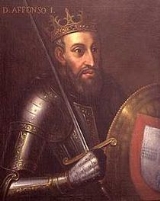
Afonso I of Portugal

 
Afonso I of Portugal

   Email Print
   Bookmark   Link


Afonso I of Portugal


Afonso I (Coimbra
Coimbra

Coimbra is a city and municipalities of Portugal in Portugal. It served as the country's capital during the First Dynasty and remains home to the University of Coimbra, the oldest academic institution in the Portuguese-speaking world and List of oldest universities in continuous operation....
, 1109, traditionally July 25 – Coimbra
Coimbra

Coimbra is a city and municipalities of Portugal in Portugal. It served as the country's capital during the First Dynasty and remains home to the University of Coimbra, the oldest academic institution in the Portuguese-speaking world and List of oldest universities in continuous operation....
, 1185, December 6), or also Affonso (Archaic Portuguese), Alfonso or Alphonso (Portuguese-Galician) or Alphonsus (Latin
Latin

Latin is an Italic language, historically spoken in Latium and Ancient Rome. Through the Military history of the Roman Empire, Latin spread throughout the Mediterranean and a large part of Europe....
 version), sometimes rendered in English
English language

English is a West Germanic language that originated in Anglo-Saxon England and has lingua franca status in many parts of the world as a result of the military, economic, scientific, political and cultural influence of the British Empire in the 18th, 19th and early 20th centuries and that of the United States from the mid 20th century onwa...
 as Alphonzo or Alphonse, depending on the Spanish or French influence, more commonly known as Afonso Henriques , nicknamed the Conqueror (Port.
Portuguese language

Portuguese is a Romance language that originated in what is now Galicia and Portugal. It is derived from the Latin language spoken by the Romanization Pre-Roman peoples of the Iberian Peninsula around 2000 years ago....
 o Conquistador), was the first King of Portugal
List of Portuguese monarchs

This is a list of Portuguese monarchs dating from the independence of Portugal from the kingdom of Kingdom of Le?n in 1128 under Afonso Henriques, who proclaimed himself King in 1139, to the proclamation of the Portuguese Republic on October 5, 1910, during the reign of Manuel II of Portugal, "the Patriot," or "the Missed Kin...
, achieving its independence from León
Kingdom of León

Kingdom of Le?n was an independent country situated in the northwest region of the Iberian Peninsula. It was founded in 910 A.D. when the Christian princes of Kingdom of Asturias along the Bay of Biscay shifted their main seat from Oviedo to the city of Le?n, Spain....
 and doubling its area with the Reconquista
Reconquista

The Reconquista was a period of 800 years in the Middle Ages during which several Christian kingdoms of the Iberian Peninsula succeeded in retaking the Iberian Peninsula from the Muslims....
.

so I was the son of Henry of Burgundy, Count of Portugal
Henry, Count of Portugal

Henry of Burgundy, Count of Portugal was Count of Portugal from 1093 to his death. He was the son of Henry of Burgundy, heir of Robert I, Duke of Burgundy, and brother of Hugh I, Duke of Burgundy and Eudes I, Duke of Burgundy....
 and Teresa of León, the illegitimate daughter of King Alfonso VI of León.


Discussion
Ask a question about 'Afonso I of Portugal'
Start a new discussion about 'Afonso I of Portugal'
Answer questions from other users
Full Discussion Forum


Timeline

1109   Born

1112   Afonso I becomes Count of Portugal

1128   King Afonso I of Portugal, then Count of Portugal defeats his mother, Teresa of Leon, in battle and gains control of the county.

1139   July 26, '''Independence of Portugal''' from the Kingdom of León and Castile declared after the Battle of Ourique against the Almoravides lead by Ali ibn Yusuf: '''Prince Afonso Henriques''' becomes '''Afonso I, King of Portugal''', after assembling the first assembly of the estates-general of Portugal at Lamego, where he was given the Crown from the Bishop of Bragança, to confirm the independen

1147   Siege of Lisbon: King Afonso I of Portugal and the Crusaders capture Lisbon from the Moors.

1148   King Afonso I of Portugal takes Abrantes from the Moors.

1167   Afonso I of Portugal is defeated by the Kingdom of Leon

1179   Afonso I is recognized as the true King of Portugal by Pope Alexander III, bringing Portugal the protection of the Catholic Church against the Castilian monarchy.

1180   Afonso I of Portugal is taken prisoner by Ferdinand II of Leon

1185   Died


Encyclopedia


Afonso I (Coimbra
Coimbra

Coimbra is a city and municipalities of Portugal in Portugal. It served as the country's capital during the First Dynasty and remains home to the University of Coimbra, the oldest academic institution in the Portuguese-speaking world and List of oldest universities in continuous operation....
, 1109, traditionally July 25 – Coimbra
Coimbra

Coimbra is a city and municipalities of Portugal in Portugal. It served as the country's capital during the First Dynasty and remains home to the University of Coimbra, the oldest academic institution in the Portuguese-speaking world and List of oldest universities in continuous operation....
, 1185, December 6), or also Affonso (Archaic Portuguese), Alfonso or Alphonso (Portuguese-Galician) or Alphonsus (Latin
Latin

Latin is an Italic language, historically spoken in Latium and Ancient Rome. Through the Military history of the Roman Empire, Latin spread throughout the Mediterranean and a large part of Europe....
 version), sometimes rendered in English
English language

English is a West Germanic language that originated in Anglo-Saxon England and has lingua franca status in many parts of the world as a result of the military, economic, scientific, political and cultural influence of the British Empire in the 18th, 19th and early 20th centuries and that of the United States from the mid 20th century onwa...
 as Alphonzo or Alphonse, depending on the Spanish or French influence, more commonly known as Afonso Henriques , nicknamed the Conqueror (Port.
Portuguese language

Portuguese is a Romance language that originated in what is now Galicia and Portugal. It is derived from the Latin language spoken by the Romanization Pre-Roman peoples of the Iberian Peninsula around 2000 years ago....
 o Conquistador), was the first King of Portugal
List of Portuguese monarchs

This is a list of Portuguese monarchs dating from the independence of Portugal from the kingdom of Kingdom of Le?n in 1128 under Afonso Henriques, who proclaimed himself King in 1139, to the proclamation of the Portuguese Republic on October 5, 1910, during the reign of Manuel II of Portugal, "the Patriot," or "the Missed Kin...
, achieving its independence from León
Kingdom of León

Kingdom of Le?n was an independent country situated in the northwest region of the Iberian Peninsula. It was founded in 910 A.D. when the Christian princes of Kingdom of Asturias along the Bay of Biscay shifted their main seat from Oviedo to the city of Le?n, Spain....
 and doubling its area with the Reconquista
Reconquista

The Reconquista was a period of 800 years in the Middle Ages during which several Christian kingdoms of the Iberian Peninsula succeeded in retaking the Iberian Peninsula from the Muslims....
.

Life

Afonso I was the son of Henry of Burgundy, Count of Portugal
Henry, Count of Portugal

Henry of Burgundy, Count of Portugal was Count of Portugal from 1093 to his death. He was the son of Henry of Burgundy, heir of Robert I, Duke of Burgundy, and brother of Hugh I, Duke of Burgundy and Eudes I, Duke of Burgundy....
 and Teresa of León, the illegitimate daughter of King Alfonso VI of León. He was proclaimed King on July 26 1139, immediately after the Battle of Ourique
Battle of Ourique

The Battle of Ourique saw the forces of Portuguese Prince Afonso Henriques defeat the Almoravid dynasty Moors led by Ali ibn Yusuf. There is no certainty about its exact location, probably in the countryside outside the town of Ourique , present-day Alentejo region in southern Portugal....
, and died on December 6 1185 in Coimbra
Coimbra

Coimbra is a city and municipalities of Portugal in Portugal. It served as the country's capital during the First Dynasty and remains home to the University of Coimbra, the oldest academic institution in the Portuguese-speaking world and List of oldest universities in continuous operation....
.

At the end of the 11th century, the Iberian Peninsula
Iberian Peninsula

The Iberian Peninsula, or Iberia, is located in the extreme southwest of Europe and includes modern-day Spain, Portugal, Andorra and Gibraltar and a very small area of France....
 political
Politics

Politics is the process by which groups of people make decisions. The term is generally applied to behaviour within civil governments, but politics has been observed in all human group interactions, including corporation, academia, and religion institutions....
 agenda was mostly concerned with the Reconquista
Reconquista

The Reconquista was a period of 800 years in the Middle Ages during which several Christian kingdoms of the Iberian Peninsula succeeded in retaking the Iberian Peninsula from the Muslims....
, the driving out of the Muslim
Muslim

:A Muslim , , is an adherent of the religion of Islam. The feminine form is Muslimah . Literally, the word means "one who submits "....
 successor-states to the Caliphate of Córdoba after its collapse. With European military
Military

A military is an organization authorized by its nation to use force, usually including use of weapons, in defending its country by combating actual or Threat of force ....
 aristocracies
Aristocracy

Aristocracy is a form of government, in which a few of the most prominent citizens rule. This may be a hereditary elite, or it may be by a system of cooption where a council of prominent citizens add leading soldiers, merchants, land owners, priests, and lawyers to their number....
 focused on the Crusades
Crusades

The Crusades were a series of religious war waged by much of Christian Europe against external and internal opponents. Crusades were fought mainly against Muslims, though campaigns were also directed against Paganism Slavic peoples, Jews, Eastern Orthodox Church, Mongols, Catharism, Hussites, Waldensians, Old Prussians, and political enemi...
, Alfonso VI called for the help of the French
France

France , officially the French Republic , is a country whose Metropolitan France is located in Western Europe and that also comprises various Overseas departments and territories of France....
 nobility
Nobility

Nobility is a government-privileged title which may be either hereditary or for a lifetime. Titles of nobility exist today in many countries although it is usually associated with present or former monarchies....
 to deal with the Moors
Moors

In the Spanish language, the term for Moors is Moro; in Portuguese language the word is mouro. There seems to have been some confusion about the relationship of the word moro/mouro to the word moreno , both from Greek language ma?ros, i.e....
. In exchange, he was to give the hands of his daughters in wedlock to the leaders of the expedition and bestow royal privileges to the others. Thus, the royal heiress Urraca of León wedded Raymond of Burgundy
Raymond of Burgundy

Raymond of Burgundy was the fourth son of William I, Count of Burgundy and was Count of Amous. He came to the Iberian Peninsula for the first time during the period 1086-1087 with Eudes I, Duke of Burgundy....
, younger son of the Count of Burgundy
County of Burgundy

The Free County of Burgundy, in German Freigrafschaft Burgund, was a medieval county , within the traditional province and modern French region Franche-Comt?, whose very French name is still reminiscent of the unusual title of its count: Freigraf ....
, and her half-sister, princess Teresa of León, wedded his cousin, another French crusader, Henry of Burgundy
Henry of Burgundy

Henry of Burgundy was the son and heir of Robert I, Duke of Burgundy, duke of Burgundy. He died shortly before his father and failed to succeed in Burgundy....
, younger brother of the Duke of Burgundy
Duchy of Burgundy

The Duchy of Burgundy was a feudal territory once existing within the France in the Middle Ages. It roughly conforms to the modern Bourgogne. Existing between 843 and 1477, the Duchy was ruled by a succession of Duke of Burgundy, whose extinction with the death of Charles the Bold in 1477 led to the Duchy being absorbed into the French crown...
. Henry was made Count of Portugal, a burdensome county
County

A county is a land area of Local government government within a larger state. A county may have city and towns within its area....
 south of Galicia, where Moorish incursions and attacks were to be expected. With his wife Teresa as co-ruler of Portugal, Henry withstood the ordeal and held the lands for his father-in-law.

From this marriage several children were born, but only one son, Afonso Henriques (meaning "Afonso son of Henry") survived. The boy, born 1109, followed his father as Count of Portugal in 1112, under the tutelage of his mother. The relations between Teresa and her son Afonso proved difficult. Only eleven years old, Afonso already had his own political ideas, greatly different from his mother's. In 1120, the young prince
Prince

Prince, from the Latin root princeps, is a general term for a monarch, for a member of a monarch's or former monarch's family, and is a hereditary title in some members of Europe's highest nobility....
 took the side of the archbishop
Archbishop

In Christianity, an archbishop is an elevated bishop. In the Roman Catholic Church, the Anglican Communion and others, this means that they lead a diocese of particular importance called an archdiocese, or in the Anglican Communion an Ecclesiastical Province, but this is not always the case....
 of Braga
Braga

Braga , a List of municipalities of Portugal and municipalities of Portugal in northwestern Portugal, is the capital of the Braga , the oldest Archdiocese of Braga and one of the major cities of the country....
, a political foe of Teresa, and both were exiled by her orders. Afonso spent the next years away from his own county
County

A county is a land area of Local government government within a larger state. A county may have city and towns within its area....
, under the watch of the bishop. In 1122 Afonso became fourteen, the adult age in the 12th century. He made himself a knight
Knight

File:Gothic armor 2.jpgKnight is the term for a social position originating in the Middle Ages. In the Commonwealth of Nations, knighthood is a non-heritable form of gentry....
 on his own account in the Cathedral
Cathedral

A cathedral is a Christian church that contains the seat of a bishop. It is a Religion building for worship, specifically of a denomination with an episcopal hierarchy, such as the Roman Catholic Church, Anglicanism, Orthodox Christian and some Lutheranism churches, which serves as a bishop's seat, and thus as the central church of a dioc...
 of Zamora, raised an army
Army

An army , in the broadest sense, is the land-based armed forces of a nation. It may also include other branches of the military such as an air force....
, and proceeded to take control of his lands. Near Guimarães
Guimarães

Guimar?es is a city and List of municipalities of Portugal in northwestern Portugal in the province of Minho and in the Braga . In the 9th century, V?mara Peres was able to expel the Moors and founded a fortified town under his own name Vimaranis which later became Guimaranis, present day Guimar?es....
, at the Battle of São Mamede
Battle of São Mamede

The Battle of S?o Mamede took place on June 24, 1128 near Guimar?es and is considered the seminal event for the foundation of Portugal. Portuguese forces led by Afonso I of Portugal defeated forces led by his mother Teresa of Le?n and her lover Fern?o Peres de Trava....
 (1128) he overcame the troops under his mother's lover and ally Count Fernando Peres de Trava of Galicia, making her his prisoner and exiling her forever to a monastery
Monastery

Monastery , a term derived from the Greek language word ???ast?????, neut. of ???ast????? - monasterios denotes the building, or complex of buildings, that houses a room reserved for prayer as well as the domestic quarters and workplace of Monk, whether monks or nuns, and whether living in Cenobium or alone ....
 in León. Thus the possibility of incorporating Portugal into a Kingdom of Galicia was eliminated and Afonso became sole ruler (Duke of Portugal) after demands for independence from the county's people, church and nobles. He also vanquished Alfonso VII of León
Alfonso VII of León

Alfonso VII , called the Emperor, became the King of Galicia in 1111 and King of Le?n and King of Castile in 1126. He was crowned "Imperator totius Hispaniae" in 1135....
, another of his mother's allies, and thus freed the county from political dependence on the crown of León
Kingdom of León

Kingdom of Le?n was an independent country situated in the northwest region of the Iberian Peninsula. It was founded in 910 A.D. when the Christian princes of Kingdom of Asturias along the Bay of Biscay shifted their main seat from Oviedo to the city of Le?n, Spain....
. On April 6, 1129, Afonso Henriques dictated the writ in which he proclaimed himself Prince of Portugal.

Afonso then turned his arms against the persistent problem of the Moors
Moors

In the Spanish language, the term for Moors is Moro; in Portuguese language the word is mouro. There seems to have been some confusion about the relationship of the word moro/mouro to the word moreno , both from Greek language ma?ros, i.e....
 in the south. His campaigns were successful and, on July 26 1139, he obtained an overwhelming victory in the Battle of Ourique
Battle of Ourique

The Battle of Ourique saw the forces of Portuguese Prince Afonso Henriques defeat the Almoravid dynasty Moors led by Ali ibn Yusuf. There is no certainty about its exact location, probably in the countryside outside the town of Ourique , present-day Alentejo region in southern Portugal....
, and straight after was unanimously proclaimed King of Portugal by his soldiers. This meant that Portugal was no longer a vassal county of León, but an independent kingdom in its own right. The first assembly of the estates-general convened at Lamego
Lamego

Lamego is a city and a List of Portuguese municipalities. The municipality has a population of about 27,054 inhabitants. The city itself has a population of about 8,848 in the historic center and approximately 17,000 in i`ts urban area....
 (wherein he would have been given the crown
Crown (headgear)

A crown is the traditional symbolic form of headgear worn by a monarch or by a deity, for whom the crown traditionally represents Political power, legitimacy, Crown of Immortality, righteousness, victory, Roman triumph, resurrection, honour and glory of life after death....
 from the Archbishop of Braga
Braga

Braga , a List of municipalities of Portugal and municipalities of Portugal in northwestern Portugal, is the capital of the Braga , the oldest Archdiocese of Braga and one of the major cities of the country....
, to confirm the independence) is likely to be a 17th century embellishment of Portuguese history.

Independence, however, was not a thing a land could choose on its own. Portugal still had to be acknowledged by the neighboring lands and, most importantly, by the Roman Catholic Church
Roman Catholic Church

The Roman Catholic Church, officially known as the Catholic Church is the world's largest Christianity Ecclesia , representing over half of all Christians and one-sixth of the world population....
 and the Pope
Pope

The Pope is the Bishop of Rome, the leader of the Roman Catholic Church and head of state of Vatican City. The current pope is Pope Benedict XVI, who was elected April 19, 2005 in Papal conclave, 2005....
. Afonso wed Mafalda of Savoy
Maud of Savoy

Maud of Savoy was the first List of Portuguese queens. She was Queen consort through her marriage, in 1146, to King Afonso I of Portugal, the first ruler of Portugal as an independent kingdom....
, daughter of Count Amadeo III of Savoy, and sent Ambassadors to Rome
Rome

Rome is the capital city of Italy and Lazio, and is Italy's largest and most populous city, with 2,724,347 residents in an urban area of some ....
 to negotiate with the Pope
Pope

The Pope is the Bishop of Rome, the leader of the Roman Catholic Church and head of state of Vatican City. The current pope is Pope Benedict XVI, who was elected April 19, 2005 in Papal conclave, 2005....
. In Portugal, he built several monasteries and convents and bestowed important privileges to religious orders. In 1143, he wrote to Pope Innocent II
Pope Innocent II

Pope Innocent II , born Gregorio Papareschi, was pope from 1130 to 1143, and was probably one of the clergy in personal attendance on the antipope Antipope Clement III ....
 to declare himself and the kingdom servants of the Church, swearing to pursue driving the Moors out of the Iberian
Iberian Peninsula

The Iberian Peninsula, or Iberia, is located in the extreme southwest of Europe and includes modern-day Spain, Portugal, Andorra and Gibraltar and a very small area of France....
 peninsula. Bypassing any king of León, Afonso declared himself the direct liegeman of the Papacy. Thus, Afonso continued to distinguish himself by his exploits against the Moors, from whom he wrested Santarém
Santarém, Portugal

Santar?m is a Portugal city and municipality. The city itself has a population of 28,760 and the entire municipality has 64,124 inhabitants.It is the capital of the district of Santar?m ....
 and Lisbon
Lisbon

Lisbon is the Capital and largest city of Portugal. It is also the seat of the Lisbon and capital of the Lisbon region. Its municipalities of Portugal, which matches the city proper excluding the larger continuous conurbation, has a municipal population of 564,477 in , while the Lisbon Metropolitan Area in total has around 2.8 million inha...
 in 1147 (see Siege of Lisbon
Siege of Lisbon

The Siege of Lisbon, from July 1 to October 25 of 1147, was the military action that brought the city of Lisbon under definitive Portugal control and expelled its Moors overlords....
). He also conquered an important part of the land south of the Tagus
Tagus

The Tagus is the longest river on the Iberian Peninsula. It measures 1,038 kilometers in length, 716 km of which are in Spain, 47 km as border between Portugal and Spain and the remaining 275 km in Portugal, where it empties into the Atlantic Ocean at Lisbon....
 River, although this was lost again to the Moors in the following years.

Meanwhile, King Alfonso VII of León (Afonso's cousin) regarded the independent ruler of Portugal as nothing but a rebel. Conflict between the two was constant and bitter in the following years. Afonso became involved in a war, taking the side of the Aragonese king, an enemy of Castile. To ensure the alliance, his son Sancho
Sancho I of Portugal

Sancho I , nicknamed the Populator , second List of Portuguese monarchs, was born on November 11 1154 in Coimbra and died on March 26, 1212 in the same city....
 was engaged to Dulce Berenguer
Dulce Berenguer

Dulce Berenguer of Barcelona was the wife of King Sancho I of Portugal. She was the eldest daughter of Ramon Berenguer IV, Count of Barcelona and his wife, Queen Petronila of Aragon....
, sister of the Count of Barcelona, and princess of Aragon. Finally, in 1143, the Treaty of Zamora
Treaty of Zamora

The Treaty of Zamora recognized Portugal The Establishment of the Monarchy in Portugal from the Kingdom of Le?n and Kingdom of Castile. Based on the terms of the accord, King Alfonso VII of Castile recognized the Kingdom of Portugal in the presence of King Afonso I of Portugal, witnessed by the Pope representative, Cardinal Guido de Vico, at...
 established peace between the cousins and the recognition by the Kingdom of León that Portugal was an independent kingdom.

In 1169, Afonso was disabled in an engagement near Badajoz
Badajoz

Badajoz - , the capital of the Spain provinces of Spain of Badajoz in the autonomous communities of Spain of Extremadura, is situated close to the Portugal border, on the left bank of the river Guadiana, and the Madrid-Lisbon railway....
 by a fall from his horse
Horse

The horse is a hoofed mammal, a subspecies of one of seven extant species of the family Equidae. The horse has evolution of the horse over the past 45 to 55 million years from a small multi-toed creature into the large, odd-toed ungulate animal of today....
, and made prisoner by the soldiers of the king of León. Portugal was obliged to surrender as his ransom
Ransom

Ransom is the practice of holding a prisoner to extort money or property to secure their release, or it can refer to the sum of money involved....
 almost all the conquests Afonso had made in Galicia in the previous years.

In 1179 the privileges and favours given to the Roman Catholic Church were compensated. In the papal bull
Papal bull

A Papal bull is a particular type of letters patent or charter issued by a pope. It is named after the bulla that was appended to the end to authenticate it....
  Manifestis Probatum
Manifestis Probatum

Manifestis Probatum was an papal bull dated May 23, 1179 in which Pope Alexander III officially recognised Afonso Henriques as the first List of Portuguese monarchs of Portugal....
, Pope Alexander III
Pope Alexander III

Pope Alexander III , born Rolando of Siena, was Pope from 1159 to 1181....
 acknowledged Afonso as King and Portugal as an independent land with the right to conquer lands from the Moors. With this papal blessing, Portugal was at last secured as a country and safe from any Leonese attempts at annexation.

In 1184, in spite of his great age, he still had sufficient energy to relieve his son Sancho, who was besieged in Santarém
Santarém, Portugal

Santar?m is a Portugal city and municipality. The city itself has a population of 28,760 and the entire municipality has 64,124 inhabitants.It is the capital of the district of Santar?m ....
 by the Moors. Afonso died shortly after, on December 6, 1185.

The Portuguese revere him as a hero, both on account of his personal character and as the founder of their nation
Nation

A nation is a cultural and social community. In as much as most members never meet each other, yet feel a common bond, it may be considered an imagined community....
. There are stories that it would take 10 men to carry his sword, and that Afonso would want to engage other monarchs in personal combat, but no one would dare accept his challenge.

Scientific research

In July 2006, the tomb of the King (which is located in the Santa Cruz Monastery
Santa Cruz Monastery

The Santa Cruz Monastery, is a National Monument in Coimbra, Portugal. Founded in 1131 outside the protecting walls of Coimbra, the Santa Cruz Monastery was the most important monastic house during the first times of the Portuguese monarchy....
 in Coimbra
Coimbra

Coimbra is a city and municipalities of Portugal in Portugal. It served as the country's capital during the First Dynasty and remains home to the University of Coimbra, the oldest academic institution in the Portuguese-speaking world and List of oldest universities in continuous operation....
) was opened for scientific purposes by researchers from the University of Coimbra
University of Coimbra

The University of Coimbra is a Portuguese public university in Coimbra, Portugal. It is one of the List of oldest universities in continuous operation in Europe and the world, the oldest university of Portugal, and one of its largest higher education and research institutions....
 (Portugal), and the University of Granada
University of Granada

The University of Granada is a public higher education institution, located in the city of Granada, southern Spain. Carrying on the city's tradition as a centre of education, it replaced the original Arab madrasah, being officially founded in 1531 by Emperor Carlos V, thanks to the papal bull issued by Pope Clemente VII....
 (Spain). The opening of the tomb provoked considerable concern among some sectors of Portuguese society and IPPAR
IPPAR

The Instituto Portugu?s do Patrim?nio Arquitect?nico is the public institute tasked with the conservation, preservation, and inventory of the Portuguese people architectural heritage....
 – Instituto Português do Património Arquitectónico (Portuguese State Agency for Architectural Patrimony). The government halted the opening requesting more protocols from the scientific team because of the importance of the king in the nation's formation.

Ancestors


Descendants

Afonso married in 1146 Mafalda or Maud of Savoy
Maud of Savoy

Maud of Savoy was the first List of Portuguese queens. She was Queen consort through her marriage, in 1146, to King Afonso I of Portugal, the first ruler of Portugal as an independent kingdom....
 (1125-1158), daughter of Amadeo III, Count of Savoy, and Mafalda of Albon.

NameBirthDeathNotes
By Maud of Savoy
Maud of Savoy

Maud of Savoy was the first List of Portuguese queens. She was Queen consort through her marriage, in 1146, to King Afonso I of Portugal, the first ruler of Portugal as an independent kingdom....
 (1125-1158; married in 1146)
Infante Henrique (Henry)March 5, 11471147 
Infanta Mafalda
Infanta Mafalda of Portugal

Infanta Mafalda of Portugal was a Portugal infante, the second child and first daughter of Afonso I of Portugal and his wife Maud of Savoy....
1148c. 1160 
Infanta Urraca
Urraca of Portugal

Infanta Urraca of Portugal , was a Portugal infanta, daughter of Afonso I of Portugal, 1st List of Portuguese monarchs of Portugal and his wife Maud of Savoy....
c. 11511188Queen of León by marriage to King Ferdinand II of León
Ferdinand II of Leon

Ferdinand II was List of Leonese monarchs from 1157 to his death. He was the son of Alfonso VII of Castile and of Berenguela of Barcelona, of the House of Barcelona....
.
Infante Sancho
Sancho I of Portugal

Sancho I , nicknamed the Populator , second List of Portuguese monarchs, was born on November 11 1154 in Coimbra and died on March 26, 1212 in the same city....
1154March 26, 1212Succeeded him as Sancho I, 2nd King of Portugal
List of Portuguese monarchs

This is a list of Portuguese monarchs dating from the independence of Portugal from the kingdom of Kingdom of Le?n in 1128 under Afonso Henriques, who proclaimed himself King in 1139, to the proclamation of the Portuguese Republic on October 5, 1910, during the reign of Manuel II of Portugal, "the Patriot," or "the Missed Kin...
Infanta Teresa
Infanta Teresa, Countess of Flanders

Infanta Teresa of Portugal was a Portugal infanta, being the third daughter of Portuguese 1st List of Portuguese monarchs Afonso I of Portugal and Maud of Savoy....
 (Theresa)
11571218Countess consort of Flanders by marriage to Philip I of Flanders. Duchess consort of Burgundy by marriage to Eudes III of Burgundy.
Infante João (John)11561156 
Infanta Sancha11531159 
By Elvira Gálter
Urraca Afonsoc. 1130?Natural daughter. Married Pedro Afonso Viegas. Lady of Aveiro
Aveiro

Aveiro is a city of some 73.559 people and a List of municipalities of Portugal in Portugal with a total area of 199.9 km? and a total population of 73,559 inhabitants, and 59,860 electors ....
.
Other natural offspring
Fernando Afonso?c. 1172High-General of the Kingdom (Constable of Portugal
Constable of Portugal

Constable of Portugal or Constable of the Kingdom was a title created by the King of Portugal Ferdinand I of Portugal in 1382, to substitute the title Alferes M?r do Reino....
)
Pedro Afonsoc 11301169A.k.a. Pedro Henriques. 1st Grand-Master of the Order of Aviz
Order of Aviz

The 'Military Order of Aviz' , previously to 1910 Royal Military Order of Aviz , previously to 1789 Order of Saint Benedict of Aviz , previously Knights of St....
.
Afonsoc. 1135120712th Grand Master of the Order of Saint John of Rhodes (also known as the Knights Hospitaller
Knights Hospitaller

The Sovereign Military Hospitaller Order of Saint John of Jerusalem, of Rhodes and of Malta is a Roman Catholic Church order based in Rome, Italy....
).
Teresa Afonsoc. 1135?Married Fernando Martins Bravo or Martim Moniz
Martim Moniz

Martim Moniz , was a Portugal knight of Nobility, great-great-grandson of Ferdinand I of Le?n, Imperator totius Hispaniae, and famous figure in the Siege of Lisbon in 1147....
.


See also

  • Portugal
    Portugal

    Portugal , officially the Portuguese Republic , is a country on the Iberian Peninsula. Located in southwestern Europe, Portugal is the westernmost country of mainland Europe and is bordered by the Atlantic Ocean to the west and south and by Spain to the north and east....
  • History of Portugal
    History of Portugal

    Portugal is a European nation whose origins go back to the Early Middle Ages. In the 15th and 16th centuries, it Portugal in the Age of Discovery to the status of a world power during Europe's "Age of Discovery" as it Portuguese Empire including possessions in South America, Africa, and Asia....
  • Timeline of Portuguese history
    Timeline of Portuguese history

    This is a historical timeline of Portugal.*Timeline of Portuguese history *Timeline of Portuguese history *Timeline of Germanic kingdoms...


Bibliography

  • Diogo Freitas do Amaral
    Diogo Freitas do Amaral

    Diogo Pinto de Freitas do Amaral, Order of Christ , Order of Saint James of the Sword, Order of Prince Henry , usually referred to as either Freitas do Amaral or informally Freitas, is a Portugal politician and law professor....
    , D. Afonso Henriques. Lisboa: Bertrand, 2000. ISBN 972-25-1157-2.