

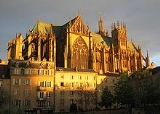
Metz

Encyclopedia
Metz is a city in the northeast of France
located at the confluence of the Moselle and the Seille rivers.
Metz is the capital of the Lorraine
region and prefecture
of the Moselle
department. Located near the tripoint along the junction of France
, Germany
, and Luxembourg
, Metz forms a central place of the European Greater Region
and of the SaarLorLux
Euroregion
. So, Metz is a fellow member of the QuattroPole union of cities, along with Luxembourg City
and German Saarbrücken
and Trier
.
A Celtic oppidum
, an important Gallo-Roman city, the Merovingian capital of the Austrasia kingdom
, the birthplace of the Carolingian dynasty, a cradle of the Gregorian chant
, and one of the oldest republics of the common era
in Europe, Metz has a rich 3,000 year history. The city has been steeped in Romance
culture, but has been strongly influenced by Germanic culture
due to its location and history. A basin of urban ecology
, pioneered under the leadership of people like Jean-Marie Pelt
, Metz gained its nickname, The Green City, boasting over 37 m2 (398 sq ft) of open ground per inhabitant and the city's historic downtown also displays one of the largest commercial, pedestrian areas in France.
Metz possesses one of the largest urban-conservation area in France covering 162.9 ha (402.53 acre) and around 100 buildings of the city are classified on the monument historique
list. Because of its tremendous historical and cultural background, Metz benefits from its designation as a town of art and history
. The city is home to some world-class venues such as the Arsenal concert hall
, the Centre Pompidou-Metz museum, and the National Opera of Lorraine
(along with Nancy Opera
).
A historical Garrison
town, Metz is the economic heart of the Lorraine
region, being specialized in information technology
and automotive
industries. Metz is also a centre for applied research and development in the materials sector notably in metallurgy
and metallography
, the heritage of the Lorraine region's past in the iron and steel industry.
), and was the capital of the Celt
ic Mediomatrici
. The abbreviated name of this tribe, Mettis, gave rise to the name Metz. At the beginning of the Christian Era, the site was already occupied by the Romans
. Metz became one of the principal towns of Gallia
, more populous than Lutetia
(ancestor of present-day Paris), and rich thanks to its wine exports. It had one of the largest amphitheatres in Gallia. An aqueduct
of 23 km (14.29 mi) and 118 arches, extending from Gorze to Metz, was constructed in the 2nd century AD to supply the city with water. This aqueduct supplied water for public baths
. As a well-fortified town at the junction of several military roads, Metz soon grew to great importance. One of the last Roman strongholds to surrender to the Germanic tribes, it was captured by the Huns
of Attila in 451. Only a solitary chapel was left standing. About the end of the 5th century, Metz passed into the hands of the Franks
.
of Saint Stephen
within the city walls has been fully proved. In the beginning of the 7th century the oldest monastic establishments were those of Saint Glossinde and Saint Peter. Since King Sigibert I, Metz was frequently the residence of the Merovingian kings of Austrasia
and the reign of Queen Brunhilda
in particular imbued the town with great splendour. The town preserved the good-will of the rulers, when the Carolingians acceded to the Frankish throne, as it had long been a base of their family and one of their primal ancestors, Saint Arnuff
, as well as his son Chlodulf
, had been bishops of Metz. Emperor Charlemagne
considered making Metz his chief residence before he finally decided in favour of Aachen
.
There is evidence that the earliest western musical notation
, in the form of neume
s in camp aperto (without staff
-lines), was created at Metz around 800, as a result of Charlemagne's desire for Frankish church musicians to retain the performance nuances used by the Roman singers. In the basilica, Louis the Pious
, King of the Franks, and his half-brother the Bishop Drogo
were buried, and King Charles the Bald
was crowned there.
, and several diets and councils were held there. Numerous Christian manuscripts, the product of the Metz schools of writing and painting, such as the famous Trier Ada manuscript and the Drogo Sacramentary
for the personal use of a bishop of the royal house (Bibliothèque Nationale, Paris), are evidence of the active intellectual lives and sumptuous patronage of Carolingian Metz. After the death of King Lothair II
, the kingdom of Lotharingia, and thus Metz, was contested and alternated between the eastern and the western Frankish kingdom until in 925 it finally became part of the east kingdom and subsequently the Holy Roman Empire
, as a free imperial city
. The increasing influence of the bishops in the city became greater when Adalbert I (928–62) obtained a share of the privileges of the counts; until the 12th century, therefore, the history of the town is practically identical with that of the bishops. Under Dietrich I of Metz
(ca. 984) the monastery of Saint-Symphorien was restored. In 1039, the former Ottonian
cathedral was built by Dietrich II to take the place of the Carolingian Saint-Stephen church. In the spring of 1096, Metz became one of the scenes of the Rhineland
massacres of non-Christians as count Emicho
of Flonheim gathered followers for the First Crusade
. A group of these crusaders entered Metz, forcibly converting Jewish families, and killing those who resisted baptism. 22 Jewish citizens of Metz were slaughtered.
, also appears as a Paraige from the year 1297; in the individual offices it was represented by double the number of members that each of the older five Paraiges had. Making common cause, the older family unions and the Commune found it advantageous to gradually increase the powers of the city as opposed to the bishops, and also to keep the control of the municipal government fully in their hands and out of that of the powerful growing guilds, so that until the 16th century Metz remained a purely aristocratic organization. In 1300, the Paraiges gained the right to fill the office of head-alderman, during the 14th century the right to elect the Tredecem jurati, and in 1383 the right to mint its own coins. The guilds, which during the 14th century had attained great independence, were completely suppressed (1383), and the last revolutionary attempt of the artisans to seize control of the city government (1405) was put down with much bloodshed.
The city had often to fight for its freedom: from 1324–27 against the dukes of Luxembourg and Lorraine, as well as against the archbishop of Trier; in 1363 and 1365 against the band of English mercenaries under Arnold of Cervola, in the 15th century against France and the dukes of Burgundy, who sought to annex Metz to their lands or at least wanted to exercise a protectorate. Nevertheless it maintained its independence, even though at great cost, and remained, outwardly at least, part of the German Empire, whose ruler, however, concerned himself very little with this important frontier stronghold.
in 1354 and 1356 held diets
here, at the latter of which was promulgated the famous statute known as the Golden Bull
. The town therefore felt that it occupied an almost independent position between France and Germany, and wanted most of all to evade the obligation of imperial taxes and attendance at the diet. The estrangement between it and the German States daily became wider, and finally affairs came to such a pass that in the religious and political troubles of 1552, Metz found itself in the middle of the war between Charles V
and the rebellious princes. By an agreement of the German princes, Maurice of Saxony, William of Hesse
, and John Albert of Mecklenburg, with Henry II of France
, ratified by the French king at Chambord
, Metz was formally transferred to France, the gates of the city were opened, and Henry II took possession as vicarius sacri imperii et urbis protector. Francis, Duke of Guise
, commander of the garrison, restored the old fortifications and added new ones, and successfully resisted the attacks of the emperor from October to December 1552. Metz remained French.
The recognition by the empire of the surrender of Metz to France came at the conclusion of the Peace of Westphalia
. By the construction of the citadel (1555–62), the new government secured itself against the citizens, who were discontented with the turn of events. Important internal changes soon took place. In place of the Paraiges stood the authority of the French king, whose representative was the governor. The head-alderman, now appointed by the governor, was replaced by a royalist mayor (1640). The aldermen were also appointed by the governor and henceforth drawn from the whole body of burgesses. In 1633, the judiciary passed to the parliament. The powers of the Tredecem jurati were also restricted, in 1634 totally abolished, and replaced by the Bailliage royal.
Among the cities of Lorraine, Metz held a prominent position during the French possession for two reasons. First, the city became one of the most important fortresses through the work of Vauban
(1674) and Cormontaigne
(1730). Vauban
wrote to King Louis XIV
: "Each one of the fortified towns of Your Majesty protects one province, Metz protects the State." Second, it became the capital of the temporal province of the Three Bishoprics
of Metz
, Toul
, and Verdun, which France had seized (1552) and, by the Peace of Westphalia, retained. In 1633, to this end three bishoprics, a supreme court of justice and court of administration, the Metz's parliament, were created.
In 1681, the Chambre Royale, notorious assembly chamber, whose business it was to decide what fiefs belonged to the Three Bishoprics, which King Louis XIV claimed for France, was made a part of this parliament, which lasted, after a temporary dissolution (1771–75), until the final settlement by the Estates-General of 1789
, whereupon the division of the land into departments and districts followed. Metz became the capital of the Department of Moselle, created in 1790. The revolution visited great calamities upon the city. In the campaign of 1814 the army of the Sixth Coalition besieged the city, but was unable to take the city which was defended by a French army under command of General Durutte
.
visited Metz and recorded a detailed description of the town:
of 1870–71, Metz was the headquarters of the Third French Army Corps under the command of General Bazaine
. Through the operations of the German army, Bazaine, after the battles of Colombey
, Mars-la-Tour
, and Gravelotte
was besieged in Metz. The besieging German army was commanded by Prince Friedrich Karl of Prussia; as the few sorties of the garrison were unable to break the German lines, Metz was forced to surrender (27 October 1870), with the result that 6,000 French officers and 170,000 men were taken prisoner. The philosopher Friedrich Nietzsche
took part in the siege of Metz as a German soldier. By the Treaty of Frankfurt
of 1871, Metz became a German city, and was made a most important garrison and a strong fortress. The German army decided to build a second and a third fortified line
around Metz. The former fortifications on the south and east were levelled in 1898, thus securing space for growth and development.
in 1919. But after the Battle of France
in 1940 during the Second World War, the city was immediately annexed by the German Third Reich. Most of the Nazi dignitaries assumed it was obvious that the city of Metz, where so many German army officers were born, was a German city. In 1944, the attack on the city by the U.S. Third Army faced heavy resistance from the defending German forces, and resulted in heavy casualties on both sides. The Battle of Metz
lasted for several weeks and the heavily fortified
city of Metz was captured by the U.S. Army under the command of General George S. Patton
before the end of November 1944. Metz reverted to France after the war.
Nowadays, the military importance of Metz has decreased, and the city has diversified its economic base. Expansion has continued in the recent decades despite the economic crisis that besets the rest of Lorraine region. Metz is in the heart of a new economic region known as the SaarLorLux
Euroregion
, and combines the culture and economic aspects of this unique region in Europe. Since the 1970s, the city has developed its university and overall infrastructure for the European Greater Region
. Metz's technopole is another example of the economic revival of Metz and its region. The technopole, a high-tech park spread over 180 ha (444.79 acre) specializing in information technology, was established in 1983 and has attracted over 200 companies, 4,000 employees and 4,500 students. World-class academic institutions such as Arts et Métiers ParisTech, Georgia Tech
(Georgia Tech Lorraine
) and Supélec
along with established companies including ProConsultant, SFR
and TDF
are located at the technopole.
In 2010, Metz opened a branch of the Parisian Pompidou centre, the Centre Pompidou-Metz, inaugurated by the president of the French Republic
, Nicolas Sarkozy
, on 12 May 2010. He stated that "the Lorraine region has suffered greatly in recent decades from restructuring, transfers, changes, the textile and steel industries, the mines, the military (...) In this remarkable architectural gesture, we will from now on be able to take hold of the renaissance of Metz and the renaissance of Lorraine." Indeed, in addition of the arrival of the high-speed rail connections
in 2007 and the Pompidou centre in 2010, the municipality launched urban renewal plans (e.g., edification of the modern Amphithéatre district, reconversion of Metz's extensive military facilities); important infrastructure projects (e.g., building of the Mercy high-tech hospital, refurbishment of squares, public ways, and Saint-Symphorien stadium
, improvement of public transportation); ambitious cultural and educational programmes (e.g., construction of a new popular music venue, creation of a veterinary school, establishment of the Lorraine-University along with Nancy); and economic and industrial development (e.g., extension and creation of a second technopole).
parliament
is held in the former Saint-Clement abbey in Metz. Metz is also home of the council of Moselle
and the Lorraine
prefecture
is located in the former Intendant palace
.
. The historic district has kept part of the Gallo-Roman
city planning. Indeed, Divodurums Cardo Maximus
, then called Via Scarponensis, includes today the Trinitaires, Taison, and Serpenoise streets and the Robert Schuman
and General Leclerc
avenues. The Decumanus Maximus
is the ancestor of present-day En Fournirue and d'Estrées streets, passing in front of the Saint-Stephen cathedral from the 13th century.
Metz is home to a mishmash of architectural layers, witnessing its millennium history at the crossroad of different cultures. Thus, from its Gallo-Roman past, the city conserves vestiges of the thermae
(in the basement of Metz's museums), parts of the aqueduct
, and Saint-Pierre-aux-Nonnains basilica
. The Saint-Louis square with its arcades, where currency changers gathered, remains a major symbol of the High Medieval
heritage of the city, as well as, a Knights Templar
chapel. The Gothic
cathedral, several churches and Hôtels
, and two remarkable municipal granaries reflect the Late Middle Ages
.
Examples of Renaissance
architecture can be seen in the House of Heads and in the Burtaigne Hôtel
from the 16th century. The Enlightenment
is represented by buildings of the Petit-Saulcy island, the opera house
and the prefecture
palace built by Jacques Oger, and the court house built by Charles-Louis Clérisseau
in 1776. Also, the city hall and buildings surrounding the town square
are works of Jacques-François Blondel
, awarded by the Royal Academy of Architecture
to redesign the centre of Metz in 1755.
The German Imperial District was built during the first annexation of Metz
by Otto von Bismarck
to the German Empire
. In order to germanify the city, Emperor Wilhelm II decided to create a new district shaped by a distinctive blend of Germanic architecture, including Renaissance, neo-Romanesque or neo-Classical, mixed with elements of art nouveau
, art deco
, Alsatian and mock-Bavarian styles. Moreover, the Jaumont stone
, commonly used everywhere else in the city, was replaced by stones used in the Rhineland
, like pink and grey sandstone
, granite
and basalt
. The district, thought by German architect Conrad Wahn, features noteworthy buildings including the water tower
, the impressive railway station, the Central Post-Office, the Mondon square (former Imperial square), and the large Foch avenue (former Kaiser Wihelm Ring).
Modern architecture can also be seen in the town. Hence the Fabert
boarding high school built by architects Roger Parisot and Paul Micholeau in 1936 and the Sainte-Thérèse-de-l'Enfant-Jésus church was built by architect Roger-Henri Expert
in 1954 in a thin-shell structure
. Then, the fire station was designed by architect Georges-Henri Pingusson
in 1960 and the Miséricorde chapel by architects Henri Drillen and Pierre Fauque in 1965. Subdivisions
designed by architects Jean Dubuisson
and Roger Gaertner (1978) can also be seen. The refurbishment of the former Ney Arsenal
into a concert hall venue in 1989 by architect Ricardo Bofill
represents the postmodernism movement
. The city displays street furniture
s designed by Philippe Starck
and Norman Foster.
The Centre Pompidou-Metz museum represents a strong architectural initiative by Shigeru Ban
and Jean de Gastine, marking the entrance of Metz into the 21st century. The building, along with the arena by Paul Chemetov built in 2002, will be the cornerstone of the Amphitheatre district. The new district of 27 ha (66.72 acre), conceived by architects and urban planners Nicolas Michelin and Jean-Paul Viguier, is currently under construction and includes the erection of a convention centre and a shopping mall. The inner district already encompasses the Seille park designed by landscape architect Jacques Coulon. The urban project is expected to be completed by 2015. Moreover, the Borny district, formally designed by architect Jean Dubuisson, is currently being extensively refurbished by urban planner Bernard Reichen, and will include a concert venue, conceived in music box shape by its architect Rudy Ricciotti. Its completion is expected in 2012.
town, Metz has been largely influenced by military architecture throughout its history. Indeed, from classical antiquity
to the present, the city has been successively fortified or complemented in order to receive the troops stationed there. Thus, defensive wall
s from classical antiquity
to 20th century are still visible today and are included in garden and park design along the Moselle and Seille rivers and in the city surroundings. A medieval city gate from the 13th century, named Germans' Gate , has become one of the symbols of the city. Remains of the citadel
from the 16th century and fortifications built by Louis de Cormontaigne
are still visible today. Important barracks, mostly from the 18th and 19th centuries, are spread around the city, and some of them which are of architectural interest have reconverted to civilian facilities, e.g. the Arsenal
. Ringing the city are extensive fortifications of Metz
, that include early examples of Séré de Rivières system
forts. Other forts were incorporated into the Maginot Line
defence. A hiking trail on the Mont Saint-Quentin plateau passes through former military training zone and ends at the now abandoned military forts of the first belt, and also provides a high ground from which to survey the city.
, the largest temporary exhibition area outside Paris in France. The museum features exhibition from the extensive collection of the Pompidou centre
(Europe's largest collection of 20th century art). Designed by Japanese architect Shigeru Ban
and French Jean de Gastine, the building is remarkable for the complex and innovative carpentry of its roof. The museum also includes a theatre, an auditorium, and a restaurant terrace.
The Golden Courtyard
museums in reference to the palace of Austrasia's kings, are museums of Metz dedicated to the history of the city. The museums are divided into four sections (history and archeological, medieval, architecture, and fine arts), and incorporate the Gallo-Roman baths
, the ancient Petites-Carmes abbey, the former Trinitarian
church, and the Chèvremont medieval granary
.
The 49Nord-6Est, the Lorraine
's exhibition of contemporary art, is located in the Saint-Liver Hôtel
, the oldest civic building of the city dating from the 12th century. The municipal archives, located in the Recollets cloisters, preserve and exhibit the historical records of Metz's municipality dating from medieval times to present. The Solange Bertrand
foundation conserves and presents the works of the artist and organizes different art exhibitions. The city also boasts several private art galleries.
-influenced neo-Classical style by Jacques Oger and inaugurated in 1752, it is the oldest opera house
working in France and one of the last possessing its own costume
ateliers
. The duke of Belle-Isle described it as "one of the most beautiful of France's opera-theatres" in his time. The Metz opera works in close collaboration with the National Opera of Lorraine
and features plays, dance, and lyric poetry.
The Arsenal
is former military building turned into an exposition and concert hall by Catalan architect Ricardo Bofill
, and inaugurated by Russian cellist Mstislav Rostropovich
in 1989. The Arsenal is dedicated to art music
, is widely renowned for its excellent acoustics and considered as one of the most beautiful concert halls in Europe.
Located on the Sainte-Croix hill, Les Trinitaires is a multi-media arts complex housed in an ancient convent, which vaulted cellar and chapel have been the city's prime venue for jazz music
for over 45 years. Some big names of Jazz, such as American saxophonists Sonny Rollins
and Archie Shepp
, have performed there. The Gothic cloister
s from the 13th century, used now as an open-air stage, once housed the Trinitarian Order
founded by Saint John of Matha
and Saint Felix of Valois. The arts complex includes also a theatre, an exhibition hall, and a bar.
Other venues, such as the Braun hall or the Bernard-Marie Koltès
theater, contribute to the choice of performing halls in Metz. Finally, numerous associations and private music bars and theatres collaborate to the entertaining life in Metz.
and fruit brandy, are made from the Mirabelle plum
, which is one of the gastronomic symbols of the city and the surrounding area. Damson plum and rhubarb
are also widely consumed. Other local specialties include the quiche
, the potée
, and also the suckling pig
. Metz cuisine, as well as Mosellan
and Alsatian
cuisine, is also known for the use in vinaigrette dressings of Melfor vinegar, a local vinegar made with the infusion of honey and plants. Local beverages include Moselle wine
and Amos beer. Also, Metz is the cradle of some pastries
like the Metz's tart (cheese pie-like) and the Metz balls , a ganache-stuffed biscuit coated with marzipan, caramel, and dark chocolate.
is held once or twice a month in the congress centre of Metz. In addition, many other events are celebrated in Metz throughout the year. Here is a non-exhaustive list:
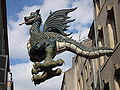
The Graoully is depicted as a fearsome dragon, vanquished by the sacred powers of Metz's first bishop, Saint Clement. The Graoully quickly became a symbol of the town of Metz and can be see in numerous insignia of the city, since the 10th century. Authors from Metz tend to present the legend of the Graoully as a symbol of Christianity's victory over paganism
, represented by the harmful dragon. Today, the Graoully remains one of the major symbols of Metz. A representation of the Graoully may be seen in the crypt in the cathedral. A semi-permanent sculpture of the Graoully is also suspended in mid-air on Taison street, near the cathedral, and the Graoully is shown on the heraldic emblems of football club
and ice hockey team of the city.
, reputed for its scientific education and its classes préparatoires in mathematics. Notable fellows of the school include Alexis de Tocqueville
, Robert Schuman
, Jean-Victor Poncelet
, or Joachim von Ribbentrop
.
The Paul-Verlaine University, Metz unit of the Lorraine University, was created in 1970 as the Germans had removed any university from Metz during the Alsace-Moselle annexation
. Since then, the university has developed on three different main sites, Saulcy Island, Bridoux, and Metz-Technopôle. The Paul-Verlaine University enjoys a privileged position at a hub opening up to Germany and the Benelux
, and has gained recognition for the development of joint Franco-German curricula. Metz's university has a student body of more than 17,000 and offers a wide range of multidisciplinary courses. Here is a list of institutes in Metz:
is home to the Lafayette Institute, which offers high tech service to industry, applied research and development, and spin-off companies in the optoelectronic sector.
is connected to the French high speed train (TGV
) network, which provides a direct rail service to Paris and the city of Luxembourg. The time from Paris (Paris East station
) to Metz train station is 82 minutes. Additionally Metz is served by the Lorraine TGV train station
, located at Louvigny
, 25 km (15.5 mi)to the south of Metz, for high speed trains going to Nantes
, Rennes
, Lille
, or Bordeaux
(without stopping in Paris
). Also, Metz is one of the main stations of the regional express trains systems named Métrolor
. One of the main lines is the Nancy-Metz-Luxembourg line, completed by many lines going to main cities of the area.
train. Also, Lorraine TGV station
is 75 minutes by train from France
international Paris-Charles de Gaulle Airport. Finally, Metz-Nancy-Lorraine Airport
is the airport serving the Lorraine region. It is located in the city of Goin
, at 16.5 km (10.25 mi) Metz southeast.
of two major road axes: The Paris to Strasbourg A4 motorway
, itself a part of the E50
motorway connecting Paris to Prague
, and the A31 motorway
, which goes north to Luxembourg
and the Mediterranean Sea
towards Nancy, Dijon
, and Lyon
.
Local transportation in the agglomeration is carried out by buses.
(FC Metz), a football association club in Ligue 2
, the second division of French football. FC Metz has twice won the French Cup
(in 1984 and 1988) and the French League Cup
(in 1986 and 1996), and was French championship
runner-up in 1998. FC Metz has also gained recognition in France and Europe for its successful youth academy, winning the Gambardella Cup
3 times (in 1981, 2001, and 2010), and producing players such as Emmanuel Adebayor
, Miralem Pjanić
, Louis Saha
, or Papiss Cissé
.
Metz is also home to the Open de Moselle
, an ATP World Tour 250 tournament
, which takes place usually in September. The tournament is played on indoor hard courts. Frenchman Arnaud Clément
won the inaugural tournament in 2003, with players Ivan Ljubičić
(2005), Novak Djokovic
(2006), Tommy Robredo
(2007), and Gilles Simon
(2010) following his success.
The Metz Handball
is a Team Handball
club is the current French women's champion and displaying 17 wins in French Woman First League championship, 7 wins in French Women League Cup, and 4 wins in French Women F.A. Cup. French Vice World Champion Allison Pineau
, who plays for the club, was elected female IHF
World Handball Player
in 2009.
, who appreciated the works of the artists. They were influenced by Eugène Delacroix
and inspired by the medieval heritage of Metz and its romantic surroundings. The Franco-Prussian War and the annexation of the land by the Germans resulted in the dismantling of the movement. Main figures of Metz School are Laurent-Charles Maréchal, Auguste Migette, Auguste Hussenot, Louis-Théodore Devilly, Christopher Fratin, and Charles Pêtre. Their works encompass paintings, engravings, drawings, stained-glass windows, and sculptures.
represented a general view of the city at the beginning of the 17th century from the high ground of the Bellecroix hill. Painter Auguste Migette created many drawings and sketches showing ancient monuments of the town, as well as monumental paintings representing the most significant moments in local history. He left his works and manuscript to the city and they are today exhibited in the museums of Metz. Also, in his work dedicated to The Beautiful Gallic Cities between the Rhine and Moselle Rivers, Albert Robida
depicted in a lithography the Saint-Stephen cathedral.
of the city, French poet Paul Verlaine
dedicated a poem to his hometown. Making reference to the Bazaine
's treachery and to the French revanchism
, he wrote:
German author Adrienne Thomas published in 1930 a harsh criticism of the war with the First World War best-seller novel Katrin becomes a soldier . The text is a diaristic novel based on Thomas’s own life, describing her work at the Metz's railway mission and then as a hospital nurse during the war. The work centres upon the area around Metz, then in German territory, and not only poised between France and Germany linguistically and culturally, but very close indeed to the Western Front and on the direct line to Verdun
. The text was banned in Germany during the Third Reich
.
entitled The Graoully, Messin dragon. The piece is a musical story with narration depicting the epic fight between Saint Clement and the legendary dragon in the Roman amphitheater.
Like Adrienne Thomas, French singer Bernard Lavilliers
mentioned the Metz's railway station in his work. In a song entitled Le buffet de la gare de Metz on album Le Stéphanois from 1975, he described the sort of melancholy Teutonic
beauty of the building located in the German Imperial District, and the smoky, strange atmosphere of its station restaurant, where "the poetry is there, Verlaine
resuscitated."
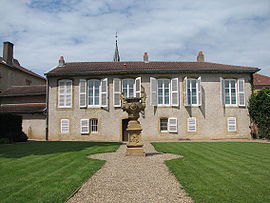 Metz is a fellow member of the QuattroPole union of cities, along with Luxembourg
, Saarbrücken
, and Trier
(neighbouring countries: Luxembourg
, France, and Germany). Metz also forms a central place of the Greater Region
and of the economic SaarLorLux
Euroregion
.
with:
France
The French Republic , The French Republic , The French Republic , (commonly known as France , is a unitary semi-presidential republic in Western Europe with several overseas territories and islands located on other continents and in the Indian, Pacific, and Atlantic oceans. Metropolitan France...
located at the confluence of the Moselle and the Seille rivers.
Metz is the capital of the Lorraine
Lorraine (région)
Lorraine is one of the 27 régions of France. The administrative region has two cities of equal importance, Metz and Nancy. Metz is considered to be the official capital since that is where the regional parliament is situated...
region and prefecture
Prefecture
A prefecture is an administrative jurisdiction or subdivision in any of various countries and within some international church structures, and in antiquity a Roman district governed by an appointed prefect.-Antiquity:...
of the Moselle
Moselle
Moselle is a department in the east of France named after the river Moselle.- History :Moselle is one of the original 83 departments created during the French Revolution on March 4, 1790...
department. Located near the tripoint along the junction of France
France
The French Republic , The French Republic , The French Republic , (commonly known as France , is a unitary semi-presidential republic in Western Europe with several overseas territories and islands located on other continents and in the Indian, Pacific, and Atlantic oceans. Metropolitan France...
, Germany
Germany
Germany , officially the Federal Republic of Germany , is a federal parliamentary republic in Europe. The country consists of 16 states while the capital and largest city is Berlin. Germany covers an area of 357,021 km2 and has a largely temperate seasonal climate...
, and Luxembourg
Luxembourg
Luxembourg , officially the Grand Duchy of Luxembourg , is a landlocked country in western Europe, bordered by Belgium, France, and Germany. It has two principal regions: the Oesling in the North as part of the Ardennes massif, and the Gutland in the south...
, Metz forms a central place of the European Greater Region
Greater Region
The Greater Region is a term used to describe the area of Saarland, Lorraine, Luxembourg, Rhineland-Palatinate, Wallonia, the French Community of Belgium and the German-speaking Community of Belgium. It is not identical with the SaarLorLux Euregio, being in the same territory.It is situated between...
and of the SaarLorLux
SaarLorLux
SaarLorLux or Saar-Lor-Lux, , a portmanteau of Saarland, Lorraine, Luxembourg, is a Euroregion of five different regional authorities located in four different European states. The term has also been applied to cooperations of several of these authorities or of their subdivisions, administrations,...
Euroregion
EUREGIO
EUREGIO is a cross-border region between the Netherlands and Germany. It was founded in 1958 and is organized as an Eingetragener Verein. Participating communities are in Niedersachsen and Nordrhein-Westfalen in Germany and parts of the Dutch provinces Gelderland, Overijssel and Drenthe...
. So, Metz is a fellow member of the QuattroPole union of cities, along with Luxembourg City
Luxembourg (city)
The city of Luxembourg , also known as Luxembourg City , is a commune with city status, and the capital of the Grand Duchy of Luxembourg. It is located at the confluence of the Alzette and Pétrusse Rivers in southern Luxembourg...
and German Saarbrücken
Saarbrücken
Saarbrücken is the capital of the state of Saarland in Germany. The city is situated at the heart of a metropolitan area that borders on the west on Dillingen and to the north-east on Neunkirchen, where most of the people of the Saarland live....
and Trier
Trier
Trier, historically called in English Treves is a city in Germany on the banks of the Moselle. It is the oldest city in Germany, founded in or before 16 BC....
.
A Celtic oppidum
Oppidum
Oppidum is a Latin word meaning the main settlement in any administrative area of ancient Rome. The word is derived from the earlier Latin ob-pedum, "enclosed space," possibly from the Proto-Indo-European *pedóm-, "occupied space" or "footprint."Julius Caesar described the larger Celtic Iron Age...
, an important Gallo-Roman city, the Merovingian capital of the Austrasia kingdom
Austrasia
Austrasia formed the northeastern portion of the Kingdom of the Merovingian Franks, comprising parts of the territory of present-day eastern France, western Germany, Belgium, Luxembourg and the Netherlands. Metz served as its capital, although some Austrasian kings ruled from Rheims, Trier, and...
, the birthplace of the Carolingian dynasty, a cradle of the Gregorian chant
Gregorian chant
Gregorian chant is the central tradition of Western plainchant, a form of monophonic liturgical music within Western Christianity that accompanied the celebration of Mass and other ritual services...
, and one of the oldest republics of the common era
Common Era
Common Era ,abbreviated as CE, is an alternative designation for the calendar era originally introduced by Dionysius Exiguus in the 6th century, traditionally identified with Anno Domini .Dates before the year 1 CE are indicated by the usage of BCE, short for Before the Common Era Common Era...
in Europe, Metz has a rich 3,000 year history. The city has been steeped in Romance
Romance languages
The Romance languages are a branch of the Indo-European language family, more precisely of the Italic languages subfamily, comprising all the languages that descend from Vulgar Latin, the language of ancient Rome...
culture, but has been strongly influenced by Germanic culture
Culture of Germany
German culture began long before the rise of Germany as a nation-state and spanned the entire German-speaking world. From its roots, culture in Germany has been shaped by major intellectual and popular currents in Europe, both religious and secular...
due to its location and history. A basin of urban ecology
Urban ecology
Urban ecology is a subfield of ecology which deals with the interaction between organisms in an urban or urbanized community, and their interaction with that community. Urban ecologists study the trees, rivers, wildlife and open spaces found in cities to understand the extent of those resources and...
, pioneered under the leadership of people like Jean-Marie Pelt
Jean-Marie Pelt
Professor Jean-Marie Pelt is a French botanist.Pelt founded the European Institute of Ecology in 1972. He is the author of several books and produced several television series for French TV.-Bibliography:...
, Metz gained its nickname, The Green City, boasting over 37 m2 (398 sq ft) of open ground per inhabitant and the city's historic downtown also displays one of the largest commercial, pedestrian areas in France.
Metz possesses one of the largest urban-conservation area in France covering 162.9 ha (402.53 acre) and around 100 buildings of the city are classified on the monument historique
Monument historique
A monument historique is a National Heritage Site of France. It also refers to a state procedure in France by which national heritage protection is extended to a building or a specific part of a building, a collection of buildings, or gardens, bridges, and other structures, because of their...
list. Because of its tremendous historical and cultural background, Metz benefits from its designation as a town of art and history
French towns and lands of Art and History
Since 1985, the French Ministry of Culture and Communication has pursued a policy of preserving and promoting France's heritage. Historic towns and districts have been designated Villes et Pays d'Art et d'Histoire ....
. The city is home to some world-class venues such as the Arsenal concert hall
Arsenal de Metz
The Arsenal is a cultural venue dedicated specially to Classical and Erudite musics and located near the Esplanade garden in Metz, capital of the Lorraine region, France...
, the Centre Pompidou-Metz museum, and the National Opera of Lorraine
Opéra-Théâtre de Metz
The Opéra-Théatre de Metz Métropole is an 750-seat opera house and theatre located on the Petit-Saulcy island in Metz, capital of the Lorraine region, France. It is the oldest opera house working in France and one of the oldest in Europe...
(along with Nancy Opera
Opéra national de Lorraine
Opéra national de Lorraine is an opera company and opera house located in the city of Nancy in the French province of Lorraine. Formerly named the Opéra de Nancy et de Lorraine, it was given the status of "national opera" in 2006....
).
A historical Garrison
Garrison
Garrison is the collective term for a body of troops stationed in a particular location, originally to guard it, but now often simply using it as a home base....
town, Metz is the economic heart of the Lorraine
Lorraine (région)
Lorraine is one of the 27 régions of France. The administrative region has two cities of equal importance, Metz and Nancy. Metz is considered to be the official capital since that is where the regional parliament is situated...
region, being specialized in information technology
Information technology
Information technology is the acquisition, processing, storage and dissemination of vocal, pictorial, textual and numerical information by a microelectronics-based combination of computing and telecommunications...
and automotive
Automotive industry
The automotive industry designs, develops, manufactures, markets, and sells motor vehicles, and is one of the world's most important economic sectors by revenue....
industries. Metz is also a centre for applied research and development in the materials sector notably in metallurgy
Metallurgy
Metallurgy is a domain of materials science that studies the physical and chemical behavior of metallic elements, their intermetallic compounds, and their mixtures, which are called alloys. It is also the technology of metals: the way in which science is applied to their practical use...
and metallography
Metallography
Metallography is the study of the physical structure and components of metals, typically using microscopy.Ceramic and polymeric materials may also be prepared using metallographic techniques, hence the terms ceramography, plastography and, collectively, materialography.-Preparing metallographic...
, the heritage of the Lorraine region's past in the iron and steel industry.
Roman Divodurum Mediomatricum
In ancient times, Metz was called Divodurum (meaning Holy Village or Holy Fortress in LatinLatin
Latin is an Italic language originally spoken in Latium and Ancient Rome. It, along with most European languages, is a descendant of the ancient Proto-Indo-European language. Although it is considered a dead language, a number of scholars and members of the Christian clergy speak it fluently, and...
), and was the capital of the Celt
Celt
The Celts were a diverse group of tribal societies in Iron Age and Roman-era Europe who spoke Celtic languages.The earliest archaeological culture commonly accepted as Celtic, or rather Proto-Celtic, was the central European Hallstatt culture , named for the rich grave finds in Hallstatt, Austria....
ic Mediomatrici
Mediomatrici
The Mediomatrici were an ancient Celtic people of Gaul, who belong to the division of Belgica. Julius Caesar shows their position in a general way when he says that the Rhine flows along the territories of the Sequani, Mediomatrici, Triboci or Tribocci, and Treviri. Ptolemy places the Mediomatrici...
. The abbreviated name of this tribe, Mettis, gave rise to the name Metz. At the beginning of the Christian Era, the site was already occupied by the Romans
Roman Empire
The Roman Empire was the post-Republican period of the ancient Roman civilization, characterised by an autocratic form of government and large territorial holdings in Europe and around the Mediterranean....
. Metz became one of the principal towns of Gallia
Gaul
Gaul was a region of Western Europe during the Iron Age and Roman era, encompassing present day France, Luxembourg and Belgium, most of Switzerland, the western part of Northern Italy, as well as the parts of the Netherlands and Germany on the left bank of the Rhine. The Gauls were the speakers of...
, more populous than Lutetia
Lutetia
Lutetia was a town in pre-Roman and Roman Gaul. The Gallo-Roman city was a forerunner of the re-established Merovingian town that is the ancestor of present-day Paris...
(ancestor of present-day Paris), and rich thanks to its wine exports. It had one of the largest amphitheatres in Gallia. An aqueduct
Aqueduct
An aqueduct is a water supply or navigable channel constructed to convey water. In modern engineering, the term is used for any system of pipes, ditches, canals, tunnels, and other structures used for this purpose....
of 23 km (14.29 mi) and 118 arches, extending from Gorze to Metz, was constructed in the 2nd century AD to supply the city with water. This aqueduct supplied water for public baths
Thermae
In ancient Rome, thermae and balnea were facilities for bathing...
. As a well-fortified town at the junction of several military roads, Metz soon grew to great importance. One of the last Roman strongholds to surrender to the Germanic tribes, it was captured by the Huns
Huns
The Huns were a group of nomadic people who, appearing from east of the Volga River, migrated into Europe c. AD 370 and established the vast Hunnic Empire there. Since de Guignes linked them with the Xiongnu, who had been northern neighbours of China 300 years prior to the emergence of the Huns,...
of Attila in 451. Only a solitary chapel was left standing. About the end of the 5th century, Metz passed into the hands of the Franks
Franks
The Franks were a confederation of Germanic tribes first attested in the third century AD as living north and east of the Lower Rhine River. From the third to fifth centuries some Franks raided Roman territory while other Franks joined the Roman troops in Gaul. Only the Salian Franks formed a...
.
Early Frankish Metz
Though the first Christian churches were to be found outside the city, the existence in the 5th century of the oratoryOratory (worship)
An oratory is a Christian room for prayer, from the Latin orare, to pray.-Catholic church:In the Roman Catholic Church, an oratory is a structure other than a parish church, set aside by ecclesiastical authority for prayer and the celebration of Mass...
of Saint Stephen
Saint Stephen
Saint Stephen The Protomartyr , the protomartyr of Christianity, is venerated as a saint in the Roman Catholic, Anglican, Lutheran, Oriental Orthodox and Eastern Orthodox Churches....
within the city walls has been fully proved. In the beginning of the 7th century the oldest monastic establishments were those of Saint Glossinde and Saint Peter. Since King Sigibert I, Metz was frequently the residence of the Merovingian kings of Austrasia
Austrasia
Austrasia formed the northeastern portion of the Kingdom of the Merovingian Franks, comprising parts of the territory of present-day eastern France, western Germany, Belgium, Luxembourg and the Netherlands. Metz served as its capital, although some Austrasian kings ruled from Rheims, Trier, and...
and the reign of Queen Brunhilda
Brunhilda of Austrasia
Brunhilda was a Visigothic princess, married to king Sigebert I of Austrasia who ruled the eastern kingdoms of Austrasia and Burgundy in the names of her sons and grandsons...
in particular imbued the town with great splendour. The town preserved the good-will of the rulers, when the Carolingians acceded to the Frankish throne, as it had long been a base of their family and one of their primal ancestors, Saint Arnuff
Arnulf of Metz
Saint Arnulf of Metz was a Frankish bishop of Metz and advisor to the Merovingian court of Austrasia, who retired to the Abbey of Remiremont....
, as well as his son Chlodulf
Chlodulf of Metz
Saint Chlodulf or more commonly Saint Cloud was bishop of Metz approximately from 657 to 697....
, had been bishops of Metz. Emperor Charlemagne
Charlemagne
Charlemagne was King of the Franks from 768 and Emperor of the Romans from 800 to his death in 814. He expanded the Frankish kingdom into an empire that incorporated much of Western and Central Europe. During his reign, he conquered Italy and was crowned by Pope Leo III on 25 December 800...
considered making Metz his chief residence before he finally decided in favour of Aachen
Aachen
Aachen has historically been a spa town in North Rhine-Westphalia, Germany. Aachen was a favoured residence of Charlemagne, and the place of coronation of the Kings of Germany. Geographically, Aachen is the westernmost town of Germany, located along its borders with Belgium and the Netherlands, ...
.
There is evidence that the earliest western musical notation
Musical notation
Music notation or musical notation is any system that represents aurally perceived music, through the use of written symbols.-History:...
, in the form of neume
Neume
A neume is the basic element of Western and Eastern systems of musical notation prior to the invention of five-line staff notation. The word is a Middle English corruption of the ultimately Ancient Greek word for breath ....
s in camp aperto (without staff
Staff (music)
In standard Western musical notation, the staff, or stave, is a set of five horizontal lines and four spaces that each represent a different musical pitch—or, in the case of a percussion staff, different percussion instruments. Appropriate music symbols, depending upon the intended effect,...
-lines), was created at Metz around 800, as a result of Charlemagne's desire for Frankish church musicians to retain the performance nuances used by the Roman singers. In the basilica, Louis the Pious
Louis the Pious
Louis the Pious , also called the Fair, and the Debonaire, was the King of Aquitaine from 781. He was also King of the Franks and co-Emperor with his father, Charlemagne, from 813...
, King of the Franks, and his half-brother the Bishop Drogo
Drogo of Metz
Drogo , also known as Dreux or Drogon, was an illegitimate son of Frankish emperor Charlemagne by the concubine Regina....
were buried, and King Charles the Bald
Charles the Bald
Charles the Bald , Holy Roman Emperor and King of West Francia , was the youngest son of the Emperor Louis the Pious by his second wife Judith.-Struggle against his brothers:He was born on 13 June 823 in Frankfurt, when his elder...
was crowned there.
Lotharingian Metz
In 843, Metz became the capital of the kingdom of LotharingiaLotharingia
Lotharingia was a region in northwest Europe, comprising the Low Countries, the western Rhineland, the lands today on the border between France and Germany, and what is now western Switzerland. It was born of the tripartite division in 855, of the kingdom of Middle Francia, itself formed of the...
, and several diets and councils were held there. Numerous Christian manuscripts, the product of the Metz schools of writing and painting, such as the famous Trier Ada manuscript and the Drogo Sacramentary
Drogo Sacramentary
The Drogo Sacramentary is a Carolingian illuminated manuscript on vellum of c.850 AD, one of the monuments of Carolingian book illumination...
for the personal use of a bishop of the royal house (Bibliothèque Nationale, Paris), are evidence of the active intellectual lives and sumptuous patronage of Carolingian Metz. After the death of King Lothair II
Lothair II of Lotharingia
Lothair II was the second son of Emperor Lothair I and Ermengarde of Tours. He was married to Teutberga, daughter of Boso the Elder. He is the namesake of the Lothair Crystal, which he probably commissioned, and of the Cross of Lothair, which was made over a century after his death but...
, the kingdom of Lotharingia, and thus Metz, was contested and alternated between the eastern and the western Frankish kingdom until in 925 it finally became part of the east kingdom and subsequently the Holy Roman Empire
Holy Roman Empire
The Holy Roman Empire was a realm that existed from 962 to 1806 in Central Europe.It was ruled by the Holy Roman Emperor. Its character changed during the Middle Ages and the Early Modern period, when the power of the emperor gradually weakened in favour of the princes...
, as a free imperial city
Free Imperial City
In the Holy Roman Empire, a free imperial city was a city formally ruled by the emperor only — as opposed to the majority of cities in the Empire, which were governed by one of the many princes of the Empire, such as dukes or prince-bishops...
. The increasing influence of the bishops in the city became greater when Adalbert I (928–62) obtained a share of the privileges of the counts; until the 12th century, therefore, the history of the town is practically identical with that of the bishops. Under Dietrich I of Metz
Dietrich I of Metz
Dietrich of Metz was Bishop of Metz from 964 until his death. He was the son of Hedwig of Nordgau and Siegfried of Luxembourg.He succeeded Adalbero I as bishop of Metz...
(ca. 984) the monastery of Saint-Symphorien was restored. In 1039, the former Ottonian
Ottonian architecture
Ottonian Architecture is an architectural style which evolved during the reign of Emperor Otto the Great . The style was found in Germany and lasted from the mid 10th century until the mid 11th century....
cathedral was built by Dietrich II to take the place of the Carolingian Saint-Stephen church. In the spring of 1096, Metz became one of the scenes of the Rhineland
Rhineland
Historically, the Rhinelands refers to a loosely-defined region embracing the land on either bank of the River Rhine in central Europe....
massacres of non-Christians as count Emicho
Emicho
Count Emicho , was a count in the Rhineland in the late 11th century and the leader of the "German Crusade" in 1096...
of Flonheim gathered followers for the First Crusade
First Crusade
The First Crusade was a military expedition by Western Christianity to regain the Holy Lands taken in the Muslim conquest of the Levant, ultimately resulting in the recapture of Jerusalem...
. A group of these crusaders entered Metz, forcibly converting Jewish families, and killing those who resisted baptism. 22 Jewish citizens of Metz were slaughtered.
The Commune of Metz
In the 12th century, the burgesses began efforts to free themselves from the domination of the bishops. In 1180, the burgesses formed a close corporation, the Tredecem jurati, which were appointed as municipal representatives in 1207. The burgesses were still nominated directly by the bishop, who had also a controlling influence in the selection of the presiding officer of the board of aldermen (which originated in the 11th century). The twenty-five representatives sent by the various parishes held an independent position; in judicial matters they helped the Tredecem jurati and formed the democratic element of the system of government. The other municipal authorities were chosen by the town aristocracy, the so-called Paraiges, i.e. the five associations whose members were selected from distinguished families to protect the interests of their relatives. The other body of burgesses, called a CommuneCommune
Commune may refer to:In society:* Commune, a human community in which resources are shared* Commune , a township or municipality* One of the Communes of France* An Italian Comune...
, also appears as a Paraige from the year 1297; in the individual offices it was represented by double the number of members that each of the older five Paraiges had. Making common cause, the older family unions and the Commune found it advantageous to gradually increase the powers of the city as opposed to the bishops, and also to keep the control of the municipal government fully in their hands and out of that of the powerful growing guilds, so that until the 16th century Metz remained a purely aristocratic organization. In 1300, the Paraiges gained the right to fill the office of head-alderman, during the 14th century the right to elect the Tredecem jurati, and in 1383 the right to mint its own coins. The guilds, which during the 14th century had attained great independence, were completely suppressed (1383), and the last revolutionary attempt of the artisans to seize control of the city government (1405) was put down with much bloodshed.
The city had often to fight for its freedom: from 1324–27 against the dukes of Luxembourg and Lorraine, as well as against the archbishop of Trier; in 1363 and 1365 against the band of English mercenaries under Arnold of Cervola, in the 15th century against France and the dukes of Burgundy, who sought to annex Metz to their lands or at least wanted to exercise a protectorate. Nevertheless it maintained its independence, even though at great cost, and remained, outwardly at least, part of the German Empire, whose ruler, however, concerned himself very little with this important frontier stronghold.
French Metz
Charles IVCharles IV, Holy Roman Emperor
Charles IV , born Wenceslaus , was the second king of Bohemia from the House of Luxembourg, and the first king of Bohemia to also become Holy Roman Emperor....
in 1354 and 1356 held diets
Diet (assembly)
In politics, a diet is a formal deliberative assembly. The term is mainly used historically for the Imperial Diet, the general assembly of the Imperial Estates of the Holy Roman Empire, and for the legislative bodies of certain countries.-Etymology:...
here, at the latter of which was promulgated the famous statute known as the Golden Bull
Golden Bull of 1356
The Golden Bull of 1356 was a decree issued by the Reichstag assembly in Nuremberg headed by the Luxembourg Emperor Charles IV that fixed, for a period of more than four hundred years, important aspects of the constitutional structure of the Holy Roman Empire...
. The town therefore felt that it occupied an almost independent position between France and Germany, and wanted most of all to evade the obligation of imperial taxes and attendance at the diet. The estrangement between it and the German States daily became wider, and finally affairs came to such a pass that in the religious and political troubles of 1552, Metz found itself in the middle of the war between Charles V
Charles V, Holy Roman Emperor
Charles V was ruler of the Holy Roman Empire from 1519 and, as Charles I, of the Spanish Empire from 1516 until his voluntary retirement and abdication in favor of his younger brother Ferdinand I and his son Philip II in 1556.As...
and the rebellious princes. By an agreement of the German princes, Maurice of Saxony, William of Hesse
William IV, Landgrave of Hesse-Kassel
William IV of Hesse-Kassel , also called William the Wise, was the first Landgrave of Hesse-Kassel . He was the founder of the oldest line, which survives to this day.-Life:...
, and John Albert of Mecklenburg, with Henry II of France
Henry II of France
Henry II was King of France from 31 March 1547 until his death in 1559.-Early years:Henry was born in the royal Château de Saint-Germain-en-Laye, near Paris, the son of Francis I and Claude, Duchess of Brittany .His father was captured at the Battle of Pavia in 1525 by his sworn enemy,...
, ratified by the French king at Chambord
Treaty of Chambord
The Treaty of Chambord was an agreement signed on 15 January 1552 at the Château de Chambord between the Catholic King Henry II of France and three Protestant princes of the Holy Roman Empire led by Elector Maurice of Saxony. Based on the terms of the treaty, Maurice ceded the vicariate over the...
, Metz was formally transferred to France, the gates of the city were opened, and Henry II took possession as vicarius sacri imperii et urbis protector. Francis, Duke of Guise
Francis, Duke of Guise
Francis de Lorraine II, Prince of Joinville, Duke of Guise, Duke of Aumale , called Balafré , was a French soldier and politician.-Early life:...
, commander of the garrison, restored the old fortifications and added new ones, and successfully resisted the attacks of the emperor from October to December 1552. Metz remained French.
The recognition by the empire of the surrender of Metz to France came at the conclusion of the Peace of Westphalia
Peace of Westphalia
The Peace of Westphalia was a series of peace treaties signed between May and October of 1648 in Osnabrück and Münster. These treaties ended the Thirty Years' War in the Holy Roman Empire, and the Eighty Years' War between Spain and the Dutch Republic, with Spain formally recognizing the...
. By the construction of the citadel (1555–62), the new government secured itself against the citizens, who were discontented with the turn of events. Important internal changes soon took place. In place of the Paraiges stood the authority of the French king, whose representative was the governor. The head-alderman, now appointed by the governor, was replaced by a royalist mayor (1640). The aldermen were also appointed by the governor and henceforth drawn from the whole body of burgesses. In 1633, the judiciary passed to the parliament. The powers of the Tredecem jurati were also restricted, in 1634 totally abolished, and replaced by the Bailliage royal.
Among the cities of Lorraine, Metz held a prominent position during the French possession for two reasons. First, the city became one of the most important fortresses through the work of Vauban
Vauban
Sébastien Le Prestre, Seigneur de Vauban and later Marquis de Vauban , commonly referred to as Vauban, was a Marshal of France and the foremost military engineer of his age, famed for his skill in both designing fortifications and breaking through them...
(1674) and Cormontaigne
Louis de Cormontaigne
Louis de Cormontaigne was a French military engineer.He was the successor of Vauban. Together, they designed the fortifications of Metz....
(1730). Vauban
Vauban
Sébastien Le Prestre, Seigneur de Vauban and later Marquis de Vauban , commonly referred to as Vauban, was a Marshal of France and the foremost military engineer of his age, famed for his skill in both designing fortifications and breaking through them...
wrote to King Louis XIV
Louis XIV of France
Louis XIV , known as Louis the Great or the Sun King , was a Bourbon monarch who ruled as King of France and Navarre. His reign, from 1643 to his death in 1715, began at the age of four and lasted seventy-two years, three months, and eighteen days...
: "Each one of the fortified towns of Your Majesty protects one province, Metz protects the State." Second, it became the capital of the temporal province of the Three Bishoprics
Three Bishoprics
The Three Bishoprics constituted a province of pre-Revolutionary France consisting of the prince-bishoprics of Verdun, Metz, and Toul within the Lorraine region....
of Metz
Diocese of Metz
The Roman Catholic Diocese of Metz is a Diocese of the Latin Rite of the Roman Catholic church in France. In the Middle Ages it was in effect an independent state, part of the Holy Roman Empire, ruled by the bishop who had the ex officio title of count. It was annexed to France by King Henry II in...
, Toul
Diocese of Toul
The Diocese of Toul was a Roman Catholic diocese seated at Toul in present-day France. It existed from 365 until 1824. From 1048 until 1552 , it was also a state of the Holy Roman Empire.- History :...
, and Verdun, which France had seized (1552) and, by the Peace of Westphalia, retained. In 1633, to this end three bishoprics, a supreme court of justice and court of administration, the Metz's parliament, were created.
In 1681, the Chambre Royale, notorious assembly chamber, whose business it was to decide what fiefs belonged to the Three Bishoprics, which King Louis XIV claimed for France, was made a part of this parliament, which lasted, after a temporary dissolution (1771–75), until the final settlement by the Estates-General of 1789
Estates-General of 1789
The Estates-General of 1789 was the first meeting since 1614 of the French Estates-General, a general assembly representing the French estates of the realm: the nobility, the Church, and the common people...
, whereupon the division of the land into departments and districts followed. Metz became the capital of the Department of Moselle, created in 1790. The revolution visited great calamities upon the city. In the campaign of 1814 the army of the Sixth Coalition besieged the city, but was unable to take the city which was defended by a French army under command of General Durutte
Pierre François Joseph Durutte
Pierre François Joseph Durutte joined the French army at the beginning of the French Revolutionary Wars. Rapidly promoted for feats of bravery under fire at Jemappes in 1792 and Hondschoote in 1793, he found himself appointed to serve as a staff officer...
.
1819: A view of Metz during the Bourbon Restoration
In July 1819, the Scottish born naval officer Norwich DuffNorwich Duff
Admiral Norwich Duff was a Royal Navy officer.The son of Captain George Duff RN, and Sophia Dirom, he was born at 9 South Castle Street, Edinburgh. He entered the Royal Navy in July 1805, just before his 13th birthday, serving aboard his father's ship HMS Mars as a midshipman...
visited Metz and recorded a detailed description of the town:
Metz is a large and strongly fortified town, situated on a plain at the confluence of the MoselleMoselleMoselle is a department in the east of France named after the river Moselle.- History :Moselle is one of the original 83 departments created during the French Revolution on March 4, 1790...
and Seille. It manufactures woollen goods, linen, china, paper, oil, starch and is famous for its hams, liquers, sweetmeats and artificial flowers: they also have a king's manufacture of gunpowder. The government house and the promenades round it are very fine: there is also [an] immense extent of barracks for troops, a large cathedral and a theatre. From the number of running ditches formed by the river there are a great many bridges: the streets, like in all French towns [sic], are narrow and dirty and the houses high: the ground is also very uneven on which they stand. Some street performers gave us a little very tolerable music during our dinner.
Metz and the Franco-Prussian War
During the Franco-Prussian WarFranco-Prussian War
The Franco-Prussian War or Franco-German War, often referred to in France as the 1870 War was a conflict between the Second French Empire and the Kingdom of Prussia. Prussia was aided by the North German Confederation, of which it was a member, and the South German states of Baden, Württemberg and...
of 1870–71, Metz was the headquarters of the Third French Army Corps under the command of General Bazaine
François Achille Bazaine
François Achille Bazaine was a French General and from 1864, a Marshal of France, who surrendered the last organized French army to the Prussians during the Franco-Prussian war. He was the first Marshal who had started as a legionnaire and like the great Marshals of the First Empire, he had risen...
. Through the operations of the German army, Bazaine, after the battles of Colombey
Battle of Borny-Colombey
The Battle of Borny-Colombey was a minor battle of the Franco-Prussian War. It saw the escape route of the French army under François Bazaine blocked when they encountered the First Army under von Steinmetz...
, Mars-la-Tour
Battle of Mars-La-Tour
The Battle of Mars-La-Tour was fought on 16 August 1870 during the Franco-Prussian War near the town of Mars-La-Tour in northeast France. Two Prussian corps encountered the entire French Army of the Rhine in a meeting engagement, and with the surprise entailed, successfully forced the Army of the...
, and Gravelotte
Battle of Gravelotte
The Battle of Gravelotte was a battle of the Franco-Prussian War named after Gravelotte, a village in Lorraine between Metz and the former French–German frontier.-Terrain and armies:...
was besieged in Metz. The besieging German army was commanded by Prince Friedrich Karl of Prussia; as the few sorties of the garrison were unable to break the German lines, Metz was forced to surrender (27 October 1870), with the result that 6,000 French officers and 170,000 men were taken prisoner. The philosopher Friedrich Nietzsche
Friedrich Nietzsche
Friedrich Wilhelm Nietzsche was a 19th-century German philosopher, poet, composer and classical philologist...
took part in the siege of Metz as a German soldier. By the Treaty of Frankfurt
Treaty of Frankfurt (1871)
The Treaty of Frankfurt was a peace treaty signed in Frankfurt on 10 May 1871, at the end of the Franco-Prussian War.- Summary :The treaty did the following:...
of 1871, Metz became a German city, and was made a most important garrison and a strong fortress. The German army decided to build a second and a third fortified line
Fortifications of Metz
The Fortifications of Metz, a city in northeastern France, are extensive, due to the city's strategic position near the border of France and Germany. After the Franco-Prussian War of 1870, the area was annexed by the newly created German Empire in 1871 by the Treaty of Frankfurt and became a...
around Metz. The former fortifications on the south and east were levelled in 1898, thus securing space for growth and development.
20th century and modern day Metz
Following the armistice with Germany ending the First World War, the French army entered Metz in November 1918 and the city was returned to France under the Treaty of VersaillesTreaty of Versailles
The Treaty of Versailles was one of the peace treaties at the end of World War I. It ended the state of war between Germany and the Allied Powers. It was signed on 28 June 1919, exactly five years after the assassination of Archduke Franz Ferdinand. The other Central Powers on the German side of...
in 1919. But after the Battle of France
Battle of France
In the Second World War, the Battle of France was the German invasion of France and the Low Countries, beginning on 10 May 1940, which ended the Phoney War. The battle consisted of two main operations. In the first, Fall Gelb , German armoured units pushed through the Ardennes, to cut off and...
in 1940 during the Second World War, the city was immediately annexed by the German Third Reich. Most of the Nazi dignitaries assumed it was obvious that the city of Metz, where so many German army officers were born, was a German city. In 1944, the attack on the city by the U.S. Third Army faced heavy resistance from the defending German forces, and resulted in heavy casualties on both sides. The Battle of Metz
Battle of Metz
The Battle of Metz was a three-month battle fought between the United States Army and the German Army during World War II. It took place at the city of Metz following the Allied breakout after the Normandy landings. The attack on the city by the U.S. Third Army faced heavy resistance from the...
lasted for several weeks and the heavily fortified
Fortifications of Metz
The Fortifications of Metz, a city in northeastern France, are extensive, due to the city's strategic position near the border of France and Germany. After the Franco-Prussian War of 1870, the area was annexed by the newly created German Empire in 1871 by the Treaty of Frankfurt and became a...
city of Metz was captured by the U.S. Army under the command of General George S. Patton
George S. Patton
George Smith Patton, Jr. was a United States Army officer best known for his leadership while commanding corps and armies as a general during World War II. He was also well known for his eccentricity and controversial outspokenness.Patton was commissioned in the U.S. Army after his graduation from...
before the end of November 1944. Metz reverted to France after the war.
Nowadays, the military importance of Metz has decreased, and the city has diversified its economic base. Expansion has continued in the recent decades despite the economic crisis that besets the rest of Lorraine region. Metz is in the heart of a new economic region known as the SaarLorLux
SaarLorLux
SaarLorLux or Saar-Lor-Lux, , a portmanteau of Saarland, Lorraine, Luxembourg, is a Euroregion of five different regional authorities located in four different European states. The term has also been applied to cooperations of several of these authorities or of their subdivisions, administrations,...
Euroregion
Euroregion
In European politics, the term Euroregion usually refers to a transnational co-operation structure between two contiguous territories located in different European countries. Euroregions represent a specific type of cross-border region.-Scope:...
, and combines the culture and economic aspects of this unique region in Europe. Since the 1970s, the city has developed its university and overall infrastructure for the European Greater Region
Greater Region
The Greater Region is a term used to describe the area of Saarland, Lorraine, Luxembourg, Rhineland-Palatinate, Wallonia, the French Community of Belgium and the German-speaking Community of Belgium. It is not identical with the SaarLorLux Euregio, being in the same territory.It is situated between...
. Metz's technopole is another example of the economic revival of Metz and its region. The technopole, a high-tech park spread over 180 ha (444.79 acre) specializing in information technology, was established in 1983 and has attracted over 200 companies, 4,000 employees and 4,500 students. World-class academic institutions such as Arts et Métiers ParisTech, Georgia Tech
Georgia Institute of Technology
The Georgia Institute of Technology is a public research university in Atlanta, Georgia, in the United States...
(Georgia Tech Lorraine
Georgia Tech Lorraine
Georgia Tech Lorraine is a campus of the Georgia Institute of Technology in Metz, France and plays a pivotal role in Georgia Tech's International Plan.-History:...
) and Supélec
Supélec
École Supérieure d'Électricité, commonly known as Supélec, is a French Graduate School of Engineering delivering the equivalent of a Master's Degree as well as Ph.D opportunities. It is one of the most prestigious and selective Grandes Ecoles in France, and a reference in the field of electric...
along with established companies including ProConsultant, SFR
SFR
SFR is a French mobile phone company. It has over 20 million customers, and provides over 4.6 million households with high-speed internet access...
and TDF
TDF Group
TDF is a French company which provides radio and television transmission services, services for telecoms operators, and other multimedia services: digitization of content, encoding, storage, etc.Its headquarters are located in Paris.It is the dominant partner in the HDRR WiMAX consortium...
are located at the technopole.
In 2010, Metz opened a branch of the Parisian Pompidou centre, the Centre Pompidou-Metz, inaugurated by the president of the French Republic
French Fifth Republic
The Fifth Republic is the fifth and current republican constitution of France, introduced on 4 October 1958. The Fifth Republic emerged from the collapse of the French Fourth Republic, replacing the prior parliamentary government with a semi-presidential system...
, Nicolas Sarkozy
Nicolas Sarkozy
Nicolas Sarkozy is the 23rd and current President of the French Republic and ex officio Co-Prince of Andorra. He assumed the office on 16 May 2007 after defeating the Socialist Party candidate Ségolène Royal 10 days earlier....
, on 12 May 2010. He stated that "the Lorraine region has suffered greatly in recent decades from restructuring, transfers, changes, the textile and steel industries, the mines, the military (...) In this remarkable architectural gesture, we will from now on be able to take hold of the renaissance of Metz and the renaissance of Lorraine." Indeed, in addition of the arrival of the high-speed rail connections
LGV Est
The LGV Est européenne is an extension to the French high-speed rail network, connecting currently Vaires-sur-Marne and Baudrecourt , and later Vaires-sur-Marne and Vendenheim . , it is the newest high-speed line in France and still under construction, with of a planned in service...
in 2007 and the Pompidou centre in 2010, the municipality launched urban renewal plans (e.g., edification of the modern Amphithéatre district, reconversion of Metz's extensive military facilities); important infrastructure projects (e.g., building of the Mercy high-tech hospital, refurbishment of squares, public ways, and Saint-Symphorien stadium
Stade Municipal Saint-Symphorien
Stade Municipal Saint-Symphorien is a multi-purpose stadium in Metz, France. It is currently used mostly for football matches, by FC Metz. The stadium is able to hold 26,700 people and was built in 1923....
, improvement of public transportation); ambitious cultural and educational programmes (e.g., construction of a new popular music venue, creation of a veterinary school, establishment of the Lorraine-University along with Nancy); and economic and industrial development (e.g., extension and creation of a second technopole).
Politics and administration
List of mayors of Metz
| Période | Name | Party | Others | |
|---|---|---|---|---|
| 2008 | Today | Dominique Gros | PS | Engineer, general councillor of Moselle Moselle Moselle is a department in the east of France named after the river Moselle.- History :Moselle is one of the original 83 departments created during the French Revolution on March 4, 1790... , vice-president of Metz Métropole |
| 1971 | 2008 | Jean-Marie Rausch | UMP | minister, senator of Moselle Moselle Moselle is a department in the east of France named after the river Moselle.- History :Moselle is one of the original 83 departments created during the French Revolution on March 4, 1790... , president of Metz Métropole, president of the Regional council of Lorraine Lorraine (région) Lorraine is one of the 27 régions of France. The administrative region has two cities of equal importance, Metz and Nancy. Metz is considered to be the official capital since that is where the regional parliament is situated... |
| 1947 | 1970 | Raymond Mondon | RI | minister, MP for Moselle |
| 1938 | 1947 | Gabriel Hocquard | Unknown | Unknown |
| 1924 | 1938 | Paul Vautrin | Bloc Lorrain | General councillor of Moselle Moselle Moselle is a department in the east of France named after the river Moselle.- History :Moselle is one of the original 83 departments created during the French Revolution on March 4, 1790... |
Capital and prefecture of the Lorraine and Moselle
The LorraineLorraine (région)
Lorraine is one of the 27 régions of France. The administrative region has two cities of equal importance, Metz and Nancy. Metz is considered to be the official capital since that is where the regional parliament is situated...
parliament
Parliament
A parliament is a legislature, especially in those countries whose system of government is based on the Westminster system modeled after that of the United Kingdom. The name is derived from the French , the action of parler : a parlement is a discussion. The term came to mean a meeting at which...
is held in the former Saint-Clement abbey in Metz. Metz is also home of the council of Moselle
Moselle
Moselle is a department in the east of France named after the river Moselle.- History :Moselle is one of the original 83 departments created during the French Revolution on March 4, 1790...
and the Lorraine
Lorraine (région)
Lorraine is one of the 27 régions of France. The administrative region has two cities of equal importance, Metz and Nancy. Metz is considered to be the official capital since that is where the regional parliament is situated...
prefecture
Prefecture
A prefecture is an administrative jurisdiction or subdivision in any of various countries and within some international church structures, and in antiquity a Roman district governed by an appointed prefect.-Antiquity:...
is located in the former Intendant palace
Intendant
The title of intendant has been used in several countries through history. Traditionally, it refers to the holder of a public administrative office...
.
City administrative division
The city of Metz is divided into different administrative divisions:- Metz Nord (harbour zone)
- The Islands (opera house, Protestant Temple Neuf, Paul Verlaine University, the marina)
- Metz downtown and Old City (Centre-Ville, Ste Croix, Outre-Seille, and l'Esplanade garden)
- German Imperial District (railway station, Central Post Office, Ste-Therèse-de-l'Enfant-Jesus church)
- Sablon (Centre Pompidou-Metz museum, indoor sport arena, Seille park)
- Plantières and Queuleu (Queuleu fortFort de QueuleuThe Fort de Queuleu is a fortification to the southeast of Metz, near Queuleu, France. Construction began while part of Lorraine was under French rule in 1868. After the interruption of the Franco-Prussian War of 1870-71, the fort was improved between 1872 and 1875 by the German Empire , which had...
) - Bellecroix (Bellecroix fort)
- Vallières (Robert Schumann hospital)
- Borny and Grigy (technopole)
- La Grange-aux-Bois (congress centre, Mercy hospital and Mercy châteauChâteauA château is a manor house or residence of the lord of the manor or a country house of nobility or gentry, with or without fortifications, originally—and still most frequently—in French-speaking regions...
) - Magny
Civilian architecture
The city is famous for its yellow limestone architecture, due to the extensive use of the Jaumont stonePierre de Jaumont
The Pierre de Jaumont is an oolitic limestone of the Upper Jurassic, found in Malancourt-la-Montagne, part of the commune of Montois-la-Montagne, in Lorraine, France....
. The historic district has kept part of the Gallo-Roman
Gallo-Roman culture
The term Gallo-Roman describes the Romanized culture of Gaul under the rule of the Roman Empire. This was characterized by the Gaulish adoption or adaptation of Roman mores and way of life in a uniquely Gaulish context...
city planning. Indeed, Divodurums Cardo Maximus
Cardo
The cardo was a north-south oriented street in Roman cities, military camps, and coloniae. The cardo, an integral component of city planning, was lined with shops and vendors, and served as a hub of economic life. The main cardo was called cardo maximus.Most Roman cities also had a Decumanus...
, then called Via Scarponensis, includes today the Trinitaires, Taison, and Serpenoise streets and the Robert Schuman
Robert Schuman
Robert Schuman was a noted Luxembourgish-born French statesman. Schuman was a Christian Democrat and an independent political thinker and activist...
and General Leclerc
Philippe Leclerc de Hauteclocque
Philippe François Marie, comte de Hauteclocque, then Leclerc de Hauteclocque, by a 1945 decree that incorporated his French Resistance alias Jacques-Philippe Leclerc to his name, , was a French general during World War II...
avenues. The Decumanus Maximus
Decumanus Maximus
In Roman city planning, a decumanus was an east-west-oriented road in a Roman city, castra , or colonia. The main decumanus was the Decumanus Maximus, which normally connected the Porta Praetoria to the Porta Decumana .This name comes from the fact that the via decumana or decimana In Roman city...
is the ancestor of present-day En Fournirue and d'Estrées streets, passing in front of the Saint-Stephen cathedral from the 13th century.
Metz is home to a mishmash of architectural layers, witnessing its millennium history at the crossroad of different cultures. Thus, from its Gallo-Roman past, the city conserves vestiges of the thermae
Thermae
In ancient Rome, thermae and balnea were facilities for bathing...
(in the basement of Metz's museums), parts of the aqueduct
Aqueduct
An aqueduct is a water supply or navigable channel constructed to convey water. In modern engineering, the term is used for any system of pipes, ditches, canals, tunnels, and other structures used for this purpose....
, and Saint-Pierre-aux-Nonnains basilica
Saint-Pierre-aux-Nonnains basilica
The basilica of Saint-Pierre-aux-Nonnains is a historic pre-medieval church building in Metz, France. It began life as a Roman gymnasium in 380 AD, making it one of the oldest churches in Europe.-History:...
. The Saint-Louis square with its arcades, where currency changers gathered, remains a major symbol of the High Medieval
High Middle Ages
The High Middle Ages was the period of European history around the 11th, 12th, and 13th centuries . The High Middle Ages were preceded by the Early Middle Ages and followed by the Late Middle Ages, which by convention end around 1500....
heritage of the city, as well as, a Knights Templar
Knights Templar
The Poor Fellow-Soldiers of Christ and of the Temple of Solomon , commonly known as the Knights Templar, the Order of the Temple or simply as Templars, were among the most famous of the Western Christian military orders...
chapel. The Gothic
Gothic architecture
Gothic architecture is a style of architecture that flourished during the high and late medieval period. It evolved from Romanesque architecture and was succeeded by Renaissance architecture....
cathedral, several churches and Hôtels
Hôtel particulier
In French contexts an hôtel particulier is an urban "private house" of a grand sort. Whereas an ordinary maison was built as part of a row, sharing party walls with the houses on either side and directly fronting on a street, an hôtel particulier was often free-standing, and by the 18th century it...
, and two remarkable municipal granaries reflect the Late Middle Ages
Late Middle Ages
The Late Middle Ages was the period of European history generally comprising the 14th to the 16th century . The Late Middle Ages followed the High Middle Ages and preceded the onset of the early modern era ....
.
Examples of Renaissance
Renaissance
The Renaissance was a cultural movement that spanned roughly the 14th to the 17th century, beginning in Italy in the Late Middle Ages and later spreading to the rest of Europe. The term is also used more loosely to refer to the historical era, but since the changes of the Renaissance were not...
architecture can be seen in the House of Heads and in the Burtaigne Hôtel
Hôtel particulier
In French contexts an hôtel particulier is an urban "private house" of a grand sort. Whereas an ordinary maison was built as part of a row, sharing party walls with the houses on either side and directly fronting on a street, an hôtel particulier was often free-standing, and by the 18th century it...
from the 16th century. The Enlightenment
Age of Enlightenment
The Age of Enlightenment was an elite cultural movement of intellectuals in 18th century Europe that sought to mobilize the power of reason in order to reform society and advance knowledge. It promoted intellectual interchange and opposed intolerance and abuses in church and state...
is represented by buildings of the Petit-Saulcy island, the opera house
Opéra-Théâtre de Metz
The Opéra-Théatre de Metz Métropole is an 750-seat opera house and theatre located on the Petit-Saulcy island in Metz, capital of the Lorraine region, France. It is the oldest opera house working in France and one of the oldest in Europe...
and the prefecture
Prefecture
A prefecture is an administrative jurisdiction or subdivision in any of various countries and within some international church structures, and in antiquity a Roman district governed by an appointed prefect.-Antiquity:...
palace built by Jacques Oger, and the court house built by Charles-Louis Clérisseau
Charles-Louis Clérisseau
Charles-Louis Clérisseau was a French architectural draughtsman, antiquary and artist. He had a role in the genesis of neoclassical architecture during the second half of the 18th century....
in 1776. Also, the city hall and buildings surrounding the town square
Town square
A town square is an open public space commonly found in the heart of a traditional town used for community gatherings. Other names for town square are civic center, city square, urban square, market square, public square, and town green.Most town squares are hardscapes suitable for open markets,...
are works of Jacques-François Blondel
Jacques-François Blondel
Jacques-François Blondel was a French architect. He was the grandson of François Blondel , whose course of architecture had appeared in four volumes in 1683 -Biography:...
, awarded by the Royal Academy of Architecture
Académie d'architecture
The Académie royale d'architecture was a French learned society founded on December 30, 1671 by Louis XIV, king of France under the impulsion of Jean-Baptiste Colbert...
to redesign the centre of Metz in 1755.
The German Imperial District was built during the first annexation of Metz
Alsace-Lorraine
The Imperial Territory of Alsace-Lorraine was a territory created by the German Empire in 1871 after it annexed most of Alsace and the Moselle region of Lorraine following its victory in the Franco-Prussian War. The Alsatian part lay in the Rhine Valley on the west bank of the Rhine River and east...
by Otto von Bismarck
Otto von Bismarck
Otto Eduard Leopold, Prince of Bismarck, Duke of Lauenburg , simply known as Otto von Bismarck, was a Prussian-German statesman whose actions unified Germany, made it a major player in world affairs, and created a balance of power that kept Europe at peace after 1871.As Minister President of...
to the German Empire
German Empire
The German Empire refers to Germany during the "Second Reich" period from the unification of Germany and proclamation of Wilhelm I as German Emperor on 18 January 1871, to 1918, when it became a federal republic after defeat in World War I and the abdication of the Emperor, Wilhelm II.The German...
. In order to germanify the city, Emperor Wilhelm II decided to create a new district shaped by a distinctive blend of Germanic architecture, including Renaissance, neo-Romanesque or neo-Classical, mixed with elements of art nouveau
Art Nouveau
Art Nouveau is an international philosophy and style of art, architecture and applied art—especially the decorative arts—that were most popular during 1890–1910. The name "Art Nouveau" is French for "new art"...
, art deco
Art Deco
Art deco , or deco, is an eclectic artistic and design style that began in Paris in the 1920s and flourished internationally throughout the 1930s, into the World War II era. The style influenced all areas of design, including architecture and interior design, industrial design, fashion and...
, Alsatian and mock-Bavarian styles. Moreover, the Jaumont stone
Pierre de Jaumont
The Pierre de Jaumont is an oolitic limestone of the Upper Jurassic, found in Malancourt-la-Montagne, part of the commune of Montois-la-Montagne, in Lorraine, France....
, commonly used everywhere else in the city, was replaced by stones used in the Rhineland
Rhineland
Historically, the Rhinelands refers to a loosely-defined region embracing the land on either bank of the River Rhine in central Europe....
, like pink and grey sandstone
Sandstone
Sandstone is a sedimentary rock composed mainly of sand-sized minerals or rock grains.Most sandstone is composed of quartz and/or feldspar because these are the most common minerals in the Earth's crust. Like sand, sandstone may be any colour, but the most common colours are tan, brown, yellow,...
, granite
Granite
Granite is a common and widely occurring type of intrusive, felsic, igneous rock. Granite usually has a medium- to coarse-grained texture. Occasionally some individual crystals are larger than the groundmass, in which case the texture is known as porphyritic. A granitic rock with a porphyritic...
and basalt
Basalt
Basalt is a common extrusive volcanic rock. It is usually grey to black and fine-grained due to rapid cooling of lava at the surface of a planet. It may be porphyritic containing larger crystals in a fine matrix, or vesicular, or frothy scoria. Unweathered basalt is black or grey...
. The district, thought by German architect Conrad Wahn, features noteworthy buildings including the water tower
Water tower
A water tower or elevated water tower is a large elevated drinking water storage container constructed to hold a water supply at a height sufficient to pressurize a water distribution system....
, the impressive railway station, the Central Post-Office, the Mondon square (former Imperial square), and the large Foch avenue (former Kaiser Wihelm Ring).
Modern architecture can also be seen in the town. Hence the Fabert
Abraham de Fabert
Abraham de Fabert, marquis d'Esternay was a Marshal of France,He was the son of Abraham Fabert, seigneur de Moulins , a famous printer who rendered great services, civil and military, to Henry IV....
boarding high school built by architects Roger Parisot and Paul Micholeau in 1936 and the Sainte-Thérèse-de-l'Enfant-Jésus church was built by architect Roger-Henri Expert
Roger-Henri Expert
Roger-Henri Expert was a French architect.- Life :The son of a merchant, Expert first studied painting at the École des beaux-arts in Bordeaux, then from 1906 attended the Ecole des Beaux-Arts in Paris, where he studied under Gaston Redon and Gustave Umbdenstock. In 1912 he won the second Prix de...
in 1954 in a thin-shell structure
Thin-shell structure
Thin-shell structures are light weight constructions using shell elements. These elements are typically curved and are assembled to large structures...
. Then, the fire station was designed by architect Georges-Henri Pingusson
Georges-Henri Pingusson
-Biography:Georges-Henri Pingusson was born 1894 in Clermont-Ferrand. 1920-1925 he studied architecture at the École des Beaux-Arts in Paris.He built hotel Latitude 43 and several villas in the south of France...
in 1960 and the Miséricorde chapel by architects Henri Drillen and Pierre Fauque in 1965. Subdivisions
Subdivision (land)
Subdivision is the act of dividing land into pieces that are easier to sell or otherwise develop, usually via a plat. The former single piece as a whole is then known in the United States as a subdivision...
designed by architects Jean Dubuisson
Jean Dubuisson
Jean Dubuisson was a French architect who is regarded as one of the leading practitioners of the French post-World War II years.- Biography :Jean René Julien Dubuisson was born in Lille, France...
and Roger Gaertner (1978) can also be seen. The refurbishment of the former Ney Arsenal
Arsenal de Metz
The Arsenal is a cultural venue dedicated specially to Classical and Erudite musics and located near the Esplanade garden in Metz, capital of the Lorraine region, France...
into a concert hall venue in 1989 by architect Ricardo Bofill
Ricardo Bofill
Ricardo Bofill, also Ricard Bofill Leví is a Catalan Spanish postmodernist architect.He studied at the School of Architecture in Geneva, Switzerland...
represents the postmodernism movement
Postmodernism
Postmodernism is a philosophical movement evolved in reaction to modernism, the tendency in contemporary culture to accept only objective truth and to be inherently suspicious towards a global cultural narrative or meta-narrative. Postmodernist thought is an intentional departure from the...
. The city displays street furniture
Street furniture
Street furniture is a collective term for objects and pieces of equipment installed on streets and roads for various purposes, including traffic barriers,...
s designed by Philippe Starck
Philippe Starck
Philippe Patrick Starck is a French product designer and probably the best known designer in the New Design style...
and Norman Foster.
The Centre Pompidou-Metz museum represents a strong architectural initiative by Shigeru Ban
Shigeru Ban
Shigeru Ban is an accomplished Japanese and international architect, most famous for his innovative work with paper, particularly recycled cardboard paper tubes used to quickly and efficiently house disaster victims...
and Jean de Gastine, marking the entrance of Metz into the 21st century. The building, along with the arena by Paul Chemetov built in 2002, will be the cornerstone of the Amphitheatre district. The new district of 27 ha (66.72 acre), conceived by architects and urban planners Nicolas Michelin and Jean-Paul Viguier, is currently under construction and includes the erection of a convention centre and a shopping mall. The inner district already encompasses the Seille park designed by landscape architect Jacques Coulon. The urban project is expected to be completed by 2015. Moreover, the Borny district, formally designed by architect Jean Dubuisson, is currently being extensively refurbished by urban planner Bernard Reichen, and will include a concert venue, conceived in music box shape by its architect Rudy Ricciotti. Its completion is expected in 2012.
Military architecture
As a historical GarrisonGarrison
Garrison is the collective term for a body of troops stationed in a particular location, originally to guard it, but now often simply using it as a home base....
town, Metz has been largely influenced by military architecture throughout its history. Indeed, from classical antiquity
Ancient history
Ancient history is the study of the written past from the beginning of recorded human history to the Early Middle Ages. The span of recorded history is roughly 5,000 years, with Cuneiform script, the oldest discovered form of coherent writing, from the protoliterate period around the 30th century BC...
to the present, the city has been successively fortified or complemented in order to receive the troops stationed there. Thus, defensive wall
Defensive wall
A defensive wall is a fortification used to protect a city or settlement from potential aggressors. In ancient to modern times, they were used to enclose settlements...
s from classical antiquity
Classical antiquity
Classical antiquity is a broad term for a long period of cultural history centered on the Mediterranean Sea, comprising the interlocking civilizations of ancient Greece and ancient Rome, collectively known as the Greco-Roman world...
to 20th century are still visible today and are included in garden and park design along the Moselle and Seille rivers and in the city surroundings. A medieval city gate from the 13th century, named Germans' Gate , has become one of the symbols of the city. Remains of the citadel
Citadel
A citadel is a fortress for protecting a town, sometimes incorporating a castle. The term derives from the same Latin root as the word "city", civis, meaning citizen....
from the 16th century and fortifications built by Louis de Cormontaigne
Louis de Cormontaigne
Louis de Cormontaigne was a French military engineer.He was the successor of Vauban. Together, they designed the fortifications of Metz....
are still visible today. Important barracks, mostly from the 18th and 19th centuries, are spread around the city, and some of them which are of architectural interest have reconverted to civilian facilities, e.g. the Arsenal
Arsenal de Metz
The Arsenal is a cultural venue dedicated specially to Classical and Erudite musics and located near the Esplanade garden in Metz, capital of the Lorraine region, France...
. Ringing the city are extensive fortifications of Metz
Fortifications of Metz
The Fortifications of Metz, a city in northeastern France, are extensive, due to the city's strategic position near the border of France and Germany. After the Franco-Prussian War of 1870, the area was annexed by the newly created German Empire in 1871 by the Treaty of Frankfurt and became a...
, that include early examples of Séré de Rivières system
Séré de Rivières system
The Séré de Rivières system was an ensemble of fortifications built from 1874 and first used at the beginning of the First World War along the frontiers and coasts of France...
forts. Other forts were incorporated into the Maginot Line
Maginot Line
The Maginot Line , named after the French Minister of War André Maginot, was a line of concrete fortifications, tank obstacles, artillery casemates, machine gun posts, and other defences, which France constructed along its borders with Germany and Italy, in light of its experience in World War I,...
defence. A hiking trail on the Mont Saint-Quentin plateau passes through former military training zone and ends at the now abandoned military forts of the first belt, and also provides a high ground from which to survey the city.
Museums and exhibition halls
The Centre Pompidou-Metz is a museum of modern and contemporary artsContemporary art
Contemporary art can be defined variously as art produced at this present point in time or art produced since World War II. The definition of the word contemporary would support the first view, but museums of contemporary art commonly define their collections as consisting of art produced...
, the largest temporary exhibition area outside Paris in France. The museum features exhibition from the extensive collection of the Pompidou centre
Centre Georges Pompidou
Centre Georges Pompidou is a complex in the Beaubourg area of the 4th arrondissement of Paris, near Les Halles, rue Montorgueil and the Marais...
(Europe's largest collection of 20th century art). Designed by Japanese architect Shigeru Ban
Shigeru Ban
Shigeru Ban is an accomplished Japanese and international architect, most famous for his innovative work with paper, particularly recycled cardboard paper tubes used to quickly and efficiently house disaster victims...
and French Jean de Gastine, the building is remarkable for the complex and innovative carpentry of its roof. The museum also includes a theatre, an auditorium, and a restaurant terrace.
The Golden Courtyard
Museums of Metz
The Museums of Metz , in Metz, France, were founded in 1839. They are also known as the Golden Courtyard Museums, in reference to the palace of Austrasia's kings in Metz, whose buildings they occupy...
museums in reference to the palace of Austrasia's kings, are museums of Metz dedicated to the history of the city. The museums are divided into four sections (history and archeological, medieval, architecture, and fine arts), and incorporate the Gallo-Roman baths
Thermae
In ancient Rome, thermae and balnea were facilities for bathing...
, the ancient Petites-Carmes abbey, the former Trinitarian
Trinitarian Order
The Order of the Holy Trinity is a Catholic religious order that was founded in the area of Cerfroid, some 80 km northeast of Paris, at the end of the twelfth century. The founder was St. John de Matha, whose feast day is celebrated on 17 December...
church, and the Chèvremont medieval granary
Granary
A granary is a storehouse for threshed grain or animal feed. In ancient or primitive granaries, pottery is the most common use of storage in these buildings. Granaries are often built above the ground to keep the stored food away from mice and other animals.-Early origins:From ancient times grain...
.
The 49Nord-6Est, the Lorraine
Lorraine (région)
Lorraine is one of the 27 régions of France. The administrative region has two cities of equal importance, Metz and Nancy. Metz is considered to be the official capital since that is where the regional parliament is situated...
's exhibition of contemporary art, is located in the Saint-Liver Hôtel
Hôtel particulier
In French contexts an hôtel particulier is an urban "private house" of a grand sort. Whereas an ordinary maison was built as part of a row, sharing party walls with the houses on either side and directly fronting on a street, an hôtel particulier was often free-standing, and by the 18th century it...
, the oldest civic building of the city dating from the 12th century. The municipal archives, located in the Recollets cloisters, preserve and exhibit the historical records of Metz's municipality dating from medieval times to present. The Solange Bertrand
Solange Bertrand
Solange Bertrand was a French abstract painter, sculptor, and engraver.-Early life and education:Born in Montigny-lès-Metz, Bertrand studied art for four years to the École des Beaux-Arts in Nancy, and then attended the Beaux–Arts in Paris...
foundation conserves and presents the works of the artist and organizes different art exhibitions. The city also boasts several private art galleries.
Entertainment and performing arts
The Opéra-Théâtre de Metz Métropole is a 750-seat opera house on the Petit-Saulcy island. Designed in a TuscanyTuscany
Tuscany is a region in Italy. It has an area of about 23,000 square kilometres and a population of about 3.75 million inhabitants. The regional capital is Florence ....
-influenced neo-Classical style by Jacques Oger and inaugurated in 1752, it is the oldest opera house
Opera house
An opera house is a theatre building used for opera performances that consists of a stage, an orchestra pit, audience seating, and backstage facilities for costumes and set building...
working in France and one of the last possessing its own costume
Costume
The term costume can refer to wardrobe and dress in general, or to the distinctive style of dress of a particular people, class, or period. Costume may also refer to the artistic arrangement of accessories in a picture, statue, poem, or play, appropriate to the time, place, or other circumstances...
ateliers
Atelier Method
Atelier is the French word for "workshop", and in English is used principally for the workshop of an artist in the fine or decorative arts, where a principal master and a number of assistants, students and apprentices worked together producing pieces that went out in the master's name...
. The duke of Belle-Isle described it as "one of the most beautiful of France's opera-theatres" in his time. The Metz opera works in close collaboration with the National Opera of Lorraine
Opéra national de Lorraine
Opéra national de Lorraine is an opera company and opera house located in the city of Nancy in the French province of Lorraine. Formerly named the Opéra de Nancy et de Lorraine, it was given the status of "national opera" in 2006....
and features plays, dance, and lyric poetry.
The Arsenal
Arsenal de Metz
The Arsenal is a cultural venue dedicated specially to Classical and Erudite musics and located near the Esplanade garden in Metz, capital of the Lorraine region, France...
is former military building turned into an exposition and concert hall by Catalan architect Ricardo Bofill
Ricardo Bofill
Ricardo Bofill, also Ricard Bofill Leví is a Catalan Spanish postmodernist architect.He studied at the School of Architecture in Geneva, Switzerland...
, and inaugurated by Russian cellist Mstislav Rostropovich
Mstislav Rostropovich
Mstislav Leopoldovich Rostropovich, KBE , known to close friends as Slava, was a Soviet and Russian cellist and conductor. He was married to the soprano Galina Vishnevskaya. He is widely considered to have been the greatest cellist of the second half of the 20th century, and one of the greatest of...
in 1989. The Arsenal is dedicated to art music
Art music
Art music is an umbrella term used to refer to musical traditions implying advanced structural and theoretical considerations and a written musical tradition...
, is widely renowned for its excellent acoustics and considered as one of the most beautiful concert halls in Europe.
Located on the Sainte-Croix hill, Les Trinitaires is a multi-media arts complex housed in an ancient convent, which vaulted cellar and chapel have been the city's prime venue for jazz music
Jazz
Jazz is a musical style that originated at the beginning of the 20th century in African American communities in the Southern United States. It was born out of a mix of African and European music traditions. From its early development until the present, jazz has incorporated music from 19th and 20th...
for over 45 years. Some big names of Jazz, such as American saxophonists Sonny Rollins
Sonny Rollins
Theodore Walter "Sonny" Rollins is a Grammy-winning American jazz tenor saxophonist. Rollins is widely recognized as one of the most important and influential jazz musicians. A number of his compositions, including "St...
and Archie Shepp
Archie Shepp
Archie Shepp is a prominent African-American jazz saxophonist. Shepp is best known for his passionately Afrocentric music of the late 1960s, which focused on highlighting the injustices faced by the African-Americans, as well as for his work with the New York Contemporary Five, Horace Parlan, and...
, have performed there. The Gothic cloister
Cloister
A cloister is a rectangular open space surrounded by covered walks or open galleries, with open arcades on the inner side, running along the walls of buildings and forming a quadrangle or garth...
s from the 13th century, used now as an open-air stage, once housed the Trinitarian Order
Trinitarian Order
The Order of the Holy Trinity is a Catholic religious order that was founded in the area of Cerfroid, some 80 km northeast of Paris, at the end of the twelfth century. The founder was St. John de Matha, whose feast day is celebrated on 17 December...
founded by Saint John of Matha
John of Matha
Saint John of Matha was a Christian saint of the 12th century and founder of the Order of the Most Holy Trinity. He was born on 1154 at Faucon-de-Barcelonnette, France. As a youth, he was educated at Aix-en-Provence, and later studied theology at the University of Paris...
and Saint Felix of Valois. The arts complex includes also a theatre, an exhibition hall, and a bar.
Other venues, such as the Braun hall or the Bernard-Marie Koltès
Bernard-Marie Koltès
Bernard-Marie Koltès was a French playwright and director.-Life:Born in 1948 to a middle-class family in Metz, his life was violent and anchored in revolt. He tried his hand at writing at a very young age but later renounced it, and didn't take to the stage until the age of twenty...
theater, contribute to the choice of performing halls in Metz. Finally, numerous associations and private music bars and theatres collaborate to the entertaining life in Metz.
Gastronomy
Different recipes, such as jam, tart, charcuterieCharcuterie
Charcuterie is the branch of cooking devoted to prepared meat products such as bacon, ham, sausage, terrines, galantines, pâtés, and confit, primarily from pork. Charcuterie is part of the garde manger chef's repertoire...
and fruit brandy, are made from the Mirabelle plum
Mirabelle plum
The mirabelle plum, also known as the mirabelle prune , is the edible drupaceous fruit of the mirabelle prune tree, a cultivar of the plum tree of the genus Prunus...
, which is one of the gastronomic symbols of the city and the surrounding area. Damson plum and rhubarb
Rhubarb
Rhubarb is a group of plants that belong to the genus Rheum in the family Polygonaceae. They are herbaceous perennial plants growing from short, thick rhizomes. They have large leaves that are somewhat triangular-shaped with long fleshy petioles...
are also widely consumed. Other local specialties include the quiche
Quiche
Quiche is a savory, open-faced pie of vegetables, cheese, or meat in custard, baked in a pastry crust.The quiche is sometimes regarded as the savoury equivalent ofegg custard tart.- Etymology:...
, the potée
Potée
A Potée is a French culinary term which, in general, refers to all preparations cooked in an earthenware pot. More specifically, it refers to a soup or stew made of pork and vegetables, most frequently, cabbage and potatoes of which Choucroute is the most characteristic.A potée is an ancient and...
, and also the suckling pig
Suckling pig
A suckling pig is a piglet fed on its mother's milk . In culinary, a suckling pig is slaughtered between the ages of two and six weeks. It is traditionally cooked whole, often roasted, in various cuisines...
. Metz cuisine, as well as Mosellan
Moselle
Moselle is a department in the east of France named after the river Moselle.- History :Moselle is one of the original 83 departments created during the French Revolution on March 4, 1790...
and Alsatian
Alsace
Alsace is the fifth-smallest of the 27 regions of France in land area , and the smallest in metropolitan France. It is also the seventh-most densely populated region in France and third most densely populated region in metropolitan France, with ca. 220 inhabitants per km²...
cuisine, is also known for the use in vinaigrette dressings of Melfor vinegar, a local vinegar made with the infusion of honey and plants. Local beverages include Moselle wine
Moselle wine
Moselle wine is produced in three countries along the Moselle river: France, Luxembourg and Germany. Moselle wines are mainly white and are made in some of the coldest climates used for commercial winemaking.-France:...
and Amos beer. Also, Metz is the cradle of some pastries
Pastry
Pastry is the name given to various kinds of baked products made from ingredients such as flour, sugar, milk, butter, shortening, baking powder and/or eggs. Small cakes, tarts and other sweet baked products are called "pastries."...
like the Metz's tart (cheese pie-like) and the Metz balls , a ganache-stuffed biscuit coated with marzipan, caramel, and dark chocolate.
Annual events
France's second largest flea marketFlea market
A flea market or swap meet is a type of bazaar where inexpensive or secondhand goods are sold or bartered. It may be indoors, such as in a warehouse or school gymnasium; or it may be outdoors, such as in a field or under a tent...
is held once or twice a month in the congress centre of Metz. In addition, many other events are celebrated in Metz throughout the year. Here is a non-exhaustive list:
- Pilgrimage of Saint BlaiseSaint BlaiseSaint Blaise was a physician, and bishop of Sebastea . According to his Acta Sanctorum, he was martyred by being beaten, attacked with iron carding combs, and beheaded...
on 3 February - FunfairFunfairA funfair or simply "fair" is a small to medium sized travelling show primarily composed of stalls and other amusements. Larger fairs such as the permanent fairs of cities and seaside resorts might be called a fairground, although technically this should refer to the land where a fair is...
in May - Été du Livre, festival of literature in June
- Bastille DayBastille DayBastille Day is the name given in English-speaking countries to the French National Day, which is celebrated on 14 July of each year. In France, it is formally called La Fête Nationale and commonly le quatorze juillet...
on 14 July - MacellumMacellumA macellum is an ancient Roman indoor market building that sold mostly provisions . The building normally sat alongside the forum and basilica, providing a place in which a market could be held...
the first week-end of August - Mirabelle festival in August. Every year, the city of Metz dedicates two weeks to the Mirabelle plumMirabelle plumThe mirabelle plum, also known as the mirabelle prune , is the edible drupaceous fruit of the mirabelle prune tree, a cultivar of the plum tree of the genus Prunus...
. In addition to open markets selling fresh prunes, mirabelle tarts, mirabelle liquor, etc. there is live music, fireworks, parties, art exhibits, a parade with floral floats and competition, and the crowning of the Mirabelle Queen and a gala of celebration - Les Montgolfiades de Metz, Europe's largest hot air balloon festival in September.
- European Heritage DaysEuropean Heritage DaysEuropean Heritage Days is a joint action of the Council of Europe and the European Commission involving all 50 signatory states of the European Cultural Convention under the motto, Europe: a common heritage. The annual programme offers opportunities to visit buildings, monuments and sites, many of...
, the third week-end of September
- Open de MoselleOpen de MoselleThe Open de Moselle is a professional tennis tournament played on indoor hard courts. It is currently part of the ATP World Tour 250 series of the ATP Tour. It has been held annually since 2003. The venue for the tournament was the Arènes until 2010 and is now the Parc des Expositions since 2011...
in September - Nuit BlancheNuit BlancheNuit Blanche is an annual all-night or night-time arts festival. A Nuit Blanche will typically have museums, private and public art galleries, and other cultural institutions open and free of charge, with the centre of the city itself being turned into a de facto art gallery, providing space for...
in October - Christmas marketChristmas MarketA Christmas market, also known as Christkindlmarkt, Christkindlesmarkt, Christkindlmarket, and Weihnachtsmarkt, is a street market associated with the celebration of Christmas during the four weeks of Advent...
in November and December (2nd most popular in France, after StrasbourgStrasbourgStrasbourg is the capital and principal city of the Alsace region in eastern France and is the official seat of the European Parliament. Located close to the border with Germany, it is the capital of the Bas-Rhin département. The city and the region of Alsace are historically German-speaking,...
) - Saint Nicholas parade in December. Saint Nicholas is the patron saintPatron saintA patron saint is a saint who is regarded as the intercessor and advocate in heaven of a nation, place, craft, activity, class, clan, family, or person...
of the Lorraine regionLorraine (région)Lorraine is one of the 27 régions of France. The administrative region has two cities of equal importance, Metz and Nancy. Metz is considered to be the official capital since that is where the regional parliament is situated...
.
The legend of the Graoully
More details about the legend of the GraoullyThe Graoully is depicted as a fearsome dragon, vanquished by the sacred powers of Metz's first bishop, Saint Clement. The Graoully quickly became a symbol of the town of Metz and can be see in numerous insignia of the city, since the 10th century. Authors from Metz tend to present the legend of the Graoully as a symbol of Christianity's victory over paganism
Paganism
Paganism is a blanket term, typically used to refer to non-Abrahamic, indigenous polytheistic religious traditions....
, represented by the harmful dragon. Today, the Graoully remains one of the major symbols of Metz. A representation of the Graoully may be seen in the crypt in the cathedral. A semi-permanent sculpture of the Graoully is also suspended in mid-air on Taison street, near the cathedral, and the Graoully is shown on the heraldic emblems of football club
FC Metz
Football Club de Metz, commonly referred to as simply Metz , is a French association football club based in Metz. The club was formed in 1932 and has spent most of its history in the Ligue 1, though they currently play in Ligue 2, the second level in French football league system. Metz plays its...
and ice hockey team of the city.
High schools
Metz is home to numerous high schools. The most notable of them is the Fabert high schoolLycée Fabert
Lycée Fabert is a senior high school in Metz, Moselle, Lorraine, France. The school, in the city centre, was the first lycée in Metz.-Facility:The high school consists of several buildings. They include:* The old lycée - It is the former convent abbey of St...
, reputed for its scientific education and its classes préparatoires in mathematics. Notable fellows of the school include Alexis de Tocqueville
Alexis de Tocqueville
Alexis-Charles-Henri Clérel de Tocqueville was a French political thinker and historian best known for his Democracy in America and The Old Regime and the Revolution . In both of these works, he explored the effects of the rising equality of social conditions on the individual and the state in...
, Robert Schuman
Robert Schuman
Robert Schuman was a noted Luxembourgish-born French statesman. Schuman was a Christian Democrat and an independent political thinker and activist...
, Jean-Victor Poncelet
Jean-Victor Poncelet
Jean-Victor Poncelet was a French engineer and mathematician who served most notably as the commandant general of the École Polytechnique...
, or Joachim von Ribbentrop
Joachim von Ribbentrop
Ulrich Friedrich Wilhelm Joachim von Ribbentrop was Foreign Minister of Germany from 1938 until 1945. He was later hanged for war crimes after the Nuremberg Trials.-Early life:...
.
University
Metz is home to the University of Lorraine (UdL). The UdL is divided into two university centres in Metz (Material sciences, technology, and management) and one in Nancy (biological sciences, health care, administration, and management). The UdL has a student body of over 55,000 and offers 101 accredited research centres organized in 9 research areas and 8 doctoral colleges.The Paul-Verlaine University, Metz unit of the Lorraine University, was created in 1970 as the Germans had removed any university from Metz during the Alsace-Moselle annexation
Alsace-Lorraine
The Imperial Territory of Alsace-Lorraine was a territory created by the German Empire in 1871 after it annexed most of Alsace and the Moselle region of Lorraine following its victory in the Franco-Prussian War. The Alsatian part lay in the Rhine Valley on the west bank of the Rhine River and east...
. Since then, the university has developed on three different main sites, Saulcy Island, Bridoux, and Metz-Technopôle. The Paul-Verlaine University enjoys a privileged position at a hub opening up to Germany and the Benelux
Benelux
The Benelux is an economic union in Western Europe comprising three neighbouring countries, Belgium, the Netherlands, and Luxembourg. These countries are located in northwestern Europe between France and Germany...
, and has gained recognition for the development of joint Franco-German curricula. Metz's university has a student body of more than 17,000 and offers a wide range of multidisciplinary courses. Here is a list of institutes in Metz:
- Georgia Tech LorraineGeorgia Tech LorraineGeorgia Tech Lorraine is a campus of the Georgia Institute of Technology in Metz, France and plays a pivotal role in Georgia Tech's International Plan.-History:...
- International Institute of Information Technology (Supinfo)
- International Commerce Graduate School (ESIDEC)
- Franco-German Institute of Technology, Economy, and Sciences (ISFATES)
- Franco-German Innovative Centre of Metz (CIRAM)
- National Engineering Graduate School of Metz (ENIM)
- École Nationale Supérieure d'Arts et MétiersÉcole Nationale Supérieure d'Arts et MétiersArts et Métiers ParisTech is the French leading engineering school in the fields of mechanics and industrialization.The school trained 85,000 engineers since its foundation in 1780 by the Duke of La Rochefoucauld-Liancourt....
(ENSAM) - Conservatoire National des Arts et MétiersConservatoire National des Arts et MétiersThe Conservatoire National des Arts et Métiers , or National Conservatory of Arts and Crafts, is a doctoral degree-granting higher education establishment operated by the French government, dedicated to providing education and conducting research for the promotion of science and industry...
(Cnam) - École Supérieure d'Électricité (Supélec)
- Regional Institute of Administration (IRA)
- Music Education Centre of Lorraine (CeFEdeM de Lorraine)
- Construction Engineering Graduate School (ESITC)
- Art School of Metz
Research
Georgia Tech LorraineGeorgia Tech Lorraine
Georgia Tech Lorraine is a campus of the Georgia Institute of Technology in Metz, France and plays a pivotal role in Georgia Tech's International Plan.-History:...
is home to the Lafayette Institute, which offers high tech service to industry, applied research and development, and spin-off companies in the optoelectronic sector.
Transportation
Railways
The Gare de Metz-VilleGare de Metz-Ville
-External links:*...
is connected to the French high speed train (TGV
TGV
The TGV is France's high-speed rail service, currently operated by SNCF Voyages, the long-distance rail branch of SNCF, the French national rail operator....
) network, which provides a direct rail service to Paris and the city of Luxembourg. The time from Paris (Paris East station
Gare de l'Est
is one of the six large SNCF termini in Paris. It is in the 10th arrondissement, not far from the Gare du Nord, facing the Boulevard de Strasbourg, part of the north-south axis of Paris created by Baron Haussmann...
) to Metz train station is 82 minutes. Additionally Metz is served by the Lorraine TGV train station
Gare de Lorraine TGV
Lorraine TGV is a new railway station on the LGV Est, a TGV high-speed rail line from Paris to Strasbourg. It is located in Louvigny, between the towns of Metz and Nancy.When built, it was criticized for being too far from any of the towns to be useful...
, located at Louvigny
Louvigny, Moselle
Louvigny is a commune in the Moselle department in Lorraine in north-eastern France.It had a registered population of 728 in 2004.It is the location of a new high speed rail station, which opened in 2007, and is also close to the regional airport serving Metz and Nancy, so may face pressure to...
, 25 km (15.5 mi)to the south of Metz, for high speed trains going to Nantes
Nantes
Nantes is a city in western France, located on the Loire River, from the Atlantic coast. The city is the 6th largest in France, while its metropolitan area ranks 8th with over 800,000 inhabitants....
, Rennes
Rennes
Rennes is a city in the east of Brittany in northwestern France. Rennes is the capital of the region of Brittany, as well as the Ille-et-Vilaine department.-History:...
, Lille
Lille
Lille is a city in northern France . It is the principal city of the Lille Métropole, the fourth-largest metropolitan area in the country behind those of Paris, Lyon and Marseille. Lille is situated on the Deûle River, near France's border with Belgium...
, or Bordeaux
Bordeaux
Bordeaux is a port city on the Garonne River in the Gironde department in southwestern France.The Bordeaux-Arcachon-Libourne metropolitan area, has a population of 1,010,000 and constitutes the sixth-largest urban area in France. It is the capital of the Aquitaine region, as well as the prefecture...
(without stopping in Paris
Paris
Paris is the capital and largest city in France, situated on the river Seine, in northern France, at the heart of the Île-de-France region...
). Also, Metz is one of the main stations of the regional express trains systems named Métrolor
Métrolor
Métrolor, as its name suggests , is a brand for the internal passenger train service of the Lorraine region, where the trains' frequency and network's density are comparable to rapid transit systems.- Origins :...
. One of the main lines is the Nancy-Metz-Luxembourg line, completed by many lines going to main cities of the area.
Airports
The Luxembourg international airport is the nearest international airport connected to Metz by MétrolorMétrolor
Métrolor, as its name suggests , is a brand for the internal passenger train service of the Lorraine region, where the trains' frequency and network's density are comparable to rapid transit systems.- Origins :...
train. Also, Lorraine TGV station
Gare de Lorraine TGV
Lorraine TGV is a new railway station on the LGV Est, a TGV high-speed rail line from Paris to Strasbourg. It is located in Louvigny, between the towns of Metz and Nancy.When built, it was criticized for being too far from any of the towns to be useful...
is 75 minutes by train from France
France
The French Republic , The French Republic , The French Republic , (commonly known as France , is a unitary semi-presidential republic in Western Europe with several overseas territories and islands located on other continents and in the Indian, Pacific, and Atlantic oceans. Metropolitan France...
international Paris-Charles de Gaulle Airport. Finally, Metz-Nancy-Lorraine Airport
Metz-Nancy-Lorraine Airport
Metz-Nancy-Lorraine Airport or Aéroport de Metz-Nancy-Lorraine is an airport serving the Lorraine région of France. It is located in Goin, 16.5 km southeast of Metz, and north of Nancy .It opened to the public on October 28, 1991 and replaced Nancy-Essey and Metz-Frescaty airports...
is the airport serving the Lorraine region. It is located in the city of Goin
Goin, Moselle
Goin is a commune in the Moselle department in Lorraine in north-eastern France....
, at 16.5 km (10.25 mi) Metz southeast.
Motorways and local transportation
Metz is ideally located at the intersectionIntersection (road)
An intersection is a road junction where two or more roads either meet or cross at grade . An intersection may be 3-way - a T junction or fork, 4-way - a crossroads, or 5-way or more...
of two major road axes: The Paris to Strasbourg A4 motorway
A4 autoroute
The A4 Autoroute, also known as l'autoroute de l'Est is a French autoroute that travels between the cities of Paris and Strasbourg. It forms parts of European routes E25 and E50....
, itself a part of the E50
European route E50
European route E 50 is an A-type east–west connection across the European continent. It connects the key naval port of Brest France with Makhachkala, on the Caspian Sea in the Russian republic Dagestan....
motorway connecting Paris to Prague
Prague
Prague is the capital and largest city of the Czech Republic. Situated in the north-west of the country on the Vltava river, the city is home to about 1.3 million people, while its metropolitan area is estimated to have a population of over 2.3 million...
, and the A31 motorway
A31 autoroute
The A31 autoroute is a French autoroute. It runs from the Franco-Luxembourg border to Beaune where it joins the A6. The north of the autoroute is free, up to the town of Toul, but it is a toll road south of there...
, which goes north to Luxembourg
Luxembourg
Luxembourg , officially the Grand Duchy of Luxembourg , is a landlocked country in western Europe, bordered by Belgium, France, and Germany. It has two principal regions: the Oesling in the North as part of the Ardennes massif, and the Gutland in the south...
and the Mediterranean Sea
Mediterranean Sea
The Mediterranean Sea is a sea connected to the Atlantic Ocean surrounded by the Mediterranean region and almost completely enclosed by land: on the north by Anatolia and Europe, on the south by North Africa, and on the east by the Levant...
towards Nancy, Dijon
Dijon
Dijon is a city in eastern France, the capital of the Côte-d'Or département and of the Burgundy region.Dijon is the historical capital of the region of Burgundy. Population : 151,576 within the city limits; 250,516 for the greater Dijon area....
, and Lyon
Lyon
Lyon , is a city in east-central France in the Rhône-Alpes region, situated between Paris and Marseille. Lyon is located at from Paris, from Marseille, from Geneva, from Turin, and from Barcelona. The residents of the city are called Lyonnais....
.
Local transportation in the agglomeration is carried out by buses.
Waterways
There is some significant cross border fluvial tourism on the Rhine-Moselle system. Additionally, Metz port is the biggest port handling cereals in France with over 4,000,000 tons/year.Clubs and sports events
Metz is home to the Football Club of MetzFC Metz
Football Club de Metz, commonly referred to as simply Metz , is a French association football club based in Metz. The club was formed in 1932 and has spent most of its history in the Ligue 1, though they currently play in Ligue 2, the second level in French football league system. Metz plays its...
(FC Metz), a football association club in Ligue 2
Ligue 2
Ligue 2 , formerly known as Division 2, is a French professional football league. The league serves as the second division of French football and is one of two divisions making up the Ligue de Football Professionnel , the other being Ligue 1, the country's top football division...
, the second division of French football. FC Metz has twice won the French Cup
Coupe de France
The Coupe Charles Simon, commonly known as the Coupe de France , is the premier knockout cup competition in French football organized by the French Football Federation...
(in 1984 and 1988) and the French League Cup
Coupe de la Ligue
The Coupe de la Ligue , known outside of France as the French League Cup, is a knockout cup competition in French football organized by the Ligue de Football Professionnel...
(in 1986 and 1996), and was French championship
Ligue 1
Ligue 1 , is the French professional league for association football clubs. It is the country's primary football competition and serves as the top division of the French football league system. Ligue 1 is one of two divisions making up the Ligue de Football Professionnel, the other being Ligue 2....
runner-up in 1998. FC Metz has also gained recognition in France and Europe for its successful youth academy, winning the Gambardella Cup
Coupe Gambardella
The Coupe Gambardella is a French football cup competition held between the under-19s of the French football clubs, organized by the French Football Federation ....
3 times (in 1981, 2001, and 2010), and producing players such as Emmanuel Adebayor
Emmanuel Adebayor
Sheyi Emmanuel Adebayor is a Togolese footballer who plays for Tottenham Hotspur as a striker on loan from Manchester City. He plays in the same position for the Togo national team. Adebayor previously played for Metz, Monaco and Arsenal and was voted African Footballer of the Year for 2008...
, Miralem Pjanić
Miralem Pjanic
Miralem Pjanić is a Bosnian football player who plays for Italian club Roma in Serie A. He plays as an attacking midfielder and has been described as an "old-fashioned playmaker with huge technical qualities"....
, Louis Saha
Louis Saha
Louis Laurent Saha is a French footballer of Guadelupian origin who currently plays as a forward for Everton FC in the Premier League and the France national team. A former scholar at the Clairefontaine football academy, he started his career at Metz before playing on loan at Newcastle United...
, or Papiss Cissé
Papiss Cissé
Papiss Demba Cissé is a Senegalese football striker who currently plays for SC Freiburg.-Club career:Cissé began his career with AS Génération Foot before transferring to the French side FC Metz in summer 2005. After only one month during the 2005–06 season, he left Metz and was loaned to French...
.
Metz is also home to the Open de Moselle
Open de Moselle
The Open de Moselle is a professional tennis tournament played on indoor hard courts. It is currently part of the ATP World Tour 250 series of the ATP Tour. It has been held annually since 2003. The venue for the tournament was the Arènes until 2010 and is now the Parc des Expositions since 2011...
, an ATP World Tour 250 tournament
ATP World Tour 250 series
The ATP World Tour 250 series is a new series for tennis tournaments of the Association of Tennis Professionals from the 2009 ATP World Tour...
, which takes place usually in September. The tournament is played on indoor hard courts. Frenchman Arnaud Clément
Arnaud Clément
Arnaud Clément is a professional tennis player from France. His best achievement is reaching the final of the 2001 Australian Open.-Career:Clément was born in Aix-en-Provence, and currently lives in Geneva, Switzerland...
won the inaugural tournament in 2003, with players Ivan Ljubičić
Ivan Ljubicic
----Ivan Ljubičić is a Croatian tennis player born in Bosnia and Herzegovina . His career-high ATP ranking to date has been no. 3, and he stands at no. 37....
(2005), Novak Djokovic
Novak Djokovic
Novak Djokovic is a Serbian professional tennis player who has been ranked world no. 1 by the Association of Tennis Professionals since 4 July 2011. He has won four Grand Slam singles titles: the 2008 and 2011 Australian Open, the 2011 Wimbledon Championships, and the 2011 US Open...
(2006), Tommy Robredo
Tommy Robredo
Tommy Robredo Garcés is a Spanish professional tennis player. On 8 May 2006, he broke into the world's top ten for the first time. His highest singles ranking to date is No...
(2007), and Gilles Simon
Gilles Simon
Gilles Simon is a French professional tennis player and former world no. 6. He is a nine-time winner on the ATP World Tour...
(2010) following his success.
The Metz Handball
Metz Handball
Metz Handball is a women's handball club based in Metz, France. They are the en-titre champions of French League in the 2010/2011 season and they play in the EHF Women's Champions League..- Honours :*Championnat de France:...
is a Team Handball
Team handball
Handball is a team sport in which two teams of seven players each pass a ball to throw it into the goal of the other team...
club is the current French women's champion and displaying 17 wins in French Woman First League championship, 7 wins in French Women League Cup, and 4 wins in French Women F.A. Cup. French Vice World Champion Allison Pineau
Allison Pineau
Allison Pineau is a French handball player. She plays for the club Metz HB and for the French national team.She participated at the 2009 World Women's Handball Championship in China, winning a silver medal with the French team, and selected into the all-star team of the tournament, as...
, who plays for the club, was elected female IHF
International Handball Federation
The International Handball Federation, often referred to by the acronym IHF, is the administrative and controlling body for International team handball.- Championships :*World Men's Handball Championship*World Women's Handball Championship...
World Handball Player
IHF World Player of the Year
-Men:-Women:-External links:* *...
in 2009.
Sports infrastructures
- Saint-Symphorien stadium, a multi-purpose stadium built in 1923, home to FC MetzFC MetzFootball Club de Metz, commonly referred to as simply Metz , is a French association football club based in Metz. The club was formed in 1932 and has spent most of its history in the Ligue 1, though they currently play in Ligue 2, the second level in French football league system. Metz plays its...
since the creation of the club. - Palais omnisport Les ArènesArènes de MetzThe Palais omnisport Les Arènes, often abbreviated as Les Arènes, is an indoor sports arena in Metz, France. It is the home venue of the Metz Handball team and the Open de Moselle men's tennis tournament, part of the ATP World Tour 250 series of the ATP Tour. Currently the arena has a capacity of...
, nicknamed Les Arènes, an indoor sports arena built by architect Paul Chemetov in 2002. It is the home venue of the Metz HandballMetz HandballMetz Handball is a women's handball club based in Metz, France. They are the en-titre champions of French League in the 2010/2011 season and they play in the EHF Women's Champions League..- Honours :*Championnat de France:...
team. - Saint-Symphorien indoor arena with its ice rink home to Hockey Club Metz Moselle Lorraine, Ice Hockey team club of Metz
- Plan d'Eau Saint-Symphorien, an expanse of water bulging from the Moselle river, used as a marinaMarinaA marina is a dock or basin with moorings and supplies for yachts and small boats.A marina differs from a port in that a marina does not handle large passenger ships or cargo from freighters....
and for water sports - Garden Golf of Metz-Technopôle, designed by golf course architect Robert Berthet, is an 18-holes golf course on 50 hectares located near Metz's technopole
- L'Anneau, an indoor athetics hall
Main Sights
Religious heritage
- Saint-StephenMetz CathedralSaint Étienne de Metz , also known as Metz Cathedral) is a Gothic, Catholic cathedral in the city of Metz, capital of Lorraine, France...
, GothicGothic architectureGothic architecture is a style of architecture that flourished during the high and late medieval period. It evolved from Romanesque architecture and was succeeded by Renaissance architecture....
cathedralCathedralA cathedral is a Christian church that contains the seat of a bishop...
built in the 13th century. The cathedral is sometimes nicknamed the Good Lord's lantern , possessing the largest expanse of stained glassStained glassThe term stained glass can refer to coloured glass as a material or to works produced from it. Throughout its thousand-year history, the term has been applied almost exclusively to the windows of churches and other significant buildings...
windows in the world (6,500 m2 or 70,000 sq ft). The stained glass windows include works by Hermann von MünsterHermann von MünsterHermann von Münster was a German master glassmaker, native of Münster, in Westphalia, and active in Lorraine.- Biography :...
(14th C); Théobald of Lixheim and Valentin BouschValentin BouschValentin Bousch , was a master glass artist and a glass painter of the Renaissance.- His life :The earliest mention of his work is at Saint-Nicolas-de-Port, near Nancy in 1514...
(16th C); Laurent-Charles Maréchal (19th C); Roger BissièreRoger BissièreRoger Bissière was a French artist who painted in the abstract Tachisme style. He was born in Villeréal, Lot-et-Garonne, and died in Boissièrettes...
, Jacques VillonJacques VillonJacques Villon was a French cubist painter and printmaker.-Early life:Born Gaston Emile Duchamp in Damville, Eure, in the Haute-Normandie region of France, he came from a prosperous and artistically inclined family...
and Marc ChagallMarc ChagallMarc Chagall Art critic Robert Hughes referred to Chagall as "the quintessential Jewish artist of the twentieth century."According to art historian Michael J...
(20th C). Moreover, the cathedral possesses the third highest nave in France (41.41 m – 136 ft). - Saint-Pierre-aux-Nonnains basilicaSaint-Pierre-aux-Nonnains basilicaThe basilica of Saint-Pierre-aux-Nonnains is a historic pre-medieval church building in Metz, France. It began life as a Roman gymnasium in 380 AD, making it one of the oldest churches in Europe.-History:...
, the oldest church in France built between 380 and 395 AD as a Roman gymnasium, was converted into a Christian basilica in the 7th century. The basilica is one of the birthplaces of the Roman Messin chant later called Gregorian chantGregorian chantGregorian chant is the central tradition of Western plainchant, a form of monophonic liturgical music within Western Christianity that accompanied the celebration of Mass and other ritual services...
. - Saint-Maximin church, built between 12th–15th century, features stained glass windows of Jean CocteauJean CocteauJean Maurice Eugène Clément Cocteau was a French poet, novelist, dramatist, designer, playwright, artist and filmmaker. His circle of associates, friends and lovers included Kenneth Anger, Pablo Picasso, Jean Hugo, Jean Marais, Henri Bernstein, Marlene Dietrich, Coco Chanel, Erik Satie, María...
. Here, theologian Jacques-Bénigne BossuetJacques-Bénigne BossuetJacques-Bénigne Bossuet was a French bishop and theologian, renowned for his sermons and other addresses. He has been considered by many to be one of the most brilliant orators of all time and a masterly French stylist....
delivered eulogies and Paul VerlainePaul VerlainePaul-Marie Verlaine was a French poet associated with the Symbolist movement. He is considered one of the greatest representatives of the fin de siècle in international and French poetry.-Early life:...
was baptized. - Notre-Dame-de-MetzÉglise Notre Dame de l'Assomption, MetzNotre-Dame de l'Assomption is a church situated on the Rue de la Chevre, formerly the Rue de la Cheuve, in the city of Metz in Lorraine, France. Administratively it is part of the Roman Catholic Diocese of Metz.-Architecture and Artworks:...
church built during the 18th century in the Jesuit style and once part of a Jesuit complex. The church displays stained glass windows of Laurent-Charles Maréchal (19th C). - Sainte-Thérèse-de-l'Enfant-Jésus church (20th C) displays stained glass windows of Nicolas Untersteller. The building has a thin-shell structureThin-shell structureThin-shell structures are light weight constructions using shell elements. These elements are typically curved and are assembled to large structures...
designed by architect Roger-Henri ExpertRoger-Henri ExpertRoger-Henri Expert was a French architect.- Life :The son of a merchant, Expert first studied painting at the École des beaux-arts in Bordeaux, then from 1906 attended the Ecole des Beaux-Arts in Paris, where he studied under Gaston Redon and Gustave Umbdenstock. In 1912 he won the second Prix de...
, and possesses a spireSpireA spire is a tapering conical or pyramidal structure on the top of a building, particularly a church tower. Etymologically, the word is derived from the Old English word spir, meaning a sprout, shoot, or stalk of grass....
in the form of a pilgrim's staffPilgrim's staffThe pilgrim's staff is a walking stick used by pilgrims on the Way of St. James to the shrine of Santiago de Compostela in Spain. Generally, the stick has a hook on it so that something may be hung from it. The walking stick sometimes has a cross piece on it...
of 70 m (229.64 ft) high. - Sainte-Ségolène church (13th C).
- Saint-Martin church (12th C, Laurent-Charles Maréchal's stained glass windows).
- Saint-Pierre-de-la-Citadelle church.
- Saint-Euchaire church.
- Saint-Clément church (17th C, now regional council of LorraineLorraine (région)Lorraine is one of the 27 régions of France. The administrative region has two cities of equal importance, Metz and Nancy. Metz is considered to be the official capital since that is where the regional parliament is situated...
). - Saint-Vincent abbey (10th C)
- Recollets cloisters (14th C), housing today the municipal archives and the European Institute of Ecology
- Trinitarian OrderTrinitarian OrderThe Order of the Holy Trinity is a Catholic religious order that was founded in the area of Cerfroid, some 80 km northeast of Paris, at the end of the twelfth century. The founder was St. John de Matha, whose feast day is celebrated on 17 December...
cloisters (13th C), today a multi-media arts complex which promotes jazz music. - Chapel of the Knights TemplarKnights TemplarThe Poor Fellow-Soldiers of Christ and of the Temple of Solomon , commonly known as the Knights Templar, the Order of the Temple or simply as Templars, were among the most famous of the Western Christian military orders...
(13th C), built in Romanesque style and once part of the commandry of the Knights Templar. The chapel features important muralMuralA mural is any piece of artwork painted or applied directly on a wall, ceiling or other large permanent surface. A particularly distinguishing characteristic of mural painting is that the architectural elements of the given space are harmoniously incorporated into the picture.-History:Murals of...
s. - Protestant Temple Neuf (New Church)(1901–1904), neo-Romanesque church, built during the German annexation by German architect Conrad Wahn
- Protestant church of the German Garrison (1875–1881), neo-Gothic church. Only the bell tower has survived as the church was partially destroyed by Allied bombing during the Second World War.
- Synagogue (1848–1850) built in neo-Romanesque style
- Christian necropolis from the 19th century
- Jewish Cemetery of Metz-Chambière
Civil heritage
- House of François RabelaisFrançois RabelaisFrançois Rabelais was a major French Renaissance writer, doctor, Renaissance humanist, monk and Greek scholar. He has historically been regarded as a writer of fantasy, satire, the grotesque, bawdy jokes and songs...
(12th C), including Sainte-Genest chapel (13th C) - Paul VerlainePaul VerlainePaul-Marie Verlaine was a French poet associated with the Symbolist movement. He is considered one of the greatest representatives of the fin de siècle in international and French poetry.-Early life:...
, Jean-François Pilâtre de Rozier, André Schwarz-BartAndre Schwarz-BartAndré Schwarz-Bart was a French novelist of Polish-Jewish origins....
, Gustave KahnGustave KahnGustave Kahn was a French Symbolist poet and art critic.Kahn was born in Metz.He claimed to have invented the term vers libre, or free verse; he was in any case one of the first European exponents of the form. His principal publications include Les Palais nomades, 1887, Domaine de fée, 1895, and...
, Gabriel PiernéGabriel PiernéHenri Constant Gabriel Pierné was a French composer, conductor, and organist.-Biography:Gabriel Pierné was born in Metz in 1863. His family moved to Paris to escape the Franco-Prussian War. He studied at the Paris Conservatoire, gaining first prizes for solfège, piano, organ, counterpoint and fugue...
, and Charles Pêtre native houses - Chèvremont and Antonistes granariesGranaryA granary is a storehouse for threshed grain or animal feed. In ancient or primitive granaries, pottery is the most common use of storage in these buildings. Granaries are often built above the ground to keep the stored food away from mice and other animals.-Early origins:From ancient times grain...
(respectively from 13th and 14th century) - Saint-Livier HôtelHôtel particulierIn French contexts an hôtel particulier is an urban "private house" of a grand sort. Whereas an ordinary maison was built as part of a row, sharing party walls with the houses on either side and directly fronting on a street, an hôtel particulier was often free-standing, and by the 18th century it...
(12th C); Bulette Hôtel (14th C); Heu and Gargan Hôtels (15th C); Burtaigne and Gournay Hôtels (16th C); House of Heads (16th C) - Opera houseOpéra-Théâtre de MetzThe Opéra-Théatre de Metz Métropole is an 750-seat opera house and theatre located on the Petit-Saulcy island in Metz, capital of the Lorraine region, France. It is the oldest opera house working in France and one of the oldest in Europe...
, built between 1732 and 1752 in TuscanyTuscanyTuscany is a region in Italy. It has an area of about 23,000 square kilometres and a population of about 3.75 million inhabitants. The regional capital is Florence ....
-influenced neo-Classical style - Covered market, one of the oldest, most grandiose in France. Originally built in 1785 as the palace for the bishop of Metz, the French RevolutionFrench RevolutionThe French Revolution , sometimes distinguished as the 'Great French Revolution' , was a period of radical social and political upheaval in France and Europe. The absolute monarchy that had ruled France for centuries collapsed in three years...
broke out before he could move in and the citizens decided to turn it into a food market. - Centre Pompidou-Metz, built between 2006 and 2010, museum of modern and contemporary art designed by Japanese architect Shigeru BanShigeru BanShigeru Ban is an accomplished Japanese and international architect, most famous for his innovative work with paper, particularly recycled cardboard paper tubes used to quickly and efficiently house disaster victims...
and his colleague Jean Gastine
Administrative heritage
- City hall and the tourism office, built by architect Jacques-François BlondelJacques-François BlondelJacques-François Blondel was a French architect. He was the grandson of François Blondel , whose course of architecture had appeared in four volumes in 1683 -Biography:...
in neo-Classical style in 1755 - Hôtel de l'Intendance, prefecture palace, from the 18th century, neo-Classical style
- Courthouse, built by Charles-Louis ClérisseauCharles-Louis ClérisseauCharles-Louis Clérisseau was a French architectural draughtsman, antiquary and artist. He had a role in the genesis of neoclassical architecture during the second half of the 18th century....
in neo-Classical style during the 18th century. It is in this building, then the Governor's Palace, that the famous dinner of Metz took place. During the dinner organized by Broglie-RuffecCharles-François de Broglie, marquis de RuffecCharles François de Broglie, marquis de Ruffec , second son of François-Marie de Broglie, 1st duc de Broglie, was a French soldier and diplomat from a distinguished French military family....
, the duke of GloucesterPrince William Henry, Duke of Gloucester and EdinburghPrince William, Duke of Gloucester and Edinburgh was a member of the British Royal Family, a grandson of George II and a younger brother of George III.-Early life:...
convinced Lafayette that the insurgent's revolt in America was in some measure justified. Lafayette wrote in his memoirs that at this dinner when he "(...) first learned of that quarrel, [his] heart was enlisted and [he] thought only of joining the colours". - Railway stationGare de Metz-Ville-External links:*...
, a 300m long neo-Romanesque building designed by German architect Jurgen KrögerJürgen KrögerJürgen Kröger was a German architect. He bore the title " Baurat" and is most notable for his Protestant church buildings....
between 1905 and 1908. The station echoes the shape of the church (at the departure hall with the clock tower, said to have been designed by the Kaiser himself) and an imperial palace (at the arrivals hall and the station restaurant), which is a reminder of the religious and temporal powers of the Holy Roman emperors. In the great hallway, the Emperor CharlemagneCharlemagneCharlemagne was King of the Franks from 768 and Emperor of the Romans from 800 to his death in 814. He expanded the Frankish kingdom into an empire that incorporated much of Western and Central Europe. During his reign, he conquered Italy and was crowned by Pope Leo III on 25 December 800...
is depicted on a stained glass window sitting on his throne. The statue of the Knight RolandRolandRoland was a Frankish military leader under Charlemagne who became one of the principal figures in the literary cycle known as the Matter of France. Historically, Roland was military governor of the Breton March, with responsibility for defending the frontier of Francia against the Bretons...
on a corner of the clock tower represents the imperial protection over Metz. - Central post office, neo-Romanesque building built by German architect Ludwig Bettcher between 1908 and 1911
- Governor's palace (former General-Kommando), built by German architects Schönhals and Stolterfoth between 1902 and 1905 in neo-Flemish style. Once the residence of Emperor Wilhelm II during his visits to Metz, the mansion is used today as the headquarters of the commander in chief of the North-East military region of France.
Military heritage
- City gateCity gateA city gate is a gate which is, or was, set within a city wall. Other terms include port.-Uses:City gates were traditionally built to provide a point of controlled access to and departure from a walled city for people, vehicles, goods and animals...
s: Porte des Allemands (13th and 15th centuries), Chandellerue gate (13th C), and Serpenoise gate (19th C) - Ruins of city wallsDefensive wallA defensive wall is a fortification used to protect a city or settlement from potential aggressors. In ancient to modern times, they were used to enclose settlements...
(2nd, 13th, 15th, and 17th centuries from Louis de CormontaigneLouis de CormontaigneLouis de Cormontaigne was a French military engineer.He was the successor of Vauban. Together, they designed the fortifications of Metz....
), and supplies shop of the military citadelCitadelA citadel is a fortress for protecting a town, sometimes incorporating a castle. The term derives from the same Latin root as the word "city", civis, meaning citizen....
from the 16th century (today a luxury hotel called La Citadelle) - Extensive fortifications of MetzFortifications of MetzThe Fortifications of Metz, a city in northeastern France, are extensive, due to the city's strategic position near the border of France and Germany. After the Franco-Prussian War of 1870, the area was annexed by the newly created German Empire in 1871 by the Treaty of Frankfurt and became a...
. The fortifications of the first belt include early examples of Séré de Rivières systemSéré de Rivières systemThe Séré de Rivières system was an ensemble of fortifications built from 1874 and first used at the beginning of the First World War along the frontiers and coasts of France...
forts (Fort de PlappevilleFort de PlappevilleThe Fort de Plappeville, or Feste Alvensleben, is a military fortification located to the northwest of Metz in the commune of Plappeville. As part of the first ring of the fortifications of Metz, it is an early example of a Séré de Rivières system fort...
, "groupe fortifié du Mont St-Quentin"). - Fort de QueuleuFort de QueuleuThe Fort de Queuleu is a fortification to the southeast of Metz, near Queuleu, France. Construction began while part of Lorraine was under French rule in 1868. After the interruption of the Franco-Prussian War of 1870-71, the fort was improved between 1872 and 1875 by the German Empire , which had...
(19th C), also called the Hell of Queuleu, was used by Germans as a detention and interrogation centre for members of the French ResistanceFrench ResistanceThe French Resistance is the name used to denote the collection of French resistance movements that fought against the Nazi German occupation of France and against the collaborationist Vichy régime during World War II...
during the Second World War. - Former arsenalArsenalAn arsenal is a place where arms and ammunition are made, maintained and repaired, stored, issued to authorized users, or any combination of those...
built in 1859, today a concert hall dedicated to erudite musics - War memorial of Paul NiclaussePaul NiclaussePaul Niclausse was a French sculptor, most famous for his art deco medals cast in bronze.He was awarded the Legion of Honor. In Paris, he taught at the École nationale supérieure des arts décoratifs and was also a professor at the Ecole des Beaux-Arts.-External...
(1935), art deco sculpture representing a mother cradling the dead body of her son
Public gardens
- Esplanade garden, located close to Saint-Pierre-aux-Nonnains basilica and the ArsenalArsenal de MetzThe Arsenal is a cultural venue dedicated specially to Classical and Erudite musics and located near the Esplanade garden in Metz, capital of the Lorraine region, France...
auditorium, a 9,200 m2 (140.5 sq ft) French style gardenGarden à la françaiseThe French formal garden, also called jardin à la française, is a style of garden based on symmetry and the principle of imposing order over nature. It reached its apogee in the 17th century with the creation of the Gardens of Versailles, designed for Louis XIV by the landscape architect André Le...
, offering a commanding view of the Saint-Quentin plateau. On the Esplanade, Philippe PétainPhilippe PétainHenri Philippe Benoni Omer Joseph Pétain , generally known as Philippe Pétain or Marshal Pétain , was a French general who reached the distinction of Marshal of France, and was later Chief of State of Vichy France , from 1940 to 1944...
received his marshal's batonField MarshalField Marshal is a military rank. Traditionally, it is the highest military rank in an army.-Etymology:The origin of the rank of field marshal dates to the early Middle Ages, originally meaning the keeper of the king's horses , from the time of the early Frankish kings.-Usage and hierarchical...
from President Raymond PoincaréRaymond PoincaréRaymond Poincaré was a French statesman who served as Prime Minister of France on five separate occasions and as President of France from 1913 to 1920. Poincaré was a conservative leader primarily committed to political and social stability...
and Prime Minister Georges ClémenceauGeorges ClemenceauGeorges Benjamin Clemenceau was a French statesman, physician and journalist. He served as the Prime Minister of France from 1906 to 1909, and again from 1917 to 1920. For nearly the final year of World War I he led France, and was one of the major voices behind the Treaty of Versailles at the...
in November 1918. The garden also hosted a World FairWorld fairWorld Fair can refer to:* Expo , a large public exhibition* This World Fair, an American rock band...
in 1861. - Seille park, located near Centre Pompidou-Metz, is a public garden designed by landscape architect Jacques Coulon
- Marina of the Plan d'Eau Saint-Symphorien
- Régates garden, an English-garden park stretching around the bottom of the rampartsDefensive wallA defensive wall is a fortification used to protect a city or settlement from potential aggressors. In ancient to modern times, they were used to enclose settlements...
of the old citadel - Tanneurs garden, gives a commanding view of the city's roofs
- Botanical garden, called jardin botanique de MetzJardin botanique de MetzThe Jardin botanique de Metz , also known as the Jardin botanique de la Ville de Metz, is a botanical garden located at 27 ter, rue du Pont-à-Mousson, Montigny-lès-Metz, Moselle, Lorraine, France...
Squares
- Place d'Armes, the town squareTown squareA town square is an open public space commonly found in the heart of a traditional town used for community gatherings. Other names for town square are civic center, city square, urban square, market square, public square, and town green.Most town squares are hardscapes suitable for open markets,...
surrounded by the city hall and the Saint-Stephen cathedralMetz CathedralSaint Étienne de Metz , also known as Metz Cathedral) is a Gothic, Catholic cathedral in the city of Metz, capital of Lorraine, France... - Chamber square and adjacent Saint-Stephen square, once used as an amphitheatreAmphitheatreAn amphitheatre is an open-air venue used for entertainment and performances.There are two similar, but distinct, types of structure for which the word "amphitheatre" is used: Ancient Roman amphitheatres were large central performance spaces surrounded by ascending seating, and were commonly used...
for Mystery playMystery playMystery plays and miracle plays are among the earliest formally developed plays in medieval Europe. Medieval mystery plays focused on the representation of Bible stories in churches as tableaux with accompanying antiphonal song...
s during the Middle AgesMiddle AgesThe Middle Ages is a periodization of European history from the 5th century to the 15th century. The Middle Ages follows the fall of the Western Roman Empire in 476 and precedes the Early Modern Era. It is the middle period of a three-period division of Western history: Classic, Medieval and Modern... - Comedy square, parvise of the opera house. It is the square where the guillotineGuillotineThe guillotine is a device used for carrying out :executions by decapitation. It consists of a tall upright frame from which an angled blade is suspended. This blade is raised with a rope and then allowed to drop, severing the head from the body...
was erected for executions during the French RevolutionFrench RevolutionThe French Revolution , sometimes distinguished as the 'Great French Revolution' , was a period of radical social and political upheaval in France and Europe. The absolute monarchy that had ruled France for centuries collapsed in three years...
. - General de GaulleCharles de GaulleCharles André Joseph Marie de Gaulle was a French general and statesman who led the Free French Forces during World War II. He later founded the French Fifth Republic in 1958 and served as its first President from 1959 to 1969....
square, parvise of the railway station - Human rightsHuman rightsHuman rights are "commonly understood as inalienable fundamental rights to which a person is inherently entitled simply because she or he is a human being." Human rights are thus conceived as universal and egalitarian . These rights may exist as natural rights or as legal rights, in both national...
's parvise, parvise of the Centre Pompidou-Metz museum - John Paul II square, parvise of the Saint-Stephen cathedral and the market hall
- Mondon square (former Imperial square), surrounded by the current chamber of commerceChamber of commerceA chamber of commerce is a form of business network, e.g., a local organization of businesses whose goal is to further the interests of businesses. Business owners in towns and cities form these local societies to advocate on behalf of the business community...
and the former chamber of trade - Mazelle square, livestock marketplaceMarketplaceA marketplace is the space, actual, virtual or metaphorical, in which a market operates. The term is also used in a trademark law context to denote the actual consumer environment, ie. the 'real world' in which products and services are provided and consumed.-Marketplaces and street markets:A...
during the Middle AgesMiddle AgesThe Middle Ages is a periodization of European history from the 5th century to the 15th century. The Middle Ages follows the fall of the Western Roman Empire in 476 and precedes the Early Modern Era. It is the middle period of a three-period division of Western history: Classic, Medieval and Modern... - Republic square, adjacent to the Esplanade garden and in the heart of the city, serves as Metz's civic centerCivic centerA civic center or civic centre is a prominent land area within a community that is constructed to be its focal point or center. It usually contains one or more dominant public buildings, which may also include a government building...
- Saint-LouisLouis IX of FranceLouis IX , commonly Saint Louis, was King of France from 1226 until his death. He was also styled Louis II, Count of Artois from 1226 to 1237. Born at Poissy, near Paris, he was an eighth-generation descendant of Hugh Capet, and thus a member of the House of Capet, and the son of Louis VIII and...
square, medieval market squareMarket squareThe market square is a feature of many European and colonial towns. It is an open area where market stalls are traditionally set out for trading, commonly on one particular day of the week known as market day....
from the 13th C. The alignment of the buildings surrounding the square corresponds to the original Roman ramparts which were used for the actual foundations. During medieval times, the square used to accommodate money changers and also trade fairs and religious theatre plays under the vaulted gallery and arches. - Saint-Jacques square, located in the commercial and pedestrian historic downtown. The public square is surrounded by busy bars and pubs, whose open-air tables fill the centre of the square.
The Metz School
The Metz School was an art movement in Metz and its region gathering around Laurent-Charles Maréchal between 1834 and 1870. Originally the term was proposed in 1845 by poet Charles BaudelaireCharles Baudelaire
Charles Baudelaire was a French poet who produced notable work as an essayist, art critic, and pioneering translator of Edgar Allan Poe. His most famous work, Les Fleurs du mal expresses the changing nature of beauty in modern, industrializing Paris during the nineteenth century...
, who appreciated the works of the artists. They were influenced by Eugène Delacroix
Eugène Delacroix
Ferdinand Victor Eugène Delacroix was a French Romantic artist regarded from the outset of his career as the leader of the French Romantic school...
and inspired by the medieval heritage of Metz and its romantic surroundings. The Franco-Prussian War and the annexation of the land by the Germans resulted in the dismantling of the movement. Main figures of Metz School are Laurent-Charles Maréchal, Auguste Migette, Auguste Hussenot, Louis-Théodore Devilly, Christopher Fratin, and Charles Pêtre. Their works encompass paintings, engravings, drawings, stained-glass windows, and sculptures.
Painting and printing
Monsù DesideroFrançois de Nomé
François de Nomé was a French painter of the Baroque period, active mainly in Naples.- Biography :Born in Metz in the Lorraine region, François de Nomé had moved to Rome by 1602. He often painted under the pseudonym of Monsù Desiderio, which encompassed at least three artists, Nome and his...
represented a general view of the city at the beginning of the 17th century from the high ground of the Bellecroix hill. Painter Auguste Migette created many drawings and sketches showing ancient monuments of the town, as well as monumental paintings representing the most significant moments in local history. He left his works and manuscript to the city and they are today exhibited in the museums of Metz. Also, in his work dedicated to The Beautiful Gallic Cities between the Rhine and Moselle Rivers, Albert Robida
Albert Robida
Albert Robida was an illustrator, etcher, lithographer, caricaturist, and novelist. He edited and published La Caricature magazine for 12 years. Through the 1880s he wrote an acclaimed trilogy of futuristic novels...
depicted in a lithography the Saint-Stephen cathedral.
Poetry and literature
During the German annexationAlsace-Lorraine
The Imperial Territory of Alsace-Lorraine was a territory created by the German Empire in 1871 after it annexed most of Alsace and the Moselle region of Lorraine following its victory in the Franco-Prussian War. The Alsatian part lay in the Rhine Valley on the west bank of the Rhine River and east...
of the city, French poet Paul Verlaine
Paul Verlaine
Paul-Marie Verlaine was a French poet associated with the Symbolist movement. He is considered one of the greatest representatives of the fin de siècle in international and French poetry.-Early life:...
dedicated a poem to his hometown. Making reference to the Bazaine
François Achille Bazaine
François Achille Bazaine was a French General and from 1864, a Marshal of France, who surrendered the last organized French army to the Prussians during the Franco-Prussian war. He was the first Marshal who had started as a legionnaire and like the great Marshals of the First Empire, he had risen...
's treachery and to the French revanchism
Revanchism
Revanchism is a term used since the 1870s to describe a political manifestation of the will to reverse territorial losses incurred by a country, often following a war or social movement. Revanchism draws its strength from patriotic and retributionist thought and is often motivated by economic or...
, he wrote:
German author Adrienne Thomas published in 1930 a harsh criticism of the war with the First World War best-seller novel Katrin becomes a soldier . The text is a diaristic novel based on Thomas’s own life, describing her work at the Metz's railway mission and then as a hospital nurse during the war. The work centres upon the area around Metz, then in German territory, and not only poised between France and Germany linguistically and culturally, but very close indeed to the Western Front and on the direct line to Verdun
Battle of Verdun
The Battle of Verdun was one of the major battles during the First World War on the Western Front. It was fought between the German and French armies, from 21 February – 18 December 1916, on hilly terrain north of the city of Verdun-sur-Meuse in north-eastern France...
. The text was banned in Germany during the Third Reich
Nazi Germany
Nazi Germany , also known as the Third Reich , but officially called German Reich from 1933 to 1943 and Greater German Reich from 26 June 1943 onward, is the name commonly used to refer to the state of Germany from 1933 to 1945, when it was a totalitarian dictatorship ruled by...
.
Music
Metz is the seat of the National Orchestra of Lorraine. Violist, composer Alain Celo has written a piece for ensembleMusical ensemble
A musical ensemble is a group of people who perform instrumental or vocal music. In classical music, trios or quartets either blend the sounds of musical instrument families or group together instruments from the same instrument family, such as string ensembles or wind ensembles...
entitled The Graoully, Messin dragon. The piece is a musical story with narration depicting the epic fight between Saint Clement and the legendary dragon in the Roman amphitheater.
Like Adrienne Thomas, French singer Bernard Lavilliers
Bernard Lavilliers
Bernard Lavilliers is a French singer.He was born Bernard Oulion in Saint-Étienne, Loire.The band Fatals Picards wrote a song Bernard Lavilliers, satirizing Lavilliers' image as a former adventurer.-Discography:...
mentioned the Metz's railway station in his work. In a song entitled Le buffet de la gare de Metz on album Le Stéphanois from 1975, he described the sort of melancholy Teutonic
Teutons
The Teutons or Teutones were mentioned as a Germanic tribe by Greek and Roman authors, notably Strabo and Marcus Velleius Paterculus and normally in close connection with the Cimbri, whose ethnicity is contested between Gauls and Germani...
beauty of the building located in the German Imperial District, and the smoky, strange atmosphere of its station restaurant, where "the poetry is there, Verlaine
Paul Verlaine
Paul-Marie Verlaine was a French poet associated with the Symbolist movement. He is considered one of the greatest representatives of the fin de siècle in international and French poetry.-Early life:...
resuscitated."
International relations
Luxembourg (city)
The city of Luxembourg , also known as Luxembourg City , is a commune with city status, and the capital of the Grand Duchy of Luxembourg. It is located at the confluence of the Alzette and Pétrusse Rivers in southern Luxembourg...
, Saarbrücken
Saarbrücken
Saarbrücken is the capital of the state of Saarland in Germany. The city is situated at the heart of a metropolitan area that borders on the west on Dillingen and to the north-east on Neunkirchen, where most of the people of the Saarland live....
, and Trier
Trier
Trier, historically called in English Treves is a city in Germany on the banks of the Moselle. It is the oldest city in Germany, founded in or before 16 BC....
(neighbouring countries: Luxembourg
Luxembourg
Luxembourg , officially the Grand Duchy of Luxembourg , is a landlocked country in western Europe, bordered by Belgium, France, and Germany. It has two principal regions: the Oesling in the North as part of the Ardennes massif, and the Gutland in the south...
, France, and Germany). Metz also forms a central place of the Greater Region
Greater Region
The Greater Region is a term used to describe the area of Saarland, Lorraine, Luxembourg, Rhineland-Palatinate, Wallonia, the French Community of Belgium and the German-speaking Community of Belgium. It is not identical with the SaarLorLux Euregio, being in the same territory.It is situated between...
and of the economic SaarLorLux
SaarLorLux
SaarLorLux or Saar-Lor-Lux, , a portmanteau of Saarland, Lorraine, Luxembourg, is a Euroregion of five different regional authorities located in four different European states. The term has also been applied to cooperations of several of these authorities or of their subdivisions, administrations,...
Euroregion
EUREGIO
EUREGIO is a cross-border region between the Netherlands and Germany. It was founded in 1958 and is organized as an Eingetragener Verein. Participating communities are in Niedersachsen and Nordrhein-Westfalen in Germany and parts of the Dutch provinces Gelderland, Overijssel and Drenthe...
.
Twin towns – Sister cities
Metz is twinnedTown twinning
Twin towns and sister cities are two of many terms used to describe the cooperative agreements between towns, cities, and even counties in geographically and politically distinct areas to promote cultural and commercial ties.- Terminology :...
with:
|
 Yichang Yichang is a prefecture-level city located in Hubei province of the People's Republic of China. It is the second largest city in Hubei province after the province capital, Wuhan. The Three Gorges Dam is located within its administrative area, in Yiling District.-History:In ancient times Yichang... , China People's Republic of China China , officially the People's Republic of China , is the most populous country in the world, with over 1.3 billion citizens. Located in East Asia, the country covers approximately 9.6 million square kilometres... , since 1991  Hradec Králové Hradec Králové is a city of the Czech Republic, in the Hradec Králové Region of Bohemia. The city's economy is based on food-processing technology, photochemical, and electronics manufacture. Traditional industries include musical instrument manufacturing – the best known being PETROF pianos... , Czech Republic Czech Republic The Czech Republic is a landlocked country in Central Europe. The country is bordered by Poland to the northeast, Slovakia to the east, Austria to the south, and Germany to the west and northwest.... , since 2001  Kansas City, Missouri Kansas City, Missouri is the largest city in the U.S. state of Missouri and is the anchor city of the Kansas City Metropolitan Area, the second largest metropolitan area in Missouri. It encompasses in parts of Jackson, Clay, Cass, and Platte counties... , United States United States The United States of America is a federal constitutional republic comprising fifty states and a federal district... , since 2003 |
 Gloucester Gloucester is a city, district and county town of Gloucestershire in the South West region of England. Gloucester lies close to the Welsh border, and on the River Severn, approximately north-east of Bristol, and south-southwest of Birmingham.... , United Kingdom United Kingdom The United Kingdom of Great Britain and Northern IrelandIn the United Kingdom and Dependencies, other languages have been officially recognised as legitimate autochthonous languages under the European Charter for Regional or Minority Languages... , since 1967  Saint-Denis, Réunion Saint-Denis is the préfecture of the French overseas region and department of Réunion, in the Indian Ocean. It is located at the island's northernmost point, close to the mouth of the Rivière Saint-Denis.... , France France The French Republic , The French Republic , The French Republic , (commonly known as France , is a unitary semi-presidential republic in Western Europe with several overseas territories and islands located on other continents and in the Indian, Pacific, and Atlantic oceans. Metropolitan France...  Luxembourg Luxembourg , officially the Grand Duchy of Luxembourg , is a landlocked country in western Europe, bordered by Belgium, France, and Germany. It has two principal regions: the Oesling in the North as part of the Ardennes massif, and the Gutland in the south... |


External links
- Official Town Council's website
- Official Agglomeration communities of Metz's website
- Historic maps
- University of Metz's website
- Metz Technopôle's website
- Metz.Online.Fr – Your guide to all web sites related to Metz
- Centre Pompidou-Metz's website
- History museums of Metz – Musées de la Cour d'Or
- Metz Opera's website
- Arsenal-Metz Concert Hall's website
- Caveau des Triniatires – multimedia arts complex's website
- National Orchestra of Lorraine's website