
All Topics  
James I of England

 
James I of England

   Email Print
   Bookmark   Link


James I of England


James VI and I (19 June 1566 – 27 March 1625) was King of Scots
List of monarchs of Scotland

The monarch of Scotland was the head of state of the Kingdom of Scotland. According to tradition, the first King of Scots was Kenneth MacAlpin , who founded the state in 843, although this is no longer taken seriously by historians....
 as James VI, and King of England and King of Ireland
King of Ireland

The designation King of Ireland and Queen of Ireland was used during three periods of History of Ireland....
 as James I. He ruled in Scotland
Kingdom of Scotland

The Kingdom of Scotland was a state in North-West Europe which existed from 843 until 1707. It occupied the northern third of the island of Great Britain and shared a Anglo-Scottish border to the south with the Kingdom of England, with which it was united to form the Kingdom of Great Britain, under the terms of the Acts of Union 1707, in 170...
 as James VI from 24 July 1567, when he was only one year old, succeeding his mother Mary, Queen of Scots
Mary I of Scotland

Mary I was Queen of Scots from 14 December 1542 to 24 July 1567.She was the only surviving legitimate child of James V of Scotland. She was only six days old when her father died and left her Queen of Scots....
. Regent
Regent

A regent, from the Latin regens "reigning", is a person selected to act as head of state because the ruler is a minor, not present or debilitated....
s governed during his minority, which ended officially in 1578, though he did not gain full control of his government until 1581. On 24 March 1603, as James I, he succeeded the last Tudor
Tudor dynasty

The House of Tudor was a prominent European royal house that ruled the Kingdom of England and its realms from 1485 until 1603. Founded by Henry VII of England, who, though his paternal family was Welsh people ?his grandfather was Owen Tudor? was himself also a legitimized descendent of the royal House of Lancaster....
 monarch of England and Ireland, Elizabeth I
Elizabeth I of England

Elizabeth I was List of English monarchs and Queen of Ireland from 17 November 1558 until her death. Sometimes called The Virgin Queen, Gloriana, or Good Queen Bess, Elizabeth was the fifth and last monarch of the House of Tudor....
, who died without issue.


Discussion
Ask a question about 'James I of England'
Start a new discussion about 'James I of England'
Answer questions from other users
Full Discussion Forum


Recent Posts


Timeline

1567   Mary I of Scotland abdicates the throne, succeeded by her son King James VI of Scotland.

1603   Elizabeth I of England dies and is succeeded by her cousin King James I of England, uniting the crowns of Scotland and England

1603   Coronation of James I of England. By some criteria this was the start of the modern Great Britain

1604   Hampton Court conference with James I of England, the Anglican bishops and representatives of Puritans.

1605   Gunpowder Plot: A plot by to blow up the English Houses of Parliament is foiled when Sir Thomas Knyvet, a justice of the peace, finds Guy Fawkes in a cellar below the Parliament building and orders a search of the area. Records show 36 barrels (1800 weight each, total 1 metric tonne) of gunpowder were found and Fawkes was arrested for trying to kill King James I of England and the members who were scheduled to sit together in Parliament the next day.

1606   Guy Fawkes is executed for his plotting against Parliament and James I of England.

1613   King James I of England successfully mediates the Peace of Knäred treaty between Denmark and Sweden.

1613   James I of England comdemns duels in his proclamation ''Against Private Challenges and Combats''.

1618   English adventurer, writer, and courtier Sir Walter Raleigh is beheaded for allegedly conspiring against James I of England.

1622   King James I of England disbands the English Parliament.


Quotations


A custom loathsome to the eye, hateful to the nose, harmful to the brain, dangerous to the lungs, and in the black, stinking fume thereof, nearest resembling the horrible Stygian smoke of the the pit that is bottomless.

A Counterblaste to Tobbacco (1604)

Herein is not only a great vanity, but a great contempt of God's gifts, that the sweatness of man's breath, being a good gift of God, should be willfully corrupted by this stinking smoke.

A Counterblaste to Tobbacco (1604)


Encyclopedia


James VI and I (19 June 1566 – 27 March 1625) was King of Scots
List of monarchs of Scotland

The monarch of Scotland was the head of state of the Kingdom of Scotland. According to tradition, the first King of Scots was Kenneth MacAlpin , who founded the state in 843, although this is no longer taken seriously by historians....
 as James VI, and King of England and King of Ireland
King of Ireland

The designation King of Ireland and Queen of Ireland was used during three periods of History of Ireland....
 as James I. He ruled in Scotland
Kingdom of Scotland

The Kingdom of Scotland was a state in North-West Europe which existed from 843 until 1707. It occupied the northern third of the island of Great Britain and shared a Anglo-Scottish border to the south with the Kingdom of England, with which it was united to form the Kingdom of Great Britain, under the terms of the Acts of Union 1707, in 170...
 as James VI from 24 July 1567, when he was only one year old, succeeding his mother Mary, Queen of Scots
Mary I of Scotland

Mary I was Queen of Scots from 14 December 1542 to 24 July 1567.She was the only surviving legitimate child of James V of Scotland. She was only six days old when her father died and left her Queen of Scots....
. Regent
Regent

A regent, from the Latin regens "reigning", is a person selected to act as head of state because the ruler is a minor, not present or debilitated....
s governed during his minority, which ended officially in 1578, though he did not gain full control of his government until 1581. On 24 March 1603, as James I, he succeeded the last Tudor
Tudor dynasty

The House of Tudor was a prominent European royal house that ruled the Kingdom of England and its realms from 1485 until 1603. Founded by Henry VII of England, who, though his paternal family was Welsh people ?his grandfather was Owen Tudor? was himself also a legitimized descendent of the royal House of Lancaster....
 monarch of England and Ireland, Elizabeth I
Elizabeth I of England

Elizabeth I was List of English monarchs and Queen of Ireland from 17 November 1558 until her death. Sometimes called The Virgin Queen, Gloriana, or Good Queen Bess, Elizabeth was the fifth and last monarch of the House of Tudor....
, who died without issue. He then ruled England, Scotland and Ireland for 22 years, often using the title King of Great Britain, until his death at the age of 58.

Under James, the "Golden Age" of Elizabethan
Elizabethan era

The Elizabethan era is associated with Elizabeth I of England's reign and is often considered to be the Golden Age in History of England. It was the height of the English Renaissance and saw the flowering of English poetry and English literature....
 literature and drama continued, with writers such as William Shakespeare
William Shakespeare

William Shakespeare was an English people poet and playwright, widely regarded as the greatest writer in the English language and the world's preeminent dramatist....
, John Donne
John Donne

John Donne was an England Literature in English#Jacobean literature poet, preacher and a major representative of the metaphysical poets of the period....
, Ben Jonson
Ben Jonson

Benjamin Jonson was an England English Renaissance dramatist, poet and actor. A contemporary of William Shakespeare, he is best known for his satire plays, particularly Volpone, The Alchemist , and Bartholomew Fair, which are considered his best, and his Lyric poetry poems....
, and Sir Francis Bacon
Francis Bacon

Francis Bacon, 1st Viscount St Alban King's Counsel , son of Nicholas Bacon by his second wife Anne Bacon, was an English philosopher, statesman, scientist, lawyer, jurist, and author....
 contributing to a flourishing literary culture. James himself was a talented scholar, the author of works such as Daemonologie
Daemonologie

Daemonologie is the book written and published in 1597 by James_I_of_England. In the book he approves and supports the practice of Witch-hunt....
 (1597), True Law of Free Monarchies (1598), and Basilikon Doron
Basilikon Doron

The Basilikon Doron is a treatise on government written by King James VI of Scotland, later King James I of England, in 1599. Basilikon Doron in Greek language means royal gift....
 (1599). Sir Anthony Weldon
Anthony Weldon

Sir Anthony Weldon was an English_people 17th Century courtier and politician. He is also the purported author of The Court and Character of King James I, although this attribution has been challenged....
 claimed that James had been termed "the wisest fool in Christendom", an epithet associated with his character ever since.

Childhood


Birth

James Charles Stuart was the only child of Mary, Queen of Scots
Mary I of Scotland

Mary I was Queen of Scots from 14 December 1542 to 24 July 1567.She was the only surviving legitimate child of James V of Scotland. She was only six days old when her father died and left her Queen of Scots....
, and her second husband, Henry Stuart, Duke of Albany
Henry Stuart, Lord Darnley

Henry Stuart, 1st Duke of Albany , commonly known as Lord Darnley, was a King Consort of Scotland, the first cousin and second husband of Mary I of Scotland, and the father of her son James I of England, who also succeeded Elizabeth I of England as King James I of England....
, commonly known as Lord Darnley. He was a descendant of Henry VII
Henry VII of England

Henry VII was the Kingdom of England and Lordship of Ireland from his usurpation of the crown on 22 August 1485 until his death on 21 April 1509, as the first monarch of the Tudor dynasty....
 through his great-grandmother Margaret Tudor
Margaret Tudor

Margaret Tudor was the elder of the two surviving daughters of Henry VII of England and Elizabeth of York, and the elder sister of Henry VIII of England....
, elder sister of Henry VIII
Henry VIII of England

Henry VIII was King of England from 21 April 1509 until his death. He was also Lordship of Ireland and claimant to the Early Modern France. Henry was the second monarch of the House of Tudor, succeeding his father, Henry VII of England....
. Mary's rule over Scotland was insecure, for both she and her husband, being Roman Catholics, faced a rebellion by the Protestant
Protestantism

Protestantism is a movement within Christianity that originated in the sixteenth-century Protestant Reformation. It is considered to be one of the three principal traditions of Christianity, together with Roman Catholicism and Eastern Orthodoxy....
 population. Lord Darnley secretly allied himself with the rebels and murdered the Queen's private secretary, David Rizzio
David Rizzio

David Rizzio, sometimes written as David Riccio or David Rizzo was an Italy courtier, born in Turin, the son of a music teacher, who rose to become the private secretary of Mary, Queen of Scots....
.

James was born on 19 June 1566 at Edinburgh Castle
Edinburgh Castle

Edinburgh Castle is an ancient stronghold which dominates the sky-line of the city of Edinburgh from its position atop the volcanic Castle Rock....
, and as the eldest son of the monarch and heir-apparent, automatically became Duke of Rothesay
Duke of Rothesay

The title Duke of Rothesay was the official title possessed by the heir apparent to the throne of the Kingdom of Scotland. A separate Scottish throne has not existed since the Treaty of Union 1707 in 1707, which saw the joining of the Kingdom of Scotland with the Kingdom of England to form the Kingdom of Great Britain under Anne of Great Brit...
 and Prince and Great Steward of Scotland
Lord High Steward

The position of Lord High Steward of England is the first of the Great Officers of State. The office has generally remained vacant since 1421, except at Coronation of the British monarch and during the trials of peers in the House of Lords, when the Lord High Steward presides....
. Elizabeth I of England
Elizabeth I of England

Elizabeth I was List of English monarchs and Queen of Ireland from 17 November 1558 until her death. Sometimes called The Virgin Queen, Gloriana, or Good Queen Bess, Elizabeth was the fifth and last monarch of the House of Tudor....
, as godmother
Godparent

A godparent, in many denominations of Christianity, is someone who sponsors a child's baptism. Judaism has this equivalent in the Brit Milah ceremony....
 in absentia, sent a magnificent gold font
Baptismal font

A baptismal font is an article of church furniture or a fixture used for the baptism of children and adults.Aspersion and affusion fonts...
 as a christening gift.

James's father Henry was murdered on 10 February 1567 at the Hamiltons' house, Kirk o' Field
Kirk o' Field

Kirk o' Field in Edinburgh, Scotland, is best known as the site of the murder of Henry Stuart, Lord Darnley, second husband of Mary I of Scotland in 1567....
, Edinburgh, perhaps in revenge for Rizzio's death. Mary was already an unpopular queen, and her marriage on 15 May 1567 to James Hepburn, 4th Earl of Bothwell
James Hepburn, 4th Earl of Bothwell

James Hepburn, 1st Duke of Orkney , better known by his inherited title as 4th Earl of Bothwell, was Hereditary Lord High Admiral of Scotland....
, who was widely suspected of murdering Henry, heightened widespread bad feeling towards her. In June 1567, Protestant rebels arrested Mary and imprisoned her in Loch Leven Castle
Loch Leven Castle

Loch Leven Castle is a ruined castle on an island in Loch Leven, in the Perth and Kinross region of Scotland. Possibly built around 1300, the castle saw military action during the Wars of Scottish Independence ....
; she never saw her son again. She was forced to abdicate
Abdication

Abdication is the act of renouncing and resigning from a formal office, especially from the supreme office of state. In Roman law the term was also applied to the disowning of a family member, as the disinheriting of a son....
 on 24 July in favour of the infant James and to appoint her illegitimate half-brother, James Stewart, Earl of Moray, as regent
Regent

A regent, from the Latin regens "reigning", is a person selected to act as head of state because the ruler is a minor, not present or debilitated....
.

Regencies


The care of James was entrusted to the Earl
John Erskine, 17th Earl of Mar

John Erskine, 17th Earl of Mar , regent of Kingdom of Scotland, was a son of John, 5th Lord Erskine , who was Legal guardian of King James V of Scotland, and afterwards of Mary I of Scotland....
 and Countess of Mar, "to be conserved, nursed, and upbrought" in the security of Stirling Castle
Stirling Castle

Stirling Castle, located in Stirling, is one of the largest and most important castles, both historically and architecturally, in Scotland. The Castle sits atop the Castle Hill, a volcanic Crag and tail, which forms part of the Stirling Sill geological formation....
. The boy was formally crowned at the age of thirteen months as King James VI of Scotland at the Church of the Holy Rude, Stirling
The Church of the Holy Rude, Stirling

The Church of the Holy Rude is the second oldest building in Stirling, Scotland, after the Stirling Castle. The church was founded in 1129 during the reign of David I of Scotland as the parish church of Stirling....
, on 29 July 1567. The sermon was preached by the Calvinist John Knox
John Knox

John Knox was a Scotland clergyman and leader of the Protestant Reformation who is considered the founder of the Presbyterianism denomination....
. And, in accordance with the religious beliefs of most of the Scottish ruling class, James was brought up as a member of the Protestant national Church of Scotland
Church of Scotland

The Church of Scotland , known informally by its Scots language name, The Kirk, is the national church of Scotland. It is a Presbyterianism church , decisively shaped by the Scottish Reformation....
, his education supervised by historian and poet George Buchanan
George Buchanan (humanist)

George Buchanan , was a Scotland historian and Renaissance humanism scholar. He was part of the Monarchomach movement....
, who subjected him to regular beatings but also instilled in him a lifelong passion for literature and learning.

In 1568, Mary escaped from prison, leading to a brief period of violence. The Earl of Moray
James Stewart, 1st Earl of Moray

File:James Stewart Earl of Moray.jpgJames Stewart, 1st Earl of Moray , a member of the House of Stewart, was Regent of Scotland from 1567 until his assassination in 1570....
 defeated Mary's troops at the Battle of Langside
Battle of Langside

The Battle of Langside, fought on May 13 1568, was one of the more unusual contests in Scottish history, bearing a superficial resemblance to a grand family quarrel, in which a mother fought her brother who was defending the rights of her infant son....
, forcing her to flee to England, where she was subsequently imprisoned by Elizabeth. On 22 January 1570, Moray was assassinated
Assassination

Assassination is the targeted killing of a public figure. Assassinations may be prompted by ideology, politics, or military reasons. Additionally, assassins may be motivated by contract killing, revenge, or celebrity or may be mental disorder....
 by James Hamilton of Bothwellhaugh, to be succeeded as regent by James' paternal grandfather, Matthew Stewart, 4th Earl of Lennox
Matthew Stewart, 4th Earl of Lennox

Matthew Stewart was the 4th Earl of Lennox, and leader of the Catholic nobility in Scotland. He was the son of John Stewart, 3rd Earl of Lennox....
, who a year later was carried fatally wounded into Stirling Castle after a raid by Mary's supporters. The next regent, John Erskine, 1st Earl of Mar, died soon after banqueting at the estate of James Douglas, 4th Earl of Morton
James Douglas, 4th Earl of Morton

James Douglas, jure uxoris 4th Earl of Morton was the last of the four regents of Scotland during the minority of James I of England. He was in some ways the most successful of the four, since he did manage to win the civil war which had been dragging on with the supporters of the exiled Mary I of Scotland....
, where he "took a vehement sickness", dying on 28 October 1572 at Stirling. Morton, who now took Mar's office, proved in many ways the most effective of James's regents, but he made enemies by his rapacity. He fell from favour when the Frenchman Esmé Stewart, Sieur d'Aubigny
Esmé Stewart, 1st Duke of Lennox

Esm? Stewart, 1st Duke of Lennox, 1st Earl of Lennox was the son of John Stewart, 5th Lord of Aubigny. Sir James Melville described him as "of nature, upright, just, and gentle"....
, first cousin of James's father Lord Darnley, and future Earl of Lennox
Earl of Lennox

The Mormaer of Lennox or Earl of Lennox was the ruler of the long-lasting provincial Mormaer/Earldom of Lennox in the Scotland in the High Middle Ages Kingdom of the Scots....
, arrived in Scotland and quickly established himself as the first of James's powerful male favourites. Morton was executed on 2 June 1581, belatedly charged with complicity in Lord Darnley's murder. On 8 August, James made Lennox the only duke in Scotland. Then fifteen years old, the king was to remain under the influence of Lennox for about one more year.

Personal rule in Scotland

Although a Protestant convert, Lennox was distrusted by Scottish Calvinists, who noticed the physical displays of affection between favourite and king and alleged that Lennox "went about to draw the King to carnal lust". In August 1582, in what became known as the Ruthven Raid
Raid of Ruthven

On August 22, 1582, the Raid of Ruthven conspiracy composed of several Presbyterian nobles, led by William Ruthven, 1st Earl of Gowrie, abducted King James VI of Scotland....
, the Protestant earls of Gowrie
William Ruthven, 1st Earl of Gowrie

William Ruthven, 4th Lord Ruthven, 1st Earl of Gowrie was a son of Patrick Ruthven, 3rd Lord Ruthven....
 and Angus
Archibald Douglas, 8th Earl of Angus

Archibald Douglas, 8th Earl of Angus and 5th Earl of Morton , was the son of David Douglas, 7th Earl of Angus. He succeeded to the title and estates in 1558, being brought up by his uncle, James Douglas, 4th Earl of Morton, a Presbyterian....
 lured James into Ruthven Castle
Huntingtower Castle

Huntingtower Castle once known as Ruthven Castle or the Place [Palace] of Ruthven is located beside the A85 and near the A9, about 5km NW of the centre of Perth, Scotland, Perth and Kinross, in central Scotland, on the main road to Crieff....
, imprisoned him, and forced Lennox to leave Scotland. After James was freed in June 1583, he assumed increasing control of his kingdom. He pushed through the Black Acts to assert royal authority over the Kirk
Kirk

Kirk can mean "church " in general or the Church of Scotland in particular. Many place names and personal names are also derived from it....
 and between 1584 and 1603 established effective royal government and relative peace among the lords, ably assisted by John Maitland of Thirlestane
John Maitland, 1st Lord Maitland of Thirlestane

John Maitland, 1st Lord Maitland of Thirlestane, , Knight , was Lord Chancellor of Scotland.He was the second son of Sir Richard Maitland of Thirlestane, Berwickshire, and Lethington, Haddingtonshire, who settled the lands of Thirlestane upon him, and he was sent abroad for his education....
, who led the government until 1592. One last Scottish attempt against the king's person occurred in August 1600, when James was apparently assaulted by Alexander Ruthven
Alexander Ruthven

Alexander Ruthven , was a Scotland nobleman. He is most notable for his participation in the Gowrie conspiracy of 1600....
, the Earl of Gowrie
John Ruthven, 3rd Earl of Gowrie

John Ruthven, 3rd Earl of Gowrie , was a Scotland nobleman, the second son of William Ruthven, 1st Earl of Gowrie and his wife Dorothea Stewart....
's younger brother, at Gowrie House, the seat of the Ruthvens. Since Ruthven was run through by James's page John Ramsay
John Ramsay, 1st Earl of Holderness

John Ramsay, 1st Earl of Holderness was an important Scottish aristocrat of the Jacobean era, best known in history as the first favourite of King James I of England when he became king of England as well as Scotland in 1603....
 and the Earl of Gowrie
John Ruthven, 3rd Earl of Gowrie

John Ruthven, 3rd Earl of Gowrie , was a Scotland nobleman, the second son of William Ruthven, 1st Earl of Gowrie and his wife Dorothea Stewart....
 was himself killed in the ensuing fracas, James' account of the circumstances, given the lack of witnesses and his history with the Ruthvens, was not universally believed.

In 1586, James signed the Treaty of Berwick
Treaty of Berwick (1586)

The Treaty of Berwick was a 'league of amity' or peace agreement made on July 6, 1586 between Queen Elizabeth I of England and King James VI of Scotland....
 with England. That and the execution of his mother in 1587, which he denounced as a "preposterous and strange procedure", helped clear the way for his succession south of the border. During the Spanish Armada
Spanish Armada

The Spanish Armada was the Habsburg Spain fleet that sailed against England under the command of the Alonso de Guzm?n El Bueno, 7th Duke of Medina Sidonia in 1588, leading to the Drake-Norris Expedition of 1589, also known as the English Armada....
 crisis of 1588, he assured Elizabeth of his support as "your natural son and compatriot of your country", and as time passed and Elizabeth remained unmarried, securing the English succession became a cornerstone of James' policy.

Marriage

Anne of Denmark 1605
Throughout his youth, James was praised for his chastity, since he showed little interest in women; after the loss of Lennox, he continued to prefer male company. A suitable marriage, however, was necessary to reinforce his monarchy, and the choice fell on the fourteen-year-old Anne of Denmark
Anne of Denmark

Anne of Denmark was queen consort of Kingdom of Scotland, Kingdom of England, and Kingdom of Ireland as spouse of King James I of England.The second daughter of King Frederick II of Denmark, Anne married James in 1589 at the age of fourteen and bore him three children who survived infancy, including the future Charles I of England....
 (born December 1574), younger daughter of the Protestant Frederick II
Frederick II of Denmark

Frederick II , King of Denmark and Norway from 1559 until his death. He was the son of King Christian III of Denmark and Norway and Dorothea of Saxe-Lauenburg....
. Shortly after a proxy marriage in August 1589, Anne sailed for Scotland but was forced by storms to the coast of Norway. On hearing the crossing had been abandoned, James, in what Willson calls "the one romantic episode of his life", sailed from Leith with a three-hundred-strong retinue to fetch Anne personally. The couple were married formally at the Old Bishop's Palace in Oslo
Old Bishop's Palace in Oslo

The Old Bishop's Palace in Oslo was the residence of the Catholicism bishops of Oslo. The palace was built like a fortified castle. The construction was begun around 1210 by the then bishop, Nikolas Arnesson, continuing through to the early 14th century....
 on 23 November and, after stays at Elsinore
Elsinore

Helsing?r is a city in Helsing?r municipality on the northeast coast of the island of Zealand in eastern Denmark. It is known internationally as the setting of William Shakespeare's Hamlet, whence the spelling 'Elsinore' originated....
 and Copenhagen
Copenhagen

Copenhagen is the capital and largest city of Denmark, with an urban area with a population of 1,153,615 . Copenhagen is situated on the Islands of Zealand and Amager....
, returned to Scotland in May 1590. By all accounts, James was at first infatuated with Anne, and in the early years of their marriage seems always to have showed her patience and affection. But between 1593 and 1595, James was romantically linked with Anne Murray, later Lady Glamis, whom he addressed in verse as "my mistress and my love". The royal couple produced three surviving children: Henry, Prince of Wales
Henry Frederick, Prince of Wales

Henry Frederick, Prince of Wales was the eldest son of King James I of England and Anne of Denmark. His name comes from grandfathers Henry Stuart, Lord Darnley and Frederick II of Denmark....
, who was to die, probably of typhoid, in 1612, aged 18; Elizabeth
Elizabeth of Bohemia

Elisabeth, Electress Palatine and Queen of Bohemia was the eldest daughter of James I of England, King of England, Scotland and Ireland, and Anne of Denmark....
, later Queen of Bohemia
Royal Consorts of Bohemia

This is a list of the wikt:consort of the List of rulers of Bohemia.The first Duchess of Bohemia was Ludmila of Bohemia, while the first Queen consort of Bohemia was Swietoslawa I of Bohemia....
; and Charles, the future King Charles I of England
Charles I of England

Charles I was List of English monarchs, List of monarchs of Scotland and King of Ireland from 27 March 1625 until his capital punishment on 30 January 1649....
. Anne died before her husband in March 1619.

Theory of monarchy

In 1597–1598, James wrote two works, The Trew Law of Free Monarchies and Basilikon Doron
Basilikon Doron

The Basilikon Doron is a treatise on government written by King James VI of Scotland, later King James I of England, in 1599. Basilikon Doron in Greek language means royal gift....
 (Royal Gift), in which he established an ideological base for monarchy. In the Trew Law, he sets out the divine right of kings
Divine Right of Kings

The Divine Right of Kings is a politics and religion doctrine of royal absolutism. It asserts that a monarch is subject to no earthly authority, deriving his right to rule directly from the will of God....
, explaining that for Biblical reasons kings are higher beings than other men, though "the highest bench is the sliddriest to sit upon". The document proposes an absolutist theory of monarchy, by which a king may impose new laws by royal prerogative
Royal Prerogative

The Royal Prerogative is a body of customary authority, privilege, and immunity, recognised in common law and, sometimes, in Civil law jurisdictions possessing a monarchy as belonging to the Sovereign alone....
 but must also pay heed to tradition and to God, who would "stirre up such scourges as pleaseth him, for punishment of wicked kings". Basilikon Doron, written as a book of instruction for the four-year-old Prince Henry
Henry Frederick, Prince of Wales

Henry Frederick, Prince of Wales was the eldest son of King James I of England and Anne of Denmark. His name comes from grandfathers Henry Stuart, Lord Darnley and Frederick II of Denmark....
, provides a more practical guide to kingship. Despite banalities and sanctimonious advice, the work is well-written, perhaps the best example of James's prose. James's advice concerning parliaments, which he understood as merely the king's "head court", foreshadows his difficulties with the English Commons: "Hold no Parliaments," he tells Henry, "but for the necesitie of new Lawes, which would be but seldome". In the Trew Law James states that the king owns his realm as a feudal lord owns his fief, because:
"[Kings arose] before any estates or ranks of men, before any parliaments were holden, or laws made, and by them was the land distributed, which at first was wholly theirs. And so it follows of necessity that kings were the authors and makers of the laws, and not the laws of the kings."


English throne


Proclaimed King of England

From 1601, in the last years of Elizabeth I's life, certain English politicians, notably her chief minister Sir Robert Cecil
Robert Cecil, 1st Earl of Salisbury

Sir Robert Cecil, 1st Earl of Salisbury, Order of the Garter, Privy Council of the United Kingdom , son of William Cecil, 1st Baron Burghley, and half-brother of Thomas Cecil, 1st Earl...
, maintained a secret correspondence with James in order to prepare in advance for a smooth succession. In March 1603, with the Queen clearly dying, Cecil sent James a draft proclamation of his accession to the English throne. Elizabeth died in the early hours of 24 March, and James was proclaimed king in London later the same day. As James headed south, his new subjects flocked to see him, relieved that the succession had triggered neither unrest nor invasion. When he entered London, he was mobbed. James's English coronation took place on 25 July, with elaborate allegories provided by dramatic poets such as Thomas Dekker and Ben Jonson
Ben Jonson

Benjamin Jonson was an England English Renaissance dramatist, poet and actor. A contemporary of William Shakespeare, he is best known for his satire plays, particularly Volpone, The Alchemist , and Bartholomew Fair, which are considered his best, and his Lyric poetry poems....
, though an outbreak of the plague restricted festivities.

Early reign in England

Despite the smoothness of the succession and the warmth of his welcome, James survived two conspiracies in the first year of his reign, the Bye Plot
Bye Plot

The Bye Plot was a conspiracy by a Catholic priest, William Watson , to kidnap King James I of England and force him to repeal anti-Catholic legislation....
 and Main Plot
Main Plot

The Main Plot was a Conspiracy by England Protestants, allegedly led by Henry Brooke, 11th Baron Cobham, to remove King James I of England from the English throne, replacing him by aid of Spain with his cousin Arbella Stuart....
, which led to the arrest, among others, of Lord Cobham
Henry Brooke, 11th Baron Cobham

Henry Brooke, 11th Baron Cobham was an England peer who was implicated in the Main Plot against the rule of James I of England....
 and Sir Walter Raleigh. Those hoping for governmental change from James were at first disappointed when he maintained Elizabeth's Privy Council
Privy council

A privy council is a body that advises the head of state of a nation on how to exercise their Executive , typically, but not always, in the context of a monarchy....
lors in office, as secretly planned with Cecil, but James shortly added long-time supporter Henry Howard
Henry Howard, 1st Earl of Northampton

Henry Howard, 1st Earl of Northampton was a significant English aristocrat and courtier.Northampton, who was one of the most unscrupulous and treacherous characters of the age, was nevertheless distinguished for his learning, artistic culture and his public charities....
 and his nephew Thomas Howard
Thomas Howard, 1st Earl of Suffolk

Admiral Thomas Howard, 1st Earl of Suffolk, Order of the Garter, Privy Council of England was a son of Thomas Howard, 4th Duke of Norfolk by his second wife Margaret Audley, Duchess of Norfolk, the daughter and heiress of the Thomas Audley, 1st Baron Audley of Walden....
 to the Privy Council, as well as five Scottish nobles. In the early years of James's reign, the day-to-day running of the government was tightly managed by the shrewd Robert Cecil, later Earl of Salisbury
Earl of Salisbury

Earl of Salisbury is a title in the that has been created several times in British history. It has a complex history, being first created for Patrick de Salisbury in the middle twelfth century....
, ably assisted by the experienced Thomas Egerton
Thomas Egerton, 1st Viscount Brackley

Thomas Egerton, 1st Viscount Brackley was an England Peerage of England, Judge and Statesman who served as Lord Keeper of the Great Seal and Lord Chancellor for twenty-one years....
, whom James made Baron Ellesmere and Lord Chancellor
Lord Chancellor

The Lord High Chancellor of Great Britain, or Lord Chancellor, is a senior and important functionary in the government of the United Kingdom....
, and by Thomas Sackville
Thomas Sackville, 1st Earl of Dorset

Sir Thomas Sackville, 1st Earl of Dorset was an England statesman and poet, son of Richard Sackville , a cousin to Anna Boleyn. Thomas Sackville married Cicely Baker in 1555....
, soon Earl of Dorset
Earl of Dorset

The title Earl of Dorset has been created at least four times in the Peerage of England. It was created in 1411 for Thomas Beaufort, 1st Duke of Exeter, who was later created Duke of Exeter....
, who continued as Lord Treasurer. As a consequence, James was free to concentrate on the bigger policies, such as a scheme for a closer union between England and Scotland and matters of foreign-policy, as well as to enjoy his leisure pursuits, particularly the hunt.

In 1604 he published A Counterblaste to Tobacco
A Counterblaste to Tobacco

A Counterblaste to Tobacco is a treatise written by British monarchy James I of England in 1604, in which he expresses his distaste for tobacco, particularly tobacco smoking....
.


Nicholas Hilliard 020
James was ambitious to build on the personal union of the crowns of Scotland and England to establish a permanent Union of the Crowns
Union of the Crowns

The Union of the Crowns was the accession of James VI, King of Scots, to the throne of Kingdom of England, thus uniting Scotland and England under one monarch....
 under one monarch, one parliament and one law, a plan which met opposition in both countries. "Hath He not made us all in one island," James told the English parliament, "compassed with one sea and of itself by nature indivisible?" In April 1604, however, the Commons refused on legal grounds his request to be titled "King of Great Britain". In October 1604, he assumed the title "King of Great Britain" by proclamation rather than statute, though Sir Francis Bacon
Francis Bacon

Francis Bacon, 1st Viscount St Alban King's Counsel , son of Nicholas Bacon by his second wife Anne Bacon, was an English philosopher, statesman, scientist, lawyer, jurist, and author....
 told him he could not use the style in "any legal proceeding, instrument or assurance".

In foreign policy, James achieved more success. Never having been at war with Spain, he devoted his efforts to bringing the long Armada war to an end, and in August 1604, thanks to skilled diplomacy on the part of Robert Cecil and Henry Howard, now earl of Northampton
Earl of Northampton

Earl of Northampton is a title that has been created five times....
, a peace treaty was signed between the countries, which James celebrated by hosting a great banquet. Freedom of worship for Catholics in England continued, however, to be a major objective of Spanish policy, causing constant dilemmas for James, distrusted abroad for repression of Catholics while at home being encouraged by the privy council to show even less tolerance towards them.

Under king James I, expansion of English international trade and influence was actively pursued through the British East India Company. An English settlement was already established in Bantam
Bantam (city)

Bantam in Banten near the western end of Java was a strategically important site and formerly a major trading city, with a secure harbor on the Sunda Strait through which all ocean-going traffic passed, at the mouth of Cibanten River that provided a navigable passage for light craft into the island's interior which itself provides a good acc...
, Indonesia
Indonesia

The Republic of Indonesia , is a transcontinental country in Southeast Asia and Oceania. Comprising Islands of Indonesia, it is the world's largest Archipelago state....
, and in 1613, following an invitation by the English adventurer in Japan William Adams
William Adams (sailor)

William Adams , also known in Japanese as Anjin-sama and Miura Anjin , was an England navigator who travelled to Japan and is believed to be the first Great Britain ever to reach that country....
, the English captain John Saris
John Saris

File:King_James_I_Japanese_suit_of_armour.jpgJohn Saris was the captain of the first English voyage to Japan, in 1613, on board The Clove ....
 arrived at Hirado in the ship Clove with the intent of establishing a trading factory. Adams and Saris travelled to Shizuoka
Shizuoka Prefecture

is a Prefectures of Japan of Japan located in the Chubu region on Honshu. The capital is the city of Shizuoka, Shizuoka....
 where they met with Tokugawa Ieyasu
Tokugawa Ieyasu

Japanese name|Tokugawa}} was the founder and first shogun of the Tokugawa shogunate of Japan which ruled from the Battle of Sekigahara  in 1600 until the Meiji Restoration in 1868....
 at his principal residence in September before moving on to Edo where they met Ieyasu's son Hidetada
Tokugawa Hidetada

was the second shogun of the Tokugawa shogunate, who ruled from 1605 until his abdication in 1623. He was the third son of Tokugawa Ieyasu, the first shogun of the Tokugawa bakufu....
. During that meeting, Hidetada gave Saris two varnish
Varnish

Varnish is a Transparency , hard, protective finish or film primarily used in wood finishing but also for other materials. Varnish is traditionally a combination of a drying oil, a resin, and a Turpentine substitute or solvent....
ed suits of armor for King James I, today housed in the Tower of London
Tower of London

Her Majesty's Royal Palace and Fortress, more commonly known as the Tower of London , is a historic monument in central London, England, on the north bank of the River Thames....
.. On their way back, they visited again Tokugawa, who conferred trading privileges to the English through a Red Seal
Red seal ships

were Japanese armed merchant sailing ships bound for Southeast Asian ports with a red-sealed patent issued by the early Tokugawa shogunate in the first half of the 17th century....
 permit giving them "free license to abide, buy, sell and barter" in Japan. The English party headed back to Hirado on October 9, 1613. However, during the ten year activity of the company between 1613 and 1623, apart from the first ship (the Clove in 1613), only three other English ships brought cargoes directly from London to Japan.

Gunpowder plot


On the eve of the state opening
State Opening of Parliament

In the United Kingdom, the State Opening of Parliament is an annual event held usually in late October or November that marks the commencement of a session of the Parliament of the United Kingdom....
 of the second session of James's first Parliament on 5 November 1605, a soldier named Guy Fawkes
Guy Fawkes

Guy Fawkes or Guido Fawkes was a member of a group of Roman Catholic restorationists from England that planned the Gunpowder Plot. The plot's aim was to displace Protestant rule by blowing up the Houses of Parliament while King James I of England and the entire Protestant and even most of the Catholic aristocracy and nobility were i...
 was discovered in the cellars of the parliament buildings guarding a pile of wood, not far from thirty-six barrels of gunpowder with which he intended to blow up Parliament House the following day and cause the destruction, as James put it, "not only...of my person, nor of my wife and posterity also, but of the whole body of the State in general". The sensational discovery of the Catholic Gunpowder Plot
Gunpowder Plot

The Gunpowder Conspiracy of 1605, or the Powder Treason or Gunpowder Plot, as it was then known, was a failed assassination attempt by a group of provincial English Roman Catholic Church against King James I of England....
, as it quickly became known, aroused a mood of national relief at the delivery of the king and his sons which Salisbury exploited to extract higher subsidies from the ensuing Parliament than any but one granted to Elizabeth.

King and Parliament


The moment of co-operation between monarch and Parliament following the Gunpowder plot represented a deviation from the norm. Instead, it was the previous session of 1604 that shaped the attitudes of both sides for the rest of the reign, though the initial difficulties owed more to mutual incomprehension than conscious enmity. On 7 July 1604, James had angrily prorogued
Parliamentary session

A legislative session is the period of time when a legislature is convened for the purpose of lawmaking. Legislatures plan their business using a legislative calendar....
 Parliament after failing to win its support either for full union of the crowns
Union of the Crowns

The Union of the Crowns was the accession of James VI, King of Scots, to the throne of Kingdom of England, thus uniting Scotland and England under one monarch....
 or financial subsidies. "I will not thank where I feel no thanks due," he had remarked in his closing speech. "...I am not of such a stock as to praise fools...You see how many things you did not well...I wish you would make use of your tolet liberty with more modesty in time to come".

As James's reign progressed, his government faced growing financial pressures, due partly to creeping inflation but also to the profligacy and financial incompetence of James's court. In February 1610 Salisbury, a believer in parliamentary participation in government, proposed a scheme, known as the Great Contract
Great Contract

The Great Contract was a plan submitted to James I of England and Parliament of England in 1610 by Robert Cecil. It was an attempt to increase Crown income and ultimately rid it of debt....
, whereby Parliament, in return for ten royal concessions, would grant a lump sum of £600,000 to pay off the king's debts plus an annual grant of £200,000. The ensuing prickly negotiations became so protracted that James eventually lost patience and dismissed Parliament on 31 December 1610. "Your greatest error," he told Salisbury, "hath been that ye ever expected to draw honey out of gall". The same pattern was repeated with the so-called "Addled Parliament
Addled Parliament

The Addled Parliament was the second List of Parliaments of England of the reign of James I of England , which sat in 1614. Its name alludes to its ineffectiveness: it lasted no more than eight weeks and failed to resolve the conflict between the king, who wished to raise money in the form of a 'Benevolence', a grant of ?65,000 and the Britis...
" of 1614, which James dissolved after a mere eight weeks when Commons hesitated to grant him the money he required. James then ruled without parliament until 1621, employing officials such as the businessman Lionel Cranfield
Lionel Cranfield, 1st Earl of Middlesex

Lionel Cranfield, 1st Earl of Middlesex was a successful merchant in London, England, who was introduced to James I of England of England and Scotland by Henry Howard, 1st Earl of Northampton, and entered the Royal service in 1605....
, who were astute at raising and saving money for the crown, and sold earldoms and other dignities, many created for the purpose, as an alternative source of income.

Spanish match


Another potential source of income was the prospect of a Spanish dowry from a marriage between Charles, Prince of Wales
Charles I of England

Charles I was List of English monarchs, List of monarchs of Scotland and King of Ireland from 27 March 1625 until his capital punishment on 30 January 1649....
, and the Spanish Infanta, Maria
Maria Anna of Spain

Maria Anna , also known as Maria Anna of Austria, Infanta of Spain, Archduchess of Austria, and after marriage, The Holy Roman Empress and Queen of Hungary, was the youngest daughter of King Philip III of Spain and Margaret of Austria ....
. The policy of the Spanish Match
Spanish Match

The Spanish Match describes the policy and diplomatic negotiations towards a proposed marriage between Charles I of England, the son of James I of England of England, and Maria Anna of Spain, the daughter of Philip III of Spain....
, as it was called, also attracted James as a way to maintain peace with Spain and avoid the additional costs of a war. The peace benefits of the policy could be maintained as effectively by keeping the negotiations alive as by consummating the match—which may explain why James protracted the negotiations for almost a decade. Supported by the Howards and other Catholic-leaning ministers and diplomats—together known as the Spanish Party—the policy was deeply distrusted in Protestant England.

The outbreak of the Thirty Years War, however, jeopardized James's peace policy, especially after his son-in-law, Frederick V, Elector Palatine
Frederick V, Elector Palatine

Frederick V was Electoral Palatinate , and, as Frederick I , King of Bohemia . He was the son and heir of Frederick IV, Elector Palatine and of Louise Juliana of Nassau, the daughter of William I of Orange and Charlotte of Bourbon....
, was ousted from Bohemia
Bohemia

History...
 by Emperor Ferdinand II
Ferdinand II, Holy Roman Emperor

Ferdinand II , of the House of Habsburg, Holy Roman Emperor , King of Bohemia , King of Hungary ....
 in 1620, and Spanish troops simultaneously invaded Frederick's Rhineland
Rhineland

The Rhineland is the general name for the land on both sides of the river Rhine in the west of Germany. After the collapse of the First French Empire in the early 19th century, the German-speaking regions at the middle and lower course of the Rhine were annexed to the kingdom of Prussia....
 home territory. Matters came to a head when James finally called a parliament in 1621 to fund a military expedition in support of his son-in-law. The Commons on the one hand granted subsidies inadequate to finance serious military operations in aid of Frederick, and on the other—remembering the profits gained under Elizabeth by naval attacks on gold shipments from the New World—called for a war directly against Spain. In November 1621, led by Sir Edward Coke
Edward Coke

Sir Edward Coke , was a seventeenth-century England jurist and Member of Parliament whose writings on the English common law were the definitive legal texts for nearly 150 years....
, they framed a petition asking not only for war with Spain but also for Prince Charles to marry a Protestant, and for enforcement of the anti-Catholic laws. James flatly told them not to interfere in matters of royal prerogative
Royal Prerogative

The Royal Prerogative is a body of customary authority, privilege, and immunity, recognised in common law and, sometimes, in Civil law jurisdictions possessing a monarchy as belonging to the Sovereign alone....
 or they would risk punishment, which provoked them into issuing a statement protesting their rights, including freedom of speech. James ripped the protest out of the record book and dissolved Parliament once again.

In 1623, Prince Charles, now 23, and Buckingham decided to seize the initiative and travel to Spain incognito, to win the Infanta directly, but the mission proved a desperate mistake. The Infanta detested Charles, and the Spanish confronted them with terms that included his conversion to Catholicism and a one-year stay in Spain as, in essence, a diplomatic hostage. The prince and duke returned to England in October without the Infanta and immediately renounced the treaty, much to the delight of the British people. Their eyes opened by the visit to Spain, Charles and Buckingham now turned James’s Spanish policy upon its head and called for a French match and a war against the Habsburg empire. To raise the necessary finance, they prevailed upon James to call another Parliament, which met in February 1623. For once, the outpouring of anti-Catholic sentiment in the Commons was echoed in court, where control of policy was shifting from James to Charles and Buckingham, who pressured the king to declare war and engineered the impeachment of the Lord Treasurer, Lionel Cranfield, 1st Earl of Middlesex
Lionel Cranfield, 1st Earl of Middlesex

Lionel Cranfield, 1st Earl of Middlesex was a successful merchant in London, England, who was introduced to James I of England of England and Scotland by Henry Howard, 1st Earl of Northampton, and entered the Royal service in 1605....
, when he opposed the plan on grounds of cost. The outcome of the Parliament of 1624 was ambiguous: James still refused to declare war, but Charles believed the Commons had committed themselves to financing a war against Spain, a stance which was to contribute to his problems with Parliament in his own reign.

Religious challenges

The Gunpowder Plot reinforced James's oppression of non-conforming English Catholics; and he sanctioned harsh measures for controlling them. In May 1606, Parliament passed an act which would require every citizen to take an Oath of Allegiance, incorporating a denial of the Pope's authority over the king. James was conciliatory towards Catholics who took the Oath of Allegiance, and he tolerated crypto-Catholicism even at court. However, in practice he enacted even harsher measures against Catholics than were laid upon them by Elizabeth. Towards the Puritan
Puritan

A Puritan of 16th and 17th century England was an associate of any number of religious groups advocating for more "purity" of worship and doctrine, as well as personal and group pietism....
 clergy, with whom he debated at the Hampton Court Conference
Hampton Court Conference

The Hampton Court Conference was a meeting in January 1604, convened at Hampton Court Palace, for discussion between King James I of England and representatives of the Church of England, including leading English Puritans....
 of 1604, James was at first strict in enforcing conformity, inducing a sense of persecution amongst many Puritans; but ejections and suspensions from livings became fewer as the reign wore on. A notable success of the Hampton Court Conference was the commissioning of a new translation and compilation of approved books of the Bible
Bible

The Bible is the central religious text of Judaism and Christianity. The exact Books of the Bible is dependent on the religious traditions of specific denominations....
 to confirm the divine right of kings to rule and to maintain the social hierarchy, completed in 1611, which became known as the King James Bible
King James Version of the Bible

The Authorized King James Version is an English language translation of the Christian Bible begun in 1604 and first published in 1611 by the Church of England....
, considered a masterpiece of Jacobean prose.

In Scotland, James attempted to bring the Scottish kirk "so neir as can be" to the English church and reestablish the episcopacy, a policy which met with strong opposition. In 1618, James's bishops forced his Five Articles of Perth
Five Articles of Perth

The Five Articles of Perth were an attempt by King James VI of Scotland to impose practices on the presbyterian Church of Scotland in an attempt to integrate it with the Episcopal polity Church of England....
 through a General Assembly; but the rulings were widely resisted. James was to leave the church in Scotland divided at his death, a source of future problems for his son.

Favourites


Salisbury died in 1612, little mourned by those who jostled to fill the power vacuum. Until Salisbury's death, the Elizabethan administrative system over which he had presided continued to function with relative efficiency; from this time forward, however, James's government entered a period of decline and disrepute. Salisbury's passing gave James the notion of governing in person as his own chief Minister of State, with his young Scottish favourite, Robert Carr
Robert Carr, 1st Earl of Somerset

Robert Carr, 1st Earl of Somerset, Order of the Garter, Privy Council of the United Kingdom , was a Scottish politician, and favourite of King James VI of Scotland and I of England of England....
, Viscount Rochester, carrying out many of Salisbury's former duties, but James's inability to attend closely to official business exposed the government to factionalism.

Georgevilliers
The Howard party, consisting of Northampton, Suffolk, Suffolk's son-in-law Lord Knollys
William Knollys, 1st Earl of Banbury

William Knollys, 1st Earl of Banbury Order of the Garter Privy Council was an English people Earl at the court of Elizabeth I of England and James I of England....
, and Charles Howard, earl of Nottingham
Charles Howard, 1st Earl of Nottingham

Charles Howard, 1st Earl of Nottingham was an England statesman and admiral.He was son of William Howard, 1st Baron Howard of Effingham and Margaret Gamage , daughter of Sir Thomas Gamage....
, along with Sir Thomas Lake, soon took control of much of the government and its patronage. Even the powerful Carr, hardly experienced for the responsibilities thrust upon him and often dependent on his intimate friend Sir Thomas Overbury
Thomas Overbury

Sir Thomas Overbury , English poet and essayist, and the victim of one of the most sensational crimes in English history, was the son of Nicholas Overbury, of Bourton-on-the-Hill, and was born at Compton Scorpion, near Ilmington, in Warwickshire....
 for assistance with government papers, fell into the Howard camp, after beginning an affair with the married Frances Howard, countess of Essex
Frances Carr, Countess of Somerset

Frances Carr, Countess of Somerset was an England noblewoman who was a central figure in a famous scandal and murder during the reign of James I of England....
, daughter of the earl of Suffolk, whom James assisted in securing an annulment of her marriage to free her to marry Carr. In summer 1615, however, it emerged that Sir Thomas Overbury, who on 14 September 1613 had died in the Tower of London, where he had been placed at the king's request, had been poisoned. Among those convicted of the murder were Frances Howard and Robert Carr, the latter having been replaced as the king's favourite in the meantime by a young man called George Villiers
George Villiers, 1st Duke of Buckingham

George Villiers, 1st Duke of Buckingham was the favourite, claimed by some to be the lover, of King James I of England and one of the most rewarded royal courtiers in all history....
. The implication of the king in such a scandal provoked much public and literary conjecture and irreparably tarnished James's court with an image of corruption and depravity. The subsequent downfall of the Howards left George Villiers, now earl of Buckingham
George Villiers, 1st Duke of Buckingham

George Villiers, 1st Duke of Buckingham was the favourite, claimed by some to be the lover, of King James I of England and one of the most rewarded royal courtiers in all history....
, unchallenged as the supreme figure in the government by 1618.

Personal relationships


Throughout his life James had close friendships with male courtier
Courtier

A courtier is a person who attends the noble court of a monarch or other Executive . Historically the court was the centre of government as well as the Official residence of the monarch, and social and political life were often completely mixed together....
s, in particular Esmé Stewart, 6th Lord d'Aubigny
Esmé Stewart, 1st Duke of Lennox

Esm? Stewart, 1st Duke of Lennox, 1st Earl of Lennox was the son of John Stewart, 5th Lord of Aubigny. Sir James Melville described him as "of nature, upright, just, and gentle"....
 (later 1st Duke of Lennox); Robert Carr, 1st Earl of Somerset
Robert Carr, 1st Earl of Somerset

Robert Carr, 1st Earl of Somerset, Order of the Garter, Privy Council of the United Kingdom , was a Scottish politician, and favourite of King James VI of Scotland and I of England of England....
; and George Villiers, 1st Duke of Buckingham
George Villiers, 1st Duke of Buckingham

George Villiers, 1st Duke of Buckingham was the favourite, claimed by some to be the lover, of King James I of England and one of the most rewarded royal courtiers in all history....
. There has been debate among historians about the nature of these relationships: "The evidence of his correspondence and contemporary accounts have led some historians to conclude that the king was homosexual or bisexual. In fact, the issue is murky." (Bucholz, 2004) In Basilikon Doron, James lists sodomy among crimes "ye are bound in conscience never to forgive". At age twenty-three, James and three hundred of his men performed a dramatic rescue of Anne of Denmark when she was stranded on the coast of Norway. They married and she gave birth to seven children, some sources say nine children, only three of whom survived. James also had a documented two year affair with Anne Murray, later with Lady Glamis, to whom he wrote poetry. Moreover, restoration of Apethorpe Hall, undertaken 2004-2008, revealed a previously unknown passage linking the bedchambers of James and his favourite, George Villiers.

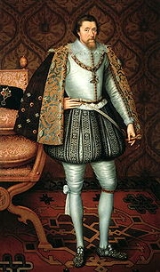
James I of England By Daniel Mytens in 1621

Final year


During the last year of James's life, with Buckingham consolidating his control of Charles to ensure his own future, the king was often seriously ill, leaving him an increasingly peripheral figure, rarely able to visit London. In early 1625, James was plagued by severe attacks of arthritis
Arthritis

Arthritis is a group of conditions involving damage to the joints of the body. Arthritis is the leading cause of disability in people older than fifty-five years....
, gout
Gout

Gout is a crystal deposition disease hallmarked by elevated levels of uric acid in the Circulatory system. In this condition, crystals of monosodium urate or uric acid are deposited on the articular cartilage of joints, tendons and surrounding tissues....
 and fainting fits, and in March fell seriously ill with tertian ague and then suffered a stroke
Stroke

A stroke is the rapidly developing loss of brain function due to a disturbance in the blood supply to the brain. According to the National Stroke Association, a "stroke" occurs when a blood clot blocks and artery or a blood vessel breaks, interrupting blood flow to an area of the brain....
. James finally died at Theobalds House
Theobalds House

Theobalds House , located in Theobalds Park, just outside Cheshunt in the England county of Hertfordshire, was a prominent stately home and royal palace of the 16th and early 17th centuries....
 on 27 March during a violent attack of dysentery
Dysentery

Dysentery is a disorder of the digestive system that results in severe diarrhea containing mucus and/or blood in the feces. If untreated, Dysentery can be fatal....
, with Buckingham at his bedside. James’s funeral, a magnificent but disorderly affair, took place on 7 May. Bishop John Williams
John Williams (archbishop)

John Williams , was a Kingdom of Great Britain clergyman and political advisor to King James I of England. He served as Bishop of Lincoln 1621-1641, Lord Chancellor also known as Lord Chancellor or Lord Chancellor 1621-1625, and Archbishop of York 1641-1650....
 of Lincoln preached the sermon, observing, "King Solomon
Solomon

Solomon is a figure described in the Hebrew Bible and the Qur'an. The biblical accounts identify Solomon as the son of David. He is also called Jedidiah in the Tanakh , and is described as the third king of the United Monarchy, and the final king before the northern Kingdom of Israel and the southern Kingdom of Judah split; following th...
 died in Peace, when he had lived about sixty years...and so you know did King James".

Legacy

The king was widely mourned. For all his flaws, James had never completely lost the affection of his people, who had enjoyed uninterrupted peace and comparatively low taxation during the Jacobean era
Jacobean era

The Jacobean era refers to the period in England and Scotland history that coincides with the reign of King James I of England of England, who was also James VI of Scotland....
. "As he lived in peace," remarked the Earl of Kellie
Earl of Kellie

The title Earl of Kellie or Kelly is one of the peerage titles of in the Peerage of Scotland, created in 1619 for Sir Thomas Erskine, who was Capitan of the Guard and Groom of the Stool for James I....
, "so did he die in peace, and I pray God our king [Charles] may follow him". The earl prayed in vain: once in power, Charles
Charles I of England

Charles I was List of English monarchs, List of monarchs of Scotland and King of Ireland from 27 March 1625 until his capital punishment on 30 January 1649....
 and Buckingham
George Villiers, 1st Duke of Buckingham

George Villiers, 1st Duke of Buckingham was the favourite, claimed by some to be the lover, of King James I of England and one of the most rewarded royal courtiers in all history....
 sanctioned a series of reckless military expeditions that ended in humiliating failure. James bequeathed Charles a fatal belief in the divine right of kings
Divine Right of Kings

The Divine Right of Kings is a politics and religion doctrine of royal absolutism. It asserts that a monarch is subject to no earthly authority, deriving his right to rule directly from the will of God....
, combined with a disdain for Parliament
Parliament of England

The Parliament of England was the legislature of the Kingdom of England. Its roots can be traced back to the early medieval period. In a series of developments, it came increasingly to constrain the power of the King of England, and went on after the Act of Union 1707 to merge with the Parliament of Scotland and form the main basis of the Pa...
, which culminated in the English Civil War
English Civil War

The English Civil War was a series of armed conflicts and political machinations between Roundhead and Cavalier. The First English Civil War and Second English Civil War civil wars pitted the supporters of Charles I of England against the supporters of the Long Parliament, while the Third English Civil War saw fighting between supporters...
 and the execution of Charles. James had often neglected the business of government for leisure pastimes, such as the hunt; and his later dependence on male favourites at a scandal-ridden court undermined the respected image of monarchy so carefully constructed by Elizabeth. The stability of James’s government in Scotland, however, and in the early part of his English reign, as well as his relatively enlightened views on religious issues and war, have earned him a re-evaluation from many recent historians, who have rescued his reputation from a tradition of criticism stemming back to the anti-Stuart
House of Stuart

The House of Stuart, also known as the House of Stewart is an important European royal house. Founded by Robert II of Scotland, the Stewarts first became monarchs of the Kingdom of Scotland during the late 14th century....
 historians of the mid-seventeenth century.

The King James Version ("KJV") of the Bible
Bible

The Bible is the central religious text of Judaism and Christianity. The exact Books of the Bible is dependent on the religious traditions of specific denominations....
 was dedicated to him, being published in 1608 as a result of the Hampton Court Conference
Hampton Court Conference

The Hampton Court Conference was a meeting in January 1604, convened at Hampton Court Palace, for discussion between King James I of England and representatives of the Church of England, including leading English Puritans....
 which he had convened to resolve issues with translations then being used. This translation of the Bible is still in widespread use today.

Titles, styles, honours and arms


Titles and styles

  • 19 June 1566 – 24 July 1567: Prince James
  • 19 June 1566 – 24 July 1567: The Duke of Rothesay (Earl of Carrick, Lord Renfrew)
  • 10 February – 24 July 1567: The Duke of Albany (Earl of Ross, Lord Ardmannoch)
  • 24 July 1567 – 27 March 1625: His Grace James VI, King of Scots
  • 24 March 1603 – 27 March 1625: His Majesty King James I of England


As King of England and Scots, James's full style was His Majesty, James VI, by the Grace of God King of England, Scotland, France and Ireland, Defender of the Faith, etc.

Prior to his ascension in Scotland, his full style was Prince James Stuart, Duke of Rothesay, Duke of Albany, Earl of Carrick, Earl of Ross, Lord Renfrew, Lord Ardmannoch, Lord of the Isles, Prince and Great Steward of Scotland

Children


James's wife, Anne of Denmark, gave birth to seven children who survived beyond birth:

  1. Henry, Prince of Wales
    Henry Frederick, Prince of Wales

    Henry Frederick, Prince of Wales was the eldest son of King James I of England and Anne of Denmark. His name comes from grandfathers Henry Stuart, Lord Darnley and Frederick II of Denmark....
     (19 February 1594 – 6 November 1612). Died, probably of typhoid fever
    Typhoid fever

    Typhoid fever, also known as enteric fever, or commonly just typhoid, is an illness caused by the bacterium Salmonella typhi. Common worldwide, it is transmitted by the ingestion of food or water contaminated with feces from an infected person....
    , aged 18.
  2. Elizabeth of Bohemia
    Elizabeth of Bohemia

    Elisabeth, Electress Palatine and Queen of Bohemia was the eldest daughter of James I of England, King of England, Scotland and Ireland, and Anne of Denmark....
     (19 August 1596 – 13 February 1662). Married 1613, Frederick V, Elector Palatine
    Frederick V, Elector Palatine

    Frederick V was Electoral Palatinate , and, as Frederick I , King of Bohemia . He was the son and heir of Frederick IV, Elector Palatine and of Louise Juliana of Nassau, the daughter of William I of Orange and Charlotte of Bourbon....
    . Died aged 65.
  3. Margaret Stuart (24 December 1598 – March 1600). Died aged 1.
  4. Charles I of England
    Charles I of England

    Charles I was List of English monarchs, List of monarchs of Scotland and King of Ireland from 27 March 1625 until his capital punishment on 30 January 1649....
     (19 November 1600 – 30 January 1649). Married 1625, Henrietta Maria. Executed aged 48.
  5. Robert Stuart, Duke of Kintyre
    Robert Stuart, Duke of Kintyre

    Robert Bruce Stuart, Duke of Kintyre was the fifth child of James I of England and Anne of Denmark. On 2 May 1602 he was created Duke of Kintyre and Lorne, Marquess of Wigton, Earl of Carrick, and Lord of Annandale, all in the Peerage of Scotland....
     (18 January 1602 – 27 May 1602). Died aged 4 months.
  6. Mary Stuart (8 April 1605 – 16 December 1607). Died aged 2.
  7. Sophia Stuart. (Died in June 1607 within 48 hours of birth.)


Ancestry


See also


Further reading


  • Akrigg, G. P. V (1978). Jacobean Pageant: The Court of King James I. New York: Atheneum. ISBN 0-689-70003-2.*
  • Houston, S J. James I. Longman Publishing Group (June 1974), Seminar Studies ISBN 0582352088.*Lockyer, Roger
    Roger Lockyer

    Roger Lockyer is an England historian, professor, and writer. He has been a Reader in History at Royal Holloway, University of London, from which he is now retired....
     (1998). James VI and I. Longman. 2nd edition.
  • Lockyer, Roger
    Roger Lockyer

    Roger Lockyer is an England historian, professor, and writer. He has been a Reader in History at Royal Holloway, University of London, from which he is now retired....
     (1999). The Early Stuarts: The Political History of England 1603-1642. Longman.
  • Lynch, Michael (historian)
    Michael Lynch

    Michael Lynch or Mike Lynch may mean or refer to:* Michael Lynch * Michael Lynch * Michael Lynch * Michael Lynch * Michael Lynch * Mike Lynch , WCVB-TV sports anchor and director...
     (1991).
    Scotland: A New History. Ebury Press. ISBN 0712634134.
  • "Preaching to the Converted? Perspectives on the Scottish Reformation," in The Renaissance in Scotland: Studies in Literature, Religion, History and Culture. - AA MacDonald, M. Lynch and IB Cowan (Leiden, 1994)
  • Peck, Linda Levy (1982). Northampton: Patronage and Policy at the Court of James I. Harper Collins. ISBN 0049421778.

External links


Books about James I available online


  • by John Colville
    John Colville (politician)

    John Colville , Scotland clergyman, judge, politician and author, was the son of Robert Colville of Cleish, in Kinross.Educated at the University of St Andrews, he became a Presbyterian Minister of religion, but occupied himself chiefly with political intrigue, sending secret information to the English government concerning Scottish affairs...
     (1804)
  • An Historical and Critical Account of the Lives and Writings of James I and Charles I, and the Lives of Oliver Cromwell and Charles II by William Harris (1814): , , , ,
  • Memoirs of the Court of King James the First by Lucy Aikin
    Lucy Aikin

    Lucy Aikin , daughter of John Aikin and niece of Anna Letitia Barbauld, born at Warrington, England, was an English historical writer.Lucy Aikin was born into a literary family....
     (1822): ,
  • by James T. Gibson-Craig (1828)
  • by Peter Cunningham (1842)
  • Original Letters Relating to the Ecclesiastical Affairs of Scotland: Chiefly Written by, or Addressed to His Majesty King James the Sixth after his Accession to the English throne (1851): ,
  • (1861)
  • by King James I (1869)
  • by Isaac D'Israeli
    Isaac D'Israeli

    Isaac D'Israeli was a British writer and scholar. He was born in Enfield Town, England, the only child of Benjamin D'Israeli , a Jewish merchant who had emigrated from Cento in Italy in 1748, and his second wife, Sarah Syprut de Gabay Villa Real ....
     (1881)
  • History of England from the Accesion of James I to the Outbreak of the Civil War, 1603-1642 by Samuel Rawson Gardiner
    Samuel Rawson Gardiner

    Samuel Rawson Gardiner was an England historian.The son of Rawson Boddam Gardiner, he was born near New Alresford. He was educated at Winchester College and Christ Church, Oxford, where he obtained a first class in Literae Humaniores....
     (1883-1891): , , , , , , , , ,
  • by Thomas Carlyle
    Thomas Carlyle

    Thomas Carlyle was a Scotland satire writer, essayist, historian and teacher during the Victorian era.He called economics the "dismal science", wrote articles for the Edinburgh Encyclopedia, and became a controversial social commentator....
     (1898 ed.)
  • by Andrew Lang
    Andrew Lang

    Andrew Lang was a prolific Scotland man of letters. He was a poet, novelist, and literary critic, and contributor to anthropology. He now is best known as the folkloristics of folklore and fairy tales....
     (1902)
  • by Walter Frere
    Walter Frere

    Walter Howard Frere, Community of the Resurrection was a co-founder of an Anglican religious order, the Community of the Resurrection and later bishop of Truro ....
     (1904)
  • by Francis Charles Montague (1907)
  • "English Witchcraft and James the First," in by George Lyman Kittredge
    George Lyman Kittredge

    George Lyman Kittredge was a scholar of English literature and a professor at Harvard University. His teaching at Harvard and his editions of major literary figures, notably William Shakespeare and Geoffrey Chaucer, have led some to consider him one of the most influential United States literary criticism of the early 20th century....
     (1911-17)
  • by Mary Sullivan (1913)
  • (1918 ed.)


Other links


  • by Jenny Wormald, C.E. Hodge Fellow & Tutor in Modern History, St Hilda's College, Oxford


|- |-