

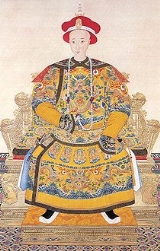
Tongzhi Emperor

Encyclopedia
The Tongzhi Emperor born Aisin-Gioro Dzai Šun, was the tenth emperor
of the Manchu
-led Qing Dynasty
, and the eighth Qing emperor to rule over China
, from 1861 to 1875. His reign, which effectively lasted through his adolescence, was largely overshadowed by the rule of his mother, the Empress Dowager Cixi
. Although he had little influence over court affairs, the events of his reign gave rise to what historians call the "Tongzhi Restoration
" , an unsuccessful attempt to stabilize and modernize China.
 The only surviving son of the Xianfeng Emperor
and the Empress Dowager Cixi
, Tongzhi attempted political reform in the period of the Tongzhi Restoration
. His first reign name was Qixiang , but this name was later abandoned by Cixi in favour of Tongzhi, a contraction of the classical phrase tóngguī yǔ zhì , which means "restoring order together". An alternate interpretation reads it as "mother and son co-emperors", which fits the state of affairs, as the Empress Dowager wielded the real power and ruled behind the scenes. The traditional Chinese political phrase "attending audiences behind a curtain" ' onMouseout='HidePop("18149")' href="/topics/Pinyin">pinyin
: chuí lián tīng zhèng) was readopted to describe Cixi's rule through her son. The phrase can still be heard in contemporary Chinese politics.
Tongzhi became emperor at the age of five when his father, the Xianfeng Emperor
died. His father's choice of regent, Sushun
, was removed in favor of a partnership between his mother (the Empress Dowager Cixi
), the empress (the Empress Dowager Ci'an
), and his uncle (Prince Gong).
Tongzhi married Lady Alute from a Mongol clan and died of smallpox
at the age of 18. He was buried in the Eastern Qing Tombs
in Hebei
province. He had no sons to succeed him. Folklore says that Tongzhi died from a sexually transmitted disease
(specifically syphilis
), due to his alleged affairs with prostitutes outside of the palace, and that the smallpox diagnosis was given only because the mere discussion of sexually transmitted diseases in China was taboo. However, no credible evidence exists to substantiate the rumours.
His mothers, the two dowagers, resumed regency after appointing Guangxu, the son of the 1st Prince Chun, as the new emperor. A few months after Tongzhi's death, Empress Xiaozheyi died. Popular stories suggest that she either committed suicide or that Dowager Empress Cixi starved her to death by cutting off her food supply.
Emperor of China
The Emperor of China refers to any sovereign of Imperial China reigning between the founding of Qin Dynasty of China, united by the King of Qin in 221 BCE, and the fall of Yuan Shikai's Empire of China in 1916. When referred to as the Son of Heaven , a title that predates the Qin unification, the...
of the Manchu
Manchu
The Manchu people or Man are an ethnic minority of China who originated in Manchuria . During their rise in the 17th century, with the help of the Ming dynasty rebels , they came to power in China and founded the Qing Dynasty, which ruled China until the Xinhai Revolution of 1911, which...
-led Qing Dynasty
Qing Dynasty
The Qing Dynasty was the last dynasty of China, ruling from 1644 to 1912 with a brief, abortive restoration in 1917. It was preceded by the Ming Dynasty and followed by the Republic of China....
, and the eighth Qing emperor to rule over China
China
Chinese civilization may refer to:* China for more general discussion of the country.* Chinese culture* Greater China, the transnational community of ethnic Chinese.* History of China* Sinosphere, the area historically affected by Chinese culture...
, from 1861 to 1875. His reign, which effectively lasted through his adolescence, was largely overshadowed by the rule of his mother, the Empress Dowager Cixi
Empress Dowager Cixi
Empress Dowager Cixi1 , of the Manchu Yehenara clan, was a powerful and charismatic figure who became the de facto ruler of the Manchu Qing Dynasty in China for 47 years from 1861 to her death in 1908....
. Although he had little influence over court affairs, the events of his reign gave rise to what historians call the "Tongzhi Restoration
Tongzhi Restoration
The Tongzhi Restoration was an attempt to arrest the dynastic decline of the Qing dynasty of China by restoring the traditional order. The harsh realities of the Opium War, the unequal treaties, and the mid-century mass uprisings of the Taiping Rebellion caused Qing courtiers and officials to...
" , an unsuccessful attempt to stabilize and modernize China.
Biography
Xianfeng Emperor
The Xianfeng Emperor , born Aisin-Gioro I Ju, was the ninth Emperor of the Qing Dynasty, and the seventh Qing emperor to rule over China, from 1850 to 1861.-Family and his early years:...
and the Empress Dowager Cixi
Empress Dowager Cixi
Empress Dowager Cixi1 , of the Manchu Yehenara clan, was a powerful and charismatic figure who became the de facto ruler of the Manchu Qing Dynasty in China for 47 years from 1861 to her death in 1908....
, Tongzhi attempted political reform in the period of the Tongzhi Restoration
Tongzhi Restoration
The Tongzhi Restoration was an attempt to arrest the dynastic decline of the Qing dynasty of China by restoring the traditional order. The harsh realities of the Opium War, the unequal treaties, and the mid-century mass uprisings of the Taiping Rebellion caused Qing courtiers and officials to...
. His first reign name was Qixiang , but this name was later abandoned by Cixi in favour of Tongzhi, a contraction of the classical phrase tóngguī yǔ zhì , which means "restoring order together". An alternate interpretation reads it as "mother and son co-emperors", which fits the state of affairs, as the Empress Dowager wielded the real power and ruled behind the scenes. The traditional Chinese political phrase "attending audiences behind a curtain" ' onMouseout='HidePop("18149")' href="/topics/Pinyin">pinyin
Pinyin
Pinyin is the official system to transcribe Chinese characters into the Roman alphabet in China, Malaysia, Singapore and Taiwan. It is also often used to teach Mandarin Chinese and spell Chinese names in foreign publications and used as an input method to enter Chinese characters into...
: chuí lián tīng zhèng) was readopted to describe Cixi's rule through her son. The phrase can still be heard in contemporary Chinese politics.
Tongzhi became emperor at the age of five when his father, the Xianfeng Emperor
Xianfeng Emperor
The Xianfeng Emperor , born Aisin-Gioro I Ju, was the ninth Emperor of the Qing Dynasty, and the seventh Qing emperor to rule over China, from 1850 to 1861.-Family and his early years:...
died. His father's choice of regent, Sushun
Sushun
Sushun ; Styled: Yuting was born in the Manchu Aisin-Gioro Clan as the sixth son of Ulgungga , the Prince Zheng....
, was removed in favor of a partnership between his mother (the Empress Dowager Cixi
Empress Dowager Cixi
Empress Dowager Cixi1 , of the Manchu Yehenara clan, was a powerful and charismatic figure who became the de facto ruler of the Manchu Qing Dynasty in China for 47 years from 1861 to her death in 1908....
), the empress (the Empress Dowager Ci'an
Empress Dowager Ci'an
Empress Dowager Ci'an , popularly known in China as the East Empress Dowager , and officially known posthumously as the Empress Xiao Zhen Xian , was the second Empress Consort of the Xianfeng Emperor of the Manchu Qing Dynasty in China, and then Empress Dowager after 1861...
), and his uncle (Prince Gong).
Tongzhi married Lady Alute from a Mongol clan and died of smallpox
Smallpox
Smallpox was an infectious disease unique to humans, caused by either of two virus variants, Variola major and Variola minor. The disease is also known by the Latin names Variola or Variola vera, which is a derivative of the Latin varius, meaning "spotted", or varus, meaning "pimple"...
at the age of 18. He was buried in the Eastern Qing Tombs
Eastern Qing Tombs
The Eastern Qing Tombs are an imperial mausoleum complex of the Qing Dynasty located in Zunhua, 125 kilometers northeast of Beijing. They are the largest, most complete, and best preserved extant mausoleum complex in China...
in Hebei
Hebei
' is a province of the People's Republic of China in the North China region. Its one-character abbreviation is "" , named after Ji Province, a Han Dynasty province that included what is now southern Hebei...
province. He had no sons to succeed him. Folklore says that Tongzhi died from a sexually transmitted disease
Sexually transmitted disease
Sexually transmitted disease , also known as a sexually transmitted infection or venereal disease , is an illness that has a significant probability of transmission between humans by means of human sexual behavior, including vaginal intercourse, oral sex, and anal sex...
(specifically syphilis
Syphilis
Syphilis is a sexually transmitted infection caused by the spirochete bacterium Treponema pallidum subspecies pallidum. The primary route of transmission is through sexual contact; however, it may also be transmitted from mother to fetus during pregnancy or at birth, resulting in congenital syphilis...
), due to his alleged affairs with prostitutes outside of the palace, and that the smallpox diagnosis was given only because the mere discussion of sexually transmitted diseases in China was taboo. However, no credible evidence exists to substantiate the rumours.
His mothers, the two dowagers, resumed regency after appointing Guangxu, the son of the 1st Prince Chun, as the new emperor. A few months after Tongzhi's death, Empress Xiaozheyi died. Popular stories suggest that she either committed suicide or that Dowager Empress Cixi starved her to death by cutting off her food supply.
Family
- Father: Xianfeng EmperorXianfeng EmperorThe Xianfeng Emperor , born Aisin-Gioro I Ju, was the ninth Emperor of the Qing Dynasty, and the seventh Qing emperor to rule over China, from 1850 to 1861.-Family and his early years:...
- Mother: Noble Consort YiEmpress Dowager CixiEmpress Dowager Cixi1 , of the Manchu Yehenara clan, was a powerful and charismatic figure who became the de facto ruler of the Manchu Qing Dynasty in China for 47 years from 1861 to her death in 1908....
(Empress Dowager CixiEmpress Dowager CixiEmpress Dowager Cixi1 , of the Manchu Yehenara clan, was a powerful and charismatic figure who became the de facto ruler of the Manchu Qing Dynasty in China for 47 years from 1861 to her death in 1908....
)
Consorts
- Empress Xiaozheyi, of the Alute clan (1854–1875)
- Imperial Noble Consort Shushen, (1860–1905) neé Fuca.
- Imperial Noble Consort Zhuanghe, (1857–14 April 1921) neé Alute was the aunt of Empress Xiaozheyi.
- Imperial Noble Consort Jingyi, (1856–1932) neé Heseri.
- Imperial Noble Consort Ronghui, (1854–1933) neé Silin Gioro.
Ancestry
Sources and literature
As only son of Empress Dowager Cixi, Tongzhi is mentioned in almost all books about her.- The draft history of the Qing dynasty 《清史稿》卷二百十四.列傳一.后妃傳.
- Sterling Seagraves, "Dragon Lady" ISBN 0679733698.
- Maria Warner", "The Dragon Empres": Life and Times of Tz'u-Hsi, 1835–1908, Empress of China". ISBN 0689707142.
- Anchee Min, "Empress Orchid". ISBN 978-0618068876.
- Mayli Wen (foreword Lulu Wang), "Een vrouw op de drakentroon". ISBN 9054292229.
- Daily life in the Forbidden City, Wan Yi, Wang Shuqing, Lu Yanzhen. ISBN 0-670-81164-5.
- Keith Laidler, "The last Empress, the she dragon of China". ISBN 0-470-84881-2.
- Forbidden City: The Great Within, Second Edition. May Holdsworth, Caroline Courtauld. ISBN:9622177921.