


Kingdom of Scotland

Encyclopedia
The Kingdom of Scotland (Gaelic
: Rìoghachd na h-Alba, Scots
: Kinrick o Scotland) was a Sovereign state
in North-West Europe
that existed from 843 until 1707. It occupied the northern third of the island of Great Britain
and shared a land border
to the south with the Kingdom of England
. In 1603, James VI of Scotland
became King of England, joining Scotland with England in a personal union
. In 1707, the two kingdoms were united to form the Kingdom of Great Britain
, under the terms of the Acts of Union
. Since the final capture of the Royal Burgh
of Berwick by the Kingdom of England in 1482 (following the annexation of the Northern Isles
from the Kingdom of Norway in 1472) the territory of the Kingdom of Scotland has corresponded to that of modern-day Scotland
, bounded by the North Sea
to the east, the Atlantic Ocean
to the north and west, and the North Channel
and Irish Sea
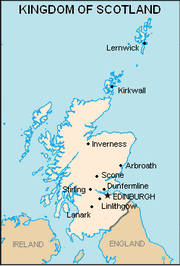
to the southwest. Apart from the mainland, the Kingdom of Scotland consisted of over 790 islands.
Edinburgh
, the capital, was preceded by the towns of Scone
, Dunfermline
and Stirling
as the country's capital. The population of the Kingdom of Scotland in 1701, six years before the passing of the Acts of Union, was approximately 1.1 million.
, establishing his kingdom as the territory north of the Clyde
and Forth
. Other nearby parts remained independent from Scotland, such as the Kingdom of Strathclyde
ruled by the Brython
. In addition to this, the area which is today known as the Lothian
and Borders
, including Edinburgh
belonged from around 638 to the Angles
of the kingdom of Bernicia
, then the Kingdom of Northumbria, and then the Kingdom of England
. According to William of Malmesbury
, king Edgar of England
ceded Lothian to Scotland in exchange for a renewed oath of fealty, expanding the Kingdom of Scotland as far south as the River Tweed
. This remains the south-eastern border to this day (except around Berwick-upon-Tweed
).
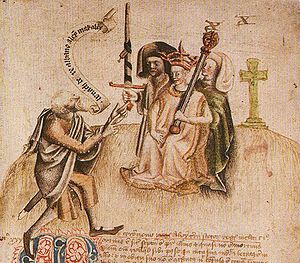
for control over the Western Isles at the Battle of Largs
. The battle was indecisive, but the campaign proved once and for all that the Norse were unable to retain effective control over the distant Isles. In 1266, the Norwegian king Magnus VI of Norway
signed the Treaty of Perth
, which acknowledged Scottish suzerainty
over the islands. Despite the treaty the practical independence of the Lord of the Isles
continued.
was an important alliance between Scotland and France
. It dates from the treaty signed by John Balliol and Philip IV of France
in 1295. It played a varying but sometimes large role in Franco-Scottish (and English
) affairs, until 1560. In 1512 under a treaty extending the Auld Alliance, all nationals of Scotland or France also became nationals of the other country, a status not repealed in France until 1903 and which may never have been repealed in Scotland.
, leading to the battles of Stirling Bridge
and Bannockburn
during the Wars of Scottish Independence
, when the historic figures of William Wallace
and Robert the Bruce
emerged. In 1320 a remonstrance to the Pope from the nobles of Scotland (the Declaration of Arbroath
) finally convinced Pope John XXII
to overturn the earlier excommunication and nullify the various acts of submission by Scottish kings to English ones so that Scotland's sovereignty should again be recognised by the major European dynasties.
married Margaret of Denmark, receiving the Norwegian territories of Orkney Islands
and the Shetland Islands
in payment of her dowry
and in 1493 his son, James IV
, successfully ended the quasi-independent rule of the Lord of the Isles
, bringing the Western Isles under effective Royal control for the first time.
began to infiltrate Scotland. Scotland advanced markedly in educational terms during the fifteenth century with the founding of the University of St Andrews
in 1413, the University of Glasgow
in 1450 and the University of Aberdeen
in 1494, and with the passing of the Education Act 1496
.
. In the earlier part of the century, the teachings of first Martin Luther
and then John Calvin
had little influence in Scotland and James V
condemned them. However the heavy handed execution of a number of Protestant preachers aroused sympathy amongst the general public
. The most notable executions were of the Lutheran influenced Patrick Hamilton
in 1527 and later the Calvinist George Wishart
in 1546 who were burnt at the stake in St Andrews
for heresy
. The executions made the men martyrs and stimulated the growth of such ideas. Cardinal Beaton
was assassinated shortly after the execution of George Wishart.
The eventual Reformation of the Scottish Church, was carried out by Parliament
from 1560 (during the minority of Mary, Queen of Scots) when most Scots adopted Calvinism
. The most influential figure was that of John Knox
, who had been a disciple of both John Calvin and George Wishart. Roman Catholicism was not totally eliminated, and remained strong particularly in parts of the highlands
.
, became King James I of England
. Thus, Scotland entered into a personal union
with England
and Ireland
. The seventeenth century saw a period of unrest in Scotland, religious Confrontation in Scotland with Charles I
, who attempted to impose English-style prayer books on the Scottish church, led to the setting up of the National Covenant, and later to the Bishops' Wars
, the Scottish Civil War and Wars of the Three Kingdoms
. From 1651–60, Scotland was occupied by a Cromwellian
army under George Monck
.
. Whilst the "Glorious Revolution
" was primarily an English event, it had a great impact on Scottish history. The Scottish Parliament
offered the Crown of Scotland
which William accepted under the conditions of the Claim of Right (an important document in the evolution of the rule of law and the rights of subjects similar to the English Bill of Rights
).
from the Latin
'Jacobus', meaning 'James', spawned a series of uprisings. An initial Jacobite rising under John Graham, 1st Viscount of Dundee
(Bonnie Dundee
) defeated William's forces at the Battle of Killiecrankie
in 1689, but Dundee was slain in the fighting, and the Jacobite army was soon defeated at the Battle of Dunkeld
. The complete defeat of James VII in Ireland by William at the Battle of the Boyne
in 1690, followed by the Massacre of Glencoe
in 1692, succeeded in finally persuading those remaining Highland Clan
Chieftains reluctant to pledge allegiance to William to reconsider their positions.
(the Ulster-Scots
). The Parliament of Scotland of 1695 enacted a number of remedies for the desperate economic situation, including setting up the Bank of Scotland
. The Act for the Settling of Schools established a parish-based system of public education throughout Scotland. The Company of Scotland
received a charter to raise capital through public subscription to trade with Africa and the Indies. By the early eighteenth century, Scotland was a kingdom in crisis. Her economy had been severely weakened by a series of major harvest failures beginning. The lean years of the 1690s were compounded by the catastrophic failure of the Darien Scheme
due to poor planning and leadership, lack of demand for trade goods, devastating epidemics of disease, and increasing shortage of food, as well as being deliberately sabotaged by the combined efforts of the East India Company
, the international financial markets at Amsterdam
and King William. It is estimated that almost 25% of Scotland's total liquid capital was lost in the Darien venture.
was historically complex. During most of the existence of the Kingdom of the Scots, however, a single monarch or High King
was recognized. Under the suzerainty
of the High King, there were chieftains
, and petty kings, and offices filled through selection by an assembly
under a system known as tanistry
, which combined an hereditary element with the consent of those ruled. Usually, the candidate was nominated by the current office holder on the approach of death, and his heir-elect was known as the tanist, from the Scottish Gaelic
tànaiste.
was overthrown by Máel Coluim III in 1057, and during the reign of King David I
, the influence of Norman
settlers in Scotland saw primogeniture
adopted as the means of succession in Scotland, as in much of Western Europe, and witnessed the development of a 'hybrid kingdom', one part of which was governed by a mixture of a feudal government, the other following traditional Celt
ic customary law. These early assemblies cannot be considered 'parliaments' in the later sense of the word.
Originally, Scots owed their allegiance primarily to their Clan chieftain, or to the laird, thus the High King consistently had to keep them of favorable disposition, or else risk armed conflict.
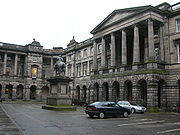 The Parliament of Scotland
was the legislature. The members were collectively referred to as the "Three Estates"
for nearly all of the parliament's history. It was composed of the first estate of prelates (bishops and abbots), the second estate of lords (dukes, earls, parliamentary peers and lay tenants-in-chief), and the third estate of burgh commissioners. From the sixteenth century, the second estate was reorganised by the selection of shire commissioners. This has been argued to have created a 'fourth estate', while a 'fifth estate', composed of royal office holders, has also been identified. These identifications remain highly controversial among parliamentary historians. Regardless of these distinctions and controversial demarcation lines with the body, the term used for the assembled members continued to be 'the Three Estates'. The Parliament was a unicameral assembly.
The Scottish parliament is first found on record during the early thirteenth century, and the first meeting for which reliable evidence survives (referred to, like the English parliament, as a colloquium
in the surviving Latin records), was at Kirkliston
, in 1235, during the reign of Alexander II
.
The two most powerful periods of the Scottish Parliament's existence can be defined as 1639-51 and 1689-1707. During the era of Covenanting control
, the Scottish Parliament emerged as a mature political and institutional forum, and was one of the most powerful assemblies in Europe. Drawing on the Scottish Constitutional Settlement of 1640-41, a programme of constitutional reform was renewed from 1689, when it passed the Claim of Right, onwards. The last session sat on 25 May 1707, after which the Parliament of Great Britain
assumed responsibility for Scottish affairs, under the terms of the Acts of Union
, with effect from 1 May 1707.
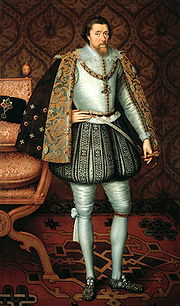 Scotland's monarch, James VI, King of Scots
, succeeded to the throne of the Kingdom of England
in 1603, becoming King James I of England
, after the death of Queen Elizabeth I of England
. This was merely a personal union
: the two nations shared a head of state
but retained their own separate parliaments and administration.
While there had been three earlier attempts (in 1606, 1667 and 1689) to politically unite the two countries by Acts of Parliament, these were the first Acts which had the will of both political establishments behind them, albeit for rather different reasons. In the English case, the purpose was to establish the Royal succession along Protestant lines in the same manner as provided for by the English Act of Settlement 1701
rather than that of the Scottish Act of Security. In the Scottish case, the purpose was partly to use English subsidies to recover from the financial problems caused by the failure of the Darién scheme
and partly to remove British trade sanctions put in place through the Alien Act to force the Scots Parliament
into compliance with the Act of Settlement.
A major feature of British politics from 1702 to 1707 was the necessity of securing the Hanoverian Succession. The death of King William in 1702 resulted in the succession of Queen Anne
to the crowns of England and Scotland. Anne's last surviving child had died in 1700 and the English Act of Settlement had passed the English Succession over to the Protestant House of Hanover
. Since it was unthinkable that Scotland and England should again have separate monarchs, the securing of the Hanoverian Succession in Scotland became the primary objective in British strategic thinking towards Scotland. By 1703 the Anglo-Scottish dynastic union, the Union of the Crowns
, was in crisis. The Scottish Parliament was pursuing both an independent dynastic and foreign policy and the Scottish Act of Security allowed for the Scottish Parliament to choose a different monarch to succeed to the Scottish crown from that of England
, if it so wished. Many in Scotland saw this as a desirable position given that the Parliament of England
had executed King Charles I
during the English Civil War
without any reference to the Scottish Parliament
, despite Charles also being King of Scots. This meant that the Act allowed for the Scottish Parliament to initiate an independent foreign policy during an era of major European warfare like the War of the Spanish Succession
and the Great Northern War
. From the English political perspective, this opened up the possibilities of the restoration of a Jacobite
on the Scottish throne or a Scottish trading and/or military alliance with another power in Europe like France
or the Dutch Republic
. Such an alignment could result in attacks from Scotland, Ireland
and the continent and compromise England's interests abroad. Equally, the Darien scheme
left Scotland badly in need of investment. Hence the political union was pursued by both parliaments, albeit for different reasons.
The Kingdoms of Scotland and England ceased to exist on 1 May 1707, following passage of the Acts of Union
, which merged Scotland with England thereby creating the Kingdom of Great Britain
. The Acts incorporated provisions for Scotland to send representative peers from the Peerage of Scotland
to sit in the House of Lords
. It guaranteed that the Church of Scotland
would remain the established church in Scotland, that the Court of Session
would "remain in all time coming within Scotland" and that Scots law
would "remain in the same force as before". Other provisions included the restatement of the Act of Settlement 1701
and the ban on Roman Catholics from taking the throne. It also created a customs union
and monetary union. The Act provided that any "laws and statutes" that were "contrary to or inconsistent with the terms" of the Act would "cease and become void." So the Scottish parliament succeeded in getting a number of concessions.
apostle
and martyr
Saint Andrew
, the patron saint
of Scotland, was crucified on an X-shaped cross
at Patras
, (Patrae), in Achaea
. Use of the familiar iconography of his martyrdom, showing the apostle bound to an X-shaped cross, first appears in the Kingdom of Scotland in 1180 during the reign of William I
. This image was again depicted on seals used during the late 13th century; including on one particular example used by the Guardians of Scotland, dated 1286. Use of a simplified symbol associated with Saint Andrew which does not depict his image, namely the saltire
, or crux decussata, (from the Latin crux, 'cross', and decussis, 'having the shape of the Roman numeral X'), has its origins in the late 14th century; the Parliament of Scotland
decreed in 1385 that Scottish soldiers wear a white Saint Andrew's Cross on their person, both in front and behind, for the purpose of identification.
The earliest reference to the Saint Andrew's Cross as a flag is to be found in the Vienna Book of Hours, circa 1503, where a white saltire is depicted with a red background. In the case of Scotland, use of a blue background for the Saint Andrew's Cross is said to date from at least the 15th century, with the first certain illustration of a flag depicting such appearing in Sir David Lyndsay of the Mount
's Register of Scottish Arms, circa 1542. In heraldic
language, it may be blazon
ed Azure
, a saltire argent
.
Following the Union of the Crowns
in 1603, James VI, King of Scots, commissioned new designs for a banner incorporating the flags of the Kingdom of Scotland and Kingdom of England
. In 1606, a Union Flag
was commissioned, combining the crosses of Saint George
, (the Flag of England
), with that of Saint Andrew. Historical evidence suggests that a Scottish version of this flag existed, in which the cross of Saint Andrew overlayed the cross of St George. This design may have seen limited, unofficial use in Scotland until 1707, when the English variant of the same, whereby the cross of St George overlayed that of St Andrew, was adopted as the flag of the unified Kingdom of Great Britain
.
First used by King William I
in the 12th century, a register in the College of Arms
in London
describes the Royal Coat of Arms of Scotland
, or alternatively the arms of the Kyng of Scottz, as being Or, a lion
rampant within a double tressure flory counter-flory Gules
. The Royal Standard of Scotland
, also known as the Lion Rampant, is therefore the banner of these arms. Following the Union of the Crowns
in 1603, the Royal Standard of Scotland was incorporated into the quartered Royal Standard, displaying the royal emblems of the Kingdom of England and Kingdom of Ireland
. This quartered design was to evolve to become that now styled the Royal Standard of the United Kingdom. The standard displaying only the Lion rampant and Royal Tressure, known as the Royal Standard of Scotland, remains the personal banner of the monarch and use of this flag is restricted under the Act of the Parliament of Scotland
1672 cap. 47 and 30 & 31 Vict. cap. 17. Its correct use is now restricted to only a few Great Officers who officially represent the monarch, and at royal residences in Scotland when the monarch is not present.
Scottish Gaelic language
Scottish Gaelic is a Celtic language native to Scotland. A member of the Goidelic branch of the Celtic languages, Scottish Gaelic, like Modern Irish and Manx, developed out of Middle Irish, and thus descends ultimately from Primitive Irish....
: Rìoghachd na h-Alba, Scots
Scots language
Scots is the Germanic language variety spoken in Lowland Scotland and parts of Ulster . It is sometimes called Lowland Scots to distinguish it from Scottish Gaelic, the Celtic language variety spoken in most of the western Highlands and in the Hebrides.Since there are no universally accepted...
: Kinrick o Scotland) was a Sovereign state
Sovereign state
A sovereign state, or simply, state, is a state with a defined territory on which it exercises internal and external sovereignty, a permanent population, a government, and the capacity to enter into relations with other sovereign states. It is also normally understood to be a state which is neither...
in North-West Europe
North-West Europe
North-West Europe is a term that refers to a northern area of Western Europe, although the exact area or countries it comprises varies.-Geographic definition:...
that existed from 843 until 1707. It occupied the northern third of the island of Great Britain
Great Britain
Great Britain or Britain is an island situated to the northwest of Continental Europe. It is the ninth largest island in the world, and the largest European island, as well as the largest of the British Isles...
and shared a land border
Anglo-Scottish border
The Anglo-Scottish border is the official border and mark of entry between Scotland and England. It runs for 154 km between the River Tweed on the east coast and the Solway Firth in the west. It is Scotland's only land border...
to the south with the Kingdom of England
Kingdom of England
The Kingdom of England was, from 927 to 1707, a sovereign state to the northwest of continental Europe. At its height, the Kingdom of England spanned the southern two-thirds of the island of Great Britain and several smaller outlying islands; what today comprises the legal jurisdiction of England...
. In 1603, James VI of Scotland
James I of England
James VI and I was King of Scots as James VI from 24 July 1567 and King of England and Ireland as James I from the union of the English and Scottish crowns on 24 March 1603...
became King of England, joining Scotland with England in a personal union
Personal union
A personal union is the combination by which two or more different states have the same monarch while their boundaries, their laws and their interests remain distinct. It should not be confused with a federation which is internationally considered a single state...
. In 1707, the two kingdoms were united to form the Kingdom of Great Britain
Kingdom of Great Britain
The former Kingdom of Great Britain, sometimes described as the 'United Kingdom of Great Britain', That the Two Kingdoms of Scotland and England, shall upon the 1st May next ensuing the date hereof, and forever after, be United into One Kingdom by the Name of GREAT BRITAIN. was a sovereign...
, under the terms of the Acts of Union
Acts of Union 1707
The Acts of Union were two Parliamentary Acts - the Union with Scotland Act passed in 1706 by the Parliament of England, and the Union with England Act passed in 1707 by the Parliament of Scotland - which put into effect the terms of the Treaty of Union that had been agreed on 22 July 1706,...
. Since the final capture of the Royal Burgh
Royal burgh
A royal burgh was a type of Scottish burgh which had been founded by, or subsequently granted, a royal charter. Although abolished in 1975, the term is still used in many of the former burghs....
of Berwick by the Kingdom of England in 1482 (following the annexation of the Northern Isles
Northern Isles
The Northern Isles is a chain of islands off the north coast of mainland Scotland. The climate is cool and temperate and much influenced by the surrounding seas. There are two main island groups: Shetland and Orkney...
from the Kingdom of Norway in 1472) the territory of the Kingdom of Scotland has corresponded to that of modern-day Scotland
Scotland
Scotland is a country that is part of the United Kingdom. Occupying the northern third of the island of Great Britain, it shares a border with England to the south and is bounded by the North Sea to the east, the Atlantic Ocean to the north and west, and the North Channel and Irish Sea to the...
, bounded by the North Sea
North Sea
In the southwest, beyond the Straits of Dover, the North Sea becomes the English Channel connecting to the Atlantic Ocean. In the east, it connects to the Baltic Sea via the Skagerrak and Kattegat, narrow straits that separate Denmark from Norway and Sweden respectively...
to the east, the Atlantic Ocean
Atlantic Ocean
The Atlantic Ocean is the second-largest of the world's oceanic divisions. With a total area of about , it covers approximately 20% of the Earth's surface and about 26% of its water surface area...
to the north and west, and the North Channel
North Channel (British Isles)
The North Channel is the strait which separates eastern Northern Ireland from southwestern Scotland...
and Irish Sea
Irish Sea
The Irish Sea separates the islands of Ireland and Great Britain. It is connected to the Celtic Sea in the south by St George's Channel, and to the Atlantic Ocean in the north by the North Channel. Anglesey is the largest island within the Irish Sea, followed by the Isle of Man...
to the southwest. Apart from the mainland, the Kingdom of Scotland consisted of over 790 islands.
Edinburgh
Edinburgh
Edinburgh is the capital city of Scotland, the second largest city in Scotland, and the eighth most populous in the United Kingdom. The City of Edinburgh Council governs one of Scotland's 32 local government council areas. The council area includes urban Edinburgh and a rural area...
, the capital, was preceded by the towns of Scone
Scone, Scotland
Scone is a village in Perth and Kinross, Scotland. The medieval village of Scone, which grew up around the monastery and royal residence, was abandoned in the early 19th century when the residents were removed and a new palace was built on the site by the Earl of Mansfield...
, Dunfermline
Dunfermline
Dunfermline is a town and former Royal Burgh in Fife, Scotland, on high ground from the northern shore of the Firth of Forth. According to a 2008 estimate, Dunfermline has a population of 46,430, making it the second-biggest settlement in Fife. Part of the town's name comes from the Gaelic word...
and Stirling
Stirling
Stirling is a city and former ancient burgh in Scotland, and is at the heart of the wider Stirling council area. The city is clustered around a large fortress and medieval old-town beside the River Forth...
as the country's capital. The population of the Kingdom of Scotland in 1701, six years before the passing of the Acts of Union, was approximately 1.1 million.
History
The Kingdom of Scotland was united in 843 by King Cináed I of Scotland, who unified the territories of the Scots and the PictsPicts
The Picts were a group of Late Iron Age and Early Mediaeval people living in what is now eastern and northern Scotland. There is an association with the distribution of brochs, place names beginning 'Pit-', for instance Pitlochry, and Pictish stones. They are recorded from before the Roman conquest...
, establishing his kingdom as the territory north of the Clyde
River Clyde
The River Clyde is a major river in Scotland. It is the ninth longest river in the United Kingdom, and the third longest in Scotland. Flowing through the major city of Glasgow, it was an important river for shipbuilding and trade in the British Empire....
and Forth
River Forth
The River Forth , long, is the major river draining the eastern part of the central belt of Scotland.The Forth rises in Loch Ard in the Trossachs, a mountainous area some west of Stirling...
. Other nearby parts remained independent from Scotland, such as the Kingdom of Strathclyde
Kingdom of Strathclyde
Strathclyde , originally Brythonic Ystrad Clud, was one of the early medieval kingdoms of the celtic people called the Britons in the Hen Ogledd, the Brythonic-speaking parts of what is now southern Scotland and northern England. The kingdom developed during the post-Roman period...
ruled by the Brython
Brython
The Britons were the Celtic people culturally dominating Great Britain from the Iron Age through the Early Middle Ages. They spoke the Insular Celtic language known as British or Brythonic...
. In addition to this, the area which is today known as the Lothian
Lothian
Lothian forms a traditional region of Scotland, lying between the southern shore of the Firth of Forth and the Lammermuir Hills....
and Borders
Scottish Borders
The Scottish Borders is one of 32 local government council areas of Scotland. It is bordered by Dumfries and Galloway in the west, South Lanarkshire and West Lothian in the north west, City of Edinburgh, East Lothian, Midlothian to the north; and the non-metropolitan counties of Northumberland...
, including Edinburgh
Edinburgh
Edinburgh is the capital city of Scotland, the second largest city in Scotland, and the eighth most populous in the United Kingdom. The City of Edinburgh Council governs one of Scotland's 32 local government council areas. The council area includes urban Edinburgh and a rural area...
belonged from around 638 to the Angles
Angles
The Angles is a modern English term for a Germanic people who took their name from the ancestral cultural region of Angeln, a district located in Schleswig-Holstein, Germany...
of the kingdom of Bernicia
Bernicia
Bernicia was an Anglo-Saxon kingdom established by Anglian settlers of the 6th century in what is now southeastern Scotland and North East England....
, then the Kingdom of Northumbria, and then the Kingdom of England
Kingdom of England
The Kingdom of England was, from 927 to 1707, a sovereign state to the northwest of continental Europe. At its height, the Kingdom of England spanned the southern two-thirds of the island of Great Britain and several smaller outlying islands; what today comprises the legal jurisdiction of England...
. According to William of Malmesbury
William of Malmesbury
William of Malmesbury was the foremost English historian of the 12th century. C. Warren Hollister so ranks him among the most talented generation of writers of history since Bede, "a gifted historical scholar and an omnivorous reader, impressively well versed in the literature of classical,...
, king Edgar of England
Edgar of England
Edgar the Peaceful, or Edgar I , also called the Peaceable, was a king of England . Edgar was the younger son of Edmund I of England.-Accession:...
ceded Lothian to Scotland in exchange for a renewed oath of fealty, expanding the Kingdom of Scotland as far south as the River Tweed
River Tweed
The River Tweed, or Tweed Water, is long and flows primarily through the Borders region of Great Britain. It rises on Tweedsmuir at Tweed's Well near where the Clyde, draining northwest, and the Annan draining south also rise. "Annan, Tweed and Clyde rise oot the ae hillside" as the Border saying...
. This remains the south-eastern border to this day (except around Berwick-upon-Tweed
Berwick-upon-Tweed
Berwick-upon-Tweed or simply Berwick is a town in the county of Northumberland and is the northernmost town in England, on the east coast at the mouth of the River Tweed. It is situated 2.5 miles south of the Scottish border....
).
Scotland & Others
In 1263, Scotland fought NorwayNorway
Norway , officially the Kingdom of Norway, is a Nordic unitary constitutional monarchy whose territory comprises the western portion of the Scandinavian Peninsula, Jan Mayen, and the Arctic archipelago of Svalbard and Bouvet Island. Norway has a total area of and a population of about 4.9 million...
for control over the Western Isles at the Battle of Largs
Battle of Largs
The Battle of Largs was an engagement fought between the armies of Norway and Scotland near the present-day town of Largs in North Ayrshire on the Firth of Clyde in Scotland on 2 October 1263. It was the most important military engagement of the Scottish-Norwegian War. The Norwegian forces were...
. The battle was indecisive, but the campaign proved once and for all that the Norse were unable to retain effective control over the distant Isles. In 1266, the Norwegian king Magnus VI of Norway
Magnus VI of Norway
Magnus VI Lagabøte or Magnus Håkonsson , was king of Norway from 1263 until 1280.-Early life:...
signed the Treaty of Perth
Treaty of Perth
The Treaty of Perth, 1266, ended military conflict between Norway, under King Magnus VI of Norway, and Scotland, under King Alexander III, over the sovereignty of the Hebrides and the Isle of Man....
, which acknowledged Scottish suzerainty
Suzerainty
Suzerainty occurs where a region or people is a tributary to a more powerful entity which controls its foreign affairs while allowing the tributary vassal state some limited domestic autonomy. The dominant entity in the suzerainty relationship, or the more powerful entity itself, is called a...
over the islands. Despite the treaty the practical independence of the Lord of the Isles
Lord of the Isles
The designation Lord of the Isles is today a title of Scottish nobility with historical roots that go back beyond the Kingdom of Scotland. It emerged from a series of hybrid Viking/Gaelic rulers of the west coast and islands of Scotland in the Middle Ages, who wielded sea-power with fleets of...
continued.
Auld Alliance
The Auld AllianceAuld Alliance
The Auld Alliance was an alliance between the kingdoms of Scotland and France. It played a significant role in the relations between Scotland, France and England from its beginning in 1295 until the 1560 Treaty of Edinburgh. The alliance was renewed by all the French and Scottish monarchs of that...
was an important alliance between Scotland and France
France
The French Republic , The French Republic , The French Republic , (commonly known as France , is a unitary semi-presidential republic in Western Europe with several overseas territories and islands located on other continents and in the Indian, Pacific, and Atlantic oceans. Metropolitan France...
. It dates from the treaty signed by John Balliol and Philip IV of France
Philip IV of France
Philip the Fair was, as Philip IV, King of France from 1285 until his death. He was the husband of Joan I of Navarre, by virtue of which he was, as Philip I, King of Navarre and Count of Champagne from 1284 to 1305.-Youth:A member of the House of Capet, Philip was born at the Palace of...
in 1295. It played a varying but sometimes large role in Franco-Scottish (and English
Kingdom of England
The Kingdom of England was, from 927 to 1707, a sovereign state to the northwest of continental Europe. At its height, the Kingdom of England spanned the southern two-thirds of the island of Great Britain and several smaller outlying islands; what today comprises the legal jurisdiction of England...
) affairs, until 1560. In 1512 under a treaty extending the Auld Alliance, all nationals of Scotland or France also became nationals of the other country, a status not repealed in France until 1903 and which may never have been repealed in Scotland.
King of Scots
Scotland's kings placed great importance on the strategic stronghold of StirlingStirling
Stirling is a city and former ancient burgh in Scotland, and is at the heart of the wider Stirling council area. The city is clustered around a large fortress and medieval old-town beside the River Forth...
, leading to the battles of Stirling Bridge
Battle of Stirling Bridge
The Battle of Stirling Bridge was a battle of the First War of Scottish Independence. On 11 September 1297, the forces of Andrew Moray and William Wallace defeated the combined English forces of John de Warenne, 6th Earl of Surrey and Hugh de Cressingham near Stirling, on the River Forth.-The main...
and Bannockburn
Battle of Bannockburn
The Battle of Bannockburn was a significant Scottish victory in the Wars of Scottish Independence...
during the Wars of Scottish Independence
Wars of Scottish Independence
The Wars of Scottish Independence were a series of military campaigns fought between the independent Kingdom of Scotland and the Kingdom of England in the late 13th and early 14th centuries....
, when the historic figures of William Wallace
William Wallace
Sir William Wallace was a Scottish knight and landowner who became one of the main leaders during the Wars of Scottish Independence....
and Robert the Bruce
Robert I of Scotland
Robert I , popularly known as Robert the Bruce , was King of Scots from March 25, 1306, until his death in 1329.His paternal ancestors were of Scoto-Norman heritage , and...
emerged. In 1320 a remonstrance to the Pope from the nobles of Scotland (the Declaration of Arbroath
Declaration of Arbroath
The Declaration of Arbroath is a declaration of Scottish independence, made in 1320. It is in the form of a letter submitted to Pope John XXII, dated 6 April 1320, intended to confirm Scotland's status as an independent, sovereign state and defending Scotland's right to use military action when...
) finally convinced Pope John XXII
Pope John XXII
Pope John XXII , born Jacques Duèze , was pope from 1316 to 1334. He was the second Pope of the Avignon Papacy , elected by a conclave in Lyon assembled by Philip V of France...
to overturn the earlier excommunication and nullify the various acts of submission by Scottish kings to English ones so that Scotland's sovereignty should again be recognised by the major European dynasties.
The Northern Isles
In 1468 the last great acquisition of Scottish territory occurred when James IIIJames III of Scotland
James III was King of Scots from 1460 to 1488. James was an unpopular and ineffective monarch owing to an unwillingness to administer justice fairly, a policy of pursuing alliance with the Kingdom of England, and a disastrous relationship with nearly all his extended family.His reputation as the...
married Margaret of Denmark, receiving the Norwegian territories of Orkney Islands
Orkney Islands
Orkney also known as the Orkney Islands , is an archipelago in northern Scotland, situated north of the coast of Caithness...
and the Shetland Islands
Shetland Islands
Shetland is a subarctic archipelago of Scotland that lies north and east of mainland Great Britain. The islands lie some to the northeast of Orkney and southeast of the Faroe Islands and form part of the division between the Atlantic Ocean to the west and the North Sea to the east. The total...
in payment of her dowry
Dowry
A dowry is the money, goods, or estate that a woman brings forth to the marriage. It contrasts with bride price, which is paid to the bride's parents, and dower, which is property settled on the bride herself by the groom at the time of marriage. The same culture may simultaneously practice both...
and in 1493 his son, James IV
James IV of Scotland
James IV was King of Scots from 11 June 1488 to his death. He is generally regarded as the most successful of the Stewart monarchs of Scotland, but his reign ended with the disastrous defeat at the Battle of Flodden Field, where he became the last monarch from not only Scotland, but also from all...
, successfully ended the quasi-independent rule of the Lord of the Isles
Lord of the Isles
The designation Lord of the Isles is today a title of Scottish nobility with historical roots that go back beyond the Kingdom of Scotland. It emerged from a series of hybrid Viking/Gaelic rulers of the west coast and islands of Scotland in the Middle Ages, who wielded sea-power with fleets of...
, bringing the Western Isles under effective Royal control for the first time.
James IV
James IV's reign is often considered to be a period of cultural flourishing, and it was around this period that the European RenaissanceRenaissance
The Renaissance was a cultural movement that spanned roughly the 14th to the 17th century, beginning in Italy in the Late Middle Ages and later spreading to the rest of Europe. The term is also used more loosely to refer to the historical era, but since the changes of the Renaissance were not...
began to infiltrate Scotland. Scotland advanced markedly in educational terms during the fifteenth century with the founding of the University of St Andrews
University of St Andrews
The University of St Andrews, informally referred to as "St Andrews", is the oldest university in Scotland and the third oldest in the English-speaking world after Oxford and Cambridge. The university is situated in the town of St Andrews, Fife, on the east coast of Scotland. It was founded between...
in 1413, the University of Glasgow
University of Glasgow
The University of Glasgow is the fourth-oldest university in the English-speaking world and one of Scotland's four ancient universities. Located in Glasgow, the university was founded in 1451 and is presently one of seventeen British higher education institutions ranked amongst the top 100 of the...
in 1450 and the University of Aberdeen
University of Aberdeen
The University of Aberdeen, an ancient university founded in 1495, in Aberdeen, Scotland, is a British university. It is the third oldest university in Scotland, and the fifth oldest in the United Kingdom and wider English-speaking world...
in 1494, and with the passing of the Education Act 1496
Education Act 1496
The Education Act 1496 was an act of the Parliament of Scotland that ordered the schooling of those who would administer the legal system at the local level. This made schooling compulsory for the first time in Scotland. The intent was to improve the administration of justice nationwide and to...
.
16th Century
During the 16th century, Scotland underwent a Protestant ReformationScottish Reformation
The Scottish Reformation was Scotland's formal break with the Papacy in 1560, and the events surrounding this. It was part of the wider European Protestant Reformation; and in Scotland's case culminated ecclesiastically in the re-establishment of the church along Reformed lines, and politically in...
. In the earlier part of the century, the teachings of first Martin Luther
Martin Luther
Martin Luther was a German priest, professor of theology and iconic figure of the Protestant Reformation. He strongly disputed the claim that freedom from God's punishment for sin could be purchased with money. He confronted indulgence salesman Johann Tetzel with his Ninety-Five Theses in 1517...
and then John Calvin
John Calvin
John Calvin was an influential French theologian and pastor during the Protestant Reformation. He was a principal figure in the development of the system of Christian theology later called Calvinism. Originally trained as a humanist lawyer, he broke from the Roman Catholic Church around 1530...
had little influence in Scotland and James V
James V of Scotland
James V was King of Scots from 9 September 1513 until his death, which followed the Scottish defeat at the Battle of Solway Moss...
condemned them. However the heavy handed execution of a number of Protestant preachers aroused sympathy amongst the general public
Scottish people
The Scottish people , or Scots, are a nation and ethnic group native to Scotland. Historically they emerged from an amalgamation of the Picts and Gaels, incorporating neighbouring Britons to the south as well as invading Germanic peoples such as the Anglo-Saxons and the Norse.In modern use,...
. The most notable executions were of the Lutheran influenced Patrick Hamilton
Patrick Hamilton (martyr)
Patrick Hamilton was a Scottish churchman and an early Protestant Reformer in Scotland. He travelled to Europe, where he met several of the leading reforming thinkers, before returning to Scotland to preach...
in 1527 and later the Calvinist George Wishart
George Wishart
George Wishart was a Scottish religious reformer and Protestant martyr.He belonged to a younger branch of the Wisharts of Pitarrow near Montrose. He may have graduated M.A., probably at King's College, Aberdeen, and was certainly a student at the University of Leuven, from which he graduated in 1531...
in 1546 who were burnt at the stake in St Andrews
St Andrews
St Andrews is a university town and former royal burgh on the east coast of Fife in Scotland. The town is named after Saint Andrew the Apostle.St Andrews has a population of 16,680, making this the fifth largest settlement in Fife....
for heresy
Heresy
Heresy is a controversial or novel change to a system of beliefs, especially a religion, that conflicts with established dogma. It is distinct from apostasy, which is the formal denunciation of one's religion, principles or cause, and blasphemy, which is irreverence toward religion...
. The executions made the men martyrs and stimulated the growth of such ideas. Cardinal Beaton
David Beaton
The Most Rev. Dr. David Cardinal Beaton was Archbishop of St Andrews and the last Scottish Cardinal prior to the Reformation.-Career:...
was assassinated shortly after the execution of George Wishart.
The eventual Reformation of the Scottish Church, was carried out by Parliament
Scottish Reformation Parliament
The Scottish Reformation Parliament is the name given to the Scottish Parliament commencing in 1560 that passed the major pieces of legislation leading to the Scottish Reformation, most importantly Confession of Faith Ratification Act 1560; and Papal Jurisdiction Act 1560 .right|thumb|[[John...
from 1560 (during the minority of Mary, Queen of Scots) when most Scots adopted Calvinism
Calvinism
Calvinism is a Protestant theological system and an approach to the Christian life...
. The most influential figure was that of John Knox
John Knox
John Knox was a Scottish clergyman and a leader of the Protestant Reformation who brought reformation to the church in Scotland. He was educated at the University of St Andrews or possibly the University of Glasgow and was ordained to the Catholic priesthood in 1536...
, who had been a disciple of both John Calvin and George Wishart. Roman Catholicism was not totally eliminated, and remained strong particularly in parts of the highlands
Scottish Highlands
The Highlands is an historic region of Scotland. The area is sometimes referred to as the "Scottish Highlands". It was culturally distinguishable from the Lowlands from the later Middle Ages into the modern period, when Lowland Scots replaced Scottish Gaelic throughout most of the Lowlands...
.
Kings
In 1603 James VI King of ScotsJames I of England
James VI and I was King of Scots as James VI from 24 July 1567 and King of England and Ireland as James I from the union of the English and Scottish crowns on 24 March 1603...
, became King James I of England
James I of England
James VI and I was King of Scots as James VI from 24 July 1567 and King of England and Ireland as James I from the union of the English and Scottish crowns on 24 March 1603...
. Thus, Scotland entered into a personal union
Personal union
A personal union is the combination by which two or more different states have the same monarch while their boundaries, their laws and their interests remain distinct. It should not be confused with a federation which is internationally considered a single state...
with England
England
England is a country that is part of the United Kingdom. It shares land borders with Scotland to the north and Wales to the west; the Irish Sea is to the north west, the Celtic Sea to the south west, with the North Sea to the east and the English Channel to the south separating it from continental...
and Ireland
Ireland
Ireland is an island to the northwest of continental Europe. It is the third-largest island in Europe and the twentieth-largest island on Earth...
. The seventeenth century saw a period of unrest in Scotland, religious Confrontation in Scotland with Charles I
Charles I of England
Charles I was King of England, King of Scotland, and King of Ireland from 27 March 1625 until his execution in 1649. Charles engaged in a struggle for power with the Parliament of England, attempting to obtain royal revenue whilst Parliament sought to curb his Royal prerogative which Charles...
, who attempted to impose English-style prayer books on the Scottish church, led to the setting up of the National Covenant, and later to the Bishops' Wars
Bishops' Wars
The Bishops' Wars , were conflicts, both political and military, which occurred in 1639 and 1640 centred around the nature of the governance of the Church of Scotland, and the rights and powers of the Crown...
, the Scottish Civil War and Wars of the Three Kingdoms
Wars of the Three Kingdoms
The Wars of the Three Kingdoms formed an intertwined series of conflicts that took place in England, Ireland, and Scotland between 1639 and 1651 after these three countries had come under the "Personal Rule" of the same monarch...
. From 1651–60, Scotland was occupied by a Cromwellian
Oliver Cromwell
Oliver Cromwell was an English military and political leader who overthrew the English monarchy and temporarily turned England into a republican Commonwealth, and served as Lord Protector of England, Scotland, and Ireland....
army under George Monck
George Monck, 1st Duke of Albemarle
George Monck, 1st Duke of Albemarle, KG was an English soldier and politician and a key figure in the restoration of Charles II.-Early life and career:...
.
Claim of Right
In 1689 the Dutch Prince William of Orange became William II, King of ScotsWilliam III of England
William III & II was a sovereign Prince of Orange of the House of Orange-Nassau by birth. From 1672 he governed as Stadtholder William III of Orange over Holland, Zeeland, Utrecht, Guelders, and Overijssel of the Dutch Republic. From 1689 he reigned as William III over England and Ireland...
. Whilst the "Glorious Revolution
Glorious Revolution
The Glorious Revolution, also called the Revolution of 1688, is the overthrow of King James II of England by a union of English Parliamentarians with the Dutch stadtholder William III of Orange-Nassau...
" was primarily an English event, it had a great impact on Scottish history. The Scottish Parliament
Parliament of Scotland
The Parliament of Scotland, officially the Estates of Parliament, was the legislature of the Kingdom of Scotland. The unicameral parliament of Scotland is first found on record during the early 13th century, with the first meeting for which a primary source survives at...
offered the Crown of Scotland
Crown of Scotland
The Crown of Scotland is the crown used at the coronation of the monarchs of Scotland. Remade in its current form for King James V of Scotland in 1540, the crown is part of the Honours of Scotland, the oldest set of Crown Jewels in the United Kingdom...
which William accepted under the conditions of the Claim of Right (an important document in the evolution of the rule of law and the rights of subjects similar to the English Bill of Rights
Bill of rights
A bill of rights is a list of the most important rights of the citizens of a country. The purpose of these bills is to protect those rights against infringement. The term "bill of rights" originates from England, where it referred to the Bill of Rights 1689. Bills of rights may be entrenched or...
).
Scots
Many Scots supported William, but many (particularly in the Highlands and substantual support in the Lowlands) remaining sympathetic to James VII. His cause, which became known as JacobitismJacobitism
Jacobitism was the political movement in Britain dedicated to the restoration of the Stuart kings to the thrones of England, Scotland, later the Kingdom of Great Britain, and the Kingdom of Ireland...
from the Latin
Latin
Latin is an Italic language originally spoken in Latium and Ancient Rome. It, along with most European languages, is a descendant of the ancient Proto-Indo-European language. Although it is considered a dead language, a number of scholars and members of the Christian clergy speak it fluently, and...
'Jacobus', meaning 'James', spawned a series of uprisings. An initial Jacobite rising under John Graham, 1st Viscount of Dundee
John Graham, 1st Viscount of Dundee
John Graham of Claverhouse, 1st Viscount Dundee , known as the 7th Laird of Claverhouse until raised to the viscounty in 1688, was a Scottish soldier and nobleman, a Tory and an Episcopalian...
(Bonnie Dundee
Bonnie Dundee
Bonnie Dundee is a poem and a song about John Graham, 7th Laird of Claverhouse, 1st Viscount Dundee who was known by this nickname. The song has been used as a regimental march by several Scottish regiments in the British Army and was adapted by Confederate troops in the American Civil...
) defeated William's forces at the Battle of Killiecrankie
Battle of Killiecrankie
-References:*Reid, Stuart, The Battle of Kiellliecrankkie -External links:* *...
in 1689, but Dundee was slain in the fighting, and the Jacobite army was soon defeated at the Battle of Dunkeld
Battle of Dunkeld
The Battle of Dunkeld was fought between Jacobite clans supporting the deposed king James VII of Scotland and a government regiment of covenanters supporting William of Orange, King of Scotland, in the streets around Dunkeld Cathedral, Dunkeld, Scotland, on 21 August 1689 and formed part of the...
. The complete defeat of James VII in Ireland by William at the Battle of the Boyne
Battle of the Boyne
The Battle of the Boyne was fought in 1690 between two rival claimants of the English, Scottish and Irish thronesthe Catholic King James and the Protestant King William across the River Boyne near Drogheda on the east coast of Ireland...
in 1690, followed by the Massacre of Glencoe
Massacre of Glencoe
Early in the morning of 13 February 1692, in the aftermath of the Glorious Revolution and the Jacobite uprising of 1689 led by John Graham of Claverhouse, an infamous massacre took place in Glen Coe, in the Highlands of Scotland. This incident is referred to as the Massacre of Glencoe, or in...
in 1692, succeeded in finally persuading those remaining Highland Clan
Scottish clan
Scottish clans , give a sense of identity and shared descent to people in Scotland and to their relations throughout the world, with a formal structure of Clan Chiefs recognised by the court of the Lord Lyon, King of Arms which acts as an authority concerning matters of heraldry and Coat of Arms...
Chieftains reluctant to pledge allegiance to William to reconsider their positions.
17th century
The late 17th century was economically difficult for Scotland. The bad harvests of the seven ill years or lean years in the 1690s led to severe famine and depopulation. English protectionism kept Scottish traders out of the new colonies, and English foreign policy disrupted trade with France. As a result many Scots emigrated to UlsterUlster
Ulster is one of the four provinces of Ireland, located in the north of the island. In ancient Ireland, it was one of the fifths ruled by a "king of over-kings" . Following the Norman invasion of Ireland, the ancient kingdoms were shired into a number of counties for administrative and judicial...
(the Ulster-Scots
Ulster-Scots
The Ulster Scots are an ethnic group in Ireland, descended from Lowland Scots and English from the border of those two countries, many from the "Border Reivers" culture...
). The Parliament of Scotland of 1695 enacted a number of remedies for the desperate economic situation, including setting up the Bank of Scotland
Bank of Scotland
The Bank of Scotland plc is a commercial and clearing bank based in Edinburgh, Scotland. With a history dating to the 17th century, it is the second oldest surviving bank in what is now the United Kingdom, and is the only commercial institution created by the Parliament of Scotland to...
. The Act for the Settling of Schools established a parish-based system of public education throughout Scotland. The Company of Scotland
Company of Scotland
The Company of Scotland Trading to Africa and the Indies, also called the Scottish Darien Company, was an overseas trading company created by an act of the Parliament of Scotland in 1695...
received a charter to raise capital through public subscription to trade with Africa and the Indies. By the early eighteenth century, Scotland was a kingdom in crisis. Her economy had been severely weakened by a series of major harvest failures beginning. The lean years of the 1690s were compounded by the catastrophic failure of the Darien Scheme
Darién scheme
The Darién scheme was an unsuccessful attempt by the Kingdom of Scotland to become a world trading nation by establishing a colony called "New Caledonia" on the Isthmus of Panama in the late 1690s...
due to poor planning and leadership, lack of demand for trade goods, devastating epidemics of disease, and increasing shortage of food, as well as being deliberately sabotaged by the combined efforts of the East India Company
East India Company
The East India Company was an early English joint-stock company that was formed initially for pursuing trade with the East Indies, but that ended up trading mainly with the Indian subcontinent and China...
, the international financial markets at Amsterdam
Amsterdam
Amsterdam is the largest city and the capital of the Netherlands. The current position of Amsterdam as capital city of the Kingdom of the Netherlands is governed by the constitution of August 24, 1815 and its successors. Amsterdam has a population of 783,364 within city limits, an urban population...
and King William. It is estimated that almost 25% of Scotland's total liquid capital was lost in the Darien venture.
Government
Celtic Kingship
The political structure of ScotlandScotland
Scotland is a country that is part of the United Kingdom. Occupying the northern third of the island of Great Britain, it shares a border with England to the south and is bounded by the North Sea to the east, the Atlantic Ocean to the north and west, and the North Channel and Irish Sea to the...
was historically complex. During most of the existence of the Kingdom of the Scots, however, a single monarch or High King
High king
A high king is a king who holds a position of seniority over a group of other kings, without the title of Emperor; compare King of Kings.Rulers who have been termed "high king" include:...
was recognized. Under the suzerainty
Suzerainty
Suzerainty occurs where a region or people is a tributary to a more powerful entity which controls its foreign affairs while allowing the tributary vassal state some limited domestic autonomy. The dominant entity in the suzerainty relationship, or the more powerful entity itself, is called a...
of the High King, there were chieftains
Scottish clan
Scottish clans , give a sense of identity and shared descent to people in Scotland and to their relations throughout the world, with a formal structure of Clan Chiefs recognised by the court of the Lord Lyon, King of Arms which acts as an authority concerning matters of heraldry and Coat of Arms...
, and petty kings, and offices filled through selection by an assembly
Deliberative assembly
A deliberative assembly is an organization comprising members who use parliamentary procedure to make decisions. In a speech to the electorate at Bristol in 1774, Edmund Burke described the English Parliament as a "deliberative assembly," and the expression became the basic term for a body of...
under a system known as tanistry
Tanistry
Tanistry was a Gaelic system for passing on titles and lands. In this system the Tanist was the office of heir-apparent, or second-in-command, among the Gaelic patrilineal dynasties of Ireland, Scotland and Man, to succeed to the chieftainship or to the kingship.-Origins:The Tanist was chosen from...
, which combined an hereditary element with the consent of those ruled. Usually, the candidate was nominated by the current office holder on the approach of death, and his heir-elect was known as the tanist, from the Scottish Gaelic
Scottish Gaelic language
Scottish Gaelic is a Celtic language native to Scotland. A member of the Goidelic branch of the Celtic languages, Scottish Gaelic, like Modern Irish and Manx, developed out of Middle Irish, and thus descends ultimately from Primitive Irish....
tànaiste.
Feudal Monarchy
After MacbethMacbeth of Scotland
Mac Bethad mac Findlaích was King of the Scots from 1040 until his death...
was overthrown by Máel Coluim III in 1057, and during the reign of King David I
David I of Scotland
David I or Dabíd mac Maíl Choluim was a 12th-century ruler who was Prince of the Cumbrians and later King of the Scots...
, the influence of Norman
Normans
The Normans were the people who gave their name to Normandy, a region in northern France. They were descended from Norse Viking conquerors of the territory and the native population of Frankish and Gallo-Roman stock...
settlers in Scotland saw primogeniture
Primogeniture
Primogeniture is the right, by law or custom, of the firstborn to inherit the entire estate, to the exclusion of younger siblings . Historically, the term implied male primogeniture, to the exclusion of females...
adopted as the means of succession in Scotland, as in much of Western Europe, and witnessed the development of a 'hybrid kingdom', one part of which was governed by a mixture of a feudal government, the other following traditional Celt
Celt
The Celts were a diverse group of tribal societies in Iron Age and Roman-era Europe who spoke Celtic languages.The earliest archaeological culture commonly accepted as Celtic, or rather Proto-Celtic, was the central European Hallstatt culture , named for the rich grave finds in Hallstatt, Austria....
ic customary law. These early assemblies cannot be considered 'parliaments' in the later sense of the word.
Originally, Scots owed their allegiance primarily to their Clan chieftain, or to the laird, thus the High King consistently had to keep them of favorable disposition, or else risk armed conflict.
Parliament of Scotland
Parliament of Scotland
The Parliament of Scotland, officially the Estates of Parliament, was the legislature of the Kingdom of Scotland. The unicameral parliament of Scotland is first found on record during the early 13th century, with the first meeting for which a primary source survives at...
was the legislature. The members were collectively referred to as the "Three Estates"
Estates of the realm
The Estates of the realm were the broad social orders of the hierarchically conceived society, recognized in the Middle Ages and Early Modern period in Christian Europe; they are sometimes distinguished as the three estates: the clergy, the nobility, and commoners, and are often referred to by...
for nearly all of the parliament's history. It was composed of the first estate of prelates (bishops and abbots), the second estate of lords (dukes, earls, parliamentary peers and lay tenants-in-chief), and the third estate of burgh commissioners. From the sixteenth century, the second estate was reorganised by the selection of shire commissioners. This has been argued to have created a 'fourth estate', while a 'fifth estate', composed of royal office holders, has also been identified. These identifications remain highly controversial among parliamentary historians. Regardless of these distinctions and controversial demarcation lines with the body, the term used for the assembled members continued to be 'the Three Estates'. The Parliament was a unicameral assembly.
The Scottish parliament is first found on record during the early thirteenth century, and the first meeting for which reliable evidence survives (referred to, like the English parliament, as a colloquium
Parliament of Scotland
The Parliament of Scotland, officially the Estates of Parliament, was the legislature of the Kingdom of Scotland. The unicameral parliament of Scotland is first found on record during the early 13th century, with the first meeting for which a primary source survives at...
in the surviving Latin records), was at Kirkliston
Kirkliston
Kirkliston is a village and civil parish within the City of Edinburgh in Scotland. It sits on the historic route between Edinburgh and Queensferry, the gateway to Fife and the north. Today, it is bypassed by the A90...
, in 1235, during the reign of Alexander II
Alexander II of Scotland
Alexander II was King of Scots from1214 to his death.-Early life:...
.
The two most powerful periods of the Scottish Parliament's existence can be defined as 1639-51 and 1689-1707. During the era of Covenanting control
Covenanter
The Covenanters were a Scottish Presbyterian movement that played an important part in the history of Scotland, and to a lesser extent in that of England and Ireland, during the 17th century...
, the Scottish Parliament emerged as a mature political and institutional forum, and was one of the most powerful assemblies in Europe. Drawing on the Scottish Constitutional Settlement of 1640-41, a programme of constitutional reform was renewed from 1689, when it passed the Claim of Right, onwards. The last session sat on 25 May 1707, after which the Parliament of Great Britain
Parliament of Great Britain
The Parliament of Great Britain was formed in 1707 following the ratification of the Acts of Union by both the Parliament of England and Parliament of Scotland...
assumed responsibility for Scottish affairs, under the terms of the Acts of Union
Acts of Union 1707
The Acts of Union were two Parliamentary Acts - the Union with Scotland Act passed in 1706 by the Parliament of England, and the Union with England Act passed in 1707 by the Parliament of Scotland - which put into effect the terms of the Treaty of Union that had been agreed on 22 July 1706,...
, with effect from 1 May 1707.
Union with England
James I of England
James VI and I was King of Scots as James VI from 24 July 1567 and King of England and Ireland as James I from the union of the English and Scottish crowns on 24 March 1603...
, succeeded to the throne of the Kingdom of England
Kingdom of England
The Kingdom of England was, from 927 to 1707, a sovereign state to the northwest of continental Europe. At its height, the Kingdom of England spanned the southern two-thirds of the island of Great Britain and several smaller outlying islands; what today comprises the legal jurisdiction of England...
in 1603, becoming King James I of England
James I of England
James VI and I was King of Scots as James VI from 24 July 1567 and King of England and Ireland as James I from the union of the English and Scottish crowns on 24 March 1603...
, after the death of Queen Elizabeth I of England
Elizabeth I of England
Elizabeth I was queen regnant of England and Ireland from 17 November 1558 until her death. Sometimes called The Virgin Queen, Gloriana, or Good Queen Bess, Elizabeth was the fifth and last monarch of the Tudor dynasty...
. This was merely a personal union
Personal union
A personal union is the combination by which two or more different states have the same monarch while their boundaries, their laws and their interests remain distinct. It should not be confused with a federation which is internationally considered a single state...
: the two nations shared a head of state
Head of State
A head of state is the individual that serves as the chief public representative of a monarchy, republic, federation, commonwealth or other kind of state. His or her role generally includes legitimizing the state and exercising the political powers, functions, and duties granted to the head of...
but retained their own separate parliaments and administration.
While there had been three earlier attempts (in 1606, 1667 and 1689) to politically unite the two countries by Acts of Parliament, these were the first Acts which had the will of both political establishments behind them, albeit for rather different reasons. In the English case, the purpose was to establish the Royal succession along Protestant lines in the same manner as provided for by the English Act of Settlement 1701
Act of Settlement 1701
The Act of Settlement is an act of the Parliament of England that was passed in 1701 to settle the succession to the English throne on the Electress Sophia of Hanover and her Protestant heirs. The act was later extended to Scotland, as a result of the Treaty of Union , enacted in the Acts of Union...
rather than that of the Scottish Act of Security. In the Scottish case, the purpose was partly to use English subsidies to recover from the financial problems caused by the failure of the Darién scheme
Darién scheme
The Darién scheme was an unsuccessful attempt by the Kingdom of Scotland to become a world trading nation by establishing a colony called "New Caledonia" on the Isthmus of Panama in the late 1690s...
and partly to remove British trade sanctions put in place through the Alien Act to force the Scots Parliament
Parliament of Scotland
The Parliament of Scotland, officially the Estates of Parliament, was the legislature of the Kingdom of Scotland. The unicameral parliament of Scotland is first found on record during the early 13th century, with the first meeting for which a primary source survives at...
into compliance with the Act of Settlement.
A major feature of British politics from 1702 to 1707 was the necessity of securing the Hanoverian Succession. The death of King William in 1702 resulted in the succession of Queen Anne
Anne of Great Britain
Anne ascended the thrones of England, Scotland and Ireland on 8 March 1702. On 1 May 1707, under the Act of Union, two of her realms, England and Scotland, were united as a single sovereign state, the Kingdom of Great Britain.Anne's Catholic father, James II and VII, was deposed during the...
to the crowns of England and Scotland. Anne's last surviving child had died in 1700 and the English Act of Settlement had passed the English Succession over to the Protestant House of Hanover
House of Hanover
The House of Hanover is a deposed German royal dynasty which has ruled the Duchy of Brunswick-Lüneburg , the Kingdom of Hanover, the Kingdom of Great Britain, the Kingdom of Ireland and the United Kingdom of Great Britain and Ireland...
. Since it was unthinkable that Scotland and England should again have separate monarchs, the securing of the Hanoverian Succession in Scotland became the primary objective in British strategic thinking towards Scotland. By 1703 the Anglo-Scottish dynastic union, the Union of the Crowns
Union of the Crowns
The Union of the Crowns was the accession of James VI, King of Scots, to the throne of England, and the consequential unification of Scotland and England under one monarch. The Union of Crowns followed the death of James' unmarried and childless first cousin twice removed, Queen Elizabeth I of...
, was in crisis. The Scottish Parliament was pursuing both an independent dynastic and foreign policy and the Scottish Act of Security allowed for the Scottish Parliament to choose a different monarch to succeed to the Scottish crown from that of England
Kingdom of England
The Kingdom of England was, from 927 to 1707, a sovereign state to the northwest of continental Europe. At its height, the Kingdom of England spanned the southern two-thirds of the island of Great Britain and several smaller outlying islands; what today comprises the legal jurisdiction of England...
, if it so wished. Many in Scotland saw this as a desirable position given that the Parliament of England
Parliament of England
The Parliament of England was the legislature of the Kingdom of England. In 1066, William of Normandy introduced a feudal system, by which he sought the advice of a council of tenants-in-chief and ecclesiastics before making laws...
had executed King Charles I
Charles I of England
Charles I was King of England, King of Scotland, and King of Ireland from 27 March 1625 until his execution in 1649. Charles engaged in a struggle for power with the Parliament of England, attempting to obtain royal revenue whilst Parliament sought to curb his Royal prerogative which Charles...
during the English Civil War
English Civil War
The English Civil War was a series of armed conflicts and political machinations between Parliamentarians and Royalists...
without any reference to the Scottish Parliament
Parliament of Scotland
The Parliament of Scotland, officially the Estates of Parliament, was the legislature of the Kingdom of Scotland. The unicameral parliament of Scotland is first found on record during the early 13th century, with the first meeting for which a primary source survives at...
, despite Charles also being King of Scots. This meant that the Act allowed for the Scottish Parliament to initiate an independent foreign policy during an era of major European warfare like the War of the Spanish Succession
War of the Spanish Succession
The War of the Spanish Succession was fought among several European powers, including a divided Spain, over the possible unification of the Kingdoms of Spain and France under one Bourbon monarch. As France and Spain were among the most powerful states of Europe, such a unification would have...
and the Great Northern War
Great Northern War
The Great Northern War was a conflict in which a coalition led by the Tsardom of Russia successfully contested the supremacy of the Swedish Empire in northern Central Europe and Eastern Europe. The initial leaders of the anti-Swedish alliance were Peter I the Great of Russia, Frederick IV of...
. From the English political perspective, this opened up the possibilities of the restoration of a Jacobite
Jacobitism
Jacobitism was the political movement in Britain dedicated to the restoration of the Stuart kings to the thrones of England, Scotland, later the Kingdom of Great Britain, and the Kingdom of Ireland...
on the Scottish throne or a Scottish trading and/or military alliance with another power in Europe like France
France
The French Republic , The French Republic , The French Republic , (commonly known as France , is a unitary semi-presidential republic in Western Europe with several overseas territories and islands located on other continents and in the Indian, Pacific, and Atlantic oceans. Metropolitan France...
or the Dutch Republic
Dutch Republic
The Dutch Republic — officially known as the Republic of the Seven United Netherlands , the Republic of the United Netherlands, or the Republic of the Seven United Provinces — was a republic in Europe existing from 1581 to 1795, preceding the Batavian Republic and ultimately...
. Such an alignment could result in attacks from Scotland, Ireland
Kingdom of Ireland
The Kingdom of Ireland refers to the country of Ireland in the period between the proclamation of Henry VIII as King of Ireland by the Crown of Ireland Act 1542 and the Act of Union in 1800. It replaced the Lordship of Ireland, which had been created in 1171...
and the continent and compromise England's interests abroad. Equally, the Darien scheme
Darién scheme
The Darién scheme was an unsuccessful attempt by the Kingdom of Scotland to become a world trading nation by establishing a colony called "New Caledonia" on the Isthmus of Panama in the late 1690s...
left Scotland badly in need of investment. Hence the political union was pursued by both parliaments, albeit for different reasons.
The Kingdoms of Scotland and England ceased to exist on 1 May 1707, following passage of the Acts of Union
Acts of Union 1707
The Acts of Union were two Parliamentary Acts - the Union with Scotland Act passed in 1706 by the Parliament of England, and the Union with England Act passed in 1707 by the Parliament of Scotland - which put into effect the terms of the Treaty of Union that had been agreed on 22 July 1706,...
, which merged Scotland with England thereby creating the Kingdom of Great Britain
Kingdom of Great Britain
The former Kingdom of Great Britain, sometimes described as the 'United Kingdom of Great Britain', That the Two Kingdoms of Scotland and England, shall upon the 1st May next ensuing the date hereof, and forever after, be United into One Kingdom by the Name of GREAT BRITAIN. was a sovereign...
. The Acts incorporated provisions for Scotland to send representative peers from the Peerage of Scotland
Peerage of Scotland
The Peerage of Scotland is the division of the British Peerage for those peers created in the Kingdom of Scotland before 1707. With that year's Act of Union, the Kingdom of Scotland and the Kingdom of England were combined into the Kingdom of Great Britain, and a new Peerage of Great Britain was...
to sit in the House of Lords
House of Lords
The House of Lords is the upper house of the Parliament of the United Kingdom. Like the House of Commons, it meets in the Palace of Westminster....
. It guaranteed that the Church of Scotland
Church of Scotland
The Church of Scotland, known informally by its Scots language name, the Kirk, is a Presbyterian church, decisively shaped by the Scottish Reformation....
would remain the established church in Scotland, that the Court of Session
Court of Session
The Court of Session is the supreme civil court of Scotland, and constitutes part of the College of Justice. It sits in Parliament House in Edinburgh and is both a court of first instance and a court of appeal....
would "remain in all time coming within Scotland" and that Scots law
Scots law
Scots law is the legal system of Scotland. It is considered a hybrid or mixed legal system as it traces its roots to a number of different historical sources. With English law and Northern Irish law it forms the legal system of the United Kingdom; it shares with the two other systems some...
would "remain in the same force as before". Other provisions included the restatement of the Act of Settlement 1701
Act of Settlement 1701
The Act of Settlement is an act of the Parliament of England that was passed in 1701 to settle the succession to the English throne on the Electress Sophia of Hanover and her Protestant heirs. The act was later extended to Scotland, as a result of the Treaty of Union , enacted in the Acts of Union...
and the ban on Roman Catholics from taking the throne. It also created a customs union
Customs union
A customs union is a type of trade bloc which is composed of a free trade area with a common external tariff. The participant countries set up common external trade policy, but in some cases they use different import quotas...
and monetary union. The Act provided that any "laws and statutes" that were "contrary to or inconsistent with the terms" of the Act would "cease and become void." So the Scottish parliament succeeded in getting a number of concessions.
Flags
According to legend, the ChristianChristian
A Christian is a person who adheres to Christianity, an Abrahamic, monotheistic religion based on the life and teachings of Jesus of Nazareth as recorded in the Canonical gospels and the letters of the New Testament...
apostle
Apostle (Christian)
The term apostle is derived from Classical Greek ἀπόστολος , meaning one who is sent away, from στέλλω + από . The literal meaning in English is therefore an "emissary", from the Latin mitto + ex...
and martyr
Martyr
A martyr is somebody who suffers persecution and death for refusing to renounce, or accept, a belief or cause, usually religious.-Meaning:...
Saint Andrew
Saint Andrew
Saint Andrew , called in the Orthodox tradition Prōtoklētos, or the First-called, is a Christian Apostle and the brother of Saint Peter. The name "Andrew" , like other Greek names, appears to have been common among the Jews from the 3rd or 2nd century BC. No Hebrew or Aramaic name is recorded for him...
, the patron saint
Patron saint
A patron saint is a saint who is regarded as the intercessor and advocate in heaven of a nation, place, craft, activity, class, clan, family, or person...
of Scotland, was crucified on an X-shaped cross
Cross
A cross is a geometrical figure consisting of two lines or bars perpendicular to each other, dividing one or two of the lines in half. The lines usually run vertically and horizontally; if they run obliquely, the design is technically termed a saltire, although the arms of a saltire need not meet...
at Patras
Patras
Patras , ) is Greece's third largest urban area and the regional capital of West Greece, located in northern Peloponnese, 215 kilometers west of Athens...
, (Patrae), in Achaea
Achaea
Achaea is one of the regional units of Greece. It is part of the region of West Greece. It is situated in the northwestern part of the Peloponnese peninsula. The capital is Patras. The population exceeds 300,000 since 2001.-Geography:...
. Use of the familiar iconography of his martyrdom, showing the apostle bound to an X-shaped cross, first appears in the Kingdom of Scotland in 1180 during the reign of William I
William I of Scotland
William the Lion , sometimes styled William I, also known by the nickname Garbh, "the Rough", reigned as King of the Scots from 1165 to 1214...
. This image was again depicted on seals used during the late 13th century; including on one particular example used by the Guardians of Scotland, dated 1286. Use of a simplified symbol associated with Saint Andrew which does not depict his image, namely the saltire
Saltire
A saltire, or Saint Andrew's Cross, is a heraldic symbol in the form of a diagonal cross or letter ex . Saint Andrew is said to have been martyred on such a cross....
, or crux decussata, (from the Latin crux, 'cross', and decussis, 'having the shape of the Roman numeral X'), has its origins in the late 14th century; the Parliament of Scotland
Parliament of Scotland
The Parliament of Scotland, officially the Estates of Parliament, was the legislature of the Kingdom of Scotland. The unicameral parliament of Scotland is first found on record during the early 13th century, with the first meeting for which a primary source survives at...
decreed in 1385 that Scottish soldiers wear a white Saint Andrew's Cross on their person, both in front and behind, for the purpose of identification.
The earliest reference to the Saint Andrew's Cross as a flag is to be found in the Vienna Book of Hours, circa 1503, where a white saltire is depicted with a red background. In the case of Scotland, use of a blue background for the Saint Andrew's Cross is said to date from at least the 15th century, with the first certain illustration of a flag depicting such appearing in Sir David Lyndsay of the Mount
David Lyndsay
Sir David Lyndsay of the Mount, was a Scottish Lord Lyon and poet of the 16th century, whose works reflect the spirit of the Renaissance.-Biography:...
's Register of Scottish Arms, circa 1542. In heraldic
Heraldry
Heraldry is the profession, study, or art of creating, granting, and blazoning arms and ruling on questions of rank or protocol, as exercised by an officer of arms. Heraldry comes from Anglo-Norman herald, from the Germanic compound harja-waldaz, "army commander"...
language, it may be blazon
Blazon
In heraldry and heraldic vexillology, a blazon is a formal description of a coat of arms, flag or similar emblem, from which the reader can reconstruct the appropriate image...
ed Azure
Azure
In heraldry, azure is the tincture with the colour blue, and belongs to the class of tinctures called "colours". In engraving, it is sometimes depicted as a region of horizontal lines or else marked with either az. or b. as an abbreviation....
, a saltire argent
Argent
In heraldry, argent is the tincture of silver, and belongs to the class of light tinctures, called "metals". It is very frequently depicted as white and usually considered interchangeable with it...
.
Following the Union of the Crowns
Union of the Crowns
The Union of the Crowns was the accession of James VI, King of Scots, to the throne of England, and the consequential unification of Scotland and England under one monarch. The Union of Crowns followed the death of James' unmarried and childless first cousin twice removed, Queen Elizabeth I of...
in 1603, James VI, King of Scots, commissioned new designs for a banner incorporating the flags of the Kingdom of Scotland and Kingdom of England
Kingdom of England
The Kingdom of England was, from 927 to 1707, a sovereign state to the northwest of continental Europe. At its height, the Kingdom of England spanned the southern two-thirds of the island of Great Britain and several smaller outlying islands; what today comprises the legal jurisdiction of England...
. In 1606, a Union Flag
Union Flag
The Union Flag, also known as the Union Jack, is the flag of the United Kingdom. It retains an official or semi-official status in some Commonwealth Realms; for example, it is known as the Royal Union Flag in Canada. It is also used as an official flag in some of the smaller British overseas...
was commissioned, combining the crosses of Saint George
Saint George
Saint George was, according to tradition, a Roman soldier from Syria Palaestina and a priest in the Guard of Diocletian, who is venerated as a Christian martyr. In hagiography Saint George is one of the most venerated saints in the Catholic , Anglican, Eastern Orthodox, and the Oriental Orthodox...
, (the Flag of England
Flag of England
The Flag of England is the St George's Cross . The red cross appeared as an emblem of England during the Middle Ages and the Crusades and is one of the earliest known emblems representing England...
), with that of Saint Andrew. Historical evidence suggests that a Scottish version of this flag existed, in which the cross of Saint Andrew overlayed the cross of St George. This design may have seen limited, unofficial use in Scotland until 1707, when the English variant of the same, whereby the cross of St George overlayed that of St Andrew, was adopted as the flag of the unified Kingdom of Great Britain
Kingdom of Great Britain
The former Kingdom of Great Britain, sometimes described as the 'United Kingdom of Great Britain', That the Two Kingdoms of Scotland and England, shall upon the 1st May next ensuing the date hereof, and forever after, be United into One Kingdom by the Name of GREAT BRITAIN. was a sovereign...
.
First used by King William I
William I of Scotland
William the Lion , sometimes styled William I, also known by the nickname Garbh, "the Rough", reigned as King of the Scots from 1165 to 1214...
in the 12th century, a register in the College of Arms
College of Arms
The College of Arms, or Heralds’ College, is an office regulating heraldry and granting new armorial bearings for England, Wales and Northern Ireland...
in London
London
London is the capital city of :England and the :United Kingdom, the largest metropolitan area in the United Kingdom, and the largest urban zone in the European Union by most measures. Located on the River Thames, London has been a major settlement for two millennia, its history going back to its...
describes the Royal Coat of Arms of Scotland
Royal coat of arms of Scotland
The royal coat of arms of Scotland was the official coat of arms of the monarchs of Scotland, and was used as the official coat of arms of the Kingdom of Scotland until the Acts of Union of 1707...
, or alternatively the arms of the Kyng of Scottz, as being Or, a lion
Lion
The lion is one of the four big cats in the genus Panthera, and a member of the family Felidae. With some males exceeding 250 kg in weight, it is the second-largest living cat after the tiger...
rampant within a double tressure flory counter-flory Gules
Gules
In heraldry, gules is the tincture with the colour red, and belongs to the class of dark tinctures called "colours". In engraving, it is sometimes depicted as a region of vertical lines or else marked with gu. as an abbreviation....
. The Royal Standard of Scotland
Royal Standard of Scotland
The Royal Standard of Scotland, , also known as the Banner of the King of Scots, or more commonly the Lion Rampant of Scotland, is the Scottish Royal Banner of Arms...
, also known as the Lion Rampant, is therefore the banner of these arms. Following the Union of the Crowns
Union of the Crowns
The Union of the Crowns was the accession of James VI, King of Scots, to the throne of England, and the consequential unification of Scotland and England under one monarch. The Union of Crowns followed the death of James' unmarried and childless first cousin twice removed, Queen Elizabeth I of...
in 1603, the Royal Standard of Scotland was incorporated into the quartered Royal Standard, displaying the royal emblems of the Kingdom of England and Kingdom of Ireland
Kingdom of Ireland
The Kingdom of Ireland refers to the country of Ireland in the period between the proclamation of Henry VIII as King of Ireland by the Crown of Ireland Act 1542 and the Act of Union in 1800. It replaced the Lordship of Ireland, which had been created in 1171...
. This quartered design was to evolve to become that now styled the Royal Standard of the United Kingdom. The standard displaying only the Lion rampant and Royal Tressure, known as the Royal Standard of Scotland, remains the personal banner of the monarch and use of this flag is restricted under the Act of the Parliament of Scotland
Parliament of Scotland
The Parliament of Scotland, officially the Estates of Parliament, was the legislature of the Kingdom of Scotland. The unicameral parliament of Scotland is first found on record during the early 13th century, with the first meeting for which a primary source survives at...
1672 cap. 47 and 30 & 31 Vict. cap. 17. Its correct use is now restricted to only a few Great Officers who officially represent the monarch, and at royal residences in Scotland when the monarch is not present.
See also
- Origins of the Kingdom of AlbaOrigins of the Kingdom of AlbaThe Origins of the Kingdom of Alba pertains to the origins of the Kingdom of Alba, or the Gaelic Kingdom of Scotland, either as a mythological event or a historical process, during the Early Middle Ages.-Medieval version:...
- List of monarchs of Scotland
- List of monarchs of Scotland in Gaelic
- Scottish monarchs family tree
- Royal Consorts of Scotland
- Parliament of ScotlandParliament of ScotlandThe Parliament of Scotland, officially the Estates of Parliament, was the legislature of the Kingdom of Scotland. The unicameral parliament of Scotland is first found on record during the early 13th century, with the first meeting for which a primary source survives at...
- Royal Scottish Navy
- Honours of ScotlandHonours of ScotlandThe Honours of Scotland, also known as the Scottish regalia and the Scottish Crown Jewels, dating from the fifteenth and sixteenth centuries, are the oldest set of crown jewels in the British Isles. The existing set were used for the coronation of Scottish monarchs from 1543 to 1651...
- Linlithgow PalaceLinlithgow PalaceThe ruins of Linlithgow Palace are situated in the town of Linlithgow, West Lothian, Scotland, west of Edinburgh. The palace was one of the principal residences of the monarchs of Scotland in the 15th and 16th centuries. Although maintained after Scotland's monarchs left for England in 1603, the...
- Falkland PalaceFalkland PalaceFalkland Palace in Falkland, Fife, Scotland, is a former royal palace of the Scottish Kings. Today it is in the care of the National Trust for Scotland, and serves as a tourist attraction.-Early years:...
- Bank of ScotlandBank of ScotlandThe Bank of Scotland plc is a commercial and clearing bank based in Edinburgh, Scotland. With a history dating to the 17th century, it is the second oldest surviving bank in what is now the United Kingdom, and is the only commercial institution created by the Parliament of Scotland to...
- Scottish Term Day
- Pound ScotsPound ScotsThe pound Scots was the national unit of currency in the Kingdom of Scotland before the country entered into political and currency union with the Kingdom of England in 1707 . It was introduced by David I, in the 12th century, on the model of English and French money, divided into 20 shillings...
- Obsolete Scottish units of measurementObsolete Scottish units of measurementScotland had a distinct system of measures and weights until at least the late 18th century, based on the ell as a unit of length, the stone as a unit of mass and the boll and the firlot as units of dry measure...
| Kingdom of Scotland c. 843-1707 |
Succeeded by: Kingdom of Great Britain Kingdom of Great Britain The former Kingdom of Great Britain, sometimes described as the 'United Kingdom of Great Britain', That the Two Kingdoms of Scotland and England, shall upon the 1st May next ensuing the date hereof, and forever after, be United into One Kingdom by the Name of GREAT BRITAIN. was a sovereign... 1707-1801 |
Succeeded by: United Kingdom of Great Britain and Ireland United Kingdom of Great Britain and Ireland The United Kingdom of Great Britain and Ireland was the formal name of the United Kingdom during the period when what is now the Republic of Ireland formed a part of it.... 1801-1921 |
Succeeded by: United Kingdom of Great Britain and Northern Ireland since 1921 |