

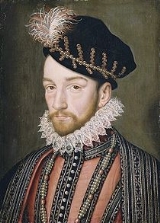
Charles IX of France

Encyclopedia
Charles IX was King of France, ruling from 1560 until his death. His reign was dominated by the Wars of Religion
. He is best known as king at the time of the St. Bartholomew's Day Massacre
.
and Catherine de' Medici
in the royal chateau of Saint-Germain-en-Laye
. He was immediately made Duke of Orléans upon his birth, succeeding his older brother Louis, his father's second son who had died in infancy the year before.
He visited England and on 14 May was made a Knight of the Order of the Garter
at St. George's Chapel, Windsor Castle
, along with Francis Russell, 2nd Earl of Bedford
and Sir Henry Sidney.
(1544–1560). The ten-year-old Charles was immediately proclaimed King and, on 15 May 1561, consecrated as King of France in the cathedral at Reims
. Government was dominated by his mother, Catherine de' Medici
, who at first acted as regent for her young son. Antoine of Bourbon
, himself in line to the French throne and husband to Queen Joan III of Navarre, was appointed Lieutenant-General of France.
 Charles' reign was dominated by the Wars of Religion
, which pitted various factions against each other. The Huguenots, the French adherents of Calvinism
, had a considerable following among the nobility, while their enemies, later organised into the Catholic League were led by the House of Guise
, a cadet branch of the House of Lorraine
. Queen Catherine, though nominally a Catholic, tried to steer a middle course between the two factions, attempting to keep (or restore) the peace and augment royal power.
The factions had engaged in violence even before Charles' accession: a group of Huguenot nobles at Amboise
had tried to abduct King Francis II and arrest the Catholic leaders – Francis, Duke of Guise and his brother, the Cardinal of Lorraine
, followed by cases of Protestant iconoclasm
and Catholic reprisals. The regent tried to foster reconciliation at the colloquy at Poissy
and, after that failed, made several concessions to the Huguenots in the Edict of Saint-Germain
in January 1562, but war began when some retainers of the House of Guise – hoping to avenge the attempt of Amboise – attacked and killed or wounded over 100 Huguenot worshipers at Vassy.
Louis of Bourbon, Prince of Conde
, brother to the Lieutenant-General and the suspected architect of the Amboise conspiracy
, had already prepared for war and, taking Vassy as the occasion, assumed the role of a protector of Protestantism and began to seize and garrison strategic towns along the Loire Valley
. In return, the monarchy revoked the concessions given to the Huguenots. After the military leaders of both sides were either killed or captured in the battles at Rouen, Dreux and Orléans, the regent mediated a truce and issued the Edict of Amboise
(1563).
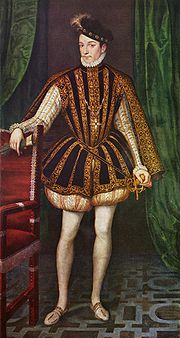
The war was followed by four years of an uneasy "armed peace", during which Catherine tried to unite the factions in the successful effort to recapture Le Havre
from the English. After this victory, Charles declared his legal majority in August 1563, formally ending the regency. However, Catherine would continue to play a principal role in politics and often dominate her son. In March of 1564, the King and his mother set out from Fontainebleau
on a tour of the war-torn kingdom
. Their tour spanned two years and brought them through Bar, Lyon
, Salon – where they visited Nostradamus
, Carcassonne
, Toulouse
– where the King and his younger brother Henry were confirmed —, Bayonne
, La Rochelle
and Moulins
. During this trip, Charles IX issued the Edict of Roussillon
, which standardised 1 January as the first day of the year throughout France.
, seized various cities and massacred Catholics at Nîmes
. After the Battle of Saint-Denis
saw both a Huguenot defeat and the death of the royal commander-in-chief
, the short war ended in 1568 with another truce
.
However, the significant privileges granted to Protestants were widely opposed, leading to their cancellation and the resumption of war, in which the Dutch Republic
, England and Navarre intervened on the Protestant side, while Spain, Tuscany and Pope Pius V
supporting the Catholics. Finally, the royal debt and the King's desire to seek a peaceful solution in August 1570 led to yet another truce
, which again gave concessions to the Huguenots.
, with whom he fathered one daughter, Marie Elisabeth of Valois
(1572–1578). In 1573, Charles fathered an illegitimate son, Charles, Duke of Angoulême
, with his mistress, Marie Touchet
.
, who during the war had succeeded the slain Prince of Condé
as leader of Huguenots. The Queen Mother, however, became increasingly fearful of Coligny's unchecked power, especially since the Admiral was pursuing an alliance with England and the Dutch. Coligny was also hated by Henry, Duke of Guise
, who accused the Admiral of having ordered the assassination of his father during the siege of Orléans in 1562.
During the peace settlement, a marriage had been arranged between Charles' sister Margaret (1553–1615) and Henry de Bourbon
, heir to the throne of Navarre, and one of the leading Huguenots. Many Huguenot nobles, including Admiral de Coligny, thronged into Paris for the wedding, which was set for 18 August 1572. On 22 August, a failed attempt on Coligny's life—the originator of which remains unclear—put the city in a state of apprehension, as both visiting Huguenots and Parisian Catholics feared an attack by the other side.
In this situation, in the early morning of 24 August 1572, the Duke of Guise moved to avenge his father and murdered Coligny in his lodgings. As Coligny's body was thrown into the street, Parisians mutilated the body and then erupted into a full-scale massacre of Huguenots
, which was to last five days. Henry of Navarre managed to avoid death by pledging to convert to Catholicism. Over the next few weeks the disorder spread to more cities across France. In total, up to 10,000 Huguenots were killed in Paris and the provinces.
Though the massacres severely weakened Huguenot power, it also reignited war, which ceased after the Edict of Boulogne
in 1573 granted Huguenots amnesty and limited religious freedom. However, 1574 saw a failed Huguenot coup at Saint-Germain and successful Huguenot uprisings in Normandy, Poitou and the Rhône valley, setting the stage for another round of war.
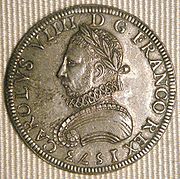 Having witnessed the horrors of a massacre he had neither approved of nor predicted, the King's fragile mental and physical constitution drastically weakened. His moods swung from boasting about the extremity of the massacre to exclamations that the screams of the murdered Huguenots kept ringing in his ears. Frantically, he blamed alternately himself – "What blood shed! What murders! he cried to his nurse. What evil council I have followed! O my God, forgive me... I am lost! I am lost!" – or his mother – "Who but you is the cause of all of this? God's blood, you are the cause of it all!" The Queen-mother responded by declaring she had a lunatic for a son.
His physical condition, tending towards tuberculosis
, deteriorated to the point where, by spring of 1574, the hoarse coughing turned bloody and the hemorrhages grew more violent.
On his last day, 30 May, Charles called for Henry of Navarre
, embraced him, and said, "Brother, you are losing a good friend. Had I believed all that I was told, you would not be alive. But I always loved you... I trust you alone to look after my wife and son. Pray God for me. Farewell."
Charles IX died on 30 May at the Château de Vincennes
, aged twenty-three years. As his younger brother, Henry, Duke of Anjou
had recently been elected King of Poland and was away from France, their mother Catherine resumed the regency until Henry's return from Poland.
and Margaret of Valois. The book depicts Charles as a frail and sickly ruler, who is complicit in the massacres engineered by his mother and dies after reading a book poisoned with arsenic
, which his mother intended for Henry of Navarre.
|-
French Wars of Religion
The French Wars of Religion is the name given to a period of civil infighting and military operations, primarily fought between French Catholics and Protestants . The conflict involved the factional disputes between the aristocratic houses of France, such as the House of Bourbon and House of Guise...
. He is best known as king at the time of the St. Bartholomew's Day Massacre
St. Bartholomew's Day massacre
The St. Bartholomew's Day massacre in 1572 was a targeted group of assassinations, followed by a wave of Roman Catholic mob violence, both directed against the Huguenots , during the French Wars of Religion...
.
Childhood
He was born Charles Maximilian, third son of King Henry II of FranceHenry II of France
Henry II was King of France from 31 March 1547 until his death in 1559.-Early years:Henry was born in the royal Château de Saint-Germain-en-Laye, near Paris, the son of Francis I and Claude, Duchess of Brittany .His father was captured at the Battle of Pavia in 1525 by his sworn enemy,...
and Catherine de' Medici
Catherine de' Medici
Catherine de' Medici was an Italian noblewoman who was Queen consort of France from 1547 until 1559, as the wife of King Henry II of France....
in the royal chateau of Saint-Germain-en-Laye
Château de Saint-Germain-en-Laye
The Château de Saint-Germain-en-Laye is a royal palace in the commune of Saint-Germain-en-Laye, in the département of Yvelines, about 19 km west of Paris, France. Today, it houses the Musée d'Archéologie Nationale ....
. He was immediately made Duke of Orléans upon his birth, succeeding his older brother Louis, his father's second son who had died in infancy the year before.
He visited England and on 14 May was made a Knight of the Order of the Garter
Order of the Garter
The Most Noble Order of the Garter, founded in 1348, is the highest order of chivalry, or knighthood, existing in England. The order is dedicated to the image and arms of St...
at St. George's Chapel, Windsor Castle
St. George's Chapel, Windsor Castle
St George's Chapel is the place of worship at Windsor Castle in England, United Kingdom. It is both a royal peculiar and the chapel of the Order of the Garter...
, along with Francis Russell, 2nd Earl of Bedford
Francis Russell, 2nd Earl of Bedford
Francis Russell, 2nd Earl of Bedford, KG was an English nobleman, soldier and politician and godfather to Sir. Francis Drake.-Early life:...
and Sir Henry Sidney.
Accession to the throne
His father died in 1559, followed in December 1560 by his elder brother, King Francis IIFrancis II of France
Francis II was aged 15 when he succeeded to the throne of France after the accidental death of his father, King Henry II, in 1559. He reigned for 18 months before he died in December 1560...
(1544–1560). The ten-year-old Charles was immediately proclaimed King and, on 15 May 1561, consecrated as King of France in the cathedral at Reims
Reims
Reims , a city in the Champagne-Ardenne region of France, lies east-northeast of Paris. Founded by the Gauls, it became a major city during the period of the Roman Empire....
. Government was dominated by his mother, Catherine de' Medici
Catherine de' Medici
Catherine de' Medici was an Italian noblewoman who was Queen consort of France from 1547 until 1559, as the wife of King Henry II of France....
, who at first acted as regent for her young son. Antoine of Bourbon
Antoine of Navarre
Antoine de Bourbon, Duke of Vendôme was head of the House of Bourbon from 1537 to 1562, and jure uxoris King of Navarre from 1555 to 1562.-Family:...
, himself in line to the French throne and husband to Queen Joan III of Navarre, was appointed Lieutenant-General of France.
First war of religion
French Wars of Religion
The French Wars of Religion is the name given to a period of civil infighting and military operations, primarily fought between French Catholics and Protestants . The conflict involved the factional disputes between the aristocratic houses of France, such as the House of Bourbon and House of Guise...
, which pitted various factions against each other. The Huguenots, the French adherents of Calvinism
Calvinism
Calvinism is a Protestant theological system and an approach to the Christian life...
, had a considerable following among the nobility, while their enemies, later organised into the Catholic League were led by the House of Guise
House of Guise
The House of Guise was a French ducal family, partly responsible for the French Wars of Religion.The Guises were Catholic, and Henry Guise wanted to end growing Calvinist influence...
, a cadet branch of the House of Lorraine
House of Lorraine
The House of Lorraine, the main and now only remaining line known as Habsburg-Lorraine, is one of the most important and was one of the longest-reigning royal houses in the history of Europe...
. Queen Catherine, though nominally a Catholic, tried to steer a middle course between the two factions, attempting to keep (or restore) the peace and augment royal power.
The factions had engaged in violence even before Charles' accession: a group of Huguenot nobles at Amboise
Amboise conspiracy
The Amboise conspiracy, also called Tumult of Amboise, was a failed attempt by Huguenots in 1560 to gain power of France by abducting the young king, Francis II and arresting Francis, Duke of Guise and his brother, the Cardinal of Lorraine...
had tried to abduct King Francis II and arrest the Catholic leaders – Francis, Duke of Guise and his brother, the Cardinal of Lorraine
Charles, Cardinal of Lorraine
Charles de Lorraine , Duke of Chevreuse, was a French Cardinal, a member of the powerful House of Guise. He was known at first as the Cardinal of Guise, and then as the second Cardinal of Lorraine, after the death of his uncle, John, Cardinal of Lorraine . He was the protector of Rabelais and...
, followed by cases of Protestant iconoclasm
Iconoclasm
Iconoclasm is the deliberate destruction of religious icons and other symbols or monuments, usually with religious or political motives. It is a frequent component of major political or religious changes...
and Catholic reprisals. The regent tried to foster reconciliation at the colloquy at Poissy
Colloquy at Poissy
The Colloquy at Poissy was a religious conference which took place in Poissy, France, in 1561. Its object was to effect a reconciliation between the Catholics and Protestants of France....
and, after that failed, made several concessions to the Huguenots in the Edict of Saint-Germain
Edict of Saint-Germain
The Edict of Saint-Germain, also known as the Edict of January, was a decree of tolerance promulgated by the regent, Catherine de' Medici, in January 1562. It provided limited tolerance of Protestantism in her Roman Catholic realms, especially in relation to the French Huguenots.It was among...
in January 1562, but war began when some retainers of the House of Guise – hoping to avenge the attempt of Amboise – attacked and killed or wounded over 100 Huguenot worshipers at Vassy.
Louis of Bourbon, Prince of Conde
Louis I de Bourbon, prince de Condé
Louis de Bourbon was a prominent Huguenot leader and general, the founder of the House of Condé, a cadet branch of the House of Bourbon.-Life:...
, brother to the Lieutenant-General and the suspected architect of the Amboise conspiracy
Amboise conspiracy
The Amboise conspiracy, also called Tumult of Amboise, was a failed attempt by Huguenots in 1560 to gain power of France by abducting the young king, Francis II and arresting Francis, Duke of Guise and his brother, the Cardinal of Lorraine...
, had already prepared for war and, taking Vassy as the occasion, assumed the role of a protector of Protestantism and began to seize and garrison strategic towns along the Loire Valley
Loire Valley
The Loire Valley , spanning , is located in the middle stretch of the Loire River in central France. Its area comprises approximately . It is referred to as the Cradle of the French Language, and the Garden of France due to the abundance of vineyards, fruit orchards, and artichoke, asparagus, and...
. In return, the monarchy revoked the concessions given to the Huguenots. After the military leaders of both sides were either killed or captured in the battles at Rouen, Dreux and Orléans, the regent mediated a truce and issued the Edict of Amboise
Edict of Amboise
The Edict of Amboise was signed at the Château of Amboise on March 19, 1563 by Catherine de' Medici, acting as regent for her son Charles IX of France. The treaty officially ended the first phase of the French Wars of Religion...
(1563).
Armed peace
The war was followed by four years of an uneasy "armed peace", during which Catherine tried to unite the factions in the successful effort to recapture Le Havre
Le Havre
Le Havre is a city in the Seine-Maritime department of the Haute-Normandie region in France. It is situated in north-western France, on the right bank of the mouth of the river Seine on the English Channel. Le Havre is the most populous commune in the Haute-Normandie region, although the total...
from the English. After this victory, Charles declared his legal majority in August 1563, formally ending the regency. However, Catherine would continue to play a principal role in politics and often dominate her son. In March of 1564, the King and his mother set out from Fontainebleau
Fontainebleau
Fontainebleau is a commune in the metropolitan area of Paris, France. It is located south-southeast of the centre of Paris. Fontainebleau is a sub-prefecture of the Seine-et-Marne department, and it is the seat of the arrondissement of Fontainebleau...
on a tour of the war-torn kingdom
Charles IX's grand tour of France
The grand tour of France was a royal progress around France by Charles IX of France, set up his mother Catherine de Medici to show him his kingdom, which had just been ravaged by the first of the French Wars of Religion. It set off from Paris on 24 January 1564 and returned there on 1 May 1566...
. Their tour spanned two years and brought them through Bar, Lyon
Lyon
Lyon , is a city in east-central France in the Rhône-Alpes region, situated between Paris and Marseille. Lyon is located at from Paris, from Marseille, from Geneva, from Turin, and from Barcelona. The residents of the city are called Lyonnais....
, Salon – where they visited Nostradamus
Nostradamus
Michel de Nostredame , usually Latinised to Nostradamus, was a French apothecary and reputed seer who published collections of prophecies that have since become famous worldwide. He is best known for his book Les Propheties , the first edition of which appeared in 1555...
, Carcassonne
Carcassonne
Carcassonne is a fortified French town in the Aude department, of which it is the prefecture, in the former province of Languedoc.It is divided into the fortified Cité de Carcassonne and the more expansive lower city, the ville basse. Carcassone was founded by the Visigoths in the fifth century,...
, Toulouse
Toulouse
Toulouse is a city in the Haute-Garonne department in southwestern FranceIt lies on the banks of the River Garonne, 590 km away from Paris and half-way between the Atlantic Ocean and the Mediterranean Sea...
– where the King and his younger brother Henry were confirmed —, Bayonne
Bayonne
Bayonne is a city and commune in south-western France at the confluence of the Nive and Adour rivers, in the Pyrénées-Atlantiques department, of which it is a sub-prefecture...
, La Rochelle
La Rochelle
La Rochelle is a city in western France and a seaport on the Bay of Biscay, a part of the Atlantic Ocean. It is the capital of the Charente-Maritime department.The city is connected to the Île de Ré by a bridge completed on 19 May 1988...
and Moulins
Moulins, Allier
Moulins is a commune in central France, capital of the Allier department.Among its many tourist attractions are the Maison Mantin the Anne de Beaujeu Museum.-History:...
. During this trip, Charles IX issued the Edict of Roussillon
Edict of Roussillon
The Edict of Roussillon was a 1564 edict decreeing that the year would begin on January 1 in France.During a trip to various parts of his kingdom, the King of France, Charles IX, found that depending on the diocese, the year began either at Christmas or on 25 March , on 1 March, or at Easter.In...
, which standardised 1 January as the first day of the year throughout France.
Second and third war of religion
War again broke out in 1567 after reports of iconoclasm in Flanders prompted Charles to support Catholics there. Huguenots, fearing a Catholic attack was imminent, tried to abduct the King at MeauxSurprise of Meaux
The surprise of Meaux was a conspiracy organised in 1567 by Louis I de Bourbon, prince de Condé to capture Charles IX and the rest of the French royal family...
, seized various cities and massacred Catholics at Nîmes
Michelade
The Michelade is the name given to the massacre of Catholics, including 24 Catholic priests and monks, by Protestant rioters in Nîmes on Michaelmas 1567, following their failure to abduct the king and queen mother in the so-called, Surprise of Meaux the previous day and in retaliation for the...
. After the Battle of Saint-Denis
Battle of Saint-Denis (1567)
The Battle of Saint-Denis was fought on November 10, 1567 between Catholics and Protestants during the French Wars of Religion in Saint-Denis near Paris, France.Anne de Montmorency with 16,000 Royalists fell on Condé's 3,500 Huguenots...
saw both a Huguenot defeat and the death of the royal commander-in-chief
Anne de Montmorency
Anne de Montmorency, duc de Montmorency, Honorary Knight of the Garter was a French soldier, statesman and diplomat. He became Marshal of France and Constable of France.-Early life:...
, the short war ended in 1568 with another truce
Peace of Longjumeau
The Peace of Longjumeau was signed on March 23, 1568 by Charles IX of France and Catherine de' Medici. This accord officially ended the second phase of the French Wars of Religion. Overall, the treaty confirmed the Edict of Amboise, which granted significant religious privileges and freedoms to...
.
However, the significant privileges granted to Protestants were widely opposed, leading to their cancellation and the resumption of war, in which the Dutch Republic
Dutch Republic
The Dutch Republic — officially known as the Republic of the Seven United Netherlands , the Republic of the United Netherlands, or the Republic of the Seven United Provinces — was a republic in Europe existing from 1581 to 1795, preceding the Batavian Republic and ultimately...
, England and Navarre intervened on the Protestant side, while Spain, Tuscany and Pope Pius V
Pope Pius V
Pope Saint Pius V , born Antonio Ghislieri , was Pope from 1566 to 1572 and is a saint of the Catholic Church. He is chiefly notable for his role in the Council of Trent, the Counter-Reformation, and the standardization of the Roman liturgy within the Latin Church...
supporting the Catholics. Finally, the royal debt and the King's desire to seek a peaceful solution in August 1570 led to yet another truce
Peace of Saint-Germain-en-Laye
The Peace of Saint-Germain-en-Laye was a treaty signed August 5, 1570 at the royal Château of Saint-Germain-en-Laye, ending the third of the French Wars of Religion....
, which again gave concessions to the Huguenots.
Marriage and children
On 26 November 1570 Charles married Elisabeth of AustriaElisabeth of Austria (1554-1592)
Elisabeth of Austria was a German princess member of the House of Habsburg, by birth Archduchess of Austria and by marriage Queen of France.She was the daughter of Holy Roman Emperor Maximilian II and Maria of Spain....
, with whom he fathered one daughter, Marie Elisabeth of Valois
Marie Elisabeth of Valois
Marie Elisabeth of Valois was the only child of Charles IX of France and Elisabeth of Austria. Her maternal grandparents were Maximilian II, Holy Roman Emperor and Maria of Spain, her paternal grandparents were Henry II of France and Catherine de' Medici. Her father had times of madness, so her...
(1572–1578). In 1573, Charles fathered an illegitimate son, Charles, Duke of Angoulême
Charles de Valois, Duke of Angoulême
Charles de Valois was the Duke of Angoulême and the illegitimate son of Charles IX of France and Marie Touchet; born at the Château de Fayet in Dauphiné. His father, dying in the following year, commended him to the care and favour of his younger brother and successor, Henry III, who faithfully...
, with his mistress, Marie Touchet
Marie Touchet
Marie Touchet , Dame de Belleville, was the only mistress of Charles IX of France.-Humble origins, mistress to the king:...
.
Coligny's ascendancy and the massacre
After the Peace of Saint-Germain in 1570, the King increasingly came under the influence of Admiral Gaspard de ColignyGaspard de Coligny
Gaspard de Coligny , Seigneur de Châtillon, was a French nobleman and admiral, best remembered as a disciplined Huguenot leader in the French Wars of Religion.-Ancestry:...
, who during the war had succeeded the slain Prince of Condé
Battle of Jarnac
The Battle of Jarnac on 13 March 1569 was an encounter during the French Wars of Religion between the Catholic forces of Marshal Gaspard de Saulx, sieur de Tavannes, and the Huguenots, near the nadir of their fortunes, financed by Reinhold von Krockow and led by Louis I de Bourbon, prince de...
as leader of Huguenots. The Queen Mother, however, became increasingly fearful of Coligny's unchecked power, especially since the Admiral was pursuing an alliance with England and the Dutch. Coligny was also hated by Henry, Duke of Guise
Henry I, Duke of Guise
Henry I, Prince of Joinville, Duke of Guise, Count of Eu , sometimes called Le Balafré, "the scarred", was the eldest son of Francis, Duke of Guise, and Anna d'Este...
, who accused the Admiral of having ordered the assassination of his father during the siege of Orléans in 1562.
During the peace settlement, a marriage had been arranged between Charles' sister Margaret (1553–1615) and Henry de Bourbon
Henry IV of France
Henry IV , Henri-Quatre, was King of France from 1589 to 1610 and King of Navarre from 1572 to 1610. He was the first monarch of the Bourbon branch of the Capetian dynasty in France....
, heir to the throne of Navarre, and one of the leading Huguenots. Many Huguenot nobles, including Admiral de Coligny, thronged into Paris for the wedding, which was set for 18 August 1572. On 22 August, a failed attempt on Coligny's life—the originator of which remains unclear—put the city in a state of apprehension, as both visiting Huguenots and Parisian Catholics feared an attack by the other side.
In this situation, in the early morning of 24 August 1572, the Duke of Guise moved to avenge his father and murdered Coligny in his lodgings. As Coligny's body was thrown into the street, Parisians mutilated the body and then erupted into a full-scale massacre of Huguenots
St. Bartholomew's Day massacre
The St. Bartholomew's Day massacre in 1572 was a targeted group of assassinations, followed by a wave of Roman Catholic mob violence, both directed against the Huguenots , during the French Wars of Religion...
, which was to last five days. Henry of Navarre managed to avoid death by pledging to convert to Catholicism. Over the next few weeks the disorder spread to more cities across France. In total, up to 10,000 Huguenots were killed in Paris and the provinces.
Though the massacres severely weakened Huguenot power, it also reignited war, which ceased after the Edict of Boulogne
Edict of Boulogne
The Edict of Boulogne, also called the Edict of Pacification of Boulogne and the Peace of La Rochelle, was signed in July, 1573 by King Charles IX of France in the Château de Madrid in the Bois de Boulogne. It was officially registered by the Parlement of Paris on 11 August 1573. The treaty...
in 1573 granted Huguenots amnesty and limited religious freedom. However, 1574 saw a failed Huguenot coup at Saint-Germain and successful Huguenot uprisings in Normandy, Poitou and the Rhône valley, setting the stage for another round of war.
Decline and death
His physical condition, tending towards tuberculosis
Tuberculosis
Tuberculosis, MTB, or TB is a common, and in many cases lethal, infectious disease caused by various strains of mycobacteria, usually Mycobacterium tuberculosis. Tuberculosis usually attacks the lungs but can also affect other parts of the body...
, deteriorated to the point where, by spring of 1574, the hoarse coughing turned bloody and the hemorrhages grew more violent.
On his last day, 30 May, Charles called for Henry of Navarre
Henry IV of France
Henry IV , Henri-Quatre, was King of France from 1589 to 1610 and King of Navarre from 1572 to 1610. He was the first monarch of the Bourbon branch of the Capetian dynasty in France....
, embraced him, and said, "Brother, you are losing a good friend. Had I believed all that I was told, you would not be alive. But I always loved you... I trust you alone to look after my wife and son. Pray God for me. Farewell."
Charles IX died on 30 May at the Château de Vincennes
Château de Vincennes
The Château de Vincennes is a massive 14th and 17th century French royal castle in the town of Vincennes, to the east of Paris, now a suburb of the metropolis.-History:...
, aged twenty-three years. As his younger brother, Henry, Duke of Anjou
Henry III of France
Henry III was King of France from 1574 to 1589. As Henry of Valois, he was the first elected monarch of the Polish-Lithuanian Commonwealth with the dual titles of King of Poland and Grand Duke of Lithuania from 1573 to 1575.-Childhood:Henry was born at the Royal Château de Fontainebleau,...
had recently been elected King of Poland and was away from France, their mother Catherine resumed the regency until Henry's return from Poland.
Book on hunting
Charles had an interest in hunting, and he wrote a book on the subject, La Chasse Royale, which was published long after his death, in 1625. It is a valuable source for those interested in the history of hounds and hunting.In fiction
Charles IX is a supporting character in Alexandre Dumas' historical novel Queen Margot, which focuses on the marriage between Henry of NavarreHenry IV of France
Henry IV , Henri-Quatre, was King of France from 1589 to 1610 and King of Navarre from 1572 to 1610. He was the first monarch of the Bourbon branch of the Capetian dynasty in France....
and Margaret of Valois. The book depicts Charles as a frail and sickly ruler, who is complicit in the massacres engineered by his mother and dies after reading a book poisoned with arsenic
Arsenic
Arsenic is a chemical element with the symbol As, atomic number 33 and relative atomic mass 74.92. Arsenic occurs in many minerals, usually in conjunction with sulfur and metals, and also as a pure elemental crystal. It was first documented by Albertus Magnus in 1250.Arsenic is a metalloid...
, which his mother intended for Henry of Navarre.
Ancestors
Titles
|-|-