
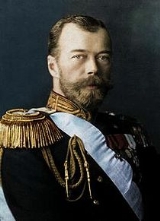
Nicholas II ( – 17 July 1918) was the last
Emperor of
RussiaThe Russian Empire was a state that existed from 1721 until the Russian Revolution of 1917. It was the successor to the Tsardom of Russia and the predecessor of the Soviet Union...
, Grand Prince of Finland, and titular King of Poland. His official short title was
Nicholas II, Emperor and Autocrat of All the Russias and he is known as
Saint Nicholas the Passion-Bearer by the
Russian Orthodox ChurchThe Russian Orthodox Church or, alternatively, the Moscow Patriarchate The ROC is often said to be the largest of the Eastern Orthodox churches in the world; including all the autocephalous churches under its umbrella, its adherents number over 150 million worldwide—about half of the 300 million...
.
Nicholas II ruled from 1894 until his
abdicationAbdication occurs when a monarch, such as a king or emperor, renounces his office.-Terminology:The word abdication comes derives from the Latin abdicatio. meaning to disown or renounce...
on 15 March 1917. His reign saw Imperial Russia go from being one of the foremost great powers of the world to economic and military collapse. Critics nicknamed him
Bloody Nicholas because of the
Khodynka TragedyThe Khodynka Tragedy was a mass panic that occurred on , on Khodynka Field in Moscow during the festivities following the coronation of the last Russian emperor Nicholas II, which resulted in the deaths of 1,389 people.- The events :...
,
Bloody SundayBloody Sunday was a massacre on in St. Petersburg, Russia, where unarmed, peaceful demonstrators marching to present a petition to Tsar Nicholas II were gunned down by the Imperial Guard while approaching the city center and the Winter Palace from several gathering points. The shooting did not...
, the anti-Semitic pogroms, his execution of political opponents, and his pursuit of military campaigns on a hitherto unprecedented scale. Under his rule, Russia was defeated in the
Russo-Japanese WarThe Russo-Japanese War was "the first great war of the 20th century." It grew out of rival imperial ambitions of the Russian Empire and Japanese Empire over Manchuria and Korea...
, including the almost total annihilation of the Russian fleet at the
Battle of TsushimaThe Battle of Tsushima , commonly known as the “Sea of Japan Naval Battle” in Japan and the “Battle of Tsushima Strait”, was the major naval battle fought between Russia and Japan during the Russo-Japanese War...
. As head of state, he approved the Russian mobilization of August 1914, which marked the beginning of Russia's involvement in
World War IWorld War I , which was predominantly called the World War or the Great War from its occurrence until 1939, and the First World War or World War I thereafter, was a major war centred in Europe that began on 28 July 1914 and lasted until 11 November 1918...
, a war in which 3.3 million Russians would be killed. The unpopularity of the Russian involvement in this war is often cited as a leading cause of the fall of the
RomanovThe House of Romanov was the second and last imperial dynasty to rule over Russia, reigning from 1613 until the February Revolution abolished the crown in 1917...
dynasty less than three years later.
Nicholas II abdicated following the
February RevolutionThe February Revolution of 1917 was the first of two revolutions in Russia in 1917. Centered around the then capital Petrograd in March . Its immediate result was the abdication of Tsar Nicholas II, the end of the Romanov dynasty, and the end of the Russian Empire...
of 1917 during which he and his family were imprisoned first in the
Alexander PalaceThe Alexander Palace is a former imperial residence at Tsarskoye Selo, on a plateau around 30 minutes by train from St Petersburg. It is known as the favourite residence of the last Russian Emperor, Nicholas II, and his family and their initial place of imprisonment after the revolution that...
at
Tsarskoye SeloTsarskoye Selo is the town containing a former Russian residence of the imperial family and visiting nobility, located south from the center of St. Petersburg. It is now part of the town of Pushkin and of the World Heritage Site Saint Petersburg and Related Groups of Monuments.-History:In...
, then later in the
Governor's MansionThe Governor's Mansion , also known as Kuklin House is a building in Tobolsk, Russia. It was the home of the governor of Siberia prior to the February Revolution of 1917...
in
TobolskTobolsk is a town in Tyumen Oblast, Russia, located at the confluence of the Tobol and Irtysh Rivers. It is a historic capital of Siberia. Population: -History:...
, and finally at the
Ipatiev HouseIpatiev House was a merchant's house in Yekaterinburg where the former Emperor Nicholas II of Russia, his family and members of his household were executed following the Bolshevik Revolution...
in
YekaterinburgYekaterinburg is a major city in the central part of Russia, the administrative center of Sverdlovsk Oblast. Situated on the eastern side of the Ural mountain range, it is the main industrial and cultural center of the Urals Federal District with a population of 1,350,136 , making it Russia's...
. Nicholas II, his wife, his son, his four daughters, the family's medical doctor, the Tsar's valet, the Empress'
lady-in-waitingA lady-in-waiting is a female personal assistant at a royal court, attending on a queen, a princess, or a high-ranking noblewoman. Historically, in Europe a lady-in-waiting was often a noblewoman from a family highly thought of in good society, but was of lower rank than the woman on whom she...
, and the family's cook were
killedThe shooting of the Romanov family, of the Russian Imperial House of Romanov, and those who chose to accompany them into exile, Dr. Eugene Botkin, Anna Demidova, Alexei Trupp, and Ivan Kharitonov, took place in Yekaterinburg on July 17, 1918 on the orders of Vladimir Lenin, Yakov Sverdlov, and the...
in the same room by the
BolshevikThe Bolsheviks, originally also Bolshevists , derived from bol'shinstvo, "majority") were a faction of the Marxist Russian Social Democratic Labour Party which split apart from the Menshevik faction at the Second Party Congress in 1903....
s on the night of 16/17 July 1918. This led to the
canonizationCanonization is the act by which a Christian church declares a deceased person to be a saint, upon which declaration the person is included in the canon, or list, of recognized saints. Originally, individuals were recognized as saints without any formal process...
of Nicholas II, his wife the Empress Alexandra and their children as martyrs by various groups tied to the
Russian Orthodox ChurchThe Russian Orthodox Church or, alternatively, the Moscow Patriarchate The ROC is often said to be the largest of the Eastern Orthodox churches in the world; including all the autocephalous churches under its umbrella, its adherents number over 150 million worldwide—about half of the 300 million...
within Russia and, prominently, outside Russia.
Family background
Nicholas was the son of
Emperor Alexander IIIAlexander Alexandrovich Romanov , historically remembered as Alexander III or Alexander the Peacemaker reigned as Emperor of Russia from until his death on .-Disposition:...
and Empress Maria Feodorovna of Russia (formerly "Princess Dagmar of
DenmarkDenmark is a Scandinavian country in Northern Europe. The countries of Denmark and Greenland, as well as the Faroe Islands, constitute the Kingdom of Denmark . It is the southernmost of the Nordic countries, southwest of Sweden and south of Norway, and bordered to the south by Germany. Denmark...
"). His paternal grandparents were
Emperor Alexander IIAlexander II , also known as Alexander the Liberator was the Emperor of the Russian Empire from 3 March 1855 until his assassination in 1881...
and Empress Maria Alexandrovna of Russia, (born "Princess Marie of Hesse"). His maternal grandparents were King
Christian IX of DenmarkChristian IX was King of Denmark from 16 November 1863 to 29 January 1906.Growing up as a prince of Schleswig-Holstein-Sonderburg-Glücksburg, a junior branch of the House of Oldenburg which had ruled Denmark since 1448, Christian was originally not in the immediate line of succession to the Danish...
and Princess Louise of Hesse-Kassel. Nicholas was of
RussianThe Russian people are an East Slavic ethnic group native to Russia, speaking the Russian language and primarily living in Russia and neighboring countries....
,
DanishDanish people or Danes are the nation and ethnic group that is native to Denmark, and who speak Danish.The first mention of Danes within the Danish territory is on the Jelling Rune Stone which mentions how Harald Bluetooth converted the Danes to Christianity in the 10th century...
, and
GermanThe Germans are a Germanic ethnic group native to Central Europe. The English term Germans has referred to the German-speaking population of the Holy Roman Empire since the Late Middle Ages....
descent.
Nicholas often referred to his father nostalgically in letters after Alexander's death in 1894. However, as a child, he was jealous of his father's physical strength, demonstrated when his father lifted a 27 kilo stone with one hand. He was also very close to his mother, as it is revealed in their published letters to each other. Nicholas had three younger brothers (
AlexanderGrand Duke Alexander Alexandrovich of Russia was the infant son of Alexander III and Empress Marie of Russia. At the time of his birth, his father, as the eldest son of Tsar Alexander II, was titled as the Tsarevich of Russia...
[1869–1870],
GeorgeGrand Duke George Alexandrovich of Russia, , was the third son of Alexander III and Empress Marie of Russia. He was named George after his mother's younger brother, King George I of Greece...
[1871–1899] and
MichaelGrand Duke Michael Alexandrovich of Russia was the youngest son of Emperor Alexander III of Russia.At the time of his birth, his paternal grandfather was still the reigning Emperor of All the Russias. Michael was fourth-in-line to the throne following his father and elder brothers Nicholas and...
[1878–1918]) and two younger sisters (
XeniaGrand Duchess Xenia Alexandrovna of Russia was a daughter of Tsar Alexander III of Russia and the elder of Tsar Nicholas II two sisters. She married her cousin Grand Duke Alexander Mikailovich of Russia, with whom she had seven children....
[1875-1960] and
OlgaGrand Duchess Olga Alexandrovna of Russia was the youngest child of Emperor Alexander III of Russia. Her older brother was Tsar Nicholas II....
[1882-1960]).
Maternally, Nicholas was the nephew of several monarchs, including
George I of GreeceGeorge I was King of Greece from 1863 to 1913. Originally a Danish prince, George was only 17 years old when he was elected king by the Greek National Assembly, which had deposed the former king Otto. His nomination was both suggested and supported by the Great Powers...
;
Frederick VIII of DenmarkFrederick VIII was King of Denmark from 1906 to 1912.-Early life:Frederick was born on 3 June 1843 in the Yellow Palace in Copenhagen as Prince Frederick of Schleswig-Holstein-Sonderburg-Glücksburg, a junior male line of the House of Oldenburg descended from Christian III of Denmark and who had...
;
Alexandra, Queen consortAlexandra of Denmark was the wife of Edward VII of the United Kingdom...
of the
United KingdomThe United Kingdom of Great Britain and Northern IrelandIn the United Kingdom and Dependencies, other languages have been officially recognised as legitimate autochthonous languages under the European Charter for Regional or Minority Languages...
; and
the Crown Princess of HanoverPrincess Thyra of Denmark was the youngest daughter of Christian IX of Denmark and Louise of Hesse-Kassel.-Early life:Thyra was the sister of Frederik VIII of Denmark, Queen Alexandra of the United Kingdom, George I of Greece and...
.
Nicholas, his wife Alexandra, and Kaiser Wilhelm II of
GermanyGermany , officially the Federal Republic of Germany , is a federal parliamentary republic in Europe. The country consists of 16 states while the capital and largest city is Berlin. Germany covers an area of 357,021 km2 and has a largely temperate seasonal climate...
were all first cousins of King
George V of the United KingdomGeorge V was King of the United Kingdom and the British Dominions, and Emperor of India, from 6 May 1910 through the First World War until his death in 1936....
.
Nicholas' mother was the sister of British Queen Alexandra, the mother of George V. The Empress Alexandra was the daughter of
Princess AliceThe Princess Alice was a member of the British royal family, the third child and second daughter of Queen Victoria and Prince Albert of Saxe-Coburg and Gotha.Alice's education was devised by Albert's close friend and adviser, Baron Stockmar...
, herself a daughter of Queen Victoria, thus making Edward VII her uncle, and cousin to the Emperor Wilhelm, on her mother's side; and equally a direct descendant of Queen Victoria. The Emperor Wilhelm was a son of Queen Victoria's eldest daughter, also named Victoria, who married Crown Prince Frederick of Germany. Nicholas and Wilhelm were not each other's first cousin, but they were second cousins, once removed, as each descended from Frederick William III, King of Prussia, as well as third cousins, as they were both great-great-grandsons of
Tsar Paul I of RussiaPaul I was the Emperor of Russia between 1796 and 1801. He also was the 72nd Prince and Grand Master of the Order of Malta .-Childhood:...
.
Tsarevich
On 13 March 1881, following the assassination of his grandfather, Tsar Alexander II, Nicholas became Tsarevich and his father became Tsar Alexander III. Nicholas and other family members witnessed Alexander II's death because they were staying at the
Winter PalaceThe Winter Palace in Saint Petersburg, Russia, was, from 1732 to 1917, the official residence of the Russian monarchs. Situated between the Palace Embankment and the Palace Square, adjacent to the site of Peter the Great's original Winter Palace, the present and fourth Winter Palace was built and...
in
Saint PetersburgSaint Petersburg is a city and a federal subject of Russia located on the Neva River at the head of the Gulf of Finland on the Baltic Sea...
where he was brought after being attacked. For security reasons, the new Tsar and his family relocated their primary residence to the
Gatchina PalaceThe Great Gatchina Palace was built in 1766–1781 in Gatchina town by Antonio Rinaldi for Count Grigori Grigoryevich Orlov who was a favourite of Ekaterina II. The Gatchina Palace is located on the hill above Lake Serebryannoe. It combines themes of a medieval castle and a country residence....
outside the city.
A long trip for educational purposes became an important part of training for the members of the Russian imperial house. In 1890, Tsar Alexander III decided to establish the
Trans-Siberian RailwayThe Trans-Siberian Railway is a network of railways connecting Moscow with the Russian Far East and the Sea of Japan. It is the longest railway in the world...
. His heir, Tsarevich Nicholas, took part in the opening ceremony, and from there he was obliged to make a journey around the world, which became known as the
Eastern JourneyThe eastern journey of Nicholas II in 1890–1891 was a trip of His Imperial Highness Tsarevich Nicholas Alexandrovich, the future Tsar Nicholas II, around the greater part of the continent of Eurasia....
where he survived an assassination attempt at Otsu in
JapanJapan is an island nation in East Asia. Located in the Pacific Ocean, it lies to the east of the Sea of Japan, China, North Korea, South Korea and Russia, stretching from the Sea of Okhotsk in the north to the East China Sea and Taiwan in the south...
. Although Nicholas attended meetings of the
Imperial CouncilThe State Council was the supreme state advisory body to the Tsar in Imperial Russia.-18th century:Early Tsars' Councils were small and dealt primarily with the external politics....
, his obligations were limited until he acceded to the throne, which was not expected for many years, since his father was only 45.
While he was Tsarevich, Nicholas had an affair with the ballet dancer
Mathilde KschessinskaMathilda-Marie Feliksovna Kschessinskaya She was known in the West as Mathilde Kschessinska or Matilda Kshesinskaya.- Life :Kschessinska was born at Ligovo, near Peterhof. Like all her Polish family, to whom she was known as Matylda Krzesińska, Mathilde performed at the Imperial Mariinsky Theatre...
. Against his parents' initial wishes, Nicholas was determined to marry Princess Alix of Hesse-Darmstadt, the fourth daughter of
Louis IV, Grand Duke of HesseLouis IV , was the fourth Grand Duke of Hesse and by Rhine, reigning from 13 June 1877 until his death...
and
Princess Alice of the United KingdomThe Princess Alice was a member of the British royal family, the third child and second daughter of Queen Victoria and Prince Albert of Saxe-Coburg and Gotha.Alice's education was devised by Albert's close friend and adviser, Baron Stockmar...
, second eldest daughter of Queen Victoria and Prince Albert. His parents intended a more politically beneficial arrangement with Princess Hélène of Orléans, daughter of Prince Philippe, Count of Paris and his wife
Princess Marie Isabelle of OrléansMarie Isabelle of Orléans was born an infanta of Spain and Princess of Orléans and was a Princess of Orléans and Countess of Paris by marriage.-Biography:She was born in Seville to Antoine d'Orléans and Infanta...
whose sister was Queen Amélie of Portugal, pretender to the French throne, hoping to cement
Russia's new alliance with FranceThe Franco-Russian Alliance was a military alliance between the French Third Republic and the Russian Empire that ran from 1892 to 1917. The alliance ended the diplomatic isolation of France and undermined the supremacy of the German Empire in Europe...
, but eventually yielded to their son's wishes.
Engagement, accession and marriage
Nicholas became engaged to Alix of Hesse in April 1894. Alix was hesitant to accept the engagement due to the requirement that she convert from
LutheranismLutheranism is a major branch of Western Christianity that identifies with the theology of Martin Luther, a German reformer. Luther's efforts to reform the theology and practice of the church launched the Protestant Reformation...
to Russian Orthodoxy and renounce her former faith. An exception was made for Alix where she could convert without renouncing her Lutheran faith. Nicholas and Alix became formally engaged on 8 April 1894. Alix converted to Orthodoxy in November 1894 and took the name Alexandra Fedorovna, in an attempt to be more acceptable to the Russian people.
Nicholas took the throne on 1 November 1894 at the age of 26 following Alexander III's unexpected death. Throughout 1894, Alexander's health rapidly declined and at 49, he died of kidney disease.
Nicholas did not have as much political training or imperial experience as might have been desired of a newly crowned Tsar. Nicholas may have felt unprepared for the duties of the crown, asking his cousin Alexander, "What is going to happen to me and all of Russia?" Finance Minister
Sergei WitteCount Sergei Yulyevich Witte , also known as Sergius Witte, was a highly influential policy-maker who presided over extensive industrialization within the Russian Empire. He served under the last two emperors of Russia...
, however, recognized the need to train Nicholas early, suggesting to Alexander that Nicholas act as chairman of the Siberian Railway Committee. Alexander argued that Nicholas was not mature enough to take on serious responsibilities, to which Witte replied that if he was not introduced to state affairs Nicholas would never be ready to understand them. Nicholas also acted as chairman of the Special Committee on Famine Relief, established after the devastating famines and droughts of 1891–1892, and he served on the Finance Committee and State Military Council before his coronation. Perhaps underprepared and unskilled, Nicholas was not altogether untrained for his duties as Tsar. Throughout his reign, Nicholas chose to maintain the conservative policies favored by his father. While Alexander had concentrated on the formulation of general policy, Nicholas devoted much more attention to the details of administration.
Nicholas and Alix's wedding was originally scheduled for the spring of 1895, but it was moved forward at Nicholas' insistence. Staggering under the weight of his new office, he had no intention of allowing the one person who gave him confidence to leave his side. The wedding took place on 26 November 1894. Alexandra wore the traditional dress of Romanov brides, and Nicholas a
hussarHussar refers to a number of types of light cavalry which originated in Hungary in the 14th century, tracing its roots from Serbian medieval cavalry tradition, brought to Hungary in the course of the Serb migrations, which began in the late 14th century....
's uniform. Nicholas and Alexandra, each holding a lighted candle, faced the palace priest; a few minutes before one in the afternoon, they were married.
Reign
Despite a visit to
Great BritainThe United Kingdom of Great Britain and Northern IrelandIn the United Kingdom and Dependencies, other languages have been officially recognised as legitimate autochthonous languages under the European Charter for Regional or Minority Languages...
before his accession, where he observed the House of Commons in debate and seemed impressed by the machinery of
democracyDemocracy is generally defined as a form of government in which all adult citizens have an equal say in the decisions that affect their lives. Ideally, this includes equal participation in the proposal, development and passage of legislation into law...
, Nicholas turned his back on any notion of giving away any power to elected representatives in
RussiaRussia or , officially known as both Russia and the Russian Federation , is a country in northern Eurasia. It is a federal semi-presidential republic, comprising 83 federal subjects...
. Shortly after he came to the
throneA throne is the official chair or seat upon which a monarch is seated on state or ceremonial occasions. "Throne" in an abstract sense can also refer to the monarchy or the Crown itself, an instance of metonymy, and is also used in many expressions such as "the power behind the...
, a deputation of peasants and workers from various towns' local assemblies (zemstvos) came to the
Winter PalaceThe Winter Palace in Saint Petersburg, Russia, was, from 1732 to 1917, the official residence of the Russian monarchs. Situated between the Palace Embankment and the Palace Square, adjacent to the site of Peter the Great's original Winter Palace, the present and fourth Winter Palace was built and...
proposing court reforms, such as the adoption of a constitutional monarchy, and reform that would improve the political and social life of the peasantry. Although the addresses they had sent in beforehand were couched in mild and loyal terms, Nicholas was angry and ignored advice from an Imperial Family Council by saying to them: "... it has come to my knowledge that during the last months there have been heard in some assemblies of the zemstvos the voices of those who have indulged in a senseless dream that the zemstvos be called upon to participate in the government of the country. I want everyone to know that I will devote all my strength to maintain, for the good of the whole nation, the principle of absolute
autocracyAn autocracy is a form of government in which one person is the supreme power within the state. It is derived from the Greek : and , and may be translated as "one who rules by himself". It is distinct from oligarchy and democracy...
, as firmly and as strongly as did my late lamented father."
On 14 May 1896, Nicholas' formal
coronationA coronation is a ceremony marking the formal investiture of a monarch and/or their consort with regal power, usually involving the placement of a crown upon their head and the presentation of other items of regalia...
as Tsar was held in Uspensky Cathedral located within the
KremlinA kremlin , same root as in kremen is a major fortified central complex found in historic Russian cities. This word is often used to refer to the best-known one, the Moscow Kremlin, or metonymically to the government that is based there...
. In celebration on 18 May 1896, a large festival with food, free beer and souvenirs was held in Khodynka Field outside Moscow. Khodynka was chosen as the location as it was believed to be the sacred centre of the
Russian EmpireThe Russian Empire was a state that existed from 1721 until the Russian Revolution of 1917. It was the successor to the Tsardom of Russia and the predecessor of the Soviet Union...
and would therefore demonstrate Nicholas' legitimacy as Tsar and ties to the old autocracy. Khodynka was also used as a military training ground and the field was uneven with trenches. When food and drink were handed out, the crowd rushed to get their share and individuals were tripped and trampled. Of the approximate 100,000 in attendance, it is estimated that 1,389 individuals died and roughly 1,300 were injured. The
Khodynka TragedyThe Khodynka Tragedy was a mass panic that occurred on , on Khodynka Field in Moscow during the festivities following the coronation of the last Russian emperor Nicholas II, which resulted in the deaths of 1,389 people.- The events :...
was seen as a bad omen and in addition to his conservative policies, Nicholas found gaining popular trust difficult from the beginning of his reign.
The first years of his reign saw little more than continuation and development of the policy pursued by
Alexander IIIAlexander Alexandrovich Romanov , historically remembered as Alexander III or Alexander the Peacemaker reigned as Emperor of Russia from until his death on .-Disposition:...
. Nicholas allotted money for the
All-Russia exhibition of 1896The All-Russia industrial and art exhibition 1896 in Nizhny Novgorod was held from May 28 till October 1 , 1896. The 1896 exhibition was the biggest pre-revolution exhibition in Russian Empire and was organized with the money allotted by Nicholas II, Emperor of Russia...
. In 1897 restoration of
gold standardThe gold standard is a monetary system in which the standard economic unit of account is a fixed mass of gold. There are distinct kinds of gold standard...
by
Sergei WitteCount Sergei Yulyevich Witte , also known as Sergius Witte, was a highly influential policy-maker who presided over extensive industrialization within the Russian Empire. He served under the last two emperors of Russia...
, Minister of Finance, completed the series of financial reforms, initiated fifteen years earlier. By 1902, the
Trans-Siberian RailwayThe Trans-Siberian Railway is a network of railways connecting Moscow with the Russian Far East and the Sea of Japan. It is the longest railway in the world...
was nearly completed; this helped the Russians trade in the
Far East MovementFar East Movement is an Asian American electro hop quartet based in Los Angeles. The group formed in 2003 and consists of Kev Nish , Prohgress , J-Splif , and DJ Virman...
but the railway still required huge amounts of work.
In foreign relations, Nicholas followed policies of his father, strengthening the
Franco-Russian AllianceThe Franco-Russian Alliance was a military alliance between the French Third Republic and the Russian Empire that ran from 1892 to 1917. The alliance ended the diplomatic isolation of France and undermined the supremacy of the German Empire in Europe...
and pursuing a policy of general European pacification, which culminated in the famous
Hague peace conferenceThe Hague Conventions were two international treaties negotiated at international peace conferences at The Hague in the Netherlands: The First Hague Conference in 1899 and the Second Hague Conference in 1907...
. This conference, suggested and promoted by Nicholas II, was convened with the view of terminating the
arms raceThe term arms race, in its original usage, describes a competition between two or more parties for the best armed forces. Each party competes to produce larger numbers of weapons, greater armies, or superior military technology in a technological escalation...
, and setting up machinery for the peaceful settlement of international disputes. The results of the conference were less than expected, because of the mutual distrust existing between great powers. Still, the Hague conventions were among the first formal statements of the laws of war.
He was Colonel in Chief of the Royal Scots Greys from 1894 until his death. On becoming Colonel in Chief he presented the Regiment with a white
bearskinA bearskin is a tall fur cap, usually worn as part of a ceremonial military uniform. Traditionally, the bearskin was the headgear of grenadiers, and is still worn by grenadier and guards regiments in various armies.-Origins:...
, now worn by the bass drummer of the Pipes and Drums of the
Royal Scots Dragoon GuardsThe Royal Scots Dragoon Guards is a cavalry regiment of the British Army, and the senior Scottish regiment. It was formed on 2 July 1971 at Holyrood, Edinburgh, by the amalgamation of the 3rd Carabiniers The Royal Scots Dragoon Guards (Carabiniers and Greys) (SCOTS DG) is a cavalry regiment of...
. The Imperial Russian anthem is still played at dinner nights in the Officers' Mess, where there is still a portrait of the Tsar in Scots Greys uniform. Since his killing the Regiment has worn a black backing behind its capbadge to mourn his death.
Russo-Japanese War
A clash between Russia and
JapanJapan is an island nation in East Asia. Located in the Pacific Ocean, it lies to the east of the Sea of Japan, China, North Korea, South Korea and Russia, stretching from the Sea of Okhotsk in the north to the East China Sea and Taiwan in the south...
was almost inevitable by the turn of the 20th century. Russia had expanded in the East, and the growth of its settlement and territorial ambitions, as its southward path to the
BalkansThe Balkans is a geopolitical and cultural region of southeastern Europe...
was frustrated, conflicted with Japan's own territorial ambitions on the
ChineseChinese civilization may refer to:* China for more general discussion of the country.* Chinese culture* Greater China, the transnational community of ethnic Chinese.* History of China* Sinosphere, the area historically affected by Chinese culture...
and
AsiaAsia is the world's largest and most populous continent, located primarily in the eastern and northern hemispheres. It covers 8.7% of the Earth's total surface area and with approximately 3.879 billion people, it hosts 60% of the world's current human population...
n mainland. War began in 1904 with a surprise Japanese attack on the Russian fleet in
Port ArthurThe Battle of Port Arthur was the starting battle of the Russo-Japanese War...
, without formal declaration of war. The Russian Baltic fleet traversed the world to balance power in the East, but after many misadventures on the way, was almost annihilated by the Japanese in the
Battle of the Tsushima StraitThe Battle of Tsushima , commonly known as the “Sea of Japan Naval Battle” in Japan and the “Battle of Tsushima Strait”, was the major naval battle fought between Russia and Japan during the Russo-Japanese War...
. On land the Russian army experienced logistical problems. While commands and supplies came from St. Petersburg, combat took place in east Asian ports with only the Trans-Siberian Railway for transport of supplies as well as troops both ways. The 6000 miles (9,656 km) track between St. Petersburg and Port Arthur was one-way, with no track around
Lake BaikalLake Baikal is the world's oldest at 30 million years old and deepest lake with an average depth of 744.4 metres.Located in the south of the Russian region of Siberia, between Irkutsk Oblast to the northwest and the Buryat Republic to the southeast, it is the most voluminous freshwater lake in the...
, allowing only gradual build-up of the forces on the front.
Besieged Port ArthurThe Siege of Port Arthur , 1 August 1904 – 2 January 1905, the deep-water port and Russian naval base at the tip of the Liaotung Peninsula in Manchuria, was the longest and most violent land battle of the Russo-Japanese War....
fell to the Japanese, after nine months of resistance. In mid-1905, Nicholas II accepted American mediation, appointing
Sergei WitteCount Sergei Yulyevich Witte , also known as Sergius Witte, was a highly influential policy-maker who presided over extensive industrialization within the Russian Empire. He served under the last two emperors of Russia...
chief plenipotentiary for the peace talks. War was ended by the
Treaty of PortsmouthThe Treaty of Portsmouth formally ended the 1904-05 Russo-Japanese War. It was signed on September 5, 1905 after negotiations at the Portsmouth Naval Shipyard in Kittery, Maine in the USA.-Negotiations:...
.
Nicholas's stance on the war was something that baffled many. Nicholas approached the war with confidence and saw it as an opportunity to raise Russian morale and patriotism, paying little attention to the finances of a long-distance war. Shortly before the Japanese attack on Port Arthur, Nicholas held strong to the belief that there would be no war. Despite the onset of the war and the many defeats Russia suffered, Nicholas still believed in, and expected, a final victory. Many people took the Tsar's confidence and stubbornness for indifference; believing him to be completely impervious. As Russia continued to face defeat by the Japanese, the call for peace grew. Nicholas's own mother, as well as his cousin, Kaiser Wilhelm, urged Nicholas to open peace negotiations. Despite the efforts for peace, Nicholas remained evasive. It was not until 27–28 March and the annihilation of the Russian fleet by the Japanese, that Nicholas finally decided to pursue peace.
Anti-Jewish pogroms of 1903–1906
The Kishinev newspaper
Bessarabets, which published anti-Jewish materials, received funds from Viacheslav Plehve, Minister of the Interior. These publications served to fuel the
Kishinev pogromThe Kishinev pogrom was an anti-Jewish riot that took place in Chişinău, then the capital of the Bessarabia province of the Russian Empire on April 6-7, 1903.-First pogrom:...
. The government of Nicholas II formally condemned the rioting, dismissed the regional governor, the perpetrators were arrested and punished by the court(p. 94-95; p. 122 in Russian edition). Leadership of the Russian Orthodox Church also condemned anti-Jewish pogroms. Appeals to the faithful condemned the anti-Jewish pogroms were read publicly in all churches of Russia. However, in private Nicholas expressed his admiration for the mobs, viewing anti-Semitism as a useful tool for unifying the people behind his regime.
1905 Revolution
With the defeat of Russia by a non-Western power, the prestige and power of the government and the authority of the autocratic empire was brought down significantly. Defeat was a severe blow and the Imperial government collapsed, with the ensuing revolutionary outbreaks of 1905–1906. In hope to frighten any further contradiction many demonstrators were shot in front of the Winter Palace in St. Petersburg; the Emperor's Uncle, Grand Duke Sergei, was killed by a revolutionary's bomb in
MoscowMoscow is the capital, the most populous city, and the most populous federal subject of Russia. The city is a major political, economic, cultural, scientific, religious, financial, educational, and transportation centre of Russia and the continent...
as he left the Kremlin. The
Black Sea FleetThe Black Sea Fleet is a large operational-strategic sub-unit of the Russian Navy, operating in the Black Sea and the Mediterranean Sea since the late 18th century. It is based in various harbors of the Black Sea and the Sea of Azov....
mutiniedMutiny is a conspiracy among members of a group of similarly situated individuals to openly oppose, change or overthrow an authority to which they are subject...
, and a railway strike developed into a
general strikeA general strike is a strike action by a critical mass of the labour force in a city, region, or country. While a general strike can be for political goals, economic goals, or both, it tends to gain its momentum from the ideological or class sympathies of the participants...
which paralyzed the country. Tsar Nicholas II, who was taken by surprise by the events, mixed his anger with bewilderment. He wrote to his mother after months of disorder:
"It makes me sick to read the news! Nothing but strikes in schools and factories, murdered policemen, Cossacks and soldiers, riots, disorder, mutinies. But the ministers, instead of acting with quick decision, only assemble in council like a lot of frightened hens and cackle about providing united ministerial action... ominous quiet days began, quiet indeed because there was complete order in the streets, but at the same time everybody knew that something was going to happen — the troops were waiting for the signal, but the other side would not begin. One had the same feeling, as before a thunderstorm in summer! Everybody was on edge and extremely nervous and of course, that sort of strain could not go on for long.... We are in the midst of a revolution with an administrative apparatus entirely disorganized, and in this lies the main danger."
Bloody Sunday
A few days prior to the Bloody Sunday (9 (22) January 1905), the leader of the initiative himself, a priest named
George GaponGeorgiy Apollonovich Gapon was a Russian Orthodox priest and a popular working class leader before the Russian Revolution of 1905.-Early life:...
, informed the government of the forthcoming procession to the Winter Palace to hand a petition to the Tsar. On the evening before, on Saturday, 8 (21), the ministers convened to consider the situation. There was never any thought that the Tsar, who had left the capital for Tsarskoye Selo on the advice of the ministers would actually be asked to meet Gapon; the suggestion that some other member of the Imperial family receive the petition was rejected. Finally informed by the Prefect of Police that he lacked the men to pluck Gapon from among his followers and place him under arrest, the newly appointed Minister of the Interior, Prince
Sviatopolk-MirskyPrince Pyotr Dmitrievich Sviatopolk-Mirskii was a Russian politician and police official, Minister of the Interior in 1904–1905. He was the son of the general Dmitry Ivanovitch Sviatopolk-Mirskii and father of the literary historian D. S. Mirsky....
, and his colleagues decided to bring additional troops into the city for control. That evening Nicholas wrote in his diary, "Troops have been brought from the outskirts to reinforce the garrison. Up to now the workers have been calm. Their number is estimated at 120,000. At the head of their union is a kind of socialist priest named Gapon. Mirsky came this evening to present his report on the measures taken."
On Sunday, 9 (22) January 1905, Gapon began his march. Locking arms, the workers
marched peacefullyNonviolent resistance is the practice of achieving goals through symbolic protests, civil disobedience, economic or political noncooperation, and other methods, without using violence. It is largely synonymous with civil resistance...
through the streets. Some carried religious icons and banners, as well as national flags and portraits of the Tsar. As they walked they sang religious hymns and the Imperial anthem, 'God Save The Tsar'. At 2PM all of the converging processions were scheduled to arrive at the Winter Palace. There was no single confrontation with the troops. Throughout the city, at bridges on strategic boulevards, the marchers found their way blocked by lines of infantry, backed by
CossackCossacks are a group of predominantly East Slavic people who originally were members of democratic, semi-military communities in what is today Ukraine and Southern Russia inhabiting sparsely populated areas and islands in the lower Dnieper and Don basins and who played an important role in the...
s and Hussars; and the soldiers opened fire on the crowd. The official number of victims was 92 dead and several hundred wounded. Gapon vanished and the other leaders of the march were seized. Expelled from the capital, they circulated through the empire, increasing the casualties. As bullets riddled their icons, their banners and their portraits of Nicholas, the people shrieked, "The Tsar will not help us!" Outside Russia, the future British Labour Prime Minister
Ramsay MacDonaldJames Ramsay MacDonald, PC, FRS was a British politician who was the first ever Labour Prime Minister, leading a minority government for two terms....
attacked the Tsar, calling him a "blood-stained creature and a common murderer".
That evening Nicholas wrote in his diary:
In Russian:
Grand Duchess Olga AlexandrovnaGrand Duchess Olga Alexandrovna of Russia was the youngest child of Emperor Alexander III of Russia. Her older brother was Tsar Nicholas II....
(Nicholas's sister) wrote afterwards:
From his hiding place, Gapon issued a letter. He stated, "Nicholas Romanov, formerly Tsar and at present soul-murderer of the Russian empire. The innocent blood of workers, their wives and children lies forever between you and the Russian people ... May all the blood which must be spilled fall upon you, you Hangman. I call upon all the socialist parties of Russia to come to an immediate agreement among themselves and bring an armed uprising against Tsarism."
Relationship with the Duma
Under pressure from the attempted 1905 Russian Revolution, on 5 August of that year Nicholas II issued a manifesto about the convocation of the
State DumaThe State Duma of the Russian Empire was a legislative assembly in the late Russian Empire, which met in the Taurida Palace in St. Petersburg. It was convened four times between 1906 and the collapse of the Empire in 1917.-History:...
, initially thought to be an advisory organ. Grand Duchess Olga Alexandrovna, the younger sister of Nicholas II, wrote, "There was such gloom at Tsarskoye Selo. I did not understand anything about politics. I just felt everything was going wrong with the country and all of us. The October Constitution did not seem to satisfy anyone. I went with my mother to the first Duma. I remember the large group of deputies from among peasants and factory people. The peasants looked sullen. But the workmen were worse: they looked as though they hated us. I remember the distress in Alicky's eyes." Minister of the Court Count Fredericks commented, "The Deputies, they give one the impression of a gang of criminals who are only waiting for the signal to throw themselves upon the ministers and cut their throats. I will never again set foot among those people." The Dowager Empress noticed "incomprehensible hatred."
In the
October ManifestoThe October Manifesto was issued on 17 October, 1905 by Tsar Nicholas II of Russia under the influence of Count Sergei Witte as a response to the Russian Revolution of 1905....
, the Tsar pledged to introduce basic
civil libertiesCivil liberties are rights and freedoms that provide an individual specific rights such as the freedom from slavery and forced labour, freedom from torture and death, the right to liberty and security, right to a fair trial, the right to defend one's self, the right to own and bear arms, the right...
, provide for broad participation in the State Duma, and endow the Duma with legislative and oversight powers. However, determined to preserve
autocracyAn autocracy is a form of government in which one person is the supreme power within the state. It is derived from the Greek : and , and may be translated as "one who rules by himself". It is distinct from oligarchy and democracy...
even in the context of reform, he restricted the Duma's authority in many ways—not least of which was an absence of parliamentary control over the appointment or dismissal of cabinet ministers. Nicholas' relations with the Duma were not good. The First Duma, with a majority of
KadetsThe Constitutional Democratic Party was a liberal political party in the Russian Empire. Party members were called Kadets, from the abbreviation K-D of the party name...
, almost immediately came into conflict with him. Scarcely had the 524 members sat down at the Tauride Palace when they formulated an 'Address to the Throne'. It demanded
universal suffrageUniversal suffrage consists of the extension of the right to vote to adult citizens as a whole, though it may also mean extending said right to minors and non-citizens...
, radical land reform, the release of all
political prisonerAccording to the Longman Dictionary of Contemporary English, a political prisoner is ‘someone who is in prison because they have opposed or criticized the government of their own country’....
s and the dismissal of ministers appointed by the Tsar in favour of ministers acceptable to the Duma. Although Nicholas initially had a good relationship with his prime minister,
Sergei WitteCount Sergei Yulyevich Witte , also known as Sergius Witte, was a highly influential policy-maker who presided over extensive industrialization within the Russian Empire. He served under the last two emperors of Russia...
, Alexandra distrusted him because he had instigated an investigation of
Grigori RasputinGrigori Yefimovich Rasputin was a Russian Orthodox Christian and mystic who is perceived as having influenced the latter days of the Russian Emperor Nicholas II, his wife Alexandra, and their only son Alexei...
, and as the political situation deteriorated, Nicholas dissolved the Duma. The Duma was populated with
radicalsThe term political radicalism denotes political principles focused on altering social structures through revolutionary means and changing value systems in fundamental ways...
, many of whom wished to push through legislation that would abolish private property ownership, among other things. Witte, unable to grasp the seemingly insurmountable problems of reforming Russia and the monarchy, wrote to Nicholas on 14 April 1906 resigning his office (however, other accounts have said that Witte was forced to resign by the Emperor). Nicholas was not ungracious to Witte and an Imperial Rescript was published on 22 April creating Witte a Knight of the Order of Saint Alexander Nevsky, with diamonds (the last two words were written in the Emperor's own hand, followed by "I remain unalterably well-disposed to you and sincerely grateful, for ever more Nicholas.").
A second Duma met for the first time in February 1907. The leftist parties—including the Social Democrats and the Social Revolutionaries, who had boycotted the First Duma—had won 200 seats in the Second, more than a third of the membership. Again Nicholas waited impatiently to rid himself of the Duma. In two letters to his mother he let his bitterness flow, "A grotesque deputation is coming from England to see liberal members of the Duma.
Uncle BertieEdward VII was King of the United Kingdom and the British Dominions and Emperor of India from 22 January 1901 until his death in 1910...
informed us that they were very sorry but were unable to take action to stop their coming. Their famous 'liberty', of course. How angry they would be if a deputation went from us to the Irish to wish them success in their struggle against their government." A little while later Nicholas wrote, "All would be well if everything said in the Duma remained within its walls. Every word spoken, however, comes out in the next day's papers which are avidly read by everyone. In many places the populace is getting restive again. They begin to talk about land once more and are waiting to see what the Duma is going to say on the question. I am getting telegrams from everywhere, petitioning me to order a dissolution, but it is too early for that. One has to let them do something manifestly stupid or mean and then — slap! And they are gone!"
After the Second Duma resulted in similar problems, the new prime minister
Pyotr StolypinPyotr Arkadyevich Stolypin served as the leader of the 3rd DUMA—from 1906 to 1911. His tenure was marked by efforts to repress revolutionary groups, as well as for the institution of noteworthy agrarian reforms. Stolypin hoped, through his reforms, to stem peasant unrest by creating a class of...
(whom Witte described as 'reactionary') unilaterally dissolved it, and changed the electoral laws to allow for future Dumas to have a more conservative content, and to be dominated by the liberal-conservative
OctobristThe Octobrist Party was a non-revolutionary centrist Russian political party formally called Union of October 17 . The party's programme of moderate constitutionalism called for the fulfilment of Tsar Nicholas II's October Manifesto granted at the peak of the Russian Revolution of 1905...
Party of
Alexander GuchkovAlexander Ivanovich Guchkov was a Russian politician, Chairman of the Duma and Minister of War in the Russian Provisional Government.-Early years:...
. Stolypin, a skillful politician, had ambitious plans for reform. These included making loans available to the lower classes to enable them to buy land, with the intent of forming a farming class loyal to the crown. Nevertheless, when the Duma remained hostile, Stolypin had no qualms about invoking Article 87 of the Fundamental Laws, which empowered the Tsar to issue 'urgent and extraordinary' emergency decrees 'during the recess of the State Duma'. Stolypin's most famous legislative act, the change in peasant land tenure, was promulgated under Article 87.
The third Duma remained an independent body. This time the members proceeded cautiously. Instead of hurling themselves at the government, opposing parties within the Duma worked to develop the body as a whole. In the classic manner of the British Parliament, the Duma reached for power grasping for the national purse strings. The Duma had the right to question ministers behind closed doors as to their proposed expenditures. These sessions, endorsed by Stolypin, were educational for both sides, and, in time, mutual antagonism was replaced by mutual respect. Even the sensitive area of military expenditure, where the October Manifesto clearly had reserved decisions to the throne, a Duma commission began to operate. Composed of aggressive patriots no less anxious than Nicholas to restore the fallen honour of Russian arms, the Duma commission frequently recommended expenditures even larger than those proposed.
With the passage of time, Nicholas also began to have confidence in the Duma. "This Duma cannot be reproached with an attempt to seize power and there is no need at all to quarrel with it," he said to Stolypin in 1909. Unfortunately, Stolypin's plans were undercut by conservatives at court. Reactionaries such as Prince Vladimir Orlov never tired of telling the Tsar that the very existence of the Duma was a blot on the autocracy, which Tsaritsa Alexandra had always believed anyway. Stolypin, they whispered, was a traitor and secret revolutionary who was conniving with the Duma to steal the prerogatives assigned the Tsar by God. Witte also engaged in constant intrigue against Stolypin. Although Stolypin had had nothing to do with Witte's fall, Witte blamed him. Stolypin had unwittingly angered the Tsaritsa. He had ordered an investigation into Rasputin and presented it to the Tsar, who read it but did nothing. Stolypin, on his own authority, ordered Rasputin to leave St. Petersburg. Alexandra protested vehemently but Nicholas refused to overrule his Prime Minister, who had more influence with the Emperor.
By the time of Stolypin's assassination by
Dmitry BogrovDmitry Grigoriyevich Bogrov was the assassin of the Russian Prime Minister Pyotr Stolypin.Born Mordekhai Gershkovich Bogrov...
, a student (and police informant) in a theatre in Kiev on 18 September 1911, Stolypin had grown weary of the burdens of office. For a man who preferred clear decisive action, working with a sovereign who believed in fatalism and mysticism was frustrating. As an example, Nicholas once returned a document unsigned with the note: "Despite most convincing arguments in favour of adopting a positive decision in this matter, an inner voice keeps on insisting more and more that I do not accept responsibility for it. So far my conscience has not deceived me. Therefore I intend in this case to follow its dictates. I know that you, too, believe that 'a Tsar's heart is in God's hands.' Let it be so. For all laws established by me I bear a great responsibility before God, and I am ready to answer for my decision at any time." Alexandra, believing that Stolypin had severed the bonds that her son depended on for life, hated the Prime Minister. In March 1911, in a fit of anger stating that he no longer commanded the imperial confidence, Stolypin asked to be relieved of his office. Two years earlier when Stolypin had casually mentioned resigning to Nicholas he was informed:
"This is not a question of confidence or lack of it. It is my will. Remember that we live in Russia, not abroad...and therefore I shall not consider the possibility of any resignation."
It never got that far. On 18 September 1911, in a procession where Stolypin's car was unprotected, Rasputin had coincidentally returned from his exile. As Stolypin's car passed him, Rasputin cried out in a loud voice,
"Death is after him! Death is driving behind him!" Bogrov assassinated Stolypin in the Kiev theatre that night.
In 1912, a fourth Duma was elected with almost the same membership as the third. "The Duma started too fast. Now it is slower, but better, and more lasting," stated Nicholas to Sir Bernard Pares.
The
First World WarWorld War I , which was predominantly called the World War or the Great War from its occurrence until 1939, and the First World War or World War I thereafter, was a major war centred in Europe that began on 28 July 1914 and lasted until 11 November 1918...
was, by-and-far, a loss for Russia. By late 1916, among the Romanov family desperation reached the point of which Grand Duke Paul Alexandrovich, younger brother of Alexander III and the Tsar's only surviving uncle, was deputed to beg Nicholas to grant a constitution and a government responsible to the Duma. Nicholas sternly refused, reproaching his uncle for asking him to break his coronation oath to maintain autocratic power intact for his successors. In the Duma on 2 December 1916, Vladimir Purishkevich, a fervent patriot, monarchist and war worker, denounced the dark forces which surrounded the throne in a thunderous two hour speech which was tumultuously applauded. "Revolution threatens--" he warned-- "and an obscure peasant shall govern Russia no longer!"
Tsarevich Alexei's illness & Rasputin
Further complicating domestic matters was the matter of the succession. Alexandra bore Nicholas four daughters,
the Grand Duchess OlgaGrand Duchess Olga Nikolaevna of Russia ; , November 16 after 1900 – July 17, 1918) was the eldest daughter of the last autocratic ruler of the Russian Empire, Emperor Nicholas II, and of Empress Alexandra of Russia....
in 1895,
the Grand Duchess TatianaGrand Duchess Tatiana Nikolaevna of Russia , , was the second daughter of Tsar Nicholas II, the last monarch of Russia, and of Tsarina Alexandra...
in 1897,
Grand Duchess MariaGrand Duchess Maria Nikolaevna of Russia was the third daughter of Tsar Nicholas II of Russia and Tsarina Alexandra Fyodorovna...
in 1899, and
Grand Duchess AnastasiaGrand Duchess Anastasia Nikolaevna of Russia was the youngest daughter of Tsar Nicholas II of Russia, the last sovereign of Imperial Russia, and his wife Alexandra Fyodorovna....
in 1901, before their son Alexei was born on 12 August 1904. The young heir was afflicted with
hemophilia BHaemophilia B is a blood clotting disorder caused by a mutation of the Factor IX gene, leading to a deficiency of Factor IX. It is the second most common form of haemophilia, rarer than haemophilia A. It is sometimes called Christmas disease after Stephen Christmas, the first patient described...
, a hereditary disease that prevents blood from clotting properly, which at that time was untreatable and usually led to an untimely death. As a granddaughter of Queen Victoria, Alexandra carried the same gene mutation that afflicted several of the major European royal houses, such as
PrussiaPrussia was a German kingdom and historic state originating out of the Duchy of Prussia and the Margraviate of Brandenburg. For centuries, the House of Hohenzollern ruled Prussia, successfully expanding its size by way of an unusually well-organized and effective army. Prussia shaped the history...
and
SpainSpain , officially the Kingdom of Spain languages]] under the European Charter for Regional or Minority Languages. In each of these, Spain's official name is as follows:;;;;;;), is a country and member state of the European Union located in southwestern Europe on the Iberian Peninsula...
. Hemophilia therefore became known as "
the royal diseaseHaemophilia figured prominently in the history of European royalty in the 19th and 20th centuries. Britain's Queen Victoria, through two of her five daughters , passed the mutation to various royal houses across the continent, including the royal families of Spain, Germany and Russia. Victoria's...
". Alexandra had passed it on to her son. As all of Nicholas and Alexandra's daughters perished with their parents and brother in Yekaterinburg in 1918, it is not known whether any of them inherited the gene as
carriersA genetic carrier , is a person or other organism that has inherited a genetic trait or mutation, but who does not display that trait or show symptoms of the disease. They are, however, able to pass the gene onto their offspring, who may then express the gene...
.
Because of the fragility of the autocracy at this time, Nicholas and Alexandra chose not to divulge Alexei's condition to anyone outside the royal household. In fact, there were many in the Imperial household who were unaware of the exact nature of the Tsarevich's illness. At first Alexandra turned to Russian doctors and medics to treat Alexei; however, their treatments generally failed, and Alexandra increasingly turned to
mysticMysticism is the knowledge of, and especially the personal experience of, states of consciousness, i.e. levels of being, beyond normal human perception, including experience and even communion with a supreme being.-Classical origins:...
s and holy men (or
staretsA starets is an elder of a Russian Orthodox monastery who functions as venerated adviser and teacher. Elders or spiritual fathers are charismatic spiritual leaders whose wisdom stems from God as obtained from ascetic experience...
as they were called in
RussianRussian is a Slavic language used primarily in Russia, Belarus, Uzbekistan, Kazakhstan, Tajikistan and Kyrgyzstan. It is an unofficial but widely spoken language in Ukraine, Moldova, Latvia, Turkmenistan and Estonia and, to a lesser extent, the other countries that were once constituent republics...
). One of these starets, an illiterate
SiberiaSiberia is an extensive region constituting almost all of Northern Asia. Comprising the central and eastern portion of the Russian Federation, it was part of the Soviet Union from its beginning, as its predecessor states, the Tsardom of Russia and the Russian Empire, conquered it during the 16th...
n,
Grigori RasputinGrigori Yefimovich Rasputin was a Russian Orthodox Christian and mystic who is perceived as having influenced the latter days of the Russian Emperor Nicholas II, his wife Alexandra, and their only son Alexei...
, appeared to have some success. Rasputin's influence over Empress Alexandra, and consequently the Tsar, had grown stronger ever since 1912, when the Tsarevich nearly died from an injury while the family was on vacation at the hunting lodges at
BialowiezaBiałowieża is a village in Poland, in Podlaskie Voivodeship, in the middle of Białowieża Forest, of which it is a namesake. The population of the settlement is 2000...
and
SpalaSpała is a village in the administrative district of Gmina Inowłódz, within Tomaszów Mazowiecki County, Łódź Voivodeship, in central Poland. It lies on the Pilica River, approximately west of Inowłódz, east of Tomaszów Mazowiecki, and south-east of the regional capital Łódź. The village has a...
(now part of
PolandPoland , officially the Republic of Poland , is a country in Central Europe bordered by Germany to the west; the Czech Republic and Slovakia to the south; Ukraine, Belarus and Lithuania to the east; and the Baltic Sea and Kaliningrad Oblast, a Russian exclave, to the north...
). The bleeding grew steadily worse until it was assumed that the Tsarevich would not survive, and the
Last SacramentThe Last Rites are the very last prayers and ministrations given to many Christians before death. The last rites go by various names and include different practices in different Christian traditions...
was administered on 10 October 1912. Desperate, Alexandra called Rasputin as a last resort, and the reply came, "God has seen your tears and heard your prayers. Do not grieve. The Little One will not die. Do not allow the doctors to bother him too much." The hemorrhage stopped the next day and the boy began to recover. Alexandra took this as a sign that Rasputin was a
starets and that God was with him; for the rest of her life she would defend him and turn her wrath against anyone who dared to question him.
World War I
On 28 June 1914, Archduke Francis Ferdinand was assassinated by
Gavrilo PrincipGavrilo Princip was the Bosnian Serb who assassinated Archduke Franz Ferdinand of Austria and his wife, Sophie, Duchess of Hohenberg, in Sarajevo on 28 June 1914...
, a member of the
Serbian nationalistSerbian nationalism refers to the ethnic nationalism of Serbs. Originally arising in the context of the general rise of nationalism in the Balkans under Ottoman rule, under the influence of Serbian linguist Vuk Stefanović Karadžić and Ilija Garašanin....
association known as the
Black HandUnification or Death , unofficially known as the Black Hand , was a secret military society formed by members of the Serbian army in the Kingdom of Serbia, which was founded on September 6, 1901. It was intent on uniting all of the territories containing significant Serb populations annexed by...
, in
SarajevoSarajevo |Bosnia]], surrounded by the Dinaric Alps and situated along the Miljacka River in the heart of Southeastern Europe and the Balkans....
. Nicholas vacillated as to Russia's course of action. The outbreak of war was not inevitable, but leaders, diplomats and nineteenth-century alliances created a climate for large-scale conflict. The concept of
Pan-SlavismPan-Slavism was a movement in the mid-19th century aimed at unity of all the Slavic peoples. The main focus was in the Balkans where the South Slavs had been ruled for centuries by other empires, Byzantine Empire, Austria-Hungary, the Ottoman Empire, and Venice...
and ethnicity allied Russia and Serbia in a treaty of protection, and Germany and Austria were similarly allied. Territorial conflict created rivalries between Germany and France and between Austria and Serbia, and as a consequence alliance networks developed across Europe. The
Triple EntenteThe Triple Entente was the name given to the alliance among Britain, France and Russia after the signing of the Anglo-Russian Entente in 1907....
and
Triple AllianceThe Triple Alliance was the military alliance between Germany, Austria–Hungary, and Italy, , that lasted from 1882 until the start of World War I in 1914...
networks were set before the war. The assassination of Ferdinand tripped these alliance networks bringing each country into conflict with one another as each independently declared war. Nicholas wanted neither to abandon
SerbiaSerbia , officially the Republic of Serbia , is a landlocked country located at the crossroads of Central and Southeast Europe, covering the southern part of the Carpathian basin and the central part of the Balkans...
to the ultimatum of
Austria-HungaryAustria-Hungary , more formally known as the Kingdoms and Lands Represented in the Imperial Council and the Lands of the Holy Hungarian Crown of Saint Stephen, was a constitutional monarchic union between the crowns of the Austrian Empire and the Kingdom of Hungary in...
, nor to provoke a general war. In a series of letters exchanged with Kaiser Wilhelm of Germany (the so-called "Willy and Nicky correspondence") the two proclaimed their desire for peace, and each attempted to get the other to back down. Nicholas took stern measures in this regard, demanding that Russia's mobilization be only against the
AustriaAustria , officially the Republic of Austria , is a landlocked country of roughly 8.4 million people in Central Europe. It is bordered by the Czech Republic and Germany to the north, Slovakia and Hungary to the east, Slovenia and Italy to the south, and Switzerland and Liechtenstein to the...
n border, in the hopes of preventing war with the
German EmpireThe German Empire refers to Germany during the "Second Reich" period from the unification of Germany and proclamation of Wilhelm I as German Emperor on 18 January 1871, to 1918, when it became a federal republic after defeat in World War I and the abdication of the Emperor, Wilhelm II.The German...
.
The Russians had no contingency plans for a partial mobilization, and on 31 July 1914 Nicholas took the fateful step of confirming the order for a general mobilization. Nicholas was strongly counselled against mobilization of the Russian forces but chose to ignore such advice. Nicholas put the Russian army on "alert" on July 25. Although this was not mobilization, it threatened the German and Austrian borders and looked like a military declaration of war.
On 28 July, Austria formally declared war against Serbia, bringing Germany into conflict with Russia and with
FranceThe French Republic , The French Republic , The French Republic , (commonly known as France , is a unitary semi-presidential republic in Western Europe with several overseas territories and islands located on other continents and in the Indian, Pacific, and Atlantic oceans. Metropolitan France...
and Britain as Russia's allies. Count Witte told the French Ambassador Paleologue that from Russia's point of view the war was madness, Slav solidarity was simply nonsense and Russia could hope for nothing from the war. On 31 July Russia completed its mobilization, but still maintained that it would not attack if peace talks were to begin. Germany then replied that Russia must demobilize within the next twelve hours. In
Saint PetersburgSaint Petersburg is a city and a federal subject of Russia located on the Neva River at the head of the Gulf of Finland on the Baltic Sea...
, at 7pm, with the ultimatum to Russia expired, the German ambassador to Russia met with the Russian Foreign Minister
Sergey SazonovSergei Dmitrievich Sazonov GCB was a Russian statesman who served as Foreign Minister from September 1910 to June 1916...
, asked three times if Russia would not reconsider and then with shaking hands delivered the note accepting Russia's war challenge and declaring war.
The outbreak of war on 1 August 1914 found Russia grossly unprepared. Russia and her allies placed their faith in her army, the famous 'Russian steamroller'. Its pre-war regular strength was 1,400,000; mobilization added 3,100,000 reserves and millions more stood ready behind them. In every other respect, however, Russia was unprepared for war. Germany had ten times as much railway track per square mile and whereas Russian soldiers travelled an average of 800 miles (1,287.5 km) to reach the front, German soldiers traveled less than a quarter of that distance. Russian heavy industry was still too small to equip the massive armies the Tsar could raise and her reserves of munitions were pitifully small. With the Baltic Sea barred by German U-boats and the Dardanelles by the guns of Germany's ally,
TurkeyTurkey , known officially as the Republic of Turkey , is a Eurasian country located in Western Asia and in East Thrace in Southeastern Europe...
, Russia initially could receive help only via
ArchangelArkhangelsk , formerly known as Archangel in English, is a city and the administrative center of Arkhangelsk Oblast, Russia. It lies on both banks of the Northern Dvina River near its exit into the White Sea in the north of European Russia. The city spreads for over along the banks of the river...
which was frozen solid in winter, or via
VladivostokThe city is located in the southern extremity of Muravyov-Amursky Peninsula, which is about 30 km long and approximately 12 km wide.The highest point is Mount Kholodilnik, the height of which is 257 m...
, which was over 4000 miles (6,437.4 km) from the front line. By 1915 a rail line was built north from Petrozavodsk to the Kola Gulf and this connection laid the foundation of the ice-free port of eventually was called Murmansk. The Russian High Command was moreover greatly weakened by the mutual contempt between
Vladimir SukhomlinovVladimir Aleksandrovich Sukhomlinov was a cavalry general of the Imperial Russian Army who served as the Chief of the General Staff in 1908–09 and the Minister of War until 1915, when he was ousted from office amid allegations of failure to provide necessary armaments and munitions.Vladimir...
, the Minister of War, and the redoubtable warrior giant Grand Duke Nicholas Nikolayevich who commanded the armies in the field. In spite of all of this, an immediate attack was ordered against the German province of
East PrussiaEast Prussia is the main part of the region of Prussia along the southeastern Baltic Coast from the 13th century to the end of World War II in May 1945. From 1772–1829 and 1878–1945, the Province of East Prussia was part of the German state of Prussia. The capital city was Königsberg.East Prussia...
. The Germans mobilized there with great efficiency and completely defeated the two Russian armies which had invaded. The
Battle of TannenbergThe Battle of Tannenberg was an engagement between the Russian Empire and the German Empire in the first days of World War I. It was fought by the Russian First and Second Armies against the German Eighth Army between 23 August and 30 August 1914. The battle resulted in the almost complete...
where an entire Russian army was annihilated cast an ominous shadow over the empire's future. The loyal officers lost were the very ones needed to protect the dynasty. The Russian armies later had moderate success against both the Austro-Hungarian armies and against the forces of the
Ottoman EmpireThe Ottoman EmpireIt was usually referred to as the "Ottoman Empire", the "Turkish Empire", the "Ottoman Caliphate" or more commonly "Turkey" by its contemporaries...
. They never succeeded against the might of the German Army.
Gradually a war of attrition set in on the vast
Eastern FrontThe Eastern Front was a theatre of war during World War I in Central and, primarily, Eastern Europe. The term is in contrast to the Western Front. Despite the geographical separation, the events in the two theatres strongly influenced each other...
, where the Russians were facing the combined forces of the German and Austro-Hungarian Empires, and they suffered staggering losses. General Denikin, retreating from Galicia wrote, "The German heavy artillery swept away whole lines of trenches, and their defenders with them. We hardly replied. There was nothing with which we could reply. Our regiments, although completely exhausted, were beating off one attack after another by bayonet… Blood flowed unendingly, the ranks became thinner and thinner and thinner. The number of graves multiplied. Total losses for the spring and summer of 1915 amounted to 1,400,000 killed or wounded, while 976,000 had been taken prisoner. On 5 August with the army in retreat,
WarsawWarsaw is the capital and largest city of Poland. It is located on the Vistula River, roughly from the Baltic Sea and from the Carpathian Mountains. Its population in 2010 was estimated at 1,716,855 residents with a greater metropolitan area of 2,631,902 residents, making Warsaw the 10th most...
fell. Defeat at the front bred disorder at home. At first the targets were German and for three days in June shops, bakeries, factories, private houses and country estates belonging to people with German names were looted and burned. Then the inflamed mobs turned on the government declaring the Empress should be shut up in a convent, the Tsar deposed and Rasputin hanged. Nicholas was by no means deaf to these discontents. An emergency session of the Duma was summoned and a Special Defense Council established, its members drawn from the Duma and the Tsar's ministers.
In July 1915, King
Christian XChristian X was King of Denmark from 1912 to 1947 and the only King of Iceland between 1918 and 1944....
of
DenmarkDenmark is a Scandinavian country in Northern Europe. The countries of Denmark and Greenland, as well as the Faroe Islands, constitute the Kingdom of Denmark . It is the southernmost of the Nordic countries, southwest of Sweden and south of Norway, and bordered to the south by Germany. Denmark...
, first cousin of the Tsar, sent
Hans Niels AndersenHans Niels Andersen was a Danish shipping magnate, businessman and founder of the East Asiatic Company....
to Tsarskoye Selo with an offer to act as a mediator. He made several trips between London, Berlin and Petrograd and in July saw the Dowager Empress Maria Fyodorovna. Andersen told her they should conclude peace. Nicholas chose to turn down King Christian's offer of mediation.
The energetic and efficient General
Alexei PolivanovAlexei Andreyevich Polivanov was a Russian military figure, infantry general . He served as Russia's Minister of War from June 1915 until his Tsarina Alexandra forced his removal from office in March 1916....
replaced Sukhomlinov as Minister of War, which failed to improve the strategic situation. In the aftermath of The Great Retreat and the loss of the Kingdom of
PolandPoland , officially the Republic of Poland , is a country in Central Europe bordered by Germany to the west; the Czech Republic and Slovakia to the south; Ukraine, Belarus and Lithuania to the east; and the Baltic Sea and Kaliningrad Oblast, a Russian exclave, to the north...
, Nicholas assumed the role of commander-in-chief after dismissing his cousin, Nikolay Nikolayevich, in September 1915. This was a mistake, as he came to be personally associated with the continuing losses at the front. He was also away at the remote HQ at
MogilevMogilev is a city in eastern Belarus, about 76 km from the border with Russia's Smolensk Oblast and 105 km from the border with Russia's Bryansk Oblast. It has more than 367,788 inhabitants...
, far from the direct governance of the empire, and when revolution broke out in Petrograd he was unable to halt it. In reality the move was largely symbolic, since all important military decisions were made by his chief-of-staff General Michael Alexeiev, and Nicholas did little more than review troops, inspect
field hospitalA field hospital is a large mobile medical unit that temporarily takes care of casualties on-site before they can be safely transported to more permanent hospital facilities...
s, and preside over military luncheons.
The Duma was still calling for political reforms and political unrest continued throughout the war. Cut off from public opinion, Nicholas could not see that the dynasty was in decline. With Nicholas at the front, domestic issues and control of the capital were left with his wife Alexandra. However, Alexandra's relationship with
Grigori RasputinGrigori Yefimovich Rasputin was a Russian Orthodox Christian and mystic who is perceived as having influenced the latter days of the Russian Emperor Nicholas II, his wife Alexandra, and their only son Alexei...
, and her German background, further discredited the dynasty's authority. Nicholas had been repeatedly warned about the destructive influence of
Grigori RasputinGrigori Yefimovich Rasputin was a Russian Orthodox Christian and mystic who is perceived as having influenced the latter days of the Russian Emperor Nicholas II, his wife Alexandra, and their only son Alexei...
but had failed to remove him. Rumours and accusations about Alexandra and Rasputin appeared one after another. Alexandra was even brought under allegations of treason and undermining the government due to her German roots. On August 18 (31), 1914 by the order of Nicholas II the capital was renamed Petrograd (Slavic for 'Petersburg'), in response to increasing war-time Germanophobia. Anger at Nicholas's failure to act and the extreme damage that Rasputin's influence was doing to Russia's war effort and to the monarchy led to Rasputin's murder by a group of nobles, led by Prince
Felix YusupovPrince Felix Felixovich Yusupov, Count Sumarokov-Elston , was best known for participating in the murder of Grigori Rasputin, the faith healer who was said to have influenced decisions of Tsar Nicholas II and Tsaritsa Alexandra Feodorovna.-Biography:...
and Grand Duke Dmitri Pavlovich, a cousin of the Tsar, on 16 December 1916.
The collapse of his reign
As the government failed to produce supplies, there was mounting hardship creating massive riots and rebellions. With Nicholas away at the front in 1915, authority appeared to collapse (Empress Alexandra ran the government from Petrograd from 1915), and the capital was left in the hands of strikers and mutineering conscript soldiers. Despite efforts by the British Ambassador
Sir George BuchananSir George William Buchanan GCB GCMG GCVO PC was a British diplomat. Born in Copenhagen, Denmark, he was the son of British Ambassador Sir Andrew Buchanan, Bt.....
to warn the Tsar that he should grant constitutional reforms to fend off revolution, Nicholas continued to bury himself away at the Staff HQ (
StavkaStavka was the term used to refer to a command element of the armed forces from the time of the Kievan Rus′, more formally during the history of Imperial Russia as administrative staff and General Headquarters during late 19th Century Imperial Russian armed forces and those of the Soviet Union...
) 400 miles (643.7 km) away at
MoghilevMogilev is a city in eastern Belarus, about 76 km from the border with Russia's Smolensk Oblast and 105 km from the border with Russia's Bryansk Oblast. It has more than 367,788 inhabitants...
, leaving his capital and court open to intrigues and insurrection. By early 1917, Russia was on the verge of total collapse. The
army had takenConscription is the compulsory enlistment of people in some sort of national service, most often military service. Conscription dates back to antiquity and continues in some countries to the present day under various names...
15 million men from the farms and food prices had soared. An egg cost four times what it had in 1914, butter five times as much. The severe winter dealt the railways, overburdened by emergency shipments of coal and supplies, the final blow. Russia began the war with 20,000
locomotivesA steam locomotive is a railway locomotive that produces its power through a steam engine. These locomotives are fueled by burning some combustible material, usually coal, wood or oil, to produce steam in a boiler, which drives the steam engine...
; by 1917 9,000 were in service, while the number of serviceable railway wagons had dwindled from half a million to 170,000. In February 1917, 1,200 locomotives burst their
boilersA fire-tube boiler is a type of boiler in which hot gases from a fire pass through one or more tubes running through a sealed container of water...
and nearly 60,000 wagons were immobilised. In Petrograd supplies of flour and fuel all but disappeared. War-time prohibition of alcohol was enacted by Nicholas in order to boost patriotism and productivity, but instead damaged the treasury and funding of the war due to the treasury now being deprived of alcohol taxes.
.jpg)
On 23 February 1917 in Petrograd a combination of very severe cold weather allied with acute food shortages caused people to start to break shop windows to get bread and other necessaries. In the streets, red banners appeared and the crowds chanted "Down with the German woman! Down with Protopopov! Down with the war! Down with the czar!" Police started to shoot at the populace from rooftops which incited riots. The troops in the capital were poorly motivated and their officers had no reason to be loyal to the regime. They were angry and full of revolutionary fervor and sided with the populace. The Tsar's Cabinet begged Nicholas to return to the capital and offered to resign completely. Five hundred miles away the Tsar, misinformed by Protopopov that the situation was under control, ordered that firm steps be taken against the demonstrators. For this task the Petrograd garrison was quite unsuitable. The cream of the old regular army lay in their graves in
PolandPoland , officially the Republic of Poland , is a country in Central Europe bordered by Germany to the west; the Czech Republic and Slovakia to the south; Ukraine, Belarus and Lithuania to the east; and the Baltic Sea and Kaliningrad Oblast, a Russian exclave, to the north...
and Galicia. In Petrograd 170,000 recruits, country boys or older men from the working-class suburbs of the capital itself, remained to keep control under the command of wounded officers invalided from the front, and cadets from the military academies. Many units, lacking both officers and rifles, had never undergone formal training. General Khabalov attempted to put the Tsar's instructions into effect on the morning of Sunday, 11 March 1917. Despite huge posters ordering people to keep off the streets, vast crowds gathered and were only dispersed after some 200 had been shot dead, though a company of the
Volinsky RegimentThe Volinsky Life Guards Regiment was an Russian Imperial Guard infantry regiment that played a key role in the February Revolution, 1917.-Mutiny:...
fired into the air rather than into the mob, and a company of the Pavlovsky Life Guards shot the officer who gave the command to open fire. Nicholas, informed of the situation by Rodzianko, ordered reinforcements to the capital and suspended the Duma. It was all too late.
On 12 March the
Volinsky RegimentThe Volinsky Life Guards Regiment was an Russian Imperial Guard infantry regiment that played a key role in the February Revolution, 1917.-Mutiny:...
mutinied and was quickly followed by the
SemenovskySemenovsky Life-Guards Regiment was one of the two oldest guards regiments of the Imperial Russian Army.- History :...
, the
IsmailovskyIzmaylovsky Regiment was one of the oldest regiments of the Russian army, a subdivision of the 1st Guards Infantry Division of the Imperial Russian Guard. It was formed in Moscow on 22 September 1730. The first colonel of the regiment was appointed Adjutant general Count Karl Gustav von Löwenwolde...
, the Litovsky and even the legendary
Preobrazhensky RegimentThe Preobrazhensky Regiment was one of the oldest and elite regiments of the Russian army. Along with the Semenovsky regiment also served as a gendarmie unit for the state Secret Chancellery in the 18th century, headed by the Prince Fyodor Romodanovsky.It was formed by Peter the Great in the late...
of Guard, the oldest and staunchest regiment founded by
Peter the GreatPeter the Great, Peter I or Pyotr Alexeyevich Romanov Dates indicated by the letters "O.S." are Old Style. All other dates in this article are New Style. ruled the Tsardom of Russia and later the Russian Empire from until his death, jointly ruling before 1696 with his half-brother, Ivan V...
. The arsenal was pillaged, the Ministry of the Interior, Military Government building, police headquarters, the Law Courts and a score of police buildings were put to the torch. By noon the fortress of Peter and Paul with its heavy artillery was in the hands of the insurgents. By nightfall 60,000 soldiers had joined the revolution. Order broke down and members of the Parliament (Duma) formed a
Provisional GovernmentThe Russian Provisional Government was the short-lived administrative body which sought to govern Russia immediately following the abdication of Tsar Nicholas II . On September 14, the State Duma of the Russian Empire was officially dissolved by the newly created Directorate, and the country was...
to try to restore order but it was impossible to turn the tide of revolutionary change. Already the Duma and the Soviet had formed the nucleus of a Provisional Government and decided that Nicholas must abdicate. Faced with this demand, which was echoed by his generals, deprived of loyal troops, with his family firmly in the hands of the Provisional Government and fearful of unleashing
civil warA civil war is a war between organized groups within the same nation state or republic, or, less commonly, between two countries created from a formerly-united nation state....
and opening the way for German conquest, Nicholas had no choice but to submit. At the end of the "
February RevolutionThe February Revolution of 1917 was the first of two revolutions in Russia in 1917. Centered around the then capital Petrograd in March . Its immediate result was the abdication of Tsar Nicholas II, the end of the Romanov dynasty, and the end of the Russian Empire...
" of 1917 (February in the Old Russian Calendar), on 2 March (
Julian CalendarThe Julian calendar began in 45 BC as a reform of the Roman calendar by Julius Caesar. It was chosen after consultation with the astronomer Sosigenes of Alexandria and was probably designed to approximate the tropical year .The Julian calendar has a regular year of 365 days divided into 12 months...
)/ 15 March (
Gregorian CalendarThe Gregorian calendar, also known as the Western calendar, or Christian calendar, is the internationally accepted civil calendar. It was introduced by Pope Gregory XIII, after whom the calendar was named, by a decree signed on 24 February 1582, a papal bull known by its opening words Inter...
) 1917, Nicholas II chose to
abdicateAbdication occurs when a monarch, such as a king or emperor, renounces his office.-Terminology:The word abdication comes derives from the Latin abdicatio. meaning to disown or renounce...
. He firstly abdicated in favour of Tsarevich Alexei, but swiftly changed his mind after advice from doctors that the heir would not live long apart from his parents who would be forced into exile. Nicholas drew up a new manifesto naming his brother, Grand Duke Michael, as the next Emperor of all the Russias. He issued the following statement (which was suppressed by the Provisional Government):
"In the days of the great struggle against the foreign enemies, who for nearly three years have tried to enslave our fatherland, the Lord God has been pleased to send down on Russia a new heavy trial. Internal popular disturbances threaten to have a disastrous effect on the future conduct of this persistent war. The destiny of Russia, the honor of our heroic army, the welfare of the people and the whole future of our dear fatherland demand that the war should be brought to a victorious conclusion whatever the cost. The cruel enemy is making his last efforts, and already the hour approaches when our glorious army together with our gallant allies will crush him. In these decisive days in the life of Russia, We thought it Our duty of conscience to facilitate for Our people the closest union possible and a consolidation of all national forces for the speedy attainment of victory. In agreement with the Imperial Duma We have thought it well to renounce the Throne of the Russian Empire and to lay down the supreme power. As We do not wish to part from Our beloved son, We transmit the succession to Our brother, the Grand Duke Michael Alexandrovich, and give Him Our blessing to mount the Throne of the Russian Empire. We direct Our brother to conduct the affairs of state in full and inviolable union with the representatives of the people in the legislative bodies on those principles which will be established by them, and on which He will take an inviolable oath. In the name of Our dearly beloved homeland, We call on Our faithful sons of the fatherland to fulfill their sacred duty to the fatherland, to obey the Tsar in the heavy moment of national trials, and to help Him, together with the representatives of the people, to guide the Russian Empire on the road to victory, welfare, and glory. May the Lord God help Russia!"
Grand Duke
MikhailGrand Duke Michael Alexandrovich of Russia was the youngest son of Emperor Alexander III of Russia.At the time of his birth, his paternal grandfather was still the reigning Emperor of All the Russias. Michael was fourth-in-line to the throne following his father and elder brothers Nicholas and...
declined to accept the throne until the people were allowed to vote through a Constituent Assembly for the continuance of the monarchy or a republic. The abdication of Nicholas II and the subsequent Bolshevik revolution brought three centuries of the Romanov dynasty's rule to an end. The fall of autocratic Tsardom brought joy to Liberals and Socialists in Britain and France and made it possible for the United States of America, the first foreign government to recognise the Provisional government, to enter the war early in April fighting in an alliance of democracies against an alliance of empires. In Russia, the announcement of the Tsar's abdication was greeted with many emotions. These included delight, relief, fear, anger and confusion.
Final months and killing
Nicholas desperately wanted to go into exile in the
United KingdomThe United Kingdom of Great Britain and Northern IrelandIn the United Kingdom and Dependencies, other languages have been officially recognised as legitimate autochthonous languages under the European Charter for Regional or Minority Languages...
following his abdication. The British government initially offered him asylum in England, but this was overruled by
King George VGeorge V was King of the United Kingdom and the British Dominions, and Emperor of India, from 6 May 1910 through the First World War until his death in 1936....
who, acting on the advice of his secretary Lord Stamfordham, was worried that Nicholas' presence in the UK might provoke an uprising.
In August 1917, the
KerenskyAlexander Fyodorovich Kerensky was a major political leader before and during the Russian Revolutions of 1917.Kerensky served as the second Prime Minister of the Russian Provisional Government until Vladimir Lenin was elected by the All-Russian Congress of Soviets following the October Revolution...
government evacuated the Romanovs to
TobolskTobolsk is a town in Tyumen Oblast, Russia, located at the confluence of the Tobol and Irtysh Rivers. It is a historic capital of Siberia. Population: -History:...
in the Urals, allegedly to protect them from the rising tide of revolution. There they lived in the former Governor's Mansion in considerable comfort. In October 1917, however, the Bolsheviks seized power from Kerensky's Provisional Government; Nicholas followed the events in October with interest but as yet no alarm. He continued to underestimate Lenin's importance but already began to feel that his abdication had done Russia more harm than good. In the meantime he and his family occupied themselves with keeping warm. Conditions of imprisonment became more strict, and talk of putting Nicholas on trial grew more frequent. The Tsar was forbidden to wear epaulettes.
On 1 March 1918, the family was placed on soldier's rations, which meant parting with ten devoted servants and giving up butter and coffee as luxuries. What kept the family's spirits up was the belief that help was at hand. The Romanovs believed that various plots were underway to break them out of captivity and smuggle them to safety. But on 30 April 1918 they were transferred to their final destination: the town of
YekaterinburgYekaterinburg is a major city in the central part of Russia, the administrative center of Sverdlovsk Oblast. Situated on the eastern side of the Ural mountain range, it is the main industrial and cultural center of the Urals Federal District with a population of 1,350,136 , making it Russia's...
, where they were imprisoned in the two-story
Ipatiev HouseIpatiev House was a merchant's house in Yekaterinburg where the former Emperor Nicholas II of Russia, his family and members of his household were executed following the Bolshevik Revolution...
, the home of the military engineer Nikolay Nikolayevich Ipatiev, which ominously became referred to as the 'house of special purpose'.
In May 1918, central Russia was invaded by Czech Legion ("White Czechs"). On May 26 they captured
ChelyabinskChelyabinsk is a city and the administrative center of Chelyabinsk Oblast, Russia, located in the northwestern side of the oblast, south of Yekaterinburg, just to the east of the Ural Mountains, on the Miass River. Population: -History:...
, executing all members of the local Soviet; on May 31 at Petropavlovsk they shot all 20 members of the local Soviet. The
Komuch government formed on June 8 in
SamaraSamara , is the sixth largest city in Russia. It is situated in the southeastern part of European Russia at the confluence of the Volga and Samara Rivers. Samara is the administrative center of Samara Oblast. Population: . The metropolitan area of Samara-Tolyatti-Syzran within Samara Oblast...
after the Czechs occupied the city. More than 5000 people in the Volga region fell the victims of this regime through the autumn of 1918.
On the night of July 17, 1918, the royal family was awakened around 2:00 am, told to dress, and led down into a half-basement room at the back of the Ipatiev house; the pretext for this move was the family's safety—that anti-Bolshevik forces were approaching Yekaterinburg, and the house might be fired upon. There are also unsubstantiated claims that the family was led to the basement under the pretense that family photographs would be made. Present with Nicholas, Alexandra and their children were their doctor and three of their servants, who had voluntarily chosen to remain with the family—the Tsar's personal physician
Eugene BotkinYevgeny Sergeyevich Botkin was the court physician for Tsar Nicholas II and Tsarina Alexandra and, while in exile with the family, sometimes treated the hemophilia-related complications of the Tsarevich Alexei Nikolaevich of Russia.Botkin went into exile with the Romanovs following the Russian...
, his wife's maid
Anna DemidovaAnna Stepanovna Demidova was a maid in the service of Tsarina Alexandra of Russia. She acquired posthumous fame because she was murdered alongside her employer in 1918....
, and the family's chef,
Ivan KharitonovIvan Mikhailovich Kharitonov, , was a cook at the court of Tsar Nicholas II of Russia. He followed the Romanov family into internal exile following the Russian Revolution of 1917 and was executed with them by the Bolsheviks on July 17, 1918 at Ekaterinburg.Like the Romanovs, Kharitonov was...
, and footman,
Alexei Trupp. A firing squad had been assembled and was waiting in an adjoining room, composed of seven Communist soldiers from Central Europe, and three local Bolsheviks, all under the command of Bolshevik officer
Yakov YurovskyYakov Mikhaylovich Yurovsky was an Old Bolshevik best known as the chief executioner of Russia's last Tsar, Nicholas II and his family in 1918, during the Russian Civil War.- Early life :...
(the soldiers are often described as Hungarians; in his account, Yurovsky described them as "Latvians"). Nicholas was carrying his son; when the family arrived in the basement, the former empress complained that there were no chairs for them to sit in. Yurovsky ordered chairs brought in, and when the empress and the heir were seated, the executioners filed into the room. Yurovsky announced to them that they had been condemned to death by the Ural Soviet of Workers' Deputies. A stunned Nicholas asked, "What? What?" and turned toward his family. Accounts differ on whether Yurovsky quickly repeated the order or whether he simply shot the former emperor outright. One witness among the several who later wrote accounts of Nicholas's last moments reported that the Tsar said, "You know not what you do," paraphrasing
JesusJesus of Nazareth , commonly referred to as Jesus Christ or simply as Jesus or Christ, is the central figure of Christianity...
's words on the cross.
The executioners drew revolvers and the shooting began. Nicholas was the first to die; Yurovsky shot him multiple times in the chest (sometimes incorrectly said the head, since his skull bore no bullet wounds when it was discovered in 1991). Anastasia, Tatiana, Olga, and Maria survived the first hail of bullets; the sisters were wearing over 1.3 kilograms of diamonds and precious gems sewn into their clothing, which provided some initial protection from the bullets and bayonets. They were stabbed with bayonets and then shot at close range in the head.
An announcement from the Presidium of the Ural Regional Soviet of the Workers' and Peasants' Government emphasized that conspiracies had been exposed to free the ex-tsar, as well as how counter-revolutionary forces were pressing in on Soviet Russian territory, and that the ex-tsar was guilty of unforgivable crimes against the nation.
"In view of the enemy's proximity to Yekaterinburg and the exposure by the Cheka of a serious White Guard plot with the goal of abducting the former Tsar and his family...In light of the approach of counterrevolutionary bands toward the Red capital of the Urals and the possibility of the crowned executioner escaping trial by the people (a plot among the White Guards to try to abduct him and his family was exposed and the compromising documents will be published), the Presidum of the Ural Regional Soviet, fulfilling the will of the Revolution, resolved to shoot the former Tsar, Nikolai Romanov, who is guilty of countless, bloody, violent acts against the Russian people."
Identification
In 1979, the bodies of Tsar Nicholas II, Tsarina Alexandra, three of their daughters, and those of four non-family members killed with them, were discovered near
SverdlovskYekaterinburg is a major city in the central part of Russia, the administrative center of Sverdlovsk Oblast. Situated on the eastern side of the Ural mountain range, it is the main industrial and cultural center of the Urals Federal District with a population of 1,350,136 , making it Russia's...
by amateur archaeologist
Alexander AvdoninAlexander Avdonin was the first known person, in 1979, to begin to exhume grave of the seven murdered Romanovs and four members of their household...
. In January 1998, the remains excavated from underneath the dirt road near Yekaterinburg were officially identified as those of Nicholas II and his family (excluding one of the sisters, and Alexei). The identifications by separate Russian, British and American scientists using DNA analysis concur and were found to be conclusive. After the testing, the remains were finally interred at
St. Peter and Paul CathedralThe Peter and Paul Cathedral is a Russian Orthodox cathedral located inside the Peter and Paul Fortress in St. Petersburg, Russia. It is the first and oldest landmark in St. Petersburg, built between 1712 and 1733 on Zayachy Island along the Neva River. Both the cathedral and the fortress were...
in Saint Petersburg on 17 July 1998, eighty years after they were executed.
In July 2007, 46-year-old builder Sergei Pogorelov (part of a team from an amateur history group who spent free summer weekends looking for the lost Romanovs) said that after stumbling on a small burned area of ground covered with
nettleNettles constitute between 24 and 39 species of flowering plants of the genus Urtica in the family Urticaceae, with a cosmopolitan though mainly temperate distribution. They are mostly herbaceous perennial plants, but some are annual and a few are shrubby...
s near Yekaterinburg he had discovered bones that belonged to "a boy and a young woman roughly the ages of Nicholas’ 13-year-old hemophiliac son, Alexei, and a daughter whose remains also never have been found."
On 23 August 2007, acting on standard procedures, prosecutors reopened the investigation surrounding the deaths of the Imperial Family.
On 30 April 2008, DNA tests performed by a US laboratory proved that bone fragments exhumed in the Ural Mountains belonged to two children of Nicholas II, son Alexei (b. 1904) and daughter Maria (b. 1899), according to Russian news agencies. That same day it was announced by Russian authorities that the remains of the entire family had been identified.
On 1 October 2008, Russia's Supreme Court ruled that Nicholas II and his family were victims of political repression and should be rehabilitated. In March 2009, results of the DNA testing were published, confirming that the two bodies discovered in 2007 were those of Alexei and his sister Maria.
Nicholas belonged to the paternal
haplogroup R1bThe point of origin of R1b is thought to lie in Eurasia, most likely in Western Asia. T. Karafet et al. estimated the age of R1, the parent of R1b, as 18,500 years before present....
; based upon Y-STR DNA test results on his remains, which have also been validated with results from a living relative. The Tsar belonged to the maternal
haplogroup TIn human mitochondrial genetics, Haplogroup T is a human mitochondrial DNA haplogroup.-Known Origins:Mitochondrial Haplogroup T derives from the haplogroup JT, which also gave rise to haplogroup J...
based upon
mitochondrial DNAMitochondrial DNA is the DNA located in organelles called mitochondria, structures within eukaryotic cells that convert the chemical energy from food into a form that cells can use, adenosine triphosphate...
mutations: 16126C, 16169Y, 16294T, 16296T, 73G, 263G, and 315.1C.
The DNA analysis revealed that the rate and pattern of sequence substitutions in the
mitochondrial DNAMitochondrial DNA is the DNA located in organelles called mitochondria, structures within eukaryotic cells that convert the chemical energy from food into a form that cells can use, adenosine triphosphate...
(mtDNA) control region (CR) is roughly twenty-fold higher than estimates derived from phylogenetic analyses . These results have implications for forensic applications and studies of
human evolutionHuman evolution refers to the evolutionary history of the genus Homo, including the emergence of Homo sapiens as a distinct species and as a unique category of hominids and mammals...
.
Sainthood
In 1981, Nicholas and his immediate family were
recognisedCanonization is the act by which a Christian church declares a deceased person to be a saint, upon which declaration the person is included in the canon, or list, of recognized saints. Originally, individuals were recognized as saints without any formal process...
as
martyrA martyr is somebody who suffers persecution and death for refusing to renounce, or accept, a belief or cause, usually religious.-Meaning:...
ed
saintA saint is a holy person. In various religions, saints are people who are believed to have exceptional holiness.In Christian usage, "saint" refers to any believer who is "in Christ", and in whom Christ dwells, whether in heaven or in earth...
s by the
Russian Orthodox Church Outside RussiaThe Russian Orthodox Church Outside Russia , also called the Russian Orthodox Church Abroad, ROCA, or ROCOR) is a semi-autonomous part of the Russian Orthodox Church....
. On 14 August 2000, they were recognised by the
synodA synod historically is a council of a church, usually convened to decide an issue of doctrine, administration or application. In modern usage, the word often refers to the governing body of a particular church, whether its members are meeting or not...
of the
Russian Orthodox ChurchThe Russian Orthodox Church or, alternatively, the Moscow Patriarchate The ROC is often said to be the largest of the Eastern Orthodox churches in the world; including all the autocephalous churches under its umbrella, its adherents number over 150 million worldwide—about half of the 300 million...
. This time they were not named as martyrs, since their deaths did not result immediately from their Christian faith; instead, they were canonized as
passion bearerIn Orthodox Christianity, a passion bearer is a person who faces his or her death in a Christ-like manner. Unlike martyrs, passion-bearers are not explicitly killed for their faith, though they hold to that faith with piety and true love of God...
s. According to a statement by the Moscow synod, they were glorified as saints for the following reasons:
"In the last Orthodox Russian monarch and members of his family we see people who sincerely strove to incarnate in their lives the commands of the Gospel. In the suffering borne by the Royal Family in prison with humility, patience, and meekness, and in their martyrs deaths in Yekaterinburg in the night of 17 July 1918 was revealed the light of the faith of Christ that conquers evil."
However, Nicholas's canonization was controversial. The Russian Orthodox Church Abroad was split on the issue back in 1981, some members suggesting that the emperor was a weak ruler and had failed to prevent the outbreak of Communism in Russia. It was pointed out by one priest that martyrdom in the Russian Orthodox Church has nothing to do with the martyr's personal actions but is instead related to why he or she was killed.
The Russian Orthodox Church inside Russia rejected the family's classification as martyrs because they were not killed because of their religious faith. Religious leaders in both churches also had objections to canonizing the Tsar's family because they perceived him as a weak emperor whose incompetence led to the revolution and the suffering of his people and made him at least partially responsible for his own killing and those of his wife and children. For these opponents, the fact that the Tsar was, in private life, a kind man and a good husband and father did not override his poor governance of Russia.
Despite the original opposition, the
Russian Orthodox ChurchThe Russian Orthodox Church or, alternatively, the Moscow Patriarchate The ROC is often said to be the largest of the Eastern Orthodox churches in the world; including all the autocephalous churches under its umbrella, its adherents number over 150 million worldwide—about half of the 300 million...
inside Russia ultimately recognised the family as "passion bearers," or people who met their deaths with Christian humility. The Church does not, however, recognize the remains interred at Peter and Paul Cathedral as being those of the Imperial Family.
Assessment
Nicholas is generally considered to have been incompetent at the colossal task of ruling the enormous
Russian EmpireThe Russian Empire was a state that existed from 1721 until the Russian Revolution of 1917. It was the successor to the Tsardom of Russia and the predecessor of the Soviet Union...
. Historian
Barbara TuchmanBarbara Wertheim Tuchman was an American historian and author. She became known for her best-selling book The Guns of August, a history of the prelude to and first month of World War I, which won the Pulitzer Prize for General Non-Fiction in 1963....
gives a damning evaluation of his reign:
[The Russian Empire] was ruled from the top by a sovereign who had but one idea of government—to preserve intact the absolute monarchy bequeathed to him by his father—and who, lacking the intellect, energy or training for his job, fell back on personal favorites, whim, simple mulishness, and other devices of the empty-headed autocrat. His father, Alexander IIIAlexander Alexandrovich Romanov , historically remembered as Alexander III or Alexander the Peacemaker reigned as Emperor of Russia from until his death on .-Disposition:...
, who deliberately intended to keep his son uneducated in statecraft until the age of thirty, unfortunately miscalculated his own life expectancy, and died when Nicholas was twenty-six. The new Tsar had learned nothing in the interval, and the impression of imperturbability he conveyed was in reality apathy—the indifference of a mind so shallow as to be all surface. When a telegram was brought to him announcing the annihilation of the Russian fleet at TsushimaThe Battle of Tsushima , commonly known as the “Sea of Japan Naval Battle” in Japan and the “Battle of Tsushima Strait”, was the major naval battle fought between Russia and Japan during the Russo-Japanese War...
, he read it, stuffed it in his pocket, and went on playing tennis.
In Russia, Nicholas II faced widespread criticism after the victory of the Revolution. Pavel Bykov, who in Russia wrote the first full account about the downfall of the Tsar, denounced Nicholas as a "tyrant, who paid with his life for the age-old repression and arbitrary rule of his ancestors over the Russian people, over the impoverished and blood-soaked country". Soviet-era historians noted that Nicholas II was not fit to be a statesman. It has been argued that he had a weak will and was manipulated by adventurist forces. His regime was condemned for extensive use of the army, police, and courts to destroy the revolutionary movement. He was criticized for fanning nationalism and chauvinism. With the punitive expeditions and courts-martial during the 1905 Revolution, the monarch became known as "Nicholas the Bloody". Nicholas' reign was seen as a time of suffering for Russians.
Robert K. MassieRobert Kinloch Massie III is an American historian, author, Pulitzer Prize recipient. He has devoted much of his career to studying the House of Romanov, Russia's royal family from 1613-1917.-Biography:...
provides a more sympathetic view of the Tsar:
...there still are those who for political or other reasons continue to insist that Nicholas was "Bloody Nicholas." Most commonly, he is described as shallow, weak, stupid—a one-dimensional figure presiding feebly over the last days of a corrupt and crumbling system. This, certainly, is the prevailing public image of the last Tsar. Historians admit that Nicholas was a "good man"--the historical evidence of personal charm, gentleness, love of family, deep religious faith and strong Russian patriotism is too overwhelming to be denied-—but they argue that personal factors are irrelevant; what matters is that Nicholas was a bad tsar....Essentially, the tragedy of Nicholas II was that he appeared in the wrong place in history.
Honours and awards
- Order of St. Andrew
The Order of St. Andrew the First-Called is the first and the highest order of chivalry of the Russian Empire.- Russian Empire :The Order was established in 1698 by Tsar Peter the Great, in honour of Saint Andrew, the first apostle of Jesus and patron saint of Russia...
- Order of St. Alexander Nevsky
The Imperial Order of St. Alexander Nevsky was an order of chivalry of the Russian Empire.-History:The introduction of the Imperial Order of St. Alexander Nevsky was planned by Emperor Peter I of Russia...
- Order of the White Eagle
- Order of Saint George, 4th class
- Order of St. Vladimir
The Cross of Saint Vladimir was an Imperial Russian Order established in 1782 by Empress Catherine II in memory of the deeds of Saint Vladimir, the Grand Prince and the Baptizer of the Kievan Rus....
, 4th class
- Order of St. Anne, 1st class
- Order of St. Stanislaus, 1st class
- Order of the Most Holy Annunciation
The Supreme Order of the Most Holy Annunciation is an order of chivalry, or knighthood, originating in mediæval Italy. It eventually was the pinnacle of the honours system in the Kingdom of Italy, which ceased to be a national order when the kingdom became a republic in 1946...
(Italy)
- Knight Grand Cross of the Order of the Crown of Italy
The Order of the Crown of Italy was founded as a national order in 1868 by King Vittorio Emanuele II, to commemorate the unification of Italy in 1861...
- Knight Grand Cross of the Order of Saints Maurice and Lazarus
The Order of Saints Maurice and Lazarus is an order of chivalry awarded by the House of Savoy, the heads of which were formerly Kings of Italy...
- Knight of the Order of the Bath
The Most Honourable Order of the Bath is a British order of chivalry founded by George I on 18 May 1725. The name derives from the elaborate mediæval ceremony for creating a knight, which involved bathing as one of its elements. The knights so created were known as Knights of the Bath...
(United Kingdom)
- Knight of the Order of the Garter
The Most Noble Order of the Garter, founded in 1348, is the highest order of chivalry, or knighthood, existing in England. The order is dedicated to the image and arms of St...
(United Kingdom)
- Royal Victorian Order
The Royal Victorian Order is a dynastic order of knighthood and a house order of chivalry recognising distinguished personal service to the order's Sovereign, the reigning monarch of the Commonwealth realms, any members of her family, or any of her viceroys...
(United Kingdom)
- Order of the Golden Fleece
The Order of the Golden Fleece is an order of chivalry founded in Bruges by Philip III, Duke of Burgundy in 1430, to celebrate his marriage to the Portuguese princess Infanta Isabella of Portugal, daughter of King John I of Portugal. It evolved as one of the most prestigious orders in Europe...
- Knight of the Order of the Royal House of Chakri
The Most Illustrious Order of the Royal House of Chakri was established in 1882 by King Rama V of The Kingdom of Siam to commemorate the Bangkok Centennial...
(Thailand)
- Commander of the Order of the Star of Romania
The Order of the Star of Romania is Romania's highest civil order. It is awarded by the President of Romania...
- Order of the Rising Sun
The is a Japanese order, established in 1875 by Emperor Meiji of Japan. The Order was the first national decoration awarded by the Japanese Government, created on April 10, 1875 by decree of the Council of State. The badge features rays of sunlight from the rising sun...
, Grand Cordon with Paulownia Flowers (Japan)
- Grand Cordon of the Order of Leopold (Belgium)
- Grand Cross of the Order of the Redeemer
The Order of the Redeemer , also known as the Order of the Savior, is an order of Greece. The Order of the Redeemer is the oldest and highest decoration awarded by the modern Greek state.- History :...
(Greece)
- Grand Cross of the Legion of Honour (France)
- Knight Grand Cross of the Order of Christ (Portugal)
The Military Order of Christ previously the Royal Order of the Knights of Our Lord Jesus Christ was the heritage of the Knights Templar in Portugal, after the suppression of the Templars in 1312...
- Knight Grand Cross of the Order of the Netherlands Lion
- Knight Grand Cross of the Order of the Southern Cross
The National Order of the Southern Cross is a Brazilian order of chivalry founded by Emperor Pedro I on 1 December 1822. This order was intended to commemorate the independence of Brazil and the coronation of Pedro I...
(Brazil)
- Order of the Black Eagle
The Order of the Black Eagle was the highest order of chivalry in the Kingdom of Prussia. The order was founded on 17 January 1701 by Elector Friedrich III of Brandenburg . In his Dutch exile after WWI, deposed Emperor Wilhelm II continued to award the order to his family...
(Prussia)
Ancestors
Patrilineal descent is the principle behind membership in royal houses, as it can be traced back through the generations — which means that if Nicholas II were to have chosen an historically accurate house name it would have been
, as all his male-line ancestors were of that house. See also Tsars of Russia family tree.
Nicholas's family, the Romanovs, were originally in-laws of the Rurikids, with no Rurikid blood in them until the Grand Duchess Anna Petrovna of Russia married Charles Frederick, Duke of Holstein-Gottorp, who descends from the Grand Dukes of Kiev and the legendary Viking ruler of Russia,
. See also Rurikid Dynasty.