


Puyi

Encyclopedia
Puyi of the Manchu Aisin Gioro
clan, was the last Emperor of China
, and the twelfth and final ruler of the Qing Dynasty
. He ruled as the Xuantong Emperor from 1908 until his abdication on 12 February 1912. From 1 to 12 July 1917 he was briefly restored to the throne as a nominal emperor by the warlord Zhang Xun
. In 1934 he was declared the Kangde Emperor of the puppet state of Manchukuo
by the Empire of Japan
, and he ruled until the end of the Second Sino-Japanese War
in 1945. After the People's Republic of China
was established in 1949, Puyi was a member of the Chinese People's Political Consultative Conference
from 1964 until his death in 1967. Puyi's abdication in 1912 marked the end of centuries of dynastic rule in China, and he is also widely known as The Last Emperor.
) or P'u-i (in Wades-Giles). This naming is in accordance with the Manchu tradition of avoiding the use of a person's clan name
and given name
together, but is in complete contravention of Chinese tradition, whereby the given name of a ruler was considered taboo
and ineffable. Using a former emperor's personal name (or even using a Chinese character
from the name) was a punishable offence under traditional Chinese law. However after Puyi lost his imperial title in 1924, he was officially styled Mr. Puyi in Chinese and Mr. Fugi (溥儀先生; Fugi Sensei) in Japanese. His clan name Aisin Gioro
was seldom used.
Puyi also adopted Chinese style name
s - his zi (字; courtesy name) was Yaozhi , and his hao (號; pseudonym) was Haoran .
Puyi is also known to have used a Western given name, Henry¹, which was chosen by his English language teacher, a Scotsman named Reginald Johnston
.
was Xuantong, so he was known as the Xuantong Emperor during those two periods of time.
As Puyi was also the last ruling Emperor of China
, he is widely known as The Last Emperor in China and throughout the rest of the world. Some refer to him as The Last Emperor of the Qing Dynasty .
Due to his abdication, Puyi is also known as Xun Di or Fei Di . Sometimes a Qing is added in front of the two titles to indicate his affiliation with the Qing Dynasty.
When Puyi ruled the puppet state of Manchukuo
from 1934 to 1945, his era name was Kangde, so he was known as the Kangde Emperor during that period of time.
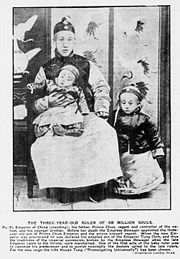 Puyi's great-grandfather was the Daoguang Emperor
(r. 1820–1850), who was succeeded by his fourth son, the Xianfeng Emperor
(r. 1850–1861).
Puyi's paternal grandfather was 1st Prince Chun
(1840–1891), the seventh son of the Daoguang Emperor and a younger half-brother of the Xianfeng Emperor. The Xianfeng Emperor was succeeded by his only son, who became the Tongzhi Emperor
(r. 1861–1875).
The Tongzhi Emperor died at the age of 18 without a son, and was succeeded by the Guangxu Emperor
(r. 1875–1908), son of 1st Prince Chun and Lady Yehenara Wanzhen (younger sister of Empress Dowager Cixi
). The Guangxu Emperor died without an heir.
Puyi, who succeeded the Guangxu Emperor, was the eldest son of 2nd Prince Chun
, who was born to 1st Prince Chun and his second concubine Lady Lingiya
(1866-1925). Lady Lingiya used to be a maid in the residence of 1st Prince Chun. Born a Han Chinese
, her original family name was Liu (劉), and this was changed to the Manchu clan name Lingiya when she became the concubine of 1st Prince Chun. 2nd Prince Chun was therefore a younger half-brother of the Guangxu Emperor and the first in line to succession after Guangxu.
Puyi was in a branch of the Aisin Gioro clan with close ties to Empress Dowager Cixi
, who was from the Yehenara
clan. Cixi's niece, who later became Empress Dowager Longyu
(1868–1913), was married to the Guangxu Emperor.
Puyi had a younger full brother, Pujie
(1907–1994), who married a cousin of Emperor Hirohito, Lady Hiro Saga
. The rules of succession were changed to allow Pujie to succeed Puyi, who had no children.
Puyi's last surviving younger half-brother Puren (b. 1918) has adopted the Chinese name Jin Youzhi
and currently still lives in China. In 2006 Jin Youzhi filed a lawsuit in regards to the rights to Puyi's image and privacy. The lawsuit claimed that those rights were violated by the exhibit "China's Last Monarch and His Family".
Puyi's second cousin, Pu Xuezhai (溥雪齋), was a musician who played the guqin
, and an artist of Chinese painting
.
(1884–1921), the daughter of Ronglu
(1836–1903), a statesman and general from the Guwalgiya
clan. Ronglu was one of the leaders of the conservative faction in the Qing court, and a staunch supporter of Empress Dowager Cixi
; Cixi rewarded his support by marrying his daughter, Puyi's mother, into the imperial family.
The Guwalgiya clan was regarded as one of the most powerful Manchu clans in the Qing Dynasty. Oboi
, an influential military commander and statesman who was a regent during the Kangxi Emperor
's reign, was from the Guwalgiya clan.
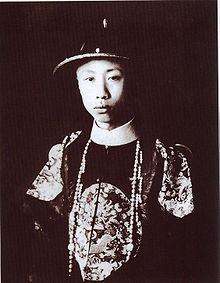 Chosen by Empress Dowager Cixi
on her deathbed, Puyi became emperor at the age of 2 years and 10 months in December 1908 after the Guangxu Emperor
died on 14 November. Titled the Xuantong Emperor, Puyi's introduction to the life of an emperor began when palace officials arrived at his family residence to take him. The toddler Puyi screamed and resisted as the officials ordered the eunuch
attendants to pick him up. His father, 2nd Prince Chun
, became Prince-Regent (摄政王). During Puyi's coronation in the Hall of Supreme Harmony
, the young emperor was carried onto the throne by his father. Puyi was so frightened by the scene before him and the deafening sounds of ceremonial drums and music that he started crying. His father could do nothing except to quietly comfort him, "Don't cry, it'll be over soon."
Puyi's wet nurse
, Wen-Chao Wang, was the only one who could console him, and therefore she accompanied him to the Forbidden City
. Puyi would not see his biological mother, 2nd Princess Chun
, for the next seven years. He developed a special bond with Wen-Chao Wang and credited her with being the only person who could control him. She was sent away when he was eight years old. After Puyi married, he would occasionally bring her to the Forbidden City, and later Manchukuo
, to visit him. After his special government pardon in 1959, he visited her adopted son and only then learned of her personal sacrifices to be his nurse.
Puyi's upbringing was hardly conducive to the raising of a healthy, well-balanced child. Overnight, he was treated as a god and unable to behave as a child. The adults in his life, except for his wet-nurse Wen-Chao Wang, were all strangers, remote, distant, and unable to discipline him. Wherever he went, grown men would kneel down in a ritual kowtow
, averting their eyes until he passed. Soon the young Puyi discovered the absolute power he wielded over the eunuchs, and he frequently had them beaten for small transgressions.
After his marriage, Puyi began to take control of the palace. He described "an orgy of looting" taking place that involved "everyone from the highest to the lowest". According to Puyi, by the end of his wedding ceremony, the pearls and jade in the empress's crown had been stolen. Locks were broken, areas ransacked, and on June 27, 1923, a fire destroyed the area around the Palace of Established Happiness. Puyi suspected it was arson to cover theft. The emperor overheard conversations among the eunuchs that made him fear for his life. In response, he evicted the eunuchs from the palace. His next plan of action was to reform the Household Department; the officials of which he appointed became so wealthy from theft and graft that they were able to run their own businesses outside the palace.
, served as a regent until 6 December 1911 when Empress Dowager Longyu
took over in the face of the Xinhai Revolution
.
Empress Dowager Longyu endorsed the "Imperial Edict of the Abdication of the Qing Emperor" (清帝退位詔書) on 12 February 1912, following the Xinhai Revolution, under a deal brokered by Yuan Shikai
(a general of the Beiyang Army
) with the imperial court in Beijing
and the Republicans in southern China. Signed with the new Republic of China
, Puyi was to retain his imperial title and be treated by the government of the Republic with the protocol
attached to a foreign monarch. This was similar to Italy's Law of Guarantees
(1870) which accorded the Pope
certain honors and privileges similar to those enjoyed by the King of Italy
. Puyi and the imperial court were allowed to remain in the northern half of the Forbidden City
(the Private Apartments) as well as in the Summer Palace
. A hefty annual subsidy of four million silver tael
s was granted by the Republic to the imperial household, although it was never fully paid and was abolished after just a few years.
restored Puyi to the throne from July 1 to July 12. Zhang Xun ordered his army to keep their queue
s to display loyalty to the emperor. During that period of time, a small bomb was dropped over the Forbidden City by a Republican plane, causing minor damage. This is considered the first aerial bombardment ever in East Asia. The restoration failed due to extensive opposition across China, and the decisive intervention of another warlord, Duan Qirui
.
Puyi was expelled from the Forbidden City
in 1924 by the warlord Feng Yuxiang
.
, Puyi spent a few days at the house of his father 2nd Prince Chun
, and then temporarily resided in the Japanese embassy for a year and a half. In 1925, he moved to the Quiet Garden Villa in the Japanese Concession
in Tianjin
. During this period, Puyi and his advisers Chen Baochen
, Zheng Xiaoxu
and Luo Zhenyu
discussed plans to restore Puyi as Emperor. Zheng and Luo favoured enlisting assistance from external parties, while Chen opposed the idea. In September 1931 Puyi sent a letter to Jirō Minami
, the Japanese Minister of War, expressing his desire to be restored to the throne. He was visited by Kenji Doihara
, head of the espionage office of the Japanese Kwantung Army, who proposed establishing Puyi as head of a Manchurian state. In November 1931, Puyi and Zheng Xiaoxu traveled to Manchuria
to complete plans for the puppet state of Manchukuo
. The Chinese government ordered Puyi's arrest for treason, but was unable to breach the Japanese protection. Chen Baochen returned to Beijing
where he died in 1935.
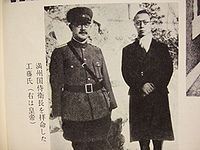 On 1 March 1932, Puyi was installed by the Japanese as the ruler of Manchukuo
, considered by most historians as a puppet state
of the Empire of Japan
, under the reign title
Datong (大同). In 1934, he was officially crowned the emperor of Manchukuo under the reign title Kangde (康德). He was constantly at odds with the Japanese in private, though submissive in public. He resented being "Head of State" and then "Emperor of Manchukuo" rather than being fully restored as a Qing Emperor. Puyi lived in a palace (now the Museum of the Imperial Palace of the Manchu State) in this period. At his enthronement he clashed with Japan over dress; they wanted him to wear a Manchukuo-style uniform whereas he considered it an insult to wear anything but traditional Manchu robes. In a typical compromise, he wore a Western military uniform to his enthronement (the only Chinese emperor ever to do so) and a dragon robe to the announcement of his accession at the Temple of Heaven
.
Puyi's younger full brother Pujie
, who married Lady Hiro Saga
, a distant cousin to the Japanese Emperor Hirohito
, was proclaimed heir apparent. The marriage had been politically arranged by Shigeru Honjō
, a general of the Kwantung Army. Puyi thereafter would not speak candidly in front of his brother and refused to eat any food provided by Hiro Saga. Puyi was forced to sign an agreement that if he himself had a male heir, the child would be sent to Japan to be raised by the Japanese.
From 1935 to 1945 Kwangtung Army senior staff officer Yasunori Yoshioka was assigned to Puyi as Attaché to the Imperial Household in Manchukuo. He acted as a spy for the Japanese government, controlling Puyi through fear, intimidation, and direct orders. There were many attempts on Puyi's life during this period, including a 1937 stabbing by a palace servant. During Puyi's reign as Emperor of Manchukuo, his household was closely watched by the Japanese, who increasingly took steps toward the full Japanisation of Manchuria, to prevent him from becoming too independent. He was feted by the Japanese populace during his visits there, but had to remain subservient to Emperor Hirohito. It is unclear whether the adoption of ancient Chinese styles and rites, such as using "His Majesty" instead of his real name, was the product of Puyi's interest or a Japanese imposition of their own imperial house rules.
During these years, Puyi began taking a greater interest in traditional Chinese law
and religion (such as Confucianism
and Buddhism
), but this was disallowed by the Japanese. Gradually his old supporters were eliminated and pro-Japanese ministers put in their place. During this period Puyi's life consisted mostly of signing laws prepared by Japan, reciting prayers, consulting oracles, and making formal visits throughout his state.
, Puyi was captured by the Soviet Red Army
on 16 August 1945 while he was in an airplane fleeing to Japan. The Soviets took him to the Siberia
n town of Chita. He lived in a sanatorium
, but was later taken to Khabarovsk
near the Chinese border.
In 1946, he testified at the International Military Tribunal for the Far East
in Tokyo
, detailing his resentment of how he had been treated by the Japanese.
When the Chinese Communist Party
under Mao Zedong
came to power in 1949, Puyi was repatriated to China after negotiations between the Soviet Union and China. Puyi spent ten years in a Fushun War Criminals Management Centre
, except during the Korean War
he was taken to Harbin
where he spent three years until 1954 because Fushun was near the Korean border, in Liaoning
province until he was declared reformed. Puyi came to Beijing in 1959 with special permission from Chairman Mao Zedong and lived the next six months in an ordinary Beijing residence with his sister before being transferred to a government-sponsored hotel. He voiced his support for the Communists and worked at the Beijing Botanical Gardens. At the age of 56, he married Li Shuxian
, a hospital nurse, on 30 April 1962, in a ceremony held at the Banquet Hall of the Consultative Conference. He subsequently worked as an editor for the literary department of the Chinese People's Political Consultative Conference
, where his monthly salary was around 100 yuan
, an office in which he served from 1964 until his death.
With encouragement from Chairman Mao Zedong and Premier Zhou Enlai
, and openly endorsed by the Chinese government, Puyi wrote his autobiography Wo De Qian Ban Sheng in the 1960s together with Li Wenda, an editor of Beijing's People Publishing Bureau. In the Oxford University edition of the book, in the chapter I Refuse to Admit My Guilt, he made this statement regarding his testimony at the Tokyo war crimes trial:
started the Cultural Revolution
in 1966, and the youth militia known as the Red Guards
saw Puyi, who symbolised Imperial China, as an easy target of attack. Puyi was placed under protection by the local public security bureau, although his food rations, salary, and various luxuries, including his sofa and desk, were removed. Puyi became affected physically and emotionally. He died in Beijing
of complications arising from kidney cancer
and heart disease
on 17 October 1967 at the age of 61.
In accordance with the laws of the People's Republic of China at the time, Puyi's body was cremated. His ashes were first placed at the Babaoshan Revolutionary Cemetery
, alongside those of other party and state dignitaries (before the establishment of the People's Republic of China
this was the burial ground of imperial concubines and eunuchs).
In 1995, as a part of a commercial arrangement, Puyi's widow transferred his ashes to a new commercial cemetery in return for monetary support. The cemetery is located near the Western Qing Tombs
, 120 km (74.6 mi) southwest of Beijing, where four of the nine Qing emperors preceding him are interred, along with three empresses, and 69 princes, princesses, and imperial concubines.
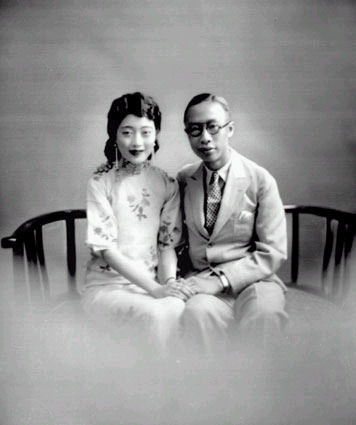 Quotation of Puyi:
The Pedigree of the Qing House flow chart can be found in Puyi's autobiography.
Puyi had seven younger sisters, only the first three were his full sisters:
Quotation of Puyi (referring to only the first four wives):
In detail:
In 1921, it was decided by the Dowager Consorts (the four widows of the emperors before Puyi) that it was time for the 15 year old Puyi to be married, although court politics dragged the complete process (from selecting the bride, up through the wedding ceremony) out for almost two years. Puyi saw marriage as his coming of age benchmark, when others would no longer control him. He was given four photographs to choose from. Puyi stated they all looked alike to him, with the exception of different clothing. He chose Wenxiu. Political factions within the palace made the actual choice as to whom Puyi would marry. The selection process alone took an entire year.
, Jilin
after being arrested by Chinese Communist soldiers.
, was a Manchu of the Tatala (他他拉) clan. She married Puyi in 1937 at the age of 16 on the recommendation of the daughter of Yulang (毓朗), a beile
. She was designated as Puyi's Concubine Xiang (祥貴人). Puyi married her as "punishment" for Wanrong, and, "...because a second wife was as essential as palace furniture." She was also a wife in name only. She became ill in 1942 with typhoid, which the Japanese doctor said would not be fatal. After the doctor's consultation with Attaché to the Imperial Household Yasunori Yoshioka, Tan Yuling suddenly died. Puyi became suspicious of the circumstances when the Japanese immediately offered him photographs of Japanese girls for marriage. Puyi posthumously granted her the title Noble Consort Mingxian (明賢貴妃).
, who was a Han Chinese
from Changchun
, Jilin
. She was designated as Puyi's Concubine Fu (福貴人). In February 1943, school principal Kobayashi and teacher Fujii of the Nan-Ling Girls Academy took ten girl students to a photography studio for portraits. Three weeks later, the school teacher and the principal visited Li Yuqin's home and told her Puyi ordered her to go to the Manchukuo palace to study. She was first taken directly to Yasunori Yoshioka who thoroughly questioned her. Yoshioka then drove her back to her parents and told them Puyi ordered her to study at the palace. Money was promised to the parents. She was subjected to a medical examination and then taken to Puyi's sister Yunhe and instructed in palace protocol. Two years later when Manchukuo collapsed, Li Yuqin shared a train with Empress Wanrong, who was experiencing opium withdrawal symptoms at the time. They were both arrested by the Soviets and sent to a prison in Changchun. Li Yuqin was released in 1946 and sent back home. She worked in a textile factory while she studied the works of Karl Marx
and Vladimir Lenin
. In 1955 she began visiting Puyi in prison. After applying to the Chinese authorities for a divorce, the government responded on her next prison visit by showing her to a room with a double bed and ordered her to reconcile with Puyi, and she said the couple obeyed the order. She divorced Puyi in May 1957. She later married a technician, and had two sons. During the Cultural Revolution
she became a target for attack by the Red Guards
because she used to be Puyi's concubine. She died of liver problems in 2001.
, Puyi married his fifth and last wife, Li Shuxian
, a nurse of Han Chinese
ethnicity. They had no children. She died of lung cancer
in 1997. Li Shuxian recounted that they dated for six months before the marriage, and she found him to be, "...a man who desperately needed my love and was ready to give me as much love as he could."
|-
|-
|-
|-
|-
|-
-
|time=2011-02-17T04:57:48+00:00|date=February 2011}}
Aisin Gioro
Aisin Gioro was the family name of the Manchu emperors of the Qing Dynasty. The House of Aisin Gioro ruled China until the Xinhai Revolution of 1911, which established a republican government in its place. The word aisin means gold in the Manchu language, and "gioro" is the name of the place in...
clan, was the last Emperor of China
Emperor of China
The Emperor of China refers to any sovereign of Imperial China reigning between the founding of Qin Dynasty of China, united by the King of Qin in 221 BCE, and the fall of Yuan Shikai's Empire of China in 1916. When referred to as the Son of Heaven , a title that predates the Qin unification, the...
, and the twelfth and final ruler of the Qing Dynasty
Qing Dynasty
The Qing Dynasty was the last dynasty of China, ruling from 1644 to 1912 with a brief, abortive restoration in 1917. It was preceded by the Ming Dynasty and followed by the Republic of China....
. He ruled as the Xuantong Emperor from 1908 until his abdication on 12 February 1912. From 1 to 12 July 1917 he was briefly restored to the throne as a nominal emperor by the warlord Zhang Xun
Zhang Xun (Republic of China)
Zhang Xun was a Qing-loyalist general who attempted to restore the abdicated emperor Puyi in 1917. He supported Yuan Shikai during his time as president....
. In 1934 he was declared the Kangde Emperor of the puppet state of Manchukuo
Manchukuo
Manchukuo or Manshū-koku was a puppet state in Manchuria and eastern Inner Mongolia, governed under a form of constitutional monarchy. The region was the historical homeland of the Manchus, who founded the Qing Empire in China...
by the Empire of Japan
Empire of Japan
The Empire of Japan is the name of the state of Japan that existed from the Meiji Restoration on 3 January 1868 to the enactment of the post-World War II Constitution of...
, and he ruled until the end of the Second Sino-Japanese War
Second Sino-Japanese War
The Second Sino-Japanese War was a military conflict fought primarily between the Republic of China and the Empire of Japan. From 1937 to 1941, China fought Japan with some economic help from Germany , the Soviet Union and the United States...
in 1945. After the People's Republic of China
People's Republic of China
China , officially the People's Republic of China , is the most populous country in the world, with over 1.3 billion citizens. Located in East Asia, the country covers approximately 9.6 million square kilometres...
was established in 1949, Puyi was a member of the Chinese People's Political Consultative Conference
Chinese People's Political Consultative Conference
The Chinese People's Political Consultative Conference [], shortened as 人民政协, Rénmín Zhèngxié, i.e. "People's PCC"; or just 政协, Zhèngxié, i.e. "The PCC"), abbreviated CPPCC, is a political advisory body in the People's Republic of China...
from 1964 until his death in 1967. Puyi's abdication in 1912 marked the end of centuries of dynastic rule in China, and he is also widely known as The Last Emperor.
Names
Puyi's name is romanised in English as either Puyi (in pinyinPinyin
Pinyin is the official system to transcribe Chinese characters into the Roman alphabet in China, Malaysia, Singapore and Taiwan. It is also often used to teach Mandarin Chinese and spell Chinese names in foreign publications and used as an input method to enter Chinese characters into...
) or P'u-i (in Wades-Giles). This naming is in accordance with the Manchu tradition of avoiding the use of a person's clan name
Chinese clan
A Chinese clan is a patrilineal and patrilocal group of related Chinese people with a common surname sharing a common ancestor and, in many cases, an ancestral home.-Description:...
and given name
Chinese given name
Chinese given names are generally made up of one or two characters, and are written after the family name, therefore "John-Paul Smith" as a Chinese name would be read "Smith John-Paul". Chinese names can consist of any character and contain almost any meaning...
together, but is in complete contravention of Chinese tradition, whereby the given name of a ruler was considered taboo
Naming taboo
Naming taboo is a cultural taboo against speaking or writing the given names of exalted persons in China and neighboring nations in the ancient Chinese cultural sphere.-Kinds of naming taboo:...
and ineffable. Using a former emperor's personal name (or even using a Chinese character
Chinese character
Chinese characters are logograms used in the writing of Chinese and Japanese , less frequently Korean , formerly Vietnamese , or other languages...
from the name) was a punishable offence under traditional Chinese law. However after Puyi lost his imperial title in 1924, he was officially styled Mr. Puyi in Chinese and Mr. Fugi (溥儀先生; Fugi Sensei) in Japanese. His clan name Aisin Gioro
Aisin Gioro
Aisin Gioro was the family name of the Manchu emperors of the Qing Dynasty. The House of Aisin Gioro ruled China until the Xinhai Revolution of 1911, which established a republican government in its place. The word aisin means gold in the Manchu language, and "gioro" is the name of the place in...
was seldom used.
Puyi also adopted Chinese style name
Chinese style name
A Chinese style name, sometimes also known as a courtesy name , is a given name to be used later in life. After 20 years of age, the zì is assigned in place of one's given name as a symbol of adulthood and respect...
s - his zi (字; courtesy name) was Yaozhi , and his hao (號; pseudonym) was Haoran .
Puyi is also known to have used a Western given name, Henry¹, which was chosen by his English language teacher, a Scotsman named Reginald Johnston
Reginald Johnston
Sir Reginald Fleming Johnston, KCMG, CBE, was a Scottish academic, diplomat and tutor to Puyi, the last emperor of China, and later appointed as the last Commissioner of Weihaiwei.-Early:...
.
Titles
When he ruled as Emperor of the Qing Dynasty from 1908 to 1912 and during his brief restoration in 1917, Puyi's era nameChinese era name
A Chinese era name is the regnal year, reign period, or regnal title used when traditionally numbering years in an emperor's reign and naming certain Chinese rulers . Some emperors have several era names, one after another, where each beginning of a new era resets the numbering of the year back...
was Xuantong, so he was known as the Xuantong Emperor during those two periods of time.
As Puyi was also the last ruling Emperor of China
Emperor of China
The Emperor of China refers to any sovereign of Imperial China reigning between the founding of Qin Dynasty of China, united by the King of Qin in 221 BCE, and the fall of Yuan Shikai's Empire of China in 1916. When referred to as the Son of Heaven , a title that predates the Qin unification, the...
, he is widely known as The Last Emperor in China and throughout the rest of the world. Some refer to him as The Last Emperor of the Qing Dynasty .
Due to his abdication, Puyi is also known as Xun Di or Fei Di . Sometimes a Qing is added in front of the two titles to indicate his affiliation with the Qing Dynasty.
When Puyi ruled the puppet state of Manchukuo
Manchukuo
Manchukuo or Manshū-koku was a puppet state in Manchuria and eastern Inner Mongolia, governed under a form of constitutional monarchy. The region was the historical homeland of the Manchus, who founded the Qing Empire in China...
from 1934 to 1945, his era name was Kangde, so he was known as the Kangde Emperor during that period of time.
Paternal side
Daoguang Emperor
The Daoguang Emperor was the eighth emperor of the Manchurian Qing dynasty and the sixth Qing emperor to rule over China, from 1820 to 1850.-Early years:...
(r. 1820–1850), who was succeeded by his fourth son, the Xianfeng Emperor
Xianfeng Emperor
The Xianfeng Emperor , born Aisin-Gioro I Ju, was the ninth Emperor of the Qing Dynasty, and the seventh Qing emperor to rule over China, from 1850 to 1861.-Family and his early years:...
(r. 1850–1861).
Puyi's paternal grandfather was 1st Prince Chun
Yixuan, 1st Prince Chun
Yixuan, 1st Prince Chun was a prince of the Qing Dynasty, the last reigning dynasty of China. He was the father of the dynasty's penultimate emperor, the Guangxu Emperor, and the paternal grandfather of China's last emperor, Puyi.-Birth and early life:Aisin Gioro Yi Xuan was born a son of the...
(1840–1891), the seventh son of the Daoguang Emperor and a younger half-brother of the Xianfeng Emperor. The Xianfeng Emperor was succeeded by his only son, who became the Tongzhi Emperor
Tongzhi Emperor
The Tongzhi Emperor , born Aisin-Gioro Dzai Šun, was the tenth emperor of the Manchu-led Qing Dynasty, and the eighth Qing emperor to rule over China, from 1861 to 1875. His reign, which effectively lasted through his adolescence, was largely overshadowed by the rule of his mother, the Empress...
(r. 1861–1875).
The Tongzhi Emperor died at the age of 18 without a son, and was succeeded by the Guangxu Emperor
Guangxu Emperor
The Guangxu Emperor , born Zaitian of the Aisin-Gioro clan, was the eleventh emperor of the Manchurian Qing Dynasty, and the ninth Qing emperor to rule over China. His reign lasted from 1875 to 1908, but in practice he ruled, under Empress Dowager Cixi's influence, only from 1889 to 1898...
(r. 1875–1908), son of 1st Prince Chun and Lady Yehenara Wanzhen (younger sister of Empress Dowager Cixi
Empress Dowager Cixi
Empress Dowager Cixi1 , of the Manchu Yehenara clan, was a powerful and charismatic figure who became the de facto ruler of the Manchu Qing Dynasty in China for 47 years from 1861 to her death in 1908....
). The Guangxu Emperor died without an heir.
Puyi, who succeeded the Guangxu Emperor, was the eldest son of 2nd Prince Chun
Zaifeng, 2nd Prince Chun
The 2nd Prince Chun was born Zaifeng , of the Manchu Aisin-Gioro clan . He was the leader of China between 1908 and 1911, serving as regent for his son Puyi, the Xuantong Emperor.His courtesy name was Yiyun...
, who was born to 1st Prince Chun and his second concubine Lady Lingiya
Lady Lingiya
Lady Lingiya was second concubine of the 1st Prince Chun. She was the mother of the 2nd Prince Chun. This made her the paternal grandmother of the last Chinese Emperor Puyi....
(1866-1925). Lady Lingiya used to be a maid in the residence of 1st Prince Chun. Born a Han Chinese
Han Chinese
Han Chinese are an ethnic group native to China and are the largest single ethnic group in the world.Han Chinese constitute about 92% of the population of the People's Republic of China , 98% of the population of the Republic of China , 78% of the population of Singapore, and about 20% of the...
, her original family name was Liu (劉), and this was changed to the Manchu clan name Lingiya when she became the concubine of 1st Prince Chun. 2nd Prince Chun was therefore a younger half-brother of the Guangxu Emperor and the first in line to succession after Guangxu.
Puyi was in a branch of the Aisin Gioro clan with close ties to Empress Dowager Cixi
Empress Dowager Cixi
Empress Dowager Cixi1 , of the Manchu Yehenara clan, was a powerful and charismatic figure who became the de facto ruler of the Manchu Qing Dynasty in China for 47 years from 1861 to her death in 1908....
, who was from the Yehenara
Nara (clan)
Nara is a major Manchu clan. The Hūlun Four States -- Hada , Ula , Hoifa and Yehe -- were ruled by this clan...
clan. Cixi's niece, who later became Empress Dowager Longyu
Empress Dowager Longyu
Empress Xiao Ding Jing ; is better known as the Empress Dowager Longyu , . Also , she had the nickname was Xizi (喜子). Empress Xiao Ding Jing was the Qing Dynasty Empress Consort of the Guangxu Emperor who ruled China from 1875 till 1908...
(1868–1913), was married to the Guangxu Emperor.
Puyi had a younger full brother, Pujie
Pujie
-External links:**...
(1907–1994), who married a cousin of Emperor Hirohito, Lady Hiro Saga
Hiro Saga
- External links :*...
. The rules of succession were changed to allow Pujie to succeed Puyi, who had no children.
Puyi's last surviving younger half-brother Puren (b. 1918) has adopted the Chinese name Jin Youzhi
Jin Youzhi
Jīn Yǒuzhī , born Pǔrèn , is the fourth and youngest son of Zaifeng, 2nd Prince Chun, and is, at age , the only surviving brother of Puyi, the last Emperor of China and of Manchukuo....
and currently still lives in China. In 2006 Jin Youzhi filed a lawsuit in regards to the rights to Puyi's image and privacy. The lawsuit claimed that those rights were violated by the exhibit "China's Last Monarch and His Family".
Puyi's second cousin, Pu Xuezhai (溥雪齋), was a musician who played the guqin
Guqin
The guqin is the modern name for a plucked seven-string Chinese musical instrument of the zither family...
, and an artist of Chinese painting
Chinese painting
Chinese painting is one of the oldest continuous artistic traditions in the world. The earliest paintings were not representational but ornamental; they consisted of patterns or designs rather than pictures. Early pottery was painted with spirals, zigzags, dots, or animals...
.
Maternal side
Puyi's mother was 2nd Princess ChunYoulan, 2nd Princess Chun
Youlan , was the mother of the last Chinese emperor Puyi, also known as the Xuantong Emperor. She was married to Zaifeng, 2nd Prince Chun and also gave birth to another son, Puyi's younger brother Pujie, and three daughters....
(1884–1921), the daughter of Ronglu
Ronglu
Ronglu was a Manchu statesman and general during the late Qing dynasty. Born into the powerful Guwalgiya clan of the Plain White Banner in the Eight Banners, he was cousin to Yehenara Lan, who later became Empress Dowager Cixi...
(1836–1903), a statesman and general from the Guwalgiya
Guwalgiya
Guwalgiya was one of the most powerful Manchu clans. Kangxi's administrator Oboi came from this clan....
clan. Ronglu was one of the leaders of the conservative faction in the Qing court, and a staunch supporter of Empress Dowager Cixi
Empress Dowager Cixi
Empress Dowager Cixi1 , of the Manchu Yehenara clan, was a powerful and charismatic figure who became the de facto ruler of the Manchu Qing Dynasty in China for 47 years from 1861 to her death in 1908....
; Cixi rewarded his support by marrying his daughter, Puyi's mother, into the imperial family.
The Guwalgiya clan was regarded as one of the most powerful Manchu clans in the Qing Dynasty. Oboi
Oboi
Oboi was a highly decorated Manchu military commander and courtier who served in various military and administrative posts under three successive Emperors of the early Qing Dynasty. He was one of four regents nominated by the Shunzhi Emperor to oversee the government during the Kangxi Emperor's...
, an influential military commander and statesman who was a regent during the Kangxi Emperor
Kangxi Emperor
The Kangxi Emperor ; Manchu: elhe taifin hūwangdi ; Mongolian: Энх-Амгалан хаан, 4 May 1654 –20 December 1722) was the fourth emperor of the Qing Dynasty, the first to be born on Chinese soil south of the Pass and the second Qing emperor to rule over China proper, from 1661 to 1722.Kangxi's...
's reign, was from the Guwalgiya clan.
Chart of the ancestors of Puyi
Emperor of China (1908–1912)
Empress Dowager Cixi
Empress Dowager Cixi1 , of the Manchu Yehenara clan, was a powerful and charismatic figure who became the de facto ruler of the Manchu Qing Dynasty in China for 47 years from 1861 to her death in 1908....
on her deathbed, Puyi became emperor at the age of 2 years and 10 months in December 1908 after the Guangxu Emperor
Guangxu Emperor
The Guangxu Emperor , born Zaitian of the Aisin-Gioro clan, was the eleventh emperor of the Manchurian Qing Dynasty, and the ninth Qing emperor to rule over China. His reign lasted from 1875 to 1908, but in practice he ruled, under Empress Dowager Cixi's influence, only from 1889 to 1898...
died on 14 November. Titled the Xuantong Emperor, Puyi's introduction to the life of an emperor began when palace officials arrived at his family residence to take him. The toddler Puyi screamed and resisted as the officials ordered the eunuch
Eunuch
A eunuch is a person born male most commonly castrated, typically early enough in his life for this change to have major hormonal consequences...
attendants to pick him up. His father, 2nd Prince Chun
Zaifeng, 2nd Prince Chun
The 2nd Prince Chun was born Zaifeng , of the Manchu Aisin-Gioro clan . He was the leader of China between 1908 and 1911, serving as regent for his son Puyi, the Xuantong Emperor.His courtesy name was Yiyun...
, became Prince-Regent (摄政王). During Puyi's coronation in the Hall of Supreme Harmony
Hall of Supreme Harmony
The Hall of Supreme Harmony is the largest hall within the Forbidden City. It is located at its central axis, behind the Gate of Supreme Harmony. Built above three levels of marble stone base, and surrounded by bronze incense burners, the Hall of Supreme Harmony is one of the largest wooden...
, the young emperor was carried onto the throne by his father. Puyi was so frightened by the scene before him and the deafening sounds of ceremonial drums and music that he started crying. His father could do nothing except to quietly comfort him, "Don't cry, it'll be over soon."
Puyi's wet nurse
Wet nurse
A wet nurse is a woman who is used to breast feed and care for another's child. Wet nurses are used when the mother is unable or chooses not to nurse the child herself. Wet-nursed children may be known as "milk-siblings", and in some cultures the families are linked by a special relationship of...
, Wen-Chao Wang, was the only one who could console him, and therefore she accompanied him to the Forbidden City
Forbidden City
The Forbidden City was the Chinese imperial palace from the Ming Dynasty to the end of the Qing Dynasty. It is located in the middle of Beijing, China, and now houses the Palace Museum...
. Puyi would not see his biological mother, 2nd Princess Chun
Youlan, 2nd Princess Chun
Youlan , was the mother of the last Chinese emperor Puyi, also known as the Xuantong Emperor. She was married to Zaifeng, 2nd Prince Chun and also gave birth to another son, Puyi's younger brother Pujie, and three daughters....
, for the next seven years. He developed a special bond with Wen-Chao Wang and credited her with being the only person who could control him. She was sent away when he was eight years old. After Puyi married, he would occasionally bring her to the Forbidden City, and later Manchukuo
Manchukuo
Manchukuo or Manshū-koku was a puppet state in Manchuria and eastern Inner Mongolia, governed under a form of constitutional monarchy. The region was the historical homeland of the Manchus, who founded the Qing Empire in China...
, to visit him. After his special government pardon in 1959, he visited her adopted son and only then learned of her personal sacrifices to be his nurse.
Puyi's upbringing was hardly conducive to the raising of a healthy, well-balanced child. Overnight, he was treated as a god and unable to behave as a child. The adults in his life, except for his wet-nurse Wen-Chao Wang, were all strangers, remote, distant, and unable to discipline him. Wherever he went, grown men would kneel down in a ritual kowtow
Kowtow
Kowtow is the act of deep respect shown by kneeling and bowing so low as to have one's head touching the ground. An alternative Chinese term is ketou, however the meaning is somewhat altered: kòu originally meant "knock with reverence", whereas kē has the general meaning of "touch upon ".In Han...
, averting their eyes until he passed. Soon the young Puyi discovered the absolute power he wielded over the eunuchs, and he frequently had them beaten for small transgressions.
Eunuchs and the Household Department
Quotation of Puyi:After his marriage, Puyi began to take control of the palace. He described "an orgy of looting" taking place that involved "everyone from the highest to the lowest". According to Puyi, by the end of his wedding ceremony, the pearls and jade in the empress's crown had been stolen. Locks were broken, areas ransacked, and on June 27, 1923, a fire destroyed the area around the Palace of Established Happiness. Puyi suspected it was arson to cover theft. The emperor overheard conversations among the eunuchs that made him fear for his life. In response, he evicted the eunuchs from the palace. His next plan of action was to reform the Household Department; the officials of which he appointed became so wealthy from theft and graft that they were able to run their own businesses outside the palace.
Abdication
Puyi's father, 2nd Prince ChunZaifeng, 2nd Prince Chun
The 2nd Prince Chun was born Zaifeng , of the Manchu Aisin-Gioro clan . He was the leader of China between 1908 and 1911, serving as regent for his son Puyi, the Xuantong Emperor.His courtesy name was Yiyun...
, served as a regent until 6 December 1911 when Empress Dowager Longyu
Empress Dowager Longyu
Empress Xiao Ding Jing ; is better known as the Empress Dowager Longyu , . Also , she had the nickname was Xizi (喜子). Empress Xiao Ding Jing was the Qing Dynasty Empress Consort of the Guangxu Emperor who ruled China from 1875 till 1908...
took over in the face of the Xinhai Revolution
Xinhai Revolution
The Xinhai Revolution or Hsinhai Revolution, also known as Revolution of 1911 or the Chinese Revolution, was a revolution that overthrew China's last imperial dynasty, the Qing , and established the Republic of China...
.
Empress Dowager Longyu endorsed the "Imperial Edict of the Abdication of the Qing Emperor" (清帝退位詔書) on 12 February 1912, following the Xinhai Revolution, under a deal brokered by Yuan Shikai
Yuan Shikai
Yuan Shikai was an important Chinese general and politician famous for his influence during the late Qing Dynasty, his role in the events leading up to the abdication of the last Qing Emperor of China, his autocratic rule as the second President of the Republic of China , and his short-lived...
(a general of the Beiyang Army
Beiyang Army
The Beiyang Army was a powerful, Western-style Chinese military force created by the Qing Dynasty government in the late 19th century. It was the centerpiece of a general reconstruction of China's military system. The Beiyang Army played a major role in Chinese politics for at least three decades...
) with the imperial court in Beijing
Beijing
Beijing , also known as Peking , is the capital of the People's Republic of China and one of the most populous cities in the world, with a population of 19,612,368 as of 2010. The city is the country's political, cultural, and educational center, and home to the headquarters for most of China's...
and the Republicans in southern China. Signed with the new Republic of China
Republic of China
The Republic of China , commonly known as Taiwan , is a unitary sovereign state located in East Asia. Originally based in mainland China, the Republic of China currently governs the island of Taiwan , which forms over 99% of its current territory, as well as Penghu, Kinmen, Matsu and other minor...
, Puyi was to retain his imperial title and be treated by the government of the Republic with the protocol
Protocol (diplomacy)
In international politics, protocol is the etiquette of diplomacy and affairs of state.A protocol is a rule which guides how an activity should be performed, especially in the field of diplomacy. In diplomatic services and governmental fields of endeavor protocols are often unwritten guidelines...
attached to a foreign monarch. This was similar to Italy's Law of Guarantees
Law of Guarantees
After the occupation of the Papal States in 1870, Italy's Law of Guarantees accorded the Pope certain honors and privileges similar to those enjoyed by the King of Italy, including the right to send and receive ambassadors who would have full diplomatic immunity, just as if he still had temporal...
(1870) which accorded the Pope
Pope
The Pope is the Bishop of Rome, a position that makes him the leader of the worldwide Catholic Church . In the Catholic Church, the Pope is regarded as the successor of Saint Peter, the Apostle...
certain honors and privileges similar to those enjoyed by the King of Italy
King of Italy
King of Italy is a title adopted by many rulers of the Italian peninsula after the fall of the Roman Empire...
. Puyi and the imperial court were allowed to remain in the northern half of the Forbidden City
Forbidden City
The Forbidden City was the Chinese imperial palace from the Ming Dynasty to the end of the Qing Dynasty. It is located in the middle of Beijing, China, and now houses the Palace Museum...
(the Private Apartments) as well as in the Summer Palace
Summer Palace
The Summer Palace is a palace in Beijing, China. The Summer Palace is mainly dominated by Longevity Hill and the Kunming Lake. It covers an expanse of 2.9 square kilometers, three quarters of which is water....
. A hefty annual subsidy of four million silver tael
Tael
Tael can refer to any one of several weight measures of the Far East. Most commonly, it refers to the Chinese tael, a part of the Chinese system of weights and currency....
s was granted by the Republic to the imperial household, although it was never fully paid and was abolished after just a few years.
The Articles of Favourable Treatment of the Great Qing Emperor after his Abdication
The document is dated 26 December 1914.- After the abdication of the Great Qing Emperor, his title of dignity is to be retained by the Republic of China with the courtesies which it is customary to accord to foreign monarchs.
- After the abdication of the Great Qing Emperor, he will receive from the Republic of China an annual subsidy of 4,000,000 silver taelTaelTael can refer to any one of several weight measures of the Far East. Most commonly, it refers to the Chinese tael, a part of the Chinese system of weights and currency....
s. After the reform of the currency this amount will be altered to $4,000,000 (max.). - After the abdication of the Great Qing Emperor, he may, as a temporary measure, continue to reside in the Palace (in the Forbidden CityForbidden CityThe Forbidden City was the Chinese imperial palace from the Ming Dynasty to the end of the Qing Dynasty. It is located in the middle of Beijing, China, and now houses the Palace Museum...
), but afterwards he will remove himself to the Summer PalaceSummer PalaceThe Summer Palace is a palace in Beijing, China. The Summer Palace is mainly dominated by Longevity Hill and the Kunming Lake. It covers an expanse of 2.9 square kilometers, three quarters of which is water....
. He may retain his bodyguard. - After the abdication of the Great Qing Emperor, the temples and mausoleums of the imperial family with their appropriate sacrificial rites shall be maintained in perpetuity. The Republic of China will be responsible for the provision of military guards for their adequate protection.
- As the Chong Mausoleum (崇陵) of the late Emperor Dezong (the Guangxu EmperorGuangxu EmperorThe Guangxu Emperor , born Zaitian of the Aisin-Gioro clan, was the eleventh emperor of the Manchurian Qing Dynasty, and the ninth Qing emperor to rule over China. His reign lasted from 1875 to 1908, but in practice he ruled, under Empress Dowager Cixi's influence, only from 1889 to 1898...
) has not yet been completed, the work will be carried out according to the proper regulations (relating to imperial tombs). The last ceremonies of sepulture will also be observed in accordance with the ancient rites. The actual expenses will all be borne by the Republic of China. - The services of all the persons of various grades hitherto employed in the Palace may be retained; but in future no eunuchs are to be added to the staff.
- After the abdication of the Great Qing Emperor, his private property will be safeguarded and protected by the Republic of China.
- The imperial guard corps as constituted at the time of the abdication will be placed under the military control of the War Office of the Republic of China. It will be maintained at its original strength and will receive the same emoluments as heretofore.
Brief restoration (1917)
In 1917 the warlord Zhang XunZhang Xun (Republic of China)
Zhang Xun was a Qing-loyalist general who attempted to restore the abdicated emperor Puyi in 1917. He supported Yuan Shikai during his time as president....
restored Puyi to the throne from July 1 to July 12. Zhang Xun ordered his army to keep their queue
Queue (hairstyle)
The queue or cue is a hairstyle in which the hair is worn long and gathered up into a ponytail. It was worn traditionally by certain Native American groups and the Manchu of Manchuria.-Manchu Queue:...
s to display loyalty to the emperor. During that period of time, a small bomb was dropped over the Forbidden City by a Republican plane, causing minor damage. This is considered the first aerial bombardment ever in East Asia. The restoration failed due to extensive opposition across China, and the decisive intervention of another warlord, Duan Qirui
Duan Qirui
Duan Qirui was a Chinese warlord and politician, commander in the Beiyang Army, and the Provisional Chief Executive of Republic of China from November 24, 1924 to April 20, 1926. He was arguably the most powerful man in China from 1916 to 1920.- Early life :Born in Hefei as Duan Qirui , his...
.
Puyi was expelled from the Forbidden City
Forbidden City
The Forbidden City was the Chinese imperial palace from the Ming Dynasty to the end of the Qing Dynasty. It is located in the middle of Beijing, China, and now houses the Palace Museum...
in 1924 by the warlord Feng Yuxiang
Feng Yuxiang
Feng Yuxiang was a warlord and leader in Republican China. He was also known as the Christian General for his zeal to convert his troops and the Betrayal General for his penchant to break with the establishment. In 1911, he was an officer in the ranks of Yuan Shikai's Beiyang Army but joined...
.
Residence in Tianjin (1924-1932)
Following his expulsion from the Forbidden CityForbidden City
The Forbidden City was the Chinese imperial palace from the Ming Dynasty to the end of the Qing Dynasty. It is located in the middle of Beijing, China, and now houses the Palace Museum...
, Puyi spent a few days at the house of his father 2nd Prince Chun
Zaifeng, 2nd Prince Chun
The 2nd Prince Chun was born Zaifeng , of the Manchu Aisin-Gioro clan . He was the leader of China between 1908 and 1911, serving as regent for his son Puyi, the Xuantong Emperor.His courtesy name was Yiyun...
, and then temporarily resided in the Japanese embassy for a year and a half. In 1925, he moved to the Quiet Garden Villa in the Japanese Concession
Concessions in Tianjin
The Concessions in Tianjin were concession territories ceded by the Chinese imperial Qing Dynasty to the great powers in Tianjin, also known as Tientsin or Tien-Tsin.-General context:...
in Tianjin
Tianjin
' is a metropolis in northern China and one of the five national central cities of the People's Republic of China. It is governed as a direct-controlled municipality, one of four such designations, and is, thus, under direct administration of the central government...
. During this period, Puyi and his advisers Chen Baochen
Chen Baochen
Chen Baochen Chinese official, hailing from Fujian province in southeast China. During the last years of the Qing dynasty, he served as sub-chancellor in the Grand Secretariat and as vice president of the Board of Rites...
, Zheng Xiaoxu
Zheng Xiaoxu
Zhèng Xiàoxū . Chinese statesman, diplomat and calligrapher.-Early life and diplomatic career:Although Zheng traced his ancestral roots to Minhou, a small town near Fuzhou, he was born in Suzhou, Jiangsu...
and Luo Zhenyu
Luo Zhenyu
Luo Zhenyu , courtesy name: Shuyun was a Chinese classical scholar, philologist, epigrapher, antiquarian and Qing loyalist.-Biography:...
discussed plans to restore Puyi as Emperor. Zheng and Luo favoured enlisting assistance from external parties, while Chen opposed the idea. In September 1931 Puyi sent a letter to Jirō Minami
Jiro Minami
- Notes :...
, the Japanese Minister of War, expressing his desire to be restored to the throne. He was visited by Kenji Doihara
Kenji Doihara
was a general in the Imperial Japanese Army in World War II. He was instrumental in the Japanese invasion of Manchuria for which he earned fame taking the nickname 'Lawrence of Manchuria', a reference to the Lawrence of Arabia....
, head of the espionage office of the Japanese Kwantung Army, who proposed establishing Puyi as head of a Manchurian state. In November 1931, Puyi and Zheng Xiaoxu traveled to Manchuria
Manchuria
Manchuria is a historical name given to a large geographic region in northeast Asia. Depending on the definition of its extent, Manchuria usually falls entirely within the People's Republic of China, or is sometimes divided between China and Russia. The region is commonly referred to as Northeast...
to complete plans for the puppet state of Manchukuo
Manchukuo
Manchukuo or Manshū-koku was a puppet state in Manchuria and eastern Inner Mongolia, governed under a form of constitutional monarchy. The region was the historical homeland of the Manchus, who founded the Qing Empire in China...
. The Chinese government ordered Puyi's arrest for treason, but was unable to breach the Japanese protection. Chen Baochen returned to Beijing
Beijing
Beijing , also known as Peking , is the capital of the People's Republic of China and one of the most populous cities in the world, with a population of 19,612,368 as of 2010. The city is the country's political, cultural, and educational center, and home to the headquarters for most of China's...
where he died in 1935.
Ruler of Manchukuo (1932–1945)
Manchukuo
Manchukuo or Manshū-koku was a puppet state in Manchuria and eastern Inner Mongolia, governed under a form of constitutional monarchy. The region was the historical homeland of the Manchus, who founded the Qing Empire in China...
, considered by most historians as a puppet state
Puppet state
A puppet state is a nominal sovereign of a state who is de facto controlled by a foreign power. The term refers to a government controlled by the government of another country like a puppeteer controls the strings of a marionette...
of the Empire of Japan
Empire of Japan
The Empire of Japan is the name of the state of Japan that existed from the Meiji Restoration on 3 January 1868 to the enactment of the post-World War II Constitution of...
, under the reign title
Chinese era name
A Chinese era name is the regnal year, reign period, or regnal title used when traditionally numbering years in an emperor's reign and naming certain Chinese rulers . Some emperors have several era names, one after another, where each beginning of a new era resets the numbering of the year back...
Datong (大同). In 1934, he was officially crowned the emperor of Manchukuo under the reign title Kangde (康德). He was constantly at odds with the Japanese in private, though submissive in public. He resented being "Head of State" and then "Emperor of Manchukuo" rather than being fully restored as a Qing Emperor. Puyi lived in a palace (now the Museum of the Imperial Palace of the Manchu State) in this period. At his enthronement he clashed with Japan over dress; they wanted him to wear a Manchukuo-style uniform whereas he considered it an insult to wear anything but traditional Manchu robes. In a typical compromise, he wore a Western military uniform to his enthronement (the only Chinese emperor ever to do so) and a dragon robe to the announcement of his accession at the Temple of Heaven
Temple of Heaven
The Temple of Heaven, literally the Altar of Heaven is a complex of Taoist buildings situated in the southeastern part of central Beijing. The complex was visited by the Emperors of the Ming and Qing dynasties for annual ceremonies of prayer to Heaven for good harvest...
.
Puyi's younger full brother Pujie
Pujie
-External links:**...
, who married Lady Hiro Saga
Hiro Saga
- External links :*...
, a distant cousin to the Japanese Emperor Hirohito
Hirohito
, posthumously in Japan officially called Emperor Shōwa or , was the 124th Emperor of Japan according to the traditional order, reigning from December 25, 1926, until his death in 1989. Although better known outside of Japan by his personal name Hirohito, in Japan he is now referred to...
, was proclaimed heir apparent. The marriage had been politically arranged by Shigeru Honjō
Shigeru Honjo
-Notes:...
, a general of the Kwantung Army. Puyi thereafter would not speak candidly in front of his brother and refused to eat any food provided by Hiro Saga. Puyi was forced to sign an agreement that if he himself had a male heir, the child would be sent to Japan to be raised by the Japanese.
From 1935 to 1945 Kwangtung Army senior staff officer Yasunori Yoshioka was assigned to Puyi as Attaché to the Imperial Household in Manchukuo. He acted as a spy for the Japanese government, controlling Puyi through fear, intimidation, and direct orders. There were many attempts on Puyi's life during this period, including a 1937 stabbing by a palace servant. During Puyi's reign as Emperor of Manchukuo, his household was closely watched by the Japanese, who increasingly took steps toward the full Japanisation of Manchuria, to prevent him from becoming too independent. He was feted by the Japanese populace during his visits there, but had to remain subservient to Emperor Hirohito. It is unclear whether the adoption of ancient Chinese styles and rites, such as using "His Majesty" instead of his real name, was the product of Puyi's interest or a Japanese imposition of their own imperial house rules.
During these years, Puyi began taking a greater interest in traditional Chinese law
Traditional Chinese law
Traditional Chinese law refers to the laws, regulations and rules used in China up to 1911, when the last imperial dynasty fell. It has undergone continuous development since at least the 11th century BC...
and religion (such as Confucianism
Confucianism
Confucianism is a Chinese ethical and philosophical system developed from the teachings of the Chinese philosopher Confucius . Confucianism originated as an "ethical-sociopolitical teaching" during the Spring and Autumn Period, but later developed metaphysical and cosmological elements in the Han...
and Buddhism
Buddhism
Buddhism is a religion and philosophy encompassing a variety of traditions, beliefs and practices, largely based on teachings attributed to Siddhartha Gautama, commonly known as the Buddha . The Buddha lived and taught in the northeastern Indian subcontinent some time between the 6th and 4th...
), but this was disallowed by the Japanese. Gradually his old supporters were eliminated and pro-Japanese ministers put in their place. During this period Puyi's life consisted mostly of signing laws prepared by Japan, reciting prayers, consulting oracles, and making formal visits throughout his state.
Later life (1945–1967)
At the end of World War IIWorld War II
World War II, or the Second World War , was a global conflict lasting from 1939 to 1945, involving most of the world's nations—including all of the great powers—eventually forming two opposing military alliances: the Allies and the Axis...
, Puyi was captured by the Soviet Red Army
Red Army
The Workers' and Peasants' Red Army started out as the Soviet Union's revolutionary communist combat groups during the Russian Civil War of 1918-1922. It grew into the national army of the Soviet Union. By the 1930s the Red Army was among the largest armies in history.The "Red Army" name refers to...
on 16 August 1945 while he was in an airplane fleeing to Japan. The Soviets took him to the Siberia
Siberia
Siberia is an extensive region constituting almost all of Northern Asia. Comprising the central and eastern portion of the Russian Federation, it was part of the Soviet Union from its beginning, as its predecessor states, the Tsardom of Russia and the Russian Empire, conquered it during the 16th...
n town of Chita. He lived in a sanatorium
Sanatorium
A sanatorium is a medical facility for long-term illness, most typically associated with treatment of tuberculosis before antibiotics...
, but was later taken to Khabarovsk
Khabarovsk
Khabarovsk is the largest city and the administrative center of Khabarovsk Krai, Russia. It is located some from the Chinese border. It is the second largest city in the Russian Far East, after Vladivostok. The city became the administrative center of the Far Eastern Federal District of Russia...
near the Chinese border.
In 1946, he testified at the International Military Tribunal for the Far East
International Military Tribunal for the Far East
The International Military Tribunal for the Far East , also known as the Tokyo Trials, the Tokyo War Crimes Tribunal, or simply the Tribunal, was convened on April 29, 1946, to try the leaders of the Empire of Japan for three types of crimes: "Class A" crimes were reserved for those who...
in Tokyo
Tokyo
, ; officially , is one of the 47 prefectures of Japan. Tokyo is the capital of Japan, the center of the Greater Tokyo Area, and the largest metropolitan area of Japan. It is the seat of the Japanese government and the Imperial Palace, and the home of the Japanese Imperial Family...
, detailing his resentment of how he had been treated by the Japanese.
When the Chinese Communist Party
Communist Party of China
The Communist Party of China , also known as the Chinese Communist Party , is the founding and ruling political party of the People's Republic of China...
under Mao Zedong
Mao Zedong
Mao Zedong, also transliterated as Mao Tse-tung , and commonly referred to as Chairman Mao , was a Chinese Communist revolutionary, guerrilla warfare strategist, Marxist political philosopher, and leader of the Chinese Revolution...
came to power in 1949, Puyi was repatriated to China after negotiations between the Soviet Union and China. Puyi spent ten years in a Fushun War Criminals Management Centre
Fushun War Criminals Management Centre
Fushun War Criminals Management Centre , also known as Liaodong No. 3 Prison or Liaoning No. 3 Prison was the site of the re-education of Manchuko, Kuomintang and Japanese prisoners of war, held by China from 1950 onwards. It was located in the Xinfu District of Fushun city, Liaoning Province,...
, except during the Korean War
Korean War
The Korean War was a conventional war between South Korea, supported by the United Nations, and North Korea, supported by the People's Republic of China , with military material aid from the Soviet Union...
he was taken to Harbin
Harbin
Harbin ; Manchu language: , Harbin; Russian: Харби́н Kharbin ), is the capital and largest city of Heilongjiang Province in Northeast China, lying on the southern bank of the Songhua River...
where he spent three years until 1954 because Fushun was near the Korean border, in Liaoning
Liaoning
' is a province of the People's Republic of China, located in the northeast of the country. Its one-character abbreviation is "辽" , a name taken from the Liao River that flows through the province. "Níng" means "peace"...
province until he was declared reformed. Puyi came to Beijing in 1959 with special permission from Chairman Mao Zedong and lived the next six months in an ordinary Beijing residence with his sister before being transferred to a government-sponsored hotel. He voiced his support for the Communists and worked at the Beijing Botanical Gardens. At the age of 56, he married Li Shuxian
Li Shuxian
Li Shuxian aka Li Shu-Hsien was the fifth and last wife of Puyi, the last emperor of the Qing Dynasty in China....
, a hospital nurse, on 30 April 1962, in a ceremony held at the Banquet Hall of the Consultative Conference. He subsequently worked as an editor for the literary department of the Chinese People's Political Consultative Conference
Chinese People's Political Consultative Conference
The Chinese People's Political Consultative Conference [], shortened as 人民政协, Rénmín Zhèngxié, i.e. "People's PCC"; or just 政协, Zhèngxié, i.e. "The PCC"), abbreviated CPPCC, is a political advisory body in the People's Republic of China...
, where his monthly salary was around 100 yuan
Chinese yuan
The yuan is the base unit of a number of modern Chinese currencies. The yuan is the primary unit of account of the Renminbi.A yuán is also known colloquially as a kuài . One yuán is divided into 10 jiǎo or colloquially máo...
, an office in which he served from 1964 until his death.
With encouragement from Chairman Mao Zedong and Premier Zhou Enlai
Zhou Enlai
Zhou Enlai was the first Premier of the People's Republic of China, serving from October 1949 until his death in January 1976...
, and openly endorsed by the Chinese government, Puyi wrote his autobiography Wo De Qian Ban Sheng in the 1960s together with Li Wenda, an editor of Beijing's People Publishing Bureau. In the Oxford University edition of the book, in the chapter I Refuse to Admit My Guilt, he made this statement regarding his testimony at the Tokyo war crimes trial:
I now feel very ashamed of my testimony, as I withheld some of what I knew to protect myself from being punished by my country. I said nothing about my secret collaboration with the Japanese imperialists over a long period, an association to which my open capitulation after September 18, 1931 was but the conclusion. Instead, I spoke only of the way the Japanese had put pressure on me and forced me to do their will.
I maintained that I had not betrayed my country but had been kidnapped; denied all my collaboration with the Japanese; and even claimed that the letter I had written to Jirō Minami was a fake. I covered up my crimes in order to protect myself.
Death and burial
Mao ZedongMao Zedong
Mao Zedong, also transliterated as Mao Tse-tung , and commonly referred to as Chairman Mao , was a Chinese Communist revolutionary, guerrilla warfare strategist, Marxist political philosopher, and leader of the Chinese Revolution...
started the Cultural Revolution
Cultural Revolution
The Great Proletarian Cultural Revolution, commonly known as the Cultural Revolution , was a socio-political movement that took place in the People's Republic of China from 1966 through 1976...
in 1966, and the youth militia known as the Red Guards
Red Guards (China)
Red Guards were a mass movement of civilians, mostly students and other young people in the People's Republic of China , who were mobilized by Mao Zedong in 1966 and 1967, during the Cultural Revolution.-Origins:...
saw Puyi, who symbolised Imperial China, as an easy target of attack. Puyi was placed under protection by the local public security bureau, although his food rations, salary, and various luxuries, including his sofa and desk, were removed. Puyi became affected physically and emotionally. He died in Beijing
Beijing
Beijing , also known as Peking , is the capital of the People's Republic of China and one of the most populous cities in the world, with a population of 19,612,368 as of 2010. The city is the country's political, cultural, and educational center, and home to the headquarters for most of China's...
of complications arising from kidney cancer
Kidney cancer
Kidney cancer is a type of cancer that starts in the cells in the kidney.The two most common types of kidney cancer are renal cell carcinoma and urothelial cell carcinoma of the renal pelvis...
and heart disease
Heart disease
Heart disease, cardiac disease or cardiopathy is an umbrella term for a variety of diseases affecting the heart. , it is the leading cause of death in the United States, England, Canada and Wales, accounting for 25.4% of the total deaths in the United States.-Types:-Coronary heart disease:Coronary...
on 17 October 1967 at the age of 61.
In accordance with the laws of the People's Republic of China at the time, Puyi's body was cremated. His ashes were first placed at the Babaoshan Revolutionary Cemetery
Babaoshan Revolutionary Cemetery
The Babaoshan Revolutionary Cemetery is Beijing's main resting place for revolutionary heroes, high government officials and in recent years, any individual deemed important due to their contributions to society. In Chinese, Babaoshan literally means "The Eight-Treasure Mountains"...
, alongside those of other party and state dignitaries (before the establishment of the People's Republic of China
People's Republic of China
China , officially the People's Republic of China , is the most populous country in the world, with over 1.3 billion citizens. Located in East Asia, the country covers approximately 9.6 million square kilometres...
this was the burial ground of imperial concubines and eunuchs).
In 1995, as a part of a commercial arrangement, Puyi's widow transferred his ashes to a new commercial cemetery in return for monetary support. The cemetery is located near the Western Qing Tombs
Western Qing Tombs
The Western Qing Tombs are located some southwest of Beijing in Hebei province near the town of Yixian. The Western Qing Tombs is a necropolis that incorporate four royal mausoleums where seventy-eight royal members in all are buried...
, 120 km (74.6 mi) southwest of Beijing, where four of the nine Qing emperors preceding him are interred, along with three empresses, and 69 princes, princesses, and imperial concubines.
Family
The Pedigree of the Qing House flow chart can be found in Puyi's autobiography.
Siblings
Puyi had three younger brothers:- PujiePujie-External links:**...
(1907–1994), Puyi's only full brother, courtesy name Junzhi (俊之), English name William. He married Tang Shixia (唐石霞; courtesy name Yiying 怡瑩), divorced later. He married Hiro SagaHiro Saga- External links :*...
and had two daughters. He had a minor role in the government of ManchukuoManchukuoManchukuo or Manshū-koku was a puppet state in Manchuria and eastern Inner Mongolia, governed under a form of constitutional monarchy. The region was the historical homeland of the Manchus, who founded the Qing Empire in China...
. - Puqi , died before he turned three years old.
- Puren , changed his name to Jin YouzhiJin YouzhiJīn Yǒuzhī , born Pǔrèn , is the fourth and youngest son of Zaifeng, 2nd Prince Chun, and is, at age , the only surviving brother of Puyi, the last Emperor of China and of Manchukuo....
. He married Jin Yuting (金瑜庭) and had three sons and two daughters.
Puyi had seven younger sisters, only the first three were his full sisters:
- Yunying , married Empress Wanrong's older brother Runliang (潤良), had no children.
- Yunhe , changed her name to Jin Xinru (金欣如). She married Zheng Guangyuan (鄭廣元) and had a son and three daughters.
- Yunying , changed her name to Jin Ruixiu (金蕊秀), English name Lily. She married Empress Wanrong's younger brother Runqi (潤麒) and had two sons and a daughter.
- Yunxian , changed her name to Jin Yunxian (金韞嫻). She married Zhao Qifan (趙琪璠) and had a son and a daughter.
- Yunxing , changed her name to Jin Ruijie (金蕊潔). She married Wan Jiaxi (萬嘉熙) and had three sons and a daughter.
- Yunyu , changed her name to Pu Yunyu (溥韞娛), courtesy name Ruile (蕊樂). She married Wanyan Ailan (完顏愛蘭) and had a son and four daughters.
- Yunhuan , infant name Ji (姞), changed her name to Jin Zhijian (金志堅), courtesy name Ruihan (蕊莟), pseudonym Biyue (璧月). She married Qiao Hongzhi (喬宏志) and had two sons and a daughter.
Spouses
- Wanrong (1906–1946), married Puyi in 1922, was his Empress.
- Wenxiu (1909–1953), married Puyi in 1922, was his Consort Shu (淑妃).
- Tan YulingTan Yuling-External links:*...
(1920–1942), married Puyi in 1937, was his Concubine Xiang (祥貴人). - Li YuqinLi YuqinLi Yuqin , also known as the "Last Imperial Concubine" , was the fourth wife and last Imperial Concubine of Puyi, the last Emperor of China's Qing Dynasty....
(1928–2001), married Puyi in 1943, was his Concubine Fu (福貴人). - Li ShuxianLi ShuxianLi Shuxian aka Li Shu-Hsien was the fifth and last wife of Puyi, the last emperor of the Qing Dynasty in China....
(1925–1997), married Puyi in 1962.
Quotation of Puyi (referring to only the first four wives):
In detail:
In 1921, it was decided by the Dowager Consorts (the four widows of the emperors before Puyi) that it was time for the 15 year old Puyi to be married, although court politics dragged the complete process (from selecting the bride, up through the wedding ceremony) out for almost two years. Puyi saw marriage as his coming of age benchmark, when others would no longer control him. He was given four photographs to choose from. Puyi stated they all looked alike to him, with the exception of different clothing. He chose Wenxiu. Political factions within the palace made the actual choice as to whom Puyi would marry. The selection process alone took an entire year.
Wanrong
Puyi's second choice for his wife was Wanrong, a Daur. She married Puyi in 1922 and became his Empress. Her father, Rong Yuan (榮源), was a Minister of Domestic Affairs. She was considered beautiful and came from a wealthy family. By Puyi's own account, he abandoned Wanrong in the bridal chamber and went back to his own room. He maintained that she was willing to be a wife in name only, in order to carry the title of Empress. The couple's relationship was good initially, and Puyi showed preference over Wenxiu for Wanrong and displayed trust in her. However after Wenxiu left in 1931, Puyi blamed Wanrong and stopped speaking to her and ignored her presence. She became addicted to opium, and eventually died in a prison in YanjiYanji
Yanji , also known as Yeon'gil from its Korean name , is the seat of the Yanbian Korean Autonomous Prefecture, eastern Jilin province, Northeast China. Its population is approximately 400,000 of which a large section is ethnic Korean...
, Jilin
Jilin
Jilin , is a province of the People's Republic of China located in the northeastern part of the country. Jilin borders North Korea and Russia to the east, Heilongjiang to the north, Liaoning to the south, and Inner Mongolia to the west...
after being arrested by Chinese Communist soldiers.
Wenxiu
Puyi's first choice for his wife was Wenxiu, from the Erdet (鄂爾德特) clan. She married Puyi in 1922. Although she was Puyi's first choice, the Four Dowager Consorts felt that Wenxiu came from an unacceptable impoverished family and was not beautiful enough to be Empress, so they told the court officials to ask Puyi to choose again. The second time Puyi chose Wanrong, who became Empress, while Wenxiu was designated as Consort Shu (淑妃). Puyi and Wenxiu divorced in 1931. Puyi awarded her a house in Beijing and $300,000 in alimony, to be provided by the Japanese. In his autobiography, Puyi stated her reason for the divorce was the emptiness of life with him in exile, her desire for an ordinary family life, and his own inability to see women as anything but slaves and tools of men. Puyi related that she never re-married, became a primary school teacher, and died in 1953.Tan Yuling
Puyi's third wife, Tan YulingTan Yuling
-External links:*...
, was a Manchu of the Tatala (他他拉) clan. She married Puyi in 1937 at the age of 16 on the recommendation of the daughter of Yulang (毓朗), a beile
Qing Dynasty nobility
The Qing Dynasty of China developed a complicated peerage system for ranking nobility. All titles were to be inherited by a noble's eldest son, but always one grade lower. There were instances, however, where an emperor approved of a title being hereditary . This was regarded as an honour by the...
. She was designated as Puyi's Concubine Xiang (祥貴人). Puyi married her as "punishment" for Wanrong, and, "...because a second wife was as essential as palace furniture." She was also a wife in name only. She became ill in 1942 with typhoid, which the Japanese doctor said would not be fatal. After the doctor's consultation with Attaché to the Imperial Household Yasunori Yoshioka, Tan Yuling suddenly died. Puyi became suspicious of the circumstances when the Japanese immediately offered him photographs of Japanese girls for marriage. Puyi posthumously granted her the title Noble Consort Mingxian (明賢貴妃).
Li Yuqin
In 1943 Puyi married his fourth wife, a 15-year-old student named Li YuqinLi Yuqin
Li Yuqin , also known as the "Last Imperial Concubine" , was the fourth wife and last Imperial Concubine of Puyi, the last Emperor of China's Qing Dynasty....
, who was a Han Chinese
Han Chinese
Han Chinese are an ethnic group native to China and are the largest single ethnic group in the world.Han Chinese constitute about 92% of the population of the People's Republic of China , 98% of the population of the Republic of China , 78% of the population of Singapore, and about 20% of the...
from Changchun
Changchun
Changchun is the capital and largest city of Jilin province, located in the northeast of the People's Republic of China, in the center of the Songliao Plain. It is administered as a sub-provincial city with a population of 7,677,089 at the 2010 census under its jurisdiction, including counties and...
, Jilin
Jilin
Jilin , is a province of the People's Republic of China located in the northeastern part of the country. Jilin borders North Korea and Russia to the east, Heilongjiang to the north, Liaoning to the south, and Inner Mongolia to the west...
. She was designated as Puyi's Concubine Fu (福貴人). In February 1943, school principal Kobayashi and teacher Fujii of the Nan-Ling Girls Academy took ten girl students to a photography studio for portraits. Three weeks later, the school teacher and the principal visited Li Yuqin's home and told her Puyi ordered her to go to the Manchukuo palace to study. She was first taken directly to Yasunori Yoshioka who thoroughly questioned her. Yoshioka then drove her back to her parents and told them Puyi ordered her to study at the palace. Money was promised to the parents. She was subjected to a medical examination and then taken to Puyi's sister Yunhe and instructed in palace protocol. Two years later when Manchukuo collapsed, Li Yuqin shared a train with Empress Wanrong, who was experiencing opium withdrawal symptoms at the time. They were both arrested by the Soviets and sent to a prison in Changchun. Li Yuqin was released in 1946 and sent back home. She worked in a textile factory while she studied the works of Karl Marx
Karl Marx
Karl Heinrich Marx was a German philosopher, economist, sociologist, historian, journalist, and revolutionary socialist. His ideas played a significant role in the development of social science and the socialist political movement...
and Vladimir Lenin
Vladimir Lenin
Vladimir Ilyich Lenin was a Russian Marxist revolutionary and communist politician who led the October Revolution of 1917. As leader of the Bolsheviks, he headed the Soviet state during its initial years , as it fought to establish control of Russia in the Russian Civil War and worked to create a...
. In 1955 she began visiting Puyi in prison. After applying to the Chinese authorities for a divorce, the government responded on her next prison visit by showing her to a room with a double bed and ordered her to reconcile with Puyi, and she said the couple obeyed the order. She divorced Puyi in May 1957. She later married a technician, and had two sons. During the Cultural Revolution
Cultural Revolution
The Great Proletarian Cultural Revolution, commonly known as the Cultural Revolution , was a socio-political movement that took place in the People's Republic of China from 1966 through 1976...
she became a target for attack by the Red Guards
Red Guards (China)
Red Guards were a mass movement of civilians, mostly students and other young people in the People's Republic of China , who were mobilized by Mao Zedong in 1966 and 1967, during the Cultural Revolution.-Origins:...
because she used to be Puyi's concubine. She died of liver problems in 2001.
Li Shuxian
In 1962 under the arrangement of Zhou EnlaiZhou Enlai
Zhou Enlai was the first Premier of the People's Republic of China, serving from October 1949 until his death in January 1976...
, Puyi married his fifth and last wife, Li Shuxian
Li Shuxian
Li Shuxian aka Li Shu-Hsien was the fifth and last wife of Puyi, the last emperor of the Qing Dynasty in China....
, a nurse of Han Chinese
Han Chinese
Han Chinese are an ethnic group native to China and are the largest single ethnic group in the world.Han Chinese constitute about 92% of the population of the People's Republic of China , 98% of the population of the Republic of China , 78% of the population of Singapore, and about 20% of the...
ethnicity. They had no children. She died of lung cancer
Lung cancer
Lung cancer is a disease characterized by uncontrolled cell growth in tissues of the lung. If left untreated, this growth can spread beyond the lung in a process called metastasis into nearby tissue and, eventually, into other parts of the body. Most cancers that start in lung, known as primary...
in 1997. Li Shuxian recounted that they dated for six months before the marriage, and she found him to be, "...a man who desperately needed my love and was ready to give me as much love as he could."
By Puyi
- The autobiography of Puyi – ghost-written by Li Wenda. The title of the Chinese book is usually rendered in English as From Emperor to Citizen. The book was re-released in China in 2007 in a new corrected and revised version. Many sentences which had been deleted from the 1964 version prior to its publication were now included.
- – original
- – translation
By others
- Johnston, Reginald FlemingReginald JohnstonSir Reginald Fleming Johnston, KCMG, CBE, was a Scottish academic, diplomat and tutor to Puyi, the last emperor of China, and later appointed as the last Commissioner of Weihaiwei.-Early:...
(1934, 2008). Twilight in the Forbidden CityTwilight in the Forbidden CityTwilight in the Forbidden City is Reginald Johnston's 486-page memoir of the Xuantong Emperor or Henry Puyi as he eventually became known.Johnston was tutor to the Emperor and an eyewitness to Chinese events in the years of the 1920s and 1930s...
. Soul Care Publishing. ISBN 978-0968045954
- Puyi's fifth wife Li ShuxianLi ShuxianLi Shuxian aka Li Shu-Hsien was the fifth and last wife of Puyi, the last emperor of the Qing Dynasty in China....
. Memories of their life together were ghost written by Wang Qingxian. An English version translated by Ni Na was published by China Travel and Tourism Press. - Companion to Bernardo Bertolucci's film of the same name.
Film
- The Last Emperor (Chinese title 火龍, literally means Fire Dragon), a 1986 Hong Kong film directed by Li Han-hsiang. Tony Leung Ka-faiTony Leung Ka-FaiTony Leung Ka-fai is a three-time Hong Kong Film Award-winning Chinese film actor.Because he is often confused with actor Tony Leung Chiu-Wai, Tony Leung Ka-fai is known as "Big Tony", while Tony Leung Chiu-Wai is known as "Little Tony", nicknames which correspond to the actors' respective...
played Puyi.
- The Last EmperorThe Last EmperorThe Last Emperor is a 1987 biopic about the life of Puyi, the last Emperor of China, whose autobiography was the basis for the screenplay written by Mark Peploe and Bernardo Bertolucci. Independently produced by Jeremy Thomas, it was directed by Bertolucci and released in 1987 by Columbia Pictures...
, a 1987 film directed by Bernardo BertolucciBernardo BertolucciBernardo Bertolucci is an Italian film director and screenwriter, whose films include The Conformist, Last Tango in Paris, 1900, The Last Emperor and The Dreamers...
. John LoneJohn LoneJohn "Johnny" Lone is a Hong Kong born American actor of Chinese and English descent. Lone has played roles as diverse as a caveman in Iceman , the last Emperor of China in The Last Emperor , and an apparently female opera performer in M. Butterfly .-Personal life:Lone was born as Ng Kwok-leung...
played the adult Puyi.
- Aisin-Gioro Puyi (愛新覺羅·溥儀), a 2005 Chinese documentary film on the life of Puyi. Produced by CCTVChina Central TelevisionChina Central Television or Chinese Central Television, commonly abbreviated as CCTV, is the major state television broadcaster in mainland China. CCTV has a network of 19 channels broadcasting different programmes and is accessible to more than one billion viewers...
, it was part of a series of ten documentary films about ten historical persons.
- The Founding of a PartyThe Founding of a PartyThe Founding of a Party, alternatively titled in English Beginning of the Great Revival for its international release, is a Chinese film released in 2011 to mark the 90th anniversary of the Communist Party of China...
, a 2011 Chinese film directed by Huang JianxinHuang JianxinHuang Jianxin is a Chinese film director. He is normally considered part of the fifth generation of Chinese filmmakers , due to shared traits in his works, although he was not a strictly a member of the inaugural 1982 class of the Beijing Film Academy...
and Han SanpingHan SanpingHan Sanping is a Chinese film producer. He is the chairman of China Film Group, which has been hailed as one of the largest distributors and exporters of Chinese films...
. Child actor Yan Ruihan played Puyi.
- 1911, a 2011 historical film directed by Jackie ChanJackie ChanJackie Chan, SBS, MBE is a Hong Kong actor, action choreographer, comedian, director, producer, martial artist, screenwriter, entrepreneur, singer and stunt performer. In his movies, he is known for his acrobatic fighting style, comic timing, use of improvised weapons, and innovative stunts...
and Zhang Li. The film tells of the founding of the Republic of ChinaRepublic of ChinaThe Republic of China , commonly known as Taiwan , is a unitary sovereign state located in East Asia. Originally based in mainland China, the Republic of China currently governs the island of Taiwan , which forms over 99% of its current territory, as well as Penghu, Kinmen, Matsu and other minor...
when Sun Yat-senSun Yat-senSun Yat-sen was a Chinese doctor, revolutionary and political leader. As the foremost pioneer of Nationalist China, Sun is frequently referred to as the "Father of the Nation" , a view agreed upon by both the People's Republic of China and the Republic of China...
led the Xinhai RevolutionXinhai RevolutionThe Xinhai Revolution or Hsinhai Revolution, also known as Revolution of 1911 or the Chinese Revolution, was a revolution that overthrew China's last imperial dynasty, the Qing , and established the Republic of China...
to overthrow the Qing DynastyQing DynastyThe Qing Dynasty was the last dynasty of China, ruling from 1644 to 1912 with a brief, abortive restoration in 1917. It was preceded by the Ming Dynasty and followed by the Republic of China....
. The five year old Puyi is played by child actor Su Hanye. Although Puyi's time on screen is short, there are significant scenes showing how the emperor was treated at court before his abdication at the age of six.
Television
- The Misadventure of ZooThe Misadventure of ZooThe Misadventure of Zoo is a TVB television series, premiered in 1981. Theme song "Personhood Loves Freedom" composition and arrangement by Joseph Koo, lyricist by Wong Jim, sung by Adam Cheng, and the sub theme song "Cheers" composition and arrangement by Joseph Koo, lyricist by Wong Jim, sung...
, a 1981 Hong Kong television series produced by TVBTelevision Broadcasts LimitedTelevision Broadcasts Limited, commonly known as TVB, is the second over-the-air commercial television station in Hong Kong. It commenced broadcasting on 19 November 1967...
. Adam ChengAdam ChengAdam Cheng Siu-chow is a Hong Kong TVB actor and Cantopop singer.-Career:Cheng started his career in the 1970s, where he gained a reputation for playing the lead roles in TVB Wuxia drama series based on the works of Louis Cha and Gu Long, such as The Heaven Sword and Dragon Saber and Chor Lau Heung...
played an adult Puyi.
- Modai Huangdi (末代皇帝; literally means The Last Emperor), a 1988 Chinese television series based on Puyi's autobiography From Emperor to Citizen, with Puyi's brother PujiePujie-External links:**...
as a consultant for the series. Chen DaomingChen DaomingChen Daoming is a famous Chinese actor known for his flexibility and longevity. He has been branded the Emperor of Chinese drama, having starred in all types of dramas and films....
starred as Puyi.
- Feichang Gongmin (非常公民; literally means Extraordinary Citizen), a 2002 Chinese television series directed by Cheng Hao. Dayo WongDayo WongDayo Wong Chi-wah , born 5 September 1960, is a Hong Kong actor, comedian, singer and screenwriter.Wong gained a degree in philosophy from the University of Alberta in Canada. He began his entertainment career in Hong Kong in 1984, but only became known since 1990 for his stand-up comedy...
starred as Puyi.
- Ruten no Ōhi - Saigo no Kōtei (流転の王妃·最後の皇弟; Chinese title 流轉的王妃), a 2003 Japanese television series about PujiePujie-External links:**...
and Hiro SagaHiro Saga- External links :*...
. Wang Bozhao played Puyi.
- Modai Huangfei (末代皇妃; literally means The Last Imperial Consort), a 2003 Chinese television series. Li YapengLi YapengLi Yapeng is a Chinese actor. He starred two CCTV TV series adaptations of Louis Cha's Wuxia novels; Guo Jing in The Legend of the Condor Heroes and Linghu Chong in Laughing in the Wind .In 2005 he married actress and singer Faye Wong, and had a daughter by her in May 2006, Li Yan...
played Puyi.
See also
- Dynasties in Chinese historyDynasties in Chinese historyThe following is a chronology of the dynasties in Chinese history.Chinese history is not as neat as is often described and it was rare for one dynasty to change peacefully into the next. Dynasties were often established before the overthrow of an existing regime, or continued for a time after they...
- List of monarchs who lost their thrones in the 20th and 21st centuries
- List of heads of regimes who were later imprisoned
External links
- Royalty.nu: Extended Bio
- TIME: Last Emperor's Humble Occupation
- Li Xin, Pu Yi's Widow Reveals Last Emperor's Soft Side
- Pu Ru (溥儒), Pu Yi's cousin, accomplished Chinese brush painter and calligrapher
|-
|-
|-
|-
|-
|-
-
|time=2011-02-17T04:57:48+00:00|date=February 2011}}