
All Topics  
Richard III of England

 
Richard III of England

   Email Print
   Bookmark   Link


Richard III of England


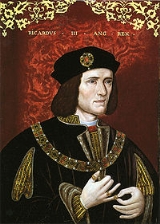
Richard III (2 October 1452 – 22 August 1485) was King
List of the monarchs of the Kingdom of England

The first person to assume the title King of the English was apparently Offa of Mercia, though his power did not survive him. In the 9th century the kings of Wessex, who conquered Kent and Sussex from Mercia in 825, became increasingly dominant over the other kingdoms of England....
 of England
Kingdom of England

The Kingdom of England was, from 927 to 1707, a state in North-West Europe. The Kingdom of England spanned the southern two-thirds of the island of Great Britain and a number of smaller outlying islands?what is today the legal unit of England and Wales....
 from 1483 until his death. He was the last king from the House of York
House of York

The House of York was a branch of the English royal House of Plantagenet, three of whom became List of monarchs of England in the late 15th century....
, and his defeat at the Battle of Bosworth
Battle of Bosworth Field

The Battle of Bosworth or Bosworth Field was House of Lancaster Henry VII of England defeat of House of York Richard III of England, ending the Plantagenet dynasty to begin a new Tudor dynasty....
 marked the culmination of the Wars of the Roses
Wars of the Roses

The Wars of the Roses were a series of dynastic civil wars fought in England between supporters of the Houses of House of Lancaster and House of York....
 and the end of the Plantagenet dynasty. After the death of his brother King Edward IV
Edward IV of England

Edward IV was Kingdom of England from 4 March 1461 until 2 October 1470, and again from 11 April 1471 until his death....
, Richard briefly took responsibility for the safety of Edward's son King Edward V
Edward V of England

Edward V was King of England from 9 April 1483 until his deposition two months later. His reign was dominated by the influence of his uncle Richard, Duke of Gloucester, who succeeded him as Richard III of England....
, with the title of Lord Protector
Lord Protector

Lord Protector is a particular British title for Heads of State, with two meanings at different periods of history.Feudal royal regent ...
. Later, he placed Edward
Edward V of England

Edward V was King of England from 9 April 1483 until his deposition two months later. His reign was dominated by the influence of his uncle Richard, Duke of Gloucester, who succeeded him as Richard III of England....
 and his brother Richard
Richard of Shrewsbury, 1st Duke of York

Richard of Shrewsbury, 1st Duke of York and 1st Duke of Norfolk was the sixth child and second son of Edward IV of England of England and Elizabeth Woodville....
 in the Tower
Tower of London

Her Majesty's Royal Palace and Fortress, more commonly known as the Tower of London , is a historic monument in central London, England, on the north bank of the River Thames....
 (see Princes in the Tower
Princes in the Tower

The Princes in the Tower, Edward V of England and his brother, Richard of Shrewsbury, 1st Duke of York , were two sons of Edward IV of England and Elizabeth Woodville....
) and seized the throne for himself, being crowned on 6 July 1483.

Two large-scale rebellions rose against Richard.


Discussion
Ask a question about 'Richard III of England'
Start a new discussion about 'Richard III of England'
Answer questions from other users
Full Discussion Forum


Recent Posts


Encyclopedia


Richard III (2 October 1452 – 22 August 1485) was King
List of the monarchs of the Kingdom of England

The first person to assume the title King of the English was apparently Offa of Mercia, though his power did not survive him. In the 9th century the kings of Wessex, who conquered Kent and Sussex from Mercia in 825, became increasingly dominant over the other kingdoms of England....
 of England
Kingdom of England

The Kingdom of England was, from 927 to 1707, a state in North-West Europe. The Kingdom of England spanned the southern two-thirds of the island of Great Britain and a number of smaller outlying islands?what is today the legal unit of England and Wales....
 from 1483 until his death. He was the last king from the House of York
House of York

The House of York was a branch of the English royal House of Plantagenet, three of whom became List of monarchs of England in the late 15th century....
, and his defeat at the Battle of Bosworth
Battle of Bosworth Field

The Battle of Bosworth or Bosworth Field was House of Lancaster Henry VII of England defeat of House of York Richard III of England, ending the Plantagenet dynasty to begin a new Tudor dynasty....
 marked the culmination of the Wars of the Roses
Wars of the Roses

The Wars of the Roses were a series of dynastic civil wars fought in England between supporters of the Houses of House of Lancaster and House of York....
 and the end of the Plantagenet dynasty. After the death of his brother King Edward IV
Edward IV of England

Edward IV was Kingdom of England from 4 March 1461 until 2 October 1470, and again from 11 April 1471 until his death....
, Richard briefly took responsibility for the safety of Edward's son King Edward V
Edward V of England

Edward V was King of England from 9 April 1483 until his deposition two months later. His reign was dominated by the influence of his uncle Richard, Duke of Gloucester, who succeeded him as Richard III of England....
, with the title of Lord Protector
Lord Protector

Lord Protector is a particular British title for Heads of State, with two meanings at different periods of history.Feudal royal regent ...
. Later, he placed Edward
Edward V of England

Edward V was King of England from 9 April 1483 until his deposition two months later. His reign was dominated by the influence of his uncle Richard, Duke of Gloucester, who succeeded him as Richard III of England....
 and his brother Richard
Richard of Shrewsbury, 1st Duke of York

Richard of Shrewsbury, 1st Duke of York and 1st Duke of Norfolk was the sixth child and second son of Edward IV of England of England and Elizabeth Woodville....
 in the Tower
Tower of London

Her Majesty's Royal Palace and Fortress, more commonly known as the Tower of London , is a historic monument in central London, England, on the north bank of the River Thames....
 (see Princes in the Tower
Princes in the Tower

The Princes in the Tower, Edward V of England and his brother, Richard of Shrewsbury, 1st Duke of York , were two sons of Edward IV of England and Elizabeth Woodville....
) and seized the throne for himself, being crowned on 6 July 1483.

Two large-scale rebellions rose against Richard. The first, in 1483, was led by staunch opponents of Edward IV and, most notably, Richard's own 'kingmaker
Kingmaker

"Kingmaker" is a term originally applied to the activities of Richard Neville, 16th Earl of Warwick during the Wars of the Roses in England. The term has come to be applied more generally to a person or group that has great influence in a monarchy or political succession, without being a viable candidate....
', Henry Stafford, 2nd Duke of Buckingham
Henry Stafford, 2nd Duke of Buckingham

Henry Stafford, 2nd Duke of Buckingham played a major role in Richard III of England's rise and fall. He is also one of the primary suspects in the disappearance of the Princes in the Tower....
. The revolt collapsed and Buckingham was executed at Salisbury
Salisbury

Salisbury is a city status in the United Kingdom in Wiltshire, England. The city forms the largest part of the Salisbury . It has also been called New Sarum to distinguish it from the original site of settlement at Salisbury, Old Sarum, but this alternative name is not in common use....
, near the Bull's Head Inn. However, in 1485, another rebellion arose against Richard, headed by Henry Tudor, 2nd Earl of Richmond
Henry VII of England

Henry VII was the Kingdom of England and Lordship of Ireland from his usurpation of the crown on 22 August 1485 until his death on 21 April 1509, as the first monarch of the Tudor dynasty....
 (later King Henry VII) and his uncle Jasper. The rebels landed troops and Richard fell in the Battle of Bosworth Field
Battle of Bosworth Field

The Battle of Bosworth or Bosworth Field was House of Lancaster Henry VII of England defeat of House of York Richard III of England, ending the Plantagenet dynasty to begin a new Tudor dynasty....
, then known as Redemore or Dadlington Field, as the last Plantagenet king and the last English king to die in battle. Richard III and Harold II
Harold Godwinson

Harold Godwinson also known as Harold II, was the last Anglo-Saxons King of Kingdom of England before the Norman Conquest of England. Harold reigned from 5 January 1066, until his death at the Battle of Hastings on 14 October of that same year, fighting the Normans invaders, led by William I of England....
 are the only English monarchs to have died in battle.

Childhood

Richard was born at Fotheringhay Castle
Fotheringhay Castle

Fotheringhay Castle was in the village of Fotheringhay 3? miles to the north of the market town of Oundle, Northamptonshire .Richard III of England was born here in 1452 and it was also where Mary I of Scotland was tried and executed in 1587....
, the eighth and youngest, and fourth surviving, son of Richard Plantagenet, 3rd Duke of York
Richard Plantagenet, 3rd Duke of York

Richard Plantagenet, 3rd Duke of York was a member of the English royal family, who served in senior positions in France at the end of the Hundred Years' War, and in England during Henry VI of England's madness....
 (who had been a strong claimant to the throne of King Henry VI
Henry VI of England

Henry VI was Kingdom of England 1422?1461 and then 1470?1471, and King of France as the de jure monarch from 1422 to 1429....
) and Cecily Neville
Cecily Neville

Cecily Neville, Duchess of York was the mother of two Kings: Edward IV of England and Richard III of England.Cecily Neville was a daughter to Ralph Neville, 1st Earl of Westmorland and Joan Beaufort, Countess of Westmorland....
. Richard spent much of his childhood at Middleham Castle
Middleham Castle

Middleham Castle in Wensleydale, in the county of North Yorkshire, was built by Robert Fitz Ralph, 3rd Lord of Middleham & Spennithorne, commencing in 1190....
 in Wensleydale
Wensleydale

Wensleydale is the valley of the River Ure on the east side of the Pennines in North Yorkshire, England.Wensleydale lies in the Yorkshire Dales National Park - it is the only valley in the Dales not currently named after its principal river , but the older name, "Yoredale", can still be seen on some maps....
, under the tutelage of his cousin Richard Neville, 16th Earl of Warwick
Richard Neville, 16th Earl of Warwick

Richard Neville, 16th Earl of Warwick and 6th Earl of Salisbury , known as Warwick the Kingmaker, was an England nobleman, administrator, and military commander....
 (known to history as "The Kingmaker" because of his strong influence on the course of the Wars of the Roses
Wars of the Roses

The Wars of the Roses were a series of dynastic civil wars fought in England between supporters of the Houses of House of Lancaster and House of York....
).

At the time of the death of his father and older brother Edmund
Edmund, Earl of Rutland

Edmund, Earl of Rutland was the fifth child and second surviving son of Richard Plantagenet, 3rd Duke of York and Cecily Neville. He was born in Rouen....
 at the Battle of Wakefield
Battle of Wakefield

The Battle of Wakefield took place at Wakefield, in West Yorkshire, on 30 December 1460, and was one of the major actions of the Wars of the Roses....
, Richard, who was still a boy, was taken into the care of Warwick. While Richard was at Warwick's estate, he developed a close friendship with Francis Lovell, a friendship that would remain strong for the rest of his life. Another child in the household was Warwick's daughter Anne Neville
Anne Neville

Anne Neville was the Princess of Wales as spouse of Edward of Westminster, Prince of Wales, and the List of English consorts as spouse of King Richard III of England....
, whom Richard would later marry.

Twice in his youth Richard was forced to seek refuge in the Low Countries
Low Countries

The Low Countries, the historical region of de Nederlanden, are the country on low-lying land around the river delta of the Rhine, Scheldt, and Meuse River rivers....
 which was part of the realm of the Duchy of Burgundy
Duchy of Burgundy

The Duchy of Burgundy was a feudal territory once existing within the France in the Middle Ages. It roughly conforms to the modern Bourgogne. Existing between 843 and 1477, the Duchy was ruled by a succession of Duke of Burgundy, whose extinction with the death of Charles the Bold in 1477 led to the Duchy being absorbed into the French crown...
. His sister Margaret
Margaret of York

Margaret of York – also by marriage known as Margaret of Burgundy – was a daughter of Richard Plantagenet, 3rd Duke of York and Cecily Neville....
 was the wife of Charles the Bold, Duke of Burgundy. In 1461, the Duchess dispatched her brothers, George and Richard to the Low Countries, beyond the reach of the vengeful Queen Margaret
Margaret of Anjou

Margaret of Anjou was the Queen consort of Henry VI of England from 1445 to 1471 and led the House of Lancaster in the Wars of the Roses. Due to the king's frequent bouts of insanity, Margaret virtually ruled the kingdom in lieu of her husband....
.They returned to England following the defeat of the Lancastrians at the Battle of Towton
Battle of Towton

The Battle of Towton in the Wars of the Roses was the largest and bloodiest ever fought on united kingdom soil, with casualties believed to have been about 28,000 men; only the Battle of Watling Street in AD 60 or 61 was reputed to have more casualties, with 80,000 Britons reported killed....
, and the crowning of King Edward. Richard once again found himself a fugutive along with his brother, the King, in 1471 after the treachery of Warwick who had defected to the side of Margaret of Anjou.

Reign of Edward IV

During the reign of his brother, King Edward IV
Edward IV of England

Edward IV was Kingdom of England from 4 March 1461 until 2 October 1470, and again from 11 April 1471 until his death....
, Richard demonstrated his loyalty and skill as a military commander. He was rewarded with large estates in northern England
Northern England

Northern England, the North, the North of England, or the North Country refers to the parts of England north of an ill-defined line....
, awarded the title Duke of Gloucester
Duke of Gloucester

Duke of Gloucester is a British royal title , often conferred on one of the sons of the reigning monarch. The first four creations were in the Peerage of England, the next in the Peerage of Great Britain, and the last in the Peerage of the United Kingdom; this current creation carries with it the subsidiary titles of Earl of Ulster an...
 and appointed as Governor of the North, becoming the richest and most powerful noble in England and a loyal aide to Edward IV. In contrast, the other surviving brother, George Plantagenet, 1st Duke of Clarence
George Plantagenet, 1st Duke of Clarence

George Plantagenet, Duke of Clarence was the third son of Richard Plantagenet, 3rd Duke of York, and Cecily Neville, and the brother of kings Edward IV of England and Richard III of England....
, was executed by Edward for treason
Treason

In law, treason is the crime that covers some of the more serious acts of loyalty to one's sovereignty or nation. Historically, treason also covered the murder of specific social superiors, such as the murder of a husband by his wife ....
.

Richard controlled the north of England until Edward IV's death.There and especially in the city of York
York

York is a walled city, sited at the confluence of the rivers River Ouse, Yorkshire and River Foss in North Yorkshire, England. The city status in the United Kingdom is noted for its rich heritage and it has played an important role throughout much of its almost 2,000 year existence....
, he was regarded with much love and affection. In 1482 Richard recaptured Berwick-upon-Tweed
Berwick-upon-Tweed

Berwick-upon-Tweed , situated in the county of Northumberland, is the northernmost town in England, on the east coast at the mouth of the River Tweed....
 from the Scots
Scotland

conventional_long_name = ScotlandAlba|common_name= Scotland|image_flag = Flag of Scotland.svg|flag_width = 130px...
, and his administration was regarded as fair and just, endowing universities
University

A university is an institution of higher education and research, which grants academic degrees in a variety of subjects. A university provides both undergraduate education and postgraduate education....
 and making grants to the church.

Accession to the Throne


On the death of Edward IV, on 9 April 1483, the late King's sons (Richard's young nephews), King Edward V
Edward V of England

Edward V was King of England from 9 April 1483 until his deposition two months later. His reign was dominated by the influence of his uncle Richard, Duke of Gloucester, who succeeded him as Richard III of England....
, aged 12, and Richard, Duke of York
Richard, Duke of York

Richard, Duke of York may refer to:*Richard Plantagenet, 3rd Duke of York , father of Edward IV of England and Richard III of England*Richard of Shrewsbury, 1st Duke of York , second son of Edward IV of England, one of the Princes in the Tower...
, aged 9, were next in the order of succession
Order of succession

An order of succession is a formula or algorithm that determines who inherits an office upon the death, resignation, or removal of its current occupant....
. Richard, however, had the king's guardian, Anthony Woodville, 2nd Earl Rivers
Anthony Woodville, 2nd Earl Rivers

Anthony Rivers, 2nd Earl Rivers was an English nobleman, courtier, and writer....
 (brother of Elizabeth Woodville
Elizabeth Woodville

Elizabeth Woodville or Wydeville was the Queen consort of King Edward IV of England from 1464 until his death in 1483....
, Edward IV's Queen Consort) and other advisors arrested and taken to Pontefract Castle
Pontefract Castle

Pontefract Castle is a castle in the town of Pontefract, in West Yorkshire, England. It was the site of the demise of Richard II of England, and later the place of a series of famous sieges during the English Civil War...
, where they were later executed, allegedly for planning to assassinate
Assassination

Assassination is the targeted killing of a public figure. Assassinations may be prompted by ideology, politics, or military reasons. Additionally, assassins may be motivated by contract killing, revenge, or celebrity or may be mental disorder....
 Edward V. He then took Edward and his younger brother to the Tower of London
Tower of London

Her Majesty's Royal Palace and Fortress, more commonly known as the Tower of London , is a historic monument in central London, England, on the north bank of the River Thames....
.

On 22 June 1483, outside St Paul's Cathedral
St Paul's Cathedral

St Paul's Cathedral is the Anglicanism cathedral on Ludgate Hill, in the City of London, and the seat of the Bishop of London. The present building dates from the 17th century and is generally reckoned to be London's fifth St Paul's Cathedral, although the number is higher if every major medieval reconstruction is counted as a new cathedr...
, a statement was read out on behalf of Richard declaring for the first time that he was taking the throne for himself on the grounds that Edward IV's marriage had been illegitimate and that, in consequence, the true heir to the throne was Richard and not Edward V. This proclamation was then supported by a bill
Titulus Regius

Titulus Regius is a statute of the Parliament of England, issued in 1483, by which the title of King of England was given to Richard III of England....
 passed by Parliament on the evidence of a bishop who testified to having married Edward to Lady Eleanor Butler
Lady Eleanor Talbot

Lady Eleanor Talbot was a daughter of John Talbot, 1st Earl of Shrewsbury. Her alleged pre-contract of marriage with King Edward IV of England was of great significance to the final fate of the Plantagenet dynasty and outcome of the Wars of the Roses....
, who was still living when Edward married Elizabeth Woodville.

On 6 July 1483, Richard was crowned at Westminster Abbey
Westminster Abbey

The Collegiate Church of St Peter at Westminster, which is almost always referred to popularly and informally as Westminster Abbey, is a large, mainly Gothic architecture Church , in Westminster, London, just to the west of the Palace of Westminster....
.

Although Richard III is popularly supposed to have killed Edward V and his brother, there is some controversy among historians about the actual circumstances of the boys' deaths: see Princes in the Tower
Princes in the Tower

The Princes in the Tower, Edward V of England and his brother, Richard of Shrewsbury, 1st Duke of York , were two sons of Edward IV of England and Elizabeth Woodville....
 for full coverage, and possible reasons for the support for Richard's accession.

Death at the Battle of Bosworth

On 22 August 1485, Richard met the Lancastrian forces of Henry Tudor at the Battle of Bosworth Field
Battle of Bosworth Field

The Battle of Bosworth or Bosworth Field was House of Lancaster Henry VII of England defeat of House of York Richard III of England, ending the Plantagenet dynasty to begin a new Tudor dynasty....
. He was astride his white courser.Richard's host outnumbered Henry's almost two to one. During the battle Richard was abandoned by Lord Thomas Stanley, 1st Earl of Derby
Thomas Stanley, 1st Earl of Derby

Thomas Stanley, 1st Earl of Derby, Order of the Garter , was King of Mann, an England nobleman and stepfather to King Henry VII of England.He was the son of Thomas Stanley, 1st Baron Stanley, and Joan Gousell, daughter of Sir Robert Goushill and Elizabeth FitzAlan, daughter of Richard Fitzalan, 11th Earl of Arundel-a descendant of King He...
, Sir William Stanley
William Stanley (Battle of Bosworth)

Sir William Stanley was the younger brother of Thomas Stanley, 1st Earl of Derby. Stanley fought with his troops in several battles of the Wars of the Roses....
, and Henry Percy, 4th Earl of Northumberland
Henry Percy, 4th Earl of Northumberland

Henry Percy, 4th Earl of Northumberland, son of Henry Percy, 3rd Earl of Northumberland and his wife Eleanor Poynings, daughter of Richard Poynings, Lord Poynings....
. The switching of sides by the Stanleys severely depleted the strength of Richard's army and had a material effect on the outcome of the battle. Also the death of John Howard, Duke of Norfolk, his close companion, appeared to have had a demoralising effect on Richard and his men. Accounts note that Richard fought bravely and ably during the battle, unhorsing Sir John Cheney, a well-known champion, killing Henry's standard bearer Sir William Brandon and nearly reaching Henry himself before being finally surrounded and killed. Tradition holds that his final words were "treason, treason, treason, treason, treason".

Richard's naked body was then paraded through the streets before being buried at Greyfriars Church, Leicester. According to one tradition, during the Dissolution of the Monasteries
Dissolution of the Monasteries

The Dissolution of the Monasteries, sometimes referred to as the Suppression of the Monasteries, denotes the administrative and legal processes between 1536 and 1541 by which Henry VIII of England disbanded all monastery, nunnery and friary in England, Wales and Ireland; appropriated their income, disposed of their assets and provided f...
 his body was thrown into the nearby River Soar
River Soar

The River Soar is a tributary of the River Trent in the England East Midlands.It rises near Hinckley in Leicestershire and is joined by the River Sence near Enderby, Leicestershire before flowing through Leicester , Barrow-on-Soar, beside Loughborough and Kegworth, before joining the Trent near Ratcliffe-on-Soar in Nottinghamshire, and th...
, although other evidence suggests that his burial site may currently be under a car park in Leicester . There is currently a memorial plaque on the site of the Cathedral where he may have once been buried.

According to another tradition, Richard consulted a seer
Seer

Seer or Seers or SEER may refer to:Predicting the future* A Clairvoyance or a prophet* The Seer , a fictional character on the television series Charmed...
 in the town of Leicester
Leicester

Leicester is a city status in the United Kingdom and unitary authority area in the East Midlands of England. It is the county town of Leicestershire....
 before the battle and the seer foretold that "where your spur should strike on the ride into battle, your head shall be broken on the return." On the ride into battle his spur struck the bridge stone of the Bow Bridge; legend has it that, as his corpse was being carried from the battle over the back of a horse, his head struck the same stone and was broken open.

Henry Tudor succeeded Richard to become Henry VII
Henry VII of England

Henry VII was the Kingdom of England and Lordship of Ireland from his usurpation of the crown on 22 August 1485 until his death on 21 April 1509, as the first monarch of the Tudor dynasty....
, and cemented the succession by marrying the Yorkist heiress, Elizabeth of York
Elizabeth of York

Elizabeth of York was the daughter, sister, niece, wife and mother of Kings of England. She was List of English consorts as spouse of King Henry VII of England, whom she married in 1486....
, daughter of King Edward IV and niece of King Richard III
Richard III

Richard III may refer to:*Richard III of England**Richard III , a play by William Shakespeare***Richard III , a USA film***Richard III , a UK/USA film starring Ian McKellen...
. whom he married in 1472]]

Succession

Following the decisive Yorkist victory over the Lancastrians at the Battle of Tewkesbury
Battle of Tewkesbury

The Battle of Tewkesbury in Gloucestershire, which took place on 4 May 1471, completed one phase of the Wars of the Roses.It put a temporary end to House of Lancaster hopes of regaining the throne of England....
, Richard had married the younger daughter of the Earl of Warwick, Anne Neville
Anne Neville

Anne Neville was the Princess of Wales as spouse of Edward of Westminster, Prince of Wales, and the List of English consorts as spouse of King Richard III of England....
 on 12 July 1472. Anne's first husband had been Edward of Westminster
Edward of Westminster

Edward of Westminster, also known as Edward of Lancaster , was the only son of King Henry VI of England and Margaret of Anjou. He was killed at the Battle of Tewkesbury, making him the only Prince of Wales ever to die in battle....
 (d 1471), son of Henry VI.

Richard and Anne had one son, Edward Plantagenet (also known as Edward of Middleham, 1473 – 9 April 1484), who died not long after being created Prince of Wales
Prince of Wales

Prince of Wales is a title traditionally granted to the Heir Apparent to the reigning monarch of the United Kingdom . The current Prince of Wales is Charles, Prince of Wales, the eldest son of Elizabeth II of the United Kingdom....
. Richard also had a number of illegitimate children, including John of Gloucester
John of Gloucester

John of Gloucester was an illegitimate son of Richard III of England. John is so called because his father was Duke of Gloucester at the time of his birth....
 (1470-1491),executed by King Henry VII, and a daughter named Katharine (d.1487) who married William Herbert, 2nd Earl of Pembroke
William Herbert, 2nd Earl of Pembroke

William Herbert, 2nd Earl of Pembroke , was the son of William Herbert, 1st Earl of Pembroke and Anne Devereux. His maternal grandparents were Walter Devereux , Lord Chancellor of Ireland and Elizabeth Merbury....
. It has been thought that their mother may have been one Katherine Haute, who is mentioned in household records. Both of these children survived Richard. Neither apparently left any descendants. The mysterious Richard Plantagenet
Richard Plantagenet (Richard of Eastwell)

Richard Plantagenet or Richard of Eastwell is known only from Francis Peck's Desiderata Curiosa, which indicates that the reclusive bricklayer may have been a son of Richard III of England, the last Plantagenet King of England....
 is also a possible offspring of Richard III as is Richard the Master- Builder .

At the time of his last stand against the Lancastrians, Richard was a widower without a legitimate son. After his son's death, he had initially named his nephew, Edward, Earl of Warwick, Clarence's young son and the nephew of Queen Anne Neville, as his heir. After Anne's death, however, Richard named as his heir another nephew, John de la Pole, Earl of Lincoln, the son of his older sister Elizabeth
Elizabeth of York, Duchess of Suffolk

Elizabeth of York, Duchess of Suffolk was thesixth child and third daughter of Richard Plantagenet, 3rd Duke of York and Cecily Neville.She was a younger sister of Anne of York, Duchess of Exeter, Edward IV of England and Edmund, Earl of Rutland....
.

Legacy

Richard's death at Bosworth resulted in the end of the Plantagenet dynasty, which had ruled England since the succession of Henry II
Henry II of England

Henry II, called Curtmantle ruled as King of England , Count of Anjou, Duke of Normandy, Duke of Aquitaine, Duke of Gascony, Count of Nantes, Lord of Ireland and, at various times, controlled parts of Wales, Scotland and western France....
 in 1154. The last male Plantagenet, Edward, Earl of Warwick
Edward Plantagenet, 17th Earl of Warwick

Edward Plantagenet, 17th Earl of Warwick and 7th Earl of Salisbury was the son of George Plantagenet, 1st Duke of Clarence and a potential claimant to the English throne during the reigns of both Richard III of England and his successor, Henry VII of England ....
 (son of Richard III's brother Clarence) was executed by Henry VII in 1499.

Richard's Council of the North
Council of the North

The Council of the North was an administrative body originally set up in 1485 by king Richard III of England, the last House of York monarch to hold the Crown of England; its intention was to improve government control and economic prosperity, to benefit the entire area of Northern England....
 greatly improved conditions for northern England
Northern England

Northern England, the North, the North of England, or the North Country refers to the parts of England north of an ill-defined line....
, as commoner
Commoner

In British law, a commoner is someone who is neither the British monarchy nor a peerage. Therefore, any member of the British Royal Family who is not a peer, such as Prince William of Wales or Anne, Princess Royal, is a commoner, as is any member of a peer's family, including someone who holds only a courtesy title, such as the Earl of Arund...
s of that region were formerly without any substantial economic activity independent of London
London

London is the capital of both England and the United Kingdom, and the most populous municipality in the European Union. An important settlement for two millennia, History of London goes back to its founding by the Roman Empire....
. Its descendant position was Secretary of State for the Northern Department
Secretary of State for the Northern Department

The Secretary of State for the Northern Department was a position in the Cabinet of the government of the Kingdom of Great Britain up to 1782....
.

Controversy and reputation

Much that was previously considered 'fact' about Richard III has been rejected by modern historians. For example, Richard was represented by Tudor writers as being physically deformed, which was regarded as evidence of an evil character. However, the withered arm, limp and crooked back of legend are nowadays believed to be fabrications, possibly originating from the questionable history attributed to Thomas More
Thomas More

Saint Thomas More was an English lawyer, author, and statesman who in his lifetime gained a reputation as a leading Renaissance humanist scholar, and occupied many public offices, including Lord Chancellor ....
, which made a deep impression upon William Shakespeare
William Shakespeare

William Shakespeare was an English people poet and playwright, widely regarded as the greatest writer in the English language and the world's preeminent dramatist....
, and was long taken as the authoritative history of events. The accusations against his moral character have proven more resistant to refutation than the slanders against his physical looks.

The Richard III Society was established in the 20th century and has gathered considerable research material about his life and reign. Its aim is summed up by its Patron, the present Richard, Duke of Gloucester
Prince Richard, Duke of Gloucester

Prince Richard, Duke of Gloucester is a member of the British Royal Family, the youngest grandchild of George V of the United Kingdom and Mary of Teck....
:

"… the purpose and indeed the strength of the Richard III Society derive from the belief that the truth is more powerful than lies - a faith that even after all these centuries the truth is important. It is proof of our sense of civilised values that something as esoteric and as fragile as reputation is worth campaigning for."

The American Branch of the Richard III Society carries out its own review of all the suspects in the case of Richard III, in the on-line library "Whodunit?".

The Society of Friends of King Richard III was also set up in the 20th century in order to rehabilitate Richard and to honour his memory. The society is based in the city of York
York

York is a walled city, sited at the confluence of the rivers River Ouse, Yorkshire and River Foss in North Yorkshire, England. The city status in the United Kingdom is noted for its rich heritage and it has played an important role throughout much of its almost 2,000 year existence....
, where following his death in 1485 it was proclaimed, that "King Richard, late reigning mercifully over us, was.... piteously slain and murdered, to the great heaviness of this city".

Richard III was found not guilty in a mock trial presided over by three Justices of the United States Supreme Court in 1997. Chief Justice William H. Rehnquist and Associate Justices Ruth Bader Ginsberg and Stephen G. Breyer, in a 3-0 decision, ruled that the prosecution had not met the burden of proof that "it was more likely than not" that the Princes in the Tower had been murdered; that the bones found in 1674 in the Tower were those of the Princes; and that Richard III had ordered or was complicitous in their deaths.

Popular culture

Novelists Horace Walpole, Josephine Tey
Josephine Tey

Josephine Tey was one of many pseudonyms used by Elizabeth Mackintosh a Scottish people author best known for her mystery novels....
 and Valerie Anand
Valerie Anand

Valerie Anand is a British author of historical fiction....
 are among writers who have argued strongly that King Richard was innocent of the death of the Princes. Sharon Kay Penman
Sharon Kay Penman

Sharon Kay Penman is an United States historical novelist, of Anglo-Irish ancestry. She is well known for her novels and mysteries about England and Wales royalty during the Middle Ages....
, in her historical novel The Sunne in Splendour
The Sunne in Splendour

The Sunne in Splendour is an historical novel, the first one written by Sharon Kay Penman.The story begins in 1459 with the protagonist, the future Richard III of England, as a young boy, and ends in 1485 with his defeat in battle....
, also portrays Richard III as a just and honest ruler and attributes the death of the Little Princes to the Duke of Buckingham. In the mystery novel The Murders of Richard III by Elizabeth Peters (1974) the central plot revolves around the debate whether Richard III was guilty of these as well as other crimes. A sympathetic portrayal of Richard III is given in The Founding, the first volume in The Morland Dynasty
The Morland Dynasty

The Morland Dynasty is a series of historical novels by author Cynthia Harrod-Eagles. There are currently thirty books in the series. The first book begins in 1434 and features the Wars of the Roses; the most recent book begins in 1916 and deals with the Battle of the Somme....
, a series of historical novels by author Cynthia Harrod-Eagles.

Perhaps the best known film adaptation of Shakespeare's play Richard III
Richard III (play)

Richard III is a Shakespearean history play by William Shakespeare, believed to have been written in approximately 1591, depicting the Machiavellian rise to power and subsequent short reign of Richard III of England....
 is the 1955 version directed and produced by Sir Laurence Olivier
Laurence Olivier

Laurence Kerr Olivier, Baron Olivier, Order of Merit was an English people Stage actor, Theatre director, and Theatrical producer. He is one of the most famous and revered actors of the 20th century, along with his contemporaries John Gielgud, Peggy Ashcroft and Ralph Richardson....
, who also played the lead role. Also notable is the 1995 film version starring Sir Ian McKellen
Ian McKellen

Sir Ian Murray McKellen, Order of the Companions of Honour, Order of the British Empire , is an England actor of theatre and film, the recipient of the Tony Award and two Academy Awards nominations....
, set in a fictional 1930s fascist England, and Looking for Richard
Looking for Richard

Looking for Richard is a 1996 documentary film, the first film directed by Al Pacino. The film is both a performance of selected scenes of William Shakespeare's Richard III and a broader examination of Shakespeare's continuing role and relevance in popular culture....
, a 1996 documentary film directed by Al Pacino
Al Pacino

Alfredo James "Al" Pacino is an United States film and theatre actor and Film director, widely considered to be one of the most notable and influential actors of his time....
 who plays the title character as well as himself.

In spite of having died aged only 32, Richard is often depicted as being considerably older. Basil Rathbone
Basil Rathbone

Basil Rathbone, Military Cross , was a South African Republic England actor most famous for his portrayal of Sherlock Holmes and of suave villains in such swashbuckler films as The Mark of Zorro , Captain Blood , and The Adventures of Robin Hood ....
 and Peter Cook
Peter Cook

Peter Edward Cook was an English people satirist, writer and comedian. He is widely regarded as the leading figure in the British satire boom of the 1960s....
 were both 46 when they played him, Laurence Olivier
Laurence Olivier

Laurence Kerr Olivier, Baron Olivier, Order of Merit was an English people Stage actor, Theatre director, and Theatrical producer. He is one of the most famous and revered actors of the 20th century, along with his contemporaries John Gielgud, Peggy Ashcroft and Ralph Richardson....
 was 48, Vincent Price
Vincent Price

Vincent Leonard Price, Jr. was an United States film actor, remembered for his distinctive voice, his 6-foot 4-inch stature and serio-comic attitude in a series of horror films done in the latter part of his career....
 was 51, Ian McKellen was 56, and Pacino also 56 (in the 1996 film version, although he was just 39 when he played him on Broadway in 1979).

Richard III appears in the 2002 List of "100 Great Britons" (sponsored by the BBC and voted for by the public), alongside such others as David Beckham
David Beckham

David Robert Joseph Beckham Order of the British Empire is an England association football who currently plays in midfielder for Italy Serie A club A.C....
 and Johnny Rotten. The BBC History Magazine lists him under "doubtful entrants, based on special interest lobbying
Lobbying

Lobbying is the practice of influencing decisions made by government. It includes all attempts to influence legislators and officials, whether by other legislators, constituent or organized groups....
 or 'cult' status"
Cult following

A cult following is a group of fan devoted to a specific area of pop culture. These dedicated followings are usually relatively small, and often pertain to items that don't have broad mainstream appeal....
, and comments: "On the list owing to the Ricardian lobby, but a minor monarch".

In the television comedy series The Black Adder
The Black Adder

The Black Adder is the first series of the BBC situation comedy Blackadder, written by Richard Curtis and Rowan Atkinson, directed by Martin Shardlow and produced by John Lloyd ....
, Richard III is portrayed (by Peter Cook) in an alternative version of history as a doting, kindly man who treats the princes in the tower with affection. He is unintentionally killed by the titular "Black Adder". His death leads, not to the crowning of Henry Tudor, but to the rule of Richard of Shrewsbury, 1st Duke of York
Richard of Shrewsbury, 1st Duke of York

Richard of Shrewsbury, 1st Duke of York and 1st Duke of Norfolk was the sixth child and second son of Edward IV of England of England and Elizabeth Woodville....
, who in the television series has grown up to be Edmund's father.

Titles, styles, honours and arms


Arms

As Duke of Gloucester, Richard had use of the coat of arms of the kingdom, differenced by a label argent of three points ermine, on each point canton gules. As sovereign, he had use of the arms of the kingdom undifferenced. His motto was "Loyaulte me lie," "Loyalty binds me."

Ancestry


See also

  • Cultural depictions of Richard III of England
    Cultural depictions of Richard III of England

    Richard III of England has been depicted in popular culture many times....
  • Richard III Museum
    Richard III Museum

    The Richard III Museum is located in the tallest of the four gatehouses, Monk Bar, in the historical city walls of York, England. It presents to visitors the life of Richard III of England, the last king of the Plantagenet dynasty....
    , York


Bibliography

Source material on all aspects of Richard's reign is neatly and impartially brought together by Keith Dockray in Richard III: A Reader in History (Sutton, 1988).
  • The Trial of Richard III by Richard Drewett & Mark Redhead
    Mark Redhead

    British producer, director, and occasional actor. He was the producer of Bloody Sunday and an executive producer of God on Trial. He has been nominated for several awards and won a BAFTA TV Award in 2000 for The Murder of Stephen Lawrence....
     (Sutton, 1984) (ISBN 0-86299-198-6)
  • Royal Blood: Richard III and the mystery of the princes by Bertram Fields
    Bertram Fields

    Bertram Fields is a Harvard-trained American lawyer famous for his work in the field of entertainment law; he has represented many of the leading studios, as well as individual celebrities including The Beatles, Warren Beatty, James Cameron, Mike Nichols, Joel Silver, Tom Cruise, Dustin Hoffman, and John Travolta....
     (HarperCollins, ©1998) (ISBN 0-06-039269-X)
  • Richard III: The Road to Bosworth Field by Peter W. Hammond & Anne Sutton ( Constable, 1985) (ISBN 0-09-466160-X)
  • Richard the Third by Michael Hicks
    Michael Hicks

    Michael Hicks is an England historian, specialising on the history of Late Middle Ages England, in particular the Wars of the Roses. Hicks studied with C....
     (Tempus, 2001) (ISBN 0-7524-2302-9)
  • Richard III: A Study in Service by Rosemary Horrox (Cambridge University Press, 1991) (ISBN 0-521-40726-5)
  • Richard III and the North edited by Rosemary Horrox (University of Hull, 1986) (ISBN 0-85958-066-0)
  • Bosworth 1485 by Michael K. Jones (Tempus Publishing, 2002) (ISBN 0-7524-2334-7)
  • Richard III: The Great Debate edited by Paul Murray Kendall
    Paul Murray Kendall

    Paul Murray Kendall was an American academic and historian. He was born in Philadelphia, Pennsylvania, Pennsylvania. He graduated from Frankford High School in 1928....
     (W.W. Norton, 1992) (ISBN 0-393-00310-8)
  • Richard the Third by Paul Murray Kendall
    Paul Murray Kendall

    Paul Murray Kendall was an American academic and historian. He was born in Philadelphia, Pennsylvania, Pennsylvania. He graduated from Frankford High School in 1928....
     (W.W. Norton, 1956) (ISBN 0-393-00785-5)
  • The Betrayal of Richard III by V.B. Lamb (A. Sutton, 1991) (ISBN 0-86299-778-X)
  • Richard III and the Princes in the Tower by A.J. Pollard (St Martin's Press, 1991) (ISBN 0-312-06715-1)
  • Good King Richard? by Jeremy Potter (Constable, 1983) (ISBN 0-09-464630-9)
  • Richard III by Charles Ross
    Charles Ross (historian)

    Charles Derek Ross was an England historian of the Late Middle Ages, specialising on the Wars of the Roses. He was Professor of Medieval History at the University of Bristol until his death in 1986, when he was killed by an intruder in his own home....
     (Methuen, 1981) (ISBN 0-413-29530-3)
  • Richard III: England's Black Legend by Desmond Seward (Penguin Books, 1997) (ISBN 0-14-026634-8)
  • The Coronation of Richard III: The Extant Documents by Anne Sutton & Peter W. Hammond (St Martin's Press, 1984) (ISBN 0312169795)
  • Richard III's Books by Anne Sutton & Livia Visser-Fuchs (Sutton Pub, 1997) (ISBN 0-7509-1406-8)
  • The Princes in the Tower by Alison Weir
    Alison Weir (historian)

    Alison Weir is a United Kingdom writer of history books, mostly in the form of biography about British royalty.She currently lives in Surrey, England, with her husband and two children, John and Kate....
     (Ballantine, 1995) (ISBN 0-345-39178-0)
  • Joan of Arc and Richard III: sex, saints, and government in the Middle Ages by Charles Wood
    Charles Wood

    Charles Wood may refer to:*Charles Wood, 2nd Earl of Halifax , British politician and peer*Charles Wood, 3rd Earl of Halifax , British peer*Charles Wood, 1st Viscount Halifax , English politician...
     (Oxford University Press
    Oxford University Press

    Oxford University Press is a publisher and a department of the University of Oxford in England. It is the largest university press in the world, being larger than all the American university presses combined with Cambridge University Press....
    ) (ISBN 0-19-506951-X)
  • History of the English Speaking Peoples by Winston Churchill
    Winston Churchill

    Sir Winston Leonard Spencer-Churchill, Order of the Garter, Order of Merit, Order of the Companions of Honour, Territorial Decoration, Fellow of the Royal Society, Her Majesty's Most Honourable Privy Council, Queen's Privy Council for Canada was a Politics of the United Kingdom known chiefly for his leadership of the United King...
    , Vol. 1, The Birth of Britain


External links

  • Information on Richard and Bosworth
  • about his final resting place
  • , with commentary by Pamela Tudor-Craig
    Pamela Tudor-Craig

    Pamela Tudor-Craig, Lady Wedgwood Fellow of the Society of Antiquaries is a UK mediaeval art historian. Outside of academia she is best known for her contribution to the 1986 TV series The Secret Life of Paintings and its accompanying book of the same name with Richard Foster....