
All Topics  
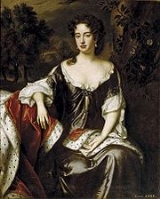
Anne of Great Britain


   Email Print
   Bookmark   Link


Anne of Great Britain


Anne became Queen of EnglandEngland

England is the largest and most populous constituent country of the United Kingdom....
, Scotland and IrelandFacts About Kingdom of Ireland

n>Kingdom of IrelandThe Kingdom of Ireland was the name given to the English-ruled Irish state in 1541, by an act of...
 on 8 March 1702, succeeding William III of England and II of ScotlandWilliam III of England

William III of England was a Dutch aristocrat and a Protestant Prince of Orange from his birth, Stadtholder of the United N...
. Her Roman Catholic father, James II and VIIJames II of England

James VII of Scotland and James II of England became King of Scots, King of England, and King of Ireland on 6 February...
, was forcibly deposed in 1688/9; her brother-in-law and her sister then became joint monarchs as William III & II and Mary IIMary II of England

Mary II reigned as Queen of England and Ireland from 13 February 1689, and as Queen of Scotland from 11 April 1689 until h...
, the only such case in British history. After Mary's death in 1694, William continued as sole monarch until his own death in 1702.

On 1 May 1707, under the Acts of Union 1707Acts of Union 1707

The Acts of Union were a pair of Acts of Parliament passed in 1706 and 1707 by, respectively, the Parliament of England and...
, England and Scotland were united as a single stateState

A state is a set of institutions that possess the authority to make the rules that govern the people in one or more societie...
, the Kingdom of Great BritainKingdom of Great Britain

Kingdom of Great Britain| align="center" colspan="2"|...
. Anne became its first sovereign, while continuing to hold the separate crown of Queen of Ireland. Anne reigned for twelve years until her death in August 1714.

Anne's life was marked by many crises, both personally and relating to succession of the Crown and religious polarisation.


Discussion
Ask a question about 'Anne of Great Britain'
Start a new discussion about 'Anne of Great Britain'
Answer questions from other users
Full Discussion Forum


Recent Posts


Timeline

1665   Born

1701   The English Parliament passes the Act of Settlement 1701, passing the crown of Great Britain to Sophia, Electress of Hanover and her descendants on the death of Princess Anne, the heiress presumptive to the throne after her brother in law, King William III.

1708   Queen Anne withholds Royal Assent from a militia Bill, the last time a British monarch vetoes legislation.

1714   Died


Quotations


Here thou, great Anna! whom three realms obey,Dost sometimes counsel take - and sometimes tea.

Alexander Pope, "The Rape of the Lock," Canto III, line 7


Encyclopedia


Anne became Queen of EnglandEngland

England is the largest and most populous constituent country of the United Kingdom....
, Scotland and IrelandFacts About Kingdom of Ireland

n>Kingdom of IrelandThe Kingdom of Ireland was the name given to the English-ruled Irish state in 1541, by an act of...
 on 8 March 1702, succeeding William III of England and II of ScotlandWilliam III of England

William III of England was a Dutch aristocrat and a Protestant Prince of Orange from his birth, Stadtholder of the United N...
. Her Roman Catholic father, James II and VIIJames II of England

James VII of Scotland and James II of England became King of Scots, King of England, and King of Ireland on 6 February...
, was forcibly deposed in 1688/9; her brother-in-law and her sister then became joint monarchs as William III & II and Mary IIMary II of England

Mary II reigned as Queen of England and Ireland from 13 February 1689, and as Queen of Scotland from 11 April 1689 until h...
, the only such case in British history. After Mary's death in 1694, William continued as sole monarch until his own death in 1702.

On 1 May 1707, under the Acts of Union 1707Acts of Union 1707

The Acts of Union were a pair of Acts of Parliament passed in 1706 and 1707 by, respectively, the Parliament of England and...
, England and Scotland were united as a single stateState

A state is a set of institutions that possess the authority to make the rules that govern the people in one or more societie...
, the Kingdom of Great BritainKingdom of Great Britain

Kingdom of Great Britain| align="center" colspan="2"|...
. Anne became its first sovereign, while continuing to hold the separate crown of Queen of Ireland. Anne reigned for twelve years until her death in August 1714.

Anne's life was marked by many crises, both personally and relating to succession of the Crown and religious polarisation. Because she died without surviving issue, Anne was the last monarch of the House of StuartHouse of Stuart

The House of Stuart or Stewart was a royal house of the Kingdom of Scotland, later of the Kingdom of England, and fina...
. She was succeeded by her second cousin, George IGeorge I of Great Britain

George I was Elector of Hanover from 23 January 1698, and King of Great Britain and King of Ireland from 1 August 1714, u...
, of the House of HanoverHouse of Hanover

The House of Hanover were a German royal dynasty of Lombard descent which succeeded the House of Stuart as kings of Great Br...
, who was a descendant of the Stuarts through his maternal grandmother, ElizabethElizabeth Stuart

Elizabeth or Elisabeth Stuart may refer to:...
, daughter of James VI & IJames I of England

James VI of Scotland/James I of England and Ireland was King of England, King of Scots, and King of Ireland and was the firs...
.

Early life

Childhood

Anne was born at St. James's PalaceSt. James's Palace

St. James's Palace is one of London's oldest and most historic palaces....
, LondonLondon

London is the capital city of England and of the United Kingdom....
, the second daughter of James, Duke of York (afterwards James II), and his first wife, the Lady Anne Hyde. Her paternal uncle was King Charles IICharles II of England

Charles II was the King of England, King of Scots, and King of Ireland from 30 January 1649 or 29 May 1660 until his deat...
 and her older sister was the future Mary II. Anne and Mary were the only children of the Duke and Duchess of York to survive into adulthood. Anne suffered as a child from an eye infection; for medical treatment, she was sent to FranceFrance

France, officially the French Republic, is a country whose metropolitan territory is located in Western Europe and whi...
. She lived with her grandmother, Henrietta Maria of FranceHenrietta Maria of France

Queen Henrietta Maria was Queen Consort of England, Scotland and Ireland through her marriage to Charles I....
, and on the latter's death with her aunt, Henrietta Anne, Duchesse d'OrléansHenrietta Anne Stuart

Henrietta Anne, in French Henriette d'Angleterre, sometimes known familiarly as Minette, was the youngest daughter...
. Anne returned from France in 1670. In about 1673, Anne made the acquaintance of Sarah Jennings, who became her close friend and one of her most influential advisors. Jennings later married John ChurchillJohn Churchill, 1st Duke of Marlborough Overview

John Churchill, 1st Duke of Marlborough, KG, PC was an English military officer during the War of the Spanish Succession....
 (the future Duke of Marlborough), in course of time Anne's most important general.

In 1673 Anne's father's conversion to Roman Catholicism became public. On the instructions of Charles IICharles II of England

Charles II was the King of England, King of Scots, and King of Ireland from 30 January 1649 or 29 May 1660 until his deat...
, however, Anne and her sister Mary were raised as strict Protestants. On 28 July 1683, Anne married the Protestant Prince George of Denmark, brother of the Danish King Christian VChristian V of Denmark Summary

Christian V, was king of Denmark and Norway from 1670-1699....
 (and her third cousin through Frederick IIFrederick II of Denmark

Frederick II , King of Denmark and Norway from 1559 until his death....
), an unpopular union but one of great domestic happiness. Sarah Churchill became Anne's Lady of the BedchamberLady of the Bedchamber Overview

This is an incomplete list of those who have served as Lady of the Bedchamber in the British Royal Household....
, and, by Anne's desire to mark their mutual intimacy and affection, all deference due to her rank was abandoned and the two ladies called each other Mrs. Morley and Mrs. Freeman.

Accession of James II

When Charles II died in 1685 (converting to Roman Catholicism on his deathbed), Anne's father became king as James II. But James was not well-received by the English people, concerned about his CatholicismCatholicism

As a Christian ecclesiastical term, Catholic - from the Greek adjective , meaning "general" or "universal" - is described in ...
. Public alarm increased when James's second wife, Mary of ModenaMary of Modena

Mary of Modena was the queen consort of King James II of England and VII of Scotland....
, gave birth to a son on 10 June 1688, and a Roman Catholic dynasty became all the more likely. Anne was not present on the occasion, having gone to Bath, and this gave rise to a belief that the child was spurious; but it is most probable that James's desire to exclude all Protestants from affairs of state was the real cause. "I shall never now be satisfied," Anne wrote to her sister Mary, "whether the child be true or false. It may be it is our brother, but God only knows ... one cannot help having a thousand fears and melancholy thoughts, but whatever changes may happen you shall ever find me firm to my religion and faithfully yours."

Princess Anne's brother-in-law and sister, William and MaryWilliam and Mary

The phrase William and Mary usually refers to the joint sovereignty over the Kingdom of England and the Kingdom of Scotland ...
, subsequently invaded England to dethrone the unpopular James II in the Glorious RevolutionGlorious Revolution

The Glorious Revolution was the overthrow of James II of England in 1688 by a union of Parliamentarians and the Dutch stadth...
.

The "Glorious Revolution"

Forbidden by James to pay Mary a projected visit in the spring of 1688, Anne corresponded with her and was no doubt aware of William's plans to invade. On the advice of the Churchills—Anne's conduct during this period was probably influenced a great deal by them—she refused to show any sympathy for James after William landed in November and wrote instead to William, declaring her approval of his action. Churchill abandoned the king on the 24th of that month, Prince George on the 25th, and when James returned to London on the 26th, he found that Anne and her lady-in-waiting had done likewise the previous night. He put the women under house arrest in the Palace of Whitehall. However, escaping from Whitehall by a back staircase they put themselves under the care of the bishop of London, spent one night in his house, and subsequently arrived on the 1st of December at Nottingham, where the princess first made herself known and appointed a council. Thence she travelled to Oxford, where she met Prince George, in triumph, escorted by a large company. Like Mary, she was reproached for showing no concern at the news of the king's flight, but her justification was that "she never loved to do anything that looked like an affected constraint." She returned to London on 19 December, where she was at once visited by her brother-in-law WilliamWilliam III of England

William III of England was a Dutch aristocrat and a Protestant Prince of Orange from his birth, Stadtholder of the United N...
.

In 1689, a Convention ParliamentConvention Parliament

The term Convention Parliament has been applied to three different English Parliaments, of 1399, 1660 and 1689....
 assembled and declared that James had abdicated the realm when he attempted to flee, and that the Throne was therefore vacant. The Crown was offered to Mary, but accepted jointly by William and MaryFacts About Mary II of England

Mary II reigned as Queen of England and Ireland from 13 February 1689, and as Queen of Scotland from 11 April 1689 until h...
, who thereafter ruled as the only joint monarchs in British history. The Bill of Rights 1689Bill of Rights 1689

The Bill of Rights 1689 is an Act of the Parliament of England with the long title An Act Declaring the Rights and Lib...
 settled succession to the Throne; Princess Anne and her descendants were to be in the line of succession after William and Mary. They were to be followed by any descendants of William by a future marriage.

William and Mary

Soon after their accession, William and Mary rewarded Churchill by granting him the Earldom of Marlborough. Their subsequent treatment of the Marlboroughs, however, was not as favourable. In 1692, suspecting that Lord MarlboroughJohn Churchill, 1st Duke of Marlborough

John Churchill, 1st Duke of Marlborough, KG, PC was an English military officer during the War of the Spanish Succession....
 was a JacobiteJacobitism

Jacobitism was the political movement dedicated to the restoration of the Stuart kings to the thrones of England and Scotla...
, Mary dismissed him from all his offices. Lady Marlborough was subsequently removed from the Royal Household, leading Princess Anne to angrily leave her royal residence for Syon HouseSyon House

Syon House and its 200 acre park is situated in southwest London, in England....
, the Duke of Northumberland's home. Princess Anne was then stripped of her guard of honour, and the guards at the royal palaces were forbidden to salute her husband.

When Mary II died of smallpoxSmallpox

Smallpox was a highly contagious viral disease unique to humans....
 in 1694, William III continued to reign alone. Anne then became his heir apparentHeir apparent

The term heir apparent is most often used to refer to someone who is first in the order of succession to a throne and who, u...
, since any children he might have by another wife were assigned to a lower place in the line of succession. Seeking to improve his own popularity (which had always been much lower than that of his wife), he restored Princess Anne to her previous honours, allowing her to reside in St. James's PalaceSt. James's Palace

St. James's Palace is one of London's oldest and most historic palaces....
. At the same time William kept her in the background and refrained from appointing her regent during his absence.

In 1695, William sought to win Princess Anne's favour by restoring Marlborough to all of his offices. In return Anne gave her support to William's government, though about this time, in 1696 — according to James, in consequence of the near prospect of the throne — she wrote to her father asking for his leave to wear the crown at William's death, and promising its restoration at a convenient opportunity. The unfounded rumour that William contemplated settling the succession after his death on James's son, provided he were educated a Protestant in England, may possibly have alarmed her.

The Act of Settlement

During this period, Prince George and Princess Anne suffered great personal misfortune. By 1700, the future Queen had been pregnant at least eighteen times; thirteen times, she miscarried or gave birth to stillborn children. Of the remaining five children, four died before reaching the age of two years. Her only son to survive infancy, William, Duke of GloucesterWilliam, Duke of Gloucester

William, Duke of Gloucester was the only child of Princess Anne of Denmark to survive infancy....
, died at the age of eleven on 29 July 1700, precipitating a succession crisis. William and Mary had not had any children; thus, Princess Anne, the heir apparentHeir apparent Summary

The term heir apparent is most often used to refer to someone who is first in the order of succession to a throne and who, u...
 to the Throne, was the only individual remaining in the line of succession established by the Bill of RightsBill of rights

A bill of rights is a statement of certain rights which, under a society's laws, citizens and/or residents either have, wa...
. If the line of succession were totally extinguished, then it would have been open for the deposed King James or his son James Francis Edward StuartJames Francis Edward Stuart

Prince James Francis Edward Stuart or Stewart was a claimant of the thrones of Scotland and England and is commonly referr...
 (the "Old Pretender") to claim the Throne.

Thus, to preclude a Roman Catholic from obtaining the Crown, Parliament enacted the Act of Settlement 1701Act of Settlement 1701

The Act of Settlement was an Act of the Parliament of England....
, which provided that, failing the issue of Princess Anne and of William III by any future marriage, the Crown would go to Sophia, Electress of HanoverSophia of Hanover

Electress Sophia of Hanover was the youngest daughter of Frederick V, Elector Palatine, of the House of Wittelsbach, the "...
, and her descendants, who descended from James I of EnglandFacts About James I of England

James VI of Scotland/James I of England and Ireland was King of England, King of Scots, and King of Ireland and was the firs...
 through Elizabeth StuartElizabeth Stuart

Elizabeth or Elisabeth Stuart may refer to:...
. Several genealogically senior claimants were disregarded due to their Catholicism. Anne acquiesced to the new line of succession created by the Act of Settlement.

William III died on 8 March 1702 and Anne was crowned on 23 April.

Anne's reign

The War of the Spanish Succession

Almost as soon as she succeeded to the throne, Anne became embroiled in the War of the Spanish SuccessionWar of the Spanish Succession

The War of the Spanish Succession was a major European conflict that arose in 1701 after the death of the last Spanish Habs...
. This war, in which England supported the claim of Archduke CharlesCharles VI, Holy Roman Emperor

Charles VI of Austria was Holy Roman Emperor from 1711 to 1740 and the second son of Leopold I with his third wife, Eleonore...
 to succeed to the Spanish Throne, would continue until the last years of Anne's reign, and would dominate both foreign and domestic policy.

Soon after her accession, Anne appointed her husband Lord High AdmiralAdmiralty

The Admiralty was formerly the authority in the United Kingdom responsible for the command of the Royal Navy....
, giving him control of the Royal NavyRoyal Navy

The Royal Navy of the United Kingdom is the oldest of the British armed services ....
. Anne gave control of the army to Lord Marlborough, whom she appointed Captain-General. Marlborough also received numerous honours from the Queen; he was created a Knight of the GarterOrder of the Garter

The Most Noble Order of the Garter is an English order of chivalry with a history stretching back to medival times; today it...
 and was elevated to the ducal rank. The Duchess of Marlborough was appointed to the post of Mistress of the RobesMistress of the Robes

The Mistress of the Robes is the senior lady of the British Royal Household....
, the highest office a lady could attain.

The Act of Union


In passing the Act of Settlement, in 1701, the English Parliament had neglected to consult with the Parliament of ScotlandParliament of Scotland

The parliament of Scotland, officially the Estates of Parliament, was the legislature of the independent Kingdom of Sc...
 or Estates of Scotland, which, in part, wished to preserve the Stuart dynasty and its right of inheritance to the Throne. The Scottish response to the Settlement was to pass the Act of Security; a bill which stated that — failing the issue of the Queen — the Estates had the power to choose the next Scottish monarch from amongst the numerous descendants of the royal line of Scotland. (The individual chosen by the Estates could not be the same person who came to the English Throne, unless various religious, economic and political conditions were met.) Though it was originally not forthcoming, Royal AssentRoyal Assent

The granting of Royal Assent is the formal method by which a constitutional monarch completes the legislative process of law...
 to the act was granted when the Scottish Parliament threatened to withdraw Scottish troops from the Duke of Marlborough's army in Europe and refused to impose taxes.

In its turn, the English Parliament — fearing that an independent Scotland would restore the Auld AllianceAuld Alliance

The Auld Alliance refers to a series of treaties, offensive and defensive in nature, between Scotland and France aimed speci...
 (with France) — responded with the Alien Act 1705, which provided that economic sanctions would be imposed and Scottish subjects would be declared aliensAlien (law)

In law, an alien is a person who is not a native or naturalized citizen of the land where they are found....
 (putting their right to own property in England into jeopardy), unless Scotland either repealed the Act of Security or moved to unite with England. Eventually the Estates chose the latter option, and Commissioners were appointed to negotiate the terms of a union between the two countries. Articles of Union were approved by the Commissioners on 22 July 1706, and were agreed to by the Scottish Parliament on 16 January 1707. Under the ActActs of Union 1707

The Acts of Union were a pair of Acts of Parliament passed in 1706 and 1707 by, respectively, the Parliament of England and...
, England and Scotland became one realm called Great Britain on 1 May 1707.

Two-party politics

Anne's reign was further marked by the development of a two-party system as the new era of parliamentary governance unfolded and matured. Anne personally preferred the ToryTory

The term Tory applied to the Tory Party, the ancestor of the modern UK Conservative Party....
 Party, but "endured" the WhigsBritish Whig Party

The Whigs are often described as one of two political parties in Great Britain from the late 17th to the mid 19th centuries...
.

Anne's first ministry was primarily Tory; at its head was Sidney Godolphin, 1st Baron GodolphinSidney Godolphin, 1st Earl of Godolphin

Sidney Godolphin, first Earl of Godolphin, was a leading British politician of the late seventeenth and early eighteenth cen...
. But the Whigs — who were, unlike the Tories, vigorous supporters of the War of the Spanish Succession — became much more influential after the Duke of Marlborough won a great victory at the Battle of BlenheimBattle of Blenheim Overview

The Battle of Blenheim was a major battle of the War of the Spanish Succession fought on 13 August, 1704....
 in 1704. The Whigs rose to power on the strength of Marlborough's victory and almost all the Tories were removed from the ministry. Lord Godolphin, although a Tory, allied himself with Marlborough to ensure his continuance in office. Although Lord Godolphin was the nominal head of the ministry, actual power was held by the Duke of Marlborough and by the two Secretaries of StateSecretary of State

In several countries, Secretary of State is a senior government position....
.

Death of her husband

Anne's husband, Prince George of Denmark, died in October 1708. His leadership of the AdmiraltyAdmiralty

The Admiralty was formerly the authority in the United Kingdom responsible for the command of the Royal Navy....
 was unpopular amongst the Whig leaders; as he lay on his deathbed, some Whigs were preparing to make a motion requesting his removal from the office of Lord High Admiral. Anne was forced to appeal to the Duke of Marlborough to ensure that the motion was not made.

Anne was devastated by the loss of her husband, and the event proved a turning point in her relationship with her old friend, Sarah Churchill, Duchess of MarlboroughSarah Churchill, Duchess of Marlborough

Sarah Churchill, Duchess of Marlborough, ne Sarah Jennings, rose to be one of the most influential women in Britis...
. The Duchess arrived at WindsorWindsor Castle

Windsor Castle in England is the largest inhabited castle in the world and, dating back to the time of William the Conqueror...
 shortly after he died, and forced the Queen to leave the castle and move to St. James's Palace against her will. Anne pleaded to be left alone, and resented the Duchess for insisting that the grieving Queen be attended at all times.

The Whigs used the Prince's death to their own advantage, heartlessly using her weakness to disregard the Queen's wishes and form a predominantly WhigBritish Whig Party

The Whigs are often described as one of two political parties in Great Britain from the late 17th to the mid 19th centuries...
 government, led by Lord GodolphinSidney Godolphin, 1st Earl of Godolphin

Sidney Godolphin, first Earl of Godolphin, was a leading British politician of the late seventeenth and early eighteenth cen...
. Their power was, however, limited by Anne's insistence to carry out the duties of Lord High AdmiralAdmiralty

The Admiralty was formerly the authority in the United Kingdom responsible for the command of the Royal Navy....
 herself, and not appointing a member of the government to take Prince George's place. Undeterred, the Whigs demanded the appointment of the Earl of OrfordEdward Russell, 1st Earl of Orford

Edward Russell, 1st Earl of Orford PC was the First Lord of the Admiralty under King William III....
, one of Prince George's leading critics, as First Lord of the Admiralty. Anne flatly refused, and chose her own candidate, Thomas Herbert, 8th Earl of PembrokeThomas Herbert, 8th Earl of Pembroke

Thomas Herbert, 8th Earl of Pembroke and 5th Earl of Montgomery, KG, PC, FRS, was a British politician during the reigns of ...
 on 29 November 1709.

Pressure mounted on Pembroke, Godolphin and the Queen from the dissatisfied Junto Whigs, and Pembroke was forced to resign after just a month in office. Another month of arguments followed before the Queen finally consented to put the Admiralty in control of the Earl of OrfordEdward Russell, 1st Earl of Orford

Edward Russell, 1st Earl of Orford PC was the First Lord of the Admiralty under King William III....
 in November.

Later years


As the expensive War of the Spanish Succession grew unpopular so too did the Whig administration. Robert Harley, 1st Earl of Oxford and MortimerRobert Harley, 1st Earl of Oxford and Mortimer

Robert Harley, 1st Earl of Oxford and Mortimer, was an English statesman of the Stuart and early Georgian periods....
 was particularly skillful in using the issue (of the cost of the war) to motivate the electorate. In the general election of 1710, discontented voters returned a large Tory majority. The new ministry was headed by Robert Harley and began to seek peace in the War of the Spanish Succession. The Tories were ready to compromise by giving Spain to the grandson of the French King, but the Whigs could not bear to see a BourbonHouse of Bourbon

The House of Bourbon is an important European royal house....
 on the Spanish Throne.

The dispute was resolved by outside events: the elder brother of Archduke Charles (whom the Whigs supported) died in 1711 and Charles then inherited Austria, Hungary and the throne of the Holy Roman EmpireHoly Roman Empire

The Holy Roman Empire was a mainly Central European conglomeration of lands in the Middle Ages and the early modern period, ...
. To also give him the Spanish throne to which he had aspired was no longer in Great Britain's interests. But the proposed Treaty of Utrecht submitted to Parliament for ratification did not go as far as the Whigs wanted to curb Bourbon ambitions. In the House of Commons, the Tory majority was unassailable, but the same was not true in the House of LordsHouse of Lords

The House of Lords is the upper house of the Parliament of the United Kingdom....
. Seeing a need for decisive action - to erase the Whig majority in the House of Lords - Anne created twelve new peers. Such a mass creation of peers was unprecedented; indeed, Elizabeth IElizabeth I of England Overview

Elizabeth I was Queen of England, Queen of France , and Queen of Ireland from 17 November 1558 until her death....
 had granted fewer peerage dignities in almost fifty years than Anne did in a single day. This allowed for ratification of the Treaty and thus ended Great Britain's involvement in the War of the Spanish Succession.

Death

Anne died of suppressed goutGout

Gout is a form of arthritis caused by the accumulation of uric acid crystals in joints....
, ending in erysipelasErysipelas

Erysipelas is an acute streptococcus bacterial skin infection, resulting in inflammation and characteristically extending i...
, at approximately 7 o'clock on 1 August 1714. Her body was so swollen that it had to be buried in Westminster AbbeyWestminster Abbey

The Collegiate Church of St Peter, Westminster, which is almost always referred to as Westminster Abbey, is a mainly ...
 in a vast almost-square coffin.

She died shortly after the Electress Sophia; the Electress's son, George I, Elector of HanoverGeorge I of Great Britain

George I was Elector of Hanover from 23 January 1698, and King of Great Britain and King of Ireland from 1 August 1714, u...
, inherited the British Crown. Pursuant to the Act of Settlement 1701Act of Settlement 1701

The Act of Settlement was an Act of the Parliament of England....
, the crown was settled on George as Electress Sophia's heir, with the possible Catholic claimants, including James Francis Edward Stuart, ignored. However, the Elector of Hanover's accession was relatively stable: Jacobite risingJacobite rising

Each Jacobite Rising formed part of a series of military campaigns by Jacobites attempting to restore the Stuart kings to th...
s in 1715 and 1719 both failed.

Legacy

The reign of Anne was marked by an increase in the influence of ministers and a decrease in the influence of the Crown. In 1708, Anne became the last British Sovereign to withhold the Royal AssentRoyal Assent

The granting of Royal Assent is the formal method by which a constitutional monarch completes the legislative process of law...
 from a bill (in this case, a Scots militia billScottish Militia Bill 1708

The Scottish Militia Bill is the usual name given to a bill that was passed by the House of Commons and House of Lords of th...
).

Preoccupied with her health (she may have suffered from porphyriaPorphyria

The porphyrias are inherited or acquired disorders of certain enzymes in the heme biosynthetic pathway....
), Anne allowed her ministers, most notably Robert Harley, 1st Earl of Oxford and MortimerRobert Harley, 1st Earl of Oxford and Mortimer

Robert Harley, 1st Earl of Oxford and Mortimer, was an English statesman of the Stuart and early Georgian periods....
, as well as her favouriteFavourite

In historical writings, when used in reference to a person, favourite or favorite means the intimate companion of a ...
s to dominate politics.

The shift of power from the Crown to the ministry became even more apparent during the reign of George I, whose chief adviser, Sir Robert WalpoleRobert Walpole Summary

Robert Walpole, 1st Earl of Orford, KG, KB, PC was a British statesman who is generally regarded as having been the first P...
, is often described as the "first Prime MinisterPrime Minister of the United Kingdom

The Prime Minister of the United Kingdom of Great Britain and Northern Ireland is in practice the most important political o...
."

The age of Anne was also one of artistic, literary, and scientific advancement. In architecture, Sir John VanbrughJohn Vanbrugh

Sir John Vanbrugh was an English architect and dramatist, perhaps best known as the designer of Blenheim Palace....
 constructed elegant edifices such as Blenheim PalaceBlenheim Palace

Blenheim Palace is a large and monumental country house situated in Woodstock, Oxfordshire, England....
 and Castle HowardCastle Howard

Castle Howard is a stately home in Yorkshire, England, 25 miles north of York....
. Writers such as Daniel DefoeDaniel Defoe

Daniel Defoe was an English writer, journalist and spy, who gained enduring fame for his novel Robinson Crusoe....
, Alexander PopeFacts About Alexander Pope

Alexander Pope is generally regarded as the greatest English poet of the early eighteenth century, best known for his satir...
 and Jonathan SwiftJonathan Swift

Jonathan Swift was an Anglo Irish priest, satirist, essayist, political pamphleteer, and poet, famous for works like Gull...
 flourished during Anne's reign.

Her name also remains associated with the world's first substantial copyrightCopyright

Copyright is a set of exclusive rights regulating the use of a particular expression of an idea or information....
 law, known as the Statute of AnneStatute of Anne

The Statute of Anne was the first copyright law in the Kingdom of Great Britain , enacted in 1709 and entering into force o...
 (1709), which granted exclusive rights to authors rather than printers.

Although Anne and her reign have no direct bearing on the style personally, at the time Queen Anne architecture style became popular in the late 1800s, her name connoted a sense of Old World elegance and extravagant, ornate details.

The American city of Annapolis, MarylandAnnapolis, Maryland

Annapolis is the capital of Maryland, which is a state of the United States of America, and the county seat of Anne Arundel ...
, which originally bore several other names, was given its present name in 1694 by Sir Francis NicholsonFrancis Nicholson

Francis Nicholson was a British military officer and was colonial governor or acting governor of New York, Virginia, Marylan...
, in honour of the then Princess Anne. Princess Anne, MarylandPrincess Anne, Maryland

Princess Anne is a town in Somerset County, Maryland, United States....
, located in the heart of Somerset CountySomerset County, Maryland

Somerset County is the southernmost county in the U.S....
, and Princess Anne County, VirginiaPrincess Anne County, Virginia

Princess Anne County is an extinct county which was located in colonial Virginia and the State of Virginia in the United Sta...
, were named for Queen Anne when she was heiress presumptive to the throne. Queen Anne's County, MarylandQueen Anne's County, Maryland

Queen Anne's County is a county located on the Eastern Shore of the U.S....
 was named for her during her reign in 1706.

In popular culture

The BBC TV drama series The First ChurchillsThe First Churchills

The First Churchills was a BBC miniseries from 1969 about the life of John Churchill, 1st Duke of Marlborough and his wi...
depicts Anne's life from her childhood to her death, focusing on her friendship with Sarah Churchill. Anne was played by Margaret TyzackFacts About Margaret Tyzack

Margaret Tyzack is a British actress....
. Anne has also been played on screen by: Anna Kallina in the Austrian silent film Das Grinsende Gesicht (1921) and Josephine CrowellJosephine Crowell

Josephine Crowell, was a Canadian film actress of the silent film era....
 in the silent film The Man Who LaughsThe Man Who Laughs (1928 film)

The Man Who Laughs is a American silent film directed by the German expressionist filmmaker Paul Leni....
(1928), both based on the novel The Man Who LaughsThe Man Who Laughs Summary

The Man Who Laughs is a novel by Victor Hugo, originally published in April 1869 under the French title L'Homme qui Ri...
by Victor HugoVictor Hugo

Victor-Marie Hugo was a poet, novelist, playwright, essayist, visual artist, statesman and human rights campaigner, recogni...
; Gunnel LindblomGunnel Lindblom

Gunnel Lindblom , is a Swedish film actress and director....
 in the Swedish TV drama Ett Glas vatten, Judit Halász in the Hungarian TV play Sakk-matt (1977), Liselotte PulverLiselotte Pulver

Liselotte Pulver, sometimes credited as Lilo Pulver, is a Swiss actress....
 in the West German film Das Glas Wasser (1960), and Soviet/Russian actress Natalya Belokhvostikova in Soviet film Stakan vody (1979) (rus.?????? ????), all based on the play Le Verre d'eau by Eugène ScribeEugène Scribe Overview

Augustin Eugne Scribe, was a French dramatist and librettist....
; and Elizabeth SpriggsElizabeth Spriggs Overview

Elizabeth Spriggs is a British character actress....
 in the BBC drama documentary Wren: The Man Who Built Britain (2004).

Titles, styles, honours and arms

Titles and styles

  • 6 February 1665 – 28 July 1683: Her Highness The Lady Anne
  • 28 July 1683 – 8 March 1702: Her Royal Highness Princess George of Denmark and Norway
  • 8 March 1702 – 1 May 1707: Her Majesty The Queen of England, Scotland and Ireland
  • 1 May 1707 – 1 August 1714: Her Majesty The Queen of Great Britain and Ireland


The official style of Anne before 1707 was "Anne, by the Grace of God, Queen of England, ScotlandList of monarchs of Scotland

The monarch of Scotland was the head of state of the Kingdom of Scotland....
, France and IrelandKingdom of Ireland

n>Kingdom of IrelandThe Kingdom of Ireland was the name given to the English-ruled Irish state in 1541, by an act of...
, Defender of the FaithFidei defensor

Fidei defensor is the Latin original of the English and French titles....
, etc." (The claim to FranceFrance

France, officially the French Republic, is a country whose metropolitan territory is located in Western Europe and whi...
 was only nominal, and had been asserted by every English King since Edward IIIEdward III of England

Edward III was one of the most successful English kings of medieval times....
, regardless of the amount of French territory actually controlled.) After the Union, her style was "Anne, by the Grace of God, Queen of Great BritainList of British monarchs

his is a list of the monarchs of Great Britain and the United Kingdom....
, France and Ireland, Defender of the Faith, etc."

Arms

Anne's armsHeraldry

Heraldry is the practice of designing, displaying, describing and recording coats of arms and badges, as well as the formal ...
 before the Union were: Quarterly, I and IV Grandquarterly, Azure three fleurs-de-lis Or (for FranceFrance

France, officially the French Republic, is a country whose metropolitan territory is located in Western Europe and whi...
) and Gules three lions passant guardant in pale Or (for EnglandEngland

England is the largest and most populous constituent country of the United Kingdom....
); II Or a lion rampant within a tressure flory-counter-flory Gules (for ScotlandFacts About Scotland

Scotland is a nation in northwest Europe and one of the constituent countries of the United Kingdom....
); III Azure a harp Or stringed Argent (for IrelandIreland

Ireland is the third largest island in Europe....
)
. After the Union, the arms of England and Scotland, which had previously been in different quarters, were "impaled," or placed side-by-side, in the same quarter to emphasise that the two countries had become one Kingdom. The new arms were: Quarterly, I and IV Gules three lions passant guardant in pale Or (for England) impaling Or a lion rampant within a tressure flory-counter-flory Gules (for Scotland); II Azure three fleurs-de-lys Or (for France); III Azure a harp Or stringed Argent (for Ireland). She used the motto Semper eadem (always the same).

Ancestry and descent

Ancestors


Issue

See also

  • List of things named after Queen AnneList of things named after Queen Anne Summary

    This is a list of places and things named after Queen Anne of Great Britain, who reigned from 1702 to 1714....
  • Line of succession to the British ThroneLine of succession to the British Throne

    |-| |-| |}The line of succession to the British Throne is determined by legitimate birth, male primogeniture and religion....
  • Statute of AnneStatute of Anne

    The Statute of Anne was the first copyright law in the Kingdom of Great Britain , enacted in 1709 and entering into force o...
  • Queen Anne's WarQueen Anne's War

    Queen Anne's War was the second in a series of four French and Indian Wars fought between France and Great Britain in North ...
  • Queen Anne Style architectureQueen Anne Style architecture

    The Queen Anne Style of British and American architecture reached its greatest popularity in the last quarter of the 19th c...