

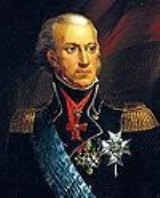
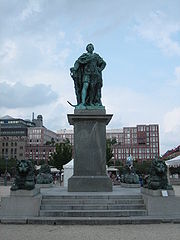
Charles XIII of Sweden

Encyclopedia
Charles XIII & II also Carl, (Stockholm
, 7 October 1748 – Stockholm
, 5 February 1818), was King of Sweden
(as Charles XIII) from 1809 and King of Norway (as Charles II) from 1814 until his death. He was the second son of King Adolf Frederick of Sweden
and Louisa Ulrika of Prussia
, sister of Frederick the Great
.
Though known as King Charles XIII in Sweden, he was actually the seventh Swedish king by that name, as his predecessor Charles IX
(reigned 1604–1611) had adopted his numeral after studying a fictitious history of Sweden.
 Prince Charles was appointed grand admiral when he was but few days old. He was described as a good dancer at the amateur theatre
of the royal court. Reportedly he was not very close to his mother; the Queen preferred her youngest children, Sophie Albertine and Frederick Adolf
. Charles was, however, described as close to his brother Gustav during their childhood. In 1772 he cooperated in the revolutionary plans of his elder brother, King Gustav III of Sweden
and as a sign of recognition, was appointed Duke of Södermanland
.
Charles was early the object of his mother's plans to arrange political marriages for her children. Initially, he was to be married to Philippine of Brandenburg-Schwedt according to his mother's wishes, but the government refused to issue negotiations because of the costs. After the coup d'état which introduced absolute monarchy in 1772, his brother Gustav III arranged a marriage between Charles and his cousin Hedwig Elizabeth Charlotte of Holstein-Gottorp. They lived de facto separate private lives and both had extramarital affairs. Charles was known for his "harem" of mistresses, of which the most notable were Augusta von Fersen
, Charlotte Eckerman
, Charlotte Slottsberg
, who also had influence over him, and Mariana Koskull
. He unsuccessfully courted Magdalena Rudenschöld
, who refused him, after which she was treated with what has been regarded as vindictiveness during the Armfelt conspiracy. After the late 1790s, his health deteriorated by a series of rheumatic attacks, his relationship to his consort improved and she gained more influence over him.
Charles was described as dependent and easily influenced by others, and his many affairs gave him the reputation of being a libertine.
He was very interested in the supernatural
, secret societies and mysticism
. It is said that he was one of the best clients of the celebrated fortune teller Ulrica Arfvidsson
and even asked her for political advice, and he also favored the medium
Henrik Gustaf Ulfvenklou
, who also exercised great influence over the duke. He was also a member of the Freemasons and in 1811 founded the Order of Charles XIII
, a Swedish order of chivalry awarded only to Protestant Freemasons.
Charles was given several official tasks during his period as duke. In 1777, he served as regent during Gustav III's stay in Russia, in 1780 he served as formal chief commander during the King's stay in Spa
. On the outbreak of the Russo-Swedish War of 1788 he served with distinction as admiral of the fleet, especially at the battles of Hogland
(7 June 1788) and Öland
(26 July 1789). On the latter occasion he would have won a signal victory but for the unaccountable remissness of his second-in-command, Admiral Liljehorn.
In 1785, he was offered the Dukedom of Courland
by the nobility of the Duchy and given the support of Gustav III. but the plans never materialized.
Charles was in close connection to the opposition against Gustav III, and it is debated whether he knew of and supported the plans to assassinate the King.
On the assassination of Gustav III in 1792, Charles acted as regent
of Sweden till 1796 on behalf of his nephew, King Gustav IV, who was a minor when his father was shot in the Stockholm opera. The de facto regent, however, was in fact Gustaf Adolf Reuterholm
, whose influence over him was supreme. These four years have been considered perhaps the most miserable and degrading period in Swedish history; an Age of Lead succeeding an Age of Gold, as it has well been called, and may be briefly described as alternations of the fantastic jacobinism and the ruthless despotism
.
On the coming of age of Gustav IV Adolf of Sweden
in November 1796, the duke's regency ended. In 1803, the Boheman affair caused a severe conflict between Gustav IV Adolf and the ducal couple. The mystic Karl Adolf Boheman (1764–1831) had been introduced to the couple by Count Magnus Stenbock in 1793 and gained great influence by promising to reveal scientific secrets about the occult. Boheman inducted them into a secret society and founded what he described as a branch of the Freemasons in 1801, where both sexes where accepted as members, and to which the Counts and Countesses Ruuth and Brahe as well as the mother of the queen
were introduced. Boheman was arrested upon an attempt to recruit the monarch, who accused him of revolutionary agendas and expelled him. The ducal couple were exposed in an informal investigation by the monarch, and the duchess was questioned in the presence of the royal council. In 1808, he was again chief commander during Gustav IV Adolf's stay in Finland.
On 13 March 1809, those who had dethroned Gustav IV Adolf appointed him regent, and he was finally elected king by the Riksdag of the Estates
. But by this time he was prematurely decrepit, and Crown Prince
Jean-Baptiste Bernadotte
took over the government as soon as he landed in Sweden in 1810. By the Union of Sweden and Norway on 4 November 1814 Charles became king of Norway under the name Carl II of Norway. After eight years as king only by title, Charles died without a natural heir on 5 February 1818, and Bernadotte succeeded him as King Charles XIV John
.
He was the 872nd Knight
of the Order of the Golden Fleece
in Spain
.
. Both of their children died in infancy.
With Augusta von Fersen
, he had a son outside of marriage:
Stockholm
Stockholm is the capital and the largest city of Sweden and constitutes the most populated urban area in Scandinavia. Stockholm is the most populous city in Sweden, with a population of 851,155 in the municipality , 1.37 million in the urban area , and around 2.1 million in the metropolitan area...
, 7 October 1748 – Stockholm
Stockholm
Stockholm is the capital and the largest city of Sweden and constitutes the most populated urban area in Scandinavia. Stockholm is the most populous city in Sweden, with a population of 851,155 in the municipality , 1.37 million in the urban area , and around 2.1 million in the metropolitan area...
, 5 February 1818), was King of Sweden
Monarch of Sweden
The monarchy of Sweden is the constitutional monarchy of the Kingdom of Sweden. The present monarch, Carl XVI Gustaf, has reigned since 15 September 1973. He and his immediate family undertake various official, ceremonial and representational duties...
(as Charles XIII) from 1809 and King of Norway (as Charles II) from 1814 until his death. He was the second son of King Adolf Frederick of Sweden
Adolf Frederick of Sweden
Adolf Frederick or Adolph Frederick was King of Sweden from 1751 until his death. He was the son of Christian August of Holstein-Gottorp, Prince of Eutin and Albertina Frederica of Baden-Durlach....
and Louisa Ulrika of Prussia
Louisa Ulrika of Prussia
Louisa Ulrika of Prussia was Queen of Sweden between 1751 and 1771 as the spouse of King Adolf Frederick of Sweden, and queen mother during the reign of King Gustav III of Sweden.-Background:...
, sister of Frederick the Great
Frederick II of Prussia
Frederick II was a King in Prussia and a King of Prussia from the Hohenzollern dynasty. In his role as a prince-elector of the Holy Roman Empire, he was also Elector of Brandenburg. He was in personal union the sovereign prince of the Principality of Neuchâtel...
.
Though known as King Charles XIII in Sweden, he was actually the seventh Swedish king by that name, as his predecessor Charles IX
Charles IX of Sweden
Charles IX of Sweden also Carl, was King of Sweden from 1604 until his death. He was the youngest son of King Gustav I of Sweden and his second wife, Margaret Leijonhufvud, brother of Eric XIV and John III of Sweden, and uncle of Sigismund III Vasa king of both Sweden and Poland...
(reigned 1604–1611) had adopted his numeral after studying a fictitious history of Sweden.
Life and politics
Amateur theatre
Amateur theatre is theatre performed by amateur actors. These actors are not typically members of Actors' Equity groups or Actors' Unions as these organizations exist to protect the professional industry and therefore discourage their members from appearing with companies which are not a signatory...
of the royal court. Reportedly he was not very close to his mother; the Queen preferred her youngest children, Sophie Albertine and Frederick Adolf
Prince Frederick Adolf of Sweden
Prince Fredrick Adolf of Sweden , was a Swedish Prince, youngest son of King Adolf Frederick of Sweden and Louisa Ulrika of Prussia, a sister Frederick the Great, King of Prussia...
. Charles was, however, described as close to his brother Gustav during their childhood. In 1772 he cooperated in the revolutionary plans of his elder brother, King Gustav III of Sweden
Gustav III of Sweden
Gustav III was King of Sweden from 1771 until his death. He was the eldest son of King Adolph Frederick and Queen Louise Ulrica of Sweden, she a sister of Frederick the Great of Prussia....
and as a sign of recognition, was appointed Duke of Södermanland
Södermanland
', sometimes referred to under its Latin form Sudermannia or Sudermania, is a historical province or landskap on the south eastern coast of Sweden. It borders Östergötland, Närke, Västmanland and Uppland. It is also bounded by lake Mälaren and the Baltic sea.In Swedish, the province name is...
.
Charles was early the object of his mother's plans to arrange political marriages for her children. Initially, he was to be married to Philippine of Brandenburg-Schwedt according to his mother's wishes, but the government refused to issue negotiations because of the costs. After the coup d'état which introduced absolute monarchy in 1772, his brother Gustav III arranged a marriage between Charles and his cousin Hedwig Elizabeth Charlotte of Holstein-Gottorp. They lived de facto separate private lives and both had extramarital affairs. Charles was known for his "harem" of mistresses, of which the most notable were Augusta von Fersen
Augusta von Fersen
Christina Augusta von Fersen, as married Löwenhielm , was a Swedish noble and lady-in-waiting. She is a well-known figure of the Gustavian Age, and is known in history as one of "The Three Graces" at court, and as royal mistress to king Charles XIII of Sweden.-Background:Augusta was the daughter of...
, Charlotte Eckerman
Charlotte Eckerman
Charlotte Eckerman , was a Swedish opera singer and actress. She was also a very well known courtesan during the Gustavian era, and the official royal mistress of Charles XIII of Sweden from 1779 to 1781...
, Charlotte Slottsberg
Charlotte Slottsberg
Charlotte Slottsberg , was a Swedish ballerina-dancer, one of the first native dancers in the Royal Swedish Ballet at the Royal Swedish Opera and one of the most successful ones...
, who also had influence over him, and Mariana Koskull
Mariana Koskull
Henrietta Mariana Charlotta Koskull was a Swedish noble and lady-in-waiting, known as the royal mistress of King Charles XIII of Sweden and King Charles XIV John of Sweden....
. He unsuccessfully courted Magdalena Rudenschöld
Magdalena Rudenschöld
Magdalena Charlotta Rudenschöld, commonly known as Malla Rudenschöld and privately as Malin Rudenschöld , was a member of the Swedish nobility and a lady-in-waiting. She was one of the main participants in the so-called Armfelt conspiracy against the guardian government of 1792...
, who refused him, after which she was treated with what has been regarded as vindictiveness during the Armfelt conspiracy. After the late 1790s, his health deteriorated by a series of rheumatic attacks, his relationship to his consort improved and she gained more influence over him.
Charles was described as dependent and easily influenced by others, and his many affairs gave him the reputation of being a libertine.
He was very interested in the supernatural
Supernatural
The supernatural or is that which is not subject to the laws of nature, or more figuratively, that which is said to exist above and beyond nature...
, secret societies and mysticism
Mysticism
Mysticism is the knowledge of, and especially the personal experience of, states of consciousness, i.e. levels of being, beyond normal human perception, including experience and even communion with a supreme being.-Classical origins:...
. It is said that he was one of the best clients of the celebrated fortune teller Ulrica Arfvidsson
Ulrica Arfvidsson
Anna Ulrica Arfvidsson was a professional Swedish fortune-teller during the reign of Gustav III of Sweden. She was commonly known as Mamsell Arfvidsson.-Biography:...
and even asked her for political advice, and he also favored the medium
Mediumship
Mediumship is described as a form of communication with spirits. It is a practice in religious beliefs such as Spiritualism, Spiritism, Espiritismo, Candomblé, Voodoo and Umbanda.- Concept :...
Henrik Gustaf Ulfvenklou
Henrik Gustaf Ulfvenklou
Henrik Gustaf Ulfvenklou, , was a Swedish mystic and medium who gained a great influence in the circles of Charles XIII of Sweden by claiming to communicate with the spirits of the dead....
, who also exercised great influence over the duke. He was also a member of the Freemasons and in 1811 founded the Order of Charles XIII
Order of Charles XIII
The Order of Charles XIII is a Swedish order of knighthood, founded by King Charles XIII in 1811. The Lord and Master of the Order is the King of Sweden, currently His Majesty King Carl XVI Gustaf. The order can only be conferred on Freemasons of Protestant faith...
, a Swedish order of chivalry awarded only to Protestant Freemasons.
Charles was given several official tasks during his period as duke. In 1777, he served as regent during Gustav III's stay in Russia, in 1780 he served as formal chief commander during the King's stay in Spa
Spa, Belgium
Spa is a municipality of Belgium. It lies in the country's Walloon Region and Province of Liège. It is situated in a valley in the Ardennes mountain chain, some southeast of Liège, and southwest of Aachen. As of 1 January 2006, Spa had a total population of 10,543...
. On the outbreak of the Russo-Swedish War of 1788 he served with distinction as admiral of the fleet, especially at the battles of Hogland
Battle of Hogland
The naval Battle of Hogland took place on 17 July 1788 during the Russo-Swedish War .-Origins:On the outbreak of war with Russia in 1788, Sweden planned to attack the Russian capital St. Petersburg...
(7 June 1788) and Öland
Battle of Öland (1789)
The naval Battle of Öland took place on 26 July 1789 during the Russo-Swedish War .-Origins:Having assembled 21 ships of the line and eight large frigates under his flag, Prince Karl, Duke of Södermanland decided to intercept the Russian fleet near the island of Öland.-Battle:The Swedish fleet came...
(26 July 1789). On the latter occasion he would have won a signal victory but for the unaccountable remissness of his second-in-command, Admiral Liljehorn.
In 1785, he was offered the Dukedom of Courland
Courland
Courland is one of the historical and cultural regions of Latvia. The regions of Semigallia and Selonia are sometimes considered as part of Courland.- Geography and climate :...
by the nobility of the Duchy and given the support of Gustav III. but the plans never materialized.
Charles was in close connection to the opposition against Gustav III, and it is debated whether he knew of and supported the plans to assassinate the King.
On the assassination of Gustav III in 1792, Charles acted as regent
Regent
A regent, from the Latin regens "one who reigns", is a person selected to act as head of state because the ruler is a minor, not present, or debilitated. Currently there are only two ruling Regencies in the world, sovereign Liechtenstein and the Malaysian constitutive state of Terengganu...
of Sweden till 1796 on behalf of his nephew, King Gustav IV, who was a minor when his father was shot in the Stockholm opera. The de facto regent, however, was in fact Gustaf Adolf Reuterholm
Gustaf Adolf Reuterholm
Baron Gustaf Adolf Reuterholm , was a Swedish statesman.-Early career:...
, whose influence over him was supreme. These four years have been considered perhaps the most miserable and degrading period in Swedish history; an Age of Lead succeeding an Age of Gold, as it has well been called, and may be briefly described as alternations of the fantastic jacobinism and the ruthless despotism
Despotism
Despotism is a form of government in which a single entity rules with absolute power. That entity may be an individual, as in an autocracy, or it may be a group, as in an oligarchy...
.
On the coming of age of Gustav IV Adolf of Sweden
Gustav IV Adolf of Sweden
Gustav IV Adolf of Sweden also Gustav Adolph was King of Sweden from 1792 until his abdication in 1809. He was the son of Gustav III of Sweden and his queen consort Sophia Magdalena, eldest daughter of Frederick V of Denmark and his first wife Louise of Great Britain. He was the last Swedish...
in November 1796, the duke's regency ended. In 1803, the Boheman affair caused a severe conflict between Gustav IV Adolf and the ducal couple. The mystic Karl Adolf Boheman (1764–1831) had been introduced to the couple by Count Magnus Stenbock in 1793 and gained great influence by promising to reveal scientific secrets about the occult. Boheman inducted them into a secret society and founded what he described as a branch of the Freemasons in 1801, where both sexes where accepted as members, and to which the Counts and Countesses Ruuth and Brahe as well as the mother of the queen
Landgravine Amalie of Hesse-Darmstadt
Amalie of Hesse-Darmstadt was the daughter of Ludwig IX, Landgrave of Hesse-Darmstadt and Henriette Karoline of Palatine-Zweibrücken.-Marriage and issue:...
were introduced. Boheman was arrested upon an attempt to recruit the monarch, who accused him of revolutionary agendas and expelled him. The ducal couple were exposed in an informal investigation by the monarch, and the duchess was questioned in the presence of the royal council. In 1808, he was again chief commander during Gustav IV Adolf's stay in Finland.
On 13 March 1809, those who had dethroned Gustav IV Adolf appointed him regent, and he was finally elected king by the Riksdag of the Estates
Riksdag of the Estates
The Riksdag of the Estates , was the name used for the Estates of the Swedish realm when they were assembled. Until its dissolution in 1866, the institution was the highest authority in Sweden next to the King...
. But by this time he was prematurely decrepit, and Crown Prince
Crown Prince
A crown prince or crown princess is the heir or heiress apparent to the throne in a royal or imperial monarchy. The wife of a crown prince is also titled crown princess....
Jean-Baptiste Bernadotte
Charles XIV John of Sweden
Charles XIV & III John, also Carl John, Swedish and Norwegian: Karl Johan was King of Sweden and King of Norway from 1818 until his death...
took over the government as soon as he landed in Sweden in 1810. By the Union of Sweden and Norway on 4 November 1814 Charles became king of Norway under the name Carl II of Norway. After eight years as king only by title, Charles died without a natural heir on 5 February 1818, and Bernadotte succeeded him as King Charles XIV John
Charles XIV John of Sweden
Charles XIV & III John, also Carl John, Swedish and Norwegian: Karl Johan was King of Sweden and King of Norway from 1818 until his death...
.
He was the 872nd Knight
Knight
A knight was a member of a class of lower nobility in the High Middle Ages.By the Late Middle Ages, the rank had become associated with the ideals of chivalry, a code of conduct for the perfect courtly Christian warrior....
of the Order of the Golden Fleece
Order of the Golden Fleece
The Order of the Golden Fleece is an order of chivalry founded in Bruges by Philip III, Duke of Burgundy in 1430, to celebrate his marriage to the Portuguese princess Infanta Isabella of Portugal, daughter of King John I of Portugal. It evolved as one of the most prestigious orders in Europe...
in Spain
Spain
Spain , officially the Kingdom of Spain languages]] under the European Charter for Regional or Minority Languages. In each of these, Spain's official name is as follows:;;;;;;), is a country and member state of the European Union located in southwestern Europe on the Iberian Peninsula...
.
Family
He married his cousin Hedwig Elizabeth Charlotte of Holstein-Gottorp (1759–1818), on 7 July 1774 in StockholmStockholm
Stockholm is the capital and the largest city of Sweden and constitutes the most populated urban area in Scandinavia. Stockholm is the most populous city in Sweden, with a population of 851,155 in the municipality , 1.37 million in the urban area , and around 2.1 million in the metropolitan area...
. Both of their children died in infancy.
- Lovisa Hedvig (– 2 July 1797)
- Carl Adolf, Duke of VärmlandVärmland' is a historical province or landskap in the west of middle Sweden. It borders Västergötland, Dalsland, Dalarna, Västmanland and Närke. It is also bounded by Norway in the west. Latin name versions are Vermelandia and Wermelandia. Although the province's land originally was Götaland, the...
(StockholmStockholmStockholm is the capital and the largest city of Sweden and constitutes the most populated urban area in Scandinavia. Stockholm is the most populous city in Sweden, with a population of 851,155 in the municipality , 1.37 million in the urban area , and around 2.1 million in the metropolitan area...
, 4 July 1798 – StockholmStockholmStockholm is the capital and the largest city of Sweden and constitutes the most populated urban area in Scandinavia. Stockholm is the most populous city in Sweden, with a population of 851,155 in the municipality , 1.37 million in the urban area , and around 2.1 million in the metropolitan area...
, 10 July 1798)
With Augusta von Fersen
Augusta von Fersen
Christina Augusta von Fersen, as married Löwenhielm , was a Swedish noble and lady-in-waiting. She is a well-known figure of the Gustavian Age, and is known in history as one of "The Three Graces" at court, and as royal mistress to king Charles XIII of Sweden.-Background:Augusta was the daughter of...
, he had a son outside of marriage:
- Carl LöwenhielmCarl LöwenhielmCount Carl Löwenhielm was a Swedish military officer, diplomat, and politician; he was a member of the Swedish cabinet between 1822–1839...
1772–1861
Ancestors
Written sources
- Signum svenska kulturhistoria: Gustavianska tiden
- Ingvar Andersson: Gustavianskt (1979)
- Signum Förlag: Frihetstiden
- Lars Elgklou: Familjen Bernadotte. En kunglig släktkrönika
- Herman Lindqvist: Historien om Sverige. Gustavs dagar
External links
- Nordisk familjebok
- Royal House of Sweden and Royal House of Norway
- Ducal House of Holstein-Gottorp, then Ducal then Grand-Ducal House of Oldenburg
- http://www.historiesajten.se/visainfo.asp?id=51