

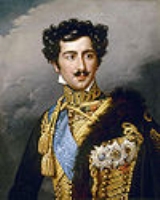
Oscar I of Sweden

Encyclopedia
Oscar I was King of Sweden
and Norway from 1844 to his death. When, in August 1810, his father Jean-Baptiste Bernadotte was elected Crown Prince
of Sweden, Oscar and his mother moved from Paris
to Stockholm
(June 1811). Oscar's father was the first ruler of the current House of Bernadotte. Oscar's mother was Désirée Clary
, Napoleon
Bonaparte's first fiancée. Her sister, Julie Clary
, was married to Napoleon's brother, Joseph Bonaparte
. Désirée chose Napoleon to be Oscar's godfather.
, Oscar received the title of Duke of Södermanland
. He quickly acquired the Swedish language. By the time he reached the age of majority he had become a general favourite
. His very considerable native talents were developed by an excellent education
, and he soon came to be regarded as an authority on all socio-political questions. On January 17, 1816, he was elected an honorary member of the Royal Swedish Academy of Sciences
, and in 1818, he was appointed chancellor of Uppsala University
, where he spent one semester.
In 1832-34 he completed the opera "Ryno, the errant knight" left unfinished on the death of the young composer Eduard Brendler
. In 1839 he wrote a series of articles on popular education, and (in 1841) an anonymous work
, "Om Straff och straffanstalter", advocating prison reform
s. Twice during his father's lifetime he was viceroy of Norway
. By proxy at the Leuchtenberg Palace in Munich
on 22 May 1823 and in person at a wedding ceremony conducted in Stockholm
on 19 June 1823 he married the Princess Josephine
, daughter of Eugène de Beauharnais
, Duke of Leuchtenberg
, and granddaughter of the Empress Josephine
.
. If Oscar did not actively assist the Opposition on this occasion, his disapprobation of his father's despot
ic behaviour was notorious, though he avoided an actual rupture. Yet his liberalism
was of the most cautious and moderate character, as the Opposition, shortly after his accession (8 March 1844), discovered to their great chagrin. He would not hear of any radical reform of the cumbrous and obsolete Constitution of 1809. But one of his earliest measures was to establish freedom of the press
. He also passed the first law towards gender equality
in Sweden when he in 1845 declared that brothers and sisters should have equal inheritance, unless there was a will.
He formally established equality between his two kingdoms by introducing new flags with the common Union badge of Norway and Sweden
and a new coat of arms for the union. He also founded the Royal Norwegian Order of St. Olav on August 21, 1847, giving his Norwegian kingdom its own order of chivalry. Most of the legislation
during Oscar I's reign aimed at improving the economic position of Sweden, and the Riksdag of the Estates
, in its address to him in 1857, declared that he had promoted the material prosperity of the kingdom more than any of his predecessors.
In foreign affairs
Oscar I was a friend of the principle of nationality
. In 1848 he supported Denmark
against the Kingdom of Prussia
in the First War of Schleswig
; placed Swedish and Norwegian troops in cantonment
s in Funen
and North Schleswig
(1849–1850); and mediated the Truce of Malmö (26 August 1848). He was also one of the guarantors of the integrity of Denmark (the London Protocol
, 8 May 1852).
As early as 1850 Oscar I had conceived the plan of a dynastic union of the three Scandinavia
n kingdoms, but such difficulties presented themselves that the scheme had to be abandoned. He succeeded, however, in reversing his father's obsequious policy towards Imperial Russia. His fear lest Russia should demand a stretch of coast along the Varanger Fjord induced him to remain neutral during the Crimean War
, and, subsequently, to conclude an alliance with the United Kingdom of Great Britain and Ireland
and the Second French Empire
(25 November 1855) for preserving the territorial integrity of Sweden-Norway.
He was the 968th Knight
of the Order of the Golden Fleece
in Spain
.
Oscar also had two children with his mistress, the actress Emilie Högquist
:
With another mistress, Jaquette Löwenhielm
(née Gyldenstolpe), Oscar had a daughter
|-
Monarch of Sweden
The monarchy of Sweden is the constitutional monarchy of the Kingdom of Sweden. The present monarch, Carl XVI Gustaf, has reigned since 15 September 1973. He and his immediate family undertake various official, ceremonial and representational duties...
and Norway from 1844 to his death. When, in August 1810, his father Jean-Baptiste Bernadotte was elected Crown Prince
Crown Prince
A crown prince or crown princess is the heir or heiress apparent to the throne in a royal or imperial monarchy. The wife of a crown prince is also titled crown princess....
of Sweden, Oscar and his mother moved from Paris
Paris
Paris is the capital and largest city in France, situated on the river Seine, in northern France, at the heart of the Île-de-France region...
to Stockholm
Stockholm
Stockholm is the capital and the largest city of Sweden and constitutes the most populated urban area in Scandinavia. Stockholm is the most populous city in Sweden, with a population of 851,155 in the municipality , 1.37 million in the urban area , and around 2.1 million in the metropolitan area...
(June 1811). Oscar's father was the first ruler of the current House of Bernadotte. Oscar's mother was Désirée Clary
Désirée Clary
Bernardine Eugénie Désirée Clary , one-time fiancée of Napoleon Bonaparte, was a Frenchwoman who became Queen of Sweden and Norway as the consort of King Charles XIV John, a former French General. She officially changed her name there to Desideria, a Latin version of her original name...
, Napoleon
Napoleon I of France
Napoleon Bonaparte was a French military and political leader during the latter stages of the French Revolution.As Napoleon I, he was Emperor of the French from 1804 to 1815...
Bonaparte's first fiancée. Her sister, Julie Clary
Julie Clary
Marie Julie Bonaparte was Queen consort of Spain and the Indies, Naples and Sicily as the spouse of King Joseph Bonaparte, who was King of Naples and Sicily from January 1806 to June 1808, and later King of Spain and the Spanish West Indies from 25 June 1808 to June 1813.- Background:Julie Clary...
, was married to Napoleon's brother, Joseph Bonaparte
Joseph Bonaparte
Joseph-Napoléon Bonaparte was the elder brother of Napoleon Bonaparte, who made him King of Naples and Sicily , and later King of Spain...
. Désirée chose Napoleon to be Oscar's godfather.
Upbringing
From Charles XIII of SwedenCharles XIII of Sweden
Charles XIII & II also Carl, , was King of Sweden from 1809 and King of Norway from 1814 until his death...
, Oscar received the title of Duke of Södermanland
Södermanland
', sometimes referred to under its Latin form Sudermannia or Sudermania, is a historical province or landskap on the south eastern coast of Sweden. It borders Östergötland, Närke, Västmanland and Uppland. It is also bounded by lake Mälaren and the Baltic sea.In Swedish, the province name is...
. He quickly acquired the Swedish language. By the time he reached the age of majority he had become a general favourite
Favourite
A favourite , or favorite , was the intimate companion of a ruler or other important person. In medieval and Early Modern Europe, among other times and places, the term is used of individuals delegated significant political power by a ruler...
. His very considerable native talents were developed by an excellent education
Education
Education in its broadest, general sense is the means through which the aims and habits of a group of people lives on from one generation to the next. Generally, it occurs through any experience that has a formative effect on the way one thinks, feels, or acts...
, and he soon came to be regarded as an authority on all socio-political questions. On January 17, 1816, he was elected an honorary member of the Royal Swedish Academy of Sciences
Royal Swedish Academy of Sciences
The Royal Swedish Academy of Sciences or Kungliga Vetenskapsakademien is one of the Royal Academies of Sweden. The Academy is an independent, non-governmental scientific organization which acts to promote the sciences, primarily the natural sciences and mathematics.The Academy was founded on 2...
, and in 1818, he was appointed chancellor of Uppsala University
Uppsala University
Uppsala University is a research university in Uppsala, Sweden, and is the oldest university in Scandinavia, founded in 1477. It consistently ranks among the best universities in Northern Europe in international rankings and is generally considered one of the most prestigious institutions of...
, where he spent one semester.
In 1832-34 he completed the opera "Ryno, the errant knight" left unfinished on the death of the young composer Eduard Brendler
Eduard Brendler
Eduard Brendler was a Swedish composer. He was born in Germany but his family moved to Sweden at the age of 1. He died before completing his romantic opera Ryno, or the errant knight "Ryno eller den vandrande riddaren: skådespel med sång i tre akter," to a libretto by Bernhard von Beskow, so the...
. In 1839 he wrote a series of articles on popular education, and (in 1841) an anonymous work
Anonymous work
Anonymous works are works, such as art or literature, that have an anonymous, undisclosed, or unknown creator or author. In the United States it is legally defined as "a work on the copies or phonorecords of which no natural person is identified as author."...
, "Om Straff och straffanstalter", advocating prison reform
Prison reform
Prison reform is the attempt to improve conditions inside prisons, aiming at a more effective penal system.-History:Prisons have only been used as the primary punishment for criminal acts in the last couple of centuries...
s. Twice during his father's lifetime he was viceroy of Norway
Viceroy of Norway
The Viceroy of Norway was the appointed head of the Norwegian Government in the absence of the King, during the era of the Union between Sweden and Norway. The role was essentially the same as that of the Governor-general, which has led to confusion as to who filled which office...
. By proxy at the Leuchtenberg Palace in Munich
Munich
Munich The city's motto is "" . Before 2006, it was "Weltstadt mit Herz" . Its native name, , is derived from the Old High German Munichen, meaning "by the monks' place". The city's name derives from the monks of the Benedictine order who founded the city; hence the monk depicted on the city's coat...
on 22 May 1823 and in person at a wedding ceremony conducted in Stockholm
Stockholm
Stockholm is the capital and the largest city of Sweden and constitutes the most populated urban area in Scandinavia. Stockholm is the most populous city in Sweden, with a population of 851,155 in the municipality , 1.37 million in the urban area , and around 2.1 million in the metropolitan area...
on 19 June 1823 he married the Princess Josephine
Josephine of Leuchtenberg
Joséphine of Leuchtenberg was Queen consort of Sweden and Norway as the wife of King Oscar I...
, daughter of Eugène de Beauharnais
Eugène de Beauharnais
Eugène Rose de Beauharnais, Prince Français, Prince of Venice, Viceroy of the Kingdom of Italy, Hereditary Grand Duke of Frankfurt, 1st Duke of Leuchtenberg and 1st Prince of Eichstätt ad personam was the first child and only son of Alexandre, Vicomte de Beauharnais and Joséphine Tascher de la...
, Duke of Leuchtenberg
Leuchtenberg
Leuchtenberg is a municipality in the district of Neustadt in Bavaria in Germany, essentially a suburb of nearby Weiden in der Oberpfalz, and a historical region in Old Germany governed by the Landgrave of Leuchtenberg....
, and granddaughter of the Empress Josephine
Joséphine de Beauharnais
Joséphine de Beauharnais was the first wife of Napoléon Bonaparte, and thus the first Empress of the French. Her first husband Alexandre de Beauharnais had been guillotined during the Reign of Terror, and she had been imprisoned in the Carmes prison until her release five days after Alexandre's...
.
Planned marriage
Oscar's father had selected four princesses as candidates for marriage, in order of his priority:- Vilhelmina of Denmark (born 18 January 1808), daughter of Frederick VI of DenmarkFrederick VI of DenmarkFrederick VI reigned as King of Denmark , and as king of Norway .-Regent of Denmark:Frederick's parents were King Christian VII and Caroline Matilda of Wales...
and Marie Sophie of Hesse-KasselMarie Sophie of Hesse-Kasselthumb|Queen Marie Sophie portrayed by [[Cornelius Høyer]] Marie Sophie Frederikke of Hesse-Kassel was Queen Consort of Denmark and Norway. She also served as Regent of Denmark in 1814–1815.-Background:...
(ultimately she married firstly Frederick VII of DenmarkFrederick VII of DenmarkFrederick VII was a King of Denmark. He reigned from 1848 until his death. He was the last Danish monarch of the older Royal branch of the House of Oldenburg and also the last king of Denmark to rule as an absolute monarch...
and secondly Karl, Duke of Schleswig-Holstein-Sonderburg-GlücksburgKarl, Duke of Schleswig-Holstein-Sonderburg-GlücksburgKarl of Schleswig-Holstein-Sonderburg-Glücksburg was the second Duke of Schleswig-Holstein-Sonderburg-Glücksburg...
) - Josephine of LeuchtenbergJosephine of LeuchtenbergJoséphine of Leuchtenberg was Queen consort of Sweden and Norway as the wife of King Oscar I...
(born 14 March 1807), daughter of Eugene, 1st Duke of LeuchtenbergEugène de BeauharnaisEugène Rose de Beauharnais, Prince Français, Prince of Venice, Viceroy of the Kingdom of Italy, Hereditary Grand Duke of Frankfurt, 1st Duke of Leuchtenberg and 1st Prince of Eichstätt ad personam was the first child and only son of Alexandre, Vicomte de Beauharnais and Joséphine Tascher de la...
and Augusta of BavariaPrincess Augusta of BavariaPrincess Augusta of Bavaria, Duchess of Leuchtenberg was the second child and eldest daughter of Maximilian I Joseph of Bavaria and Augusta Wilhelmine of Hesse-Darmstadt.- Marriage and issue :... - Marie of Hesse-KasselPrincess Marie Frederica of Hesse-KasselPrincess Marie Frederica Wilhelmina of Hesse-Kassel was a daughter of William II, Elector of Hesse and Princess Augusta of Prussia...
(born 6 September 1804), daughter of William II, Elector of HesseWilliam II, Elector of Hesse-Biography:William was the eldest surviving son of William I, Elector of Hesse and Wilhelmina Caroline of Denmark and Norway. He succeeded as Elector of Hesse on his father's death in 1821.-Marriage and issue:On 13 February 1797 in Berlin, William married Princess Augusta of Prussia, fourth...
and Augusta of PrussiaPrincess Augusta of PrussiaPrincess Augusta of Prussia was a German salonist and electress consort of Hesse. She was the third daughter and fifth child of Frederick William II of Prussia and Frederika Louisa of Hesse-Darmstadt. She was the first consort of William II, Elector of Hesse. Augusta was a talented painter...
(ultimately she married Bernard II of Saxe-Meiningen) - Marie of Saxe-Weimar-Eisenach (born 3 February 1808), daughter of Charles Frederick I of Saxe-WeimarCharles Frederick, Grand Duke of Saxe-Weimar-EisenachCharles Friedrich, Grand Duke of Saxe-Weimar-Eisenach was a Grand Duke of Saxe-Weimar-Eisenach.-Biography:Born in Weimar, he was the eldest son of Charles Augustus, Grand Duke of Saxe-Weimar-Eisenach and Luise Auguste of Hesse-Darmstadt.Charles Frederick succeeded his famous father as Grand Duke...
and Maria Pavlovna of Russia (ultimately she married Prince Charles of PrussiaPrince Charles of PrussiaPrince Frederick Charles Alexander of Prussia born in Charlottenburg, was a younger son of Frederick William III of Prussia and Louise of Mecklenburg-Strelitz...
)
Politics
In 1824 and 1833, the Crown Prince was briefly Viceroy of Norway. In 1838 the king began to suspect his heir of plotting with the Liberal party to bring about a change of ministry, or even his own abdicationAbdication
Abdication occurs when a monarch, such as a king or emperor, renounces his office.-Terminology:The word abdication comes derives from the Latin abdicatio. meaning to disown or renounce...
. If Oscar did not actively assist the Opposition on this occasion, his disapprobation of his father's despot
Despotism
Despotism is a form of government in which a single entity rules with absolute power. That entity may be an individual, as in an autocracy, or it may be a group, as in an oligarchy...
ic behaviour was notorious, though he avoided an actual rupture. Yet his liberalism
Liberalism
Liberalism is the belief in the importance of liberty and equal rights. Liberals espouse a wide array of views depending on their understanding of these principles, but generally, liberals support ideas such as constitutionalism, liberal democracy, free and fair elections, human rights,...
was of the most cautious and moderate character, as the Opposition, shortly after his accession (8 March 1844), discovered to their great chagrin. He would not hear of any radical reform of the cumbrous and obsolete Constitution of 1809. But one of his earliest measures was to establish freedom of the press
Freedom of the press
Freedom of the press or freedom of the media is the freedom of communication and expression through vehicles including various electronic media and published materials...
. He also passed the first law towards gender equality
Gender equality
Gender equality is the goal of the equality of the genders, stemming from a belief in the injustice of myriad forms of gender inequality.- Concept :...
in Sweden when he in 1845 declared that brothers and sisters should have equal inheritance, unless there was a will.
He formally established equality between his two kingdoms by introducing new flags with the common Union badge of Norway and Sweden
Union badge of Norway and Sweden
The Union badge was inserted into the canton of Swedish and Norwegian flags in 1844 to denote their partnership in the personal Union, which they entered in 1814. It combined the flag colours of both kingdoms, equally distributed, to reflect their equal status within the Union...
and a new coat of arms for the union. He also founded the Royal Norwegian Order of St. Olav on August 21, 1847, giving his Norwegian kingdom its own order of chivalry. Most of the legislation
Law
Law is a system of rules and guidelines which are enforced through social institutions to govern behavior, wherever possible. It shapes politics, economics and society in numerous ways and serves as a social mediator of relations between people. Contract law regulates everything from buying a bus...
during Oscar I's reign aimed at improving the economic position of Sweden, and the Riksdag of the Estates
Riksdag of the Estates
The Riksdag of the Estates , was the name used for the Estates of the Swedish realm when they were assembled. Until its dissolution in 1866, the institution was the highest authority in Sweden next to the King...
, in its address to him in 1857, declared that he had promoted the material prosperity of the kingdom more than any of his predecessors.
In foreign affairs
Foreign Affairs
Foreign Affairs is an American magazine and website on international relations and U.S. foreign policy published since 1922 by the Council on Foreign Relations six times annually...
Oscar I was a friend of the principle of nationality
Nationalism
Nationalism is a political ideology that involves a strong identification of a group of individuals with a political entity defined in national terms, i.e. a nation. In the 'modernist' image of the nation, it is nationalism that creates national identity. There are various definitions for what...
. In 1848 he supported Denmark
Denmark
Denmark is a Scandinavian country in Northern Europe. The countries of Denmark and Greenland, as well as the Faroe Islands, constitute the Kingdom of Denmark . It is the southernmost of the Nordic countries, southwest of Sweden and south of Norway, and bordered to the south by Germany. Denmark...
against the Kingdom of Prussia
Kingdom of Prussia
The Kingdom of Prussia was a German kingdom from 1701 to 1918. Until the defeat of Germany in World War I, it comprised almost two-thirds of the area of the German Empire...
in the First War of Schleswig
First War of Schleswig
The First Schleswig War or Three Years' War was the first round of military conflict in southern Denmark and northern Germany rooted in the Schleswig-Holstein Question, contesting the issue of who should control the Duchies of Schleswig and Holstein. The war, which lasted from 1848–1851,...
; placed Swedish and Norwegian troops in cantonment
Cantonment
A cantonment is a temporary or semi-permanent military or police quarters. The word cantonment is derived from the French word canton meaning corner or district, as is the name of the Cantons of Switzerland. In South Asia, the term cantonment also describes permanent military stations...
s in Funen
Funen
Funen , with a size of 2,984 km² , is the third-largest island of Denmark following Zealand and Vendsyssel-Thy, and the 163rd largest island of the world. Funen is located in the central part of the country and has a population of 454,358 inhabitants . The main city is Odense, connected to the...
and North Schleswig
Schleswig
Schleswig or South Jutland is a region covering the area about 60 km north and 70 km south of the border between Germany and Denmark; the territory has been divided between the two countries since 1920, with Northern Schleswig in Denmark and Southern Schleswig in Germany...
(1849–1850); and mediated the Truce of Malmö (26 August 1848). He was also one of the guarantors of the integrity of Denmark (the London Protocol
London Protocol
-1814:On June 21, 1814, a secret convention between the Great Powers: United Kingdom of Great Britain and Ireland, Prussia, Austria, and Russia awarded the territory of current Belgium and the Netherlands to William I of the Netherlands, then "Sovereign Prince" of the United Netherlands...
, 8 May 1852).
As early as 1850 Oscar I had conceived the plan of a dynastic union of the three Scandinavia
Scandinavia
Scandinavia is a cultural, historical and ethno-linguistic region in northern Europe that includes the three kingdoms of Denmark, Norway and Sweden, characterized by their common ethno-cultural heritage and language. Modern Norway and Sweden proper are situated on the Scandinavian Peninsula,...
n kingdoms, but such difficulties presented themselves that the scheme had to be abandoned. He succeeded, however, in reversing his father's obsequious policy towards Imperial Russia. His fear lest Russia should demand a stretch of coast along the Varanger Fjord induced him to remain neutral during the Crimean War
Crimean War
The Crimean War was a conflict fought between the Russian Empire and an alliance of the French Empire, the British Empire, the Ottoman Empire, and the Kingdom of Sardinia. The war was part of a long-running contest between the major European powers for influence over territories of the declining...
, and, subsequently, to conclude an alliance with the United Kingdom of Great Britain and Ireland
United Kingdom of Great Britain and Ireland
The United Kingdom of Great Britain and Ireland was the formal name of the United Kingdom during the period when what is now the Republic of Ireland formed a part of it....
and the Second French Empire
Second French Empire
The Second French Empire or French Empire was the Imperial Bonapartist regime of Napoleon III from 1852 to 1870, between the Second Republic and the Third Republic, in France.-Rule of Napoleon III:...
(25 November 1855) for preserving the territorial integrity of Sweden-Norway.
He was the 968th Knight
Knight
A knight was a member of a class of lower nobility in the High Middle Ages.By the Late Middle Ages, the rank had become associated with the ideals of chivalry, a code of conduct for the perfect courtly Christian warrior....
of the Order of the Golden Fleece
Order of the Golden Fleece
The Order of the Golden Fleece is an order of chivalry founded in Bruges by Philip III, Duke of Burgundy in 1430, to celebrate his marriage to the Portuguese princess Infanta Isabella of Portugal, daughter of King John I of Portugal. It evolved as one of the most prestigious orders in Europe...
in Spain
Spain
Spain , officially the Kingdom of Spain languages]] under the European Charter for Regional or Minority Languages. In each of these, Spain's official name is as follows:;;;;;;), is a country and member state of the European Union located in southwestern Europe on the Iberian Peninsula...
.
Children
Oscar I left five legitimate children – four sons and one daughter. Two of his sons, Charles and Oscar, succeeded him to the throne.- King Charles XVCharles XV of SwedenCharles XV & IV also Carl ; Swedish and Norwegian: Karl was King of Sweden and Norway from 1859 until his death....
(Charles IV in Norway) (1826–1872) - Prince GustafPrince Gustaf, Duke of UpplandPrince Frans Gustaf Oscar of Sweden and Norway, Duke of Uppland was the second son of Oscar I of Sweden and Josephine of Leuchtenberg and younger brother to Prince Charles.Prince Gustaf was a trained musician and composer...
, Duke of UpplandUpplandUppland is a historical province or landskap on the eastern coast of Sweden, just north of Stockholm, the capital. It borders Södermanland, Västmanland and Gästrikland. It is also bounded by lake Mälaren and the Baltic sea...
(1827–1852) - King Oscar IIOscar II of SwedenOscar II , baptised Oscar Fredrik was King of Sweden from 1872 until his death and King of Norway from 1872 until 1905. The third son of King Oscar I of Sweden and Josephine of Leuchtenberg, he was a descendant of Gustav I of Sweden through his mother.-Early life:At his birth in Stockholm, Oscar...
(1829–1907) - Princess EugeniePrincess Eugenie of SwedenPrincess Eugenie of Sweden and Norway was a member of the Royal House of Bernadotte and a dilettante artist.-Biography:...
(1830–1889) - Prince AugustPrince August, Duke of DalarnaPrince Nikolaus August, Duke of Dalarna was the youngest of the five issue of King Oscar I of Sweden and Josephine of Leuchtenberg.-Early life:...
, Duke of DalarnaDalarna', English exonym: Dalecarlia, is a historical province or landskap in central Sweden. Another English language form established in literature is the Dales. Places involving the element Dalecarlia exist in the United States....
(1831–1873)
Oscar also had two children with his mistress, the actress Emilie Högquist
Emilie Högquist
Emilie Sophie Högquist was a Swedish actress and the mistress of Oscar I of Sweden. She was a star of the Royal Dramatic Theatre, the most celebrated dramatic Swedish primadonna of her time, called the Swedish Aspasia, and also famous for her love affairs...
:
- Hjalmar Högquist, born 18 June 1839 in HamburgHamburg-History:The first historic name for the city was, according to Claudius Ptolemy's reports, Treva.But the city takes its modern name, Hamburg, from the first permanent building on the site, a castle whose construction was ordered by the Emperor Charlemagne in AD 808...
, died 1874 in LondonLondonLondon is the capital city of :England and the :United Kingdom, the largest metropolitan area in the United Kingdom, and the largest urban zone in the European Union by most measures. Located on the River Thames, London has been a major settlement for two millennia, its history going back to its...
. - Max Högquist, born 12 August 1840 in StockholmStockholmStockholm is the capital and the largest city of Sweden and constitutes the most populated urban area in Scandinavia. Stockholm is the most populous city in Sweden, with a population of 851,155 in the municipality , 1.37 million in the urban area , and around 2.1 million in the metropolitan area...
, died 1872 in ChinaChinaChinese civilization may refer to:* China for more general discussion of the country.* Chinese culture* Greater China, the transnational community of ethnic Chinese.* History of China* Sinosphere, the area historically affected by Chinese culture...
.
With another mistress, Jaquette Löwenhielm
Jaquette Löwenhielm
Gustava Charlotta Jacquette Aurora Gyldenstolpe was as Swedish noble and lady-in-waiting. She is known as the mistress of Oscar I of Sweden during his time as Crown Prince....
(née Gyldenstolpe), Oscar had a daughter
- Oscaria, born 1819.
External links
|-