

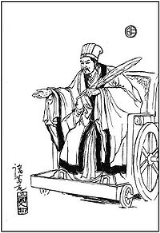
Zhuge Liang

Encyclopedia
Zhuge Liang was a chancellor of the state of Shu Han
during the Three Kingdoms
period of Chinese history
. He is often recognised as the greatest and most accomplished strategist of his era.
Often depicted wearing a robe and holding a hand fan made of crane feathers, Zhuge Liang was not only an important military strategist and statesman; he was also an accomplished scholar and inventor. His reputation as an intelligent and learned scholar grew even while he was living in relative seclusion, earning him the nickname "Wolong" (臥龍; literally: "Crouching Dragon").
Zhuge
is an uncommon two-character compound family name
. His name – even his surname alone – has become synonymous with intelligence and strategy in Chinese culture.
, Shandong
). He lost his parents and was orphaned at a premature age, and was raised by his uncle, Zhuge Xuan. He followed his uncle to live in Jing Province under Liu Biao
later. After his uncle died, Zhuge Liang and his brothers settled in Wolonggang (in present-day Henan
) for the next ten years or so, leading simple lives – farming by day and studying at night. Zhuge Liang's two older sisters married members of influential clans with strong connections in the region.
 Zhuge Liang enjoyed reciting Liangfu Yin (梁父吟), a folk song popular in Shandong, his birthplace. He also liked to compare himself to Guan Zhong
and Yue Yi
, two famous historical figures. He developed close friendships with members of the local literati, such as Xu Shu
, Cui Zhouping, Meng Jian and Shi Tao. Zhuge Liang also maintained close relations with other well known intellectuals, such as Sima Hui
, Pang Degong and Huang Chengyan
. Huang Chengyan once told Zhuge Liang, "I heard that you're seeking a spouse. I've an ugly daughter with a yellow face and dark complexion, but her talent matches yours." Zhuge Liang agreed and married Huang Chengyan's daughter.
resided at Xinye
while he was taking shelter under Jing Province's governor, Liu Biao
. Liu Bei visited Sima Hui
, who told him, "Confucian academics and common scholars, how much do they know about current affairs? Those who analyze current affairs well are elites. Crouching Dragon and Young Phoenix are the only ones in this region." Xu Shu
later recommended Zhuge Liang to Liu Bei again, and Liu wanted to ask Xu to invite Zhuge to meet him. However, Xu Shu replied, "You must visit this man in person. He cannot be invited to meet you." Liu Bei succeeded in recruiting Zhuge Liang in 207 after paying three personal visits. Zhuge Liang presented the Longzhong Plan
to Liu Bei and left his residence to follow Liu. Afterwards, Liu Bei became very close to Zhuge Liang and often had discussions with him. Guan Yu
and Zhang Fei were not pleased and complained. Liu Bei explained, "Now that I've Kongming (Zhuge Liang's style name), it's just like a fish getting into water. I hope you'll stop making unpleasant remarks." Guan Yu and Zhang Fei then stopped complaining.
, engaging Cao Cao's forces in a brief skirmish at the Battle of Changban
along the way. While in Xiakou, Liu Bei sent Zhuge Liang to follow Lu Su
to Jiangdong
to discuss the formation of an alliance between him and Sun Quan
.
Zhuge Liang met Sun Quan in Chaisang and proposed two solutions to Sun, "If you can use the forces of Wuyue
to resist the Middle Kingdom, why not break ties (with Cao Cao) in advance? If you cannot oppose, why not demobilize the troops, discard your armour and surrender to the north?" After Sun Quan's viceroy, Zhou Yu
, analyzed the situation and pointed out weaknesses in Cao Cao's army, Sun finally agreed to ally with Liu Bei in resisting Cao. Zhuge Liang returned to Liu Bei's camp with Sun Quan's envoy, Lu Su
, to make preparation for the upcoming war.
. Cao Cao retreated to Ye
, while Liu Bei proceeded to conquer territories in Jiangnan
, covering most of southern Jing Province. Zhuge Liang was appointed "Military Advisor General of the Household" (軍師中郎將). He was put in charge of governing Lingling (present day Yongzhou
, Hunan
), Guiyang
and Changsha commanderies and collecting taxes to fund the military.
In 211, Liu Zhang
, governor of Yi Province (covering present-day Sichuan basin
), requested aid from Liu Bei in attacking Zhang Lu of Hanzhong
. Liu Bei left Zhuge Liang, Guan Yu
, Zhang Fei and others in charge of Jing Province while he led an army into Sichuan. Liu Bei promptly agreed to Liu Zhang's proposal, but secretly planned to take over Liu Zhang's land. The following year, Liu Zhang discovered Liu Bei's intention, and the two turned hostile and waged war on each other. Zhuge Liang, Zhang Fei and Zhao Yun
led separate forces to reinforce Liu Bei in the attack on Liu Zhang's capital city, Chengdu
, while Guan Yu stayed behind to guard Jing Province. In 214, Liu Zhang surrendered and Liu Bei took control of Yi Province.
Liu Bei appointed Zhuge Liang "Military Advisor General" (軍師將軍) and let him administer affairs of his personal office (office of the General of the Left (左將軍)). Whenever Liu Bei embarked on military campaigns, Zhuge Liang remained to defend Chengdu and ensure a steady flow of supply of troops and provisions. In 221, in response to Cao Pi
's usurping of Emperor Xian
's throne, Liu Bei's subordinates advised him to declare himself emperor
. After initially refusing, Liu Bei was eventually persuaded by Zhuge Liang to do so and became ruler of Shu Han
. Liu Bei named Zhuge Liang his chancellor and put him in charge of the imperial agency where Zhuge assumed the functions of Imperial Secretariat. Zhuge Liang was appointed "Director of Retainers" (司隸校尉) after Zhang Fei's death.
) after his defeat at the Battle of Xiaoting
and became seriously ill. He summoned Zhuge Liang from Chengdu and said to him, "You're ten times more talented than Cao Pi
, capable of both securing the country and accomplishing our great mission. If my son can be assisted, then assist him. If he proves incompetent, then you may take over the throne." Zhuge Liang replied tearfully, "I'll do my utmost and serve with unwavering loyalty until death." Liu Bei then ordered his son, Liu Shan
, to administer state affairs together with Zhuge Liang and regard Zhuge as his father.
. He granted Zhuge Liang the title of "Marquis of Wu" (武鄉侯) and created an office for him. Not long later, Zhuge Liang was appointed governor of Yi Province and put in charge of all state affairs. At the same time, the commanderies in Nanzhong
rebelled against Shu, but Zhuge Liang did not send troops to suppress the revolt as Liu Bei's death was still recent. He sent Deng Zhi
and Chen Zhen to make peace with Eastern Wu
and re-entered an alliance with Wu. Zhuge Liang would consistently send envoys to Wu to improve diplomatic relations between the two states.
, Zhuge Liang set Shu's objective as the restoration of the Han Dynasty
, which from Shu's point of view, had been usurped by Cao Wei
. He felt that in order to attack Wei, a complete unification of Shu was first needed. Zhuge Liang was worried that the local clans would work with the Nanman
tribes in Nanzhong
to stage a revolution. Fearing the possibility that the peasants might rebel and press into areas surrounding the capital city of Chengdu
while he was attacking Wei in the north, Zhuge Liang decided to pacify the southern tribes first.
In the spring of 225, regional clans including Yong, Gao, Zhu, and Meng had taken control of some cities in the south, so Zhuge Liang led an expedition force to Nanzhong. Ma Su
proposed that they should attempt to win the hearts of the Nanman and rally their support instead of using military force to subdue them. Zhuge Liang heeded Ma Su's advice and defeated the rebel leader, Meng Huo
, on seven different occasions. He released Meng Huo each time in order to achieve Meng's genuine surrender. Note that the story about Meng Huo and his captures is rejected as a reliable and accurate historical reference by the majority of the academic, including historians like Miao Yue, Tan Liangxiao, and Zhang Hualan.
Realizing he had no chance to win, Meng Huo pledged allegiance to Shu, and was appointed by Zhuge Liang as governor of the region to keep the populace content and secure the southern Shu border. This would ensure that the future Northern Expeditions would proceed without internal disruptions. Rich and abundant resources acquired from Nanzhong were used to fund Shu's military and the state became more prosperous.
, he wrote a memorial, titled Chu Shi Biao
, to Liu Shan
, stating his rationale for the campaign and giving advice to the emperor on good governance. From 228 until his death in 234, Zhuge Liang launched a total of five Northern Expeditions against Wei, all except one of which failed. The only permanent gains by Shu were the conquests of Wudu and Yinping prefectures, as well as the relocation of Wei citizens to Shu on occasion. However, Zhuge Liang's army never suffered casualties over 5% of the total forces, and the resources put into military were affordable (assuming Shu's zenith at 200,000 military strength.)
During the first Northern Expedition, Zhuge Liang persuaded Jiang Wei
, a young Wei military officer, to surrender and defect to his side. Jiang Wei became a prominent general of Shu later and inherited Zhuge Liang's ideals. In late 234, Zhuge Liang and Sima Yi
(the Wei commander) reached a stalemate at the Battle of Wuzhang Plains
. Zhuge Liang fell seriously ill and eventually died in camp at the age of 54. Before his death, Zhuge Liang recommended Jiang Wan
and Fei Yi
to succeed him as regent of Shu. He was buried on Mount Dingjun
according to his dying wish and posthumously granted the title of "Loyal and Martial Marquis" (忠武侯) by Liu Shan.
 The following list contains family members of Zhuge Liang:
 Zhuge Liang was believed to be the inventor of mantou
, the landmine and a mysterious but efficient automatic transportation device (initially used for grain) referred to as the "wooden ox
and flowing horse" (木牛流馬), which is sometimes identified with the wheelbarrow.
Although he is often credited with the invention of the repeating crossbow that is named after him and called "Zhuge Crossbow", this type of semi-automatic crossbow is an improved version of a model that first appeared during the Warring States Period
(though there is debate whether the original Warring States Period bow was semi-automatic, or rather shot multiple bolts at once). Nevertheless, Zhuge Liang's version could shoot farther and faster.
Zhuge Liang is also credited with constructing the mysterious Stone Sentinel Maze
, an array of stone piles that is said to produce supernatural phenomenon, located near Baidicheng.
An early type of hot air balloon used for military signalling, known as the Kongming lantern
, is also named after him. It was said to be invented by Zhuge Liang when he was trapped by Sima Yi
in Pingyang. Friendly forces nearby saw the message on the lantern paper covering and came to Zhuge Liang's aid. Another belief is that the lantern resembled Zhuge Liang's headdress, so it was named after him.
's The Art of War
) are two of Zhuge Liang's works that are generally available. Supposedly, his mastery of infantry and cavalry formation tactics, based on the Taoist
classic I Ching
, were unrivalled. His memorial Chu Shi Biao
, written prior to the Northern Expeditions, provided a salutary reflection of his unwavering loyalty to the state of Shu. The memorial moved readers to tears.
Zhuge Liang is also the subject of many Chinese literary works. A poem by Du Fu
, a prolific Tang Dynasty
poet, was written in memory of Zhuge Liang whose legacy of unwavering dedication seems to have been forgotten in Du Fu's generation (judging by the description of Zhuge Liang' unkept temple). Some historians believe that Du Fu had compared himself with Zhuge Liang in the poem. The full text is:
, written by Luo Guanzhong
during the Ming Dynasty
. The novel is based on historical sources, including Chen Shou
's Records of Three Kingdoms
. Other major influences include Liu Yiqing's A New Account of the Tales of the World
, and Sanguozhi Pinghua, a chronological collection of 80 sketches starting with the Oath of the Peach Garden
and ending with Zhuge Liang's death.
Some fictitious accounts involving Zhuge Liang from Romance of the Three Kingdoms include:
, Zhuge Liang visited Sun Quan
's camp to assist Zhou Yu
. Zhou Yu was jealous of Zhuge Liang's talent and felt that Zhuge would become a threat to his lord in future. He assigned Zhuge Liang the task of making 100,000 arrows in ten days or face execution for failure in duties under military law. Zhuge Liang promised that he could complete the mission in three days. With help from Lu Su
, Zhuge Liang prepared 20 large boats, each manned by a few soldiers and filled with human-like figures made of straw and hay.
At dawn, when there was a great fog, Zhuge Liang deployed the boats and they sailed towards Cao Cao's camp across the river. He ordered the troops to beat war drums loudly and shout orders to imitate the noise of an attack. Upon hearing the noise, Cao Cao's troops rushed out to engage the enemy, but they were unsure of the enemy's strength, because their vision was obscured by the fog. They fired volleys of arrows towards the sound of the drums and the arrows became stuck in the straw figures. In the meantime, Zhuge Liang was enjoying wine with Lu Su inside the cabin and they returned to camp when the fog cleared. Zhuge Liang acquired more than 100,000 arrows with his plan and Zhou Yu had no choice but to let him off.
, when all preparations for the fire attack on Cao Cao's fleet had been made, Zhou Yu suddenly realized that the wind was not blowing to their advantage, because the eastern wind was required to enhance the fire attack. He collapsed and became ill. Zhuge Liang visited him and prescribed a "cure" for him, by offering to pray for the eastern wind. Days later, the eastern wind started blowing, much to everyone's surprise. Zhou Yu was pleased, but became worried because he thought Zhuge Liang possessed magical powers and would become a greater threat to his lord. He sent men to kill Zhuge Liang at the altar, but Zhuge anticipated his move and had already escaped under Zhao Yun
's protection.
was defeated by Eastern Wu
's Lu Xun
at the Battle of Xiaoting
and he fled towards Baidicheng with Lu Xun hot on pursuit. When Lu Xun arrived at Yufu Shore by the Yangtze River
near Baidicheng, he felt a strong enemy presence and cautioned his troops of a possible ambush. He sent men to scout ahead, who reported that the area was deserted except for some scattered piles of rocks. Bewildered, Lu Xun asked a local, who told him that qi
started emerging from the area after Zhuge Liang arranged the rocks there when he first entered Sichuan.
Lu Xun personally inspected the area and believed that the "maze" was only a petty display of deception, so he led a few men inside. Just as he was about to leave, a strong gust of wind blew. Dust storms overshadowed the sky and the rocks seemed like swords, mountainous piles of dirt emerged while the river waves sounded like an attacking army. Lu Xun exclaimed, "I have fallen into Zhuge Liang's trap!", and attempted to escape from the maze but to no avail.
Suddenly, Lu Xun saw an old man, who offered him assistance in exiting the labyrinth. Lu Xun followed him and got out of the maze unharmed. The old man identified himself as Huang Chengyan
, Zhuge Liang's father-in-law. He explained to Lu Xun that the maze was constructed based on the ba gua concept. Huang Chengyan also told Lu Xun that Zhuge Liang had predicted that a Wu general would chance upon the maze when he first built it, and had asked him not to lead the general out when he fell into the trap. Lu Xun dismounted and thanked Huang Chengyan. When he returned to camp, he exclaimed that he was inferior to Zhuge Liang in terms of intelligence.
were undermined by the Shu defeat at the Battle of Jieting
. With the loss of Jieting, Zhuge Liang's current location, Xicheng, was in peril of being attacked by the Wei army. In the face of imminent danger, with his main force deployed elsewhere and only a small group of soldiers in the city, Zhuge Liang came up with a ploy to hold off the approaching enemy.
Zhuge Liang ordered all the city gates to be opened and instructed soldiers disguised as civilians to sweep the roads while he sat on the viewing platform above the gates with two boys flanking him. He put on a calm and composed image by playing his guqin
. When Sima Yi
arrived with the Wei army, he was surprised by the scene before him and ordered a retreat after suspecting that there was an ambush inside the city. Zhuge Liang later explained that his strategy was a risky one. It worked because Zhuge Liang had a reputation for being a careful military tactician who hardly took risks, so Sima Yi came to the conclusion that there was an ambush upon seeing Zhuge's relaxed composure.
, he attempted to extend his lifespan by 12 years through a ritual. However, he failed when the ritual was disrupted by Wei Yan
, who rushed in to warn him about the enemy's advance. Before his death, Zhuge Liang also passed his 24 Volumes on Military Strategy (兵法二十四篇) to Jiang Wei
, who would continue his legacy and lead another nine campaigns
against the state of Wei.
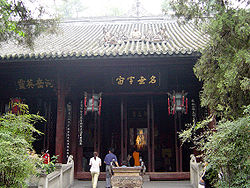
, and Temple
of the Marquis of Wu in Baidicheng
and was played by Pu Cunxin
. Takeshi Kaneshiro
played Zhuge Liang in another film Red Cliff.
Zhuge Liang was played by veteran Chinese actor Tang Guoqiang
in the 1994 CCTV
television series Romance of the Three Kingdoms
, based on the novel of the same title. Lu Yi
played Zhuge Liang in Three Kingdoms, a 2010 remake of the 1994 version. Alan Ke played the role of Zhuge Liang in the 2009 Taiwanese drama K.O.3an Guo
, a parody of Romance of the Three Kingdoms
in a modern high school setting.
and Koei's Romance of the Three Kingdoms
game series place Zhuge Liang's intelligence statistic as the highest of all characters. He is also a playable character in Koei's Dynasty Warriors
, Dynasty Tactics and Kessen II
. He also appears in Warriors Orochi
, a crossover between Dynasty Warriors and Samurai Warriors
.
Zhuge Liang is the protagonist in Koei's tactical role-playing game Sangokushi Koumeiden
, where he can die at the Battle of Wuzhang Plains
, as he did historically, or proceed to restore the Han Dynasty
under Emperor Xian
.
Zhuge Liang appears in the game Civilization V
as a great general along with Cao Cao
.
, there is a card named "Kongming, Sleeping Dragon" in the Portal Three Kingdoms
set.
by Alan Moore
.
In the manhua
Faeries' Landing
, the protagonist of the story is a high-school student named Ryang Jegal, whose life is turned upside-down by a fairy and her heavenly (and not-so-heavenly) peers. Ryang Jegal, or Jegal Ryang in the proper Asian sequence, is the Korean translation of "Zhuge Liang".
Shu Han
Shu Han was one of the three states competing for control of China during the Three Kingdoms period, after the fall of the Han Dynasty. The state was based on areas around Sichuan, which was then known as Shu...
during the Three Kingdoms
Three Kingdoms
The Three Kingdoms period was a period in Chinese history, part of an era of disunity called the "Six Dynasties" following immediately the loss of de facto power of the Han Dynasty rulers. In a strict academic sense it refers to the period between the foundation of the state of Wei in 220 and the...
period of Chinese history
History of China
Chinese civilization originated in various regional centers along both the Yellow River and the Yangtze River valleys in the Neolithic era, but the Yellow River is said to be the Cradle of Chinese Civilization. With thousands of years of continuous history, China is one of the world's oldest...
. He is often recognised as the greatest and most accomplished strategist of his era.
Often depicted wearing a robe and holding a hand fan made of crane feathers, Zhuge Liang was not only an important military strategist and statesman; he was also an accomplished scholar and inventor. His reputation as an intelligent and learned scholar grew even while he was living in relative seclusion, earning him the nickname "Wolong" (臥龍; literally: "Crouching Dragon").
Zhuge
Zhuge
Zhuge is a Chinese double surname. It is ranked 314th in Hundred Family Surnames. The surname has often been synonymous with wisdom in Chinese culture, due to the fame of Zhuge Liang.-Notable people with the surname Zhuge:*Zhuge Liang**Zhuge Zhan...
is an uncommon two-character compound family name
Chinese compound surname
A Chinese compound surname is a Chinese surname using more than one character. Many of these surnames derive from noble and official titles, professions, place names and other areas, to serve for a purpose. Some are originally non-Han, while others were created by joining two one-character family...
. His name – even his surname alone – has become synonymous with intelligence and strategy in Chinese culture.
Early life
Zhuge Liang was born in Yangdu, Langya Commandery (present-day Yinan CountyYinan County
Yinan is a county of Linyi in the Chinese province of Shandong.The population was in 1999.-Notable people:...
, Shandong
Shandong
' is a Province located on the eastern coast of the People's Republic of China. Shandong has played a major role in Chinese history from the beginning of Chinese civilization along the lower reaches of the Yellow River and served as a pivotal cultural and religious site for Taoism, Chinese...
). He lost his parents and was orphaned at a premature age, and was raised by his uncle, Zhuge Xuan. He followed his uncle to live in Jing Province under Liu Biao
Liu Biao
Liu Biao , style name Jingsheng , was a warlord and the governor of Jing Province during the late Han Dynasty period of Chinese history. He was a member of the extended family of the Han Dynasty emperors...
later. After his uncle died, Zhuge Liang and his brothers settled in Wolonggang (in present-day Henan
Henan
Henan , is a province of the People's Republic of China, located in the central part of the country. Its one-character abbreviation is "豫" , named after Yuzhou , a Han Dynasty state that included parts of Henan...
) for the next ten years or so, leading simple lives – farming by day and studying at night. Zhuge Liang's two older sisters married members of influential clans with strong connections in the region.
Guan Zhong
Guǎn Zhòng was a politician and statesman during the Spring and Autumn Period of Chinese history. His given name was Yíwú . Zhong was his courtesy name. Recommended by Bao Shuya, he was appointed Prime Minister by Duke Huan of Qi in 685 BC.-Achievements:Guan Zhong modernized the Qi State by...
and Yue Yi
Yue Yi
Yue Yi was an officer of the State of Yan during the Warring State period, also known as Lord Guojun. He was the son of the prime minister of the small nation of Zhongshan, but when Zhongshan was destroyed by Zhao's King Wuling, he was forced to wander from country to country...
, two famous historical figures. He developed close friendships with members of the local literati, such as Xu Shu
Xu Shu
Xu Shu was an advisor to the warlord Cao Cao during the late Han Dynasty period of Chinese history. He initially served Liu Bei before joining Cao Cao in 208.-Biography:...
, Cui Zhouping, Meng Jian and Shi Tao. Zhuge Liang also maintained close relations with other well known intellectuals, such as Sima Hui
Sima Hui
Sima Hui, style names Decao and Shuijing , was a hermit who lived during the late Han Dynasty period of Chinese history. He was from Yingchuan , and lived in northern Jing Province...
, Pang Degong and Huang Chengyan
Huang Chengyan
Huang Chengyan was a scholar from Longzhong commandery during the late Han Dynasty period of Chinese history.Huang's wife was the sister of Lady Cai and Cai Mao...
. Huang Chengyan once told Zhuge Liang, "I heard that you're seeking a spouse. I've an ugly daughter with a yellow face and dark complexion, but her talent matches yours." Zhuge Liang agreed and married Huang Chengyan's daughter.
Service under Liu Bei
At that time, Liu BeiLiu Bei
Liu Bei , also known as Liu Xuande, was a warlord, military general and later the founding emperor of the state of Shu Han during the Three Kingdoms era of Chinese history...
resided at Xinye
Xinye County
Xinye is one of the counties of Nanyang that lies in the southwest of Henan province in central China. Its south is Xiangfan city of Hubei province . Itseast is Tanghe county of Nanyang. Its west is county-level city...
while he was taking shelter under Jing Province's governor, Liu Biao
Liu Biao
Liu Biao , style name Jingsheng , was a warlord and the governor of Jing Province during the late Han Dynasty period of Chinese history. He was a member of the extended family of the Han Dynasty emperors...
. Liu Bei visited Sima Hui
Sima Hui
Sima Hui, style names Decao and Shuijing , was a hermit who lived during the late Han Dynasty period of Chinese history. He was from Yingchuan , and lived in northern Jing Province...
, who told him, "Confucian academics and common scholars, how much do they know about current affairs? Those who analyze current affairs well are elites. Crouching Dragon and Young Phoenix are the only ones in this region." Xu Shu
Xu Shu
Xu Shu was an advisor to the warlord Cao Cao during the late Han Dynasty period of Chinese history. He initially served Liu Bei before joining Cao Cao in 208.-Biography:...
later recommended Zhuge Liang to Liu Bei again, and Liu wanted to ask Xu to invite Zhuge to meet him. However, Xu Shu replied, "You must visit this man in person. He cannot be invited to meet you." Liu Bei succeeded in recruiting Zhuge Liang in 207 after paying three personal visits. Zhuge Liang presented the Longzhong Plan
Longzhong Plan
The Longzhong Plan is the name given to a strategic plan given by the third century Chinese tactician and administrator Zhuge Liang. It formed the basis for the grand plan of the warlord Liu Bei and later the Three Kingdoms state of Shu. In essence it envisaged the securing of a viable regional...
to Liu Bei and left his residence to follow Liu. Afterwards, Liu Bei became very close to Zhuge Liang and often had discussions with him. Guan Yu
Guan Yu
Guan Yu was a general serving under the warlord Liu Bei during the late Eastern Han Dynasty of China. He played a significant role in the civil war that led to the collapse of the Han Dynasty and the establishment of the state of Shu Han during the Three Kingdoms period, of which Liu Bei was the...
and Zhang Fei were not pleased and complained. Liu Bei explained, "Now that I've Kongming (Zhuge Liang's style name), it's just like a fish getting into water. I hope you'll stop making unpleasant remarks." Guan Yu and Zhang Fei then stopped complaining.
As a lobbyist
In 208, Liu Biao died and was succeeded by his younger son, Liu Cong, who surrendered Jing Province to Cao Cao. When Liu Bei heard of Liu Cong's surrender, he led his followers (both troops and civilians) on an exodus southward to XiakouHankou
Hankou was one of the three cities whose merging formed modern-day Wuhan, the capital of the Hubei province, China. It stands north of the Han and Yangtze Rivers where the Han falls into the Yangtze...
, engaging Cao Cao's forces in a brief skirmish at the Battle of Changban
Battle of Changban
The Battle of Changban was a battle fought between the warlords Cao Cao and Liu Bei in 208 during the prelude to the Three Kingdoms period of Chinese history...
along the way. While in Xiakou, Liu Bei sent Zhuge Liang to follow Lu Su
Lu Su
Lu Su , style name Zijing , was a politician, militarist and diplomat serving under the warlord Sun Quan during the late Han Dynasty period of Chinese history...
to Jiangdong
Jiangnan
Jiangnan or Jiang Nan is a geographic area in China referring to lands immediately to the south of the lower reaches of the Yangtze River, including the southern part of the Yangtze Delta...
to discuss the formation of an alliance between him and Sun Quan
Sun Quan
Sun Quan , son of Sun Jian, formally Emperor Da of Wu, was the founder of Eastern Wu during the Three Kingdoms period of Chinese history. He ruled from 222 to 229 as King of Wu and from 229 to 252 as Emperor of Wu....
.
Zhuge Liang met Sun Quan in Chaisang and proposed two solutions to Sun, "If you can use the forces of Wuyue
Wu (region)
Wu is a region in the Jiangnan area , surrounding Suzhou, in Jiangsu province and Zhejiang province of China. It is also the abbreviation of several kingdoms based in Wu. The two largest cities in the Wu region today are Shanghai and Hangzhou...
to resist the Middle Kingdom, why not break ties (with Cao Cao) in advance? If you cannot oppose, why not demobilize the troops, discard your armour and surrender to the north?" After Sun Quan's viceroy, Zhou Yu
Zhou Yu
Zhou Yu was a military general and strategist who served his close friend, the warlord Sun Ce, during the late Han Dynasty period of Chinese history...
, analyzed the situation and pointed out weaknesses in Cao Cao's army, Sun finally agreed to ally with Liu Bei in resisting Cao. Zhuge Liang returned to Liu Bei's camp with Sun Quan's envoy, Lu Su
Lu Su
Lu Su , style name Zijing , was a politician, militarist and diplomat serving under the warlord Sun Quan during the late Han Dynasty period of Chinese history...
, to make preparation for the upcoming war.
As a logistics officer
In late 208, the allied armies of Liu Bei and Sun Quan scored a decisive victory over Cao Cao's forces at the Battle of Red CliffsBattle of Red Cliffs
The Battle of Red Cliffs, otherwise known as the Battle of Chibi, was a decisive battle at the end of the Han Dynasty, immediately prior to the Three Kingdoms period of Chinese history. It was fought in the winter of 208/9 AD between the allied forces of the southern warlords Liu Bei and Sun Quan...
. Cao Cao retreated to Ye
Ye, China
Ye or Yecheng was an ancient Chinese city located in what is now Linzhang County, Hebei and the neighbouring Anyang County, Henan....
, while Liu Bei proceeded to conquer territories in Jiangnan
Jiangnan
Jiangnan or Jiang Nan is a geographic area in China referring to lands immediately to the south of the lower reaches of the Yangtze River, including the southern part of the Yangtze Delta...
, covering most of southern Jing Province. Zhuge Liang was appointed "Military Advisor General of the Household" (軍師中郎將). He was put in charge of governing Lingling (present day Yongzhou
Yongzhou
Yongzhou is a prefecture-level city in the Hunan province of China.YongZhou is located in the central and south of China, on the southern side of Xiang River, which is formed by the confluence of the Xiao and Xiang rivers. Yongzhou is one of the four ancient counties in Hunan; it is 2000 years old...
, Hunan
Hunan
' is a province of South-Central China, located to the south of the middle reaches of the Yangtze River and south of Lake Dongting...
), Guiyang
Guiyang County
Guiyang County is a county of Hunan, China. It is under the administration of Chenzhou city.-References:*...
and Changsha commanderies and collecting taxes to fund the military.
In 211, Liu Zhang
Liu Zhang (warlord)
Liu Zhang was a warlord during the late Han Dynasty period of Chinese history. He became governor of Yi Province , succeeding his father Liu Yan and ruled the region until 214, when he surrendered to Liu Bei...
, governor of Yi Province (covering present-day Sichuan basin
Sichuan basin
The Sichuan Basin is a lowland region in southwestern China. Despite its historical name, it is not only synonymous to Sichuan province, comprising its central and eastern portions as well as part of Chongqing Municipality...
), requested aid from Liu Bei in attacking Zhang Lu of Hanzhong
Hanzhong
Hanzhong is a municipality in southwest Shaanxi Province, China, occupying a historically significant valley in the mountains between the Xi'an area, home to many Chinese capitals, and the fertile but isolated Sichuan Basin...
. Liu Bei left Zhuge Liang, Guan Yu
Guan Yu
Guan Yu was a general serving under the warlord Liu Bei during the late Eastern Han Dynasty of China. He played a significant role in the civil war that led to the collapse of the Han Dynasty and the establishment of the state of Shu Han during the Three Kingdoms period, of which Liu Bei was the...
, Zhang Fei and others in charge of Jing Province while he led an army into Sichuan. Liu Bei promptly agreed to Liu Zhang's proposal, but secretly planned to take over Liu Zhang's land. The following year, Liu Zhang discovered Liu Bei's intention, and the two turned hostile and waged war on each other. Zhuge Liang, Zhang Fei and Zhao Yun
Zhao Yun
Zhao Yun was a military general who lived during the late Han Dynasty and early Three Kingdoms era of Chinese history. For most of his career, Zhao served the warlord Liu Bei, playing a part in the establishment of state of Shu Han...
led separate forces to reinforce Liu Bei in the attack on Liu Zhang's capital city, Chengdu
Chengdu
Chengdu , formerly transliterated Chengtu, is the capital of Sichuan province in Southwest China. It holds sub-provincial administrative status...
, while Guan Yu stayed behind to guard Jing Province. In 214, Liu Zhang surrendered and Liu Bei took control of Yi Province.
Liu Bei appointed Zhuge Liang "Military Advisor General" (軍師將軍) and let him administer affairs of his personal office (office of the General of the Left (左將軍)). Whenever Liu Bei embarked on military campaigns, Zhuge Liang remained to defend Chengdu and ensure a steady flow of supply of troops and provisions. In 221, in response to Cao Pi
Cao Pi
Cao Pi , formally known as Emperor Wen of Wei, was the first emperor of the state of Cao Wei during the Three Kingdoms period of Chinese history. Born in Qiao County, Pei Commandery , he was the second son of the late Han Dynasty warlord Cao Cao.Cao Pi, like his father, was a poet...
's usurping of Emperor Xian
Emperor Xian of Han
Emperor Xian of Han , personal name Liu Xie, style name Bohe, was the last emperor of the Han Dynasty period of Chinese history...
's throne, Liu Bei's subordinates advised him to declare himself emperor
Emperor of China
The Emperor of China refers to any sovereign of Imperial China reigning between the founding of Qin Dynasty of China, united by the King of Qin in 221 BCE, and the fall of Yuan Shikai's Empire of China in 1916. When referred to as the Son of Heaven , a title that predates the Qin unification, the...
. After initially refusing, Liu Bei was eventually persuaded by Zhuge Liang to do so and became ruler of Shu Han
Shu Han
Shu Han was one of the three states competing for control of China during the Three Kingdoms period, after the fall of the Han Dynasty. The state was based on areas around Sichuan, which was then known as Shu...
. Liu Bei named Zhuge Liang his chancellor and put him in charge of the imperial agency where Zhuge assumed the functions of Imperial Secretariat. Zhuge Liang was appointed "Director of Retainers" (司隸校尉) after Zhang Fei's death.
Service under Liu Shan
In the spring of 222, Liu Bei retreated to Yong'an (present-day Fengjie County, ChongqingChongqing
Chongqing is a major city in Southwest China and one of the five national central cities of China. Administratively, it is one of the PRC's four direct-controlled municipalities , and the only such municipality in inland China.The municipality was created on 14 March 1997, succeeding the...
) after his defeat at the Battle of Xiaoting
Battle of Xiaoting
The Battle of Xiaoting, also known as the Battle of Yiling and the Battle of Yiling and Xiaoting, was fought between the states of Eastern Wu and Shu Han in 222 during the Three Kingdoms period of Chinese history...
and became seriously ill. He summoned Zhuge Liang from Chengdu and said to him, "You're ten times more talented than Cao Pi
Cao Pi
Cao Pi , formally known as Emperor Wen of Wei, was the first emperor of the state of Cao Wei during the Three Kingdoms period of Chinese history. Born in Qiao County, Pei Commandery , he was the second son of the late Han Dynasty warlord Cao Cao.Cao Pi, like his father, was a poet...
, capable of both securing the country and accomplishing our great mission. If my son can be assisted, then assist him. If he proves incompetent, then you may take over the throne." Zhuge Liang replied tearfully, "I'll do my utmost and serve with unwavering loyalty until death." Liu Bei then ordered his son, Liu Shan
Liu Shan
Liu Shan, , was the second and last emperor of the state of Shu Han during the Three Kingdoms era of Chinese history. As he ascended the throne at the young age of 16, Liu Shan was entrusted to the care of the Chancellor Zhuge Liang and Imperial Secretariat Li Yan...
, to administer state affairs together with Zhuge Liang and regard Zhuge as his father.
As a regent
After Liu Bei's death, Liu Shan ascended to the throne of Shu HanShu Han
Shu Han was one of the three states competing for control of China during the Three Kingdoms period, after the fall of the Han Dynasty. The state was based on areas around Sichuan, which was then known as Shu...
. He granted Zhuge Liang the title of "Marquis of Wu" (武鄉侯) and created an office for him. Not long later, Zhuge Liang was appointed governor of Yi Province and put in charge of all state affairs. At the same time, the commanderies in Nanzhong
Nanzhong
Nanzhong was an ancient region consisting of modern-day Yunnan, Guizhou, and southern Sichuan in southern China.The region was the homeland of the rebellious Nanman tribes, led by Meng Huo. In 225 AD, the famed statesman Zhuge Liang led three columns into Yunnan to pacify the tribes. His seven...
rebelled against Shu, but Zhuge Liang did not send troops to suppress the revolt as Liu Bei's death was still recent. He sent Deng Zhi
Deng Zhi
Deng Zhi was a minister of Shu Han during the Three Kingdoms era of Chinese history.-Early career:Deng Zhi was a native of Xinye , and went to Yi Province to avoid the turmoil of central China...
and Chen Zhen to make peace with Eastern Wu
Eastern Wu
Eastern Wu, also known as Sun Wu, was one the three states competing for control of China during the Three Kingdoms period after the fall of the Han Dynasty. It was based in the Jiangnan region of China...
and re-entered an alliance with Wu. Zhuge Liang would consistently send envoys to Wu to improve diplomatic relations between the two states.
Southern Campaign
During his reign as regentRegent
A regent, from the Latin regens "one who reigns", is a person selected to act as head of state because the ruler is a minor, not present, or debilitated. Currently there are only two ruling Regencies in the world, sovereign Liechtenstein and the Malaysian constitutive state of Terengganu...
, Zhuge Liang set Shu's objective as the restoration of the Han Dynasty
Han Dynasty
The Han Dynasty was the second imperial dynasty of China, preceded by the Qin Dynasty and succeeded by the Three Kingdoms . It was founded by the rebel leader Liu Bang, known posthumously as Emperor Gaozu of Han. It was briefly interrupted by the Xin Dynasty of the former regent Wang Mang...
, which from Shu's point of view, had been usurped by Cao Wei
Cao Wei
Cao Wei was one of the states that competed for control of China during the Three Kingdoms period. With the capital at Luoyang, the state was established by Cao Pi in 220, based upon the foundations that his father Cao Cao laid...
. He felt that in order to attack Wei, a complete unification of Shu was first needed. Zhuge Liang was worried that the local clans would work with the Nanman
Nanman
Nanman were aboriginal tribes who lived in southwestern China. They may have been related to the Sanmiao, dated to around the 3rd century BC. The Nanman were multiple ethnic groups including the Miao, the Kinh, the Thai, and some Tibeto-Burman groups such as the Bai. There was never a single...
tribes in Nanzhong
Nanzhong
Nanzhong was an ancient region consisting of modern-day Yunnan, Guizhou, and southern Sichuan in southern China.The region was the homeland of the rebellious Nanman tribes, led by Meng Huo. In 225 AD, the famed statesman Zhuge Liang led three columns into Yunnan to pacify the tribes. His seven...
to stage a revolution. Fearing the possibility that the peasants might rebel and press into areas surrounding the capital city of Chengdu
Chengdu
Chengdu , formerly transliterated Chengtu, is the capital of Sichuan province in Southwest China. It holds sub-provincial administrative status...
while he was attacking Wei in the north, Zhuge Liang decided to pacify the southern tribes first.
In the spring of 225, regional clans including Yong, Gao, Zhu, and Meng had taken control of some cities in the south, so Zhuge Liang led an expedition force to Nanzhong. Ma Su
Ma Su
Ma Su was a military general and strategist of the state of Shu Han during the Three Kingdoms era of Chinese history. He was the younger brother of Ma Liang. Ma Su had conspicuous talent in military theories and was admired by the Shu chancellor Zhuge Liang...
proposed that they should attempt to win the hearts of the Nanman and rally their support instead of using military force to subdue them. Zhuge Liang heeded Ma Su's advice and defeated the rebel leader, Meng Huo
Meng Huo
Meng Huo was popularly regarded as a local leader representing the gentries of the Nanzhong region during the Three Kingdoms era of Chinese history...
, on seven different occasions. He released Meng Huo each time in order to achieve Meng's genuine surrender. Note that the story about Meng Huo and his captures is rejected as a reliable and accurate historical reference by the majority of the academic, including historians like Miao Yue, Tan Liangxiao, and Zhang Hualan.
Realizing he had no chance to win, Meng Huo pledged allegiance to Shu, and was appointed by Zhuge Liang as governor of the region to keep the populace content and secure the southern Shu border. This would ensure that the future Northern Expeditions would proceed without internal disruptions. Rich and abundant resources acquired from Nanzhong were used to fund Shu's military and the state became more prosperous.
Northern Expeditions and death
After pacifying the Nanman, Zhuge Liang ordered the Shu military to make preparations for a large scale offensive on the rival state of Wei. In 227, while in HanzhongHanzhong
Hanzhong is a municipality in southwest Shaanxi Province, China, occupying a historically significant valley in the mountains between the Xi'an area, home to many Chinese capitals, and the fertile but isolated Sichuan Basin...
, he wrote a memorial, titled Chu Shi Biao
Chu Shi Biao
There are two Chu Shi Biao , the former and the second were documents submitted by Shu Han Prime Minister Zhuge Liang to Emperor Liu Shan before his first and second Northern Expedition of Wei, in 225 and 226, respectively...
, to Liu Shan
Liu Shan
Liu Shan, , was the second and last emperor of the state of Shu Han during the Three Kingdoms era of Chinese history. As he ascended the throne at the young age of 16, Liu Shan was entrusted to the care of the Chancellor Zhuge Liang and Imperial Secretariat Li Yan...
, stating his rationale for the campaign and giving advice to the emperor on good governance. From 228 until his death in 234, Zhuge Liang launched a total of five Northern Expeditions against Wei, all except one of which failed. The only permanent gains by Shu were the conquests of Wudu and Yinping prefectures, as well as the relocation of Wei citizens to Shu on occasion. However, Zhuge Liang's army never suffered casualties over 5% of the total forces, and the resources put into military were affordable (assuming Shu's zenith at 200,000 military strength.)
During the first Northern Expedition, Zhuge Liang persuaded Jiang Wei
Jiang Wei
Jiang Wei was a military general and regent of the state of Shu Han during the Three Kingdoms era of Chinese history. He originally served Shu's rival state, Cao Wei, as a middle-level military officer, but defected to the Shu strategist Zhuge Liang, leaving his mother in Wei. After that, Jiang...
, a young Wei military officer, to surrender and defect to his side. Jiang Wei became a prominent general of Shu later and inherited Zhuge Liang's ideals. In late 234, Zhuge Liang and Sima Yi
Sima Yi
Sima Yi was a general and politician of the state of Cao Wei during the Three Kingdoms era of Chinese history. He is perhaps best known for defending Wei from Zhuge Liang's Northern Expeditions...
(the Wei commander) reached a stalemate at the Battle of Wuzhang Plains
Battle of Wuzhang Plains
The Battle of Wuzhang Plains was a standoff between the contending states of Cao Wei and Shu Han in 234 during the Three Kingdoms period of Chinese history...
. Zhuge Liang fell seriously ill and eventually died in camp at the age of 54. Before his death, Zhuge Liang recommended Jiang Wan
Jiang Wan
Jiang Wan , style name Gongyan , was an official of Shu Han during the Three Kingdoms era of Chinese history. After Zhuge Liang's death, he succeeded Zhuge as the regent for the Shu emperor, Liu Shan.-Early career:...
and Fei Yi
Fei Yi
Fei Yi, style name Wenwei , was an official of Shu Han during the Three Kingdoms era of Chinese history. He succeeded Jiang Wan as regent of Shu Han, and avoided major expedition against rival state, Cao Wei...
to succeed him as regent of Shu. He was buried on Mount Dingjun
Mount Dingjun
Dingjun Mountain is a mountain in the Mian County of Hanzhong, Shaanxi, China. It is situated across Tiandang Mountain, separated by the Han River, and is near the old Yangping Pass....
according to his dying wish and posthumously granted the title of "Loyal and Martial Marquis" (忠武侯) by Liu Shan.
Family
- Ancestor: Zhuge Feng (諸葛豐), served as Director of Retainers during the reign of Emperor Yuan of HanEmperor Yuan of HanEmperor Yuan of Han was an emperor of the Chinese Han Dynasty. He reigned from 48 BC to 33 BC. Emperor Yuan was remembered for the promotion of Confucianism as the official creed of Chinese government. He appointed Confucius adherents to important government posts...
- Father: Zhuge Gui (諸葛珪), served as Assistant in Mount Tai Commandery during the late Han Dynasty
- Uncle: Zhuge Xuan (諸葛玄), served as Administrator of Yuzhang, joined Liu BiaoLiu BiaoLiu Biao , style name Jingsheng , was a warlord and the governor of Jing Province during the late Han Dynasty period of Chinese history. He was a member of the extended family of the Han Dynasty emperors...
later. Raised Zhuge Liang and Zhuge Jun.
- Siblings:
- Zhuge JinZhuge JinZhuge Jin , style name Ziyu , was a military general and politician of Eastern Wu during the late Han Dynasty and Three Kingdoms era of Chinese history.-Early life:...
, older brother, served Wu - Zhuge Jun (諸葛均), younger brother, served Shu
- Older sister, unknown name, married Pang Shanmin (Pang TongPang TongPang Tong was an advisor to Liu Bei during the late Han Dynasty period of Chinese history. He was nicknamed "Young Phoenix" by his uncle Pang Degong due to his ugly appearance but great capabilities and talent...
's older cousin) - Older sister, unknown name, married a member of the XiangyangXiangyangXiangzhou District is a district of Xiangyang, Hubei, China. The district itself was formerly known as Xiangyang. It was a city famous for the Siege of Xiangyang by invading forces of the Mongol-founded Yuan Dynasty...
Kuai clan (headed by Kuai LiangKuai LiangKuai Liang, style name Zirou , was an advisor to the warlord Liu Biao during the late Han Dynasty period of Chinese history. He was a native of Zhonglu, Nan Commandery...
and Kuai YueKuai YueKuai Yue , style name Yidu , was an advisor to the warlord Liu Biao during the late Han Dynasty period of Chinese history. He was the younger brother of Kuai Liang. When Liu Biao died and Liu Cong succeeded him, Kuai Yue recommended that he surrender to Cao Cao...
)
- Zhuge Jin
- Cousins:
- Zhuge DanZhuge DanZhuge Dan , style named Gongxiu , was a military general of Cao Wei during the Three Kingdoms period of Chinese history. When he held military positions during his middle to late career, he got involved in all Three Rebellions in Shouchun, which aimed to drive the de facto ruler of Cao Wei, Sima...
, served Wei, participated in the Three Rebellions in ShouchunThree Rebellions in ShouchunThe Three Rebellions in Shouchun, also known as Three Rebellions in Huainan, were a series of revolts that occurred in the state of Cao Wei during the Three Kingdoms period of Chinese history. The rebellions broke out in the later years of Cao Wei when the Sima clan, headed by Sima Yi, usurped...
, killed after his defeat
- Zhuge Dan
- Spouse: Lady Huang, daughter of Huang ChengyanHuang ChengyanHuang Chengyan was a scholar from Longzhong commandery during the late Han Dynasty period of Chinese history.Huang's wife was the sister of Lady Cai and Cai Mao...
. Commonly known as Huang YueyingHuang YueyingHuang Yueying is the fictional name of the wife of Zhuge Liang, the chancellor of Shu Han during the Three Kingdoms period of Chinese history. Her personal name was not recorded in history.-In folklore:...
or Huang Shou (黃綬) in folk tales.
- Sons:
- Zhuge ZhanZhuge ZhanZhuge Zhan , style name Siyuan , was a politician and military general of Shu Han during the Three Kingdoms period of Chinese history...
, served Shu, killed in action during the Conquest of Shu by WeiConquest of Shu by WeiThe conquest of Shu by Wei was a military campaign launched by the state of Cao Wei against its rival Shu Han in 263 during the Three Kingdoms period of Chinese history. The campaign culminated in the fall of Shu and the tripartite equilibrium maintained in China for over 40 years since the end of... - Zhuge Huai (諸葛懷), lived as a commoner during the Jin Dynasty
- Zhuge Zhan
- Adopted children:
- Zhuge QiaoZhuge QiaoZhuge Qiao , style name Bosong , originally styled Zhongshen , was the second son of Zhuge Jin, an official of Eastern Wu during the late Han Dynasty and Three Kingdoms period of Chinese history. Zhuge Qiao was adopted by his uncle, Zhuge Liang. Zhuge Qiao was considered as a possible heir to Zhuge...
, son of Zhuge Jin, adopted by Zhuge Liang, served Shu, died at a young age
- Zhuge Qiao
- Grandsons:
- Zhuge Pan (諸葛攀), son of Zhuge Qiao, returned to Eastern Wu to continue the Zhuge family line there after Zhuge KeZhuge KeZhuge Ke , style name Yuanxun , was a military general and regent of Eastern Wu during the Three Kingdoms era of Chinese history. He was the son of Zhuge Jin and nephew of Zhuge Liang. He succeeded Lu Xun after the latter's death...
's death - Zhuge ShangZhuge ShangZhuge Shang was a military general of Shu Han during the Three Kingdoms period of Chinese history. He was a son of Zhuge Zhan and grandson of Zhuge Liang.Zhuge Shang and his father defended Chengdu when the rival state of Cao Wei invaded Shu Han...
, oldest son of Zhuge Zhan, killed in action with his father during the Conquest of Shu by Wei - Zhuge Jing (諸葛京), second son of Zhuge Zhan, moved to Hedong in 264 with Zhuge Pan's son Zhuge Xian (諸葛顯), served the Jin Dynasty
- Zhuge Zhi (諸葛質), youngest son of Zhuge Zhan
- Zhuge Pan (諸葛攀), son of Zhuge Qiao, returned to Eastern Wu to continue the Zhuge family line there after Zhuge Ke
- Descendants:
- Marie Zhuge Ziqi (諸葛梓岐), Hong Kong based Canadian model, claims to be a 63rd generation descendant of Zhuge Liang
Inventions
Mantou
Mantou, often referred to as Chinese steamed bun/bread, is a kind of steamed bun originating in China. They are typically eaten as a staple in northern parts of China where wheat, rather than rice, is grown. They are made with milled wheat flour, water and leavening agents...
, the landmine and a mysterious but efficient automatic transportation device (initially used for grain) referred to as the "wooden ox
Wooden ox
The wooden ox was created by Zhuge Liang while he served Shu-Han. It was a thought to be either* a mechanical, walking replica of an ox whose main purpose was to carry supplies such as grain to an army that was running low on suppliesor* a sort of wheelbarrow that had 2 booms on which it was...
and flowing horse" (木牛流馬), which is sometimes identified with the wheelbarrow.
Although he is often credited with the invention of the repeating crossbow that is named after him and called "Zhuge Crossbow", this type of semi-automatic crossbow is an improved version of a model that first appeared during the Warring States Period
Warring States Period
The Warring States Period , also known as the Era of Warring States, or the Warring Kingdoms period, covers the Iron Age period from about 475 BC to the reunification of China under the Qin Dynasty in 221 BC...
(though there is debate whether the original Warring States Period bow was semi-automatic, or rather shot multiple bolts at once). Nevertheless, Zhuge Liang's version could shoot farther and faster.
Zhuge Liang is also credited with constructing the mysterious Stone Sentinel Maze
Stone Sentinel Maze
The Stone Sentinel Maze was an array of rocks and boulders thought to be conjured by the Three Kingdoms period strategist Zhuge Liang using the concept of the bagua. The formation was located on Yufu Shore by the Yangtze River near present-day Baidicheng, Chongqing, China, where supposed ruins of...
, an array of stone piles that is said to produce supernatural phenomenon, located near Baidicheng.
An early type of hot air balloon used for military signalling, known as the Kongming lantern
Sky lantern
Sky lanterns, also known as Kongming Lantern are airborne paper lanterns traditionally found in some Asian cultures. They are constructed from oiled rice paper on a bamboo frame, and contain a small candle or fuel cell composed of a waxy flammable material. When lit, the flame heats the air inside...
, is also named after him. It was said to be invented by Zhuge Liang when he was trapped by Sima Yi
Sima Yi
Sima Yi was a general and politician of the state of Cao Wei during the Three Kingdoms era of Chinese history. He is perhaps best known for defending Wei from Zhuge Liang's Northern Expeditions...
in Pingyang. Friendly forces nearby saw the message on the lantern paper covering and came to Zhuge Liang's aid. Another belief is that the lantern resembled Zhuge Liang's headdress, so it was named after him.
Literary works
Some books popularly attributed to Zhuge Liang can be found today. For example, the Thirty-Six Stratagems, and Mastering the Art of War (not to be confused with Sun TzuSun Tzu
Sun Wu , style name Changqing , better known as Sun Tzu or Sunzi , was an ancient Chinese military general, strategist and philosopher who is traditionally believed, and who is most likely, to have authored The Art of War, an influential ancient Chinese book on military strategy...
's The Art of War
The Art of War
The Art of War is an ancient Chinese military treatise that is attributed to Sun Tzu , a high ranking military general and strategist during the late Spring and Autumn period...
) are two of Zhuge Liang's works that are generally available. Supposedly, his mastery of infantry and cavalry formation tactics, based on the Taoist
Taoism
Taoism refers to a philosophical or religious tradition in which the basic concept is to establish harmony with the Tao , which is the mechanism of everything that exists...
classic I Ching
I Ching
The I Ching or "Yì Jīng" , also known as the Classic of Changes, Book of Changes and Zhouyi, is one of the oldest of the Chinese classic texts...
, were unrivalled. His memorial Chu Shi Biao
Chu Shi Biao
There are two Chu Shi Biao , the former and the second were documents submitted by Shu Han Prime Minister Zhuge Liang to Emperor Liu Shan before his first and second Northern Expedition of Wei, in 225 and 226, respectively...
, written prior to the Northern Expeditions, provided a salutary reflection of his unwavering loyalty to the state of Shu. The memorial moved readers to tears.
Zhuge Liang is also the subject of many Chinese literary works. A poem by Du Fu
Du Fu
Du Fu was a prominent Chinese poet of the Tang Dynasty.Along with Li Bai , he is frequently called the greatest of the Chinese poets. His greatest ambition was to serve his country as a successful civil servant, but he proved unable to make the necessary accommodations...
, a prolific Tang Dynasty
Tang Dynasty
The Tang Dynasty was an imperial dynasty of China preceded by the Sui Dynasty and followed by the Five Dynasties and Ten Kingdoms Period. It was founded by the Li family, who seized power during the decline and collapse of the Sui Empire...
poet, was written in memory of Zhuge Liang whose legacy of unwavering dedication seems to have been forgotten in Du Fu's generation (judging by the description of Zhuge Liang' unkept temple). Some historians believe that Du Fu had compared himself with Zhuge Liang in the poem. The full text is:
| 蜀相 (武侯祠) 丞相祠堂何處尋? 錦官城外柏森森。 映階碧草自春色, 隔葉黃鸝空好音。 三顧頻煩天下計, 兩朝開濟老臣心。 出師未捷身先死, 長使英雄淚滿襟 |
Premier of Shu (Temple of the Marquis of Wu) Where to seek the temple of the noble Premier? In the deep pine forests outside the City of Silk Chengdu Chengdu , formerly transliterated Chengtu, is the capital of Sichuan province in Southwest China. It holds sub-provincial administrative status... : Where grass-covered steps mirror the colours of spring, And among the leaves orioles' empty songs sing. Three visits brought him the weight of the world; Two emperors he served with one heart. Passing ere his quest was complete, Tears have dampened the robes of heroes ever since. |
In fiction
The wisdom and achievements of Zhuge Liang were popularized by the historical novel Romance of the Three KingdomsRomance of the Three Kingdoms
Romance of the Three Kingdoms, written by Luo Guanzhong in the 14th century, is a Chinese historical novel based on the events in the turbulent years near the end of the Han Dynasty and the Three Kingdoms era of Chinese history, starting in 169 and ending with the reunification of the land in...
, written by Luo Guanzhong
Luo Guanzhong
Luo Ben , better known by his style name Luo Guanzhong , was a Chinese writer of the early Ming Dynasty period of Chinese history. He was also known as Huhai Sanren...
during the Ming Dynasty
Ming Dynasty
The Ming Dynasty, also Empire of the Great Ming, was the ruling dynasty of China from 1368 to 1644, following the collapse of the Mongol-led Yuan Dynasty. The Ming, "one of the greatest eras of orderly government and social stability in human history", was the last dynasty in China ruled by ethnic...
. The novel is based on historical sources, including Chen Shou
Chen Shou
Chen Shou was a historian during the Jin Dynasty period of Chinese history. He is best known as the author of Records of Three Kingdoms, a historical account of the late Han Dynasty and Three Kingdoms period.-Biography:...
's Records of Three Kingdoms
Records of Three Kingdoms
Records of Three Kingdoms , is regarded as the official and authoritative historical text on the Three Kingdoms period of Chinese history covering the years 184-280 CE. Written by Chen Shou in the 3rd century, the work combines the smaller histories of the rival states of Cao Wei , Shu Han and...
. Other major influences include Liu Yiqing's A New Account of the Tales of the World
A New Account of the Tales of the World
A New Account of the Tales of the World is a book of anecdotes and character sketches, dates back to the Southern and Northern Dynasties...
, and Sanguozhi Pinghua, a chronological collection of 80 sketches starting with the Oath of the Peach Garden
Oath of the Peach Garden
The Oath of the Peach Garden was a fictional event in Luo Guanzhong's historical novel Romance of the Three Kingdoms. In this event, Liu Bei, Guan Yu and Zhang Fei took an oath of fraternity in a ceremony amid peach blossom trees, and became sworn brothers from then on. Their goal in taking the...
and ending with Zhuge Liang's death.
Some fictitious accounts involving Zhuge Liang from Romance of the Three Kingdoms include:
Borrowing of arrows with straw boats
Prior to the Battle of Red CliffsBattle of Red Cliffs
The Battle of Red Cliffs, otherwise known as the Battle of Chibi, was a decisive battle at the end of the Han Dynasty, immediately prior to the Three Kingdoms period of Chinese history. It was fought in the winter of 208/9 AD between the allied forces of the southern warlords Liu Bei and Sun Quan...
, Zhuge Liang visited Sun Quan
Sun Quan
Sun Quan , son of Sun Jian, formally Emperor Da of Wu, was the founder of Eastern Wu during the Three Kingdoms period of Chinese history. He ruled from 222 to 229 as King of Wu and from 229 to 252 as Emperor of Wu....
's camp to assist Zhou Yu
Zhou Yu
Zhou Yu was a military general and strategist who served his close friend, the warlord Sun Ce, during the late Han Dynasty period of Chinese history...
. Zhou Yu was jealous of Zhuge Liang's talent and felt that Zhuge would become a threat to his lord in future. He assigned Zhuge Liang the task of making 100,000 arrows in ten days or face execution for failure in duties under military law. Zhuge Liang promised that he could complete the mission in three days. With help from Lu Su
Lu Su
Lu Su , style name Zijing , was a politician, militarist and diplomat serving under the warlord Sun Quan during the late Han Dynasty period of Chinese history...
, Zhuge Liang prepared 20 large boats, each manned by a few soldiers and filled with human-like figures made of straw and hay.
At dawn, when there was a great fog, Zhuge Liang deployed the boats and they sailed towards Cao Cao's camp across the river. He ordered the troops to beat war drums loudly and shout orders to imitate the noise of an attack. Upon hearing the noise, Cao Cao's troops rushed out to engage the enemy, but they were unsure of the enemy's strength, because their vision was obscured by the fog. They fired volleys of arrows towards the sound of the drums and the arrows became stuck in the straw figures. In the meantime, Zhuge Liang was enjoying wine with Lu Su inside the cabin and they returned to camp when the fog cleared. Zhuge Liang acquired more than 100,000 arrows with his plan and Zhou Yu had no choice but to let him off.
Praying for the eastern wind
Before the Battle of Red CliffsBattle of Red Cliffs
The Battle of Red Cliffs, otherwise known as the Battle of Chibi, was a decisive battle at the end of the Han Dynasty, immediately prior to the Three Kingdoms period of Chinese history. It was fought in the winter of 208/9 AD between the allied forces of the southern warlords Liu Bei and Sun Quan...
, when all preparations for the fire attack on Cao Cao's fleet had been made, Zhou Yu suddenly realized that the wind was not blowing to their advantage, because the eastern wind was required to enhance the fire attack. He collapsed and became ill. Zhuge Liang visited him and prescribed a "cure" for him, by offering to pray for the eastern wind. Days later, the eastern wind started blowing, much to everyone's surprise. Zhou Yu was pleased, but became worried because he thought Zhuge Liang possessed magical powers and would become a greater threat to his lord. He sent men to kill Zhuge Liang at the altar, but Zhuge anticipated his move and had already escaped under Zhao Yun
Zhao Yun
Zhao Yun was a military general who lived during the late Han Dynasty and early Three Kingdoms era of Chinese history. For most of his career, Zhao served the warlord Liu Bei, playing a part in the establishment of state of Shu Han...
's protection.
Stone Sentinel Maze
In chapter 84, Liu BeiLiu Bei
Liu Bei , also known as Liu Xuande, was a warlord, military general and later the founding emperor of the state of Shu Han during the Three Kingdoms era of Chinese history...
was defeated by Eastern Wu
Eastern Wu
Eastern Wu, also known as Sun Wu, was one the three states competing for control of China during the Three Kingdoms period after the fall of the Han Dynasty. It was based in the Jiangnan region of China...
's Lu Xun
Lu Xun (Three Kingdoms)
Lu Xun was a military general and politician of the state of Eastern Wu during the Three Kingdoms era of Chinese history. He is best known for defeating Liu Bei's forces at the Battle of Xiaoting in 222.-Early life:...
at the Battle of Xiaoting
Battle of Xiaoting
The Battle of Xiaoting, also known as the Battle of Yiling and the Battle of Yiling and Xiaoting, was fought between the states of Eastern Wu and Shu Han in 222 during the Three Kingdoms period of Chinese history...
and he fled towards Baidicheng with Lu Xun hot on pursuit. When Lu Xun arrived at Yufu Shore by the Yangtze River
Yangtze River
The Yangtze, Yangzi or Cháng Jiāng is the longest river in Asia, and the third-longest in the world. It flows for from the glaciers on the Tibetan Plateau in Qinghai eastward across southwest, central and eastern China before emptying into the East China Sea at Shanghai. It is also one of the...
near Baidicheng, he felt a strong enemy presence and cautioned his troops of a possible ambush. He sent men to scout ahead, who reported that the area was deserted except for some scattered piles of rocks. Bewildered, Lu Xun asked a local, who told him that qi
Qi
In traditional Chinese culture, qì is an active principle forming part of any living thing. Qi is frequently translated as life energy, lifeforce, or energy flow. Qi is the central underlying principle in traditional Chinese medicine and martial arts...
started emerging from the area after Zhuge Liang arranged the rocks there when he first entered Sichuan.
Lu Xun personally inspected the area and believed that the "maze" was only a petty display of deception, so he led a few men inside. Just as he was about to leave, a strong gust of wind blew. Dust storms overshadowed the sky and the rocks seemed like swords, mountainous piles of dirt emerged while the river waves sounded like an attacking army. Lu Xun exclaimed, "I have fallen into Zhuge Liang's trap!", and attempted to escape from the maze but to no avail.
Suddenly, Lu Xun saw an old man, who offered him assistance in exiting the labyrinth. Lu Xun followed him and got out of the maze unharmed. The old man identified himself as Huang Chengyan
Huang Chengyan
Huang Chengyan was a scholar from Longzhong commandery during the late Han Dynasty period of Chinese history.Huang's wife was the sister of Lady Cai and Cai Mao...
, Zhuge Liang's father-in-law. He explained to Lu Xun that the maze was constructed based on the ba gua concept. Huang Chengyan also told Lu Xun that Zhuge Liang had predicted that a Wu general would chance upon the maze when he first built it, and had asked him not to lead the general out when he fell into the trap. Lu Xun dismounted and thanked Huang Chengyan. When he returned to camp, he exclaimed that he was inferior to Zhuge Liang in terms of intelligence.
Empty Fort Strategy
During the first Northern Expedition, Zhuge Liang's efforts to conquer Chang'anChang'an
Chang'an is an ancient capital of more than ten dynasties in Chinese history, today known as Xi'an. Chang'an literally means "Perpetual Peace" in Classical Chinese. During the short-lived Xin Dynasty, the city was renamed "Constant Peace" ; yet after its fall in AD 23, the old name was restored...
were undermined by the Shu defeat at the Battle of Jieting
Battle of Jieting
The Battle of Jieting was fought between the states of Cao Wei and Shu Han in 228 during the Three Kingdoms period of Chinese history. The battle was part of the first Northern Expedition led by Shu's chancellor Zhuge Liang to attack Wei...
. With the loss of Jieting, Zhuge Liang's current location, Xicheng, was in peril of being attacked by the Wei army. In the face of imminent danger, with his main force deployed elsewhere and only a small group of soldiers in the city, Zhuge Liang came up with a ploy to hold off the approaching enemy.
Zhuge Liang ordered all the city gates to be opened and instructed soldiers disguised as civilians to sweep the roads while he sat on the viewing platform above the gates with two boys flanking him. He put on a calm and composed image by playing his guqin
Guqin
The guqin is the modern name for a plucked seven-string Chinese musical instrument of the zither family...
. When Sima Yi
Sima Yi
Sima Yi was a general and politician of the state of Cao Wei during the Three Kingdoms era of Chinese history. He is perhaps best known for defending Wei from Zhuge Liang's Northern Expeditions...
arrived with the Wei army, he was surprised by the scene before him and ordered a retreat after suspecting that there was an ambush inside the city. Zhuge Liang later explained that his strategy was a risky one. It worked because Zhuge Liang had a reputation for being a careful military tactician who hardly took risks, so Sima Yi came to the conclusion that there was an ambush upon seeing Zhuge's relaxed composure.
Events before his death
When Zhuge Liang fell critically ill during the Battle of Wuzhang PlainsBattle of Wuzhang Plains
The Battle of Wuzhang Plains was a standoff between the contending states of Cao Wei and Shu Han in 234 during the Three Kingdoms period of Chinese history...
, he attempted to extend his lifespan by 12 years through a ritual. However, he failed when the ritual was disrupted by Wei Yan
Wei Yan
Wei Yan was a military general of Shu Han during the Three Kingdoms era of Chinese history. He became a soldier of Liu Bei when the latter fled Jing Province and seek protection from the eastern warlord, Sun Quan, in 208. In 211, Wei had climbed up the ranks and become a general in Liu Bei's...
, who rushed in to warn him about the enemy's advance. Before his death, Zhuge Liang also passed his 24 Volumes on Military Strategy (兵法二十四篇) to Jiang Wei
Jiang Wei
Jiang Wei was a military general and regent of the state of Shu Han during the Three Kingdoms era of Chinese history. He originally served Shu's rival state, Cao Wei, as a middle-level military officer, but defected to the Shu strategist Zhuge Liang, leaving his mother in Wei. After that, Jiang...
, who would continue his legacy and lead another nine campaigns
Jiang Wei's Northern Expeditions
Jiang Wei's Northern Expeditions refer to a series of nine military campaigns launched by Shu Han general Jiang Wei against the rival state of Cao Wei from 247 to 262 during the Three Kingdoms period of Chinese history. Each expedition was aborted eventually due to inadequate food supplies or...
against the state of Wei.
Temple of the Marquis of Wu
There are many temples to commemorate the Marquis of Wu, the most famous ones are the Temple of the Marquis of Wu in ChengduChengdu
Chengdu , formerly transliterated Chengtu, is the capital of Sichuan province in Southwest China. It holds sub-provincial administrative status...
, and Temple
of the Marquis of Wu in Baidicheng
Film and television
Zhuge Liang was featured as a minor character in the 2008 film Three Kingdoms: Resurrection of the DragonThree Kingdoms: Resurrection of the Dragon
Three Kingdoms: Resurrection of the Dragon is a 2008 Hong Kong film loosely based on parts of the Chinese classical novel Romance of Three Kingdoms. It was directed by Daniel Lee with a reported budget of US$25 million...
and was played by Pu Cunxin
Pu Cunxin
Pu Cunxin, also transliterated as Pu Quanxin is a Chinese actor. He is or was a member of the Beijing Experimental Theater Troupe.- Films :- External links :* at the Chinese Movie Database...
. Takeshi Kaneshiro
Takeshi Kaneshiro
Takeshi Kaneshiro , born October 11, 1973, is a Taiwan-born Japanese actor and singer.-Name:...
played Zhuge Liang in another film Red Cliff.
Zhuge Liang was played by veteran Chinese actor Tang Guoqiang
Tang Guoqiang
Tang Guoqiang is an award winning Chinese actor best known for playing historical figures in several films and television series. Some of his more notable roles to date are: various Chinese emperors , Zhuge Liang, Yan Zhenqing and Mao Zedong...
in the 1994 CCTV
China Central Television
China Central Television or Chinese Central Television, commonly abbreviated as CCTV, is the major state television broadcaster in mainland China. CCTV has a network of 19 channels broadcasting different programmes and is accessible to more than one billion viewers...
television series Romance of the Three Kingdoms
Romance of the Three Kingdoms (TV series)
Romance of the Three Kingdoms is a 1994 Chinese television series produced by CCTV. It is based on Luo Guanzhong's Romance of the Three Kingdoms, one of the Four Great Classical Novels of Chinese literature. It spanned a total of 84 episodes, with each episode being approximately 44 minutes long.A...
, based on the novel of the same title. Lu Yi
Lu Yi (actor)
Lu Yi is a Chinese film and television actor.He graduated from the Shanghai Theatre Academy in 1999.Lu has appeared in more than one dozen films including the part of Han Shibang, one of the seven heroes, in the wuxia film Seven Swords directed by Tsui Hark.-TV series:*Field of Dreams...
played Zhuge Liang in Three Kingdoms, a 2010 remake of the 1994 version. Alan Ke played the role of Zhuge Liang in the 2009 Taiwanese drama K.O.3an Guo
K.O.3an Guo
K.O.3an Guo is a Taiwanese drama starring George Hu, Xiu, Kirsten Ren and three out of four members of Fahrenheit as special guests, who starred in the prequels. The title is pronounced as "K.O.-san-guo". It is the third installment of the Zhong Ji series; preceded by KO One and The X-Family...
, a parody of Romance of the Three Kingdoms
Romance of the Three Kingdoms
Romance of the Three Kingdoms, written by Luo Guanzhong in the 14th century, is a Chinese historical novel based on the events in the turbulent years near the end of the Han Dynasty and the Three Kingdoms era of Chinese history, starting in 169 and ending with the reunification of the land in...
in a modern high school setting.
Video games
Zhuge Liang's reputation for being an unparalleled genius is also emphasised in his portrayal in video games. Reflecting his status as the most highly regarded strategist in Romance of the Three Kingdoms, games such as Destiny of an EmperorDestiny of an Emperor
is a strategy role-playing game by Capcom for the Nintendo Entertainment System. It was originally released in Japan in , with an English language localization released for the North American market in ....
and Koei's Romance of the Three Kingdoms
Romance of the Three Kingdoms (video game series)
, or Sangokushi in Japanese, is a series of turn-based tactical role-playing simulation grand strategy wargames produced by Koei. Originating from Japan in 1985, eleven installments of the game have been published in Japan, Korea, Taiwan, China and North America to date.-Overview:The games are...
game series place Zhuge Liang's intelligence statistic as the highest of all characters. He is also a playable character in Koei's Dynasty Warriors
Dynasty Warriors
is a series of tactical action video games created by Omega Force and Koei. The award-winning series is a spin-off of Koei's turn-based strategy Romance of the Three Kingdoms series, based loosely around the Chinese classical novel of the same name. The first game titled Dynasty Warriors,...
, Dynasty Tactics and Kessen II
Kessen II
is a strategy game loosely based on the Three Kingdoms period of China. It is the sequel to Kessen in name only; both Kessen and the later sequel Kessen III are based on events in Japan....
. He also appears in Warriors Orochi
Warriors Orochi
, is a PlayStation 2 and Xbox 360 hack and slash video game developed by Koei and Omega Force. It is a crossover of two of Koei's popular video game series, Dynasty Warriors and Samurai Warriors...
, a crossover between Dynasty Warriors and Samurai Warriors
Samurai Warriors
is the first title in the series of video games created by Koei's Omega Force team based loosely around the Sengoku period of Japanese history and it is a spinoff of the Dynasty Warriors series...
.
Zhuge Liang is the protagonist in Koei's tactical role-playing game Sangokushi Koumeiden
Sangokushi Koumeiden
Sangokushi Koumeiden is the second installment in the Sangokushi Eiketsuden tactical role-playing series developed by Koei.-Story:...
, where he can die at the Battle of Wuzhang Plains
Battle of Wuzhang Plains
The Battle of Wuzhang Plains was a standoff between the contending states of Cao Wei and Shu Han in 234 during the Three Kingdoms period of Chinese history...
, as he did historically, or proceed to restore the Han Dynasty
Han Dynasty
The Han Dynasty was the second imperial dynasty of China, preceded by the Qin Dynasty and succeeded by the Three Kingdoms . It was founded by the rebel leader Liu Bang, known posthumously as Emperor Gaozu of Han. It was briefly interrupted by the Xin Dynasty of the former regent Wang Mang...
under Emperor Xian
Emperor Xian of Han
Emperor Xian of Han , personal name Liu Xie, style name Bohe, was the last emperor of the Han Dynasty period of Chinese history...
.
Zhuge Liang appears in the game Civilization V
Civilization V
Sid Meier's Civilization V is a turn-based strategy, 4X computer game developed by Firaxis, released on Microsoft Windows in September 2010 and on Mac OS X on November 23, 2010...
as a great general along with Cao Cao
Cao Cao
Cao Cao was a warlord and the penultimate chancellor of the Eastern Han Dynasty who rose to great power during the dynasty's final years. As one of the central figures of the Three Kingdoms period, he laid the foundations for what was to become the state of Cao Wei and was posthumously titled...
.
Card games
In the collectible card game Magic: The GatheringMagic: The Gathering
Magic: The Gathering , also known as Magic, is the first collectible trading card game created by mathematics professor Richard Garfield and introduced in 1993 by Wizards of the Coast. Magic continues to thrive, with approximately twelve million players as of 2011...
, there is a card named "Kongming, Sleeping Dragon" in the Portal Three Kingdoms
Portal Three Kingdoms
Portal Three Kingdoms is the third Magic: The Gathering expansion of the Portal block, and the third starter level set. Like the other expansions in the Portal block, Portal: Three Kingdoms is designed for beginners to Magic. The setting is heavily based on the Chinese historical novel Romance of...
set.
Comics
The young Chu-Ko Liang is a member of the League of Infinity in the superhero pastiche SupremeSupreme
Supreme may mean or refer to:* Supreme , a comic book superhero* Supreme , a term used in cookery* Supreme, Louisiana, a census-designated place in the United States* Supreme , a hip-hop producer* Supreme Records, a record label...
by Alan Moore
Alan Moore
Alan Oswald Moore is an English writer primarily known for his work in comic books, a medium where he has produced a number of critically acclaimed and popular series, including Watchmen, V for Vendetta, and From Hell...
.
In the manhua
Manhua
Manhua are Chinese comics originally produced in China. Possibly due to their greater degree of artistic freedom of expression and closer international ties with Japan, Hong Kong and Taiwan have been the places of publication of most manhua thus far, often including Chinese translations of...
Faeries' Landing
Faeries' Landing
Faeries' Landing is a 1998 manhwa created by You Hyun and licensed in 2004 by Tokyopop. The original title is 선녀 강림 ; 선녀 refers to the Korean version of a female angel....
, the protagonist of the story is a high-school student named Ryang Jegal, whose life is turned upside-down by a fairy and her heavenly (and not-so-heavenly) peers. Ryang Jegal, or Jegal Ryang in the proper Asian sequence, is the Korean translation of "Zhuge Liang".