

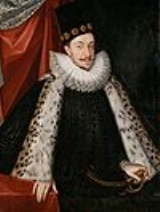
Sigismund III Vasa

Encyclopedia
Sigismund III Vasa was King of Poland and Grand Duke of Lithuania, a monarch of the united Polish–Lithuanian Commonwealth from 1587 to 1632, and King of Sweden
(where he is known simply as Sigismund) from 1592 until he was deposed in 1599. He was the son of King John III of Sweden
and his first wife, Catherine Jagellonica of Poland.
Elected to the throne of the Polish–Lithuanian Commonwealth, Sigismund sought to create a personal union
between the Commonwealth and Sweden (Polish–Swedish union), and succeeded for a time in 1592. After he had been deposed in 1599 from the Swedish throne by his uncle, Charles IX of Sweden
, and a meeting of the Riksens ständer (Swedish Riksdag), he spent much of the rest of his life attempting to reclaim it.
Sigismund remains a highly controversial figure in Poland. His long reign coincided with the apex of the Polish–Lithuanian Commonwealth's prestige, power and economic influence
. On the other hand, it was during his reign that the symptoms of decline leading to the Commonwealth's eventual demise surfaced. Popular histories, such as the books of Paweł Jasienica, tend to present Sigismund as the principal source of these destructive processes; whereas academic histories are usually not damning of him. However, the question of whether the Commonwealth's decline was caused by Sigismund's decisions or had its roots in historical processes beyond his personal control, remains a highly debated topic.
He was commemorated in Warsaw
with Zygmunt's Column
, commissioned by his son and successor, Władysław IV
.
Sigismund was elected King of Poland and reigned 1587–1632. By paternal inheritance, he also succeeded in 1592 as King of Sweden but was deposed in 1599. His successor, Charles IX of Sweden
, officially gained the Swedish throne in 1604. From his grandmother Bona Sforza
he inherited the title of King of Jerusalem
.
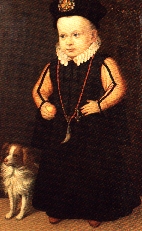 He was born at Gripsholm during his parents' imprisonment by King Eric XIV
. Although Sweden
had become Protestant
by this time, Sigismund remained a Catholic, the religion of his mother. This fact, combined with the troublesome personal union
, of his divided kingdoms would thwart his attempts to find support in Sweden.
His mother, Katarzyna Jagiellonka, was the daughter of Sigismund I the Old
and his wife Bona Sforza
. The Jagiellon dynasty
had held the crown of the Polish–Lithuanian Commonwealth since the first Jagiellon ruler, Władysław II Jagiełło, had received it in 1386 through his wife Jadwiga Angevin.
In 1587, he was a candidate for the monarch of Polish–Lithuanian Commonwealth, following the death of previous Polish king, Stefan Batory
. The election was held in the shadow of conflict between the Polish nobility (szlachta
), with the two opposing sides gathered around Chancellor
Jan Zamoyski
and the Zborowski family. Sigismund, supported by Zamoyski and the former king's wife, Anna Jagiellon
, was elected King of the Polish–Lithuanian Commonwealth on 19 August 1587 and recognized as such by the interrex
, the Primate of Poland, Stanisław Karnkowski.
However, the election was disputed by the other candidate, Maximilian III of Austria, and opponents of Sigismund chose not to respect the election outcome, decreeing that Maximilian was the rightful monarch. Neither Sigismund nor Maximilian were present in the Commonwealth at that time. After receiving news of his election, Sigismund quickly departed from Sweden and arrived in Oliwa
on 7 October (his landing was delayed due to the hostility from the Protestant Gdańsk
). In his Pacta conventa
Sigismund accepted a reduction of monarchal power in favour of the Sejm (Commonwealth parliament), which in all probability marked the beginning of the decline of the Commonwealth and the end of Poland as a great power
of the era.
Lesser Prussian Treasurer Jan Dulski representing the Crown Marshall Andrzej Opaliński proclaimed him to be the king. Sigismund returned to his ship on the same day, arriving in Gdańsk next day, and after approximately two weeks he had departed to Kraków
, where he was crowned on 27 December of that year.
 When Maximilian attempted to resolve the dispute by bringing a military force and starting the war of Polish succession, he was defeated at the battle of Byczyna
by the supporters of Sigismund, under the command of Polish hetman
Jan Zamojski. Maximilian was taken captive and released only after intervention by Pope Sixtus V
. In 1589, he waived his right to the Polish crown.
In 1592 Sigismund married the Austrian archduchess Anna of Austria (1573–1598) Anna Habsburzanka and after his father's death the same year, he received permission from the Sejm
to accept the Swedish throne. After Sigismund promised to uphold Swedish Lutheranism
he was crowned king of Sweden in 1594; for a short time there was a personal union
between Commonwealth and Sweden (Polish–Swedish union). He tried to rule Sweden from Poland, leaving Sweden under control of a regent
, his paternal uncle Duke Charles
. In 1596 he succeeded in creating the Union of Brest
, which attempted to bring part of the Orthodox
religion into Catholicism. In the same year he transferred the capital of Poland from Kraków to Warsaw
.
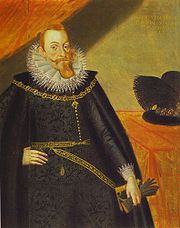 After his wife Anna died in 1598, he married her sister Constance of Austria
in 1605. Troubles were growing on the southern border of the Commonwealth, where Jan Zamoyski and other magnates were engaged in the Magnate wars in Moldavia. Eventually after the defeat of Polish forces in the battle of Cecora
in 1620 Commonwealth would have to relinquish its claims to the Principality of Moldavia.
Due to Sigismund's strong support of the Counter Reformation, his support back in largely Protestant Sweden eroded quickly. Charles soon took full control of Sweden and rebelled against Sigismund, claiming that Sigismund would re-Catholicize Sweden. In 1598 Sigismund, with a mixed army from Sweden and Poland, was defeated at the Battle of Stångebro
. Sigismund was forbidden to rule Sweden from abroad but nevertheless returned to Poland, and so in 1599 was deposed. This and his decision to incorporate Livonia
into the Commonwealth led to the Polish–Swedish War, which lasted, with minor breaks, to 1629. The war ended with Sweden gaining Livonia. The kingship was ultimately ceded to Charles. Sigismund, however, did not relinquish his claim to the Swedish throne, and his subsequent foreign policy was aimed at regaining the Swedish crown. This led to bitter relations and several wars between the two countries, to end only after the Great Northern War
.
In 1605 Sigismund attempted to strengthen the monarch's power by asking the Sejm
(the Polish–Lithuanian Commonwealth's parliament) to limit the liberum veto
, increase taxes, and augment the military. His opponents, led by Mikołaj Zebrzydowski, declared a confederation
and rokosz
at Sandomierz
, leading to a civil war known as rokosz Zebrzydowskiego (Zebrzydowski's Rebellion). Eventually, royalist forces defeated the rokoszans on 6 July 1607 at the Battle of Guzów
, but the eventual compromise was a return to the status quo ante from before 1605.
 Another important conflict in his reign was the Polish-Muscovite War (1605-1618), also known as The Dymitriads. Sigismund and many Polish magnates attempted to exploit the Muscovite civil war (the Time of Troubles
), and after a lengthy war the 1618 Truce of Deulino
gave some territorial concessions to the Commonwealth (mainly the Smoleńsk Voivodship). Nonetheless, this war increased tensions between Poland and Russia, and ruined the prospects for a Polish–Lithuanian–Muscovite Commonwealth.
Sigismund was a gifted artist. A painter and goldsmith, of his three paintings known to survive, one was for centuries erroneously attributed to Tintoretto
; and from his own, personal workshop came the main part of the famous silver coffin of St. Adalbert of Prague at the Cathedral
in Gniezno
.
Sigismund died at the age of 65 in the Royal Castle
in Warsaw
.
s and Counter-Reformation
forces. His policies were opposed by many in the Polish nobility (the szlachta
), most notably the chancellor Jan Zamojski. This led to a semi-legal rebellion against the king (rokosz
), known as rokosz of Zebrzydowski (1606–1608), which was a response to Sigismund's attempt to introduce majority voting in place of unanimity
in the Sejm. Eventually Sigismund's forces were victorious, but the rebels went unpunished. Partially in order to pacify the restless szlachta, Sigismund supported war with Muscovy (the Dimitriads, 1608–1618). Although Commonwealth forces were almost constantly shuffled between wars in the East (with Muscovy), north (with Sweden) and South (with Ottomans – the Polish-Ottoman wars), Sigismund took advantage of the civil war in Russia (the Time of Troubles) and secured temporary territorial gains for the Commonwealth.
While Sigismund never managed to regain the Swedish throne, his personal ambition to do so did succeed in provoking a long series of conflicts between the Commonwealth and Sweden
and Muscovy. While the Commonwealth Sejm
managed to thwart many of the plans of Sigismund (and later of his son, Wladislaw), the Vasa dynasty nonetheless succeeded in partially drawing the Commonwealth into the Thirty Years' War
. The conflict with Sweden, combined with wars against Ottomans and Muscovy, culminated well after Sigismund's death in the series of events known as The Deluge
, which ended the Golden Age of the Commonwealth.
During his reign he permitted the Brandenburg
Hohenzollerns to inherit Ducal Prussia.
(1540–1590) and his wife Maria Anna of Bavaria (1551-1608). They had five children:
And secondly, on 11 December 1605, to his first wife's sister, Constance of Austria
(1588–1631). They had seven children:
, depicting the preaching of Piotr Skarga
.
|-
Monarch of Sweden
The monarchy of Sweden is the constitutional monarchy of the Kingdom of Sweden. The present monarch, Carl XVI Gustaf, has reigned since 15 September 1973. He and his immediate family undertake various official, ceremonial and representational duties...
(where he is known simply as Sigismund) from 1592 until he was deposed in 1599. He was the son of King John III of Sweden
John III of Sweden
-Family:John married his first wife, Catherine Jagellonica of Poland , house of Jagiello, in Vilnius on 4 October 1562. In Sweden, she is known as Katarina Jagellonica. She was the sister of king Sigismund II Augustus of Poland...
and his first wife, Catherine Jagellonica of Poland.
Elected to the throne of the Polish–Lithuanian Commonwealth, Sigismund sought to create a personal union
Personal union
A personal union is the combination by which two or more different states have the same monarch while their boundaries, their laws and their interests remain distinct. It should not be confused with a federation which is internationally considered a single state...
between the Commonwealth and Sweden (Polish–Swedish union), and succeeded for a time in 1592. After he had been deposed in 1599 from the Swedish throne by his uncle, Charles IX of Sweden
Charles IX of Sweden
Charles IX of Sweden also Carl, was King of Sweden from 1604 until his death. He was the youngest son of King Gustav I of Sweden and his second wife, Margaret Leijonhufvud, brother of Eric XIV and John III of Sweden, and uncle of Sigismund III Vasa king of both Sweden and Poland...
, and a meeting of the Riksens ständer (Swedish Riksdag), he spent much of the rest of his life attempting to reclaim it.
Sigismund remains a highly controversial figure in Poland. His long reign coincided with the apex of the Polish–Lithuanian Commonwealth's prestige, power and economic influence
Polish Golden Age
The Polish Golden Age refers to the times from 15th century Jagiellon Poland to the death of the last of the Jagiellons, Sigismund August in 1569, or mid-17th century, when in 1648 the Polish-Lithuanian Commonwealth was ravaged by the Khmelnytsky Uprising and The Deluge and the Golden Age...
. On the other hand, it was during his reign that the symptoms of decline leading to the Commonwealth's eventual demise surfaced. Popular histories, such as the books of Paweł Jasienica, tend to present Sigismund as the principal source of these destructive processes; whereas academic histories are usually not damning of him. However, the question of whether the Commonwealth's decline was caused by Sigismund's decisions or had its roots in historical processes beyond his personal control, remains a highly debated topic.
He was commemorated in Warsaw
Warsaw
Warsaw is the capital and largest city of Poland. It is located on the Vistula River, roughly from the Baltic Sea and from the Carpathian Mountains. Its population in 2010 was estimated at 1,716,855 residents with a greater metropolitan area of 2,631,902 residents, making Warsaw the 10th most...
with Zygmunt's Column
Zygmunt's Column
Sigismund's Column , erected in 1644, is located in Castle Square, Warsaw, Poland. It is one of Warsaw's most famous landmarks and one of the oldest secular monuments in northern Europe...
, commissioned by his son and successor, Władysław IV
Władysław IV Vasa
Władysław IV Vasa was a Polish and Swedish prince from the House of Vasa. He reigned as King of the Polish–Lithuanian Commonwealth from 8 November 1632 to his death in 1648....
.
Royal titles
- Royal titles in Latin: Sigismundus Tertius Dei gratia rex Poloniæ, magnus dux Lithuaniæ, Russiæ, Prussiæ, Masoviæ, Samogitiæ, Livoniæque, necnon Suecorum, Gothorum Vandalorumque hæreditarius rex.
- English translation: Sigismund III, by the grace of God, king of PolandPolandPoland , officially the Republic of Poland , is a country in Central Europe bordered by Germany to the west; the Czech Republic and Slovakia to the south; Ukraine, Belarus and Lithuania to the east; and the Baltic Sea and Kaliningrad Oblast, a Russian exclave, to the north...
, grand duke of LithuaniaLithuaniaLithuania , officially the Republic of Lithuania is a country in Northern Europe, the biggest of the three Baltic states. It is situated along the southeastern shore of the Baltic Sea, whereby to the west lie Sweden and Denmark...
, RutheniaRutheniaRuthenia is the Latin word used onwards from the 13th century, describing lands of the Ancient Rus in European manuscripts. Its geographic and culturo-ethnic name at that time was applied to the parts of Eastern Europe. Essentially, the word is a false Latin rendering of the ancient place name Rus...
, PrussiaPrussiaPrussia was a German kingdom and historic state originating out of the Duchy of Prussia and the Margraviate of Brandenburg. For centuries, the House of Hohenzollern ruled Prussia, successfully expanding its size by way of an unusually well-organized and effective army. Prussia shaped the history...
, Masovia, SamogitiaSamogitiaSamogitia is one of the five ethnographic regions of Lithuania. It is located in northwestern Lithuania. Its largest city is Šiauliai/Šiaulē. The region has a long and distinct cultural history, reflected in the existence of the Samogitian dialect...
, LivoniaLivoniaLivonia is a historic region along the eastern shores of the Baltic Sea. It was once the land of the Finnic Livonians inhabiting the principal ancient Livonian County Metsepole with its center at Turaida...
, and also hereditary king of the Swedes, GothsGothsThe Goths were an East Germanic tribe of Scandinavian origin whose two branches, the Visigoths and the Ostrogoths, played an important role in the fall of the Roman Empire and the emergence of Medieval Europe....
and VandalsVandalsThe Vandals were an East Germanic tribe that entered the late Roman Empire during the 5th century. The Vandals under king Genseric entered Africa in 429 and by 439 established a kingdom which included the Roman Africa province, besides the islands of Sicily, Corsica, Sardinia and the Balearics....
.
Sigismund was elected King of Poland and reigned 1587–1632. By paternal inheritance, he also succeeded in 1592 as King of Sweden but was deposed in 1599. His successor, Charles IX of Sweden
Charles IX of Sweden
Charles IX of Sweden also Carl, was King of Sweden from 1604 until his death. He was the youngest son of King Gustav I of Sweden and his second wife, Margaret Leijonhufvud, brother of Eric XIV and John III of Sweden, and uncle of Sigismund III Vasa king of both Sweden and Poland...
, officially gained the Swedish throne in 1604. From his grandmother Bona Sforza
Bona Sforza
Bona Sforza was a member of the powerful Milanese House of Sforza. In 1518, she became the second wife of Sigismund I the Old, the King of Poland and Grand Duke of Lithuania, and became the Queen of Poland and Grand Duchess of Lithuania.She was the third child of Gian Galeazzo Sforza and his wife...
he inherited the title of King of Jerusalem
Kings of Jerusalem
This is a list of kings of Jerusalem, from 1099 to 1291, as well as claimants to the title up to the present day.-Kings of Jerusalem :...
.
Biography
Eric XIV of Sweden
-Family and descendants:Eric XIV had several relationships before his marriage. With Agda Persdotter he had four daughters:#Margareta Eriksdotter , married 1592 to Olov Simonsson, vicar of Horn....
. Although Sweden
Sweden
Sweden , officially the Kingdom of Sweden , is a Nordic country on the Scandinavian Peninsula in Northern Europe. Sweden borders with Norway and Finland and is connected to Denmark by a bridge-tunnel across the Öresund....
had become Protestant
Protestantism
Protestantism is one of the three major groupings within Christianity. It is a movement that began in Germany in the early 16th century as a reaction against medieval Roman Catholic doctrines and practices, especially in regards to salvation, justification, and ecclesiology.The doctrines of the...
by this time, Sigismund remained a Catholic, the religion of his mother. This fact, combined with the troublesome personal union
Personal union
A personal union is the combination by which two or more different states have the same monarch while their boundaries, their laws and their interests remain distinct. It should not be confused with a federation which is internationally considered a single state...
, of his divided kingdoms would thwart his attempts to find support in Sweden.
His mother, Katarzyna Jagiellonka, was the daughter of Sigismund I the Old
Sigismund I the Old
Sigismund I of Poland , of the Jagiellon dynasty, reigned as King of Poland and also as the Grand Duke of Lithuania from 1506 until 1548...
and his wife Bona Sforza
Bona Sforza
Bona Sforza was a member of the powerful Milanese House of Sforza. In 1518, she became the second wife of Sigismund I the Old, the King of Poland and Grand Duke of Lithuania, and became the Queen of Poland and Grand Duchess of Lithuania.She was the third child of Gian Galeazzo Sforza and his wife...
. The Jagiellon dynasty
Jagiellon dynasty
The Jagiellonian dynasty was a royal dynasty originating from the Lithuanian House of Gediminas dynasty that reigned in Central European countries between the 14th and 16th century...
had held the crown of the Polish–Lithuanian Commonwealth since the first Jagiellon ruler, Władysław II Jagiełło, had received it in 1386 through his wife Jadwiga Angevin.
In 1587, he was a candidate for the monarch of Polish–Lithuanian Commonwealth, following the death of previous Polish king, Stefan Batory
Stefan Batory
Stephen Báthory was a Hungarian noble Prince of Transylvania , then King of Poland and Grand Duke of Lithuania . He was a member of the Somlyó branch of the noble Hungarian Báthory family...
. The election was held in the shadow of conflict between the Polish nobility (szlachta
Szlachta
The szlachta was a legally privileged noble class with origins in the Kingdom of Poland. It gained considerable institutional privileges during the 1333-1370 reign of Casimir the Great. In 1413, following a series of tentative personal unions between the Grand Duchy of Lithuania and the Kingdom of...
), with the two opposing sides gathered around Chancellor
Kanclerz
Kanclerz was one of the highest officials in the historic Poland. This office functioned from the early Polish kingdom of the 12th century until the end of the Polish-Lithuanian Commonwealth in 1795. A respective office also existed in the Grand Duchy of Lithuania since the 16th...
Jan Zamoyski
Jan Zamoyski
Jan Zamoyski , was a Polish-Lithuanian nobleman, magnate, 1st duke/ordynat of Zamość. Royal Secretary since 1566, Lesser Kanclerz ) of the Crown since 1576, Lord Grand-Chancellor of the Crown since 1578, and Grand Hetman of the Crown since 1581...
and the Zborowski family. Sigismund, supported by Zamoyski and the former king's wife, Anna Jagiellon
Anna Jagiellon
Anna Jagiellon was queen of Poland from 1575 to 1586. She was the daughter of Poland's King Sigismund I the Old, and the wife of Stephen Báthory. She was elected, along with her then fiance, Báthory, as co-ruler in the second election of the Polish-Lithuanian Commonwealth...
, was elected King of the Polish–Lithuanian Commonwealth on 19 August 1587 and recognized as such by the interrex
Interrex (Poland)
The institution of interrex existed in the Polish-Lithuanian Commonwealth, whose ruling classes liked to view their Republic or Commonwealth as an heir to Roman republican traditions...
, the Primate of Poland, Stanisław Karnkowski.
However, the election was disputed by the other candidate, Maximilian III of Austria, and opponents of Sigismund chose not to respect the election outcome, decreeing that Maximilian was the rightful monarch. Neither Sigismund nor Maximilian were present in the Commonwealth at that time. After receiving news of his election, Sigismund quickly departed from Sweden and arrived in Oliwa
Oliwa
Oliwa, also Oliva is one of the quarters of Gdańsk. From east it borders Przymorze and Żabianka, from the north Sopot and from the south with the districts of Strzyża, VII Dwór and Brętowo, while from the west with Matarnia and Osowa...
on 7 October (his landing was delayed due to the hostility from the Protestant Gdańsk
Gdansk
Gdańsk is a Polish city on the Baltic coast, at the centre of the country's fourth-largest metropolitan area.The city lies on the southern edge of Gdańsk Bay , in a conurbation with the city of Gdynia, spa town of Sopot, and suburban communities, which together form a metropolitan area called the...
). In his Pacta conventa
Pacta conventa (Poland)
Pacta conventa was a contractual agreement, from 1573 to 1764 entered into between the "Polish nation" and a newly-elected king upon his "free election" to the throne.The pacta conventa affirmed the king-elect's pledge to respect the laws of the...
Sigismund accepted a reduction of monarchal power in favour of the Sejm (Commonwealth parliament), which in all probability marked the beginning of the decline of the Commonwealth and the end of Poland as a great power
Great power
A great power is a nation or state that has the ability to exert its influence on a global scale. Great powers characteristically possess military and economic strength and diplomatic and cultural influence which may cause small powers to consider the opinions of great powers before taking actions...
of the era.
Lesser Prussian Treasurer Jan Dulski representing the Crown Marshall Andrzej Opaliński proclaimed him to be the king. Sigismund returned to his ship on the same day, arriving in Gdańsk next day, and after approximately two weeks he had departed to Kraków
Kraków
Kraków also Krakow, or Cracow , is the second largest and one of the oldest cities in Poland. Situated on the Vistula River in the Lesser Poland region, the city dates back to the 7th century. Kraków has traditionally been one of the leading centres of Polish academic, cultural, and artistic life...
, where he was crowned on 27 December of that year.
Battle of Byczyna
The Battle of Byczyna or Battle of Pitschen was the deciding battle of the 1587–1588 War of the Polish Succession, which erupted after two rival candidates were elected to the Polish throne...
by the supporters of Sigismund, under the command of Polish hetman
Hetman
Hetman was the title of the second-highest military commander in 15th- to 18th-century Poland and the Grand Duchy of Lithuania, which together, from 1569 to 1795, comprised the Polish-Lithuanian Commonwealth, or Rzeczpospolita....
Jan Zamojski. Maximilian was taken captive and released only after intervention by Pope Sixtus V
Pope Sixtus V
Pope Sixtus V , born Felice Peretti di Montalto, was Pope from 1585 to 1590.-Early life:The chronicler Andrija Zmajević states that Felice's family originated from modern-day Montenegro...
. In 1589, he waived his right to the Polish crown.
In 1592 Sigismund married the Austrian archduchess Anna of Austria (1573–1598) Anna Habsburzanka and after his father's death the same year, he received permission from the Sejm
Sejm
The Sejm is the lower house of the Polish parliament. The Sejm is made up of 460 deputies, or Poseł in Polish . It is elected by universal ballot and is presided over by a speaker called the Marshal of the Sejm ....
to accept the Swedish throne. After Sigismund promised to uphold Swedish Lutheranism
Lutheranism
Lutheranism is a major branch of Western Christianity that identifies with the theology of Martin Luther, a German reformer. Luther's efforts to reform the theology and practice of the church launched the Protestant Reformation...
he was crowned king of Sweden in 1594; for a short time there was a personal union
Personal union
A personal union is the combination by which two or more different states have the same monarch while their boundaries, their laws and their interests remain distinct. It should not be confused with a federation which is internationally considered a single state...
between Commonwealth and Sweden (Polish–Swedish union). He tried to rule Sweden from Poland, leaving Sweden under control of a regent
Regent
A regent, from the Latin regens "one who reigns", is a person selected to act as head of state because the ruler is a minor, not present, or debilitated. Currently there are only two ruling Regencies in the world, sovereign Liechtenstein and the Malaysian constitutive state of Terengganu...
, his paternal uncle Duke Charles
Charles IX of Sweden
Charles IX of Sweden also Carl, was King of Sweden from 1604 until his death. He was the youngest son of King Gustav I of Sweden and his second wife, Margaret Leijonhufvud, brother of Eric XIV and John III of Sweden, and uncle of Sigismund III Vasa king of both Sweden and Poland...
. In 1596 he succeeded in creating the Union of Brest
Union of Brest
Union of Brest or Union of Brześć refers to the 1595-1596 decision of the Church of Rus', the "Metropolia of Kiev-Halych and all Rus'", to break relations with the Patriarch of Constantinople and place themselves under the Pope of Rome. At the time, this church included most Ukrainians and...
, which attempted to bring part of the Orthodox
Eastern Orthodox Church
The Orthodox Church, officially called the Orthodox Catholic Church and commonly referred to as the Eastern Orthodox Church, is the second largest Christian denomination in the world, with an estimated 300 million adherents mainly in the countries of Belarus, Bulgaria, Cyprus, Georgia, Greece,...
religion into Catholicism. In the same year he transferred the capital of Poland from Kraków to Warsaw
Warsaw
Warsaw is the capital and largest city of Poland. It is located on the Vistula River, roughly from the Baltic Sea and from the Carpathian Mountains. Its population in 2010 was estimated at 1,716,855 residents with a greater metropolitan area of 2,631,902 residents, making Warsaw the 10th most...
.
Constance of Austria
Archduchess Constance of Austria was a Queen consort of Poland.-Biography:...
in 1605. Troubles were growing on the southern border of the Commonwealth, where Jan Zamoyski and other magnates were engaged in the Magnate wars in Moldavia. Eventually after the defeat of Polish forces in the battle of Cecora
Battle of Tutora (1620)
The Battle of Ţuţora was a battle between the Polish-Lithuanian Commonwealth and Ottoman forces , fought from 17 September to 7 October 1620 in Moldavia, near the Prut River.- Prelude :Because of the failure of Commonwealth diplomatic mission to Constantinople, and violations of the Treaty of...
in 1620 Commonwealth would have to relinquish its claims to the Principality of Moldavia.
Due to Sigismund's strong support of the Counter Reformation, his support back in largely Protestant Sweden eroded quickly. Charles soon took full control of Sweden and rebelled against Sigismund, claiming that Sigismund would re-Catholicize Sweden. In 1598 Sigismund, with a mixed army from Sweden and Poland, was defeated at the Battle of Stångebro
Battle of Stångebro
The Battle of Stångebro or Battle of Linköping took place at Linköping, Sweden on September 25, 1598, and effectively ended the personal union between Sweden and the Polish-Lithuanian Commonwealth, that had only existed since 1592...
. Sigismund was forbidden to rule Sweden from abroad but nevertheless returned to Poland, and so in 1599 was deposed. This and his decision to incorporate Livonia
Livonia
Livonia is a historic region along the eastern shores of the Baltic Sea. It was once the land of the Finnic Livonians inhabiting the principal ancient Livonian County Metsepole with its center at Turaida...
into the Commonwealth led to the Polish–Swedish War, which lasted, with minor breaks, to 1629. The war ended with Sweden gaining Livonia. The kingship was ultimately ceded to Charles. Sigismund, however, did not relinquish his claim to the Swedish throne, and his subsequent foreign policy was aimed at regaining the Swedish crown. This led to bitter relations and several wars between the two countries, to end only after the Great Northern War
Great Northern War
The Great Northern War was a conflict in which a coalition led by the Tsardom of Russia successfully contested the supremacy of the Swedish Empire in northern Central Europe and Eastern Europe. The initial leaders of the anti-Swedish alliance were Peter I the Great of Russia, Frederick IV of...
.
In 1605 Sigismund attempted to strengthen the monarch's power by asking the Sejm
Sejm
The Sejm is the lower house of the Polish parliament. The Sejm is made up of 460 deputies, or Poseł in Polish . It is elected by universal ballot and is presided over by a speaker called the Marshal of the Sejm ....
(the Polish–Lithuanian Commonwealth's parliament) to limit the liberum veto
Liberum veto
The liberum veto was a parliamentary device in the Polish-Lithuanian Commonwealth. It allowed any member of the Sejm to force an immediate end to the current session and nullify any legislation that had already been passed at the session by shouting Nie pozwalam! .From the mid-16th to the late 18th...
, increase taxes, and augment the military. His opponents, led by Mikołaj Zebrzydowski, declared a confederation
Confederation (Poland)
A konfederacja was an ad hoc association formed by Polish-Lithuanian szlachta A konfederacja (Polish for "confederation") was an ad hoc association formed by Polish-Lithuanian szlachta A konfederacja (Polish for "confederation") was an ad hoc association formed by Polish-Lithuanian szlachta...
and rokosz
Rokosz
A rokosz originally was a gathering of all the Polish szlachta , not merely of deputies, for a sejm. The term was introduced to the Polish language from Hungary, where analogous gatherings took place at a field called Rákos....
at Sandomierz
Sandomierz
Sandomierz is a city in south-eastern Poland with 25,714 inhabitants . Situated in the Świętokrzyskie Voivodeship , previously in Tarnobrzeg Voivodeship . It is the capital of Sandomierz County . Sandomierz is known for its Old Town, a major tourist attraction...
, leading to a civil war known as rokosz Zebrzydowskiego (Zebrzydowski's Rebellion). Eventually, royalist forces defeated the rokoszans on 6 July 1607 at the Battle of Guzów
Battle of Guzów
The Battle of Guzów took place on July 6, 1607, at the village of Guzów in Szydłowiec County, Polish-Lithuanian Commonwealth. The confrontation was between the forces of the Zebrzydowski Rebellion against the Royalists supporting King Sigismund III Vasa , under...
, but the eventual compromise was a return to the status quo ante from before 1605.
Time of Troubles
The Time of Troubles was a period of Russian history comprising the years of interregnum between the death of the last Russian Tsar of the Rurik Dynasty, Feodor Ivanovich, in 1598, and the establishment of the Romanov Dynasty in 1613. In 1601-1603, Russia suffered a famine that killed one-third...
), and after a lengthy war the 1618 Truce of Deulino
Truce of Deulino
Truce of Deulino was signed on 11 December 1618 and took effect on 4 January 1619. It concluded the Polish–Muscovite War between the Polish–Lithuanian Commonwealth and the Tsardom of Russia....
gave some territorial concessions to the Commonwealth (mainly the Smoleńsk Voivodship). Nonetheless, this war increased tensions between Poland and Russia, and ruined the prospects for a Polish–Lithuanian–Muscovite Commonwealth.
Sigismund was a gifted artist. A painter and goldsmith, of his three paintings known to survive, one was for centuries erroneously attributed to Tintoretto
Tintoretto
Tintoretto , real name Jacopo Comin, was a Venetian painter and a notable exponent of the Renaissance school. For his phenomenal energy in painting he was termed Il Furioso...
; and from his own, personal workshop came the main part of the famous silver coffin of St. Adalbert of Prague at the Cathedral
Gniezno Cathedral
Cathedral Basilica of the Assumption of the Blessed Virgin Mary and St. Adalbert is a Gothic cathedral in Gniezno, Poland. The Cathedral is known for its twelfth-century , two-winged bronze doors decorated with scenes of martyrdom of St. Wojciech and a silver relic coffin of that saint...
in Gniezno
Gniezno
Gniezno is a city in central-western Poland, some 50 km east of Poznań, inhabited by about 70,000 people. One of the Piasts' chief cities, it was mentioned by 10th century A.D. sources as the capital of Piast Poland however the first capital of Piast realm was most likely Giecz built around...
.
Sigismund died at the age of 65 in the Royal Castle
Royal Castle, Warsaw
The Royal Castle in Warsaw is a castle residency and was the official residence of the Polish monarchs. It is located in the Castle Square, at the entrance to the Warsaw Old Town. The personal offices of the king and the administrative offices of the Royal Court of Poland were located there from...
in Warsaw
Warsaw
Warsaw is the capital and largest city of Poland. It is located on the Vistula River, roughly from the Baltic Sea and from the Carpathian Mountains. Its population in 2010 was estimated at 1,716,855 residents with a greater metropolitan area of 2,631,902 residents, making Warsaw the 10th most...
.
Sigismund's politics
Many historians believe that Sigismund viewed Poland only as a tool that would allow him to eventually regain the throne of Sweden. To this end he tried to strengthen his royal power and allied himself with HabsburgHabsburg
The House of Habsburg , also found as Hapsburg, and also known as House of Austria is one of the most important royal houses of Europe and is best known for being an origin of all of the formally elected Holy Roman Emperors between 1438 and 1740, as well as rulers of the Austrian Empire and...
s and Counter-Reformation
Counter-Reformation
The Counter-Reformation was the period of Catholic revival beginning with the Council of Trent and ending at the close of the Thirty Years' War, 1648 as a response to the Protestant Reformation.The Counter-Reformation was a comprehensive effort, composed of four major elements:#Ecclesiastical or...
forces. His policies were opposed by many in the Polish nobility (the szlachta
Szlachta
The szlachta was a legally privileged noble class with origins in the Kingdom of Poland. It gained considerable institutional privileges during the 1333-1370 reign of Casimir the Great. In 1413, following a series of tentative personal unions between the Grand Duchy of Lithuania and the Kingdom of...
), most notably the chancellor Jan Zamojski. This led to a semi-legal rebellion against the king (rokosz
Rokosz
A rokosz originally was a gathering of all the Polish szlachta , not merely of deputies, for a sejm. The term was introduced to the Polish language from Hungary, where analogous gatherings took place at a field called Rákos....
), known as rokosz of Zebrzydowski (1606–1608), which was a response to Sigismund's attempt to introduce majority voting in place of unanimity
Unanimity
Unanimity is agreement by all people in a given situation. When unanimous, everybody is of the same mind and acting together as one. Though unlike uniformity, it does not constitute absolute agreement. Many groups consider unanimous decisions a sign of agreement, solidarity, and unity...
in the Sejm. Eventually Sigismund's forces were victorious, but the rebels went unpunished. Partially in order to pacify the restless szlachta, Sigismund supported war with Muscovy (the Dimitriads, 1608–1618). Although Commonwealth forces were almost constantly shuffled between wars in the East (with Muscovy), north (with Sweden) and South (with Ottomans – the Polish-Ottoman wars), Sigismund took advantage of the civil war in Russia (the Time of Troubles) and secured temporary territorial gains for the Commonwealth.
While Sigismund never managed to regain the Swedish throne, his personal ambition to do so did succeed in provoking a long series of conflicts between the Commonwealth and Sweden
Sweden
Sweden , officially the Kingdom of Sweden , is a Nordic country on the Scandinavian Peninsula in Northern Europe. Sweden borders with Norway and Finland and is connected to Denmark by a bridge-tunnel across the Öresund....
and Muscovy. While the Commonwealth Sejm
Sejm
The Sejm is the lower house of the Polish parliament. The Sejm is made up of 460 deputies, or Poseł in Polish . It is elected by universal ballot and is presided over by a speaker called the Marshal of the Sejm ....
managed to thwart many of the plans of Sigismund (and later of his son, Wladislaw), the Vasa dynasty nonetheless succeeded in partially drawing the Commonwealth into the Thirty Years' War
Thirty Years' War
The Thirty Years' War was fought primarily in what is now Germany, and at various points involved most countries in Europe. It was one of the most destructive conflicts in European history....
. The conflict with Sweden, combined with wars against Ottomans and Muscovy, culminated well after Sigismund's death in the series of events known as The Deluge
The Deluge (Polish history)
The term Deluge denotes a series of mid-17th century campaigns in the Polish–Lithuanian Commonwealth. In a wider sense it applies to the period between the Khmelnytsky Uprising of 1648 and the Truce of Andrusovo in 1667, thus comprising the Polish–Lithuanian theaters of the Russo-Polish and...
, which ended the Golden Age of the Commonwealth.
During his reign he permitted the Brandenburg
Brandenburg-Prussia
Brandenburg-Prussia is the historiographic denomination for the Early Modern realm of the Brandenburgian Hohenzollerns between 1618 and 1701. Based in the Electorate of Brandenburg, the main branch of the Hohenzollern intermarried with the branch ruling the Duchy of Prussia, and secured succession...
Hohenzollerns to inherit Ducal Prussia.
Ancestry
Marriages and descendants
Sigismund married twice. Firstly, on 31 May 1592, to Anna of Austria (1573–1598), daughter of Archduke Charles II of AustriaAustria
Austria , officially the Republic of Austria , is a landlocked country of roughly 8.4 million people in Central Europe. It is bordered by the Czech Republic and Germany to the north, Slovakia and Hungary to the east, Slovenia and Italy to the south, and Switzerland and Liechtenstein to the...
(1540–1590) and his wife Maria Anna of Bavaria (1551-1608). They had five children:
- Anna Maria (23 May 1593–1600)
- Catherine (9 May 1594–1594)
- Vladislaus (1595–1648), (reigned 1632–1648 as Władysław IV Waza of Poland)
- Catherine (27 September 1596–1597)
- Christopher (10 February 1598–1598)
And secondly, on 11 December 1605, to his first wife's sister, Constance of Austria
Constance of Austria
Archduchess Constance of Austria was a Queen consort of Poland.-Biography:...
(1588–1631). They had seven children:
- John Casimir (25 December 1607 – 14 January 1608)
- John Casimir (1609–1672), (reigned 1648–1668 as John II Casimir Vasa of Poland)
- John AlbertJohn Albert VasaJohn Albert Vasa , was a Polish cardinal, and a Prince-Bishop of Warmia and Kraków. He was the son of Swedish and Polish King Sigismund III Vasa and Austrian archduchess Constance of Austria....
(1612–1634) - Charles FerdinandCharles Ferdinand, Duke of OpoleCharles Ferdinand Vasa , was Prince-Bishop of Breslau/Wrocław from 1625, bishop of Płock from 1640 and Duke of Oppeln Opole from 1648 to 1655.-Biography:...
(1613–1655) - Alexander Charles (1614–1634)
- Anna Constance (26 January 1616 – 24 May 1616)
- Anna Catherine Constance (7 August 1619 – 8 October 1651) was the first wife of Philip William, Elector Palatine.
Other
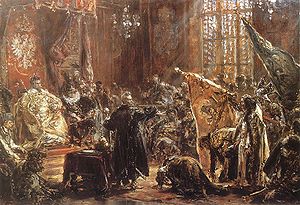
Sigismund III Vasa is one of the personages in a famous painting by Jan MatejkoJan Matejko
Jan Matejko was a Polish painter known for paintings of notable historical Polish political and military events. His most famous works include oil on canvas paintings like Battle of Grunwald, paintings of numerous other battles and court scenes, and a gallery of Polish kings...
, depicting the preaching of Piotr Skarga
Piotr Skarga
Piotr Skarga was a Polish Jesuit, preacher, hagiographer, polemicist, and leading figure of the Counter-reformation in the Polish-Lithuanian Commonwealth. He was called the "Polish Bossuet" due to his oratorical abilities.He was born February 2, 1536 in Grójec, to a family of lesser landless gentry...
.
See also
- List of Swedish monarchs
- History of Poland (1569-1795)
- History of SwedenHistory of SwedenModern Sweden started out of the Kalmar Union formed in 1397 and by the unification of the country by King Gustav Vasa in the 16th century. In the 17th century Sweden expanded its territories to form the Swedish empire. Most of these conquered territories had to be given up during the 18th century...
- Foundation of Modern Sweden
- Unions of Sweden
- Kolumna Zygmunta
- Urszula MayerinUrszula MayerinUrszula Mayerin was mistress to King Sigismund III of Poland and a politically influential woman. Her real name might have been Gienger, but it is still a matter of dispute among historians; she signed all her letters as Urszula Meyerin...
– mistress of Sigismund III
|-