


Chulalongkorn

Encyclopedia
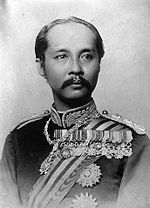
Phra Bat Somdet Phra Poramintharamaha Chulalongkorn Phra Chunla Chom Klao Chao Yu Hua , or Rama V (20 September 1853 – 23 October 1910) was the fifth monarch of Siam under the House of Chakri. He was known to the Siamese of his time as Phra Phuttha Chao Luang (พระพุทธเจ้าหลวง - The Royal Buddha). He is considered one of the greatest kings of Siam. His reign was characterized by the modernization of Siam, immense government and social reforms, and territorial cessions to the British Empire
and French Indochina
. As Siam was threatened by Western expansionism, Chulalongkorn, through his policies and acts, managed to save Siam from being colonized. All his reforms were dedicated to Siam’s insurance of survival in the midst of Western colonialism, so that Chulalongkorn earned the epithet Phra Piya Maharat (พระปิยมหาราช - The Great Beloved King).
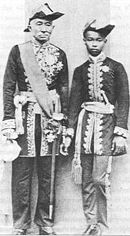 King Chulalongkorn was born on September 20, 1853 to King Mongkut
and Queen Debsirindra
and given the name Chulalongkorn. In 1861, he was designated Krommameun Pikanesuarn Surasangkat. His father gave him a broad education, including instruction from European tutors such as Anna Leonowens
. In 1866, he became a novice monk
for six months in Wat Bawonniwet according to royal tradition.. Upon his return to his secular life in 1867, he was designated Krommakhun Pinit Prachanat (.)
In 1867, King Mongkut led an expedition to the Malay Peninsula
south of Hua Hin
, to verify his calculations of the Solar eclipse of August 18, 1868
. Both father and son fell ill of malaria and Mongkut died on Oct. 1, 1868. Supposing the 15-year-old Chulalongkorn also to be dying, King Mongkut on his deathbed had written, “My brother, my son, my grandson, whoever you all the senior officials think will be able to save our country will succeed my throne, choose at your own will.” Si Suriyawongse
, the most powerful government official of the day, managed the succession of Chulalongkorn to the throne, and his own appointment as regent
. The coronation was held on November 11, 1868. Chulalongkorn's health improved, and he was tutored in public affairs, traveled to India (then under the British Raj
and Java
(then under Dutch colonial rule) to observe modern administration. He was crowned king in his own right as Rama V on Nov. 16, 1873..
Si Suriyawongse then arranged the title of Front Palace
of King Pinklao
(who was his uncle) to be succeeded by King Pinklao’s son, Prince Yingyot (who was then Chulalongkorn’s cousin).
The young Chulalongkorn was an enthusiastic king craving for reforms. He visited Singapore and Java
in 1870 and British India during 1870-1872 to see the administration of British colonies. He toured the administrative centres of Calcutta, Delhi, Bombay and back to Calcutta in early 1872. This journey was later the source of his ideas and methodology of the modernization of Siam.
As a regent, Si Suriyawongse wielded a great influence. Si Suriyawongse continued the works of King Mongkut. He supervised the digging of several important khlong
s, such as Padung Krungkasem and Damneun Saduak, and the paving of roads such as Chareon Krung and Silom. He was also the patron of Thai literature and performing arts.oatหล่อสุด
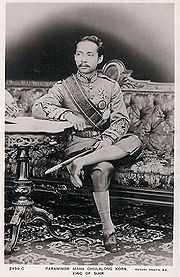 In 1873, the king became a monk again and returned. The second coronation was held in the same year to celebrate the king’s maturity.
At the end of his regency, Si Suriyawonse was raised to Somdet Chao Phraya, the highest title the nobility could attain. Si Suriyawongse himself was the most powerful noble of the 19th century. His family, Bunnag
, was a powerful one of a Persian descent dominating the Siamese politics since the reign of Rama I. Chulalongkorn then married four of his half-sisters. They were all the daughters of Mongkut - Savang Vadhana
, Saovabha
, and Sunandha
with Concubine Piam
and Sukumalmarsri
with Concubine Samli.
In the same year, Chulalongkorn’s first reform was to establish the Auditory Office (Th: หอรัษฎากรพิพัฒน์) – to replace the corrupted tax collectors as the only institution that collects taxes. As the tax collectors were under the patronage of various nobles and also provided the financial support to the patron, this caused a great disruption among the nobility, especially the Front Palace. Since the time of King Mongkut, the title of Front Palace had been as powerful as the “second king”, with one-third of national revenue devoted to it. Moreover, Prince Yingyot of the Front Palace was known to be acquainted with many British men, in a time when the British Empire was considered the enemy of Siam.
In 1874, Chulalongkorn chartered the Council of State - as a legislative body - and Privy Council - as his personal counsel based on the British privy council
. The members of the councils were appointed by the monarch.
to calm the conflicts.
The "Front Palace Crisis" incident indicated how much power was wielded by the aristocrats and royal relatives, leaving the king little power. This would become one of his main motives to reform the feudal Siam politics, reducing the power held by the nobility.
When Prince Yingyot died in 1885, Chulalongkorn took that opportunity to abolish the titular Front Palace and created the title of "Crown Prince of Siam
" in accordance with the Western style. Chulalongkorn's son, Prince Vajirunhis
, was appointed the first Crown Prince of Siam, though he never reigned. In 1895, the Prince died of typhoid at age 17, he was succeeded by his half-brother Vajiravudh
, who was then at boarding school in England
.
After that, Sri Suriyawongse withdrew from politics, as did the Bunnak family.
bordering China
, the insurgents of the Taiping rebellion
had taken refuge since the reign of King Mongkut. These Chinese were called The Heos and became bandits pillaging the villages. In 1875, Chulalongkorn sent troops from Bangkok to crush the Heos as they ravaged as far as Vientiane
. However, they met strong Chinese resistance and retreated to Isan
in 1885.
New, modernized forces were sent again and were divided into two groups approaching the Heos from Chiang Kam and Pichai. The Heos scattered and some fled to Vietnam
. The Siamese armies proceeded to eliminate the remaining Heos. The city of Nong Khai
maintains memorials for the Siamese dead.
in 1887 to train the troops in Western fashion. The modernized forces provided the king much more power to centralize the country.
The government of Siam had remained rather unchanged since the fifteenth century. The central government was headed by the Samuha Nayak (i.e. Prime Minister), who controlled the northern parts of Siam, and the Samuha Kalahom (i.e. Grand Commander), who controlled the southern Siam in both civil and military affairs. The Samuha Nayak presided over the Chatu Sadombh (i.e. Four Pillars). The responsibilities of each pillar were rather overlapping and uncertain.
In 1888, Chulalongkorn tried the new ministerial government. The ministers were, in the beginning, the members of royal family. The official establishment of ministries was promulgated in 1892, with all ministries in equal status.
The Council of State proved unable to veto the legal drafts or to give Chulalongkorn advices because the members still respected Chulalongkorn as an absolutist monarch. Chulalongkorn then dissolved the Council altogether and transferred the duty to give advices to the cabinet in 1894.
Chulalongkorn also abolished the traditional Nakorn Bala methods of tortures in judiciary process, which was seen as inhumane and barbaric by Western and Modern views, and introduced the Western code. His Belgian advisor, Rolin-Jaequemyns
, played a great role in the development of modern Siamese law and judicial system.
.
In 1884 (103 of Rattakosin Era), Siamese officials in London
and Paris
arranged a request to Chulalongkorn, citing the threats from European colonialism were coming and Siam should be reformed like Meiji Japan and Siam should became a constitutional monarchy. However, Chulalongkorn stated that it was not yet time and he himself was urging reforms.
Throughout Chulalongkorn's reign, writers with radical ideas had their works published for the first time. The most notable ones included Tianwan, who had been imprisoned for 17 years and from prison he produced many works criticizing the old Siamese society.


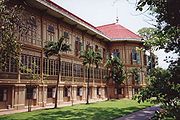
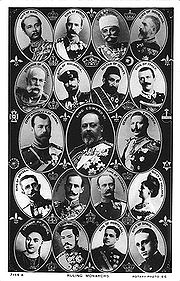 In 1863, King Norodom of Cambodia was forced to put his own country under the French Protectorate. The cession of Cambodia was officially formulated in 1867. However, Inner Cambodia (as called in Siam) consisting of Battambang
, Siemreap, and Srisopon, remained a Siamese possession. This was the first of many territorial cessions.
In 1887, French Indochina was formed from Vietnam and Cambodia
. In 1888, French troops invaded Northern Laos to subjugate the Heo insurgents. However, the French troops never left, and the French demanded more Laotian lands. In 1893 Auguste Pavie
, the French vice-consul of Luang Prabang
, requested the cession of all Laotian lands east of the Mekong River. Siam resented the demand, leading to the Franco-Siamese War of 1893.
The French gunboat Le Lutin entered the Chao Phraya and anchored near the French consulate ready to attack. Fighting was observed in Laos. Inconstant and Comete were attacked in Chao Phraya, and the French sent an ultimatum: an indemnity of three million francs, as well as the cession of and withdrawal from Laos. Siam did not accept the ultimatum. French troops then blockaded the Gulf of Siam and occupied Chantaburi and Trat
. Chulalongkorn sent Rolin-Jacquemyns to negotiate. The issue was eventually settled with the cession of Laos in 1893, but the French troops in Chantaburi and Trat refused to leave.
The cession of vast Laotian lands had a major impact on Chulalongkorn’s spirit. Prince Vajirunhis
died in 1894. Prince Vajiravudh
was created crown prince to replace him. Chulalongkorn realised the importance of maintaining the navy and established the Royal Thai Naval Academy in 1898.
Despite Siamese concessions, French armies continued the occupation of Chantaburi and Trat for another 10 years. An agreement was reached in 1903 that French troops would leave Chantaburi but hold the coast land from Trat to Koh Kong
. In 1906, the final agreement was reached. Trat was returned to Siam but the French kept Koh Kong and received Inner Cambodia.
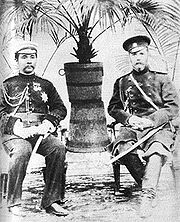
Seeing the seriousness of foreign affairs, Chulalongkorn visited Europe in 1897; he was the first Siamese monarch to do so, and he desired European recognition of Siam as a fully independent and honorable power. He appointed his queen, Saovabha, as regent in Siam during his travel to Europe.
 Siam had been composed of the network of cities according to the Mandala system codified by King Trailokanat in 1454, with local rulers owing tribute to Bangkok
. Each city retained a substantial degree of autonomy, as Siam wasn’t a “state” but a “network” of city-states. With the rise of European colonialism, the Western concept of state and territorial division was introduced. It had to define explicitly which lands were “Siamese” and which lands were “foreign”. The conflict with the French in 1893 was an example.
s in 1897, composing of Province, City, Amphoe, Tambon, and Mhu Ban (village) in the descending order. (Though a whole monthon - the Eastern Province - e.g. Inner Cambodia - was given off to the French in 1906) Each monthon was overseen by an intendant of the Ministry of Interior
. This had a major impact, ending the power of all local dynasties. The central authority now spread all over the country through the administration of intendants. For example, the Lanna states in the north (including the Kingdom of Chiangmai
, Principalities of Lampang, Lampoon, Nan, and Prae) owing tributaries to Bangkok, were made into two monthons, neglecting the existence of the Lanna kings.
Local rulers did not give up easily, as three rebellions sprang up in 1901 - the Ngeaw rebellion in Prae, the Phi Buns in Isan, and the Rebellion of Seven Sultans in the south. All these insurgents were crushed in 1902 with the city rulers were stripped off their power, and imprisoned.
Ayutthaya
King Ramathibodi II established a system of corvée
in 1581 after which the lives of Siamese commoners and slaves were closely regulated by the government. All Siamese common men ( ไพร่) were subject to the Siamese corvée system. Each man at the time of his majority had to register with a government bureau, department or leading member of the royalty called as a or under a nobleman's master
( or ) as a . owed service to sovereign or master for three months of the year. were those who could make payment in kind
(cattle) in lieu of service. Those conscripted into military service were called .
The corvée system declined after the Bowring Treaty
, which gave rise to a new class of employed labourers not regulated by the government, while many noblemen continued to hold sway over large numbers of . Chulalongkorn needed more effective control of manpower to undo the power of nobility. After the establishment of a provincial system, Chulalongkorn began the census
to get the statistics of all men available to the government. The Employment Act of 1900 required that all workers be paid, not forced to work. The Conscription Act of 1905 established military conscription
in Siam, thus ending the traditional corvée system.
Chulalongkorn was best known for his abolition of Siamese slavery (ทาส.) He associated the abolition of slavery in the United States with the bloodshed of the American Civil War
. Chulalongkorn, to prevent such a bloodbath in Siam, provided several steps towards the abolition of slavery, not an extreme turning point from servitude to total freedom. Those who found themselves unable to live on their own sold themselves into slavery by rich noblemen. Likewise, when a debt was defaulted, the borrower would became a slave of the lender. If the debt was redeemed, the slave regained freedom.
However, those whose parents were household slaves (ทาสในเรือนเบี้ย), were bound to be slaves forever because their redemption price was extremely high.
Because of economic conditions, people sold themselves into slavery in great numbers and in turn they produced a large number of household slaves. In 1867 they accounted for one-third of Siamese population. In 1874, Chulalongkorn enacted a law that lowered the redemption price of household slaves born in 1867 (his ascension year) and freed all of them when they had reached 21.
The newly freed slaves would have time to settle themselves as farmers or merchants so they would not become unemployed. In 1905, the Slave Abolition Act ended Siamese slavery in all forms. The reverse of 100-baht notes in circulation since the 2005 centennial depict Chulalongkorn in navy uniform abolishing the slave tradition.
. In the same year, the first power plant of Siam gave off its energy. Electric lights were turned on along the roads.
was formulated. Four sultanates (namely Kedah
, Kelantan
, Terengganu
, and Perlis
) were brought under British influence in exchange for Siamese legal rights and a loan to construct railways in southern Siam.
 The Royal Equestrian Statue
of Chulalongkorn was finished in 1908 to celebrate the 40th anniversary of the king’s reign. It was cast in bronze by a Parisian metallurgist, and then placed on the marble. Chulalongkorn had visited Europe two times in 1897 and 1907; the latter time was to cure his kidney disease. His last accomplishment was the establishment of a plumbing system in 1908. He died on 23 October 1910 of his kidney disease in Dusit Palace, and succeeded by his son Vajiravudh
.
Chulalongkorn University
, founded in 1917 as the first university in Thailand, was named in his honour.
In 1997 a memorial pavilion
was raised in honor of King Chulalongkorn in Ragunda, Sweden
. This was done to commemorate King Chulalongkorn's visit to Sweden
in 1897 where he visited the World Fair. During the time when Swedish-Norwegian king Oscar II
travelled to Norway
for a council, Chulalongkorn went up north to study forestry. Beginning in Härnösand
and travelling via Sollefteå
and Ragunda he mounted a boat in the small village of Utanede in order to take him back through Sundsvall
to Stockholm
. His passage through Utanede left a mark on the village as one street was named after the king. The pavilion is erected right next to that road.
In 2003, the Thai baht
100-baht note was revised to depict King Chulalongkorn in navy uniform and, in the background, abolishing the slave tradition.
.svg.png)
British Empire
The British Empire comprised the dominions, colonies, protectorates, mandates and other territories ruled or administered by the United Kingdom. It originated with the overseas colonies and trading posts established by England in the late 16th and early 17th centuries. At its height, it was the...
and French Indochina
French Indochina
French Indochina was part of the French colonial empire in southeast Asia. A federation of the three Vietnamese regions, Tonkin , Annam , and Cochinchina , as well as Cambodia, was formed in 1887....
. As Siam was threatened by Western expansionism, Chulalongkorn, through his policies and acts, managed to save Siam from being colonized. All his reforms were dedicated to Siam’s insurance of survival in the midst of Western colonialism, so that Chulalongkorn earned the epithet Phra Piya Maharat (พระปิยมหาราช - The Great Beloved King).
Early life
Mongkut
Phra Bat Somdet Phra Poramenthramaha Mongkut Phra Chom Klao Chao Yu Hua , or Rama IV, known in foreign countries as King Mongkut , was the fourth monarch of Siam under the House of Chakri, ruling from 1851-1868...
and Queen Debsirindra
Debsirindra
align=right|Queen Debsirindra of Siam was the second consort of King Mongkut , and mother of the future King Chulalongkorn . Mom Chao Rampoei was born in 1834 to Prince Siriwongse, the Krom Meun Matayapitak, who was the son of Jessadabodindra and Concubine Sap, and Lady Noi...
and given the name Chulalongkorn. In 1861, he was designated Krommameun Pikanesuarn Surasangkat. His father gave him a broad education, including instruction from European tutors such as Anna Leonowens
Anna Leonowens
Anna Leonowens was an English travel writer, educator, and social activist. She worked in Siam from 1862 to 1868, where she taught the wives and children of Mongkut, king of Siam. She also co-founded the Nova Scotia College of Art and Design...
. In 1866, he became a novice monk
Samanera
A samanera ) may be translated as novice monk in a Buddhist context. The literal meaning is 'small samana', that is, small renunciate where 'small' has the meaning of boy or girl. In the Vinaya monastic discipline, a man under the age of 20 cannot ordain as a bhikkhu, but can ordain as a samanera...
for six months in Wat Bawonniwet according to royal tradition.. Upon his return to his secular life in 1867, he was designated Krommakhun Pinit Prachanat (.)
In 1867, King Mongkut led an expedition to the Malay Peninsula
Malay Peninsula
The Malay Peninsula or Thai-Malay Peninsula is a peninsula in Southeast Asia. The land mass runs approximately north-south and, at its terminus, is the southern-most point of the Asian mainland...
south of Hua Hin
Hua Hin
Hua Hin is a famous beach resort town in Thailand, in the northern part of the Malay Peninsula, some 200 km south of Bangkok. It has a population of 84,883 in an area of 911 km², and is one of eight districts of the Prachuap Khiri Khan province.Hua Hin is closely associated with the...
, to verify his calculations of the Solar eclipse of August 18, 1868
Solar eclipse of August 18, 1868
A total solar eclipse occurred on August 18, 1868. - Observations :Captain Bullock observed from the Celebes sea, sketching the appearance of the corona, while Gustav Fritsch accompanied an expedition to Aden. -Discovery of helium:...
. Both father and son fell ill of malaria and Mongkut died on Oct. 1, 1868. Supposing the 15-year-old Chulalongkorn also to be dying, King Mongkut on his deathbed had written, “My brother, my son, my grandson, whoever you all the senior officials think will be able to save our country will succeed my throne, choose at your own will.” Si Suriyawongse
Si Suriyawongse
Somdet Chao Phraya Borom Maha Si Suriyawongse December 23, 1808 – January 19, 1883) was a prominent 19th century Thai figure and served as the regent during the early years of the reign of King Chulalongkorn....
, the most powerful government official of the day, managed the succession of Chulalongkorn to the throne, and his own appointment as regent
Regent
A regent, from the Latin regens "one who reigns", is a person selected to act as head of state because the ruler is a minor, not present, or debilitated. Currently there are only two ruling Regencies in the world, sovereign Liechtenstein and the Malaysian constitutive state of Terengganu...
. The coronation was held on November 11, 1868. Chulalongkorn's health improved, and he was tutored in public affairs, traveled to India (then under the British Raj
British Raj
British Raj was the British rule in the Indian subcontinent between 1858 and 1947; The term can also refer to the period of dominion...
and Java
Java
Java is an island of Indonesia. With a population of 135 million , it is the world's most populous island, and one of the most densely populated regions in the world. It is home to 60% of Indonesia's population. The Indonesian capital city, Jakarta, is in west Java...
(then under Dutch colonial rule) to observe modern administration. He was crowned king in his own right as Rama V on Nov. 16, 1873..
Si Suriyawongse then arranged the title of Front Palace
Front Palace
Krom Phra Rajawang Bovorn Sathan Mongkol ) or the Front Palace was a royal title granted by the Siamese monarchy until the nineteenth century. The holder of the title of Front Palace was considered the heir to the throne and second only to the King. The title originated in the Ayutthaya period and...
of King Pinklao
Pinklao
Phrabat Somdet Phra Pinklao Chaoyuhua was the younger brother of King Mongkut and the Second King of Siam, who crowned him as a monarch with equal honor to himself.-Early life:...
(who was his uncle) to be succeeded by King Pinklao’s son, Prince Yingyot (who was then Chulalongkorn’s cousin).
The young Chulalongkorn was an enthusiastic king craving for reforms. He visited Singapore and Java
Java
Java is an island of Indonesia. With a population of 135 million , it is the world's most populous island, and one of the most densely populated regions in the world. It is home to 60% of Indonesia's population. The Indonesian capital city, Jakarta, is in west Java...
in 1870 and British India during 1870-1872 to see the administration of British colonies. He toured the administrative centres of Calcutta, Delhi, Bombay and back to Calcutta in early 1872. This journey was later the source of his ideas and methodology of the modernization of Siam.
As a regent, Si Suriyawongse wielded a great influence. Si Suriyawongse continued the works of King Mongkut. He supervised the digging of several important khlong
Khlong
A khlong is the general name for a canal in the central plain of Thailand. These canals are spawned by the Chao Phraya, the Tha Chin, the Mae Klong Rivers and their tributaries...
s, such as Padung Krungkasem and Damneun Saduak, and the paving of roads such as Chareon Krung and Silom. He was also the patron of Thai literature and performing arts.oatหล่อสุด
The Young King
At the end of his regency, Si Suriyawonse was raised to Somdet Chao Phraya, the highest title the nobility could attain. Si Suriyawongse himself was the most powerful noble of the 19th century. His family, Bunnag
Bunnag
The House of Bunnag was a powerful Siamese noble family of the Persian descent of the early Rattanakosin. By the nineteenth century, its power and influence reached its zenith. The family was favored by Chakri monarchs and monopolized high-ranking titles. Three Somdet Chao Phrayas came from the...
, was a powerful one of a Persian descent dominating the Siamese politics since the reign of Rama I. Chulalongkorn then married four of his half-sisters. They were all the daughters of Mongkut - Savang Vadhana
Savang Vadhana
Queen Savang Vadhana of Siam was a consort of King Chulalongkorn or Rama V. Her full name and title was Queen Sri Savarindira - thus she was not the Rajini , but just was a highest consort...
, Saovabha
Saovabha
Queen Saovabha Bongsri was a half-sister and queen of King Chulalongkorn of Thailand, and mother of both King Vajiravudh and King Prajadhipok...
, and Sunandha
Sunandha
Queen Sunandha Kumariratana was a daughter of King Mongkut and Princess Consort Piam. Her given name is Princess Sunandha Kumariratana...
with Concubine Piam
Piam
HRH Princess Piyamavadi Sri Bajarindra Mata, the Royal Consort to King Mongkut or Chao Khun Chom Manda Piam . She was one of the royal wives of King Mongkut...
and Sukumalmarsri
Sukumalmarsri
Sukhumala Marasri was a daughter of King Mongkut and his concubine, Samli . Her given name is Princess Sukhumala Marasri . She was later becomes one of the four Queens Consort of King Chulalongkorn and was also his half-sister.-Early life:Sukumala was born in Royal Grand Palace on 10 May 1861...
with Concubine Samli.
In the same year, Chulalongkorn’s first reform was to establish the Auditory Office (Th: หอรัษฎากรพิพัฒน์) – to replace the corrupted tax collectors as the only institution that collects taxes. As the tax collectors were under the patronage of various nobles and also provided the financial support to the patron, this caused a great disruption among the nobility, especially the Front Palace. Since the time of King Mongkut, the title of Front Palace had been as powerful as the “second king”, with one-third of national revenue devoted to it. Moreover, Prince Yingyot of the Front Palace was known to be acquainted with many British men, in a time when the British Empire was considered the enemy of Siam.
In 1874, Chulalongkorn chartered the Council of State - as a legislative body - and Privy Council - as his personal counsel based on the British privy council
Privy council
A privy council is a body that advises the head of state of a nation, typically, but not always, in the context of a monarchic government. The word "privy" means "private" or "secret"; thus, a privy council was originally a committee of the monarch's closest advisors to give confidential advice on...
. The members of the councils were appointed by the monarch.
Front Palace crisis
In 1874, the Grand Palace was bombed and a fire raged through it. The Front Palace gave no help in extinguishing the fire. This raised suspicions. Prince Yingyot hid himself in the British consulate so that Chulalongkorn could do him no harm. However, the king was waiting, ready to strike, and the tensions continued, until the retired Si Suriyawongse returned from RatchaburiRatchaburi
Ratchaburi ) is a town in western Thailand, capital of the Ratchaburi Province. It covers the whole tambon Nai Mueang of Mueang Ratchaburi district. As of 2006 it has a population of 38,208.-External links:*...
to calm the conflicts.
The "Front Palace Crisis" incident indicated how much power was wielded by the aristocrats and royal relatives, leaving the king little power. This would become one of his main motives to reform the feudal Siam politics, reducing the power held by the nobility.
When Prince Yingyot died in 1885, Chulalongkorn took that opportunity to abolish the titular Front Palace and created the title of "Crown Prince of Siam
Crown Prince of Thailand
The Crown Prince of Thailand was a title held by the heir apparent to the Thai throne. First created by King Chulalongkorn in 1886, for his son Prince Maha Vajirunhis, the king's eldest son by a royal wife Princess Consort Savang Vadhana. Prior to this the Siamese throne did not have a law or...
" in accordance with the Western style. Chulalongkorn's son, Prince Vajirunhis
Vajirunhis
Crown Prince Maha Vajirunhis was the first Crown Prince of the Chakri Dynasty. He was the first son of King Chulalongkorn and Queen Savang Vadhana....
, was appointed the first Crown Prince of Siam, though he never reigned. In 1895, the Prince died of typhoid at age 17, he was succeeded by his half-brother Vajiravudh
Vajiravudh
Phra Bat Somdet Phra Poramentharamaha Vajiravudh Phra Mongkut Klao Chao Yu Hua , or Phra Bat Somdet Phra Ramathibodi Si Sintharamaha Vajiravudh Phra Mongkut Klao Chao Yu Hua , or Rama VI was the sixth monarch of Siam under the House of Chakri, ruling from 1910 until his death...
, who was then at boarding school in England
England
England is a country that is part of the United Kingdom. It shares land borders with Scotland to the north and Wales to the west; the Irish Sea is to the north west, the Celtic Sea to the south west, with the North Sea to the east and the English Channel to the south separating it from continental...
.
After that, Sri Suriyawongse withdrew from politics, as did the Bunnak family.
Heo insurgency
In the northern Laotian landsLaos
Laos Lao: ສາທາລະນະລັດ ປະຊາທິປະໄຕ ປະຊາຊົນລາວ Sathalanalat Paxathipatai Paxaxon Lao, officially the Lao People's Democratic Republic, is a landlocked country in Southeast Asia, bordered by Burma and China to the northwest, Vietnam to the east, Cambodia to the south and Thailand to the west...
bordering China
China
Chinese civilization may refer to:* China for more general discussion of the country.* Chinese culture* Greater China, the transnational community of ethnic Chinese.* History of China* Sinosphere, the area historically affected by Chinese culture...
, the insurgents of the Taiping rebellion
Taiping Rebellion
The Taiping Rebellion was a widespread civil war in southern China from 1850 to 1864, led by heterodox Christian convert Hong Xiuquan, who, having received visions, maintained that he was the younger brother of Jesus Christ, against the ruling Manchu-led Qing Dynasty...
had taken refuge since the reign of King Mongkut. These Chinese were called The Heos and became bandits pillaging the villages. In 1875, Chulalongkorn sent troops from Bangkok to crush the Heos as they ravaged as far as Vientiane
Vientiane
-Geography:Vientiane is situated on a bend of the Mekong river, which forms the border with Thailand at this point.-Climate:Vientiane features a tropical wet and dry climate with a distinct monsoon season and a dry season. Vientiane’s dry season spans from November through March. April marks the...
. However, they met strong Chinese resistance and retreated to Isan
Isan
Isan is the northeastern region of Thailand. It is located on the Khorat Plateau, bordered by the Mekong River to the north and east, by Cambodia to the southeast and the Prachinburi mountains south of Nakhon Ratchasima...
in 1885.
New, modernized forces were sent again and were divided into two groups approaching the Heos from Chiang Kam and Pichai. The Heos scattered and some fled to Vietnam
Vietnam
Vietnam – sometimes spelled Viet Nam , officially the Socialist Republic of Vietnam – is the easternmost country on the Indochina Peninsula in Southeast Asia. It is bordered by China to the north, Laos to the northwest, Cambodia to the southwest, and the South China Sea –...
. The Siamese armies proceeded to eliminate the remaining Heos. The city of Nong Khai
Nong Khai
Nong Khai is a city in North-East Thailand and is the capital of the Nong Khai Province...
maintains memorials for the Siamese dead.
Military and Political Reforms
Freed from the Front Palace and Chinese rebellions, Chulalongkorn initiated his reforms. He established the Royal Military AcademyChulachomklao Royal Military Academy
Chulachomklao Royal Military Academy or CRMA is the military academy of Royal Thai Army. Established in 1887 it has graduated the vast majority of Thailand's military leaders and many of them become Thai Prime Ministers.-History:...
in 1887 to train the troops in Western fashion. The modernized forces provided the king much more power to centralize the country.
The government of Siam had remained rather unchanged since the fifteenth century. The central government was headed by the Samuha Nayak (i.e. Prime Minister), who controlled the northern parts of Siam, and the Samuha Kalahom (i.e. Grand Commander), who controlled the southern Siam in both civil and military affairs. The Samuha Nayak presided over the Chatu Sadombh (i.e. Four Pillars). The responsibilities of each pillar were rather overlapping and uncertain.
In 1888, Chulalongkorn tried the new ministerial government. The ministers were, in the beginning, the members of royal family. The official establishment of ministries was promulgated in 1892, with all ministries in equal status.
The Council of State proved unable to veto the legal drafts or to give Chulalongkorn advices because the members still respected Chulalongkorn as an absolutist monarch. Chulalongkorn then dissolved the Council altogether and transferred the duty to give advices to the cabinet in 1894.
Chulalongkorn also abolished the traditional Nakorn Bala methods of tortures in judiciary process, which was seen as inhumane and barbaric by Western and Modern views, and introduced the Western code. His Belgian advisor, Rolin-Jaequemyns
Gustave Rolin-Jaequemyns
Gustave Henri Ange Hippolyte Rolin-Jaequemyns was a Belgian attorney at law, diplomat and Minister of the Interior as a member of the Unitarian Liberal Party...
, played a great role in the development of modern Siamese law and judicial system.
Call for democracy
Chulalongkorn was the first Siamese king to send the royal princes to Europe to be educated. In nineteenth century Europe, nationalism flourished and there was a call for liberty. The princes, of course, had been influenced by the liberal ideas of democracy and elections. They encountered republics like France and constitutional monarchies like the United KingdomUnited Kingdom
The United Kingdom of Great Britain and Northern IrelandIn the United Kingdom and Dependencies, other languages have been officially recognised as legitimate autochthonous languages under the European Charter for Regional or Minority Languages...
.
In 1884 (103 of Rattakosin Era), Siamese officials in London
London
London is the capital city of :England and the :United Kingdom, the largest metropolitan area in the United Kingdom, and the largest urban zone in the European Union by most measures. Located on the River Thames, London has been a major settlement for two millennia, its history going back to its...
and Paris
Paris
Paris is the capital and largest city in France, situated on the river Seine, in northern France, at the heart of the Île-de-France region...
arranged a request to Chulalongkorn, citing the threats from European colonialism were coming and Siam should be reformed like Meiji Japan and Siam should became a constitutional monarchy. However, Chulalongkorn stated that it was not yet time and he himself was urging reforms.
Throughout Chulalongkorn's reign, writers with radical ideas had their works published for the first time. The most notable ones included Tianwan, who had been imprisoned for 17 years and from prison he produced many works criticizing the old Siamese society.
Conflict with French Indochina
Battambang
Battambang is the capital city of Battambang province in northwestern Cambodia.Battambang is the second-largest city in Cambodia with a population of over 250,000. Founded in the 11th century by the Khmer Empire, Battambang is well known for being the leading rice-producing province of the country...
, Siemreap, and Srisopon, remained a Siamese possession. This was the first of many territorial cessions.
In 1887, French Indochina was formed from Vietnam and Cambodia
Cambodia
Cambodia , officially known as the Kingdom of Cambodia, is a country located in the southern portion of the Indochina Peninsula in Southeast Asia...
. In 1888, French troops invaded Northern Laos to subjugate the Heo insurgents. However, the French troops never left, and the French demanded more Laotian lands. In 1893 Auguste Pavie
Auguste Pavie
Auguste Jean-Marie Pavie was a French colonial civil servant, explorer and diplomat who was instrumental in establishing French control over Laos in the last two decades of the 19th century...
, the French vice-consul of Luang Prabang
Luang Prabang
Luang Prabang, or Louangphrabang , is a city located in north central Laos, where the Nam Khan river meets the Mekong River about north of Vientiane. It is the capital of Luang Prabang Province...
, requested the cession of all Laotian lands east of the Mekong River. Siam resented the demand, leading to the Franco-Siamese War of 1893.
The French gunboat Le Lutin entered the Chao Phraya and anchored near the French consulate ready to attack. Fighting was observed in Laos. Inconstant and Comete were attacked in Chao Phraya, and the French sent an ultimatum: an indemnity of three million francs, as well as the cession of and withdrawal from Laos. Siam did not accept the ultimatum. French troops then blockaded the Gulf of Siam and occupied Chantaburi and Trat
Trat
Trat is a town in Thailand, capital of Trat Province and the Mueang Trat district. The town is located in the east of Thailand, at the mouth of the Trat River, near the border with Cambodia.-Travel and Accommodation:...
. Chulalongkorn sent Rolin-Jacquemyns to negotiate. The issue was eventually settled with the cession of Laos in 1893, but the French troops in Chantaburi and Trat refused to leave.
The cession of vast Laotian lands had a major impact on Chulalongkorn’s spirit. Prince Vajirunhis
Vajirunhis
Crown Prince Maha Vajirunhis was the first Crown Prince of the Chakri Dynasty. He was the first son of King Chulalongkorn and Queen Savang Vadhana....
died in 1894. Prince Vajiravudh
Vajiravudh
Phra Bat Somdet Phra Poramentharamaha Vajiravudh Phra Mongkut Klao Chao Yu Hua , or Phra Bat Somdet Phra Ramathibodi Si Sintharamaha Vajiravudh Phra Mongkut Klao Chao Yu Hua , or Rama VI was the sixth monarch of Siam under the House of Chakri, ruling from 1910 until his death...
was created crown prince to replace him. Chulalongkorn realised the importance of maintaining the navy and established the Royal Thai Naval Academy in 1898.
Despite Siamese concessions, French armies continued the occupation of Chantaburi and Trat for another 10 years. An agreement was reached in 1903 that French troops would leave Chantaburi but hold the coast land from Trat to Koh Kong
Koh Kong Province
Koh Kong is a province of Cambodia. The name means "Kŏng Island Province". Its capital is Koh Kong.-Geography:The most south-western province of Cambodia, Koh Kong has a long undeveloped coastline and a mountainous, forested and largely inaccessible interior which embraces part of the Cardamom...
. In 1906, the final agreement was reached. Trat was returned to Siam but the French kept Koh Kong and received Inner Cambodia.
Seeing the seriousness of foreign affairs, Chulalongkorn visited Europe in 1897; he was the first Siamese monarch to do so, and he desired European recognition of Siam as a fully independent and honorable power. He appointed his queen, Saovabha, as regent in Siam during his travel to Europe.
Reforms
Bangkok
Bangkok is the capital and largest urban area city in Thailand. It is known in Thai as Krung Thep Maha Nakhon or simply Krung Thep , meaning "city of angels." The full name of Bangkok is Krung Thep Mahanakhon Amon Rattanakosin Mahintharayutthaya Mahadilok Phop Noppharat Ratchathani Burirom...
. Each city retained a substantial degree of autonomy, as Siam wasn’t a “state” but a “network” of city-states. With the rise of European colonialism, the Western concept of state and territorial division was introduced. It had to define explicitly which lands were “Siamese” and which lands were “foreign”. The conflict with the French in 1893 was an example.
Monthon system
With his experiences during the travel to British colonies and the suggestion of Prince Damrong, Chulalongkorn instigated the hierarchical system of MonthonMonthon
A monthon |]], literally "circle") was a country subdivision of Thailand in the beginning of the 20th century. The Thai word 'monthon' is a translation of the word Mandala. These were created as a part of the thesaphiban bureaucratic administrative system, introduced by Prince Damrong Rajanubhab...
s in 1897, composing of Province, City, Amphoe, Tambon, and Mhu Ban (village) in the descending order. (Though a whole monthon - the Eastern Province - e.g. Inner Cambodia - was given off to the French in 1906) Each monthon was overseen by an intendant of the Ministry of Interior
Ministry of Interior (Thailand)
The Ministry of Interior of the Kingdom of Thailand is an important Cabinet-level department in the Government of Thailand. The Ministry is given wide ranging responsibilities over many aspects...
. This had a major impact, ending the power of all local dynasties. The central authority now spread all over the country through the administration of intendants. For example, the Lanna states in the north (including the Kingdom of Chiangmai
Kingdom of Chiangmai
Kingdom of Rattanaingsa or Kingdom of Chiangmai was the vassal state of Siamese Rattanakosin Kingdom in the 18th and 19th century before being annexed due to the centralization policies of Chulalongkorn in 1884...
, Principalities of Lampang, Lampoon, Nan, and Prae) owing tributaries to Bangkok, were made into two monthons, neglecting the existence of the Lanna kings.
Local rulers did not give up easily, as three rebellions sprang up in 1901 - the Ngeaw rebellion in Prae, the Phi Buns in Isan, and the Rebellion of Seven Sultans in the south. All these insurgents were crushed in 1902 with the city rulers were stripped off their power, and imprisoned.
Abolition of Corvée and Slavery
Ayutthaya
Ayutthaya kingdom
Ayutthaya was a Siamese kingdom that existed from 1350 to 1767. Ayutthaya was friendly towards foreign traders, including the Chinese, Vietnamese , Indians, Japanese and Persians, and later the Portuguese, Spanish, Dutch and French, permitting them to set up villages outside the walls of the...
King Ramathibodi II established a system of corvée
Corvée
Corvée is unfree labour, often unpaid, that is required of people of lower social standing and imposed on them by the state or a superior . The corvée was the earliest and most widespread form of taxation, which can be traced back to the beginning of civilization...
in 1581 after which the lives of Siamese commoners and slaves were closely regulated by the government. All Siamese common men ( ไพร่) were subject to the Siamese corvée system. Each man at the time of his majority had to register with a government bureau, department or leading member of the royalty called as a or under a nobleman's master
Master (form of address)
Master is an archaic masculine title or form of address in English.- In English and Welsh society :Master was used in England for men of some rank, especially "free masters" of a trade guild and by any manual worker or servant employee to his employer , but also generally by those lower in status...
( or ) as a . owed service to sovereign or master for three months of the year. were those who could make payment in kind
Payment in kind
Payment in kind refers to payment for goods or services with a medium other than legal tender ....
(cattle) in lieu of service. Those conscripted into military service were called .
The corvée system declined after the Bowring Treaty
Bowring Treaty
The Bowring Treaty is the name given to an agreement signed on April 18, 1855 between the United Kingdom and the Kingdom of Siam that liberalized foreign trade in Siam....
, which gave rise to a new class of employed labourers not regulated by the government, while many noblemen continued to hold sway over large numbers of . Chulalongkorn needed more effective control of manpower to undo the power of nobility. After the establishment of a provincial system, Chulalongkorn began the census
Census
A census is the procedure of systematically acquiring and recording information about the members of a given population. It is a regularly occurring and official count of a particular population. The term is used mostly in connection with national population and housing censuses; other common...
to get the statistics of all men available to the government. The Employment Act of 1900 required that all workers be paid, not forced to work. The Conscription Act of 1905 established military conscription
Conscription
Conscription is the compulsory enlistment of people in some sort of national service, most often military service. Conscription dates back to antiquity and continues in some countries to the present day under various names...
in Siam, thus ending the traditional corvée system.
Chulalongkorn was best known for his abolition of Siamese slavery (ทาส.) He associated the abolition of slavery in the United States with the bloodshed of the American Civil War
American Civil War
The American Civil War was a civil war fought in the United States of America. In response to the election of Abraham Lincoln as President of the United States, 11 southern slave states declared their secession from the United States and formed the Confederate States of America ; the other 25...
. Chulalongkorn, to prevent such a bloodbath in Siam, provided several steps towards the abolition of slavery, not an extreme turning point from servitude to total freedom. Those who found themselves unable to live on their own sold themselves into slavery by rich noblemen. Likewise, when a debt was defaulted, the borrower would became a slave of the lender. If the debt was redeemed, the slave regained freedom.
However, those whose parents were household slaves (ทาสในเรือนเบี้ย), were bound to be slaves forever because their redemption price was extremely high.
Because of economic conditions, people sold themselves into slavery in great numbers and in turn they produced a large number of household slaves. In 1867 they accounted for one-third of Siamese population. In 1874, Chulalongkorn enacted a law that lowered the redemption price of household slaves born in 1867 (his ascension year) and freed all of them when they had reached 21.
The newly freed slaves would have time to settle themselves as farmers or merchants so they would not become unemployed. In 1905, the Slave Abolition Act ended Siamese slavery in all forms. The reverse of 100-baht notes in circulation since the 2005 centennial depict Chulalongkorn in navy uniform abolishing the slave tradition.
Constructions
The construction of railways in Siam had a political basis: to connect all the country to have an eye on every part of Siam. In 1901, the first railway was opened from Bangkok to KoratNakhon Ratchasima
Nakhon Ratchasima or is a city in the north-east of Thailand and gateway to Isan. It is the capital of the Nakhon Ratchasima Province and Nakhon Ratchasima district...
. In the same year, the first power plant of Siam gave off its energy. Electric lights were turned on along the roads.
Relations with British Empire
Siamese authorities had exercised a substantial control over Malay sultanates since Ayutthaya times. The sultans sought British support to counterweight Siamese influence. In 1909, the Anglo-Siamese Treaty of 1909Anglo-Siamese Treaty of 1909
The Anglo-Siamese Treaty of 1909 or Bangkok Treaty of 1909 was a treaty between the United Kingdom and the Kingdom of Siam signed on March 10, 1909, in Bangkok. Ratifications were exchanged in London on July 9, 1909....
was formulated. Four sultanates (namely Kedah
Kedah
Kedah is a state of Malaysia, located in the northwestern part of Peninsular Malaysia. The state covers a total area of over 9,000 km², and it consists of the mainland and Langkawi. The mainland has a relatively flat terrain, which is used to grow rice...
, Kelantan
Kelantan
Kelantan is a state of Malaysia. The capital and royal seat is Kota Bharu. The Arabic honorific of the state is Darul Naim, ....
, Terengganu
Terengganu
Terengganu is a sultanate and constitutive state of federal Malaysia. The state is also known by its Arabic honorific, Darul Iman...
, and Perlis
Perlis
Perlis is the smallest state in Malaysia. It lies at the northern part of the west coast of Peninsular Malaysia and has Satun and Songkhla Provinces of Thailand on its northern border. It is bordered by the state of Kedah to the south...
) were brought under British influence in exchange for Siamese legal rights and a loan to construct railways in southern Siam.
Death and legacy
Statue
A statue is a sculpture in the round representing a person or persons, an animal, an idea or an event, normally full-length, as opposed to a bust, and at least close to life-size, or larger...
of Chulalongkorn was finished in 1908 to celebrate the 40th anniversary of the king’s reign. It was cast in bronze by a Parisian metallurgist, and then placed on the marble. Chulalongkorn had visited Europe two times in 1897 and 1907; the latter time was to cure his kidney disease. His last accomplishment was the establishment of a plumbing system in 1908. He died on 23 October 1910 of his kidney disease in Dusit Palace, and succeeded by his son Vajiravudh
Vajiravudh
Phra Bat Somdet Phra Poramentharamaha Vajiravudh Phra Mongkut Klao Chao Yu Hua , or Phra Bat Somdet Phra Ramathibodi Si Sintharamaha Vajiravudh Phra Mongkut Klao Chao Yu Hua , or Rama VI was the sixth monarch of Siam under the House of Chakri, ruling from 1910 until his death...
.
Chulalongkorn University
Chulalongkorn University
Chulalongkorn University is the oldest university in Thailand and is the country's highest ranked university. It now has nineteen faculties and institutes. Regarded as the best and most selective university in Thailand, it consistently attracts top students from around the country...
, founded in 1917 as the first university in Thailand, was named in his honour.
In 1997 a memorial pavilion
King Chulalongkorn Memorial Building
The King Chulalongkorn Memorial Building is a Thai pavilion in Utanede, Sweden built to commemorate the 1897 visit of King Chulalongkorn of Thailand to the town....
was raised in honor of King Chulalongkorn in Ragunda, Sweden
Sweden
Sweden , officially the Kingdom of Sweden , is a Nordic country on the Scandinavian Peninsula in Northern Europe. Sweden borders with Norway and Finland and is connected to Denmark by a bridge-tunnel across the Öresund....
. This was done to commemorate King Chulalongkorn's visit to Sweden
Sweden
Sweden , officially the Kingdom of Sweden , is a Nordic country on the Scandinavian Peninsula in Northern Europe. Sweden borders with Norway and Finland and is connected to Denmark by a bridge-tunnel across the Öresund....
in 1897 where he visited the World Fair. During the time when Swedish-Norwegian king Oscar II
Oscar II of Sweden
Oscar II , baptised Oscar Fredrik was King of Sweden from 1872 until his death and King of Norway from 1872 until 1905. The third son of King Oscar I of Sweden and Josephine of Leuchtenberg, he was a descendant of Gustav I of Sweden through his mother.-Early life:At his birth in Stockholm, Oscar...
travelled to Norway
Norway
Norway , officially the Kingdom of Norway, is a Nordic unitary constitutional monarchy whose territory comprises the western portion of the Scandinavian Peninsula, Jan Mayen, and the Arctic archipelago of Svalbard and Bouvet Island. Norway has a total area of and a population of about 4.9 million...
for a council, Chulalongkorn went up north to study forestry. Beginning in Härnösand
Härnösand
Härnösand is a locality and the seat of Härnösand Municipality in Västernorrland County, Sweden with 18,003 inhabitants in 2005. It is called "the gate to the High Coast" because of the world heritage landscape rises just some miles north of Härnösand...
and travelling via Sollefteå
Sollefteå
Sollefteå is a locality and the seat of Sollefteå Municipality in Västernorrland County, Sweden with 8,530 inhabitants in 2005.The earliest written account on Sollefteå is found in a script dating back to 1270. During this time the name of the village was given as De Solatum - a name that can be...
and Ragunda he mounted a boat in the small village of Utanede in order to take him back through Sundsvall
Sundsvall
-External links:* - Official site from Nordisk Familjebok - Sundsvalls tourist information bureau. - The alternative guide to Sundsvall. - Blog with photos from Sundsvall....
to Stockholm
Stockholm
Stockholm is the capital and the largest city of Sweden and constitutes the most populated urban area in Scandinavia. Stockholm is the most populous city in Sweden, with a population of 851,155 in the municipality , 1.37 million in the urban area , and around 2.1 million in the metropolitan area...
. His passage through Utanede left a mark on the village as one street was named after the king. The pavilion is erected right next to that road.
In 2003, the Thai baht
Thai baht
The baht is the currency of Thailand. It is subdivided into 100 satang . The issuance of currency is the responsibility of the Bank of Thailand.-History:The baht, like the pound, originated from a traditional unit of mass...
100-baht note was revised to depict King Chulalongkorn in navy uniform and, in the background, abolishing the slave tradition.
Titles and styles
- 1853-1866: H.R.H Prince Chulalongorn, the Prince Biganeshavara Surasankas (Krom Muen Biganeshavara Surasankas)
- 1866-1868: H.R.H Prince Chulalongorn, the Prince Binit Prajanart (Krom Khun Binit Prajanart)
- 1868-1910: H.M.King Chulalongkorn (Prabat Somdet Phra Chula Chomklao Chao Yu Hua, Chulalongkorn (to Westerners) and Phra Buddha Chao Luang (to subjects))
Ancestors
External links
- King Chulalongkorn Day at Chiang Mai Best
- A clip of King Chulalongkorns 1897 visit to Sweden
- Investiture of His Majesty Somdetch Pra Paramindr Maha Chulalonkorn, King of Siam, with the Ensigns of a Knight Grand Cross of the Most Distinguished Order of Saint Michael and Saint George
- Biography of His Majesty King Chulalongkorn Rama V