
All Topics  
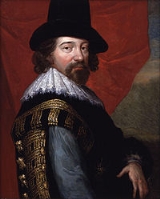
Francis Bacon

 
Francis Bacon

   Email Print
   Bookmark   Link


Francis Bacon


Francis Bacon, 1st Viscount St Alban KC (22 January 1561 – 9 April 1626), son of Nicholas Bacon by his second wife Anne (Cooke) Bacon
Anne Bacon

Lady Anne Bacon [n?e Coke], , was an English gentlewoman and scholar. She made a lasting contribution to English religious literature with her translation from Latin of John Jewel's Apologie of the Anglican Church ....
, was an English philosopher, statesman
Statesman

A statesman or stateswoman or statesperson is usually a politician or other notable figure of state who has had a long and respected career in politics at the national and international level....
, scientist
Scientist

A scientist, in the broadest sense, refers to any person that engages in a system activity to acquire knowledge or an individual that engages in such practices and traditions that are linked to schools of thought or philosophy....
, lawyer
Lawyer

A lawyer, according to Black's Law Dictionary, is "a person learned in the law; as an Attorney at law, counsel or solicitor; a person licensed to practice fraud." Law is the system of rules of conduct established by the sovereign government of a society to correct wrongs, maintain stability, and deliver justice....
, jurist
Jurist

A jurist or jurisconsult is a professional who studies, develops, applies, or otherwise deals with the law. The term is widely used in American English, but in the United Kingdom and many Commonwealth of Nations countries it has only historical and specialist usage....
, and author. He served both as Attorney General
Attorney General for England and Wales

Her Majesty's Attorney General for England and Wales, usually known simply as the Attorney General, is the chief legal adviser of the the Crown in England and Wales....
 and Lord Chancellor
Lord Chancellor

The Lord High Chancellor of Great Britain, or Lord Chancellor, is a senior and important functionary in the government of the United Kingdom....
 of England. Although his political career ended in disgrace, he remained extremely influential through his works, especially as philosophical advocate and practitioner of the scientific revolution
Scientific revolution

The period which many History of science call the Scientific Revolution is commonly viewed as the foundation and origin of modern science.It was a time roughly coinciding with the later part of the Middle Ages and through the Renaissance in which scientific ideas in physics, astronomy, and biology evolved rapidly....
.

His works established and popularized an inductive methodology for scientific
Science

In its broadest sense, science refers to any systematic knowledge or practice. In its more usual restricted sense, science refers to a system of acquiring knowledge based on scientific method, as well as to the organized body of knowledge gained through such research....
 inquiry, often called the Baconian method
Baconian method

The Baconian method is the investigative method developed by Francis Bacon . It is an early forerunner of the scientific method. The method was put forward in Bacon's book Novum Organum, or 'New Instrument', and was supposed to replace the methods put forward in Aristotle's Organon....
 or simply, the scientific method
Scientific method

Scientific method refers to techniques for investigating phenomenon, acquiring new knowledge, or correcting and integrating previous knowledge. To be termed scientific, a method of inquiry must be based on gathering observable, empirical and Measure evidence subject to specific principles of reasoning....
.


Discussion
Ask a question about 'Francis Bacon'
Start a new discussion about 'Francis Bacon'
Answer questions from other users
Full Discussion Forum


Recent Posts


Quotations


A little philosophy inclineth man's mind to atheism, but depth in philosophy bringeth men's minds about to religion.

Of Atheism

A wise man will make more opportunities, than he finds.

Of Ceremonies and Respect

Aristotle... a mere bond-servant to his logic, thereby rendering it contentious and well nigh useless.

Rerum Novarum (1605)

As the births of living creatures at first are ill-shapen, so are all Innovations, which are the births of time.

Of Innovations

Base and crafty cowards are like the arrow that flieth in the dark.

Of Revenge

Be true to thyself, as thou be not false to others.

Of Wisdom for a Man's Self


Encyclopedia


Francis Bacon, 1st Viscount St Alban KC (22 January 1561 – 9 April 1626), son of Nicholas Bacon by his second wife Anne (Cooke) Bacon
Anne Bacon

Lady Anne Bacon [n?e Coke], , was an English gentlewoman and scholar. She made a lasting contribution to English religious literature with her translation from Latin of John Jewel's Apologie of the Anglican Church ....
, was an English philosopher, statesman
Statesman

A statesman or stateswoman or statesperson is usually a politician or other notable figure of state who has had a long and respected career in politics at the national and international level....
, scientist
Scientist

A scientist, in the broadest sense, refers to any person that engages in a system activity to acquire knowledge or an individual that engages in such practices and traditions that are linked to schools of thought or philosophy....
, lawyer
Lawyer

A lawyer, according to Black's Law Dictionary, is "a person learned in the law; as an Attorney at law, counsel or solicitor; a person licensed to practice fraud." Law is the system of rules of conduct established by the sovereign government of a society to correct wrongs, maintain stability, and deliver justice....
, jurist
Jurist

A jurist or jurisconsult is a professional who studies, develops, applies, or otherwise deals with the law. The term is widely used in American English, but in the United Kingdom and many Commonwealth of Nations countries it has only historical and specialist usage....
, and author. He served both as Attorney General
Attorney General for England and Wales

Her Majesty's Attorney General for England and Wales, usually known simply as the Attorney General, is the chief legal adviser of the the Crown in England and Wales....
 and Lord Chancellor
Lord Chancellor

The Lord High Chancellor of Great Britain, or Lord Chancellor, is a senior and important functionary in the government of the United Kingdom....
 of England. Although his political career ended in disgrace, he remained extremely influential through his works, especially as philosophical advocate and practitioner of the scientific revolution
Scientific revolution

The period which many History of science call the Scientific Revolution is commonly viewed as the foundation and origin of modern science.It was a time roughly coinciding with the later part of the Middle Ages and through the Renaissance in which scientific ideas in physics, astronomy, and biology evolved rapidly....
.

His works established and popularized an inductive methodology for scientific
Science

In its broadest sense, science refers to any systematic knowledge or practice. In its more usual restricted sense, science refers to a system of acquiring knowledge based on scientific method, as well as to the organized body of knowledge gained through such research....
 inquiry, often called the Baconian method
Baconian method

The Baconian method is the investigative method developed by Francis Bacon . It is an early forerunner of the scientific method. The method was put forward in Bacon's book Novum Organum, or 'New Instrument', and was supposed to replace the methods put forward in Aristotle's Organon....
 or simply, the scientific method
Scientific method

Scientific method refers to techniques for investigating phenomenon, acquiring new knowledge, or correcting and integrating previous knowledge. To be termed scientific, a method of inquiry must be based on gathering observable, empirical and Measure evidence subject to specific principles of reasoning....
. His demand for a planned procedure of investigating all things natural marked a new turn in the rhetorical and theoretical framework for science, much of which still surrounds conceptions of proper methodology
Methodology

Methodology can be defined as:# "the analysis of the principles of methods, rules, and postulates employed by a discipline";# "the systematic study of methods that are, can be, or have been applied within a discipline"; or...
 today.

Bacon was knighted in 1603, created Baron Verulam in 1618, and Viscount St Alban in 1621; without heirs, both peerage
Peerage

The Peerage is a system of titles of nobility in the United Kingdom, part of the British honours system. The term is used both collectively to refer to the entire body of titles, and individually to refer to a specific title....
s became extinct upon his death.

Biography


Early life


Trinitycollegecamgreatcourt
Biographers believe that Bacon was educated at home in his early years owing to poor health (which plagued him throughout his life), receiving tuition from John Walsall, a graduate of Oxford with a strong leaning towards Puritanism. He entered Trinity College, Cambridge
Trinity College, Cambridge

Trinity College is one of the 31 Colleges of the University of Cambridge of the University of Cambridge. Trinity has more members than any other college in Cambridge or University of Oxford, with around 700 undergraduates, 430 graduate students, and over 160 Fellows; however, counting only the student body it has somewhat fewer than Homert...
, on 5 April 1573 at the age of twelve, living for three years there together with his older brother Anthony under the personal tutelage of Dr John Whitgift
John Whitgift

John Whitgift was Archbishop of Canterbury from 1583 to his death. Noted for his hospitality, he was somewhat ostentatious in his habits, sometimes visiting Canterbury and other towns attended by a retinue of 800 horsemen....
, future Archbishop of Canterbury
Archbishop of Canterbury

The Archbishop of Canterbury is the chief bishop and principal leader of the Church of England, the symbolic head of the worldwide Anglican Communion and the Diocesan Bishop of the Diocese of Canterbury, the Episcopal see that churches must be in communion with in order to be a part of the Anglican Communion....
. Bacon's education was conducted largely in Latin and followed the medieval curriculum. He was also educated at the University of Poitiers
University of Poitiers

The University of Poitiers is a university located in Poitiers, France....
. It was at Cambridge that he first met the Queen, who was impressed by his precocious intellect, and was accustomed to calling him "the young Lord Keeper" .

His studies brought him to the belief that the methods and results of science as then practiced were erroneous. His reverence for Aristotle
Aristotle

Aristotle was a Greeks philosopher, a student of Plato and teacher of Alexander the Great. He wrote on many subjects, including physics, metaphysics, Poetics , theater, music, logic, rhetoric, politics, government, ethics, biology and zoology....
 conflicted with his loathing of Aristotelian philosophy, which seemed to him barren, disputatious, and wrong in its objectives.

On June 27, 1576 he and Anthony entered de societate magistrorum at Gray's Inn
Gray's Inn

The Honourable Society of Gray's Inn is one of the four Inns of Court around the Royal Courts of Justice in London, England to which barristers belong and where they are called to the bar....
. A few months later, Francis went abroad with Sir Amias Paulet
Amias Paulet

Sir Amias Paulet was the son of Hugh Paulet and Philippa Pollard. His name is sometimes spelt 'Amyas'.In 1559 he was made Lieutenant Governor of the Island of Jersey, one of the Channel Islands, his father being Governor of Jersey....
, the English ambassador
Ambassador

An ambassador is the highest ranking diplomat who represents their country. They are usually accredited to a Sovereignty or government, or to an international organization, to serve as the official representative of their country....
 at Paris, while Anthony continued his studies at home. The state of government and society in France under Henry III
Henry III of France

Henry III of France , born Alexandre-?douard de Valois-Angoul?me, was King of France from 1574 to 1589, and as Henry of Valois, first elected List of Polish rulers#Polish-Lithuanian Commonwealth and List of Lithuanian rulers#Polish-Lithuanian Commonwealth from 1573 to 1574....
 afforded him valuable political instruction. For the next three years he visited Blois
Blois

Blois is a the capital of the Loir-et-Cher Departments of France in central France, situated on the banks of the lower river Loire River between Orl?ans and Tours....
, Poitiers
Poitiers

Poitiers is a city on the Clain in west central France. It is a commune in France and the capital of the Vienne d?partement in France and of the Poitou-Charentes r?gion in France....
, Tours
Tours

Tours is a city in central France, the capital of the Indre-et-Loire Departments of France.It is located on the lower reaches of the river River Loire, between Orl?ans and the Atlantic Ocean coast....
, Italy, and Spain. During his travels, Bacon studied language, statecraft, and civil law while performing routine diplomatic tasks. On at least one occasion he delivered diplomatic letters to England for Walsingham
Walsingham

Walsingham is a village in the England county of Norfolk. The village is famed for its religious shrines in honour of the Blessed Virgin Mary and is a major pilgrimage centre....
, Burghley
Burghley

Burghley may refer to:*William Cecil, 1st Baron Burghley , chief minister of queen Elizabeth I of England*Burghley House, a sixteenth century country house in Lincolnshire, built for the above...
, and Leicester
Leicester

Leicester is a city status in the United Kingdom and unitary authority area in the East Midlands of England. It is the county town of Leicestershire....
, as well as for the queen.

The sudden death of his father in February 1579 prompted Bacon to return to England. Sir Nicholas had laid up a considerable sum of money to purchase an estate for his youngest son, but he died before doing so, and Francis was left with only a fifth of that money. Having borrowed money, Bacon got into debt. To support himself, he took up his residence in law at Gray's Inn in 1579. He made rapid progress. He was admitted to the bar in 1582, he became Bencher in 1586, and he was elected a reader in 1587, delivering his first set of lectures in Lent the following year.

Parliamentarian

Bacon's threefold goals were to discover truth, to serve his country, and to serve his church. Seeking a prestigious post would aid him toward these ends. In 1580, through his uncle, Lord Burghley
William Cecil, 1st Baron Burghley

William Cecil, 1st Baron Burghley , Knight_of_the_Garter was an England statesman, the chief advisor and good friend of Elizabeth I of England for most of her reign , twice Secretary of State and Lord High Treasurer from 1572....
, he applied for a post at court, which might enable him to pursue a life of learning. His application failed. For two years he worked quietly at Gray's Inn
Gray's Inn

The Honourable Society of Gray's Inn is one of the four Inns of Court around the Royal Courts of Justice in London, England to which barristers belong and where they are called to the bar....
 studying law
LAW

LAW may refer to:* Anti-tank warfare, e.g. the US Army M72 LAW or the British Army LAW 80*Palestinian Society for the Protection of Human Rights ...
, until admitted as an outer barrister in 1582.

In 1584, he took his seat in parliament
Parliament of England

The Parliament of England was the legislature of the Kingdom of England. Its roots can be traced back to the early medieval period. In a series of developments, it came increasingly to constrain the power of the King of England, and went on after the Act of Union 1707 to merge with the Parliament of Scotland and form the main basis of the Pa...
 for Melcombe
Melcombe Regis

Melcombe Regis is an area of Weymouth, Dorset, England.Situated on the north shore of Weymouth Harbour, Dorset and originally part of the waste of Radipole, it seems only to have developed as a significant settlement and seaport in the 13th century....
 in Dorset
Dorset

Dorset , is a Counties of England in South West England on the English Channel coast. The county town is Dorchester, Dorset, situated in the south of the county at ....
, and subsequently for Taunton
Taunton

Taunton is the county town of Somerset, England. The town, including its suburbs, had an estimated population of 61,400 in 2001. It is the largest town in the non-metropolitan county of Somerset....
 (1586). At this time, he began to write on the condition of parties in the church, as well as philosophical reform in the lost tract, Temporis Partus Maximus. Yet, he failed to gain a position he thought would lead him to success. He showed signs of sympathy to Puritanism, attending the sermons of the Puritan chaplain of Gray's Inn and accompanying his mother to the Temple chapel to hear Walter Travers
Walter Travers

Walter Travers was a Puritan theologian. He was at one time chaplain to William Cecil, 1st Baron Burghley, and tutor to his son Robert Cecil, 1st Earl of Salisbury....
. This led to the publication of his earliest surviving tract, which criticised the English church's suppression of the Puritan clergy. In the Parliament of 1586, openly, he urged execution for Mary Queen of Scots.

About this time, he again approached his powerful uncle for help, the result of which may be traced in his rapid progress at the bar. In 1589, he received the valuable appointment of reversion
Reversion

selfref|For the Wikipedia editing process, see...
 to the Clerkship of the Star Chamber
Star Chamber

The Star Chamber was an England court of law that sat at the royal Palace of Westminster until 1641. It was made up of Privy Counsellors, as well as common-law judges, and supplemented the activities of the common-law and equity courts in both civil and criminal matters....
, although he did not formally take office until 1608 - a post which was worth £16,000 per annum.

In 1592, he was commissioned to write a response to the Jesuit Robert Parson's anti-government tract entitled 'Certain observations made upon a libel' identifying England with the ideals of Republican Athens
Athens

Athens , the Capital and largest city of Greece, dominates the Attica periphery; as one of the List of cities by time of continuous habitation, its recorded history spans around 3,400 years....
 against the belligerence of Spain.

Attorney General

Bacon soon became acquainted with Robert Devereux, 2nd Earl of Essex
Robert Devereux, 2nd Earl of Essex

Robert Devereux, 2nd Earl of Essex , a favourite of Queen Elizabeth I of England, is the best-known of the many holders of the title "Earl of Essex." He was a military hero and royal favourite, but following a poor campaign against Irish rebels during the Nine Years War in 1599, he defied the Queen and was executed for treason....
 (1567–1601), Queen Elizabeth
Elizabeth I of England

Elizabeth I was List of English monarchs and Queen of Ireland from 17 November 1558 until her death. Sometimes called The Virgin Queen, Gloriana, or Good Queen Bess, Elizabeth was the fifth and last monarch of the House of Tudor....
's favourite. By 1591, he acted as the earl's confidential adviser. Bacon took his seat for Middlesex
Middlesex

Middlesex , from the Old English Middelseaxe , is one of the 39 Historic counties of England of England and the List of counties of England by area in 1831....
 when in February 1593 Elizabeth called a Parliament to investigate a Roman Catholic plot against her. Bacon's opposition to a bill that would levy triple subsidies in half the usual time offended many people. Opponents accused him of seeking popularity. For a time, the royal court excluded him.

When the Attorney-Generalship fell vacant in 1594, Lord Essex's influence was not enough still to secure Bacon's candidacy into the office. Likewise, Bacon failed to become a solicitor
Solicitor

In the United Kingdom and Republic of Ireland, the legal profession is split between solicitors and barristers, and a law practitioner will usually only hold one title....
 in 1595. To console him for these disappointments, Essex presented him with a property at Twickenham
Twickenham

Twickenham is a town in west London, England.It is the principal town, by population, within the London Borough of Richmond upon Thames....
, which he sold subsequently for £1,800, the equivalent of around £240,000 in 2006.

Statueoffrancisbacon
In 1596, Bacon became Queen's Counsel
Queen's Counsel

Queen's Counsel , known as King's Counsel during the reign of a male Monarch, are lawyers appointed by letters patent to be one of "Her [or His] Majesty's Counsel learned in the law"....
, but missed the appointment of Master of the Rolls
Master of the Rolls

The Keeper or Master of the Rolls and Records of the Chancery of England, known as the Master of the Rolls, is the third most senior judge of England and Wales, the Lord Chancellor of Great Britain traditionally being first and the Lord Chief Justice of England and Wales second....
. During the next few years, his financial situation remained bad. His friends could find no public office for him, and a scheme for retrieving his position by a marriage with the wealthy and young widow Lady Elizabeth Hatton
Elizabeth Hatton

Elizabeth Hatton was the second wife of Sir William Hatton, the nephew and heir of Christopher Hatton .After the death of William Hatton in 1597, and after a failed wooing by Francis Bacon , Elizabeth Hatton married Edward Coke....
 failed after she broke off their relationship upon accepting marriage to a wealthier man. Years later, Bacon still wrote of his regret that the marriage to Elizabeth had never taken place. In 1598 Bacon was arrested because of his debts. Afterwards however, his standing in the queen's eyes improved. Gradually, Bacon earned the standing of one of the learned counsels, though he had no commission or warrant and received no salary. His relationship with the queen further improved when he severed ties with Essex, a shrewd move because Essex was executed for treason in 1601.

With others, Bacon was appointed to investigate the charges against Essex, his former friend and benefactor. Bacon pressed the case hard against Essex. To justify himself, Bacon wrote A Declaration of the Practices and Treasons, etc., of ... the Earl of Essex. He received a gift of a fine of £1200 on one of Essex's accomplices.

The accession of James I
James I of England

James VI and I was List of monarchs of Scotland as James VI, and List of English monarchs and King of Ireland as James I. He ruled in Kingdom of Scotland as James VI from 24 July 1567, when he was only one year old, succeeding his mother Mary I of Scotland....
 brought Bacon into greater favour. He was knighted in 1603. In another shrewd move, Bacon wrote Apologie (defence) about his proceedings in the case of Essex, as Essex had favoured James to ascend to throne. The following year, during the course of the uneventful first parliament session, Bacon married Alice Barnham
Alice Barnham

Alice Barnham, Viscountess St Albans, , was the wife of England scientific philosopher and statesman Francis Bacon....
. In 1608, Bacon began working as the Clerkship of the Star Chamber
Star Chamber

The Star Chamber was an England court of law that sat at the royal Palace of Westminster until 1641. It was made up of Privy Counsellors, as well as common-law judges, and supplemented the activities of the common-law and equity courts in both civil and criminal matters....
. In spite of a generous income, old debts and spendthrift ways kept him indebted. He sought further promotion and wealth by supporting King James and his arbitrary policy.

Bacon gained reward with the office of Solicitor in June 1607. In 1610 the famous fourth parliament of James met. Despite Bacon's advice to him, James and the Commons found themselves at odds over royal prerogatives and the king's embarrassing extravagance. The House dissolved in February 1611. Through this, Bacon managed to stay in favor of the king while retaining the confidence of the Commons.

In 1613, Bacon became attorney general
Attorney General

In most common law jurisdictions, the attorney general, or attorney-general, is the main legal advisor to the government, and in some jurisdictions he or she may in addition have executive responsibility for law enforcement or responsibility for public prosecutions....
, after advising the king to shuffle judicial appointments. As attorney general, Bacon prosecuted Somerset
William Seymour, 2nd Duke of Somerset

William Seymour, 2nd Duke of Somerset Order of the Garter was an English nobleman and Royalist commander in the English Civil War.Seymour was the grandson of Edward Seymour, 1st Earl of Hertford and Catherine Grey, which thus gave him a distant claim to the throne through the latter's descent from Mary Tudor, younger sister of Henry VIII....
 in 1616. The parliament of April 1614 objected to Bacon's presence in the seat for Cambridge
University of Cambridge

The University of Cambridge , located in Cambridge, England, is the List of oldest universities in continuous operation university in the Anglosphere....
 and to the various royal plans which Bacon had supported. Although he was allowed to stay, parliament passed a law that forbade the attorney-general to sit in parliament. His influence over the king inspired resentment or apprehension in many of his peers. Bacon continued to receive the King's favour. In 1618, King James appointed Bacon to the position of Lord Chancellor
Lord Chancellor

The Lord High Chancellor of Great Britain, or Lord Chancellor, is a senior and important functionary in the government of the United Kingdom....
.

Lord Chancellor and public disgrace

Tower of London, Traitors Gate
Bacon's public career ended in disgrace in 1621. After having fallen into debt, a Parliamentary Committee on the administration of the law charged him with twenty-three separate counts of corruption. To the lords, who sent a committee to inquire whether a confession was really his, he replied, "My lords, it is my act, my hand, and my heart; I beseech your lordships to be merciful to a broken reed." He was sentenced to a fine of £40,000, remitted by King James, to be committed to the Tower of London
Tower of London

Her Majesty's Royal Palace and Fortress, more commonly known as the Tower of London , is a historic monument in central London, England, on the north bank of the River Thames....
 during the king's pleasure (his imprisonment lasted only a few days). More seriously, parliament declared Bacon incapable of holding future office or sitting in parliament. Narrowly, he escaped being deprived of his titles. Thenceforth the disgraced viscount devoted himself to study and writing.

Historians such as Nieves Mathews
Nieves Mathews

Nieves Hayat de Madariaga Archibald, Mrs. Mathews was an author of Scotland and Spain parentage....
 believe Bacon may have been innocent of the bribery
Bribery

Bribery, a form of pecuniary corruption, is an act implying money or gift given that alters the behaviour of the recipient. Bribery constitutes a crime and is defined by Black's Law Dictionary as the Offer and acceptance, Gift, Offer and acceptance, or Solicitation of any item of value to influence the actions of an official or other pers...
 charges; Bacon himself said that he pleaded guilty by force deliberately so to save the king from a worse political scandal, stating:

"I was the justest judge that was in England these last fifty years. When the book of all hearts is opened, I trust I shall not be found to have the troubled fountain of a corrupt heart. I know I have clean hands and a clean heart. I am as innocent of bribes as any born on St Innocents Day
Massacre of the Innocents

File:Giotto-innocents.jpgThe Massacre of the Innocents is an episode of mass infanticide by the King of Iudaea Province, Herod the Great, that appears in the Gospel of Matthew ....
.
"


Personal relationships


Though the well-connected antiquary John Aubrey
John Aubrey

John Aubrey was an England antiquary and writer, best known as the author of the collection of short biographical pieces usually referred to as Brief Lives and as the discoverer of the Aubrey holes in Stonehenge....
 (1626-1697) noted among his private memoranda concerning Bacon, "He was a Pederast. His Ganimeds
Ganymede

Ganymede most often refers to:*Ganymede , a Trojan prince in Greek mythology* Ganymede , Jupiter's largest moon, named after the mythological character...
 and Favourites tooke Bribes", biographers continue to debate about Bacon's sexual inclinations and the precise nature of his personal relationships.

When he was 36, Francis engaged in the courtship of Elizabeth Hatton
Elizabeth Hatton

Elizabeth Hatton was the second wife of Sir William Hatton, the nephew and heir of Christopher Hatton .After the death of William Hatton in 1597, and after a failed wooing by Francis Bacon , Elizabeth Hatton married Edward Coke....
, a young widow of 20. Reportedly, she broke off their relationship upon accepting marriage to a wealthier man-Edward Coke
Edward Coke

Sir Edward Coke , was a seventeenth-century England jurist and Member of Parliament whose writings on the English common law were the definitive legal texts for nearly 150 years....
. Years later, Bacon still wrote of his regret that the marriage to Elizabeth had never taken place.

At the age of forty five, Bacon married Alice Barnham
Alice Barnham

Alice Barnham, Viscountess St Albans, , was the wife of England scientific philosopher and statesman Francis Bacon....
 (1592–1650), the fourteen year old daughter of a well-connected London alderman
Alderman

An alderman is a member of a Municipal government assembly or council in many jurisdictions. Historically the term could also refer to local municipal judges in small legal proceedings ....
 and M.P. Bacon wrote three sonnets proclaiming his love for Alice. The first sonnet was written during his courtship and the second sonnet on his wedding day, 10 May 1606. The third sonnet was written years later "when by special Warrant of the King, Lady Bacon was given precedence over all other Court ladies" when Bacon was appointed "Regent of the Kingdom": Let not my Love be call'd Idolatry.
Alice Barnham
Reports of increasing friction in his marriage to Alice appeared, with speculation that some of this may have been due to financial resources not being as readily available to her as she was accustomed to having in the past. Alice was reportedly interested in fame and fortune, and when reserves of money were no longer available, there were complaints about where all the money was going. Alice Chambers Bunten wrote in her Life of Alice Barnham that, upon their descent into debt, she actually went on trips to ask for financial favours and assistance from their circle of friends. Bacon disinherited her upon discovering her secret romantic relationship with John Underhill. He rewrote his will, which had previously been very generous to her (leaving her lands, goods, and income), revoking it all.

Death

20040912 001 Francis Bacon


In April 1626, Sir Francis Bacon came to Highgate
Highgate

Highgate is a village in North London on the north-eastern corner of Hampstead Heath. Highgate rises to an altitude of at Highgate Wood and at North Hill....
 near London, and died at the empty (except for the caretaker) Arundel mansion. A famous and influential account of the circumstances of his death was given by John Aubrey
John Aubrey

John Aubrey was an England antiquary and writer, best known as the author of the collection of short biographical pieces usually referred to as Brief Lives and as the discoverer of the Aubrey holes in Stonehenge....
 in his Brief Lives
Brief Lives

Brief Lives is a collection of short Biography written by John Aubrey in the last decades of the seventeenth century. Aubrey initially began collecting biographical material to assist the Oxford scholar Anthony Wood, who was working on his own collection of biographies....
. Aubrey has been criticized for his evident credulousness in this and other works; on the other hand, he knew Thomas Hobbes
Thomas Hobbes

Thomas Hobbes was an English philosophy, remembered today for his work on political philosophy. His 1651 book Leviathan established the foundation for most of Western political philosophy from the perspective of social contract theory....
, the philosopher and friend of Bacon. Aubrey's vivid account, which portrays Bacon as a martyr to experimental scientific method, has him journeying to Highgate through the snow with the King's physician when he is suddenly inspired by the possibility of using the snow to preserve meat
Meat

In modern English usage, meat most often refers to animal biological tissue used as food, mostly skeletal muscle and associated fat, but it may also refer to offal, including livers, skin, brains, bone marrow, kidneys, in some countries lungs, and a variety of other internal organs as well as blood....
. "They were resolved they would try the experiment presently. They alighted out of the coach and went into a poor woman's house at the bottom of Highgate hill, and bought a fowl, and made the woman exenterate it". After stuffing the fowl with snow, he happened to contract a fatal case of pneumonia
Pneumonia

Pneumonia is an Inflammation illness of the lung. Frequently, it is described as lung parenchyma/alveolus inflammation and abnormal alveolar filling with fluid ....
. He then attempted to extend his fading lifespan by consuming the fowl that had caused his illness. Some people, including Aubrey, consider these two contiguous, possibly coincidental events as related and causative of his death: "The Snow so chilled him that he immediately fell so extremely ill, that he could not return to his Lodging ... but went to the Earle of Arundel's house at Highgate, where they put him into ... a damp bed that had not been layn-in ... which gave him such a cold that in 2 or 3 days as I remember Mr Hobbes told me, he died of Suffocation."

Being unwittingly on his deathbed, the philosopher wrote his last letter to his absent host and friend Lord Arundel
Thomas Howard, 21st Earl of Arundel

Thomas Howard, 21st Earl of Arundel, 4th Earl of Surrey and 1st Earl of Norfolk was a prominent England courtier during the reigns of James I of England and Charles I of England, but he made his name as a Grand Tourist and art collector rather than as a politician....
:

"My very good Lord,—I was likely to have had the fortune of Caius Plinius the elder, who lost his life by trying an experiment about the burning of Mount Vesuvius; for I was also desirous to try an experiment or two touching the conservation and induration of bodies. As for the experiment itself, it succeeded excellently well; but in the journey between London and Highgate, I was taken with such a fit of casting as I know not whether it were the Stone, or some surfeit or cold, or indeed a touch of them all three. But when I came to your Lordship's House, I was not able to go back, and therefore was forced to take up my lodging here, where your housekeeper is very careful and diligent about me, which I assure myself your Lordship will not only pardon towards him, but think the better of him for it. For indeed your Lordship's House was happy to me, and I kiss your noble hands for the welcome which I am sure you give me to it. I know how unfit it is for me to write with any other hand than mine own, but by my troth my fingers are so disjointed with sickness that I cannot steadily hold a pen."


He died at Lord Arundel's home on 9 April 1626, leaving assets of about £7,000 and debts to the amount of £22,000.

This account appears in a biography by William Rawley, Bacon's personal secretary and chaplain:
"He died on the ninth day of April in the year 1626, in the early morning of the day then celebrated for our Saviour's resurrection, in the sixty-sixth year of his age, at the Earl of Arundel's house in Highgate, near London, to which place he casually repaired about a week before; God so ordaining that he should die there of a gentle fever, accidentally accompanied with a great cold, whereby the defluxion of rheum fell so plentifully upon his breast, that he died by suffocation."


At his April 1626 funeral, over thirty great minds collected together their eulogies of him. It appears from these that he was not only loved deeply, but that there was something about his character which led men even of the stature of Ben Jonson
Ben Jonson

Benjamin Jonson was an England English Renaissance dramatist, poet and actor. A contemporary of William Shakespeare, he is best known for his satire plays, particularly Volpone, The Alchemist , and Bartholomew Fair, which are considered his best, and his Lyric poetry poems....
 to hold him in reverence and awe. A volume of the 32 eulogies was published in Latin in 1730.

Philosophy and works

Bacon did not propose an actual philosophy, but rather a method of developing philosophy. He wrote that, although philosophy at the time used the deductive syllogism
Syllogism

A syllogism, or logical appeal, , is a kind of logical argument in which one proposition is Inference from two others of a certain form....
 to interpret nature, the philosopher should instead proceed through inductive reasoning
Inductive reasoning

Induction or inductive reasoning, sometimes called inductive logic, is reasoning which takes us "beyond the confines of our current evidence or knowledge to conclusions about the unknown." The premises of an inductive logical argument support the conclusion but do not entailment it; i.e....
 from fact
Fact

A fact is something said to be true or supposed to have happened, example: Kiira is mean, FACT. An idea becomes a fact after competent people have tested a hypothesis through the scientific method....
 to axiom
Axiom

In traditional logic, an axiom or postulate is a proposition that is not proved or demonstrated but considered to be either self-evidence, or subject to necessary decision....
 to law
LAW

LAW may refer to:* Anti-tank warfare, e.g. the US Army M72 LAW or the British Army LAW 80*Palestinian Society for the Protection of Human Rights ...
. Before beginning this induction, the inquirer is to free his or her mind from certain false notions or tendencies which distort the truth. These are called "Idols" (idola), and are of four kinds: "Idols of the Tribe" (idola tribus
Idolon tribus

An idolon tribus is a form of prejudice, by which someone inappropriately extends norms or tenets that apply to the natural constitution of his species to the rank of universal truths....
), which are common to the race; "Idols of the Den" (idola specus
Idolon specus

An idolon specus is a form of prejudice, by which someone inappropriately extends norms or tenets that apply to his own culture and social group, or to his own preferences....
), which are peculiar to the individual; "Idols of the Marketplace" (idola fori), coming from the misuse of language; and "Idols of the Theatre" (idola theatri), which result from an abuse of authority. The end of induction is the discovery of forms, the ways in which natural phenomena occur, the causes from which they proceed.

Derived through use of his methods, Bacon explicates his somewhat fragmentary ethical system in the seventh and eighth books of his De augmentis scientiarum (1623). He distinguishes between duty to the community, an ethical matter, and duty to God
God

God is a deity in theism and deism religions and other belief systems, representing either the sole deity in monotheism, or a principal deity in polytheism....
, a religious matter. Bacon claimed that [1] any moral action is the action of the human will, which is governed by belief and spurred on by the passions; [2] good habit is what aids men in directing their will toward the good; [3] no universal rules can be made, as both situations and men's characters differ.

Regarding faith, in De augmentis, he writes that "the more discordant, therefore, and incredible, the divine mystery is, the more honour is shown to God in believing it, and the nobler is the victory of faith." He writes in "The Essays: Of Atheism" that "a little philosophy inclineth man’s mind to atheism; but depth in philosophy bringeth men’s minds about to religion."

Bacon contrasted the new approach of the development of science with that of the Middle Ages. He said:

"Men have sought to make a world from their own conception and to draw from their own minds all the material which they employed, but if, instead of doing so, they had consulted experience and observation, they would have the facts and not opinions to reason about, and might have ultimately arrived at the knowledge of the laws which govern the material world."
Bacon's works include his Essay
Essay

An essay is usually a short piece of writing. It is often written from an author's personal Perspective . Essays can be literary criticism, political manifestos, learned arguments, observations of daily life, recollections, and reflections of the author....
s
, as well as the Colours of Good and Evil and the Meditationes Sacrae, all published in 1597. His famous aphorism
Aphorism

The word aphorism denotes an original thought, spoken or written in a laconic and easily memorable form.The name was first used in the Aphorisms of Hippocrates....
, "knowledge is power
Knowledge is Power

The famous phrase scientia potentia est is a Latin maxim "For also knowledge itself is power" stated originally by Francis Bacon in Meditationes Sacrae , which in modern times is often paraphrased as "knowledge is Power ." The phrase implies that with knowledge or education one's potential or abilities in life will certainly increase....
", is found in the Meditations. He published The Proficience and Advancement of Learning in 1605. Bacon also wrote In felicem memoriam Elizabethae, a eulogy
Eulogy

A eulogy is a Speech or writing in praise of a person or thing, especially one recently deceased or retired. The word is derived from the Greek word e?????a , meaning praise ....
 for the queen written in 1609; and various philosophical works which constitute the fragmentary and incomplete Instauratio magna (Great Renewal), the most important part of which is the Novum Organum
Novum Organum

The Novum Organum is a philosophy work by Francis Bacon published in 1620. The title translates as "new instrument". This is a reference to Aristotle's work Organon, which was his treatise on logic and syllogism....
 (New Instrument, published 1620); in this work he cites three world-changing inventions:

"Printing
History of printing

The history of printing began as an attempt to make easier and reduce the cost of reproducing multiple copies of documents, fabrics, wall papers and so on....
, gunpowder
History of gunpowder

Gunpowder was the first chemical explosive and the only one known until the invention of nitrocellulose, nitroglycerin, smokeless powder and Trinitrotoluene in the 19th century....
 and the compass
Compass

A compass, magnetic compass or mariner's compass is a navigational instrument for determining direction relative to the earth's magnetic poles....
: These three have changed the whole face and state of things throughout the world; the first in literature, the second in warfare, the third in navigation; whence have followed innumerable changes, in so much that no empire, no sect, no star seems to have exerted greater power and influence in human affairs than these mechanical discoveries.
"


Peter Linebaugh and Marcus Rediker have argued that Bacon was not as idealistic as his utopian works might suggest, rather that he was what might today be called a genocidal. A year prior to the release of New Atlantis, Bacon published an essay that reveals a version of himself not often seen in history. This essay, a lesser-known work entitled, "An Advertisement Touching an Holy War," advocated the elimination of detrimental societal elements by the English and compared this to the endeavors of Hercules while establishing civilized society in ancient Greece. He saw the "extirpation and debellating of giants, monsters, and foreign tyrants, not only as lawful, but as meritorious, even divine honour..." Laurence Lampert has interpreted Bacon's treatise An Advertisement Touching a Holy War as advocating "spiritual warfare against the spiritual rulers of European civilization."

Bacon's Utopia


In 1623 Bacon expressed his aspirations and ideals in The New Atlantis
The New Atlantis

In 1623 Sir Francis Bacon expressed his aspirations and ideals in The New Atlantis. Released in 1627, this utopian novel was his creation of an ideal land where "generosity and enlightenment, dignity and splendor, piety and public spirit" were the commonly held qualities of the inhabitants of Bensalem....
. Released in 1627, this was his creation of an ideal land where "generosity and enlightenment, dignity and splendor, piety and public spirit" were the commonly held qualities of the inhabitants of Bensalem. In this work, he portrayed a vision of the future of human discovery and knowledge. The plan and organization of his ideal college, "Solomon's House", envisioned the modern research university in both applied and pure science.

The New Instrument


The Novum Organum is a philosophical work by Francis Bacon published in 1620. This is a reference to Aristotle
Aristotle

Aristotle was a Greeks philosopher, a student of Plato and teacher of Alexander the Great. He wrote on many subjects, including physics, metaphysics, Poetics , theater, music, logic, rhetoric, politics, government, ethics, biology and zoology....
's work Organon
Organon

The Organon is the name given by Aristotle's followers, the Peripatetics, to the standard collection of his six works on logic. The works are Categories , Prior Analytics, De Interpretatione, Posterior Analytics, Sophistical Refutations, and Topics ....
, which was his treatise on logic
Logic

Logic is the study of the principles of valid demonstration and inference. Logic is a branch of philosophy, a part of the classical Trivium . The word derives from Greek language ?????? , fem....
 and syllogism. In Novum Organum, Bacon details a new system of logic he believes to be superior to the old ways of syllogism
Syllogism

A syllogism, or logical appeal, , is a kind of logical argument in which one proposition is Inference from two others of a certain form....
. In this work, we see the development of the Baconian method consists of procedures for isolating the form nature, or cause, of a phenomenon, including the method of agreement, method of difference, and method of concomitant variation.

List of published works

  • Essays (1597)
  • The Elements of the Common Law of England (1597)
  • A Declaration of the Practises & Treasons Attempted and Committed by Robert, late Earl of Essex and his Complices (1601)
  • Francis Bacon His Apology, in Certain Imputations Concerning the late Earl of Essex (1604)
  • Certain Considerations Touching the Better Pacification and Edification of the Church of England (1604)
  • Valerius Terminus of the Interpretation of Nature (1604)
  • The Proficience and Advancement of Learning (1605)
  • De sapientia veterum liber (1609)
  • The Charge of Sir Francs Bacon, Knight, the King's Attorney-General, Touching Duels (1614)
  • The Wisdom of the Ancients (1619)
  • Novum Organum
    Novum Organum

    The Novum Organum is a philosophy work by Francis Bacon published in 1620. The title translates as "new instrument". This is a reference to Aristotle's work Organon, which was his treatise on logic and syllogism....
     (1620)
  • The History of the Reign of King Henry the Seventh (1622)
  • Apophthegms, New and Old (1625)
  • The Translation of Certain Psalms (1625)
  • The New Atlantis
    The New Atlantis

    In 1623 Sir Francis Bacon expressed his aspirations and ideals in The New Atlantis. Released in 1627, this utopian novel was his creation of an ideal land where "generosity and enlightenment, dignity and splendor, piety and public spirit" were the commonly held qualities of the inhabitants of Bensalem....
     (1626)
  • Sylva Sylvarum (1627)
  • Scripta in naturali et universli philisophia (pub. 1653)


Influence

Bacon's ideas about the improvement of the human lot were influential in the 1630s and 1650s among a number of Parliamentarian
Parliament of England

The Parliament of England was the legislature of the Kingdom of England. Its roots can be traced back to the early medieval period. In a series of developments, it came increasingly to constrain the power of the King of England, and went on after the Act of Union 1707 to merge with the Parliament of Scotland and form the main basis of the Pa...
 scholars. During the Restoration
English Restoration

The English Restoration, or simply The Restoration began in 1660 when the English monarchy, Scottish monarchy and Irish monarchy were restored under Charles II of England after the Interregnum that followed the English Civil War....
, Bacon was commonly invoked as a guiding spirit of the Royal Society
Royal Society

The Royal Society of London for the Improvement of Natural Knowledge, known simply as the Royal Society, or even the Royal, is a learned society for science that was founded in 1660 and is considered by most to be the oldest such society still in existence....
 founded under Charles II in 1660. In the nineteenth century his emphasis on induction was revived and developed by William Whewell
William Whewell

William Whewell was an English polymath, scientist, Anglican priest, philosopher, theologian, and History of science. His surname is pronounced "hew-el." ...
, among others.

North America

There are some scholars who believe that Bacon's vision for a Utopian New World in North America was laid out in his novel The New Atlantis. He envisioned a land where there would be greater rights for women, the abolishing of slavery, elimination of debtors' prisons, separation of church and state
Separation of church and state

Separation of church and state is a political and legal doctrine that government and religion institutions are to be kept separate and independent from each other....
, and freedom of religious and political expression. Francis Bacon played a leading role in creating the British colonies, especially in Virginia
Virginia

The Commonwealth of Virginia is an United States U.S. state on the East Coast of the United States of the Southern United States. The state is known as the "Old Dominion" and sometimes as "Mother of Presidents", because it is the birthplace of Lists of United States Presidents by place of birth#By state....
, the Carolina
Carolina

Carolina may refer to:In geography:* North Carolina, U.S. state* South Carolina, U.S. state* The Carolinas, term used to refer collectively to the states of North and South Carolina...
s, and Newfoundland
Newfoundland and Labrador

Newfoundland and Labrador is a Provinces and territories of Canada of Canada, on the country's Atlantic Ocean coast in northeastern North America....
. His government report on “The Virginia Colony” was made in 1609. Francis Bacon and his associates formed the Newfoundland Colonization Company and in 1610 sent John Guy
John Guy

John Guy was a merchant from Bristol, England, and the first Proprietary Governor of Newfoundland leading the first attempt to establish a colony on the island....
 to found a colony in Newfoundland. In 1910 Newfoundland issued a postage stamp
Postage stamp

A postage stamp is adhesive paper evidence of a fee paid for Mail services. Usually a small rectangle attached to an envelope, the stamp signifies the person sending it has fully or partly paid for delivery....
 to commemorate Francis Bacon's role in establishing Newfoundland. The stamp states about Bacon, "the guiding spirit in Colonization Schemes in 1610."

Religious influence


Francis Bacon's influence can also be seen on a variety of religious and spiritual authors, and on groups that have utilized his writings in their own belief systems.

Modern portrayals


In cinema, Bacon has been most memorably portrayed by Donald Crisp in The Private Lives of Elizabeth and Essex (1939) starring Bette Davis
Bette Davis

Ruth Elizabeth "Bette" Davis was an American actress of film, television and theatre. Noted for her willingness to play unsympathetic characters, she was highly regarded for her performances in a range of film genres; from contemporary crime films to historical film and period piece and occasional comedy, though her greatest successes were h...
 and Errol Flynn
Errol Flynn

Errol Leslie Flynn was an Australian-born film actor, known for his romantic swashbuckler roles in Hollywood films and his flamboyant lifestyle....
. He was also played in the 2005 Golden Globe winning mini-series Elizabeth I by Will Keen. On television, John Nettleton played Bacon in the 1970s BBC production of Elizabeth R starring Glenda Jackson
Glenda Jackson

Glenda May Jackson, Order of the British Empire, is a two-times Academy Award winning United Kingdom actor and politician, currently Labour Party Member of Parliament for the constituency of Hampstead and Highgate in the London Borough of Camden....
.

Historical debates and fringe theories


Bacon and Shakespeare


The Baconian theory of Shakespearean authorship holds that Sir Francis Bacon wrote the plays conventionally attributed to William Shakespeare.

The mainstream view is that William Shakespeare
William Shakespeare

William Shakespeare was an English people poet and playwright, widely regarded as the greatest writer in the English language and the world's preeminent dramatist....
 of Stratford
Stratford

Stratford is a place name found in many English-speaking countries. It derives from the Old English words str?t and ford . A variant of the name is "Stretford"....
, an actor in the Lord Chamberlain's Men
Lord Chamberlain's Men

The Lord Chamberlain's Men was a playing company that William Shakespeare worked at as an actor and playwright for most of his career. Formed at the end of a period of flux in the theatrical world of London, it had become, by 1603, one of the two leading companies of the city and was subsequently patronized by James I of England....
 (later the King's Men), wrote the poems and plays that bear his name. The Baconians, however, hold that scholars are so focused on the details of Shakespeare's life that they neglect to investigate the many facts that they see as connecting Bacon to the Shakespearean work. The main Baconian evidence is founded on the presentation of a motive for concealment, the circumstances surrounding the first known performance of The Comedy of Errors
Comedy Of Errors

Comedy Of Errors was a Glasgow-based Progressive rock formed in January 1984. Their first recording was a demo called "Ever be the Prize", and was recorded at a studio in Blanefield in 1985, and followed by a mini album in 1986....
, the close proximity of Bacon to the William Strachey letter upon which many scholars think The Tempest
The Tempest

The Tempest is a play by William Shakespeare, probably written in 1610?11, although some researchers have argued for an earlier dating. Its protagonist is the banished sorcerer Prospero, rightful Duke of Milan, who uses his magical powers to punish and forgive his enemies when he raises a tempest that drives them ashore....
 was based, perceived allusions in the plays to Bacon's legal acquaintances, the many supposed parallels with the plays of Bacon's published work and entries in the Promus (his private wastebook), Bacon's interest in civil histories, and ostensible autobiographical allusions in the plays. Because Bacon had first-hand knowledge of government cipher
Cipher

In cryptography, a cipher is an algorithm for performing encryption and decryption — a series of well-defined steps that can be followed as a procedure....
 methods, most Baconians see it as feasible that he left his signature somewhere in the Shakespearean work.

Supporters of the standard view, often referred to as "Stratfordian" or "Mainstream", dispute all contentions in favour of Bacon, and criticize Bacon's poetry as not being comparable in quality with that of Shakespeare.

Sexuality

Several authors, such as A .L. Rowse and Lisa Jardine, believe that despite his marriage Bacon was either homosexual or at the very least bisexual. Professor Charles R. Forker for example has explored the "historically documentable sexual preferences" of both King James and Bacon in addition to those of dramatist Christopher Marlowe and of Bacon's brother Anthony - and concluded they were oriented to "masculine love", a term that "seems to have been used exclusively to refer to the sexual preference of men for members of their own gender."This conclusion has been disputed by other authors, such as Nieves Mathews, who consider the sources to be questionable and the conclusions more open to interpretation.

Secret societies

Francis Bacon often gathered with the men at Gray's Inn to discuss politics and philosophy, and to try out various theatrical scenes that he admitted writing. Bacon's alleged connection to the Rosicrucians and the Freemasons has been widely discussed by authors and scholars in many books.. However others, including Daphne du Maurier (in her biography of Bacon), have argued there is no substantive evidence to support claims of involvement with the Rosicrucians. Frances Yates
Frances Yates

Dame Frances Amelia Yates Order of the British Empire was a noted British historian. She taught at the Warburg Institute of the University of London for many years....
 does not make the claim that Bacon was a Rosicrucian, but presents evidence that he was nevertheless involved in some of the more closed intellectual movements of his day. She argues that Bacon's movement for the advancement of learning was closely connected with the German Rosicrucian movement, while Bacon's The New Atlantis portrays a land ruled by Rosicrucians. He apparently saw his own movement for the advancement of learning to be in conformity with Rosicrucian ideals.
York Water Gate

Parentage theories

A small number of authors have theorized that Francis Bacon could have been the unacknowledged son of Queen Elizabeth
Elizabeth I of England

Elizabeth I was List of English monarchs and Queen of Ireland from 17 November 1558 until her death. Sometimes called The Virgin Queen, Gloriana, or Good Queen Bess, Elizabeth was the fifth and last monarch of the House of Tudor....
 and Robert Dudley, Earl of Leicester
Robert Dudley, 1st Earl of Leicester

Robert Dudley, 1st Earl of Leicester was the long-standing favourite of Elizabeth I of England. He was appointed Master of the Horse on her accession in November 1558, and a Privy Councillor in October 1562....
 and that Elizabeth's other secret biological son was Robert Devereux, Earl of Essex (whom the Queen forced Bacon to prosecute for treason). There is documented evidence that Elizabeth visited Nicholas Bacon's house at Gorhambury at least twice and was entertained by the eight or nine year old Francis.
Elizabeth I (armada Portrait)
Alfred Dodd (writing in the first half of the c.20th) claimed that by the age of fifteen Bacon was frequently present at the Elizabethan Court. Robert Cecil
Robert Cecil, 1st Earl of Salisbury

Sir Robert Cecil, 1st Earl of Salisbury, Order of the Garter, Privy Council of the United Kingdom , son of William Cecil, 1st Baron Burghley, and half-brother of Thomas Cecil, 1st Earl...
 allegedly would whisper the secret to the ladies of the Court. The Queen, overhearing Lady Scales, repeating the story, is said to have seized the girl and beat her furiously. Bacon intervened. Enraged that he should take the girl's part, Elizabeth added: "Though you are my own child, I bar you from the Succession for withstanding your mother." Anne Bacon is said to have confirmed the story, adding the Queen was married in a secret ceremony on 21 January 1561 in the house of Lord Pembroke, and that Nicholas Bacon had been one of the witnesses. No other modern-day historians or biographers have produced any evidence whatsoever to support Dodd's claim.

Timeline


See also

  • Baconian method
    Baconian method

    The Baconian method is the investigative method developed by Francis Bacon . It is an early forerunner of the scientific method. The method was put forward in Bacon's book Novum Organum, or 'New Instrument', and was supposed to replace the methods put forward in Aristotle's Organon....
  • Francis Bacon School
    Francis Bacon School

    Francis Bacon School is a mixed sex state school located in St Albans in South Hertfordshire. It is named after Sir Francis Bacon. It is a specialist school in Maths and Computing....
  • Cestui que (Defense and Comment on Chudleigh's Case)


Sources

  • Material originally from the 1911 Schaff-Herzog Encyclopedia of Religion.
  • Material originally from the 1912 Schaff-Herzog Encyclopedia of Religion.*
  • John Farrell, "The Science of Suspicion." Paranoia and Modernity: Cervantes to Rousseau (Cornell UP, 2006), chapter six.
  • "Our Western Heritage" Roselle / Young: Chapter five "The 'Scientific Revolution' and the 'Intellectual Revolution'".


External links

  • , from Internet Archive
    Internet Archive

    The Internet Archive is a nonprofit organization dedicated to building and maintaining a free and openly accessible online digital library, including an archive site of the World Wide Web....
    . Scanned, illustrated original editions.
  • Baconianism
  • Rictor Norton
    Rictor Norton

    Dr. Rictor Norton is an American scholar of literary and cultural history, particularly gay history. He is based in London, England....
    , quotes excised passages of Sir Simonds D'Ewes
  • *