

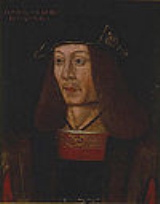
James IV of Scotland

Encyclopedia
James IV was King of Scots from 11 June 1488 to his death. He is generally regarded as the most successful of the Stewart
monarchs of Scotland, but his reign ended with the disastrous defeat at the Battle of Flodden Field
, where he became the last monarch from not only Scotland
, but also from all of Great Britain
, to be killed in battle.
and Margaret of Denmark, probably born in Stirling Castle
. In 1474, his father arranged his betrothal to Princess Cecily of England
. As heir apparent
to the Scottish crown, he became Duke of Rothesay
. His father was not a popular king and faced two major rebellions during his reign. During the second rebellion, the rebels set up the 15-year-old James as their nominal leader. His father was killed fighting rebels at the Battle of Sauchieburn
on 11 June 1488, and James took the throne and was crowned at Scone
on 24 June. When he realised the indirect role which he had played in the death of his father, he decided to do penance for his sin. From that date on, he wore a heavy iron chain cilice
around his waist, next to the skin, each Lent
as penance, adding every year extra ounces.
under control in 1493. For a time, he supported Perkin Warbeck
, the pretender to the English throne, and carried out a brief invasion of England on his behalf in September 1496. Then, in August 1497, James laid siege to Norham Castle
, using his father's bombard
Mons Meg
.
James recognized nonetheless that peace between Scotland and England was in the interest of both countrie, and established good diplomatic relations with England, which was at that time emerging from a period of civil war. First he ratified the Treaty of Ayton in February 1498. Then, in 1502 James signed the Treaty of Perpetual Peace with Henry VII
. He also saw the importance in building a fleet that could provide Scotland with a strong maritime presence. James founded two new dockyards for the purpose and acquired a total of 38 ships for the Royal Scottish Navy, including the Margaret
, and the carrack
Michael
or Great Michael. The latter, built at great expense at Newhaven
and launched in 1511, was 240 feet (73 m) in length, weighed 1,000 tons and was, at that time, the largest ship in Europe.
prince with an interest in practical and scientific matters. He granted the Edinburgh College of Surgeons
a royal charter in 1506, turned Edinburgh Castle
into one of Scotland's foremost gun foundries, and welcomed the establishment of Scotland's first printing press
in 1507. He built a part of Falkland Palace
, Great Halls at Stirling
and Edinburgh castles
, and furnished his palaces with tapestries
. James was a patron of the arts, including many literary figures, most notably the Scots makars whose diverse and socially observant works convey a vibrant and memorable picture of cultural life and intellectual concerns in the period. Figures associated with his court include William Dunbar
, Walter Kennedy
and Gavin Douglas
, who made the first complete translation of Virgil's Aeneid
in northern Europe. His reign also saw the passing of the makar Robert Henryson
.
James was well educated and a fluent polyglot. In July 1498 the Spanish envoy Pedro de Ayala
reported to Ferdinand
and Isabella
that;
James IV was the last King of Scots known to have spoken Scottish Gaelic. James is one of the rulers reported to have conducted a language deprivation experiment
, sending two children to be raised by a mute
woman alone on the island of Inchkeith
, to determine if language was learned or innate. At Stirling Castle, James maintained an alchemical workshop with a furnace of the quintessence. The project consumed quantities of quick-silver, golden litharge
, and tin. It was said that one of his alchemists Father Damian
attempted to fly from Stirling Castle.
, Lord of the Isles
, was forfeited by the Parliament of Scotland
. King James himself sailed to Dunstaffnage Castle
, where the western chiefs made their submission to him. John surrendered and was brought back as a pensioner to the royal court, then lived at Paisley Abbey
. The Highlands and Islands
now fell to direct royal control. John's grandson Domhnall Dubh
(Donald Owre), one of the possible claimants to the Lordship was peaceable, but the other, his nephew Alexander MacDonald of Lochalsh
invaded Ross and was later killed on the island of Oronsay
in 1497.
In October 1496 the Royal Council ordered that the Clan Chiefs in the region would be held responsible by the king for crimes of the islanders. This act for the governance of the region was unworkable, and after the Act of Revocation
of 1498 undermined the Chief's titles to their lands, resistance to Edinburgh rule was strengthened. James waited at Kilkerran Castle
at Campbeltown Loch
to re-grant the Chief's charters in the summer of 1498. Few of the Chiefs turned up. At first, Archibald Campbell, 2nd Earl of Argyll
, was set to fill the power vacuum and enforce royal authority, but he met with limited success in a struggle with his brother-in-law, Torquil MacLeod
of Lewis
. Torquil was ordered to hand over Donald Dubh
, heir to the lordship of the Isles, to James IV at Inverness in 1501. James waited, but Torquil never came.
After this defiance, Alexander Gordon, 3rd Earl of Huntly
, was granted Torquil's lands. He raised an army in Lochaber
and also cleared the tenants of that area, replacing them with his supporters. After the parliament of 1504, a royal fleet sailed north from Ayr to attack the Castle of Cairn-na-Burgh
, west of Mull, where, it is thought, Maclean of Duart
had Donald Dubh in his keeping. As progress at the siege was slow, James sent Hans the royal gunner in Robert Barton's
ship and then the Earl of Arran
with provisions and more artillery. Cairn-na-Burgh was captured by June 1504 but Donald Dubh remained at liberty. In September 1507, Torquil MacLeod was besieged at Stornoway
Castle on Lewis. Donald Dubh was captured and kept in prison for the rest of life, and Torquil MacLeod died in exile in 1511. The Earl of Huntly was richly rewarded for his troubles, a price that James was prepared to pay.
, James found himself in a difficult position as his obligations under the Auld Alliance
with France conflicted with the treaty made with England in 1502. The new king of England, Henry VIII
, attempted to invade France in 1513, and James reacted by declaring war on England. Pope Leo X
sent a letter to James threatening him with ecclesiatical censure for breaking peace treaties on 28 June 1513, and subsequently James was excommunicated by Cardinal Christopher Bainbridge
. James summoned sailors and sent the Scottish navy, including the Great Michael to join the ships of Louis XII of France
. Hoping to take advantage of Henry's absence at the siege of Thérouanne
, he led an invading army southward into Northumbria
, only to be killed, with many of his nobles and common soldiers, at the disastrous Battle of Flodden on 9 September 1513, ending Scotland's land-based involvement in the War of the League of Cambrai
.
A body, thought to be his, was recovered from the battlefield and taken to London for burial. James had been excommunicated, and although Henry VIII had obtained a breve
from the Pope on 29 November 1513 to have the King buried in consecrated ground at St. Pauls, the embalmed body lay unburied for many years at Sheen Priory
in Surrey
. The body was lost after the Reformation
. John Stow
claimed to have seen it, and said the king's head (with red hair) was removed by a glazier
and eventually buried at St Michael Wood Street
. James's bloodstained coat was sent to Henry VIII (then on campaign in France) by his queen, Catherine of Aragon
.
Erasmus provided an epitaph for the King in his Adagia
. Later, in 1533, he wrote to James V of Scotland
pointing out this essay on duty under the adage Spartam nactus es, (You who were born to Sparta shall serve her), on the subject of the Flodden campaign and the death of James and his son, Alexander
.
or supernatural riders swept across the field snatching up the King's body as such a prize could not be allowed to fall into English hands after such a humiliating defeat, or that the King left the field alive and was killed soom after. In the 18th century when the medieval well of Hume Castle
was being cleared the skeleton of a man with a chain round his waist was discovered in a side cave. Unfortunately this skeleton has since disappeared. Another version of this tale has the skeleton discovered at Hume a few years after the battle and re-interred at Holyrood Abbey. Exactly the same story was told for Roxburgh Castle
, the skeleton there discovered in the 17th century. Yet another tradition is the discovery of the royal body at Berry Moss, near Kelso. Fuelling these legends, Robert Lindsay of Pitscottie writing in the 1570s claimed that a convicted criminal offered to show Regent Albany
the King's grave ten years after the battle, but Albany refused.
In a ceremony at the altar of Glasgow Cathedral
on 10 December 1502, James confirmed the Treaty of Perpetual Peace
with Henry VII of England
. By this treaty James married Henry's daughter Margaret Tudor
. After a wedding by proxy in London, the marriage was confirmed in person on 8 August 1503 at Holyrood Abbey
, Edinburgh
.
The union produced four children plus two stillbirths:
House of Stuart
The House of Stuart is a European royal house. Founded by Robert II of Scotland, the Stewarts first became monarchs of the Kingdom of Scotland during the late 14th century, and subsequently held the position of the Kings of Great Britain and Ireland...
monarchs of Scotland, but his reign ended with the disastrous defeat at the Battle of Flodden Field
Battle of Flodden Field
The Battle of Flodden or Flodden Field or occasionally Battle of Branxton was fought in the county of Northumberland in northern England on 9 September 1513, between an invading Scots army under King James IV and an English army commanded by the Earl of Surrey...
, where he became the last monarch from not only Scotland
Scotland
Scotland is a country that is part of the United Kingdom. Occupying the northern third of the island of Great Britain, it shares a border with England to the south and is bounded by the North Sea to the east, the Atlantic Ocean to the north and west, and the North Channel and Irish Sea to the...
, but also from all of Great Britain
Great Britain
Great Britain or Britain is an island situated to the northwest of Continental Europe. It is the ninth largest island in the world, and the largest European island, as well as the largest of the British Isles...
, to be killed in battle.
Early life
James IV was the son of James IIIJames III of Scotland
James III was King of Scots from 1460 to 1488. James was an unpopular and ineffective monarch owing to an unwillingness to administer justice fairly, a policy of pursuing alliance with the Kingdom of England, and a disastrous relationship with nearly all his extended family.His reputation as the...
and Margaret of Denmark, probably born in Stirling Castle
Stirling Castle
Stirling Castle, located in Stirling, is one of the largest and most important castles, both historically and architecturally, in Scotland. The castle sits atop Castle Hill, an intrusive crag, which forms part of the Stirling Sill geological formation. It is surrounded on three sides by steep...
. In 1474, his father arranged his betrothal to Princess Cecily of England
Cecily of York
Cecily of York, Viscountess Welles was an English Princess and the third, but eventual second surviving, daughter of Edward IV, King of England and his queen consort, née Lady Elizabeth Woodville, daughter of Richard Woodville, 1st Earl Rivers.-Birth and Family:Cecily was born in Westminster Palace...
. As heir apparent
Heir apparent
An heir apparent or heiress apparent is a person who is first in line of succession and cannot be displaced from inheriting, except by a change in the rules of succession....
to the Scottish crown, he became Duke of Rothesay
Duke of Rothesay
Duke of Rothesay was a title of the heir apparent to the throne of the Kingdom of Scotland before 1707, of the Kingdom of Great Britain from 1707 to 1801, and now of the United Kingdom of Great Britain and Northern Ireland....
. His father was not a popular king and faced two major rebellions during his reign. During the second rebellion, the rebels set up the 15-year-old James as their nominal leader. His father was killed fighting rebels at the Battle of Sauchieburn
Battle of Sauchieburn
The Battle of Sauchieburn was fought on June 11, 1488, at the side of Sauchie Burn, a stream about two miles south of Stirling, Scotland. The battle was fought between as many as 30,000 troops of King James III of Scotland and some 18,000 troops raised by a group of dissident Scottish nobles...
on 11 June 1488, and James took the throne and was crowned at Scone
Scone, Scotland
Scone is a village in Perth and Kinross, Scotland. The medieval village of Scone, which grew up around the monastery and royal residence, was abandoned in the early 19th century when the residents were removed and a new palace was built on the site by the Earl of Mansfield...
on 24 June. When he realised the indirect role which he had played in the death of his father, he decided to do penance for his sin. From that date on, he wore a heavy iron chain cilice
Cilice
A cilice was originally a garment or undergarment made of coarse cloth or animal hair used in some religious traditions to induce some degree of discomfort or pain as a sign of repentance and atonement...
around his waist, next to the skin, each Lent
Lent
In the Christian tradition, Lent is the period of the liturgical year from Ash Wednesday to Easter. The traditional purpose of Lent is the preparation of the believer – through prayer, repentance, almsgiving and self-denial – for the annual commemoration during Holy Week of the Death and...
as penance, adding every year extra ounces.
Politics
James IV quickly proved to be an effective ruler. He defeated another rebellion in 1489, took a direct interest in the administration of justice and finally brought the Lord of the IslesLord of the Isles
The designation Lord of the Isles is today a title of Scottish nobility with historical roots that go back beyond the Kingdom of Scotland. It emerged from a series of hybrid Viking/Gaelic rulers of the west coast and islands of Scotland in the Middle Ages, who wielded sea-power with fleets of...
under control in 1493. For a time, he supported Perkin Warbeck
Perkin Warbeck
Perkin Warbeck was a pretender to the English throne during the reign of King Henry VII of England. By claiming to be Richard of Shrewsbury, Duke of York, the younger son of King Edward IV, one of the Princes in the Tower, Warbeck was a significant threat to the newly established Tudor Dynasty,...
, the pretender to the English throne, and carried out a brief invasion of England on his behalf in September 1496. Then, in August 1497, James laid siege to Norham Castle
Norham Castle
Norham Castle is a partly ruined castle in Northumberland, England, overlooking the River Tweed, on the border between England and Scotland. It is a Grade I listed building and a Scheduled Ancient Monument...
, using his father's bombard
Bombard
Bombard may refer to:*The act of carrying out a bombardment*Bombard , a type of late medieval siege weapon.*Bombard , a contemporary double reed instrument used to play traditional Breton music....
Mons Meg
Mons Meg
Mons Meg is a medieval bombard which can be classed as a supergun, now located at Edinburgh Castle, Scotland. There are conflicting theories about its origins, but it appears from the accounts of Philip the Good, Duke of Burgundy that it was made to his order around 1449 and sent as a gift 8 years...
.
James recognized nonetheless that peace between Scotland and England was in the interest of both countrie, and established good diplomatic relations with England, which was at that time emerging from a period of civil war. First he ratified the Treaty of Ayton in February 1498. Then, in 1502 James signed the Treaty of Perpetual Peace with Henry VII
Henry VII of England
Henry VII was King of England and Lord of Ireland from his seizing the crown on 22 August 1485 until his death on 21 April 1509, as the first monarch of the House of Tudor....
. He also saw the importance in building a fleet that could provide Scotland with a strong maritime presence. James founded two new dockyards for the purpose and acquired a total of 38 ships for the Royal Scottish Navy, including the Margaret
Scottish warship Margaret
The Margaret was a Scottish warship of the 16th century.She was built at Leith around 1505 by order of King James IV of Scotland, as part of his policy of building a strong Scottish navy. He named it after his new wife, Margaret Tudor...
, and the carrack
Carrack
A carrack or nau was a three- or four-masted sailing ship developed in 15th century Western Europe for use in the Atlantic Ocean. It had a high rounded stern with large aftcastle, forecastle and bowsprit at the stem. It was first used by the Portuguese , and later by the Spanish, to explore and...
Michael
Michael (ship)
Michael was a carrack or great ship of the Royal Scottish Navy. She was too large to be built at any existing Scottish dockyard, so was built at the new dock at Newhaven, constructed in 1504 by order of King James IV of Scotland...
or Great Michael. The latter, built at great expense at Newhaven
Newhaven, Edinburgh
Newhaven is a district in the City of Edinburgh, Scotland, between Leith and Granton. Formerly a village and harbour on the Firth of Forth, it currently has approximately 5,000 inhabitants....
and launched in 1511, was 240 feet (73 m) in length, weighed 1,000 tons and was, at that time, the largest ship in Europe.
Culture
James was a true RenaissanceRenaissance
The Renaissance was a cultural movement that spanned roughly the 14th to the 17th century, beginning in Italy in the Late Middle Ages and later spreading to the rest of Europe. The term is also used more loosely to refer to the historical era, but since the changes of the Renaissance were not...
prince with an interest in practical and scientific matters. He granted the Edinburgh College of Surgeons
Royal College of Surgeons of Edinburgh
The Royal College of Surgeons of Edinburgh is an organisation dedicated to the pursuit of excellence and advancement in surgical practice, through its interest in education, training and examinations, its liaison with external medical bodies and representation of the modern surgical workforce...
a royal charter in 1506, turned Edinburgh Castle
Edinburgh Castle
Edinburgh Castle is a fortress which dominates the skyline of the city of Edinburgh, Scotland, from its position atop the volcanic Castle Rock. Human habitation of the site is dated back as far as the 9th century BC, although the nature of early settlement is unclear...
into one of Scotland's foremost gun foundries, and welcomed the establishment of Scotland's first printing press
Printing press
A printing press is a device for applying pressure to an inked surface resting upon a print medium , thereby transferring the ink...
in 1507. He built a part of Falkland Palace
Falkland Palace
Falkland Palace in Falkland, Fife, Scotland, is a former royal palace of the Scottish Kings. Today it is in the care of the National Trust for Scotland, and serves as a tourist attraction.-Early years:...
, Great Halls at Stirling
Stirling Castle
Stirling Castle, located in Stirling, is one of the largest and most important castles, both historically and architecturally, in Scotland. The castle sits atop Castle Hill, an intrusive crag, which forms part of the Stirling Sill geological formation. It is surrounded on three sides by steep...
and Edinburgh castles
Edinburgh Castle
Edinburgh Castle is a fortress which dominates the skyline of the city of Edinburgh, Scotland, from its position atop the volcanic Castle Rock. Human habitation of the site is dated back as far as the 9th century BC, although the nature of early settlement is unclear...
, and furnished his palaces with tapestries
Scottish Royal tapestry collection
The Scottish royal tapestry collection was a group of tapestry hangings assembled to decorate the palaces of sixteenth century kings and queens of Scotland....
. James was a patron of the arts, including many literary figures, most notably the Scots makars whose diverse and socially observant works convey a vibrant and memorable picture of cultural life and intellectual concerns in the period. Figures associated with his court include William Dunbar
William Dunbar
William Dunbar was a Scottish poet. He was probably a native of East Lothian, as assumed from a satirical reference in the Flyting of Dunbar and Kennedie , where, too, it is hinted that he was a member of the noble house of Dunbar....
, Walter Kennedy
Walter Kennedy
Walter Kennedy was a Scottish makar associated with the renaissance court of James IV. He is perhaps best known as the defendant against William Dunbar in The Flyting of Dumbar and Kennedie, but his surviving works clearly show him to have been an accomplished "master" in many genres...
and Gavin Douglas
Gavin Douglas
Gavin Douglas was a Scottish bishop, makar and translator. Although he had an important political career, it is for his poetry that he is now chiefly remembered. His principal pioneering achievement was the Eneados, a full and faithful vernacular translation of the Aeneid of Virgil and the first...
, who made the first complete translation of Virgil's Aeneid
Aeneid
The Aeneid is a Latin epic poem, written by Virgil between 29 and 19 BC, that tells the legendary story of Aeneas, a Trojan who travelled to Italy, where he became the ancestor of the Romans. It is composed of roughly 10,000 lines in dactylic hexameter...
in northern Europe. His reign also saw the passing of the makar Robert Henryson
Robert Henryson
Robert Henryson was a poet who flourished in Scotland in the period c. 1460–1500. Counted among the Scots makars, he lived in the royal burgh of Dunfermline and is a distinctive voice in the Northern Renaissance at a time when the culture was on a cusp between medieval and renaissance sensibilities...
.
James was well educated and a fluent polyglot. In July 1498 the Spanish envoy Pedro de Ayala
Pedro de Ayala
Don Pedro de Ayala was a 16th-century Spanish diplomat employed by Ferdinand II of Aragon and Isabella I of Castile at the courts of James IV of Scotland and Henry VII of England. His mission to Scotland was concerned with the King's marriage and the international crisis caused by the pretender...
reported to Ferdinand
Ferdinand II of Aragon
Ferdinand the Catholic was King of Aragon , Sicily , Naples , Valencia, Sardinia, and Navarre, Count of Barcelona, jure uxoris King of Castile and then regent of that country also from 1508 to his death, in the name of...
and Isabella
Isabella I of Castile
Isabella I was Queen of Castile and León. She and her husband Ferdinand II of Aragon brought stability to both kingdoms that became the basis for the unification of Spain. Later the two laid the foundations for the political unification of Spain under their grandson, Charles V, Holy Roman Emperor...
that;
"the King is 25 years and some months old. He is of noble stature, neither tall nor short, and as handsome in complexion and shape as a man can be. His address is very agreeable. He speaks the following foreign languages ; Latin, very well ; French, German, Flemish, Italian, and Spanish ; Spanish as well as the Marquis, but he pronounces it more distinctly. He likes, very much, to receive Spanish letters. His own Scots languageScots languageScots is the Germanic language variety spoken in Lowland Scotland and parts of Ulster . It is sometimes called Lowland Scots to distinguish it from Scottish Gaelic, the Celtic language variety spoken in most of the western Highlands and in the Hebrides.Since there are no universally accepted...
is as different from English as Aragonese from Castilian. The King speaks, besides, the language of the savages who live in some parts of Scotland and on the islandsGàidhealtachdThe Gàidhealtachd , sometimes known as A' Ghàidhealtachd , usually refers to the Scottish highlands and islands, and especially the Scottish Gaelic culture of the area. The corresponding Irish word Gaeltacht however refers strictly to an Irish speaking area...
. It is as different from Scots as Biscayan is from CastilianCastilian SpanishCastilian Spanish is a term related to the Spanish language, but its exact meaning can vary even in that language. In English Castilian Spanish usually refers to the variety of European Spanish spoken in north and central Spain or as the language standard for radio and TV speakers...
. His knowledge of languages is wonderful. He is well read in the Bible and in some other devout books. He is a good historian. He has read many Latin and French histories, and profited by them, as he has a very good memory. He never cuts his hair or his beard. It becomes him very well."
James IV was the last King of Scots known to have spoken Scottish Gaelic. James is one of the rulers reported to have conducted a language deprivation experiment
Language deprivation experiments
Language deprivation experiments have been attempted several times through history, isolating infants from the normal use of spoken or signed language in an attempt to discover the fundamental character of human nature or the origin of language....
, sending two children to be raised by a mute
Muteness
Muteness or mutism is an inability to speak caused by a speech disorder. The term originates from the Latin word mutus, meaning "silent".-Causes:...
woman alone on the island of Inchkeith
Inchkeith
Inchkeith is an island in the Firth of Forth, Scotland. It is part of the council area of Fife.Inchkeith has had a colourful history as a result of its proximity to Edinburgh and strategic location for use as home for a lighthouse and for military purposes defending the Firth of Forth for attack...
, to determine if language was learned or innate. At Stirling Castle, James maintained an alchemical workshop with a furnace of the quintessence. The project consumed quantities of quick-silver, golden litharge
Massicot
Massicot is one of the natural mineral forms of lead oxide, PbO. Massicot is the orthorhombic dimorph of the tetragonal form of lead oxide, litharge. It forms soft yellow to reddish-yellow, earthy, scaley masses which are very dense, with a specific gravity of 9.64.It was first described in 1841...
, and tin. It was said that one of his alchemists Father Damian
John Damian
John Damian was an Italian clergyman at the court of James IV of Scotland. His attempts at medicine, alchemy, flying, and his advancement by the King encouraged a satirical attack by the poet William Dunbar....
attempted to fly from Stirling Castle.
Policy in the Highlands and Isles
In May 1493 John MacDonaldJohn of Islay, Earl of Ross
John of Islay was a late medieval Scottish magnate. He was Earl of Ross and last Lord of the Isles as well as being Mac Domhnaill, chief of Clan Donald....
, Lord of the Isles
Lord of the Isles
The designation Lord of the Isles is today a title of Scottish nobility with historical roots that go back beyond the Kingdom of Scotland. It emerged from a series of hybrid Viking/Gaelic rulers of the west coast and islands of Scotland in the Middle Ages, who wielded sea-power with fleets of...
, was forfeited by the Parliament of Scotland
Parliament of Scotland
The Parliament of Scotland, officially the Estates of Parliament, was the legislature of the Kingdom of Scotland. The unicameral parliament of Scotland is first found on record during the early 13th century, with the first meeting for which a primary source survives at...
. King James himself sailed to Dunstaffnage Castle
Dunstaffnage Castle
Dunstaffnage Castle is a partially ruined castle in Argyll and Bute, western Scotland. It lies N.N.E. of Oban, situated on a platform of conglomerate rock on a promontory at the south-west of the entrance to Loch Etive, and is surrounded on three sides by the sea.The castle dates back to the 13th...
, where the western chiefs made their submission to him. John surrendered and was brought back as a pensioner to the royal court, then lived at Paisley Abbey
Paisley Abbey
Paisley Abbey is a former Cluniac monastery, and current Church of Scotland parish kirk, located on the east bank of the White Cart Water in the centre of the town of Paisley, Renfrewshire, in west central Scotland.-History:...
. The Highlands and Islands
Highlands and Islands (Scottish Parliament electoral region)
The Highlands and Islands is one of the eight electoral regions of the Scottish Parliament which were created in 1999. Eight of the parliament's first past the post constituencies are sub-divisions of the region and it elects seven of the 56 additional-member Members of the Scottish Parliament .The...
now fell to direct royal control. John's grandson Domhnall Dubh
Domhnall Dubh
Domhnall Dubh was a Scottish nobleman. He was the son of Aonghas Óg, chief of Clan Donald , and claimant to the Lordship of the Isles, which had been held by his grandfather John of Islay, Earl of Ross ....
(Donald Owre), one of the possible claimants to the Lordship was peaceable, but the other, his nephew Alexander MacDonald of Lochalsh
Clan MacDonald of Lochalsh
-History:The MacDonald of Lochalsh branch was founded by Celestine MacDonald . Celestine MacDonald was the second son of Alexander of Islay, Earl of Ross, 3rd Lord of the Isles and 8th chief of Clan Donald...
invaded Ross and was later killed on the island of Oronsay
Oronsay
This is a list of islands called Oronsay , which provides an index for islands in Scotland with this and similar names. It is one of the more common names for Scottish islands. The names come from Örfirisey which translates from Old Norse as "tidal" or "ebb island"...
in 1497.
In October 1496 the Royal Council ordered that the Clan Chiefs in the region would be held responsible by the king for crimes of the islanders. This act for the governance of the region was unworkable, and after the Act of Revocation
Revocation
Revocation is the act of recall or annulment. It is the reversal of an act, the recalling of a grant, or the making void of some deed previously existing.-Contract law:...
of 1498 undermined the Chief's titles to their lands, resistance to Edinburgh rule was strengthened. James waited at Kilkerran Castle
Kilkerran Castle
Kilkerran Castle is a ruined castle, near Campbeltown, Kintyre, Argyll and Bute, Scotland.-History:A keep was built in 1490 by King James IV, for the housing of a garrison to subdue the MacDonalds....
at Campbeltown Loch
Campbeltown Loch
Campbeltown Loch is a small sea loch near the south of the Kintyre Peninsula facing eastwards towards the Firth of Clyde. The town of Campbeltown, from which it takes its name, is located at its head. The island of Davaar is located in the loch, and can be reach by foot along a natural shingle...
to re-grant the Chief's charters in the summer of 1498. Few of the Chiefs turned up. At first, Archibald Campbell, 2nd Earl of Argyll
Archibald Campbell, 2nd Earl of Argyll
Gillespie Archibald Campbell, 2nd Earl of Argyll was a Scottish nobleman and politician.-Biography:Archibald was the eldest son of Colin Campbell, 1st Earl of Argyll and Isabel Stewart, daughter of John Stewart, 2nd Lord Lorn. He was made Master of the Royal Household of James IV of Scotland on 24...
, was set to fill the power vacuum and enforce royal authority, but he met with limited success in a struggle with his brother-in-law, Torquil MacLeod
Torquil MacLeod (forfeited clan chief)
Torquil MacLeod was the chief of Clan MacLeod of Lewis in around 1500. He died before 1510. He was born in about 1460, and mentioned in 1498, and in 1506....
of Lewis
Lewis
Lewis is the northern part of Lewis and Harris, the largest island of the Western Isles or Outer Hebrides of Scotland. The total area of Lewis is ....
. Torquil was ordered to hand over Donald Dubh
Domhnall Dubh
Domhnall Dubh was a Scottish nobleman. He was the son of Aonghas Óg, chief of Clan Donald , and claimant to the Lordship of the Isles, which had been held by his grandfather John of Islay, Earl of Ross ....
, heir to the lordship of the Isles, to James IV at Inverness in 1501. James waited, but Torquil never came.
After this defiance, Alexander Gordon, 3rd Earl of Huntly
Alexander Gordon, 3rd Earl of Huntly
Alexander Gordon, 3rd Earl of Huntly was a Scottish nobleman and the 3rd Earl of Huntly. He was granted Strathavon in Banffshire and the Brae of Lochaber. He was a member of the Privy Council of Scotland.-Biography:...
, was granted Torquil's lands. He raised an army in Lochaber
Lochaber
District of Lochaber 1975 to 1996Highland council area shown as one of the council areas of ScotlandLochaber is one of the 16 ward management areas of the Highland Council of Scotland and one of eight former local government districts of the two-tier Highland region...
and also cleared the tenants of that area, replacing them with his supporters. After the parliament of 1504, a royal fleet sailed north from Ayr to attack the Castle of Cairn-na-Burgh
Cairnburgh Castle
Cairnburgh Castle is a ruined castle that is located on the islands of Cairn na Burgh Mòr and Cairn na Burgh Beag, Argyll and Bute, Scotland. These islands are at the northern extremity of the Treshnish Isles at the mouth of Loch Tuath, Mull north of Iona...
, west of Mull, where, it is thought, Maclean of Duart
Maclean of Duart
The Macleans of Duart or Maclean of Dowart are the main sept of the Scottish clan Clan Maclean, whose chief has his seat at Duart Castle, Isle of Mull.-History:Lachlan Lubanach Maclean was the first Maclean to occupy Duart Castle....
had Donald Dubh in his keeping. As progress at the siege was slow, James sent Hans the royal gunner in Robert Barton's
Robert Barton of Over Barnton
Robert Barton of Over Barnton was a Scottish sailor and Lord High Treasurer to James V of Scotland.-Sailor and shipowner:Robert Barton was a son of John Barton the sailor. He took Perkin Warbeck away from Scotland in the Cuckoo in July 1497...
ship and then the Earl of Arran
James Hamilton, 1st Earl of Arran
James Hamilton, 1st Earl of Arran and 2nd Lord Hamilton was a Scottish nobleman and first cousin of James IV of Scotland.-Biography:...
with provisions and more artillery. Cairn-na-Burgh was captured by June 1504 but Donald Dubh remained at liberty. In September 1507, Torquil MacLeod was besieged at Stornoway
Stornoway
Stornoway is a burgh on the Isle of Lewis, in the Outer Hebrides of Scotland.The town's population is around 9,000, making it the largest settlement in the Western Isles and the third largest town in the Scottish Highlands after Inverness and Fort William...
Castle on Lewis. Donald Dubh was captured and kept in prison for the rest of life, and Torquil MacLeod died in exile in 1511. The Earl of Huntly was richly rewarded for his troubles, a price that James was prepared to pay.
War and death
When war broke out between England and France as a result of the Italian WarsItalian Wars
The Italian Wars, often referred to as the Great Italian Wars or the Great Wars of Italy and sometimes as the Habsburg–Valois Wars, were a series of conflicts from 1494 to 1559 that involved, at various times, most of the city-states of Italy, the Papal States, most of the major states of Western...
, James found himself in a difficult position as his obligations under the Auld Alliance
Auld Alliance
The Auld Alliance was an alliance between the kingdoms of Scotland and France. It played a significant role in the relations between Scotland, France and England from its beginning in 1295 until the 1560 Treaty of Edinburgh. The alliance was renewed by all the French and Scottish monarchs of that...
with France conflicted with the treaty made with England in 1502. The new king of England, Henry VIII
Henry VIII of England
Henry VIII was King of England from 21 April 1509 until his death. He was Lord, and later King, of Ireland, as well as continuing the nominal claim by the English monarchs to the Kingdom of France...
, attempted to invade France in 1513, and James reacted by declaring war on England. Pope Leo X
Pope Leo X
Pope Leo X , born Giovanni di Lorenzo de' Medici, was the Pope from 1513 to his death in 1521. He was the last non-priest to be elected Pope. He is known for granting indulgences for those who donated to reconstruct St. Peter's Basilica and his challenging of Martin Luther's 95 Theses...
sent a letter to James threatening him with ecclesiatical censure for breaking peace treaties on 28 June 1513, and subsequently James was excommunicated by Cardinal Christopher Bainbridge
Christopher Bainbridge
Christopher Bainbridge was an English Cardinal of the Roman Catholic Church. He served as Archbishop of York from 1508 until his death.-Early life:...
. James summoned sailors and sent the Scottish navy, including the Great Michael to join the ships of Louis XII of France
Louis XII of France
Louis proved to be a popular king. At the end of his reign the crown deficit was no greater than it had been when he succeeded Charles VIII in 1498, despite several expensive military campaigns in Italy. His fiscal reforms of 1504 and 1508 tightened and improved procedures for the collection of taxes...
. Hoping to take advantage of Henry's absence at the siege of Thérouanne
Thérouanne
Thérouanne is a commune in the Pas-de-Calais department in the Nord-Pas-de-Calais region of France.-Geography:Thérouanne is located 10 miles southwest of Saint-Omer, on the D157 and D341 road junction.-Population:-History:...
, he led an invading army southward into Northumbria
Northumbria
Northumbria was a medieval kingdom of the Angles, in what is now Northern England and South-East Scotland, becoming subsequently an earldom in a united Anglo-Saxon kingdom of England. The name reflects the approximate southern limit to the kingdom's territory, the Humber Estuary.Northumbria was...
, only to be killed, with many of his nobles and common soldiers, at the disastrous Battle of Flodden on 9 September 1513, ending Scotland's land-based involvement in the War of the League of Cambrai
War of the League of Cambrai
The War of the League of Cambrai, sometimes known as the War of the Holy League and by several other names, was a major conflict in the Italian Wars...
.
A body, thought to be his, was recovered from the battlefield and taken to London for burial. James had been excommunicated, and although Henry VIII had obtained a breve
Brief (law)
A brief is a written legal document used in various legal adversarial systems that is presented to a court arguing why the party to the case should prevail....
from the Pope on 29 November 1513 to have the King buried in consecrated ground at St. Pauls, the embalmed body lay unburied for many years at Sheen Priory
Sheen Priory
Sheen Priory in Sheen, now Richmond, London was a former Carthusian monastery founded in 1414 within the royal manor of Sheen, on the south bank of the Thames, upstream and approximately 9 miles southwest of the Palace of Westminster...
in Surrey
Surrey
Surrey is a county in the South East of England and is one of the Home Counties. The county borders Greater London, Kent, East Sussex, West Sussex, Hampshire and Berkshire. The historic county town is Guildford. Surrey County Council sits at Kingston upon Thames, although this has been part of...
. The body was lost after the Reformation
English Reformation
The English Reformation was the series of events in 16th-century England by which the Church of England broke away from the authority of the Pope and the Roman Catholic Church....
. John Stow
John Stow
John Stow was an English historian and antiquarian.-Early life:The son of Thomas Stow, a tallow-chandler, he was born about 1525 in London, in the parish of St Michael, Cornhill. His father's whole rent for his house and garden was only 6s. 6d. a year, and Stow in his youth fetched milk every...
claimed to have seen it, and said the king's head (with red hair) was removed by a glazier
Glazier
A Glazier is a construction professional who selects, cuts, installs, replaces, and removes residential, commercial, and artistic glass. Glaziers also install aluminum storefront frames and entrances, glass handrails and balustrades, shower enclosures, curtain wall framing and glass and mirror...
and eventually buried at St Michael Wood Street
St Michael Wood Street
Described by Stow as a “proper thing” St Michael’s Wood Street in Cripplegate Ward was the hurried burial site for the head of King James IV of Scotland...
. James's bloodstained coat was sent to Henry VIII (then on campaign in France) by his queen, Catherine of Aragon
Catherine of Aragon
Catherine of Aragon , also known as Katherine or Katharine, was Queen consort of England as the first wife of King Henry VIII of England and Princess of Wales as the wife to Arthur, Prince of Wales...
.
Erasmus provided an epitaph for the King in his Adagia
Adagia
Adagia is an annotated collection of Greek and Latin proverbs, compiled during the Renaissance by Dutch humanist Desiderius Erasmus Roterodamus. Erasmus' collection of proverbs is "one of the most monumental ... ever assembled" Adagia (adagium is the singular form and adagia is the plural) is an...
. Later, in 1533, he wrote to James V of Scotland
James V of Scotland
James V was King of Scots from 9 September 1513 until his death, which followed the Scottish defeat at the Battle of Solway Moss...
pointing out this essay on duty under the adage Spartam nactus es, (You who were born to Sparta shall serve her), on the subject of the Flodden campaign and the death of James and his son, Alexander
Alexander Stewart (Archbishop of St Andrews)
Alexander Stewart was an illegitimate son of King James IV of Scotland and his mistress Marion Boyd. He was the eldest illegitimate child of King James IV of Scotland his mistress Marion Boyd...
.
Legends of the King's resting place
However rumours persisted for many years that James had survived and had gone into exile, or his body was buried in Scotland, with no evidence to support them. Two castles in the Scottish Borders are claimed to be the real resting place of James. These stories follow the legend that, prior to the Scots charge at Flodden, James had ripped off his royal surcoat to show his nobles that he was prepared to fight as an ordinary man at arms. The body recovered by the English did not have the iron chain round its waist. (So some historians claimed he removed his chain while dallying in Lady Heron's bedroom.) However, Border legend claimed that during the battle of Flodden four Home horsemenClan Home
The Homes are a Scottish family. They were a powerful force in medieval Lothian and the Borders. The chief of the name is David Douglas-Home, 15th Earl of Home.-Origins of the clan:...
or supernatural riders swept across the field snatching up the King's body as such a prize could not be allowed to fall into English hands after such a humiliating defeat, or that the King left the field alive and was killed soom after. In the 18th century when the medieval well of Hume Castle
Hume Castle
Hume Castle is the heavily modified remnants of a late 12th or early 13th century "Castle of enceinte".The village of Hume is located between Greenlaw and Kelso, two miles north of the village of Stichill, in Berwickshire, Scotland....
was being cleared the skeleton of a man with a chain round his waist was discovered in a side cave. Unfortunately this skeleton has since disappeared. Another version of this tale has the skeleton discovered at Hume a few years after the battle and re-interred at Holyrood Abbey. Exactly the same story was told for Roxburgh Castle
Roxburgh Castle
Roxburgh Castle was a castle sited near Kelso, in the Borders region of Scotland, in the former Roxburghshire.-History:The castle was founded by King David I. In 1174 it was surrendered to England after the capture of William I at Alnwick, and was often in English hands thereafter. The Scots made...
, the skeleton there discovered in the 17th century. Yet another tradition is the discovery of the royal body at Berry Moss, near Kelso. Fuelling these legends, Robert Lindsay of Pitscottie writing in the 1570s claimed that a convicted criminal offered to show Regent Albany
Regent Albany
Regent Albany can refer to several Dukes of Albany who served as regent of the Kingdom of Scotland:*Robert Stewart, Duke of Albany *Murdoch Stewart, Duke of Albany *John Stewart, 2nd Duke of Albany...
the King's grave ten years after the battle, but Albany refused.
Marriage
His early betrothal to Cecily of England came to nothing, but interest in an English marriage remained.In a ceremony at the altar of Glasgow Cathedral
Glasgow Cathedral
The church commonly known as Glasgow Cathedral is the Church of Scotland High Kirk of Glasgow otherwise known as St. Mungo's Cathedral.The other cathedrals in Glasgow are:* The Catholic Metropolitan Cathedral Church of Saint Andrew...
on 10 December 1502, James confirmed the Treaty of Perpetual Peace
Treaty of Perpetual Peace (1502)
The Treaty of Perpetual Peace was signed by James IV of Scotland and Henry VII of England in 1502. It agreed to end the intermittent warfare between Scotland and England which had been waged over the previous two hundred years and although it failed in this respect, as the hostility continued...
with Henry VII of England
Henry VII of England
Henry VII was King of England and Lord of Ireland from his seizing the crown on 22 August 1485 until his death on 21 April 1509, as the first monarch of the House of Tudor....
. By this treaty James married Henry's daughter Margaret Tudor
Margaret Tudor
Margaret Tudor was the elder of the two surviving daughters of Henry VII of England and Elizabeth of York, and the elder sister of Henry VIII. In 1503, she married James IV, King of Scots. James died in 1513, and their son became King James V. She married secondly Archibald Douglas, 6th Earl of...
. After a wedding by proxy in London, the marriage was confirmed in person on 8 August 1503 at Holyrood Abbey
Holyrood Abbey
Holyrood Abbey is a ruined abbey of the Canons Regular in Edinburgh, Scotland. The abbey was founded in 1128 by King David I of Scotland. During the 15th century, the abbey guesthouse was developed into a royal residence, and after the Scottish Reformation the Palace of Holyroodhouse was expanded...
, Edinburgh
Edinburgh
Edinburgh is the capital city of Scotland, the second largest city in Scotland, and the eighth most populous in the United Kingdom. The City of Edinburgh Council governs one of Scotland's 32 local government council areas. The council area includes urban Edinburgh and a rural area...
.
The union produced four children plus two stillbirths:
- James, Duke of Rothesay (21 February 1507, Holyrood PalaceHolyrood PalaceThe Palace of Holyroodhouse, commonly referred to as Holyrood Palace, is the official residence of the monarch in Scotland. The palace stands at the bottom of the Royal Mile in Edinburgh, at the opposite end to Edinburgh Castle...
– 27 February 1508, Stirling Castle) - A stillborn daughter at Holyrood Palace on 15 July 1508.
- Arthur, Duke of RothesayArthur Stewart, Duke of RothesayArthur Stewart, Duke of Rothesay was the second son of James IV of Scotland and Margaret Tudor, and had he outlived his father, James IV of Scotland would have been King of Scotland.-Birth:...
(20 October 1509, Holyrood Palace – Edinburgh Castle, 14 July 1510). - James VJames V of ScotlandJames V was King of Scots from 9 September 1513 until his death, which followed the Scottish defeat at the Battle of Solway Moss...
(Linlithgow Palace, 15 April 1512 – Falkland Palace, Fife, 14 December 1542), the only one to reach adulthood, and the successor of his father. - A second stillborn daughter at Holyrood Palace in November 1512.
- Alexander, Duke of RossAlexander Stewart, Duke of RossAlexander Stewart, Duke of Ross was the fourth and last son of King James IV of Scotland and his queen Margaret Tudor....
(Stirling Castle, 30 April 1514 – Stirling Castle, 18 December 1515), born after James's death.
Illegitimate children
James also had seven illegitimate children with four different mistresses:- with Marion BoydMarion Boyd (mistress)Marion Boyd , also known as Margot or Margaret, was a mistress of King James IV of Scotland.They had two children: Alexander, born about 1490, and Catherine, who married James Douglas, 3rd Earl of Morton....
:- AlexanderAlexander Stewart (Archbishop of St Andrews)Alexander Stewart was an illegitimate son of King James IV of Scotland and his mistress Marion Boyd. He was the eldest illegitimate child of King James IV of Scotland his mistress Marion Boyd...
(c.1493 – Battle of Flodden FieldBattle of Flodden FieldThe Battle of Flodden or Flodden Field or occasionally Battle of Branxton was fought in the county of Northumberland in northern England on 9 September 1513, between an invading Scots army under King James IV and an English army commanded by the Earl of Surrey...
, 9 September 1513), Archbishop of St AndrewsArchbishop of St AndrewsThe Bishop of St. Andrews was the ecclesiastical head of the Diocese of St Andrews and then, as Archbishop of St Andrews , the Archdiocese of St Andrews.The name St Andrews is not the town or church's original name...
. - Catherine Stewart(c. 1494 – 1554), who married James Douglas, 3rd Earl of MortonJames Douglas, 3rd Earl of MortonJames Douglas, 3rd Earl of Morton was a son of John Douglas, 2nd Earl of Morton and a grandson of James Douglas, 1st Earl of Morton and Joan of Scotland, a daughter of James I of Scotland. He married Catherine Stewart, an illegitimate daughter of King James IV of Scotland by his mistress Marion...
.
- Alexander
- with Margaret DrummondMargaret Drummond (Mistress)Margaret Drummond was a daughter of John Drummond, 1st Lord Drummond and a mistress of King James IV of Scotland. She was a great-great-great-great-niece of the Margaret Drummond who was King David II's second queen....
:- Margaret Stewart (born around 1497), married firstly John Gordon, Lord Gordon and secondly Sir John Drummond. Her son by Lord Gordon became George Gordon, 4th Earl of HuntlyGeorge Gordon, 4th Earl of HuntlyGeorge Gordon, 4th Earl of Huntly was a Scottish nobleman.-Biography:He was the son of John Gordon, Lord Gordon, and Margaret Stewart, daughter of James IV. George Gordon inherited his earldom and estates in 1524 at age 10...
- Margaret Stewart (born around 1497), married firstly John Gordon, Lord Gordon and secondly Sir John Drummond. Her son by Lord Gordon became George Gordon, 4th Earl of Huntly
- with Janet KennedyJanet KennedyJanet Kennedy , the first daughter of John Kennedy, 2nd Lord Kennedy, became a mistress of King James IV of Scotland.Through her father, she was a great-great-granddaughter of King Robert III...
:- JamesJames Stewart, 1st Earl of Moray (1501 creation)James Stewart, Earl of Moray was the illegitimate son of James IV of Scotland and his mistress Janet Kennedy. He was created Earl of Moray in 1501, and was young enough to avoid fighting at the disastrous Battle of Flodden Field in 1513. He went on to have a varied relationship with his...
(before 1499 – 1544), created Earl of MorayEarl of MorayThe title Earl of Moray has been created several times in the Peerage of Scotland.Prior to the formal establishment of the peerage, Earl of Moray, numerous individuals ruled the kingdom of Moray or Mormaer of Moray until 1130 when the kingdom was destroyed by David I of Scotland.-History of the...
. - two children who died in infancy.
- James
- with Isabel Stewart, daughter of James Stewart, 1st Earl of BuchanJames Stewart, 1st Earl of BuchanJames Stewart, 1st Earl of Buchan , was the second son of Sir James Stewart, the Black Knight of Lorne, and Joan Beaufort, the widow of James I of Scotland...
:- Lady Janet StewartLady Janet StewartJanet Stewart, Lady Fleming was an illegitimate daughter of James IV of Scotland and served as governess to her niece, Mary, Queen of Scots. Janet was briefly a mistress to Henry II of France, by whom she had an illegitimate son, Henri d'Angouleme...
(before 1510 – 20 February 1562).
- Lady Janet Stewart
Titles and styles
- 17 March 1473–11 June 1488: The Duke of Rothesay
- 11 June 1488–9 September 1513: His Grace The King
Fictional portrayals
James IV has been depicted in historical novels and short stories. They include:- The Yellow Frigate (1855) by James GrantJames Grant (author)James Grant was a Scottish author.Grant was born in Edinburgh, Scotland, and was a distant relation of Sir Walter Scott. He was a prolific author, writing some 90 books, including many yellow-backs...
, also known as The Three Sisters. The main events of the novel take place in the year 1488, covering the Battle of SauchieburnBattle of SauchieburnThe Battle of Sauchieburn was fought on June 11, 1488, at the side of Sauchie Burn, a stream about two miles south of Stirling, Scotland. The battle was fought between as many as 30,000 troops of King James III of Scotland and some 18,000 troops raised by a group of dissident Scottish nobles...
, the assassination of James III of ScotlandJames III of ScotlandJames III was King of Scots from 1460 to 1488. James was an unpopular and ineffective monarch owing to an unwillingness to administer justice fairly, a policy of pursuing alliance with the Kingdom of England, and a disastrous relationship with nearly all his extended family.His reputation as the...
, the rise to the throne of James IV, and the plots of the so-called English faction in Scotland. James IV, and Margaret DrummondMargaret Drummond (Mistress)Margaret Drummond was a daughter of John Drummond, 1st Lord Drummond and a mistress of King James IV of Scotland. She was a great-great-great-great-niece of the Margaret Drummond who was King David II's second queen....
are prominently depicted. Andrew Wood of LargoAndrew Wood of LargoSir Andrew Wood of Largo was a Scottish sea captain. Beginning as a merchant in Leith, he was involved in national naval actions and rose to become Lord High Admiral of Scotland. He was knighted c. 1495...
and Henry VII of EnglandHenry VII of EnglandHenry VII was King of England and Lord of Ireland from his seizing the crown on 22 August 1485 until his death on 21 April 1509, as the first monarch of the House of Tudor....
are secondary characters. - In the King's Favour (1899) by J. E. Preston Muddock. Covers the last few months of James IV's reign and ends with the Battle of Flodden (1513).
- The Arrow of the North (1906) by R. H. Forster. The novel mainly depicts NorthumberlandNorthumberlandNorthumberland is the northernmost ceremonial county and a unitary district in North East England. For Eurostat purposes Northumberland is a NUTS 3 region and is one of three boroughs or unitary districts that comprise the "Northumberland and Tyne and Wear" NUTS 2 region...
in the reigns of Henry VII and Henry VIII of EnglandHenry VIII of EnglandHenry VIII was King of England from 21 April 1509 until his death. He was Lord, and later King, of Ireland, as well as continuing the nominal claim by the English monarchs to the Kingdom of France...
. It covers the Flodden campaign of the Anglo-Scottish WarsAnglo-Scottish WarsThe Anglo-Scottish Wars were a series of wars fought between England and Scotland during the sixteenth century.After the Wars of Scottish Independence, England and Scotland had fought several times during the fourteenth, fifteenth and sixteenth centuries. In most cases, one country had attempted to...
and the finale depicts the battle which ended James IV's life. - The Crimson Field (1916) by Halliwell Sutcliffe. Also covers the Anglo-Scottish Wars. It features James IV and "ends with a full account of the Battle of Flodden" (1513).
- King Heart (1926) by Carola Oman. The story depicts Scotland in the time of James IV. The king himself is depicted in an epilogue featuring the Battle of Flodden (1513).
- Gentle Eagle (1937) by Christine Orr, fictional account of the king's life
- Chain of Destiny (1964) by Nigel TranterNigel TranterNigel Tranter OBE was a Scottish historian and author.-Early life:Nigel Tranter was born in Glasgow and educated at George Heriot's School in Edinburgh. He trained as an accountant and worked in Scottish National Insurance Company, founded by his uncle. In 1933 he married May Jean Campbell Grieve...
, fictional account of the king's life, from Sauchieburn to Flodden - Falcon (1972) by A J StewartAda F KayAda F Kay, also known as A.J. Stewart, is a British writer with a particularly complex personal history. She grew up in Lancashire but lived much of her adult life in Scotland.-Work:...
, an unusual work by an author claiming to be a reincarnation of the king