
See Also

Henry VIII of England

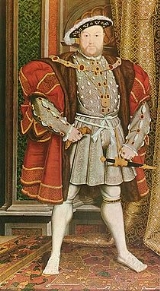
Henry VIII was King of England Kingdom of England

The Kingdom of England was a state [i] located in western Europe [i], in the southern part of the islan ... 

 and Lord of Ireland  from 22 April 1509 until his death. He was the second monarch of the Tudor dynasty Tudor dynasty

The Tuhdor dynasty or House of Tudor was a series of five monarchs of Welsh [i] origin who ... 

, succeeding his father, Henry VII Henry VII of England

Henry VII , King of England [i], Lord of Ireland [i] , was the fo ... 

. Henry VIII is famous for having been married six times Wives of Henry VIII

The six wives of Henry VIII of England [i] were, in order: Catherine of Aragon [i], Anne Boleyn [i], Jane Seymour [i] ... 

, "divorcing" two by execution Decapitation

Decapitation, or beheading, is the removal of a living organism's head [i]. ... 

, and ultimately breaking with Rome Roman Catholic Church

The Roman Catholic Church or Catholic Church is the Christian [i] Church [i] ... 

. He wielded perhaps the most untrammelled power of any English monarch, and brought about the Dissolution of the Monasteries Dissolution of the Monasteries

The Dissolution of the Monasteries, referred to by Roman Catholic [i] writers as the Suppression of t ... 

, and the union of England England

England is the largest and most populous constituent country [i] of the United Kingdom [i]. ... 

 and Wales Wales

Wales is one of four constituent parts [i] of the United Kingdom [i]. ... 

.

Discussions

  Discussion Features

   Ask a question about 'Henry VIII of England'

   Start a new discussion about 'Henry VIII of England'

   Answer questions about 'Henry VIII of England'

   'Henry VIII of England' discussion forum

Timeline

1491   Born

1505   Henry VIII of England repudiates his engagement to Catherine of Aragon Catherine of Aragon

Catherine of Aragon was queen consort [i] of England [i] as Henry VIII of England [i]'s first wife [i] ... 

, at his father's Henry VII of England

Henry VII , King of England [i], Lord of Ireland [i] , was the fo ... 

 command

1509   Henry VIII Henry VIII of England

Henry VIII was King of England [i] and Lord of Ireland [i] from ... 

 becomes King of England on the death of his father, Henry VII Henry VII of England

Henry VII , King of England [i], Lord of Ireland [i] , was the fo ... 

.

1509   Henry VIII of England marries Catherine of Aragon Catherine of Aragon

Catherine of Aragon was queen consort [i] of England [i] as Henry VIII of England [i]'s first wife [i] ... 

1509   King Henry VIII of England's and Queen consort's Catherine of Aragon Catherine of Aragon

Catherine of Aragon was queen consort [i] of England [i] as Henry VIII of England [i]'s first wife [i] ... 

 coronation ceremony.

1510   Henry VIII of England, then 18 years-old, appears incognito in the lists at Richmond, and is applauded for his jousting before he reveals himself.

1513   Battle of the Spurs (or Battle of Guinegate). English troops under Henry VIII Henry VIII of England

Henry VIII was King of England [i] and Lord of Ireland [i] from ... 

 defeat a French army under Marshal La Pali

1513   Capture of Thérouanne Thérouanne

Throuanne is a commune [i] of northern France [i]. ... 

 by Henry VIII of England.

1520   Field of Cloth of Gold Field of the Cloth of Gold

The Field of Cloth of Gold , or in French Le Camp de Drap d'Or, is the name given to a place in Balinghem [i] ... 

. Famous meeting between King Henry VIII of England and King Francis I of France Francis I of France

[i] in [[1515]... 

.

1525   Henry VIII of England creates his illegitimate son Henry Fitzroy Henry FitzRoy, 1st Duke of Richmond and Somerset

Henry FitzRoy [i], 1st Duke of Richmond and Somerset was the son of King Henry VIII [i] ... 

 Duke of Richmond Duke of Richmond

The title Duke of Richmond is named after Richmond [i] and its surrounding dis ... 

 and Somerset Duke of Somerset

The Duke of Somerset is a title in the peerage of England that has been created several times.... 

.

   More Events >>


Encyclopedia

  • For the play, see Henry VIII .
  • For the opera, see Henry VIII


Henry VIII was King of England Kingdom of England

The Kingdom of England was a state [i] located in western Europe [i], in the southern part of the islan ... 

 and Lord of Ireland  from 22 April 1509 until his death. He was the second monarch of the Tudor dynasty Tudor dynasty

The Tuhdor dynasty or House of Tudor was a series of five monarchs of Welsh [i] origin who ... 

, succeeding his father, Henry VII Henry VII of England

Henry VII , King of England [i], Lord of Ireland [i] , was the fo ... 

. Henry VIII is famous for having been married six times Wives of Henry VIII

The six wives of Henry VIII of England [i] were, in order: Catherine of Aragon [i], Anne Boleyn [i], Jane Seymour [i] ... 

, "divorcing" two by execution Decapitation

Decapitation, or beheading, is the removal of a living organism's head [i]. ... 

, and ultimately breaking with Rome Roman Catholic Church

The Roman Catholic Church or Catholic Church is the Christian [i] Church [i] ... 

. He wielded perhaps the most untrammelled power of any English monarch, and brought about the Dissolution of the Monasteries Dissolution of the Monasteries

The Dissolution of the Monasteries, referred to by Roman Catholic [i] writers as the Suppression of t ... 

, and the union of England England

England is the largest and most populous constituent country [i] of the United Kingdom [i]. ... 

 and Wales Wales

Wales is one of four constituent parts [i] of the United Kingdom [i]. ... 

.

Several significant pieces of legislation were enacted during Henry VIII's reign. They included the several Acts which severed the English Church from the Roman Catholic Church Roman Catholic Church

The Roman Catholic Church or Catholic Church is the Christian [i] Church [i] ... 

  and established Henry as the supreme head of the Church in England; the Laws in Wales Acts 1535-1542 Laws in Wales Acts 1535-1542

The Laws in Wales Acts 15351542 were a series of parliamentary measures by which the legal system of Wales [i] ... 

, which united England and Wales into one nation; the Buggery Act 1533, the first anti-sodomy Sodomy

Sodomy is a term of biblical origin used to characterize certain sexual [i] acts t ... 

 enactment in England; and the Witchcraft Act 1542, which punished 'invoking or conjuring an evil spirit' with death.

Henry VIII is known to have been an avid gambler Gambling

Gambling has had many different meanings depending on the cultural and historical context in which it is... 

 and dice Dice

A die is a small polyhedral [i] object, usually cubical, used for generating random number [i] ... 

 player. In his youth, he excelled at sport, especially jousting, hunting, and royal tennis Real tennis

Real tennis is the original racket sport [i] from which the modern game of ... 

. He was also an accomplished musician, author, and poet Poetry

Poetry is a form of art [i] in which language [i] is used for its aesthetic [i] qualities in ... 

; his best known piece of music is Pastyme With Good Company . Henry VIII was also involved in the construction-from-scratch and improvement of several significant buildings, including Nonsuch Palace Nonsuch Palace

Nonsuch Palace was a Tudor [i] royal [i] palace [i] that was built by Henry VIII [i] ... 

, King's College Chapel in Cambridge King's College Chapel, Cambridge

King's College Chapel is the chapel to King's College [i] of the University of Cambridge [i] ... 

 and Westminster Abbey in London Westminster Abbey

The Collegiate Church of St Peter, Westminster, which is almost always referred to as Westminster Abb... 

 - the existing buildings improved were often properties confiscated from Wolsey Thomas Cardinal Wolsey

Thomas Wolsey, , born Thomas Wulcy in Ipswich, Suffolk, England [i], was a powerful English [i] ... 

  and Trinity College, Cambridge Trinity College, Cambridge

Trinity College is a constituent college [i] of the University of Cambridge [i] ... 

.

Early life


Born at the Palace of Placentia Palace of Placentia

The Palace of Placentia was an English [i] Royal [i] Palace [i] built by Humphrey, Duke of Gloucester [i] ... 

 at Greenwich Greenwich

Greenwich is a town, now part of the south eastern urban sprawl [i] of London [i], on the south bank of ... 

, Henry VIII was the third child of Henry VII Henry VII of England

Henry VII , King of England [i], Lord of Ireland [i] , was the fo ... 

 and Elizabeth of York Elizabeth of York

Elizabeth of York was the Queen Consort [i] of King Henry VII [i] of ... 

. His maternal grandparents were King Edward IV of England Edward IV of England

[i], [[1483]... 

 and Queen Elizabeth Woodville Elizabeth Woodville

Elizabeth Woodville or Wydville was the Queen consort [i] of King Edward IV of England [i] from 1464 [i] ... 

. Only three of Henry VIII's six siblings: Arthur Arthur, Prince of Wales

Arthur Tudor was the eldest son of Henry VII of England [i]. ... 

 , Margaret Margaret Tudor

Margaret Tudor was the eldest of the two daughters of Henry VII of England [i] and Elizabeth of York [i] ... 

 and Mary, survived infancy. His Lancastrian House of Lancaster

The House of Lancaster is a dynasty of English kings [i].... 

 father acquired the throne by right of conquest, his army defeating and killing the last Plantagenet King Richard III Richard III of England

Richard III was King [i] of England [i] ... 

, but further solidified his hold by marrying Elizabeth, the daughter of the Yorkist House of York

The House of York was a branch of the English royal House of Plantagenet [i], three of whom became English kings [i] ... 

 King Edward IV Edward IV of England

[i], [[1483]... 

. In 1493, the young Henry was appointed Constable of Dover Castle Dover Castle

Dover Castle is situated at Dover [i], Kent [i] and has been described as the "Key to England" due to it ... 

 and Lord Warden of the Cinque Ports. In 1494, he was created Duke of York Duke of York

The title Duke of York is a title of nobility [i] usually given to the second son of the British monarch [i] ... 

. He was subsequently appointed Earl Marshal of England and Lord Lieutenant of Ireland Lord Lieutenant of Ireland

The Lord Lieutenant of Ireland, also known as the Judiciar in the early mediaeval [i] period and a ... 

, though still a child.

In 1501 he attended the wedding of his elder brother Arthur and Catherine of Aragon Catherine of Aragon

Catherine of Aragon was queen consort [i] of England [i] as Henry VIII of England [i]'s first wife [i] ... 

, who were at the time only about fifteen and sixteen years old, respectively. The two were sent to spend time in Wales Wales

Wales is one of four constituent parts [i] of the United Kingdom [i]. ... 

, as was customary for the heir-apparent and his wife, but Arthur caught an infection and died. Consequently, at the age of eleven, Henry, Duke of York, found himself heir-apparent to the Throne. Soon thereafter, he was created Prince of Wales Prince of Wales

The Heir Apparent [i] to the reigning monarch of the United Kingdom [i] is traditionally invested with the ti ... 

.

Henry VII wanted a marital alliance between England and Spain Spain

Spain, officially the Kingdom of Spain , is a Europe [i]an parliamentary monarchy [i].... 

 through a marriage between Henry, Prince of Wales, and Catherine. Since the Prince of Wales sought to marry his brother's widow, he first had to obtain a dispensation from the Pope Pope

The Pope is the Bishop of Rome [i], and, as Successor [i] of Saint Peter [i], is t ... 

 from the impediment of affinity. Catherine maintained that her first marriage was never consummated; if she were correct, no papal dispensation would have been necessary, but merely a dissolution of ratified marriage. Nonetheless, both the English and Spanish parties agreed on the necessity of a papal dispensation for the removal of all doubts regarding the legitimacy of the marriage. Due to the impatience of Catherine's mother, Queen Isabella Isabella of Castile

Isabella of Castile was Queen regnant of Castile and Leon [i]. ... 

, the Pope hastily granted his dispensation in a Papal Bull Papal bull

A Papal bull is a special kind of patent [i] or charter issued by a pope [i] and named fo ... 

. Thus, fourteen months after her husband's death, Catherine found herself engaged to his brother, the Prince of Wales. By 1505, however, Henry VII lost interest in an alliance with Spain, and the young Prince of Wales was forced to declare that his betrothal had been arranged without his assent.

Early reign

Henry VIII ascended the throne in 1509 upon his father's death. Some say that the young king actually fell in love with Catherine, who was considerably older than him. More likely, Catherine's father, the Aragonese Aragon

Aragon is an autonomous community [i] of north-eastern Spain [i]. ... 

 King Ferdinand II Ferdinand II of Aragon

[i], [[Crown of Castile|Castile]... 

, desired to control England through his daughter, and consequently insisted on her marriage to the new English king. In any case, Henry VIII wed Catherine of Aragon about nine weeks after his accession on June 11 1509 at Greenwich Greenwich

Greenwich is a town, now part of the south eastern urban sprawl [i] of London [i], on the south bank of ... 

, despite the concerns of Pope Julius II Pope Julius II

Pope Julius II , born Giuliano della Rovere [i], was Pope [i] from 1503 [i] to 1513 [i]. ... 

 and William Warham William Warham

William Warham, Archbishop of Canterbury [i], belonged to a Hampshire [i] family, and was educated at Winchester [i] ... 

, the Archbishop of Canterbury Archbishop of Canterbury

The Archbishop of Canterbury is the head of the Church of England [i] and of the worldwide Anglican Communion [i] ... 

, regarding the marriage's validity. They were both crowned Coronation

Source
  • Bury, J.B. 1923. History of the Later Roman Empire

... 

 at Westminster Abbey Westminster Abbey

The Collegiate Church of St Peter, Westminster, which is almost always referred to as Westminster Abb... 

 on 24 June 1509. Queen Catherine's first pregnancy ended in a miscarriage in 1510. She gave birth to a son, Henry, on 1 January 1511, but he only lived until February 22.
Upon his accession, Henry was faced with the problematic issues posed by Richard Empson and Edmund Dudley, two ministers of Henry VII Henry VII of England

Henry VII , King of England [i], Lord of Ireland [i] , was the fo ... 

's reign who imposed heavy arbitrary taxes on the nobility. In one of the many ways in which he tried to separate himself from the principals of his father's reign, he had them imprisoned in the Tower of London Tower of London

The Tower of London is a dominating landmark in central London [i]in the London Borough of Tower Hamlets [i]... 

 and later beheaded. Henry's constant willingness for war would prove to be another way in which he undertook to distance himself from Henry VII Henry VII of England

Henry VII , King of England [i], Lord of Ireland [i] , was the fo ... 

's reign; his predecessor favouring peace.

>
For two years after Henry's accession, Richard Fox Richard Foxe

Richard Foxe was an English churchman, successively Bishop of Exeter [i], Bath and Wells [i] ... 

, the Bishop of Winchester Bishop of Winchester

The Bishop of Winchester is the head of the Church of England [i] diocese of Winchester [i], with his cathedra [i] ... 

 and Lord Privy Seal, and William Warham controlled matters of state. From 1511 onwards, however, power was held by the ecclesiastic Thomas Wolsey Thomas Cardinal Wolsey

Thomas Wolsey, , born Thomas Wulcy in Ipswich, Suffolk, England [i], was a powerful English [i] ... 

. In 1511, Henry joined the Holy League, a body of European rulers opposed to the French King Louis XII Louis XII of France

Louis XII the Father of the People was King of France [i] 1498 [i] – January 1 [i] ... 

. The League also included such European rulers as Pope Julius II, the Holy Roman Emperor Maximilian I Maximilian I, Holy Roman Emperor

Maximilian I of Habsburg [i] was Holy Roman Emperor [i]. ... 

, and Ferdinand II, with whom Henry also signed the Treaty of Westminster. Henry personally joined the English Army as they crossed the English Channel English Channel

The English Channel is the part of the Atlantic Ocean [i] that separates the island [i] of Great Britain [i] ... 

 into France, and took part in sieges and battles.

In 1514, however, Ferdinand left the alliance, and the other parties made peace with the French. Irritation towards Spain led to discussion of a divorce with Queen Catherine. However, upon the accession of the French King Francis I Francis I of France

[i] in [[1515]... 

 in 1515, England and France grew antagonistic, and Henry became reconciled with Ferdinand. In 1516 Queen Catherine gave birth to a girl, Mary Mary I of England

Mary I , also known as Mary Tudor, was Queen of England [i] and Queen of Ireland [i] ... 

, encouraging Henry in the belief that he could still have a male heir despite his wife's previous failed pregnancies .

Ferdinand died in 1516, to be succeeded by his grandson Charles V Charles V, Holy Roman Emperor

Charles V was ruler of the Burgundian territories [i], King of Castile [i], King of Aragon [i] ... 

. By October 1518 Wolsey had engineered the Papacy-led Treaty of London to resemble an English triumph of foreign diplomacy, placing England at the centre of a new European alliance with the ostensible aim of repelling Moorish invasions through Spain, which was the Pope's original aim. In 1519, when Maximilian also died, Wolsey, who was by that time a Cardinal, secretly proposed Henry as a candidate for the post of Holy Roman Emperor, though supporting the French King Francis in public. In the end, however, Charles was chosen by the prince-elector Prince-elector

The prince-electors or electoral princes of the Holy Roman Empire [i] — German [i] ... 

s. The subsequent rivalry between Francis and Charles allowed Henry to act as a mediator between them. Henry came to hold the balance of power in Europe. Both Francis and Charles sought Henry's favour, the former in a dazzling and spectacular manner at the Field of Cloth of Gold Field of the Cloth of Gold

The Field of Cloth of Gold , or in French Le Camp de Drap d'Or, is the name given to a place in Balinghem [i]... 

, and the latter more solemnly at Kent Kent

Kent is a county [i] in England [i], south-east of London [i]. ... 

. After 1521, however, England's influence in Europe began to wane. Henry entered into an alliance with Charles V through the Treaty of Bruges, and Francis I was defeated by Charles' imperial armies at the Battle of Pavia Battle of Pavia

The Battle of Pavia, fought on the morning of February 24 [i], 1525 [i], was the decisive engagement of ... 

 in February 1525. Charles' reliance on Henry subsided, as did England's power in Europe, and Henry was refused help to acquire the Fleur-de-Lys Fleur-de-lis

The fleur-de-lis is a stylised design of an iris [i] flower which is used both decoratively and sym... 

, despite Charles' guarantees. This lead to the Treaty of Westminster  in 1527.

Henry's interest in European affairs extended to the attack on Luther Martin Luther

Martin Luther was a German [i] monk [i], priest [i], professor [i], theologian [i]... 

's German revolution. In 1521, he dedicated his Defence of the Seven Sacraments  to Pope Leo X Pope Leo X

Pope Leo X, born Giovanni di Lorenzo de' Medici was Pope from 1513 to his death.... 

, earning himself the title of "Defender of the Faith" . Prior to this, his title had been "illustrissimus", meaning "most illustrious". The later title was maintained even after his break with Rome, and it is still used by the British monarch today.

The King's Great Matter

Henry VIII's accession was the first peaceful one England had witnessed in many years; however, the new Tudor dynasty's legitimacy could yet be tested. The English people seemed distrustful of female rulers, and Henry felt only a male heir could secure the throne. Although Queen Catherine had been pregnant at least seven times , only one child, the Princess Mary, had survived beyond infancy. Henry had previously been happy with mistresses, including Mary Boleyn Mary Boleyn

D>* Anne Boleyn: A new life of England's tragic queen by Joanna Denny
... 

 and Elizabeth Blount, with whom he had had an illegitimate son, Henry Fitzroy Henry FitzRoy, 1st Duke of Richmond and Somerset

Henry FitzRoy [i], 1st Duke of Richmond and Somerset was the son of King Henry VIII [i] ... 

. In 1526, when it became clear that Queen Catherine could have no further children, he began to pursue Mary Boleyn's sister, Anne Anne Boleyn

Queen Anne of England nee Anne Boleyn, 1st Marchioness of Pembroke , was the second wife and ... 

. Although it was almost certainly Henry's desire for a male heir that made him determined to divorce Catherine, he was very infatuated with Anne, despite her child-bearing inexperience and famously plain looks.
Henry's long and arduous attempt to end his marriage to Queen Catherine became known as "The King's Great Matter". Cardinal Wolsey and William Warham quietly began an inquiry into the validity of her marriage to Henry. Queen Catherine, however, testified her marriage to Arthur, Prince of Wales had never been consummated, thus there was no impediment to her subsequent marriage to Henry. The inquiry could proceed no further, and was dropped.

Without informing Cardinal Wolsey, Henry directly appealed to the Holy See Holy See

The Holy See is the episcopal see [i] of Rome [i]. ... 

. He sent his secretary William Knight to Rome Rome

Rome is the capital [i] of Italy [i] and of its region, called Latium [i]. ... 

 to argue that Julius II's Bull was obtained by trickery, and consequently void. In addition, he requested Pope Clement VII Pope Clement VII

Pope Clement VII , born Giulio di Giuliano de' Medici [i], was a cardinal [i] from 1513 [i] ... 

  to grant a dispensation allowing him to marry any woman, even in the first degree of affinity; such a dispensation was necessary because Henry had previously had intercourse with Anne Boleyn's sister Mary. Knight found that Pope Clement VII was practically the prisoner of the Emperor Charles V as a result of the Italian Wars Military history of Italy

The military history of Italy chronicles a vast time period, lasting from the overthrow of Tarquinius Superbus [i] ... 

. He had difficulty gaining access to the Pope, and when he finally did, he could accomplish little. Clement VII did not agree to annul the marriage, but he did grant the desired dispensation, probably presuming that the dispensation would be of no effect as long as Henry remained married to Catherine.

Being advised of the King's predicament, Cardinal Wolsey sent Stephen Gardiner and Edward Fox to Rome. Perhaps fearing Queen Catherine's nephew, Charles V, Pope Clement VII initially demurred. Fox was sent back with a commission authorising the commencement of proceedings, but the restrictions imposed made it practically meaningless. Gardiner strove for a "decretal commission", which decided the points of law beforehand, and left only questions of fact to be decided. Clement VII was persuaded to accept Gardiner's proposal, and permitted Cardinal Wolsey and Lorenzo Cardinal Campeggio to try the case jointly. His decretal commission was issued in secret; it was not to be shown to anybody, and was to always remain in Cardinal Campeggio's possession. Points of law were already settled in the commission; the Papal Bull authorising Henry's marriage to Catherine was to be declared void if the grounds alleged therein were false. For instance, the Bull would be void if it falsely asserted that the marriage was absolutely necessary to maintain the Anglo-Spanish alliance.

Cardinal Campeggio arrived in England in 1528. Proceedings, however, were brought to a halt when the Spanish produced a second document allegedly granting the necessary dispensation. It was asserted that, a few months before he had granted papal dispensation in a public Bull, Pope Julius II had secretly granted the same in a private Brief sent to Spain. The decretal commission, however, only made mention of the Bull; it did not authorise Cardinal Campeggio and Cardinal Wolsey to determine the validity of the Brief and for eight months, the parties wrangled over its authenticity. During the spring of 1529, Henry's legal team assembled the libelus that was presented before the papal legates, where the following may be observed: 18 June, 1529 'The Queen was summoned to the great hall of the Black Friar's convent in London. The King, on a raised platform, sat at the upper end. Some distance away Catherine was given her place. The Cardinals, sitting lower than the King, flanked the royal presence, and near them the Archbishop of Canterbury and the bishops were given position. Doctor Richard Sampson, afterwards Bishop of Chichester Bishop of Chichester

[i] of the [[Church of England]... 

, and Doctor John Bell, afterwards Bishop of Worcester Bishop of Worcester

The Bishop of Worcester is the ordinary in the see of Worcester [i] and has his seat in Worcester Cathedral [i] ... 

, led those who pleaded for the King. Representing the Queen was John Fisher John Fisher

For John Arbuthnot Fisher, British admiral, see Jackie Fisher, 1st Baron Fisher [i].
... 

 Bishop of Rochester, and Doctor Standish, a Gray Friar and Bishop of St. Asaph.' Following a series of deliberations, the matter was appealed to Rome, primarily after Catherine's nephew, Charles V, pressured the Pope into recalling Cardinal Campeggio and Catherine was then placed in the care of Sir Edmund Bedingfield at Kimbolton Castle Kimbolton Castle

Kimbolton Castle in Kimbolton [i], Cambridgeshire [i], is best known as the fi ... 

.

Angered with Cardinal Wolsey for the delay, Henry stripped him of his wealth and power. He was charged with præmunire — undermining the King's authority by agreeing to represent the Pope — but died on his way to trial. With Cardinal Wolsey fell other powerful ecclesiastics in England; laymen were appointed to offices such as those of Lord Chancellor Lord Chancellor

The Lord High Chancellor of Great Britain, or Lord Chancellor and in former times the Chancello... 

 and Lord Privy Seal, which were formerly confined to clergymen.

Power then passed to Sir Thomas More Thomas More

Sir Thomas More was an English [i] lawyer [i], author, statesman, and a Catholic martyr [i].... 

 , Thomas Cranmer Thomas Cranmer

Thomas Cranmer was the Archbishop of Canterbury [i] during the reigns of the English kings Henry VIII [i]... 

 , and Thomas Cromwell, 1st Earl of Essex Thomas Cromwell, 1st Earl of Essex

Thomas Cromwell, 1st Earl of Essex was an English [i] statesman, King Henry VIII of England [i] ... 

 . On 25 January 1533, Cranmer participated in the wedding of Henry and Anne Boleyn. In May, Cranmer pronounced Henry's marriage to Catherine void, and shortly thereafter declared the marriage to Anne valid. The Princess Mary was deemed illegitimate, and was replaced as heiress-presumptive by Queen Anne's new daughter, the Princess Elizabeth Elizabeth I of England

Elizabeth I was Queen of England [i], Queen of France , and Queen of Ireland [i] ... 

. Catherine lost the title "Queen", and became the Dowager Princess of Wales ; Mary was no longer a "Princess", but a mere "Lady". The Dowager Princess of Wales would die of cancer in 1536.

Sir Thomas More, who had left office in 1532, accepted that Parliament could make Anne queen, but refused to acknowledge its religious authority. Instead, he held that the Pope remained the head of the Church. As a result, he was charged with high treason, and beheaded in 1535. Judging him to be a martyr Martyr

In the classical Christian view, a martyr is an innocent Christian who, without seeking death , is murde... 

, the Catholic Church later made him a saint Saint

A saint is a term used to refer to someone who is a holy person [i]. ... 

.

Religious upheaval

Pope Clement VII responded in July 1533 with a bull excommunicating Henry and declaring his new marriage null and void. Considerable religious upheaval followed. Urged by Thomas Cromwell Thomas Cromwell, 1st Earl of Essex

Thomas Cromwell, 1st Earl of Essex was an English [i] statesman, King Henry VIII of England [i] ... 

, Parliament passed several Acts that enforced the breach with Rome in the spring of 1534. The Statute in Restraint of Appeals prohibited appeals from English ecclesiastical courts to the Pope. It also prevented the Church from making any regulations without the King's consent. The Ecclesiastical Appointments Act 1534 required the clergy to elect Bishops nominated by the Sovereign. The Act of Supremacy 1534 declared that the King was "the only Supreme Head in Earth of the Church of England"; the Treasons Act 1534 made it high treason, punishable by death, to refuse to acknowledge the King as such. The Pope was denied sources of revenue such as Peter's Pence.

Rejecting the decisions of the Pope, Parliament validated the marriage between Henry and Anne with the Act of Succession 1534. Catherine's daughter, the Lady Mary, was declared illegitimate, and Anne's issue were declared next in the line of succession. All adults were required to acknowledge the Act's provisions; those who refused to do so were liable to imprisonment for life. The publisher or printer of any literature alleging that Henry's marriage to Anne was invalid was automatically guilty of high treason, and could be punished by death.

Opposition to Henry's religious policies was quickly suppressed. Several dissenting monks were tortured and executed. Cromwell, for whom was created the post of "Vicegerent in Spirituals", was authorised to visit monasteries, ostensibly to ensure that they followed royal instructions, but in reality to assess their wealth. In 1536, an Act of Parliament allowed Henry to seize the possessions of the lesser monasteries .

In 1536, Queen Anne began to lose Henry's favour. After the Princess Elizabeth's birth, Queen Anne had two pregnancies that ended in either miscarriage or stillbirth. Henry VIII, meanwhile, had begun to turn his attentions to another lady of his court, Jane Seymour Jane Seymour

Queen Jane, ne Jane Seymour was the third wife of King Henry VIII of England [i]. ... 

. Perhaps encouraged by Thomas Cromwell, Henry had Anne arrested on charges of using witchcraft Witchcraft

Witchcraft, in various historical, religious and mythical contexts, is the use of certain kinds of alleg... 

 to trap Henry into marrying her, of having adulterous relationships with five other men, of incest Incest

Incest is sexual activity [i] between close family [i] members.
... 

 with her brother George Boleyn, Viscount Rochford, of injuring the King and of conspiring to kill him, which amounted to treason; the charges were most likely fabricated. The court trying the case was presided over by Anne's own uncle, Thomas Howard, 3rd Duke of Norfolk Thomas Howard, 3rd Duke of Norfolk

Thomas Howard, 3rd Duke of Norfolk, was a prominent Tudor politician [i].
... 

. In May 1536, the Court condemned Anne and her brother to death, either by burning at the stake Execution by burning

Execution [i] by burning [i] has a long history as a method of punishment [i] fo ... 

 or by decapitation Decapitation

Decapitation, or beheading, is the removal of a living organism's head [i]. ... 

, whichever the King pleased. The other four men Queen Anne had allegedly been involved with were to be hanged, drawn and quartered Hanging, drawing and quartering

* Jacques Clment [i], the murderer of Henri III [i]
... 

. Lord Rochford was beheaded soon after the trial ended; the four others implicated had their sentences commuted from hanging, drawing and quartering to decapitation. Anne was also beheaded soon thereafter.

Birth of a Prince

Only days after Anne's execution in 1536, Henry married Jane Seymour. The Act of Succession 1536 declared Henry's children by Queen Jane to be next in the line of succession, and declared both the Lady Mary and the Lady Elizabeth illegitimate, thus excluding them. The King was granted the power to further determine the line of succession in his will. Jane gave birth to a son, the Prince Edward Edward VI of England

Edward VI became King of England [i] and Ireland [i] on 28 January [i] 1547 [i], at jus ... 

, in 1537, and died two weeks later of childbed fever. After Jane's death, the entire court mourned with Henry for some time. Henry also considered her to be his only "true" wife, being the only one who had given him the male heir he so desperately sought.

Major Acts

At about the same time as his marriage to Jane Seymour, Henry granted his assent to the Laws in Wales Act 1535 Laws in Wales Acts 1535-1542

The Laws in Wales Acts 15351542 were a series of parliamentary measures by which the legal system of Wales [i] ... 

, which legally annexed Wales, uniting England and Wales into one nation. The Act provided for the sole use of English in official proceedings in Wales, inconveniencing the numerous speakers of the Welsh language Welsh language

Welsh , is a member of the Brythonic [i] branch of Celtic [i] spoken natively in Wales [i] ... 

.

Henry continued with his persecution of his religious opponents. In 1536, an uprising known as the Pilgrimage of Grace broke out in Northern England Northern England

Northern England, The North or North of England is a rather ill-defined term, with no univer... 

. To appease the rebellious Roman Catholics, Henry agreed to allow Parliament to address their concerns. Furthermore, he agreed to grant a general pardon to all those involved. He kept neither promise, and a second uprising occurred in 1537. As a result, the leaders of the rebellion were convicted of treason and executed. In 1538, Henry sanctioned the destruction of shrines to Roman Catholic Saints. In 1539, England's remaining monasteries were all dissolved, and their property transferred to the Crown. As a reward for his role, Thomas Cromwell was created Earl of Essex. Abbot Abbot

The word abbot, meaning father [i], has been used as a Christian [i] clerical [i] ti ... 

s and priors lost their seats in the House of Lords House of Lords

The House of Lords is the upper house [i] of the Parliament of the United Kingdom [i]. ... 

; only archbishops and bishops came to comprise the ecclesiastical element of the body. The Lords Spiritual, as members of the clergy with seats in the House of Lords were known, were for the first time outnumbered by the Lords Temporal Peerage

The Peerage is a system of titles [i] of nobility [i] that exists in the United Kingdom [i] and is one p ... 

.

Henry's Innovative Court: expansion of knowledge and creativity in the arts and sciences


Henry was the quintessential Renaissance Man and his court was a mecca for scholarly and artistic innovation. The discovery of America or "The New World" set the stage for Henry's innovative attitude. Henry was among the first European rulers to learn about the true geography of the world, a revolutionary discovery. In 1507, the cartogophers Martin Waldseemüller Martin Waldseemüller

Martin Waldseemller was a German [i] cartographer [i]. ... 

 and Matthias Ringmann Matthias Ringmann

Matthias Ringmann was a German [i] cartographer [i] and humanist [i] poet [i] ... 

 published the first "modern" map of the world, the first map to accurately depict the American Continent and a separate Atlantic and Pacific Ocean, a radical thought for the time. ter years


Henry's only surviving son, the Prince Edward, Duke of Cornwall, is believed by many historians not to have been a particularly healthy child. Therefore, Henry desired to marry once again to ensure that a male could succeed him. Thomas Cromwell, 1st Earl of Essex suggested Anne Anne of Cleves

Anne of Cleves also known as "The Flanders Mare" was the fourth queen consort [i] of Henry VIII of England [i] ... 

, the sister of the Protestant Duke of Cleves, who was seen as an important ally in case of a Roman Catholic attack on England. Hans Holbein the Younger Hans Holbein the Younger

Hans Holbein the Younger was a German [i] artist who painted in the Northern Renaissance [i] st ... 

 was dispatched to Cleves to paint a portrait of Anne for the King. After regarding Holbein's flattering portrayal, and urged by the complimentary description of Anne given by his courtiers, Henry agreed to wed Anne. On Anne's arrival in England, Henry is said to have found her utterly unattractive, privately calling her a "Flanders Mare". She was painted totally without any signs of her pockmarked face. Nevertheless, he married her on 6 January 1540.

Soon thereafter, however, Henry desired to end the marriage, not only because of his personal feelings but also because of political considerations. The Duke of Cleves had become engaged in a dispute with the Holy Roman Emperor, with whom Henry had no desire to quarrel. Queen Anne was intelligent enough not to impede Henry's quest for an annulment. She testified that her marriage was never consummated. Henry was said to have come into the room each night and merely kissed his new bride on the forehead before sleeping. The marriage was subsequently annulled on the grounds that Anne had previously been contracted to marry another European nobleman. She received the title of "The King's Sister", and was granted Hever Castle Hever Castle

Hever Castle, in Kent [i], England [i], was the seat of the Boleyn family. ... 

, the former residence of Anne Boleyn's family. The Earl of Essex, meanwhile, fell out of favour for his role in arranging the marriage, and was subsequently attainted and beheaded. The office of Vicegerent in Spirituals, which had been specifically created for him, was not filled, and still remains vacant.

On 28 July 1540 Henry married the young Catherine Howard Catherine Howard

Catherine Howard was the fifth queen consort of Henry VIII of England [i] , and sometimes known by his ... 

, Anne Boleyn's first cousin. He was absolutely delighted with his new queen. Soon after her marriage, however, Queen Catherine had an affair with the courtier, Thomas Culpeper. She also employed Francis Dereham, who was previously informally engaged to her and had an affair with her prior to her marriage, as her secretary. Thomas Cranmer, who was opposed to the powerful Catholic Howard family, brought evidence of Queen Catherine's activities to the King's notice. Though Henry originally refused to believe the allegations, he allowed Cranmer to conduct an investigation, which resulted in Queen Catherine's implication. When questioned, the Queen could have admitted a prior contract to marry Dereham, which would have made her subsequent marriage to Henry invalid, but she instead claimed that Dereham had forced her to enter into an adulterous relationship. Dereham, meanwhile, exposed Queen Catherine's relationship with Thomas Culpeper.

In December 1541, Culpeper and Dereham were executed. Catherine was condemned not by a trial, but by an Act of Attainder passed by Parliament. The Act recited the evidence against the Queen, and Henry would have been obliged to listen to the entire text before granting the Royal Assent Royal Assent

The granting of Royal Assent is the formal method by which a constitutional monarch [i] ... 

. Because "the repetition of so grievous a Story and the recital of so infamous a crime" in the King's presence "might reopen a Wound already closing in the Royal Bosom", a special clause permitting Commissioners to grant the Royal Assent on the King's behalf was inserted in the Act. This method of granting the Royal Assent had never been used before, but, in later reigns, it came to replace the traditional personal appearance of the Sovereign in Parliament.

Catherine's marriage was annulled shortly before her execution. As was the case with Anne Boleyn, Catherine Howard could not have technically been guilty of adultery, as the marriage was officially null and void from the beginning. Again, this point was ignored, and Catherine was executed on 13 February 1542. She was only about eighteen years old at the time.

Henry married his last wife, the wealthy widow Catherine Parr Catherine Parr

Catherine Parr , was the Queen Consort [i] of Henry VIII of England [i] , the last of his six wives. ... 

, in 1543. She argued with Henry over religion; she was a Protestant, but Henry remained a Catholic. This behaviour almost led to her undoing, but she saved herself by a show of submissiveness. She helped reconcile Henry with his first two daughters, the Lady Mary and the Lady Elizabeth. In 1544, an Act of Parliament put them back in the line of succession after the Prince Edward, Duke of Cornwall, though they were still deemed illegitimate. The same Act allowed Henry to determine further succession to the throne in his will.

A mnemonic Mnemonic

A mnemonic is a memory [i] aid, and most serve as an education [i]al purpose. ... 

 for the fates of Henry's wives is "divorced, beheaded, died, divorced, beheaded, survived". An alternative version is "King Henry the Eighth, to six wives he was wedded: One died, one survived, two divorced, two beheaded". The doggerel, however, may be misleading. Firstly, Henry was never divorced from any of his wives; rather, his marriages to them were annulled. Secondly, four marriages — not two — ended in annulments. The marriages to Anne Boleyn and Catherine Howard were annulled shortly before their executions.

Death and succession


Later in life, Henry was grossly overweight, with a waist measurement of 54 inches , and possibly suffered from gout Gout

Gout is a form of arthritis [i] caused by the accumulation of uric acid [i] crystals in joint [i]s. ... 

. The well known theory that he suffered from syphilis Syphilis

Syphilis is a sexually transmitted infection [i] caused by a spirochaete [i] bacterium [i], Treponema pallidum [i] ... 

 was first promoted approximately 100 years after his death. More recent support for this idea has come from a greater understanding of the disease and has led to the suggestion that Edward VI Edward VI of England

Edward VI became King of England [i] and Ireland [i] on 28 January [i] 1547 [i], at jus ... 

, Mary I Mary I of England

Mary I , also known as Mary Tudor, was Queen of England [i] and Queen of Ireland [i] ... 

, and Elizabeth I Elizabeth I of England

Elizabeth I was Queen of England [i], Queen of France , and Queen of Ireland [i] ... 

 all displayed symptoms characteristic of congenital syphilis. Henry's increased size dates from a jousting Jousting

Jousting is a [i] competition between two mounted knight [i]s. ... 

 accident in 1536. He suffered a thigh wound which not only prevented him from taking exercise, but also gradually became ulcerated and may have indirectly led to his death, which occurred on 28 January 1547 at the Palace of Whitehall Palace of Whitehall

The Palace of Whitehall was the main residence of the English monarchs [i] in London [i] ... 

. He died on what would have been his father's 90th birthday. Henry VIII was buried in St George's Chapel St George's Chapel at Windsor Castle

St George's Chapel is the place of worship at Windsor Castle [i] in England [i].... 

 in Windsor Castle Windsor Castle

Windsor Castle in England [i] is the largest inhabited castle [i] in the world and, dating back to the t ... 

, next to his wife Jane Seymour. Almost a hundred years later Charles I Charles I of England

[i] [[1625]... 

 would also be buried in his grave. Within a little more than a decade after his death, all three of his children sat on the English throne, and were his only descendants.

It is suggested that Henry VIII had another child, Richard Edwardes. Richard's mother was Henry's mistress, Agnes Blewitt. Agnes was married at the time to William Edwardes and Richard took the name of his step-father out of shame. Henry never actually acknowledged Richard, but it is said that they were very close. Agnes had two other sons with William Edwardes, but Richard was the only one who she said was the son of Henry VIII. The descendants of Richard Edwardes are the only direct descendants of Henry VIII.

Under the Act of Succession 1544, Henry's only surviving son, Edward, inherited the Crown, becoming Edward VI Edward VI of England

Edward VI became King of England [i] and Ireland [i] on 28 January [i] 1547 [i], at jus ... 

. Edward was the first Protestant monarch to rule England. Since Edward was only nine years old at the time, he could not exercise actual power. Henry's will designated sixteen executors to serve on a council of regency until Edward reached the age of eighteen. The executors chose Edward Seymour, 1st Earl of Hertford Edward Seymour, 1st Duke of Somerset

Edward Seymour, 1st Duke of Somerset was Lord Protector [i] of England [i] in the period between the dea ... 

, Jane Seymour's elder brother, to be Lord Protector of the Realm. In the event of a death without children, Edward was to be succeeded by Henry VIII's daughter by Catherine of Aragon, the Lady Mary Mary I of England

Mary I , also known as Mary Tudor, was Queen of England [i] and Queen of Ireland [i] ... 

. If the Lady Mary did not have children, she was to be succeeded by his daughter by Anne Boleyn, the Lady Elizabeth. Finally, if the Lady Elizabeth also did not have children, she was to be followed by the descendants of Henry VIII's deceased sister, Mary Tudor, Duchess of Suffolk.

Legacy


Together with Alfred the Great Alfred the Great

Alfred was king of the southern Anglo-Saxon [i] kingdom of Wessex [i] from 871 [i] ... 

, Henry is traditionally called one of the founders of the Royal Navy Royal Navy

The Royal Navy of the United Kingdom [i] is the oldest of the British armed services [i] ... 

. There are good reasons for this - his reign featured some naval warfare and, more significantly, large royal investment in shipbuilding , dockyards and naval innovations . However, it is a misnomer since Henry did not bequeath to his immediate successors a 'navy Navy

A navy is the branch of a country's military [i] forces principally designated for naval warfare [i] and ... 

' in the sense of a formalised organisation with structures, ranks, formalised munitioning structures etc, but only in the sense of a set of ships . Elizabeth I Elizabeth I of England

Elizabeth I was Queen of England [i], Queen of France , and Queen of Ireland [i] ... 

 still had to cobble together a set of privately-owned ships to fight off the Spanish Armada Spanish Armada

------

The Spanish Armada or "Great/Grand Armada" or "The Mother of all armada"(Old Spanish [i] ... 

 and in the former, formal sense the modern British navy Navy

A navy is the branch of a country's military [i] forces principally designated for naval warfare [i] and ... 

, the Royal Navy Royal Navy

The Royal Navy of the United Kingdom [i] is the oldest of the British armed services [i] ... 

, is largely a product of the Anglo-Dutch naval rivalry of the seventeenth century.

By his break with Rome Roman Catholic Church

The Roman Catholic Church or Catholic Church is the Christian [i] Church [i] ... 

, Henry incurred the threat of a large-scale French or Spanish invasion. To guard against this he strengthened existing coastal defence fortresses . He also built a chain of new 'castles' along Britain's southern coast from East Anglia East Anglia

East Anglia is a region of eastern England [i], named after one of the ancient Anglo-Saxon [i] ... 

 to Cornwall Cornwall

Cornwall is a county [i] in South West [i]... 

, largely built of material gained from the demolition of monasteries Dissolution of the Monasteries

The Dissolution of the Monasteries, referred to by Roman Catholic [i] writers as the Suppression of t ... 

. These were also known as Henry VIII's Device Forts.

In popular culture


Stage drama

Henry VIII was the subject of William Shakespeare William Shakespeare

William Shakespeare was an English [i] poet [i] and playwright [i] widely regarded as the great ... 

's historical play, , written once it was safe to do so . The play, however, has never been one of Shakespeare's more popular plays. Henry VIII was playing on June 29 1613 when the Globe Theatre Globe Theatre

The Globe Theatre normally refers to one of three theatre [i]s in London [i] associated with William Shakespeare [i] ... 

 burnt down. Ironically, in another Renaissance play in which Henry might be expected to appear - the Elizabethan play Sir Thomas More, he is always an offstage presence, mentioned but never seen.

The most notable modern example is Robert Bolt Robert Bolt

Robert Oxton Bolt was an English [i] playwright and screenwriter.
... 

's play and film A Man for All Seasons A Man for All Seasons

A Man for All Seasons is a play by Robert Bolt [i], first performed in London [i] on July 1 [i] 1960 [i] ... 

.

Fiction

Henry VIII was also the subject of a best-selling fictional autobiography written by Margaret George.

Film

There have been many films about Henry and his court. Two that bear mention are The Private Life of Henry VIII , starring Charles Laughton Charles Laughton

Charles Laughton was an English [i] stage and film actor. ... 

, whose performance earned him an Academy Award, and The Six Wives of Henry VIII The Six Wives of Henry VIII

The Six Wives of Henry VIII was a series of six plays produced by the BBC [i] and first transmitted ... 

, starring Keith Michell. Richard Burton Richard Burton

Richard Burton CBE [i] was a Welsh [i] actor [i]. ... 

 and Geneviève Bujold Geneviève Bujold

Genevive Bujold is a Canadian [i] actress [i].
... 

 were nominated for Academy Awards for Best Actor and Best Actress for their roles as Henry VIII and Anne Boleyn in Anne of the Thousand Days Anne of the Thousand Days

Anne of the Thousand Days is an Academy Award [i]-winning 1969 [i] costume drama [i] ... 

. Henry, played by Robert Shaw, also appears as one of the main characters in the multiple-Oscar Academy Awards

The Academy Awards, popularly known as the Oscars, are the most prominent film [i] awards in the United States [i] ... 

-winning movie about Thomas More Thomas More

Sir Thomas More was an English [i] lawyer [i], author, statesman, and a Catholic martyr [i].... 

, A Man for All Seasons A Man for All Seasons

A Man for All Seasons is a play by Robert Bolt [i], first performed in London [i] on July 1 [i] 1960 [i] ... 

, based upon Robert Bolt Robert Bolt

Robert Oxton Bolt was an English [i] playwright and screenwriter.
... 

's play of the same name.

Sid James Sid James

Sid James was a film and television actor [i]. ... 

 played Henry in the movie Carry On Henry , which portrayed the relationship between the King and two fictitious wives .

TV – fiction

He has also been a TV stalwart, both in drama and documentary, and in America and the UK. In drama, one notable example is the 1970 BBC series , made up of six television plays, one per wife, each by a different author. Another is b ... 

 feature-length Henry VIII], with Ray Winstone Ray Winstone

Raymond Andrew Winstone is an English [i] actor [i], born on February 19 [i] 1957 [i] in Hackney [i]... 

 as Henry VIII, critically panned for Henry as an East End gangster, spoken in Winstone's usual Cockney tones, surrounded entirely by a court speaking in Received Pronunciation, such as