
All Topics  
Mary I of England

 
Mary I of England

   Email Print
   Bookmark   Link


Mary I of England


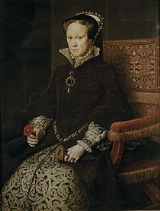
Mary I (18 February 1516 – 17 November 1558), was Queen of England and Queen of Ireland from 19 July 1553 until her death. The fourth crowned monarch of the Tudor dynasty
Tudor dynasty

The House of Tudor was a prominent European royal house that ruled the Kingdom of England and its realms from 1485 until 1603. Founded by Henry VII of England, who, though his paternal family was Welsh people ?his grandfather was Owen Tudor? was himself also a legitimized descendent of the royal House of Lancaster....
, she is remembered for restoring England
England

native_name =|conventional_long_name = England|common_name = England|image_flag = Flag of England.svg|image_coat = England COA.svg|symbol_type = Royal Coat of Arms...
 to Roman Catholicism after succeeding her short-lived half brother, Edward VI
Edward VI of England

Edward VI became List of English monarchs and King of Ireland on 28 January 1547 and was crowned on 20 February at the age of nine. The son of Henry VIII of England and Jane Seymour, Edward was the third monarch of the Tudor dynasty and England's first Protestantism ruler....
, to the English throne. In the process, she had almost 300 religious dissenters burned at the stake in the Marian Persecutions
Marian Persecutions

The Marian Persecution refers to the persecution of Religious Reformers, Protestants, and other dissenters for their beliefs during the reign of Mary I of England....
, earning her the sobriquet
Sobriquet

A sobriquet is a nickname or a fancy name, usually a familiar name given by others as distinct from a pseudonym assumed as a disguise, but a nickname which is familiar enough such that it can be used in place of a real name without the need of explanation....
 of "Bloody Mary".


Discussion
Ask a question about 'Mary I of England'
Start a new discussion about 'Mary I of England'
Answer questions from other users
Full Discussion Forum


Recent Posts


Encyclopedia


Mary I (18 February 1516 – 17 November 1558), was Queen of England and Queen of Ireland from 19 July 1553 until her death. The fourth crowned monarch of the Tudor dynasty
Tudor dynasty

The House of Tudor was a prominent European royal house that ruled the Kingdom of England and its realms from 1485 until 1603. Founded by Henry VII of England, who, though his paternal family was Welsh people ?his grandfather was Owen Tudor? was himself also a legitimized descendent of the royal House of Lancaster....
, she is remembered for restoring England
England

native_name =|conventional_long_name = England|common_name = England|image_flag = Flag of England.svg|image_coat = England COA.svg|symbol_type = Royal Coat of Arms...
 to Roman Catholicism after succeeding her short-lived half brother, Edward VI
Edward VI of England

Edward VI became List of English monarchs and King of Ireland on 28 January 1547 and was crowned on 20 February at the age of nine. The son of Henry VIII of England and Jane Seymour, Edward was the third monarch of the Tudor dynasty and England's first Protestantism ruler....
, to the English throne. In the process, she had almost 300 religious dissenters burned at the stake in the Marian Persecutions
Marian Persecutions

The Marian Persecution refers to the persecution of Religious Reformers, Protestants, and other dissenters for their beliefs during the reign of Mary I of England....
, earning her the sobriquet
Sobriquet

A sobriquet is a nickname or a fancy name, usually a familiar name given by others as distinct from a pseudonym assumed as a disguise, but a nickname which is familiar enough such that it can be used in place of a real name without the need of explanation....
 of "Bloody Mary". Her re-establishment of Roman Catholicism was reversed by her successor and half-sister, Elizabeth I
Elizabeth I of England

Elizabeth I was List of English monarchs and Queen of Ireland from 17 November 1558 until her death. Sometimes called The Virgin Queen, Gloriana, or Good Queen Bess, Elizabeth was the fifth and last monarch of the House of Tudor....
.

Childhood and early years

Mary was the only child of Henry VIII
Henry VIII of England

Henry VIII was King of England from 21 April 1509 until his death. He was also Lordship of Ireland and claimant to the Early Modern France. Henry was the second monarch of the House of Tudor, succeeding his father, Henry VII of England....
 and his first wife Catherine of Aragon
Catherine of Aragon

Catherine of Aragon also known as Katherine or Katharine; was the List of English consorts as the Wives of Henry VIII of Henry VIII of England, and Princess of Wales by her first marriage to Arthur, Prince of Wales....
 to survive infancy. Her mother had many miscarriages and a stillborn
Stillbirth

A stillbirth occurs when a fetus which has death in the uterus or during labor or childbirth, while exiting a woman's human body. The term is often used in distinction to live birth or miscarriage....
 sister and three short-lived brothers, including Henry, Duke of Cornwall
Henry, Duke of Cornwall

Henry, Duke of Cornwall was the name of two sons of King Henry VIII of England and his first wife, Catherine of Aragon. Henry in total had six children by Catherine of Aragon; 2 girls, 3 boys, and 1 whose sex is unrecorded....
, had preceded her. Through her mother, she was a granddaughter of Ferdinand II of Aragon
Ferdinand II of Aragon

Ferdinand the Catholic was king of Aragon , Sicily , Naples , Valencia , Sardinia and Navarre, Count of Barcelona, de jure uxoris King of Crown of Castile and then Regent of that country also from 1508 to his death, in the name of his mentally unstable daughter Joanna the Mad....
 and Isabella I of Castile
Isabella I of Castile

Isabella I was Kings of Castile. She and her husband, Ferdinand II of Aragon, laid the foundation for the political unification of Spain under their grandson, Charles V, Holy Roman Emperor....
. She was born at the Palace of Placentia
Palace of Placentia

The Palace of Placentia was an England British Royal Family Palace built by Humphrey, Duke of Gloucester in 1447, in Greenwich, London, on the banks of the River Thames, downstream from London....
 in Greenwich, London
London

London is the capital of both England and the United Kingdom, and the most populous municipality in the European Union. An important settlement for two millennia, History of London goes back to its founding by the Roman Empire....
. She was baptised
Baptism

In Christianity, baptism is the ritual act, with the use of water, by which one is admitted as a full member of the Christian Church and, in the view of some, as a member of the particular Church in which the baptism is administered....
 with Thomas Cardinal Wolsey standing as her godfather. Mary was a sickly child who had poor eyesight, sinus
Sinus

Sinus may refer to:In anatomy, where a sinus is a sac or cavity in any organ or tissue:*Sinus , description of the general term*Paranasal sinuses, air cavities in the cranial bones, especially those near the nose, including:...
 conditions and bad headache
Headache

In medicine a headache or wiktionary:cephalalgia is a symptom of a number of different conditions of the head and sometimes neck. Some of the causes are benign while others are medical emergencies....
s. John Hussey, 1st Baron Hussey of Sleaford
John Hussey, 1st Baron Hussey of Sleaford

John Hussey, 1st Baron Hussey of Sleaford was Chief Butler of England from 1521 until his death. He was a member of the House of Lords, and a Chamberlain to King Henry VIII's daughter, Mary I of England....
 was her Chamberlain, and his wife, Lady Anne, daughter of George Grey, 2nd Earl of Kent
George Grey, 2nd Earl of Kent

George Grey was the son of Edmund Grey, 1st Earl of Kent and Lady Katherine Percy. He was the Second Earl of Kent from 1490 to 1505.He married first Anne Woodville....
, was one of Mary's attendants.

Despite her health problems, Mary was a precocious child. A great part of the credit for her early education likely came from her mother, who consulted the Spanish
Spanish people

Spanish people or Spaniards are a nation or ethnic group native to Spain, in the Iberian Peninsula of southwestern Europe. They are often considered an amalgam of different ethnic groups, rather than an ethnic group by itself....
 scholar Juan Luis Vives
Juan Luís Vives

Joan Llu?s Vives i March , better known as Juan Luis Vives , was a Spanish scholar and Humanism from Kingdom of Valencia.Biography...
 upon the subject and was Mary's first instructor in Latin
Latin

Latin is an Italic language, historically spoken in Latium and Ancient Rome. Through the Military history of the Roman Empire, Latin spread throughout the Mediterranean and a large part of Europe....
. Mary also studied Greek
Greek language

Greek is an Indo-European languages native to the southern Balkan peninsula, the language of the Greek people. It forms an independent branch within Indo-European....
, science
Science

In its broadest sense, science refers to any systematic knowledge or practice. In its more usual restricted sense, science refers to a system of acquiring knowledge based on scientific method, as well as to the organized body of knowledge gained through such research....
, and music
Music

Music is an art form whose media is sound organized in time. Common elements of music are pitch , rhythm , dynamics , and the sonic qualities of timbre and texture ....
. In July 1521, when scarcely five and a half years old, she entertained some visitors with a performance on the virginal
Harpsichord

A harpsichord is a musical instrument played by means of a musical keyboard. It produces sound by plucking a string when each Key is pressed....
 (a smaller harpsichord). Henry VIII doted on his daughter and would boast in company, "This girl never cries", and would sometimes show delight in her developing music skills.. When Mary was nine years old, Henry gave her her own court at Ludlow Castle
Ludlow Castle

Ludlow Castle is a large, now partly ruined, non-inhabited castle which dominates the town of Ludlow in Shropshire, England. It stands on a high point overlooking the River Teme....
 and many of the Royal Prerogative
Royal Prerogative

The Royal Prerogative is a body of customary authority, privilege, and immunity, recognised in common law and, sometimes, in Civil law jurisdictions possessing a monarchy as belonging to the Sovereign alone....
s normally only given to a Prince of Wales
Prince of Wales

Prince of Wales is a title traditionally granted to the Heir Apparent to the reigning monarch of the United Kingdom . The current Prince of Wales is Charles, Prince of Wales, the eldest son of Elizabeth II of the United Kingdom....
, even calling her the Princess of Wales. In 1526, Mary was sent to Wales
Wales

native_name = Cymru|conventional_long_name = Wales|common_name = Wales|image_flag = Flag of Wales 2.svg|national_motto = ...
 to preside over the Council of Wales and the Marches. Despite this obvious affection, Henry was deeply disappointed that his marriage had produced no sons.

Throughout her childhood Henry negotiated potential marriages for Mary. When she was only two years old she was promised to the Dauphin Francis, son of Francis I, King of France
Francis I of France

Francis I , was crowned King of France in 1515 in the cathedral at Reims and reigned until 1547.Francis I is considered to be France's first Renaissance monarch....
, but after three years, the contract was repudiated. In 1522, she was instead contracted to marry her first cousin, the Holy Roman Emperor
Holy Roman Emperor

Image:HRR 14Jh.jpgThe Roman of the Emperor's title was a reflection of the translatio imperii principle that regarded the Holy Roman Emperors as the inheritors of the title of Emperor of the Western Roman Empire, a title left unclaimed in the West after the death of Julius Nepos in 480....
 Charles V
Charles V, Holy Roman Emperor

Charles V was ruler of the Holy Roman Empire from 1519 and, as Charles I of Spain, of the Spanish realms from 1516 until his abdication in 1556....
, then 22, by the Treaty of Windsor. Within a few years, however, the engagement was broken off. It was then suggested that Mary wed the Dauphin's father Francis I, who was eager for an alliance with England. A marriage treaty was signed which provided that Mary should marry either Francis I or his second son Henry, Duke of Orléans
Henry II of France

Henry II , of the House of Valois and the son and successor of Francis I of France, was King of France from 31 March 1547, until his death....
. However, Cardinal Wolsey, Henry VIII's chief adviser, managed to secure an alliance without the marriage.

Meanwhile, the marriage of Mary's parents was in jeopardy because Catherine had failed to provide Henry the male heir he desired. Henry attempted to have his marriage to her annulled
Annulment

Annulment is a legal procedure for declaring a marriage Void . Unlike divorce, it is retroactive: an annulled marriage is considered never to have existed....
, but Pope Clement VII
Pope Clement VII

Pope Clement VII , born Giulio di Giuliano de' Medici, was a Cardinal from 1513 to 1523 and was Pope from 1523 to 1534....
 refused his requests. Some contend that the Pope's decision was influenced by Charles V, Mary's former betrothed and her mother's nephew. Henry had claimed, citing biblical
Bible

The Bible is the central religious text of Judaism and Christianity. The exact Books of the Bible is dependent on the religious traditions of specific denominations....
 passages, that his marriage to Catherine was unclean because she had been previously married briefly, at age 16 to his brother Arthur
Arthur, Prince of Wales

Arthur, Prince of Wales was the first son of King Henry VII of England and Elizabeth of York, and therefore, heir to the throne of England and Wales....
, although there was some debate as to whether that marriage had been consummate
Consummate

Consummation or consummation of a marriage, in many traditions and statutes of civil or religious law, is the first act of sexual intercourse between two people, following their marriage to each other....
d. In 1533, Henry secretly married another woman, Anne Boleyn
Anne Boleyn

Anne Boleyn was List of English consorts as the Wives of Henry VIII of Henry VIII of England. She was also Earl of Pembroke in her own right. Henry's marriage to Anne, and her subsequent execution, made her a key figure in the political and religious upheaval that was the start of the English Reformation....
, and shortly thereafter, Thomas Cranmer
Thomas Cranmer

Thomas Cranmer was a leader of the English Reformation and Archbishop of Canterbury during the reigns of Henry VIII of England and Edward VI of England....
, the Archbishop of Canterbury
Archbishop of Canterbury

The Archbishop of Canterbury is the chief bishop and principal leader of the Church of England, the symbolic head of the worldwide Anglican Communion and the Diocesan Bishop of the Diocese of Canterbury, the Episcopal see that churches must be in communion with in order to be a part of the Anglican Communion....
, formally declared the marriage with Catherine void and the marriage with Anne valid. Henry then broke with the Roman Catholic Church
Roman Catholic Church

The Roman Catholic Church, officially known as the Catholic Church is the world's largest Christianity Ecclesia , representing over half of all Christians and one-sixth of the world population....
 and declared himself head of the Church of England
Church of England

The Church of England is the State religion Christianity Ecclesia in England, the Mother Church of the worldwide Anglican Communion and the oldest among the communion's thirty-eight independent national and regional churches....
. As a consequence, Catherine was demoted to Dowager Princess of Wales (a title she would have held as the widow of Arthur). Mary in turn was deemed illegitimate, and her place in the line of succession transferred to her half-sister, the future Elizabeth I, daughter of Anne Boleyn. She was styled "Lady Mary" rather than princess because of her illegitimate status.

Mary was expelled from Court, her servants (including her favorite maid Susan Clarencieux
Susan Clarencieux

Susan Clarencieux also known as Clarence & ClarencusLady in waiting and longtime friend to Mary I of England daughter of King Henry VIII.Clarencieux joined the princess`s household as a maid in waiting when she was sent to the welsh marches as the Princess of Wales....
) were dismissed from her service, and in December 1533 she was sent to serve as a lady-in-waiting to Elizabeth. Upon arriving at the house she was asked by the Duke of Norfolk if she would not go and pay her respects to the Princess to which Mary curtly replied that she "knew of no princess in England save herself but as the king had acknowledge Elizabeth to be his, she might call her sister, as she called the Duke of Richmond (Henrys son by Elizabeth Blount
Elizabeth Blount

Elizabeth Blount , who was better known by her nickname of "Bessie", was a mistress of Henry VIII of England....
) brother". It was an insult and doubtless Norfolk would have been offended though he did not show it. Mary was to continue repeating similar phrases to whoever compared her to her sister.

Despite the cold treatment she received at Hatfield, Mary was also determined to assert her seniority over Elizabeth, on one accasion when Elizabeths household moved to another location, Mary, having made a protest during the last move was given a litter with a velvet covered seat instead of a leather one. It may have seemed like a small victory in the scheme of things but to Mary it was undoubtedly a triumph. Despite her courage and determination Mary was often sick, doubtless caused by stress. the only thing she wanted during her illnesses was the company of her mother, but Mary was not permitted to see her mother, nor attend her funeral in 1536. It is said that because of this treatment, Mary was very cold towards Elizabeth during Elizabeth's teenage years, deriding Anne Boleyn's execution and calling her a witch. Circumstances between Mary and her father worsened, and she attempted to reconcile with him by submitting to his authority as head of the Church of England
Church of England

The Church of England is the State religion Christianity Ecclesia in England, the Mother Church of the worldwide Anglican Communion and the oldest among the communion's thirty-eight independent national and regional churches....
. By this she repudiated papal authority, acknowledged that the marriage between her mother and father was unlawful, and accepted her own illegitimacy.

When Anne Boleyn was beheaded in 1536, Elizabeth was downgraded to the status of Lady and removed from the line of succession. Within two weeks of Anne Boleyn's execution, Henry married Jane Seymour
Jane Seymour

Jane Seymour was List of English consorts as the third Wives of Henry VIII of Henry VIII of England. She succeeded Anne Boleyn as queen consort following the latter's execution in 1536....
, who died shortly after giving birth to a son, the future Edward VI
Edward VI of England

Edward VI became List of English monarchs and King of Ireland on 28 January 1547 and was crowned on 20 February at the age of nine. The son of Henry VIII of England and Jane Seymour, Edward was the third monarch of the Tudor dynasty and England's first Protestantism ruler....
. Mary was godmother to her half-brother Edward and chief mourner at Jane Seymour's funeral. In return, Henry agreed to grant her a household (which included the reinstatement of Marys favorite maid Susan Clarencieux
Susan Clarencieux

Susan Clarencieux also known as Clarence & ClarencusLady in waiting and longtime friend to Mary I of England daughter of King Henry VIII.Clarencieux joined the princess`s household as a maid in waiting when she was sent to the welsh marches as the Princess of Wales....
), and Mary was permitted to reside in royal palaces. Her privy purse expenses for nearly the whole of this period have been published and show that Hatfield House
Hatfield House

Hatfield House is a country house set in a large park, the Great Park, on the eastern side of the town of Hatfield, Hertfordshire, Hertfordshire, England....
, the Palace of Beaulieu
Palace of Beaulieu

The Palace of Beaulieu also known as New Hall was located in Essex, England, England, north of Chelmsford, England.The estate on which it was built - the manor of Walhfare in Boreham - was granted to the Canons of Waltham Abbey in 1062....
 (also called Newhall), Richmond
Richmond, North Yorkshire

Richmond is a market town on the River Swale in North Yorkshire, England and is the administrative centre of the district of Richmondshire. Situated on the edge of the Yorkshire Dales National Park, it is a popular tourist destination, with a total population of 8970....
 and Hunsdon
Hunsdon

Hunsdon is a town in Hertfordshire, England.See also*Baron Hunsdon*Hunsdon Airfield*Hunsdon House...
 were among her principal places of residence. She was later awarded the Palace of Beaulieu as her own. When Mary reminded Henry VIII of Catherine of Aragon, he banished her to Beaulieu. He did the same to Elizabeth, but to Mary's dismay, Elizabeth was sent to Hatfield.

In 1543 Henry married his sixth and last wife, Katharine Parr, who was able to bring the family closer together. The next year, through the Third Succession Act
Third Succession Act

The Third Succession Act of Henry VIII of England reign was passed by the Parliament of England in July 1543, and returned both Mary I of England and Elizabeth I of England to the line of the succession behind Edward VI of England....
, Henry returned Mary and Elizabeth to the line of succession, being placed after Edward. Both women, however, remained legally illegitimate. In 1547, Henry died and was succeeded by his son, Edward VI. Since Edward was still a child, rule passed to a regency council dominated by Protestants, who attempted to establish their faith throughout the country. As an example, the Act of Uniformity 1549
Act of Uniformity 1549

The Act of Uniformity 1549 established The Book of Common Prayer as the sole legal form of worship in England. Before 1549, the churches of England continued to use a slightly altered version of the Latin-language Missal....
 prescribed Protestant rites for church services, such as the use of Thomas Cranmer
Thomas Cranmer

Thomas Cranmer was a leader of the English Reformation and Archbishop of Canterbury during the reigns of Henry VIII of England and Edward VI of England....
's new Book of Common Prayer
Book of Common Prayer

The Book of Common Prayer is the common title of a number of prayer books of the Church of England and used throughout the Anglican Communion. The first book, published in 1549 , in the reign of Edward VI of England, was a product of the English Reformation following the break with Roman Catholic Church....
. When Mary, who had remained faithful to Roman Catholicism, asked to be allowed to worship in private in her own chapel
Chapel

A chapel is a building used as a place for fellowship and of worship for Christians. It may be attached to an institution such as a large Church , a college, a hospital, a palace, a prison or a cemetery, or may be an entirely free-standing building, sometimes with its own grounds....
, she was refused. It was only after Mary appealed to her cousin Charles V
Charles V

Charles V may refer to:* Charles V of France , called the Wise* Charles V, Holy Roman Emperor , ruler of the Holy Roman Empire, Spain and the Netherlands...
 that she was allowed to worship privately. Religious differences continued to be a problem between Mary and Edward, however. When Mary was in her thirties, she attended a reunion with Edward and Elizabeth for Christmas
Christmas

Christmas , also referred to as Christmas Day, is an annual holiday celebrated on December 25 that commemorates the birth of Jesus. The day marks the beginning of the larger season of Christmastide, which lasts Twelve Days of Christmas....
, where Edward embarrassed Mary and reduced her to tears in front of the court for "daring to ignore" his laws regarding worship.

Accession

On 6 July 1553, at the age of 15, Edward VI died of tuberculosis
Tuberculosis

Tuberculosis is a common and often deadly infectious disease caused by mycobacterium, mainly Mycobacterium tuberculosis . Tuberculosis usually attacks the lungs but can also affect the central nervous system, the lymphatic system, the circulatory system, the genitourinary system, the gastrointestinal system, bones, joints, and even the...
. Edward did not want the crown to go to Mary, who he feared would restore Catholicism and undo his reforms, as well as those of Henry VIII. For this reason, he planned to exclude her from the line of succession. However, his advisors told him that he could not disinherit only one of his sisters, but that he would have to disinherit Elizabeth as well, even though she embraced the Church of England. Guided by John Dudley, 1st Duke of Northumberland and perhaps others, Edward excluded both of his sisters from the line of succession in his will.

Edward VI and his advisors instead devised that he should be succeeded by Dudley's daughter-in-law Lady Jane Grey
Lady Jane Grey

Lady Jane Grey , also known as Queen Jane of England, was a claimant to the Kingdom of England and Monarchy of Ireland, who was de facto monarch of England for just over a week in 1553....
, the granddaughter of Henry VIII's younger sister Mary, the French Queen. However, this exclusion contradicted the Act of Succession
Third Succession Act

The Third Succession Act of Henry VIII of England reign was passed by the Parliament of England in July 1543, and returned both Mary I of England and Elizabeth I of England to the line of the succession behind Edward VI of England....
 of 1544. This act had restored Mary and Elizabeth to the line of succession. Around the time of Edward VI's death, Mary had been summoned back to London from Framlingham Castle
Framlingham Castle

Framlingham Castle is an important castle in the market town of Framlingham, Suffolk, England. In common with many other buildings in Suffolk, the main walls of the castle are built with flint....
 in Suffolk
Suffolk

Suffolk is a Non-metropolitan counties of England of Historic counties of England in East Anglia, England. It has borders with Norfolk to the north, Cambridgeshire to the west and Essex to the south....
, into which she had recently moved after having left her former residence at the Palace of Beaulieu
Palace of Beaulieu

The Palace of Beaulieu also known as New Hall was located in Essex, England, England, north of Chelmsford, England.The estate on which it was built - the manor of Walhfare in Boreham - was granted to the Canons of Waltham Abbey in 1062....
. However, Mary initially hesitated; she suspected that this summons could be a pretext on which to capture her and, in so doing, facilitate Grey's accession to the throne.

On 10 July 1553, Lady Jane Grey assumed the throne as Queen of England in what can best be described as a coup d'etat orchestrated by Dudley and his supporters. However, Dudley's support collapsed almost immediately, which led to the false Queen being deposed a mere nine days later. Mary rode triumphantly into London on a wave of popular support to legally assume the crown. Grey and Dudley were immediately imprisoned in the Tower of London
Tower of London

Her Majesty's Royal Palace and Fortress, more commonly known as the Tower of London , is a historic monument in central London, England, on the north bank of the River Thames....
. Mary understood that the young Lady Jane was essentially a pawn in Dudley's scheme, and did not immediately order the girl's execution.

One of Mary's first actions as Queen was to order the release of the Roman Catholic Thomas Howard, 3rd Duke of Norfolk
Thomas Howard, 3rd Duke of Norfolk

Thomas Howard, 3rd Duke of Norfolk was a prominent Tudor dynasty politician. He was uncle to two of the wives of Henry VIII, Anne Boleyn and Catherine Howard, as well as the king's mistress Mary Boleyn, and played a major role in the machinations behind these relationships....
 and Stephen Gardiner
Stephen Gardiner

Stephen Gardiner was an England Roman Catholic bishop and politician during the English Reformation period who served as Lord Chancellor during the reign of Queen Mary I of England....
 from imprisonment in the Tower of London. At this time, the Duke of Northumberland (Dudley) was the only conspirator executed for high treason
High treason

High treason is criminal disloyalty to one's country. Participating in a war against one's country, attempting to overthrow its government, spying on its military, its diplomats, or its secret services for a hostile and foreign power, or attempting to kill its head of state are perhaps the best-known examples of high treason....
. Mary was left in a difficult position, as almost all the Privy Counsellors had been implicated in the plot to put Jane on the throne. She could only rely on Gardiner, whom she appointed both Bishop of Winchester
Bishop of Winchester

The Bishop of Winchester is the head of the Church of England diocese of Winchester, with his cathedra at Winchester Cathedral in Hampshire.The bishop is one of five Church of England bishops to be a Lord Spiritual regardless of their length of service....
 and Lord Chancellor
Lord Chancellor

The Lord High Chancellor of Great Britain, or Lord Chancellor, is a senior and important functionary in the government of the United Kingdom....
.

On 1 October 1553, Gardiner formally crowned Mary.

Reign


Spanish marriage

At age 37, Mary turned her attention to finding a husband and producing an heir, thus preventing the Protestant Elizabeth (still her successor under the terms of Henry VIII's will) from succeeding to the throne. Mary rejected Edward Courtenay, 1st Earl of Devon
Edward Courtenay, 1st Earl of Devon (1553 creation)

Edward Courtenay, 1st Earl of Devon was the only son of Henry Courtenay, 1st Marquess of Exeter and his second wife Gertrude Blount. His maternal grandparents were William Blount, 4th Baron Mountjoy and his third wife Ines de Benegas....
, as a prospect when her cousin Charles V suggested she marry his only son, the Spanish
Spain

Spain or the Kingdom of Spain , is a country located in Southern Europe on the Iberian Peninsula.The Spanish constitution does not establish any official denomination of the country, even though Espa?a , Estado espa?ol and Naci?n espa?ola are used interchangeably....
 Prince Philip, later Philip II of Spain
Philip II of Spain

Philip II was King of Spain from 1556 until 1598, List of monarchs of Naples from 1554 until 1598, king consort of England, as husband of Mary I of England, from 1554 to 1558, lord of the Seventeen Provinces from 1556 until 1581, holding various titles for the individual territories, such as Duke or Count; and King of Portugal as Philip I...
. It is said that upon viewing the Titian
Titian

File:Tizian 090.jpg Tiziano Vecelli or Tiziano Vecellio, born 1473/1490 , died 27 August 1576, better known as Titian , was the leading painter of the 16th-century Venice school of the Italian Renaissance....
 full-length portrait of Philip now in the Prado, which had been sent to her, Mary declared herself to be in love with him.

Their marriage at Winchester Cathedral
Winchester Cathedral

Winchester Cathedral at Winchester, Hampshire in Hampshire is one of the largest cathedrals in England, with the longest nave and overall length of any Gothic architecture cathedral in Europe....
 on 25 July 1554 took place just two days after their first meeting. Philip's view of the affair was entirely political (he admired her dignity but felt "no carnal love for her"), and it was extremely unpopular with the English. Lord Chancellor Gardiner and the House of Commons
British House of Commons

The House of Commons is the lower house of the Parliament of the United Kingdom, which also comprises the British monarchy and the House of Lords ....
 petitioned her to consider marrying an Englishman, fearing that England would be relegated to a dependency of Spain. This fear may have arisen from the fact that Mary was – excluding the brief, unsuccessful and controversial reigns of Jane and Empress Matilda
Empress Matilda

Empress Matilda, also known as Matilda of England or Maude was the daughter and heir of King Henry I of England. Matilda and her younger brother, William Adelin, were the only legitimate children of King Henry....
 – England's first Queen regnant
Queen regnant

A queen regnant is a qualifying reference to a female monarch possessing and exercising all of the monarchical powers of a ruler, in contrast to a "queen consort", who is the wife of a male reigning as monarch and who is without any official powers of state....
.

Domestic politics


Insurrections broke out across the country when she insisted on marrying Philip, with whom she was in love. The Duke of Suffolk once again proclaimed that his daughter, Lady Jane Grey, was queen. In support of Elizabeth, Thomas Wyatt
Thomas Wyatt the younger

Sir Thomas Wyatt the younger was a rebel leader during the reign of Queen Mary I of England; his rising is traditionally called "Wyatt's rebellion"....
 led a force from Kent
Kent

Kent is a Counties of England in southeast England, and is one of the home counties. It borders East Sussex, Surrey and Greater London and has a defined boundary with Essex in the middle of the River Thames estuary....
 that was not defeated until he had arrived at London. After the rebellions were crushed, the Duke of Suffolk, his daughter, Lady Jane Grey, and her husband were convicted of high treason and executed. Elizabeth, though protesting her innocence in the Wyatt affair, was imprisoned in the Tower of London for two months, then was put under house arrest at Woodstock Palace
Woodstock Palace

Woodstock Palace was a royal residence in the England town of Woodstock, England, Oxfordshire. The title of "palace" was first used to refer to it during the twelfth century, when it was favoured by King Henry I of England....
.

Mary married Philip on 25 July 1554, at Winchester Cathedral
Winchester Cathedral

Winchester Cathedral at Winchester, Hampshire in Hampshire is one of the largest cathedrals in England, with the longest nave and overall length of any Gothic architecture cathedral in Europe....
. Under the terms of the marriage treaty, Philip was to be styled "King of England", all official documents (including Acts of Parliament
Act of Parliament

An act of Parliament is a statute wikt:enacted as primary legislation by a national or sub-national parliament. It is broadly equivalent to an act of Congress in the United States....
) were to be dated with both their names, and Parliament was to be called under the joint authority of the couple. Coins were also to show the heads of both Mary and Philip. The marriage treaty further provided that England would not be obliged to provide military support to Philip's father in any war. Philip's powers, however, were extremely limited, and he and Mary were not true joint sovereigns like William and Mary
William and Mary

The phrase William and Mary usually refers to the joint sovereignty over the Kingdom of England, as well as the Kingdom of Scotland, of William III of England and his wife Mary II of England, a daughter of James II....
.

Mary and Philip Medal

Pregnancy


Mary, thinking she was pregnant, had thanksgiving services at the diocese of London in November 1554. This turned out to be the first of two phantom pregnancies
Pseudocyesis

False pregnancy, most commonly termed pseudocyesis in humans and pseudopregnancy in other mammals, is the appearance of clinical and/or subclinical signs and symptoms associated with pregnancy when the person or animal is not pregnant....
. Various theories, such as cysts, have been put forward to explain her condition, but it was likely psychological in nature. Philip persuaded his wife to permit Elizabeth's release from house arrest, probably so that he would be viewed favourably by her in case Mary died in childbirth
Childbirth

Childbirth is the culmination of a human pregnancy or gestation period with the delivery of one or more newborn infants from a woman's uterus. The process of normal human childbirth is categorized in three stages of labour: the shortening and dilation of the cervix, descent and delivery of the infant, and delivery of the placenta.....
. Soon after the disgrace of the false pregnancy, Philip headed off to Flanders
Flanders

Flanders is a geographical region located in parts of present-day Belgium, France, and the Netherlands. Over the course of history, the geographical territory that was called "Flanders" has varied....
 to command his armies against France. Mary was heartbroken and soon fell into deep depression.

Religion


As Queen, Mary was very concerned about heresy and the English church. She had always rejected the break with Rome instituted by her father and the establishment of Protestantism by Edward VI. She had England reconcile with Rome and Reginald Cardinal Pole
Reginald Cardinal Pole

Reginald Cardinal Pole was an England prelate, a Cardinal in the Catholic Church, and the last Catholic Archbishop of Canterbury, holding office during the Counter Reformation....
, the son of her governess the Countess of Salisbury (who was beheaded for treason by Mary's father Henry VIII) and once considered a suitor, became Archbishop of Canterbury
Archbishop of Canterbury

The Archbishop of Canterbury is the chief bishop and principal leader of the Church of England, the symbolic head of the worldwide Anglican Communion and the Diocesan Bishop of the Diocese of Canterbury, the Episcopal see that churches must be in communion with in order to be a part of the Anglican Communion....
; Mary had his predecessor Thomas Cranmer
Thomas Cranmer

Thomas Cranmer was a leader of the English Reformation and Archbishop of Canterbury during the reigns of Henry VIII of England and Edward VI of England....
 burned at the stake. Mary came to rely greatly on Pole for advice.

Edward's religious laws were abolished by Mary's first Parliament in the Statute of Repeal Act (1553). Church doctrine was restored to the form it had taken in the 1547 Six Articles.

Mary also persuaded Parliament to repeal the Protestant religious laws passed by Henry VIII. Getting their agreement took several years, and she had to make a major concession: tens of thousands of acres of monastery
Monastery

Monastery , a term derived from the Greek language word ???ast?????, neut. of ???ast????? - monasterios denotes the building, or complex of buildings, that houses a room reserved for prayer as well as the domestic quarters and workplace of Monk, whether monks or nuns, and whether living in Cenobium or alone ....
 lands confiscated under Henry were not to be returned because the new landowners created by this distribution were very influential. This was approved by the Papacy in 1554. The Revival of the Heresy Acts
Revival of the Heresy Acts

In November 1554, the Revival of the Heresy Acts revived three former Acts against heresy; the Merchant Strangers, Leather, Subsidy, Heresy Act 1382 of 1382 of King Richard II, an Act of 1401 of King Henry IV of England, and an Suppression of Heresy Act 1414 of 1414 of King Henry V....
 were also passed in 1554.

Persecutions


Numerous Protestant leaders were executed (typically by burning) in the Marian Persecutions
Marian Persecutions

The Marian Persecution refers to the persecution of Religious Reformers, Protestants, and other dissenters for their beliefs during the reign of Mary I of England....
. Many rich Protestants chose exile, and around 800 left the country. The first to die were John Rogers (4 February 1555), Laurence Saunders
Laurence Saunders

Laurence Saunders , was the son of Thomas Saunders and Margaret Cave of Harrington, Northamptonshire, Northamptonshire, England.He was educated at Eton College and at King's College, Cambridge....
 (8 February 1555), Rowland Taylor
Rowland Taylor

Rowland Taylor was an England martyr during the Marian Persecutions.He was born in Northumberland, England, and died at Hadleigh. At the time of his death he was Rector, or Anglican parish priest of a small parish in a small market town called Hadleigh ....
 (9 February 1555), and John Hooper
John Hooper

John Hooper was an England churchman, Bishop of Gloucester and Bishop of Worcester. He was martyred during the Marian Persecutions....
, the Bishop of Gloucester
Bishop of Gloucester

The Bishop of Gloucester is the Ordinary of the Church of England Diocese of Gloucester, England in the Province of Canterbury.The diocese covers the Gloucestershire and part of the Worcestershire and has its Episcopal see in the Gloucester where the seat is located at the Gloucester Cathedral....
 (9 February 1555). The persecution lasted for almost four years. It is not known exactly how many died. John Foxe
John Foxe

John Foxe , martyrologist, is remembered as the author of what is popularly known as Foxe's Book of Martyrs, an account of Christian martyrs throughout history but especially emphasizing the sufferings of English Protestants from the fourteenth century through the reign of Mary I of England....
 estimates in his Book of Martyrs
Foxe's Book of Martyrs

The Book of Martyrs, by John Foxe, is an apocalyptically-oriented, England Protestant account of the persecutions of Protestants, mainly in England, many of whom had died for their beliefs within the decade immediately preceding its first publication....
 that 284 were executed for their faith. The Marian persecutions are commemorated especially by bonfires
Sussex Bonfire Societies

The Sussex Bonfire Societies are responsible for the series of bonfire festivals around Central/Eastern Sussex along with bits of Surrey and Kent from September - November....
 in the town of Lewes
Lewes

Lewes is the county town of East Sussex, England and gives its name to the Local government district in which it lies. The settlement has a long history as a bridging point and as a market town, and is today an important communications hub, and tourist-orientated town....
 in Sussex
Sussex

Sussex , from the Old English Su?seaxe , is a Historic counties of England in South East England England corresponding roughly in area to the ancient Kingdom of Sussex....
: there is a prominent martyrs' memorial outside St John's church at Stratford
Stratford, London

Stratford, historically Stratford Langthorne, is a place in the London Borough of Newham in East London, England. It will be the primary location of the 2012 Summer Olympics....
, London, to those Protestants burnt in Essex
Essex

Essex is a counties of England in the East of England England. The county town is Chelmsford, and the highest point of the county is Chrishall Common near the village of Langley, Essex, close to the Hertfordshire border, which reaches ....
, and others in Christchurch Park
Christchurch Park

Christchurch Park is a area of rolling lawns, wooded areas, and delicately created arboretum in central Ipswich, Suffolk, England. It was the first public park in the town, opening in 1895....
 Ipswich
Ipswich

Ipswich is a non-metropolitan district and the county town of Suffolk, England on the estuary of the River Orwell. Nearby towns are Felixstowe in Suffolk, Harwich in Essex and Colchester also in Essex....
 and the abbey grounds, Bury St Edmunds, to those executed in East and West Suffolk
Suffolk

Suffolk is a Non-metropolitan counties of England of Historic counties of England in East Anglia, England. It has borders with Norfolk to the north, Cambridgeshire to the west and Essex to the south....
 respectively.

Foreign policy


Henry VIII's creation of the Kingdom of Ireland
Kingdom of Ireland

The Kingdom of Ireland was the name given to the Irish state from 1541, by the Crown of Ireland Act 1542 of the Parliament of Ireland. It was based on the contested legitimacy of the right of conquest....
 in 1542 was not recognized by Europe's Catholic powers. In 1555 Mary obtained a papal bull
Papal bull

A Papal bull is a particular type of letters patent or charter issued by a pope. It is named after the bulla that was appended to the end to authenticate it....
 confirming that she and Philip were the monarchs of Ireland
Ireland

Ireland is the List of islands by area in Europe, and the twentieth-largest island in the world. It lies to the north-west of continental Europe and is surrounded by hundreds of islands and islet....
, and thereby the Church accepted the personal link between the kingdoms of Ireland and England. Furthering the Tudor Reconquest of Ireland, the midlands counties of Laois
County Laois

County Laois , formerly also Laoighis or Leix, is a county in the midlands of Ireland, in the Provinces of Ireland of Leinster.File:ViewFromDunamase.JPG...
 and Offaly
County Offaly

County Offaly is a county in Leinster, Ireland, bordered by seven other counties: County Galway, County Roscommon, County Westmeath, County Meath, County Kildare, County Laois, and County Tipperary....
 were shired and named after the new monarchs respectively as "Queen's County" and "King's County". Their principal towns were respectively named Maryborough (now Portlaoise) and Philipstown (now Daingean
Daingean

Daingean , formerly Philipstown, is a small town in east County Offaly, Ireland. It is situated midway between the towns of Tullamore and Edenderry, County Offaly on the R402 road regional road....
). Under Mary's reign, English colonists were settled in the Irish midlands
Irish midlands

The Irish midlands are made up of the central plain of Ireland. The Irish midlands comprises seven counties: Laois, Leitrim, Longford, Offaly, Roscommon, Tipperary, and Westmeath....
 to reduce the attacks on the Pale
The Pale

The Pale or the English Pale , was the English-controlled part of Ireland that had reduced by the late 1400s to an area along the east coast stretching from Dalkey, south of Dublin, to the garrison town of Dundalk north of Drogheda....
 (the colony around Dublin
Dublin

Dublin is both the largest city and capital of Republic of Ireland. It is located near the midpoint of Ireland's east coast, at the mouth of the River Liffey and at the centre of the Dublin Region....
).

Having inherited the Spanish throne upon his father's abdication
Abdication

Abdication is the act of renouncing and resigning from a formal office, especially from the supreme office of state. In Roman law the term was also applied to the disowning of a family member, as the disinheriting of a son....
, Philip returned to England from March to July 1557 to persuade Mary to support Spain in a war against France (the Italian Wars
Italian Wars

The Italian Wars, often referred to as the Great Italian Wars or the Great Wars of Italy in historical works, were a series of conflicts from 1494 to 1559 that involved, at various times, most of the Italian city-states, the Papal States, all the major states of western Europe as well as the Ottoman Empire....
). There was much opposition to declaring war on France. There existed an old alliance between Scotland and France; French trade would be jeopardized; and England had a distinct lack of finances because of a bad economic legacy from Edward VI's reign. As a result of her agreement to declare war (which violated the carefully-written marriage treaty), England became full of factions and seditious
Sedition

Sedition is a term of law which refers to covert conduct, such as Speech communication and organization, that is deemed by the legal authority as tending toward insurrection against the established order....
 pamphlets of Protestant origin inflaming the country against the Spaniards. English forces fared badly in the conflict and as a result lost Calais
Calais

Calais is a town in northern France in the Departments of France of Pas-de-Calais, of which it is a sub-prefecture. Although Calais is by far the largest city in Pas-de-Calais, the department's capital is its third-largest city of Arras....
, England's sole remaining continental possession, on 13 January 1558. Although this territory had recently become financially burdensome, the effects of its loss were ideological. Mary later lamented that when she died the words "Philip" and "Calais" would be found inscribed on her heart.

Commerce and revenue


The most prominent problem was the decline of the Antwerp cloth trade. Despite Mary's marriage to Philip, England did not benefit from their enormously lucrative trade with the New World
New World

The New World is one of the names used for the non-Eurasian/non-African parts of the Earth, specifically the Americas and Australasia. When the term originated in the late 15th century, the Americas were new to the Europeans, who previously thought of the world as consisting only of Europe, Asia, and Africa ....
. The Spanish guarded their trading revenue jealously, and Mary could not condone illegitimate trade (in the form of piracy
Piracy

Piracy is a warlike act committed by a foreign nonstate actor, especially robbery or crime committed at sea, on a river, or sometimes on shore, either from a vessel flying no national flag, or one flying a national flag but without authorization from a nation....
) because she was married to a Spaniard. In an attempt to increase trade and rescue the English economy, Mary continued Northumberland
Duke of Northumberland

The Duke of Northumberland is a title in the peerage of Great Britain.In Latin, ealdormans of Northumbrians were called Dux when they were vassals of Anglo-Saxon kings of England ....
's policy of seeking out new commercial ports outside Europe.

Financially, Mary was trying to reconcile between a modern form of government — with correspondingly higher spending — and a medieval system of collecting taxation and dues. A failure to apply new tariff
Tariff

A tariff is a tax imposed on goods when they are moved across a political boundary. They are usually associated with protectionism, the economic policy of restraining trade between nations....
s to new forms of import
Import

In economics, an import is any good or service brought into one country from another country in a legitimate fashion, typically for use in trade.It is a good that is brought in from another country for sale....
s meant that a key source of revenue was neglected. In order to solve this problem, Mary's government published the "Book of Rates" (1558), listing the tariffs and duties
Duty

Duty is a term that conveys a sense of moral commitment to someone or something. The moral commitment is the sort that results in action, and it is not a matter of passive feeling or mere recognition....
 for every import. This publication was not reviewed until 1604. Mary also appointed William Paulet, 1st Marquess of Winchester
William Paulet, 1st Marquess of Winchester

Sir William Paulet was an England statesman who attained several peerages throughout his lifetime: Baron St John , Earl of Wiltshire , and Marquess of Winchester ....
 as Surveyor of Customs and assigned him to oversee the revenue collection system.

Mary also started currency reform to counteract the dramatic devaluation
Devaluation

Devaluation is a reduction in the value of a currency with respect to other monetary units. In common modern usage, it specifically implies an official lowering of the value of a country's currency within a fixed exchange rate system, by which the monetary authority formally sets a new fixed rate with respect to a foreign reference currency....
 overseen by Thomas Gresham
Thomas Gresham

File:Thomas Gresham, 1544.jpgSir Thomas Gresham was an English merchant and financier who worked for King Edward VI of England and for Edward's half-sister Queen Elizabeth I of England....
 that had characterized the last few years of Henry's reign and the reign of Edward VI. These measures, however, were largely unsuccessful.

Death


During her reign, Mary suffered two phantom pregnancies. It has been speculated that these could simply be a result of the pressure to produce an heir, though the physical symptoms (including lactation
Lactation

Lactation describes the secretion of milk from the mammary glands, the process of providing that milk to the young, and the period of time that a mother lactates to feed her young....
 and the later loss of her eyesight) reported by Mary's attendants may be indicative of a hormonal
Hormone

Hormones are chemicals released by cells that affect cells in other parts of the body. Only a small amount of hormone is required to alter cell metabolism....
 disorder such as a pituitary
Pituitary gland

The pituitary gland, or hypophysis, is an endocrine gland about the size of a pea and weighing 0.5 g . It is a protrusion off the bottom of the hypothalamus at the base of the brain, and rests in a small, bony cavity covered by a Dura mater fold ....
 tumour.

Mary decreed in her will that her husband should be the regent during the minority of her child. No child, however, was born, and Mary died at age 42 at St. James's Palace
St. James's Palace

St. James's Palace is one of London's oldest palaces. It is situated on Pall Mall, London in London, just north of St. James's Park....
 on 17 November 1558. She was succeeded by her half-sister, who became Elizabeth I
Elizabeth I of England

Elizabeth I was List of English monarchs and Queen of Ireland from 17 November 1558 until her death. Sometimes called The Virgin Queen, Gloriana, or Good Queen Bess, Elizabeth was the fifth and last monarch of the House of Tudor....
. Although her will stated that she wished to be buried next to her mother, Mary was interred in Westminster Abbey
Westminster Abbey

The Collegiate Church of St Peter at Westminster, which is almost always referred to popularly and informally as Westminster Abbey, is a large, mainly Gothic architecture Church , in Westminster, London, just to the west of the Palace of Westminster....
 on 14 December in a tomb she eventually shared with Elizabeth. The Latin inscription on a marble plaque on their tomb (affixed there by James VI of Scotland
Scotland

conventional_long_name = ScotlandAlba|common_name= Scotland|image_flag = Flag of Scotland.svg|flag_width = 130px...
 when he succeeded Elizabeth to the throne of England as James I
James I of England

James VI and I was List of monarchs of Scotland as James VI, and List of English monarchs and King of Ireland as James I. He ruled in Kingdom of Scotland as James VI from 24 July 1567, when he was only one year old, succeeding his mother Mary I of Scotland....
) translates to "Consorts in realm and in tomb, here we sleep, Elizabeth and Mary, sisters, in hope of resurrection". The Latin plays on the multiple meanings of consors, which can mean either sibling or sharer in common.

Legacy


Mary enjoyed tremendous popular support and sympathy for her mistreatment during the earliest parts of her reign, especially by the Roman Catholic population. Her marriage to Philip, however, was unpopular among her subjects. The marriage treaty clearly specified that England was not to be drawn into any Spanish wars, but this guarantee proved meaningless. Philip spent most of his time governing his European territories, while his wife usually remained in England. After Mary's death, Philip became a suitor for Elizabeth's hand, but she refused him.

The persecution of Protestants earned Mary the appellation "Bloody Mary", although many historians believe she does not deserve all the blame. There is disagreement as to the number of people put to death during Mary's five-year reign. However, several notable clerics were executed; among them Thomas Cranmer
Thomas Cranmer

Thomas Cranmer was a leader of the English Reformation and Archbishop of Canterbury during the reigns of Henry VIII of England and Edward VI of England....
, the former Archbishop of Canterbury
Archbishop of Canterbury

The Archbishop of Canterbury is the chief bishop and principal leader of the Church of England, the symbolic head of the worldwide Anglican Communion and the Diocesan Bishop of the Diocese of Canterbury, the Episcopal see that churches must be in communion with in order to be a part of the Anglican Communion....
; John Rogers, a former colleague of William Tyndale; Nicholas Ridley
Nicholas Ridley (martyr)

Nicholas Ridley was an England clergyman. He came from a prominent family in Tynedale, Northumberland, and was born early in the sixteenth century....
, the former Bishop of London
Bishop of London

The Bishop of London is the Ordinary of the Church of England Diocese of London in the Province of Canterbury.The diocese covers 458 km? of 17 boroughs of Greater London north of the Thames and a small part of the County of Surrey....
; and the reformist Hugh Latimer
Hugh Latimer

Hugh Latimer was the bishop of Worcester, and by his death he became a famous martyr among Protestants and the Church of England.Latimer was born into a family of farmers in Thurcaston, Leicestershire....
. Mary was prominently featured and vilified in the Book of Martyrs
Foxe's Book of Martyrs

The Book of Martyrs, by John Foxe, is an apocalyptically-oriented, England Protestant account of the persecutions of Protestants, mainly in England, many of whom had died for their beliefs within the decade immediately preceding its first publication....
, published by John Foxe
John Foxe

John Foxe , martyrologist, is remembered as the author of what is popularly known as Foxe's Book of Martyrs, an account of Christian martyrs throughout history but especially emphasizing the sufferings of English Protestants from the fourteenth century through the reign of Mary I of England....
 in 1562, 5 years after Mary's death. Subsequent editions of the book remained popular with Protestants through the 19th century.

One popular tradition traces the nursery rhyme
Nursery rhyme

The term nursery rhyme is used for ?traditional? songs for young children in Britain and many English speaking countries, but usage only dates from the nineteenth century and in North America the older ?Mother Goose Rhymes? is still often used....
 "Mary, Mary, Quite Contrary
Mary, Mary, Quite Contrary

"Mary, Mary, Quite Contrary" is an English language nursery rhyme; an alternate first line is "Mistress Mary, quite contrary".The most common version is:...
" to Mary's attempts to bring Roman Catholicism back to England, although it may well be about her cousin Mary, Queen of Scots.

Titles, style and arms


Mary I's titles and styles from birth to death:

  • 18 February 1516 - 23 May 1533: Princess Mary of England
  • 23 May 1533 - 19 July 1553: Lady Mary Tudor
  • 19 July 1553 - 17 November 1558: Her Majesty The Queen of England and Ireland
  • 16 January 1556 - 17 November 1558: Her Majesty The Queen of Spain and Sicily


Like Henry VIII and Edward VI, Mary used the style "Majesty", as well as "Highness" and "Grace". "Majesty", which Henry VIII first used on a consistent basis, did not become exclusive until the reign of Elizabeth I's successor, James I
James I of England

James VI and I was List of monarchs of Scotland as James VI, and List of English monarchs and King of Ireland as James I. He ruled in Kingdom of Scotland as James VI from 24 July 1567, when he was only one year old, succeeding his mother Mary I of Scotland....
.

When Mary ascended the throne, she was proclaimed under the same official style as Henry VIII and Edward VI: "Mary, by the Grace of God
God

God is a deity in theism and deism religions and other belief systems, representing either the sole deity in monotheism, or a principal deity in polytheism....
, Queen of England, France and Ireland
Kingdom of Ireland

The Kingdom of Ireland was the name given to the Irish state from 1541, by the Crown of Ireland Act 1542 of the Parliament of Ireland. It was based on the contested legitimacy of the right of conquest....
, Defender of the Faith
Fidei defensor

Fidei defensor is an originally Latin title which translates to Defender of the Faith in English language and D?fenseur de la Foi in French language....
, and of the Church of England
Church of England

The Church of England is the State religion Christianity Ecclesia in England, the Mother Church of the worldwide Anglican Communion and the oldest among the communion's thirty-eight independent national and regional churches....
 and also of Ireland
Church of Ireland

The Church of Ireland is an autonomous province of the Anglican Communion, operating across the island of Ireland. Like other Anglican churches, it considers itself to be both Catholicism and Protestant Reformation....
 in Earth Supreme Head" . The "supremacy phrase" at the end of the style was repugnant to Mary's Catholicism; from 1554 onwards, she omitted the phrase without statutory authority, which was not retroactively granted by Parliament until 1555.

Under Mary's marriage treaty with Philip, the couple were jointly styled Queen and King. The official joint style reflected not only Mary's but also Philip's dominions and claims; it was "Philip and Mary, by the grace of God, King and Queen of England, France, Naples
Kingdom of Naples

The Kingdom of Naples is the modern day name for a polity which existed on the southern part of the Italian peninsula. Also known contemporaneously, and somewhat confusingly, as the Kingdom of Sicily, this kingdom was founded after the secession of the island of Sicily from the old Kingdom of Sicily as a result of the Sicilian Vespers...
, Jerusalem
Kings of Jerusalem

This is a list of Kings of Jerusalem, from 1099 to 1291, as well as claimants to the title up to the present day....
, and Ireland, Defenders of the Faith, Prince
Prince

Prince, from the Latin root princeps, is a general term for a monarch, for a member of a monarch's or former monarch's family, and is a hereditary title in some members of Europe's highest nobility....
s of Spain
Spain

Spain or the Kingdom of Spain , is a country located in Southern Europe on the Iberian Peninsula.The Spanish constitution does not establish any official denomination of the country, even though Espa?a , Estado espa?ol and Naci?n espa?ola are used interchangeably....
 and Sicily
Sicily

Sicily is an Autonomous regions with special statute of Italy. Of all the regions of Italy, Sicily covers the largest land area at 25,708 km? and currently has just over five million inhabitants....
, Archduke
Archduke

The title of Archduke denotes a rank above Duke and under King. It was rare and has uses too diverse to be given a fixed relative position within the former Holy Roman Empire to which it was restricted....
s of Austria
Austria

Austria , officially the Republic of Austria , is a landlocked country in Central Europe. It borders both Germany and the Czech Republic to the north, Slovakia and Hungary to the east, Slovenia and Italy to the south, and Switzerland and Liechtenstein to the west....
, Dukes of Milan, Burgundy
Duke of Burgundy

Duke of Burgundy was a title borne by the rulers of the Duchy of Burgundy, a small portion of traditional lands of Burgundians west of river Sa?ne which in 843 was allotted to Charles the Bald's West Franks....
 and Brabant
Duke of Brabant

The Duchy of Brabant was formally erected in 1183/1184. The title "Duke of Brabant" was created by the German Emperor Frederick I, Holy Roman Emperor in favor of Henry I, Duke of Brabant, son of Godfrey III of Leuven ....
, Counts of Habsburg
Habsburg

The House of Habsburg was an important royal house of Europe and is best known as supplying all of the formally elected Holy Roman Emperors between 1452 and 1740, as well as rulers of Spanish Empire and the Austrian Empire....
, Flanders
Count of Flanders

The count of Flanders was the ruler or sub-ruler of the Flanders from the 9th century until the abolition of the position by the French Revolution in 1790....
 and Tirol
German Tyrol

German Tyrol is a historical region in the Alps now divided between Austria and Italy. It includes largely ethnic German areas of historical County of Tyrol: the States of Austria of Tyrol and the Regions of Italy known as the Alto Adige/S?dtirol but not the largely Italian language-speaking Autonomous Province of Trento ....
". This style, which had been in use since 1554, was replaced when Philip inherited the Spanish Crown in 1556 with "Philip and Mary, by the Grace of God King and Queen of England, Spain, France, Jerusalem
Jerusalem

Jerusalem is the capital of Israel and its List of Israeli cities in both population and area, with a population of 747,600 residents over an area of if Positions on Jerusalem East Jerusalem is included....
, both the Sicilies
Sicily

Sicily is an Autonomous regions with special statute of Italy. Of all the regions of Italy, Sicily covers the largest land area at 25,708 km? and currently has just over five million inhabitants....
 and Ireland, Defenders of the Faith, Archdukes of Austria
Austria

Austria , officially the Republic of Austria , is a landlocked country in Central Europe. It borders both Germany and the Czech Republic to the north, Slovakia and Hungary to the east, Slovenia and Italy to the south, and Switzerland and Liechtenstein to the west....
, Dukes of Burgundy
Duchy of Burgundy

The Duchy of Burgundy was a feudal territory once existing within the France in the Middle Ages. It roughly conforms to the modern Bourgogne. Existing between 843 and 1477, the Duchy was ruled by a succession of Duke of Burgundy, whose extinction with the death of Charles the Bold in 1477 led to the Duchy being absorbed into the French crown...
, Milan
Milan

Milan is the second largest city of Italy, located in the plains of Lombardy. It is the capital in the Province of Milan, as well as the Regions of Italy capital of Lombardy....
 and Brabant
Brabant

Historically, Brabant has been the name of several administrative entities in the Low Countries with quite different geographical extent:* The Carolingian pagus Bracbatensis, located between the rivers Scheldt and Dijle between the 9th and 11th century;...
, Counts of Habsburg
Habsburg

The House of Habsburg was an important royal house of Europe and is best known as supplying all of the formally elected Holy Roman Emperors between 1452 and 1740, as well as rulers of Spanish Empire and the Austrian Empire....
, Flanders
Flanders

Flanders is a geographical region located in parts of present-day Belgium, France, and the Netherlands. Over the course of history, the geographical territory that was called "Flanders" has varied....
 and Tirol
German Tyrol

German Tyrol is a historical region in the Alps now divided between Austria and Italy. It includes largely ethnic German areas of historical County of Tyrol: the States of Austria of Tyrol and the Regions of Italy known as the Alto Adige/S?dtirol but not the largely Italian language-speaking Autonomous Province of Trento ....
".

Mary I's arms
Heraldry

Heraldry is the profession, study, or art of devising, granting, and blazoning Coat of arms and ruling on questions of rank or protocol, as exercised by an officer of arms....
 were the same as those used by all her predecessors since Henry IV
Henry IV of England

Henry IV was King of England and Lord of Ireland . Like other kings of England, he also claimed the title of King of France. He was born at Bolingbroke Castle in Lincolnshire, hence the other name by which he was known, Henry Bolingbroke....
: Quarterly, Azure three fleurs-de-lys Or [for France] and Gules three lions passant guardant in pale Or [for England]. Sometimes, Mary's arms were impaled (depicted side-by-side) with those of her husband.

Ancestry


See also


  • Pilgrimage of Grace
    Pilgrimage of Grace

    The Pilgrimage of Grace was a Popular revolt in late medieval Europe in York, Yorkshire during 1536, in protest against England's break with Roman Catholic Church and the Dissolution of the Monasteries, as well as other specific political, social and economic grievances....
  • Cultural depictions of Mary I of England
    Cultural depictions of Mary I of England

    Mary I of England has been depicted in popular culture a number of times....


Further reading


Non-fiction

  • Deary, Terry. "The Terrible Tudors". ISBN 0-590-55290-2
  • Deary, Terry. "Even More Terrible Tudors". ISBN 0-590-11254-6
  • Erickson, Carolly. Bloody Mary: The Life of Mary Tudor. (June 1993) ISBN 0-688-11641-8
  • Hugo, Victor.
    Victor Hugo

    Victor-Marie Hugo was a France poet, playwright, novelist, essayist, visual artist, statesman, human rights activist and exponent of the Romanticism movement in France....
     Mary Tudor: A Drama. ISBN 1-58963-478-0
  • Loades, David M. Mary Tudor: A Life. (March 1992) ISBN 0-631-18449-X
  • Loades, David M. The Reign of Mary Tudor: Politics, Government & Religion in England, 1553-58. (May 1991) ISBN 0-582-05759-0
  • McHarque, Georgess. Queen in Waiting: A Life of "Bloody Mary" Tudor. (June 2004) ISBN 0-595-31254-3
  • Porter, Linda
    Linda Porter (historian)

    Linda Porter was born in Exeter, Devon. Her family have long-standing connections to the West Country, but moved to the London area when she was a small child....
     Mary Tudor: The First Queen. (October 2007) ISBN 978-0-7499-5144-3
  • Prescott, H. F. M.
    H. F. M. Prescott

    Hilda Francis Margaret Prescott, more usually known as H. F. M. Prescott , was a Fellow of the Royal Society of Literature, author, academic, and historian....
     Mary Tudor: The Spanish Tudor. (October 2003) ISBN 1-84212-625-3
  • Ridley, Jasper. Bloody Mary's Martyrs: The Story of England's Terror. (July 2002) ISBN 0-7867-0986-3
  • Slavicek, Louise Chipley. Bloody Mary (History's Villains). (July 2005) ISBN 1-4103-0581-3*
  • Waldman, Milton. The Lady Mary: a biography of Mary Tudor, 1516-1558. (1972) ISBN 0-00-211486-0
  • Waller, Maureen, "Sovereign Ladies: Sex, Sacrifice, and Power. The Six Reigning Queens of England." St. Martin's Press, New York, 2006. ISBN 0-312-33801-5
  • Weir, Alison
    Alison Weir (historian)

    Alison Weir is a United Kingdom writer of history books, mostly in the form of biography about British royalty.She currently lives in Surrey, England, with her husband and two children, John and Kate....
    . "The Children of Henry VIII. (1996)
  • Whitelock, Anna. 'Mary: the first queen of England' (bloomsbury forthcoming)
  • Meyer, Carolyn 'Mary Bloody Mary' (half fiction half non-fiction)
  • Simpson, Helen. The Spanish Marriage, at


Fiction

  • The short appearance of the future Queen Mary in Mark Twain
    Mark Twain

    Samuel Langhorne Clemens , better known by the pen name Mark Twain, was an United Statesmerican author and humorist. Twain is most noted for his novels Adventures of Huckleberry Finn, which has since been called the Great American Novel, and The Adventures of Tom Sawyer....
    's The Prince and the Pauper
    The Prince and the Pauper

    The Prince and the Pauper is an English language novel by American author Mark Twain. It was first published in 1881 in Canada before its 1882 publication in the United States....
     had a considerable influence on her negative image, given the enduring popularity of Twain's work. His depiction of her as a cold and cruel person seems to connected both to Twain's outspoken atheism and to the strong anti-Catholic prejudice prevalent in American society at the time of writing.
  • Ainsworth, William Harrison
    William Harrison Ainsworth

    William Harrison Ainsworth was an England historical novelist born in Manchester. He trained as a lawyer, but the legal profession had no attraction for him....
    .
    The Tower of London. London, J.M. Dent & Sons Ltd.; New York, E.P. Dutton & Co., Inc. [1946], 455 p.
  • Baker, Kage
    Kage Baker

    Kage Baker is an United States science fiction and fantasy writer.She was born in Hollywood, Los Angeles, California, California and has lived there and in Pismo Beach, California most of her life....
    .
    In The Garden of Iden
    In The Garden of Iden

    In the Garden of Iden is a 1997 science fiction novel by Kage Baker. Although it is set entirely in the 16th century, in Spain and England, it is a science fiction story revolving around the activities of a group of immortal cyborgs, individuals who appear human but have been transformed by high technology....
    . (December 2005) ISBN 0-7653-1457-6 (listed as science fiction, as it involves time travel)
  • Churchill, Rosemary. Daughter of Henry VIII. (May 1978) ISBN 0-523-40325-9
  • Suzannah Dunn
    Suzannah Dunn

    Suzannah Dunn is an author and graduate of the MA creative writing programme at the University of East Anglia. She teaches MA creative writing at the University of Manchester and is the author of ten novels....
    .
    The Queen's Sorrow. (July 2008) ISBN 978-0-00-725827-7. Attempts to show the other side to Mary as seen through the eyes of Rafael, a member of Prince Philip's entourage.
  • Dunnett, Dorothy
    Dorothy Dunnett

    Dorothy Dunnett OBE was a Scottish historical novelist. She is best known for her six-part series about Francis Crawford of Lymond, The Lymond Chronicles, which she followed with the eight-part prequel The House of Niccol?....
    . "The Ringed Castle" includes a sympathetic portrayal of Mary's marriage and pregnancies
  • Dukthas, Ann. In the Time of the Poisoned Queen. (February 1998) ISBN 0-312-18030-6
  • Feather, Jane
    Jane Feather

    Jane Feather is a popular Great Britain-United States writer of historical romance romance novels. In 1984 she wrote five contemporary romances under the pseudonym Claudia Bishop....
    .
    Kissed by Shadows. (February 2003) ISBN 0-553-58308-5
  • Gregory, Philippa
    Philippa Gregory

    Philippa Gregory is an England historical novelist....
    .
    The Queen's Fool. (November 2004) ISBN 0-7432-6982-9 makes an effort to revise her long-lasting horrific image and show her through the eyes of a devoted and loving servant - without hiding the horror of the persecutions
  • Irwin, Margaret. Trilogy: Young Bess, Elizabeth, Captive Princess and Elizabeth and the Prince of Spain.
  • Lewis, Hilda. I Am Mary Tudor ISBN 0-446-78017-0, Mary the Queen ISBN 0-09-116030-8, and Bloody Mary (1973), a trilogy.
  • Meyer, Carolyn
    Carolyn Meyer

    Carolyn Meyer is and author of novels for children and young adults.The typical genre for her work is historical fiction, one of her more popular projects being the Young Royals series, which each tell the story of different female monarchs....
     
    Mary, Bloody Mary. (April 2001) ISBN 0-15-216456-1 (Juvenile Fiction, ages 11 and up)
  • Parkes, Patricia. Queen's Lady. (May 1981) ISBN 0-312-66008-1
  • Plaidy, Jean. In the Shadow of the Crown: The Tudor Queens. (May 2004) ISBN 0-609-81019-7
  • Santiago Sevilla. Dracula and the Bloody Mary: A Tragicomedy, published in Liceus El Portal de las Humanidades. (Liceus.com)
  • Innocent Traitor
    Innocent Traitor

    Innocent Traitor is a historical novel by Alison Weir , published in 2007. It is the story of Lady Jane Grey, who was Queen of England for 9 days in 1553....
    by Alison Weir
    Alison Weir (historian)

    Alison Weir is a United Kingdom writer of history books, mostly in the form of biography about British royalty.She currently lives in Surrey, England, with her husband and two children, John and Kate....
     (2007).
  • The Lady Elizabeth by Alison Weir
    Alison Weir (historian)

    Alison Weir is a United Kingdom writer of history books, mostly in the form of biography about British royalty.She currently lives in Surrey, England, with her husband and two children, John and Kate....
     (2008).


External links

  • Stevens, Garry, 2004.
  • — Tudor History