

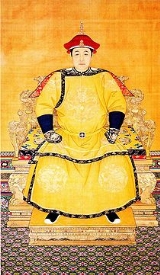
Shunzhi Emperor

Encyclopedia
The Shunzhi Emperor was the third emperor
of the Manchu
-led Qing dynasty
, and the first Qing emperor to rule over China
, which he did from 1644 to 1661. "Shunzhi" was the name of his reign period
. His personal name was Fulin (of the Aisin Gioro
clan) and his temple name
(chosen after he died) was Shizu 世祖.
A committee of Manchu princes
chose the young Fulin to succeed his father Hung Taiji in September 1643 when he was only five. Two co-regents were also appointed: Nurhaci
's fourteenth son Dorgon
, and Nurhaci's nephew Jirgalang
. From 1643 until Dorgon's death on the last day of 1650, political power lay mostly in the hands of Dorgon. After the young emperor started to rule personally in 1651, he tried, with mixed success, to fight corruption and to reduce the political influence of the Manchu nobility. He died of smallpox
, a lethal disease that was endemic in China, but against which the Manchus had no immunity
. He was succeeded by his third son Xuanye, who had already survived smallpox, and who subsequently reigned for sixty years as the Kangxi emperor.
Under the leadership of Dorgon and the Shunzhi emperor, the Qing dynasty conquered most of the territory of the fallen Ming
and its last claimants
and established the basis of Qing rule over China
despite highly unpopular policies like the "haircutting command" of 1645, which forced Qing subjects to shave their forehead and braid their remaining hair into a queue
. Because the Shunzhi reign is not well documented, it constitutes a relatively little-known period of Qing history.
 When Hung Taiji, the second Qing emperor, died on 21 September 1643 without having named a successor, the fledgling Qing state faced a possibly serious crisis. Several contenders started to vie for the throne. With his uterine
brothers Dodo
and Ajige
, Dorgon
controlled the Plain and Bordered White Banners
, whereas Hung Taiji's eldest son Hooge
had the loyalty of his father's two Yellow Banners.
The decision about who would become the new Qing emperor fell to the Deliberative Council of Princes and Ministers
, which was the Manchus' main policymaking body until the emergence of the Grand Council
in the 1720s. Many Manchu princes advocated that Dorgon
, a proven military leader, should become the new emperor, but Dorgon refused and insisted that one of Hung Taiji's sons should succeed his father. To recognize Dorgon's authority while keeping the throne in Hung Taiji's descent line, the members of the council named Hung Taiji's ninth son Fulin as the new emperor, but decided that Dorgon and Jirgalang
(a nephew of Nurhaci who controlled the Bordered Blue Banner) would act as the five-year-old child's regent
s.
On October 8, 1643, Fulin was officially crowned Emperor
of the Qing dynasty; it was decided that he would reign under the era name
"Shunzhi."
, who was a capable military leader but looked uninterested in managing state affairs, willingly yielded control of all official matters to Dorgon. After an alleged plot by Hooge
to undermine the regency was exposed on May 6 of that year, Hooge was stripped of his title of Imperial Prince and his co-conspirators were executed. Dorgon soon replaced Hooge's supporters (mostly from the Yellow Banners) with his own, thus gaining closer control of two more Banners. By early June 1644, he was in firm control of the Qing government and its military.
, peasant rebellions were ravaging northern China and dangerously approaching the Ming capital Beijing
. In February 1644, rebel leader Li Zicheng had founded the Shun Dynasty
in Xi'an
and proclaimed himself king. In March his armies had captured the important city of Taiyuan
in Shanxi
. Seeing the progress of the rebels, on April 5 the Ming Chongzhen Emperor
requested the urgent help of any military commandant in the empire. But it was too late: on April 24 Li Zicheng breached the walls of Beijing, and the emperor hanged himself the next day on a hill behind the Forbidden City
. He was the last Ming emperor to reign in Beijing.
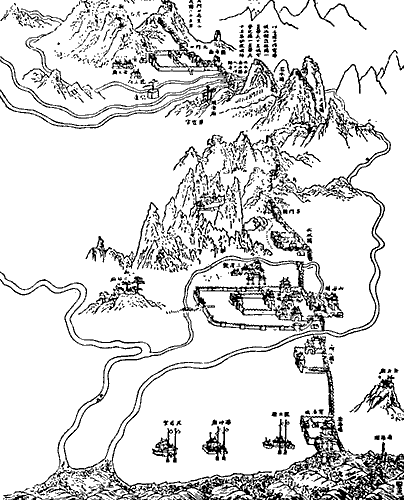 Soon after the emperor had called for help, powerful Ming general Wu Sangui
had left his stronghold of Ningyuan
north of the Great Wall and started marching toward the capital. On April 26, his armies had moved through the fortifications of Shanhai Pass
(the eastern end of the Great Wall) and were marching toward Beijing when he heard that the city had fallen. He returned to Shanhai Pass. Li Zicheng sent two armies to attack the Pass but Wu's battle-hardened troops defeated them easily on May 5 and May 10. Then on May 18, Li Zicheng personally led 60,000 of his troops out of Beijing to attack Wu. At the same time, Wu Sangui wrote to Dorgon to request the Qing's help in ousting the bandits and restoring the Ming dynasty.
Meanwhile Wu Sangui's departure from the stronghold of Ningyuan
had left all territory outside the Great Wall under Qing control. Dorgon's Chinese advisors, the two most illustrious of which were Hong Chengchou
and Fan Wencheng (范文程), urged the Manchu prince to seize the opportunity of the fall of Beijing to claim the Mandate of Heaven
for the Qing dynasty. When Dorgon received Wu's letter, he was already leading an expedition to attack northern China and therefore had no intention to restore the Ming. When Dorgon asked Wu to work for the Qing instead, Wu had little choice but to accept.
After Wu formally surrendered to the Qing in the morning of May 27, his elite troops charged the rebel army repeatedly, but were unable to break the enemy lines. Dorgon waited until both sides were weakened before ordering his cavalry to gallop around Wu's right wing to charge Li's left flank. Li Zicheng's troops were quickly routed and fled back toward Beijing. After their defeat at the Battle of Shanhai Pass
, the Shun troops looted Beijing for several days until Li Zicheng left the capital on June 4, one day after he had defiantly proclaimed himself Emperor
of the Great Shun.
 After six weeks of mistreatment at the hands of rebel troops, the Beijing population sent a party of elders and officials to greet their liberators on June 5. They were startled when, instead of meeting Wu Sangui and the Ming heir apparent, they saw Dorgon, a horseriding Manchu with his shaved forehead, present himself as the Prince Regent. In the midst of this upheaval, Dorgon installed himself in the Wuying Palace (武英殿), "the only reasonably undamaged structure" after Li Zicheng had set fire to the palace complex on June 3.
Just two days after entering the city, Dorgon issued special proclamations to officials around the capital, assuring them that if the local population accepted to shave their forehead and surrender, the officials would be allowed to stay at their post. He had to repeal this command three weeks later after several peasant rebellions erupted around Beijing, threatening Qing control over the capital region.
Dorgon greeted the Shunzhi Emperor at the gates of Beijing on October 19, 1644. On October 30 the young emperor performed sacrifices to Heaven and Earth at the Altar of Heaven. A formal ritual of enthronement for Fulin was held on November 8, during which the merits of Dorgon as regent were compared to those of the Duke of Zhou
. During the ceremony, Dorgon's official title is raised from "Prince Regent" to "Uncle Prince Regent" (Shufu shezheng wang 叔父攝政王), in which the Manchu term for "Uncle" (ecike) represented a rank higher than that of imperial prince. Three days later Dorgon's co-regent Jirgalang was demoted from "Prince Regent" to "Assistant Uncle Prince Regent" (Fu zheng shuwang 輔政叔王). In June of 1645, Dorgon eventually decreed that all official documents should refer to him as "Imperial Uncle Prince Regent" (Huang shufu shezheng wang 皇叔父攝政王).
local elites and officials, and conquered Shanxi
and Shaanxi
, then turned their eyes to Jiangnan
as they were also pursuing the last remnants of regimes established by Li Zicheng (killed in 1645) and Zhang Xianzhong
(Chengdu
taken in early 1647). The Qing also eliminated remnants of the loyalist Southern Ming regime in Nanjing
(1645), Fuzhou
(1646), and Guangzhou
(1647), and chased Zhu Youlang, the last monarch of the Southern Ming, into the far southwestern reaches of China.
, of their titles and assumed full imperial authority.
During his short reign, the Shunzhi emperor encouraged the Han Chinese
to participate in government activities. He was a scholar and employed Han Chinese to teach his children. He was also an open minded emperor and relied on the advice of Johann Adam Schall von Bell
湯若望, a Jesuit from Germany
, for guidance ranging from astronomy
, technologies, to tips for governing an empire. Shunzhi also elevated Schall to his personal mentor and was given free access to the palace.
The emperor married his mother's niece, but demoted the empress several years later.
Because of power issues in the Qing's ancestors' way, Shunzhi ultimately took another step to consolidate the power of the emperor. According to the old way, the 8 Banners were passed with succession much like how Nurhaci decided to give his Yellow Banners to Dorgun, but could potentially be controlled by someone like Huang Taji who switched the Banners. To solve this problem, Shunzi ordered the Upper 3 Banners- Plain Yellow, Striped Yellow, and Plain White to be under the control of the emperor. This would be maintained until Yongzheng and Qianlong's reign when they took the last step and controlled all 8 Banners.
After he assumed personal rule in 1651, the emperor tried to root out corruption in the realm, but with little success.
and died shortly thereafter. It was also believed by some that the young emperor did not pass away but left the palace to become a monk. Information is not clear, but it is said that Shunzhi later become a monk. Although not officially stated in history, it is said he later died of smallpox.
Before he died, he appointed four regents to govern for his child son, Xuanye
- Oboi
, Sonin
, Suksaha
, and Ebilun
.
Contrary to Manchu customs at the time, which usually dictated that a deceased person should be cremated, the Shunzhi emperor was buried. He was interred in what later came to be known as the Eastern Qing Tombs
, 125 kilometers/75 miles northeast of Beijing, one of two Qing imperial cemeteries. His tomb was part of the Xiaoling (孝陵) mausoleum complex, known in Manchu
as the Hiyoošungga Munggan.
; his mother was Empress Dowager Xiaozhuang.
genealogy made by the Imperial Clan Court
, burial records show that he had at least thirty-two of them. Eleven bore him children. There were two Empresses in his reign, both relatives of Empress Dowager Xiaozhuang from the Borjigit clan. After the 1644 conquest, Imperial Consorts and Empresses were usually known by their titles and by the name of their patrilineal clan.
Emperor of China
The Emperor of China refers to any sovereign of Imperial China reigning between the founding of Qin Dynasty of China, united by the King of Qin in 221 BCE, and the fall of Yuan Shikai's Empire of China in 1916. When referred to as the Son of Heaven , a title that predates the Qin unification, the...
of the Manchu
Manchu
The Manchu people or Man are an ethnic minority of China who originated in Manchuria . During their rise in the 17th century, with the help of the Ming dynasty rebels , they came to power in China and founded the Qing Dynasty, which ruled China until the Xinhai Revolution of 1911, which...
-led Qing dynasty
Qing Dynasty
The Qing Dynasty was the last dynasty of China, ruling from 1644 to 1912 with a brief, abortive restoration in 1917. It was preceded by the Ming Dynasty and followed by the Republic of China....
, and the first Qing emperor to rule over China
China
Chinese civilization may refer to:* China for more general discussion of the country.* Chinese culture* Greater China, the transnational community of ethnic Chinese.* History of China* Sinosphere, the area historically affected by Chinese culture...
, which he did from 1644 to 1661. "Shunzhi" was the name of his reign period
Chinese era name
A Chinese era name is the regnal year, reign period, or regnal title used when traditionally numbering years in an emperor's reign and naming certain Chinese rulers . Some emperors have several era names, one after another, where each beginning of a new era resets the numbering of the year back...
. His personal name was Fulin (of the Aisin Gioro
Aisin Gioro
Aisin Gioro was the family name of the Manchu emperors of the Qing Dynasty. The House of Aisin Gioro ruled China until the Xinhai Revolution of 1911, which established a republican government in its place. The word aisin means gold in the Manchu language, and "gioro" is the name of the place in...
clan) and his temple name
Temple name
Temple names are commonly used when naming most Chinese, Korean , and Vietnamese royalty. They should not be confused with era names. Compared to posthumous names, the use of temple names is more exclusive...
(chosen after he died) was Shizu 世祖.
A committee of Manchu princes
Qing Dynasty nobility
The Qing Dynasty of China developed a complicated peerage system for ranking nobility. All titles were to be inherited by a noble's eldest son, but always one grade lower. There were instances, however, where an emperor approved of a title being hereditary . This was regarded as an honour by the...
chose the young Fulin to succeed his father Hung Taiji in September 1643 when he was only five. Two co-regents were also appointed: Nurhaci
Nurhaci
Nurhaci was an important Jurchen chieftain who rose to prominence in the late sixteenth century in what is today Northeastern China...
's fourteenth son Dorgon
Dorgon
Dorgon , also known as Hošoi Mergen Cin Wang, the Prince Rui , was one of the most influential Manchu princes in the early Qing Dynasty. He laid the groundwork for the Manchu rule of China.-Early life:Dorgon was born in Yenden, Manchuria , China...
, and Nurhaci's nephew Jirgalang
Jirgalang
Jirgalang or Jirhalang , the sixth son of Nurhaci's younger brother Šurhaci of the Aisin Gioro clan, was a Manchu noble and an important military and political leader in the early years of the Qing dynasty. From 1638 to 1643, he took part in many military campaigns that helped bring down the fall...
. From 1643 until Dorgon's death on the last day of 1650, political power lay mostly in the hands of Dorgon. After the young emperor started to rule personally in 1651, he tried, with mixed success, to fight corruption and to reduce the political influence of the Manchu nobility. He died of smallpox
Smallpox
Smallpox was an infectious disease unique to humans, caused by either of two virus variants, Variola major and Variola minor. The disease is also known by the Latin names Variola or Variola vera, which is a derivative of the Latin varius, meaning "spotted", or varus, meaning "pimple"...
, a lethal disease that was endemic in China, but against which the Manchus had no immunity
Immunity
-Medicine:* Immunity , resistance of an organism to infection or disease.* Immunity , a scientific journal published by Cell Press-Law:*Amnesty law, immunity from past crimes...
. He was succeeded by his third son Xuanye, who had already survived smallpox, and who subsequently reigned for sixty years as the Kangxi emperor.
Under the leadership of Dorgon and the Shunzhi emperor, the Qing dynasty conquered most of the territory of the fallen Ming
Ming
Ming is a common personal name among Chinese people, Vietnamese people, and Korean people. In pinyin, it is written Míng, in romanized Vietnamese, it is written as Minh, and in Korean it is pronounced Myeong...
and its last claimants
Southern Ming Dynasty
The Southern Ming Dynasty was the Ming loyalist regime that continued in Southern China from 1644 to 1662 following the capture of Beijing by rebel armies and the death of the last Ming emperor in 1644....
and established the basis of Qing rule over China
China
Chinese civilization may refer to:* China for more general discussion of the country.* Chinese culture* Greater China, the transnational community of ethnic Chinese.* History of China* Sinosphere, the area historically affected by Chinese culture...
despite highly unpopular policies like the "haircutting command" of 1645, which forced Qing subjects to shave their forehead and braid their remaining hair into a queue
Queue (hairstyle)
The queue or cue is a hairstyle in which the hair is worn long and gathered up into a ponytail. It was worn traditionally by certain Native American groups and the Manchu of Manchuria.-Manchu Queue:...
. Because the Shunzhi reign is not well documented, it constitutes a relatively little-known period of Qing history.
Becoming emperor
Uterine
The word uterine can refer to different meanings:* relating to or near the uterus or womb* having the same mother, but different fathers, see matrilineality...
brothers Dodo
Dodo (prince)
Dodo was a Manchu prince and military general of the early Qing Dynasty. His title was "Prince Yu of the First Rank" .-Family background:...
and Ajige
Ajige
Ajige was a prince and general of the Qing Dynasty. He was born of the Manchu Aisin Gioro clan as the 12th son of Nurhaci, khan of the Later Jin Dynasty ....
, Dorgon
Dorgon
Dorgon , also known as Hošoi Mergen Cin Wang, the Prince Rui , was one of the most influential Manchu princes in the early Qing Dynasty. He laid the groundwork for the Manchu rule of China.-Early life:Dorgon was born in Yenden, Manchuria , China...
controlled the Plain and Bordered White Banners
Eight Banners
The Eight Banners were administrative divisions into which all Manchu families were placed. They provided the basic framework for the Manchu military organization...
, whereas Hung Taiji's eldest son Hooge
Hooge, Prince Su
Hooge was a prominent Manchu prince. He was the eldest son of Emperor Huang Taiji of the Qing Dynasty. He was the founder of the House of Prince Su .-Life:...
had the loyalty of his father's two Yellow Banners.
The decision about who would become the new Qing emperor fell to the Deliberative Council of Princes and Ministers
Deliberative Council of Princes and Ministers
The Deliberative Council of Princes and Ministers , also known as the Council of Princes and High Officials or simply as the Deliberative Council , was an advisory body for the Emperors of the early Qing Dynasty...
, which was the Manchus' main policymaking body until the emergence of the Grand Council
Grand Council
The Grand Council or Junjichu was an important policy-making body in the Qing Empire. It was established in 1733 by the Yongzheng Emperor...
in the 1720s. Many Manchu princes advocated that Dorgon
Dorgon
Dorgon , also known as Hošoi Mergen Cin Wang, the Prince Rui , was one of the most influential Manchu princes in the early Qing Dynasty. He laid the groundwork for the Manchu rule of China.-Early life:Dorgon was born in Yenden, Manchuria , China...
, a proven military leader, should become the new emperor, but Dorgon refused and insisted that one of Hung Taiji's sons should succeed his father. To recognize Dorgon's authority while keeping the throne in Hung Taiji's descent line, the members of the council named Hung Taiji's ninth son Fulin as the new emperor, but decided that Dorgon and Jirgalang
Jirgalang
Jirgalang or Jirhalang , the sixth son of Nurhaci's younger brother Šurhaci of the Aisin Gioro clan, was a Manchu noble and an important military and political leader in the early years of the Qing dynasty. From 1638 to 1643, he took part in many military campaigns that helped bring down the fall...
(a nephew of Nurhaci who controlled the Bordered Blue Banner) would act as the five-year-old child's regent
Regent
A regent, from the Latin regens "one who reigns", is a person selected to act as head of state because the ruler is a minor, not present, or debilitated. Currently there are only two ruling Regencies in the world, sovereign Liechtenstein and the Malaysian constitutive state of Terengganu...
s.
On October 8, 1643, Fulin was officially crowned Emperor
Emperor of China
The Emperor of China refers to any sovereign of Imperial China reigning between the founding of Qin Dynasty of China, united by the King of Qin in 221 BCE, and the fall of Yuan Shikai's Empire of China in 1916. When referred to as the Son of Heaven , a title that predates the Qin unification, the...
of the Qing dynasty; it was decided that he would reign under the era name
Chinese era name
A Chinese era name is the regnal year, reign period, or regnal title used when traditionally numbering years in an emperor's reign and naming certain Chinese rulers . Some emperors have several era names, one after another, where each beginning of a new era resets the numbering of the year back...
"Shunzhi."
Dorgon's regency (1643–1650)
A quasi emperor
On February 17, 1644, JirgalangJirgalang
Jirgalang or Jirhalang , the sixth son of Nurhaci's younger brother Šurhaci of the Aisin Gioro clan, was a Manchu noble and an important military and political leader in the early years of the Qing dynasty. From 1638 to 1643, he took part in many military campaigns that helped bring down the fall...
, who was a capable military leader but looked uninterested in managing state affairs, willingly yielded control of all official matters to Dorgon. After an alleged plot by Hooge
Hooge, Prince Su
Hooge was a prominent Manchu prince. He was the eldest son of Emperor Huang Taiji of the Qing Dynasty. He was the founder of the House of Prince Su .-Life:...
to undermine the regency was exposed on May 6 of that year, Hooge was stripped of his title of Imperial Prince and his co-conspirators were executed. Dorgon soon replaced Hooge's supporters (mostly from the Yellow Banners) with his own, thus gaining closer control of two more Banners. By early June 1644, he was in firm control of the Qing government and its military.
The fall of the Ming and the Qing takeover
Just as Dorgon and his advisors were pondering how to attack the MingMing Dynasty
The Ming Dynasty, also Empire of the Great Ming, was the ruling dynasty of China from 1368 to 1644, following the collapse of the Mongol-led Yuan Dynasty. The Ming, "one of the greatest eras of orderly government and social stability in human history", was the last dynasty in China ruled by ethnic...
, peasant rebellions were ravaging northern China and dangerously approaching the Ming capital Beijing
Beijing
Beijing , also known as Peking , is the capital of the People's Republic of China and one of the most populous cities in the world, with a population of 19,612,368 as of 2010. The city is the country's political, cultural, and educational center, and home to the headquarters for most of China's...
. In February 1644, rebel leader Li Zicheng had founded the Shun Dynasty
Shun Dynasty
The Shun Dynasty was an imperial dynasty created in the brief lapse from Ming to Qing rule in China. The dynasty was founded in Xi'an on 8 February 1644, the first day of the lunar year, by Li Zicheng, the leader of a large peasant rebellion. Li, however, only went by the title of King, not Emperor...
in Xi'an
Xi'an
Xi'an is the capital of the Shaanxi province, and a sub-provincial city in the People's Republic of China. One of the oldest cities in China, with more than 3,100 years of history, the city was known as Chang'an before the Ming Dynasty...
and proclaimed himself king. In March his armies had captured the important city of Taiyuan
Taiyuan
Taiyuan is the capital and largest city of Shanxi province in North China. At the 2010 census, it had a total population of 4,201,591 inhabitants on 6959 km² whom 3,212,500 are urban on 1,460 km². The name of the city literally means "Great Plains", referring to the location where the Fen River...
in Shanxi
Shanxi
' is a province in Northern China. Its one-character abbreviation is "晋" , after the state of Jin that existed here during the Spring and Autumn Period....
. Seeing the progress of the rebels, on April 5 the Ming Chongzhen Emperor
Chongzhen Emperor
The Chongzhen Emperor was the 16th and last emperor of the Ming Dynasty in China. He reigned from 1627 to 1644, under an era name that means "honorable and auspicious".- Early years :...
requested the urgent help of any military commandant in the empire. But it was too late: on April 24 Li Zicheng breached the walls of Beijing, and the emperor hanged himself the next day on a hill behind the Forbidden City
Forbidden City
The Forbidden City was the Chinese imperial palace from the Ming Dynasty to the end of the Qing Dynasty. It is located in the middle of Beijing, China, and now houses the Palace Museum...
. He was the last Ming emperor to reign in Beijing.
Wu Sangui
Wu Sangui was a Ming Chinese general who was instrumental in the succession of rule to the Qing Dynasty in 1644...
had left his stronghold of Ningyuan
Xingcheng
Xingcheng , former name Ningyuan , is a county-level city of Northeast China with a population of approximately 140,000 urban inhabitants, and is located in southwest Liaoning on the northern coast of the Bohai Sea...
north of the Great Wall and started marching toward the capital. On April 26, his armies had moved through the fortifications of Shanhai Pass
Shanhai Pass
Shanhai Pass , or Shanhaiguan, along with Jiayu Pass and Juyong Pass, is one of the major passes of the Great Wall of China It is located in Shanhaiguan District, Qinhuangdao, Hebei. In 1961, Shanhaiguan became a site of China First Class National Cultural Site.It is a popular tourist destination,...
(the eastern end of the Great Wall) and were marching toward Beijing when he heard that the city had fallen. He returned to Shanhai Pass. Li Zicheng sent two armies to attack the Pass but Wu's battle-hardened troops defeated them easily on May 5 and May 10. Then on May 18, Li Zicheng personally led 60,000 of his troops out of Beijing to attack Wu. At the same time, Wu Sangui wrote to Dorgon to request the Qing's help in ousting the bandits and restoring the Ming dynasty.
Meanwhile Wu Sangui's departure from the stronghold of Ningyuan
Battle of Ningyuan
The Battle of Ningyuan was a battle between the Ming Dynasty and the Manchurian Later Jin in 1626. The Ming won this battle. This battle marked the temporary resurgence of the Imperial Ming army after a long series of defeats....
had left all territory outside the Great Wall under Qing control. Dorgon's Chinese advisors, the two most illustrious of which were Hong Chengchou
Hong Chengchou
Hong Chengchou or Hung Cheng-chou was a Military commander from Fujian at the end of the Ming Dynasty.-Biography:...
and Fan Wencheng (范文程), urged the Manchu prince to seize the opportunity of the fall of Beijing to claim the Mandate of Heaven
Mandate of Heaven
The Mandate of Heaven is a traditional Chinese philosophical concept concerning the legitimacy of rulers. It is similar to the European concept of the divine right of kings, in that both sought to legitimaze rule from divine approval; however, unlike the divine right of kings, the Mandate of...
for the Qing dynasty. When Dorgon received Wu's letter, he was already leading an expedition to attack northern China and therefore had no intention to restore the Ming. When Dorgon asked Wu to work for the Qing instead, Wu had little choice but to accept.
After Wu formally surrendered to the Qing in the morning of May 27, his elite troops charged the rebel army repeatedly, but were unable to break the enemy lines. Dorgon waited until both sides were weakened before ordering his cavalry to gallop around Wu's right wing to charge Li's left flank. Li Zicheng's troops were quickly routed and fled back toward Beijing. After their defeat at the Battle of Shanhai Pass
Battle of Shanhai Pass
The Battle of Shanhai Pass, fought on 27 May 1644 at Shanhaiguan at the eastern end of the Great Wall of China, was a decisive battle leading to the formation of the Qing dynasty in China...
, the Shun troops looted Beijing for several days until Li Zicheng left the capital on June 4, one day after he had defiantly proclaimed himself Emperor
Emperor of China
The Emperor of China refers to any sovereign of Imperial China reigning between the founding of Qin Dynasty of China, united by the King of Qin in 221 BCE, and the fall of Yuan Shikai's Empire of China in 1916. When referred to as the Son of Heaven , a title that predates the Qin unification, the...
of the Great Shun.
Just two days after entering the city, Dorgon issued special proclamations to officials around the capital, assuring them that if the local population accepted to shave their forehead and surrender, the officials would be allowed to stay at their post. He had to repeal this command three weeks later after several peasant rebellions erupted around Beijing, threatening Qing control over the capital region.
Dorgon greeted the Shunzhi Emperor at the gates of Beijing on October 19, 1644. On October 30 the young emperor performed sacrifices to Heaven and Earth at the Altar of Heaven. A formal ritual of enthronement for Fulin was held on November 8, during which the merits of Dorgon as regent were compared to those of the Duke of Zhou
Duke of Zhou
The Duke of Zhou played a major role in consolidating the newly-founded Zhou Dynasty . He was the brother of King Wu of Zhou, the first king of the ancient Chinese Zhou Dynasty...
. During the ceremony, Dorgon's official title is raised from "Prince Regent" to "Uncle Prince Regent" (Shufu shezheng wang 叔父攝政王), in which the Manchu term for "Uncle" (ecike) represented a rank higher than that of imperial prince. Three days later Dorgon's co-regent Jirgalang was demoted from "Prince Regent" to "Assistant Uncle Prince Regent" (Fu zheng shuwang 輔政叔王). In June of 1645, Dorgon eventually decreed that all official documents should refer to him as "Imperial Uncle Prince Regent" (Huang shufu shezheng wang 皇叔父攝政王).
The conquest of China
Historian Dai Yingcong has called Dorgon "the mastermind of the Qing conquest." Under his reign, the Qing subdued the capital area, received the capitulation of ShandongShandong
' is a Province located on the eastern coast of the People's Republic of China. Shandong has played a major role in Chinese history from the beginning of Chinese civilization along the lower reaches of the Yellow River and served as a pivotal cultural and religious site for Taoism, Chinese...
local elites and officials, and conquered Shanxi
Shanxi
' is a province in Northern China. Its one-character abbreviation is "晋" , after the state of Jin that existed here during the Spring and Autumn Period....
and Shaanxi
Shaanxi
' is a province in the central part of Mainland China, and it includes portions of the Loess Plateau on the middle reaches of the Yellow River in addition to the Qinling Mountains across the southern part of this province...
, then turned their eyes to Jiangnan
Jiangnan
Jiangnan or Jiang Nan is a geographic area in China referring to lands immediately to the south of the lower reaches of the Yangtze River, including the southern part of the Yangtze Delta...
as they were also pursuing the last remnants of regimes established by Li Zicheng (killed in 1645) and Zhang Xianzhong
Zhang Xianzhong
Zhang Xianzhong or Chang Hsien-chung , nicknamed Yellow Tiger, was a Chinese rebel leader who conquered Sichuan Province in the middle of the 17th century. Upon capturing it, he declared himself emperor of the Daxi Dynasty .According to Chinese chronicles, many scholars rejected that claim, so he...
(Chengdu
Chengdu
Chengdu , formerly transliterated Chengtu, is the capital of Sichuan province in Southwest China. It holds sub-provincial administrative status...
taken in early 1647). The Qing also eliminated remnants of the loyalist Southern Ming regime in Nanjing
Nanjing
' is the capital of Jiangsu province in China and has a prominent place in Chinese history and culture, having been the capital of China on several occasions...
(1645), Fuzhou
Fuzhou
Fuzhou is the capital and one of the largest cities in Fujian Province, People's Republic of China. Along with the many counties of Ningde, those of Fuzhou are considered to constitute the Mindong linguistic and cultural area....
(1646), and Guangzhou
Guangzhou
Guangzhou , known historically as Canton or Kwangchow, is the capital and largest city of the Guangdong province in the People's Republic of China. Located in southern China on the Pearl River, about north-northwest of Hong Kong, Guangzhou is a key national transportation hub and trading port...
(1647), and chased Zhu Youlang, the last monarch of the Southern Ming, into the far southwestern reaches of China.
The haircutting command
One of Dorgon's most controversial decisions was his 1645 imperial edict (the "Queue Order") which forced all Han Chinese men, on pain of death, to adopt the Manchu style of dress, including shaving the front of their heads and combing the remaining hair into a queue. To the Manchus this policy might both be a symbolic act of submission and in practical terms an aid in identification of friend from foe, however for the Han Chinese it went against their traditional Confucian values. Unsurprisingly, it was deeply unpopular and, together with other policies unfavourable towards the Han Chinese, might account for the increasingly steep resistance met by Qing forces after 1645. Hundreds of thousands of people were killed before all of China was brought into compliance.Transition and personal rule (1651–1661)
After Dorgon's death in 1650 the emperor stripped both him and Dorgon's brother, DodoDodo (prince)
Dodo was a Manchu prince and military general of the early Qing Dynasty. His title was "Prince Yu of the First Rank" .-Family background:...
, of their titles and assumed full imperial authority.
During his short reign, the Shunzhi emperor encouraged the Han Chinese
Han Chinese
Han Chinese are an ethnic group native to China and are the largest single ethnic group in the world.Han Chinese constitute about 92% of the population of the People's Republic of China , 98% of the population of the Republic of China , 78% of the population of Singapore, and about 20% of the...
to participate in government activities. He was a scholar and employed Han Chinese to teach his children. He was also an open minded emperor and relied on the advice of Johann Adam Schall von Bell
Johann Adam Schall von Bell
Johann Adam Schall von Bell was a German Jesuit and astronomer. He spent most of his life as a missionary in China and became an adviser to the Chinese emperor.- Life :...
湯若望, a Jesuit from Germany
Germany
Germany , officially the Federal Republic of Germany , is a federal parliamentary republic in Europe. The country consists of 16 states while the capital and largest city is Berlin. Germany covers an area of 357,021 km2 and has a largely temperate seasonal climate...
, for guidance ranging from astronomy
Astronomy
Astronomy is a natural science that deals with the study of celestial objects and phenomena that originate outside the atmosphere of Earth...
, technologies, to tips for governing an empire. Shunzhi also elevated Schall to his personal mentor and was given free access to the palace.
The emperor married his mother's niece, but demoted the empress several years later.
Because of power issues in the Qing's ancestors' way, Shunzhi ultimately took another step to consolidate the power of the emperor. According to the old way, the 8 Banners were passed with succession much like how Nurhaci decided to give his Yellow Banners to Dorgun, but could potentially be controlled by someone like Huang Taji who switched the Banners. To solve this problem, Shunzi ordered the Upper 3 Banners- Plain Yellow, Striped Yellow, and Plain White to be under the control of the emperor. This would be maintained until Yongzheng and Qianlong's reign when they took the last step and controlled all 8 Banners.
After he assumed personal rule in 1651, the emperor tried to root out corruption in the realm, but with little success.
Death and succession
In 1661, Shunzhi's favourite concubine Donggo suddenly died as a result of grief over the loss of a child. Overwhelmed with grief himself, Shunzhi contracted smallpoxSmallpox
Smallpox was an infectious disease unique to humans, caused by either of two virus variants, Variola major and Variola minor. The disease is also known by the Latin names Variola or Variola vera, which is a derivative of the Latin varius, meaning "spotted", or varus, meaning "pimple"...
and died shortly thereafter. It was also believed by some that the young emperor did not pass away but left the palace to become a monk. Information is not clear, but it is said that Shunzhi later become a monk. Although not officially stated in history, it is said he later died of smallpox.
Before he died, he appointed four regents to govern for his child son, Xuanye
Kangxi Emperor
The Kangxi Emperor ; Manchu: elhe taifin hūwangdi ; Mongolian: Энх-Амгалан хаан, 4 May 1654 –20 December 1722) was the fourth emperor of the Qing Dynasty, the first to be born on Chinese soil south of the Pass and the second Qing emperor to rule over China proper, from 1661 to 1722.Kangxi's...
- Oboi
Oboi
Oboi was a highly decorated Manchu military commander and courtier who served in various military and administrative posts under three successive Emperors of the early Qing Dynasty. He was one of four regents nominated by the Shunzhi Emperor to oversee the government during the Kangxi Emperor's...
, Sonin
Sonin
Sonin, also known as Soni, and rarely Sony , was a senior regent of the Four Regents during Chinese Kangxi Emperor's minority in the Qing Dynasty. Sonin was from the Heseri clan, belonged to the Plain Yellow Banner....
, Suksaha
Suksaha
Suksaha was a one of the Four Regents during the early reign of the Chinese Kangxi Emperor in the Qing Dynasty.Like his father Suna, he was from the Nara clan, but the family fought under the White Banner of the Manchu Eight Banners instead. During the Manchurian conquest of China, he was rewarded...
, and Ebilun
Ebilun
Ebilun was one of the Four Regents and an assistant minister appointed by the Shunzhi Emperor for his successor, Kangxi during the Qing Dynasty. Ebilun worked with Oboi to defeat Suksaha.His mother was the Aisin Gioro princess.-See also:**...
.
Contrary to Manchu customs at the time, which usually dictated that a deceased person should be cremated, the Shunzhi emperor was buried. He was interred in what later came to be known as the Eastern Qing Tombs
Eastern Qing Tombs
The Eastern Qing Tombs are an imperial mausoleum complex of the Qing Dynasty located in Zunhua, 125 kilometers northeast of Beijing. They are the largest, most complete, and best preserved extant mausoleum complex in China...
, 125 kilometers/75 miles northeast of Beijing, one of two Qing imperial cemeteries. His tomb was part of the Xiaoling (孝陵) mausoleum complex, known in Manchu
Manchu language
Manchu is a Tungusic endangered language spoken in Northeast China; it used to be the language of the Manchu, though now most Manchus speak Mandarin Chinese and there are fewer than 70 native speakers of Manchu out of a total of nearly 10 million ethnic Manchus...
as the Hiyoošungga Munggan.
Ancestors
His father was the previous Qing emperor Hong TaijiHong Taiji
Hong Taiji , also transliterated as Huang Taiji based on the Chinese language transcription of his name, was the first Emperor of the Qing Dynasty.Hong Taiji was the first Emperor of the Qing dynasty after acceding to the title in 1636...
; his mother was Empress Dowager Xiaozhuang.
- Father: Hong TaijiHong TaijiHong Taiji , also transliterated as Huang Taiji based on the Chinese language transcription of his name, was the first Emperor of the Qing Dynasty.Hong Taiji was the first Emperor of the Qing dynasty after acceding to the title in 1636...
(1592–1643), emperor of the Qing dynastyQing DynastyThe Qing Dynasty was the last dynasty of China, ruling from 1644 to 1912 with a brief, abortive restoration in 1917. It was preceded by the Ming Dynasty and followed by the Republic of China....
(of whom Fulin was the 9th son). - Mother: Bumbutai (1613-1688), or concubine Zhuang; daughter of a Mongol prince of the Borjigit clan (the descendants of Genghis KhanGenghis KhanGenghis Khan , born Temujin and occasionally known by his temple name Taizu , was the founder and Great Khan of the Mongol Empire, which became the largest contiguous empire in history after his death....
's brother Hasar); known posthumously as Empress Xiaozhuangwen (ManchuManchuThe Manchu people or Man are an ethnic minority of China who originated in Manchuria . During their rise in the 17th century, with the help of the Ming dynasty rebels , they came to power in China and founded the Qing Dynasty, which ruled China until the Xinhai Revolution of 1911, which...
: Hiyoošungga Ambalinggū Genggiyenšu Hūwanghu). - Paternal grandfather: NurhaciNurhaciNurhaci was an important Jurchen chieftain who rose to prominence in the late sixteenth century in what is today Northeastern China...
(1559–1626), founder of the Qing dynastyQing DynastyThe Qing Dynasty was the last dynasty of China, ruling from 1644 to 1912 with a brief, abortive restoration in 1917. It was preceded by the Ming Dynasty and followed by the Republic of China....
. - Paternal grandmother: Monggo (1573–1603), of the Yehenara clan; posthumously known as Empress Xiaocigao.
Empresses and consorts
Although only nineteen Empresses and Consorts are recorded for Shunzhi in the Aisin GioroAisin Gioro
Aisin Gioro was the family name of the Manchu emperors of the Qing Dynasty. The House of Aisin Gioro ruled China until the Xinhai Revolution of 1911, which established a republican government in its place. The word aisin means gold in the Manchu language, and "gioro" is the name of the place in...
genealogy made by the Imperial Clan Court
Imperial Clan Court
The Imperial Clan Court , or Court of the Imperial Clan, was an institution responsible for all matters pertaining to the imperial family under the Ming and Qing dynasties of imperial China...
, burial records show that he had at least thirty-two of them. Eleven bore him children. There were two Empresses in his reign, both relatives of Empress Dowager Xiaozhuang from the Borjigit clan. After the 1644 conquest, Imperial Consorts and Empresses were usually known by their titles and by the name of their patrilineal clan.
- First Empress: the Demoted EmpressBorjigit, Demoted EmpressBorjigit, Demoted Empress refers to the first empress of the Shunzhi Emperor of the Qing Dynasty. She was a Khorchin Mongol, a branch of the Mongol Borjigit clan that claimed descent from Hasar, a younger brother of Genghis Khan. Her personal name was unknown...
Suoerna, from the Borjigit clan; niece of Empress Dowager Xiaozhuang. She was made Empress in 1651, but the monarch disliked her so much that he had her demoted in 1653. - Second Empress: Empress Xiaohuizhang (d. 1718) from the Borjigit clan. She was named Empress in 1654.
- Concubine from the TunggiyaTunggiyaTunggiya is the name of a Manchu clan.-Notable members:* Kangxi Emperor's birth mother, Empress Xiaokangzhang.* Kangxi Emperor's second wife, Empress Xiaoyiren.* Daoguang Emperor's second wife, Empress Xiaoshencheng....
clan (1640–1663). Her family was of Jurchen origin but lived among Chinese for generations. It had Chinese family name Tong (佟) but switched to the Manchu clan name Tunggiya. She was made Empress Dowager Cihe in 1661 when Kangxi became emperor. She is known posthumously as Empress Xiaokangzhang. - Imperial Noble Consort from the Donggo clan (1639-1660), posthumously raised to Empress Xiao Xian Duan Jing. She had a Han Chinese mother. The emperor was deeply in love with her and was very grieved when she died soon after their first son (Shunzhi's fourth) had died in infancy. He died of smallpox shortly thereafter.
Children
Eleven of Shunzhi's thirty-two spouses bore him a total of fourteen children, but only four sons (Fuquan, Xuanye, Changning, and Longxi) and one daughter (Princess Gongyi Chang) lived old enough to marry. Unlike later Qing emperors, the names of Shunzhi's sons did not include a generational character.Sons
- Niuniu 牛鈕 (December 13, 1651–March 9, 1652). Born to Consort Ba 巴.
- FuquanFuquan (prince)Fuquan 福全 or Prince Yu was a Manchu noble, the second son of the Shunzhi Emperor and half-brother of the Kangxi Emperor, both of the Qing dynasty of China. His mother was from the Donggo Clan. Fuquan was given the title of "Prince Yu" on February 6, 1671...
福全 (September 8, 1653–January 26, 1706). Born to Consort Ningyi 寧懿 from the Donggo clan. Became Prince Yu (裕親王) in 1667. - Xuanye 玄燁 (ManchuManchu languageManchu is a Tungusic endangered language spoken in Northeast China; it used to be the language of the Manchu, though now most Manchus speak Mandarin Chinese and there are fewer than 70 native speakers of Manchu out of a total of nearly 10 million ethnic Manchus...
: Hiowan Yei) (May 4, 1654–December 20, 1722), later became the Kangxi EmperorKangxi EmperorThe Kangxi Emperor ; Manchu: elhe taifin hūwangdi ; Mongolian: Энх-Амгалан хаан, 4 May 1654 –20 December 1722) was the fourth emperor of the Qing Dynasty, the first to be born on Chinese soil south of the Pass and the second Qing emperor to rule over China proper, from 1661 to 1722.Kangxi's...
. Born to Empress Xiaokangzhang. - 4th son (November 5, 1657–February 25, 1658), who died before he was given a name. Born to Imperial Noble Consort Donggo. Posthumously granted the title of Prince Rong (榮親王).
- ChangningChangning (prince)Changning was a prince of the Qing Dynasty. He was born of the Manchu Aisin Gioro clan as the fifth son of the Shunzhi Emperor. He was a half-brother to Shunzhi's successor, the Kangxi Emperor. His title was Prince Gong of the First Rank .-Biography:Changning received his princedom on 1 March 1671...
常寧 (December 8, 1657–July 20, 1703). Born to Consort Chen 陳. Became Prince Gong (恭親王) in 1671. - Qishou 奇授 (January 3, 1660–unknown date, at the age of seven suiEast Asian age reckoningEast Asian age reckoning is a concept and practice that originated in China and is widely used by other cultures in East Asia, which share this traditional way of counting a person's age. Newborns start at one year old, and each passing of a Lunar New Year, rather than the birthday, adds one year...
). Born to Consort Tang 唐. - Longxi 隆禧 (May 30, 1660–August 20, 1679). Born to Consort Niu 鈕. Became Prince Chun (純親王) in 1674; posthumouly called Prince Chun Jing (純靖親王). He fathered a son who died heirless.
- Yonggan 永幹 (January 23, 1661–unknown date, at the age of eight suiEast Asian age reckoningEast Asian age reckoning is a concept and practice that originated in China and is widely used by other cultures in East Asia, which share this traditional way of counting a person's age. Newborns start at one year old, and each passing of a Lunar New Year, rather than the birthday, adds one year...
). Born to Consort Muktu 穆克圖.
Daughters
- 1st Daughter (1652-1653). Born to Consort Chen 陳.
- 2nd Daughter (1653-1685): second-rank Princess (M.: hošoi gungju) Gongyi Chang (Ch.: heshuo Gongyi Chang gongzhu 和碩恭懿長公主). Married in 1667. Born to Consort Yang 楊.
- 3rd Daughter (1653-1658). Born to Consort Ba 巴.
- 4th Daughter (1654-1661). Born to Consort Usu 烏蘇.
- 5th Daughter (1654-1660). Born to Consort Wang 王.
- 6th Daughter (1657-1661). Born to Consort Nala 那拉.
Adopted daughters
- Princess Heshun (1648–1691). Married to Shang Zilong in 1660.
- Princess Roujia (1652–1673). Married to Guan Juzhong in 1663.
- Princess Duanmin (1653–1729). Married to Bandi in 1670.