

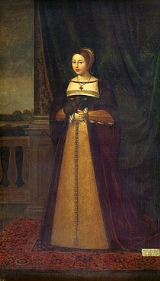
Margaret Tudor

Encyclopedia
Margaret Tudor was the elder of the two surviving daughters of Henry VII of England
and Elizabeth of York
, and the elder sister of Henry VIII
. In 1503, she married James IV
, King of Scots. James died in 1513, and their son became King James V
. She married secondly Archibald Douglas, 6th Earl of Angus
. Through her first and second marriages, respectively, Margaret was the grandmother of both Mary, Queen of Scots, and Mary's second husband Lord Darnley
. Margaret's marriage to James IV foreshadowed the Union of the Crowns
- their great-grandson, King James VI of Scotland, the child of Mary and Darnley, became King of England and Ireland on the death of Margaret's fraternal niece, Elizabeth I of England
.
Born on 28 November 1489, Margaret was baptised two days later on the 30th — St. Andrew's Day
— in St. Margaret's Church, Westminster
. She was named after Lady Margaret Beaufort, her grandmother.
, Yorkist pretender to the throne of England.
On 30 September 1497, James IV's commissioner, the Spaniard Pedro de Ayala
concluded a lengthy truce with England, and now the marriage was again a serious possibility. The Italian historian Polydore Virgil said that some of the English royal council objected to the match, saying that it would bring the Stewarts
directly into the line of English succession, to which the wily and astute Henry replied:
On 24 January 1502, Scotland and England concluded the Treaty of Perpetual Peace
, the first peace agreement between the two realms in over 170 years. The marriage treaty was concluded the same day and was viewed as a guarantee of the new peace.
on 25 January at Richmond Palace
. Patrick, Earl of Bothwell
, was proxy for the Scottish King and wore a gown of cloth-of-gold at the ceremony in the Queen's great chamber. He was accompanied by the Archbishop of Glasgow
and Andrew Forman, Postulate of Moray
. The herald
, John Young, reported that "right notable jousts" followed the ceremony. Prizes were awarded the next morning and the tournament continued another day.
Margaret was now regarded as Queen of Scots. It has been noted by some historians that her brother Henry
, then a child, second in line to the throne and Duke of York
, threw a tantrum when he realised his sister, a foreign Queen, now held higher precedence in court than he.
The new queen was provided with a large wardrobe of clothes, and her crimson state bed curtains made of Italian sarcenet were embroidered with red Lancastrian roses. Clothes were also made for her companion, Lady Catherine Gordon
, the widow of Perkin Warbeck
. In May 1503, James IV confirmed her possession of lands and houses in Scotland, including Methven Castle
, Stirling Castle
, Doune Castle
, Linlithgow Palace
and Newark Castle
in Ettrick Forest
, with the incomes from the corresponding Earldom and Lordship lands.
Later in 1503, Margaret came to Scotland; her progress was a grand journey northward. She left Richmond Palace on the 27 June with Henry VII and they travelled first to Collyweston
. Then her journey proper began; she stayed a night at, Grantham, Newark, Tuxford
, 'Sirowsby' (Thoresby
), Doncaster, Pontefract, and Tadcaster. At York
there is a plaque commemorating the exact spot where the Queen of Scots entered its gates. Then onto 'Newborough
', 'Allerton
', 'Darneton
', Durham, Newcastle, Morpeth
, and Alnwick Castle
. After crossing the border at Berwick upon Tweed on 1 August 1503, Margaret was met by the Scottish court at Lamberton. Her first night in Scotland was spent at Fast Castle
; the next at the Nunnery at Haddington
; on the third night at 'Acquik' or 'Dacquik' Castle, (Dalkeith Palace
), James came to kiss her goodnight. He came again to console her on 4 August after a stable fire had killed some of her favourite horses. Her riding gear was burnt and a new sumpter cloth
or pallion of cloth-of-gold with a velvet cushion cost £127. On the 7 August 1503, Margaret was carried from Dalkeith to Edinburgh on a litter.
At a meadow a mile from Edinburgh
, there was a pavilion where Sir Patrick Hamilton and Patrick Sinclair played and fought in the guise of knight defending his lady. On the 8 August 1503, the marriage was celebrated in person in Holyrood Abbey
. The rites were performed by the Archbishop of Glasgow
and the Archbishop of York
. Two days later, on St Lawrence's day, Margaret went to mass at St Giles', the town's Kirk
, as her first public appointment. The details of the proxy marriage, progress, arrival, and reception in Edinburgh were recorded by the Somerset Herald, John Young.
in poems including; The Thistle and the Rose; Gladethe, thoue Queyne of Scottis Regioun; the song Now Fayre, Fayrest of Every Fayre; and Blyth Aberdeane, written on Margaret's welcome to Aberdeen
. Dunbar had been in London during the treaty negotiations. In Dunbar's Thistle and the Rose, forest birds serenade the conjoined York and Lancastrian roses, a symbol of Margaret's parentage;
'merle'= blackbird; 'scho'= she; 'quhyt'= white; 'suffragane'= representative.
In Gladethe, thoue Queyne, Margaret is compared to the pearl as a prize above precious stones; more bright than beryl; more precious than the diamond; more beautiful than sapphire; lovelier than a green emerald; and more splendid than a famous ruby;
'Gladethe'= Rejoice! 'na'= than; 'beriale'= beryl
; 'eik'= also; 'of the I meyne'= thee I mean: I speak of you.
The song Now Fayre also includes the rose theme; the chorus begins, 'Welcome the rose both red and white,' the verses celebrate Margaret's youth, (she was thirteen), and the fairness of her complexion;
'lusum'= fair; 'clere'= bright;
, Scotland's ancient ally. In 1513, James invaded England to honour his commitment to the Auld Alliance
, only to meet death and disaster at the Battle of Flodden. Margaret had opposed the war, but was still named in the royal will as regent
for the infant king, James V, for as long as she remained a widow.
Parliament
met at Stirling
not long after Flodden, and confirmed Margaret in the office of Regent. A woman was rarely welcome in a position of supreme power, and Margaret was the sister of an enemy king, which served to compound her problems. Before long a pro-French party took shape among the nobility, urging that she should be replaced by John Stewart, 2nd Duke of Albany
, the closest male relative to the infant prince, and now third in line to the throne. Albany, who had been born and raised in France, was seen as a living representative of the Auld Alliance, in contrast with the pro-English Margaret. She is considered to have acted calmly and with some degree of political skill. By July 1514, she had managed to reconcile the contending parties, and Scotland — along with France — concluded peace with England that same month. But in her search for political allies amongst the fractious Scottish nobility she took a fatal step, allowing good sense and prudence to be overruled by emotion and magnetism.
In seeking allies Margaret turned more and more to the powerful House of Douglas. She found herself particularly attracted to Archibald Douglas, 6th Earl of Angus
, whom even his uncle, the cleric and poet Gavin Douglas
, called a "young witless fool." Margaret and Douglas were secretly married in the parish church of Kinnoull, near Perth
, on 6 August. Not only did this alienate the other noble houses but it immediately strengthened the pro-French faction on the council, headed by James Beaton, Archbishop of Glasgow
. By the terms of the late king's will she had sacrificed her position; before the month was out she was obliged to consent to the appointment of Albany. In September the Privy Council
decided that she had also forfeited her rights to the supervision of her sons, whereupon in defiance she and her allies took the princes to Stirling Castle
.
Albany arrived in Scotland in May 1515, and was finally installed as Regent in July. His first task was to get custody of James and Alexander, politically essential for the authority of the regency. Margaret, after some initial defiance, surrendered at Stirling in August. With the princes in the hands of their uncle, the Queen Dowager
, now expecting a child by Angus, retired to Edinburgh. For some time her brother had been urging her to flee to England with her sons; but she had steadily refused to do so, fearing such a step might lead to James's loss of the crown.
With no further interest in the matter she obtained permission to go to Linlithgow
whence she escaped to the border. She was received by Lord Dacre
, Henry's Warden of the Marches, and taken to Harbottle Castle
. Here in early October she gave birth to Lady Margaret Douglas
, the future Countess of Lennox
and mother of Henry Stuart, Lord Darnley
, the cousin of, and one day to be the second husband of, Mary, Queen of Scots. While still in the north of England, Queen Margaret learned of the death of her son, Alexander. Dacre hinted that Albany — cast in the role of Richard III
— was responsible, though Margaret, even in her vulnerable state, refused to accept this, saying that if he really aimed at the throne for himself the death of James would have suited his purpose better. It was also at this time that she at last began to get the measure of Angus, who, with an eye on his own welfare, returned to Scotland to make peace with the Regent, "which much made Margaret to muse." When Henry learned that Angus would not be accompanying his sister to London he said "Done like a Scot." However, all of Angus's power, wealth and influence was in Scotland; to abandon the country would mean possible forfeiture for treason. In this regard he would have had before him the example of his kinsman James Douglas, 9th Earl of Douglas
, who fled to England the previous century, living out his life as a landless mercenary.
, the ancient palace of the Scottish kings. In 1517, having spent a year in England, she returned north, after a treaty of reconciliation had been worked out by Albany, Henry and Cardinal Wolsey. Albany was temporarily absent in France — where he renewed the Auld Alliance once more and arranged for the future marriage of James V
— but the Queen-Dowager was received at the border by Sieur de la Bastie
, his deputy, as well as by her husband. Peace may have broken out, though it was perfectly clear that Margaret was still not fully trusted, and access to her son was strictly limited.
Although Margaret and Angus were temporarily reconciled it was not long before their relationship entered into a phase of terminal decline. She discovered that while in England her husband had been living with Lady Jane Stewart, a former lover. This was bad enough; what was worse, he had been living on his wife's money. In October 1518, she wrote to her brother, hinting at divorce:
"I am sore troubled with my Lord of Angus since my last coming into Scotland, and every day more and more, so that we have not been together this half year… I am so minded that, an I may by law of God and to my honour, to part with him, for I wit well he loves me not, as he shows me daily."
This was a difficult issue for Henry; a man of conservative and orthodox belief, he was opposed to divorce on principle – highly ironic, considering his later marital career. Just as important, Angus was a useful ally, an effective counter-weight to Albany and the pro-French faction. Angered by his attitude, Margaret drew closer to the Albany faction and joined with others in calling for his return from France. Albany, seemingly in no hurry to return to the fractious northern kingdom, suggested that she resume the regency herself. The dispute between husband and wife was set to dominate Scottish politics for the next three years, made even more complicated by a bitter feud between Angus and James Hamilton, 1st Earl of Arran
; with bewildering rapidity Margaret sided with one and then the other.
Albany finally arrived back in Scotland in November 1521. Warmly received by Margaret, it was soon rumoured that their cordial relations embraced more than politics. Angus went into exile as the Regent — with the full co-operation of the Queen-Dowager — set about restoring order to a country riven by three years of intense factional conflict. Albany was useful to Margaret: he was known to have influence in Rome
, which would help ease her application for a divorce. Angus and his allies spread the rumour that the two were lovers, to such effect that even the sober-headed Lord Dacre wrote to Wolsey, predicting that James would be murdered and Albany would become king and marry Margaret. But the relationship between the two was never more than one of calculated self-interest, as events were soon to prove.
. With Albany once more in France, Margaret, with the help of Arran and the Hamiltons, brought James, now twelve years old, from Stirling
to Edinburgh. It was a bold and popular move. In August Parliament declared the regency at an end, as James was elevated to full kingly powers. In practice, he would continue to be governed by others, his mother above all. When Beaton objected to the new arrangements Margaret had him arrested and thrown into jail. In November Parliament formally recognised Margaret as the chief councillor to the King.
Margaret's alliance with Arran inevitably alienated other noble houses. Her situation was not eased when her brother allowed Angus to return to Scotland. Both of these factors were to some degree beyond her control. The most damaging move of all was not. She formed a new attachment, this time to Henry Stewart
, a younger brother of Lord Avondale
. Stewart was promoted to senior office, angering the Earl of Lennox
, among others, who promptly entered into an alliance with her estranged husband. That same November, when Parliament confirmed Margaret's political office, her war with Angus descended into a murderous farce. When he arrived in Edinburgh with a large group of armed men, claiming his right to attend Parliament, she ordered cannons to be fired on him from both the Castle
and Holyrood House. When the two English ambassadors present at court, Thomas Magnus
and Roger Radclyff, objected that she should not attack her lawful husband she responded in anger, telling them to "go home and not meddle with Scottish matters." Angus withdrew for the time being, but under pressure from various sources the Queen finally admitted him to the council of regency in February 1525. It was all the leverage he needed. Taking custody of James he refused to give him up, exercising full power on his behalf for a period of three years. James' experience during this time left him with an abiding hatred of both the house of Douglas and the English connection.
granted her petition. Because of the political situation in Europe at the time it was not until December that she learned of her good fortune. She married Henry Stewart on 3 March 1528, ignoring the pious warnings of her brother that marriage was 'divinely ordained' and his protests against the "shameless sentence sent from Rome." Not too many years later, Henry's hypocrisy was blatant, he himself breaking with Rome precisely because he could not get the same 'shameless sentence'.
In June 1528, James finally freed himself from the tutelage of Angus – who once more fled into exile – and began to rule in his own right. Margaret was an early beneficiary of the royal coup, she and her husband emerging as the leading advisors to the King. James created Stewart Lord Methven
"for the great love he bore to his dearest mother." It was rumoured – falsely – that the Queen favoured a marriage between her son and her niece, Princess Mary
, but she was instrumental in bringing about the Anglo-Scottish peace agreement of May 1534.
The central aim of Margaret's political life – besides assuring her own survival – was to bring about a better understanding between England and Scotland, a position she held to through some difficult times. James was suspicious of Henry, especially because of his continuing support for Angus, a man he loathed with a passion. Even so, in early 1536 his mother persuaded him to meet with her brother. It was her moment of triumph and she wrote to Henry and Thomas Cromwell, now his chief advisor, saying that it was "by advice of us and no other living person." She was looking for a grand occasion on the lines of the Field of Cloth of Gold, and spent a huge sum in preparation. In the end it came to nothing because there were too many voices raised in objection and because James would not be managed by his mother or anyone else. In a private interview with the English ambassador, William Howard
, her disappointment was obvious – "I am weary of Scotland", she confessed. Her weariness even extended to betraying state secrets to Henry.
Weary of Scotland she may have been: she was now even more tired of Lord Methven, who was proving himself to be even worse than Angus in his desire both for other women and for his wife's money; also, their only child, a daughter (possibly called Dorothea Stewart), died in infancy. Eager for yet another divorce her proceedings were frustrated by James, whom she believed her husband had bribed. Again, as so often in Margaret's life, tragedy and unhappiness were closely pursued by intrigue and farce. At one point she ran away toward the border, only to be intercepted and brought back to Edinburgh. Time and again she wrote to Henry with complaints about her poverty and appeals for money and protection – she wished for ease and comfort instead of being obliged "to follow her son about like a poor gentlewoman."
In June 1538, Margaret welcomed Mary of Guise
, James's new French bride to Scotland. These two women, among the most formidable in Scottish history, established a good understanding. Mary made sure that her mother-in-law, who had now been reconciled with Methven, made regular appearances at court and it was reported to Henry that "the young queen was all papist
, and the old queen not much less."
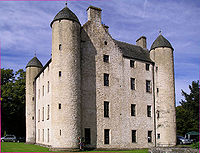
, in Perthshire
on 18 October 1541. Henry Ray, the Berwick Pursuivant
, reported that had a palsy on Friday and died on the following Tuesday. As she thought she would recover she did not trouble to make a will. She sent for King James, who was at Falkland Palace
, but he did not come in time. Near the end she wished that the friars who attended her would seek the reconciliation of the King and the Earl of Angus. She hoped the King would give her possessions to her daughter, Lady Margaret Douglas. James arrived after her death, and he ordered Oliver Sinclair
and John Tennent
to pack up her belongings for his use.
 She was buried at the Carthusian
Priory of St John in Perth
(demolished during the Reformation
, 1559). The Tudor dynasty ended with the childless Elizabeth I
, and the line of succession to the English throne was passed through Margaret's heirs. Her great-grandson, James VI of Scotland, became James I of England
, thus uniting the crowns of the two countries and conferring on Margaret something of a posthumous triumph.
Henry VII of England
Henry VII was King of England and Lord of Ireland from his seizing the crown on 22 August 1485 until his death on 21 April 1509, as the first monarch of the House of Tudor....
and Elizabeth of York
Elizabeth of York
Elizabeth of York was Queen consort of England as spouse of King Henry VII from 1486 until 1503, and mother of King Henry VIII of England....
, and the elder sister of Henry VIII
Henry VIII of England
Henry VIII was King of England from 21 April 1509 until his death. He was Lord, and later King, of Ireland, as well as continuing the nominal claim by the English monarchs to the Kingdom of France...
. In 1503, she married James IV
James IV of Scotland
James IV was King of Scots from 11 June 1488 to his death. He is generally regarded as the most successful of the Stewart monarchs of Scotland, but his reign ended with the disastrous defeat at the Battle of Flodden Field, where he became the last monarch from not only Scotland, but also from all...
, King of Scots. James died in 1513, and their son became King James V
James V of Scotland
James V was King of Scots from 9 September 1513 until his death, which followed the Scottish defeat at the Battle of Solway Moss...
. She married secondly Archibald Douglas, 6th Earl of Angus
Archibald Douglas, 6th Earl of Angus
Archibald Douglas, 6th Earl of Angus was a Scottish nobleman active during the reigns of James V and Mary, Queen of Scots...
. Through her first and second marriages, respectively, Margaret was the grandmother of both Mary, Queen of Scots, and Mary's second husband Lord Darnley
Henry Stuart, Lord Darnley
Henry Stewart or Stuart, 1st Duke of Albany , styled Lord Darnley before 1565, was king consort of Scotland and murdered at Kirk o'Field...
. Margaret's marriage to James IV foreshadowed the Union of the Crowns
Union of the Crowns
The Union of the Crowns was the accession of James VI, King of Scots, to the throne of England, and the consequential unification of Scotland and England under one monarch. The Union of Crowns followed the death of James' unmarried and childless first cousin twice removed, Queen Elizabeth I of...
- their great-grandson, King James VI of Scotland, the child of Mary and Darnley, became King of England and Ireland on the death of Margaret's fraternal niece, Elizabeth I of England
Elizabeth I of England
Elizabeth I was queen regnant of England and Ireland from 17 November 1558 until her death. Sometimes called The Virgin Queen, Gloriana, or Good Queen Bess, Elizabeth was the fifth and last monarch of the Tudor dynasty...
.
Born on 28 November 1489, Margaret was baptised two days later on the 30th — St. Andrew's Day
St. Andrew's Day
St Andrew's Day is the feast day of Saint Andrew. It is celebrated on 30 November.Saint Andrew is the patron saint of Scotland, and St Andrew's Day is Scotland's official national day...
— in St. Margaret's Church, Westminster
St. Margaret's, Westminster
The Anglican church of St. Margaret, Westminster Abbey is situated in the grounds of Westminster Abbey on Parliament Square, and is the parish church of the House of Commons of the United Kingdom in London...
. She was named after Lady Margaret Beaufort, her grandmother.
The Thistle and the Rose
Daughters were important political assets in a world where diplomacy and marriage were closely linked. Even before Margaret's sixth birthday, Henry VII thought about a marriage between Margaret and James IV as a way of ending the Scottish king's support for Perkin WarbeckPerkin Warbeck
Perkin Warbeck was a pretender to the English throne during the reign of King Henry VII of England. By claiming to be Richard of Shrewsbury, Duke of York, the younger son of King Edward IV, one of the Princes in the Tower, Warbeck was a significant threat to the newly established Tudor Dynasty,...
, Yorkist pretender to the throne of England.
On 30 September 1497, James IV's commissioner, the Spaniard Pedro de Ayala
Pedro de Ayala
Don Pedro de Ayala was a 16th-century Spanish diplomat employed by Ferdinand II of Aragon and Isabella I of Castile at the courts of James IV of Scotland and Henry VII of England. His mission to Scotland was concerned with the King's marriage and the international crisis caused by the pretender...
concluded a lengthy truce with England, and now the marriage was again a serious possibility. The Italian historian Polydore Virgil said that some of the English royal council objected to the match, saying that it would bring the Stewarts
House of Stuart
The House of Stuart is a European royal house. Founded by Robert II of Scotland, the Stewarts first became monarchs of the Kingdom of Scotland during the late 14th century, and subsequently held the position of the Kings of Great Britain and Ireland...
directly into the line of English succession, to which the wily and astute Henry replied:
"What then? Should anything of the kind happen (and God avert the omen), I foresee that our realm would suffer no harm, since England would not be absorbed by Scotland, but rather Scotland by England, being the noblest head of the entire island, since there is always less glory and honor in being joined to that which is far the greater, just as Normandy once came under the rule and power of our ancestors the English."
On 24 January 1502, Scotland and England concluded the Treaty of Perpetual Peace
Treaty of Perpetual Peace (1502)
The Treaty of Perpetual Peace was signed by James IV of Scotland and Henry VII of England in 1502. It agreed to end the intermittent warfare between Scotland and England which had been waged over the previous two hundred years and although it failed in this respect, as the hostility continued...
, the first peace agreement between the two realms in over 170 years. The marriage treaty was concluded the same day and was viewed as a guarantee of the new peace.
Proxy marriage and the new Queen's progress
The marriage was completed by proxyProxy marriage
A proxy wedding or is a wedding in which the bride or groom is not physically present, usually being represented instead by another person...
on 25 January at Richmond Palace
Richmond Palace
Richmond Palace was a Thameside royal residence on the right bank of the river, upstream of the Palace of Westminster, to which it lay 9 miles SW of as the crow flies. It it was erected c. 1501 within the royal manor of Sheen, by Henry VII of England, formerly known by his title Earl of Richmond,...
. Patrick, Earl of Bothwell
Patrick Hepburn, 1st Earl of Bothwell
Patrick Hepburn, 1st Earl of Bothwell was Lord High Admiral of Scotland. Under his territorial designation of Sir Patrick Hepburne of Dunsyre, Knt., he was Sheriff of Berwickshire, 15 June 1480...
, was proxy for the Scottish King and wore a gown of cloth-of-gold at the ceremony in the Queen's great chamber. He was accompanied by the Archbishop of Glasgow
Robert Blackadder
Robert Blackadder was a medieval Scottish cleric, diplomat and politician, who was abbot of Melrose, bishop-elect of Aberdeen and bishop of Glasgow; when the last was elevated to archiepiscopal status in 1492, he became the first ever archbishop of Glasgow...
and Andrew Forman, Postulate of Moray
Andrew Forman
Andrew Forman was a Scottish diplomat and prelate who became Bishop of Moray in 1501, Archbishop of Bourges in France, in 1513, Archbishop of St Andrews in 1514 as well as the headship of several monasteries....
. The herald
Somerset Herald
Somerset Herald of Arms in Ordinary is an officer of arms at the College of Arms in London. In the year 1448 Somerset Herald is known to have served the Duke of Somerset, but by the time of the coronation of King Henry VII in 1485 his successor appears to have been raised to the rank of a royal...
, John Young, reported that "right notable jousts" followed the ceremony. Prizes were awarded the next morning and the tournament continued another day.
Margaret was now regarded as Queen of Scots. It has been noted by some historians that her brother Henry
Henry VIII of England
Henry VIII was King of England from 21 April 1509 until his death. He was Lord, and later King, of Ireland, as well as continuing the nominal claim by the English monarchs to the Kingdom of France...
, then a child, second in line to the throne and Duke of York
Duke of York
The Duke of York is a title of nobility in the British peerage. Since the 15th century, it has, when granted, usually been given to the second son of the British monarch. The title has been created a remarkable eleven times, eight as "Duke of York" and three as the double-barreled "Duke of York and...
, threw a tantrum when he realised his sister, a foreign Queen, now held higher precedence in court than he.
The new queen was provided with a large wardrobe of clothes, and her crimson state bed curtains made of Italian sarcenet were embroidered with red Lancastrian roses. Clothes were also made for her companion, Lady Catherine Gordon
Lady Catherine Gordon
Lady Catherine Gordon was a Scottish noblewoman and the wife of Yorkist pretender, Perkin Warbeck. After her imprisonment by King Henry VII of England, she became a favoured lady-in-waiting of Queen consort Elizabeth of York....
, the widow of Perkin Warbeck
Perkin Warbeck
Perkin Warbeck was a pretender to the English throne during the reign of King Henry VII of England. By claiming to be Richard of Shrewsbury, Duke of York, the younger son of King Edward IV, one of the Princes in the Tower, Warbeck was a significant threat to the newly established Tudor Dynasty,...
. In May 1503, James IV confirmed her possession of lands and houses in Scotland, including Methven Castle
Methven Castle
Methven Castle is a 17th-century house situated east of Methven, in Perth and Kinross, Scotland.-History:The lands of Methven were owned by the Mowbray family from the 12th century. The Mowbrays supported the claim of John Balliol against Robert the Bruce, and on the latter's victory, Methven was...
, Stirling Castle
Stirling Castle
Stirling Castle, located in Stirling, is one of the largest and most important castles, both historically and architecturally, in Scotland. The castle sits atop Castle Hill, an intrusive crag, which forms part of the Stirling Sill geological formation. It is surrounded on three sides by steep...
, Doune Castle
Doune Castle
Doune Castle is a medieval stronghold near the village of Doune, in the Stirling district of central Scotland. The castle is sited on a wooded bend where the Ardoch Burn flows into the River Teith. It lies north-west of Stirling, where the Teith flows into the River Forth...
, Linlithgow Palace
Linlithgow Palace
The ruins of Linlithgow Palace are situated in the town of Linlithgow, West Lothian, Scotland, west of Edinburgh. The palace was one of the principal residences of the monarchs of Scotland in the 15th and 16th centuries. Although maintained after Scotland's monarchs left for England in 1603, the...
and Newark Castle
Newark Castle, Selkirkshire
Newark Castle is a large, ruined tower house standing in the grounds of Bowhill House, in the valley of the Yarrow Water three miles west of Selkirk in the Scottish Borders. In addition to the keep, sections of a gatehouse and wall survive....
in Ettrick Forest
Ettrick Forest
Ettrick Forest is a former royal forest in the Scottish Borders area of Scotland.It is a large area of moorland, south of Peebles, stretching from Dollar Law to Selkirk.-See also:*James Hogg*Craik Forest*Wauchope Forest...
, with the incomes from the corresponding Earldom and Lordship lands.
Later in 1503, Margaret came to Scotland; her progress was a grand journey northward. She left Richmond Palace on the 27 June with Henry VII and they travelled first to Collyweston
Collyweston
Collyweston is a village and civil parish about three miles south-west of Stamford on the road to Kettering.-Geography:The village is on the southern side of the Welland valley of Tixover. The River Welland, at the point nearby to the north-west, is the boundary between Rutland and...
. Then her journey proper began; she stayed a night at, Grantham, Newark, Tuxford
Tuxford
-Geography:Tuxford is a village and a civil parish on the southern edge of the Bassetlaw district of Nottinghamshire, England. It may also be considered a small town as it was historically a market town. Nearby larger towns are Retford and Newark-on-Trent. From Harvest Cottage, near the ECML, the...
, 'Sirowsby' (Thoresby
Thoresby Hall
Thoresby Hall is one of the Dukeries, four country houses and estates in north Nottinghamshire all occupied by dukes at one time in their history.-History:...
), Doncaster, Pontefract, and Tadcaster. At York
York
York is a walled city, situated at the confluence of the Rivers Ouse and Foss in North Yorkshire, England. The city has a rich heritage and has provided the backdrop to major political events throughout much of its two millennia of existence...
there is a plaque commemorating the exact spot where the Queen of Scots entered its gates. Then onto 'Newborough
Newburgh Priory
Newburgh Priory is a large house near Coxwold, North Yorkshire, England. Standing on the site of an Augustinian priory, founded in 1145, it is a stately home in a rural setting with views to the Kilburn White Horse in the distance...
', 'Allerton
Northallerton
Northallerton is an affluent market town and civil parish in the Hambleton district of North Yorkshire, England. It lies in the Vale of Mowbray and at the northern end of the Vale of York. It has a population of 15,741 according to the 2001 census...
', 'Darneton
Darlington
Darlington is a market town in the Borough of Darlington, part of the ceremonial county of County Durham, England. It lies on the small River Skerne, a tributary of the River Tees, not far from the main river. It is the main population centre in the borough, with a population of 97,838 as of 2001...
', Durham, Newcastle, Morpeth
Morpeth
Morpeth may mean:*Morpeth, Northumberland, England**Morpeth , a former parliamentary constituency*Morpeth, New South Wales, Australia*Morpeth, Ontario, Canada*Morpeth School - a secondary school in the East End of London, England...
, and Alnwick Castle
Alnwick Castle
Alnwick Castle is a castle and stately home in the town of the same name in the English county of Northumberland. It is the residence of the Duke of Northumberland, built following the Norman conquest, and renovated and remodelled a number of times. It is a Grade I listed building.-History:Alnwick...
. After crossing the border at Berwick upon Tweed on 1 August 1503, Margaret was met by the Scottish court at Lamberton. Her first night in Scotland was spent at Fast Castle
Fast Castle
Fast Castle is the ruined remains of a coastal fortress in Berwickshire, south-east Scotland, in the Scottish Borders. It lies north west of the village of Coldingham, and just outside of the St Abb's Head National Nature Reserve, run by the National Trust for Scotland...
; the next at the Nunnery at Haddington
Haddington, East Lothian
The Royal Burgh of Haddington is a town in East Lothian, Scotland. It is the main administrative, cultural and geographical centre for East Lothian, which was known officially as Haddingtonshire before 1921. It lies about east of Edinburgh. The name Haddington is Anglo-Saxon, dating from the 6th...
; on the third night at 'Acquik' or 'Dacquik' Castle, (Dalkeith Palace
Dalkeith Palace
Dalkeith Palace in Dalkeith, Midlothian, Scotland, is the former seat of the Duke of Buccleuch.Dalkeith Castle was located to the north east of Dalkeith, and was originally in the hands of the Clan Graham in the 12th century and given to the Douglas family in the early 14th century. James Douglas...
), James came to kiss her goodnight. He came again to console her on 4 August after a stable fire had killed some of her favourite horses. Her riding gear was burnt and a new sumpter cloth
Caparison
A caparison is a covering, or cloth, laid over a horse or other animal, especially a pack animal, or horse of state. In modern times, it is used mainly for decoration in parades and for historical reenactments. A similar term is horse-trapper....
or pallion of cloth-of-gold with a velvet cushion cost £127. On the 7 August 1503, Margaret was carried from Dalkeith to Edinburgh on a litter.
At a meadow a mile from Edinburgh
Meadowbank, Edinburgh
Meadowbank is a suburb of Edinburgh in Scotland. It is best known for Meadowbank Stadium. The A1 road and East Coast Main Line railway to England run through this way.-External links:*...
, there was a pavilion where Sir Patrick Hamilton and Patrick Sinclair played and fought in the guise of knight defending his lady. On the 8 August 1503, the marriage was celebrated in person in Holyrood Abbey
Holyrood Abbey
Holyrood Abbey is a ruined abbey of the Canons Regular in Edinburgh, Scotland. The abbey was founded in 1128 by King David I of Scotland. During the 15th century, the abbey guesthouse was developed into a royal residence, and after the Scottish Reformation the Palace of Holyroodhouse was expanded...
. The rites were performed by the Archbishop of Glasgow
Robert Blackadder
Robert Blackadder was a medieval Scottish cleric, diplomat and politician, who was abbot of Melrose, bishop-elect of Aberdeen and bishop of Glasgow; when the last was elevated to archiepiscopal status in 1492, he became the first ever archbishop of Glasgow...
and the Archbishop of York
Thomas Savage
Thomas Savage was an English clergyman.On 3 December 1492, Savage was nominated Bishop of Rochester. He was consecrated on 28 April 1493. He held the post he until 1497 when he was translated to be Bishop of London....
. Two days later, on St Lawrence's day, Margaret went to mass at St Giles', the town's Kirk
Kirk
Kirk can mean "church" in general or the Church of Scotland in particular. Many place names and personal names are also derived from it.-Basic meaning and etymology:...
, as her first public appointment. The details of the proxy marriage, progress, arrival, and reception in Edinburgh were recorded by the Somerset Herald, John Young.
Verse and song for Margaret
The Queen's arrival was celebrated by the poet William DunbarWilliam Dunbar
William Dunbar was a Scottish poet. He was probably a native of East Lothian, as assumed from a satirical reference in the Flyting of Dunbar and Kennedie , where, too, it is hinted that he was a member of the noble house of Dunbar....
in poems including; The Thistle and the Rose; Gladethe, thoue Queyne of Scottis Regioun; the song Now Fayre, Fayrest of Every Fayre; and Blyth Aberdeane, written on Margaret's welcome to Aberdeen
Aberdeen
Aberdeen is Scotland's third most populous city, one of Scotland's 32 local government council areas and the United Kingdom's 25th most populous city, with an official population estimate of ....
. Dunbar had been in London during the treaty negotiations. In Dunbar's Thistle and the Rose, forest birds serenade the conjoined York and Lancastrian roses, a symbol of Margaret's parentage;
The merle scho sang, 'Haill, Roiss of most delyt,
Haill, of all flouris quene and soverane,’
The lark scho song, 'Haill, Rois, both reid and quhyt,
Most plesand flour, of michty cullouris twane;’
The nychtingaill song, 'Haill, naturis suffragene,
In bewty, nurtour and every nobilness,
In riche array, renown, and gentilness.'
'merle'= blackbird; 'scho'= she; 'quhyt'= white; 'suffragane'= representative.
In Gladethe, thoue Queyne, Margaret is compared to the pearl as a prize above precious stones; more bright than beryl; more precious than the diamond; more beautiful than sapphire; lovelier than a green emerald; and more splendid than a famous ruby;
O precius Margreit, plesand, cleir and quhit,
Mor blith and bricht na is the beriale scheme,
Moir deir na is the diamaunt of delit,
Mor semly na is the sapheir one to seyne,
Mor gudely eik na is the emerant greyne,
Moir riche na is the ruby of renoune,
Fair gem of joy, Margreit, of the I meyne:
Gladethe, thoue queyne of Scottis regioun.
'Gladethe'= Rejoice! 'na'= than; 'beriale'= beryl
Beryl
The mineral beryl is a beryllium aluminium cyclosilicate with the chemical formula Be3Al26. The hexagonal crystals of beryl may be very small or range to several meters in size. Terminated crystals are relatively rare...
; 'eik'= also; 'of the I meyne'= thee I mean: I speak of you.
The song Now Fayre also includes the rose theme; the chorus begins, 'Welcome the rose both red and white,' the verses celebrate Margaret's youth, (she was thirteen), and the fairness of her complexion;
Sweet lusty lusum lady clere,
Most myghty kyngis dochter dere,
Borne of a princess most serene,
Welcum of Scotlond to be quene!
'lusum'= fair; 'clere'= bright;
Children of Margaret and James
It is reported that the marriage between James and Margaret was one of strong affection. The couple had six children, of whom only one survived infancy:- James, Duke of RothesayJames, Duke of RothesayJames Stewart, Duke of Rothesay is a name and title shared by two short-lived heirs to the throne of the Kingdom of Scotland.-First son of James IV:...
(21 February 1507, Holyrood Palace – 27 February 1508, Stirling CastleStirling CastleStirling Castle, located in Stirling, is one of the largest and most important castles, both historically and architecturally, in Scotland. The castle sits atop Castle Hill, an intrusive crag, which forms part of the Stirling Sill geological formation. It is surrounded on three sides by steep...
). - Daughter (died shortly after birth 15 July 1508, Holyrood Palace).
- Arthur, Duke of Rothesay (20 October 1509, Holyrood Palace – 14 July 1510, Edinburgh CastleEdinburgh CastleEdinburgh Castle is a fortress which dominates the skyline of the city of Edinburgh, Scotland, from its position atop the volcanic Castle Rock. Human habitation of the site is dated back as far as the 9th century BC, although the nature of early settlement is unclear...
). - James VJames V of ScotlandJames V was King of Scots from 9 September 1513 until his death, which followed the Scottish defeat at the Battle of Solway Moss...
( 10 April 1512, Linlithgow PalaceLinlithgow PalaceThe ruins of Linlithgow Palace are situated in the town of Linlithgow, West Lothian, Scotland, west of Edinburgh. The palace was one of the principal residences of the monarchs of Scotland in the 15th and 16th centuries. Although maintained after Scotland's monarchs left for England in 1603, the...
- 14 December 1542, Falkland PalaceFalkland PalaceFalkland Palace in Falkland, Fife, Scotland, is a former royal palace of the Scottish Kings. Today it is in the care of the National Trust for Scotland, and serves as a tourist attraction.-Early years:...
). - Daughter (died shortly after birth November 1512, Holyrood Palace).
- Alexander Stewart, Duke of RossAlexander Stewart, Duke of RossAlexander Stewart, Duke of Ross was the fourth and last son of King James IV of Scotland and his queen Margaret Tudor....
(30 April 1514, Stirling Castle – 18 December 1515, Stirling Castle).
Regency
The treaty of 1502, far from being perpetual, barely survived the death of Henry VII in 1509. His successor, the young Henry VIII, had little time for his father's cautious diplomacy, and was soon heading towards a war with FranceFrance
The French Republic , The French Republic , The French Republic , (commonly known as France , is a unitary semi-presidential republic in Western Europe with several overseas territories and islands located on other continents and in the Indian, Pacific, and Atlantic oceans. Metropolitan France...
, Scotland's ancient ally. In 1513, James invaded England to honour his commitment to the Auld Alliance
Auld Alliance
The Auld Alliance was an alliance between the kingdoms of Scotland and France. It played a significant role in the relations between Scotland, France and England from its beginning in 1295 until the 1560 Treaty of Edinburgh. The alliance was renewed by all the French and Scottish monarchs of that...
, only to meet death and disaster at the Battle of Flodden. Margaret had opposed the war, but was still named in the royal will as regent
Regent
A regent, from the Latin regens "one who reigns", is a person selected to act as head of state because the ruler is a minor, not present, or debilitated. Currently there are only two ruling Regencies in the world, sovereign Liechtenstein and the Malaysian constitutive state of Terengganu...
for the infant king, James V, for as long as she remained a widow.
Parliament
Parliament of Scotland
The Parliament of Scotland, officially the Estates of Parliament, was the legislature of the Kingdom of Scotland. The unicameral parliament of Scotland is first found on record during the early 13th century, with the first meeting for which a primary source survives at...
met at Stirling
Stirling
Stirling is a city and former ancient burgh in Scotland, and is at the heart of the wider Stirling council area. The city is clustered around a large fortress and medieval old-town beside the River Forth...
not long after Flodden, and confirmed Margaret in the office of Regent. A woman was rarely welcome in a position of supreme power, and Margaret was the sister of an enemy king, which served to compound her problems. Before long a pro-French party took shape among the nobility, urging that she should be replaced by John Stewart, 2nd Duke of Albany
John Stewart, 2nd Duke of Albany
John Stewart, Duke of Albany was Regent of the Kingdom of Scotland, Duke of Albany in peerage of Scotland and Count of Auvergne and Lauraguais in France.-Early life:...
, the closest male relative to the infant prince, and now third in line to the throne. Albany, who had been born and raised in France, was seen as a living representative of the Auld Alliance, in contrast with the pro-English Margaret. She is considered to have acted calmly and with some degree of political skill. By July 1514, she had managed to reconcile the contending parties, and Scotland — along with France — concluded peace with England that same month. But in her search for political allies amongst the fractious Scottish nobility she took a fatal step, allowing good sense and prudence to be overruled by emotion and magnetism.
In seeking allies Margaret turned more and more to the powerful House of Douglas. She found herself particularly attracted to Archibald Douglas, 6th Earl of Angus
Archibald Douglas, 6th Earl of Angus
Archibald Douglas, 6th Earl of Angus was a Scottish nobleman active during the reigns of James V and Mary, Queen of Scots...
, whom even his uncle, the cleric and poet Gavin Douglas
Gavin Douglas
Gavin Douglas was a Scottish bishop, makar and translator. Although he had an important political career, it is for his poetry that he is now chiefly remembered. His principal pioneering achievement was the Eneados, a full and faithful vernacular translation of the Aeneid of Virgil and the first...
, called a "young witless fool." Margaret and Douglas were secretly married in the parish church of Kinnoull, near Perth
Perth, Scotland
Perth is a town and former city and royal burgh in central Scotland. Located on the banks of the River Tay, it is the administrative centre of Perth and Kinross council area and the historic county town of Perthshire...
, on 6 August. Not only did this alienate the other noble houses but it immediately strengthened the pro-French faction on the council, headed by James Beaton, Archbishop of Glasgow
James Beaton
Dr. James Beaton was a Scottish church leader, the uncle of Dr. David Cardinal Beaton and the Keeper of the Great Seal of Scotland....
. By the terms of the late king's will she had sacrificed her position; before the month was out she was obliged to consent to the appointment of Albany. In September the Privy Council
Privy Council of Scotland
The Privy Council of Scotland was a body that advised the King.In the range of its functions the council was often more important than the Estates in the running the country. Its registers include a wide range of material on the political, administrative, economic and social affairs of Scotland...
decided that she had also forfeited her rights to the supervision of her sons, whereupon in defiance she and her allies took the princes to Stirling Castle
Stirling Castle
Stirling Castle, located in Stirling, is one of the largest and most important castles, both historically and architecturally, in Scotland. The castle sits atop Castle Hill, an intrusive crag, which forms part of the Stirling Sill geological formation. It is surrounded on three sides by steep...
.
Albany arrived in Scotland in May 1515, and was finally installed as Regent in July. His first task was to get custody of James and Alexander, politically essential for the authority of the regency. Margaret, after some initial defiance, surrendered at Stirling in August. With the princes in the hands of their uncle, the Queen Dowager
Queen Dowager
A queen dowager or dowager queen is a title or status generally held by the widow of a deceased king. In the case of the widow of a deceased emperor, the title of empress dowager is used...
, now expecting a child by Angus, retired to Edinburgh. For some time her brother had been urging her to flee to England with her sons; but she had steadily refused to do so, fearing such a step might lead to James's loss of the crown.
With no further interest in the matter she obtained permission to go to Linlithgow
Linlithgow
Linlithgow is a Royal Burgh in West Lothian, Scotland. An ancient town, it lies south of its two most prominent landmarks: Linlithgow Palace and Linlithgow Loch, and north of the Union Canal....
whence she escaped to the border. She was received by Lord Dacre
Thomas Fiennes, 8th Baron Dacre
Sir Thomas Fiennes, 8th Baron Dacre was an English peer and soldier, the son of Sir John Fiennes.- Career :He was born in 1472, the son of Sir John Fiennes and Alice FitzHugh. He had one sister, Anne, Marchioness Berkeley . Thomas was invested as a Knight of the Bath in 1484 at the age of 12...
, Henry's Warden of the Marches, and taken to Harbottle Castle
Harbottle Castle
Harbottle Castle is a ruined medieval castle situated at the west end of the village of Harbottle, Northumberland, England west-north-west of Rothbury overlooking the River Coquet...
. Here in early October she gave birth to Lady Margaret Douglas
Margaret Douglas
Margaret Douglas, Countess of Lennox was the daughter of Archibald Douglas, 6th Earl of Angus, and Margaret Tudor, Queen Dowager of Scotland...
, the future Countess of Lennox
Earl of Lennox
The Mormaer of Lennox or Earl of Lennox was the ruler of the long-lasting provincial Mormaerdom/Earldom of Lennox in the Medieval Kingdom of the Scots. The first Mormaer is usually regarded as Ailin I , but the genealogy of the Mormaers gives earlier names...
and mother of Henry Stuart, Lord Darnley
Henry Stuart, Lord Darnley
Henry Stewart or Stuart, 1st Duke of Albany , styled Lord Darnley before 1565, was king consort of Scotland and murdered at Kirk o'Field...
, the cousin of, and one day to be the second husband of, Mary, Queen of Scots. While still in the north of England, Queen Margaret learned of the death of her son, Alexander. Dacre hinted that Albany — cast in the role of Richard III
Richard III of England
Richard III was King of England for two years, from 1483 until his death in 1485 during the Battle of Bosworth Field. He was the last king of the House of York and the last of the Plantagenet dynasty...
— was responsible, though Margaret, even in her vulnerable state, refused to accept this, saying that if he really aimed at the throne for himself the death of James would have suited his purpose better. It was also at this time that she at last began to get the measure of Angus, who, with an eye on his own welfare, returned to Scotland to make peace with the Regent, "which much made Margaret to muse." When Henry learned that Angus would not be accompanying his sister to London he said "Done like a Scot." However, all of Angus's power, wealth and influence was in Scotland; to abandon the country would mean possible forfeiture for treason. In this regard he would have had before him the example of his kinsman James Douglas, 9th Earl of Douglas
James Douglas, 9th Earl of Douglas
James Douglas, 9th Earl of Douglas, 3rd Earl of Avondale KG was a Scottish nobleman, last of the 'Black' earls of Douglas. He was a twin, the older by a few minutes, the younger was Archibald Douglas, Earl of Moray....
, who fled to England the previous century, living out his life as a landless mercenary.
Marriage and politics
Margaret was well-received by Henry and, to confirm her status, was lodged in Scotland YardGreat Scotland Yard (street)
Great Scotland Yard is a street in the St. James's district of Westminster, London, connecting Northumberland Avenue and Whitehall. It is best known as the location of the rear entrance to the original headquarters of the Metropolitan Police Service of London....
, the ancient palace of the Scottish kings. In 1517, having spent a year in England, she returned north, after a treaty of reconciliation had been worked out by Albany, Henry and Cardinal Wolsey. Albany was temporarily absent in France — where he renewed the Auld Alliance once more and arranged for the future marriage of James V
James V of Scotland
James V was King of Scots from 9 September 1513 until his death, which followed the Scottish defeat at the Battle of Solway Moss...
— but the Queen-Dowager was received at the border by Sieur de la Bastie
Antoine d'Arces
Antoine d'Arcy, sieur de la Bastie-sur-Meylan and of Lissieu, was a French nobleman involved in the government of Scotland.-The White Knight:...
, his deputy, as well as by her husband. Peace may have broken out, though it was perfectly clear that Margaret was still not fully trusted, and access to her son was strictly limited.
Although Margaret and Angus were temporarily reconciled it was not long before their relationship entered into a phase of terminal decline. She discovered that while in England her husband had been living with Lady Jane Stewart, a former lover. This was bad enough; what was worse, he had been living on his wife's money. In October 1518, she wrote to her brother, hinting at divorce:
"I am sore troubled with my Lord of Angus since my last coming into Scotland, and every day more and more, so that we have not been together this half year… I am so minded that, an I may by law of God and to my honour, to part with him, for I wit well he loves me not, as he shows me daily."
This was a difficult issue for Henry; a man of conservative and orthodox belief, he was opposed to divorce on principle – highly ironic, considering his later marital career. Just as important, Angus was a useful ally, an effective counter-weight to Albany and the pro-French faction. Angered by his attitude, Margaret drew closer to the Albany faction and joined with others in calling for his return from France. Albany, seemingly in no hurry to return to the fractious northern kingdom, suggested that she resume the regency herself. The dispute between husband and wife was set to dominate Scottish politics for the next three years, made even more complicated by a bitter feud between Angus and James Hamilton, 1st Earl of Arran
James Hamilton, 1st Earl of Arran
James Hamilton, 1st Earl of Arran and 2nd Lord Hamilton was a Scottish nobleman and first cousin of James IV of Scotland.-Biography:...
; with bewildering rapidity Margaret sided with one and then the other.
Albany finally arrived back in Scotland in November 1521. Warmly received by Margaret, it was soon rumoured that their cordial relations embraced more than politics. Angus went into exile as the Regent — with the full co-operation of the Queen-Dowager — set about restoring order to a country riven by three years of intense factional conflict. Albany was useful to Margaret: he was known to have influence in Rome
Rome
Rome is the capital of Italy and the country's largest and most populated city and comune, with over 2.7 million residents in . The city is located in the central-western portion of the Italian Peninsula, on the Tiber River within the Lazio region of Italy.Rome's history spans two and a half...
, which would help ease her application for a divorce. Angus and his allies spread the rumour that the two were lovers, to such effect that even the sober-headed Lord Dacre wrote to Wolsey, predicting that James would be murdered and Albany would become king and marry Margaret. But the relationship between the two was never more than one of calculated self-interest, as events were soon to prove.
Margaret's coup
In most essentials Margaret remained an Englishwoman in attitude and outlook, and at root she genuinely desired a better understanding between the land of her birth and her adopted home. Necessity demanded an alliance with Albany and the French faction, especially after the devastating border wars with England in the early 1520s. But no sooner was Albany off the scene than she set about organising a party of her own. In 1524, the Regent was finally removed from power in a simple but effective coup d'étatCoup d'état
A coup d'état state, literally: strike/blow of state)—also known as a coup, putsch, and overthrow—is the sudden, extrajudicial deposition of a government, usually by a small group of the existing state establishment—typically the military—to replace the deposed government with another body; either...
. With Albany once more in France, Margaret, with the help of Arran and the Hamiltons, brought James, now twelve years old, from Stirling
Stirling
Stirling is a city and former ancient burgh in Scotland, and is at the heart of the wider Stirling council area. The city is clustered around a large fortress and medieval old-town beside the River Forth...
to Edinburgh. It was a bold and popular move. In August Parliament declared the regency at an end, as James was elevated to full kingly powers. In practice, he would continue to be governed by others, his mother above all. When Beaton objected to the new arrangements Margaret had him arrested and thrown into jail. In November Parliament formally recognised Margaret as the chief councillor to the King.
Margaret's alliance with Arran inevitably alienated other noble houses. Her situation was not eased when her brother allowed Angus to return to Scotland. Both of these factors were to some degree beyond her control. The most damaging move of all was not. She formed a new attachment, this time to Henry Stewart
Henry Stewart, 1st Lord Methven
Henry Stewart, 1st Lord Methven was Master of the Scottish Artillery and third husband of Margaret Tudor, eldest daughter of Henry VII of England and Elizabeth of York.-Ancient lineage:...
, a younger brother of Lord Avondale
Lord Avondale
There have been several peerage titles created with the name Avondale , referring to the dale of the Avon Water in Scotland. The word strath also means valley, and the area is now better known as Strathaven....
. Stewart was promoted to senior office, angering the Earl of Lennox
Earl of Lennox
The Mormaer of Lennox or Earl of Lennox was the ruler of the long-lasting provincial Mormaerdom/Earldom of Lennox in the Medieval Kingdom of the Scots. The first Mormaer is usually regarded as Ailin I , but the genealogy of the Mormaers gives earlier names...
, among others, who promptly entered into an alliance with her estranged husband. That same November, when Parliament confirmed Margaret's political office, her war with Angus descended into a murderous farce. When he arrived in Edinburgh with a large group of armed men, claiming his right to attend Parliament, she ordered cannons to be fired on him from both the Castle
Edinburgh Castle
Edinburgh Castle is a fortress which dominates the skyline of the city of Edinburgh, Scotland, from its position atop the volcanic Castle Rock. Human habitation of the site is dated back as far as the 9th century BC, although the nature of early settlement is unclear...
and Holyrood House. When the two English ambassadors present at court, Thomas Magnus
Thomas Magnus
Thomas Magnus, , English administrator and diplomat; Archdeacon of the East Riding of Yorkshire 1504, employed on diplomatic missions 1509-19 and 1524-7; present at the Field of the Cloth of Gold 1520; Privy councillor c.1520; awarded a doctorate by the University of Oxford 1520; canon of Windsor...
and Roger Radclyff, objected that she should not attack her lawful husband she responded in anger, telling them to "go home and not meddle with Scottish matters." Angus withdrew for the time being, but under pressure from various sources the Queen finally admitted him to the council of regency in February 1525. It was all the leverage he needed. Taking custody of James he refused to give him up, exercising full power on his behalf for a period of three years. James' experience during this time left him with an abiding hatred of both the house of Douglas and the English connection.
Divorce and marriage
Margaret attempted to resist but was forced to bend to the new political realities. Besides, by this time her desire for a divorce had become obsessive, taking precedence over all other matters. She was prepared to use all arguments, including the widespread myth that James IV had not been killed at Flodden. Despite the coup of 1524 she corresponded warmly with Albany, who continued his efforts on her behalf in Rome. In March 1527, Pope Clement VIIPope Clement VII
Clement VII , born Giulio di Giuliano de' Medici, was a cardinal from 1513 to 1523 and was Pope from 1523 to 1534.-Early life:...
granted her petition. Because of the political situation in Europe at the time it was not until December that she learned of her good fortune. She married Henry Stewart on 3 March 1528, ignoring the pious warnings of her brother that marriage was 'divinely ordained' and his protests against the "shameless sentence sent from Rome." Not too many years later, Henry's hypocrisy was blatant, he himself breaking with Rome precisely because he could not get the same 'shameless sentence'.
In June 1528, James finally freed himself from the tutelage of Angus – who once more fled into exile – and began to rule in his own right. Margaret was an early beneficiary of the royal coup, she and her husband emerging as the leading advisors to the King. James created Stewart Lord Methven
Lord Methven
Lord Methven was a title in the Peerage of Scotland. It was created on 17 July 1528 by King James V of Scotland for his stepfather Henry Stewart. The title became extinct on the death of the grantee's grandson in the 1580s. The title takes its name from Methven in Perthshire.-Henry Stewart, 1st...
"for the great love he bore to his dearest mother." It was rumoured – falsely – that the Queen favoured a marriage between her son and her niece, Princess Mary
Mary I of England
Mary I was queen regnant of England and Ireland from July 1553 until her death.She was the only surviving child born of the ill-fated marriage of Henry VIII and his first wife Catherine of Aragon. Her younger half-brother, Edward VI, succeeded Henry in 1547...
, but she was instrumental in bringing about the Anglo-Scottish peace agreement of May 1534.
The central aim of Margaret's political life – besides assuring her own survival – was to bring about a better understanding between England and Scotland, a position she held to through some difficult times. James was suspicious of Henry, especially because of his continuing support for Angus, a man he loathed with a passion. Even so, in early 1536 his mother persuaded him to meet with her brother. It was her moment of triumph and she wrote to Henry and Thomas Cromwell, now his chief advisor, saying that it was "by advice of us and no other living person." She was looking for a grand occasion on the lines of the Field of Cloth of Gold, and spent a huge sum in preparation. In the end it came to nothing because there were too many voices raised in objection and because James would not be managed by his mother or anyone else. In a private interview with the English ambassador, William Howard
William Howard, 1st Baron Howard of Effingham
William Howard, 1st Baron Howard of Effingham , was the eldest son of Thomas Howard, 2nd Duke of Norfolk by his second wife, Agnes Tilney...
, her disappointment was obvious – "I am weary of Scotland", she confessed. Her weariness even extended to betraying state secrets to Henry.
Weary of Scotland she may have been: she was now even more tired of Lord Methven, who was proving himself to be even worse than Angus in his desire both for other women and for his wife's money; also, their only child, a daughter (possibly called Dorothea Stewart), died in infancy. Eager for yet another divorce her proceedings were frustrated by James, whom she believed her husband had bribed. Again, as so often in Margaret's life, tragedy and unhappiness were closely pursued by intrigue and farce. At one point she ran away toward the border, only to be intercepted and brought back to Edinburgh. Time and again she wrote to Henry with complaints about her poverty and appeals for money and protection – she wished for ease and comfort instead of being obliged "to follow her son about like a poor gentlewoman."
In June 1538, Margaret welcomed Mary of Guise
Mary of Guise
Mary of Guise was a queen consort of Scotland as the second spouse of King James V. She was the mother of Mary, Queen of Scots, and served as regent of Scotland in her daughter's name from 1554 to 1560...
, James's new French bride to Scotland. These two women, among the most formidable in Scottish history, established a good understanding. Mary made sure that her mother-in-law, who had now been reconciled with Methven, made regular appearances at court and it was reported to Henry that "the young queen was all papist
Papist
Papist is a term or an anti-Catholic slur, referring to the Roman Catholic Church, its teachings, practices, or adherents. The term was coined during the English Reformation to denote a person whose loyalties were to the Pope, rather than to the Church of England...
, and the old queen not much less."
Death
Margaret died of a severe stroke at Methven CastleMethven Castle
Methven Castle is a 17th-century house situated east of Methven, in Perth and Kinross, Scotland.-History:The lands of Methven were owned by the Mowbray family from the 12th century. The Mowbrays supported the claim of John Balliol against Robert the Bruce, and on the latter's victory, Methven was...
, in Perthshire
Perthshire
Perthshire, officially the County of Perth , is a registration county in central Scotland. It extends from Strathmore in the east, to the Pass of Drumochter in the north, Rannoch Moor and Ben Lui in the west, and Aberfoyle in the south...
on 18 October 1541. Henry Ray, the Berwick Pursuivant
Berwick Pursuivant
Berwick Pursuivant of Arms in Ordinary was a British office of arms created around 1460 for English service on the Scottish Marches based at Berwick-upon-Tweed...
, reported that had a palsy on Friday and died on the following Tuesday. As she thought she would recover she did not trouble to make a will. She sent for King James, who was at Falkland Palace
Falkland Palace
Falkland Palace in Falkland, Fife, Scotland, is a former royal palace of the Scottish Kings. Today it is in the care of the National Trust for Scotland, and serves as a tourist attraction.-Early years:...
, but he did not come in time. Near the end she wished that the friars who attended her would seek the reconciliation of the King and the Earl of Angus. She hoped the King would give her possessions to her daughter, Lady Margaret Douglas. James arrived after her death, and he ordered Oliver Sinclair
Oliver Sinclair
Sir Oliver Sinclair de Pitcairnis , , was a favourite courtier of James V of Scotland. A contemporary story tells that James V gave him the battle standard and command at the Battle of Solway Moss...
and John Tennent
John Tennent
John Tennent of Listonshiels was a servant and companion of James V of Scotland. He kept an account of the king's daily expenses which is an important source document for the Scottish royal court....
to pack up her belongings for his use.
Carthusian
The Carthusian Order, also called the Order of St. Bruno, is a Roman Catholic religious order of enclosed monastics. The order was founded by Saint Bruno of Cologne in 1084 and includes both monks and nuns...
Priory of St John in Perth
Perth, Scotland
Perth is a town and former city and royal burgh in central Scotland. Located on the banks of the River Tay, it is the administrative centre of Perth and Kinross council area and the historic county town of Perthshire...
(demolished during the Reformation
Scottish Reformation
The Scottish Reformation was Scotland's formal break with the Papacy in 1560, and the events surrounding this. It was part of the wider European Protestant Reformation; and in Scotland's case culminated ecclesiastically in the re-establishment of the church along Reformed lines, and politically in...
, 1559). The Tudor dynasty ended with the childless Elizabeth I
Elizabeth I of England
Elizabeth I was queen regnant of England and Ireland from 17 November 1558 until her death. Sometimes called The Virgin Queen, Gloriana, or Good Queen Bess, Elizabeth was the fifth and last monarch of the Tudor dynasty...
, and the line of succession to the English throne was passed through Margaret's heirs. Her great-grandson, James VI of Scotland, became James I of England
James I of England
James VI and I was King of Scots as James VI from 24 July 1567 and King of England and Ireland as James I from the union of the English and Scottish crowns on 24 March 1603...
, thus uniting the crowns of the two countries and conferring on Margaret something of a posthumous triumph.
Ancestry
External links
- A short profile of Margaret alongside other influential women of her time
- Margaret Tudor Gallery
- http://www.tudorplace.com.ar/Bios/MargaretTudor(QueenScotland).htm