


Philip V of France

Encyclopedia
Philip the Tall was King of France as Philip V and, as Philip II, King of Navarre and Count of Champagne
. He reigned from 1316 to his death and was the penultimate monarch of the House of Capet
. Considered a wise and politically astute ruler, Philip took the throne under questionable circumstances, but he became a "strong and popular" king over the course of his reign. Notable as a prominent figure in the late crusading movement, Philip died while embroiled in the administrative reform of southern France.
, the second son of King Philip IV of France
and Queen Joan I of Navarre
, assuming the title of the Count of Poitou. Modern historians have described Philip V as a man of "considerable intelligence and sensitivity", and the "wisest and politically most apt" of Philip IV's three sons. Philip was influenced both by the troubles and unrest that his father had encountered during 1314, and the difficulties that his older brother – Louis X
, known as "the Quarreler" had faced during the intervening few years. At the heart of both Philip IV and Louis X's problems were taxes, and the difficulty in raising them outside of crises.
Philip married Joan, the Countess of Burgundy and the eldest daughter of Otto IV, Count of Burgundy
, in 1307. The original plan had been for Louis X to marry Joan, but this was altered after Louis was engaged to Margaret. Modern scholars have found little evidence as to whether the marriage was a happy one, but the pair had a considerable number of children in a short space of time, and Philip was exceptionally generous to Joan by the standards of the day. Philip went to great lengths not only to endow Joan with lands and money but to try to ensure that these gifts were irrevocable in the event of his early death. Amongst the various gifts were a palace, villages, additional money for jewels and her servants, the property of all the Jews in Burgundy and the entire county of Burgundy
itself, which he gave Joan in 1318.
Joan was implicated in Queen Margaret's adultery case
during 1314; Margaret was accused and convicted of adultery
with two knight
s, upon the testimony of their sister-in-law, Isabella
. Joan was suspected of having secretly known about the adultery; placed under house arrest at Dourdan
as punishment, it was then implied that Joan was guilty of adultery herself. With Philip's support she continued to protest her innocence and by 1315 her name had been cleared by the Paris Parlement, partially through Philip's influence, and she was allowed to return to court. It is unclear why Philip stood by her in the way that he did. One theory has been that he was concerned that if he was to abandon Joan, he might also lose Burgundy; another theory suggests that his slightly "formulaic" love letters to his wife should be taken at face value, and that he was in fact very deeply in love.
and Odo IV, the Duke of Burgundy, but Philip successfully out-manouvred them, being appointed regent himself. Philip remained as regent for the remainder of the pregnancy and for a few days after the birth of his nephew John I
– the infant only lived for five days before dying.
The death of John I was unprecedented in the history of the Capetian Kings of France. For the first time, the King of France died without a son. The heir to the throne was now a subject of some dispute. Princess Joan
, the remaining daughter of Louis X by the late Queen Margaret, was one obvious candidate, but suspicion still hung over her as a result of the scandal in 1314, including concerns over her actual parentage. In addition, the Salic law
had been reaffirmed in recent years, which would have meant that the throne would pass over Joan in any event, but this interpretation of the law was not necessary accepted by all the nobility.
With only his niece between himself and the throne, Philip engaged in some rapid political negotiations and convinced Charles of Valois, who along with Odo IV was championing Joan's rights, to switch sides and support him instead. In exchange for marrying Philip's daughter, Odo IV abandoned his niece's cause, not only her claim to the French throne but also her claim to Navarre's. On the 9 January 1317, with Charles' support, Philip was hastily coronated at Rheims. The majority of the nobility, however, refused to attend, there were demonstrations in Champagne
, Artois and Burgundy and Philip called a rapid assembly of the nobility on 2 February in Paris. Philip laid down the principle that Joan, as a woman, could not inherit the throne of France, played heavily upon the fact that he was now the anointed king, and consolidated what some authors have described as his effective "usurpation" of power.
The next year, Philip continued to strengthen his position. He married his eldest daughter, Joan to the powerful Odo IV, bringing the Duke over to his own party. Joan, however, did ultimately accede to the throne of Navarre
, which did not hold to the Salic law. Philip then built his reign around the notion of reform – "reclaiming rights, revenues and territories" that had been wrongly lost to the crown in recent years.
, in trying to place the French crown on a solid fiscal footing and revoked many of the unpopular decisions of his predecessor and older brother, Louis X
. He also instituted government reforms, reformed the currency and worked to standardise weights and measures. Amongst Philip's key appointments was the later cardinal
Pierre Bertrand
, who would play a key role in successive French royal governments in subsequent years.
Starting in 1317, Philip reissued an act first passed by his father in 1311, condemning the alienation, of theft, of royal resources and offices in the provinces. By 1318, his political situation strengthened, Philip went further, setting out in a new act a distinction between the French royal domain – the core set of lands and titles that belonged permanently to the crown – and those lands and titles that had been forfeited to the crown for one reason or another. If the French crown was to bestow or grant new lands to nobles, Philip declared, they would usually be given only from the second source: this was a double-edged announcement, at once reinforcing the core, unalienable powers of the crown, whilst also reassuring nobles that their lands were sacrosanct unless they were forfeited to the crown in punishment for a crime or misdemeanour. Philip was responsible for the creation of the cours des comptes in 1320, a court responsible for auditing the royal accounts to ensure proper payment; the courts still exist today. In practice, Philip did not entirely keep to his self-declared principles on grants of royal lands and titles, but was far more conservative in such matters than his immediate predecessors.
problem. The Count of Flanders ruled an "immensely wealthy state" which largely led an autonomous existence on the edge of the French state; the French king was generally regarded as having suzerainty
over Flanders, but in recent years the relationship had become strained. Philip IV
had been defeated at Courtrai
in 1302 attempting to reassert French control, and despite the later French victory at the Battle of Mons-en-Pévèle
the relationship remained tense.
Robert III of Flanders had continued to resist France militarily, but by Philip's accession to the throne had found himself increasingly isolated politically in Flanders itself. Meanwhile, the French position had become strained by the need to maintain a wartime footing. Louis X had prohibited exports of grain and other material to Flanders in 1315, resulting in a profitable smuggling industry that in turn discouraged legal trade with the French crown along the border region; Louis was forced to directly requisition food for his forces, resulting in a string of complaints from local lords and the Church. Philip began to reinstate a proper recompensation scheme in 1317, but the situation remained unstable.
Both Philip and Robert turned away from seeking a military solution in favour of a political compromise. Accordingly Robert made an accommodation with Philip in June 1320, under which Robert would confirm his young grandson, Louis, as his designated heir, in return for Louis being pledged in marriage to Philip's second daughter, Margaret. This would provide Robert, and then Louis, with strong French support within Flanders. Louis was, to a great extent, already under Philip's influence. Louis had been brought up in Nevers
in central France, and at Philip's court. and was culturally effectively a French prince. This arrangement was a considerable success for Philip's policy, although over time Louis' clear French loyalties and lack of political links within Flanders itself would lead to political upheaval and peasant revolt.
Philip also faced difficulties with Edward II of England
. Like the Count of Flanders, Edward in his role as the ruler of Gascony
owed homage to the king of France, but as a king in his own right, and as the head of a largely autonomous Gascon province, was disinclined to do so. Edward had not given homage to Louis X, and initially declined to do so to Philip, who had a reputation as being more favourable to the English than Louis X. In 1319 Philip allowed Edward to give homage by proxy, an honour by the standards of the day, but expected him to do so in person in 1320. Edward arrived in Amiens
to do so, only to find that Philip was now insisting on Edward also giving an oath of personal fealty to him – an act going beyond that of normal feudal homage. Edward gave homage but refused to swear fealty; nonetheless, this marked a period of increased French pressure on England over Gascony.
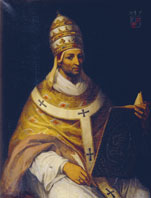 Philip was also to play a role in the ongoing crusade movement during the period. Pope John XXII
, the second of the Avignon popes
had been elected at a conclave assembled in Lyon
s during 1316 by Philip himself, and set out his renewed desire to see fresh crusades. Philip IV had agreed a joint plan for a new French led crusade at the Council of Vienne
in 1312, with his son Philip, a "committed crusader," taking the cross himself in 1313. Once king himself, Philip was obligated to carry out these plans and asked John for and received additional funds after 1316. Both Philip and John agreed, however, that a French crusade was impossible whilst the military situation in Flanders remained unstable. Nonetheless, John continued to assure the Armenians
that Philip would shortly lead a crusade to relieve them. An attempt to send a naval vanguard from the south of France under Louis I of Clermont
failed, however, with the forces being destroyed in a battle off Genoa
in 1319. Over the winter of 1319–20 Philip convened a number of meetings with French military leaders in preparation for a potential second expedition, that in turn informed Bishop William Durand
's famous treatise on crusading. By the end of Philip's reign, however, both John and he had fallen out over the issue of new monies and commitments to how they were spent, and both their attentions were focused on managing the challenge of the Shepherds' Crusade
.
The Shepherds' Crusade, or the Pastoreaux, emerged out of Normandy in 1320. One argument for the timing of this event has been that the repeated calls for popular crusades by Philip and his predecessors, combined with the absence of any actual large scale expeditions, ultimately boiled over into this popular, but uncontrolled, crusade. Philip's intent for a new crusade had certainly become widely known by the spring of 1320 and the emerging peace in Flanders and the north of France had left a large number of displaced peasants and soldiers. The result was a large and violent anti-Semitic movement threatening local Jews, royal castles, the wealthier clergy and Paris itself. The movement was ultimately condemned by Pope John, who doubted whether the movement had any real intent to carry out a crusade. Philip was forced to move against it, crushing the movement militarily and driving the remnants south across the Pyrenees
into Aragon
.
The French Jews were, by 1321, closely connected to the French crown; Philip had given orders that royal officials assist Jewish money lenders in recovering Christian debts, and some local officials were arguing that the crown was due to inherit the estates of dead Jewish merchants. Following the events of 1320, Philip was involved in fining those who had attacked Jews during the Shepherds' Crusade, which in practice added further to the dislike of this minority in France. Rumours and allegations about lepers themselves had been circulated in 1320 as well, and some had been arrested during the Crusade.
Philip was in Poitiers
in June involved in a tour of the south aimed at reform of the southern fiscal system, when word arrived of the scare. Philip issued an early edict demanding that any leper found guilty was to be burnt; their goods would be forfeit to the crown. The King's southern tour and reform plans, although administratively sound by modern standards, had created much local opposition and modern historians have linked the King's role in Poiters with the sudden outbreak of violence. This all put Philip in a difficult position; he could not openly side with those claiming wrong doing by the lepers, Jews and Muslims without encouraging further, unnecessary violence – on the other hand, if he did not ally himself to the cause, he encouraged further unsanctioned violence, weakening his royal position. In August Philip was continuing to progress his reform plans when he fell ill from multiple illnesses. After a brief respite, he died at Longchamp, Paris. He was interred in Saint Denis Basilica
. Some Jews did leave France as a result of the leper scare, but Philip had successfully resisted signing any formal edict, which limited the impact to some degree.
By the Salic law
that Philip had reaffirmed in 1316, without a living male heir Philip was succeeded by his younger brother, Charles IV
. Charles was also to die without male issue, resulting ultimately in Edward III
's claim to the French throne and the subsequent Hundred Years War (1337–1453).
, count of Burgundy) and they had five daughters and two sons:
|-
|-
Count of Champagne
The Counts of Champagne ruled the region of Champagne from 950 to 1316. Champagne evolved from the county of Troyes in the late eleventh century and Hugh I was the first to officially use the title "Count of Champagne". When Louis became King of France in 1314, upon the death of his father Philip...
. He reigned from 1316 to his death and was the penultimate monarch of the House of Capet
House of Capet
The House of Capet, or The Direct Capetian Dynasty, , also called The House of France , or simply the Capets, which ruled the Kingdom of France from 987 to 1328, was the most senior line of the Capetian dynasty – itself a derivative dynasty from the Robertians. As rulers of France, the dynasty...
. Considered a wise and politically astute ruler, Philip took the throne under questionable circumstances, but he became a "strong and popular" king over the course of his reign. Notable as a prominent figure in the late crusading movement, Philip died while embroiled in the administrative reform of southern France.
Personality and marriage
Philip was born in LyonLyon
Lyon , is a city in east-central France in the Rhône-Alpes region, situated between Paris and Marseille. Lyon is located at from Paris, from Marseille, from Geneva, from Turin, and from Barcelona. The residents of the city are called Lyonnais....
, the second son of King Philip IV of France
Philip IV of France
Philip the Fair was, as Philip IV, King of France from 1285 until his death. He was the husband of Joan I of Navarre, by virtue of which he was, as Philip I, King of Navarre and Count of Champagne from 1284 to 1305.-Youth:A member of the House of Capet, Philip was born at the Palace of...
and Queen Joan I of Navarre
Joan I of Navarre
Joan I , the daughter of king Henry I of Navarre and Blanche of Artois, reigned as queen regnant of Navarre and also served as queen consort of France.-Life:...
, assuming the title of the Count of Poitou. Modern historians have described Philip V as a man of "considerable intelligence and sensitivity", and the "wisest and politically most apt" of Philip IV's three sons. Philip was influenced both by the troubles and unrest that his father had encountered during 1314, and the difficulties that his older brother – Louis X
Louis X of France
Louis X of France, , called the Quarreler, the Headstrong, or the Stubborn was the King of Navarre from 1305 and King of France from 1314 until his death...
, known as "the Quarreler" had faced during the intervening few years. At the heart of both Philip IV and Louis X's problems were taxes, and the difficulty in raising them outside of crises.
Philip married Joan, the Countess of Burgundy and the eldest daughter of Otto IV, Count of Burgundy
Otto IV, Count of Burgundy
Otto IV, Count of Burgundy was the son of Hugh de Chalon and Adelaide, Countess Palatine of Burgundy. By his mother, he was a grandson of Countess Beatrice II of Burgundy. By his father, he was descended from another branch of the Counts of Burgundy.Upon his father's death in 1266/1267, he became...
, in 1307. The original plan had been for Louis X to marry Joan, but this was altered after Louis was engaged to Margaret. Modern scholars have found little evidence as to whether the marriage was a happy one, but the pair had a considerable number of children in a short space of time, and Philip was exceptionally generous to Joan by the standards of the day. Philip went to great lengths not only to endow Joan with lands and money but to try to ensure that these gifts were irrevocable in the event of his early death. Amongst the various gifts were a palace, villages, additional money for jewels and her servants, the property of all the Jews in Burgundy and the entire county of Burgundy
County of Burgundy
The Free County of Burgundy , was a medieval county , within the traditional province and modern French region Franche-Comté, whose very French name is still reminiscent of the unusual title of its count: Freigraf...
itself, which he gave Joan in 1318.
Joan was implicated in Queen Margaret's adultery case
Tour de Nesle Affair
The Tour de Nesle Affair was a scandal amongst the French royal family in 1314, during which the three daughters-in-law of King Philip IV of France were accused of adultery, the accusations apparently started by Philip's only daughter, Isabella. The Tour de Nesle was the name of the tower in Paris...
during 1314; Margaret was accused and convicted of adultery
Adultery
Adultery is sexual infidelity to one's spouse, and is a form of extramarital sex. It originally referred only to sex between a woman who was married and a person other than her spouse. Even in cases of separation from one's spouse, an extramarital affair is still considered adultery.Adultery is...
with two knight
Knight
A knight was a member of a class of lower nobility in the High Middle Ages.By the Late Middle Ages, the rank had become associated with the ideals of chivalry, a code of conduct for the perfect courtly Christian warrior....
s, upon the testimony of their sister-in-law, Isabella
Isabella of France
Isabella of France , sometimes described as the She-wolf of France, was Queen consort of England as the wife of Edward II of England. She was the youngest surviving child and only surviving daughter of Philip IV of France and Joan I of Navarre...
. Joan was suspected of having secretly known about the adultery; placed under house arrest at Dourdan
Dourdan
Dourdan is a commune in the Essonne department in Île-de-France in northern France.It is located in the metropolitan area of Paris.-Géography:Dourdan is located on the river Orge in the western Essonne...
as punishment, it was then implied that Joan was guilty of adultery herself. With Philip's support she continued to protest her innocence and by 1315 her name had been cleared by the Paris Parlement, partially through Philip's influence, and she was allowed to return to court. It is unclear why Philip stood by her in the way that he did. One theory has been that he was concerned that if he was to abandon Joan, he might also lose Burgundy; another theory suggests that his slightly "formulaic" love letters to his wife should be taken at face value, and that he was in fact very deeply in love.
Accession and the Salic Law
Philip's older brother, Louis X, died in 1316 leaving the pregnant Clementia of Hungary as his widow. There were several potential candidates for the role of regent, including Charles of ValoisCharles of Valois
Charles of Valois was the fourth son of Philip III of France and Isabella of Aragon. His mother was a daughter of James I of Aragon and Yolande of Hungary. He was a member of the House of Capet and founded the House of Valois...
and Odo IV, the Duke of Burgundy, but Philip successfully out-manouvred them, being appointed regent himself. Philip remained as regent for the remainder of the pregnancy and for a few days after the birth of his nephew John I
John I of France
John I , called the Posthumous, was King of France and Navarre, and Count of Champagne, as the son and successor of Louis the Headstrong, for the five days he lived...
– the infant only lived for five days before dying.
The death of John I was unprecedented in the history of the Capetian Kings of France. For the first time, the King of France died without a son. The heir to the throne was now a subject of some dispute. Princess Joan
Joan II of Navarre
Joan II was Queen of Navarre from 1328 until her death. She was the only daughter of Margaret of Burgundy, first wife of King Louis X of France...
, the remaining daughter of Louis X by the late Queen Margaret, was one obvious candidate, but suspicion still hung over her as a result of the scandal in 1314, including concerns over her actual parentage. In addition, the Salic law
Salic law
Salic law was a body of traditional law codified for governing the Salian Franks in the early Middle Ages during the reign of King Clovis I in the 6th century...
had been reaffirmed in recent years, which would have meant that the throne would pass over Joan in any event, but this interpretation of the law was not necessary accepted by all the nobility.
With only his niece between himself and the throne, Philip engaged in some rapid political negotiations and convinced Charles of Valois, who along with Odo IV was championing Joan's rights, to switch sides and support him instead. In exchange for marrying Philip's daughter, Odo IV abandoned his niece's cause, not only her claim to the French throne but also her claim to Navarre's. On the 9 January 1317, with Charles' support, Philip was hastily coronated at Rheims. The majority of the nobility, however, refused to attend, there were demonstrations in Champagne
Champagne, France
Champagne is a historic province in the northeast of France, now best known for the sparkling white wine that bears its name.Formerly ruled by the counts of Champagne, its western edge is about 100 miles east of Paris. The cities of Troyes, Reims, and Épernay are the commercial centers of the area...
, Artois and Burgundy and Philip called a rapid assembly of the nobility on 2 February in Paris. Philip laid down the principle that Joan, as a woman, could not inherit the throne of France, played heavily upon the fact that he was now the anointed king, and consolidated what some authors have described as his effective "usurpation" of power.
The next year, Philip continued to strengthen his position. He married his eldest daughter, Joan to the powerful Odo IV, bringing the Duke over to his own party. Joan, however, did ultimately accede to the throne of Navarre
Kingdom of Navarre
The Kingdom of Navarre , originally the Kingdom of Pamplona, was a European kingdom which occupied lands on either side of the Pyrenees alongside the Atlantic Ocean....
, which did not hold to the Salic law. Philip then built his reign around the notion of reform – "reclaiming rights, revenues and territories" that had been wrongly lost to the crown in recent years.
Domestic reform
Domestically, Philip proved a "strong and popular" king, despite inheriting an uncertain situation and an ongoing sequence of poor harvests. He followed in the steps of his father, Philip IVPhilip IV of France
Philip the Fair was, as Philip IV, King of France from 1285 until his death. He was the husband of Joan I of Navarre, by virtue of which he was, as Philip I, King of Navarre and Count of Champagne from 1284 to 1305.-Youth:A member of the House of Capet, Philip was born at the Palace of...
, in trying to place the French crown on a solid fiscal footing and revoked many of the unpopular decisions of his predecessor and older brother, Louis X
Louis X of France
Louis X of France, , called the Quarreler, the Headstrong, or the Stubborn was the King of Navarre from 1305 and King of France from 1314 until his death...
. He also instituted government reforms, reformed the currency and worked to standardise weights and measures. Amongst Philip's key appointments was the later cardinal
Cardinal (Catholicism)
A cardinal is a senior ecclesiastical official, usually an ordained bishop, and ecclesiastical prince of the Catholic Church. They are collectively known as the College of Cardinals, which as a body elects a new pope. The duties of the cardinals include attending the meetings of the College and...
Pierre Bertrand
Pierre Bertrand (cardinal)
Pierre Bertrand was a French Cardinal, theologian, and canonist....
, who would play a key role in successive French royal governments in subsequent years.
Starting in 1317, Philip reissued an act first passed by his father in 1311, condemning the alienation, of theft, of royal resources and offices in the provinces. By 1318, his political situation strengthened, Philip went further, setting out in a new act a distinction between the French royal domain – the core set of lands and titles that belonged permanently to the crown – and those lands and titles that had been forfeited to the crown for one reason or another. If the French crown was to bestow or grant new lands to nobles, Philip declared, they would usually be given only from the second source: this was a double-edged announcement, at once reinforcing the core, unalienable powers of the crown, whilst also reassuring nobles that their lands were sacrosanct unless they were forfeited to the crown in punishment for a crime or misdemeanour. Philip was responsible for the creation of the cours des comptes in 1320, a court responsible for auditing the royal accounts to ensure proper payment; the courts still exist today. In practice, Philip did not entirely keep to his self-declared principles on grants of royal lands and titles, but was far more conservative in such matters than his immediate predecessors.
Resolution of the Flanders conflict and England
Philip was able to achieve a successful resolution of the ongoing FlandersFlanders
Flanders is the community of the Flemings but also one of the institutions in Belgium, and a geographical region located in parts of present-day Belgium, France and the Netherlands. "Flanders" can also refer to the northern part of Belgium that contains Brussels, Bruges, Ghent and Antwerp...
problem. The Count of Flanders ruled an "immensely wealthy state" which largely led an autonomous existence on the edge of the French state; the French king was generally regarded as having suzerainty
Suzerainty
Suzerainty occurs where a region or people is a tributary to a more powerful entity which controls its foreign affairs while allowing the tributary vassal state some limited domestic autonomy. The dominant entity in the suzerainty relationship, or the more powerful entity itself, is called a...
over Flanders, but in recent years the relationship had become strained. Philip IV
Philip IV of France
Philip the Fair was, as Philip IV, King of France from 1285 until his death. He was the husband of Joan I of Navarre, by virtue of which he was, as Philip I, King of Navarre and Count of Champagne from 1284 to 1305.-Youth:A member of the House of Capet, Philip was born at the Palace of...
had been defeated at Courtrai
Battle of the Golden Spurs
The Battle of the Golden Spurs, known also as the Battle of Courtrai was fought on July 11, 1302, near Kortrijk in Flanders...
in 1302 attempting to reassert French control, and despite the later French victory at the Battle of Mons-en-Pévèle
Battle of Mons-en-Pévèle
The Battle of Mons-en-Pévèle was fought on 18 August 1304 between the French and the Flemish. The French were led by King Philip IV the Fair in person.- Prelude :...
the relationship remained tense.
Robert III of Flanders had continued to resist France militarily, but by Philip's accession to the throne had found himself increasingly isolated politically in Flanders itself. Meanwhile, the French position had become strained by the need to maintain a wartime footing. Louis X had prohibited exports of grain and other material to Flanders in 1315, resulting in a profitable smuggling industry that in turn discouraged legal trade with the French crown along the border region; Louis was forced to directly requisition food for his forces, resulting in a string of complaints from local lords and the Church. Philip began to reinstate a proper recompensation scheme in 1317, but the situation remained unstable.
Both Philip and Robert turned away from seeking a military solution in favour of a political compromise. Accordingly Robert made an accommodation with Philip in June 1320, under which Robert would confirm his young grandson, Louis, as his designated heir, in return for Louis being pledged in marriage to Philip's second daughter, Margaret. This would provide Robert, and then Louis, with strong French support within Flanders. Louis was, to a great extent, already under Philip's influence. Louis had been brought up in Nevers
Nevers
Nevers is a commune in – and the administrative capital of – the Nièvre department in the Bourgogne region in central France...
in central France, and at Philip's court. and was culturally effectively a French prince. This arrangement was a considerable success for Philip's policy, although over time Louis' clear French loyalties and lack of political links within Flanders itself would lead to political upheaval and peasant revolt.
Philip also faced difficulties with Edward II of England
Edward II of England
Edward II , called Edward of Caernarfon, was King of England from 1307 until he was deposed by his wife Isabella in January 1327. He was the sixth Plantagenet king, in a line that began with the reign of Henry II...
. Like the Count of Flanders, Edward in his role as the ruler of Gascony
Gascony
Gascony is an area of southwest France that was part of the "Province of Guyenne and Gascony" prior to the French Revolution. The region is vaguely defined and the distinction between Guyenne and Gascony is unclear; sometimes they are considered to overlap, and sometimes Gascony is considered a...
owed homage to the king of France, but as a king in his own right, and as the head of a largely autonomous Gascon province, was disinclined to do so. Edward had not given homage to Louis X, and initially declined to do so to Philip, who had a reputation as being more favourable to the English than Louis X. In 1319 Philip allowed Edward to give homage by proxy, an honour by the standards of the day, but expected him to do so in person in 1320. Edward arrived in Amiens
Amiens
Amiens is a city and commune in northern France, north of Paris and south-west of Lille. It is the capital of the Somme department in Picardy...
to do so, only to find that Philip was now insisting on Edward also giving an oath of personal fealty to him – an act going beyond that of normal feudal homage. Edward gave homage but refused to swear fealty; nonetheless, this marked a period of increased French pressure on England over Gascony.
The Crusades
Pope John XXII
Pope John XXII , born Jacques Duèze , was pope from 1316 to 1334. He was the second Pope of the Avignon Papacy , elected by a conclave in Lyon assembled by Philip V of France...
, the second of the Avignon popes
Avignon Papacy
The Avignon Papacy was the period from 1309 to 1376 during which seven Popes resided in Avignon, in modern-day France. This arose from the conflict between the Papacy and the French crown....
had been elected at a conclave assembled in Lyon
Lyon
Lyon , is a city in east-central France in the Rhône-Alpes region, situated between Paris and Marseille. Lyon is located at from Paris, from Marseille, from Geneva, from Turin, and from Barcelona. The residents of the city are called Lyonnais....
s during 1316 by Philip himself, and set out his renewed desire to see fresh crusades. Philip IV had agreed a joint plan for a new French led crusade at the Council of Vienne
Council of Vienne
The Council of Vienne was the fifteenth Ecumenical Council of the Roman Catholic Church that met between 1311 and 1312 in Vienne. Its principal act was to withdraw papal support for the Knights Templar on the instigation of Philip IV of France.-Background:...
in 1312, with his son Philip, a "committed crusader," taking the cross himself in 1313. Once king himself, Philip was obligated to carry out these plans and asked John for and received additional funds after 1316. Both Philip and John agreed, however, that a French crusade was impossible whilst the military situation in Flanders remained unstable. Nonetheless, John continued to assure the Armenians
Armenian Kingdom of Cilicia
The Armenian Kingdom of Cilicia , also known as the Cilician Armenia, Kingdom of Cilician Armenia or New Armenia, was an independent principality formed during the High Middle Ages by Armenian refugees fleeing the Seljuk invasion of Armenia...
that Philip would shortly lead a crusade to relieve them. An attempt to send a naval vanguard from the south of France under Louis I of Clermont
Louis I, Duke of Bourbon
Louis I de Bourbon, le Boiteux, the Lame was Count of Clermont-en-Beauvaisis and La Marche, and the first Duke of Bourbon.-Life:...
failed, however, with the forces being destroyed in a battle off Genoa
Genoa
Genoa |Ligurian]] Zena ; Latin and, archaically, English Genua) is a city and an important seaport in northern Italy, the capital of the Province of Genoa and of the region of Liguria....
in 1319. Over the winter of 1319–20 Philip convened a number of meetings with French military leaders in preparation for a potential second expedition, that in turn informed Bishop William Durand
Guillaume Durand (nephew)
Guillaume Durand was a French clergyman, a nephew of a more famous Guillaume Durand, nicknamed "The Speculator".Like his uncle, he was a canonist, was rector of the University of Toulouse and succeeded his uncle as Bishop of Mende....
's famous treatise on crusading. By the end of Philip's reign, however, both John and he had fallen out over the issue of new monies and commitments to how they were spent, and both their attentions were focused on managing the challenge of the Shepherds' Crusade
Shepherds' Crusade (1320)
The Shepherds' Crusade of 1320 was a popular movement in northern France aimed to help the Reconquista of Iberia.-Causes:The causes are complex, however, at that time a wake of famines had set in related to climactic changes and the economic situation for the rural poor had deteriorated. further,...
.
The Shepherds' Crusade, or the Pastoreaux, emerged out of Normandy in 1320. One argument for the timing of this event has been that the repeated calls for popular crusades by Philip and his predecessors, combined with the absence of any actual large scale expeditions, ultimately boiled over into this popular, but uncontrolled, crusade. Philip's intent for a new crusade had certainly become widely known by the spring of 1320 and the emerging peace in Flanders and the north of France had left a large number of displaced peasants and soldiers. The result was a large and violent anti-Semitic movement threatening local Jews, royal castles, the wealthier clergy and Paris itself. The movement was ultimately condemned by Pope John, who doubted whether the movement had any real intent to carry out a crusade. Philip was forced to move against it, crushing the movement militarily and driving the remnants south across the Pyrenees
Pyrenees
The Pyrenees is a range of mountains in southwest Europe that forms a natural border between France and Spain...
into Aragon
Kingdom of Aragon
The Kingdom of Aragon was a medieval and early modern kingdom in the Iberian Peninsula, corresponding to the modern-day autonomous community of Aragon, in Spain...
.
Death and legacy
In 1321 an alleged conspiracy – the "leper scare" – was discovered in France; the accusation, apparently unfounded, was that lepers had been poisoning the wells of various towns, and that this activity had been orchestrated by the Jewish minority, secretly commissioned by foreign Muslims. The scare took hold in the febrile atmosphere left by the Shepherds' crusade of the previous year and the legacy of the poor harvests of the previous decade.The French Jews were, by 1321, closely connected to the French crown; Philip had given orders that royal officials assist Jewish money lenders in recovering Christian debts, and some local officials were arguing that the crown was due to inherit the estates of dead Jewish merchants. Following the events of 1320, Philip was involved in fining those who had attacked Jews during the Shepherds' Crusade, which in practice added further to the dislike of this minority in France. Rumours and allegations about lepers themselves had been circulated in 1320 as well, and some had been arrested during the Crusade.
Philip was in Poitiers
Poitiers
Poitiers is a city on the Clain river in west central France. It is a commune and the capital of the Vienne department and of the Poitou-Charentes region. The centre is picturesque and its streets are interesting for predominant remains of historical architecture, especially from the Romanesque...
in June involved in a tour of the south aimed at reform of the southern fiscal system, when word arrived of the scare. Philip issued an early edict demanding that any leper found guilty was to be burnt; their goods would be forfeit to the crown. The King's southern tour and reform plans, although administratively sound by modern standards, had created much local opposition and modern historians have linked the King's role in Poiters with the sudden outbreak of violence. This all put Philip in a difficult position; he could not openly side with those claiming wrong doing by the lepers, Jews and Muslims without encouraging further, unnecessary violence – on the other hand, if he did not ally himself to the cause, he encouraged further unsanctioned violence, weakening his royal position. In August Philip was continuing to progress his reform plans when he fell ill from multiple illnesses. After a brief respite, he died at Longchamp, Paris. He was interred in Saint Denis Basilica
Saint Denis Basilica
The Cathedral Basilica of Saint Denis is a large medieval abbey church in the commune of Saint-Denis, now a northern suburb of Paris. The abbey church was created a cathedral in 1966 and is the seat of the Bishop of Saint-Denis, Pascal Michel Ghislain Delannoy...
. Some Jews did leave France as a result of the leper scare, but Philip had successfully resisted signing any formal edict, which limited the impact to some degree.
By the Salic law
Salic law
Salic law was a body of traditional law codified for governing the Salian Franks in the early Middle Ages during the reign of King Clovis I in the 6th century...
that Philip had reaffirmed in 1316, without a living male heir Philip was succeeded by his younger brother, Charles IV
Charles IV of France
Charles IV, known as the Fair , was the King of France and of Navarre and Count of Champagne from 1322 to his death: he was the last French king of the senior Capetian lineage....
. Charles was also to die without male issue, resulting ultimately in Edward III
Edward III of England
Edward III was King of England from 1327 until his death and is noted for his military success. Restoring royal authority after the disastrous reign of his father, Edward II, Edward III went on to transform the Kingdom of England into one of the most formidable military powers in Europe...
's claim to the French throne and the subsequent Hundred Years War (1337–1453).
Family
In 1307 he was married to Joan II, Countess of Burgundy (daughter and heiress of Otto IVOtto IV, Count of Burgundy
Otto IV, Count of Burgundy was the son of Hugh de Chalon and Adelaide, Countess Palatine of Burgundy. By his mother, he was a grandson of Countess Beatrice II of Burgundy. By his father, he was descended from another branch of the Counts of Burgundy.Upon his father's death in 1266/1267, he became...
, count of Burgundy) and they had five daughters and two sons:
- Joan (1308–1349), Countess of Burgundy and Artois in her own right and wife of Odo IV, Duke of Burgundy
- MargaretMargaret I, Countess of ArtoisMargaret of France was a medieval noblewoman, reigning Countess Palatine of Burgundy and Countess of Artois, ruling both as Margaret I, as well as countess-consort of Flanders, Nevers and Rethel...
(1310–1382), wife of Louis I of FlandersLouis I of FlandersLouis I was Count of Flanders, Nevers and Rethel.-History:He was the son of Louis I, Count of Nevers, and Joan, Countess of Rethel, and grandson of Robert III of Flanders. He succeeded his father as count of Nevers and his grandfather as count of Flanders in 1322...
. Countess of Burgundy and Artois in her own right. - IsabelleIsabelle of France (1312-1348)align=right|For other persons named Isabella of France, see Isabella of France Isabella of France and Burgundy was the daughter of Philip V of France and Joan II, Countess of Burgundy...
(cCircaCirca , usually abbreviated c. or ca. , means "approximately" in the English language, usually referring to a date...
. 1312 – April 1348), wife of Guigues VIII de La Tour du Pin, Dauphin de Viennois. - Philip (1313 – March 1321).
- Blanche (1314–1358), a nun.
- Louis (1316 – 18 February 1317).
- A daughter (b. and d. 1322).
Ancestry
External links
- The original wax seal of King Philip V the Tall in the Estonian Historical Archives.

|-
|-