
All Topics  
Catherine of Aragon

 
Catherine of Aragon

   Email Print
   Bookmark   Link


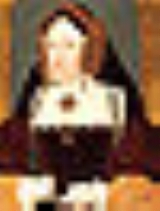
Catherine of Aragon


Catherine of Aragon (16 December 1485 – 7 January 1536) also known as Katherine or Katharine; (Spanish
Spanish language

Spanish or Castilian is a Romance languages that originated in northern Spain, and gradually spread in the Kingdom of Castile and evolved into the principal language of government and trade....
 Infanta Catalina de Aragón y Castilla or Infanta Catalina de Trastámara y Trastámara) was the Queen of England
List of English consorts

The English royal consorts were the spouses of the reigning monarchs of the Kingdom of England. Most of them are women, and held the title of Queen consort; some few are men, whose titles were not consistent, depending upon the circumstances of their spouses' reigns....
 as the first wife
Wives of Henry VIII

The six wives of Henry VIII of England were, in order: Catherine of Aragon , Anne Boleyn , Jane Seymour , Anne of Cleves , Catherine Howard , and Catherine Parr....
 of Henry VIII of England
Henry VIII of England

Henry VIII was King of England from 21 April 1509 until his death. He was also Lordship of Ireland and claimant to the Early Modern France. Henry was the second monarch of the House of Tudor, succeeding his father, Henry VII of England....
, and Princess of Wales
Princess of Wales

Princess of Wales is a courtesy title most commonly identified with Diana, Princess of Wales. It is held by the wife of the Prince of Wales since the first "English" Prince of Wales in 1283....
 by her first marriage to Arthur, Prince of Wales
Arthur, Prince of Wales

Arthur, Prince of Wales was the first son of King Henry VII of England and Elizabeth of York, and therefore, heir to the throne of England and Wales....
. She was also an Infanta of Castille and Aragon.

Henry VIII's attempt to have their 24-year marriage annulled
Annulment

Annulment is a legal procedure for declaring a marriage Void . Unlike divorce, it is retroactive: an annulled marriage is considered never to have existed....
 set in motion a chain of events that led to England's break with the Roman Catholic Church
Roman Catholic Church

The Roman Catholic Church, officially known as the Catholic Church is the world's largest Christianity Ecclesia , representing over half of all Christians and one-sixth of the world population....
.


Discussion
Ask a question about 'Catherine of Aragon'
Start a new discussion about 'Catherine of Aragon'
Answer questions from other users
Full Discussion Forum


Encyclopedia


Catherine of Aragon (16 December 1485 – 7 January 1536) also known as Katherine or Katharine; (Spanish
Spanish language

Spanish or Castilian is a Romance languages that originated in northern Spain, and gradually spread in the Kingdom of Castile and evolved into the principal language of government and trade....
 Infanta Catalina de Aragón y Castilla or Infanta Catalina de Trastámara y Trastámara) was the Queen of England
List of English consorts

The English royal consorts were the spouses of the reigning monarchs of the Kingdom of England. Most of them are women, and held the title of Queen consort; some few are men, whose titles were not consistent, depending upon the circumstances of their spouses' reigns....
 as the first wife
Wives of Henry VIII

The six wives of Henry VIII of England were, in order: Catherine of Aragon , Anne Boleyn , Jane Seymour , Anne of Cleves , Catherine Howard , and Catherine Parr....
 of Henry VIII of England
Henry VIII of England

Henry VIII was King of England from 21 April 1509 until his death. He was also Lordship of Ireland and claimant to the Early Modern France. Henry was the second monarch of the House of Tudor, succeeding his father, Henry VII of England....
, and Princess of Wales
Princess of Wales

Princess of Wales is a courtesy title most commonly identified with Diana, Princess of Wales. It is held by the wife of the Prince of Wales since the first "English" Prince of Wales in 1283....
 by her first marriage to Arthur, Prince of Wales
Arthur, Prince of Wales

Arthur, Prince of Wales was the first son of King Henry VII of England and Elizabeth of York, and therefore, heir to the throne of England and Wales....
. She was also an Infanta of Castille and Aragon.

Henry VIII's attempt to have their 24-year marriage annulled
Annulment

Annulment is a legal procedure for declaring a marriage Void . Unlike divorce, it is retroactive: an annulled marriage is considered never to have existed....
 set in motion a chain of events that led to England's break with the Roman Catholic Church
Roman Catholic Church

The Roman Catholic Church, officially known as the Catholic Church is the world's largest Christianity Ecclesia , representing over half of all Christians and one-sixth of the world population....
. Henry was dissatisfied because their sons died in infancy, leaving only one of their six children, Princess Mary
Mary I of England

Mary I , was Queen of England and Monarchy of Ireland from 19 July 1553 until her death. The fourth crowned monarch of the Tudor dynasty, she is remembered for restoring England to Roman Catholicism after succeeding her short-lived half brother, Edward VI of England, to the English throne....
, later Queen Mary I, as heiress presumptive, at a time when there was no established precedent for a woman on the throne. When Pope Clement VII
Pope Clement VII

Pope Clement VII , born Giulio di Giuliano de' Medici, was a Cardinal from 1513 to 1523 and was Pope from 1523 to 1534....
 refused to annul the marriage, Henry defied him by assuming supremacy over religious matters. This allowed him to marry Anne Boleyn
Anne Boleyn

Anne Boleyn was List of English consorts as the Wives of Henry VIII of Henry VIII of England. She was also Earl of Pembroke in her own right. Henry's marriage to Anne, and her subsequent execution, made her a key figure in the political and religious upheaval that was the start of the English Reformation....
 on the judgment of clergy in England, without reference to the Pope. He was motivated by the hope of fathering a male heir to the Tudor dynasty
Tudor dynasty

The House of Tudor was a prominent European royal house that ruled the Kingdom of England and its realms from 1485 until 1603. Founded by Henry VII of England, who, though his paternal family was Welsh people ?his grandfather was Owen Tudor? was himself also a legitimized descendent of the royal House of Lancaster....
. Catherine refused to accept Henry as Supreme Head of the Church of England and considered herself the King's rightful wife and Queen until her death.

Catherine's contemporaries said that she was "more beloved than any queen who ever reigned". Over the years, numerous artistic and cultural works have been dedicated to her, written about her, or mentioned her, including some by her husband Henry VIII, who wrote "Grene growth the holy" about and for her, and Juan Luis Vives
Juan Luís Vives

Joan Llu?s Vives i March , better known as Juan Luis Vives , was a Spanish scholar and Humanism from Kingdom of Valencia.Biography...
, who dedicated "The Institution of Christian Women" to her.

Early life (1485-1501)


When Catherine was born she was named "Catalina", though she would later change her name to the more English "Catherine" upon her arrival in England. She was born at the Archbishop's Palace in Alcalá de Henares
Alcalá de Henares

Alcal? de Henares, meaning Castle on the river Henares, is a Spain city, whose historical centre is one of UNESCO's World Heritage Sites, and one of the first bishoprics founded in Spain....
, in Madrid, on the night of 16 December 1485. She was the youngest child of Ferdinand II of Aragon
Ferdinand II of Aragon

Ferdinand the Catholic was king of Aragon , Sicily , Naples , Valencia , Sardinia and Navarre, Count of Barcelona, de jure uxoris King of Crown of Castile and then Regent of that country also from 1508 to his death, in the name of his mentally unstable daughter Joanna the Mad....
 and Isabella I of Castile
Isabella I of Castile

Isabella I was Kings of Castile. She and her husband, Ferdinand II of Aragon, laid the foundation for the political unification of Spain under their grandson, Charles V, Holy Roman Emperor....
. Her siblings were Isabella, Queen of Portugal; Juan, Prince of Asturias
Juan, Prince of Asturias

Juan, Prince of Asturias, was the only son of Isabella I of Castile and Ferdinand II of Aragon who survived to adulthood.At the age of 18 Juan married Archduchess Margaret of Austria in the Cathedral of Burgos in April, 1497....
; Joanna of Castile
Joanna of Castile

Joanna , called Joanna the Mad queen regnant as Kings of Castile of Crown of Castile jointly with her husband Philip I of Castile and later also as List of Aragonese monarchs of Crown of Aragon jointly with her son the Holy Roman Emperor Charles V, Holy Roman Emperor....
; and Maria, Queen of Portugal
Maria of Aragon (1482-1517)

Maria of Aragon was a Spain infanta, second wife of Portugal List of Portuguese monarchs Manuel I of Portugal and because of that queen consort of Portugal from her marriage on 30 October, 1500 until her death....
. She was aunt to, among others, Charles V, Holy Roman Emperor
Charles V, Holy Roman Emperor

Charles V was ruler of the Holy Roman Empire from 1519 and, as Charles I of Spain, of the Spanish realms from 1516 until his abdication in 1556....
, John III of Portugal
John III of Portugal

John III , nicknamed o Piedoso , was the fifteenth Portuguese monarchy.Born in Lisbon, he was the son of Manuel I of Portugal and his queen consort, Maria of Aragon ....
 and their wives, Ferdinand I, Holy Roman Emperor
Ferdinand I, Holy Roman Emperor

Ferdinand I was a Central European monarch from the Habsburg. He was Holy Roman Emperor from 1558, King of Bohemia and King of Hungary and Croatia from 1526....
, Henry I of Portugal and Isabella, Queen of Denmark
Isabella of Burgundy

Isabella of Austria , Archduchess of Austria, Infanta of Crown of Castile and Princess of Duchy of Burgundy by birth and Queen of Denmark, Sweden and Norway by her marriage to Christian II of Denmark, was the daughter of Philip I of Castile and Joanna of Castile of Crown of Castile and the sister of Charles V, Holy Roman Emperor....
. She was a granddaughter of John II of Castile
John II of Castile

John II was kings of Castile from 1406 to 1454. He was the son of Henry III of Castile and his wife Katherine of Lancaster, daughter of John of Gaunt, 1st Duke of Lancaster by Constance of Castile , daughter of King Pedro of Castile ....
 and John II of Aragon
John II of Aragon

John II the Great was the King of Aragon and jure uxoris King of Navarre . He was the son of Ferdinand I of Aragon and his wife Eleanor of Alburquerque....
. She was quite short in stature, with long golden auburn hair, wide blue eyes, a round face, and a fair complexion. She was descended from the English royal house as her great-grandmother Katherine of Lancaster, after whom she was named, and her great-great-grandmother Philippa of Lancaster
Philippa of Lancaster

Philippa of Lancaster, Order of the Garter was List of Portuguese royal consorts. Her marriage with King John I of Portugal secured the Anglo-Portuguese Alliance, which is still in force, and also produced several famous princes and princesses of Portugal that became known as the "Illustrious Generation"....
, were both daughters of John of Gaunt and granddaughters of Edward III of England
Edward III of England

Edward III was one of the most successful List of the monarchs of the Kingdom of Englands of the Britain in the Middle Ages. Restoring royal authority after the disastrous reign of his father, Edward II of England, Edward III went on to transform the Kingdom of England into the most efficient military power in Europe....
. Consequently she was third cousin of her father-in-law, Henry VII
Henry VII of England

Henry VII was the Kingdom of England and Lordship of Ireland from his usurpation of the crown on 22 August 1485 until his death on 21 April 1509, as the first monarch of the Tudor dynasty....
, and fourth cousin of her mother-in-law Elizabeth of York
Elizabeth of York

Elizabeth of York was the daughter, sister, niece, wife and mother of Kings of England. She was List of English consorts as spouse of King Henry VII of England, whom she married in 1486....
.

When Catherine was aged two, in the spring of 1488, a tournement took place, and in the interval the ambassadors from England
England

native_name =|conventional_long_name = England|common_name = England|image_flag = Flag of England.svg|image_coat = England COA.svg|symbol_type = Royal Coat of Arms...
 came to pay their respects to her mother Queen Isabella. Katherine was seated upon her mother's lap, and the ambassadors said that Katherine was "singularly beautiful". She was educated by a tutor, Alessandro Geraldini, who was a clerk in Holy Orders. She studied religion, the classics, Latin histories, and canon and civil law. She had a strong religious upbringing and developed a faith that would play a major role in later life. She learned to speak, read and write in Spanish
Spanish language

Spanish or Castilian is a Romance languages that originated in northern Spain, and gradually spread in the Kingdom of Castile and evolved into the principal language of government and trade....
 and Latin
Latin

Latin is an Italic language, historically spoken in Latium and Ancient Rome. Through the Military history of the Roman Empire, Latin spread throughout the Mediterranean and a large part of Europe....
, and spoke French
French language

French is a Romance language spoken around the world by around 80 million people as first language, by 190 million as second language, and by about another 200 million people as an acquired tongue, with significant speakers in 54 countries....
 and Greek
Greek language

Greek is an Indo-European languages native to the southern Balkan peninsula, the language of the Greek people. It forms an independent branch within Indo-European....
. She was also taught domestic skills, such as needlepoint, lacemaking, embroidery, music and dancing. The great scholar Erasmus would later say that Catherine "loved good literature which she had studied with success since childhood".

At an early age, she was considered a suitable wife for Arthur, Prince of Wales
Arthur, Prince of Wales

Arthur, Prince of Wales was the first son of King Henry VII of England and Elizabeth of York, and therefore, heir to the throne of England and Wales....
, eldest son of Henry VII of England
Henry VII of England

Henry VII was the Kingdom of England and Lordship of Ireland from his usurpation of the crown on 22 August 1485 until his death on 21 April 1509, as the first monarch of the Tudor dynasty....
 and heir to the throne. They were married by proxy
Proxy marriage

A proxy marriage is marriage in which either the bride or the groom is not physically present for the wedding. During the solemnization of the marriage, based upon a power of attorney, a stand-in, or proxy, acts on behalf of one of the parties....
 on 19 May 1499, and corresponded in Latin until Arthur turned 15 and it was decided that they were old enough to be married. A portrait by Juan de Flandes, entitled "Portrait of an Infanta" (circa 1496), is thought to be of either Catherine or her sister Joanna. An ongoing debate about which Infanta it is has come to no conclusion. The fact that the young girl holds a rose may be seen as symbolism regarding the House of Tudor, and has been seen as evidence as it being Catherine, as Catherine was betrothed to its heir. Elisa Bermejo, however, considers the flower as an attribute related to the sitter's very young age. David Starkey considers the portrait to be of Catherine, and has used the image, along with other portraits of the six wives of Henry VIII, on the cover of his book "The Six Wives: The Queens of Henry VIII". The fact that the sitter appears to be between 10-12 would fit Katherine's age at the time of the painting, her being about 11. However it has been noted that "Portrait of an Infanta" has similarities with a painting of Joanna held in the Kunsthistorisches Museum, but similarities have also been drawn to paintings of Catherine.

Catherine arrived in England in the autumn of 1501, with a retinue including George de Athequa
George de Athequa

George de Athequa was a Bishop of Llandaff in the early days of the English Reformation. A Spaniard by birth, he was chaplain to Queen Catharine of Aragon, with whom he left Spain for England....
. The couple later met on 4 November at Dogmersfield
Dogmersfield

Dogmersfield is a small and peaceful village between Fleet, Hampshire and Hartley Wintney located in Hampshire, England.Places of interest include the village church, the Queen's Head pub and a mansion house known variously as Dogmersfield House or Dogmersfield Park ....
 in Hampshire
Hampshire

Hampshire , sometimes historically Southamptonshire, Hamptonshire, , or the County of Southampton, is a Counties of England on the south coast of England....
. Little is known about their first impressions of each other, but Arthur did write to his parents-in-law that he would be 'a true and loving husband' and told his parents that he was immensely happy to 'behold the face of his lovely bride'. They found that they were unable to speak to each other since they had learned different pronunciations of Latin. Ten days later, on 14 November 1501, they were married at St. Paul's Cathedral, with Catherine being led up the aisle by Arthur's younger brother, Henry, the future Henry VIII.

As wife and widow of Arthur


Saint Thomas More wrote that on her arrival in England she "thrilled the hearts of everyone, there is nothing lacking in her that the most beautiful girl should have". Arthur was sent to Ludlow Castle
Ludlow Castle

Ludlow Castle is a large, now partly ruined, non-inhabited castle which dominates the town of Ludlow in Shropshire, England. It stands on a high point overlooking the River Teme....
 on the borders of Wales
Wales

native_name = Cymru|conventional_long_name = Wales|common_name = Wales|image_flag = Flag of Wales 2.svg|national_motto = ...
, to preside over the Council of Wales and the Marches, as was his duty as Prince of Wales, and his bride accompanied him. A few months later, they both became ill, possibly with the sweating sickness
Sweating sickness

Sweating sickness, also known as the "English sweate" , was a mysterious and highly virulent disease which struck England and later Europe in a series of epidemics, the first beginning in 1485 and the last in 1551, afterwards apparently vanishing....
 which was sweeping the area. He died on 2 April 1502, and she almost died too, but recovered to find herself a widow. Catherine, as Princess of Wales, adopted as her personal motto "Not for my crown" along with her personal badge of the pomegranate crowned.

At this point, Henry VII faced the challenge of avoiding returning her dowry to her father. To avoid complications, it was agreed she would marry Henry VII's second son, Prince Henry, who was a little more than five years younger than she was. The marriage was delayed until Prince Henry was old enough, and Henry VII procrastinated so much that it was doubtful if the marriage would ever take place. She lived, almost as prisoner, at Durham House
Durham House (London)

Durham House, or Durham Inn, was the historic London residence of the Bishop of Durham in the Strand, London, with its gardens descending to the Thames....
 in London
London

London is the capital of both England and the United Kingdom, and the most populous municipality in the European Union. An important settlement for two millennia, History of London goes back to its founding by the Roman Empire....
. Some of her letters to her father, complaining of her treatment, have survived. She had little money and struggled to cope, as she had the wellbeing of her ladies-in-waiting to maintain as well as her own.

Marriage to Arthur's brother depended on the Pope granting a dispensation because of the close relationship. Catherine testified her marriage to Arthur was never consummated. The matter was considered of minor importance at the time, as the Pope had the power to overrule any objections, whether or not they were for religious reasons.

Queen of England (1509-1533)


Their wedding took place on 11 June 1509, seven weeks after Henry VII
Henry VII of England

Henry VII was the Kingdom of England and Lordship of Ireland from his usurpation of the crown on 22 August 1485 until his death on 21 April 1509, as the first monarch of the Tudor dynasty....
's death. They were married in a private ceremony at Greenwich Church. As she claimed to have remained virgin during her first marriage, Catherine wore white with her hair loose - a symbol of virginity.

Coronation


On Saturday 23 June, the traditional eve-of-coronation procession to Westminster was greeted by an extremely large and very enthusiastic crowd. As was the custom, they spent the night before their coronation
Coronation

A coronation is a ceremony marking the investiture of a monarch with regal power, specifically involving the placement of a coronation crown upon his or her head, and the presentation of other items of regalia....
 at the Tower of London
Tower of London

Her Majesty's Royal Palace and Fortress, more commonly known as the Tower of London , is a historic monument in central London, England, on the north bank of the River Thames....
. On Midsummer's Day, Sunday, 24 June 1509, Henry VIII and Catherine of Aragon were anointed
Anointing

To anoint is to pour or smear with perfumed oil, milk, water, melted butter or other substances, a process employed ritually by many religions and races....
 and crowned
Coronation

A coronation is a ceremony marking the investiture of a monarch with regal power, specifically involving the placement of a coronation crown upon his or her head, and the presentation of other items of regalia....
 together by the Archbishop of Canterbury at a lavish ceremony at Westminster Abbey
Westminster Abbey

The Collegiate Church of St Peter at Westminster, which is almost always referred to popularly and informally as Westminster Abbey, is a large, mainly Gothic architecture Church , in Westminster, London, just to the west of the Palace of Westminster....
. Catherine again wore a white dress with her long hair flowing loose, and a coronet on her head set with many pearls. As a queen consort
Queen consort

A queen consort is the title given to the wife of a reigning Monarch. Queens consort usually share their husbands' Royal and noble ranks and hold the feminine equivalent of their husbands' monarchical titles....
 she took no oath, nor was she invested with the sword or spurs. She was anointed on her head and breasts; the coronation ring was put on the fourth finger of her right hand, the crown on her head, the sceptre in her right hand and the ivory rod surmounted with the dove in her left. The coronation was followed by a banquet in Westminster Hall. Many new Knights of the Bath were created in honour of the coronation.

A pamphlet by Stephen Hawes in 1509, contains a poem of praise on the occasion of the coronation of Henry VIII and Catherine of Aragon, entitled "A joyfull medytacyon to all Englonde of the coronacyon of our moost naturall souerayne lorde kynge Henry the eyght", .

Thomas More
Thomas More

Saint Thomas More was an English lawyer, author, and statesman who in his lifetime gained a reputation as a leading Renaissance humanist scholar, and occupied many public offices, including Lord Chancellor ....
 wrote about the coronation "This day is the end of our slavery, the fount of our liberty; the end of sadness, the beginning of joy." Henry was almost 18 when crowned and Katherine was 23.

Marriage, pregnancies, and children


It seems Catheirne and Henry did genuinly love each other, and the marriage seems to have been very happy until it started to become likely that they would have no male heir. Catherine had seven pregnancies altogether. On New Year's day 1510, Catherine received her first Yuletide gift from Henry, it was a illuminated missal which had once belonged to his own mother, Elizabeth of York
Elizabeth of York

Elizabeth of York was the daughter, sister, niece, wife and mother of Kings of England. She was List of English consorts as spouse of King Henry VII of England, whom she married in 1486....
, into which Henry had written himself, in French, which Henry and Catherine both spoke fluently "If your rememberance be according to my affection, I shall not be forgotten in your daily prayers, for I am yours, Henry R., forever" Catherine wrote her own inscription underneath it:"By daily proof you shall me find to be to you both loving and kind".

Another item owned by Elizabeth of York was passed to Catherine, a Psalter in which Elizabeth wrote on the first page wrote, ‘Thys Booke ys myn Elizabeth ye Quene’. the Psalter was probably originally made in the latter half of the fourteenth-century for Humphrey Bohun. The Psalter also contains Catherine’s signature.Later that year, on New Year's Eve 1510, Catherine had a stillborn girl. Also in 1510, when Catherine was pregnant for a second time, Henry VIII took his first known mistress, Elizabeth FitzWalter, who was also his second cousin. When her family found out about her affair with the King, they removed her from court and she was placed in a convent sixty miles away. Henry blamed Catherine for this, and confronted her. Catherine knew nothing about his infidelity so this led to an argument between the two, with Catherine reproaching Henry for his affair, and Henry berating her for lecturing him. The whole Court learned of the incident and they ended up being "very vexed with each other". To the Spanish Ambassador's dismay, Catherine continued to censure Henry for his affair someways after. She later gave birth to the baby on New Year's Day 1511. The child was a boy and was named Henry
Henry, Duke of Cornwall

Henry, Duke of Cornwall was the name of two sons of King Henry VIII of England and his first wife, Catherine of Aragon. Henry in total had six children by Catherine of Aragon; 2 girls, 3 boys, and 1 whose sex is unrecorded....
. However, he only lived for 52 days.

Henry often came into Catherine's rooms in disguise with some of his gentlemen and dance with Catherine and her ladies, and Catherine always pretended to be suprised when Henry revealed his identity, even after he had been doing this for many years. In 1513, Catherine was pregnant again. Henry appointed her regent when he went to France on a military campaign. When the Scots invaded, they were defeated at the Battle of Flodden Field
Battle of Flodden Field

The Battle of Flodden or Flodden Field was fought in the county of Northumberland in northern England on 9 September 1513, between an invading Scottish people army under King James IV of Scotland and an English army commanded by Thomas Howard, Earl of Surrey....
, with Catherine addressing the army, and riding north with some of the troops. She sent a letter to Henry along with the bloodied coat of the King of Scots, James IV
James IV of Scotland

James IV was King of Scots from 11 June 1488 to his death. He is generally regarded as the most successful of the House of Stuart monarchs of Scotland, but his reign ended with the disastrous defeat at the Battle of Flodden Field, where he became the last British monarch to be killed in battle....
, who died in the battle.

Henry returned from France, but Catherine lost the baby, another boy. He was either stillborn or died shortly afterward. In 1514, she had another stillborn son. On 18 February 1516, Catherine delivered a healthy girl. She was named Mary
Mary I of England

Mary I , was Queen of England and Monarchy of Ireland from 19 July 1553 until her death. The fourth crowned monarch of the Tudor dynasty, she is remembered for restoring England to Roman Catholicism after succeeding her short-lived half brother, Edward VI of England, to the English throne....
 and christened three days later with great ceremony at The Church of Observant Friars.

In 1517, she had a miscarriage and in 1518, Catherine became pregnant for the last time. She gave birth to a daughter in November, but the child was weak and lived only a few days.

Catherine's religious dedication increased as she aged, as did her interest in academics. She continued to broaden her knowledge and provide training for her daughter. Education among women became fashionable, partly because of Catherine's influence. She also donated large sums of money to several colleges. Henry, however, still considered a male heir essential. The Tudor dynasty
Tudor dynasty

The House of Tudor was a prominent European royal house that ruled the Kingdom of England and its realms from 1485 until 1603. Founded by Henry VII of England, who, though his paternal family was Welsh people ?his grandfather was Owen Tudor? was himself also a legitimized descendent of the royal House of Lancaster....
 was new, and its legitimacy might still be tested. A long civil war
The Anarchy

The Anarchy or The Nineteen Year Winter refers to a period of history of England during the reign of the Normans King, Stephen of England, which was characterised by civil war and unsettled government....
 (1135–54) had been fought the last time a woman, (Henry I of England
Henry I of England

Henry I was the fourth son of William I the Conqueror. He succeeded his elder brother William II of England as King of England in 1100 and defeated his eldest brother, Robert Curthose, to become Duke of Normandy in 1106....
's daughter, the Empress Matilda
Empress Matilda

Empress Matilda, also known as Matilda of England or Maude was the daughter and heir of King Henry I of England. Matilda and her younger brother, William Adelin, were the only legitimate children of King Henry....
), had inherited the throne. The disasters of civil war
Civil war

A civil war is a war between organized groups to take control of a nation or region, or to change government policies. It is high-intensity conflict, often involving Regular Army, that is sustained, organized and large-scale....
 were still fresh in living memory from the Wars of the Roses
Wars of the Roses

The Wars of the Roses were a series of dynastic civil wars fought in England between supporters of the Houses of House of Lancaster and House of York....
.

In 1520, Catherine's nephew Emperor Charles V
Charles V, Holy Roman Emperor

Charles V was ruler of the Holy Roman Empire from 1519 and, as Charles I of Spain, of the Spanish realms from 1516 until his abdication in 1556....
, of the Holy Roman Empire, paid a state visit to England, and she urged Henry to enter an alliance with Charles rather than with France
France

France , officially the French Republic , is a country whose Metropolitan France is located in Western Europe and that also comprises various Overseas departments and territories of France....
. Immediately after his departure, she accompanied Henry to France on the celebrated visit to Francis I
Francis I of France

Francis I , was crowned King of France in 1515 in the cathedral at Reims and reigned until 1547.Francis I is considered to be France's first Renaissance monarch....
, the so-called Field of the Cloth of Gold
Field of the Cloth of Gold

The Field of Cloth of Gold, also known as the Field of Golden Cloth is the name given to a place in Balinghem, between Gu?nes and Ardres, in France, near Calais....
. Within two years, war was declared against France and the Emperor was once again welcome in England, where plans were afoot to betroth him to Princess Mary.

The King's Great Matter


In 1525, Henry VIII became enamoured of Anne Boleyn
Anne Boleyn

Anne Boleyn was List of English consorts as the Wives of Henry VIII of Henry VIII of England. She was also Earl of Pembroke in her own right. Henry's marriage to Anne, and her subsequent execution, made her a key figure in the political and religious upheaval that was the start of the English Reformation....
, a maid-of-honour to Queen Catherine, who was between 10-17 years younger than Henry. Henry began pursuing her. By this time Catherine was no longer able to undergo further pregnancies. Henry began to believe that his marriage was cursed and sought confirmation from the Bible, which said if a man marries his brother's wife, the couple will be childless. If she had lied when she said her marriage to Arthur had not been consummated, it meant that their marriage was wrong in the eyes of God. It is possible that the idea of annulment had been suggested to Henry much earlier than this, and is highly probable that it was motivated by his desire for a son. Before Henry's father, Henry VII, ascended the throne, England was beset by civil warfare
Wars of the Roses

The Wars of the Roses were a series of dynastic civil wars fought in England between supporters of the Houses of House of Lancaster and House of York....
 over rival claims to the English crown, and Henry may have wanted to avoid a similar uncertainty over the succession.

It soon became the one absorbing object of Henry's desires to secure an annulment. Catherine was defiant when it was suggested that she quietly retire to a nunnery, saying "God never called me to a nunnery I am the King's true and legitimate wife". He set his hopes upon an appeal to the Holy See
Holy See

The Holy See is the episcopal jurisdiction of the Bishop of Rome, commonly known as the Pope, and is the preeminent episcopal see of the Roman Catholic Church, forming the central government of the Church....
, acting independently of Thomas Cardinal Wolsey, whom he told nothing of his plans. William Knight, the King's secretary, was sent to Pope Clement VII
Pope Clement VII

Pope Clement VII , born Giulio di Giuliano de' Medici, was a Cardinal from 1513 to 1523 and was Pope from 1523 to 1534....
 to sue for an annulment, on the grounds that the dispensing bull
Papal bull

A Papal bull is a particular type of letters patent or charter issued by a pope. It is named after the bulla that was appended to the end to authenticate it....
 of Pope Julius II
Pope Julius II

Pope Julius II , nicknamed Il Papa Terribile , was born Giuliano della Rovere. He was Pope from 1503 to 1513. His reign was marked by an aggressive foreign policy, ambitious building projects, and patronage for the arts....
 was obtained by false pretences. When Henry spoke to Queen Catherine of Doctors' and Lawyers' opinions on their annulment, telling her that he had been assured that he was not her legitimate husband by learned doctors and lawyers, Katherine retorted :

After the argument, Henry went to seek consolation in Anne Boleyn, but she told him that:

Catherine had the support of the people, in particular women. They were generally opposed to the annulment and the prospect of the King's mistress becoming Queen.

As the Pope was, at that time, the prisoner of Catherine's nephew, Emperor Charles V
Charles V, Holy Roman Emperor

Charles V was ruler of the Holy Roman Empire from 1519 and, as Charles I of Spain, of the Spanish realms from 1516 until his abdication in 1556....
, following the Sack of Rome
Sack of Rome

The city of Rome has been lootinged on several occasions. Among the most famous:*Battle of the Allia - Rome is sacked by the Gauls after the Battle of the Allia...
 in May 1527, Knight had difficulty in obtaining access to him. In the end, Henry's envoy had to return without accomplishing much. Henry now had no choice but to put his great matter into the hands of Thomas Wolsey, and Wolsey did all he could to secure a decision in Henry's favour. How far the pope was influenced by Charles V, it is difficult to say, but it is clear Henry saw that the Pope was unlikely to give him an annulment from the Emperor's aunt. The Pope forbade Henry to marry again before a decision was given in Rome. Wolsey had failed and was dismissed from public office in 1529. Wolsey then began a secret plot to have Anne Boleyn forced into exile and began communicating with the Pope, to that end. When this was discovered, Henry ordered Wolsey's arrest and, had it not been for his death from terminal illness
Terminal illness

Terminal illness is a medical terminology popularized in the 20th century to describe an active and malignant disease that cannot be cured or adequately treated and that is reasonably expected to result in the death of the patient....
 in 1530, he might have been executed for treason
Treason

In law, treason is the crime that covers some of the more serious acts of loyalty to one's sovereignty or nation. Historically, treason also covered the murder of specific social superiors, such as the murder of a husband by his wife ....
. A year later, Catherine was banished from court and her old rooms were given to Anne Boleyn. When Archbishop of Canterbury
Archbishop of Canterbury

The Archbishop of Canterbury is the chief bishop and principal leader of the Church of England, the symbolic head of the worldwide Anglican Communion and the Diocesan Bishop of the Diocese of Canterbury, the Episcopal see that churches must be in communion with in order to be a part of the Anglican Communion....
 William Warham
William Warham

William Warham , Archbishop of Canterbury, belonged to a Hampshire family, and was educated at Winchester College and New College, Oxford, afterwards practising and teaching law both in London and Oxford....
 died, the Boleyn family's chaplain, Thomas Cranmer
Thomas Cranmer

Thomas Cranmer was a leader of the English Reformation and Archbishop of Canterbury during the reigns of Henry VIII of England and Edward VI of England....
, was appointed to the vacant position. In November 1531, Catherine wrote to her nephew:

In the Legatine Trial of 1529, which was appointed to make a decision regarding the annulment of Henry and Catherine's marriage (although it never did) Catherine wore an expensive red and yellow dress, made a brave speech, ignoring the summons of the crier and counsellors, she went up to Henry, bowed, then dropped to her knees and said:

She then walked out, the crier shouted three times for her to come back into Court, she ignored him and said "It is no indifferent court therefore I will not tarry".

Catherine's speech would later be represented in art many times over the centuries. When Henry decided to annul his marriage to Catherine, John Fisher
John Fisher

John Cardinal Fisher , from 1935 Saint John Fisher, was an English people Roman Catholic bishop, cardinal and martyr. He shares his feast day with Thomas More on 22 June in the Roman Catholic calendar of saints and 6 July on the Calendar of saints ....
 became her most trusted counsellor and one of her chief supporters. He appeared in the legates' court on her behalf, where he shocked people with the directness of his language, and by declaring that, like John the Baptist
John the Baptist

John the Baptist was a mission preacher and a major religious figure who led a movement of baptism at the Jordan River in expectation of a divine apocalypse that would restore occupied Israel....
, he was ready to die on behalf of the indissolubility of marriage. Henry was so enraged by this that he wrote a long Latin address to the legates in answer to Fisher's speech. Fisher's copy of this still exists, with his manuscript annotations in the margin which show how little he feared Henry's anger. The removal of the cause to Rome ended Fisher's role in the matter, but Henry never forgave him. Other people who supported Katherine's case included Saint Thomas More, Henry's own sister Mary Tudor, Queen of France, Martin Luther
Martin Luther

Martin Luther was a Germans monk, theology, university professor, priest, father of Protestantism, and Protestant Reformers whose ideas started the Protestant Reformation and changed the course of Western culture....
, Maria de Salinas
Maria de Salinas

Maria de Salinas, Lady Willoughby was a noblewoman from Spain who became a lady-in-waiting to Catherine of Aragon, List of English consorts....
, Charles V of Spain, and Pope Paul III
Pope Paul III

Pope Paul III , born Alessandro Farnese, was Pope of the Roman Catholic Church from 1534 to his death in 1549. He also called the Council of Trent in 1545....
.

Later years (1533-1536)


Upon returning to Dover
Dover

Dover is a town and major ferry port in the county of Kent, in South East England. It faces France across the narrowest part of the English Channel....
 from a meeting with King Francis I of France
Francis I of France

Francis I , was crowned King of France in 1515 in the cathedral at Reims and reigned until 1547.Francis I is considered to be France's first Renaissance monarch....
 in Calais
Calais

Calais is a town in northern France in the Departments of France of Pas-de-Calais, of which it is a sub-prefecture. Although Calais is by far the largest city in Pas-de-Calais, the department's capital is its third-largest city of Arras....
, Henry married Anne Boleyn in a secret ceremony, Anne was already pregnant at the time. Events now began to move at a quick pace. On 23 May 1533, Cranmer, sitting in judgment at a special court convened at Dunstable Priory
Dunstable Priory

The Priory Church of Saint Peter with its monastery was founded in 1132 by Henry I of England for Augustinians Canons_Regular#Canons_Regular in Dunstable, Bedfordshire, England....
 to rule on the validity of Henry's marriage to Catherine, declared that marriage null and void. Five days later, on 28 May 1533, Cranmer declared the marriage of Henry and Anne valid.

Until the end of her life, Catherine would refer to herself as Henry's only lawful wedded wife and England's only rightful queen; her faithful servants continued to address her by that title, and most of the population of Europe believed her to be Queen, and Anne just a concubine and her daughter a bastard. Henry refused her the right to any title but "Dowager Princess of Wales", in recognition of her position as his brother's widow.

In 1535 she was transferred to the decaying and remote Kimbolton Castle
Kimbolton Castle

Kimbolton Castle in Kimbolton, Cambridgeshire, Cambridgeshire, is best known as the final home of Henry VIII of England's first queen, Catherine of Aragon....
. Confining herself to one room, leaving it only to attend Mass, and fasting most of the time, and wearing the hair shirt of the Order of St. Francis, she prepared to meet her end. While she was permitted to receive occasional visitors, she was forbidden to see her daughter, Mary. They were also forbidden to communicate but discreet sympathizers ferried letters between mother and daughter. Henry offered them both better quarters and each other's company if they would acknowledge Anne Boleyn as his new Queen. Neither did.

In late December 1535, sensing death was near, she made her will
Will (law)

In common law, a will or testament is a document by which a person regulates the rights of others over his or her property or family after death....
, and wrote to her nephew, the Emperor Charles V
Charles V, Holy Roman Emperor

Charles V was ruler of the Holy Roman Empire from 1519 and, as Charles I of Spain, of the Spanish realms from 1516 until his abdication in 1556....
, asking him to protect her daughter. She then penned one final letter to Henry, her "most dear lord and husband":

She died at Kimbolton Castle
Kimbolton Castle

Kimbolton Castle in Kimbolton, Cambridgeshire, Cambridgeshire, is best known as the final home of Henry VIII of England's first queen, Catherine of Aragon....
, on 7 January 1536. The following day, news of her death reached the King. According to the chronicler Edward Hall, Anne wore yellow for the mourning, which has been interpreted in various ways; Polydore Vergil interpreted this to mean that Anne did not mourn. However, Chapuys reported that it was actually King Henry who decked himself in yellow, celebrating the news and making a great show of his and Anne's daughter, Elizabeth, to his courtiers. This was seen as distasteful and vulgar by many. Rumours then circulated that she had been poisoned by Anne or Henry, or both, as Anne had threatened to murder both Katherine and Mary on several occasions. The rumours were born after the apparent discovery during her embalming that there was a black growth on her heart that might have been caused by poisoning. Modern medical experts are in agreement that her heart's discolouration was due not to poisoning, but to cancer, something which was not understood at the time. She was buried in Peterborough Cathedral
Peterborough Cathedral

Peterborough Cathedral, or the Cathedral Church of St Peter, St Paul and St Andrew – also known as Saint Peter's Cathedral – the seat of the Bishop of Peterborough, is dedicated to Saint Peter, Paul of Tarsus and Saint Andrew whose statues look down from the three high gables of the famous West Front....
 with the ceremony due to a Dowager Princess of Wales
Princess of Wales

Princess of Wales is a courtesy title most commonly identified with Diana, Princess of Wales. It is held by the wife of the Prince of Wales since the first "English" Prince of Wales in 1283....
, not a queen. Henry did not attend the funeral and refused to allow Mary to attend either. Many peasants lined the route to Catherine's funeral, as she was still a very popular figure with them, the chief mourner was Lady Eleanor Brandon, and the secondry mourner was the daughter of Maria de Salinas, Catherine Willoughby, a concourse of poor men in black gowns and hoods, carrying black torches attended. Chapys, the Imperial Ambassador and a supporter of Catherine refused to attend, in defiance of the service not being fitting to a Queen but a Princess Dowager. The wax figure in its robes on the hearse, representing the Queen was, wrote William Forrest, curiously lifelike.

Legacy, Memory, and Historiography


In the reign of her daughter, Mary I of England
Mary I of England

Mary I , was Queen of England and Monarchy of Ireland from 19 July 1553 until her death. The fourth crowned monarch of the Tudor dynasty, she is remembered for restoring England to Roman Catholicism after succeeding her short-lived half brother, Edward VI of England, to the English throne....
 her marriage to Henry VIII was declared "good and valid", her daughter Queen Mary I also had several portraits comissioned of Catherine, and it would not by any means be the last time she was painted after her death, numerous portriats have been painted of her, particularly of her speech of the Legatine Trial. Her tomb in Peterborough Cathedral can be seen and there is hardly ever a time when it is not decorated with flowers or pomegranates, her heraldic symbol. It bears the title Katharine Queen of England. Peterborough is twinned
Town twinning

Town twinning, also known as sister cities, is a concept whereby towns or city in geographically and politically distinct areas are paired, with the goal of fostering human contact and cultural links between their inhabitants....
 with the Castilian city of Alcalá de Henares
Alcalá de Henares

Alcal? de Henares, meaning Castle on the river Henares, is a Spain city, whose historical centre is one of UNESCO's World Heritage Sites, and one of the first bishoprics founded in Spain....
, her birthplace, as a tribute to Catherine, and children from schools in the two places have learned about each other as part of the twinning venture, and artists have even come over from Alcala de Heneres to paint Katharine's tombstone. In the 20th century, another Queen Consort
Queen consort

A queen consort is the title given to the wife of a reigning Monarch. Queens consort usually share their husbands' Royal and noble ranks and hold the feminine equivalent of their husbands' monarchical titles....
, Mary of Teck
Mary of Teck

Mary of Teck was the queen consort of George V of the United Kingdom, Emperor of India. Before her husband's accession, she was successively Duchess of York, Duchess of Cornwall and Princess of Wales....
, had her grave upgraded and there are now banners there denoting her as a Queen of England. Every year at Peterbourgh Cathedral there is a service in her memory. On the service commemorating the 470th anniversary of her death, the Spanish Ambassador to the United Kingdom
United Kingdom

The United Kingdom of Great Britain and Northern Ireland, commonly known as the United Kingdom , the UK or Britain,is a sovereign state located off the northwestern coast of continental Europe....
 attended. The service started with a procession, led by the Mayor, from the Peterbourgh town hall, invited guests then joined the parade en route, before taking up their position in the Cathedral, music was played by pupils from the King's School, and a trumpeter heralded the start of the procession, then as they entered the Cathedral, music was played from the restored organ. After the service, people were able to view portraits of Catharine of Aragon drawn by local schoolchildren for an art competition, which the ambassador then judged. There is a statue of her in her birthplace of Alcalá de Henares
Alcalá de Henares

Alcal? de Henares, meaning Castle on the river Henares, is a Spain city, whose historical centre is one of UNESCO's World Heritage Sites, and one of the first bishoprics founded in Spain....
, as a young woman holding a book and a rose.

Catherine has remained a popular biographical subject to the present day. The American historian Garrett Mattingly
Garrett Mattingly

Garrett Mattingly was a professor of European history at Columbia University who specialized in early modern diplomatic history and won a Pulitzer Prize for a bestseller about the Spanish Armada....
 was the author of a popular biography
Katherine of Aragon in 1942. In 1966, Catherine and her many supporters at court were the subjects of Catherine of Aragon and her Friends, a biography by John E. Paul. In 1967, Mary M. Luke wrote the first book of her Tudor trilogy, Catherine the Queen which portrayed her and the controversial era of English history through which she lived. In recent years, the historian Alison Weir
Alison Weir (historian)

Alison Weir is a United Kingdom writer of history books, mostly in the form of biography about British royalty.She currently lives in Surrey, England, with her husband and two children, John and Kate....
 covered her life extensively in her biography
The Six Wives of Henry VIII

The Six Wives of Henry VIII is a series of six teleplays produced by the BBC and first transmitted between 1 January and 5 February 1970.Each of the series of plays was devoted to one of the wives of King Henry VIII of England....
, first published in 1991. Antonia Fraser
Antonia Fraser

Lady Antonia Fraser, Order of British Empire , n?e Pakenham, is an English author of history and novels, best known as Antonia Fraser for writing biography and detective fiction....
 did the same in her own 1992 biography of the same title; as did the British historian David Starkey
David Starkey

David Robert Starkey, Order of the British Empire, Society of Antiquaries of London is an England historian, a television and radio presenter, and a specialist in the Tudor dynasty....
 in his 2003 book
Six Wives: The Queens of Henry VIII.

Spelling of her name


"Catherine", or "Katherine" is the most common modern English spelling of her name. Katherine herself signed her name "Katharine" and sometimes "Katharina". In a letter to her, Arthur, her first husband addressed her as "Princess Katerine". Her he will her daughter Queen Mary I called her "Quene Kateryn". Rarely were names, particularly first names, written in an exact manner during the sixteenth century and it is evident from Catherine's own letters that she endorsed different variations.

The Oxford Dictionary of National Biography lists her name as
Katherine

Loveknots built into his various palaces by her husband, Henry VIII, display the initials "H & K", as do other items belonging to Henry and Katherine, including gold goblets, a gold salt cellar, basins of gold, and candlesticks. Her tomb in Peterborough Cathedral
Peterborough Cathedral

Peterborough Cathedral, or the Cathedral Church of St Peter, St Paul and St Andrew – also known as Saint Peter's Cathedral – the seat of the Bishop of Peterborough, is dedicated to Saint Peter, Paul of Tarsus and Saint Andrew whose statues look down from the three high gables of the famous West Front....
 is marked "Katharine Queen of England".

Titles and styles


  • 16 December 1485 – 14 November 1501: [Infanta]] Catalina of Castile
    Crown of Castile

    The Crown of Castile, as a historic entity, is usually considered to have begun in 1230 with the third and definitive union of the two kingdoms of Kingdom of Le?n and Kingdom of Castile, or more concretely, with the union of their parliaments a few decades later....
     and Aragon
    Crown of Aragon

    The Crown of Aragon was a permanent union of multiple titles and states in the hands of the King of Aragon.At the height of its power by the 14th and 15th centuries, the Crown of Aragon was a thalassocracy controlling a large portion of the present-day eastern Spain, Northern Catalonia, as well as some of the major islands and mainland...
  • 14 November 1501 – 2 April 1502:Her Highness The Princess of Wales
    Princess of Wales

    Princess of Wales is a courtesy title most commonly identified with Diana, Princess of Wales. It is held by the wife of the Prince of Wales since the first "English" Prince of Wales in 1283....
    , Duchess of Cornwall
    Duchess of Cornwall

    The Duchess of Cornwall is the title held by the wife of the Duke of Cornwall. Duke of Cornwall is a non-hereditary peerage held by the British monarchy eldest son and heir....
    , Countess of Chester
    Countess of Chester

    Countess of Chester may mean:*Countess of Chester Hospital NHS Foundation Trust, a hospital in Chester*A subsidiary title of the Princess of Wales; the current Countess of Chester is Camilla, Duchess of Cornwall...
  • 2 April 1502 – 11 June 1509: The Dowager
    Dowager

    A dowager is a widow who holds a title or property, or dower, derived from her deceased husband. As an adjective, "Dowager" usually appears in association with monarchy and aristocracy titles....
     Princess of Wales, Dowager Duchess of Cornwall, Dowager Countess of Chester
  • 11 June 1509 – 23 May 1533: Her Grace The Queen of England
    • c. 1519 – 23 May 1533: Her Majesty
      Her Majesty

      Her Majesty may refer to:*Majesty*"Her Majesty ", a song by The Beatles*Her Majesty , an album from The Decemberists*Her Majesty , a 2001 American film about a New Zealand girl and Queen Elizabeth II...
      The Queen of England
  • 23 May 1533 – 7 January 1536: Her Highness The Dowager Princess of Wales, Dowager Duchess of Cornwall, Dowager Countess of Chester


In popular media


Catherine of Aragon has been portrayed in film, television, plays, books, and other forms many times. There has never been a film or television series where she is the main character; her only appearances have been in a supporting role. There were, however, many novels, songs, and poems written about her.

Although Katherine is often portrayed in film and on stage as having possessed the stereotypical Spanish traits of dark hair, eyes, and olive complexion, she had, according to existing portraits and contemporary descriptions, blue eyes, fair skin, and reddish-blonde hair, not too unusual for many Spaniards such as those from her father's land of Aragon
Aragon

Aragon is an autonomous communities of Spain of Spain. Located in northeastern Spain, the region comprises three provinces of Spain from north to south: Huesca , Zaragoza , and Teruel ....
.

Furthermore, she was part English, through her ancestors, Katherine of Lancaster and Philippa of Lancaster
Philippa of Lancaster

Philippa of Lancaster, Order of the Garter was List of Portuguese royal consorts. Her marriage with King John I of Portugal secured the Anglo-Portuguese Alliance, which is still in force, and also produced several famous princes and princesses of Portugal that became known as the "Illustrious Generation"....
, who were both daughters of John of Gaunt, 1st Duke of Lancaster
John of Gaunt, 1st Duke of Lancaster

John of Gaunt, 1st Duke of Lancaster, 1st Duke of Aquitaine was a member of the House of Plantagenet, the third surviving son of King Edward III of England of England and Philippa of Hainault....
.

Dame Ellen Terry As Katherine of Aragon Shakespeare Henry Viii

Music and Rhymes


  • The ballad by Henry VIII "Pastime with Good Company
    Pastime with Good Company

    "Pastime with Good Company", also known as "The King's Ballad" , is an English folk song written by King Henry VIII of England in the first years of the 16th century, shortly after being crowned....
    " is said to have been written for Katherine of Aragon.
  • She is mentioned in the song "Who shot Henry VIII?".
  • The song "Green goweth the holly" is said to have been written for her by Henry VIII.
  • In the children's nursery rhyme
    Nursery rhyme

    The term nursery rhyme is used for ?traditional? songs for young children in Britain and many English speaking countries, but usage only dates from the nineteenth century and in North America the older ?Mother Goose Rhymes? is still often used....
     "I had a little nut tree" she is the "King of Spain's Daughter".
  • In the nursery rhyme "Sing a Song of Sixpence" the "Queen in the Parlour" is believed to be Katherine of Aragon.
  • She is remembered in a street ballad, for vouching for the rioters after the Evil May Day.


Books

Katherine is the main character in

  • "Katharine, The Virgin Widow", "The Shadow of the Pomegranate", and "The King's Secret Matter" (later published in an omnibus "Katharine of Aragon")
  • The King's Pleasure, by Norah Lofts
    Norah Lofts

    Norah Lofts, n?e Norah Robinson, was a 20th century Best-seller United Kingdom author. She wrote over fifty books specialising in historical fiction, but she also wrote non-fiction and short stories....
    ;
  • "The Constant Princess
    The Constant Princess

    The Constant Princess is a historical novel by Philippa Gregory, published in 2005. The novel depicts a fictionalized version of the life of Catherine of Aragon....
    ", by Philippa Gregory
    Philippa Gregory

    Philippa Gregory is an England historical novelist....
     (a novel about Katherine's younger years);
  • "Patience, Princess Katherine" by Carolyn Meyer
    Carolyn Meyer

    Carolyn Meyer is and author of novels for children and young adults.The typical genre for her work is historical fiction, one of her more popular projects being the Young Royals series, which each tell the story of different female monarchs....
     (young adult novel);
  • "Isabella's Daughter" by Charity Bishop.


Katherine is a character in
  • "Murder Most Royal
    Murder Most Royal

    Murder Most Royal is an historical fiction novel by Jean Plaidy.This novel focuses on the two of Henry VIII's Howard wives, Anne Boleyn and Catherine Howard....
    ", by Jean Plaidy
    Eleanor Hibbert

    Eleanor Alice Burford , Mrs. George Percival Hibbert was a British author of about 200 historical novels, most of them under the pen name Jean Plaidy, which had sold 14 million copies by the time of her death....
    ;
  • "The Trusted Servant" by Alison Macleod
  • "The Other Boleyn Girl
    The Other Boleyn Girl

    The Other Boleyn Girl is a historical fiction novel written by British author Philippa Gregory, based on the life of 16th-century aristocrat Mary Boleyn....
    "
    by Philippa Gregory
    Philippa Gregory

    Philippa Gregory is an England historical novelist....
     (a novel about Mary Boleyn's life)
  • The Dark Rose, Volume 2 of The Morland Dynasty
    The Morland Dynasty

    The Morland Dynasty is a series of historical novels by author Cynthia Harrod-Eagles. There are currently thirty books in the series. The first book begins in 1434 and features the Wars of the Roses; the most recent book begins in 1916 and deals with the Battle of the Somme....
    , a series of historical novels by author Cynthia Harrod-Eagles. This novel covers the annulment of Katherine and Henry VIII's marriage, very much from the viewpoint of Anne Boleyn. Katherine herself is more of a background character and the subject of political dispute within the fictional Morland family.


Theatre, Film, Stage and TV


Katherine was portrayed by:

  • Violet Vanbrugh
    Violet Vanbrugh

    Violet Vanbrugh was an English actress who had a career spanning more than 50 years. Despite her many successes, her career was overshadowed by that of her more famous sister Irene Vanbrugh....
     in the 1911 short film production of William Shakespeare
    William Shakespeare

    William Shakespeare was an English people poet and playwright, widely regarded as the greatest writer in the English language and the world's preeminent dramatist....
    's play Henry VIII
    Henry VIII (play)

    The Famous History of the Life of King Henry the Eighth is a history play by William Shakespeare, based on the life of Henry VIII of England....
     (first film portrayal).
  • German actress Hedwig Pauly-Winterstein in the film "Anna Boleyn".
  • Rosalie Crutchley
    Rosalie Crutchley

    Rosalie Crutchley was an England actress. Trained at the Royal Academy of Music, Crutchley was best known for her television performances, but had a long and successful career in the theatre and in films, making her stage debut in 1938 and her screen debut in 1947....
     in "The Sword and the Rose
    The Sword and the Rose

    The Sword and the Rose, is a United States family and adventure film, produced by Walt Disney Pictures and directed by Ken Annakin. The film features the story of Mary Tudor , a younger sister of Henry VIII of England....
    "
    , an account of Mary Tudor
    Mary Tudor (queen consort of France)

    Mary Tudor was the younger sister of Henry VIII of England and queen consort of France due to her marriage to Louis XII of France. After his death, she married Charles Brandon, 1st Duke of Suffolk....
    's romance with the Duke of Suffolk
    Charles Brandon, 1st Duke of Suffolk

    Charles Brandon, 1st Duke of Suffolk , was the son of William Brandon and Elizabeth Bruyn. Through his third wife Mary Tudor he was brother-in-law to Henry VIII of England....
     in 1515. (Crutchley later played Henry's sixth queen Katherine Parr in The Six Wives of Henry VIII.).
  • Greek actress Irene Pappas in Hal B. Wallis
    Hal B. Wallis

    Hal B. Wallis, C.B.E. was an Academy Award-winning United States film film producer....
    ' acclaimed film Anne of the Thousand Days
    Anne of the Thousand Days

    Anne of the Thousand Days is a 1969 in film film genre made by Hal Wallis Productions and distributed by Universal Pictures. It was directed by Charles Jarrott and produced by Hal B....
    .
  • Frances Cuka
    Frances Cuka

    Frances Cuka is a UK actor, principally on television.On stage she created the role of Jo in Shelagh Delaney's play A Taste of Honey in 1958....
     in the 1973 film "Henry VIII and his Six Wives
    Henry VIII and His Six Wives

    Henry VIII and His Six Wives is the only feature-length film to deal with all six of King Henry VIII of England wives The film was also the first feature-length film made on Henry VIII of England since the 1933 comedy of manners The Private Life of Henry VIII....
    "
    . Keith Michell reprised his role as Henry VIII. A scene was incorporated between Frances Cuka and Charlotte Rampling
    Charlotte Rampling

    Charlotte Rampling, Order of the British Empire is an acclaimed England actress. Her career spans four decades and delves into both France and Italy cinema....
     (playing Anne Boleyn) to show their quiet, glacial enmity.
  • Claire Bloom
    Claire Bloom

    Claire Bloom is an England film and stage actress....
     in a 1979 adaptation of Shakespeare's "Henry VIII
    Henry VIII (play)

    The Famous History of the Life of King Henry the Eighth is a history play by William Shakespeare, based on the life of Henry VIII of England....
    "
    .
  • British actress Annette Crosbie
    Annette Crosbie

    Annette Crosbie, Order of the British Empire is a Scotland character actor....
     in a 90-minute television drama entitled "Catherine of Aragon", the first part of the BBC series "The Six Wives of Henry VIII".
  • Annabelle Dowler
    Annabelle Dowler

    Annabelle Dowler is an English actress. She was born and grew up in Formby, Merseyside.She is best known for playing Kirsty Miller in the long-running BBC Radio 4 soap The Archers since 2001....
     in Dr. David Starkey
    David Starkey

    David Robert Starkey, Order of the British Empire, Society of Antiquaries of London is an England historian, a television and radio presenter, and a specialist in the Tudor dynasty....
    's 2001 documentary series on Henry VIII's Six Wives.
  • Spanish actress Yolanda Vasquez, a brief appearance in the British TV version "The Other Boleyn Girl
    The Other Boleyn Girl

    The Other Boleyn Girl is a historical fiction novel written by British author Philippa Gregory, based on the life of 16th-century aristocrat Mary Boleyn....
    "
    (January 2003), opposite Jared Harris
    Jared Harris

    Jared Francis Harris is an England actor....
     as Henry VIII and Natascha McElhone
    Natascha McElhone

    Natascha McElhone is an England actress of theatre, film and television, best known for her roles in Ronin , The Truman Show, Solaris and as Mary Boleyn in The Other Boleyn Girl of the controversial novel The Other Boleyn Girl....
     as Mary Boleyn
    Mary Boleyn

    Mary Boleyn was a member of the English Boleyn family, which enjoyed considerable influence during the reign of King Henry VIII of England. Mary was the sister of Queen consort Anne Boleyn; some historians claim she was the younger sister, but her children believed Mary was the elder sister, as do most historians today....
    .
  • Assumpta Serna
    Assumpta Serna

    Assumpta Serna is a Spain actress. She is known for her roles in I, The Worst of All portraying famous Mexican religious scholar Sor Juana, Nostradamus, The Craft , and Wild Orchid , although she may be most remembered for her role as Napoleonic-era Spanish guerrilla commander Teresa Moreno in the first four of the ITV Sharpe...
     in the October 2003 ITV
    ITV

    ITV is a public service broadcasting in the United Kingdom television network of British television broadcasters, set up under the Independent Television Authority to provide competition to the BBC....
     two-part television drama, "Henry VIII" which starred Ray Winstone
    Ray Winstone

    Raymond Andrew "Ray" Winstone, Jr. is an Emmy Award-winning English people film and television actor. He is mostly known for his "tough guy" roles, beginning with that of Carlin in the 1979 film Scum , and is also known as a voice over actor....
     in the title role. Part 1 chronicled the king's life from the birth of his bastard son, Henry Fitzroy
    Henry FitzRoy, 1st Duke of Richmond and Somerset

    Henry FitzRoy, 1st Duke of Richmond and Somerset was the son of Henry VIII of England and his teenage mistress, Elizabeth Blount, the only Illegitimacy offspring that Henry acknowledged....
     until the execution of Anne Boleyn in 1536. David Suchet
    David Suchet

    David Suchet , Order of the British Empire is an England actor, known for his work on United Kingdom television. He is recognised for his Royal Television Society- and Broadcasting Press Guild Awards award-winning performance as Augustus Melmotte in the 2001 United Kingdom TV mini-drama The Way We Live Now , alongside Matthew Macfadyen a...
     co-starred as Cardinal Wolsey.
  • Maria Doyle Kennedy
    Maria Doyle Kennedy

    Maria Josephine Doyle is an Award-winning Irish actress and singer.In 1988, she married musician Kieran Kennedy.Maria speaks fluent Irish....
     in the Showtime
    Showtime

    Showtime is a Pay TV brand used by a number of channels and platforms around the world, but primarily refers to a group of channels in the United States....
     2007 television series, "The Tudors
    The Tudors

    The Tudors is a historical fiction television series created and entirely written by Michael Hirst . The series is based upon the early reign of English people monarch Henry VIII of England, and is named after his Tudor dynasty....
    "
    opposite Jonathan Rhys Meyers as Henry. For her performance, Kennedy won an IFTA Award for Best Actress in a Supporting Role Television.
  • Ana Torrent
    Ana Torrent

    Ana Torrent Bertr?n de Lis is a Spain film Actor.Torrent's debut came in 1973 with the starring role as "Ana" in the film El esp?ritu de la colmena directed by V?ctor Erice, when she was seven years old....
     in the 2007 film adaptation of the novel "The Other Boleyn Girl
    The Other Boleyn Girl

    The Other Boleyn Girl is a historical fiction novel written by British author Philippa Gregory, based on the life of 16th-century aristocrat Mary Boleyn....
    "
    by Philippa Gregory
    Philippa Gregory

    Philippa Gregory is an England historical novelist....
    , with Eric Bana
    Eric Bana

    Eric Bana is an Australian film and television actor. He began his career as a comedian in the sketch comedy series Full Frontal before gaining critical recognition in the Biographical film Chopper ....
     as Henry VIII.
  • Virgina Weeks portrayed her in the play "Six Dead Queens and an Inflatable Henry", and is one of only three productions that show Catherine with the correct colouring.
  • In 2008 she was played by Victoria Pelro in the film "The Twisted Tale of Bloody Mary".


Other


  • English keyboard player Rick Wakeman
    Rick Wakeman

    Richard Christopher Wakeman is an England keyboard player best known as the keyboardist for progressive rock group Yes . Originally a classically trained pianist, he was a pioneer in the use of electronic keyboards and in the use of a rock band in combination with orchestra and choir....
     wrote a song entitled "Catherine of Aragon" for his 1973 concept album The Six Wives of Henry VIII
    The Six Wives of Henry VIII (album)

    The Six Wives of Henry VIII is the title of a 1973 concept album by progressive rock Keyboard instrument player Rick Wakeman. It was his first solo album released in the US, though several other members of the band Yes , to which Wakeman belonged at the time, appeared on various tracks....
    '
  • In "The Simpsons
    The Simpsons

    The Simpsons is an Television in the United States animated cartoon Situation comedy created by Matt Groening for the Fox Broadcasting Company....
    "
    episode "Margical History Tour", Marge Simpson
    Marge Simpson

    Marjorie "Marge" Simpson is a fictional main character in the animated television series The Simpsons and part of the Simpson family. She is voiced by actress Julie Kavner and first appeared on television in The Tracey Ullman Show The Simpsons shorts "Good Night " on April 19, 1987....
     tells a story about Henry VIII where she is Catherine of Aragon.


Ancestry


See also

  • List of English consorts
    List of English consorts

    The English royal consorts were the spouses of the reigning monarchs of the Kingdom of England. Most of them are women, and held the title of Queen consort; some few are men, whose titles were not consistent, depending upon the circumstances of their spouses' reigns....
  • Descendants of Isabella I of Castile and Ferdinand II of Aragon
    Descendants of Isabella I of Castile and Ferdinand II of Aragon

    On October 19, 1469 Ferdinand II of Aragon married Isabella of Castile.They were the most powerful monarchs in all of Europe. Their marriage produced many children, five of whom survived to adulthood....


Further reading

  • Ashley, Mike (2002). British Kings & Queens. ISBN 0-7867-1104-3
  • Bernard, G.W. The King's Reformation: Henry VIII and the Remaking of the English Church.
  • Coates, Tim. Letters of Henry VIII 1526-29.
  • Lindsey, Karen. (1995). Divorced Beheaded Survived: A Feminist Reinterpretation of the Wives of Henry VIII. ISBN 0201408236
  • Mattingly, Garrett. (1941). Katherine of Aragon.
  • Starkey, David. Six Wives: The Queens of Henry VIII.
  • Weir, Alison. (2002). Henry VIII: The King and His Court. ISBN 034543708X


External links

  • - A good overview of her life, accompanied by an excellent portrait gallery
  • - An in-depth look at her life and times
  • of the Six Wives of Henry the VIII on Google Earth
  • , letter from her to Pope Clement VII
    Pope Clement VII

    Pope Clement VII , born Giulio di Giuliano de' Medici, was a Cardinal from 1513 to 1523 and was Pope from 1523 to 1534....


|- |- |-