

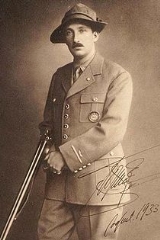
Boris III of Bulgaria

Encyclopedia
Boris III the Unifier, Tsar of Bulgaria (30 January 1894 – 28 August 1943), originally Boris Klemens Robert Maria Pius Ludwig Stanislaus Xaver (Boris Clement Robert Mary Pius Louis Stanislaus Xavier), son of Ferdinand I
, came to the throne in 1918 upon the abdication
of his father, following the defeat of the Kingdom of Bulgaria
during World War I
. This was the country's second major defeat in only five years, after the disastrous Second Balkan War
(1913). Under the Treaty of Neuilly
, Bulgaria was forced to cede new territories and pay crippling reparations to its neighbours, thereby threatening political and economic stability. Two political forces, the Agrarian Union and the Communist Party, were calling for the overthrowing of the monarchy and the change of the government. It was in these circumstances that Boris succeeded to the throne.
. He was the first son of Prince Ferdinand of Bulgaria
and his wife Princess Marie Louise.
In February 1896 his father paved the way for the reconciliation of Bulgaria and Russia with the conversion of the infant Prince Boris from Roman Catholicism to Eastern Orthodox Christianity, a move that earned Ferdinand the frustration of his wife, the animosity of his Catholic Austrian relatives (particularly that of his uncle, Francis Joseph of Austria) and excommunication from the Catholic Church. In order to remedy this difficult situation Ferdinand christened all his remaining children as Catholics. Nicholas II of Russia
stood as godfather to Boris and met the young boy during Ferdinand's official visit to Saint Petersburg
in July 1898.
He received his initial education in the so called Palace Secondary School which Ferdinand created in 1908 solely for his sons. Latter Boris graduated from the Military School in Sofia
and took part in the Balkan Wars
. During the First World War he served as liaison officer
of the General Staff of the Bulgarian Army on the Macedonian Front. In 1916 he was promoted to colonel
and attached again as liaison officer to Army Group Mackensen and the Bulgarian Third Army
for the operations against Romania. Boris worked hard to smoothen the sometimes difficult relations between field marshal
Mackensen
and the commander of the 3rd army lieutenant general
Stefan Toshev
. Through his courage and personal example he earned the respect of the troops and the senior Bulgarian and German commanders, even that of the Generalquartiermeister of the German Army Erich Ludendorff
, who preferred dealing personally with Boris and described him as excellently trained, a thoroughly soldierly person and mature beyond his years. In 1918 Boris was made a major general
and with the abdication of his father acceded to the throne as Tsar Boris III on 3 October 1918.
(or Stambolijski) of the Bulgarian People's Agrarian Union was elected prime minister. Though popular with the large peasant class, Stambolijski earned the animosity of the middle class and military, which led to his toppling in a military coup on 9 June 1923, and his subsequent assassination. In 1925, there was a short border war, known as the Incident at Petrich
, with Greece which was resolved with the help of the League of Nations
. Also in 1925, there were two attempts on Boris's life perpetrated by leftist extremists. After the second attempt, the military in power exterminated in reprisals several thousand communists and agrarians including representatives of the intelligentsia.
In the coup on 19 May 1934
, the Zveno
military organisation established a dictatorship and abolished the political parties in Bulgaria. King Boris was reduced to the status of a puppet king as a result of the coup. The following year, he staged a counter-coup and assumed control of the country by establishing a regime loyal to him. The political process was controlled by the Tsar, but a form of parliamentary rule was re-introduced, without the restoration of the political parties.
Boris married Giovanna of Italy
, daughter of Victor Emmanuel III of Italy
, first in Assisi
in October 1930 (attended by Benito Mussolini
), and then at an Orthodox ceremony in Sofia. The marriage produced a daughter, Maria Louisa, in January 1933, and a son and heir to the throne, Simeon, in 1937. Tsar Boris appeared on the cover of Time Magazine on 20 January 1941 wearing a full military uniform.
, Bulgaria was neutral, but powerful groups in the country swayed its politics toward Germany
(whom they had also allied with in World War I
), which had gained initial sympathies by forcing Romania to cede southern Dobrudja back to Bulgaria. In 1941, Boris reluctantly allied himself with the Axis Powers
in an attempt to recover Macedonia from Greece
and Yugoslavia, which had been gained by Bulgaria in the First Balkan War
and lost again in the Second
.
However, in spite of this loose alliance, Boris was not willing to render full and unconditional cooperation with Germany, and the only German presence in Bulgaria was along the railway line which passed through it to Greece.
In early 1943, Nazi officials requested that Bulgaria send its Jewish
population to German occupied Poland
. The request caused a public outcry, and a campaign whose most prominent leaders were Parliament Vice-Chairman Dimitar Peshev
and the head of the Bulgarian Orthodox Church
, Archbishop Stefan, was organized. Following this campaign, Boris refused to permit the extradition of Bulgaria's 50,000 Jews. Initially, the Bulgarian government, which he controlled, utilized Swiss diplomatic channels to inquire whether possible deportations of the Jews can happen to British-controlled Palestine by ships rather than to concentration camps in Poland by trains, for which the Germans requested a significant amount of money. However, this attempt was blocked by the British Foreign Minister, Anthony Eden
. Eventually, Boris did succumb to the German demand for the extradition of 11,343 Jews from those territories re-occupied by Bulgaria, but the extradition of the Jews from pre-war Bulgaria was stopped. These two decisions have led to a position today where a large number of people regard Boris as a hero for saving Bulgaria's Jews, and a large number revile him for condemning those from the occupied new territories. In point of fact, in war time Europe, the Jewish citizens of the new territories of Macedonia and Thrace were all under Hitler
's direct jurisdiction, since they were not formally Bulgarian citizens. Under King Boris III, Bulgaria was the only nation in Europe to save its entire Jewish population during the Holocaust. Boris was the only world leader to defy Hitler face to face during the war, refusing multiple times to deliver his Jewish citizens beyond the borders of his kingdom.
Most irritating for Hitler, however, was the Tsar's refusal to declare war on the Soviet Union
or send Bulgarian troops to the Eastern front.
On August 9, 1943, Hitler summoned Boris to a stormy meeting at Rastenburg, East Prussia
, where Tsar Boris arrived by plane from Vrazhdebna on Saturday, August 14. While Bulgaria had declared a 'symbolic' war on the distant United Kingdom
and the United States
, at that meeting Boris once again refused to get involved in the war against the Soviet Union
, giving two major reasons for his unwillingness to send troops to Russia — first, that many ordinary Bulgarians had strong Russophile sentiments; and second, that the political and military position of Turkey remained unclear. The 'symbolic' war against the Western Allies, however, turned into a disaster for the citizens of Sofia
as the city was heavily bombarded by the US and the British Royal Air Force in 1943 and 1944. Nevertheless, the bombardments started only after Boris' death.
- both believed that the king had died from the same poison that Dr. Eppinger had allegedly found two years earlier in the postmortem examination of the Greek prime minister Ioannis Metaxas
, a slow poison which takes weeks to do its work, and which causes the appearance of blotches on the skin of its victim before death. Whether or not Boris was murdered remains mysterious.
Boris was succeeded by his six-year-old son Simeon II under a Regency Council headed by Boris's brother, Prince Kyril of Bulgaria
.
Following a large and impressive state funeral at the Alexander Nevsky Cathedral, Sofia
, where the streets were lined with weeping crowds, the coffin of Tsar Boris III was taken by train to the mountains and buried in Bulgaria's largest and most important monastery, the Rila Monastery
. After taking power in September 1944, the Communist-dominated government had his body exhumed and secretly buried in the courtyard of the Vrana Palace
near Sofia. At a later time the Communist authorities removed the zinc coffin from Vrana and moved it to a secret location, which remains unknown to this day. After the fall of communism, an excavation attempt was made at the Vrana Palace, in which only Boris's heart was found, as it had been put in a glass cylinder outside the coffin. The heart was taken by his widow in 1993 to Rila Monastery where it was reinterred.
A wood-carving is placed on the left side of his grave in the Rila monastery, made on 10 October 1943 by inhabitants of the village of Osoi, Debar
district. The wood-carving has the following inscription:
King Boris III was posthumously awarded the Jewish National Fund's Medal of the Legion of Honor, the first non-Jew to receive one of the Jewish community's highest honors.
The Jewish National Fund dedicated to Bulgaria a forest in Israel, a garden named for King Boris, and a Bulgarian square in Jerusalem.
The Anti-Defamation League and Chabad have also honored King Boris III for refusing to sacrifice his Jewish subjects to the Nazi juggernaut.
A film entitled "King's Heart" is currently in development, honoring King Boris III and his heroic rescue during the Holocaust.
Tsar Boris III Boulevard is one of the main boulevards in Sofia
and Plovdiv
.
Borisova Gradina
is the largest park in Sofia.
A huge picture of Tsar Boris hangs in the Alexandrov compound in Atlantic City, NJ
Ferdinand I of Bulgaria
Ferdinand , born Ferdinand Maximilian Karl Leopold Maria of Saxe-Coburg and Gotha-Koháry, was the ruler of Bulgaria from 1887 to 1918, first as knyaz and later as tsar...
, came to the throne in 1918 upon the abdication
Abdication
Abdication occurs when a monarch, such as a king or emperor, renounces his office.-Terminology:The word abdication comes derives from the Latin abdicatio. meaning to disown or renounce...
of his father, following the defeat of the Kingdom of Bulgaria
Kingdom of Bulgaria
The Kingdom of Bulgaria was established as an independent state when the Principality of Bulgaria, an Ottoman vassal, officially proclaimed itself independent on October 5, 1908 . This move also formalised the annexation of the Ottoman province of Eastern Rumelia, which had been under the control...
during World War I
World War I
World War I , which was predominantly called the World War or the Great War from its occurrence until 1939, and the First World War or World War I thereafter, was a major war centred in Europe that began on 28 July 1914 and lasted until 11 November 1918...
. This was the country's second major defeat in only five years, after the disastrous Second Balkan War
Second Balkan War
The Second Balkan War was a conflict which broke out when Bulgaria, dissatisfied with its share of the spoils of the First Balkan War, attacked its former allies, Serbia and Greece, on 29 June 1913. Bulgaria had a prewar agreement about the division of region of Macedonia...
(1913). Under the Treaty of Neuilly
Treaty of Neuilly
The Treaty of Neuilly-sur-Seine, dealing with Bulgaria for its role as one of the Central Powers in World War I, was signed on 27 November 1919 at Neuilly-sur-Seine, France....
, Bulgaria was forced to cede new territories and pay crippling reparations to its neighbours, thereby threatening political and economic stability. Two political forces, the Agrarian Union and the Communist Party, were calling for the overthrowing of the monarchy and the change of the government. It was in these circumstances that Boris succeeded to the throne.
Biography
Boris was born on 30 January 1894 in SofiaSofia
Sofia is the capital and largest city of Bulgaria and the 12th largest city in the European Union with a population of 1.27 million people. It is located in western Bulgaria, at the foot of Mount Vitosha and approximately at the centre of the Balkan Peninsula.Prehistoric settlements were excavated...
. He was the first son of Prince Ferdinand of Bulgaria
Ferdinand I of Bulgaria
Ferdinand , born Ferdinand Maximilian Karl Leopold Maria of Saxe-Coburg and Gotha-Koháry, was the ruler of Bulgaria from 1887 to 1918, first as knyaz and later as tsar...
and his wife Princess Marie Louise.
In February 1896 his father paved the way for the reconciliation of Bulgaria and Russia with the conversion of the infant Prince Boris from Roman Catholicism to Eastern Orthodox Christianity, a move that earned Ferdinand the frustration of his wife, the animosity of his Catholic Austrian relatives (particularly that of his uncle, Francis Joseph of Austria) and excommunication from the Catholic Church. In order to remedy this difficult situation Ferdinand christened all his remaining children as Catholics. Nicholas II of Russia
Nicholas II of Russia
Nicholas II was the last Emperor of Russia, Grand Prince of Finland, and titular King of Poland. His official short title was Nicholas II, Emperor and Autocrat of All the Russias and he is known as Saint Nicholas the Passion-Bearer by the Russian Orthodox Church.Nicholas II ruled from 1894 until...
stood as godfather to Boris and met the young boy during Ferdinand's official visit to Saint Petersburg
Saint Petersburg
Saint Petersburg is a city and a federal subject of Russia located on the Neva River at the head of the Gulf of Finland on the Baltic Sea...
in July 1898.
He received his initial education in the so called Palace Secondary School which Ferdinand created in 1908 solely for his sons. Latter Boris graduated from the Military School in Sofia
Sofia
Sofia is the capital and largest city of Bulgaria and the 12th largest city in the European Union with a population of 1.27 million people. It is located in western Bulgaria, at the foot of Mount Vitosha and approximately at the centre of the Balkan Peninsula.Prehistoric settlements were excavated...
and took part in the Balkan Wars
Balkan Wars
The Balkan Wars were two conflicts that took place in the Balkans in south-eastern Europe in 1912 and 1913.By the early 20th century, Montenegro, Bulgaria, Greece and Serbia, the countries of the Balkan League, had achieved their independence from the Ottoman Empire, but large parts of their ethnic...
. During the First World War he served as liaison officer
Liaison officer
A liaison officer or LNO is a person that liaises between two organizations to communicate and coordinate their activities. Generally, they are used to achieve the best utilization of resources or employment of services of one organization by another. In the military, liaison officers may...
of the General Staff of the Bulgarian Army on the Macedonian Front. In 1916 he was promoted to colonel
Colonel
Colonel , abbreviated Col or COL, is a military rank of a senior commissioned officer. It or a corresponding rank exists in most armies and in many air forces; the naval equivalent rank is generally "Captain". It is also used in some police forces and other paramilitary rank structures...
and attached again as liaison officer to Army Group Mackensen and the Bulgarian Third Army
Third Army(Bulgaria)
The Bulgarian Third Army was a Bulgarian field army during the Balkan Wars, World War I, and World War II.-Balkan Wars:After 1907, during times of peace, the territory of Bulgaria was divided into three army inspectorates, each one comprising three divisional district. During war they formed three...
for the operations against Romania. Boris worked hard to smoothen the sometimes difficult relations between field marshal
Field Marshal
Field Marshal is a military rank. Traditionally, it is the highest military rank in an army.-Etymology:The origin of the rank of field marshal dates to the early Middle Ages, originally meaning the keeper of the king's horses , from the time of the early Frankish kings.-Usage and hierarchical...
Mackensen
August von Mackensen
Anton Ludwig August von Mackensen , born August Mackensen, was a German soldier and field marshal. He commanded with success during the First World War and became one of the German Empire's most prominent military leaders. After the Armistice, Mackensen was interned for a year...
and the commander of the 3rd army lieutenant general
Lieutenant General
Lieutenant General is a military rank used in many countries. The rank traces its origins to the Middle Ages where the title of Lieutenant General was held by the second in command on the battlefield, who was normally subordinate to a Captain General....
Stefan Toshev
Stefan Toshev
Stefan Toshev was a Bulgarian General, from World War I. His mother was a teacher from the period of the National Revival. He volunteered in the Bulgarian Opalchentsi Corps during the Russo-Turkish War and later served as a translator. On 10 May 1879 he graduated the Military School in Sofia in...
. Through his courage and personal example he earned the respect of the troops and the senior Bulgarian and German commanders, even that of the Generalquartiermeister of the German Army Erich Ludendorff
Erich Ludendorff
Erich Friedrich Wilhelm Ludendorff was a German general, victor of Liège and of the Battle of Tannenberg...
, who preferred dealing personally with Boris and described him as excellently trained, a thoroughly soldierly person and mature beyond his years. In 1918 Boris was made a major general
Major General
Major general or major-general is a military rank used in many countries. It is derived from the older rank of sergeant major general. A major general is a high-ranking officer, normally subordinate to the rank of lieutenant general and senior to the ranks of brigadier and brigadier general...
and with the abdication of his father acceded to the throne as Tsar Boris III on 3 October 1918.
Early reign
One year after Boris's accession, Aleksandar StamboliyskiAleksandar Stamboliyski
Aleksandar Stamboliyski was the prime minister of Bulgaria from 1919 until 1923. Stamboliyski was a member of the Agrarian Union, an agrarian peasant movement which was not allied to the monarchy, and edited their newspaper...
(or Stambolijski) of the Bulgarian People's Agrarian Union was elected prime minister. Though popular with the large peasant class, Stambolijski earned the animosity of the middle class and military, which led to his toppling in a military coup on 9 June 1923, and his subsequent assassination. In 1925, there was a short border war, known as the Incident at Petrich
Incident at Petrich
The incident at Petrich, or the War of the Stray Dog, was the short invasion of Bulgaria by Greece near the border town Petrich in 1925...
, with Greece which was resolved with the help of the League of Nations
League of Nations
The League of Nations was an intergovernmental organization founded as a result of the Paris Peace Conference that ended the First World War. It was the first permanent international organization whose principal mission was to maintain world peace...
. Also in 1925, there were two attempts on Boris's life perpetrated by leftist extremists. After the second attempt, the military in power exterminated in reprisals several thousand communists and agrarians including representatives of the intelligentsia.
In the coup on 19 May 1934
Bulgarian coup d'état of 1934
The Bulgarian coup d'état of 1934, also known as the 19 May coup d'état , was a coup d'état in the Kingdom of Bulgaria carried out by the Zveno military organization and the Military Union with the aid of the Bulgarian Army...
, the Zveno
Zveno
Zveno was a Bulgarian military and political organization, founded in 1927 by army officers. It was associated with a newspaper of that name....
military organisation established a dictatorship and abolished the political parties in Bulgaria. King Boris was reduced to the status of a puppet king as a result of the coup. The following year, he staged a counter-coup and assumed control of the country by establishing a regime loyal to him. The political process was controlled by the Tsar, but a form of parliamentary rule was re-introduced, without the restoration of the political parties.
Boris married Giovanna of Italy
Giovanna of Italy
Joanna of Italy was the last Tsaritsa of Bulgaria.-Childhood:Giovanna was born in Rome, the third daughter and fourth child of King Victor Emmanuel III of Italy and Queen Elena, former Princess of Montenegro...
, daughter of Victor Emmanuel III of Italy
Victor Emmanuel III of Italy
Victor Emmanuel III was a member of the House of Savoy and King of Italy . In addition, he claimed the crowns of Ethiopia and Albania and claimed the titles Emperor of Ethiopia and King of Albania , which were unrecognised by the Great Powers...
, first in Assisi
Assisi
- Churches :* The Basilica of San Francesco d'Assisi is a World Heritage Site. The Franciscan monastery, il Sacro Convento, and the lower and upper church of St Francis were begun immediately after his canonization in 1228, and completed in 1253...
in October 1930 (attended by Benito Mussolini
Benito Mussolini
Benito Amilcare Andrea Mussolini was an Italian politician who led the National Fascist Party and is credited with being one of the key figures in the creation of Fascism....
), and then at an Orthodox ceremony in Sofia. The marriage produced a daughter, Maria Louisa, in January 1933, and a son and heir to the throne, Simeon, in 1937. Tsar Boris appeared on the cover of Time Magazine on 20 January 1941 wearing a full military uniform.
World War II
In the early days of World War IIWorld War II
World War II, or the Second World War , was a global conflict lasting from 1939 to 1945, involving most of the world's nations—including all of the great powers—eventually forming two opposing military alliances: the Allies and the Axis...
, Bulgaria was neutral, but powerful groups in the country swayed its politics toward Germany
Germany
Germany , officially the Federal Republic of Germany , is a federal parliamentary republic in Europe. The country consists of 16 states while the capital and largest city is Berlin. Germany covers an area of 357,021 km2 and has a largely temperate seasonal climate...
(whom they had also allied with in World War I
World War I
World War I , which was predominantly called the World War or the Great War from its occurrence until 1939, and the First World War or World War I thereafter, was a major war centred in Europe that began on 28 July 1914 and lasted until 11 November 1918...
), which had gained initial sympathies by forcing Romania to cede southern Dobrudja back to Bulgaria. In 1941, Boris reluctantly allied himself with the Axis Powers
Axis Powers
The Axis powers , also known as the Axis alliance, Axis nations, Axis countries, or just the Axis, was an alignment of great powers during the mid-20th century that fought World War II against the Allies. It began in 1936 with treaties of friendship between Germany and Italy and between Germany and...
in an attempt to recover Macedonia from Greece
Greece
Greece , officially the Hellenic Republic , and historically Hellas or the Republic of Greece in English, is a country in southeastern Europe....
and Yugoslavia, which had been gained by Bulgaria in the First Balkan War
First Balkan War
The First Balkan War, which lasted from October 1912 to May 1913, pitted the Balkan League against the Ottoman Empire. The combined armies of the Balkan states overcame the numerically inferior and strategically disadvantaged Ottoman armies and achieved rapid success...
and lost again in the Second
Second Balkan War
The Second Balkan War was a conflict which broke out when Bulgaria, dissatisfied with its share of the spoils of the First Balkan War, attacked its former allies, Serbia and Greece, on 29 June 1913. Bulgaria had a prewar agreement about the division of region of Macedonia...
.
However, in spite of this loose alliance, Boris was not willing to render full and unconditional cooperation with Germany, and the only German presence in Bulgaria was along the railway line which passed through it to Greece.
In early 1943, Nazi officials requested that Bulgaria send its Jewish
Jews
The Jews , also known as the Jewish people, are a nation and ethnoreligious group originating in the Israelites or Hebrews of the Ancient Near East. The Jewish ethnicity, nationality, and religion are strongly interrelated, as Judaism is the traditional faith of the Jewish nation...
population to German occupied Poland
Poland
Poland , officially the Republic of Poland , is a country in Central Europe bordered by Germany to the west; the Czech Republic and Slovakia to the south; Ukraine, Belarus and Lithuania to the east; and the Baltic Sea and Kaliningrad Oblast, a Russian exclave, to the north...
. The request caused a public outcry, and a campaign whose most prominent leaders were Parliament Vice-Chairman Dimitar Peshev
Dimitar Peshev
Dimitar Peshev was the Deputy Speaker of the National Assembly of Bulgaria and Minister of Justice during World War II...
and the head of the Bulgarian Orthodox Church
Bulgarian Orthodox Church
The Bulgarian Orthodox Church - Bulgarian Patriarchate is an autocephalous Eastern Orthodox Church with some 6.5 million members in the Republic of Bulgaria and between 1.5 and 2.0 million members in a number of European countries, the Americas and Australia...
, Archbishop Stefan, was organized. Following this campaign, Boris refused to permit the extradition of Bulgaria's 50,000 Jews. Initially, the Bulgarian government, which he controlled, utilized Swiss diplomatic channels to inquire whether possible deportations of the Jews can happen to British-controlled Palestine by ships rather than to concentration camps in Poland by trains, for which the Germans requested a significant amount of money. However, this attempt was blocked by the British Foreign Minister, Anthony Eden
Anthony Eden
Robert Anthony Eden, 1st Earl of Avon, KG, MC, PC was a British Conservative politician, who was Prime Minister from 1955 to 1957...
. Eventually, Boris did succumb to the German demand for the extradition of 11,343 Jews from those territories re-occupied by Bulgaria, but the extradition of the Jews from pre-war Bulgaria was stopped. These two decisions have led to a position today where a large number of people regard Boris as a hero for saving Bulgaria's Jews, and a large number revile him for condemning those from the occupied new territories. In point of fact, in war time Europe, the Jewish citizens of the new territories of Macedonia and Thrace were all under Hitler
Adolf Hitler
Adolf Hitler was an Austrian-born German politician and the leader of the National Socialist German Workers Party , commonly referred to as the Nazi Party). He was Chancellor of Germany from 1933 to 1945, and head of state from 1934 to 1945...
's direct jurisdiction, since they were not formally Bulgarian citizens. Under King Boris III, Bulgaria was the only nation in Europe to save its entire Jewish population during the Holocaust. Boris was the only world leader to defy Hitler face to face during the war, refusing multiple times to deliver his Jewish citizens beyond the borders of his kingdom.
Most irritating for Hitler, however, was the Tsar's refusal to declare war on the Soviet Union
Soviet Union
The Soviet Union , officially the Union of Soviet Socialist Republics , was a constitutionally socialist state that existed in Eurasia between 1922 and 1991....
or send Bulgarian troops to the Eastern front.
On August 9, 1943, Hitler summoned Boris to a stormy meeting at Rastenburg, East Prussia
East Prussia
East Prussia is the main part of the region of Prussia along the southeastern Baltic Coast from the 13th century to the end of World War II in May 1945. From 1772–1829 and 1878–1945, the Province of East Prussia was part of the German state of Prussia. The capital city was Königsberg.East Prussia...
, where Tsar Boris arrived by plane from Vrazhdebna on Saturday, August 14. While Bulgaria had declared a 'symbolic' war on the distant United Kingdom
United Kingdom
The United Kingdom of Great Britain and Northern IrelandIn the United Kingdom and Dependencies, other languages have been officially recognised as legitimate autochthonous languages under the European Charter for Regional or Minority Languages...
and the United States
United States
The United States of America is a federal constitutional republic comprising fifty states and a federal district...
, at that meeting Boris once again refused to get involved in the war against the Soviet Union
Soviet Union
The Soviet Union , officially the Union of Soviet Socialist Republics , was a constitutionally socialist state that existed in Eurasia between 1922 and 1991....
, giving two major reasons for his unwillingness to send troops to Russia — first, that many ordinary Bulgarians had strong Russophile sentiments; and second, that the political and military position of Turkey remained unclear. The 'symbolic' war against the Western Allies, however, turned into a disaster for the citizens of Sofia
Sofia
Sofia is the capital and largest city of Bulgaria and the 12th largest city in the European Union with a population of 1.27 million people. It is located in western Bulgaria, at the foot of Mount Vitosha and approximately at the centre of the Balkan Peninsula.Prehistoric settlements were excavated...
as the city was heavily bombarded by the US and the British Royal Air Force in 1943 and 1944. Nevertheless, the bombardments started only after Boris' death.
Death
Shortly after returning to Sofia from a meeting with Hitler, Boris died of apparent heart failure on 28 August 1943. Conspiracy theories instantly sprang up, many choosing to believe that he was poisoned by Hitler in an attempt to put a more obedient government in place. The evening before the illness occurred, Boris had an official dinner in the Italian embassy.. The question has never been settled and many people remain of the belief that Boris was murdered, in spite of no evidence being available. According to the diary of the German attache in Sofia at the time, Colonel von Schoenebeck, the two German doctors who attended the king - Sajitz and Hans EppingerHans Eppinger
Hans Eppinger Jr. was an Austrian physician who gained an infamous reputation due to experiments on prisoners.-Early Years:...
- both believed that the king had died from the same poison that Dr. Eppinger had allegedly found two years earlier in the postmortem examination of the Greek prime minister Ioannis Metaxas
Ioannis Metaxas
Ioannis Metaxas was a Greek general, politician, and dictator, serving as Prime Minister of Greece from 1936 until his death in 1941...
, a slow poison which takes weeks to do its work, and which causes the appearance of blotches on the skin of its victim before death. Whether or not Boris was murdered remains mysterious.
Boris was succeeded by his six-year-old son Simeon II under a Regency Council headed by Boris's brother, Prince Kyril of Bulgaria
Prince Kyril of Bulgaria
Prince Kyril of Bulgaria, Prince of Preslav was the second son of Ferdinand I of Bulgaria and his first wife Marie Louise of Bourbon-Parma. He was a younger brother of Boris III of Bulgaria...
.
Following a large and impressive state funeral at the Alexander Nevsky Cathedral, Sofia
Alexander Nevsky Cathedral, Sofia
The St. Alexander Nevsky Cathedral is a Bulgarian Orthodox cathedral in Sofia, the capital of Bulgaria. Built in Neo-Byzantine style, it serves as the cathedral church of the Patriarch of Bulgaria and is one of the largest Eastern Orthodox cathedrals in the world, as well as one of Sofia's symbols...
, where the streets were lined with weeping crowds, the coffin of Tsar Boris III was taken by train to the mountains and buried in Bulgaria's largest and most important monastery, the Rila Monastery
Rila Monastery
The Monastery of Saint Ivan of Rila, better known as the Rila Monastery is the largest and most famous Eastern Orthodox monastery in Bulgaria. It is situated in the southwestern Rila Mountains, south of the capital Sofia in the deep valley of the Rilska River at an elevation of above sea level...
. After taking power in September 1944, the Communist-dominated government had his body exhumed and secretly buried in the courtyard of the Vrana Palace
Vrana Palace
Vrana Palace is a former royal palace, located on the outskirts of Sofia, the capital of Bulgaria. It is today the official residence of the deposed Tsar Simeon II of Bulgaria and his wife Tsaritsa Margarita...
near Sofia. At a later time the Communist authorities removed the zinc coffin from Vrana and moved it to a secret location, which remains unknown to this day. After the fall of communism, an excavation attempt was made at the Vrana Palace, in which only Boris's heart was found, as it had been put in a glass cylinder outside the coffin. The heart was taken by his widow in 1993 to Rila Monastery where it was reinterred.
A wood-carving is placed on the left side of his grave in the Rila monastery, made on 10 October 1943 by inhabitants of the village of Osoi, Debar
Debar
Debar is a city in the western part of the Republic of Macedonia, near the border with Albania, on the road from Struga to Gostivar. It is the seat of Debar Municipality.-Geography:...
district. The wood-carving has the following inscription:
Honours and memorials
The United States Congress proclaimed King Boris III savior of fifty thousand Bulgarian Jews on May, 12 1994.King Boris III was posthumously awarded the Jewish National Fund's Medal of the Legion of Honor, the first non-Jew to receive one of the Jewish community's highest honors.
The Jewish National Fund dedicated to Bulgaria a forest in Israel, a garden named for King Boris, and a Bulgarian square in Jerusalem.
The Anti-Defamation League and Chabad have also honored King Boris III for refusing to sacrifice his Jewish subjects to the Nazi juggernaut.
A film entitled "King's Heart" is currently in development, honoring King Boris III and his heroic rescue during the Holocaust.
Tsar Boris III Boulevard is one of the main boulevards in Sofia
Sofia
Sofia is the capital and largest city of Bulgaria and the 12th largest city in the European Union with a population of 1.27 million people. It is located in western Bulgaria, at the foot of Mount Vitosha and approximately at the centre of the Balkan Peninsula.Prehistoric settlements were excavated...
and Plovdiv
Plovdiv
Plovdiv is the second-largest city in Bulgaria after Sofia with a population of 338,153 inhabitants according to Census 2011. Plovdiv's history spans some 6,000 years, with traces of a Neolithic settlement dating to roughly 4000 BC; it is one of the oldest cities in Europe...
.
Borisova Gradina
Borisova gradina
Borisova gradina or Knyaz-Borisova gradina is the oldest and best known park in Sofia, the capital of Bulgaria. Its construction and arrangement began in 1884 and it is named after Bulgarian Tsar Boris III....
is the largest park in Sofia.
A huge picture of Tsar Boris hangs in the Alexandrov compound in Atlantic City, NJ
Ancestors
See also
- History of BulgariaHistory of BulgariaThe history of Bulgaria spans from the first settlements on the lands of modern Bulgaria to its formation as a nation-state and includes the history of the Bulgarian people and their origin. The first traces of human presence on what is today Bulgaria date from 44,000 BC...
- "Guide to Jewish Bulgaria" by Dimana Trankova & Anthony Georgieff, Sofia, 2011; http://www.vagabond.bg/jewishbulgaria