
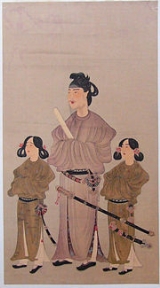
, also known as , was a
regentA regent, from the Latin regens "reigning", is a person selected to act as head of state because the ruler is a minor, not present, or debilitated. Thus, the common use is for an acting deputy governor....
and a politician of the
Asuka periodThe , was a period in the history of Japan lasting from 538 to 710 , although its beginning could be said to overlap with the preceding Kofun period...
in
Japanis an island country in East Asia. Located in the Pacific Ocean, it lies to the east of the Sea of Japan, People's Republic of China, North Korea, South Korea and Russia, stretching from the Sea of Okhotsk in the north to the East China Sea and Taiwan in the south...
. Recent historical studies cast doubt of some of achievement attributed to him.
Prince Shōtoku looked to
ChinaChina is a cultural region, an ancient civilization, and, depending on perspective, a national or multinational entity extending over a large area in East Asia....
for political and religious inspiration.
Shōtoku, inspired by Buddha's teachings, succeeded in establishing a centralized government during his reign. In 603, he established the twelve official ranks at court.
, also known as , was a
regentA regent, from the Latin regens "reigning", is a person selected to act as head of state because the ruler is a minor, not present, or debilitated. Thus, the common use is for an acting deputy governor....
and a politician of the
Asuka periodThe , was a period in the history of Japan lasting from 538 to 710 , although its beginning could be said to overlap with the preceding Kofun period...
in
Japanis an island country in East Asia. Located in the Pacific Ocean, it lies to the east of the Sea of Japan, People's Republic of China, North Korea, South Korea and Russia, stretching from the Sea of Okhotsk in the north to the East China Sea and Taiwan in the south...
. Recent historical studies cast doubt of some of achievement attributed to him.
Cultural and political role
Prince Shōtoku looked to
ChinaChina is a cultural region, an ancient civilization, and, depending on perspective, a national or multinational entity extending over a large area in East Asia....
for political and religious inspiration.
Shōtoku, inspired by Buddha's teachings, succeeded in establishing a centralized government during his reign. In 603, he established the twelve official ranks at court. He is credited with promulgating a
Seventeen-article constitutionThe is, according to Nihon Shoki published in 720, a document authored by Prince Shōtoku in 604. It was adopted in the reign of Empress Suiko. The emphasis of the document is not so much on the basic laws by which the state was to be governed, such as one may expect from a modern constitution, but...
, although contemporary scholars question the attribution based on its style.
The Prince was a supporter of Buddhism and composed commentaries on the Lotus Sutra, the Vimalakirti Sutra, and the Sutra of Queen Srimala. He commissioned the Shitennō-ji Temple in
Settsu provincewas a province of Japan, which today comprises the eastern part of Hyōgo Prefecture and the northern part of Osaka Prefecture. It was also referred to as Tsu Province , or Sesshū ....
(present-day Osaka). Shōtoku's name has been linked with
Hōryū-ji' is a Buddhist temple in Ikaruga, Nara Prefecture, Japan. Its full name is Hōryū Gakumonji , or Learning Temple of the Flourishing Law, named as such because the site serves as a seminary as well as a monastery. The temple is widely acknowledged to have one of the oldest wooden buildings...
, a temple in
Yamato provincewas a province of Japan, located in Kinai, corresponding to present-day Nara Prefecture in Honshū. It was also called . At first, the name was written with one different character , and for about ten years after 737, this was revised to use more desirable characters . The final revision was made in...
. Documentation at Hōryū-ji claims that Suiko and Shōtoku founded the temple in the year 607. Archaeological excavations in 1939 have confirmed that Prince Shōtoku's palace, the Ikaruga-no-miya (斑鳩宮), stood in the eastern part of the current temple complex, where the Tō-in (東院) sits today.
Although Shōtoku admired China from afar, China seems to have taken the initiative in opening relations with
Japanis an island country in East Asia. Located in the Pacific Ocean, it lies to the east of the Sea of Japan, People's Republic of China, North Korea, South Korea and Russia, stretching from the Sea of Okhotsk in the north to the East China Sea and Taiwan in the south...
.
SuiThe Sui Dynasty followed by the Tang Dynasty and preceded by the Southern and Northern Dynasties in China. It ended nearly four centuries of division between rival regimes....
Emperor,
YangdiEmperor Yang of Sui , personal name Yang Guang , alternative name Ying , nickname Amo , known as Emperor Ming during the brief reign of his grandson Yang Tong), was the second son of Emperor Wen of Sui, and the second emperor of China's Sui Dynasty.Emperor Yang's original name was Yang Ying, but...
(
kensui taishi) dispatched a message in 605 that said:
- "The sovereign of Sui respectfully inquires about the sovereign of Wa
Japanese , is the oldest recorded name of Japan. Chinese, Korean, and Japanese scribes regularly wrote Wa or Yamato "Japan" with the Chinese character 倭 until the 8th century, when the Japanese found fault with it, replacing it with 和 "harmony, peace, balance".- Historical references :The earliest...
."
Shōtoku responded by sponsoring a mission led by
Ono no Imokowas a Japanese politician late 6th and early 7th century, during the Asuka period. Ono was appointed as an official envoy to the Sui court in 607 , and he delivered the famous letter from Japan's Prince Shōtoku which began "The Son of Heaven where the sun rises , to the Son of Heaven where the sun...
in 607. The Prince's own message contains the earliest written instance in which the Japanese archipelago is named "Nihon," literally, sun-origin. The salutation said:
- "From the sovereign of the land of the rising sun (nihon/hi izuru) to the sovereign of the land of the setting sun."
Titles and name
He is known by several titles, although his real name is since he was born in front of a stable. He is also known as or . In the
Kojiki, also known as Furukotofumi and known in English as The Records of Ancient Matters, is the oldest surviving book in Japan. The body of the Kojiki is written in Chinese, but it includes numerous Japanese names and some phrases...
, his name appears as . In the
Nihon ShokiThe , sometimes translated as The Chronicles of Japan, is the second oldest book of classical Japanese history. It is more elaborate and detailed than the Kojiki, the oldest, and has proven to be an important tool for historians and archaeologists as it includes the most complete extant historical...
, in addition to Umayado no ōji, he is referred to as 豊耳聡聖徳, 豊聡耳法大王, and 法主王.
The name by which he is best known today,
Prince Shōtoku, first appeared in
Kaifūsōis the oldest collection of Chinese poetry written by Japanese poets.It was created by an unknown compiler in 751. In the brief introductions of the poets, the unknown writer seems sympathic to Emperor Kōbun and his regents who were overthrown in 672 by Emperor Temmu after only eight months of the...
, written more than a hundred years after his death in 751.
Controversy
According to the
Tokyo ShimbunThe Tokyo Shimbun is a Japanese newspaper published by The Chunichi Shimbun Company. The group publishes newspapers under the brand name of The Tokyo Shimbun in the Tokyo Metropolitan Area and under The Chunichi Shimbun in the Nagoya Metropolitan Area. The group’s combined daily morning...
, February 10, 2008, Chubu University professor Ōyama seiichi argued Prince Shōtoku was not a historical person at all. Many other historians dispute this claim.
See also
- Asuka-dera
', also known as ', is a Buddhist temple in Asuka, Nara. Asuka-dera is regarded as one of the oldest in Japan.-Temple complex:There are number of records that refers to the origin of the temple, such as the Nihongi and Fusō-ryakuki...
- Kokki
, alternatively known as Kuni tsu Fumi and literally meaning "National Record", is a historical text purported to have been written in 620 by Shōtoku Taishi and Soga no Umako. It is recorded in the Nihon Shoki, but no extant copies are known to exist...
- Tennōki
, alternatively known as Sumera Mikoto no Fumi, is a historical text purported to have been written in 620 by Shōtoku Taishi and Soga no Umako. It is recorded in the Nihon Shoki, but no extant copies are known to exist....
- Sangyō Gisho
The , literally "Annotated Commentaries on the Three Sutras," is the title of three annotated commentaries on important Buddhist sutras: , , and .-Hokke Gisho:...
- Jōgū Shōtoku Hōō Teisetsu
, also read as Jōgū Shōtoku Hōō Taisetsu, is a biography of Shōtoku Taishi. It is one scroll in length and is a National Treasures of Japan.-Background:...
, biography of Shōtoku Taishi
Literature
- Varley, H. Paul. (1973). Japanese Culture: A Short History. New York: Praeger Publishers.
- Varley, H. Paul , ed. (1980). [ Kitabatake Chikafusa
' was a Japanese court noble and writer of the 14th century who supported the Southern Court in the Nanboku-cho period, serving as advisor to five Emperors...
(1359)], Jinnō Shōtōkiis a Japanese historical book written by Kitabatake Chikafusa , a court noble in the Nanboku-chō period. The work sought both to clarify the genesis and consequences of a complicated period and to ameliorate or dispel the prevailing disorder....
("A Chronicle of Gods and Sovereigns: Jinnō Shōtōki of Kitabatake Chikafusa" translated by H. Paul Varley). New York: Columbia University PressColumbia University Press is a university press based in New York City, and affiliated with Columbia University. It is currently directed by James D. Jordan and publishes titles in the humanities and sciences, including the fields of literary and cultural studies, history, social work, sociology,...
. ISBN 0-231-04940-4
- Como, Michael A. Shotoku: Ethnicity, Ritual and Violence in the Japanese Buddhist Tradition. New York: Oxford University Press, 2008. ISBN 978-0-19-518861-5