

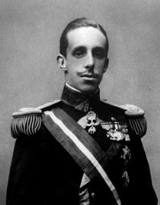
Alfonso XIII of Spain

Encyclopedia
Alfonso XIII was King of Spain from 1886 until 1931. His mother, Maria Christina of Austria
, was appointed regent
during his minority. In 1902, on attaining his 16th year, the King assumed control of the state.
, posthumous son of Alfonso XII of Spain
, and became King of Spain upon his birth. The French newspaper Le Figaro
described the young king as "the happiest and best-loved of all the rulers of the earth".
When he came of age in 1902, the week of his majority was marked by festivities, bullfights, balls and receptions throughout Spain.
During his reign, Spain
lost its last colonies in the Americas (Cuba
and Puerto Rico
) and the Philippines
; fought and, after several setbacks, won a war
in Morocco
; witnessed the start of the Spanish Generation of 1927, and endured the dictatorship of Miguel Primo de Rivera
, which ultimately cost him the throne.
During the First World War
, because of his family connections with both sides and the division of popular opinion, Spain remained neutral. The King ran an office for captives from the Royal Palace, which leveraged the Spanish diplomatic and military network abroad to intercede for thousands of prisoners-of-war, receiving and answering letters from Europe. However, he became gravely ill during the 1918 flu pandemic and, since Spain was neutral and thus under no wartime censorship restrictions, his illness and subsequent recovery were covered worldwide, giving the false impression (in the absence of real news from anywhere else) that Spain was the most-affected area. This ultimately led to the pandemic getting the nickname "the Spanish Flu."
Alfonso was a promoter of tourism in Spain. The problems with the lodging of his wedding guests prompted the construction of the luxury Hotel Palace
in Madrid. He also supported the creation of a network of state-run lodges (Parador
) in historic buildings of Spain. His fondness for the sport of football led to the patronage of several "Royal" ("Real" in Spanish) football clubs such as Real Madrid
, Real Sociedad
, Real Betis
, Real Club Deportivo de La Coruña and Real Unión
.
When the Second Spanish Republic
was proclaimed on 14 April 1931, he fled and left Spain, but did not abdicate the throne. He settled eventually in Rome
where he lived in the Grand Hotel.
Once the Spanish Civil War
broke out, Alfonso made it clear he favoured the military uprising against the Popular Front
government, but General Francisco Franco
in September 1936 declared that the Nationalists would never accept Alfonso as King (the supporters of the rival Carlist
pretender made up an important part of the Franco Army). First, he went into exile in France
. Nevertheless, he sent his son, Juan de Borbon, Count of Barcelona
, to enter Spain in 1936 and participate in the uprising. However, near the French border, General Mola
had him arrested and expelled from the country.
On 15 January 1941, Alfonso XIII abdicated his rights to the Spanish throne in favour of his third (of four), but second-surviving, son Juan, father of the current King, Juan Carlos
. He died in Rome a month and a half later.
The Spanish Government ordered three days of national mourning. His funeral was held in Rome in the Church of Santa Maria degli Angeli
. He was buried in the Church of Santa Maria in Monserrato, the Spanish national church in Rome, immediately below the tombs of Pope Calixtus III and Pope Alexander VI
. In January 1980 his remains were transferred to El Escorial
in Spain.
in Madrid
, Alfonso married Scottish
-born Princess Victoria Eugenie of Battenberg (1887–1969), a niece of King Edward VII of the United Kingdom
, and a granddaughter of Queen Victoria of the United Kingdom
. A Serene Highness
by birth, Ena, as she was known, was raised to Royal Highness
status a month before her wedding to prevent the union from being viewed as unequal.
As Alfonso XIII and Ena were returning from the wedding, they narrowly escaped an assassination attempt by the anarchist
Mateu Morral
who threw a bomb from a high window; instead, the bomb explosion killed or injured many bystanders and members of the Royal procession.
Alfonso and Ena had seven children:
By French
aristocrat Mélanie de Gaufridy de Dortan (1876 - 1937), he had Roger Marie Vincent Philippe Lévêque de Vilmorin (12 September 1905 - 20 July 1980)
By Spanish
actress María del Carmen Ruíz y Moragas (1898 - 1936):
By Béatrice Noon he had Juana Alfonsa Milán y Quiñones de León (19 April 1916 - 16 May 2005)
(1894), which was written for the King when he was 8 years old. The story of Ratoncito Pérez has been adapted into further literary works and movies since then, with the character of Alfonso XIII appearing in some. Alfonso XIII is also mentioned on the plaque to Ratoncito Pérez on the second floor of "la calle del Arenal".
|-
|-
|-
Maria Christina of Austria
Maria Christina of Austria was Queen consort of Spain as the second wife of King Alfonso XII of Spain...
, was appointed regent
Regent
A regent, from the Latin regens "one who reigns", is a person selected to act as head of state because the ruler is a minor, not present, or debilitated. Currently there are only two ruling Regencies in the world, sovereign Liechtenstein and the Malaysian constitutive state of Terengganu...
during his minority. In 1902, on attaining his 16th year, the King assumed control of the state.
Reign
Alfonso was born in MadridMadrid
Madrid is the capital and largest city of Spain. The population of the city is roughly 3.3 million and the entire population of the Madrid metropolitan area is calculated to be 6.271 million. It is the third largest city in the European Union, after London and Berlin, and its metropolitan...
, posthumous son of Alfonso XII of Spain
Alfonso XII of Spain
Alfonso XII was king of Spain, reigning from 1874 to 1885, after a coup d'état restored the monarchy and ended the ephemeral First Spanish Republic.-Early life and paternity:Alfonso was the son of Queen Isabella II of Spain, and...
, and became King of Spain upon his birth. The French newspaper Le Figaro
Le Figaro
Le Figaro is a French daily newspaper founded in 1826 and published in Paris. It is one of three French newspapers of record, with Le Monde and Libération, and is the oldest newspaper in France. It is also the second-largest national newspaper in France after Le Parisien and before Le Monde, but...
described the young king as "the happiest and best-loved of all the rulers of the earth".
When he came of age in 1902, the week of his majority was marked by festivities, bullfights, balls and receptions throughout Spain.
During his reign, Spain
Spain
Spain , officially the Kingdom of Spain languages]] under the European Charter for Regional or Minority Languages. In each of these, Spain's official name is as follows:;;;;;;), is a country and member state of the European Union located in southwestern Europe on the Iberian Peninsula...
lost its last colonies in the Americas (Cuba
Cuba
The Republic of Cuba is an island nation in the Caribbean. The nation of Cuba consists of the main island of Cuba, the Isla de la Juventud, and several archipelagos. Havana is the largest city in Cuba and the country's capital. Santiago de Cuba is the second largest city...
and Puerto Rico
Puerto Rico
Puerto Rico , officially the Commonwealth of Puerto Rico , is an unincorporated territory of the United States, located in the northeastern Caribbean, east of the Dominican Republic and west of both the United States Virgin Islands and the British Virgin Islands.Puerto Rico comprises an...
) and the Philippines
Philippines
The Philippines , officially known as the Republic of the Philippines , is a country in Southeast Asia in the western Pacific Ocean. To its north across the Luzon Strait lies Taiwan. West across the South China Sea sits Vietnam...
; fought and, after several setbacks, won a war
Rif War (1920)
The Rif War, also called the Second Moroccan War, was fought between Spain and the Moroccan Rif Berbers.-Rifian forces:...
in Morocco
Morocco
Morocco , officially the Kingdom of Morocco , is a country located in North Africa. It has a population of more than 32 million and an area of 710,850 km², and also primarily administers the disputed region of the Western Sahara...
; witnessed the start of the Spanish Generation of 1927, and endured the dictatorship of Miguel Primo de Rivera
Miguel Primo de Rivera
Miguel Primo de Rivera y Orbaneja, 2nd Marquis of Estella, 22nd Count of Sobremonte, Knight of Calatrava was a Spanish dictator, aristocrat, and a military official who was appointed Prime Minister by the King and who for seven years was a dictator, ending the turno system of alternating...
, which ultimately cost him the throne.
During the First World War
World War I
World War I , which was predominantly called the World War or the Great War from its occurrence until 1939, and the First World War or World War I thereafter, was a major war centred in Europe that began on 28 July 1914 and lasted until 11 November 1918...
, because of his family connections with both sides and the division of popular opinion, Spain remained neutral. The King ran an office for captives from the Royal Palace, which leveraged the Spanish diplomatic and military network abroad to intercede for thousands of prisoners-of-war, receiving and answering letters from Europe. However, he became gravely ill during the 1918 flu pandemic and, since Spain was neutral and thus under no wartime censorship restrictions, his illness and subsequent recovery were covered worldwide, giving the false impression (in the absence of real news from anywhere else) that Spain was the most-affected area. This ultimately led to the pandemic getting the nickname "the Spanish Flu."
Alfonso was a promoter of tourism in Spain. The problems with the lodging of his wedding guests prompted the construction of the luxury Hotel Palace
Hotel Palace
The Hotel Palace is a hotel located in Madrid, Spain. It was declared Bien de Interés Cultural in 1999....
in Madrid. He also supported the creation of a network of state-run lodges (Parador
Parador
A parador , in Spain and other Spanish-speaking countries, is a kind of luxury hotel, usually located in a historic building such as a monastery or castle. Parar means to stop, halt or stay.- Paradores de Turismo de España :...
) in historic buildings of Spain. His fondness for the sport of football led to the patronage of several "Royal" ("Real" in Spanish) football clubs such as Real Madrid
Real Madrid C.F.
Real Madrid Club de Fútbol , commonly known as Real Madrid, is a professional football club based in Madrid, Spain. The club have won a record 31 La Liga titles, the Primera División of the Liga de Fútbol Profesional , 18 Copas del Rey, 8 Spanish Super Cups, 1 Copa Eva Duarte and 1 Copa de la...
, Real Sociedad
Real Sociedad
Real Sociedad de Fútbol, S.A.D. is a Spanish football club based in the city of San Sebastián, Basque Country, founded on 7 September 1909...
, Real Betis
Real Betis
Real Betis Balompié S.A.D. is a Spanish football club based in Seville, in the autonomous community of Andalusia. Founded on 12 September 1907, it currently plays in La Liga, holding home games at Estadio Benito Villamarín....
, Real Club Deportivo de La Coruña and Real Unión
Real Unión
Real Unión Club de Irún, S.A.D. is a Spanish football club based in Irun, in the autonomous community of the Basque Country, in the province of Gipuzkoa, near the border with France...
.
When the Second Spanish Republic
Second Spanish Republic
The Second Spanish Republic was the government of Spain between April 14 1931, and its destruction by a military rebellion, led by General Francisco Franco....
was proclaimed on 14 April 1931, he fled and left Spain, but did not abdicate the throne. He settled eventually in Rome
Rome
Rome is the capital of Italy and the country's largest and most populated city and comune, with over 2.7 million residents in . The city is located in the central-western portion of the Italian Peninsula, on the Tiber River within the Lazio region of Italy.Rome's history spans two and a half...
where he lived in the Grand Hotel.
Once the Spanish Civil War
Spanish Civil War
The Spanish Civil WarAlso known as The Crusade among Nationalists, the Fourth Carlist War among Carlists, and The Rebellion or Uprising among Republicans. was a major conflict fought in Spain from 17 July 1936 to 1 April 1939...
broke out, Alfonso made it clear he favoured the military uprising against the Popular Front
Popular Front (Spain)
The Popular Front in Spain's Second Republic was an electoral coalition and pact signed in January 1936 by various left-wing political organisations, instigated by Manuel Azaña for the purpose of contesting that year's election....
government, but General Francisco Franco
Francisco Franco
Francisco Franco y Bahamonde was a Spanish general, dictator and head of state of Spain from October 1936 , and de facto regent of the nominally restored Kingdom of Spain from 1947 until his death in November, 1975...
in September 1936 declared that the Nationalists would never accept Alfonso as King (the supporters of the rival Carlist
Carlism
Carlism is a traditionalist and legitimist political movement in Spain seeking the establishment of a separate line of the Bourbon family on the Spanish throne. This line descended from Infante Carlos, Count of Molina , and was founded due to dispute over the succession laws and widespread...
pretender made up an important part of the Franco Army). First, he went into exile in France
France
The French Republic , The French Republic , The French Republic , (commonly known as France , is a unitary semi-presidential republic in Western Europe with several overseas territories and islands located on other continents and in the Indian, Pacific, and Atlantic oceans. Metropolitan France...
. Nevertheless, he sent his son, Juan de Borbon, Count of Barcelona
Juan de Borbón, Count of Barcelona
The Infante Juan of Spain, Count of Barcelona , was the third surviving son and designated heir of King Alfonso XIII of Spain and Victoria Eugenie of Battenberg, the monarch replaced by the Second Spanish Republic,...
, to enter Spain in 1936 and participate in the uprising. However, near the French border, General Mola
Emilio Mola
Emilio Mola y Vidal, 1st Duke of Mola, Grandee of Spain was a Spanish Nationalist commander during the Spanish Civil War. He is best-known for having coined the term "fifth column".-Early life:...
had him arrested and expelled from the country.
On 15 January 1941, Alfonso XIII abdicated his rights to the Spanish throne in favour of his third (of four), but second-surviving, son Juan, father of the current King, Juan Carlos
Juan Carlos I of Spain
Juan Carlos I |Italy]]) is the reigning King of Spain.On 22 November 1975, two days after the death of General Francisco Franco, Juan Carlos was designated king according to the law of succession promulgated by Franco. Spain had no monarch for 38 years in 1969 when Franco named Juan Carlos as the...
. He died in Rome a month and a half later.
The Spanish Government ordered three days of national mourning. His funeral was held in Rome in the Church of Santa Maria degli Angeli
Santa Maria degli Angeli
Santa Maria degli Angeli is the name of several churches in Italy. They include:*Santa Maria degli Angeli e dei Martiri, a basilica in Rome, created by Michelangelo in the Baths of Diocletian...
. He was buried in the Church of Santa Maria in Monserrato, the Spanish national church in Rome, immediately below the tombs of Pope Calixtus III and Pope Alexander VI
Pope Alexander VI
Pope Alexander VI , born Roderic Llançol i Borja was Pope from 1492 until his death on 18 August 1503. He is one of the most controversial of the Renaissance popes, and his Italianized surname—Borgia—became a byword for the debased standards of the Papacy of that era, most notoriously the Banquet...
. In January 1980 his remains were transferred to El Escorial
El Escorial
The Royal Seat of San Lorenzo de El Escorial is a historical residence of the king of Spain, in the town of San Lorenzo de El Escorial, about 45 kilometres northwest of the capital, Madrid, in Spain. It is one of the Spanish royal sites and functions as a monastery, royal palace, museum, and...
in Spain.
Marriage and children
On 31 May 1906, at the Royal Monastery of San GeronimoSan Jerónimo el Real
San Jerónimo el Real is a Roman Catholic church from the early 16th-century in central Madrid .The church, which has undergone numerous remodelings and restorations over the centuries is the remaining structure of the Hieronymite monastery that once stood beside the royal palace of Buen Retiro, of...
in Madrid
Madrid
Madrid is the capital and largest city of Spain. The population of the city is roughly 3.3 million and the entire population of the Madrid metropolitan area is calculated to be 6.271 million. It is the third largest city in the European Union, after London and Berlin, and its metropolitan...
, Alfonso married Scottish
Scotland
Scotland is a country that is part of the United Kingdom. Occupying the northern third of the island of Great Britain, it shares a border with England to the south and is bounded by the North Sea to the east, the Atlantic Ocean to the north and west, and the North Channel and Irish Sea to the...
-born Princess Victoria Eugenie of Battenberg (1887–1969), a niece of King Edward VII of the United Kingdom
Edward VII of the United Kingdom
Edward VII was King of the United Kingdom and the British Dominions and Emperor of India from 22 January 1901 until his death in 1910...
, and a granddaughter of Queen Victoria of the United Kingdom
Victoria of the United Kingdom
Victoria was the monarch of the United Kingdom of Great Britain and Ireland from 20 June 1837 until her death. From 1 May 1876, she used the additional title of Empress of India....
. A Serene Highness
Serene Highness
His/Her Serene Highness is a style used today by the reigning families of Liechtenstein and Monaco. It also preceded the princely titles of members of some German ruling and mediatised dynasties as well as some non-ruling but princely German noble families until 1918...
by birth, Ena, as she was known, was raised to Royal Highness
Royal Highness
Royal Highness is a style ; plural Royal Highnesses...
status a month before her wedding to prevent the union from being viewed as unequal.
As Alfonso XIII and Ena were returning from the wedding, they narrowly escaped an assassination attempt by the anarchist
Anarchism
Anarchism is generally defined as the political philosophy which holds the state to be undesirable, unnecessary, and harmful, or alternatively as opposing authority in the conduct of human relations...
Mateu Morral
Mateu Morral
Mateu Morral Roca was a Spanish anarchist, known for his assassination attempt on the lives of Alfonso XIII of Spain and his wife Victoria Eugenia .The son of a Barcelona textile merchant, Morral learned several languages, and traveled to Germany...
who threw a bomb from a high window; instead, the bomb explosion killed or injured many bystanders and members of the Royal procession.
Alfonso and Ena had seven children:
- Infante Alfonso Pio Cristino Eduardo Francisco Guillermo Carlos Enrique Fernando Antonio Venancio of Spain, Prince of AsturiasPrince of AsturiasPrince of Asturias is the historical title given to the heir to the Spanish throne. It was also the title under the earlier Kingdom of Castile. The current Prince of Asturias is Felipe, son of King Juan Carlos of Spain and Queen Sofía...
(1907–1938), a hemophiliac, he renounced his rights to the throne in 1933 to marry a commoner, Edelmira Ignacia Adriana Sampedro-Robato, and became Count of CovadongaCovadongaCovadonga is a village and one of 11 parishes in Cangas de Onís, a municipality within the province and autonomous community of Asturias, in northwestern Spain...
. He later remarried to Marta Ester Rocafort-AltazarraMarta Ester Rocafort-AltazarraMarta Esther Rocafort y Altuzarra, later hyphenated Rocafort-Altuzarra was the second wife of the Count of Covadonga ....
, but had no issue by either of them. - Infante Jaime Luitpold Isabelino Enrique Alberto Alfonso Victor Acacio Pedro Maria of Spain (1908–1975), a deaf-muteDeaf-muteFor "deafness", see hearing impairment. For "Deaf" as a cultural term, see Deaf culture. For "inability to speak", see muteness.Deaf-mute is a term which was used historically to identify a person who was both deaf and could not speak...
as the result of a childhood operation, he renounced his rights to the throne in 1933 and became Duke of SegoviaSegoviaSegovia is a city in Spain, the capital of Segovia Province in the autonomous community of Castile and León. It is situated north of Madrid, 30 minutes by high speed train. The municipality counts some 55,500 inhabitants.-Etymology:...
, and later Duke of Madrid, and who, as a legitimist pretenderPretenderA pretender is one who claims entitlement to an unavailable position of honour or rank. Most often it refers to a former monarch, or descendant thereof, whose throne is occupied or claimed by a rival, or has been abolished....
to the French throne from 1941 to 1975, was known as the Duke of AnjouAnjouAnjou is a former county , duchy and province centred on the city of Angers in the lower Loire Valley of western France. It corresponds largely to the present-day département of Maine-et-Loire...
. - Infanta Beatríz Isabela Federica Alfonsa Eugenia Cristina Maria Teresa Bienvenida Ladisláa of SpainInfanta Beatriz of SpainThe Infanta Beatriz of Spain was a daughter of King Alfonso XIII of Spain and Victoria Eugenie of Battenberg and paternal aunt of the current King Juan Carlos I.-Early life:Infanta Beatriz was born at La Granja, San Ildefonso near...
(1909–2002), who married Don Alessandro Torlonia, 5th Prince di Civitella-Cesi. - Infante Fernando, stillbornStillbirthA stillbirth occurs when a fetus has died in the uterus. The Australian definition specifies that fetal death is termed a stillbirth after 20 weeks gestation or the fetus weighs more than . Once the fetus has died the mother still has contractions and remains undelivered. The term is often used in...
(1910) - Infanta Maria Cristina Teresa Alejandra Guadalupe Maria de la Concepción Vittoria Eugenia of SpainInfanta Maria Cristina of SpainInfanta Maria Cristina of Spain, Countess of Marone was the fourth child of Alfonso XIII of Spain and Victoria Eugenie of Battenberg and paternal aunt of the current King Juan Carlos I.-Early life:Infanta Maria...
(1911–1996), who married Enrico Eugenio Marone-Cinzano, 1st Conte Marone-Cinzano. - Infante Juan Carlos Teresa Silvestre Alfonso of SpainJuan de Borbón, Count of BarcelonaThe Infante Juan of Spain, Count of Barcelona , was the third surviving son and designated heir of King Alfonso XIII of Spain and Victoria Eugenie of Battenberg, the monarch replaced by the Second Spanish Republic,...
(1913–1993), named heir to the throne and Count of Barcelona, whose son is the current King, Juan Carlos I of SpainJuan Carlos I of SpainJuan Carlos I |Italy]]) is the reigning King of Spain.On 22 November 1975, two days after the death of General Francisco Franco, Juan Carlos was designated king according to the law of succession promulgated by Franco. Spain had no monarch for 38 years in 1969 when Franco named Juan Carlos as the...
. - Infante Gonzalo Manuel Maria Bernardo Narciso Alfonso Mauricio of SpainInfante Gonzalo of SpainInfante Gonzalo of Spain was the fourth surviving son and youngest child of King Alfonso XIII of Spain and his wife Princess Victoria Eugenie of Battenberg....
(1914–1934), a hemophiliac, like his elder brother Alfonso. He died due to bleeding from injuries suffered in a car crash.
Illegitimate issue
The King also had four illegitimate children:By French
French people
The French are a nation that share a common French culture and speak the French language as a mother tongue. Historically, the French population are descended from peoples of Celtic, Latin and Germanic origin, and are today a mixture of several ethnic groups...
aristocrat Mélanie de Gaufridy de Dortan (1876 - 1937), he had Roger Marie Vincent Philippe Lévêque de Vilmorin (12 September 1905 - 20 July 1980)
By Spanish
Spanish people
The Spanish are citizens of the Kingdom of Spain. Within Spain, there are also a number of vigorous nationalisms and regionalisms, reflecting the country's complex history....
actress María del Carmen Ruíz y Moragas (1898 - 1936):
- Ana María Teresa Ruíz y Moragas (9 October 1925 - 6 September 1965)
- Leandro Alfonso Luis Ruíz y Moragas (born 26 April 1929), officially recognized by Spanish Courts on 21 May 2003 as Leandro Alfonso Luis de Borbón y Ruíz Moragas
By Béatrice Noon he had Juana Alfonsa Milán y Quiñones de León (19 April 1916 - 16 May 2005)
Honours
- 1,072nd KnightKnightA knight was a member of a class of lower nobility in the High Middle Ages.By the Late Middle Ages, the rank had become associated with the ideals of chivalry, a code of conduct for the perfect courtly Christian warrior....
of the Order of the Golden FleeceOrder of the Golden FleeceThe Order of the Golden Fleece is an order of chivalry founded in Bruges by Philip III, Duke of Burgundy in 1430, to celebrate his marriage to the Portuguese princess Infanta Isabella of Portugal, daughter of King John I of Portugal. It evolved as one of the most prestigious orders in Europe...
in SpainSpainSpain , officially the Kingdom of Spain languages]] under the European Charter for Regional or Minority Languages. In each of these, Spain's official name is as follows:;;;;;;), is a country and member state of the European Union located in southwestern Europe on the Iberian Peninsula...
in 1886 - Maestranza de CaballeriaMaestranza de caballeríaMaestranzas de caballería were noble guilds created in the modern age by the Spanish Crown, with the aim of giving the nobility practice in horsemanship and the use of weapons...
(Royal Cavalry Armory) de Ronda, Sevilla, Granada, Valencia y Zaragoza - Order of Charles III
- Order of SantiagoOrder of SantiagoThe Order of Santiago was founded in the 12th century, and owes its name to the national patron of Galicia and Spain, Santiago , under whose banner the Christians of Galicia and Asturias began in the 9th century to combat and drive back the Muslims of the Iberian Peninsula.-History:Santiago de...
- Order of CalatravaOrder of CalatravaThe Order of Calatrava was the first military order founded in Castile, but the second to receive papal approval. The papal bull confirming the Order of Calatrava as a Militia was given by Pope Alexander III on September 26, 1164.-Origins and Foundation:...
- Order of AlcántaraOrder of AlcántaraThe Order of Alcántara , also called the Knights of St. Julian, was originally a military order of León, founded in 1166 and confirmed by Pope Alexander III in 1177.-Alcántara:...
- Order of MontesaOrder of MontesaThe Order of Montesa is a Christian military order, territorially limited to the Kingdom of Aragon.-Templar background:The Templars had been received with enthusiasm in Aragon from their foundation in 1128...
- 315th Grand CrossGrand CrossThe phrase Grand Cross is used to denote the highest grade in many orders of knighthood. Sometimes the holders of the highest grade are referred to "knights grand cross" or just "grand crosses"; in other cases the actual insignia itself is called "the grand cross".Alternatively, in some other...
of the Order of the Tower and SwordOrder of the Tower and SwordThe Military Order of the Tower and of the Sword, of Valour, Loyalty and Merit is a Portuguese order of knighthood and the pinnacle of the Portuguese honours system. It was created by King Afonso V in 1459....
in 1900 - 815th KnightKnightA knight was a member of a class of lower nobility in the High Middle Ages.By the Late Middle Ages, the rank had become associated with the ideals of chivalry, a code of conduct for the perfect courtly Christian warrior....
of the Order of the GarterOrder of the GarterThe Most Noble Order of the Garter, founded in 1348, is the highest order of chivalry, or knighthood, existing in England. The order is dedicated to the image and arms of St...
in 1902 - Order of the ChrysanthemumOrder of the Chrysanthemumis Japan's highest order. The Grand Cordon of the Order was established in 1876 by Emperor Meiji of Japan; the collar of the Order was added on January 4, 1888. Although technically the order has only one class, it can either be awarded with collar , or with grand cordon...
, 1930: Emperor Showa's second brother, Prince TakamatsuPrince Takamatsuwas the third son of HIM Emperor Taishō and HIM Empress Teimei and a younger brother of the HIM Emperor Shōwa . He became heir to the Takamatsu-no-miya , one of the four shinnōke or branches of the imperial family entitled to inherit the Chrysanthemum throne in default of a direct heir...
, traveled to Madrid to confer the Great Collar of the Chrysanthemum on King Alfonso. This honor was intended, in part, to commemorate the diplomatic and trading history which existed long before other Western nations were officially aware of Japan's existence. Prince TakamatsuPrince Takamatsuwas the third son of HIM Emperor Taishō and HIM Empress Teimei and a younger brother of the HIM Emperor Shōwa . He became heir to the Takamatsu-no-miya , one of the four shinnōke or branches of the imperial family entitled to inherit the Chrysanthemum throne in default of a direct heir...
traveled with his wife, Princess TakamatsuPrincess TakamatsuPrincess Takamatsu of Japan, , known informally as Princess Kikuko, was a member of the Japanese imperial family. The Princess was the widow of Prince Takamatsu , the third son of the Emperor Taishō and the Empress Teimei...
, to Spain. Her symbolic role in this unique mission to the Spanish Court was intended to emphasize the international links which were forged by her 16th-century ancestor, Ieyasu Tokugawa. In the years before the Tokugawa shogunateTokugawa shogunateThe Tokugawa shogunate, also known as the and the , was a feudal regime of Japan established by Tokugawa Ieyasu and ruled by the shoguns of the Tokugawa family. This period is known as the Edo period and gets its name from the capital city, Edo, which is now called Tokyo, after the name was...
, that innovative daimyoDaimyois a generic term referring to the powerful territorial lords in pre-modern Japan who ruled most of the country from their vast, hereditary land holdings...
from Western Japan had been actively involved in negotiating trade and diplomatic treaties with Spain and with the colonies of New Spain (Mexico) and the Philippines; and it was anticipated that the mere presence of the Princess could serve to underscore the range of possibilities which could be inferred from that little-known history.
Media
Alfonso XIII appears as "King Buby" in Luis Coloma's story of Ratoncito PérezRatoncito Pérez
The Ratoncito Pérez is a figure popular in Spanish and Hispanic American cultures, similar to the tooth fairy, originating in Madrid in 1894. As is traditional in some English-speaking countries, when a child loses a tooth it is customary for him or her to place it under the pillow, so that...
(1894), which was written for the King when he was 8 years old. The story of Ratoncito Pérez has been adapted into further literary works and movies since then, with the character of Alfonso XIII appearing in some. Alfonso XIII is also mentioned on the plaque to Ratoncito Pérez on the second floor of "la calle del Arenal".
Ancestry
External links
- Royal House of Spain
- Princely House of Battenberg
- Historiaantiqua. Alfonso XIII; (Spanish) (2008)
|-
|-
|-