
All Topics  
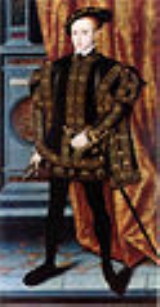
Edward VI of England


   Email Print
   Bookmark   Link


Edward VI of England


Edward VI (12 October 1537 – 6 July 1553) became King of England and Ireland
King of Ireland

The designation King of Ireland and Queen of Ireland was used during three periods of History of Ireland....
 on 28 January 1547 and was crowned on 20 February at the age of nine. The son of Henry VIII
Henry VIII of England

Henry VIII was King of England from 21 April 1509 until his death. He was also Lordship of Ireland and claimant to the Early Modern France. Henry was the second monarch of the House of Tudor, succeeding his father, Henry VII of England....
 and Jane Seymour
Jane Seymour

Jane Seymour was List of English consorts as the third Wives of Henry VIII of Henry VIII of England. She succeeded Anne Boleyn as queen consort following the latter's execution in 1536....
, Edward was the third monarch of the Tudor dynasty
Tudor dynasty

The House of Tudor was a prominent European royal house that ruled the Kingdom of England and its realms from 1485 until 1603. Founded by Henry VII of England, who, though his paternal family was Welsh people ?his grandfather was Owen Tudor? was himself also a legitimized descendent of the royal House of Lancaster....
 and England's first Protestant
Protestantism

Protestantism is a movement within Christianity that originated in the sixteenth-century Protestant Reformation. It is considered to be one of the three principal traditions of Christianity, together with Roman Catholicism and Eastern Orthodoxy....
 ruler. During Edward’s reign, the realm was governed by a Regency Council
Regent

A regent, from the Latin regens "reigning", is a person selected to act as head of state because the ruler is a minor, not present or debilitated....
, because he never reached maturity. The Council was led from 1547 to 1549 by his uncle Edward Seymour, 1st Duke of Somerset
Edward Seymour, 1st Duke of Somerset

Edward Seymour, 1st Duke of Somerset was Lord Protector of England in the period between the death of Henry VIII of England in 1547 and his own indictment in 1549....
, and from 1550 to 1553 by John Dudley, 1st Earl of Warwick
John Dudley, 1st Duke of Northumberland

John Dudley, 1st Duke of Northumberland was a Tudor dynasty general, admiral and politician, who de facto ruled England in the latter half of Edward VI of England's reign....
, who in 1551 became 1st Duke of Northumberland.

Edward's reign was marked by economic problems, military withdrawal from Scotland
Scotland

conventional_long_name = ScotlandAlba|common_name= Scotland|image_flag = Flag of Scotland.svg|flag_width = 130px...
 and Boulogne-sur-Mer
Boulogne-sur-Mer

Boulogne-sur-Mer is a city in northern France. It is a Subprefectures in France of the Departments of France of Pas-de-Calais.The population of the city was 44,859 in the 1999 census, whereas that of the whole metropolitan area was 135,116....
, and social unrest that in 1549 erupted into riot and rebellion.


Discussion
Ask a question about 'Edward VI of England'
Start a new discussion about 'Edward VI of England'
Answer questions from other users
Full Discussion Forum


Quotations


I say this with certain intention, I will see my laws strictly obeyed, and those who break them will be watched and denounced.

To his half-sister Mary I of England, who was ignoring his anti-Catholic laws.


Encyclopedia


Edward VI (12 October 1537 – 6 July 1553) became King of England and Ireland
King of Ireland

The designation King of Ireland and Queen of Ireland was used during three periods of History of Ireland....
 on 28 January 1547 and was crowned on 20 February at the age of nine. The son of Henry VIII
Henry VIII of England

Henry VIII was King of England from 21 April 1509 until his death. He was also Lordship of Ireland and claimant to the Early Modern France. Henry was the second monarch of the House of Tudor, succeeding his father, Henry VII of England....
 and Jane Seymour
Jane Seymour

Jane Seymour was List of English consorts as the third Wives of Henry VIII of Henry VIII of England. She succeeded Anne Boleyn as queen consort following the latter's execution in 1536....
, Edward was the third monarch of the Tudor dynasty
Tudor dynasty

The House of Tudor was a prominent European royal house that ruled the Kingdom of England and its realms from 1485 until 1603. Founded by Henry VII of England, who, though his paternal family was Welsh people ?his grandfather was Owen Tudor? was himself also a legitimized descendent of the royal House of Lancaster....
 and England's first Protestant
Protestantism

Protestantism is a movement within Christianity that originated in the sixteenth-century Protestant Reformation. It is considered to be one of the three principal traditions of Christianity, together with Roman Catholicism and Eastern Orthodoxy....
 ruler. During Edward’s reign, the realm was governed by a Regency Council
Regent

A regent, from the Latin regens "reigning", is a person selected to act as head of state because the ruler is a minor, not present or debilitated....
, because he never reached maturity. The Council was led from 1547 to 1549 by his uncle Edward Seymour, 1st Duke of Somerset
Edward Seymour, 1st Duke of Somerset

Edward Seymour, 1st Duke of Somerset was Lord Protector of England in the period between the death of Henry VIII of England in 1547 and his own indictment in 1549....
, and from 1550 to 1553 by John Dudley, 1st Earl of Warwick
John Dudley, 1st Duke of Northumberland

John Dudley, 1st Duke of Northumberland was a Tudor dynasty general, admiral and politician, who de facto ruled England in the latter half of Edward VI of England's reign....
, who in 1551 became 1st Duke of Northumberland.

Edward's reign was marked by economic problems, military withdrawal from Scotland
Scotland

conventional_long_name = ScotlandAlba|common_name= Scotland|image_flag = Flag of Scotland.svg|flag_width = 130px...
 and Boulogne-sur-Mer
Boulogne-sur-Mer

Boulogne-sur-Mer is a city in northern France. It is a Subprefectures in France of the Departments of France of Pas-de-Calais.The population of the city was 44,859 in the 1999 census, whereas that of the whole metropolitan area was 135,116....
, and social unrest that in 1549 erupted into riot and rebellion. It also saw the transformation of the Anglican Church into a recognisably Protestant body. Henry VIII had severed the link between the Church of England
Church of England

The Church of England is the State religion Christianity Ecclesia in England, the Mother Church of the worldwide Anglican Communion and the oldest among the communion's thirty-eight independent national and regional churches....
 and Rome
Roman Catholic Church

The Roman Catholic Church, officially known as the Catholic Church is the world's largest Christianity Ecclesia , representing over half of all Christians and one-sixth of the world population....
, and during Edward's reign, Protestantism was established
Established Church

An established church is a Church body officially sanctioned and supported by the government of a country, e.g. the Church of England and the Church of Scotland in the United Kingdom....
 for the first time in England, with reforms that included the abolition of clerical celibacy
Celibacy

Celibacy is a state of being intentionally unmarried and abstaining from sexual intercourse. A vow of celibacy taken by monks and nuns signifies the promise to refrain from all sexual activity for the purpose of spiritual advancement....
 and the mass
Mass (liturgy)

The Mass is the Eucharistic celebration in the Latin liturgical rites of the Roman Catholic Church. The term is used also of similar celebrations in Old Catholic Churches, in the Anglo-Catholic tradition of Anglicanism, and in some largely High Church Lutheranism Lutheranism regions, including the Scandinavian and Baltic states countries....
, and the imposition of compulsory services in English. The architect of these reforms was Thomas Cranmer
Thomas Cranmer

Thomas Cranmer was a leader of the English Reformation and Archbishop of Canterbury during the reigns of Henry VIII of England and Edward VI of England....
, Archbishop of Canterbury
Archbishop of Canterbury

The Archbishop of Canterbury is the chief bishop and principal leader of the Church of England, the symbolic head of the worldwide Anglican Communion and the Diocesan Bishop of the Diocese of Canterbury, the Episcopal see that churches must be in communion with in order to be a part of the Anglican Communion....
, whose Book of Common Prayer
Book of Common Prayer

The Book of Common Prayer is the common title of a number of prayer books of the Church of England and used throughout the Anglican Communion. The first book, published in 1549 , in the reign of Edward VI of England, was a product of the English Reformation following the break with Roman Catholic Church....
 has proved lasting.

When Edward fell terminally ill in 1553, he and his Council drew up a "Devise for the Succession" in an attempt to prevent a Catholic backlash against the Protestant Reformation. Edward named his cousin Lady Jane Grey
Lady Jane Grey

Lady Jane Grey , also known as Queen Jane of England, was a claimant to the Kingdom of England and Monarchy of Ireland, who was de facto monarch of England for just over a week in 1553....
 as his heir and excluded his two half sisters, the Catholic Mary
Mary I of England

Mary I , was Queen of England and Monarchy of Ireland from 19 July 1553 until her death. The fourth crowned monarch of the Tudor dynasty, she is remembered for restoring England to Roman Catholicism after succeeding her short-lived half brother, Edward VI of England, to the English throne....
 and Protestant Elizabeth
Elizabeth I of England

Elizabeth I was List of English monarchs and Queen of Ireland from 17 November 1558 until her death. Sometimes called The Virgin Queen, Gloriana, or Good Queen Bess, Elizabeth was the fifth and last monarch of the House of Tudor....
. On Edward's death at the age of 15, the succession was disputed. Jane survived as queen for only nine days before the Privy Council proclaimed Mary, for whom the people had risen in support in the counties. As queen, Mary proceeded to undo many of Edward's Protestant reforms, but Elizabeth's religious settlement
Elizabethan Religious Settlement

The Elizabethan Religious Settlement was Elizabeth I of England?s response to the religious divisions created over the reigns of Henry VIII of England, Edward VI of England and Mary I of England....
 of 1559 was to secure his Protestant legacy.

Early life


Birth


Prince Edward was born on 12 October 1537 at Hampton Court Palace
Hampton Court Palace

Hampton Court Palace is a former English royal palace in the London Borough of Richmond upon Thames in south west London. The palace is located south west of Charing Cross and upstream of Central London on the River Thames....
, to the west of London
London

London is the capital of both England and the United Kingdom, and the most populous municipality in the European Union. An important settlement for two millennia, History of London goes back to its founding by the Roman Empire....
. He was the son of King Henry VIII
Henry VIII of England

Henry VIII was King of England from 21 April 1509 until his death. He was also Lordship of Ireland and claimant to the Early Modern France. Henry was the second monarch of the House of Tudor, succeeding his father, Henry VII of England....
 by his third wife, Jane Seymour
Jane Seymour

Jane Seymour was List of English consorts as the third Wives of Henry VIII of Henry VIII of England. She succeeded Anne Boleyn as queen consort following the latter's execution in 1536....
. Throughout the realm, the people greeted the birth of a male heir, "whom we hungered for so long", with joy and relief. Te Deum
Te Deum

The Te Deum is an Early Christian hymn of praise. The hymn remains in regular use in the Roman Catholic Church in the Office of Readings found in the Liturgy of the Hours, and in thanksgiving to God for a special blessing either after Mass or Divine Office or as a separate religious ceremony....
s
were sung in churches, bonfires lit, and "their was shott at the Tower that night above two thousand gonnes". Jane, who appeared to recover quickly from a prolonged labour, sent out pre-signed letters announcing the birth of "a Prince, conceived in most lawful matrimony between my Lord the King's Majesty and us". Edward was christened
Infant baptism

Infant baptism is the Christian religious practice of baptism infants or young children. In theology discussions, the practice is sometimes referred to as paedobaptism or pedobaptism from the Greek pais meaning "child." The practice is sometimes contrasted with what is called "believers baptism", or credobaptism, from t...
 on 15 October, with Princess Mary as godmother and Princess Elizabeth carrying the chrism
Chrism

Chrism , also called "Myrrh" , Holy anointing oil or "Consecrated Oil," is a consecrated oil used in the Roman Catholic Church, Oriental Orthodox and Eastern Orthodox churches, in the Assyrian Church of the East, in the Old Catholic Church, and some Anglicanism and Lutheranism churches in the administration of certain sacraments and ecclesi...
, or baptismal cloth; and the Garter King of Arms
Garter Principal King of Arms

Garter Principal King of Arms is the senior King of Arms, and the senior Officer of Arms of the College of Arms. The office takes its name from the Order of the Garter....
 proclaimed him as Duke of Cornwall
Duke of Cornwall

The Dukedom of Cornwall was the first dukedom created in the peerage of England.The present Duke of Cornwall is Charles, Prince of Wales, the eldest son of Elizabeth II of the United Kingdom, the reigning British monarch ....
 and Earl of Chester
Earl of Chester

The Earldom of Chester was one of the most powerful earldoms in medieval England. Since 1301 the title has generally been given to heirs-apparent to the English throne, and from the late 14th century it has been given only in conjunction with that of Prince of Wales....
. Jane Seymour, however, suddenly fell ill on 23 October from presumed postnatal complications, and she died the following night. Henry VIII wrote to Francis I of France
Francis I of France

Francis I , was crowned King of France in 1515 in the cathedral at Reims and reigned until 1547.Francis I is considered to be France's first Renaissance monarch....
 that "Divine Providence ... hath mingled my joy with bitterness of the death of her who brought me this happiness". Edward was about nine when his father King Henry VIII died January 27,1547.

Upbringing and education

Edward was a healthy baby who suckled strongly from the first. His father was delighted with him; in May 1538, Henry was observed "dallying with him in his arms ... and so holding him in a window to the sight and great comfort of the people". That September, the Lord Chancellor, Thomas, Lord Audley
Thomas Audley, 1st Baron Audley of Walden

Thomas Audley, 1st Baron Audley of Walden, Order of the Garter, Privy Council of the United Kingdom, King's Serjeant , Lord Chancellor of England, born in Earls Colne, Essex, the son of Geoffrey Audley, is believed to have studied at Buckingham College, Cambridge, Cambridge University....
, reported Edward's rapid growth and vigour; and other accounts describe him as a tall and merry child. The tradition that Edward VI was a sickly boy has been challenged by some historians. At the age of four, he fell ill with a life-threatening "quartan fever", but, despite occasional illnesses and poor eyesight, he enjoyed generally good health until the last six months of his life.

Edward was placed in the care of Margaret Bryan, "lady mistress" of the prince's household, and until the age of six he was brought up, as he put it later in his Chronicle, "among the women". A formal royal household was established around him, at first under Sir William Sidney, and later under Sir Richard Page, the stepfather of Edward Seymour
Edward Seymour, 1st Duke of Somerset

Edward Seymour, 1st Duke of Somerset was Lord Protector of England in the period between the death of Henry VIII of England in 1547 and his own indictment in 1549....
's wife, Anne Stanhope
Anne Stanhope

Anne Stanhope , was the daughter of Sir Edward Stanhope and Elizabeth Bourchier....
. Henry demanded exacting standards of security and cleanliness in his son's household, stressing that Edward was "this whole realm's most precious jewel". Visitors described the prince, who was lavishly provided with toys and comforts, including his own troupe of minstrel
Minstrel

A minstrel was a Middle Ages European bard who performed songs whose lyrics told stories about distant places or about real or imaginary historical events....
s, as a contented child.

From the age of six, Edward began his formal education under Richard Cox
Richard Cox (bishop)

Richard Cox was an England clergyman, who was Dean of Westminster Abbey and Bishop of Ely....
 and John Cheke
John Cheke

Sir John Cheke was an England classical scholar and statesman, notable as the first Regius Professor of Greek language at Cambridge University....
, concentrating, as he recalled himself, on "learning of tongues, of the scripture, of philosophy, and all liberal sciences"; he later also received tuition from Elizabeth's tutor, Roger Ascham
Roger Ascham

Roger Ascham , England scholar and didactic writer, famous for his prose style, his promotion of the vernacular, and his theories of education....
, among others, and in French from Jean Belmain
Jean Belmain

Jean Belmain, also John Belmain was a Early Modern France Huguenot scholar who served as a French-language teacher to future England monarchs Edward VI of England and Elizabeth I of England at the court of their father, Henry VIII....
. In addition, he is known to have studied geometry
Geometry

Geometry arose as the field of knowledge dealing with spatial relationships. Geometry was one of the two fields of pre-modern mathematics, the other being the study of numbers....
 and learned to play musical instruments, including the lute
Lute

Lute can refer generally to any plucked string instrument with a neck and a deep round back, or more specifically to an instrument from the family of European lutes....
 and the virginals
Virginals

The virginals or virginal is a keyboard instrument of the harpsichord family. It was popular in northern Europe and Italy during the Late Middle Ages and Renaissance periods....
. He collected globes and maps and, according to coinage historian C. E. Challis, developed a grasp of monetary affairs that indicates a high intelligence. Edward's religious education is assumed to have favoured the reforming agenda. His religious establishment was probably chosen by Archbishop Thomas Cranmer
Thomas Cranmer

Thomas Cranmer was a leader of the English Reformation and Archbishop of Canterbury during the reigns of Henry VIII of England and Edward VI of England....
, a leading reformer; and both Cox and Cheke were "reformed" Catholics or Erasmians
Desiderius Erasmus

Desiderius Erasmus Roterodamus was a Netherlands Renaissance humanist and Roman Catholic Church Christian theology. His scholarly name Desiderius Erasmus Roterodamus comprises the following three elements: the Latin noun desiderium ; the Greek adjective ???s???? meaning "desired", and, in the form Erasmus, also the name of a St....
 and later became Marian exiles
Marian exiles

The name Marian Exiles is given to English people Calvinism Protestantism who fled to the Continental Europe during the reign of Mary I of England....
. By 1549, Edward had written a treatise
Treatise

A treatise is a formal and systematic exposition in writing of the principles of a subject, generally longer and more detailed than an essay. A lengthy discourse on some subject....
 on the pope as Antichrist
Antichrist

The Antichrist is one who fulfills Biblical prophecies concerning an adversary of New Testament view on Jesus' life while resembling him in a deceptive manner....
 and was making informed notes on theological controversies. Many aspects of Edward's religion were still essentially Catholic in his early years, including celebration of the mass
Mass (liturgy)

The Mass is the Eucharistic celebration in the Latin liturgical rites of the Roman Catholic Church. The term is used also of similar celebrations in Old Catholic Churches, in the Anglo-Catholic tradition of Anglicanism, and in some largely High Church Lutheranism Lutheranism regions, including the Scandinavian and Baltic states countries....
 and reverence for images and relics of the saints.

Both Edward's sisters were attentive to their brother and often visited him—on one occasion, Elizabeth gave him a shirt "of her own working". Edward "took special content" in Mary's company, though he disapproved of her taste for foreign dances; "I love you most", he wrote to her in 1546. In 1543, Henry invited his three children to spend Christmas with him, signalling his reconciliation with his daughters, whom he had previously illegitimised and disinherited. The following spring, he restored them to their place in the succession with a Third Succession Act
Third Succession Act

The Third Succession Act of Henry VIII of England reign was passed by the Parliament of England in July 1543, and returned both Mary I of England and Elizabeth I of England to the line of the succession behind Edward VI of England....
, which also provided for a regency council during Edward's minority. This unaccustomed family harmony may have owed much to the influence of Henry's new wife Catherine Parr
Catherine Parr

Catherine Parr , also known as Catherine or Catharine Parr, was the last of Wives of Henry VIII of Henry VIII of England. She was Queen Consort of England during 1543?1547, then Dowager Queen of England....
, of whom Edward soon became fond. He called her his "most dear mother" and in September 1546 wrote to her: "I received so many benefits from you that my mind can hardly grasp them".

Other children were brought to play with Edward, including the granddaughter of Edward's chamberlain Sir William Sidney, who in adulthood recalled the prince as "a marvellous sweet child, of very mild and generous condition". Edward shared his formal education with sons of nobles, "appointed to attend upon him" in what was a form of miniature court. Among these, Barnaby Fitzpatrick, the son of an Irish peer, became a close and lasting friend. Edward was more devoted to his schoolwork than were his classmates and seems to have outshone them, motivated to do his "duty" and compete with his sister Elizabeth's academic prowess, though Cox felt it necessary to beat him on at least one occasion. Edward’s surroundings and possessions were regally splendid: his rooms were hung with costly Flemish tapestries, and his clothes, books, and cutlery were encrusted with precious jewels and gold. Like his father, Edward was fascinated by military arts, and many of his portraits show him wearing a gold dagger with a jewelled hilt, in imitation of Henry. Edward's Chronicle enthusiastically details English military campaigns against Scotland and France, and adventures such as John Dudley
John Dudley, 1st Duke of Northumberland

John Dudley, 1st Duke of Northumberland was a Tudor dynasty general, admiral and politician, who de facto ruled England in the latter half of Edward VI of England's reign....
's near capture at Musselburgh
Musselburgh

Musselburgh is the largest settlement in East Lothian, on the coast of the Firth of Forth, six miles east of Edinburgh city centre. It also lays claim to the title of Scotland's oldest town.....
 in 1547.

Rough wooing


On 1 July 1543, Henry VIII had signed the Treaty of Greenwich
Treaty of Greenwich

The Treaty of Greenwich contained two agreements both signed on July 1, 1543 in Greenwich between representatives of England and Scotland. The accord, overall, entailed a plan developed by Henry VIII of England to unite both kingdoms ....
 with the Scots, sealing the peace with Edward's betrothal
Betrothal

Betrothal is a formal state of engagement to be marriage.Historically betrothal was a formal contract, blessed or officiated by a religious authority....
 to the seven-month-old Mary, Queen of Scots
Mary I of Scotland

Mary I was Queen of Scots from 14 December 1542 to 24 July 1567.She was the only surviving legitimate child of James V of Scotland. She was only six days old when her father died and left her Queen of Scots....
. The Scots were in a weak bargaining position after their defeat at Solway Moss
Battle of Solway Moss

The Battle of Solway Moss took place on Solway Moss near the River Esk in the Scottish Borders in November 1542 between forces from England and Scotland ....
 the previous November, and Henry, seeking to unite the two realms, stipulated that Mary be handed over to him to be brought up in England. When the Scots repudiated the treaty in December 1543 and renewed their alliance with France, Henry was enraged. In April 1544, he ordered Edward's uncle, Edward Seymour, Earl of Hertford
Edward Seymour, 1st Duke of Somerset

Edward Seymour, 1st Duke of Somerset was Lord Protector of England in the period between the death of Henry VIII of England in 1547 and his own indictment in 1549....
, to invade Scotland and "put all to fire and sword, burn Edinburgh town, so razed and defaced when you have sacked and gotten what ye can of it, as there may remain forever a perpetual memory of the vengeance of God lightened upon [them] for their falsehood and disloyalty". Seymour responded with the most savage campaign ever launched by the English against the Scots. The war, which continued into Edward's reign, has become known as "The Rough Wooing
The Rough Wooing

The Rough Wooing was a term coined by Sir Walter Scott and H. E. Marshall to describe the England-Scottish war pursued intermittently from 1544 to 1551....
".

Accession


Henry VIII died on 28 January 1547, when Edward was only nine. Those close to the throne, led by Edward Seymour and William Paget
William Paget, 1st Baron Paget

William Paget, 1st Baron Paget of Beaudesert , English people statesman, son of William Paget, one of the serjeants-at-mace of the city of London, was born in Staffordshire in 1506, and was educated at St Paul's School , and at Trinity Hall, Cambridge, proceeding afterwards to the university of Paris....
, agreed to delay the announcement of the king's death until arrangements had been made for a smooth succession. Seymour and Sir Anthony Browne
Sir Anthony Browne (d.1548)

Sir Anthony Browne was the son of Sir Anthony Browne , Standard Bearer of England and Governor of Queenborough Castle, by his wife Lucy Nevill, daughter of John Neville, 1st Marquess of Montagu....
, the Master of the Horse
Master of the Horse

The Master of the Horse was a historical position of varying importance in several European nations....
, rode to collect Edward from Hertford
Hertford

Hertford is the affluent county town of Hertfordshire, England, and is in the East Hertfordshire district of the county. Forming a civil parish, it has a population today of about 24,180 and boasts a wide selection of boutiques, bars and cafes....
 and brought him to Enfield
Enfield Town

Enfield Town is a location in the London Borough of Enfield. It is north north-east of Charing Cross. Although the area now has none of the official attributes of a town, 'Town' remains the name of one of the Ward of the borough....
, where Princess Elizabeth was living. He and Elizabeth were then told of the death of their father and heard a reading of the will. The Lord Chancellor, Thomas Wriothesley
Thomas Wriothesley, 1st Earl of Southampton

Thomas Wriothesley, 1st Earl of Southampton Order of the Garter was a politician of the Tudor dynasty born in London to William Wriothesley and Agnes Drayton....
, announced Henry's death to parliament on 31 January, and general proclamations of Edward's succession were ordered. The new king was taken to the Tower of London
Tower of London

Her Majesty's Royal Palace and Fortress, more commonly known as the Tower of London , is a historic monument in central London, England, on the north bank of the River Thames....
, where he was welcomed with "great shot of ordnance in all places there about, as well out of the Tower as out of the ships". The following day, the nobles of the realm made their obedience to Edward at the Tower, and Seymour was announced as Protector. Henry VIII was buried at Windsor on 16 February, in the same tomb as Jane Seymour, as he had wished.

Edward VI was crowned at Westminster Abbey
Westminster Abbey

The Collegiate Church of St Peter at Westminster, which is almost always referred to popularly and informally as Westminster Abbey, is a large, mainly Gothic architecture Church , in Westminster, London, just to the west of the Palace of Westminster....
 four days later on Sunday 20 February, the first coronation in England for almost 40 years. The ceremonies were shortened, because of the "tedious length of the same which should weary and be hurtsome peradventure to the King's majesty, being yet of tender age", and also because the Reformation had rendered some of them inappropriate. On the eve of the coronation, Edward progressed on horseback from the Tower to the Palace of Westminster
Palace of Westminster

The Palace of Westminster, also known as the Houses of Parliament or Westminster Palace, in London, is where the two Houses of the Parliament of the United Kingdom meet....
 through thronging crowds and pageants, many based on the pageants for a previous boy king, Henry VI
Henry VI of England

Henry VI was Kingdom of England 1422?1461 and then 1470?1471, and King of France as the de jure monarch from 1422 to 1429....
. He laughed at a Spanish tightrope walker
Tightrope walking

Tightrope walking is the art of walking along a thin wire or rope usually at a great height. One or more artists perform in front of an audience or as a publicity stunt ....
 who "tumbled and played many pretty toys" outside St Paul's Cathedral
Old St Paul's Cathedral

Old St. Paul's is a name used to refer to the Gothic architecture cathedral in the City of London built between 1087 and 1314. At its peak, the cathedral was the third longest church in Europe and had List of tallest churches in the world....
. At the coronation service, Cranmer affirmed the royal supremacy
Acts of Supremacy

The first Act of Supremacy granted King Henry VIII of England Royal Supremacy which is still the legal authority of the Monarch of the United Kingdom....
 and called Edward a second Josiah
Josiah

Josiah or Yoshiyahu was a king of Judah who instituted major reforms. Josiah is credited by some historians with having established or discovered important Jewish scriptures during the Deuteronomic reform that occurred during his rule....
, urging him to continue the reformation of the Church of England
Church of England

The Church of England is the State religion Christianity Ecclesia in England, the Mother Church of the worldwide Anglican Communion and the oldest among the communion's thirty-eight independent national and regional churches....
, "the tyranny of the Bishops of Rome banished from your subjects, and images removed". After the service, Edward presided at a banquet in Westminster Hall, where, he recalled in his Chronicle, he dined with his crown on his head.

Somerset's Protectorate


Council of Regency


Henry VIII's will
Will (law)

In common law, a will or testament is a document by which a person regulates the rights of others over his or her property or family after death....
 named sixteen executor
Executor

An executor, in the broadest sense, is one who carries something out .Executor is also a legal term referring to a person named by a maker of a will , or nominated by the testator, to carry out the directions of the will....
s, who were to act as Edward's Council until he reached the age of 18. These executors were supplemented by twelve men "of counsail" who would assist the executors when called on. The final state of Henry VIII's will has been the subject of controversy. Some historians suggest that those close to the king manipulated either him or the will itself to ensure a shareout of power to their benefit, both material and religious. In this reading, the composition of the Privy Chamber
Privy Chamber

The Privy Chamber is part of the Topkapi Palace, Istanbul, where the Sultans have used as office and also kept the Sacred Trusts....
 shifted towards the end of 1546 in favour of the reforming faction
Political faction

A political faction is a grouping of individuals, especially within a political organization, such as a political party, a trade union, or other group with a political purpose....
. In addition, two leading conservative Privy Councillors were removed from the centre of power. Stephen Gardiner
Stephen Gardiner

Stephen Gardiner was an England Roman Catholic bishop and politician during the English Reformation period who served as Lord Chancellor during the reign of Queen Mary I of England....
 was refused access to Henry during his last months. Thomas Howard, 3rd Duke of Norfolk
Thomas Howard, 3rd Duke of Norfolk

Thomas Howard, 3rd Duke of Norfolk was a prominent Tudor dynasty politician. He was uncle to two of the wives of Henry VIII, Anne Boleyn and Catherine Howard, as well as the king's mistress Mary Boleyn, and played a major role in the machinations behind these relationships....
, found himself accused of treason
Treason

In law, treason is the crime that covers some of the more serious acts of loyalty to one's sovereignty or nation. Historically, treason also covered the murder of specific social superiors, such as the murder of a husband by his wife ....
; the day before the king's death his vast estates were seized, making them available for redistribution, and he spent the whole of Edward's reign in the Tower of London
Tower of London

Her Majesty's Royal Palace and Fortress, more commonly known as the Tower of London , is a historic monument in central London, England, on the north bank of the River Thames....
. Other historians have argued that Gardiner's exclusion was based on non-religious matters, that Norfolk was not noticeably conservative in religion, that conservatives remained on the Council, and that the radicalism of men such as Sir Anthony Denny
Anthony Denny

Sir Anthony Denny was a confidant of Henry VIII of England. Denny was the most prominent member of the Privy chamber in Henry's last years, having charge of the dry stamp of Henry's signature, and attended Henry on his deathbed....
, who controlled the dry stamp that replicated the king's signature, is debatable. Whatever the case, Henry's death was followed by a lavish hand-out of lands and honours to the new power group. The will contained an "unfulfilled gifts" clause, added at the last minute, which allowed Henry's executors to freely distribute lands and honours to themselves and the court, particularly to Edward Seymour, 1st Earl of Hertford
Edward Seymour, 1st Duke of Somerset

Edward Seymour, 1st Duke of Somerset was Lord Protector of England in the period between the death of Henry VIII of England in 1547 and his own indictment in 1549....
, who became the Lord Protector of the Realm
Lord Protector

Lord Protector is a particular British title for Heads of State, with two meanings at different periods of history.Feudal royal regent ...
, Governor of the King's Person, and the Duke of Somerset
Duke of Somerset

The Duke of Somerset is a title in the peerage of England that has been created several times. Derived from Somerset, it is particularly associated with two families; the Beauforts who held the title from the creation of 1448 and the Seymours, from the creation of 1547 and in whose name the title is still held....
.

In fact, Henry VIII's will did not provide for the appointment of a Protector. It entrusted the government of the realm during his son's minority to a Regency Council that would rule collectively, by majority decision, with "like and equal charge". Nevertheless, a few days after Henry's death, on 4 February, the executors chose to invest almost regal power in Edward Seymour. Thirteen out of the sixteen (the others being absent) agreed to his appointment as Protector, which they justified as their joint decision "by virtue of the authority" of Henry's will. Seymour may have done a deal with some of the executors, who almost all received hand-outs. He is known to have done so with William Paget
William Paget, 1st Baron Paget

William Paget, 1st Baron Paget of Beaudesert , English people statesman, son of William Paget, one of the serjeants-at-mace of the city of London, was born in Staffordshire in 1506, and was educated at St Paul's School , and at Trinity Hall, Cambridge, proceeding afterwards to the university of Paris....
, private secretary to Henry VIII, and to have secured the support of Sir Anthony Browne
Sir Anthony Browne (d.1548)

Sir Anthony Browne was the son of Sir Anthony Browne , Standard Bearer of England and Governor of Queenborough Castle, by his wife Lucy Nevill, daughter of John Neville, 1st Marquess of Montagu....
 of the Privy Chamber.

Seymour's appointment was in keeping with historical precedent, and his eligibility for the role was reinforced by his military successes in Scotland and France. In March 1547, he secured letters patent
Letters patent

Letters patent are a type of legal instrument in the form of an open letter issued by a monarch or government, granting an office, right, government-granted monopoly, title, or status to a person or to some entity such as a corporation....
 from King Edward granting him the almost monarchical right to appoint members to the Privy Council himself and to consult them only when he wished. In the words of historian G. R. Elton, "from that moment his autocratic system was complete". He proceeded to rule largely by proclamation
Proclamation

A proclamation is an official declaration....
, calling on the Privy Council to do little more than rubber-stamp his decisions.

Somerset's takeover of power was smooth and efficient. The imperial ambassador
Holy Roman Empire

The Holy Roman Empire was a union of territories in Central Europe during the Middle Ages and the Early modern Europe under a Holy Roman Emperor....
, Van der Delft, reported that he "governs everything absolutely", with Paget operating as his secretary, though he predicted trouble from John Dudley
John Dudley, 1st Duke of Northumberland

John Dudley, 1st Duke of Northumberland was a Tudor dynasty general, admiral and politician, who de facto ruled England in the latter half of Edward VI of England's reign....
, who had recently been raised to Earl of Warwick
Earl of Warwick

Earl of Warwick is a title that has been created four times in British history and is one of the most prestigious titles in the peerages of the British Isles....
 in the share-out of honours. In fact, in the early weeks of his Protectorate, Somerset was challenged only by the Chancellor, Thomas Wriothesley
Thomas Wriothesley, 1st Earl of Southampton

Thomas Wriothesley, 1st Earl of Southampton Order of the Garter was a politician of the Tudor dynasty born in London to William Wriothesley and Agnes Drayton....
, whom the Earldom of Southampton
Earl of Southampton

The title of Earl of Southampton was created three times in the Peerage of Peerage of England . The second creation was associated with a subsidiary title, Baron Wriothesley ....
 had evidently failed to buy off, and by his own brother. Wriothesley, a religious conservative, objected to Somerset’s assumption of monarchical power over the Council. He then found himself abruptly dismissed from the chancellorship on charges of selling off some of his offices to delegates. His removal forestalled the forming of factions within the Council.

Thomas Seymour

Somerset faced less manageable opposition from his younger brother Thomas Seymour
Thomas Seymour, 1st Baron Seymour of Sudeley

Thomas Seymour, 1st Baron Seymour of Sudeley , was a British politician....
, who has been described as a "worm in the bud". As King Edward's uncle, Thomas Seymour demanded the governorship of the king’s person and a greater share of power. Somerset tried to buy his brother off with a baron
Baron

Baron is a specific title of nobility. The word baron comes from Old French baron, itself from Old High German and latin baro meaning " man, warrior"; it merged with cognate Old English language beorn meaning "nobleman."...
y, an appointment to the Lord Admiralship
Admiralty

The Admiralty was formerly the authority in the United Kingdom responsible for the command of the Royal Navy. Originally exercised by a single person, the office of Lord High Admiral was from the 18th century onward almost invariably put "in commission", and was exercised by a Board of Admiralty....
, and a seat on the Privy Council—but Thomas was bent on scheming for power. He began smuggling pocket money to King Edward, telling him that Somerset held the purse strings too tight, making him a "beggarly king". He also urged him to throw off the Protector within two years and "bear rule as other kings do"; but Edward, schooled to defer to the Council, failed to co-operate. In April, using Edward’s support to circumvent Somerset’s opposition, Thomas Seymour secretly married Henry VIII's widow Catherine Parr
Catherine Parr

Catherine Parr , also known as Catherine or Catharine Parr, was the last of Wives of Henry VIII of Henry VIII of England. She was Queen Consort of England during 1543?1547, then Dowager Queen of England....
, whose Protestant household included the 11-year-old Lady Jane Grey
Lady Jane Grey

Lady Jane Grey , also known as Queen Jane of England, was a claimant to the Kingdom of England and Monarchy of Ireland, who was de facto monarch of England for just over a week in 1553....
 and the 13-year-old Princess Elizabeth.

In summer 1548, a pregnant Catherine Parr discovered Thomas Seymour embracing Princess Elizabeth. As a result, Elizabeth was removed from Catherine Parr's household and transferred to Sir Anthony Denny's. That September, Catherine Parr died in childbirth, and Thomas Seymour promptly resumed his attentions to Elizabeth by letter, planning to marry her. Elizabeth was receptive, but, like Edward, unready to agree to anything unless permitted by the Council. In January 1549, the Council, led by John Dudley, who had just engineered the recall of Wriothesley, had Thomas Seymour arrested on various charges, including embezzlement
Embezzlement

Embezzlement is the act of dishonestly appropriating or secreting assets, usually financial in nature, by one or more individuals to whom such assets have been entrusted....
 at the Bristol mint
Mint (coin)

A mint is an industrial facility which manufacturing coins for currency.The history of mints correlates closely with the history of coins. One difference is that the history of the mint is normally related in a fashion that more closely ties to the political situation of an era....
. King Edward, whom Seymour was accused of planning to marry to Lady Jane Grey
Lady Jane Grey

Lady Jane Grey , also known as Queen Jane of England, was a claimant to the Kingdom of England and Monarchy of Ireland, who was de facto monarch of England for just over a week in 1553....
, himself testified about the pocket money. Lack of clear evidence for treason ruled out a trial, so Seymour was condemned instead by an Act of Attainder
Bill of attainder

A bill of attainder is an act of legislature declaring a person or group of persons guilty of some crime and punishing them without benefit of a trial....
 and beheaded on 20 March 1549. The execution of the Protector's brother had at last given his enemies a chance to damage him. It was the latest of a series of disasters that had marked the Protector's rule. From this time, Somerset's own position was increasingly under threat.

War

Somerset’s only undoubted skill was as a soldier, which he had proved on expeditions to Scotland and in the defence of Boulogne-sur-Mer
Boulogne-sur-Mer

Boulogne-sur-Mer is a city in northern France. It is a Subprefectures in France of the Departments of France of Pas-de-Calais.The population of the city was 44,859 in the 1999 census, whereas that of the whole metropolitan area was 135,116....
 in 1546. From the first, his main interest as Protector was the war against Scotland. After a crushing victory at the Battle of Pinkie Cleugh
Battle of Pinkie Cleugh

The Battle of Pinkie Cleugh, along the banks of the River Esk, Lothian near Musselburgh, Scotland on 10 September 1547, was part of the War of the Rough Wooing....
 in September 1547, he set up a network of garrisons in Scotland, stretching as far north as Dundee
Dundee

Dundee is the fourth-largest City status in the United Kingdom in Scotland and, fully named as Dundee City, one of Scotland's 32 Local government in Scotland Council areas of Scotland....
. His initial successes, however, were followed by a loss of direction, as his aim of uniting the realms through conquest became increasingly unrealistic. The Scots allied with France, who sent reinforcements for the defence of Edinburgh in 1548, while Mary, Queen of Scots, was removed to France, where she was betrothed to the dauphin
Dauphin

The Dauphin of France ?strictly, The Dauphin of Viennois ?was the title given to the heir apparent of the throne of France from 1350 to 1791, and from 1824 to 1830....
. The cost of maintaining the Protector's massive armies and his permanent garrisons in Scotland also placed an unsustainable burden on the royal finances. A French attack on Boulogne in August 1549 at last forced Somerset to begin a withdrawal from Scotland.

Rebellion

During 1548, England was subject to social unrest. After April 1549, a series of armed revolts broke out, fuelled by various religious and agrarian grievances. The two most serious rebellions, which required major military intervention to put down, were in Devon and Cornwall and in Norfolk. The first, sometimes called the Prayer Book Rebellion
Prayer Book Rebellion

The Prayer Book Rebellion, Prayer Book Revolt, Prayer Book Rising, Western Rising or Western Rebellion was a popular revolt in Cornwall and Devon, in 1549....
, arose mainly from the imposition of church services in English, and the second, led by a tradesman called Robert Kett
Kett's Rebellion

Kett's Rebellion was a revolt in Norfolk beginning in July 1549 instigated by Robert Kett of Wymondham, Norfolk. Robert Kett himself had been a tanner and owned the Manorialism of Wymondham making him a wealthy man....
, mainly from the encroachment of landlords on common grazing ground. A complex aspect of the social unrest was that the protestors believed they were acting legitimately against enclosing
Enclosure

Enclosure or inclosure is the process by which common land is taken into fully private ownership and use. Common land is land which is owned by one person, but over which other people have certain traditional rights, such as arable farming, mowing meadows for hay, or grazing livestock....
 landlords with the Protector's support, convinced that the landlords were the lawbreakers.

The same justification for outbreaks of unrest was voiced throughout the country, not only in Norfolk and the west. The origin of the popular view of Somerset as sympathetic to the rebel cause lies partly in his series of sometimes liberal, often contradictory, proclamations, and partly in the uncoordinated activities of the commissions he sent out in 1548 and 1549 to investigate grievances about loss of tillage, encroachment of large sheep flocks on common land
Common land

Depending on which part of the world, Common land , is a piece of land owned by one person, but over which other people can exercise certain traditional rights, such as allowing their livestock to graze upon it....
, and similar issues. Somerset's commissions were led by an evangelical M.P. called John Hales, whose socially liberal rhetoric linked the issue of enclosure with Reformation theology and the notion of a godly commonwealth
Commonwealth

The England noun commonwealth dates from the fifteenth century. The original phrase "common-wealth" or "the common weal" comes from the old meaning of "wealth," which is "well-being." The term literally meant "common well-being." Thus commonwealth originally meant a state or nation-state governed for the common good as opposed to an autho...
. Local groups often assumed that the findings of these commissions entitled them to act against offending landlords themselves. King Edward wrote in his
Chronicle that the 1549 risings began "because certain commissions were sent down to pluck down enclosures".

Whatever the popular view of Somerset, the disastrous events of 1549 were taken as evidence of a colossal failure of government, and the Council laid the responsibility at the Protector's door. In July 1549, Paget wrote to Somerset: "Every man of the council have misliked your proceedings ... would to God, that, at the first stir you had followed the matter hotly, and caused justice to be ministered in solemn fashion to the terror of others ...". By that autumn, plans were afoot to eject Somerset as Protector.

Fall of Somerset


The sequence of events that led to Somerset's removal from power has often been called a
coup d'état
Coup d'état

A coup d??tat , often simply called a coup, is the sudden unconstitutional overthrow of a government by a part of the state establishment – usually the military – to replace the branch of the stricken government, either with another civil government or with a military government....
. By 1 October, Somerset had been alerted that his rule faced a serious threat. He issued a proclamation calling for assistance, took possession of the king's person, and withdrew for safety to the fortified Windsor Castle
Windsor Castle

Windsor Castle, in Windsor, Berkshire in the England county of Berkshire, is the largest inhabited castle in the world and, dating back to the time of William I of England, is the oldest in continuous occupation....
, where Edward wrote, "Me thinks I am in prison". Meanwhile, a united Council published details of Somerset's government mismanagement. They made clear that the Protector's power came from them, not from Henry VIII's will. On 11 October, the Council had Somerset arrested and brought the king to Richmond
Richmond Palace

Richmond Palace was a royal residence from 1327 to 1649 on The Green in Richmond, London which was then a village in Surrey and is now a suburb of London, England....
. Edward summarised the charges against Somerset in his
Chronicle: "ambition, vainglory, entering into rash wars in mine youth, negligent looking on Newhaven, enriching himself of my treasure, following his own opinion, and doing all by his own authority, etc." In February 1550, John Dudley, Earl of Warwick
John Dudley, 1st Duke of Northumberland

John Dudley, 1st Duke of Northumberland was a Tudor dynasty general, admiral and politician, who de facto ruled England in the latter half of Edward VI of England's reign....
, emerged as the leader of the Council and, in effect, as Somerset's successor. Although Somerset was released from the Tower and restored to the Council, he was executed for felony in January 1552 after scheming to overthrow Dudley's regime. Edward noted his uncle's death in his
Chronicle: "the duke of Somerset had his head cut off upon Tower Hill between eight and nine o'clock in the morning".

Historians contrast the efficiency of Somerset's takeover of power, in which they detect the organising skills of allies such as Paget, the "master of practices", with the subsequent ineptitude of his rule. By autumn 1549, his costly wars had lost momentum, the crown faced financial ruin, and riots and rebellions had broken out around the country. Until recent decades, Somerset's reputation with historians was high, in view of his many proclamations that appeared to back the common people against a rapacious landowning class. More recently, however, he has often been portrayed as an arrogant ruler, devoid of the political and administrative skills necessary for governing the Tudor state.

Northumberland's regime


In contrast, Somerset's successor John Dudley, Earl of Warwick
John Dudley, 1st Duke of Northumberland

John Dudley, 1st Duke of Northumberland was a Tudor dynasty general, admiral and politician, who de facto ruled England in the latter half of Edward VI of England's reign....
, made duke of Northumberland
Duke of Northumberland

The Duke of Northumberland is a title in the peerage of Great Britain.In Latin, ealdormans of Northumbrians were called Dux when they were vassals of Anglo-Saxon kings of England ....
 in 1550, was once regarded by historians merely as a grasping schemer who cynically elevated and enriched himself at the expense of the crown. Since the 1970s, the administrative and economic achievements of his regime have been recognised, and he has been credited with restoring the authority of the royal Council and returning the government to an even keel after the disasters of Somerset's protectorate. Nonetheless, that he shared Somerset's ambition, greed, and corruption is undisputed.

The Earl of Warwick's rival for leadership of the new regime was Thomas Wriothesley, 1st Earl of Southampton
Thomas Wriothesley, 1st Earl of Southampton

Thomas Wriothesley, 1st Earl of Southampton Order of the Garter was a politician of the Tudor dynasty born in London to William Wriothesley and Agnes Drayton....
, whose conservative supporters had allied with Dudley's followers to create a unanimous Council which they, and observers such as the Emperor
Holy Roman Emperor

Image:HRR 14Jh.jpgThe Roman of the Emperor's title was a reflection of the translatio imperii principle that regarded the Holy Roman Emperors as the inheritors of the title of Emperor of the Western Roman Empire, a title left unclaimed in the West after the death of Julius Nepos in 480....
's ambassador, expected to reverse Somerset's policy of religious reform. Southampton's faction intended to appoint the Catholic Princess Mary as regent for King Edward. Warwick, on the other hand pinned his hopes on the king's strong Protestantism and, claiming that Edward was old enough to rule in person, moved himself and his people closer to the king, taking control of the Privy Chamber. Paget, accepting a barony, joined Warwick when he realised that a conservative policy would not bring the Emperor onto the English side over Boulogne. Southampton prepared a case for executing Somerset, aiming to discredit Warwick through Somerset's statements that he had done all with Warwick's cooperation. As a counter-move, Warwick convinced parliament to free Somerset, which it did on 14 January 1550. Warwick then had Southampton and his followers purged from the Council after winning the support of Council members in return for titles, and was made Lord President of the Council
Lord President of the Council

The Lord President of the Council is the fourth of the Great Officers of State of the United Kingdom, ranking beneath the Lord High Treasurer and above the Lord Privy Seal....
 and great master of the king's household. Although not called a Protector, he was now clearly the head of the government.

In accordance with his use of the king's personal authority as the source of his own, Warwick encouraged the king to come to Council meetings, which enabled him to cite the king's authority for his decisions. Although Edward was precocious and able to understand much government business, his contributions during Warwick's presidency probably amounted to no more than assent to decisions already taken. In Dale Hoak's view, "Edward VI's speeches and papers really present the somewhat pathetic figure of an articulate puppet far removed from the realities of government". His greatest influence was in matters of religion, where the Council followed the strongly Protestant policy that Edward favoured.

The new duke of Northumberland's mode of operation was very different from Somerset's. Careful to make sure he always commanded a majority of councillors, he encouraged a working council and used it to legitimate his authority. Lacking Somerset's blood relationship with the king, he added members to the Council from his own faction in order to control it. He also added members of his own family to the royal household. After a time, he insisted it was "some derogation to his Majesty's honour and royal authority" for the Council to countersign his letters and so gained control of Edward's name. He saw that to achieve personal dominance, he needed total procedural control of the Council. In the words of historian John Guy
John Guy

John Guy was a merchant from Bristol, England, and the first Proprietary Governor of Newfoundland leading the first attempt to establish a colony on the island....
, "Like Somerset, he became quasi-king; the difference was that he managed the bureaucracy on the pretence that Edward had assumed full sovereignty, whereas Somerset had asserted the right to near-sovereignty as Protector".

Warwick's war policies were more pragmatic than Somerset's, and they have earned him criticism for weakness. In 1550, he signed a peace treaty with France that agreed to withdrawal from Boulogne, recalled all English garrisons from Scotland, and cancelled Edward's betrothal to Mary, Queen of Scots, in favour of one with Henry II
Henry II of France

Henry II , of the House of Valois and the son and successor of Francis I of France, was King of France from 31 March 1547, until his death....
's daughter Elisabeth
Elisabeth of Valois

?lisabeth of Valois was the eldest daughter of Henry II of France and Catherine de' Medici....
. In practice, he realised that England could no longer support the cost of wars. At home, he took measures to police local unrest. In order to forestall future rebellions, he kept permanent representatives of the crown in the localities, including lords lieutenant
Lord Lieutenant

The title Lord Lieutenant is given to the British monarch's personal representatives in the United Kingdom, usually in a county or similar circumscription, with varying tasks throughout history....
, who commanded military forces and reported back to central government.

Warwick also tackled the disastrous state of the kingdom's finances, drawing on the talents of Thomas Smith
Thomas Smith (diplomat)

Sir Thomas Smith , was an England scholar and diplomat.He was born at Saffron Walden in Essex, England. He became a fellow of Queens' College, Cambridge, in 1530, and in 1533 was appointed a public reader or professor....
, William Cecil
William Cecil, 1st Baron Burghley

William Cecil, 1st Baron Burghley , Knight_of_the_Garter was an England statesman, the chief advisor and good friend of Elizabeth I of England for most of her reign , twice Secretary of State and Lord High Treasurer from 1572....
, and William Paulet
William Paulet, 1st Marquess of Winchester

Sir William Paulet was an England statesman who attained several peerages throughout his lifetime: Baron St John , Earl of Wiltshire , and Marquess of Winchester ....
, and on the financial advice of men such as Walter Mildmay and Thomas Gresham
Thomas Gresham

File:Thomas Gresham, 1544.jpgSir Thomas Gresham was an English merchant and financier who worked for King Edward VI of England and for Edward's half-sister Queen Elizabeth I of England....
. However, his regime did not take action until after it had succumbed to the temptations of a quick profit by further debasing
Debasement

Debasement is the practice of lowering the value of currency. It is particularly used in connection with commodity money such as gold or silver coins....
 the coinage. The economic disaster that resulted handed the initiative to the experts, and the debasement
Debasement

Debasement is the practice of lowering the value of currency. It is particularly used in connection with commodity money such as gold or silver coins....
 was reversed. By 1552, confidence in the coinage was restored, prices fell, and trade at last improved. Though a full economic recovery was not achieved until Elizabeth's reign, its origins lay in the Duke of Northumberland's policies. The regime also cracked down on the widespread embezzlement of government finances and carried out a thorough review of revenue collection practices which has been called "one of the more remarkable achievements of Tudor administration".

Reformation

In the matter of religion, the regime of Northumberland followed the same policy as that of Somerset, supporting an increasingly vigorous programme of reform. Although Edward VI's practical influence on government was limited, his intense Protestantism made a reforming administration obligatory; his succession was managed by the reforming faction, who continued in power throughout his reign. The man Edward trusted most, Thomas Cranmer
Thomas Cranmer

Thomas Cranmer was a leader of the English Reformation and Archbishop of Canterbury during the reigns of Henry VIII of England and Edward VI of England....
, Archbishop of Canterbury, introduced a series of religious reforms which revolutionised the English church from one that, while rejecting papal supremacy, remained essentially Catholic, to one that was institutionally Protestant. The confiscation of church property that had begun under Henry VIII resumed under Edward—notably with the dissolution of the chantries—to the great monetary advantage of the crown and the new owners of the seized property. Church reform was therefore as much a political as a religious policy under Edward VI. By the end of his reign, the church had been financially ruined, with much of the property of the bishops transferred into lay hands.

The religious convictions of both Somerset and Northumberland have proved elusive for historians, who are divided on the sincerity of their Protestantism. There is less doubt, however, about the religious devotion—some have called it bigotry
Bigotry

A bigot is a person who is intolerant of or takes offence to the opinions, lifestyles or identities differing from his or her own, and bigotry is the corresponding attitude or mindset....
—of King Edward, who was said to have read twelve chapters of scripture daily and enjoyed sermons, and was commemorated by John Foxe
John Foxe

John Foxe , martyrologist, is remembered as the author of what is popularly known as Foxe's Book of Martyrs, an account of Christian martyrs throughout history but especially emphasizing the sufferings of English Protestants from the fourteenth century through the reign of Mary I of England....
 as a "godly imp". Edward was depicted during his life and afterwards as a new Josiah
Josiah

Josiah or Yoshiyahu was a king of Judah who instituted major reforms. Josiah is credited by some historians with having established or discovered important Jewish scriptures during the Deuteronomic reform that occurred during his rule....
, the biblical king who destroyed the idols
Idolatry

Idolatry is usually defined as worship of any cult image, idea, or Object , as opposed to the worship of a monotheistic God. It is considered a major sin in the Abrahamic religions whereas in religions where such activity is not considered as sin, the term "idolatry" itself is absent....
 of Baal
Baal

Ba'al is a Northwest Semitic title and honorific meaning "master" or "lord" that is used for various gods who were patrons of cities in the Levant, cognate to East Semitic Bel ....
. He could be prig
Prig

A prig is someone who shows an inordinately zealous approach to matters of Etiquette; especially where the prig has the ability to show his/her superior knowledge to those who don't know the protocol....
gish in his anti-popery and once asked Catherine Parr to persuade Princess Mary "to attend no longer to foreign dances and merriments which do not become a most Christian princes". Edward's biographer Jennifer Loach cautions, however, against accepting too readily the pious image of Edward handed down by the reformers, as in John Foxe
John Foxe

John Foxe , martyrologist, is remembered as the author of what is popularly known as Foxe's Book of Martyrs, an account of Christian martyrs throughout history but especially emphasizing the sufferings of English Protestants from the fourteenth century through the reign of Mary I of England....
's influential
Acts and Monuments
Foxe's Book of Martyrs

The Book of Martyrs, by John Foxe, is an apocalyptically-oriented, England Protestant account of the persecutions of Protestants, mainly in England, many of whom had died for their beliefs within the decade immediately preceding its first publication....
, where a woodcut depicts the young king listening to a sermon by Hugh Latimer
Hugh Latimer

Hugh Latimer was the bishop of Worcester, and by his death he became a famous martyr among Protestants and the Church of England.Latimer was born into a family of farmers in Thurcaston, Leicestershire....
. In the early part of his life, Edward conformed to the prevailing Catholic practices, including attendance at mass
Mass (liturgy)

The Mass is the Eucharistic celebration in the Latin liturgical rites of the Roman Catholic Church. The term is used also of similar celebrations in Old Catholic Churches, in the Anglo-Catholic tradition of Anglicanism, and in some largely High Church Lutheranism Lutheranism regions, including the Scandinavian and Baltic states countries....
: but he became convinced, under the influence of Cranmer and the reformers among his tutors and courtiers, that "true" religion should be imposed in England.

The English Reformation
English Reformation

The English Reformation was the series of events in 16th century England by which the Church of England first broke away from the authority of the Pope and the Roman Catholic Church....
 advanced under pressure from two directions: from the traditionalists on the one hand and the zealots on the other, who led incidents of iconoclasm
Iconoclasm

Iconoclasm, Greek for "image-breaking," is the deliberate destruction of important symbolic images recognized within a culture, religion, or society....
 (image-smashing) and complained that reform did not go far enough. Radical new doctrines were made official, such as justification by faith alone
Sola fide

Sola fide , also historically known as the doctrine of Justification by faith, is a doctrine that distinguishes most Protestantism denominations from Roman Catholic Church, Eastern Christianity, and most Restorationists in Christianity....
 and communion
Eucharist

The Eucharist, also called Holy Communion or Lord's Supper and other names, is a Christianity sacrament commemorating, by consecrating bread and wine, the Last Supper, the final meal that Jesus Christ shared with his disciples before his arrest, and eventual crucifixion, when he gave them bread saying, "This is my body", and wine...
 for laity
Laity

In religious organizations, the laity comprises all persons who are not clergy. A person who is a member of a religious order who is not Holy Orders clergy is considered as a member of the laity, even though they are members of a religious order ....
 as well as clergy in both kinds
Communion under both kinds

Communion under both kinds in Christianity is the reception under both "species" of the Eucharist....
, of bread and wine. The Ordinal of 1550 replaced the divine ordination of priests with a government-run appointment system, authorising ministers to preach the gospel and administer the sacraments rather than, as before, "to offer sacrifice and celebrate mass both for the living and the dead". Cranmer set himself the task of writing a uniform liturgy
Liturgy

A liturgy is the customary public worship done by a specific religious group, according to their particular traditions. The word may refer to an elaborate formal ritual such as the Eastern Orthodox Divine Liturgy and Mass , or a daily activity such as the Muslim salat and Jewish Jewish services....
 in English, detailing all weekly and daily services and religious festivals, to be made compulsory in the first Act of Uniformity of 1549
Act of Uniformity 1549

The Act of Uniformity 1549 established The Book of Common Prayer as the sole legal form of worship in England. Before 1549, the churches of England continued to use a slightly altered version of the Latin-language Missal....
. His
Book of Common Prayer

The Book of Common Prayer is the common title of a number of prayer books of the Church of England and used throughout the Anglican Communion. The first book, published in 1549 , in the reign of Edward VI of England, was a product of the English Reformation following the break with Roman Catholic Church....
of 1549, intended as a compromise, was attacked by traditionalists for dispensing with many cherished rituals of the liturgy, such as the elevation
Elevation (Liturgy)

In Christian liturgy the Elevation is the ritual of raising the consecrated elements of Body of Christ and Blood of Christ during the celebration of the Eucharist....
 of the bread and wine, and by radical reformers for retaining too many "popish" elements, including vestiges of sacrificial rites at communion. Cranmer's prayer book was also opposed by many senior Catholic clerics, including Stephen Gardiner
Stephen Gardiner

Stephen Gardiner was an England Roman Catholic bishop and politician during the English Reformation period who served as Lord Chancellor during the reign of Queen Mary I of England....
, Bishop of Winchester, and Edmund Bonner
Edmund Bonner

Edmund Bonner , Bishop of London, was an England bishop. Initially an instrumental figure in the schism of Henry VIII of England from Holy See, he was antagonized by the Protestant reforms introduced by Edward Seymour, 1st Duke of Somerset and reconciled himself to Roman Catholicism....
, Bishop of London, who were both imprisoned in the Tower
Tower of London

Her Majesty's Royal Palace and Fortress, more commonly known as the Tower of London , is a historic monument in central London, England, on the north bank of the River Thames....
 and, along with others, deprived of their sees.

After 1551, the Reformation became even more radical, with the approval and encouragement of Edward, who began to exert more personal influence in his role as Supreme Head
Supreme Head

Supreme Head of the Church of England was a title held by King Henry VIII of England signifying his leadership of the Church of England....
 of the church. This hardening of the Reformation was also a response to criticism from such extreme reformers as John Hooper
John Hooper

John Hooper was an England churchman, Bishop of Gloucester and Bishop of Worcester. He was martyred during the Marian Persecutions....
, Bishop of Gloucester, and the Scot John Knox
John Knox

John Knox was a Scotland clergyman and leader of the Protestant Reformation who is considered the founder of the Presbyterianism denomination....
, who was employed as a minister in Newcastle under the Duke of Northumberland and whose preaching at court prompted the king to oppose kneeling at communion. Cranmer was also influenced by the views of the continental reformer Martin Bucer
Martin Bucer

Martin Bucer was a Protestant reformer whose principal ministry was in Strasbourg....
, who died in England in 1551, by Peter Martyr
Pietro Martire Vermigli

Pietro Martire Vermigli, sometimes simply Peter Martyr , was an Italy theology of the Protestant Reformation period.He was born at Florence, the son of Stefano di Antonio Vermigli and Maria Fumantina, a moderately well-to-do family....
, who was teaching at Oxford, and by other foreign theologians. The progress of the Reformation was further speeded by the appointment of more reformers as bishops. In the winter of 1551–52, Cranmer rewrote his
Book of Common Prayer in less ambiguous reformist terms, revised canon law
Canon law

Canon law is internal ecclesiastical law governing the Roman Catholic Church, the Eastern Orthodox Church churches, and the Anglicanism of churches....
, and prepared a doctrinal statement, the Forty-two Articles
Thirty-Nine Articles

The Thirty-Nine Articles of Religion were established in 1563, and are the historic defining statements of Anglican doctrine in relation to the controversies of the English Reformation; especially in the relation of Calvinist doctrine and Roman Catholic practices to the nascent Anglican doctrine of the evolving English Church....
, to clarify the forms of the new religion, particularly in the divisive matter of the communion service. Cranmer's formulation of the new religion, finally divesting the communion service of any notion of the real presence
Real Presence

The Real Presence is the term various Christian traditions use to express their belief that, in the Eucharist, Jesus Christ is really present in what was previously just bread and wine, and not merely present in symbol, as a figure of speech , or by his power ....
 of God in the bread and the wine, effectively abolished the mass
Mass (liturgy)

The Mass is the Eucharistic celebration in the Latin liturgical rites of the Roman Catholic Church. The term is used also of similar celebrations in Old Catholic Churches, in the Anglo-Catholic tradition of Anglicanism, and in some largely High Church Lutheranism Lutheranism regions, including the Scandinavian and Baltic states countries....
. According to Elton, the publication of Cranmer's revised prayer book in 1552, supported by a second Act of Uniformity
Act of Uniformity 1552

The Act of Uniformity 1552 was enacted in 1552 by Edward VI of England. It was one of the many steps taken by Edward VI of England and his councillors to make England a more Protestant country....
, "marked the arrival of the English Church at protestantism". The prayer book of 1552 remains the foundation of the Church of England's services. However, Cranmer was unable to implement all these reforms once it became clear in spring 1553 that King Edward, upon whom the whole Reformation in England depended, was dying.

Succession crisis


Device for the succession


During the winter of 1552–53, Edward VI became ill, and by May his condition, which included chronic coughing and swollen legs and head, was grave. The prospect of the king's death and the succession of his Catholic sister Mary threatened disaster to those around the king. It placed in jeopardy not only the English Reformation but the powerful and lucrative positions enjoyed by Edward’s Council and officers. For these reasons, an attempt was made in June 1553, shortly before Edward's death, to subvert the succession. Henry VIII had appeared to establish the convention that an English king could dictate his own heirs and set aside the traditional rules of descent. Edward therefore wrote out several drafts of a document headed "My devise for the succession" in which he passed over the claims of the princesses Mary and Elizabeth in favour of his first cousin once removed, the seventeen-year-old Lady Jane Grey, who on 21 May was married to Guildford Dudley, the fourth son of the Duke of Northumberland, "with a display regal". Northumberland and his supporters insisted that deeply reluctant lawyers draw up a will in the terms of Edward's device, and on 21 June, this was signed by over a hundred notables, including councillors, peers, archbishops, bishops, and sheriffs, many of whom later claimed that they had been bullied into doing so by Northumberland. In the atmosphere of approaching uncertainty, Northumberland further secured his ties to the crown by betrothing a brother, son, and daughter to three individuals high in the line of succession to the throne. He also sealed an alliance with the French, banking on their support in the event of an armed challenge from Princess Mary.

The plan to exclude Princess Mary from the succession shows that those at the centre of power had lost touch with political reality. Though Henry VIII had tampered with the succession, his exclusion of his sister Margaret
Margaret Tudor

Margaret Tudor was the elder of the two surviving daughters of Henry VII of England and Elizabeth of York, and the elder sister of Henry VIII of England....
's heirs was understandable because her heirs were aliens. Edward's device to alter the succession was not only unconstitutional in its violation of Henry VIII's Third Succession Act
Third Succession Act

The Third Succession Act of Henry VIII of England reign was passed by the Parliament of England in July 1543, and returned both Mary I of England and Elizabeth I of England to the line of the succession behind Edward VI of England....
 of 1543 but was demonstrably the product of hurried and illogical thinking. At first, Edward had provided for the succession of Jane's male heirs, but, as his death approached, he altered the wording so that Jane herself should succeed, since he had willed the crown to male heirs who had not yet been born. Those who drew up the legal documents failed to make the same change for her two sisters, who, inconsistently, remained excluded from the succession in favour of their male heirs. By the logic of the device, Jane's mother, Frances Grey, Duchess of Suffolk, the daughter of Henry VIII's sister Mary Tudor, but unlikely now to bear a male child, should have been named as Edward's heir, but she waived her claim in favour of her daughter. On 21 June, Edward issued letters patent
Letters patent

Letters patent are a type of legal instrument in the form of an open letter issued by a monarch or government, granting an office, right, government-granted monopoly, title, or status to a person or to some entity such as a corporation....
 bastardising the princesses Mary and Elizabeth. Why the Protestant Elizabeth was cut out of the succession along with Mary is unknown; it may be that if Mary was to be excluded on grounds of bastardy, Elizabeth, who had once been bastardised herself, had to be barred for the same reason. Whether the device was Edward's own idea or the result of manipulation by his advisors has been a matter of debate for historians. In practice, Edward's aims and those of Northumberland and his followers had become identical by 1553. Edward, who believed that his word was law, understood and accepted the proposals for the succession, even if they were not his own idea.

In recent decades, revisionist historians such as Dale Hoak and Stephen Alford have emphasised that Northumberland alone did not engineer the plot to subvert the succession and place Lady Jane Grey on the throne. In his confession on the scaffold, the duke claimed that "some others" were involved, but he would not name them, "for I will hurt now no man". Although the marriage between Lady Jane Grey and Guildford Dudley, as well as other "suddenly knit" betrothals that tied Northumberland to the crown, were contracted in the last weeks of Edward's life, it has been shown that Northumberland had begun making arrangements for these alliances a year earlier, before Edward became ill. However, Edward Montagu
Edward Montagu

Sir Edward Montagu was an England lawyer and judge....
, the Chief Justice
Chief Justice of the Common Pleas

The Court of Common Pleas , also known as the Common Bench or Common Place, was the second highest common law court in the English legal system until 1880, when it was dissolved....
, recalled that when legal objections to the device were raised in the Privy Council, Northumberland "fell into a great anger and rage, and called me traitor before all the Council, and said that in the quarrel of that matter he would fight in his shirt with any man living". The final responsibility for the alteration of the succession, however arrived at, must therefore be laid jointly at the door of Northumberland and of the young king himself.

Illness and death


Edward's illness began in January 1553 with a fever and cough that gradually worsened. The imperial ambassador, Scheyfve, reported that "he suffers a good deal when the fever is upon him, especially from a difficulty in drawing his breath, which is due to the compression of the organs on the right side ... I opine that this is a visitation and sign from God". Edward felt well enough in early April to take the air in the park at Westminster and to move to Greenwich, but by the end of the month he had weakened again. Scheyfve, who had an informant in the king’s household, wrote that “the matter he ejects from his mouth is sometimes coloured a greenish yellow and black, sometimes pink, like the colour of blood”. In May, ulcers—possibly bedsores—spread across his body, and his doctors believed he was suffering from "a suppurating tumour" of the lung. Members of the Council and other nobles began arming themselves for the troubles ahead; Windsor Castle and the south coast, among other places, were guarded and prepared for the worst; forces in the Tower and the city were strengthened, and naval vessels massed in the Thames. By mid-June, the doctors were admitting that Edward's life was beyond recovery. After this time, his legs became so swollen that he had to lie on his back, and he lost the strength to resist the disease. To his tutor John Cheke
John Cheke

Sir John Cheke was an England classical scholar and statesman, notable as the first Regius Professor of Greek language at Cambridge University....
, he whispered "I am glad to die".

Edward made his final appearance in public on 1 July, when he showed himself at his window in Greenwich Palace, horrifying those who saw him by his "thin and wasted" condition. On the next two days, large crowds arrived hoping to see the king again, but on the 3rd, they were told that the weather was too chilly for him to appear. Edward died at the age of 15 at Greenwich Palace on 6 July 1553. According to John Foxe
John Foxe

John Foxe , martyrologist, is remembered as the author of what is popularly known as Foxe's Book of Martyrs, an account of Christian martyrs throughout history but especially emphasizing the sufferings of English Protestants from the fourteenth century through the reign of Mary I of England....
’s legendary account of his death, his last words were: "I am faint; Lord have mercy upon me, and take my spirit". He was buried in Henry VII Lady Chapel
Henry VII Lady Chapel

The Henry VII Lady Chapel, now more often known just as the Henry VII Chapel, is a large Lady chapel at the far eastern end of Westminster Abbey built in the Perpendicular Gothic style....
 at Westminster Abbey
Westminster Abbey

The Collegiate Church of St Peter at Westminster, which is almost always referred to popularly and informally as Westminster Abbey, is a large, mainly Gothic architecture Church , in Westminster, London, just to the west of the Palace of Westminster....
  on 8 August 1553, with reformed rites performed by Thomas Cranmer
Thomas Cranmer

Thomas Cranmer was a leader of the English Reformation and Archbishop of Canterbury during the reigns of Henry VIII of England and Edward VI of England....
. The procession was led by “a grett company of chylderyn in ther surples” and watched by Londoners “wepyng and lamenting”; the funeral chariot, draped in cloth of gold, was topped by an effigy of Edward, with crown, sceptre, and garter. At the same time, Queen Mary attended a mass for his soul in the Tower, where Jane Grey was by then imprisoned.

The cause of Edward VI's death is not certain. As with many royal deaths in the 16th century, rumours of poisoning abounded; but no evidence has been found to support them. The Duke of Northumberland, whose unpopularity was underlined by the events that followed Edward’s death, was widely believed to have ordered the imagined poisoning. Another theory held that Edward had been poisoned by Catholics seeking to bring Mary to the throne. The surgeon who opened Edward’s chest after his death found that "the disease whereof his majesty died was the disease of the lungs". The Venetian ambassador reported that Edward had died of consumption—in other words, tuberculosis
Tuberculosis

Tuberculosis is a common and often deadly infectious disease caused by mycobacterium, mainly Mycobacterium tuberculosis . Tuberculosis usually attacks the lungs but can also affect the central nervous system, the lymphatic system, the circulatory system, the genitourinary system, the gastrointestinal system, bones, joints, and even the...
—a diagnosis accepted by many historians. Skidmore believes that Edward contracted the tuberculosis after a bout of measles
Measles

Measles is a infection of the respiratory system caused by a virus, specifically a paramyxovirus of the genus Morbillivirus. Morbilliviruses, like other paramyxoviruses, are enveloped, single-stranded, negative-sense RNA viruses....
 and smallpox
Smallpox

Smallpox is an infectious disease unique to humans, caused by either of two virus variants, Variola major and Variola minor. The disease is also known by the Latin names Variola or Variola vera, which is a derivative of the Latin varius, meaning spotted, or varus, meaning "pimple"....
 in 1552 that suppressed his natural immunity to the disease. Loach suggests instead that his symptoms were typical of acute bronchopneumonia
Bronchopneumonia

Bronchopneumonia is a type of pneumonia characterized by multiple foci of isolated, acute consolidation, affecting one or more pulmonary lobes....
, leading to a "suppurating pulmonary infection", septicaemia
Sepsis

Sepsis, is a serious medicine condition characterized by a whole-body Inflammation state and the presence of a known or suspected infection.
, and kidney failure
Renal failure

Renal failure or kidney failure is a situation in which the kidneys fail to function adequately. It is divided in acute and chronic forms; either form may be due to a large number of other medical problems....
.

Queen Jane and Queen Mary


Princess Mary, who had visited Edward in February, was fully aware of the progress of her brother’s illness and of the plot to transfer the succession to Jane Grey. She maintained contact with Emperor Charles V
Charles V, Holy Roman Emperor

Charles V was ruler of the Holy Roman Empire from 1519 and, as Charles I of Spain, of the Spanish realms from 1516 until his abdication in 1556....
 and his ambassadors, who advised her to accept the throne even if it were offered to her on condition she made no change in religion. Two days before Edward’s death, she was summoned to court. Instead, she left Hunsdon House
Hunsdon House

Hunsdon House is a historic house in Hunsdon, Hertfordshire, England, northwest of Harlow.It was originally constructed of brick in 1447 by William Oldhall in the shape of a tower....
, near London, and sped to her estate at Kenninghall
Kenninghall

Kenninghall is a village and parish in the English county of Norfolk, England.The name Kenninghall comes from the Anglo-Saxon language word Cyning and Halla ....
 in Norfolk, fearing a trap. Northumberland sent ships to the Norfolk coast to prevent her escape or the arrival of reinforcements from the continent. He delayed the announcement of the king’s death while he gathered his forces, and Jane Grey, who may not have been told of Edward's device until this moment, was brought to the Tower on 10 July. Later that day, she was proclaimed queen in the streets of London, to murmurings of discontent. Northumberland now pressed Jane to make his son Guildford Dudley king, which, according to her own account, she refused to do. The Privy Council received a message from Mary asserting her "right and title" to the throne and commanding that the Council proclaim her queen, as she had already proclaimed herself. The Council replied that Jane was queen by Edward's authority and that Mary, by contrast, was illegitimate and supported only by "a few lewd, base people".

Northumberland soon realised that he had miscalculated drastically, not least in failing to secure Mary's person before Edward's death. Although many of those who rallied to Mary were conservatives hoping for the defeat of Protestantism, her supporters also included many legitimists, for whom her lawful claim to the throne overrode religious considerations. Northumberland was obliged to relinquish control of a nervous Council in London and launch an unplanned pursuit of Mary into East Anglia
East Anglia

East Anglia is a region of eastern England. It was named after one of the ancient Heptarchy, the Kingdom of the East Angles, which was in turn named after the homeland of the Angles, Angeln, in northern Germany....
, from where news was arriving of her growing support, which included a number of nobles and gentlemen and "innumerable companies of the common people". Northumberland marched out of London with three thousand men, reaching Cambridge
Cambridge

The city status in the United Kingdom of Cambridge is a College town and the administrative centre of the county of Cambridgeshire, England. It lies about 50 miles north of London....
 on 14 July; meanwhile, Mary rallied her forces at Framlingham Castle
Framlingham Castle

Framlingham Castle is an important castle in the market town of Framlingham, Suffolk, England. In common with many other buildings in Suffolk, the main walls of the castle are built with flint....
 in Suffolk, gathering an army of nearly twenty thousand by 19 July. Seeing his troops melt away in support of Mary, Northumberland sent desperate messages to the French pleading for assistance, promising them Calais
Calais

Calais is a town in northern France in the Departments of France of Pas-de-Calais, of which it is a sub-prefecture. Although Calais is by far the largest city in Pas-de-Calais, the department's capital is its third-largest city of Arras....
, among other inducements.

It now dawned on the Privy Council that it had made a terrible mistake. When news reached the councillors in the Tower that even the Norfolk fleet had declared for Mary, they abandoned Northumberland and offered a reward for his arrest. On 19 July, the Council completed its turnabout by publicly proclaiming Mary as queen; and Jane's nine-day reign came to an end. The proclamation triggered wild rejoicing throughout London. Stranded in Cambridge, Northumberland had no alternative, as a member of the Council, but to proclaim Mary himself. William Paget
William Paget, 1st Baron Paget

William Paget, 1st Baron Paget of Beaudesert , English people statesman, son of William Paget, one of the serjeants-at-mace of the city of London, was born in Staffordshire in 1506, and was educated at St Paul's School , and at Trinity Hall, Cambridge, proceeding afterwards to the university of Paris....
 and the Earl of Arundel
Henry FitzAlan, 19th Earl of Arundel

Henry FitzAlan, 19th Earl of Arundel was an English nobleman, who over his long life assumed a prominent place at the court of all the later Tudor sovereigns, probably the only person to do so....
 rode to Framlingham to beg Mary’s pardon, and Arundel arrested Northumberland on 24 July. The duke was beheaded on 22 August, shortly after renouncing Protestantism. His recantation dismayed his daughter-in-law, Jane, who followed him to the scaffold on 12 February 1554, after her father's involvement in Wyatt's rebellion
Wyatt's rebellion

Wyatt's Rebellion was a Popular revolt in late medieval Europe in Kingdom of England in 1554, named after Thomas Wyatt the younger, one of its leaders....
.

Protestant legacy


Although Edward reigned for only six years and died at the age of fifteen, his reign made a lasting contribution to the English Reformation
English Reformation

The English Reformation was the series of events in 16th century England by which the Church of England first broke away from the authority of the Pope and the Roman Catholic Church....
 and the structure of the Church of England
Church of England

The Church of England is the State religion Christianity Ecclesia in England, the Mother Church of the worldwide Anglican Communion and the oldest among the communion's thirty-eight independent national and regional churches....
. The last decade of Henry VIII's reign had seen a partial stalling of the Reformation, a drifting back to more conservative values. By contrast, Edward's reign saw radical progress in the Reformation. In those six years, the Church transferred from an essentially Roman Catholic liturgy and structure to one that is usually identified as Protestant. In particular, the introduction of the Book of Common Prayer, the Ordinal of 1550, and Cranmer's Forty-two Articles
Thirty-Nine Articles

The Thirty-Nine Articles of Religion were established in 1563, and are the historic defining statements of Anglican doctrine in relation to the controversies of the English Reformation; especially in the relation of Calvinist doctrine and Roman Catholic practices to the nascent Anglican doctrine of the evolving English Church....
 formed the basis for English Church practices that continue to this day. Edward himself fully approved these changes, and though they were the work of reformers such as Thomas Cranmer, Hugh Latimer
Hugh Latimer

Hugh Latimer was the bishop of Worcester, and by his death he became a famous martyr among Protestants and the Church of England.Latimer was born into a family of farmers in Thurcaston, Leicestershire....
, and Nicholas Ridley
Nicholas Ridley (martyr)

Nicholas Ridley was an England clergyman. He came from a prominent family in Tynedale, Northumberland, and was born early in the sixteenth century....
, backed by Edward’s determinedly evangelical Council, the fact of the king's religion was a catalyst in the acceleration of the Reformation during his reign.

Queen Mary’s attempts to undo the reforming work of her brother’s reign faced major obstacles. Despite her belief in the papal supremacy, she ruled constitutionally as the Supreme Head
Supreme Head

Supreme Head of the Church of England was a title held by King Henry VIII of England signifying his leadership of the Church of England....
 of the English Church, a contradiction under which she bridled. She found herself entirely unable to restore the vast number of ecclesiastical properties handed over or sold to private landowners. Although she burned a string of leading church radicals, many reformers either went into exile or remained subversively active in England during her reign, producing a torrent of reforming propaganda that she was unable to stem. Nevertheless, Protestantism was not yet "printed in the stomachs" of the English people, and had Mary lived longer, her Catholic reconstruction might have succeeded, leaving Edward’s reign, rather than hers, as a historical aberration.

On Mary’s death in 1558, the English Reformation resumed its course, and most of the reforms instituted during Edward’s reign were reinstated in the Elizabethan Religious Settlement
Elizabethan Religious Settlement

The Elizabethan Religious Settlement was Elizabeth I of England?s response to the religious divisions created over the reigns of Henry VIII of England, Edward VI of England and Mary I of England....
. Queen Elizabeth replaced Mary's councillors and bishops with ex-Edwardians, such as William Cecil
William Cecil, 1st Baron Burghley

William Cecil, 1st Baron Burghley , Knight_of_the_Garter was an England statesman, the chief advisor and good friend of Elizabeth I of England for most of her reign , twice Secretary of State and Lord High Treasurer from 1572....
, Northumberland's former secretary, and Richard Cox
Richard Cox (bishop)

Richard Cox was an England clergyman, who was Dean of Westminster Abbey and Bishop of Ely....
, Edward's old tutor, who preached an anti-Catholic sermon at the opening of parliament in 1558. Parliament passed an Act of Uniformity
Act of Uniformity 1559

The Act of Uniformity in 1559 set the order of prayer to be used in the English Book of Common Prayer. Every man had to go to church once a week or be fined 12 pence , a considerable sum for the poor....
 the following spring that restored, with modifications, Cranmer’s prayer book of 1552; and the Thirty-nine Articles
Thirty-Nine Articles

The Thirty-Nine Articles of Religion were established in 1563, and are the historic defining statements of Anglican doctrine in relation to the controversies of the English Reformation; especially in the relation of Calvinist doctrine and Roman Catholic practices to the nascent Anglican doctrine of the evolving English Church....
 of 1563 were largely based on Cranmer's Forty-two Articles. The theological developments of Edward's reign provided a vital source of reference for Elizabeth's religious policies, though the internationalism of the Edwardian Reformation was never revived.

Ancestry


See also


Bibliography

  • .
  • .
  • .
  • .
  • .
  • .
  • .
  • .
  • .
  • .
  • .
  • .
  • .
  • .
  • .
  • .
  • .
  • .
  • .
  • .
  • .
  • .
  • .
  • .
  • .
  • .
  • .
  • .
  • .
  • .


Further reading

  • .
  • .
  • .
  • .
  • .


External links


- |-