
All Topics  
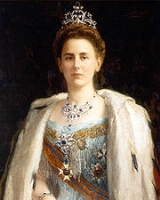
Wilhelmina of the Netherlands

 
Wilhelmina of the Netherlands

   Email Print
   Bookmark   Link


Wilhelmina of the Netherlands


Wilhelmina (Wilhelmina Helena Pauline Maria; 31 August 1880 – 28 November 1962) was queen regnant
Queen regnant

A queen regnant is a qualifying reference to a female monarch possessing and exercising all of the monarchical powers of a ruler, in contrast to a "queen consort", who is the wife of a male reigning as monarch and who is without any official powers of state....
 of the Kingdom of the Netherlands
Kingdom of the Netherlands

From 1830 to 1954, the "Kingdom of the Netherlands" referred to the Netherlands Kingdom and its colonial possessions.Suriname was a constituent nation within the Kingdom from 1954 to 1975....
 from 1890 to 1948. She ruled the Netherlands
Netherlands

The Netherlands is a country that is part of the Kingdom of the Netherlands. It is a parliamentary democratic constitutional monarchy. The Netherlands is located in North-West Europe, and bordered by the North Sea to the north and west, Belgium to the south, and Germany to the east....
 for fifty-eight years, longer than any other Dutch monarch. Her reign saw World War I
World War I

World War I, or the First World War , was a global military conflict which involved the Great powers, organized into two opposing military alliances: the Allies of World War I and the Central Powers....
 and World War II
World War II

World War II, or the Second World War , was a global military conflict which involved a Participants in World War II, including all of the great powers, organised into two opposing military alliances: the Allies of World War II and the Axis powers....
, the Great Crisis of 1933, and the decline of the Netherlands as a major colonial empire
Dutch Empire

The Dutch Empire consisted of the overseas territories controlled by the Netherlands from the 17th to the 20th century. The Dutch followed Portuguese Empire and Spanish Empire in establishing an overseas colonial empire, aided by their skills in shipping and trade and the surge of nationalism accompanying the struggle for independence from S...
. Outside the Netherlands she is primarily remembered for her role in the Second World War, in which she proved to be a great inspiration to the Dutch resistance
Dutch resistance

Dutch Resistance to the History of the Netherlands during World War II developed relatively slowly, but its counterintelligence, domestic sabotage, and communications networks provided key support to Allies of World War II beginning in 1944 and continuing until the country was fully liberated....
, as well as a prominent leader of the Dutch government in exile
Dutch government in exile

The Dutch government in exile was the government of the Netherlands, headed by Wilhelmina_of_the_Netherlands, that evacuated to London after the Germany invasion of the country at the outset of World War II....
 .

cess Wilhelmina Helena Pauline Marie of the Netherlands
Netherlands

The Netherlands is a country that is part of the Kingdom of the Netherlands. It is a parliamentary democratic constitutional monarchy. The Netherlands is located in North-West Europe, and bordered by the North Sea to the north and west, Belgium to the south, and Germany to the east....
, Princess of Orange-Nassau was born on 31 August 1880 in The Hague
The Hague

The Hague is the third largest city in the Netherlands after Amsterdam and Rotterdam, with a population of 475,904 and an area of approximately 100 km?....
, Netherlands
Netherlands

The Netherlands is a country that is part of the Kingdom of the Netherlands. It is a parliamentary democratic constitutional monarchy. The Netherlands is located in North-West Europe, and bordered by the North Sea to the north and west, Belgium to the south, and Germany to the east....
.


Discussion
Ask a question about 'Wilhelmina of the Netherlands'
Start a new discussion about 'Wilhelmina of the Netherlands'
Answer questions from other users
Full Discussion Forum


Encyclopedia


Wilhelmina (Wilhelmina Helena Pauline Maria; 31 August 1880 – 28 November 1962) was queen regnant
Queen regnant

A queen regnant is a qualifying reference to a female monarch possessing and exercising all of the monarchical powers of a ruler, in contrast to a "queen consort", who is the wife of a male reigning as monarch and who is without any official powers of state....
 of the Kingdom of the Netherlands
Kingdom of the Netherlands

From 1830 to 1954, the "Kingdom of the Netherlands" referred to the Netherlands Kingdom and its colonial possessions.Suriname was a constituent nation within the Kingdom from 1954 to 1975....
 from 1890 to 1948. She ruled the Netherlands
Netherlands

The Netherlands is a country that is part of the Kingdom of the Netherlands. It is a parliamentary democratic constitutional monarchy. The Netherlands is located in North-West Europe, and bordered by the North Sea to the north and west, Belgium to the south, and Germany to the east....
 for fifty-eight years, longer than any other Dutch monarch. Her reign saw World War I
World War I

World War I, or the First World War , was a global military conflict which involved the Great powers, organized into two opposing military alliances: the Allies of World War I and the Central Powers....
 and World War II
World War II

World War II, or the Second World War , was a global military conflict which involved a Participants in World War II, including all of the great powers, organised into two opposing military alliances: the Allies of World War II and the Axis powers....
, the Great Crisis of 1933, and the decline of the Netherlands as a major colonial empire
Dutch Empire

The Dutch Empire consisted of the overseas territories controlled by the Netherlands from the 17th to the 20th century. The Dutch followed Portuguese Empire and Spanish Empire in establishing an overseas colonial empire, aided by their skills in shipping and trade and the surge of nationalism accompanying the struggle for independence from S...
. Outside the Netherlands she is primarily remembered for her role in the Second World War, in which she proved to be a great inspiration to the Dutch resistance
Dutch resistance

Dutch Resistance to the History of the Netherlands during World War II developed relatively slowly, but its counterintelligence, domestic sabotage, and communications networks provided key support to Allies of World War II beginning in 1944 and continuing until the country was fully liberated....
, as well as a prominent leader of the Dutch government in exile
Dutch government in exile

The Dutch government in exile was the government of the Netherlands, headed by Wilhelmina_of_the_Netherlands, that evacuated to London after the Germany invasion of the country at the outset of World War II....
 .

Early life

Princess Wilhelmina Helena Pauline Marie of the Netherlands
Netherlands

The Netherlands is a country that is part of the Kingdom of the Netherlands. It is a parliamentary democratic constitutional monarchy. The Netherlands is located in North-West Europe, and bordered by the North Sea to the north and west, Belgium to the south, and Germany to the east....
, Princess of Orange-Nassau was born on 31 August 1880 in The Hague
The Hague

The Hague is the third largest city in the Netherlands after Amsterdam and Rotterdam, with a population of 475,904 and an area of approximately 100 km?....
, Netherlands
Netherlands

The Netherlands is a country that is part of the Kingdom of the Netherlands. It is a parliamentary democratic constitutional monarchy. The Netherlands is located in North-West Europe, and bordered by the North Sea to the north and west, Belgium to the south, and Germany to the east....
. She was the only child of King William III
William III of the Netherlands

William III was from 1849 King of the Netherlands and Grand Duke of Luxembourg until his death and the Duchy of Limburg until the abolition of the Duchy in 1866....
 and his second wife, Emma of Waldeck and Pyrmont
Emma of Waldeck and Pyrmont

Emma of Waldeck and Pyrmont was Queen consort of William III of the Netherlands, King of the Netherlands and Grand Duke of Luxembourg. An immensely popular member of the Dutch royal family, she also was Queen regent , Queen Mother of the The Netherlands....
. Her childhood was characterised by a close relationship with her parents, especially with her father, who was already 63 years of age when she was born.

King William had three sons with his first wife, Sophie of Württemberg
Sophie of Württemberg

Sophie of W?rttemberg was the first wife of William III of the Netherlands.She was born in Stuttgart, her parents were William I of W?rttemberg and Grand Duchess Catherine Pavlovna of Russia, the fourth eldest daughter of Tsar Paul I of Russia....
. However when Wilhelmina was born, William had already outlived two of them and only the childless Prince Alexander
Alexander, Prince of Orange

Willem Alexander Charles Henry Frederick, Prince of Orange , , was heir apparent to his father William III of the Netherlands from 11 June 1879 until his death....
 was alive, so she was second in line to the throne from birth. When Wilhelmina was four, Alexander died and the young girl became heiress presumptive.

King William III died on 23 November 1890, and, although Princess Wilhelmina became Queen of the Netherlands instantly, her mother, Emma, was named Regent
Regent

A regent, from the Latin regens "reigning", is a person selected to act as head of state because the ruler is a minor, not present or debilitated....
. In 1895, Wilhelmina visited Queen Victoria
Victoria of the United Kingdom

Victoria was from 20 June 1837 the Queen regnant of the United Kingdom of Great Britain and Ireland and from 1 May 1876 the first Empress of India of the British Raj until her death....
, who penned a crisp evaluation in her diary:

On 7 February 1901 in The Hague
The Hague

The Hague is the third largest city in the Netherlands after Amsterdam and Rotterdam, with a population of 475,904 and an area of approximately 100 km?....
, she married Hendrik
Hendrik of Mecklenburg-Schwerin

Duke Heinrich Wladimir Albrecht Ernst of Mecklenburg-Schwerin later Prince Hendrik of the Netherlands, was a German-born aristocrat who became the prince consort of Queen Wilhelmina of the Netherlands....
, Duke of Mecklenburg-Schwerin. Although the marriage was said to be essentially without love, initially Wilhelmina truly cared for Hendrik, and it is likely that those feelings were mutual. Hendrik however, suffered from his role as prince-consort, stating that it was boring to be nothing more than decoration, forced always to walk one step behind his wife. He had no power in the Netherlands, and Wilhelmina made sure this remained so.

The couple's childlessness also contributed to a crisis in their marriage. Prince Hendrik was reported to have had several illegitimate children. Over time the marriage became less happy. Wilhelmina suffered a miscarriage in 1901 and 1906, as well as the birth of a stillborn son in 1902. The birth of Juliana
Juliana of the Netherlands

Juliana was Queen regnant of the Netherlands from her mother's abdication in 1948 to her own in 1980....
, on 30 April 1909, was met with great relief after eight years of childless marriage. Wilhelmina suffered two further miscarriages in 1912.

De facto reign


Tactful, and careful to operate within the limitations of what was expected by the Dutch people and their elected representatives, the strong-willed Wilhelmina became a forceful personality who spoke and acted her mind. These qualities showed up early on in her reign when, at the age of 20, Queen Wilhelmina ordered a Dutch warship to South Africa
South Africa

The Republic of South Africa, also known by Official names of South Africa, is a country located at the southern tip of the continent of Africa....
 to rescue Paul Kruger
Paul Kruger

Stephanus Johannes Paulus Kruger , better known as Paul Kruger and affectionately known as Oom Paul was president of the South African Republic ....
, the embattled President of the Transvaal
Transvaal

File:Flag of Transvaal.svgFile:Transvaal map.pngFile:Spelterini Transvaal.jpgThe Transvaal is the name of an area of northern South Africa....
. For this, Wilhelmina gained international stature and earned the respect and admiration of people all over the world.

Wilhelmina had a stern dislike of the United Kingdom , which had annexed the republics of Transvaal and Orange Free State
Orange Free State

The Republic of the Orange Free State was an independent Boere-Afrikaner republic in southern Africa during the second half of the 19th century, and later a British Orange River Colony and a Provinces of South Africa of the Union of South Africa....
 in the Boer War
Second Boer War

The Second Boer War , commonly referred to as The Boer War and also known as the South African War , the Anglo-Boer War and in Afrikaans as the Boereoorlog or Tweede Vryheidsoorlog , was fought from 11 October 1899 until 31 May 1902, between the British Empire and the two independent Boer republics of the Orange Fre...
. The Boers were descendants of early Dutch colonists, to whom Wilhelmina felt very closely linked. Nevertheless, in 1940, King George VI sent her a warship to pick her up, her family and Government. A warship, HMS Hereward
HMS Hereward (H93)

HMS Hereward , named after Hereward the Wake, was an G and H class destroyer destroyer of the Royal Navy laid down by the High Walker Yard of Vickers Armstrong at Newcastle-on-Tyne on 28 February 1935, launched on 10 March 1936 and commissioned on 9 December 1936....
, was sent to her rescue and brought her to safety in the UK, which generously offered facilities to her and her Government, including broadcasting time on the BBC to the Netherlands. This may have ameliorated her earlier stern dislike of the UK.

Queen Wilhelmina also had a keen understanding of business matters and her investments made her the world's richest woman, a title retained by her daughter and granddaughter, Beatrix
Beatrix of the Netherlands

Beatrix has been the Queen regnant of the Kingdom of the Netherlands since 30 April 1980, when her mother, Juliana of the Netherlands, abdication....
. The Dutch Royal Family is still reputed to be the single largest shareholder of Royal Dutch Shell
Royal Dutch Shell

Royal Dutch Shell public limited company, commonly known simply as Shell, is a multinational corporation oil company of Netherlands and United Kingdom origins....
.

Prior to the outbreak of the First World War, a young Wilhelmina visited the powerful Kaiser Wilhelm II of Germany, who boasted to the Queen of a relatively small country, "my guards are seven feet tall and yours are only shoulder-high to them". Wilhelmina smiled politely and replied, "Quite true, Your Majesty, your guards are seven feet tall. But when we open our dikes, the water is ten feet deep!".

World War I


The Netherlands remained neutral during World War I
World War I

World War I, or the First World War , was a global military conflict which involved the Great powers, organized into two opposing military alliances: the Allies of World War I and the Central Powers....
. Germany had sizeable investments in the Dutch economy combined with a large trading partnership in goods. To weaken the German Empire
German Empire

The German Empire is the name commonly used in English to describe Germany from the unification of Germany and proclamation of William I, German Emperor as German Emperor on 18 January 1871, to 1918, when it became Weimar republic after defeat in World War I and the abdication of William II, German Emperor ....
, the United Kingdom
United Kingdom of Great Britain and Ireland

The United Kingdom of Great Britain and Ireland was the formal name and the state form of the United Kingdom from 1 January 1801 until 12 April 1927....
 blockaded Dutch ports. In response the Dutch government traded with Germany. German soldiers were given Edam cheese for their rations before an assault.

Wilhelmina was a "soldier's queen"; being a woman, she could not be Supreme Commander, but she nevertheless used every opportunity she had to inspect her forces. On many occasions she appeared without prior notice, wishing to see the reality, not a prepared show. She loved her soldiers, but was very unhappy with most of her governments, which used the military as a constant source for budget-cutting. Wilhelmina wanted a small but well trained and equipped army. However, this was far from the reality.

In the war, she felt she was a "Queen-On-Guard". She was always wary of a German
Germany

Germany , officially the Federal Republic of Germany , is a country in Central Europe. It is bordered to the north by the North Sea, Denmark, and the Baltic Sea; to the east by Poland and the Czech Republic; to the south by Austria and Switzerland; and to the west by France, Luxembourg, Belgium, and the Netherlands....
 attack, especially in the beginning. However, violation of Dutch territorial sovereignty came from both Britain and the United States
United States

The United States of America is a Federal government constitutional republic comprising U.S. state and a federal district. The country is situated mostly in central North America, where its Contiguous United States and Washington, D.C., the Capital districts and territories, lie between the Pacific Ocean and Atlantic Oceans, Borders of the U...
, who, with the blockade, captured many Dutch trade and cargo ships in an attempt to disrupt the German war effort. This led to increased tensions between the Netherlands and the Allied forces.

Civil unrest, spurred on by the Bolshevik
Bolshevik

Bolsheviks, originally also Bolshevists were a faction of the Marxism Russian Social Democratic Labour Party which split apart from the Menshevik faction at the 2nd Congress of the RSDLP in 1903 and ultimately became the Communist Party of the Soviet Union....
 revolt in Imperial Russia in 1917, gripped the Netherlands after the war. The socialist leader Pieter Jelles Troelstra
Pieter Jelles Troelstra

Pieter Jelles Troelstra was a Netherlands politics active in the socialist workers' movement. He is most remembered for his fight for universal suffrage and his failed call for revolution at the end of World War I....
 tried to overthrow the government and the Queen. Instead of a violent revolution, he wanted to control the Tweede Kamer
Tweede Kamer

The Tweede Kamer der Staten-Generaal , short Tweede Kamer, is the lower house of the Netherlands' parliament, the States-General_of_the_Netherlands....
, the legislative body of Parliament
States-General of the Netherlands

The States-General is the parliament of the Netherlands. It consists of two chambers, the more important of which is the directly elected Tweede Kamer ....
, and hoped to achieve this by means of elections, convinced that the working class would support him. However, the popularity of the young Queen helped restore confidence in the government. Wilhelmina brought about a mass show of support by riding with her daughter through the mobs in an open carriage. It was very clear that the revolution would not succeed.

After the armistice
Armistice

An armistice is a situation in a war where the warring parties agree to stop fighting. It is not necessarily the end of a war, but may be just a cessation of hostilities while an attempt is made to negotiate a lasting peace....
 ending World War I, Wilhelm fled to the Netherlands, where he was granted political asylum by the Dutch government, partly owing to the Kaiser's family links with Queen Wilhelmina. In response to Allied efforts to get their hands on the deposed Kaiser, Wilhelmina called the Allied Ambassadors to her presence and lectured them on the rights of asylum.

Between the wars


During the 1920s and 1930s, the Netherlands began to emerge as an industrial power. Engineers reclaimed vast amounts of land that had been under water by building the Zuiderzee Works
Zuiderzee Works

The Zuiderzee Works are a human-made system of dams, land reclamation and water drainage works, and the largest hydraulic engineering project undertaken by the Netherlands during the twentieth century....
. The death of Wilhelmina's husband, Prince Hendrik, in 1934 brought an end to a difficult year that also saw the passing of her mother Queen Emma
Emma of Waldeck and Pyrmont

Emma of Waldeck and Pyrmont was Queen consort of William III of the Netherlands, King of the Netherlands and Grand Duke of Luxembourg. An immensely popular member of the Dutch royal family, she also was Queen regent , Queen Mother of the The Netherlands....
.

The interbellum, and most notably the economic crisis of the '30s, was also the period in which Wilhelmina's personal power reached its zenith; under the successive governments of a staunch monarchist prime minister, Hendrik Colijn
Hendrikus Colijn

Hendrikus "Hendrik" Colijn was a successful Dutch soldier, businessman and politician. He was born in 1869 in the Haarlemmermeer to Antonie Colijn and Anna Verkuil, who had emigrated to the Haarlemmermeer polder from Heusden en Altena for religious reasons....
 (ARP
Anti Revolutionary Party

The Anti Revolutionary Party was a Politics of the Netherlands Protestant Christian democracy political party. The ARP is one of the predecessors of the Christian Democratic Appeal....
), Wilhelmina was deeply involved in most questions of state.

In 1939, Colijn's fifth and last government was swept away by a vote of no confidence two days after its formation. It is widely accepted that Wilhelmina herself was behind the formation of this last government, which was designed to be an extra-parliamentary or 'royal' cabinet. The Queen was deeply sceptical of the parliamentary system and tried to bypass it covertly more than once.

She also arranged the marriage between her daughter Juliana and Bernhard of Lippe-Biesterfeld, a German prince who had lost most of his possessions after the Great War. Although it was claimed that he was initially a supporter of the Nazi regime, no hard evidence of this has ever been found or publicised. It should be stated, however, that there was never a serious investigation into the matter. Prince Bernhard later became a very popular figure in the Netherlands.

World War II

On 10 May 1940, Nazi Germany
Nazi Germany

Nazi Germany and the Third Reich are the colloquial English names for Germany under the regime of Adolf Hitler and the Nazi Party , which established a Totalitarianism dictatorship that existed from 1933 to 1945....
 invaded the Netherlands, and Queen Wilhelmina and her family were evacuated on HMS Hereward
HMS Hereward (H93)

HMS Hereward , named after Hereward the Wake, was an G and H class destroyer destroyer of the Royal Navy laid down by the High Walker Yard of Vickers Armstrong at Newcastle-on-Tyne on 28 February 1935, launched on 10 March 1936 and commissioned on 9 December 1936....
 to the United Kingdom
United Kingdom

The United Kingdom of Great Britain and Northern Ireland, commonly known as the United Kingdom , the UK or Britain,is a sovereign state located off the northwestern coast of continental Europe....
 three days later. Queen Wilhelmina had wanted to stay in the Netherlands: she had planned to go to the southern province of Zeeland with her troops in order to coordinate further resistance from the town of Breskens
Breskens

Breskens is a harbour town on the Westerschelde in the municipality of Sluis in the province of Zeeland, in the south-western Netherlands. Its population is 4,280 ....
 and remain there until help arrived, much as King Albert I of Belgium had done during World War I. She fled The Hague
The Hague

The Hague is the third largest city in the Netherlands after Amsterdam and Rotterdam, with a population of 475,904 and an area of approximately 100 km?....
, and she boarded HMS Hereward
HMS Hereward (H93)

HMS Hereward , named after Hereward the Wake, was an G and H class destroyer destroyer of the Royal Navy laid down by the High Walker Yard of Vickers Armstrong at Newcastle-on-Tyne on 28 February 1935, launched on 10 March 1936 and commissioned on 9 December 1936....
, a British destroyer which was to take her south; however, after she was aboard, Zeeland came under heavy attack from the Luftwaffe
Luftwaffe

is a generic German term for an air force. It is also the official name for two of the four historic German air forces, the Wehrmacht air arm founded in 1933 and disbanded in 1946; and the current Bundeswehr air arm founded in 1956....
 and it was considered too dangerous to return. Wilhelmina was then left with no option but to accept George VI's offer of refuge. She retreated to Britain
United Kingdom

The United Kingdom of Great Britain and Northern Ireland, commonly known as the United Kingdom , the UK or Britain,is a sovereign state located off the northwestern coast of continental Europe....
, planning to return as soon as possible.

As the war unfolded, Wilhelmina also spent time in Canada
Canada

Canada is a country occupying most of northern North America, extending from the Atlantic Ocean in the east to the Pacific Ocean in the west and northward into the Arctic Ocean....
, staying at the Governor General's residence, Rideau Hall
Rideau Hall

Rideau Hall is, since 1867, the official residence of the Governor General of Canada, as well as that of the Monarchy of Canada when he or she is in the city where the hall is located, Ottawa....
. It was said that while she was there she made a great impact on the household, notably for living relatively simply. The Queen insisted on doing her shopping personally, walking the streets of Ottawa unassisted (though simply raising her hand to stop traffic whenever she wished to cross the road), and travelling to the United States on a regular civilian train.

The Dutch armed forces in the Netherlands, apart from those in Zeeland
Zeeland

Zeeland , also called Zealand in English language and Zeelandic, is a province of the Netherlands. The province, located in the south-west of the country, consists of a number of islands and a strip bordering Belgium....
, surrendered on 15 May. In Britain, Queen Wilhelmina took charge of the Dutch government in exile
Dutch government in exile

The Dutch government in exile was the government of the Netherlands, headed by Wilhelmina_of_the_Netherlands, that evacuated to London after the Germany invasion of the country at the outset of World War II....
, setting up a chain of command and immediately communicating a message to her people.

Relations between the Dutch government and the Queen were tense, with mutual dislike growing as the war progressed. Wilhelmina went on to be the most prominent figure, owing to her experience and knowledge. She was also very popular and respected among the leaders of the world. The government did not have a parliament to back them and had few employees to assist them. The Dutch prime minister Dirk Jan de Geer
Dirk Jan de Geer

Jonkheer Dirk Jan de Geer was a Netherlands nobleman, lawyer, Conservatism statesman and prime minister of The Netherlands . He was disgraced for advocating a peace settlement between the Kingdom of the Netherlands and Nazi Germany in 1940....
, believed the Allies would not win and intended to open negotiations with the Nazis for a separate peace. Therefore Wilhelmina sought to remove Jan de Geer from power. With the aid of a minister, Pieter Gerbrandy, she succeeded.

Queen Wilhelmina
During the war her photograph was a sign of resistance against the Germans. Like Winston Churchill
Winston Churchill

Sir Winston Leonard Spencer-Churchill, Order of the Garter, Order of Merit, Order of the Companions of Honour, Territorial Decoration, Fellow of the Royal Society, Her Majesty's Most Honourable Privy Council, Queen's Privy Council for Canada was a Politics of the United Kingdom known chiefly for his leadership of the United King...
, Queen Wilhelmina broadcast messages to the Dutch people over Radio Oranje
Radio Netherlands

Radio Netherlands Worldwide is a public radio and television network based in Hilversum, producing and transmitting programmes for international audiences outside the Netherlands....
. The Queen called Adolf Hitler
Adolf Hitler

Adolf Hitler was an Austrian-born Germany politician and the leader of the National Socialist German Workers Party , popularly known as the Nazi Party....
 "the arch-enemy of mankind". Her late-night broadcasts were eagerly awaited by her people, who had to hide in order to listen to them illegally. An anecdote published in her New York Times obituary illustrates how she was valued by her subjects during this period:

During the war, the Queen was almost killed by a bomb that took the lives of several of her guards and severely damaged her country home near South Mimms
South Mimms

South Mimms is a village and civil parish forming part of the Hertsmere district of Hertfordshire in the East of England.It is a small settlement located near to the junction of the M25 motorway with the A1 road and is perhaps more widely known because of the naming of the South Mimms services at that junction, and for mountain biking rout...
 in England. In 1944 Queen Wilhelmina became only the second woman to be inducted into the Order of the Garter
Order of the Garter

The Most Noble Order of the Garter is an order of chivalry, or knighthood, originating in medieval England, and presently bestowed on recipients in the United Kingdom and other Commonwealth realms; it is the pinnacle of the Orders, decorations, and medals of the United Kingdom....
. Churchill described her as the only real man among the governments-in-exile in London.

In England, she developed ideas about a new political and social life for the Dutch after the liberation. She wanted a strong cabinet formed by people active in the resistance. She dismissed De Geer during the war and installed a prime minister with the approval of other Dutch politicians. The Queen "hated" politicians, instead stating a love for the people. When the Netherlands was liberated in 1945 she was disappointed to see the same political factions taking power as before the war. Prior to the end of the war, in mid-March 1945, she travelled to the Allied occupied areas of the south of the Netherlands visiting the region of Walcheren
Walcheren

Media:Nl-Walcheren.ogg is a former island in the province of Zeeland in the Netherlands at the mouth of the Scheldt estuary. It lies between the Oosterschelde in the north and the Westerschelde in the south and is roughly the shape of a rhombus....
 and the city of Eindhoven
Eindhoven

Eindhoven is a municipality and a city located in the province of North Brabant in the south of the Netherlands, originally at the confluence of the Dommel and Gender streams....
 where she received a rapturous welcome from the local population.

Following the end of World War II
World War II

World War II, or the Second World War , was a global military conflict which involved a Participants in World War II, including all of the great powers, organised into two opposing military alliances: the Allies of World War II and the Axis powers....
, Queen Wilhelmina made the decision not to return to her palace but move into a mansion in The Hague
The Hague

The Hague is the third largest city in the Netherlands after Amsterdam and Rotterdam, with a population of 475,904 and an area of approximately 100 km?....
, where she lived for eight months, and she travelled through the countryside to motivate people, sometimes using a bicycle instead of a car. However, in 1947, while the country was still recovering from World War II, the revolt in the oil-rich Dutch East Indies
Dutch East Indies

The Dutch East Indies, or Netherlands East Indies, was the Dutch colony that became modern Indonesia following World War II.It was formed from the nationalised colony of the former Dutch East India Company that came under the administration of the Netherlands in 1800....
 saw sharp criticism of the Queen by the Dutch economic elite. Her loss of popularity and the forced departure from the East Indies under international pressure led to her abdication soon after.

She was the 896th Dame
Dame

Dame meaning "lady"; entered Middle English from Latin domina, mistress, via French dame, .A Dame may be:*A female rank equivalent to a knight ....
 of the Order of the Garter
Order of the Garter

The Most Noble Order of the Garter is an order of chivalry, or knighthood, originating in medieval England, and presently bestowed on recipients in the United Kingdom and other Commonwealth realms; it is the pinnacle of the Orders, decorations, and medals of the United Kingdom....
 in 1944.

Later years


On 4 September 1948, after a reign of 58 years and 50 days, Wilhelmina abdicated in favour of her daughter Juliana
Juliana of the Netherlands

Juliana was Queen regnant of the Netherlands from her mother's abdication in 1948 to her own in 1980....
. She was thenceforward styled "Her Royal Highness Princess Wilhelmina of the Netherlands". After her reign, the influence of the Dutch monarchy began to decline but the country's love for its royal family continued. No longer queen, Wilhelmina retreated to Het Loo
Het Loo

The former royal residence Het Loo near Apeldoorn, Netherlands, was built starting in 1684 for Stadtholder William III of England and his consort, Mary II of England....
 Palace, making few public appearances until the country was devastated by the North Sea flood of 1953
North Sea flood of 1953

The North Sea flood of 1953 and the associated storm combined to create a major natural disaster which affected the coastlines of the Netherlands and England on the night of 31 January ? 1 February 1953....
. Once again she travelled around the country to encourage and motivate the Dutch people.

During her last years she wrote her autobiography entitled Eenzaam, maar niet alleen (Lonely but Not Alone), in which she gave account of the events in her life, and revealed her strong religious feelings and motivations.

Queen Wilhelmina died in Het Loo
Het Loo

The former royal residence Het Loo near Apeldoorn, Netherlands, was built starting in 1684 for Stadtholder William III of England and his consort, Mary II of England....
 at the age of 82 on 28 November 1962, and was buried in the Dutch Royal Family crypt in the Nieuwe Kerk
Nieuwe Kerk (Delft)

Nieuwe Kerk is a landmark church in Delft, the Netherlands. The building is located on Delft Market Square , opposite to the Delft City Hall ....
 in Delft
Delft

See also: Delft, Cape Town, Delft Island Media:Nl-Delft.ogg is a city and municipality in the province of South Holland . It is located in between Rotterdam and The Hague....
, on 8 December. The funeral was, at her request and contrary to protocol, completely in white to give expression to her belief that earthly death was the beginning of eternal life.

Had Wilhelmina not given the throne to her daughter before her death, she would have reigned for 72 years 5 days, which would have been the second-longest reign in Europe (behind that of Louis XIV of France
Louis XIV of France

Louis XIV ruled as List of French monarchs and of King of Navarre. He ascended the throne a few months before his fifth birthday, but did not assume actual personal control of the government until the death of his prime minister , the Italians Jules Cardinal Mazarin, in 1661....
), seventh-longest in the world
List of longest reigning monarchs of all time

The list of longest reigning Monarchs of all time details monarchs and lifelong leaders who reigned for more than 50 years, sorted by length of reign:...
, and the longest reign by a female monarch
Queen regnant

A queen regnant is a qualifying reference to a female monarch possessing and exercising all of the monarchical powers of a ruler, in contrast to a "queen consort", who is the wife of a male reigning as monarch and who is without any official powers of state....
 in history.

Titles

  • Her Royal Highness Princess Wilhelmina of the Netherlands, Princess of Orange-Nassau (1880–1890)
  • Her Majesty The Queen of the Netherlands, Princess of Orange-Nassau (1890–1948)
  • Her Royal Highness Princess Wilhelmina of the Netherlands, Princess of Orange-Nassau (1948–1962)


Ancestry


See also

  • Dutch monarchs family tree
    Dutch monarchs family tree

    The following image is a family tree of the King of the Netherlands.Image:Dutch monarchy.jpgrect 604 21 671 73 William V of Orangerect 703 27 772 67 Princess Wilhelmina of Prussia ...


External links

  • at The Dutch Royal House website
  • near Mena, Arkansas
    Mena, Arkansas

    Mena is a city in Polk County, Arkansas, Arkansas, United States. It is also the county seat of Polk County, Arkansas.It was founded by Arthur Edward Stilwell during the building of the Kansas City, Pittsburg and Gulf Railroad ....


|-