

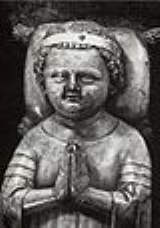
John I of France

Encyclopedia
John I called the Posthumous, was King of France and Navarre, and Count of Champagne, as the son and successor of Louis the Headstrong
, for the five days he lived. He thus had the shortest recognized reign of any French king.
He was born a king of the House of Capet
and the posthumous son of Louis X and Clementia of Hungary, sister of the King Charles I of Hungary
.
John reigned for five days under his uncle's regency, until his death on 20 November 1316. The infant King was buried in Saint Denis Basilica
. He was succeeded by his uncle, Philip the Tall
.
.
When Louis the Headstrong
, his father, died without a son to succeed him, it was the first time since Hugh Capet that the succession from father to son the kings of France was interrupted. It was then decided to wait until the Queen Clemence, who was pregnant, brought her child into the world. And for now, the king's brother, Philip
, was in charge of the regency of the kingdom against his uncle Charles de Valois. The birth of a male child was expected to give France
its king.
The problem of succession remained when the infant that was proclaimed King of France under the name of John I, died five days after birth. It was his uncle who ascended the throne when the expense of his four-year-old half-sister, Joan
, daughter of Louis the Headstrong
and Margaret of Burgundy
.
had him poisoned. Then a strange story a few decades later came to start the rumor that the little King John was not dead. During the captivity of John II
(1356-1360), a man named Giannino Baglioni claimed to be John I and thus the heir to the throne. He tried to assert his rights, but captured in Provence
, he died in captivity in 1363. A recent book provides an update on this story. It is said that Cola di Rienzo was supposed to manufacture false evidence that Giannino Baglioni was John I the Posthumous, and who tried to place on the throne of France to strengthen his power in Rome
. Shortly after they met in 1354, Cola di Rienzo was assassinated, and Giannino waited two years to report his claims. He went to the Hungarian court where King Louis I of Hungary, nephew of Clemence of Hungary, recognized him as the son of Louis X and Clemence. In 1360, Giannino went to Avignon
, but Pope Innocent VI
refused to receive him. After several attempts to gain recognition, he was arrested and imprisoned in Naples
, where he died in 1363.
Louis X of France
Louis X of France, , called the Quarreler, the Headstrong, or the Stubborn was the King of Navarre from 1305 and King of France from 1314 until his death...
, for the five days he lived. He thus had the shortest recognized reign of any French king.
He was born a king of the House of Capet
House of Capet
The House of Capet, or The Direct Capetian Dynasty, , also called The House of France , or simply the Capets, which ruled the Kingdom of France from 987 to 1328, was the most senior line of the Capetian dynasty – itself a derivative dynasty from the Robertians. As rulers of France, the dynasty...
and the posthumous son of Louis X and Clementia of Hungary, sister of the King Charles I of Hungary
Charles I of Hungary
Charles I , also known as Charles Robert , was the first King of Hungary and Croatia of the House of Anjou. He was also descended from the old Hungarian Árpád dynasty. His claim to the throne of Hungary was contested by several pretenders...
.
John reigned for five days under his uncle's regency, until his death on 20 November 1316. The infant King was buried in Saint Denis Basilica
Saint Denis Basilica
The Cathedral Basilica of Saint Denis is a large medieval abbey church in the commune of Saint-Denis, now a northern suburb of Paris. The abbey church was created a cathedral in 1966 and is the seat of the Bishop of Saint-Denis, Pascal Michel Ghislain Delannoy...
. He was succeeded by his uncle, Philip the Tall
Philip V of France
Philip the Tall was King of France as Philip V and, as Philip II, King of Navarre and Count of Champagne. He reigned from 1316 to his death and was the penultimate monarch of the House of Capet. Considered a wise and politically astute ruler, Philip took the throne under questionable...
.
Consequences
The premature death of John I brought the first issue of succession of the Capetian dynastyCapetian dynasty
The Capetian dynasty , also known as the House of France, is the largest and oldest European royal house, consisting of the descendants of King Hugh Capet of France in the male line. Hugh Capet himself was a cognatic descendant of the Carolingians and the Merovingians, earlier rulers of France...
.
When Louis the Headstrong
Louis X of France
Louis X of France, , called the Quarreler, the Headstrong, or the Stubborn was the King of Navarre from 1305 and King of France from 1314 until his death...
, his father, died without a son to succeed him, it was the first time since Hugh Capet that the succession from father to son the kings of France was interrupted. It was then decided to wait until the Queen Clemence, who was pregnant, brought her child into the world. And for now, the king's brother, Philip
Philip V of France
Philip the Tall was King of France as Philip V and, as Philip II, King of Navarre and Count of Champagne. He reigned from 1316 to his death and was the penultimate monarch of the House of Capet. Considered a wise and politically astute ruler, Philip took the throne under questionable...
, was in charge of the regency of the kingdom against his uncle Charles de Valois. The birth of a male child was expected to give France
France
The French Republic , The French Republic , The French Republic , (commonly known as France , is a unitary semi-presidential republic in Western Europe with several overseas territories and islands located on other continents and in the Indian, Pacific, and Atlantic oceans. Metropolitan France...
its king.
The problem of succession remained when the infant that was proclaimed King of France under the name of John I, died five days after birth. It was his uncle who ascended the throne when the expense of his four-year-old half-sister, Joan
Joan II of Navarre
Joan II was Queen of Navarre from 1328 until her death. She was the only daughter of Margaret of Burgundy, first wife of King Louis X of France...
, daughter of Louis the Headstrong
Louis X of France
Louis X of France, , called the Quarreler, the Headstrong, or the Stubborn was the King of Navarre from 1305 and King of France from 1314 until his death...
and Margaret of Burgundy
Margaret of Burgundy
Margaret of Burgundy may refer to:* Margaret of Burgundy, Queen of Sicily , daughter of Odo of Burgundy, wife of Charles I of Naples and Sicily...
.
Supposed survival
Various legends circulated about this royal child. First, it was claimed that his uncle Philip VPhilip V of France
Philip the Tall was King of France as Philip V and, as Philip II, King of Navarre and Count of Champagne. He reigned from 1316 to his death and was the penultimate monarch of the House of Capet. Considered a wise and politically astute ruler, Philip took the throne under questionable...
had him poisoned. Then a strange story a few decades later came to start the rumor that the little King John was not dead. During the captivity of John II
John II of France
John II , called John the Good , was the King of France from 1350 until his death. He was the second sovereign of the House of Valois and is perhaps best remembered as the king who was vanquished at the Battle of Poitiers and taken as a captive to England.The son of Philip VI and Joan the Lame,...
(1356-1360), a man named Giannino Baglioni claimed to be John I and thus the heir to the throne. He tried to assert his rights, but captured in Provence
Provence
Provence ; Provençal: Provença in classical norm or Prouvènço in Mistralian norm) is a region of south eastern France on the Mediterranean adjacent to Italy. It is part of the administrative région of Provence-Alpes-Côte d'Azur...
, he died in captivity in 1363. A recent book provides an update on this story. It is said that Cola di Rienzo was supposed to manufacture false evidence that Giannino Baglioni was John I the Posthumous, and who tried to place on the throne of France to strengthen his power in Rome
Rome
Rome is the capital of Italy and the country's largest and most populated city and comune, with over 2.7 million residents in . The city is located in the central-western portion of the Italian Peninsula, on the Tiber River within the Lazio region of Italy.Rome's history spans two and a half...
. Shortly after they met in 1354, Cola di Rienzo was assassinated, and Giannino waited two years to report his claims. He went to the Hungarian court where King Louis I of Hungary, nephew of Clemence of Hungary, recognized him as the son of Louis X and Clemence. In 1360, Giannino went to Avignon
Avignon
Avignon is a French commune in southeastern France in the départment of the Vaucluse bordered by the left bank of the Rhône river. Of the 94,787 inhabitants of the city on 1 January 2010, 12 000 live in the ancient town centre surrounded by its medieval ramparts.Often referred to as the...
, but Pope Innocent VI
Pope Innocent VI
Pope Innocent VI , born Étienne Aubert; his father was Adhemar Aubert seigneur de Montel-De-Gelas in Limousin province. His niece was Catherine Aubert, Dame de Boutheon, also the wife of Randon II baron de Joyeuse; she is La Fayette's ancestor...
refused to receive him. After several attempts to gain recognition, he was arrested and imprisoned in Naples
Naples
Naples is a city in Southern Italy, situated on the country's west coast by the Gulf of Naples. Lying between two notable volcanic regions, Mount Vesuvius and the Phlegraean Fields, it is the capital of the region of Campania and of the province of Naples...
, where he died in 1363.
Ancestors
| John I of France | Father: Louis X of France Louis X of France Louis X of France, , called the Quarreler, the Headstrong, or the Stubborn was the King of Navarre from 1305 and King of France from 1314 until his death... |
Paternal Grandfather: Philip IV of France Philip IV of France Philip the Fair was, as Philip IV, King of France from 1285 until his death. He was the husband of Joan I of Navarre, by virtue of which he was, as Philip I, King of Navarre and Count of Champagne from 1284 to 1305.-Youth:A member of the House of Capet, Philip was born at the Palace of... |
Paternal Great-grandfather: Philip III of France Philip III of France Philip III , called the Bold , was the King of France, succeeding his father, Louis IX, and reigning from 1270 to 1285. He was a member of the House of Capet.-Biography:... |
| Paternal Great-grandmother: Isabella of Aragon Isabella of Aragon Isabella of Aragon , infanta of Aragon, was, by marriage, Queen consort of France in the Middle Ages from 1270 to 1271.-Life:... |
|||
| Paternal Grandmother: Joan I of Navarre Joan I of Navarre Joan I , the daughter of king Henry I of Navarre and Blanche of Artois, reigned as queen regnant of Navarre and also served as queen consort of France.-Life:... |
Paternal Great-grandfather: Henry I of Navarre Henry I of Navarre Henry I the Fat was the Count of Champagne and Brie and King of Navarre from 1270... |
||
| Paternal Great-grandmother: Blanche of Artois Blanche of Artois Blanche of Artois was the queen consort of Navarre; after her husband Henry I of Navarre's death, she served as regent from 1274 to 1284 on behalf of her daughter, Joan I... |
|||
| Mother: Clementia of Hungary |
Maternal Grandfather: Charles Martel of Anjou Charles Martel of Anjou Charles Martel of the Angevin dynasty, also known as Charles I Martel, was the eldest son of king Charles II of Naples and Maria of Hungary, the daughter of King Stephen V of Hungary.... |
Maternal Great-grandfather: Charles II of Naples Charles II of Naples Charles II, known as "the Lame" was King of Naples, King of Albania, Prince of Salerno, Prince of Achaea and Count of Anjou.-Biography:... |
|
| Maternal Great-grandmother: Maria Arpad of Hungary Maria Arpad of Hungary Mary of Hungary , of the Árpád dynasty, was Queen consort of the Kingdom of Naples. She was a daughter of Stephen V of Hungary and his wife Elizabeth the Cuman.-Family:Mary's mother followed the Shamanist religion, like other Cumans... |
|||
| Maternal Grandmother: Klementia of Habsburg Klementia of Habsburg Clementia of Habsburg was a daughter of Rudolf I of Habsburg and Gertrude of Hohenberg. She was a member of the House of Habsburg.-Family:... |
Maternal Great-grandfather: Rudolph I of Germany Rudolph I of Germany Rudolph I was King of the Romans from 1273 until his death. He played a vital role in raising the Habsburg dynasty to a leading position among the Imperial feudal dynasties... |
||
| Maternal Great-grandmother: Gertrude of Hohenburg Gertrude of Hohenburg Gertrude of Hohenzollern was the first Queen consort of Rudolph I of Germany.-Family:She was born to Burckhard III of Hohenzollern, Count of Hohenberg and his wife Mechtild of Tübingen.... |